

Submitted:
27 February 2024
Posted:
27 February 2024
You are already at the latest version
Abstract
Urban environments face escalating challenges, e.g. due to uncontrolled urbanization, rapid population growth or climate changes, prompting the exploration of sustainable solutions for enhancing urban green spaces (UGS). For this reason, poplars (Populus L.), due to their rapid growth, wide range adaptability to environmental conditions and versatility of use, would have emerged as very promising. This comprehensive review synthesizes current knowledge regarding poplar's application in urban landscapes, emphasizing its multifaceted contributions and benefits. However, challenges arise from the variable lifespans of different poplar cultivars, necessitating strategic management approaches. Selecting cultivars based on growth rates, root system characteristics, and adaptability to urban conditions is pivotal. Adaptive replanting strategies, incorporating species with varying lifespans, offer solutions to maintain continual greenery in urban landscapes. Collaborative efforts between researchers, urban planners, and policymakers are essential for devising comprehensive strategies that maximize benefits while addressing challenges associated with their variable lifespans. In conclusion, harnessing poplar's potential in urban greenery initiatives requires a balanced approach that capitalizes on their benefits while mitigating challenges. Further research and adaptive strategies are crucial for sustained and effective utilization in creating resilient and vibrant urban landscapes.
Keywords:
poplars
; green infrastrucuture
; urban green spaces
; urbanized landscape
; urban environments
; climate changes
; phytoremediation
; value of trees
; Populus xberolinensis
1. Introduction
Urbanization is rapidly transforming landscapes worldwide (e.g., urban densification, urban sprawl, landscape fragmentation and others), necessitating innovative approaches to mitigate environmental degradation and enhance the quality of urban green spaces (UGS) [1,2,3,4,5,6,7,8,9,10,11,12,13].
Looking back into the past, knowledge about the incredibly beneficial role of greenery in cities has quite distant origins. Throughout the 19th and 20th centuries, greenery was continuously incorporated into the urban structure of cities and has traditionally been utilized in aesthetic, ecological, and technical contexts (e.g., city squares, parks, public gardens, children’s playgrounds, or numerous spa parks in health resorts). The research referred to the topic also showed the beneficial role of urban greenery against climate change in cities, disruptions in water management, soil depletion, environmental pollution, maintaining avifauna diversity and providing fauna habitats and other important issues, which became even more critical at the beginning of the 21st century [5,14,15,16,17,18,19,20,21,22,23,24,25,26,27,28,29,30,31,32,33,34,35,36,37,38,39,40,41,42,43,44].
Urban green spaces (USG) are frequently characterized by complex spatial artificial composition and heterogeneity. In comparison to natural forests, they are essential for enhancing microclimatic conditions, aesthetic appeal, and ecological diversity in urban environments, playing a crucial role, e.g., maintaining bird diversity and providing habitats despite facing challenges such as habitat loss and ecosystem fragmentation due to urbanization. However, to fulfill their much-expected functions effectively, urban green spaces (UGS) must be adequately designed, maintained, and protected for years. UGS are largely anthropogenic, meaning their durability and self-regulation capacity are limited compared to natural ecosystems.
Trees especially play a crucial role in fostering sustainable urban ecosystems [7,8,10,14,45,46,47,48,49,50,51,52,53]. In urbanized and open landscapes, trees can provide a diverse range of ecosystem services - among others, the mitigation of environmental degradation or enhancement of biodiversity. The impact of high greenery on cultural services is also invaluable [30,54,55,56,57,58,59,60]. Planting and maintaining trees in urban areas is widely recognized as environmental biotechnology (phytoremediation) - the simplest and most direct way to limit air, water and soil pollution and to increase carbon sequestration due to the vast biologically active surface area that trees can produce [5,18,32,46,61,62,63,64,65,66,67].
Unfortunately, on average, in cities (downtowns), trees appear to feature gradually decreasing lifespan or health and safety quality. Because of anthropopression, large, mature and old trees are declining (one large urban tree often provides benefits equivalent to a few dozen young, new plantings), and a percentage of new-planted trees which are failing to establish is significant [46,68,69,70,71,72]. At the same time, the need arises to obtain the effect of planting healthy and mature trees as quickly as possible because only such specimens can provide the desired ecosystem services to face challenges like, e.g., global climate changes [73,74,75,76].
In such a context, poplar trees (Populus L.) have garnered attention in previous decades for their great potential to contribute significantly to the quality and quantity of urban greenery. It is just worth mentioning that already before the II World War, and then from the 50s up to the end of 70s of the 20th century, in some European countries (e.g., Poland or Czech), the mass afforestation of urbanized, industrial and open landscapes was carried out with a significant share of poplars [77]. Difficult urban conditions make poplars valuable for the introduction to UGS because of their wide range of critical predispositions, including:
- • achieving quite large dimensions connected to rapid growth and increase in biomass (e.g., LAI);
- • quick impact on the local microclimate, e.g., shading, transpiration, protection against wind and noise;
- • the phytoremediation abilities like filtration of particular matter (PM) or gas pollutions from air or absorption of heavy metals from water and soil;
- • the high adaptability to various soil and water conditions;
- • considerable tolerance to pollution of air, water and soil;
- • mass production of nursery material;
- • good planting efficiency with the minimum necessary maintenance.
In general, the advantages of poplars making them a promising planting material for improving urbanized landscapes, are connected to their rapid growth (allowing them to obtain a large amount of plant biomass in a relatively short time), high adaptability to various soil conditions and diverse environmental benefits, they can provide [78,79,80].
On the other hand, the use of poplars in urban areas is limited due to some inconvenient features of these plants like relatively short lifespan, low wood resistance (which makes them affected more by storms), shallow root systems possibly damaging the infrastructure, potential production of root suckers, quite a long period of the leaf fall (cleaning), relatively higher susceptibility to insect and fungal diseases or production seeds with cottony hairs polluting the environment in the spring (only female specimens) [77,78,79,80,81].
Regarding the undoubted advantages of poplars (Populus L.) for diverse urban environments worldwide and keeping in mind their obvious limitations, the problem about to solve is how to conduct their optimal integration into urban green spaces (UGS) for maximizing their environmental benefits, mitigating potential challenges, and ensuring their sustainable use. This publication aims to synthesize and critically examine the use of poplars in urban landscapes, emphasizing their aesthetical, ecological, economic and social significance. Our goal was also to consolidate existing knowledge on utilizing poplars in urban greenery, identify critical areas for further research, and advocate for their strategic incorporation in urban planning for a more sustainable and resilient urban future.
Here, we formulated our research thesis about the research goal we are trying to prove. The rational use of poplars in 21st-century cities worldwide, e.g., Europe, Middle-East, and Asia (important proper selection of species, adaptation to the habitat and functional and spatial conditions) is necessary for the quantitative and qualitative maintenance of healthy high greenery - trees and urban woodlots, which, together with the development of UGS, should be a response to the dynamic, ongoing climate change and the desire to improve the quality of life of the growing population of cities.
2. Materials and Methods
The first section of the presented review contains an extended literature search. It was conducted to explore and compile examples of the ecological characteristics and wide range of use of poplars essential for urban greening efforts. The combinations of keywords including: “urban green spaces”, “green areas “, “urban environments”, “climate changes”, “trees’ values”, “poplars”, and “phytoremediation”, were used in searching online literature databases, including Scopus, ISI Web of Knowledge, Websco and Google Scholar. The data collected at this research stage was from both the literature and the authors’ professional, scientific, and practical experience concerning designing and maintaining tall greenery forms in urban spaces. Issues identified during the literature review led us to synthesize poplar’s traits, making them unique for use in diverse urban settings. Regarding the general aim of the research, we formulated the following questions essential for a literature review on the application of poplars in urban environments:
1. How do poplars characteristics impact their suitability for diverse urban settings?
2. What specific environmental benefits could the use of poplar provide, and what role could they play in mitigating contemporary threats typical for urban areas?
3. What are the most effective ways to use poplar’s potential in urban settings to ensure optimal growth, sustainability, and community acceptance while minimizing potential risks regarding their presence in cities?
Relying on the answers to the above questions, the authors identified the major issues related to maintaining city greenery.
The second part of the research shows the results of field observation and investigations by authors of woodlot forms consisting of various poplar taxons located in urban areas of various locations. Field studies used techniques of dendrological inventories and included, among others, taxonomic identification; spatial form of woodlots (the horizontal and vertical structure); measurements parameters of representative trees; determining the condition and health status; assessing the dates of planting and the age of representative trees; photographic documentation. The analysis of collected data allowed us to show especially one representative cultivar of balsamic poplar (Populus ×berolinensis (K. Koch) Dippel for its up-and-coming use features in urbanized landscapes.
The third section consists of cameral studies of multi-mixed methods, combining different research methods and techniques from the interface of dendrology, urban ecology, graphical engineering, landscape architecture and urban forestry.
Firstly, it consisted of a collection of archival photographs illustrating the Ziętek Promenade in Chorzów and Rakowiecka Street at the former headquarters of the Warsaw University of Life Sciences (WULS-SGGW) building and graphic processing of archive materials in GIMP and Inkscape graphical applications. The analysis of the photos was as follows:
1. Rakowiecka Street in Warsaw, Poland. Images from individual years (1925-2014) collected during the literature search were superimposed and aligned with the original 1930 photograph of the first tree planting on the building, then scaled and aligned using perspective and grid tools in the GIMP graphics. The building’s facade was measured using a Nikon laser rangefinder (model Forestry Pro 2) for verification purposes. Then, the profile of the poplar at the entrance to the building was drawn in individual years, and the dimension was measured by reading the data from the grid. Subsequently, auxiliary illustrations were made showing the pattern of poplars in specific periods and the parameters obtained. On this basis, the age of the trees was estimated.
2. Ziętek Promenade in Chorzów, Poland. First, three pictures illustrating the view of the even row of Berlin poplar were selected from the query literature (the fifties of the 20th century, the turn of the 50s and 60s of the 20th century, and the last one made during the documentation in 2014). Then, the length and height of characteristic elements in the field were measured with a rangefinder - lamps, the distance between the poplars in the alley (dimensions similar to those of previous years). These dimensions were plotted based on illustrations, and then the height and width of the tree bark in specific periods were estimated. Average values for plant growth for each year were used, i.e., 1959, 1965, 2014. Subsequently, auxiliary illustrations were made showing the pattern of poplars in specific periods and obtained parameters.
Secondly, we test the relationship between selected dendrometric parameters (e.g., height vs age) using Statistica 13.0 software. A representative group of 10 young Berlin poplars from a newly replanted section of Ziętek Promenade measured in 2016, 2021 and 2023, as well as selected preserved poplars on Rakowiecka Street in Warsaw (data from 2012 and 2024), were subjected to a statistical study (Sperman’s rank correlation analysis).
3. Results
Our review of scientific databases has shown that, there are virtually very little of research devoted to the direct use of poplar cultivars in woodlots located in urban green spaces UGS. But indirectly some of these research indicate also the practical potential of poplars for use in anthropogenic environments. The conducted review of the literature revealed that poplars offer significant potential in current research for providing ecosystem services and mitigating pollutants in urban areas, recognized for their role in improving air quality and acting as natural barriers for contaminant retention [77,83,84,85,86,87]. In cities, poplars are valuable trees for:
- • obtaining quick visual results in urban green spaces and cityscape itself;
- • reinforcing environment and shaping a favorable microclimate in a relatively short time;
- • covering and masking buildings and unattractive objects and views, e.g., warehouses, landfills and heaps, etc.
Integrating poplars into urban greenery initiatives presents challenges and opportunities that must be carefully navigated, including selecting species considering environmental impacts [88], managing potential trace metal contamination [89], ensuring long-term maintenance, addressing community concerns, and recognizing ecological and psychological benefits for sustainable urban environments.
3.1. The Contribution of Poplars to Urban Environment
As mentioned, urban landscapes in 21st century suffer from the deforestation, which stems from numerous factors. In context of global climate changes and the need of reaching sustainable urban environments, this phenomenon could be mitigated by comprehensive reforestation initiatives and development of urban green spaces [90,91,92,93,94] connected to the effective urban planning [92,93]. The expansion of urban areas and changes in land cover pose threats to urban vegetation, emphasizing the importance of sustainable management [95]. In this case a strategic tree selection is one of a necessary comprehensive solutions that provides ecosystem services such as carbon sequestration, biodiversity support, and air and water pollution mitigation. Poplars could stand out in this field due to their suitability for contemporary challenges of environmental urban and industrial environments [78,79,80].
Figure 1.
Original group of Populus ×canadensis Moench (P. ×euroamericana Guiner) in the Pole Mokotowskie Park, 2019, Warsaw, Poland, exchanged into a new group of Populus ×canadensis ‘Koster’ in 2020 (J. Łukaszkiewicz).
Figure 1.
Original group of Populus ×canadensis Moench (P. ×euroamericana Guiner) in the Pole Mokotowskie Park, 2019, Warsaw, Poland, exchanged into a new group of Populus ×canadensis ‘Koster’ in 2020 (J. Łukaszkiewicz).
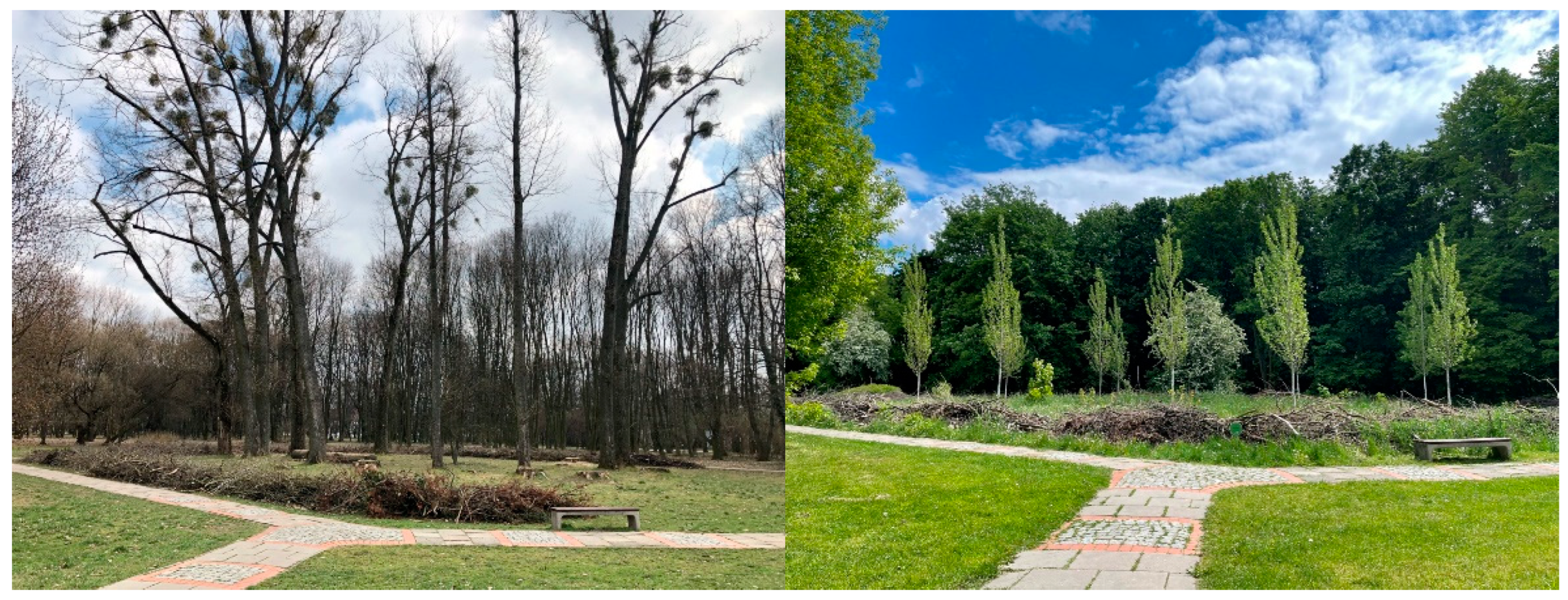
It is proved, that poplar trees can efficiently remove airborne particulate matter (PM) and associated metals through phytoremediation, contributing to urban air quality enhancement, while their adaptation to adverse environments and fast growth make them an interesting alternative for urban landscaping [86,87]. Cultivars of poplars - if used properly (carefully selected e.g., in relation to spatial and site conditions) - could effectively improve air quality by capturing PMs, thereby reducing air pollution levels [96].
Figure 2.
P. simonii Carrière ‘Fastigiata’ as urban street trees along pedestrian route - sheltering functions (J. Łukaszkiewicz 2018).
Figure 2.
P. simonii Carrière ‘Fastigiata’ as urban street trees along pedestrian route - sheltering functions (J. Łukaszkiewicz 2018).
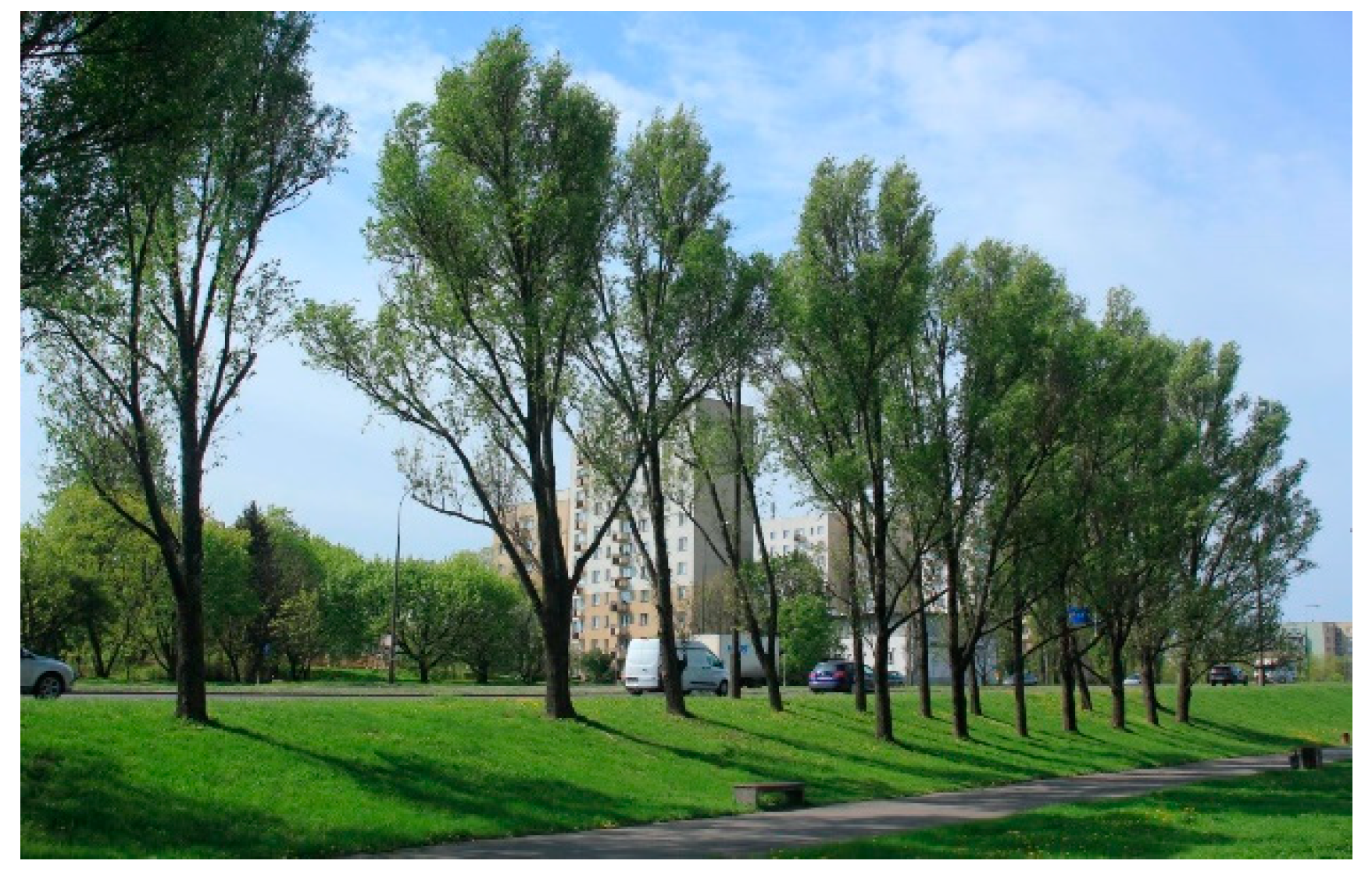
Poplars could also be effective in carbon sequestration by accumulating trace elements from polluted urban soils, serving as bioindicators for urban environmental pollution assessment [97]. Furthermore, poplar trees can modify soil microbial communities, enhance soil stability, and provide valuable habitats for ground beetles and entomofauna, enriching urban biodiversity [98].
Because of their fast growth poplars could be pivotal in counteracting the urban heat island effect and improving urban microclimates. Urban tree cover supplemented with plantings of different poplar taxa could mitigate more quickly the urban heat island effect. Poplar trees enhance the urban thermal environment through transpiration, stimulating urban “cold islands” [99,100,101,102,103,104].
Figure 3.
Populus ×canadensis Moench ‘Marilandica’ planted in by-water shelterbelts of Żerański Canal, Warsaw, Poland (J. Łukaszkiewicz 2016).
Figure 3.
Populus ×canadensis Moench ‘Marilandica’ planted in by-water shelterbelts of Żerański Canal, Warsaw, Poland (J. Łukaszkiewicz 2016).
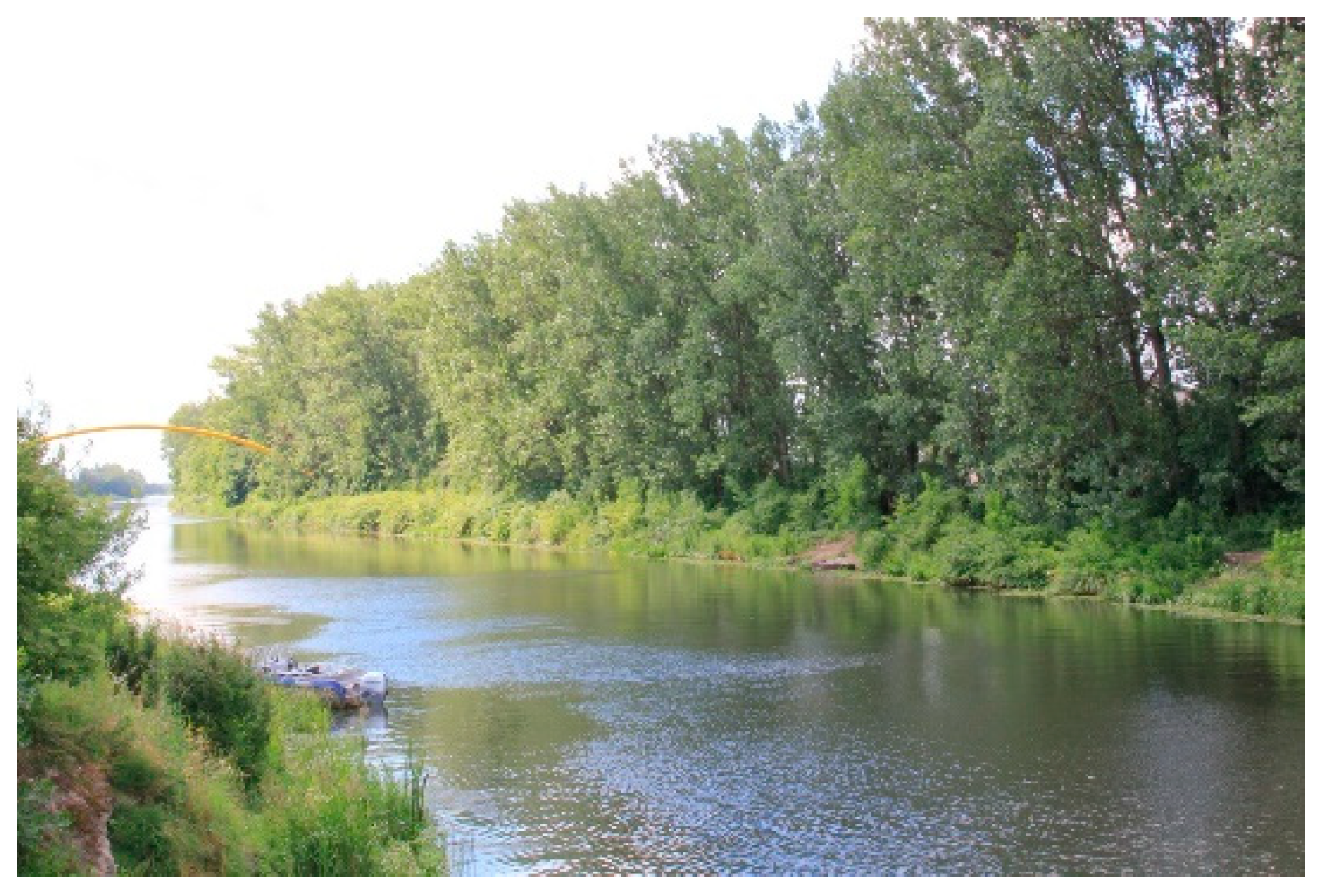
Of course, also in the case of poplars in cities, their cultivation and maintenance is necessary. Considering diverse research findings to ensure optimal growth and sustainability of poplars in urban settings while minimizing risks, effective maintenance practices such as pruning, soil amendment, and irrigation are crucial [105,106,107,108,109,110,111,112]. The challenges such as insect pests and heavy metal accumulation in poplar require careful management and selection of clones, especially when monoculture plantations are planned to be introduced [42,43,113,114,115].
Figure 4.
Populus ×canadensis Moench (P. ×euroamericana Guiner) as a high greenery screen for multi-storey’s residential buildings - sheltering functions against the traffic, Sobieskiego Street, Warsaw, Poland (J. Łukaszkiewicz 06.2019).
Figure 4.
Populus ×canadensis Moench (P. ×euroamericana Guiner) as a high greenery screen for multi-storey’s residential buildings - sheltering functions against the traffic, Sobieskiego Street, Warsaw, Poland (J. Łukaszkiewicz 06.2019).
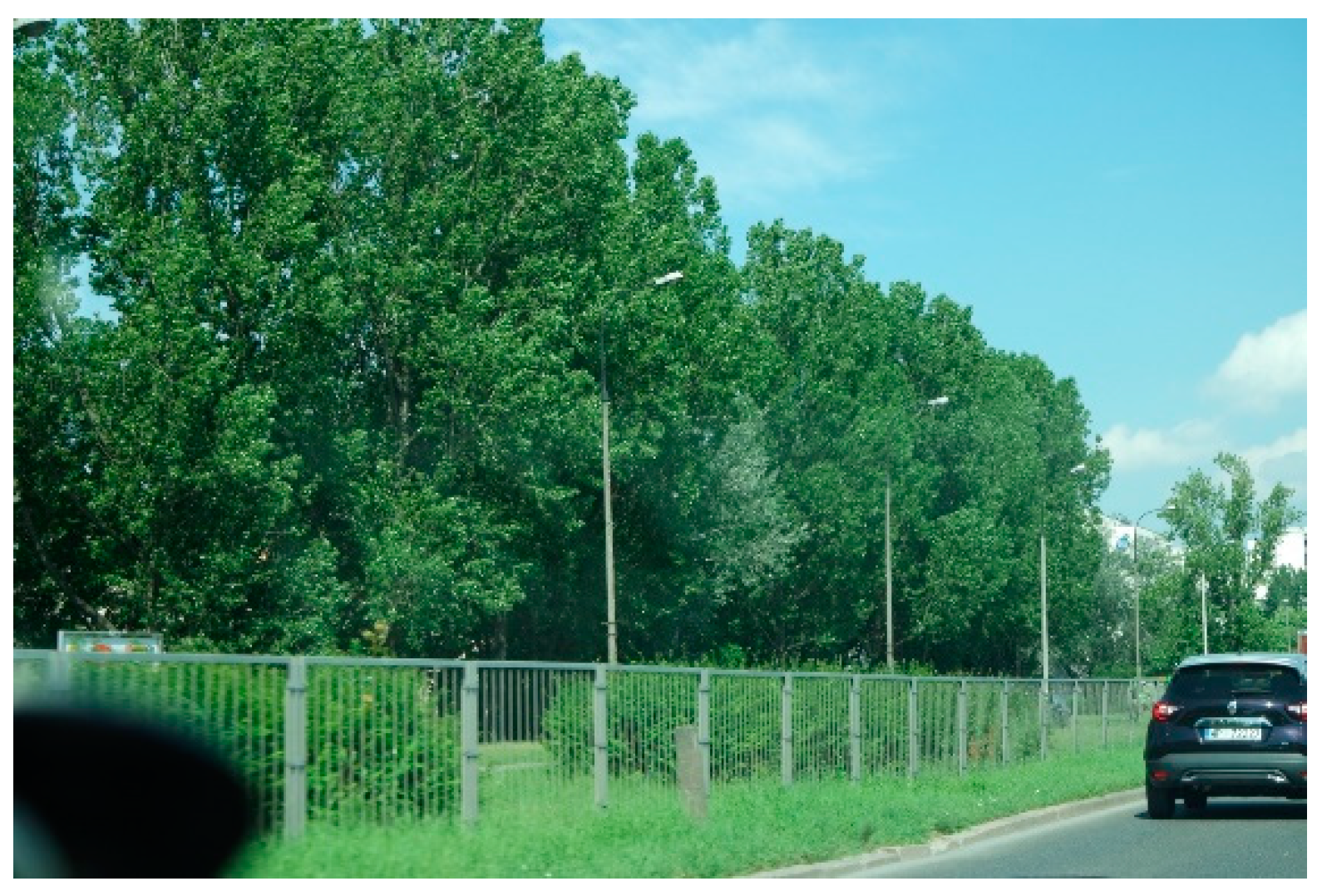
Figure 5.
Populus nigra L. ‘Italica’ planted repeatedly in regular groups of four trees each, creating a green wall along the interior borders of “Field of Mars” - one of the most important interior of Silesia Park in Chorzów, Poland (B. Fortuna-Antoszkiewicz, 2014).
Figure 5.
Populus nigra L. ‘Italica’ planted repeatedly in regular groups of four trees each, creating a green wall along the interior borders of “Field of Mars” - one of the most important interior of Silesia Park in Chorzów, Poland (B. Fortuna-Antoszkiewicz, 2014).
3.2. The Fast Increments of Poplars
In the past decades, there was a lot of practical knowledge about the use of poplars in plantations or tree stands (eg. 81,116). For instance in central and east Europe - already before the II World War, and then in period from 1950s to 1970s - mass afforestation of urban, industrial and open landscape was carried out, motivated by economic purposes, counteracting environmental degradation and improving landscape values (e.g., technical and shielding functions, phytoremediation, windbreaks, anti-snow, anti-erosion and others). In Poland for instance it is estimated, that at that time the share of various poplars’ taxa in shelterbelts and woodlots reached up to ¼ (25%) of total trees species amount [77,84,117,118,119]. The obtaining objective was to achieve the desired effect in the possible shortest time!
Traditionally poplars are considered to be one of fastest growing trees in Europe and Asia (similarly to some willow species), eg. P. alba L., P. nigra L. ‘Italica’ - increase in height ± 1.7 m / year (juvenile life phase), reaching max. rate of shoots elongation ca. 17 - 25 cm / week (referenced to climate zone 6) [77,81,82,120].
The research from databases indicate, that the use of poplar species in urban greenery initiatives, including e.g., P. tomentosa, P.s alba ‘Berolinensis’, and P. nigra, is driven by their rapid growth, strong adaptability, and tolerance to environmental stressors [121,122,123]. These species are favored for their ability to thrive in diverse urban settings, offering benefits such as flood tolerance and resilience to adverse conditions [124,125].
Populus tomentosa exhibits rapid growth and ecological adaptability, making it ideal for establishing greenery in urban areas [121]. Similarly, the hybrid triploid P. alba ‘Berolinensis’ demonstrates fast growth and high stress tolerance, suitable for urban forestry [122]. P. nigra’s flood tolerance further enhances its suitability for urban settings, particularly in flood-prone areas [124]. However, susceptibility to diseases like leaf rust poses challenges [126]. Therefore to ensure long-term success, the general careful disease management is crucial when selecting poplar cultivars for urban greenery projects.
3.3. The Short Lifespan of Poplars
One of the controversies arisen in relation to poplars is the very short lifespan of these trees. Short-lived (few dozen years) is mainly characterized by taxa that are hybrids of botanical species or their varieties - cultivated varieties (cultivars, marked as ‘cv’. or ‘×’ preceding the name), e.g.,: P. nigra L. ‘Italica’, P. simonii Carrière ‘Fastigiata’) or P. ×canadensis Moench (P. xeuroamericana Guiner) [77,82]. Definitely more durable reaching medium and long-lived (life expectancy of ±150(200) years in natural conditions) are:
- • typical botanical species, e.g . white poplar (P. alba L.) and black poplar (P. nigra L.);
- • the section of balsam poplars Tacamahaca and some cultivated varieties, e.g., P. simonii Carrière, P. maksymowiczii Henry, or balsam poplar hybrids, e.g.,: P. ×berolinensis Dippel) or hybrids like ‘NE 49’, ‘NE 42’ (Table 1).
3.4. The Use of Berlin Poplar in Afforestation of Urban Landscapes - Field Research
Regarding the literature on the use of poplars in urban conditions [117,118,119,127,128], our field research (chapter 2.) focuses on one selected cultivar - the Berlin poplar (chapter 3.3.). Our choice to study this particular cultivar is dictated by its many interesting characteristics, making it, in the past, a good choice for planting in cities. Therefore, by examining selected locations in Poland, we wanted to determine how the Berlin poplar performed in urban conditions. This cultivar was bred around 1870 in the botanical garden in Berlin as the male form of Populus ×berolinensis (K. Koch)Dippel ‘Berlin’. Then, at the end of the 19th century, at the Petrovsko-Razum Agricultural Academy near Moscow, female forms were bred: P. ×berolinensis (K. Koch)Dippel ‘Petrowskyana’ (the so-called Tsar’s poplar) and P. ×berolinensis(K. Koch)Dippel ‘Razumovskyana’. It tolerates dry urban environments and dry soil very well; it has also been successfully tested on a gravel-sand base with an inaccessible groundwater level. It grows well even on sloping localities. Conversely, P. ×berolinensis (K. Koch)Dippel is susceptible to cancer as it is planted in locations with high groundwater levels, flooded or with high air moisture levels. This cultivar is suitable for urban areas due to its narrow oval crown, which will keep even old. It has a straight, continuous trunk. That is why it is recommended especially for planting in lines or rows, e.g., along streets or avenues. Berlin poplar wood is stronger than other poplar species and cultivars. That is why these trees growing in the alleys do not suffer much from fractures in the canopy. Despite inhibiting factors of the urban environment, this poplar can grow very fast, reaching up to 30 m in height and a trunk diameter at breast height (DBH) of 1,0 m. Leaves can also accumulate PM from the air, so Berlin poplars possess phytoremediation abilities too.
Berlin poplar’s lifespan varies, and, in good health, it can easily reach over 60 years and even more (as indicates our observations). However, exchanging overmatured trees over 40 years old for younger specimens is sometimes advisable in urban areas. Such a policy of exchanging older generations of trees is similar to how urban plantations are maintained. A distinctive feature of the female forms of the Berlin poplar is the production of seed down, which is abundantly secreted by the trees in May. In the context of use, especially in streets, avenues and squares, this is a very undesirable factor, which may result in abandoning the use of female forms in urban areas. Attention should also be paid to the shallow root systems of these trees, which may cause damage to paved surfaces and, in consequence, should be planted in locations that allow sufficient space for rooting (e.g., wide grassy sections along streets, etc.). During past decades, Berlin poplars were used in urban locations in Central European countries, like Czech or Poland.
Because, among many other species and cultivars, Berlin poplars are much better suited for planting in cities, our research was focused on two representative locations in Poland where such trees were used in the context of the urban environment. The first research area is Rakowiecka Street in Warsaw, and the second is the great Ziętek Promenade in Silesia Park in Chorzów.
Example 1. The research area of Rakowiecka Street in Warsaw, Poland
Rakowiecka Street in Warsaw began to be intensively built in the second half of the 19th century, and this process culminated in the 1950s. The characteristic number 8 building of the WULS-SGGW headquarters was partially put into service in 1929. In 1930, Rakowiecka Street was upgraded with road infrastructure with green belts planted with Berlin poplars (Populus ×berolinensis (K. Koch)Dippel ‘Petrowskyana’); young trees were 3.5 m high, with spacing of 8.0 - 10.0 m in each row [129].
Figure 6.
The magnificent streetside row of Populus ×berolinensis (K. Koch)Dippel ‘Petrowskyana’ along Rakowiecka Street, Warsaw, Poland - visible the adjusted size of the trees to the street scale! (J. Łukaszkiewicz, 2017).
Figure 6.
The magnificent streetside row of Populus ×berolinensis (K. Koch)Dippel ‘Petrowskyana’ along Rakowiecka Street, Warsaw, Poland - visible the adjusted size of the trees to the street scale! (J. Łukaszkiewicz, 2017).
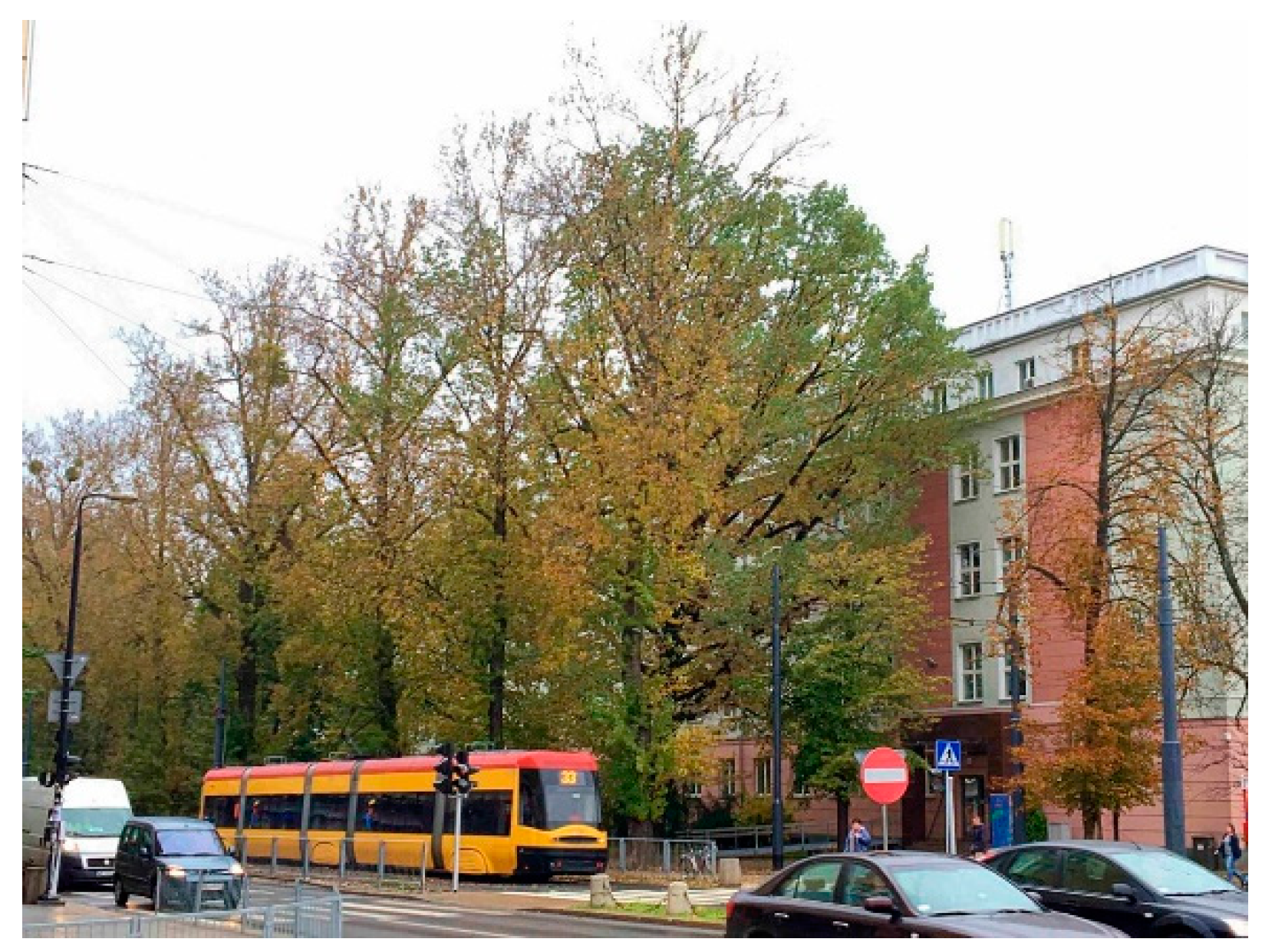
The street buildings and rows of poplars survived the destruction of World War II. Already in the 1940s, trees were large enough to provide shade for the SGGW building and protection against noise and pollution from the street [129] (Figure 7). However, in the late 1970s, specific problems were already noticed related to the collision of rapidly growing trees with the infrastructure of buildings and the traction network [130]. In addition, the problem was the shallow root system of poplars that lifted the paving slabs. Trees were planted too shallow, and permeable surfaces were not used then. One of the significant inconveniences of lining the street with the female form of Berlin poplar (Populus ×berolinensis (K. Koch)Dippel ‘Petrowskyana’) was the annual abundant release of seed down (cotton-like), which disturbed people and caused much littering of the street and apartments in nearby houses. In the following years, the Berlin poplars gradually fell out during infrastructure modernization or due to weather anomalies. In 2024, only a few trees remain from the avenue that existed in past decades, which are the subject of our further measurements and analyses.
Figure 7.
The cross section of Rakowiecka Street in Warsaw - eastwards direction (a), lined with two-sided rows of Populus ×berolinensis (K. Koch)Dippel ‘Petrowskyana’ (1973), and a view of Rakowiecka Street near the WULS-SGGW headquarters builing (b) in 1973 [129].
Figure 7.
The cross section of Rakowiecka Street in Warsaw - eastwards direction (a), lined with two-sided rows of Populus ×berolinensis (K. Koch)Dippel ‘Petrowskyana’ (1973), and a view of Rakowiecka Street near the WULS-SGGW headquarters builing (b) in 1973 [129].
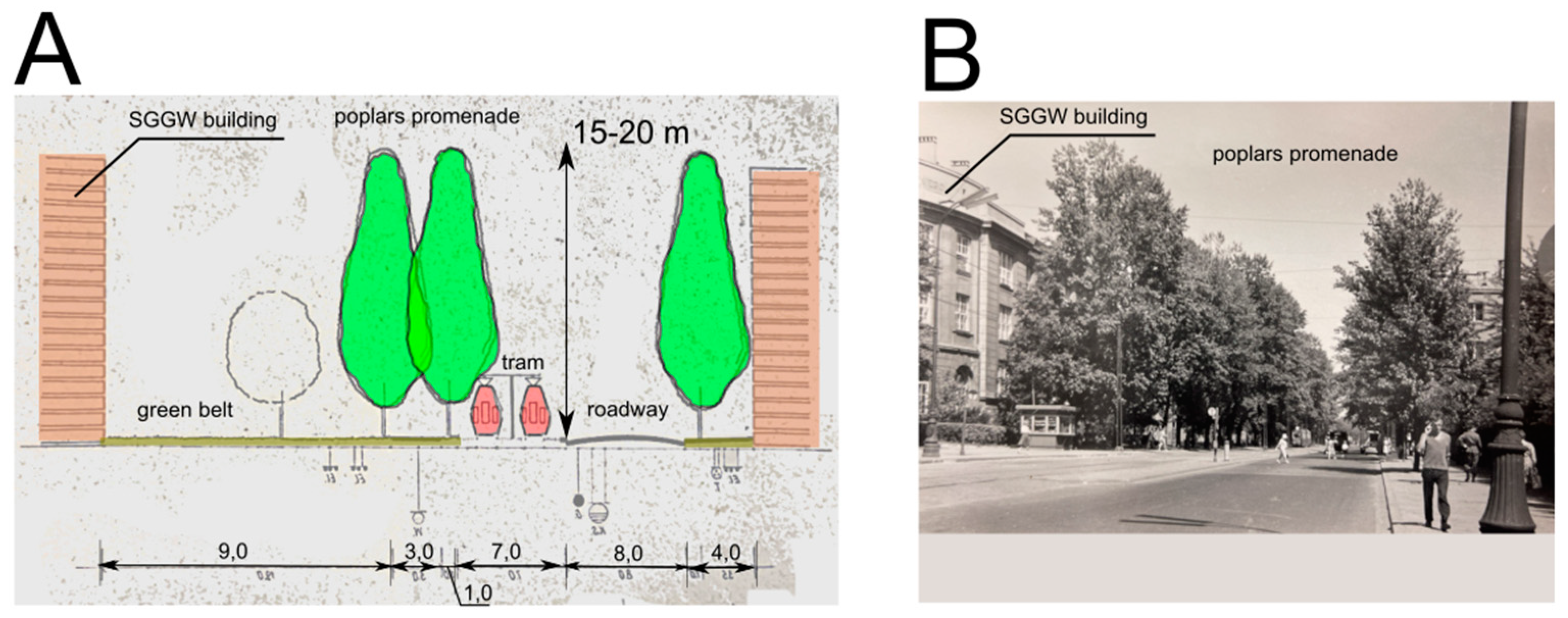
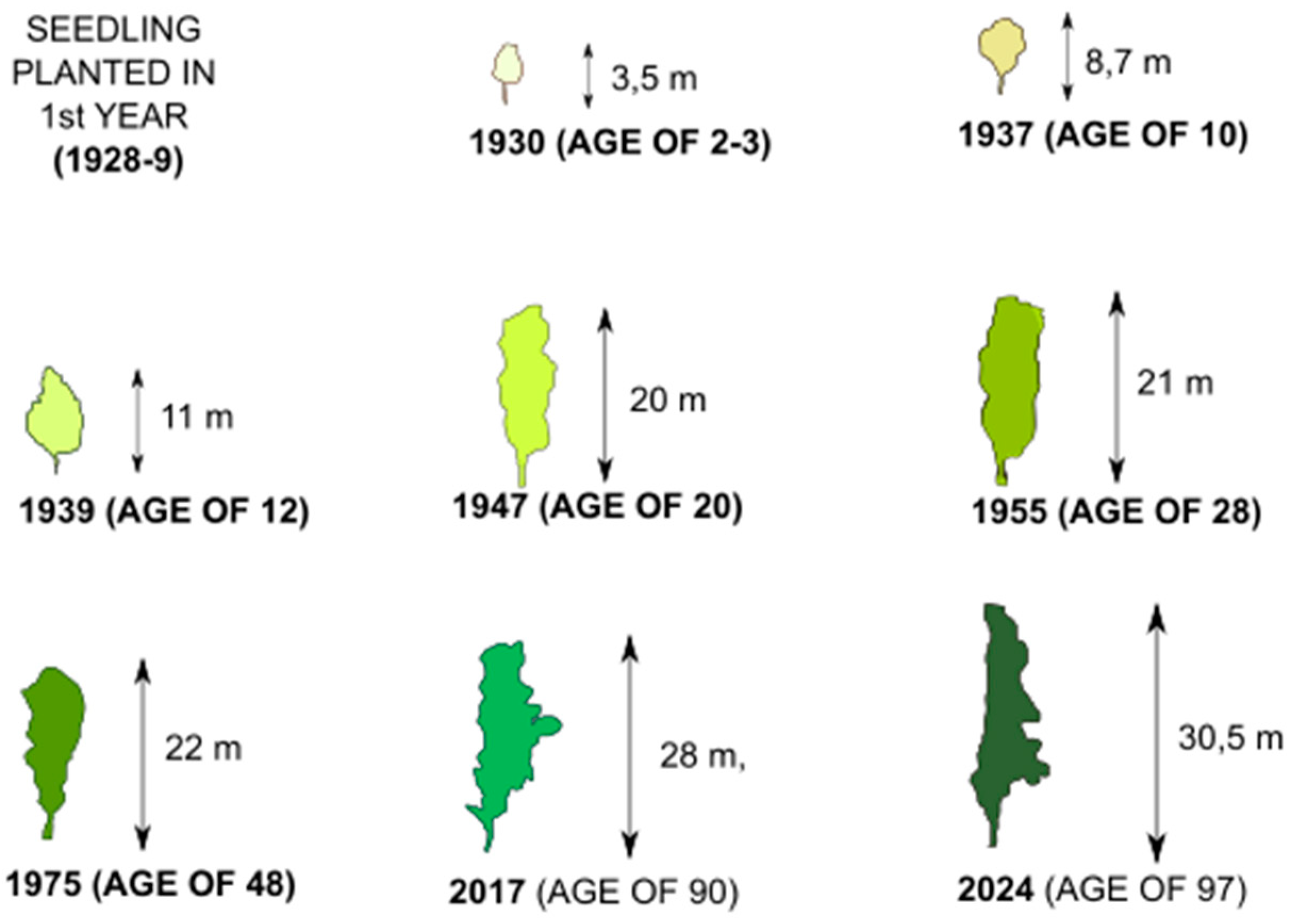
We analyzed historical iconographic materials [130,131] and made field measurements, i.e., measurements of trees, the street and the facade of the WULS-SGGW building. The results are presented in Figure 6, Figure 7 and Figure 8 and Table 2. Figure 8a from 1925 shows the measured heights of the building’s floors during field tests. Based on the analysis of the remaining illustrations (Figure 8B-H), it can be concluded that the trees planted at the turn of the 1920s and 1930s were homogeneous plant material with equal parameters (height of approximately 3.5 m). The trees reach the windows of the high ground floor of the WULS-SGGW building (Figure 8B). In 1937, it can be seen that the trees reached the windows of the first floor of the SGGW building, reaching a height of approximately 8.5 m (Figure 8C). In 1939, the trees reached the windows of the second floor of the WULS-SGGW building, reaching a height of approximately 11.0 m (Figure 8D). In the illustration from 1947, the trees reach the roof of the SGGW building, reaching a height of approximately 20 m (Figure 8E). In 1955, the trees obscured the SGGW building and reached a height of approximately 21 m (Figure 8F). In 1975, the trees were already mature and reached a height of approximately 22-25 m (Figure 8G). At the beginning of the 21st century, the poplars remaining from the original forest cover had already reached their maximum size; in 2012, their height was 24.0 m; in 2017 - 28.0 m; and 2024 - 30.5 m. Due to collisions with buildings and technical infrastructure, the trees were cut, and their shape was deformed. The illustration from 2017 shows partial losses in the street trees, and the trees in the planted avenue are getting old and falling out (Figure 8H).
Field measurements showed that Populus ×berolinensis (K. Koch)Dippel ‘Petrowskyana’ planted at the turn of the 1920s and 1930s of the 20th century along Rakowiecka Street in Warsaw (section Boboli Street - Niepodległości Av.) achieved in 2013 average trunk girths 220 - 235 cm (measured at 1.3 m - breast’s high), and in 2024 an average of 241.3 cm (Table 2). Tree age parameters were calculated and correlated with illustrations in individual years and heights (Figure 9). On this basis, it was estimated that in 1930, the trees were approximately three years old; in 1937 - approximately. 8-10 years, 1937 - 12 years, 1947 - 20 years, 1955 - 28 years, 1975 - 48 years, and 2017, already approx. 90-95 years, and now in 2024 - approx. 97-102 years. The figure shows averaged values or rounded to the upper or lower values for better data visualization.
Figure 8.
The sequence of illustrations (A-I) of Rakowiecka Street in Warsaw showing the growth of Populus ×berolinensis Dippel ‘Petrowskyana’ (1925-2024) near the WULS-SGGW former headquarters building [authors own elaboration based on historical photos of Rakowiecka Street in Warsaw (photos [131] and own photo: Łukaszkiewicz, 23.02.2024).
Figure 8.
The sequence of illustrations (A-I) of Rakowiecka Street in Warsaw showing the growth of Populus ×berolinensis Dippel ‘Petrowskyana’ (1925-2024) near the WULS-SGGW former headquarters building [authors own elaboration based on historical photos of Rakowiecka Street in Warsaw (photos [131] and own photo: Łukaszkiewicz, 23.02.2024).
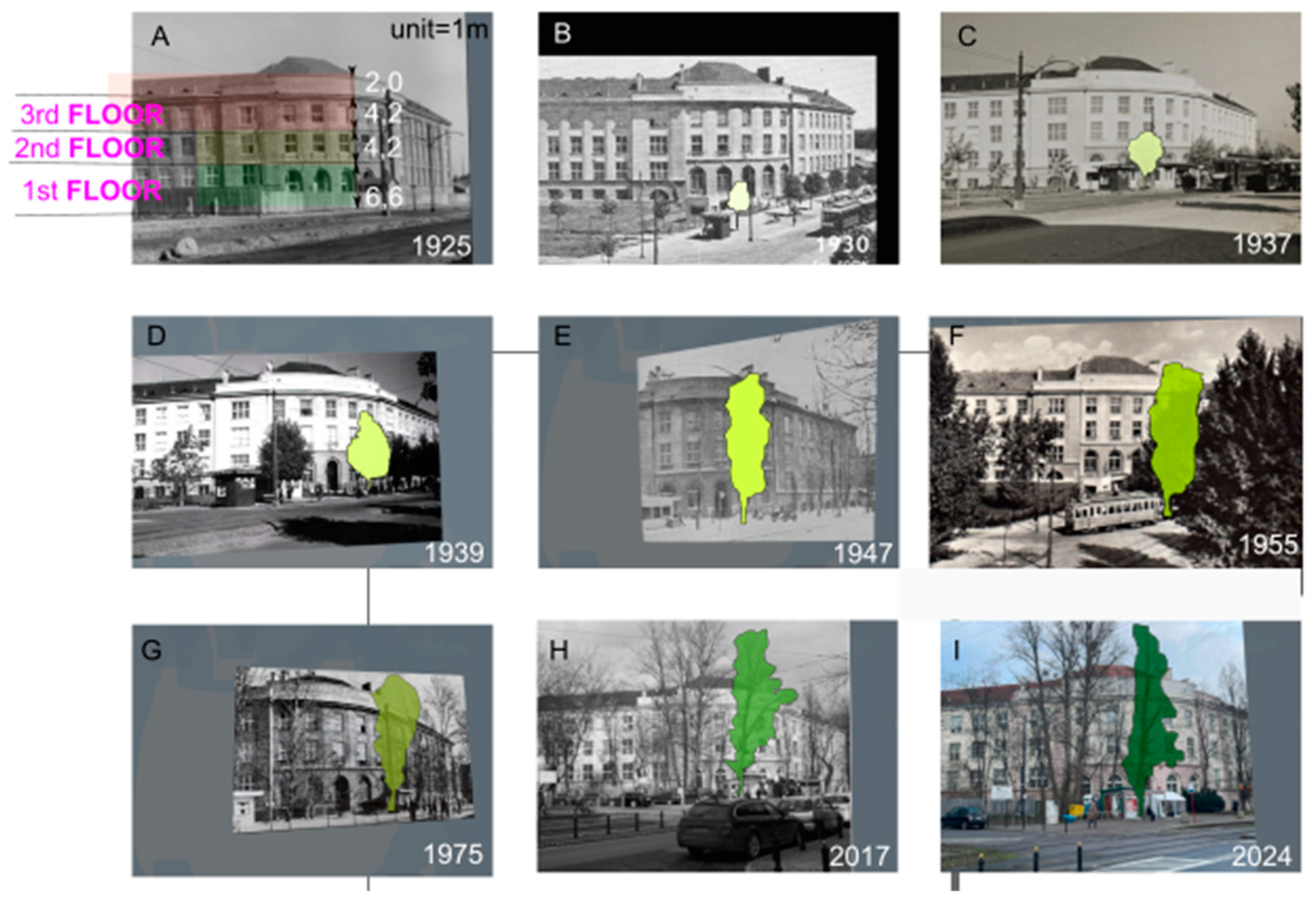
Table 2 shows the descriptive statistics of average measurements of tree height and trunk circumference at a height of 1.3 m and compares the significance of differences in the average values of these measurements. In order to compare the significance of differences between the average values of tree height and trunk circumference at a height of 1.3 m, the student’s t-test was used (after performing a test of compliance with the normal distribution using the Shapiro-Wilk test). In the case of data from 2024, the number of trees (n=12) was lower than in 2012 (n=16) because some trees fell due to weather anomalies, poor health, or infrastructure modernization. Based on the results obtained, it can be concluded that in the tested sample, both the trunk circumference and the height of the trees increased over the 12 years, but statistically significant growth was only observed in the case of height.
It was also checked whether the increase in tree height and circumference depended on the spacing between the examined trees; Spearman’s rank correlation analysis was used. The average spacing between the examined trees was 10.3 m, the smallest distance between them was 8.0 m, and the largest was 16.0 m (SD = 2.25 m). A negative relationship was observed in the case of height, but despite the coefficient value r = 0.64 indicating a relatively significant relationship, it was statistically insignificant (r = -0.64; t = -2.21; p = 0.0627). In the case of trunk circumference, a similar direction of relationship was observed, which was also statistically insignificant, but the strength of this relationship was much weaker (r=-0.14; t=-0.36; p=0.7256). This direction means that as the distance between trees decreases, the value of the analyzed parameters increases.
Figure 9.
The schematic habits and estimated height of Populus ×berolinensis (K. Koch)Dippel ‘Petrowskyana’ along Rakowiecka Street in Warsaw in chosen years of period 1930-2024, located near the WULS-SGGW former headquarters building. The authors’ elaboration based on pictures from Figure 8. photo A-I ([131] and own photo: Łukaszkiewicz, 23.02.2024).
Figure 9.
The schematic habits and estimated height of Populus ×berolinensis (K. Koch)Dippel ‘Petrowskyana’ along Rakowiecka Street in Warsaw in chosen years of period 1930-2024, located near the WULS-SGGW former headquarters building. The authors’ elaboration based on pictures from Figure 8. photo A-I ([131] and own photo: Łukaszkiewicz, 23.02.2024).
Example 2. The research area of Ziętek Promenade in Silesia Park in Chorzów, Poland
Figure 10.
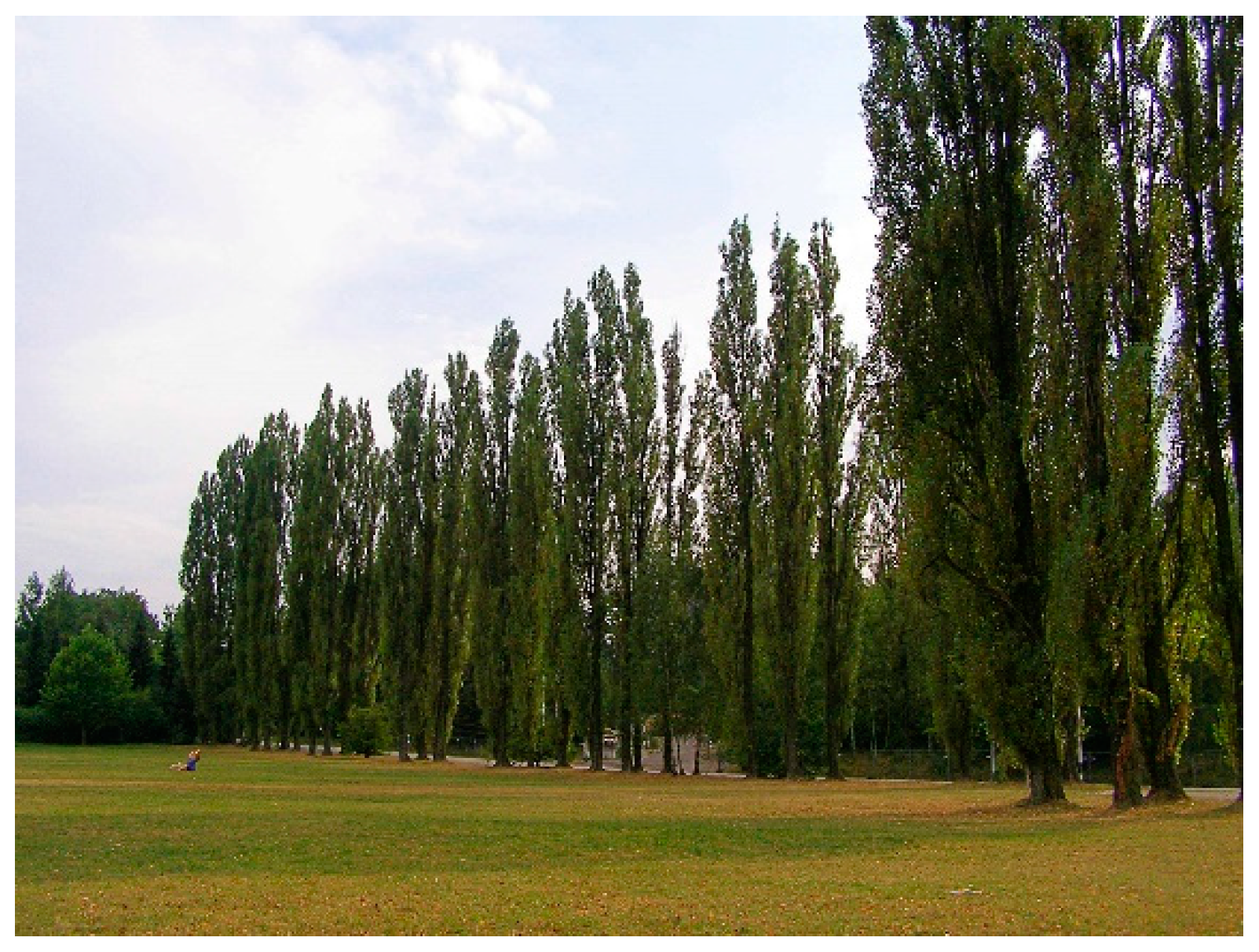
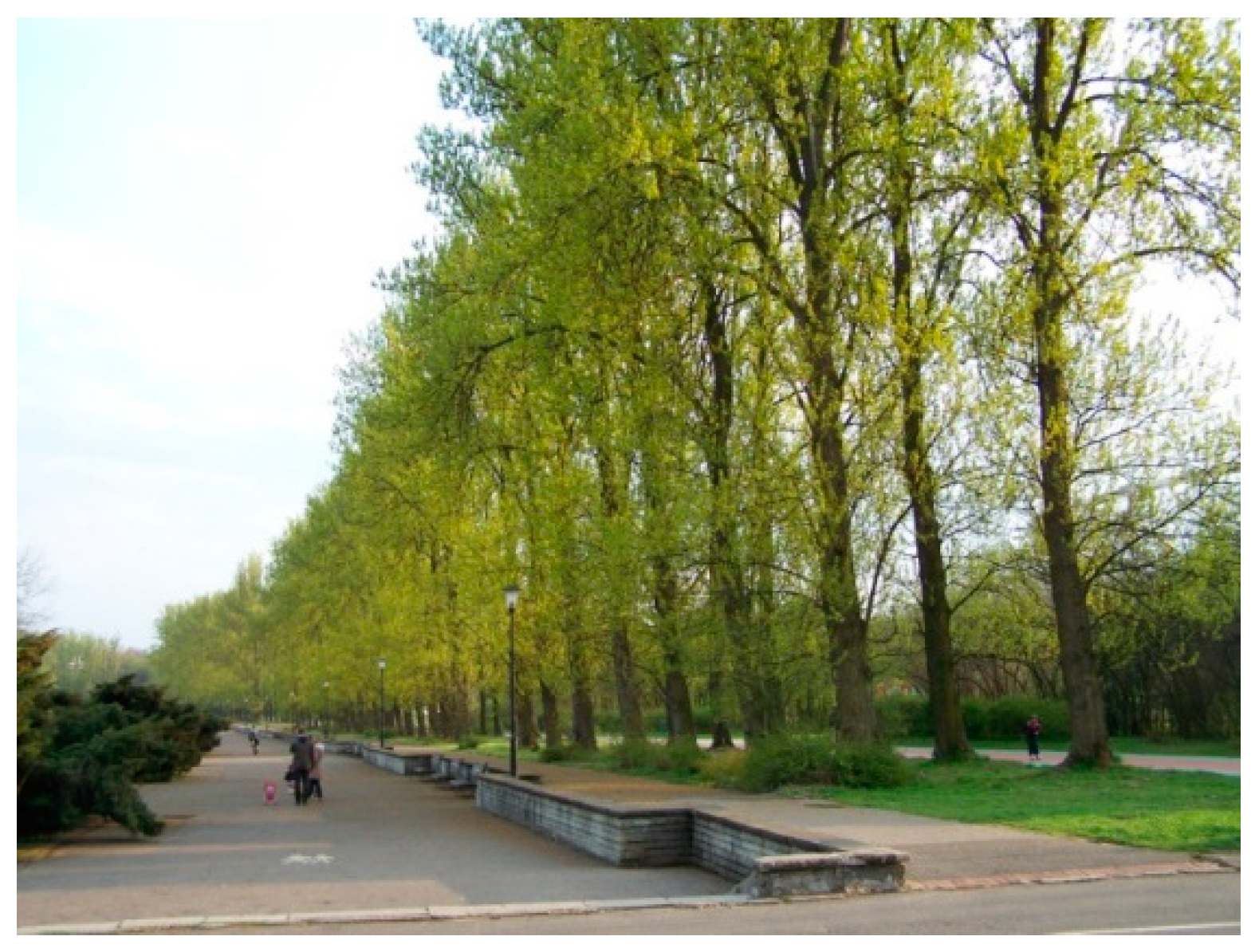
The form of a high, even wall of Populus ×berolinensis (K. Koch) Dippel ‘Berlin’ in Silesia Park’s Ziętek Promenade, Chorzów, Poland (B. Fortuna-Antoszkiewicz, 2014).
Figure 10.
The form of a high, even wall of Populus ×berolinensis (K. Koch) Dippel ‘Berlin’ in Silesia Park’s Ziętek Promenade, Chorzów, Poland (B. Fortuna-Antoszkiewicz, 2014).
Silesia Park (The Voivodship Park of Culture and Recreation in Chorzów, Poland) with a total area of ca 600 ha, was established on land of poor quality, partially degraded by mining and metallurgy industries. The main objective was to improve the quality of life for residents of Silesia by creating the bulk enclave of greenery combined with a versatile programme for active recreation in this partially degraded area. After many years, the Silesia Park has become an example of a successful restoration and naturalization of the anthropogenic landscape [132,133].
The Ziętek Promenade in Silesia Park is a main, wide walkway connecting the most attractive park programme elements and is the backbone of Park composition. Regular tree arrangements, such as multi-row bosquets in a checkerboard pattern, are the leading theme of the spatial composition. The original design, including vegetation, is preserved and visible. The main feature of that Park’s section is a magnificent double-row of Berlin poplar’s male form (Populus ×berolinensis (K. Koch)Dippel ‘Berlin’). It runs along the banks of the Park’s great pond, constituting a uniform “living wall” which ideally fits the scale of the vast Park’s interior. In 2016, at the end of the promenade near Al. Główna, the section of an old poplar row, was exchanged for plantings of new trees of the same specimen [46, 146, Fortuna et al. 2017; Łukaszkiewicz et al. 2022].
In the first step we analyzed iconographic materials and made field measurements. The results are presented in Figure 11 and Figure 12 and Table 3 and Table 4. Based on the data obtained, it can be concluded that the trees planted in the 1950s on the Park’s promenade reached a height of 4.5 m at the end of the 1950s (the estimated year was 1959), which was equal to the height of the park lamp (Figure 11a). On this basis, the remaining parameters were estimated: width equal to 2.0 m and spacing equal to 6.0 m. Next, the average height of poplars at the turn of the 1960s and 1970s was estimated (the estimated year was 1965), which was already 9.0 m, and the width of the crown was 6.0 m because the trees touched each other with their crowns, building a homogeneous wall like the row of trees (Figure 11b). In turn, the analysis of photos and own field tree inventory from 2014 shows that their parameters were, on average, as follows: height - approx. 24.0 m, crown width - ca. 8.0 m, mean trunk girth at 1.3 m: ca ± 197 cm [132].
Figure 11.
The analyzed sequence of historical photographs of the Silesia Park in Chorzów, Poland showing the double row of Berlin poplars (Populus ×berolinensis (K. Koch)Dippel ‘Berlin)’ in the Park in Chorzów (the authors’ elaboration): A) view of the promenade from the late 1950s [134], B) view of the promenade from the turn of the 1960s and 1970s [135], C) view of the avenue of adult poplars in 2014 (photo by J. Łukaszkiewicz, 2014) [132].
Figure 11.
The analyzed sequence of historical photographs of the Silesia Park in Chorzów, Poland showing the double row of Berlin poplars (Populus ×berolinensis (K. Koch)Dippel ‘Berlin)’ in the Park in Chorzów (the authors’ elaboration): A) view of the promenade from the late 1950s [134], B) view of the promenade from the turn of the 1960s and 1970s [135], C) view of the avenue of adult poplars in 2014 (photo by J. Łukaszkiewicz, 2014) [132].
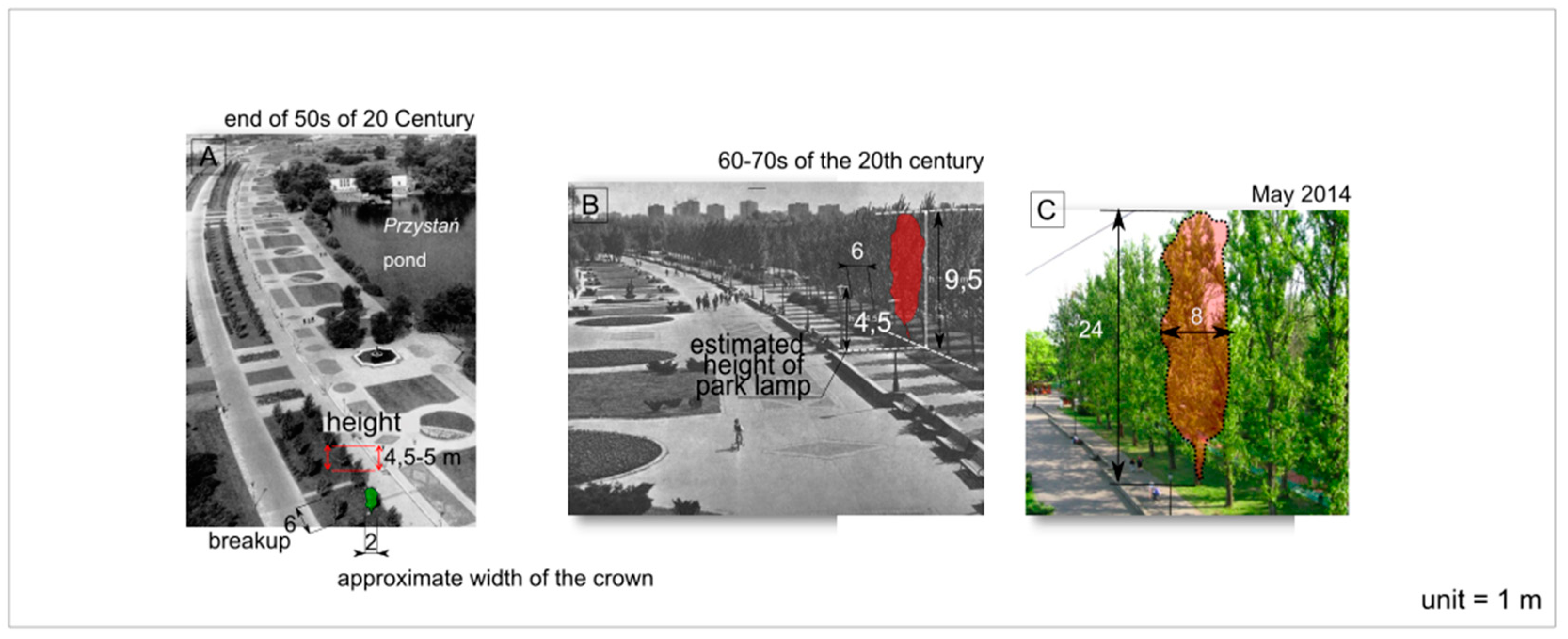
On this basis, the age of the trees was assessed approximately: ±3 years in 1959, ±10 years in 1965 and ±65 years in 2014 (Figure 12). Knowing the poplars average height of individual years, it can be concluded that these trees, having favourable conditions for development (city park space), achieved the most significant growth of 8.5 times in approximately 6-10 years (between 1959 and 1965) and relatively slower during the mature phase of life - over the next ca. fifty years (between 1965 and 2014) equal only 2.5 times. For better data visualization, the following figure uses average values or extreme ranges (Figure 12).
Due to the ageing of the original poplars and for safety reasons, the gradual replacement of trees in the Ziętka Promenade began in 2016. Following the original project assumptions, new Berlin poplars of the same variety were planted instead of the old trees. In the first section of the poplar row, replaced on April 2016, 37 new young poplars were planted (planting material of girth 12-14 cm).
Our next step was to value descriptive statistics, estimated for measurements collected on ten newly planted Berlin poplars (Populus ×berolinensis (K. Koch)Dippel ‘Berlin’) in 2016, 2021 and 2023. Based on the results obtained, it should be concluded that with age, there is a systematic increase in all the parameters examined (height, trunk circumference, crown width).
Next, the average annual increase in the studied parameters and the strength of the relationship between age and the average growth rate of the studied trees was estimated. Sperman’s rank correlation analysis was used to estimate the strength of the relationship, and the growth rate was estimated using the obtained average values of the studied characteristics and dividing by the appropriate number of years. Table 3 summarizes the results of these analyses. They show that between the fifth and eighth year of life of Berlin poplars, the trunk circumference grows most intensively, while in the following years, the trunk growth slows down in favour of the crown growth (Table 4).
4. Discussion
4.1. Poplar in Cities as Suitable and Forgotten Trees in Urban Greenery
Using poplars (Populus L.) in urban environments offers a spectrum of ecological benefits crucial for sustainable urban development. Rapid growth and adaptability to diverse conditions have been highlighted in studies by Ghezehei et al. [136] and Fabg et al. [137], showcasing their potential for air quality improvement and carbon sequestration [138,139]. However, the variable lifespans of different poplar species present challenges for sustained urban greenery initiatives. Research by Khurana [140] and Konijnendijk [141] emphasized the shorter lifespans of certain species, necessitating frequent replanting and raising concerns about green spaces’ continuity in urban landscapes.
Strategic species selection and management practices are pivotal in maximizing the benefits of poplars while mitigating challenges associated with their shorter lifespans. Miller et al. [142] discussed the importance of selecting species based on growth rates and root system characteristics for better adaptability to urban conditions. Adaptive replanting strategies offer a potential solution, as suggested by Miller et al. [142] and McCarthy et al. [143], involving a mix of species with varying lifespans. These strategies allow for continual greenery while accommodating the changing environmental dynamics in urban settings, aligning with findings from studies by Brancalion [144] and D’Amato [145].
The varied lifespan of poplars presents an intriguing aspect in the context of the generally reduced lifespan of all trees in urban areas and cities. Urban environments often face challenges that limit the longevity of trees, such as pollution, compacted soils, limited space for root growth, and susceptibility to damage from construction and urban activities.
Poplars, known for their relatively shorter lifespans than some tree species, offer an advantageous perspective in this scenario. Their faster growth rates and adaptability enable quicker introduction and establishment within urban landscapes. This characteristic becomes particularly relevant in the pressing need for expedited tree plantings to combat urban heat, improve air quality, and enhance overall environmental resilience [146,147,148,149].
Urban environment and anthropopression tend to shorten trees’ lifespan due to various stressors. The quicker growth and establishment of poplars allow for rapid greening of areas that may otherwise remain devoid of green cover for extended periods. Despite their shorter lifespans, introducing poplars is a practical strategy for swiftly introducing tree canopy cover, contributing to immediate benefits such as shade provision, air quality enhancement, and visual aesthetics within urban spaces [150,151,152].
Their ability to adapt to diverse soil conditions and climates further positions poplars as a viable choice for urban greening initiatives, offering flexibility in replanting and adaptability to changing urban environments. While the variable lifespans of poplars might necessitate more frequent replanting cycles, their quick growth and establishment align with the urgency of creating green spaces in urban areas, addressing immediate environmental concerns, and fostering a more sustainable and livable urban landscape [153,154,155].
Implications for sustainable urban development. Integrating poplars into urban landscapes has significant implications for sustainable urban development. Their contributions to air quality improvement, carbon sequestration, and soil stabilization align with the objectives of creating resilient cities, as highlighted by research from Aitchison et al. [156] and Goodarzi et al. [157]. However, the challenges of variable lifespans necessitate holistic approaches to urban planning. Collaborative efforts between researchers, urban planners, and policymakers, as advocated by Miller [142], are crucial for devising comprehensive strategies that maximize poplar’s benefits while addressing challenges associated with their shorter lifespans.
Integrating poplars into urban greenery initiatives presents a pathway towards sustainable urban development. Nevertheless, their variable lifespans require innovative management strategies and adaptive replanting approaches to ensure sustained and effective utilization in creating resilient and vibrant urban landscapes. Continued research efforts, collaborative partnerships, and adaptive planning strategies are pivotal in harnessing the full potential of poplars for the future of urban development.
According to the texts mentioned above, we can summarize that in this context, specific species selection, management practices, and comprehensive strategies can play a key role in poplar’s application in urban green spaces (UGS).
In conclusion, using poplars in urban areas offers various advantages, including their ability to provide ecosystem services, improve air quality, and suitability for urban landscaping. However, the potential accumulation of pollutants and susceptibility to insect pests in urban settings are essential considerations that need to be addressed to maximize the benefits of poplar use in urban areas while minimizing potential risks.
However, over time, several myths and misunderstandings have arisen around using poplars in cities, which means that currently - despite their apparent advantages - their use is reluctantly recommended. One of them is the belief that these trees are short-lived.
In summary, poplar plantations alleviate the urban heat island effect by reducing land surface temperature, providing shading, and enhancing urban microclimates. Vegetation transpiration, water bodies, and urban forestry are pivotal in mitigating the urban heat island effect and cooling urban areas.
Especially short-lived taxons, planted en masse in the post-war years in Europe, have just reached the senile phase and pose increasing maintenance problems and threats. As a result, poplars are wrongly perceived as low-value trees in general, which leads to the massive removal of poplars from the landscape around the country.
Trees in cities live shorter and shorter! Therefore, the so-called short lives of poplars are not a disadvantage in cities. In conditions of intense urbanization and anthropopressure, poplars - exceptionally short-lived Canadian poplars - should be used in cities as a kind of forecrop - removed at the age of approximately 30-40 years, i.e., when they reach their full size and replaced with new plantings. Due to the permanent loss of trees in cities and open areas and the changing conditions of the natural environment, a “renaissance” of poplars in urban and open landscapes is necessary.
4.2. Problems of Poplars Database Analysis in Poland
The field observation of old poplars from Warsaw Rakowiecka Street and Aleja Ziętka in Chorzów shows that in favorable conditions, poplars might withstand a lot of benefits in the city. Surprisingly, the age of the oldest specimens from Warsaw Rakowiecka Street may reach up to 100 years. This example preserved a collection of trees on Rakowiecka Street; most trees planted in the 1930s have already crumbled/fallen out. Secondly, field studies have shown that Berlin poplars are still strong after several decades (40-60 years), as in the case of Chorzow (example 2). On the other hand, in the case of Warsaw (example 1), where trees are exposed to difficult urban conditions, as well as proximity to buildings, technical infrastructure (traction network, impermeable surfaces, including cutting the root system for the modernization of the pavement, etc.), it turns out that they die as early as at the age of 40, and gradually, with increasing age, more and more of them fall out. Only a few trees survive to the age of 100.
Based on the results of the statistical analyses carried out based on the measurements of tree height, trunk circumference and crown growth, it was concluded that in the first years of the tree’s life (Aleja Ziętka in Chorzów), they change in a statistically significant way, and the correlation between the age of the trees and the increase in the value of the analyzed parameters is very strong. In the case of definitely older trees from Rakowiecka Street in Warsaw, whose age was determined to be about 100 years, there was also an increase in the mean values of both the height of the tree and the circumference of its trunk, but a statistically significant increase was observed only for the height. If we compare the values of the r coefficients for the relationship between the measurements analyzed and the age of the trees, we see that they are very high in the first years of life and growth of the poplar, which indicates a very intensive growth rate, both in height and, between the third and eighth years of life of the plant, in the circumference of the trunk. Then, between the eighth and tenth year of the tree’s life, the trunk’s growth slows considerably. If we look at trees of advanced age, i.e., those that are at the end of their life, this tendency to increase in height remains, but the rate is much lower and is around 0.1 m/year, in the case of changes in the girth of the trunk the rate is 1.3 cm/year. In the case of these trees, we also checked whether the distance between them affected their growth rate and obtained a somewhat surprising result, which indicates that the smaller the distance between the trees and Rakowiecka Street, the more intensive their growth rate, especially for height, although for both height and girth, these correlations were statistically insignificant. These trends can be explained by competition between plants [158].
In conclusion, although the studied material was not numerous and studies of the growth tendency of these trees were limited to the first twelve years of the life of the trees, as well as the twelve-year growth of trees at the end of their development, the analyses carried out allowed to capture specific directions. They mainly concern the rapid increase in the size of trees in this species’ first years of life, which allows us to conclude that in a relatively quick time, they can replace older trees subject to felling or so-called fallout (drying, overturning during storms, etc.). Taking into account the overall lifespan of Berlin poplars of about 100 years, an analysis of tree height would suggest that, with growth trends from the first eight years (0.69 m/year), the young trees would be able to replace the average 100-year-old tree of this species in about 37 years. On the other hand, if one considers the average circumference of a 100-year-old tree, it would take about 24 years. It means that, in a relatively short period, it is possible to achieve a similar level of tree activity (respiration, etc.) as with the maintenance of older trees of this species, whose maintenance costs can be much higher (treatment of abscesses, dried out parts of the crown, fractures due to reduced wood strength, etc.). However, it is worth mentioning here that even in urban areas, where tree development conditions can generally be defined as poor, trees of this species subjected to appropriate and sustained care can reach an advanced age in relatively good condition, which is expressed by the increase in both height and girth of the trunks of the trees studied in Rakowiecka Street.
Although the girth is an interesting parameter and worth analyzing at any stage of development, it is growing all the time, whereas the crown may break (as in the case of the trees on Rakowiecka), and these parameters are no longer so reliable. In addition, when measuring the circumference, the measurement is more precise (measurement in centimeters), and when measuring the distance between the crowns, in practice, it is often measured in two steps, which gives a more general picture of the growth of the trees, or for some time, and also in the case of our studies - a distance meter. There may (though not necessarily) be a risk of measurement errors. So, to summarize, the measurements of the circuits are precise and always well measured and should always be carried out when assessing the growth of trees.
In selected examples, we see the possible applications. Poplars in Silesia Park in Chorzów (cultivars well selected) will fulfil their functions perfectly, and in this way also, street promenade trees of these poplars might be planted in the future. When choosing the right example of the Berlin variety, some of them might be successfully transferred to other cultivars adapted to the area site’s natural, historical and cultural conditions, e.g., in Rakowiecka Street in the future.
Thus, tree species selected for the right conditions could also fulfil their ES properly. It should be noted that in the past, many mistakes were undoubtedly made in the selection of poplars for spatial and habitat conditions. Therefore, they did not work and caused some problems, as our article highlights as well.
Moreover, we observed during field research that there are problems and shortcomings. On the one hand, the rapid growth causes infrastructure damage, and trees need to be planted using ecological surfaces. Also, monitoring their condition should be done regularly. On the other hand, it is possible to get a rapid tree wall in a very short time, as we observed in the period of 50-70 in Polish cities as well. Of course, there is no need to use poplars in each area in cities. However, some promenades or streets due to rapid growth might be selected. It is essential to exchange the trees after 60 years old for new ones due to their wrong conditions after the age of 70, as in both cases in Poland we can observe as well.
It is not worth getting too attached to various poplar species, even if it reaches a considerable size. As the example of Chorzów shows, keeping them for a long time is possible. However, when the time comes that they are overripe and start to get old (60 years), it is necessary to exchange them to young specimens, and it is the next ones that usually fill the gap quickly due to rapid growth. In this way, the example presented in the article shows that replacing the same species based on Chorzów Silesia Park might be a great solution. In spite of this, planting other slow-growing noble species (such as lime, sycamore or maple, etc.) would not give such quick results of growth, and removing all these trees would be a significant loss for the environment of the promenade or park in a city.
Finally, it is impossible to take a rigid approach to old trees, which is unfortunately common practice in Poland. The example of Western countries, e.g., Germany, Czech Republic or France), only if there is such a need can it be considered that they should be replaced with similar and the same ones as alternatives to other common species used currently in urban greenery.
5. Conclusions
- • The following conclusions highlight the complex interplay between the advantages and challenges of integrating poplars into urban landscapes, emphasizing the need for holistic and adaptive approaches to urban greening initiatives.
- • The diverse genus Populus sp. presents a promising avenue for enhancing urban greenery due to its rapid growth, adaptability, and contributions to environmental quality.
- • Despite their ecological benefits, the variable lifespans of different poplar species pose challenges that necessitate strategic urban planning and management practices.
- • Poplars contribute significantly to air quality improvement, carbon sequestration, soil stabilization, and biodiversity enhancement, enhancing the ecological resilience of urban areas.
- • Proper species selection, planting techniques, and maintenance strategies are crucial for maximizing the benefits of poplars while addressing concerns related to their shorter lifespans.
- • The shorter lifespan of certain poplar species presents challenges and opportunities, allowing for faster adaptation to changing urban conditions but requiring careful replanting and maintenance efforts.
- • Concerns surrounding allergenic tendencies, invasive characteristics, and the need for community acceptance highlight the complexities of integrating poplars into urban landscapes.
- • The integration of poplars in urban greenery initiatives necessitates comprehensive planning considering species diversity, spatial distribution, and long-term maintenance to ensure sustainability.
- • The dynamic nature of urban environments calls for innovative approaches that leverage the benefits of poplar while addressing challenges, allowing for adaptable and resilient green spaces.
- • Continued research is essential to develop comprehensive strategies that optimize the benefits of poplars in urban settings while mitigating risks associated with their variable lifespans and ecological characteristics.
- • Collaboration between researchers, urban planners, policymakers, and communities is crucial for harnessing poplar’s potential in urban environments, fostering sustainable and livable cities for future generations.
- • Poplars, because of their rapid growth, the enormous mass of these leaves and the rapid attainment of large sizes, have a positive impact on the city and the urban environment for phytomedicinal purposes (cleaning the surface with plants), shading, evaporation, oxygen production, cooling the atmosphere, providing a series of ecosystem services.
- • Polish examples of Berlin poplars show that the male form does not produce seeds in the ground and is practically a much better specimen for the city. This relationship confirms that if we choose a suitable variety of poplar for the proper purpose, we might quickly get very good results in biomass production and ascetic values of urban greenery.
Author Contributions
“Conceptualization, J.Ł., B.F.-A. and J.F.; methodology, J.Ł., and J.F.; software, J.Ł., A.D.; validation, J.Ł. and J.F.; formal analysis, J.Ł.; investigation, J.Ł., B.F.-A. and J.F.; resources, B.F.-A.; data curation, J.F., A.D.; writing—original draft preparation, J.Ł.; writing—review and editing, J.F.; visualization, J.Ł., A.D.; supervision, J.F. All authors have read and agreed to the published version of the manuscript.”
Funding
“This research received no external funding”
Data Availability Statement
No new data were created.
Acknowledgments
In this section, you can acknowledge any support given which is not covered by the author contribution or funding sections. This may include administrative and technical support, or donations in kind (e.g., materials used for experiments).
Conflicts of Interest
“The authors declare no conflicts of interest.”
References
- UNEP, 2007 UNEP (United Nations Environmental Programme) Annual Report, 2007. Available online: http://wedocs.unep.org/bitstream/handle/20.500.11822/7647/-UNEP%202007%20Annual%20Report-2008806.pdf?sequence=5&isAllowed=y (accessed on 17 July 2018).
- Krause Ch.L. Our visual landscape Managing the landscape under special consideration of visual aspects. Landscape and Urban Planning 2001, 54/2001, ss. 239-254. [CrossRef]
- European Environmental Agency Landscape fragmentation in Europe, Report No 2/2011, EEA, Copenhagen.
- Cui, Y., Xu, X., Dong, J., & Qin, Y. Influence of urbanization factors on surface urban heat island intensity: A comparison of countries at different developmental phases. Sustainability 2016, 8(8), 706. [CrossRef]
- Murray, R. Why cities need large parks [in] Murray, R. (ed.) Why Cities Need Large Parks. Large parks in large cities. Ed. Routledge, London, New York, 2021. pp 11-17.
- OECD Regions and Cities at a glance 2020. In OECD regions and cities at a glance. 2020. [CrossRef]
- Fischer, L. K., Neuenkamp, L., Lampinen, J., Tuomi, M., Alday, J. G., Bucharová, A., Cancellieri, L., Casado-Arzuaga, I., Čeplová, N., Cerveró, L., Deák, B., Eriksson, O., Fellowes, M. D. E., De Manuel, B. F., Filibeck, G., González-Guzmán, A., Hinojosa, M. B., Kowarik, I., Lumbierres, B., . . . Klaus, V. H. Public attitudes toward biodiversity-friendly greenspace management in Europe. Conservation Letters 2020, 13(4). [CrossRef]
- Dade, M. C., Mitchell, M. G. E., Brown, G., & Rhodes, J. R. The effects of urban greenspace characteristics and socio-demographics vary among cultural ecosystem services. Urban Forestry & Urban Greening 2020, 49, 126641. [CrossRef]
- Haaland, C., & Van Den Bosch, C. C. K. Challenges and strategies for urban green-space planning in cities undergoing densification: A review. Urban Forestry & Urban Greening 2015, 14(4), 760–771. [CrossRef]
- WHO. Urban green spaces: A brief for action. World Health Organization, Regional Office for Europe. Bonn. 2017. Retrieved on 1 October 2021 from https:// www. euro. who. int/ en/ health- topics/ envir onment- and- health/ urban- health/ publi catio ns/ 2017/urban- green- spaces- a- brief- for- action- 2017.
- Beckers, B., De Beeck, M. O., Weyens, N., Boerjan, W., & Vangronsveld, J. Structural variability and niche differentiation in the rhizosphere and endosphere bacterial microbiome of field-grown poplar trees. Microbiome 2017, 5(1). [CrossRef]
- De Rigo, D., Enescu, C. M., Houston Durrant, T., & Caudullo, G. Populus nigra in Europe: distribution, habitat, usage and threats. European atlas of forest tree species, 2016, 136-137.
- Vanden Broeck, A. EUFORGEN Technical Guidelines for genetic conservation and use for black poplar (Populus nigra). Bioversity International, 2003.
- Forman, R.T.T. Values of large-versus-small urban greenspaces and their arregement [in] Murray, R. (ed.) Why Cities Need Large Parks. Large parks in large cities. Ed. Routledge, London, New York, 2021. pp 18-43.
- Clark, P. Large urban parks and urban green space: a historical perspective [in] Murray, R. (ed.) Why Cities Need Large Parks. Large parks in large cities. Ed. Routledge, London, New York, 2021. pp 47-64.
- Schantz, P., Can nature really affect our health? A short review of studies [in] Murray, R. (ed.) Why Cities Need Large Parks. Large parks in large cities. Ed. Routledge, London, New York, 2021. pp 122-133.
- Bamwesigye, D., Fialová, J., Kupec, P., Łukaszkiewicz, J., & Fortuna-Antoszkiewicz, B. Forest Recreational services in the face of COVID-19 Pandemic stress. Land 2021, 10(12), 1347. [CrossRef]
- Bell, J.N.B.; Treshow, M.: Air pollution and plant life. [Zanieczyszczenie powietrza a życie roślin]. WNT, Warszawa, 2016.
- Slater, S.J.: Recommendations for keeping parks and green space accessible for mental and physical health during COVID-19 and other pandemics. Preventing Chronic Disease 2020, 17: 200204. [CrossRef]
- Ewing, R.; Schmid, T.; Killingsworth, R.; Zlot, A.; Raudenbush, S.: Relationship between Urban Sprawl and Physical Activity, Obesity and Morbidity. Marzluff, J.M. et al. (eds.); Urban Ecology, Boston, Springer 2008: 567-582.
- Łukaszkiewicz, J., Fortuna-Antoszkiewicz, B., Rosłon-Szeryńska, E., & Wiśniewski, P. The advantages of park’s stands for recreation bioclimate on the example of selected large scale parks in Europe. Journal of Landscape Management 2018, 9, 30–37. https://sgw0.bg.sggw.pl/F/?func=direct&doc_number=000048292&find_code=SYS&local_base=SGW03.
- Ordóñez, C., Beckley, T. M., Duinker, P. N., & Sinclair, A. J. Public values associated with urban forests: Synthesis of findings and lessons learned from emerging methods and cross-cultural case studies. Urban Forestry & Urban Greening 2017, 25, 74–84. [CrossRef]
- Moss, J. L., Doick, K. J., Smith, S. T., & Shahrestani, M. Influence of evaporative cooling by urban forests on cooling demand in cities. Urban Forestry & Urban Greening 2019, 37, 65–73. [CrossRef]
- Adams, J. F., Adeli, A., Hsu, C. Y., Harkess, R. L., Page, G. P., dePamphilis, C. W., Schultz, E. B., & Yüceer, Ç. Poplar maintains zinc homeostasis with heavy metal genes HMA4 and PCS1. Journal of Experimental Botany 2011, 62(11), 3737–3752. [CrossRef]
- Assad, M., Parelle, J., Cazaux, D., Gimbert, F., Chalot, M., & Tatin-Froux, F. Mercury uptake into poplar leaves. Chemosphere 2016, 146, 1–7. [CrossRef]
- Levei, L., Cadar, O., Băbălău-Fuss, V., Kovács, E., Török, A. I., Levei, E. A., & Ozunu, A. Use of black poplar leaves for the biomonitoring of air pollution in an urban agglomeration. Plants 2011, 10(3), 548. [CrossRef]
- Pajević, S., Borišev, M., Nikolić, N., Krstić, B., Pilipović, A., & Orlović, S. Phytoremediation capacity of poplar (Populus spp.) and willow (Salix spp.) clonesin relation to photosynthesis. Archives of Biological Sciences 2009, 61(2), 239–247. [CrossRef]
- Pilipović, A., Zalesny, R. S., Orlović, S., Drekić, M., Pekeč, S., Katanić, M., & Poljaković-Pajnik, L. Growth and physiological responses of three poplar clones grown on soils artificially contaminated with heavy metals, diesel fuel, and herbicides. International Journal of Phytoremediation 2019, 22(4), 436–450. [CrossRef]
- Silva, N. a. F., Lopes, M. I., Leitão, R. a. E., Silva, H. F. A., & Matos, M. Simultaneous monitoring of toxic metals on white poplar (Populus) by SWASV. Journal of the Brazilian Chemical Society 2005, 16(6a), 1275–1282. [CrossRef]
- Bamwesigye, D., Fialova, J., Kupec, P., Yeboah, E., Łukaszkiewicz, J., Fortuna-Antoszkiewicz, B., & Botwina, J. Urban Forest Recreation and Its Possible Role throughout the COVID-19 Pandemic. Forests 2023, 14, 1–16. [CrossRef]
- Fialová, J., Bamwesigye, D., Łukaszkiewicz, J., & Fortuna-Antoszkiewicz, B. Smart Cities Landscape and Urban Planning for Sustainability in Brno City. Land 2021, 10(8), 870. [CrossRef]
- Lo, A., Byrne, J., & Jim, C. Y. How climate change perception is reshaping attitudes towards the functional benefits of urban trees and green space: Lessons from Hong Kong. Urban Forestry & Urban Greening 2017, 23, 74–83. [CrossRef]
- Hewitt, C. N., Ashworth, K., & MacKenzie, A. R. Using green infrastructure to improve urban air quality (GI4AQ). AMBIO: A Journal of the Human Environment 2019, 49(1), 62–73. [CrossRef]
- Frosini, G., Amato, A., Mugnai, F., & Cinelli, F. The impact of trees on the UHI effect and urban environment quality: a case study of a district in Pisa, Italy. Atmosphere 2024, 15(1), 123. [CrossRef]
- Berland, A., Shiflett, S. A., Shuster, W. D., Garmestani, A. S., Goddard, H. C., Herrmann, D. L., & Hopton, M. E. The role of trees in urban stormwater management. Landscape and Urban Planning 2017, 162, 167–177. [CrossRef]
- Avdeev, Y., Gorovoy, S., Karpenko, E., Kudryavtsev, V., & Kozlovsky, L. Evaluation of the state of green plants under the conditions of urbanization. Periódico Tchê Química 2020, 17(34), 966-975. [CrossRef]
- Jin, R., Huang, J., & Xu, Y. Optimization of unmanned aerial vehicle application for measuring in complex urban green space. 2023. [CrossRef]
- Wu, J., Hu, J., Zhao, X., Sun, Y., & Hu, G. Role of tea plantations in the maintenance of bird diversity in anji county, china. Peerj 2023, 11, e14801. [CrossRef]
- Biamonte, E., Sandoval, L., Chacón, E., & Barrantes, G. Effect of urbanization on the avifauna in a tropical metropolitan area. Landscape Ecology 2010, 26(2), 183-194. [CrossRef]
- Muñoz, P., Garcia-Rodriguez, A., & Sandoval, L. Urbanization, habitat extension and spatial pattern, threaten a costa rican endemic bird. Revista De Biología Tropical 2020, 69(1). [CrossRef]
- Purwoko, A. Economic feasibility and development strategy of jabon (anthocephalus cadamba) cultivation in urban areas to meet the needs of timber and green open space. Iop Conference Series Earth and Environmental Science, 2023, 1241(1), 012105. [CrossRef]
- Mureva, A., Nyamugure, T., Masona, C., Mudyiwa, S., Makumbe, P., Muringayi, M., … & Nyamadzawo, G. Community perceptions towards the establishment of an urban forest plantation: a case of dzivaresekwa, zimbabwe. International Journal of Agricultural Research Innovation and Technology 2014, 4(1), 16-23. [CrossRef]
- Lüttge, U. and Buckeridge, M. Trees: structure and function and the challenges of urbanization. Trees 2020, 37(1), 9-16. [CrossRef]
- Östberg, J. and Sjögren, J. The linear index of tree appraisal (lita) model for economic valuation of large urban trees in sweden. Arboriculture & Urban Forestry 2016, 42(1). [CrossRef]
- Matos, P., Vieira, J., Rocha, B., Branquinho, C., & Pinho, P. Modeling the provision of air-quality regulation ecosystem service provided by urban green spaces using lichens as ecological indicators. Science of the Total Environment 2019, 665, 521–530. [CrossRef]
- Borowski, J., Fortuna-Antoszkiewicz, B., Łukaszkiewicz, J., & Rosłon-Szeryńska, E. Conditions for the effective development and protection of the resources of urban green infrastructure. E3S Web of Conferences, 45, 00010, 2018. [CrossRef]
- Graça, M., Queirós, C., Farinha-Marques, P., & Cunha, M. Street trees as cultural elements in the city: Understanding how perception affects ecosystem services management in Porto, Portugal. Urban Forestry & Urban Greening 2018, 30, 194–205. [CrossRef]
- Konijnendijk, C. C. Evidence-based guidelines for greener, healthier, more resilient neighbourhoods: Introducing the 3–30–300 rule. Journal of Forestry Research 2022, 34(3), 821–830. [CrossRef]
- Ziter, C., Pedersen, E. J., Kucharik, C. J., & Turner, M. G. Scale-dependent interactions between tree canopy cover and impervious surfaces reduce daytime urban heat during summer. Proceedings of the National Academy of Sciences of the United States of America, 2019, 116(15), 7575–7580. [CrossRef]
- Yang, J., Chang, Y., & Yan, P. Ranking the suitability of common urban tree species for controlling PM2.5 pollution. Atmospheric Pollution Research 2015, 6(2), 267–277. [CrossRef]
- Yang, Q., Wang, H., Wang, J., Lu, M., Liu, C., Xia, X., Yin, W., & Guo, H. PM2.5-bound SO42– absorption and assimilation of poplar and its physiological responses to PM2.5 pollution. Environmental and Experimental Botany 2018, 153, 311–319. [CrossRef]
- Kis, B., Avram, S., Pavel, I. Z., Lombrea, A., Buda, V., Dehelean, C., Şoica, C., Yerer, M. B., Bojin, F., Folescu, R., & Danciu, C. Recent Advances Regarding the Phytochemical and Therapeutic Uses of Populus nigra L. Buds. Plants 2020, 9(11), 1464. [CrossRef]
- Madejón, P., Ciadamidaro, L., Marañón, T., & Murillo, J. Long-Term biomonitoring of soil contamination using poplar trees: accumulation of trace elements in leaves and fruits. International Journal of Phytoremediation 2013, 15(6), 602–614. [CrossRef]
- Roy, S., Byrne, J., & Pickering, C. A systematic quantitative review of urban tree benefits, costs, and assessment methods across cities in different climatic zones. Urban forestry & urban greening 2012, 11(4), 351-363. [CrossRef]
- Bose, A., Moser, B., Rigling, A., Lehmann, M., Milcu, A., Peter, M., … & Gessler, A. Memory of environmental conditions across generations affects the acclimation potential of scots pine. Plant Cell & Environment 2020, 43(5), 1288-1299. [CrossRef]
- Pretzsch, H., Biber, P., Uhl, E., Dahlhausen, J., Schütze, G., Perkins, D., … & Lefer, B. Climate change accelerates growth of urban trees in metropolises worldwide. Scientific Reports 2017, 7(1). [CrossRef]
- Crous-Duran, J., Graves, A., Jalón, S., Kay, S., Tomé, M., Burgess, P., … & Palma, J. Quantifying regulating ecosystem services with increased tree densities on european farmland. Sustainability 2020, 12(16), 6676. [CrossRef]
- Zhang, M., Yuan, N., & Li, M. Evaluation of the growth, adaption, and ecosystem services of two potentially-introduced urban tree species in guangzhou under drought stress. Scientific Reports 2023, 13(1). [CrossRef]
- Vaz, A., Castro-Díez, P., Godoy, Ó., Alonso, Á., Vilà, M., Saldaña, A., … & Honrado, J. An indicator-based approach to analyse the effects of non-native tree species on multiple cultural ecosystem services. Ecological Indicators 2018, 85, 48-56. [CrossRef]
- Lima, I., Scariot, A., & Giroldo, A. Impacts of the implementation of silvopastoral systems on biodiversity of native plants in a traditional community in the brazilian savanna. Agroforestry Systems 2016, 91(6), 1069-1078. [CrossRef]
- Gawroński, S.W. Phytoremediation Role of Plants in Urbanized Areas; Nowak, G., Kubus, M., Sobisz, Z., Eds.; Trees and Shrubs in Environmental Reclamation, Mat. IX Zjazdu Polskiego Towarzystwa Dendrologicznego. Konferencja Naukowa, Wirty-Ustka, 19-22 września 2018 r.; Polish Dendrology Society: Szczecin, Poland; 2018: 19–27.
- Łukaszkiewicz, J. Zadrzewienia w krajobrazie miasta: wybrane aspekty kształtowania struktury i funkcji [Trees in the city landscape: selected aspects of shaping the structure and function]. Ed. SGGW, Warsaw, Poland, 2019.
- Łukaszkiewicz, J., & Fortuna-Antoszkiewicz, B. The influence of woodlots on the photoclimate of green areas and the quality of recreation. W J. Fialová (Red.), Public recreation and landscape protection – with environment hand in hand… (T. 13, s. 385–389). Mendel University in Brno, 2022. [CrossRef]
- Popek, R.; Gawronska, H.; Gawronski, S.W. The level of particulate matter on foliage depends on the distance from the source of emission. Int J Phytoremediation 2015, 17(12): 1262-1268. [CrossRef]
- Sgrigna, G., Sæbø, A., Gawroński, S., Popek, R., & Calfapietra, C. Particulate Matter deposition on Quercus ilex leaves in an industrial city of central Italy. Environmental Pollution 2015, 197, 187–194. [CrossRef]
- Chambers-Ostler, A., Walker, H., & Doick, K. J. The role of the private tree in bringing diversity and resilience to the urban forest. Urban Forestry & Urban Greening 2024, 91, 127973. [CrossRef]
- Gillner, S., Vogt, J., Tharang, A., Dettmann, S., & Roloff, A. Role of street trees in mitigating effects of heat and drought at highly sealed urban sites. Landscape and Urban Planning 2015, 143, 33–42. [CrossRef]
- Jim, C. Y. Urban Heritage Trees: Natural-Cultural Significance Informing management and Conservation. In Advances in 21st century human settlements, 2017, pp. 279–305. [CrossRef]
- Jacobsen, R. M., Birkemoe, T., Evju, M., Skarpaas, O., & Sverdrup-Thygeson, A. Veteran trees in decline: Stratified national monitoring of oaks in Norway. Forest Ecology and Management 2023, 527, 120624. [CrossRef]
- Carmichael, C., & McDonough, M. H. The trouble with trees? Social and political dynamics of street tree-planting efforts in Detroit, Michigan, USA. Urban Forestry & Urban Greening 2018, 31, 221–229. [CrossRef]
- Nowak, D. J., & Aevermann, T. Tree compensation rates: Compensating for the loss of future tree values. Urban Forestry & Urban Greening 2019, 41, 93–103. [CrossRef]
- Riedman, E., Roman, L. A., Pearsall, H., Maslin, M., Ifill, T., & Dentice, D. Why don’t people plant trees? Uncovering barriers to participation in urban tree planting initiatives. Urban Forestry & Urban Greening 2022, 73, 127597. [CrossRef]
- Hurley, A., & Heinrich, I. Assessing urban-heating impact on street tree growth in Berlin with open inventory and environmental data. Urban Ecosystems 2023. [CrossRef]
- Moffat, A. Communicating the benefits of urban trees: A critical review. Arboricultural Journal 2016, 38(2), 64–82. [CrossRef]
- Moffat, A., Ambrose-Oji, B., Clarke, T., O’Brien, L., & Doick, K. J. Public attitudes to urban trees in Great Britain in the early 2020 s. Urban Forestry & Urban Greening 2024, 91, 128177. [CrossRef]
- Schroeder, H., Flannigan, J., & Coles, R. Residents’ attitudes toward street trees in the UK and U.S. communities. Arboriculture and Urban Forestry 2006, 32(5), 236–246. [CrossRef]
- Łukaszkiewicz, J., Fortuna-Antoszkiewicz, B., Rosłon-Szeryńska, E., & Wiśniewski, P. Poplars’ shelterbelts and woodlots in the cultural landscape of Poland - functions, application and maintenance. W J. Fialová (Red.), Public recreation and landscape protection - with sense hand in hand... : conference proceeding : 13th - 15th May 2019, Křtiny (s. 281–285). Mendel University in Brno, 2019.
- Endreny, T. Strategically growing the urban forest will improve our world. Nature Communications 2018, 9(1). [CrossRef]
- Livesley, S., McPherson, E., & Calfapietra, C. The urban forest and ecosystem services: impacts on urban water, heat, and pollution cycles at the tree, street, and city scale. Journal of Environmental Quality 2016, 45(1), 119-124. [CrossRef]
- Hiemstra, J. A., Schoenmaker-van der Bijl, E., Tonneijck, A. E. G., & Hoffman, M. H. A. Trees: relief for the city. Plant Publicity Holland. 2008.
- Avşar, M. D., & Ok, T. Using poplars (Populus L.) in urban afforestation: KAHRAMANMARAŞ sample. Turkish Journal of Forestry, 2010, 11(2), 127–135. https://dergipark.org.tr/tr/download/article-file/195755.
- Fortuna-Antoszkiewicz, B., Łukaszkiewicz, J., & Wiśniewski, P. Stan zachowania i walory krajobrazowe przywodnych zadrzewień topolowych Kanału Żerańskiego - metodologiczne studium przypadku. MAZOWSZE Studia Regionalne, 2018, 81–102. [CrossRef]
- Zalesny, R. and Headlee, W. Developing woody crops for the enhancement of ecosystem services under changing climates in the north central united states. Journal of Forest and Environmental Science 2015, 31(2), 78-90. [CrossRef]
- Levei, L., Cadar, O., Babalau-Fuss, V., Kovacs, E., Török, A., Levei, E., … & Ozunu, A. Use of black poplar leaves for the biomonitoring of air pollution in an urban agglomeration. Plants 2021, 10(3), 548. [CrossRef]
- Molnár, V., Tőzsér, D., Szabó, S., Tóthmérész, B., & Simon, E. Use of leaves as bioindicator to assess air pollution based on composite proxy measure (apti), dust amount and elemental concentration of metals. Plants 2020, 9(12), 1743. [CrossRef]
- Liu, Y., Yang, Z., Zhu, M., & Yin, J. Role of plant leaves in removing airborne dust and associated metals on beijing roadsides. Aerosol and Air Quality Research 2017, 17(10), 2566-2584. [CrossRef]
- Chen, S., Yu, Y., Wang, X., Wang, S., Zhang, T., Zhou, Y., … & Chen, S. Chromosome-level genome assembly of a triploid poplar populus alba ‘berolinensis’. Molecular Ecology Resources 2023, 23(5), 1092-1107. [CrossRef]
- Fineschi, S. and Loreto, F. A survey of multiple interactions between plants and the urban environment. Frontiers in Forests and Global Change 2020, 3. [CrossRef]
- Luo, X., Yu, S., Zhu, Y., & Li, X. Trace metal contamination in urban soils of china. The Science of the Total Environment, 2021, 421-422, 17-30. [CrossRef]
- Kroeger, T., Escobedo, F., Hernandez, J., Varela, S., Delphin, S., Fisher, J., … & Waldron, J. Reforestation as a novel abatement and compliance measure for ground-level ozone. Proceedings of the National Academy of Sciences, 2014, 111(40). [CrossRef]
- Urgilez-Clavijo, A., Fernández, J., Rivas-Tabares, D., & Tarquis, A. Linking deforestation patterns to soil types: a multifractal approach. European Journal of Soil Science 2020, 72(2), 635-655. [CrossRef]
- Cardoso, M., Alves, H., Costa, I., & Vieira, T. Anthropogenic actions and socioenvironmental changes in lake of juá, brazilian amazonia. Sustainability 2021, 13(16), 9134. [CrossRef]
- Millward, A. and Sabir, S. Benefits of a forested urban park: what is the value of allan gardens to the city of toronto, canada?. Landscape and Urban Planning 2011, 100(3), 177-188. [CrossRef]
- Pavlacky, D., Goldizen, A., Prentis, P., Nicholls, J., & Lowe, A. A landscape genetics approach for quantifying the relative influence of historic and contemporary habitat heterogeneity on the genetic connectivity of a rainforest bird. Molecular Ecology 2009, 18(14), 2945-2960. [CrossRef]
- Sari, N., Indra, T., & Kushardono, D. Urban vegetation quality assessment using vegetation index and leaf area index from spot 7 data with fuzzy logic algorithm. International Journal on Advanced Science Engineering and Information Technology 2022, 12(2), 738. [CrossRef]
- Rosier, C., Polson, S., D’Amico, V., Kan, J., & Trammell, T. Urbanization pressures alter tree rhizosphere microbiomes. Scientific Reports 2021, 11(1). [CrossRef]
- Assad, M., Chalot, M., Tatin-Froux, F., Bert, V., & Parelle, J. Trace metal(oid) accumulation in edible crops and poplar cuttings grown on dredged sediment enriched soil. Journal of Environmental Quality 2018, 47(6), 1496-1503. [CrossRef]
- Piotrowska, N., Czachorowski, S., & Stolarski, M. Ground beetles (carabidae) in the short-rotation coppice willow and poplar plants—synergistic benefits system. Agriculture 2020, 10(12), 648. [CrossRef]
- Liu, L. and Zhang, Y. Urban heat island analysis using the landsat tm data and aster data: a case study in hong kong. Remote Sensing 2011, 3(7), 1535-1552. [CrossRef]
- Tang, C. A study of the urban heat island effect in guangzhou. Iop Conference Series Earth and Environmental Science, 2022, 1087(1), 012015. [CrossRef]
- Li, B., Liu, Z., Nan, Y., Li, S., & Yang, Y. Comparative analysis of urban heat island intensities in chinese, russian, and dprk regions across the transnational urban agglomeration of the tumen river in northeast asia. Sustainability 2018, 10(8), 2637. [CrossRef]
- Lee, D., Oh, K., & Seo, J. An analysis of urban cooling island (uci) effects by water spaces applying uci indices. International Journal of Environmental Science and Development 2016, 7(11), 810-815. [CrossRef]
- Zhou, L., Dickinson, R., Tian, Y., Fang, J., Li, Q., Kaufmann, R., … & Myneni, R. Evidence for a significant urbanization effect on climate in china. Proceedings of the National Academy of Sciences, 2004, 101(26), 9540-9544. [CrossRef]
- Yang, Y., Fan, S., Ma, J., Zheng, W., Song, L., & Wei, C. Spatial and temporal variation of heat islands in the main urban area of zhengzhou under the two-way influence of urbanization and urban forestry. Plos One 2022, 17(8), e0272626. [CrossRef]
- Simiele, M., Zio, E., Montagnoli, A., Terzaghi, M., Chiatante, D., Scippa, G., … & Trupiano, D. Biochar and/or compost to enhance nursery-produced seedling performance: a potential tool for forest restoration programs. Forests 2022, 13(4), 550. [CrossRef]
- Jia, D., Li, X., Zhang, Y., Feng, Y., & Liu, D. Analysis on water use strategies of natural poplar in hunshandake sandy land, china. Environmental Progress & Sustainable Energy 2021, 40(3). [CrossRef]
- Wang, G., Deng, F., Xu, W., Chen, H., & Ruan, H. Poplar plantations in coastal china: towards the identification of the best rotation age for optimal soil carbon sequestration. Soil Use and Management 2016, 32(3), 303-310. [CrossRef]
- Xia, J., Zhang, S., Li, T., Liu, X., & Guangcan, Z. Effect of continuous cropping generations on each component biomass of poplar seedlings during different growth periods. The Scientific World Journal, 2014, 1-9. [CrossRef]
- Scotti, R., D’Ascoli, R., Cáceres, M., Bonanomi, G., Sultana, S., Cozzolino, L., … & Rao, M. Combined use of compost and wood scraps to increase carbon stock and improve soil quality in intensive farming systems. European Journal of Soil Science 2015, 66(3), 463-475. [CrossRef]
- Wang, K., Ri-sheng, Z., Song, L., & Yan, T. Comparison of c:n:p stoichiometry in the plant–litter–soil system between poplar and elm plantations in the horqin sandy land, china. Frontiers in Plant Science 2021, 12. [CrossRef]
- Guarino, F., Improta, G., Triassi, M., Cicatelli, A., & Castiglione, S. Effects of zinc pollution and compost amendment on the root microbiome of a metal tolerant poplar clone. Frontiers in Microbiology 2020, 11. [CrossRef]
- Ferré, C., Comolli, R., Leip, A., & Seufert, G. Forest conversion to poplar plantation in a lombardy floodplain (italy): effects on soil organic carbon stock. Biogeosciences 2014, 11(22), 6483-6493. [CrossRef]
- Wang, G., Dong, Y., Liu, X., Yao, G., Yu, X., & Yang, M. The current status and development of insect-resistant genetically engineered poplar in china. Frontiers in Plant Science 2018, 9. [CrossRef]
- Shahid, M., Dumat, C., Khalid, S., Schreck, E., Xiong, T., & Niazi, N. Foliar heavy metal uptake, toxicity and detoxification in plants: a comparison of foliar and root metal uptake. Journal of Hazardous Materials 2017, 325, 36-58. [CrossRef]
- Assad, M., Chalot, M., Tatin-Froux, F., Bert, V., & Parelle, J. Trace metal(oid) accumulation in edible crops and poplar cuttings grown on dredged sediment enriched soil. Journal of Environmental Quality 2018, 47(6), 1496-1503. [CrossRef]
- Camarero, J. J., De Andrés, E. G., Colangelo, M., & De Jaime Loren, C. Growth history of pollarded black poplars in a continental Mediterranean region: A paradigm of vanishing landscapes. Forest Ecology and Management, 2022, 517, 120268. [CrossRef]
- Hejmanowski S., Milewski J., Terpiński Z., Poradnik zadrzewieniowca, PWRiL, Warszawa, 1964.
- Jakuszewski T. Topola w zadrzewieniu kraju [w:] Topole (Populus L.). Nasze Drzewa Leśne, S. Białobok (red.). Monografie Popularnonaukowe, Tom XII s. 463-470, Zakład Dendrologii i Arboretum Kórnickie w Kórniku k. Poznania. PWN, Warszawa – Poznań, 1973.
- Zabielski, 1973. Uprawa topoli w Polsce [w:] S. Białobok (red.), Topole (Populus L.). Nasze Drzewa Leśne. Monografie Popularnonaukowe, 12, Zakład Dendrologii i Arboretum Kórnickie w Kórniku, PWN, Warszawa – Poznań, s. 413-462.
- Çölkesen, İ., Kavzoğlu, T., Ateşoğlu, A., Tonbul, H., & Öztürk, M. Y. Multi-seasonal evaluation of hybrid poplar (P. Deltoides) plantations using Worldview-3 imagery and State-Of-The-Art ensemble learning algorithms. Advances in Space Research, 2023, 71(7), 3022–3044. [CrossRef]
- Li, J., Gao, K., Yang, X., Guo, B., Xue, Y., Miao, D., … & An, X. Comprehensive analyses of four ptonfyc genes from populus tomentosa and impacts on flowering timing. International Journal of Molecular Sciences 2022, 23(6), 3116. [CrossRef]
- Chen, S., Yu, Y., Wang, X., Wang, S., Zhang, T., Zhou, Y., … & Chen, S. Chromosome-level genome assembly of a triploid poplar populus alba ‘berolinensis’. Molecular Ecology Resources 2023, 23(5), 1092-1107. [CrossRef]
- Wilkaniec, A., Borowiak-Sobkowiak, B., Irzykowska, L., Bres, W., Świerk, D., Pardela, Ł., … & Wielgus, K. Biotic and abiotic factors causing the collapse of robinia pseudoacacia l. veteran trees in urban environments. Plos One 2021 16(1), e0245398. [CrossRef]
- Peng, Y., Zhou, Z., Zhang, Z., Yu, X., Zhang, X., & Du, K. Molecular and physiological responses in roots of two full-sib poplars uncover mechanisms that contribute to differences in partial submergence tolerance. Scientific Reports 2018, 8(1). [CrossRef]
- Chen, S., Yu, Y., Wang, X., Wang, S., Zhang, T., Meng, N., … & Chen, S. (2022). Chromosome-level genome assembly of a triploid poplar populus alba ’berolinensis’.. [CrossRef]
- Hacquard, S., Pêtre, B., Frey, P., Hecker, A., Rouhier, N., & Duplessis, S. The poplar-poplar rust interaction: insights from genomics and transcriptomics. Journal of Pathogens, 2011, 1-11. [CrossRef]
- Seneta W., Dolatowski J., Dendrologia, PWN, Warszawa, 2012.
- Čížková, L. (Forestry and Game Management Research Institute, Jílové u Prahy, Czechia). Personal communication, 2021.
- Piasecki J.K. Tereny zieleni dzielnicy Warszawa-Ochota [Green areas in Warsaw’s Ochota district]; MSc Thesis - manuscript in collection of Landscape Architecture Department, WULS-SGGW, Warsaw, 1974 (in Polish).
- Zielonko A. Drzewostan przyuliczny w kolizji z infrastrukturą [Street tree stand colliding with infrastructure] Journal Ogrodnictwo 1977, RXIV Nr.10, pp 269-273 (in Polish).
- Historical photos of Rakowiecka street in Warsaw - Photo A-H: FotoPolska.eu; https://warszawa.fotopolska.eu [access: 19.10.2019].
- Fortuna-Antoszkiewicz, B., Łukaszkiewicz, J., Wisniewski, P. Przekształcenia kompozycji szaty roślinnej Parku Śląskiego w Chorzowie po 60 latach [The transformation of vegetation’s composition 60 years after the establishment of Silesia Park]. Urbanism and Architecture Files of the Polish Academy of Sciences Kraków Branch, Vol. XLV, 2017, 193–215 PL eISSN 2450-0038.
- Łukaszkiewicz, J., Fortuna-Antoszkiewicz, B., Wiśniewski, P. Silesia Park, Chorzów, Poland in: Murray R. (ed.) Why Cities Need Large Parks. Routledge, London, New York / 2021, pp: 264-273, ISBN 978-1-03-207293-7.
- Niemirski W. Schlesischer Kulturpark in Kattowitz. Baumeister No7, 1971, pp. 826-827.
- Knobelsdorf W. (red.) Oaza pod rudym obłokiem: Śląski Park Kultury i Wypoczynku. Wyd. 1., Wyd. 1972, “Śląsk”, Katowice.
- Ghezehei, S.B.; Nichols, E.G.; Maier, C.A.; Hazel, D.W. Adaptability of Populus to Physiography and Growing Conditions in the Southeastern USA. Forests 2019, 10, 118. [CrossRef]
- Fang, S., Liu, Y., Yue, J., Tian, Y., & Xu, X. Assessments of growth performance, crown structure, stem form and wood property of introduced poplar clones: Results from a long-term field experiment at a lowland site. Forest Ecology and Management 2021, 479, 118586. [CrossRef]
- Riccioli, F.; Guidi Nissim, W.; Masi, M.; Palm, E.; Mancuso, S.; Azzarello, E. Modeling the Ecosystem Services Related to Phytoextraction: Carbon Sequestration Potential Using Willow and Poplar. Appl. Sci. 2020, 10, 8011. [CrossRef]
- Fang, S., Xue, J., & Tang, L. Biomass production and carbon sequestration potential in poplar plantations with different management patterns. Journal of environmental management 2007, 85(3), 672-679. [CrossRef]
- Khurana, D. K. Mitigating Wood Shortages Through a People Friendly Tree-Poplar. AGE, 7(9), 11.
- Konijnendijk, C. C., & Gauthier, M. Urban forestry for multifunctional urban land use. Cities farming for the future: Agriculture for green and productive cities. R. van Veenhuizen, Ed. Rome: RUAF Foundation, 2006, 414-416.
- Miller, R. W., Hauer, R. J., & Werner, L. P. Urban forestry: planning and managing urban greenspaces. Waveland press, 2015.
- McCarthy, M. A., & Possingham, H. P. Active adaptive management for conservation. Conservation Biology 2007, 21(4), 956-963. [CrossRef]
- Brancalion, P. H., & Holl, K. D. Guidance for successful tree planting initiatives. Journal of Applied Ecology 2020, 57(12), 2349-2361. [CrossRef]
- D’Amato, A. W., Palik, B. J., Raymond, P., Puettmann, K. J., & Girona, M. M. Building a Framework for Adaptive Silviculture Under Global Change. In Boreal Forests in the Face of Climate Change: Sustainable Management, 2023 (pp. 359-381). Cham: Springer International Publishing.
- Rauf, H. A., Wolff, E., & Hamel, P. Climate Resilience in Informal Settlements: The Role of Natural Infrastructure: A Focus on Climate Adaptation. In The Palgrave Encyclopedia of Urban and Regional Futures (pp. 269-277). Cham: Springer International Publishing. 2023.
- Coseo, P., & Hamstead, Z. Just, nature-based solutions as critical urban infrastructure for cooling and cleaning airsheds. Nature-Based Solutions for Cities, 2023, 106-146.
- Maouni, Y., Boubekraoui, H., Taaouati, M., Maouni, A., & Draoui, M. Assessment of Urban Outdoor Comfort Variation in a Northwestern Moroccan City-Toward the Implementation of Effective Mitigation Strategies. Ecological Engineering & Environmental Technology (EEET) 2023, 24(7). [CrossRef]
- D’Amato, G., Girard, L. F., Murena, F., & Nocca, F. 14. Climate change, air pollution and circular city model: a proposal for the urban sustainable development of the historical center of Naples (Italy). Reconnecting the city with nature and history: Towards circular regeneration strategies, 2023, 367.
- Nádasy, L. Z., Valánszki, I., & Sárospataki, M. Space compositional aspects regarding the importance of trees in the urban landscape. Plants 2023, 12(13), 2581. [CrossRef]
- Deakin, R. Poplar Stories: Whiteness, Class Loss and the Affective Infrastructure of Urban Regeneration in East London’s Former Docklands, 2023 (Doctoral dissertation, Goldsmiths, University of London).
- Ma, R., Luo, Y., & Furuya, K. Gender Differences and Optimizing Women’s Experiences: An Exploratory Study of Visual Behavior While Viewing Urban Park Landscapes in Tokyo, Japan. Sustainability, 2023, 15(5), 3957. [CrossRef]
- Du, K., Jiang, S., Chen, H., Xia, Y., Guo, R., Ling, A., ... & Kang, X. Spatiotemporal miRNA and transcriptomic network dynamically regulate the developmental and senescence processes of poplar leaves. Horticulture Research 2023, 10(10). [CrossRef]
- Vornicu, L., Okros, A., Șmuleac, L., Pascalau, R., Petcov, A., Zoican, Ș., ... & Zoican, C. Energetic poplars and their importance for the environment. Research Journal of Agricultural Science 2023 55(2).
- Fuertes, A., Oliveira, N., Pérez-Cruzado, C., Cañellas, I., Sixto, H., & Rodríguez-Soalleiro, R. Adapting 3-PG foliar variables to deciduous trees in response to water restriction: poplar short rotation plantations under Mediterranean conditions. Forestry: An International Journal of Forest Research 2024, 97(1), 107-119. [CrossRef]
- Aitchison, E. W., Kelley, S. L., Alvarez, P. J., & Schnoor, J. L. Phytoremediation of 1, 4-dioxane by hybrid poplar trees. Water Environment Research 2000, 72(3), 313-321. [CrossRef]
- Goodarzi, G. R., & Ahmadloo, F. Assessment of quantitative and qualitative characteristics of traditional poplar plantations production in Markazi province. Forest and Wood Products 2022, 75(3), 201-216. [CrossRef]
- Buchwald, A. Dentrometria [Dentrometry]. Chapter 4.2. Określanie przyrostu drzewa i drzewostanu, Wydawnictwo SGGW, Warszawa pp.170-176 (in Polish).
Figure 12.
The increase in the height and spacing of the crown of historic Berlin poplars (Populus ×berolinensis (K. Koch)Dippel ‘Berlin)’ in the Silesia Park in Chorzów in the years 1955 - 2014 [authors elaboration based on: 132, 134,135].
Figure 12.
The increase in the height and spacing of the crown of historic Berlin poplars (Populus ×berolinensis (K. Koch)Dippel ‘Berlin)’ in the Silesia Park in Chorzów in the years 1955 - 2014 [authors elaboration based on: 132, 134,135].
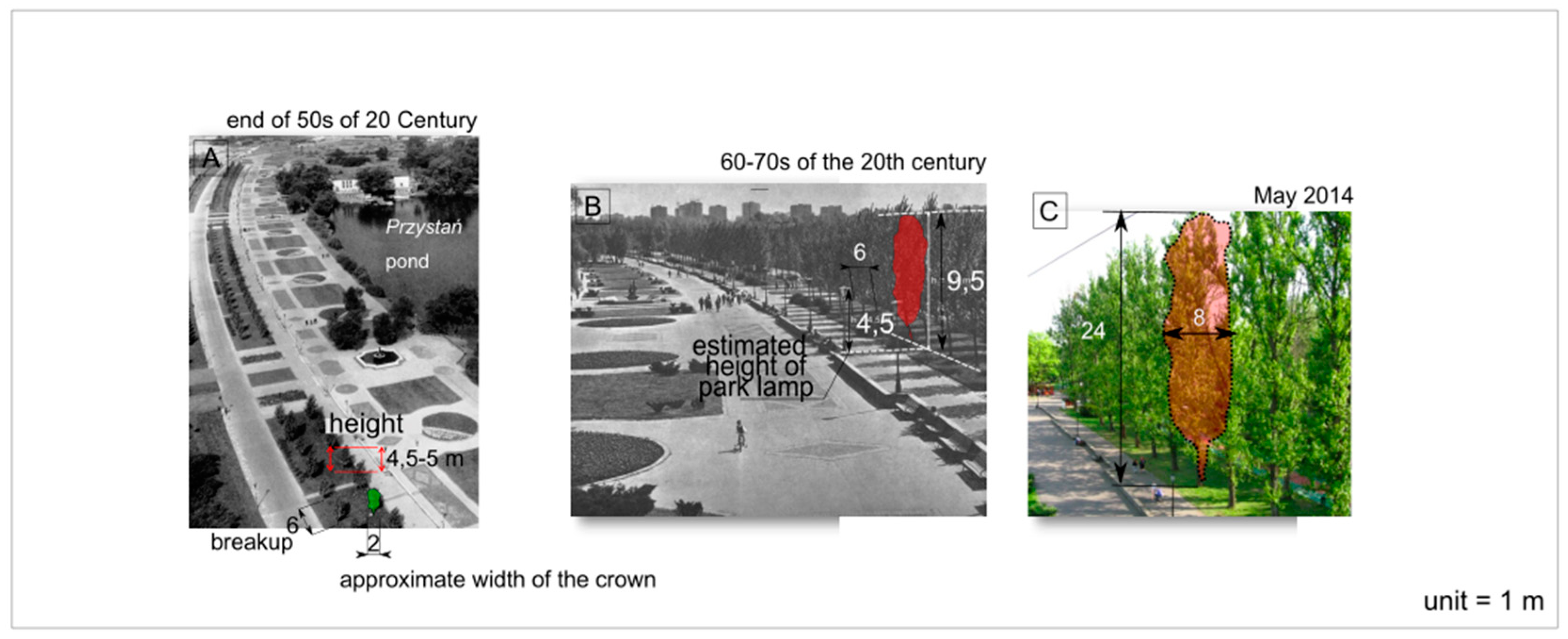
Figure 13.
The perfect condition of young trees (a) of Berlin poplars (Populus ×berolinensis (K. Koch)Dippel ‘Berlin’) planted in exchange of one section of Ziętka Promenade in Chorzów in 2016 together with general view (b) on promenade’s main way (J. Łukaszkiewicz 2018).
Figure 13.
The perfect condition of young trees (a) of Berlin poplars (Populus ×berolinensis (K. Koch)Dippel ‘Berlin’) planted in exchange of one section of Ziętka Promenade in Chorzów in 2016 together with general view (b) on promenade’s main way (J. Łukaszkiewicz 2018).
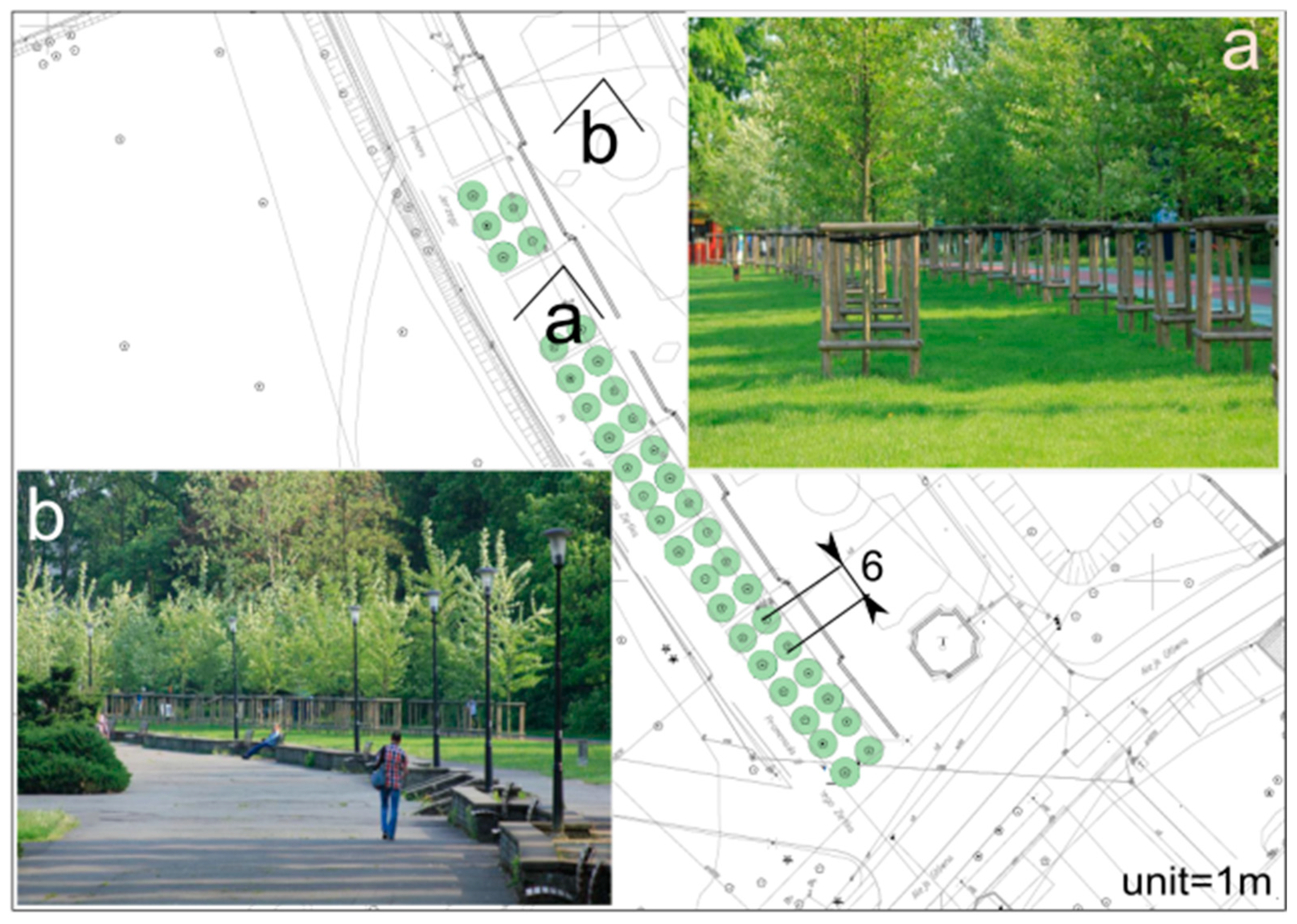

Table 1.
Selected examples of balsam poplar (Populus L.) species and hybrids used, among others, in afforestation of urban landscapes [authors elaboration based on: 117-119, 127,128].
Table 1.
Selected examples of balsam poplar (Populus L.) species and hybrids used, among others, in afforestation of urban landscapes [authors elaboration based on: 117-119, 127,128].
| Balsam poplar section (Tacamahaca) | |
|---|---|
| Subsection | Selected representative |
| American balsam poplars |
P. balsamifera (syn. P. tacamahaca) P. trichocarpa |
| Asian balsam poplars |
P. simonii P. maximowiczii P. laurifolia |
| Intra- and inter-sectional hybrids of balsam poplars |
Europe: P. ×berolinensis (K. Koch)Dippel ‘Berlin’ - Berlin poplar (male form) P. ×berolinensis (K. Koch)Dippel ‘Petrowskyana’ - Berlin poplar - so called “Tsar’s” (female); P. xberolinensis ‘Razumovskyana’ (female form) USA (in 1920s by E.J. Schreiner and A.B. Stout - the so-called Schreinerian hybrids): Populus ‘NE 49’ or ‘Hybrid 194’ (P. x ‘Hybrid 194’) Populus ‘NE 42’ or ‘Hybrid 275’ (P. x ‘Hybrid 275’) Populus ‘NE 44’ or ‘Hybrid 277’ (P. x ‘Hybrid 277’) Populus ‘Androscoggin’, ‘Geneva’, ‘Oxford’ |
Table 2.
Descriptive statistics of the parameters of the studied Berlin poplars near the SGGW of Rakowiecka Street in Warsaw in 2012 and 2024.
Table 2.
Descriptive statistics of the parameters of the studied Berlin poplars near the SGGW of Rakowiecka Street in Warsaw in 2012 and 2024.
| Parameter | Year | Age [years] | Descriptive statistics | t test | ||
|---|---|---|---|---|---|---|
| Mean (+/- SD) | Me | Min-Max | ||||
| height [m] | 2012 [n=16] | 85 | 23.87 (1.86) | 224.00 | 20.0-27.0 | p=0,0175 t=-2.536 |
| 2024 [n=12] | 97 | 25,5 (1.40) | 25.60 | 23.5-27.5 | ||
| circumference [cm] at 1.3 breast height | 2012 [n=16] | 85 | 225.87 (50.98) | 224.00 | 116.00-321.00 | p=0.4341 t=-0.794 |
| 2024 [n=12] | 97 | 241.33 (50.93) | 244.50 | 146.00-339.00 | ||
Table 3.
Descriptive statistics of the parameters of young studied Berlin poplars from Ziętek Promenade in Silesia Park in Chorzów in 2016, 2021 and 2023.
Table 3.
Descriptive statistics of the parameters of young studied Berlin poplars from Ziętek Promenade in Silesia Park in Chorzów in 2016, 2021 and 2023.
| Parameter | Year | Age [years] | Descriptive statistics | ||
|---|---|---|---|---|---|
| Mean (+/- SD) | Me | Min-Max | |||
| height [m] | 2016 [n=10] | 3 | 4.96 (0.10) | 5.0 | 4.8-5.1 |
| 2021 [n=10] | 8 | 8.40 (0.51) | 8.5 | 7.6-9.5 | |
| 2023 [n=10] | 10 | 13.90 (0.42) | 14.0 | 13.5-14.5 | |
| circumference [cm] at 1.3 breast height | 2016 [n=10] | 3 | 12.90 (0.87) | 13.0 | 12.0-14.0 |
| 2021 [n=10] | 8 | 63.65 (6.11) | 62.0 | 57.0-76.0 | |
| 2023 [n=10] | 10 | 79.80 (5.12) | 82.0 | 74.0-86.0 | |
| crown average diameter [m] | 2016 [n=10] | 3 | 2.17 (0.26) | 2.0 | 2.0-2.5 |
| 2021 [n=10] | 8 | 4.50 (0.33) | 4.5 | 4.0-5.0 | |
| 2023 [n=10] | 10 | 7.90 (0.26) | 8.0 | 7.5-8.2 | |
Table 4.
Descriptive statistics of the parameters of the examined poplars in Zietka Avenue in Chorzów Park in 2016, 2021 and 2023.
Table 4.
Descriptive statistics of the parameters of the examined poplars in Zietka Avenue in Chorzów Park in 2016, 2021 and 2023.
| Age | Parameter | growth/1 year | Correlation | ||
|---|---|---|---|---|---|
| R(X.Y) | t | p | |||
| 2-8 | height [m] | 0.69 | 0.9740 | 16.1 | <0.0001 |
| circumference 1.3 [cm] | 10.15 | 0.9831 | 20.1 | <0.0001 | |
| crown diameter [m] | 0.66 | 0.9689 | 14.6 | <0.0001 | |
| 8-10 | height [m] | 0.83 | 0.9853 | 20.8 | <0.0001 |
| circumference 1.3 [cm] | 5.38 | 0.8146 | 5.1 | <0.0002 | |
| crown diameter [m] | 1.33 | 0.9837 | 19.8 | <0.0001 | |
Disclaimer/Publisher’s Note: The statements, opinions and data contained in all publications are solely those of the individual author(s) and contributor(s) and not of MDPI and/or the editor(s). MDPI and/or the editor(s) disclaim responsibility for any injury to people or property resulting from any ideas, methods, instructions or products referred to in the content. |
© 2024 by the authors. Licensee MDPI, Basel, Switzerland. This article is an open access article distributed under the terms and conditions of the Creative Commons Attribution (CC BY) license (http://creativecommons.org/licenses/by/4.0/).
Copyright: This open access article is published under a Creative Commons CC BY 4.0 license, which permit the free download, distribution, and reuse, provided that the author and preprint are cited in any reuse.


