

Submitted:
15 November 2024
Posted:
18 November 2024
You are already at the latest version
Abstract
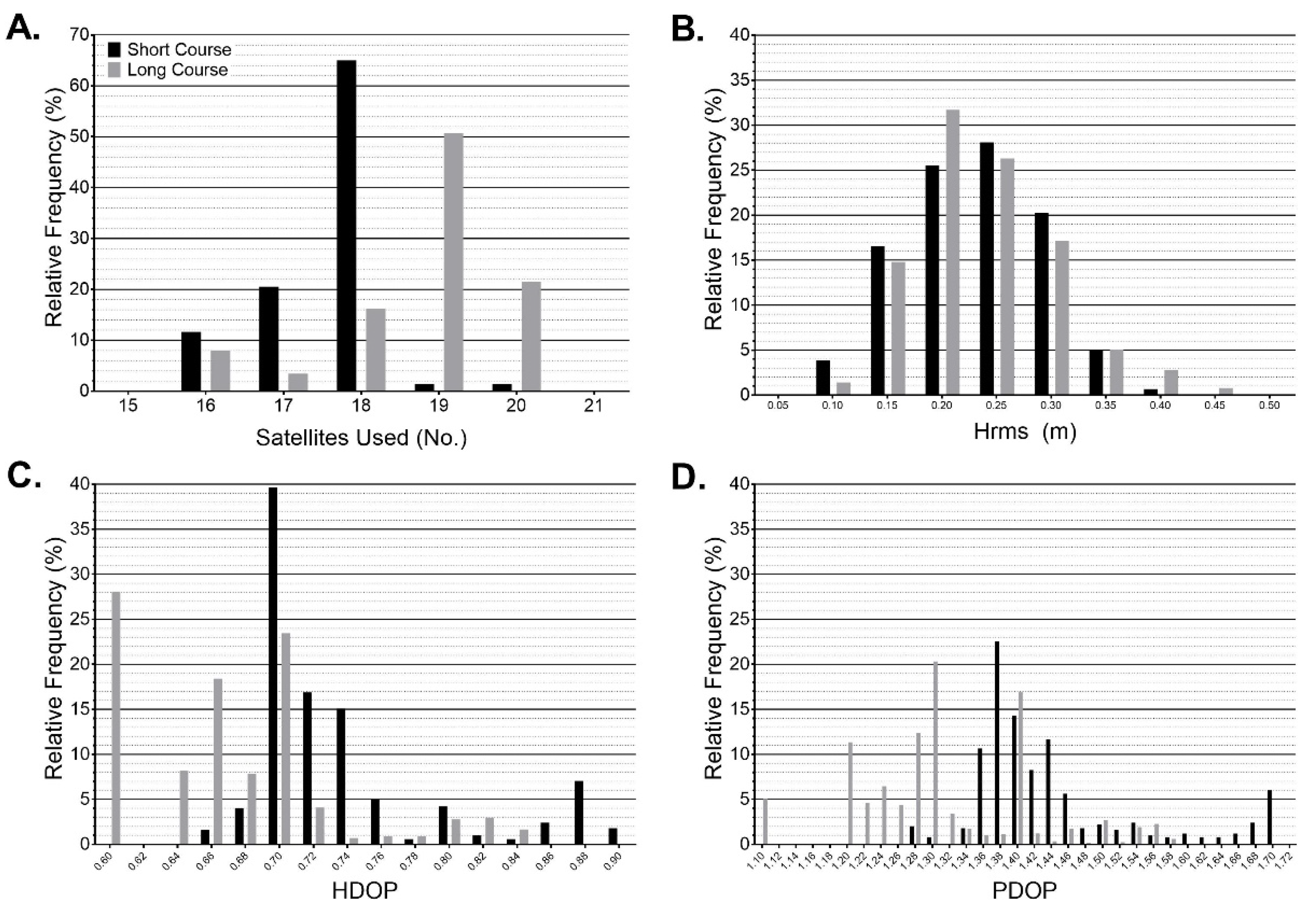
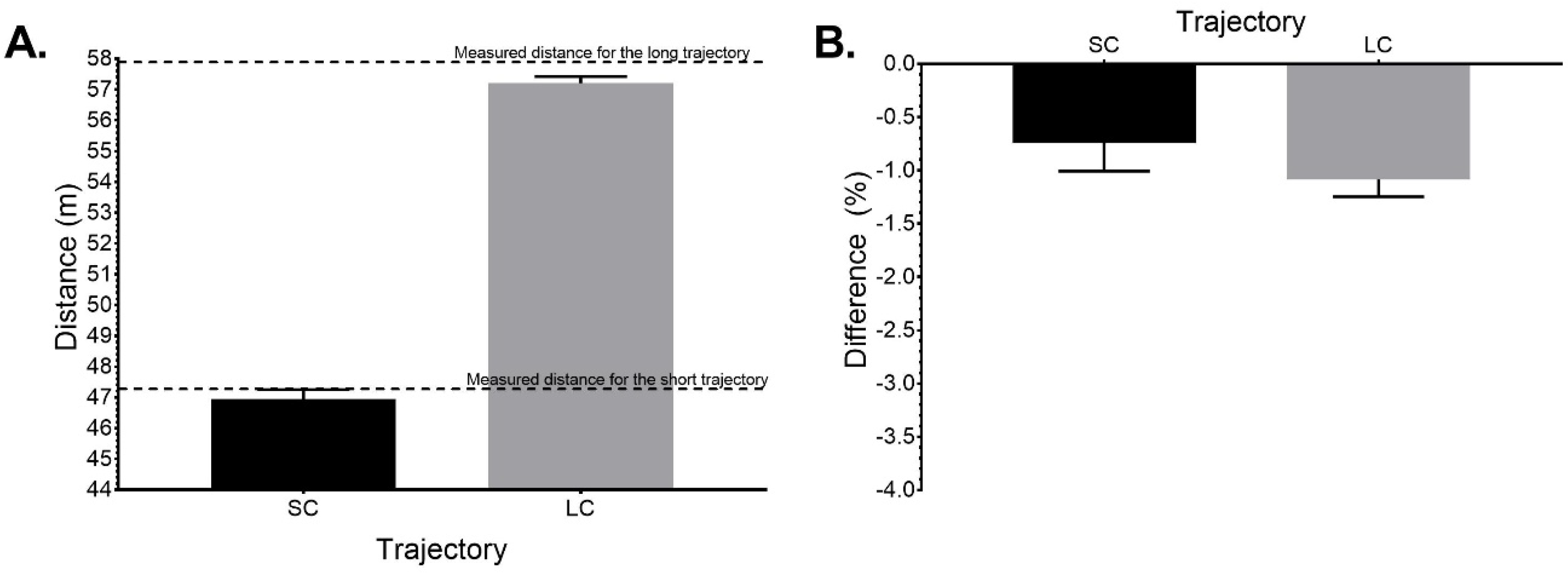
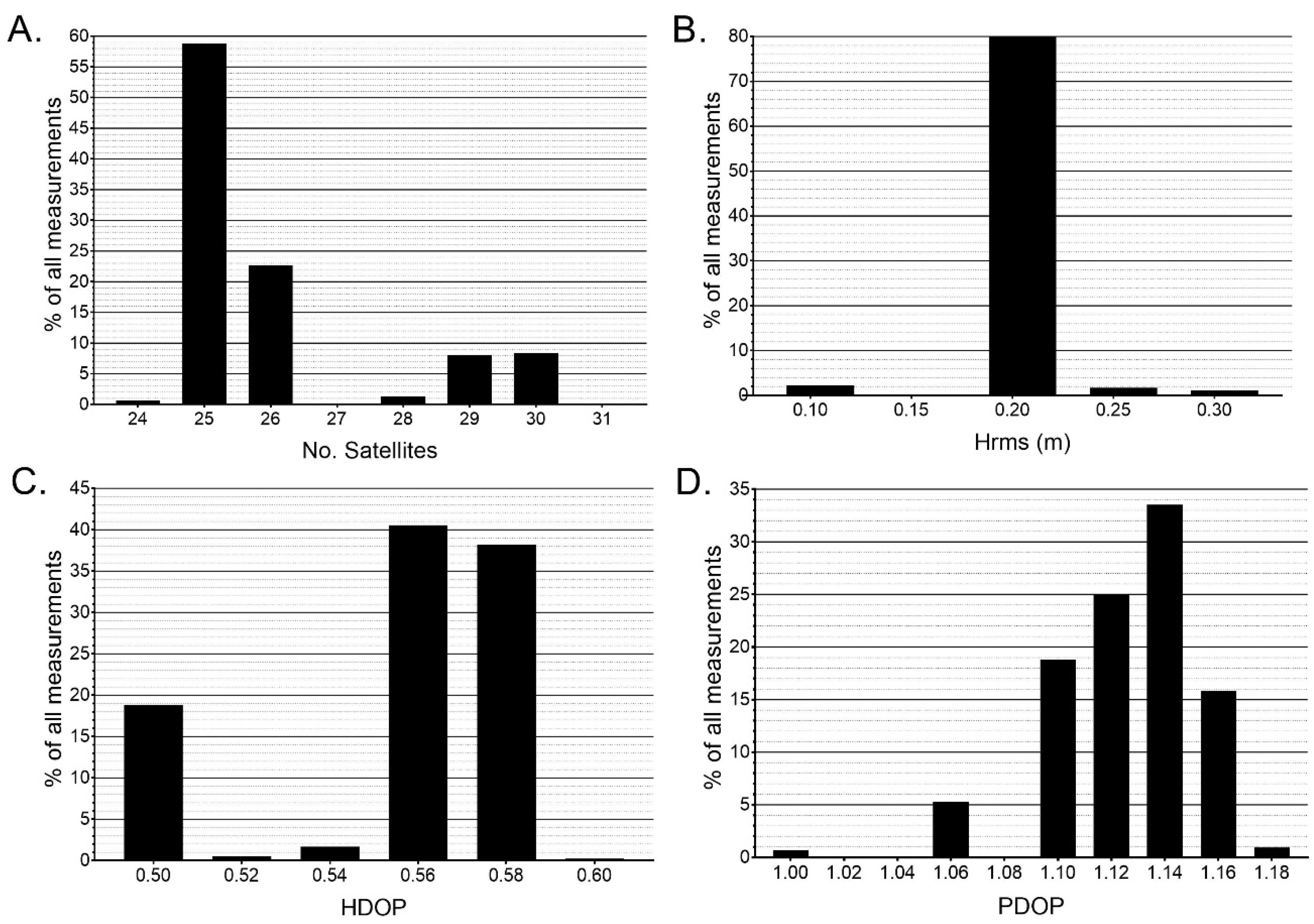
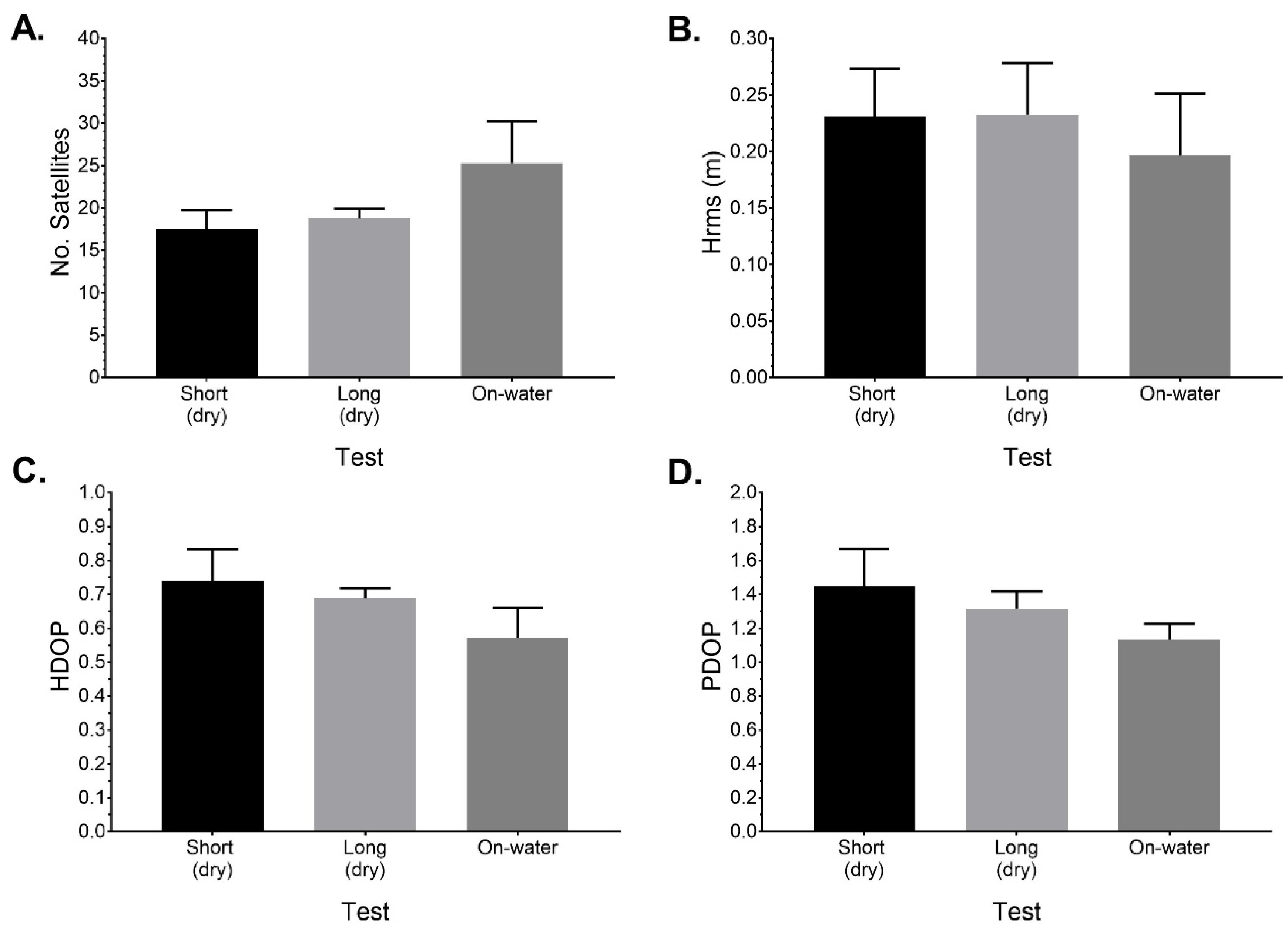
This study investigated the accuracy and precision of a commercially available PNT solution that uses DGNSS-SBAS technology. Time and position data were sampled at a frequency of 20Hz during both short and long trajectory of a simulated controlled dry-land slalom, as well as during a real-world on-water slalom exercise. The primary objective was to assess the positional accuracy, availability, integrity, and service continuity of the PNT solution while evaluating its ability to differentiate between trajectories. Additionally, the simulated results were compared with an on-water real-world slalom test to validate the findings. The results of the controlled dry-land slalom test indicate that the PNT solution provided accurate measurements with an overall mean±SD Hrms of 0.20±0.02m. The integrity measures, HDOD and PDOP were found to be ideal to excellent, with values of 0.68±0.03, and 1.36±0.07, respectively. The PNT solution utilised an average of 20±1 satellites from the constellation, resulting in an accuracy of <1.5% when measuring the known trajectory of 50 simulated slalom runs. The data from the real-world on-water slalom test supported these findings, providing similar or improved results. Based on these findings, a PNT solution using DGNSS-SBAS can be considered effective means of tracking athlete trajectory in the sport of canoe slalom. Future research should be conducted to quantify its efficacy more precisely.
Keywords:
1. Introduction
2. Materials and Methods
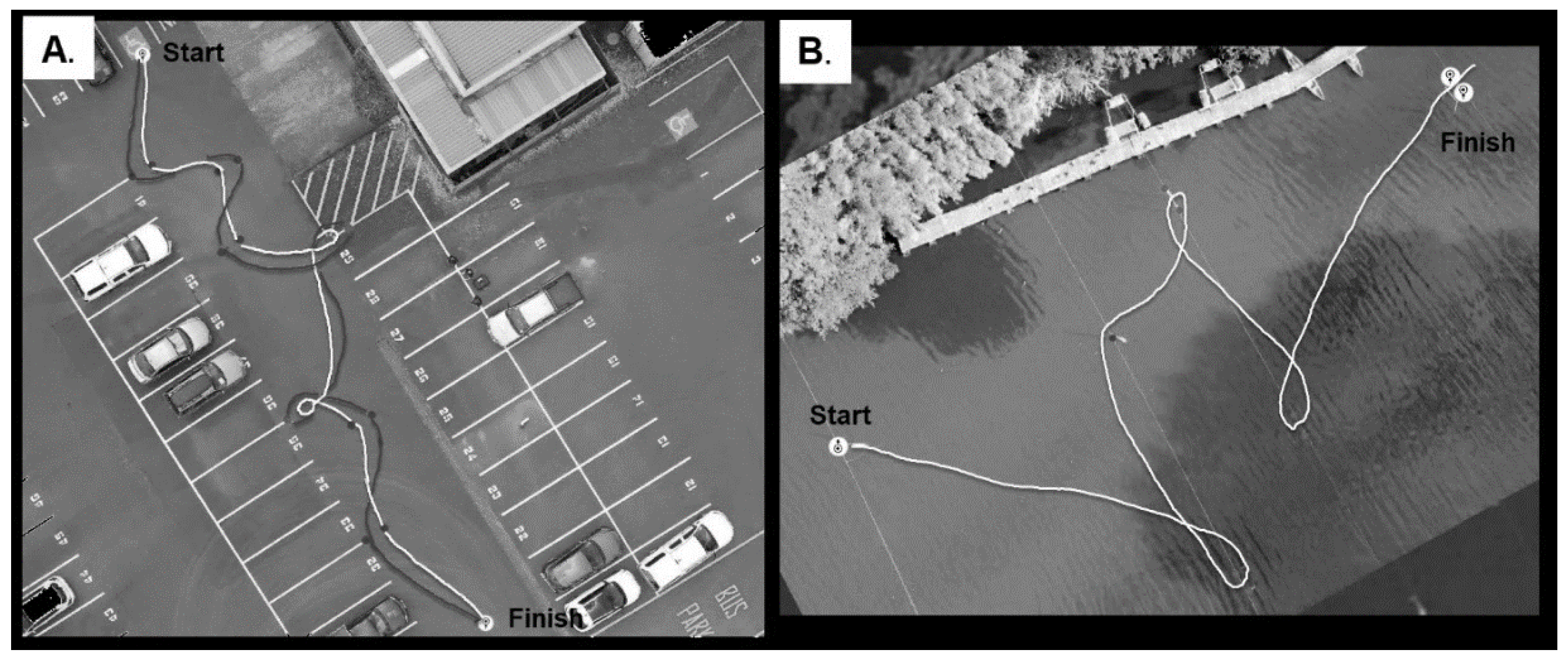
- All post-processing of logged raw data took place in ArcGis Pro (v3.2.0, ESRI, Redlands, CA, USA) where five steps:
- Load a georeferenced aerial image (DJI Matrice 300RTK, Zenmuse P1 35mm with 45 MP Full-frame sensor, Shenzhen, China).
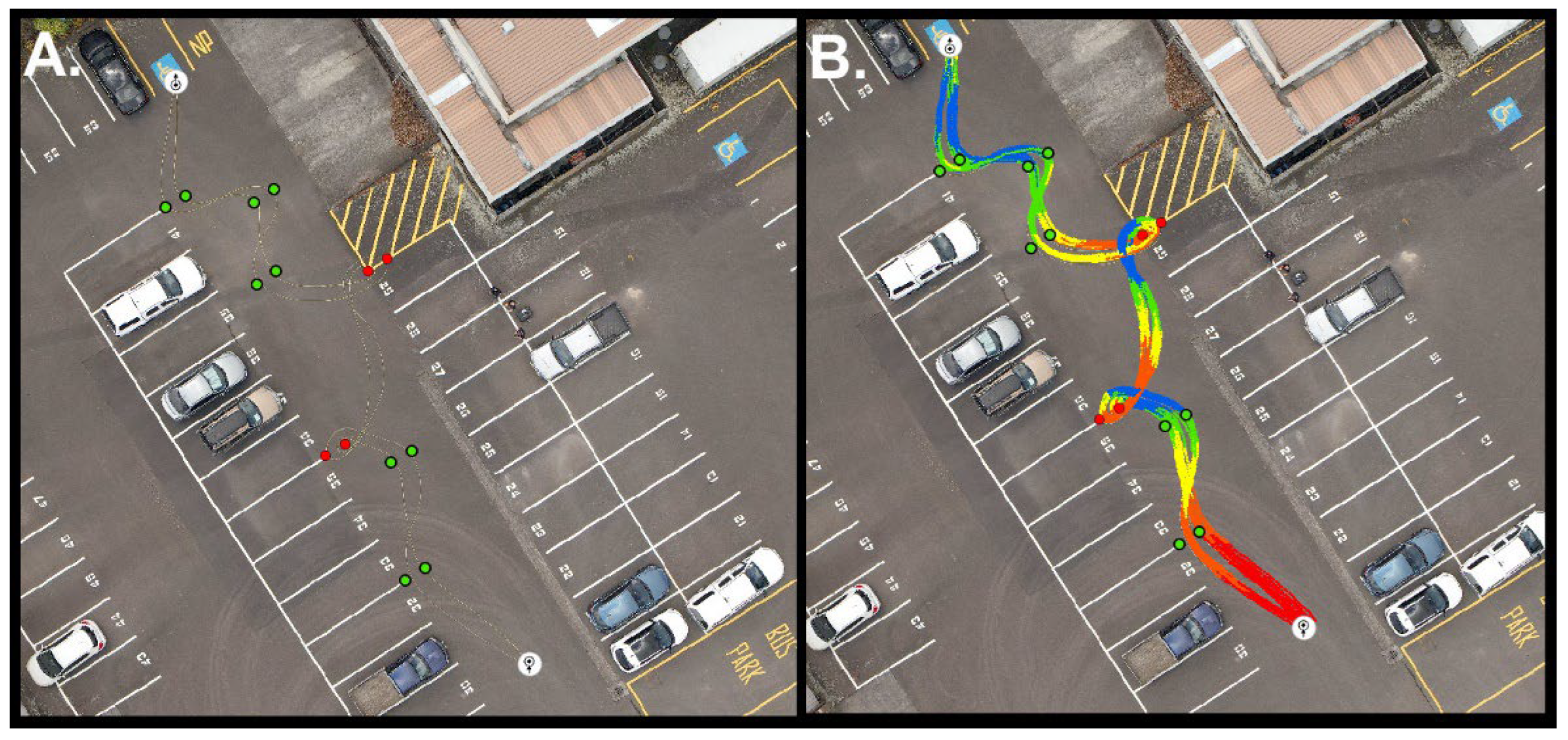
- Add slalom gates to the georeferenced image as a layer on top of the actual gates within the image.
- Load data from the PNT solution stored within the ArcGis Cloud.
- Perform a geographic transformation from NZGD_2000 to WGS_1984_UTMZone_60s.
- Export to data to statistical analysis software (Graphpad prism (V6.0f)).
2.1. Test 1: Dry land Slalom.
2.2. Test 2: On-water Slalom
2.3. Data Analysis
3. Results
3.1. Test 1: Dry-land Slalom
3.2. Test 2: On-Water Slalom
4. Discussion
Author Contributions
Funding
Institutional Review Board Statement
Informed Consent Statement
Conflicts of Interest
References
- ICF. Slalom Competition Rules. Available online: https://www.canoeicf.com/sites/default/files/2023_canoe_slalom_competition_rules.pdf (accessed on.
- MacIntyre, T.E.; Moran, A.P. A qualitative investigation of imagery use and meta-imagery processes among elite canoe-slalom competitors. J Imagery Res Sport Phys Activ 2007. [Google Scholar] [CrossRef]
- Hunter, A. Canoe slalom boat trajectory while negotiating an upstream gate. Sports Biomech. 2009, 8, 105–113. [Google Scholar] [CrossRef] [PubMed]
- Sigmund, M.; Rozsypal, R.; KUDLÁČEK, M.; KRATOCHVÍL, J.; Sigmundová, D. Influence of one-year sport activities on the changes in morphological parameters and somatotypes in the current junior members of the Czech national whitewater slalom team. Journal of Physical Education and Sport 2016, 16, 118. [Google Scholar]
- Macdermid, P.W.; Olazabal, T. The Relationship between Stroke Metrics, Work Rate and Performance in Slalom Kayakers. Biomechanics 2022, 2, 31–43. [Google Scholar] [CrossRef]
- Michael, J.S.; Smith, R.; Rooney, K.B. Determinants of kayak paddling performance. Sports Biomech. 2009, 8, 167–179. [Google Scholar] [CrossRef]
- Green, C. Performance analysis of canoe slalom: Performance indicators at cardiff international white water (ciww). University of Wales Institute Cardiff, 2012.
- Malek, K.; Mohamed, E.; Aboelmagd, N. GNSS Error Sources. In Multifunctional Operation and Application of GPS, Rustam, B.R., Arif, M.H., Eds.; IntechOpen: Rijeka, 2018; p. Ch. 4.
- Joardar, S.; Siddique, T.A.; Alam, S.; Hossam-E-Haider, M. Analyses of different types of errors for better precision in GNSS. In Proceedings of the 2016 3rd International Conference on Electrical Engineering and Information Communication Technology (ICEEICT), 22-24 Sept. 2016, 2016; pp. 1-6.
- Januszewski, J. Sources of error in satellite navigation positioning. TransNav: International Journal on Marine Navigation and Safety of Sea Transportation 2017, 11. [CrossRef]
- Wing, M.G.; Eklund, A.; Kellogg, L.D. Consumer-Grade Global Positioning System (GPS) Accuracy and Reliability. J. For. 2005, 103, 169–173. [Google Scholar] [CrossRef]
- Abd Rabbou, M.; El-Rabbany, A. Performance analysis of precise point positioning using multi-constellation GNSS: GPS, GLONASS, Galileo and BeiDou. Survey Review 2017, 49, 39–50. [Google Scholar] [CrossRef]
- Yu, X.; Gao, J. Kinematic Precise Point Positioning Using Multi-Constellation Global Navigation Satellite System (GNSS) Observations. ISPRS International Journal of Geo-Information 2017, 6, 6. [Google Scholar] [CrossRef]
- Li, L.; Jia, C.; Zhao, L.; Cheng, J.; Liu, J.; Ding, J. Real-Time Single Frequency Precise Point Positioning Using SBAS Corrections. Sensors 2016, 16, 1261. [Google Scholar] [CrossRef]
- Zabalegui, P.; Miguel, G.D.; Pérez, A.; Mendizabal, J.; Goya, J.; Adin, I. A Review of the Evolution of the Integrity Methods Applied in GNSS. IEEE Access 2020, 8, 45813–45824. [Google Scholar] [CrossRef]
- Huggins, R.A.; Giersch, G.E.; Belval, L.N.; Benjamin, C.L.; Curtis, R.M.; Sekiguchi, Y.; Peltonen, J.; Casa, D.J. The Validity and Reliability of Global Positioning System Units for Measuring Distance and Velocity During Linear and Team Sport Simulated Movements. J Strength Cond Res 2020, 34, 3070–3077. [Google Scholar] [CrossRef] [PubMed]
- Portas, M.D.; Harley, J.A.; Barnes, C.A.; Rush, C.J. The validity and reliability of 1-Hz and 5-Hz global positioning systems for linear, multidirectional, and soccer-specific activities. Int J Sports Physiol Perform 2010, 5, 448–458. [Google Scholar] [CrossRef] [PubMed]
- Hoppe, M.W.; Baumgart, C.; Polglaze, T.; Freiwald, J. Validity and reliability of GPS and LPS for measuring distances covered and sprint mechanical properties in team sports. PloS one 2018, 13, e0192708. [Google Scholar] [CrossRef] [PubMed]
- Wakeling, J.M.; Smiešková, S.; Pratt, J.S.; Vajda, M.; Busta, J. Asymmetries in paddle force influence choice of stroke type for canoe slalom athletes. Front Physiol 2023, 14, 1227871. [Google Scholar] [CrossRef]
- Nibali, M.; Hopkins, W.G.; Drinkwater, E. Variability and predictability of elite competitive slalom canoe-kayak performance. Eur J Sport Sci 2011, 11, 125–130. [Google Scholar] [CrossRef]
- Hunter, A.; Cochrane, J.; Sachlikidis, A. Canoe slalom – competition analysis reliability. Sports Biomech. 2007, 6, 155–170. [Google Scholar] [CrossRef]
- Macdermid, P.W.; Coppelmans, A.; Cochrane, D. The Validity and Reliability of a Global Navigation Satellite System in Canoe Slalom. Biomechanics 2022, 2, 20–29. [Google Scholar] [CrossRef]
- Isik, O.K.; Hong, J.; Petrunin, I.; Tsourdos, A. Integrity analysis for GPS-based navigation of UAVs in urban environment. Robotics 2020, 9, 66. [Google Scholar] [CrossRef]
- Jølstad, P.A.H.; Reid, R.C.; Gjevestad, J.G.O.; Gilgien, M. Validity of the admos, advanced sport instruments, GNSS sensor for use in alpine skiing. Remote Sensing 2022, 14, 22. [Google Scholar] [CrossRef]
- Gilgien, M.; Kröll, J.; Spörri, J.; Crivelli, P.; Müller, E. Application of dGNSS in Alpine Ski Racing: Basis for Evaluating Physical Demands and Safety. Front Physiol 2018, 9. [Google Scholar] [CrossRef]
- Tahsin, M.; Sultana, S.; Reza, T.; Hossam-E-Haider, M. Analysis of DOP and its preciseness in GNSS position estimation. In Proceedings of the 2015 International Conference on Electrical Engineering and Information Communication Technology (ICEEICT), 21-23 May 2015, 2015; pp. 1-6.
- Shabnam, M.; Chowdhury, I.H.; Tushar, Z.H.; Sultana, S.; Hossam-E-Haider, M. Performance evaluation of GNSS receiver in multi-constellation system. In Proceedings of the 2017 International Conference on Electrical, Computer and Communication Engineering (ECCE), 16-18 Feb. 2017, 2017; pp. 610-614.
- Padokhin, A.M.; Mylnikova, A.A.; Yasyukevich, Y.V.; Morozov, Y.V.; Kurbatov, G.A.; Vesnin, A.M. Galileo E5 AltBOC Signals: Application for Single-Frequency Total Electron Content Estimations. Remote Sensing 2021, 13, 3973. [Google Scholar] [CrossRef]
- MacLeod, H.; Morris, J.; Nevill, A.; Sunderland, C. The validity of a non-differential global positioning system for assessing player movement patterns in field hockey. J. Sports Sci. 2009, 27, 121–128. [Google Scholar] [CrossRef] [PubMed]
- Mahato, S.; Santra, A.; Dan, S.; Verma, P.; Banerjee, P.; Bose, A. Visibility anomaly of GNSS satellite and support from regional systems. Curr. Sci. 2020, 119, 1774–1782. [Google Scholar] [CrossRef]

| Base station distance (km) | Sat No. Used | Hrms | PDOP | HDOP | ||||
| static | moving | static | moving | static | moving | static | moving | |
| 18 | 17±0 | 17±0 | 0.09±0.02 | 0.19±0.03 | 1.43±0.07 | 1.50±0.00 | 0.80±0.00 | 0.76±0.05 |
| 50 | 25±1 | 23±1 | 0.11±0.00 | 0.20±0.02 | 1.07±0.05 | 1.00±0.00 | 0.75±0.05 | 0.50±0.00 |
Disclaimer/Publisher’s Note: The statements, opinions and data contained in all publications are solely those of the individual author(s) and contributor(s) and not of MDPI and/or the editor(s). MDPI and/or the editor(s) disclaim responsibility for any injury to people or property resulting from any ideas, methods, instructions or products referred to in the content. |
© 2024 by the authors. Licensee MDPI, Basel, Switzerland. This article is an open access article distributed under the terms and conditions of the Creative Commons Attribution (CC BY) license (http://creativecommons.org/licenses/by/4.0/).