

Submitted:
21 February 2024
Posted:
21 February 2024
You are already at the latest version
Abstract
Redox mediators comprising I–, Co3+, and Ti3C2Tx MXene were applied to dye-sensitized solar cells (DSCs). In the as-prepared DSCs (I-DSCs), wherein hole conduction occurred via the redox reaction of I−/I3− ions, the power conversion efficiency (PCE) was not altered by the addition of Ti3C2Tx MXene. The I-DSCs were exposed to light to produce Co2+/Co3+-based cells (Co-DSCs), wherein the holes were transferred via the redox reaction of Co2+/Co3+ ions. A PCE of 9.01% was achieved in a Co-DSC with Ti3C2Tx MXene (Ti3C2Tx-Co-DSC), which indicated an improvement from the PCE of a bare Co-DSC without Ti3C2Tx MXene (7.27%). It was also found that the presence of Ti3C2Tx MXene in the redox mediator increased the hole collection, dye regeneration, and electron injection efficiencies of the Ti3C2Tx-Co-DSC, leading to an improvement in both the short-circuit current and the PCE when compared with those of the bare Co-DSC without MXene.
Keywords:
dye-sensitized solar cell
; redox mediator
; Ti3C2Tx MXene
; hole conduction
1. Introduction
Two-dimensional (2D) materials are typically crystalline solids consisting of a single layer of atoms. These materials are considered promising for various applications, which explains why they remain the focus of research. MXenes with a general formula of Mn+1XnTx (where n = 1−3; M denotes a transition metal; X is either carbon or nitrogen; and Tx indicates surface terminal groups such as −OH, −F, −Cl, and/or −O−) were created by selectively etching the “A” layers from layered MAX phases (Mn+1AXn, where A is usually any element from among Cd, Al, Si, P, S, Ga, Ge, As, In, Sn, Tl, Pb, and S [groups 12–16]) and can be easily solution-processed in aqueous or polar organic solvents due to their hydroxyl- or oxygen-terminated surfaces [1,2,3,4]. Following the production of multilayered Ti3C2Tx MXene by etching the Al layers from the Ti3AlC2 MAX phase in 2011 at Drexel University [1], numerous related research results have been reported in the fields of energy storage, sensors, light-emitting diodes, electromagnetic shielding, and environmental applications [2,3,4]. In addition, MXenes have been extensively studied in relation to applications concerning solar cells, given their metallic conductivity, excellent charge carrier mobility, high optical transmittance, and tunable work function [5,6,7,8]. Among the various MXenes, Ti3C2Tx is the most commonly studied in terms of third-generation solar cells, such as dye-sensitized solar cells (DSCs) [9,10,11], perovskite solar cells [12,13,14], and polymer solar cells [15,16]. A conventional DSC is composed of a dye-adsorbed TiO2 layer on a transparent electrode (i.e., a working electrode), a liquid electrolyte, and a Pt catalytic layer on a conductive electrode (i.e., a Pt counter electrode). Light absorption in dye molecules leads to the formation of excitons (electron–hole pairs), and the excited electrons are injected into the TiO2 layer. The photoinjected electrons and the holes in the dye molecules are transported to the electrodes via the TiO2 layer and the electrolyte, respectively. Finally, the electrons and holes are collected in the electrodes, allowing electron flows through the external circuits to occur [17,18]. The hole-conducting electrolyte is comprised of redox couples and electrical additives [19,20]. The redox couples, such as I−/I3−, Co+2/Co+3, Cu+1/Cu+2, and Ni+3/Ni+4, are reduced near the Pt counter electrode and oxidized near the excited dye molecules, thereby allowing for hole collection and dye regeneration, respectively. Electrical additives such as 4-tert-butylpyridine (TBP) and cations (lithium [Li+] or guanidinium [C(NH2)3+]) represent another important ingredient in a liquid electrolyte for enhancing the photovoltaic parameters of cells. These additives can control the potential of the redox couple, the surface state of the TiO2 semiconductor, the shift in the conduction band edge, and the interfacial charge recombination through being incorporating in small amounts [20]. Ti3C2Tx MXene was introduced as an additive for electrolytes to improve the photovoltaic performance of quasi-solid-state DSCs [21,22]. Sun et al. reported that, via the addition of Ti3C2Tx MXene to a quasi-solid-state electrolyte composed of an I−/I3− redox couple and a melamine-formaldehyde (MF) sponge, the average power conversion efficiency (PCE) of the DSCs under a room light condition (1000 lux) was improved by 26.92% from that of the reference cell without MXene (23.35%) [21]. It was also reported that a PCE of 29.94% under a condition of 1000 lux was achieved through the incorporation of both reduced graphene oxide and Ti3C2Tx to a quasi-solid-state electrolyte containing an I−/I3− redox couple, polyethylene oxide (PEO), and poly(vinylidene fluoride-co-hexafluoropropylene) (PVDF-HFP) [22].
In this study, we report the effects of Ti3C2Tx MXene addition to a liquid electrolyte on the photovoltaic performance of cells. Ti3C2Tx-dispersed liquid electrolytes based on a metal complex (tris(2-(1H-pyrazol-1-yl)-4-tert-butylpyridine)cobalt(III) tri[bis(trifluoromethane)sulfonimide] [FK209]) as a source of Co3+ and an ionic liquid (1-methyl-3-propylimidazolium iodine [MPII]) as a source of I− (iodide) were first prepared. Then, DSCs with Ti3C2Tx-dispersed Co3+/I− liquid electrolytes (redox mediators) were fabricated and their photovoltaic properties were compared with those of the reference cell without Ti3C2Tx MXene. To the best of our knowledge, this is the first report on the effects of Ti3C2Tx addition to Co complex (Co3+)/ionic liquid (I−)-based redox mediators. The reported photovoltaic parameters (short-circuit current [Jsc], open-circuit voltage [Voc] and fill factor [FF]) of the DSCs with Ti3C2Tx MXene are summarized in Table 1, including those of our devices with FK209 (Co3+)/MPII (I−)/Ti3C2Tx-based liquid electrolytes.
2. Results and Discussion
2.1. Photovoltaic Performance of DSCs Based on Ti3C2Tx-Incorporated Co3+/I− Redox Mediators
In a previous report, we revealed that, through the simple mixing of MPII and FK209, triiodide (I3−) and Co2+(FK209) were produced via a chemical reaction (1) between the iodide (I−) of MPII and Co3+(FK209), where Co2+(FK209) and Co3+(FK209) are the Co2+ and Co3+ ions of FK209, respectively. Since the Co3+(FK209) was almost fully converted into Co2+(FK209), the redox mediators contained both I3− and Co2+(FK209) as well as I− (originating from non-reacted MPII) [23]. Therefore, hole conduction occurs through reactions (2)–(5) when as-prepared DSCs are exposed to the AM 1.5 condition, indicating that the I−/I3− redox couple is involved in the dye regeneration (reaction [4]) and hole collection (reaction [5]). Here, we code the as-prepared DSCs based on the I−/I3− redox couple as I-DSCs.
3I− + 2Co3+(FK209) → I3− + 2Co2+(FK209)
2Dye + hν → 2Dye*
2Dye* → 2Dye+ + 2e− (TiO2)
3I− + 2Dye+ → I3− + 2Dye
I3− + 2e− (Pt) → 3I−
Using the FK209 (Co3+)/MPII (I−) redox mediators with or without Ti3C2Tx MXene, DSCs were fabricated and the variations in the photovoltaic parameters were investigated. The average photovoltaic performance measured using the four I-DSCs (i.e., the as-prepared DSCs) are compared in Figure 1 and Table 2, while the raw data are presented in Table S1 in the electronic supplementary information (ESI). Through the incorporation of Ti3C2Tx MXene into the Co3+/I− liquid redox mediators, the average Jsc value of the I-DSCs was enhanced, whereas the average Voc value was decreased when compared with the values of the device without MXene, as shown in Figure 1a,b, respectively. As a result, the average PCE of the I-DSCs with Ti3C2Tx was very similar to that of the cells without Ti3C2Tx.
Moreover, it was also found that chemical reactions (6) and (7) occurred through the exposure of the I-DSCs to light for a certain time [23]. Under illumination, the Co2+(FK209) that was produced via reaction (1) reduced the oxidized dye (Dye+), thereby regenerating Co3+(FK209) at the dye/redox mediator interface (reaction [6]). The resulting Co3+(FK209) diffused to the counter electrode and then reduced to Co2+(FK209) through receiving an electron from the platinized FTO electrode (reaction [7]), indicating that the Co2+/Co3+ redox couple is related to the dye regeneration (reaction [6]) and hole collection (reaction [7]). This may lead to an increase in the Voc value of the Co2+/Co3+-based cell when compared with that of the I−/I3−-based cell, as the potential gap between the conduction band edge (CBE) of the TiO2 and the redox potential (1.06 V versus a normal hydrogen electrode [NHE]) of the Co2+/Co3+(FK209) is wider than that (0.35 V versus a NHE) of the I−/I3− electrolyte [24,25,26]. Here, we code the DSCs based on the Co2+/Co3+ redox couple as Co-DSCs, which were transformed from the I-DSCs via exposure to AM 1.5 light. To determine the time taken to convert the I-DSCs into Co-DSCs, we measured the Voc variations with the light-exposure time of the I-DSCs. As shown in Figure S1, the Voc values improved with an increasing exposure time and then saturated after over a period of 150 min. This indicates that hole conduction mainly occurred through the action of the Co2+/Co3+ redox couple after exposure of the I-DSCs to light for over 150 min. To investigate effects of the MXene incorporation in Co-DSCs, the I-DSCs with or without Ti3C2Tx MXene were exposed to AM 1.5 condition for 150 min and their photovoltaic performance was measured. As a reference, the Voc values of the Co-DSCs was sharply increased when compared with those of the I-DSCs due to the wider potential gap between the TiO2’s CBE and the Co2+/Co3+(FK209)’s redox potential, as mentioned above. This suggests that the Co2+/Co3+(FK209) rather than the I−/I3− redox couple participates in the hole conduction (reactions [6] and [7]) in the Co-DSCs.
2Co2+(FK209) + 2Dye+ → 2Co3+(FK209) + 2Dye
2Co3+(FK209) + 2e− (Pt) → 2Co2+(FK209)
Through the addition of MXene, a substantial enhancement of the Jsc and a slight decrement in the Voc values were observed in the Co-DSCs with Ti3C2Tx when compared with those of the reference cell without MXene, as shown in Figure 1a,b, respectively. There was no meaningful variation in the FF value, as demonstrated in Figure 1c. As a consequence, an improvement in the PCE was recorded in the MXene-incorporated Co-DSCs because the increase in the Jsc overcame the decrement in the Voc value, as shown in Figure 1d. Among the four cells, we focused on the best-performing cells to reveal the origins of the improvement in the PCE via the incorporation of Ti3C2Tx MXene into Co3+/I− liquid redox mediators. Here, we denote the best-performing Co-DSCs with or without Ti3C2Tx MXene as Ti3C2Tx-Co-bDSC or bare Co-bDSC, respectively. Figure 2 presents the current density–voltage (J–V) curves of the Ti3C2Tx- and bare Co-bDSC, while the cell performance is compared in Table 3.
2.2. Effects of Ti3C2Tx Incorporation on the Jsc of Co-DSCs
Through the incorporation of Ti3C2Tx MXene into the Co3+/I− redox mediator, the Jsc value (18.45 mA/cm2) of the Ti3C2Tx-Co-bDSC was substantially improved from that of the bare Co-bDSC (14.41 mA/cm2). It is believed that the conductive Ti3C2Tx MXene present in the Co2+/Co3+(FK209) electrolyte reduced the charge transfer resistance and improved the electrocatalytic performance between the Co3+(FK209) and the platinized FTO electrode, thereby leading to a reduction in the internal resistances and, therefore, an increase in the Jsc value of the Ti3C2Tx-Co-bDSC [21,22,27]. To confirm this, impedance spectroscopic (EIS) analysis was performed for the bare and Ti3C2Tx-Co-bDSC. Figure 3a shows the Nyquist plots of the EIS spectra of the Co-DSCs, as measured at the open-circuit condition under under AM 1.5 one-sun illumination, providing the series (Rs) and internal resistances. Three typical arcs, corresponding to the resistance (R1) of the redox reaction at the platinized FTO/electrolyte interface in the high-frequency region, the electron transfer resistance (R2) at the TiO2/dye/electrolyte interface in the medium-frequency region, and the ionic diffusion resistance (R3) within the electrolyte, were observed. A smaller R1 value (around 3.18 Ω) was measured in the Ti3C2Tx-Co-bDSC when compared with that of the bare Co-bDSC (around 4.11 Ω). This indicates that the incorporation of Ti3C2Tx MXene can lead to an improvement in the electrocatalytic performance, causing an increase in the hole collection efficiency, when considering that the R1 value is related to the reduction of the Co3+(FK209) by the Pt catalyst (chemical reaction [7]) [21,22,27]. In addition, it is considered that the reduced resistance (R1) associated with chemical reaction (7) can effectively produce Co2+(FK209), resulting in the promotion of dye regeneration (chemical reaction [6]) [27].
Furthermore, a shift in the TiO2’s CBE could be estimated from the dark current curves of the DSCs [28,29,30]. Figure 4 presents the dark current–voltage curves of the bare- and Ti3C2Tx-Co-bDSCs. The onset potential of the dark current for the bare Co-bDSC was estimated to be approximately 0.771 V, whereas the onset potential for the Ti3C2Tx-Co-bDSC was shifted to approximately 0.661 V. Through the incorporation of Ti3C2Tx MXene, a lower onset potential was recorded, indicating that the potential difference between the work function of the FTO and the TiO2’s CBE in the Ti3C2Tx-Co-bDSC was smaller than that in the bare Co-bDSC. This suggests that the TiO2’s CBE in the Ti3C2Tx-Co-bDSC was located at a more positive potential than that in the bare Co-bDSC. It is thought that the Ti3C2Tx MXene particles are adsorbed on the TiO2 surface, causing a surface dipole to be formed and resulting in a positive shift in the TiO2’s CBE. This positive shift (away from the vacuum level) of the CBE in the Ti3C2Tx-Co-bDSC may lead to the more favorable injection of photoexcited electrons from the dye into the TiO2 due to the larger potential difference between the dye’s lowest unoccupied molecular orbital level and the TiO2’s CBE, thereby resulting in an improvement in the electron injection efficiency [31]. Thus, it is considered that the more positive shift of the TiO2’s CBE in the Ti3C2Tx-Co-bDSC yielded a higher electron injection efficiency than the bare Co-bDSC. A similar result was reported in relation to the incorporation of Ti3C2Tx MXene into the mesoporous TiO2 layer, which induced a positive shift in the TiO2’s CBE, leading to an enhancement of the electron injection efficiency [32]. Overall, we attributed the enhanced Jsc value in the Ti3C2Tx-Co-bDSC to the increases in both the hole collection and the dye-regeneration efficiency, which resulted from the reduced internal resistances, as well as to the improvement in the electron injection efficiency due to the positive shift of the TiO2’s CBE.
2.3. Effects of Ti3C2Tx Incorporation on the Voc of Co-DSCs
The Voc value (0.760 V) of the Ti3C2Tx-Co-bDSC was decreased when compared with that of the bare Co-bDSC (0.780 V). As expressed in Equation (8), the Voc value of the DSCs under constant illumination can be expressed as a function of the quasi-Fermi level (EFn) and the dark value (EF0), which is related to the thermal energy (kBT; 4.11 × 10⁻²¹ J at 25°C), Boltzmann constant (kB), absolute temperature (T), positive elementary charge (e; 1.602 × 10⁻¹⁹ C), concentration in the dark (n0), and free electron density of the TiO2 photoelectrode (n) [33,34,35]. Equation (8) indicates that the Voc is affected by n, which is closely related to the back electron transfer (BET) reaction that occurs between the photoinjected electrons and the ions in the electrolyte. As the BET reaction decreases the n value, suppression of the BET reaction is necessary to increase the Voc. The n value can be estimated by measuring the lifetime of the electrons photoinjected into the TiO2, where a longer electron lifetime can increase the n value and, therefore, the Voc. Figure 3b shows Bode phase plots of the EIS spectra of the bare and Ti3C2Tx-Co-bDSCs. Using the peak frequencies (fmax) of 38.2 Hz and 45.5 Hz obtained from the EIS Bode phase plots of the bare and Ti3C2Tx-Co-bDSCs, respectively, the electron lifetime (τn) was estimated using Equation (9) [29,36]. The calculated electron lifetimes were 4.16 ms and 3.50 ms for the bare and Ti3C2Tx-Co-bDSCs, respectively. A shortened lifetime on the part of the electrons injected from the photoexcited dyes was observed for the Ti3C2Tx-Co-bDSC relative to that of the control cell (bare Co-bDSC), indicating that the BET reaction (chemical reaction [10]) in the Ti3C2Tx-Co-bDSC occurred faster than that in the bare Co-bDSC.
Co3+(FK209) + e− (TiO2) → Co2+(FK209)
To further confirm that the BET reaction was faster in the Ti3C2Tx-Co-bDSC, Nyquist plots of the EIS spectra measured at −0.7 V in the dark were obtained, as shown in Figure 5a. When the EIS measurement is performed in the dark, electrons are injected from the FTO into the TiO2 under external applied voltage and then transferred to the electrolyte. Thus, the R2′ value of the Nyquist plot measured in the dark corresponds to the resistance of the BET reaction between the Co3+(FK209) in the electrolyte and the electrons injected into the TiO2 conduction band (reaction [10]). It was observed that the arc of the impedance component R2′ in the Ti3C2Tx-Co-bDSC was smaller than that in the bare Co-bDSC. The smaller semicircle in the R2′ suggests that the BET reaction at the TiO2/dye/electrolyte interface was faster [34,35]. Moreover, from the peak frequencies (fmax) given in Figure 5b and Equation (9), the lifetime of the electrons injected from the FTO was calculated to be 11.9 ms and 8.4 ms for the bare and Ti3C2Tx-Co-bDSCs, respectively. The same tendency in terms of a shortened electron lifetime was observed in the measurements under illumination (Figure 3b) and dark conditions (Figure 5b). Overall, a faster BET reaction resulted in a lower n value, leading to a decrease in the Voc of the Ti3C2Tx-Co-bDSC based on Equation (8). Furthermore, the reduced Voc value in the Ti3C2Tx-Co-bDSC can be explained by the positive shift in the TiO2’s CBE, as discussed above (Figure 4). The lower n value can cause the positioning of the TiO2’s CBE to shift in a positive direction, lowering the Voc value due to the narrower potential gap between the TiO2’s CBE and the redox potential of the electrolyte [39,40]. It is considered that this decrease in the Voc (or n) value originated from the adsorption of the Ti3C2Tx MXene on the TiO2 surface. More specifically, the electronically conductive Ti3C2Tx MXene particles could provide pathways for chemical reaction (10)—that is, the BET reaction between the photoinjected electrons and the Co3+(FK209) in the redox mediator.
As a reference, the shorter electron lifetime observed in the Ti3C2Tx-Co-bDSC may decrease the electron collection on the FTO and, therefore, the Jsc value. In this study, it is believed that the enhanced hole collection, dye regeneration, and electron injection efficiencies surpassed the decreased electron collection efficiency.
2.4. Long Long-Term Stability of the Bare- and Ti3C2Tx-Co-bDSCs
We compared the long-term stability of the bare- and Ti3C2Tx-Co-bDSCs by evaluating their photovoltaic properties over time. Here, the fabricated devices were additionally sealed using hot-melt glue sticks to minimize the electrolyte leakage. Prior to the measurement of the photovoltaic performance, the I-DSCs with or without Ti3C2Tx MXene were converted into Co-DSCs through exposing them to the AM 1.5 condition for 150 min. Figure 6 compares the time-dependent performance variations of the cells stored at room temperature in the dark. Similar decay curves were noted in both devices, indicating that the incorporation of Ti3C2Tx MXene into the redox mediator did not affect the devices’ stability.
3. Materials and Methods
3.1. Materials
To fabricate DSCs, the same materials as those used in our previous report were utilized [23]. Detailed their information is provided in the ESI. The acetonitrile solvent used to prepare the liquid electrolytes was procured from Daejung Chemicals and Metals Co., Ltd. (Gyeonggi-do, Korea). Colloidal suspension of single-layer Ti3C2 in acetonitrile (2 mg Ti3C2/mL) (BK2020082105-08) was purchased from Beijing Beike New Material Technology Co., Ltd. (Jiangsu, China). All the chemicals used for DSC fabrication were exploited without further purification. The single-layer Ti3C2Tx MXene structure is illustrated in Figure S2 in the ESI. The chemical structures of the main components (FK209 and MPII) and additives (LiTFSI and TBP) of the electrolyte are shown in Figure S3 in the ESI.
3.2. Preparation of Co3+/I−-Based Liquid Electrolytes with or without Ti3C2Tx
The Ti3C2Tx-dispersed liquid electrolyte based on a Co3+/I− redox mediator was prepared by dissolving MPII (0.6 M, 302.5 mg), FK209 (0.015 M, 15.2 mg), TBP (0.11 M, 32.4 mg), and LiTFSI (0.04 M, 22.8 mg) in the single-layer Ti3C2Tx colloid (2 ml). For the purpose of comparison, Co3+/I−-based liquid electrolytes without Ti3C2Tx were also prepared by simply replacing the Ti3C2Tx colloid with acetonitrile solvent (2 ml).
3.3. Fabrication of DSCs
Similar procedures to those described in our previous work were utilized to prepared the working (glass/FTO/TiO2:dye) and counter (glass/FTO/Pt) electrodes for the DSCs [23]. A 60-μm-thick hot-melt adhesive was placed between the working and counter electrodes and then annealed for 10 min at 120 °C to seal the two electrodes. The Co3+/I−-based liquid electrolytes with or without Ti3C2Tx MXene were injected into the cells through one of the two small holes predrilled into the counter electrodes. By sealing the two holes, we were able to fabricate DSCs with a 25 mm2 active area. Detailed procedures are mentioned in the ESI.
3.4. Measurements
Photovoltaic performance measurements, EIS analyses and dark current studies were carried out. All the measurements were performed under ambient conditions at room temperature. Detailed information for the measuring instruments is presented in the ESI.
4. Conclusions
The photovoltaic properties of DSCs with or without Ti3C2Tx MXene in Co3+/I−-based redox mediators were investigated in this study. Through the incorporation of Ti3C2Tx MXene into the Co3+/I− liquid redox mediators, the average Jsc value of the I-DSCs, in which hole conduction occurred via the redox reaction of the I− and I3− ions, was enhanced, whereas the average Voc value was decreased when compared with that of the device without the MXene. As a result, the average PCE of the I-DSCs with Ti3C2Tx was very similar to that of the cells without Ti3C2Tx. To obtain Co-DSCs based on the Co2+/Co3+ redox couple, the I-DSCs were exposed to light for 150 min. Through the addition of Ti3C2Tx MXene into the Co3+/I−-based redox mediators, the hole collection, dye regeneration, and electron injection efficiencies of the Ti3C2Tx-Co-DSCs were all increased, leading to an improvement in both the Jsc and PCE when compared with those of the bare Co-DSCs without MXene. These results indicate that Ti3C2Tx MXene, as a Jsc-improver, is a good additive for improving the PCE of Co-DSCs.
Supplementary Materials
The following supporting information can be downloaded at: www.mdpi.com/xxx/s1, Table S1: Photovoltaic parameters of I- and Co-DSCs with or without Ti3C2Tx MXene; Figure S1: Improvement in Voc values by exposing I-DSCs to AM 1.5 light; Figure S2: Illustration of single-layered Ti3C2Tx MXene structure; Figure S3. Chemical structures of (a) FK209, (b) MPII, (c) LiTFSI, and (d) TBP.
Author Contributions
Conceptualization, Y.S.H.; methodology, Y.S.H. and K.-H.J.; formal analysis, J.H.G. and D.P.; writing—original draft preparation, Y.S.H.; writing—review and editing, K.-H.J. and B.-C.L.; funding acquisition, Y.S.H. and K.-H.J. All authors have read and agreed to the published version of the manuscript.
Funding
Please add: This work was supported by the National Research Foundation of Korea (NRF) grant funded by the Korean government (MSIT) (No. NRF-2022R1A2C1003512). This research was also funded by “Regional Innovation Strategy (RIS)” through the National Research Foundation of Korea (NRF) funded by the Ministry of Education (MOE) (2022RIS-006).
Data Availability Statement
Data are contained within the article and the supplementary material.
Conflicts of Interest
The authors declare no conflict of interest. The funders had no role in the design of the study; in the collection, analyses, or interpretation of data; in the writing of the manuscript; or in the decision to publish the results.
References
- Naguib, M.; Kurtoglu, M.; Presser, V.; Lu, J.; Niu, J.; Heon, M.; Hultman, L.; Gogotsi, Y. Two-dimensional nanocrystals produced by exfoliation of Ti3AlC2. Adv. Mater. 2011, 23, 4248–4253. [Google Scholar] [CrossRef]
- Papadopoulou, K.A.; Chroneos, A.; Parfitt, D.; and Christopoulos, S.-R.G. A perspective on MXenes: their synthesis, properties, and recent applications. J. Appl. Phys. 2020, 128, 170902. [Google Scholar] [CrossRef]
- Jun, B.-M.; Kim, S.; Heo, J.; Park, C.M.; Her, N.; Jang, M.; Huang, Y.; Han, J.; Yoon, Y. Review of MXenes as new nanomaterials for energy storage/delivery and selected environmental applications. Nano Res. 2019, 12, 471–487. [Google Scholar] [CrossRef]
- Jimmy, J.; Kandasubramanian, B. MXene functionalized polymer composites: synthesis and applications. Eur. Polym. J. 2020, 122, 109367. [Google Scholar] [CrossRef]
- Saeed, M.A.; Shahzad, A.; Rasool, K.; Mateen, F.; Oh, J.-M.; Shim, J.W. 2D MXene: a potential candidate for photovoltaic cells? a critical review. Adv. Sci. 2022, 9, 2104743. [Google Scholar] [CrossRef] [PubMed]
- Yin, L.; Li, Y.; Yao, X.; Wang, Y.; Jia, L.; Liu, Q.; Li, J.; Li, Y.; He, D. MXenes for solar cells. Nano-Micro Lett. 2021, 13, 78. [Google Scholar] [CrossRef] [PubMed]
- Shi, Z.; Khaledialidusti, R.; Malaki, M.; Zhang, H. MXene-based materials for solar cell applications. Nanomaterials 2021, 11, 3170. [Google Scholar] [CrossRef] [PubMed]
- Qamar, S.; Fatima, K.; Ullah, N.; Akhter, Z.; Waseem, A.; Sultan, M. Recent progress in use of MXene in perovskite solar cells: for interfacial modification, work-function tuning, and additive engineering. Nanoscale 2022, 14, 13018–13039. [Google Scholar] [CrossRef] [PubMed]
- Di, Y.; Qin, T. Efficient wide-spectrum dye-sensitized solar cell by plasmonic TiN@Ni-MXene as electrocatalyst. Ceram. Int. 2022, 48, 12635–12640. [Google Scholar] [CrossRef]
- Ma, J.-Y.; Sun, M.; Zhu, Y.-A.; Zhou, H.; Wu, K.; Xiao, J.; Wu, M. Highly effective 2D layer structured titanium carbide electrode for dye-sensitized and perovskite solar cells. ChemElectroChem 2020, 7, 1149–1154. [Google Scholar] [CrossRef]
- Nagalingam, S.P.; Grace, A.N. Poly(3,4-ethylenedioxythiophene) decorated MXene as an alternative counter electrode for dye-sensitized solar cells. Mater. Today Chem. 2022, 26, 101113. [Google Scholar] [CrossRef]
- Chen, T.; Tong, G.; Xu, E.; Li, H.; Li, P.; Zhu, Z.; Tang, J.; Qi, Y.; Jiang, Y. Accelerating hole extraction by inserting 2D Ti3C2-MXene interlayer to all inorganic perovskite solar cells with long-term stability. J. Mater. Chem. A 2019, 7, 20597–20603. [Google Scholar] [CrossRef]
- Jin, X.; Yang, L.; Wang, X.-F. Efficient two-dimensional perovskite solar cells realized by incorporation of Ti3C2Tx MXene as nano-dopants. Nano-Micro Lett. 2021, 13, 68. [Google Scholar] [CrossRef] [PubMed]
- Agresti, A.; Pazniak, A.; Pescetelli, S.; Di Vito, A.; Rossi, D.; Pecchia, A.; Auf der Maur, M.; Liedl, A.; Larciprete, R.; Kuznetsov, D.V.; Saranin, D.; Di Carlo, A. Titanium-carbide MXenes for work function and interface engineering in perovskite solar cells. Nat. Mater. 2019, 18, 1228–1234. [Google Scholar] [CrossRef] [PubMed]
- Hou, C.; Yu, H. Modifying the nanostructures of PEDOT:PSS/Ti3C2TX composite hole transport layers for highly efficient polymer solar cells. J. Mater. Chem. C 2020, 8, 4169–4180. [Google Scholar] [CrossRef]
- Hou, C.; Yu, H.; Huang, C. Solution-processable Ti3C2Tx nanosheets as an efficient hole transport layer for high-performance and stable polymer solar cells. J. Mater. Chem. C 2019, 7, 11549–11558. [Google Scholar] [CrossRef]
- Gong, J.; Sumathya, K.; Qiao, Q.; Zhou, Z. Review on dye-sensitized solar cells (DSSCs): advanced techniques and research trends. Renew. Sustain. Energy Rev. 2017, 68, 234–246. [Google Scholar] [CrossRef]
- Sharma, K.; Sharma, V.; Sharma, S.S. Dye-sensitized solar cells: fundamentals and current status. Nanoscale Res. Lett. 2018, 13, 381. [Google Scholar] [CrossRef]
- Wu, J.; Lan, Z.; Lin, J.; Huang, M.; Huang, Y.; Fan, L.; Luo, G. Electrolytes in dye-sensitized solar cells. Chem. Rev. 2015, 115, 2136–2173. [Google Scholar] [CrossRef]
- Iftikhar, H.; Sonai, G.G.; Hashmi, S.G.; Nogueira, A.F.; Lund, P.D. Progress on electrolytes development in dye-sensitized solar cells. Materials 2019, 12, 1998. [Google Scholar] [CrossRef]
- Wen, J.; Liu, Y.; Li, T.; Liu, C.; Wang, T.; Liu, Y.; Zhou, Y.; Li, G.; Sun, Z. Low cost and strongly adsorbed melamine formaldehyde sponge electrolyte for nontraditional quasi-solid dye-sensitized solar cells. ACS Appl. Energy Mater. 2023, 6, 4952–4960. [Google Scholar] [CrossRef]
- Wen, J.; Sun, Z.; Qiao, Y.; Zhou, Y.; Liu, Y.; Zhang, Q.; Liu, Y.; Jiao, S. Ti3C2 MXene-reduced graphene oxide composite polymer-based printable electrolyte for quasi-solid-State dye-sensitized solar cells. ACS Appl. Energy Mater. 2022, 5, 3329–3338. [Google Scholar] [CrossRef]
- Lee, Y.; Kwon, Y.; Cho, Y.; Ahn, K.-S.; Han, Y.S. Novel heterologous binary redox mediator based on an ionic liquid and cobalt complex for efficient organic-solvent-free dye-sensitized solar cells. J. Ind. Eng. Chem. 2022, 115, 263–271. [Google Scholar] [CrossRef]
- Noh, J.H.; Jeon, N.J.; Choi, Y.C.; Nazeeruddin, M.K.; Grätzel, M.; Seok, S.I. Nanostructured TiO2/CH3NH3PbI3 heterojunction solar cells employing spiro-OMeTAD/Co-complex as hole-transporting material. J. Mater. Chem. A 2013, 1, 11842–11847. [Google Scholar] [CrossRef]
- Zhang, Y.; Sun, Z.; Shi, C.; Yan, F. Highly efficient dye-sensitized solar cells based on low concentration organic thiolate/disulfide redox couples. RSC Adv. 2016, 6, 70460–70467. [Google Scholar] [CrossRef]
- Xu, D.; Zhang, H.; Chen, X.; Yan, F. Imidazolium functionalized cobalt tris(bipyridyl) complex redox shuttles for high efficiency ionic liquid electrolyte dye-sensitized solar cells. J. Mater. Chem. A 2013, 1, 11933–11941. [Google Scholar] [CrossRef]
- Chen, X.; Tang, Q.; He, B.; Lin, L.; Yu, L. Platinum-free binary Co-Ni alloy counter electrodes for efficient dye-sensitized solar cells. Angew. Chem. 2014, 126, 10975–10979. [Google Scholar] [CrossRef]
- Diamant, Y.; Chen, S.G.; Melamed, O.; Zaban, A. Core-shell nanoporous electrode for dye sensitized solar cells: the effect of the SrTiO3 shell on the electronic properties of the TiO2 core. J. Phys. Chem. B 2003, 107, 1977–1981. [Google Scholar] [CrossRef]
- Baek, G.W.; Kim, Y.-J.; Jung, K.-H.; Han, Y.S. Enhancement of solar cell performance through the formation of a surface dipole on polyacrylonitrile-treated TiO2 photoelectrodes. J. Ind. Eng. Chem. 2019, 73, 260–267. [Google Scholar] [CrossRef]
- Shin, S.; Kim, J.; Kwon, S.-J.; Ryu, K.H.; Choi, B.; Han, Y.S. Enhancement of photovoltaic performance of solvent-free dye-sensitized solar cells with doped poly(3-hexylthiophene). J. Ind. Eng. Chem. 2023, 123, 428–435. [Google Scholar] [CrossRef]
- Watson, D.F.; Meyer, G.J. Cation effects in nanocrystalline solar cells. Coord. Chem. Rev. 2004, 248, 1391–1406. [Google Scholar] [CrossRef]
- Lemos, H.G.; Ronchi, R.M.; Portugal, G.R.; Rossato, J.H.H.; Selopal, G.S.; Barba, D.; Venancio, E.C.; Rosei, F.; Arantes, J.T.; Santos, S.F. Efficient Ti3C2Tx MXene/TiO2 hybrid photoanodes for dye-sensitized solar cells. ACS Appl. Energy Mater. 2022, 5, 15928–15938. [Google Scholar] [CrossRef]
- Peng, T.; Shi, W.; Wu, S.; Ying, Z.; Ri, J.H. Sea urchin-like TiO2 microspheres as scattering layer of nanosized TiO2 film-based dye-sensitized solar cell with enhanced conversion efficiency. Mater. Chem. Phys. 2015, 164, 238–245. [Google Scholar] [CrossRef]
- Zaban, A.; Greenshtein, M.; Bisquert, J. Determination of the Electron lifetime in nanocrystalline dye solar cells by open-circuit voltage decay measurements. ChemPhysChem 2003, 4, 859–864. [Google Scholar] [CrossRef]
- Kim, J.Y.; Kim, K.H.; Kim, D.-H.; Han, Y.S. Effects of a dianion compound as a surface modifier on the back reaction of photogenerated electrons in TiO2-based solar cells. Arabian J. Chem. 2020, 13, 2340–2348. [Google Scholar] [CrossRef]
- Kim, K.S.; Song, H.; Nam, S.H.; Kim, S.-M.; Jeong, H.; Kim, W.B.; Jung, G.Y. Fabrication of an efficient light-scattering functionalized photoanode using periodically aligned ZnO hemisphere crystals for dye-sensitized solar cells. Adv. Mater. 2012, 24, 792–798. [Google Scholar] [CrossRef]
- Zhao, J.; Sun, B.; Qiu, L.; Cao, H.; Li, Q.; Chen, X.; Yan, F. Efficient light-scattering functionalized TiO2 photoanodes modified with cyanobiphenyl-based benzimidazole for dye-sensitized solar cells with additive-free electrolytes. J. Mater. Chem. 2012, 22, 18380–18386. [Google Scholar] [CrossRef]
- Tian, H.; Hu, L.; Zhang, C.; Liu, W.; Huang, Y.; Mo, L.; Guo, L.; Sheng, J.; Dai, S. Retarded charge recombination in dye-sensitized nitrogen-doped TiO2 solar cells. J. Phys. Chem. C 2010, 114, 1627–1632. [Google Scholar] [CrossRef]
- Park, K.-H.; Dhayal, M. High efficiency solar cell based on dye sensitized plasma treated nano-structured TiO2 films. Electrochem. Commun. 2009, 11, 75–79. [Google Scholar] [CrossRef]
- Mandal, D.; Hamann, T.W. Charge distribution in nanostructured TiO2 photoanode determined by quantitative analysis of the band edge unpinning. ACS Appl. Mater. Interfaces 2016, 8, 419–424. [Google Scholar] [CrossRef]
Figure 1.
Performance comparison of the I- and Co-DSCs with or without Ti3C2Tx MXene: (a) Jsc, (b) Voc, (c) FF, and (d) PCE measured under AM 1.5 irradiation.
Figure 1.
Performance comparison of the I- and Co-DSCs with or without Ti3C2Tx MXene: (a) Jsc, (b) Voc, (c) FF, and (d) PCE measured under AM 1.5 irradiation.
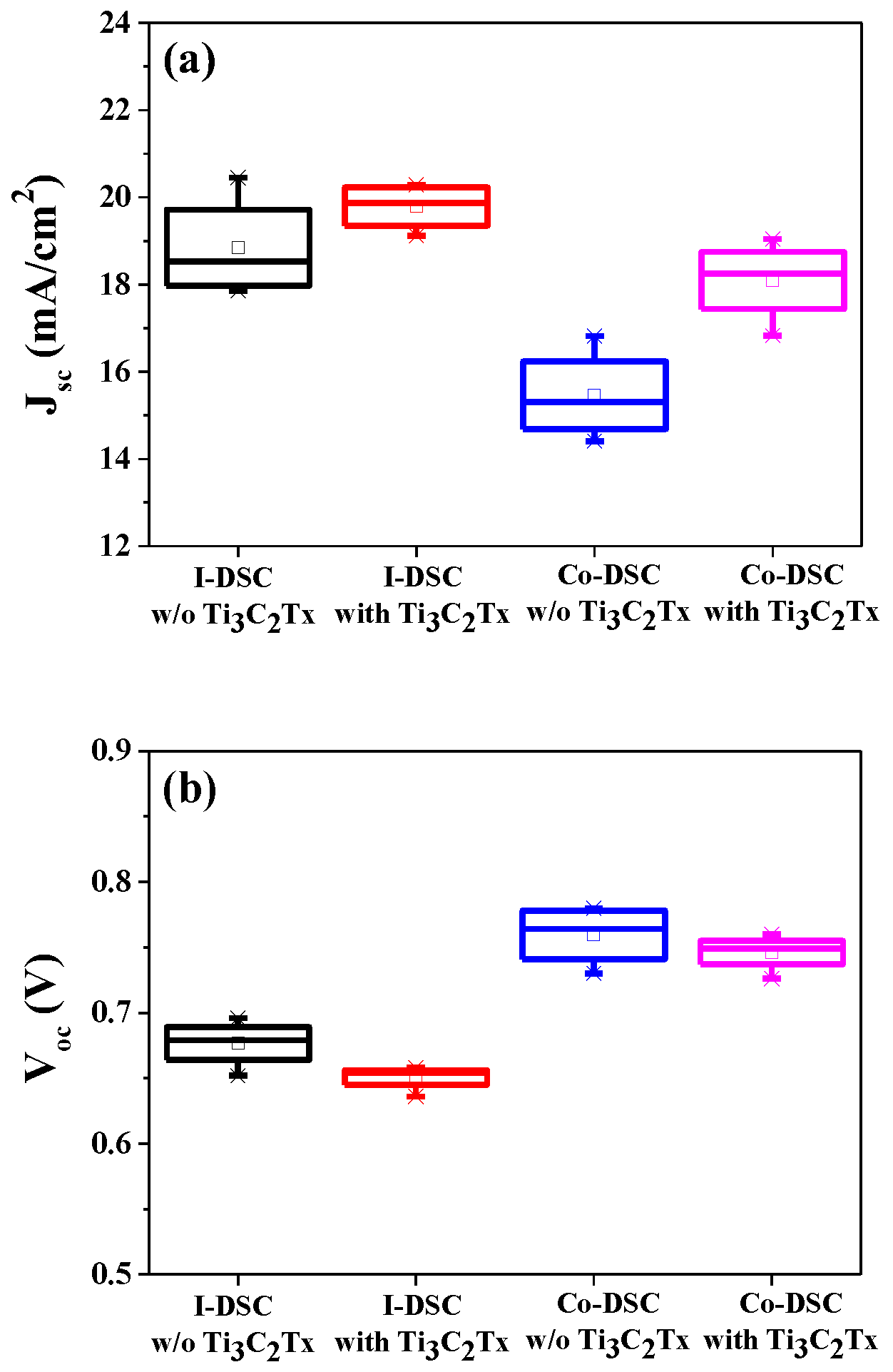
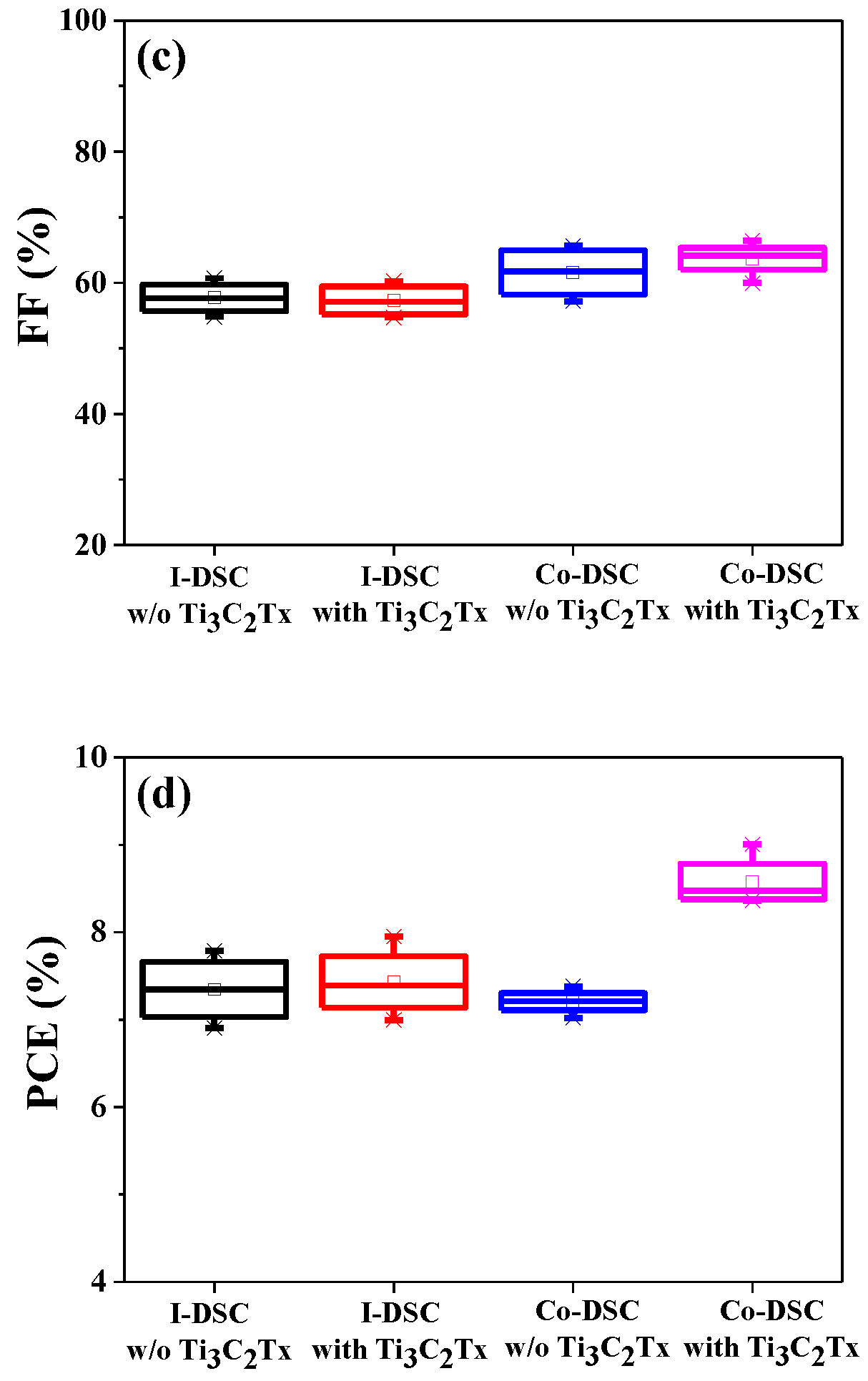
Figure 2.
J–V characteristics of the best-performing cells—that is, the bare Co-bDSC and Ti3C2Tx-Co-bDSC.
Figure 2.
J–V characteristics of the best-performing cells—that is, the bare Co-bDSC and Ti3C2Tx-Co-bDSC.
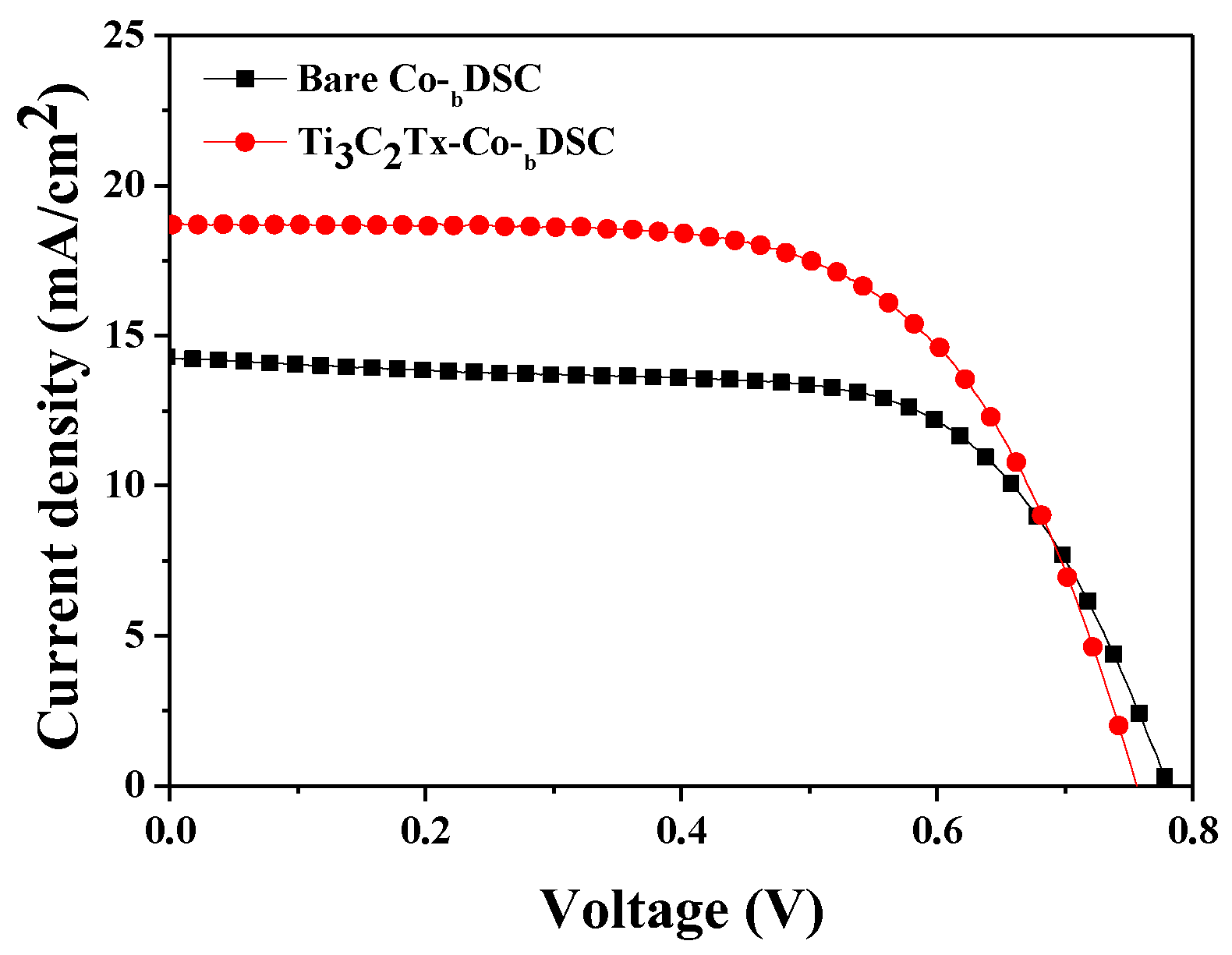
Figure 3.
Nyquist (a) and Bode (b) plots of the EIS spectra for the bare- and Ti3C2Tx-Co-bDSCs, as measured under open-circuit conditions and under the illumination of simulated AM 1.5 solar light.
Figure 3.
Nyquist (a) and Bode (b) plots of the EIS spectra for the bare- and Ti3C2Tx-Co-bDSCs, as measured under open-circuit conditions and under the illumination of simulated AM 1.5 solar light.
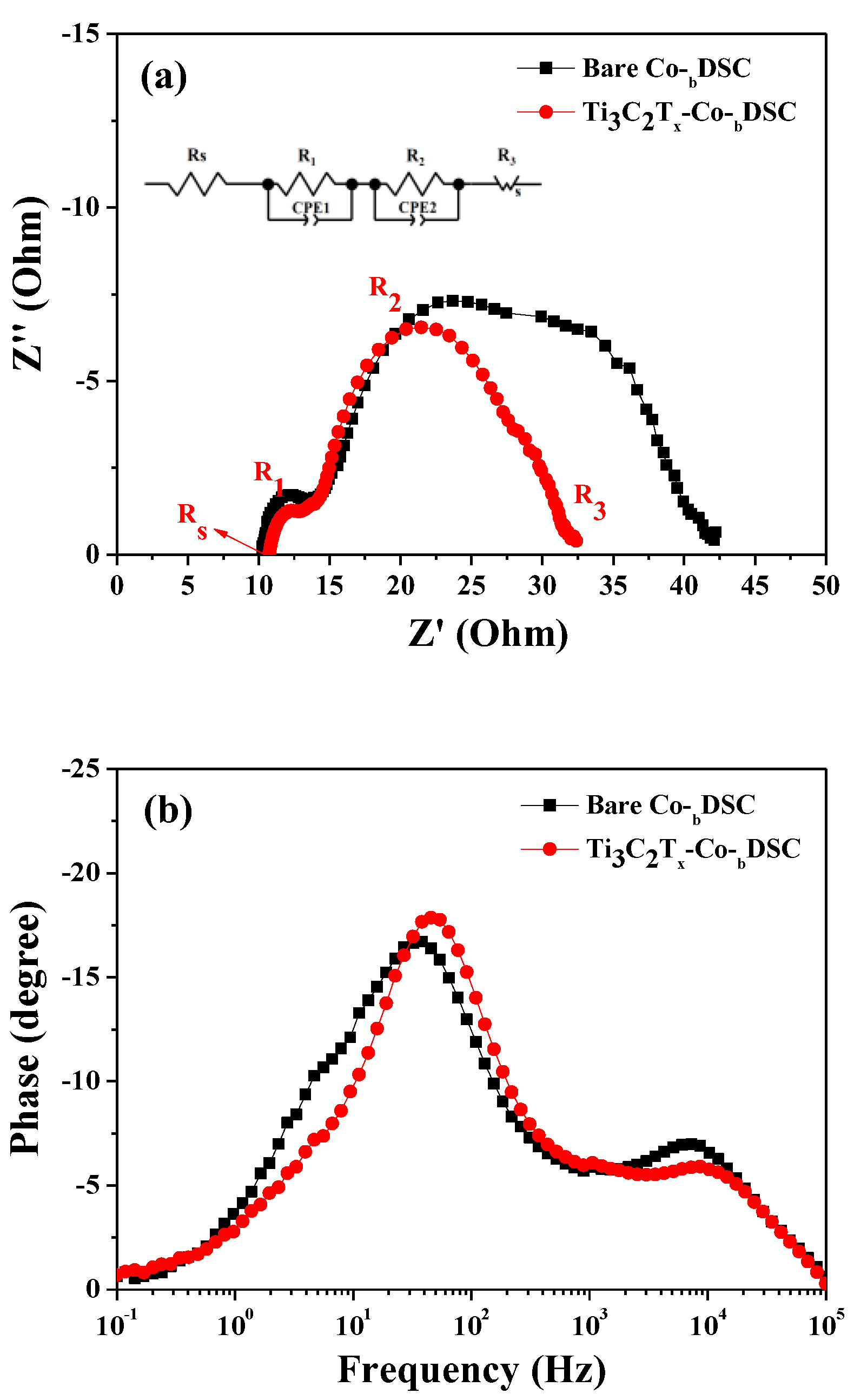
Figure 4.
Dark current curves of the best-performing cells—that is, bare Co-bDSC and Ti3C2Tx-Co-bDSC.
Figure 4.
Dark current curves of the best-performing cells—that is, bare Co-bDSC and Ti3C2Tx-Co-bDSC.
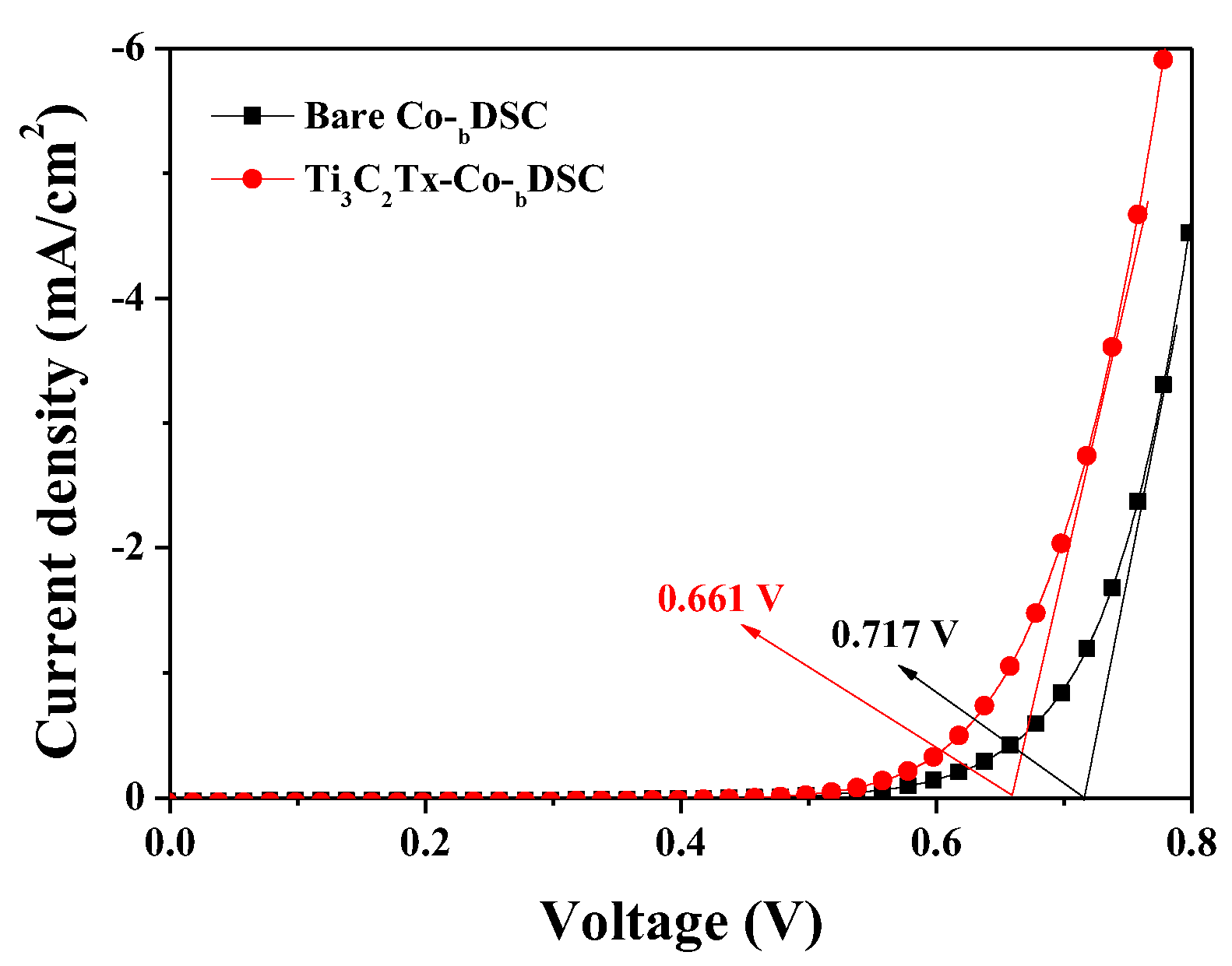
Figure 5.
Nyquist (a) and Bode (b) plots of the EIS spectra for the bare- and Ti3C2Tx-Co-bDSCs, as measured at −0.7 V in the dark.
Figure 5.
Nyquist (a) and Bode (b) plots of the EIS spectra for the bare- and Ti3C2Tx-Co-bDSCs, as measured at −0.7 V in the dark.
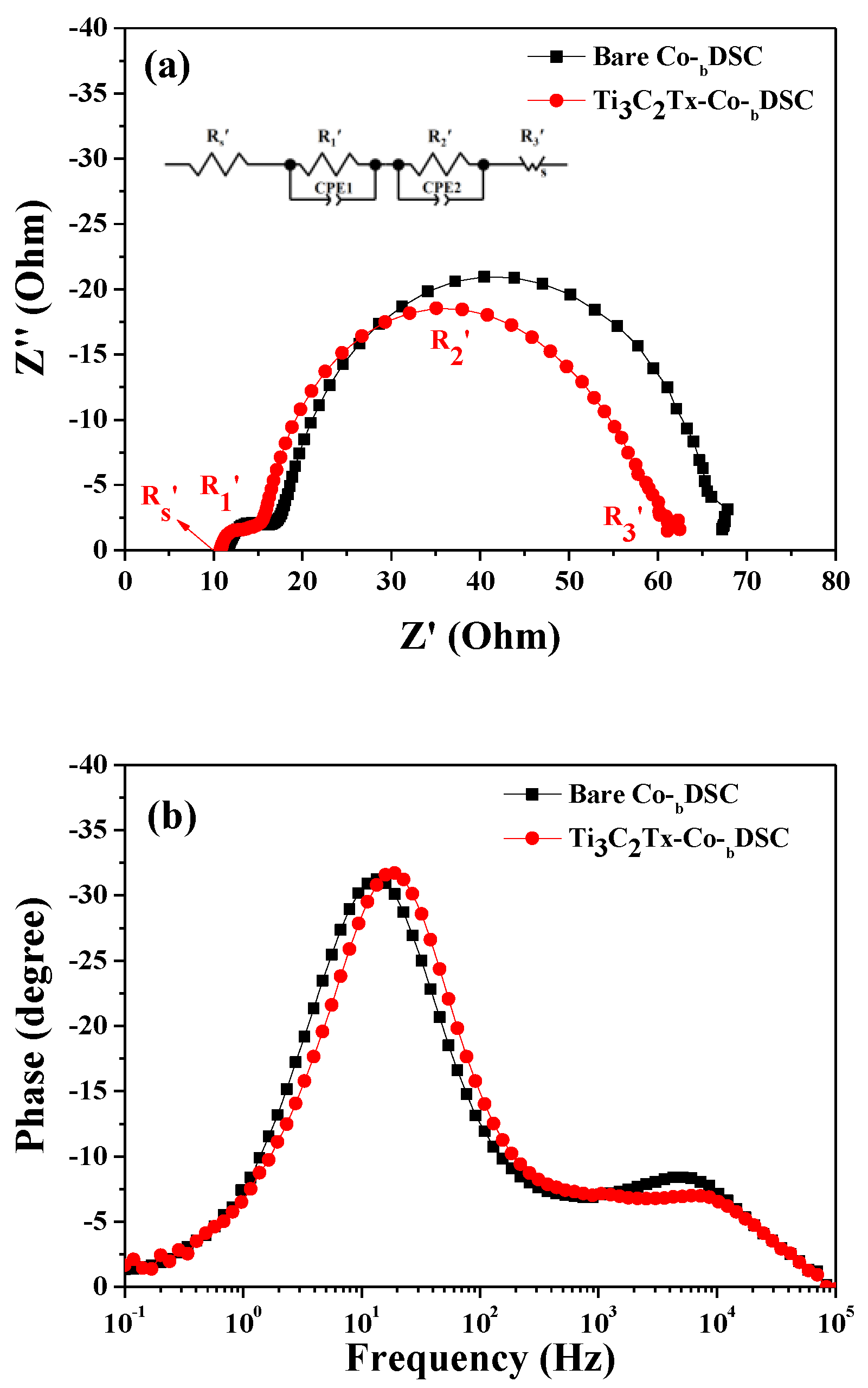
Figure 6.
Variations in the photovoltaic performance over time: normalized Jsc (a), Voc (b), FF (c) and PCE (d) of the bare- and Ti3C2Tx-Co-bDSCs stored at room temperature in the dark.
Figure 6.
Variations in the photovoltaic performance over time: normalized Jsc (a), Voc (b), FF (c) and PCE (d) of the bare- and Ti3C2Tx-Co-bDSCs stored at room temperature in the dark.
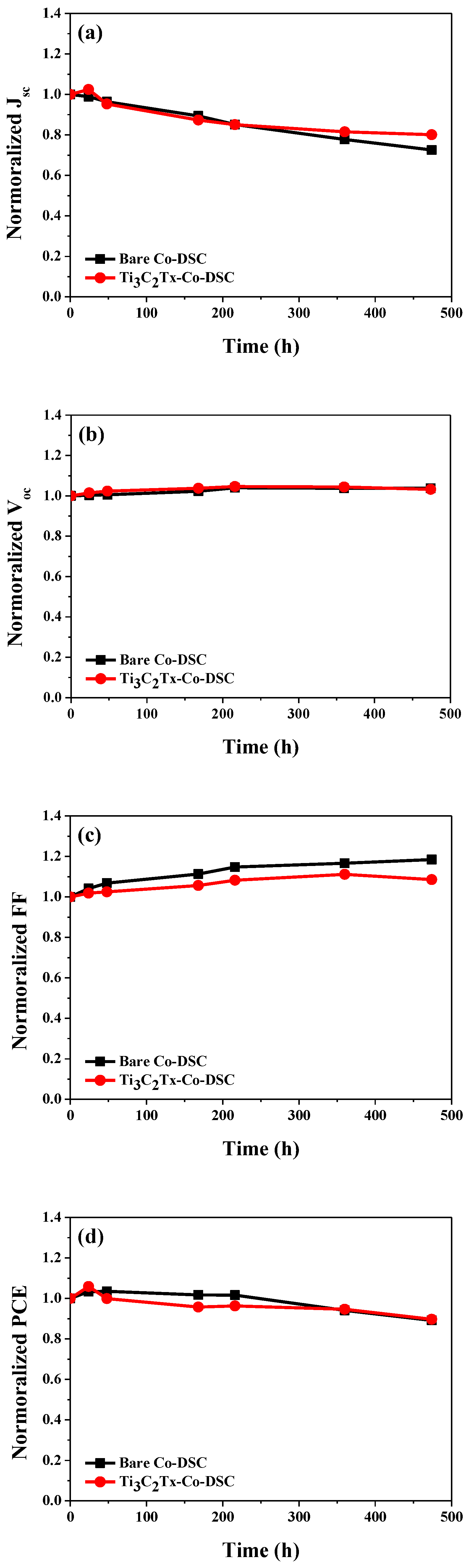

Table 1.
Photovoltaic performances of DSCs with Ti3C2Tx-MXene-incorporated electrolytes.
| Device | Measurement condition | Redox mediator |
Jsc (mA/cm2) |
Voc (V) |
FF (%) |
PCE (%) |
Ref. | |
| Quasi-solid-state DSC |
AM 1.5 | MF-sponge-based I−/I3− | Without Ti3C2Tx | 14.979 ± 0.175 |
0.778 ± 0.004 |
65.3 ± 0.3 |
7.610 ± 0.106 |
[21] |
| With Ti3C2Tx | 15.085 ± 0.188 |
0.781 ± 0.003 |
66.4 ± 0.6 |
7.822 ± 0.092 |
[21] | |||
| 1000 lux | MF-sponge-based I−/I3− | Without Ti3C2Tx | 0.177 ± 0.001 |
0.569 ± 0.007 |
70.3 ± 0.5 |
23.35 ± 0.43 |
[21] | |
| With Ti3C2Tx | 0.196 ± 0.003 |
0.579 ± 0.004 |
71.9 ± 0.4 |
26.92 ± 0.43 |
[21] | |||
| AM 1.5 | PEO/PVDH-HFP-based I−/I3− | Without rGO/Ti3C2Tx | - | - | - | - | - | |
| With rGO/Ti3C2Tx | 15.170 ± 0.203 |
0.783 ± 0.002 |
69.5 ± 0.5 |
8.255 ± 0.109 |
[22] | |||
| 1000 lux | PEO/PVDH-HFP-based I−/I3− | Without Ti3C2Tx | - | - | - | - | - | |
| With rGO | 0.189 ± 0.002 |
0.544 ± 0.002 |
76.1 ± 0.4 |
23.22 ± 0.43 |
[22] | |||
| With rGO/Ti3C2Tx | 0.223 ± 0.001 |
0.561 ± 0.004 |
75.7 ± 0.1 |
29.94 ± 0.49 |
[22] | |||
| Liquid-electrolyte DSC | AM 1.5 | Co3+/ I− (FK209/MPII) | Without Ti3C2Tx | 15.46 ± 1.04 |
0.760 ± 0.023 |
61.33 ± 3.70 |
7.18 ± 0.11 |
This study |
| With Ti3C2Tx | 18.09 ± 0.94 |
0.746 ± 0.014 |
63.66 ± 2.69 |
8.58 ± 0.30 |
This study | |||
Table 2.
Averages and standard deviations of the cell performances measured using four I- and Co-DSCs with or without Ti3C2Tx MXene.
Table 2.
Averages and standard deviations of the cell performances measured using four I- and Co-DSCs with or without Ti3C2Tx MXene.
| Devices |
Jsc (mA/cm2) |
Voc (V) |
FF (%) |
PCE (%) |
|
| I-DSC | Without Ti3C2Tx | 18.84 ± 1.18 | 0.677 ± 0.018 | 57.70 ± 2.55 | 7.35 ± 0.39 |
| With Ti3C2Tx | 19.95 ± 0.78 | 0.651 ± 0.010 | 57.29 ± 2.59 | 7.43 ± 0.40 | |
| Co-DSC | Without Ti3C2Tx | 15.46 ± 1.04 | 0.760 ± 0.023 | 61.33 ± 3.70 | 7.18 ± 0.11 |
| With Ti3C2Tx | 18.09 ± 0.94 | 0.746 ± 0.014 | 63.66 ± 2.69 | 8.58 ± 0.30 | |
Table 3.
Photovoltaic performance of the best-performing cells—that is, the bare Co-bDSC and Ti3C2Tx-Co-bDSC.
Table 3.
Photovoltaic performance of the best-performing cells—that is, the bare Co-bDSC and Ti3C2Tx-Co-bDSC.
| Best-performing cells |
Jsc (mA/cm2) |
Voc (V) |
FF (%) |
PCE (%) |
| Bare Co-bDSC | 14.41 | 0.780 | 64.66 | 7.27 |
| Ti3C2Tx-Co-bDSC | 18.45 | 0.760 | 64.23 | 9.01 |
Disclaimer/Publisher’s Note: The statements, opinions and data contained in all publications are solely those of the individual author(s) and contributor(s) and not of MDPI and/or the editor(s). MDPI and/or the editor(s) disclaim responsibility for any injury to people or property resulting from any ideas, methods, instructions or products referred to in the content. |
© 2024 by the authors. Licensee MDPI, Basel, Switzerland. This article is an open access article distributed under the terms and conditions of the Creative Commons Attribution (CC BY) license (http://creativecommons.org/licenses/by/4.0/).
Copyright: This open access article is published under a Creative Commons CC BY 4.0 license, which permit the free download, distribution, and reuse, provided that the author and preprint are cited in any reuse.


