

Submitted:
09 February 2024
Posted:
12 February 2024
You are already at the latest version
Abstract
Radish (Raphanus sativus L.), a root vegetable belonging to the Brassicaceae family, is considered as one of the representative crops displaying sporophytic self-incompatibility (SSI). The utilization of a self-incompatibility system in F1 breeding can improve the efficiency of cross combinations, leading to a reduction in breeding time and aiding in the development of novel F1 varieties. The successful implementation of this system necessitates the rapid and accurate identification of S haplotypes in parental lines. In this study, we identified a total of 9 S haplotypes among 22 elite radish lines through Sanger sequencing. Subsequently, we obtained sequences for showing 95% similarity to 9 S haplotypes, along with sequences identified by other researchers using BLAST. Following this, multiple sequence alignment (MSA) was conducted to identify SRK and SLG sequence similarities, as well as polymorphisms within the class I, II groups. Subsequently, S haplotype-specific marker sets were developed, targeting polymorphic regions of SRK and SLG alleles. These markers successfully amplified each of 9 S haplotypes. these markers will play a crucial role in the rapid and precise identification of parental S haplotypes in the radish F1 breeding process, proving instrumental in the radish F1 purity test.
Keywords:
radish (Rahpanus sativus L.)
; self-incompatibility
; S haplotype
; MSA
1. Introduction
Radish (Raphanus sativus L.) is a root vegetable that belongs to the Brassicaceae family and is one of the most globally cultivated crops. The radish root is low in calories and rich in various minerals, particularly secondary metabolites such as polyphenols and glucosinolates, known for their anti-cancer effects [1,2].
Self-incompatibility (SI) is a mechanism that prevents self-fertilization and promotes outcrossing to maintain genetic diversity in plants [3]. Self-incompatibility can be classified into sporophytic self-incompatibility (SSI) and gametophytic self-incompatibility (GSI), depending on the timing of S gene expression [4,5,6]. Brassicaceae plants, including radish, exhibit sporophytic self-incompatibility (SSI) determined by the genotype of the pollen parent [7]. SSI is controlled by a single multi-allelic locus, termed the S locus after “S” of sterility [6,7,8].
There are three major genes that comprise the S locus: SRK (S locus receptor kinase), SLG (S locus glycoprotein), and SCR/SP11 (S locus cysteine-rich protein/S locus protein 11) [9,10]. S locus Receptor Kinase (SRK) is specifically expressed in the stigma and acts as a maternal determinant [11]. SRK comprises three domains: the receptor domain (S domain), transmembrane domain, and serine/threonine kinase domain. The S domain is crucial in the process of self-pollen recognition, and its structural characteristics include 12 cysteine residues, potential N-glycosylation sites, and three hypervariable regions. The S domain of SRK and SLG alleles have the same structure features, and the sequence similarity of two genes is over 80% within S alleles [12,13,14]. S locus glycoprotein (SLG) is also specifically expressed in the stigma, and the function of the SLG gene has been reported to be crucial for stabilizing the self-incompatibility response. However, the exact function or mechanism remains unknown [11,15]. S locus cysteine rich protein/S locus protein11 (SCR/SP11), specifically expressed in pollen, acts as a ligand in the allele-specific recognition between SRK and SCR/SP11. SCR/SP11 activates a signal cascade mediating SI response [8].
SRK, SLG, and SCR/SP11 involved in S locus, are tightly linked to each other and tend to be inherited together in the next generation, forming what is termed an S haplotype [16]. S haplotypes can be classified into two groups, class I and class II, based on amino acid sequence similarities of SLG and SRK [17]. The amino acid sequences of the S domain of SRK or SLG alleles shows 72% similarity within the same group and 70% or less similarity between different groups [18]. Additionally, SLG and S domain of SRK alleles within the same S haplotype generally show high sequence similarity, especially in class II group [19,20,21,22]. Between the two groups, there exists a complex genetic dominance relationship, where class I S haplotypes are generally dominant over class II S haplotypes in the pollen. On the other hand, in the stigma, codominance frequently occurs [21,23].
The SI system has been widely applied to F1 hybrid breeding, encompassing radish, cabbage, and other Brassica species. The utilization of the SI system has increased the efficiency of cross combinations, shortening breeding time and facilitating the development of novel F1 varieties [24]. However, if parents share the same S haplotype, it is difficult to produce a large scale of F1 hybrid seeds [25]. Therefore, it is necessary to select cross combinations by early excluding radish breeding lines that exhibit the same S haplotype through the rapid and accurate identification of radish S haplotypes in the F1 hybrid breeding process.
Early studies on the identification of radish S haplotypes involved compatibility index (CI) analysis through test crosses, pollen tube examination, fluorescence analysis, and isoelectric focusing (IEF) gel examination [10,26,27]. However, these methods were labor-intensive, complex, and low accuracy. Recently, Polymerase Chain Reaction-Restriction Fragment Length Polymorphism (PCR-RFLP) markers and Sequence Characterized Amplified Region (SCAR) markers that specifically amplify radish SRK or SLG alleles have been developed and used for the identification of radish S haplotypes [28,29,30]. Despite the development of several methods, identification of radish S haplotypes remains challenging. When using PCR-RFLP, the presence of identical restriction enzyme sites among some S haplotypes complicates the accurate identification process. With SCAR markers, the high sequence similarity between certain class I and II S haplotypes often leads to the co-amplification of several different S haplotypes [24,29,30]. Furthermore, each researcher has independently assigned a nomenclature for radish S haplotypes in different countries, making the identification of radish S haplotypes more difficult [31,32].
In this study, to overcome the limitations of previously developed S haplotype markers, we developed radish S haplotype-specific markers based on the nucleotide sequences of SRK and SLG using 22 radish breeding lines, mainly used for F1 hybrid breeding in Korea and Japan etc., fixed through more than 7 generations of self-pollination. S haplotype-specific markers developed in this study are expected to be used for effective identifying the S haplotypes of parental lines, selecting cross combinations for F1 hybrid breeding, and performing seed purity tests during the F1 hybrid breeding process.
2. Materials and Methods
2.1. Plant Materials
The 22 elite cultivated radish lines (‘SJ-1~22’), serving as parental lines for F1 hybrid breeding in Korea, Japan, and other regions, were used as plant materials in this study [33]. The plant materials were rendered homozygous through self-pollination via bud pollination for more than 7 generations at a plant breeding house in Gyeonggi-do, Yeoju, Yanggui-ri, South Korea (Table 1).
2.2. Amplification and Sequencing of SRK, SLG Alleles
2.2.1. Extraction of Genomic DNA and Amplification of SRK, SLG Alleles
Genomic DNA was extracted from seedling leaves (15 to 20 days after germination) of each radish breeding line using the CTAB method [34]. The concentration and purity of all extracted genomic DNAs were assessed using a nanodrop machine (DeNovix Co., Wilmington, DE, USA).
For the PCR amplification of SRK and SLG nucleotide sequences of ‘SJ-1~22’, 7 class I, II SRK and SLG universal primer sets were used in this study (Table 1 and Table S1). The UVSLGII primer set was designed to amplify the most region of SLG21 (Lim) nucleotide sequence with the multiple sequence alignment of 12 class II SLG and S domain of SRK sequences identified from radish. This primer set targeted the 5' and 3' class II SLG conserved nucleotide sequences. PCR amplification was performed in a total 15 μL reaction mixture, consisted of 7.5 μL Dyne Ready 2X-GO (Star Plus Taq with Dye; Dynebio Co., Gyeonggido, Korea), 1.5 μL 5X Tune-up solution, 1.5 μL forward primer (5 μM), 1.5 μL reverse primer (5 μM), 1.5 μL template DNA (50 ng/μL) and 1.5 μL distilled water. The PCR amplification conditions involved an initial denaturation at 95 °C for 3 minutes and a final elongation at 72 °C for 5 minutes, with the optimal annealing temperature applied to each primer (Table 2).
2.2.2. Identification of S Haplotypes Based on BLAST Search
The PCR products obtained by amplifying SRK and SLG alleles of 22 radish breeding lines were separated by electrophoresis on a 2% agarose gel stained with 7.2 μL of EcoDye (Biofact Co., Daejeon, Korea) in 360 mL of 0.5X TBE buffer at 250 V for 40 minutes and visualized using an Ultraviolet (UV) Transilluminator. Subsequently, gel extraction was carried out to obtain accurate nucleotide sequence information for SRK and SLG alleles. Slices of the agarose gel containing the amplified target SRK and SLG alleles were cut to approximately 0.2 to 0.3 g, transferred to a 2 mL micro-centrifuge tube, and purified using the LaboPass Gel and PCR Clean-up Kit (Cosmogenetech Co., Seoul, Korea). Following purification, Sanger sequencing was performed by Cosmogenetech Co. (Seoul, Korea). To address base noise, sequencing was performed twice, using both forward and reverse primers. Any base with a base quality value (QVs) of 20 or less was excluded from the sequencing analysis.
To determine the S haplotypes of the 22 elite breeding lines (‘SJ-1~22’), the sequencing data was compared with other kinase domain and S domain of SRK and SLG alleles registered in the National Center for Biotechnology Information (NCBI) or other database using the Basic Local Alignment Search Tool (BLAST) program.
Since nomenclature of S haplotype differed for each researcher in each country and was not unified, the S haplotypes were classified based on the nomenclature proposed by Lim [28].
2.3. Multiple Sequence Alignment (MSA)
To develop S haplotype-specific markers, we attempted to identify target regions of SRK and SLG alleles that showed sequence or structural variation. we performed multiple sequence alignment (MSA) for both nucleotide and amino acid sequences. This analysis involved the S haplotypes amplified by PCR from 22 radish breeding lines, S haplotypes showing more than 94% similarity through a BLAST search, and additional S haplotypes identified by researchers in Korea [18,28], China [25], and Japan [32,35].
Using BLAST, we acquired SRK and SLG nucleotide sequences with more than 94% similarity to SRK and SLG alleles of ‘SJ-1~22’. Subsequently, MSA of both nucleotide and amino acid sequences was performed using EMBL-EBI (European Bioinformatics Institute), MAFFT version 7.0, and MEGA version 11.0 programs. Hypervariable regions 1 to 3 (HV-I to III) of SRK and SLG alleles were identified through the EMBL-EBI sixpack tool.
2.4. Development of S Haplotype-Specific Markers
Based on the results of MSA, S haplotype-specific markers were developed, targeting specific regions that show polymorphism in SRK and SLG alleles of ‘SJ-1~22’. The Primer-BLAST program was used, with the primer length set between 20-30 bp, the melting temperature (Tm) value ranging from 52-66°C, and the GC-content around 60%. The annealing temperature was calculated using NEB Tm calculator version 1.15.0.
First, candidate S haplotype-specific markers that selectively amplified the kinase domain of SRK and SLG of each of ‘SJ-1~22’ in silico were chosen. Primer sets that exhibited overlapping binding sites, low polymorphism, or amplified regions of 100 bp or less were discarded. Subsequently, PCR amplification and gel electrophoresis were performed on the 22 elite breeding lines (‘SJ-1~22’) using the selected S haplotype-specific markers to assess whether they specifically amplified the corresponding S haplotypes.
3. Results
3.1. Amplification of SRK, SLG Alleles Using Universal Primers
A total of three class I SRK and SLG universal primer sets, along with four class II SRK and SLG universal primer sets, were used to amplify the kinase domain of SRK and SLG alleles of 22 radish breeding lines (‘SJ-1~22’).
In 14 radish breeding lines ('SJ-1~14'), class I kinase domain of SRK was amplified using the UVSRK-F + UVSRK-R primer combination. Additionally, class I SLG alleles were amplified with the SLG-I-F + SLG-I-R and PS22 + SLG-I-R primer combinations, resulting in a total band size of 1,000 to 1,500 bp (Figure S1).
In 8 radish breeding lines ('SJ-15~22'), class II kinase domain of SRK was amplified using the KS2 + KA2 primer combination. Additionally, class II SLG alleles were amplified with the SLG-II-F + SLG-II-R, Rs9 SLG-F + Rs9 SLG-R, and UVSLGII-F + UVSLGII-R primer combinations, resulting in a total band size of 800 to 1,500 bp (Figure S2).
3.2. Identification of S Haplotypes Based on BLAST Search
We performed BLAST search using SRK and SLG alleles amplified by universal primer sets from 'SJ-1~22' to identify the corresponding S haplotypes. these sequences were compared to previously published S haplotypes in NCBI database or from other researchers. As a result, it was determined that the 22 radish breeding lines possessed a total of 9 S haplotypes (Table 3). Nucleotide sequence information is provided in the supplementary materials (Table S4), and if two or more radish lines had the same S haplotype, only the sequence obtained from one of them was indicated.
A total of 14 radish breeding lines (‘SJ-1~14’) were classified as class I S haplotype. ‘SJ-1~4’ were identified as S1 (Lim), since kinase domain of SRK and SLG alleles showed 100%, 99% identity to SRK1(Lim) and SLG1(Lim) respectively. ‘SJ-5~6’ were identified as S8 (Lim) due to 100% identity in kinase domain of SRK allele with SRK8 (Lim), SRK19 (Kim) and SRK-19 (Haseyama), along with 100% identity in SLG allele with SLG-19 (Haseyama). S8 (Lim) has been reported as the same S haplotype as S19 (Kim) and RsS-19 (Haseyama) [32]. Additionally, kinase domain of ‘SJ-5~6’ SRK allele showed 97% identity with SRK-18 (Haseyama). ‘SJ-7~9’ were identified as S10 (Lim), since kinase domain of SRK and SLG alleles showed 99.9% identity to SRK10 (Lim) and SLG10 (Lim) respectively. There were 11 other SRK sequences showing 98 to 99% identities to kinase domain of ‘SJ-7~9’ SRK allele (Table 3, Figure S7). ‘SJ-10~11’ were identified as S16 (Lim) due to 99.9% identity in kinase domain of SRK allele with SRK16 (Lim) and SRK-22 (Haseyama), along with 100% identity in SLG allele with SLG-22 (Haseyama). S16 (Lim) has been reported as the same S haplotype as RsS-22 (Haseyama) [32]. ‘SJ-12~14’ were identified as S18 (Lim) due to 99.9% identity in kinase domain of SRK allele with SRK18 (Lim) and SRK-6 (Haseyama), along with 100% identity in SLG allele with SLG18 (Lim) and SLG-6 (Sakamoto). S18 (Lim) has been reported as the same S haplotype as RsS-6(Sakamoto) [32].
A total of 8 radish breeding lines (‘SJ-15~22’) were classified as class II S haplotype. ‘SJ-15~17’ were identified as S4 (Lim) due to 99% and 100% identity in SLG allele with SLG4 (Lim) and SLG-26 (Lim). S4 (Lim) has been reported as the same S haplotype as RsS-26 (Haseyama) [32]. Additionally, ‘SJ-15~17’ SLG allele showed 97% identity with SLG-11 (Haseyama). ‘SJ-18~20’ were identified as S5 (Lim) due to 99% identity in kinase domain and S domain of SRK allele with SRK-5 (Wang). S5 (Lim) has been reported as the same S haplotype as S-5 (Wang) [25]. Also, kinase domain of ‘SJ-18~20’ SRK allele showed 99% identity with SRK-9 (Wang) and SRK6 (R.raphanistrum). Additionally, S domain of ‘SJ-18~20’ SRK allele showed 97 to 99% identity with 10 other class II S domain of SRK and SLG alleles (Table 3). ‘SJ-21’ was identified as S21 (Lim) due to 99% identity in kinase domain of SRK allele with SRK-9 (Wang) and 100% identity in SLG allele with SLG21 (Lim), SLG-9 (Haseyama) and SLG-9 (Wang). S21 (Lim) has been reported as the same S haplotype as RsS-9 (Haseyama) and S-9 (Wang) [25,32]. Also, kinase domain of ‘SJ-21’ SRK allele showed 99% identity with SRK-5 (Wang) and SRK6 (R.raphanistrum). Additionally, ‘SJ-21’ SLG allele showed 94 to 100% identity with 9 other class II S domain of SRK and SLG alleles (Table 3). ‘SJ-22’ was identified as S26 (Lim) due to 100% identity in SLG allele with SLG26 (Lim) and SLG-29 (Haseyama). S26 (Lim) has been reported as the same S haplotype as RsS-29 (Haseyama) [32].

Table 3.
Identification and comparison of S haplotypes using BLAST program; Acc.: accession name of radish breeding lines (‘SJ-1~22’) used in this study; NCBI Acc.: accession number of genes registered in NCBI database; bold letters: S haplotype with best hit in result of BLAST search.
Table 3.
Identification and comparison of S haplotypes using BLAST program; Acc.: accession name of radish breeding lines (‘SJ-1~22’) used in this study; NCBI Acc.: accession number of genes registered in NCBI database; bold letters: S haplotype with best hit in result of BLAST search.
| Acc. | S Haplotype | Gene region | Tool | Gene | NCBI Acc. | Iden(%) | Query Cov |
|---|---|---|---|---|---|---|---|
| SJ-1~4 | S1 (Lim) | SRK-KD (1,063bp) | BLASTn | SRK1 (Lim) | AY052579 | 100% | 99% |
| SLG (1,220bp) | BLASTn | SLG1 (Lim) | AY052572 | 99% | 99% | ||
| SJ-5~6 | S8 (Lim) | SRK-KD (1,133bp) | BLASTn |
SRK8 (Lim) SRK19 SRK-19 SRK-18 |
AY052583 KX961713 LC341229 LC341228 |
100% 100% 100% 97% |
100% 100% 97% 97% |
| SLG (1,201bp) | BLASTn | SLG-19 | LC341238 | 99% | 55% | ||
| SJ-7~9 | S10 (Lim) | BLASTn |
SRK10 (Lim) SRK11 (Lim) SRK16 (Lim) SRK20 (Lim) SRK29 (Lim) SRK-22 SRK-23 SRK-31 SRK7 SRK10 SRK16 SRK17 |
AY052585 AY534533 AY534535 AY534537 AY534541 LC341231 LC341232 LC341234 KX961701 KX961704 KX961710 KX961711 |
99.9% 98% 98% 98% 99% 98% 98% 99% 98% 98% 99% 98% |
100% 100% 100% 100% 100% 95% 99% 96% 78% 78% 78% 78% |
|
| SRK-KD (1,051bp) | |||||||
| SLG (1,202bp) | BLASTn | SLG10 (Lim) | AY052576 | 99.9% | 100% |
Table 3.
Continued.
| Acc. | S Haplotype | Gene Region | Tool | Gene | NCBI Acc. | Iden(%) | Query Cov |
|---|---|---|---|---|---|---|---|
| SJ-10~11 | S16 (Lim) | SRK-KD (1,071bp) | BLASTn |
SRK16 (Lim) SRK-22 SRK10 (Lim) SRK11 (Lim) SRK20 (Lim) SRK29 (Lim) SRK-23 SRK-31 SRK7 SRK10 SRK16 SRK17 |
AY052579 LC341231 AY052585 AY534533 AY534537 AY534541 LC341232 LC341234 KX961701 KX961704 KX961710 KX961711 |
99.9% 100% 98% 98% 97% 98% 97% 98% 99% 98% 99% 99% |
100% 94% 100% 100% 100% 100% 100% 94% 76% 76% 76% 76% |
| SLG (1,168bp) | BLASTn |
SLG-22 SLG-7 |
LC341239 AB009684 |
100% 99.9% |
64% 100% |
||
| SJ-12~14 | S18 (Lim) | SRK-KD (1,108bp) | BLASTn |
SRK18 (Lim) SRK-6 |
AY534536 LC341226 |
99.9% 99.9% |
100% 95% |
| SLG (1,235bp) | BLASTn |
SLG18 (Lim) SLG-6 |
AY527401 AB009682 |
100% 100% |
100% 100% |
||
| SJ-15~17 | S4 (Lim) | SRK-KD (Not amplified) |
- | - | - | - | - |
| SLG (1,002bp) | BLASTn |
SLG4 (Lim) SLG-26 SLG-11 |
AY052577 LC341241 LC341236 |
99% 99% 97% |
100% 99% 87% |
||
| SJ-18~20 | S5 (Lim) | SRK-KD (1,053bp) | BLASTn |
SRK-5 (Wang) SRK-9 (Wang) SRK6 |
- - KP117077 |
99% 99% 99% |
99% 99% 94% |
| SLG (1,004bp) | BLASTn |
SRK-5 (Wang) SLG5 (Lim) SLG21 (Lim) SLG24 (Lim) SRK1 SRK-9 SLG-9 Rs chr7 Rs chr8 |
- AY052578 AY529650 AY529651 KX961695 AB114851 LC341235 OY743213 LR778317 |
99% 97% 95% 96% 96% 96% 95% 95, 97% 95, 97% |
94% 100% 100% 100% 100% 98% 90% 100% 100% |
Table 3.
Continued.
| Acc. | S Haplotype | Gene Region | Tool | Gene | NCBI Acc. | Iden(%) | Query Cov |
|---|---|---|---|---|---|---|---|
| SJ-21 | S21 (Lim) | SRK-KD (1,015bp) | BLASTn |
SRK-9 (Wang) SRK-5 (Wang) SRK6 |
- - KP117077 |
99% 99% 99% |
99% 99% 96% |
| SLG (1,055bp) | BLASTn |
SLG21 (Lim) SLG-9 Rs chr7 Rs chr8 Rs SLG S13-like SLG24 (Lim) SLG5 (Lim) SRK-1 SRK-9 |
AY529650 LC341235 OY743213 LR778317 XM_056990347 AY529651 AY052578 KX961695 AB114851 |
100% 100% 100, 94% 100, 94% 100% 96% 94% 94% 94% |
84% 77% 100% 100% 100% 84% 84% 100% 100% |
||
| SJ-22 | S26 (Lim) | SRK-KD (Not amplified) |
- | - | - | - | - |
| SLG (802bp) | BLASTn | SLG26 (Lim) | AY529652 | 100% | 100% | ||
| SLG-29 | LC341242 | 100% | 100% |
3.3. Multiple Sequence Alignment (MSA) of SRK, SLG Alleles
Multiple Sequence Alignment (MSA) of nucleotide and amino acid sequences was performed to develop S haplotype-specific markers targeting polymorphic regions of SRK and SLG alleles. In this alignment, we used all the S haplotype sequences registered by Korean, Chinese, and Japanese researchers. This included 7 kinase domains of SRK and 10 SLG alleles from Lim's group [28], 10 kinase domains of SRK alleles from Kim's group [18], 3 kinase domains and 3 S domains of SRK alleles from Wang's group [25], 7 SLG alleles from Sakamoto's group [35], along with 8 kinase domains, 3 S domains of SRK alleles, and 4 SLG alleles from Haseyama's group [32]. Only one sequence of the S haplotype was used when the same S haplotype was designated differently.
A total of 19 class I kinase domain of SRK sequences were used for the alignment of class I kinase domain of SRK alleles. The similarity between class I kinase domain of SRK nucleotide sequences ranged from 83.86 to 91.85%. All exon regions (4th to 7th) were conserved relative to intron regions (4th to 7th). In the 6th and 7th exons, some nucleotide polymorphisms, including insertions/deletions (InDels), were detected. In the 6th exon region, a small gap (13bp) was observed. Additionally, a large gap (41 to 49 bp) and a small gap (19 to 29 bp) were observed in the 4th and 6th intron region, excluding SRK-KD18 (Haseyama) and SRK-KD1 (Haseyama) (Figure S3).
A total of 15 class I SLG sequences were used for the alignment of class I SLG alleles. The similarity between class I SLG nucleotide sequences ranged from 84 to 88.94%. many single nucleotide polymorphisms (SNPs) were observed in hypervariable region I to III (HV-I to III). Especially, a small gap (6bp) was observed in the downstream region of HV-II, excluding SLG4 (Sakamoto). The deduced amino acid sequences of 14 class I SLG alleles revealed characteristics as previously reported, including 12 conserved cysteine residues, the potential N-glycosylation sites, and three hypervariable regions (Figure 1 and Figure S4).
A total of 9 class II kinase domain of SRK sequences were used for the alignment of class II kinase domain of SRK alleles. The similarity between class II kinase domain of SRK nucleotide sequences ranged from 90.17 to 99.17%. Notably, SRK26-KD (Wang) nucleotide sequence showed high similarity (99.17%) with SRK14-KD (Kim). As observed in the case of class I kinase domain of SRK alleles, all exon regions were conserved relative to intron regions. On the other hand, all exon regions showed high similarity within the same group of class II kinase domain of SRK alleles. Some single nucleotide polymorphisms (SNPs) and insertions/deletions (InDels) were observed in the 6th intron region, particularly a small gap (14bp) was only detected in SRK-5 (Wang) and SRK-9 (Wang) (Figure S5).
Due to high similarity between class II SLG and S domain of SRK sequences, a total of 12 sequences including SLG and S domain of SRK alleles, were used for the alignment. The similarity between class II SLG nucleotide sequences was 90 to 97.05%, and when including S domain of SRK sequences, they showed 87.5 to 99.16%. In the upstream region of HV-I, small gaps (9, 12bp) were observed. In the deduced amino acid sequences of class II SLG and S domain of SRK alleles, 12 conserved cysteine residues were detected at the same positions as those in class I SLG alleles, excluding SLG4, 21 (Lim) and SRK-5 (Wang). Additionally, the potential N-glycosylation sites and three hypervariable regions were found to be located at the same positions (Figure 2 and Figure S6).
3.4. Development of S Haplotype-Specific Markers
Based on the results of class I and II SRK and SLG sequences alignment, we identified regions showing single nucleotide polymorphisms (SNPs) or small insertions/deletions (INDELs) within class I and II groups. Targeting these regions, we developed S haplotype-specific markers to selectively amplify the 9 S haplotypes present in 22 radish breeding lines ('SJ-1~22') (Table 4 and Table S2).
A total of 4 kinase domain of SRK primer sets were designed, with each primer set amplifying specific regions of SRK1 (Lim), SRK8 (Lim), SRK10 (Lim), and SRK18 (Lim) kinase domains, ranging from 4th to 7 th exon of SRK alleles. The expected PCR product size using these primer sets was 105 to 764bp, designed to exhibit length polymorphism with each primer set (Table 4)
Additionally, 9 SLG primer sets were designed, each amplifying specific regions of SLG1 (Lim), SLG4 (Lim), SLG5 (Lim), SLG8 (Lim), SLG10 (Lim), SLG16 (Lim), SLG18 (Lim), SLG21 (Lim) and SLG26 (Lim), ranging from HV-I to III of SLG alleles. The expected PCR product size using these primer sets was 131 to 529bp, similar to kinase domain of SRK alleles, designed to show length polymorphism with each primer set (Table 4).
To verify the specificity of the kinase domain of SRK and SLG primer sets developed in this study, genotyping was conducted on 22 radish breeding lines (‘SJ-1~22’) using the kinase domain of SRK and SLG primer sets. Consequently, all 5 SRK primer sets and 9 SLG primer sets selectively amplified radish breeding lines possessing a distinct S haplotype, and the predicted length of the PCR product from in silico analysis aligned with the observed results (Figure 3 and Figure 4). Furthermore, it was noted that the drawbacks, such as the amplification of nonspecific S haplotypes, which arose from the previously developed SCAR marker, did not occur in the S haplotype-specific markers developed in this study.
4. Discussion and Conclusions
For both class I, II SRK and SLG alleles, PCR amplification using universal primers posed challenges in identifying S haplotypes due to inaccurate amplification of the target gene in some instances. For instance, when performing PCR amplification using universal class II SLG primer sets in ‘SJ-21’, It was observed that PCR amplification occurred for the S domain of SRK allele instead of SLG allele. These results were consistent with previous reports indicating that the sequences of S domain of SRK and SLG alleles within class II group were highly similar [22,25,36].
Additionally, when using universal class II kinase domain of SRK primer sets in ‘SJ-15~17’ and ‘SJ-22’, other regions with the same primer binding sites were co-amplified, leading to sequencing error (mixed signal). As a result, the exact kinase domain of SRK sequences of ‘SJ-15~17’ and ‘SJ-22’ could not be identified.
Within the class I S haplotype group, including SRK and SLG alleles of 'SJ-1~14', along with those obtained through BLAST search in the NCBI database, there were numerous cases where kinase domain of SRK alleles exhibited significant similarity to each other. This similarity was particularly notable in SRK10 (Lim) and SRK16 (Lim). The kinase domain of SRK alleles is known to be the region where recombination could occur, and the observed high similarity within class I kinase domain of SRK alleles might be attributed to genetic recombination events [37]. In contrast to previous reports suggesting recombination in SLG alleles, we did not observe high similarity within class I SLG alleles.
When BLAST search was conducted using kinase domain of SRK10 (Lim) sequence as a query, 11 kinase domain of SRK sequences showing high similarity (98 to 99%) were identified. Subsequent sequence alignment of SRK10 (Lim) kinase domain with these 11 similar kinase domains revealed nearly identical nucleotide sequences, with only a few single nucleotide polymorphisms (SNPs) (Figure S7).
Although SLG16 (Lim) nucleotide sequence identified in ‘SJ-10~11’ and SLG-7 (Sakamoto) were 99.9% identity, S16 (Lim) has not been reported to be the same as RsS-7 (Sakamoto). Consequently, a comparison of the total length of two SLG alleles or S domain of SRK alleles was necessary to reclassify the two S haplotypes.
In the class II S haplotype group, including SRK and SLG alleles of 'SJ-15~22', along with those obtained through BLAST search in the NCBI database, kinase domain of SRK alleles as well as SLG alleles were highly similar to each other, unlike the class I S haplotype group. Previous studies have been reported that kinase domain of SRK and SLG alleles is the regions where recombination could occur [37,38]. The class II S haplotype group is inferred to be more recently diverged than the class I S haplotype group, as indicated by the high similarity within the class II S haplotype group [39]. According to the Brassica SI evolutionary model proposed by Uyenoyama, the class II S haplotype group might invade populations at lower rates than class I S haplotype, leading to a decrease in the occurrence of mutations and divergence within the class II group [40].
SLG4 (Lim) sequence identified in ‘SJ-12~14’ showed 97% similarity with SLG-11 (Haseyama), but S4 (Lim) has not been reported to be the same as RsS-11 (Haseyama).
The S domain of SRK5 (Lim) sequence exhibited high similarity with SLG21 (Lim) and SLG24 (Lim) at 95% and 96%, respectively. This is presumed to result from the gene duplication of the S domain of SRK alleles, intergenic recombination within SLG alleles, and gene conversion between the S domain of SRK and SLG alleles [19,41,42,43,44].
The kinase domain of SRK5 (Lim) and SRK 21 (Lim) sequences not only showed similarity with each other but also revealed high similarity with the kinase domain of wild radish SRK allele (99%). It has been reported that class II S haplotypes of cultivated cabbage have been identified in wild species of the cabbage group [45]. This implies that nucleotide sequences more similar or identical to class II S haplotypes of cultivated radish may be discovered in wild radish.
Highly similarity regions with SLG5 (Lim) and SLG21 (Lim) were searched on radish chromosomes 7 and 8 (OY743213, LR778317). The S locus is a single gene locus located on chromosome 7 [46]. When performing local BLAST with SLG21 (Lim) sequence as a query on the radish genome 'QZ-16' (GCA_902824885.1), including chromosomes 7 (LR778316) and 8 (LR778317), sequences corresponding to SLG21 (Lim) were only founded on chromosome 8, with none matching on chromosome 7 (Table S3). Therefore, it is highly probable that the two regions searched on chromosome 8 (LR778317) were S domain of SRK and SLG alleles rather than S homologs. this issue was inferred to result from errors during the chromosome-scale assembly process, and it could potentially lead to confusion in identifying radish S haplotypes through BLAST search.
In this study, multiple sequence alignment was performed using all the S haplotype sequences identified until now by Korean, Chinese, and Japanese researchers. Through this, variations in SRK and SLG alleles for each class group were detected.
In the class I group alignment, a gap of 19 to 29bp was observed only in the 6th intron of SRK6 (Lim) kinase domain and an insertion of 6bp was observed only in the downstream region of HV-III in SLG-4 (Sakamoto). It was thought that these regions could be used to design candidate S6 (Lim) and S4 (Sakamoto) haplotype-specific markers.
In the case of the class II group alignment, S domain of SRK and SLG alleles showed very high similarity (87.5 to 99.16%). Notably, SLG5 (Lim) and S domain of SRK21 (Lim) showed the highest similarity (99.16%), although they were different S haplotypes. This result elucidated why the two S haplotypes (S5, S21) were co-amplified when previously developed SCAR markers were used.
Additionally, we observed tyrosine residue in HV-III of SLG4, 21 (Lim) and S domain of SRK21 (Lim). it was presumed that non-synonymous mutations might have occurred at that site, substituting the 12th cysteine residue with tyrosine. Based on the observation that mutations have occurred not only in SLG alleles but also in the S domain of SRK alleles, it is considered necessary to further study whether the SNP mutation at that location affects the main function of the S domain of SRK alleles, which perceives and rejects self-pollen in the stigma.
Based on the results of BLAST search and sequence alignment, as there was a potential risk of nonspecific amplification of the kinase domain of SRK alleles. For a more accurate identification of the target S haplotype, it might be preferable to prioritize SLG allele-specific primer sets over kinase domain of SRK primer sets.
When using S haplotype-specific markers developed in this study, it will be possible to overcome the shortcomings of previously developed SCAR markers, such as amplification of nonspecific S haplotypes. These markers can be used for the more accurate and rapid amplification of target S haplotypes in radish (Figure 3 and Figure 4). These markers are anticipated to aid in identifying the S haplotypes of parental lines and selecting cross combinations during radish F1 breeding processes. Furthermore, these markers are expected to be effectively applied in the F1 seed purity test.
To identify additional S haplotypes rapidly and accurately, in addition to the 9 S haplotypes already identified, it is considered imperative to develop other S-allele-specific markers based on the methods applied in this study.
Supplementary Materials
The following supporting information can be downloaded at: www.mdpi.com/xxx/s1, Figure S1. PCR result of 22 radish breeding lines (‘SJ-1~22’) using class I, II kinase domain of SRK (SRK-KD) primer set. (A) PCR amplification of class I SRK-KD using UVSRK-F + UVSRK-R primer set; (B): PCR amplification of class II SRK-KD using KS2 + KA2 primer set; M: 100bp size marker. Figure S2: PCR result of 22 radish breeding lines (‘SJ-1~22’) using class I, II SLG primer set. (A) PCR amplification of class I SLG using SLG-I-F + SLG-I-R primer set; (B): PCR amplification of class I SLG using PS22 + SLG-I-R primer set; (C): PCR amplification of class II SLG using SLG-II-F + SLG-II-R primer set; (D): PCR amplification of class II SLG using Rs9 SLG-F + Rs9 SLG-R primer set; M: 100bp size marker; (E): PCR amplification of class II SLG using UVSLGII-F + UVSLGII-R primer set; M: 100bp sizer marker. Figure S3. Multiple sequence alignment of the nucleotide sequences of the 19 class I S haplotype kinase domain of SRK alleles; a: S haplotype published by Haseyama (2018); b: S haplotype published by Kim (2016); c: S haplotype published by Lim (2002); Red box: 4th to 7th exons of the SRK; Asterisk: conserved nucleotide. Figure S4. Multiple sequence alignment of the nucleotide sequences of the 15 class I S haplotype SLG alleles; a: S haplotype published by Sakamoto (1998); b: S haplotype published by Haseyama (2018); c: S haplotype published by Lim (2002); Red box: hypervariable region I to III of the SLG; Asterisk: conserved nucleotide. Figure S5. Multiple sequence alignment of the nucleotide sequences of the 9 class II S haplotype kinase domain of SRK alleles; a: S haplotype published by Kim (2016); b: S haplotype published by Haseyama (2018); c: S haplotype published by Lim (2002); Red box: 4th to 7th exons of the SRK; Asterisk: conserved nucleotide. Figure S6. Multiple sequence alignment of the nucleotide sequences of the 12 class II S haplotype SLG and S domain of SRK alleles; a: S haplotype published by Haseyama (2018); b: S haplotype published by Lim (2002); c: S haplotype published by Wang (2018); Red box: hypervariable region I to III of SLG; Asterisk: conserved nucleotide. Figure S7: Multiple sequence alignment of SRK10 (Lim, AY052579) and other 11 S haplotypes; Asterisk: conserved nucleotide; a: S haplotype published by Lim (2002); b: S haplotype published by Haseyama (2018); c: S haplotype published by Kim (2016). Table S1: Information of class I, II S haplotype universal primer used in this study. Table S2: Information of 9 S haplotype-specific primer developed in this study. Table S3: Result of BLASTN 2.14.1+ using SLG21 (Lim) nucleotide sequence to Raphanus sativus genome assembly ‘QZ-16’ (GCA_902824885.1). SLG21 (Lim) sequence is obtained from ‘SJ-21’ radish breeding line; Bold letters: putative region of SLG21 (Lim) and SRK21 (Lim) S domain. Table S4: Nucleotide sequences of SRK and SLG alleles of SJ-1~22.
Author Contributions
Conceptualization, S.H.H. and H.Y.P.; methodology, S.H.H., S.Y.M. and H.Y.P.; validation, S.H.H. and S.Y.K.; formal analysis, S.H.H. and S.Y.K.; investigation, S.H.H., S.Y.M. and S.Y.K.; resources, H.Y.P.; writing—original draft preparation, S.H.H.; writing—review and editing, S.H.H., S.Y.M. and H.Y.P.; funding acquisition, H.Y.P. All authors have read and agreed to the published version of the manuscript.
Funding
This work was supported by Korea Institute of Planning and Evaluation for Technology in Food, Agriculture, Forestry and Fisheries (IPET) through Digital Breeding Transformation Technology Development Program, funded by Ministry of Agriculture, Food and Rural Affairs (MAFRA) (322063-03-3-SB010).
Institutional Review Board Statement
Not applicable.
Informed Consent Statement
Not applicable.
Data Availability Statement
Upon request, the corresponding author can provide access to the research data generated in this study.
Conflicts of Interest
The authors declare no conflict of interest.
References
- Manivannan, A.; et al. Deciphering the nutraceutical potential of Raphanus sativus—A comprehensive overview. Nutrients 2019, 11, 402. [Google Scholar] [CrossRef] [PubMed]
- Gamba, M.; et al. Nutritional and phytochemical characterization of radish (Raphanus sativus): A systematic review. Trends in Food Science & Technology 2021, 113, 205–218. [Google Scholar]
- De Nettancourt, D. Incompatibility in angiosperms. Sexual Plant Reproduction 1997, 10, 185–199. [Google Scholar] [CrossRef]
- Hinata, K.; et al. A review of recent studies on homomorphic self-incompatibility. International review of cytology 1993, 143, 257–296. [Google Scholar]
- Newbigin, E.; Anderson, M.A.; Clarke, A.E. Gametophytic Self-Incompatibility Systems. The Plant Cell 1993, 5, 1315. [Google Scholar] [CrossRef] [PubMed]
- de Nettancourt, D. and D. de Nettancourt, The genetics of self-incompatibility. Incompatibility and Incongruity in Wild and Cultivated Plants, 2001: P. 25-72.
- Stone, S.L. and D.R. Goring, The molecular biology of self-incompatibility systems in flowering plants. Plant Cell, Tissue and Organ Culture 2001, 67, 93–114. [Google Scholar] [CrossRef]
- Watanabe, M.; Suwabe, K.; Suzuki, G. Molecular genetics, physiology and biology of self-incompatibility in Brassicaceae. Proc Jpn Acad Ser B Phys Biol Sci 2012, 88, 519–535. [Google Scholar] [CrossRef] [PubMed]
- Casselman, A.L.; et al. Determining the physical limits of the Brassica S locus by recombinational analysis. The Plant Cell 2000, 12, 23–33. [Google Scholar] [CrossRef]
- Kitashiba, H. and J.B. Nasrallah, Self-incompatibility in Brassicaceae crops: Lessons for interspecific incompatibility. Breeding science 2014, 64, 23–37. [Google Scholar] [CrossRef]
- Takasaki, T.; et al. The S receptor kinase determines self-incompatibility in Brassica stigma. Nature 2000, 403, 913–916. [Google Scholar] [CrossRef]
- Watanabe, M. and K. Hinata, 5 Self-incompatibility, in Developments in Plant Genetics and Breeding, C. Gómez-Campo, Editor. 1999, Elsevier. p. 149-183.
- Takayama, S. and A. Isogai, SELF-INCOMPATIBILITY IN PLANTS. Annual Review of Plant Biology 2005, 56, 467–489. [Google Scholar] [CrossRef]
- Watanabe, M.; Suwabe, K.; Suzuki, G. Molecular genetics, physiology and biology of self-incompatibility in Brassicaceae. Proceedings of the Japan Academy, Series B 2012, 88, 519–535. [Google Scholar] [CrossRef]
- Dixit, R.; Nasrallah Me Fau-Nasrallah, J.B.; Nasrallah, J.B. Post-transcriptional maturation of the S receptor kinase of Brassica correlates with co-expression of the S-locus glycoprotein in the stigmas of two Brassica strains and in transgenic tobacco plants. (0032-0889 (Print)).
- Nasrallah, J.B. and M.E. Nasrallah, Pollen[mdash]Stigma Signaling in the Sporophytic Self-Incompatibility Response. Plant Cell 1993, 5, 1325–1335. [Google Scholar] [CrossRef]
- Takayama, S. and A. Isogai, Molecular mechanism of self-recognition in Brassica self-incompatibility. Journal of Experimental Botany 2003, 54, 149–156. [Google Scholar] [CrossRef]
- Kim, D.; et al. Development of a system for S locus haplotyping based on the polymorphic SLL2 gene tightly linked to the locus determining self-incompatibility in radish (Raphanus sativus L.). Euphytica 2016, 209, 525–535. [Google Scholar] [CrossRef]
- Stein, J.C.; et al. Molecular cloning of a putative receptor protein kinase gene encoded at the self-incompatibility locus of Brassica oleracea. Proc Natl Acad Sci U S A 1991, 88, 8816–8820. [Google Scholar] [CrossRef]
- Watanabe, M.; et al. A high degree of homology exists between the protein encoded by SLG and the S receptor domain encoded by SRK in self-incompatible Brassica campestris L. Plant Cell Physiol 1994, 35, 1221–1229. [Google Scholar] [CrossRef]
- Hatakeyama, K.; et al. Dominance relationships between S-alleles in self-incompatible Brassica campestris L. Heredity 1998, 80, 241–247. [Google Scholar] [CrossRef]
- Sato, K.; et al. Coevolution of the S-locus genes SRK, SLG and SP11/SCR in Brassica oleracea and B. rapa. Genetics 2002, 162, 931–940. [Google Scholar] [CrossRef] [PubMed]
- Fujii, S. and S. Takayama, Multilayered dominance hierarchy in plant self-incompatibility. Plant Reprod 2018, 31, 15–19. [Google Scholar] [CrossRef] [PubMed]
- Ni, M.; et al. Classification and Identification of S Haplotypes in Radish Based on Kinase domain of SRK Sequence Analysis. Plants 2022, 11, 2304. [Google Scholar] [CrossRef]
- Wang, Q.; et al. Identification and classification of Shaplotypes in radish (Raphanus sativus). Plant Breeding, 2018.
- Fang, Z.; Sun, P.; Liu, Y. Problems on the utilization of heterosis in cabbage and the selection of self-incompatibility genotypes. Chung-kuo nung yeh k'o hsueh= Scientia agricultura sinica, 1983.
- Pastuglia, M.; et al. Rapid induction by wounding and bacterial infection of an S gene family receptor-like kinase gene in Brassica oleracea. The Plant Cell 1997, 9, 49–60. [Google Scholar]
- Lim, S.H.; et al. Identification and classification of S haplotypes in Raphanus sativus by PCR-RFLP of the S locus glycoprotein (SLG) gene and the S locus receptor kinase (SRK) gene. Theor Appl Genet 2002, 104, 1253–1262. [Google Scholar] [CrossRef]
- Kim, K.T.; et al. Application of SCAR markers to self-incompatibility genotyping in breeding lines of radish (Raphanus sativus L.). Korean Journal of Breeding Science 2009, 41, 397–402. [Google Scholar]
- Tian, L.; et al. Identification of S haplotypes in cabbage inbred lines (Brassica oleracea var. capitata L. ). Scientia Horticulturae 2013, 164, 400–408. [Google Scholar] [CrossRef]
- Nishio, T. and K. Sakamoto, Polymorphism of Self-Incompatibility Genes. 2017. p. 177-188.
- Haseyama, Y.; et al. Nucleotide sequence analysis of S-locus genes to unify S haplotype nomenclature in radish. Molecular Breeding 2018, 38, 116. [Google Scholar] [CrossRef]
- Lee, O.N. and H.Y. Park, Assessment of genetic diversity in cultivated radishes (Raphanus sativus) by agronomic traits and SSR markers. Scientia Horticulturae 2017, 223, 19–30. [Google Scholar] [CrossRef]
- Doyle, J.J. and J.L. Doyle, A rapid DNA isolation procedure for small quantities of fresh leaf tissue. 1987.
- Sakamoto, K.; Kusaba, M.; Nishio, T. Polymorphism of the S -locus glycoprotein gene (SLG ) and the S -locus related gene (SLR1 ) in Raphanus sativus L. and self-incompatible ornamental plants in the Brassicaceae. Molecular and General Genetics MGG 1998, 258, 397–403. [Google Scholar] [CrossRef] [PubMed]
- Cabrillac, D.; et al. The S15 Self-Incompatibility Haplotype in Brassica oleracea Includes Three S Gene Family Members Expressed in Stigmas. The Plant Cell 1999, 11, 971–986. [Google Scholar] [CrossRef] [PubMed]
- Takuno, S.; et al. Effects of recombination on hitchhiking diversity in the Brassica self-incompatibility locus complex. Genetics 2007, 177, 949–958. [Google Scholar] [CrossRef] [PubMed]
- Kusaba, M. and T. Nishio, Comparative analysis of S haplotypes with very similar SLG alleles in Brassica rapa and Brassica oleracea. The Plant Journal 1999, 17, 83–91. [Google Scholar] [CrossRef] [PubMed]
- Sato, Y.; Sato, K.; Nishio, T. Interspecific pairs of class II S haplotypes having different recognition specificities between Brassica oleracea and Brassica rapa. Plant Cell Physiol 2006, 47, 340–345. [Google Scholar] [CrossRef]
- Uyenoyama, M.K. Evolutionary dynamics of self-incompatibility alleles in Brassica. Genetics 2000, 156, 351–359. [Google Scholar] [CrossRef] [PubMed]
- Tantikanjana, T.; et al. An alternative transcript of the S locus glycoprotein gene in a class II pollen-recessive self-incompatibility haplotype of Brassica oleracea encodes a membrane-anchored protein. The Plant Cell 1993, 5, 657–666. [Google Scholar]
- Nasrallah, J.B.; Rundle, S.J.; Nasrallah, M.E. Genetic evidence for the requirement of the Brassica S-locus receptor kinase gene in the self-incompatibility response. The Plant Journal 1994, 5, 373–384. [Google Scholar] [CrossRef]
- Kusaba, M.; et al. Striking sequence similarity in inter- and intra-specific comparisons of class I SLG alleles from Brassica oleracea and Brassica campestris: Implications for the evolution and recognition mechanism. Proceedings of the National Academy of Sciences 1997, 94, 7673–7678. [Google Scholar] [CrossRef]
- Fujimoto, R.; Sugimura, T.; Nishio, T. Gene conversion from SLG to SRK resulting in self-compatibility in Brassica rapa. FEBS Lett 2006, 580, 425–430. [Google Scholar] [CrossRef]
- Edh, K.; Wide, B.R.; Ceplitis, A. The Evolution and Diversification of S-Locus Haplotypes in the Brassicaceae Family. Genetics 2009, 181, 977–984. [Google Scholar] [CrossRef]
- Kim, D.-S.; Kim, S. Identification of the S locus core sequences determining self-incompatibility and S multigene family from draft genome sequences of radish (Raphanus sativus L.). Euphytica 2017, 214, 16. [Google Scholar] [CrossRef]
Figure 1.
Multiple sequence alignment of the amino acid sequences of the 15 class I S haplotype SLG alleles; a: S haplotype published by Sakamoto [35]; b: S haplotype published by Haseyama [32]; c: S haplotype published by Lim [28]; Red box: hypervariable region I to III of the SLG; Filled circle: N-linked glycosylation site; Filled triangle: conserved cysteine residues; Asterisk: conserved amino acid residues.
Figure 1.
Multiple sequence alignment of the amino acid sequences of the 15 class I S haplotype SLG alleles; a: S haplotype published by Sakamoto [35]; b: S haplotype published by Haseyama [32]; c: S haplotype published by Lim [28]; Red box: hypervariable region I to III of the SLG; Filled circle: N-linked glycosylation site; Filled triangle: conserved cysteine residues; Asterisk: conserved amino acid residues.
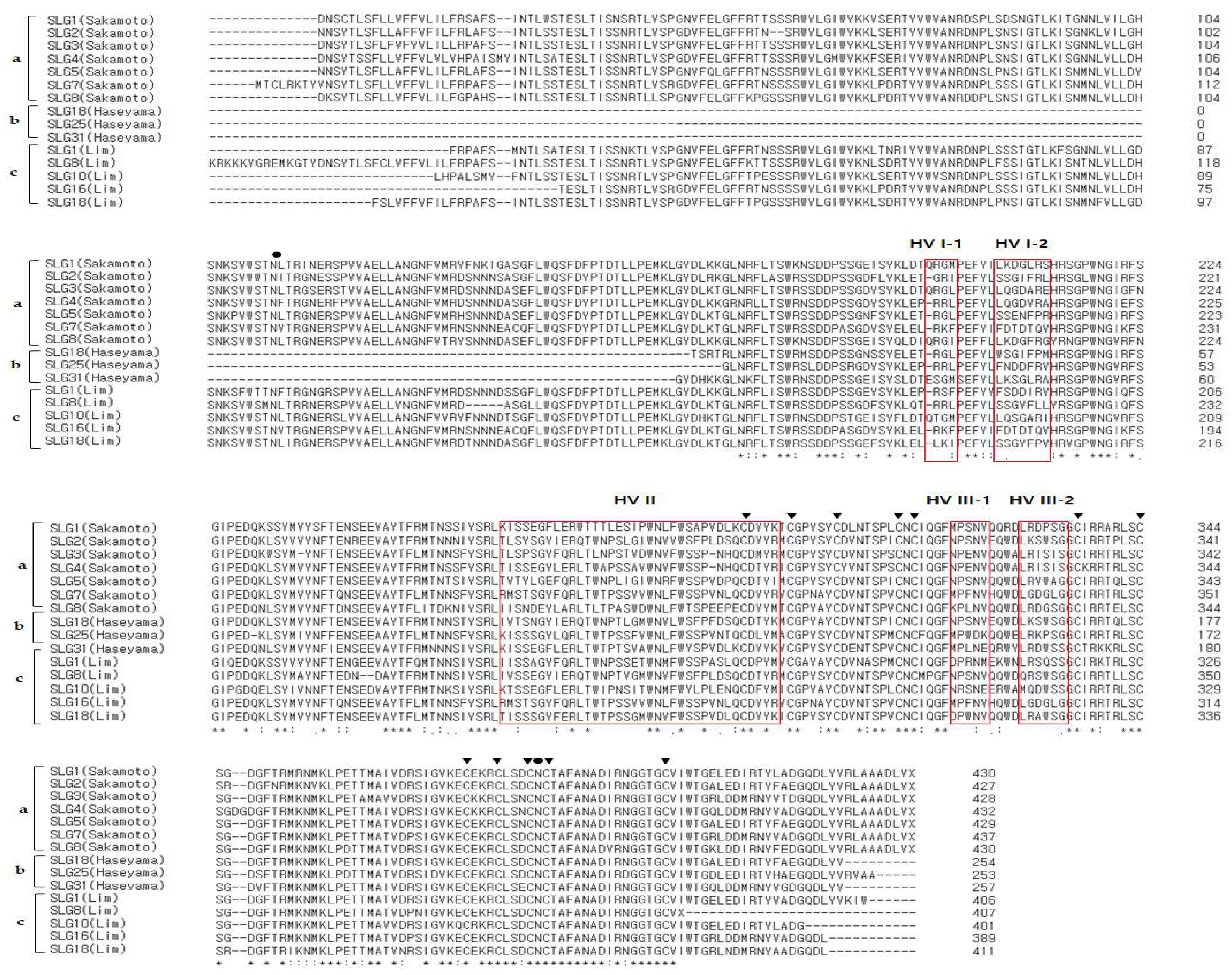
Figure 2.
Multiple sequence alignment of the amino acid sequences of the 12 class II S haplotype SLG and S domain of SRK alleles; a: S haplotype published by Haseyama [32]; b: S haplotype published by Lim [28]; c: S haplotype published by Wang [25]; Red box: hypervariable region I to III of the SLG; Filled circle: N-linked glycosylation site; Filled triangle: conserved cysteine residues; empty triangle: the site where non-synonymous mutation was inferred to have occured; Asterisk: conserved amino acid residues.
Figure 2.
Multiple sequence alignment of the amino acid sequences of the 12 class II S haplotype SLG and S domain of SRK alleles; a: S haplotype published by Haseyama [32]; b: S haplotype published by Lim [28]; c: S haplotype published by Wang [25]; Red box: hypervariable region I to III of the SLG; Filled circle: N-linked glycosylation site; Filled triangle: conserved cysteine residues; empty triangle: the site where non-synonymous mutation was inferred to have occured; Asterisk: conserved amino acid residues.
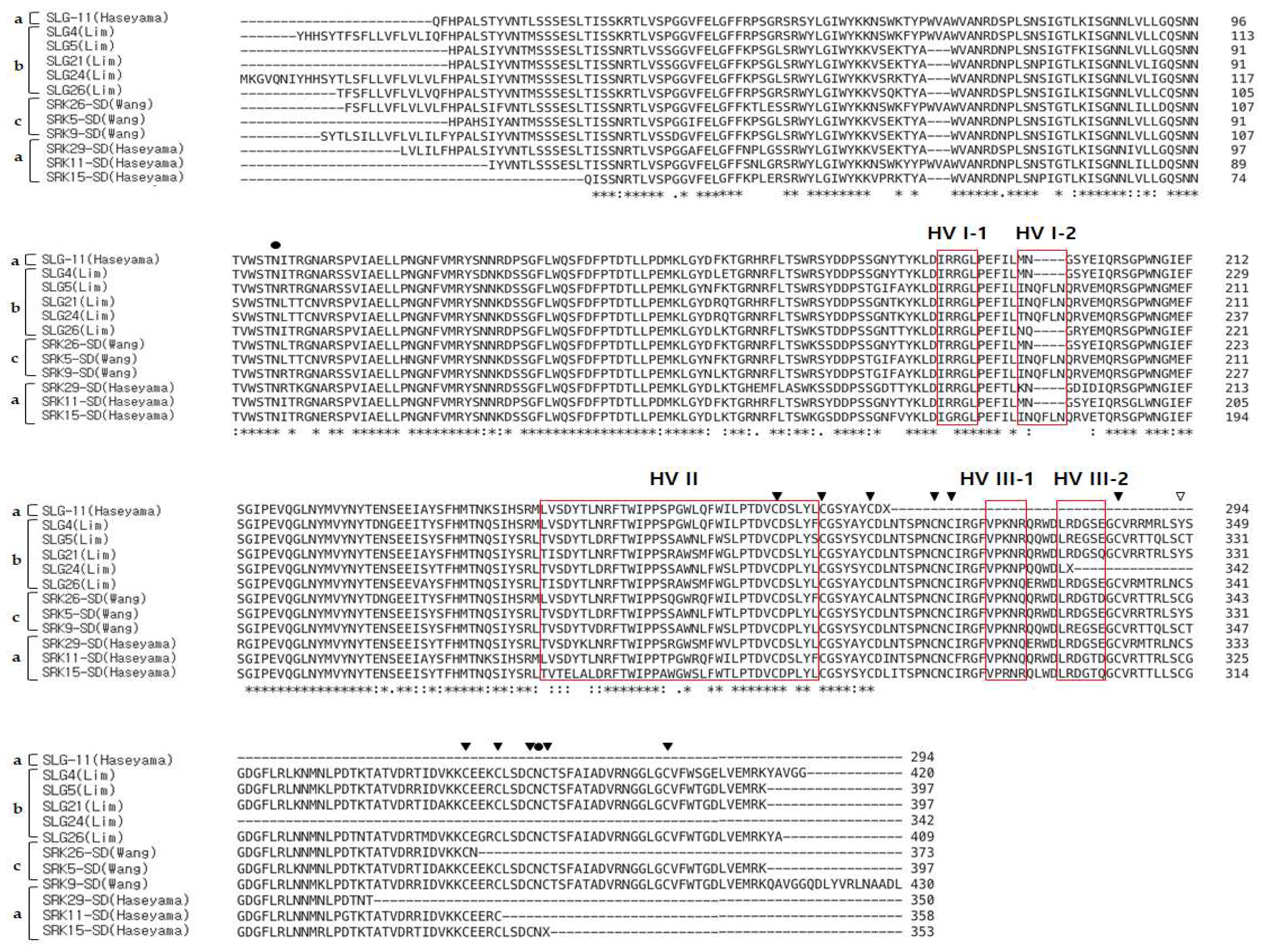
Figure 3.
PCR result of 22 radish breeding lines (‘SJ-1~22’) using developed kinase domain of SRK (SRK-KD)-specific primer sets in this study. ‘S1~S26’ are S haplotype that each of lines have. (A): SRK1 (665bp); (B): SRK8 (271bp); (C): SRK10 (411bp); (D): SRK18 (105bp).
Figure 3.
PCR result of 22 radish breeding lines (‘SJ-1~22’) using developed kinase domain of SRK (SRK-KD)-specific primer sets in this study. ‘S1~S26’ are S haplotype that each of lines have. (A): SRK1 (665bp); (B): SRK8 (271bp); (C): SRK10 (411bp); (D): SRK18 (105bp).
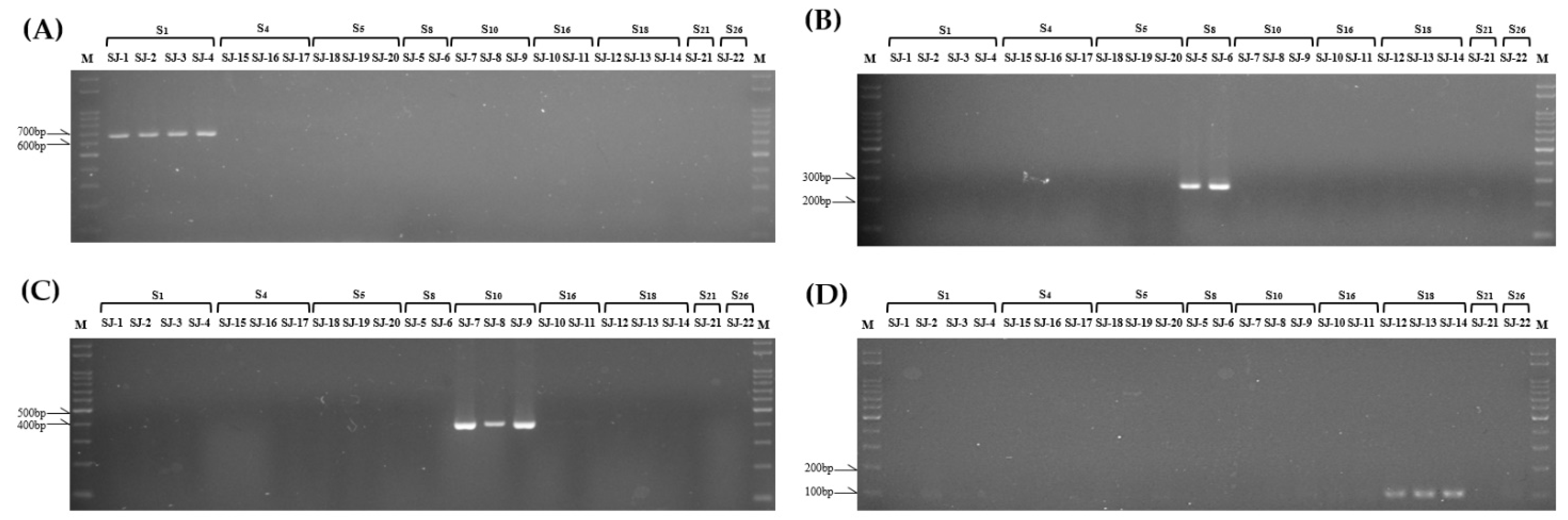
Figure 4.
PCR result of class I radish breeding lines (‘SJ-1~22’) using developed SLG-specific primer sets in this study. Each number is S haplotype that each S homozygous lines have. (A): SLG1 (388bp); (B): SLG4 (529bp); (C): SLG5 (204bp); (D): SLG8 (314bp); (E): SLG10 (369bp); (F): SLG16 (216bp); (G): SLG18 (353bp); (H): SLG21 (445bp): (I): SLG26 (131bp).
Figure 4.
PCR result of class I radish breeding lines (‘SJ-1~22’) using developed SLG-specific primer sets in this study. Each number is S haplotype that each S homozygous lines have. (A): SLG1 (388bp); (B): SLG4 (529bp); (C): SLG5 (204bp); (D): SLG8 (314bp); (E): SLG10 (369bp); (F): SLG16 (216bp); (G): SLG18 (353bp); (H): SLG21 (445bp): (I): SLG26 (131bp).
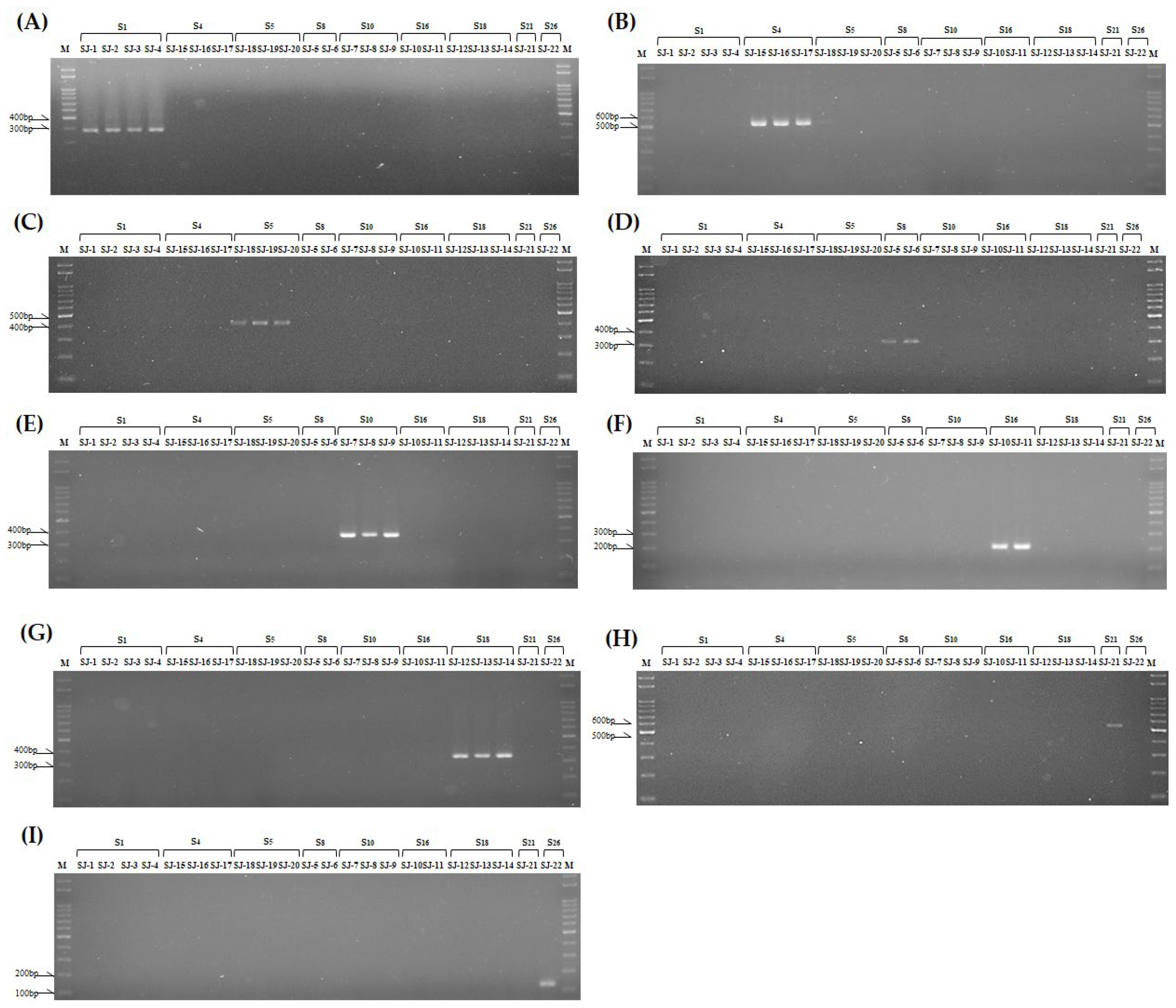
Table 1.
Materials of radish breeding lines used in this study.
| Accession Number | Type of Fleshy Root | Color of Fleshy Root | Source |
|---|---|---|---|
| SJ-1 | Narrow elliptic | Green and White | South Chinese |
| SJ-2 | Acicular | Green and White | South Chinese |
| SJ-3 | Narrow elliptic | Green and White | South Chinese |
| SJ-4 | Oblong | Green and White | South Chinese |
| SJ-5 | Medium elliptic | Green and White | North Chinese |
| SJ-6 | Medium elliptic | Green and White | North Chinese |
| SJ-7 | Bell shaped | Green and White | North Chinese |
| SJ-8 | Oblong | Green and White | South Chinese |
| SJ-9 | Oblong | Green and White | South Chinese |
| SJ-10 | Oblong | Green and White | South Chinese |
| SJ-11 | Oblong | Green and White | South Chinese |
| SJ-12 | Ovate | Green and White | South Chinese |
| SJ-13 | Medium elliptic | Green and White | North Chinese |
| SJ-14 | Medium elliptic | Green and White | North Chinese |
| SJ-15 | Bell shaped | Green and White | North Chinese |
| SJ-16 | Oblong | White | South Chinese |
| SJ-17 | Oblong | White | South Chinese |
| SJ-18 | Bell shaped | Green and White | North Chinese |
| SJ-19 | Oblong | Green and White | South Chinese |
| SJ-20 | Oblong | Green and White | South Chinese |
| SJ-21 | Bell shaped | Green and White | South Chinese |
| SJ-22 | Narrow elliptic | Green and White | North Chinese |
Table 2.
PCR condition for class I, II Universal primer sets used in this study.
| Gene | Forward | Reverse | Annealing Temperature / Cycle |
|---|---|---|---|
| Class I SRK-KD | UVSRK-F | UVSRK-R | 54℃ / 34X |
| Class I SLG | SLG-I-F PS22 |
SLG-I-R SLG-I-R |
50℃ / 39X 54℃ / 35X |
| Class II SRK-KD | KS2 | KA2 | 61℃ / 35X |
| Class II SLG | SLG-II-F Rs9SLG-F UVSLGII-F |
SLG-II-R Rs9SLG-R UVSLGII-R |
55.5℃ / 39X 53℃ / 35X 61℃ / 30X |
Table 4.
List of 9 S haplotype-specific markers (kinase domain of SRK, SLG) developed in this study.
Table 4.
List of 9 S haplotype-specific markers (kinase domain of SRK, SLG) developed in this study.
| S haplotype | Primer Set | Forward | Reverse | Expected Size |
|---|---|---|---|---|
| S1 (Lim) | SRK1 SLG1 |
KD1-F SLG1-F |
KD1-R SLG1-R |
665bp 388bp |
| S4 (Lim) | SLG4 | SLG4-F | SLG4-R | 529bp |
| S5 (Lim) | SLG5 | SLG5-F | SLG5-R | 409bp |
| S8 (Lim) | SRK8 SLG8 |
KD8-F SLG8-F |
KD8-R SLG8-R |
271bp 314bp |
| S10 (Lim) | SRK10 SLG10 |
KD10-F SLG10-F |
KD10-R SLG10-R |
411bp 369bp |
| S16 (Lim) | SLG16 | SLG16-F | SLG16-R | 216bp |
| S18 (Lim) | SRK18 SLG18 |
KD18-F SLG18-F |
KD18-R SLG18-R |
105bp 353bp |
| S21 (Lim) | SLG21 | SLG21-F | SLG21-R | 529bp |
| S26 (Lim) | SLG26 | SLG26-F | SLG26-R | 131bp |
Disclaimer/Publisher’s Note: The statements, opinions and data contained in all publications are solely those of the individual author(s) and contributor(s) and not of MDPI and/or the editor(s). MDPI and/or the editor(s) disclaim responsibility for any injury to people or property resulting from any ideas, methods, instructions or products referred to in the content. |
© 2024 by the authors. Licensee MDPI, Basel, Switzerland. This article is an open access article distributed under the terms and conditions of the Creative Commons Attribution (CC BY) license (http://creativecommons.org/licenses/by/4.0/).
Copyright: This open access article is published under a Creative Commons CC BY 4.0 license, which permit the free download, distribution, and reuse, provided that the author and preprint are cited in any reuse.


