

Submitted:
29 January 2024
Posted:
30 January 2024
You are already at the latest version
Abstract
Tribenuron-methyl is used extensively in Iranian cereal cropping systems under rainfed conditions. However, there is little information on the soil persistence and carryover of this herbicide and its phytotoxicity to subsequent crops in the rotation. This study was carried out with the aim of investigating the sensitivity of different chickpea cultivars to tribenuron-methyl and also finding alternative crops. In field experiments, the chickpea fields of Ravansar County, Kermanshah province, Iran were monitored during 2023-2022, and the growth of chickpea in response to residues of tribenuron-methyl used in the previous wheat crop was evaluated. Furthermore, in a greenhouse experiment, the effect of various concentrations of tribenuron-methyl on the growth of chickpeas, lentil and common vetch was investigated. In all the investigated species in this study, presence of tribenuron-methyl decreased plant growth. Ttotally, among examined crop species, lentil had a higher tolerance to tribenuron-methyl followed by common vetch and chickpea varieties. Bivanij chickpea variety was more sensitive to the residues of tribenuron-methyl in the soil (30% reduction in grain yield) when compared to the other two varieties, namely Mansour and Adel. Based on the results of this study, residues of tribenuron-methyl applied in wheat fields is the main responsible factor reducing the height of chickpea in rai-fed cropping systems of western Iran. It is recommended to replace lentil and common vetch with chickpeas in rotation with wheat in soils heavily contaminated with the residues of tribenuron-methyl.
Keywords:
Bioassy
; common vetch
; herbicide residue
; lentil
1. Introduction
Weeds are a great problem in agriculture and were recently estimated to seriously reduce the crop production in Iranian cropping systems [1]. Similar to other countries, the primary method for weed control in most Iranian agricultural systems involves herbicide application [2]. Although increased herbicide use is not a requirement for rainfed cropping systems, there is evidence for greater reliance on herbicides for weed control under these circumstances [3].
Chemical weed control is considered an effective means to suppress weeds then to increase crops yield; however, applying agrochemical mistakenly, high doses and incorrect time application can negatively affect the environment, particularly their residual in soils. Study on the persistence of the herbicides residues in the soil is crucially required for the environmental issues and preventive crops damage. Herbicide residues are regarded a serious fact in crop production which can potentially injure sensitive crops in rotation [4,5].
Generally, sulfonylureas are low-dose herbicides and assessing their persistence in soil and their residual effect on the following crops may be a challenging issue. High efficacy on weeds at very low rates does not preclude phytotoxic effect on susceptible crops such as sugar beet, oilseed rape, lentils, peas and other sensitive crops in rotation [6,7].
Tribenuron-methyl, belong to the class of sulfonylurea herbicides, inhibits acetolactate synthase (ALS) enzyme that catalyzes the first common reaction in the biosynthesis of branched amino acids namely valine, leucine, and isoleucine [8].
is a systemic herbicide, which is absorbed via both the roots and foliage and then spreads throughout the whole plant [8]. In Iran, Tribenuron-methyl is used for postemergence control of a wide range of broad-leaf weeds in cereal crops including wheat and barley. Recently, farmers who grow chickpea following wheat crops treated with tribenuron-methyl have reported some cases of significant reduction in chickpea yield [1].
Despite the many advantages of chemical weed control in agriculture, herbicide residues after application can contaminate soil, and in crop rotations it can cause damage to sensitive crops [5]. Herbicide carryover may be because of higher doses of herbicides than recommended dose (e.g., due to improper calibration of sprayer) or usage of recommended dose but under unsuitable conditions (e.g., low soil moisture) [9].
Generally, the probability of carryover or build-up of a herbicide residue in soil is governed by the percentage and rate of breakdown or dissipation of the active ingredient. Soil properties including texture and organic carbon content affect both herbicides degradation and persistence. Environmental and edaphic factors, particularly those that influence soil moisture content and microbial activity, strongly regulate herbicide persistence in soil [10].
The structure of tribenuron-methyl is characterized by a sulfonylurea bridge, an aryl group, and a nitrogen-containing heterocyclic portion. Chemical hydrolysis and microbial degradation are the two major pathways of sulfonylurea degradation in soil, whereas photolysis (and volatilization are relatively minor processes [8,10]. Tribenuron-methyl binds to the soil matrix through a mixed interaction mode. Herbicide-soil interactions depend on the chemical structure of the herbicide along with the properties of the soil [10]. Hence, a primary threat to the efficacy of tribenuron-methyl in rain-fed systems under arid conditions is the accumulation of herbicide residues in the soil, particularly in the case of its repeated usage.
Managing herbicide carryover in soil is particularly important where next crops in the crop rotation are sensitive to persistent herbicides used in the previous crop. In addition to carry over effects of sulfonylurea herbicides, they have the potential to pollute soil and groundwater directly or by their derivatives [11].
In rain-fed croplands of western Iran typically legumes (e.g. lentil or chickpea) follows a cereal crop (e.g. wheat or barley). Presence of an extremely low concentration of tribenuron-methyl in soil causes greater phytotoxicity of several crops such as sugar beet, maize, cotton, sunflower, soybean, and rice [10,12].
While some studies have determined the potential risk of tribenuron-methyl to non-target crops [12,13], residue risk assessments of this herbicide toxicity to chickpea growth under real conditions of rain-fed cropping systems, to our knowledge, are absent. This knowledge gap limits our ability to determine whether current tribenuron-methyl use patterns in wheat damage chickpea crop and finding alternative crop species/cultivar to tribenuron-methyl residues in the soil.
The present study was therefore undertaken to assess the sensitivity of different chickpea cultivars to the residues of tribenuron-methyl and to find a potential crop for replacing with chickpea capable of tolerating the presence of this herbicide in the soil.
2. Materials and Methods
2.1. Field experiment
2.1.1. Design and method of the field experiment
To conduct this part of the study, three regions including, Meskinabad, Moradabad, and Khorramabad were selected from Ravansar County (34° 43'N, 46° 40'E), Kermanshah province, Iran during 2022-2023. Ravansar is one of the major areas of chickpea production in Kermanshah province and western Iran, where chickpea cultivation is very popular due to its special climatic conditions.
The common crop rotation in Ravansar includes chickpea and wheat. Since the maximum period of time that tribenuron-methyl residues have phytotoxic effects on sensitive crops is three years, three groups of chickpea fields were selected in each region of Ravansar. The grouping was based on the frequency of using tribenuron-methyl herbicide in the wheat field in the last two years. The first group included fields that had no history of using tribenuron methyl herbicide in the last two years, the second group had a history of using the herbicide once, and the third group had a two-year history of using the herbicide.
In each region and each field group, five fields with an approximate area of two hectares were selected from each of the Bivanij, Adel and Mansour chickpea cultivars. A total of 30 farms in the entire Ravansar were monitored during 2022 and 2023. From each of the monitored farms, soil samples were prepared and tested to determine the physicochemical properties of the soil. At flowering and physiological ripening growing stages of chickpeas, plant traits including, plant height, number of lateral branches, number of leaflets and chickpea seed yield were measured.
To measure the chickpea traits, one square meter quadrat was randomly placed in 10 points of each field and 5 chickpea plants were selected in each quadrat and plant height, number of leaflets, and number of lateral branches were measured. In order to measure the chickpea seed yield, all the plants in each quadrat were harvested and the chickpea seeds were separated from the straw and weighed.
The field experiment was conducted as nested test design in which combinations of chickpea cultivars and herbicide usage frequency were nested in each region (Meskinabad, Moradabad and Khorramabad).
2.2. Greenhouse experiment
2.2.1. General procedures
This part of the study was aimed at investigating the effect of different concentrations of Tribenuron-methyl on Bivanij, Adel and Mansour chickpea cultivars, as well as two possible alternative legumes for cultivation in rain-fed systems, namely Lens culinaris and Vicia sativa. Since in this study we did not measure the exact amount of tribenuron-methyl residues in the soil of contaminated fields by using chemical analysis, we selected a soil sample from a heavily contaminated field with severe symptoms of dwarfism in chickpeas. Along with applying different concentrations of tribenuron-methyl, the effect of this contaminated soil sample on the growth of above-mentioned plants was evaluated in the greenhouse. The purpose of including this soil sample was to know if its possible damage corresponds to the applied concentrations of tribenuron-methyl.
On the basis of the surface area of the pots and the weight soil they contained, the appropriate amount for each herbicide dose was calculated. Tribenuron-methyl were incorporated into the potting soil. Desired doses of herbicide were prepared by adding a relevant amount for each dose to 1 L of deionized water, mixing with the potting soil in a mixer with a backpack sprayer, then mixing for 10 min.
The herbicide-treated potting soil was used to fill the pots. It is noticeable that 1 mg kg-1 concentration is equal to 0.046 kg ha-1 broadcast to the soil surface. Herbicides were applied as described above at rate of 0, 1.37, 3.75, 7.50, 13.00, 26.00, 52.00 g ai ha-1, where 26.00 g is the recommended dose of tribenuron-methyl in Iranian wheat fields [1].
Three seeds of above-mentioned crop variety/species were planted in each of the 4.0 L plastic pots. The herbicide-treated potting soil was loam, comprised of 43% sand, 32% silt, and 25% clay with 0.74% of total organic matter and a pH of 7.2. This soil sample was the provided from a non-treated site neighboring to a heavily-contaminated field from which soil sample from more evaluation was taken (Table 1). This was helpful for comparison between the phytotoxic effects of applied doses of tribenuron-methyl and herbicide residues on examined plants. The plant height, number of leaflets per plant, and plant stem diameter were recorded 4 weeks after treatments and was expressed as a proportion of the untreated control for each crop species/variety.
The greenhouse experiment was conducted as completely randomized design with four replications.
2.3. Statistical analysis:
Data for field survey were pooled over year because lack of year by treatment interaction. Data for field and greenhouse experiments were subjected to ANOVA using SAS software (v. 9.1, SAS Institute, Cary, NC) and Fisher’s Protected LSD test (P≤0.05) was used for means separation.
To describe plant height, number of leaflet per plant, and plant stem diameter in response to different doses of tribenuron-methyl, a nonlinear curve model (sigmoidal logistic, three parameters) using SigmaPlot software was fitted to data [14]:
Where, Y is plant response (plant height, number of leaflets per plant, and plant stem diameter) reduction (percentage of untreated control), a =the upper limit of Y; x is the herbicide dose, X0: GR50 is the herbicide doses required to inhibit plant response by 50% and b describes the slope of the curve in GR50.
3. Results and Discussions
3.1. Field survey
3.1.1. Plant height and lateral branch number at chickpea flowering stage
The results of the field experiment showed that in all surveyed regions, the highest height of chickpea cultivars was related to the fields where there was no history of using tribenuron-methyl during the last two years. In general, the average height of the plant in the Meskinabad region was lower than all regions (28 cm), but in the two regions of Khorramabad and Moradabad, where the plant height was almost equal, the plant height was higher than Meskinabad (Table 2).
In Khorramabad, in farms with a history of using herbicide once or twice, the height of the Bivanij variety decreased by 5% compared to farms without a history of using tribenuron-methyl while this number was 19% in Moradabad. In Meskinabad, the height of the Bivanij variety in fields treat with herbicide once and two times decreased by 6% and 25.71%, respectively. In general, the negative impact of herbicide residues in Meskinabad was higher on the height of Bivanij when compared with other regions (Table 2).
In Meskinabad, fields having one or two times of herbicide usage history, the height of Adel variety decreased by 8% compared to fields without the history of herbicide use. In Moradabad, the height of Adel variety in fields treated once and two times with herbicide decreased by 11 and 18%, respectively (Table 2).
The height of Mansour cultivar in Khorramabad in fields with one year history of herbicide use was not different from fields without herbicide application, while in fields with two years history of herbicide use, the height of this variety decreased by 22.12% compared to the control. The same trend was observed in two other two regions, Meskinabad and Moradabad, with the difference that the extend of height reduction in farms with two years of herbicide use was 7% and 10.94%, respectively (Table 2).
The number of lateral branches at the flowering stage in Bivanij and Mansour cultivars in all three regions and herbicide treatments was not significantly different from each other (Table 2). For Adel cultivar growing in fields treated one and two years by tribenuron-methyl in Khorramabad, the number of lateral branches decreased by 10 and 30, respectively (Table 2).
3.1.2. Final chickpea hright and grain yield
The results showed that the height of all cultivars in Khorramabad region was on average lower than the other two regions, Meskinabad and Moradabad (Table 2).
In general, in all the three studied regions, the highest plant height belonged to the fields without a history of tribenuron-methyl treatment, the exception was in Meskinabad, where one year of herbicide usage did not differ from non-treated fields (Table 3)
In Khorramabad, one and two year of using the herbicide decreased the final height of Adel cultivar by 10.11% and 12.35%, respectively, compared to the control or fields with no history of herbicide usage. These values were insignificant in Meskinabad (about 2%) and in Moradabad, these numbers were 4% and 7%, respectively. These results indicate the higher sensitivity of Adel cultivar in Meskinabad to tribenuron-methyl residues (Table 3). Bivanij cultivar lost about 8% of its final height in fields treated once or three times with herbicide use compared to fields without history of herbicide use in both Khorramabad and Meskinabad regions. This value was 14.6% in Moradabad (Table 3).
In all three regions, Mansour variety in all the three regions studied in fields with a history of herbicide application twice did not differ from fields without herbicide contamination, but in fields with herbicide application history of two years in the two mentioned regions, the final plant height decreased by 7% (Table 3).
The seed yield of Adel variety in Khorramabad in fields received once and two times of herbicide in comparison with fields without any history of herbicide application decreased by 3% and 6%, respectively. In Meskinabad and Moradabad one year of herbicide usage did not cause a decrease in yield, but three times of herbicide use in the two mentioned areas caused a 7% and 3% reduction in seed yield, respectively (Table 3).
In Meskinabad and Moradabad regions, one year of use of herbicide in fields devoted to Bivanij cultivar had no effect on its seed yield compared to no fields without herbicide residues. However, seed yield of fields with history of two times of tribenuron-methyl decreased by 7% and 31.81%, respectively. The seed yield of Bivanij variety in fields treated once and two times with herbicide decreased by 7% and 33.40%, respectively.
In the all three regions, the application of herbicide twice had a negligible effect on the seed yield of Mansour cultivar, but in the fields treat with herbicide two times yield reduction about 7% was observed (Table 3).
3.1.3. Correlation between seed yield, number of lateral branch and height of chickpea varieties
The results of correlation analysis between seed yield, plant height and the number of lateral branches of all chickpea cultivars grown in fields with zero, two and three years of applying tribenuron-methyl in the three regions are shown in Table 3. The results showed that there is a positive and significant relationship between the height of the plant and the seed yield of chickpea cultivars. With the increase in plant height, seed yield increased. On the other hand, there was a negative and significant relationship between the number of lateral branches and seed yield. In other words, the yield decreased with the increase in the number of lateral branches. The relationship between plant height and the number of lateral branches was also negative and significant. The increase in the number of lateral branches resulted in a decrease in the plant height (Table 4).
In total, the results of the field experiment showed that Bivanij variety was more sensitive to the residues of tribenuron-methyl in the soil compared to the other two varieties, namely Mansour and Adel. For instance, in some areas there was more than 30% decrease in grain yield of Bivanij in fields heavily contaminated with herbicide residues. Mansoor and Adel cultivars were almost the same in terms of sensitivity to tribenuron-methyl residues.
On the average, there was no difference between not using the herbicide and applying herbicide for one year and the history of using the herbicide. However, all chickpea cultivars showed a decrease in growth and grain yield in fields treated with herbicide twice; so that the yield of chickpea in such farms showed four times more decrease in grain yield compared to the fields without herbicide history and those treated once.
In general, biodegradation (degradation by microorganisms), chemical degradation (hydrolysis and oxidation), photodegradation (degradation due to the effect of sunlight), uptake by susceptible plants, adsorption to soil particles and leaching are main factors driving herbicide degradation and its subsequent persistence in the soil [15].
A wide range of edaphic factors such as pH, texture, organic matter content, moisture, and microorganisms affect the degradation and persistence of herbicides in soils [16,17]. It is well known that the most important pathways for sulfonylurea herbicides degradation in soil are microbial breakdown and chemical hydrolysis [10]. So, it can be expected that greater degradation of such herbicides would be achieved in soils of higher water content than for dry soils. Most sulfonylureas are anion in soil with pH above 5–6 and therefore mobile in such soils [18] while the acidity of soils of region of the study site is typically higher than 7 [19]. Furthermore, degradation of herbicides in soils containing high organic matter content is accelerated because the population of soil microorganisms consuming herbicides as food is high [20].
Despite the difference in some traits of different chickpea cultivars grown in all three studied regions, chickpea seed yield in different regions did not differ significantly. The physicochemical characteristics of the soil of all three regions are given in the Table 1. Although regions had different soil characteristics, the effect of this difference on the carry over effect of tribenuron-methyl residues was not significant. This result is contrary to the results of other studies on the effect of soil physicochemical properties on herbicide residues.
Natural hydrolysis as the main pathways of tribenuron-methyl degradation. On the contrary, more and more researches have reported the microbial degradation of sulfonylurea herbicides [17,21,22]. Since both pathways of decomposition of tribenuron-methyl residues are dependent on soil moisture, the conditions in the rainfed areas of western Iran are not suitable for the degradation of the residues of this herbicide. Although we did not determine the type of decomposition of tribenuron-methyl herbicide in this study
Mehdizadeh, Alebrahim and Roushani [12] reported that 26% of applied tribenuron-methyl remained 10 days after application in the soil; however, they did not measure long time herbicide residual in soil. In a study conducted Chen [23] usage of tribenuron-methyl on wheat resulted in substantial reduction of growth of corn the rotation
The greater degradation rate of tribenuron methyl in comparison with sulfosulfuron has been reported [12]. No phytotoxic effect of another member of sulfonylurea chemical family herbicides, sulfosulfuron, on bottle gourd at nearly four months after application was observed [6]. Likewise, lentil (a predominant legume in the region of our study) was tolerant to tribenuron methyl residues 8 months after herbicide application [24]. Similar to our results, Serim and Maden [25] reported the carry over effects of sulfosulfuron residues on sunflower one year after application.
Nine months after application the carry over effect of sulfosulfuron, another sulfonylurea, on barley and common vetch was not observed while sulfosulfuron residues did not affect the shoot and root length and root dry weight of sunflower [26]. Tribenuron-methyl has an acceptable controlling level on broad leaf weeds, which means it has a potential to damage broad leaf crops, such as chickpea, lentil, sugar beet and oilseed rape [27].
The results of field trials indicated that trace residue concentrations below our detection limit may have remained in the soil even in a long period of times after application of these herbicides and accumulated in the soil environment and affected sensitive crops as well as soil microorganisms.
3.2. Greenhous experiments
3.2.1. Plant height
In all the investigated species in this study, the use of the herbicide tribenuron-methyl decreased the height of the plant. The results showed that the application of tribenuron-methyl at the rate of 52 g ai ha-1 decreased the height of the treated plants drastically, with the exception of V. sativa, which had a height of 16 cm (Figure 1). At the herbicide dose of 52 g ai ha-1, the chickpea cultivars Bivanij, Adel, Mansour, lentil and common vetch were able to kept 5.92, 25.71, 14.89, 15.18, 28.57% of their final height compared to control, respectively.
The fitted model (3-parameter Sigomidal model) to the data obtained from the effect of different concentrations of tribenuron-methyl on plant height showed that the dose required to reduce the plant height by 50% in lentil, common vetch, Mansoor, Adel and Bivanij cultivars were 12.20, 9.99, 4.33, 3.27 and 3.18 g ai ha-1 herbicide, respectively (Table 5).
These results clearly showed the high resistance of lentil to the presence of tribenuron-methyl in the soil. Among chickpea cultivars, Mansour had the highest herbicide tolerance.
In the greenhouse experiment, the effect of herbicide was measured only on the initial growth of tested plants, so the number of lateral branches did not have the opportunity to be produced and this trait was not measured.
3.2.2. Number leaflets per plant
Application of the highest dose of tribenuron-methyl (52 g ai ha-1) decreased the number of leaflets in all species, so that the chickpea cultivars Bivanij, Adel Mansour, as well as Lentil and common vetch lost their leaflets by 3, 20, 12, 41 and 13% compared to the unsprayed control, respectively (Figure 2).
Table 6 shows that the three-parameter sigmoid model is well fitted to the data obtained from the effect of the herbicide doses on the number of leaflets of the examined plants. Based on this table, the herbicide dosage required to reduce the number of lentil leaves by 50% was the highest, which indicates the high tolerance of tribnuron-methyl by this crop. Among chickpea cultivars, Adel was more tolerant than the other two cultivars, and Mansour cultivar was the most sensitive (Table 6). In general, common vetch and different chickpea cultivars were highly sensitive to the presence of the herbicide in the soil in terms of leaf production.
3.2.3. Plant stem diameter
The three chickpea cultivars had a higher stem diameter compared to lentil and common vetch (Figure 3). The presence of 52 g ai ha-1 of tribenuron-methyl reduced the stem diameter of Bivanij, Adel, Mansour, lentils, and common vetch by 51, 47, 54, 50, and 24%, respectively. Among chickpea cultivars, Mansour cultivar was more tolerant to herbicide, followed by Bayonij and Adel (Figure 3).
Similar to plant height and number of leaflets, a three-parameter logistic equation described well the relationship between the dose of tribenuron-methyl in the soil and the diameter of plant stem (Table 7). The dose of herbicide needed to reduce the stem diameter by 50% in common vetch was lower than all other species, followed by lentil. All three chickpea cultivars had higher tolerance to herbicide compared to lentils and common vetch (Table 7).
Totally, among three measured plant traits viz. plant height, number of leaves and stem diameter, lentil plants had a higher tolerance to the presence of the herbicide in the soil when compared to other species. Plant height, which showed great effectiveness of the herbicide, had a higher tolerance in this plant, and on average, 3 to 4 times more concentration of herbicide was needed to reduce its height than the three varieties of chickpea. Despite having trace differences, the three chickpea cultivars showed a similar response to tribenuron-methyl.
In all the species grown in pots containing soil samples collected from a field heavily contaminated with tribenuron-methyl residues, the reduction in plant height, number of leaves and stem diameter was consistent with the pot treated with approximately 13 g ai ha-1 of tribenuron-methyl.
Typically, symptoms of sulfonylurea herbicides residues on susceptible found that sulfosulfuron residues resulted in symptoms including stunting of the plant stem [26]. These results are in agreement with other studies reporting that a very small amount of sulfonylurea herbicides can have a significant damage to the subsequent susceptible crop in the rotation [28,29]. Bioassays is a direct measurement of bioavailable of herbicide residues in the soil is called bioassay in the soil which is agronomically more meaningful than the chemical analysis [13].
Based on previous studies, some crops are highly sensitive to a wide range of herbicides -so called test plant- are usually used to investigate and trace herbicide residues’ toxicity in the soil. Test or indicator plants (e.g., sugar beet, oilseed rape, soybean, tomato, chickpea, and cotton) affect by even a very small amount of certain herbicides The results of bioassay using test plants typically is reliable and accurate the same as chemical techniques (e.g., gas chromatography) [15]. Plant traits, including plant height and biomass are used in evaluating the phytotoxic effect of herbicide residues on crops [15].
4. Conclusions
In conclusion, chickpea cultivars were highly susceptible to tribenuron-methyl while lentil and common vetch were tolerant to this herbicide. Based on the results of this study, residues of tribenuron-methyl applied in wheat fields is the responsible factor reducing the height of chickpea in rai-fed cropping systems. Due to the lack of moisture in the drylands of the region, as well as the calcareousness and high acidity of the soil, as well as the high sensitivity of chickpea to tribenuron-methyl residues, care should be taken in amount and frequency of herbicide usage. In some cases, when the farmer is to grow wheat, it is recommended to grow legume substitutes for chickpea, such as common and lentil, which have a higher tolerance to the residues of tribenuron-methyl.
The main suggestion for further research on this issue includes the cultivation of leguminous crops instead of chickpea in rotation with wheat in fields with a history of tribenuron-methyl contamination. With this method, it is very likely that this problem can be solved to some extent and more damage to farmers can be prevented.
Author Contributions
Conceptualization: I.N. Writing (original draft preparation): I.N., M.F., and M.E.G. All authors contributed to the writing (review and editing) stage and approved the final version of the manuscript. All authors have read and agreed to the published version of the manuscript.
Funding
The authors acknowledge financial support from the Razi University.
Data Availability Statement
The datasets generated and/or analyzed during the current study will be made publicly available in the ERDA repository, upon acceptance for publication.
Conflicts of Interest
The authors declare no conflicts of interest.
References
- Nosratti, I.; Sabeti, P.; Chaghamirzaee, G.; Heidari, H. Weed problems, challenges, and opportunities in Iran. Crop Protection 2020, 134, 104371. [Google Scholar] [CrossRef]
- Nosratti, I.; Muhammadyari, A. First report of multiple resistance in Galium aparine to ALS-inhibiting and auxin analog herbicides in Kermanshah, Iran. Planta Daninha 2019, 37, e019187358. [Google Scholar] [CrossRef]
- Bagheri, A.; Sohrabi, N.; Mondani, F.; Nosratti, I. Weed infestation is affected by chickpea farmer demographics and agronomic practices. Weed Research 2021, 61, 45–54. [Google Scholar] [CrossRef]
- Ahmadkhani, E.; Nosratti, I.; Sabeti, P. Evaluation of various herbicides for controlling annual ground cherry Physalis divaricata in sugar beet Beta vulgaris fields. Journal of Applied Research in Plant Protection 2023, 11, 97–109. [Google Scholar] [CrossRef]
- Ahmadi, F.; Nosratti, I.; Mosavi, S.K.; Sabeti, P. Evaluation of efficiency of some soil-applied herbicides for weed control in chickpea (Cicer aretinum L.) and their residual effect on growth and grain yield of bread wheat (Triticum aestivum L.) in crop rotation under rainfed conditions. Iranian Journal of Crop Sciences 2022, 24, 136–149. [Google Scholar]
- Singh, S.B.; Kulshrestha, G. Determination of sulfosulfuron residues in soil under wheat crop by a novel and cost-effective method and evaluation of its carryover effect. Journal of Environmental Science and Health Part B 2007, 42, 27–31. [Google Scholar] [CrossRef]
- HernÁNdez-Sevillano, E.; Villarroya, M.; Alonso-Prados, J.L.; García-Baudín, J.M. Bioassay to detect MON-37500 and triasulfuron residues in soils. Weed Technology 2001, 15, 447–452. [Google Scholar] [CrossRef]
- Bhattacherjee, A.; Dureja, P. Light-induced transformations of tribenuron-methyl in aqueous solution. Pesticide science 1999, 55, 183–188. [Google Scholar] [CrossRef]
- Rector, L.S.; Pittman, K.B.; Beam, S.C.; Bamber, K.W.; Cahoon, C.W.; Frame, W.H.; Flessner, M.L. Herbicide carryover to various fall-planted cover crop species. Weed Technology 2020, 34, 25–34. [Google Scholar] [CrossRef]
- Brown, H.M. Mode of action, crop selectivity, and soil relations of the sulfonylurea herbicides. Pesticide Science 1990, 29, 263–281. [Google Scholar] [CrossRef]
- Rosenbom, A.E.; Kjær, J.; Olsen, P. Long-term leaching of rimsulfuron degradation products through sandy agricultural soils. Chemosphere 2010, 79, 830–838. [Google Scholar] [CrossRef]
- Mehdizadeh, M.; Alebrahim, M.T.; Roushani, M. Determination of two sulfonylurea herbicides residues in soil environment using HPLC and phytotoxicity of these herbicides by lentil bioassay. Bulletin of environmental contamination and toxicology 2017, 99, 93–99. [Google Scholar] [CrossRef] [PubMed]
- Mehdizadeh, M.; Alebrahim, M.T.; Roushani, M.; Streibig, J.C. Evaluation of four different crops’ sensitivity to sulfosulfuron and tribenuron methyl soil residues. Acta Agriculturae Scandinavica, Section B—Soil & Plant Science 2016, 66, 706–713. [Google Scholar] [CrossRef]
- Payamani, R.; Nosratti, I.; Amerian, M. Variations in the germination characteristics in response to environmental factors between the hairy and spiny seeds of hedge parsley (Torilis arvensis Huds.). Weed Biology and Management 2018, 18, 176–183. [Google Scholar] [CrossRef]
- Mehdizadeh, M.; Mushtaq, W.; Siddiqui, S.A.; Ayadi, S.; Kaur, P.; Yeboah, S.; Mazraedoost, S.; AL-Taey, D.K.; Tampubolon, K. Herbicide residues in agroecosystems: Fate, detection, and effect on non-target plants. Reviews in Agricultural Science 2021, 9, 157–167. [Google Scholar] [CrossRef] [PubMed]
- Cessna, A.J.; Donald, D.B.; Bailey, J.; Waiser, M. Persistence of the sulfonylurea herbicides sulfosulfuron, rimsulfuron, and nicosulfuron in farm dugouts (ponds). Journal of environmental quality 2015, 44, 1948–1955. [Google Scholar] [CrossRef] [PubMed]
- Grey, T.L.; McCullough, P.E. Sulfonylurea herbicides' fate in soil: dissipation, mobility, and other processes. Weed Technology 2012, 26, 579–581. [Google Scholar] [CrossRef]
- Si, Y.; Wang, S.; Zhou, J.; Hua, R.; Zhou, D. Leaching and degradation of ethametsulfuron-methyl in soil. Chemosphere 2005, 60, 601–609. [Google Scholar] [CrossRef]
- Khorami, S.S.; Kazemeini, S.A.; Afzalinia, S.; Gathala, M.K. Changes in soil properties and productivity under different tillage practices and wheat genotypes: A short-term study in Iran. Sustainability 2018, 10, 3273. [Google Scholar] [CrossRef]
- Moyer, J.R.; Hamman, W.M. Factors affecting the toxicity of MON 37500 residues to following crops. Weed Technology 2001, 15, 42–47. [Google Scholar] [CrossRef]
- Wang, H.; Xu, J.; Yates, S.R.; Zhang, J.; Gan, J.; Ma, J.; Wu, J.; Xuan, R. Mineralization of metsulfuron-methyl in Chinese paddy soils. Chemosphere 2010, 78, 335–341. [Google Scholar] [CrossRef]
- Wang, N.-X.; Tang, Q.; Ai, G.-M.; Wang, Y.-N.; Wang, B.-J.; Zhao, Z.-P.; Liu, S.-J. Biodegradation of tribenuron methyl that is mediated by microbial acidohydrolysis at cell-soil interface. Chemosphere 2012, 86, 1098–1105. [Google Scholar] [CrossRef] [PubMed]
- Chen, X. Study on sensitivity of sulfonylurea herbicides to maize and residue dynamics. J Henan VocatTechni Teachers College 2004, 32, 24–26. [Google Scholar]
- Kotoula-syka, E.; Eleftherohorinos, I.; Gagianas, A.; Sficas, A. Phytotoxicity and persistence of chlorsulfuron, metsulfuron-methyl, triasulfuron and tribenuron-methyl in three soils. Weed Research 1993, 33, 355–367. [Google Scholar] [CrossRef]
- Serim, A.; Maden, S. Effects of soil residues of sulfosulfuron and mesosulfuron methyl+ iodosulfuron methyl sodium on sunflower varieties. Journal of Agricultural Sciences 2014, 20, 1–9. [Google Scholar] [CrossRef]
- Alonso-Prados, J.L.; Hernández-Sevillano, E.; Llanos, S.; Villarroya, M.; Garcı́a-Baudı́n, J.M. Effects of sulfosulfuron soil residues on barley (Hordeum vulgare), sunflower (Helianthus annuus) and common vetch (Vicia sativa). Crop Protection 2002, 21, 1061–1066. [Google Scholar] [CrossRef]
- Volova, T.; Shumilova, A.; Zhila, N.; Sukovatyi, A.; Shishatskaya, E.; Thomas, S. Efficacy of slow-release formulations of metribuzin and tribenuron methyl herbicides for controlling weeds of various species in wheat and barley stands. ACS omega 2020, 5, 25135–25147. [Google Scholar] [CrossRef]
- SANTÍN-MONTANYÁ, I.; ALONSO-PRADOS, J.L.; Villarroya, M.; Garcia-Baudin, J. Bioassay for determining sensitivity to sulfosulfuron on seven plant species. Journal of Environmental Science and Health Part B 2006, 41, 781–793. [Google Scholar] [CrossRef]
- Villaverde, J.; Kah, M.; Brown, C.D. Adsorption and degradation of four acidic herbicides in soils from southern Spain. Pest Management Science: formerly Pesticide Science 2008, 64, 703–710. [Google Scholar] [CrossRef]
Figure 1.
Plant height of Vicia sativa, Lens culinaris and three varieties of Cicer arietinum following applicationof various doses of tribenuron-methyl. Data are fitted to a 3-parameter Sigomidal model.
Figure 1.
Plant height of Vicia sativa, Lens culinaris and three varieties of Cicer arietinum following applicationof various doses of tribenuron-methyl. Data are fitted to a 3-parameter Sigomidal model.
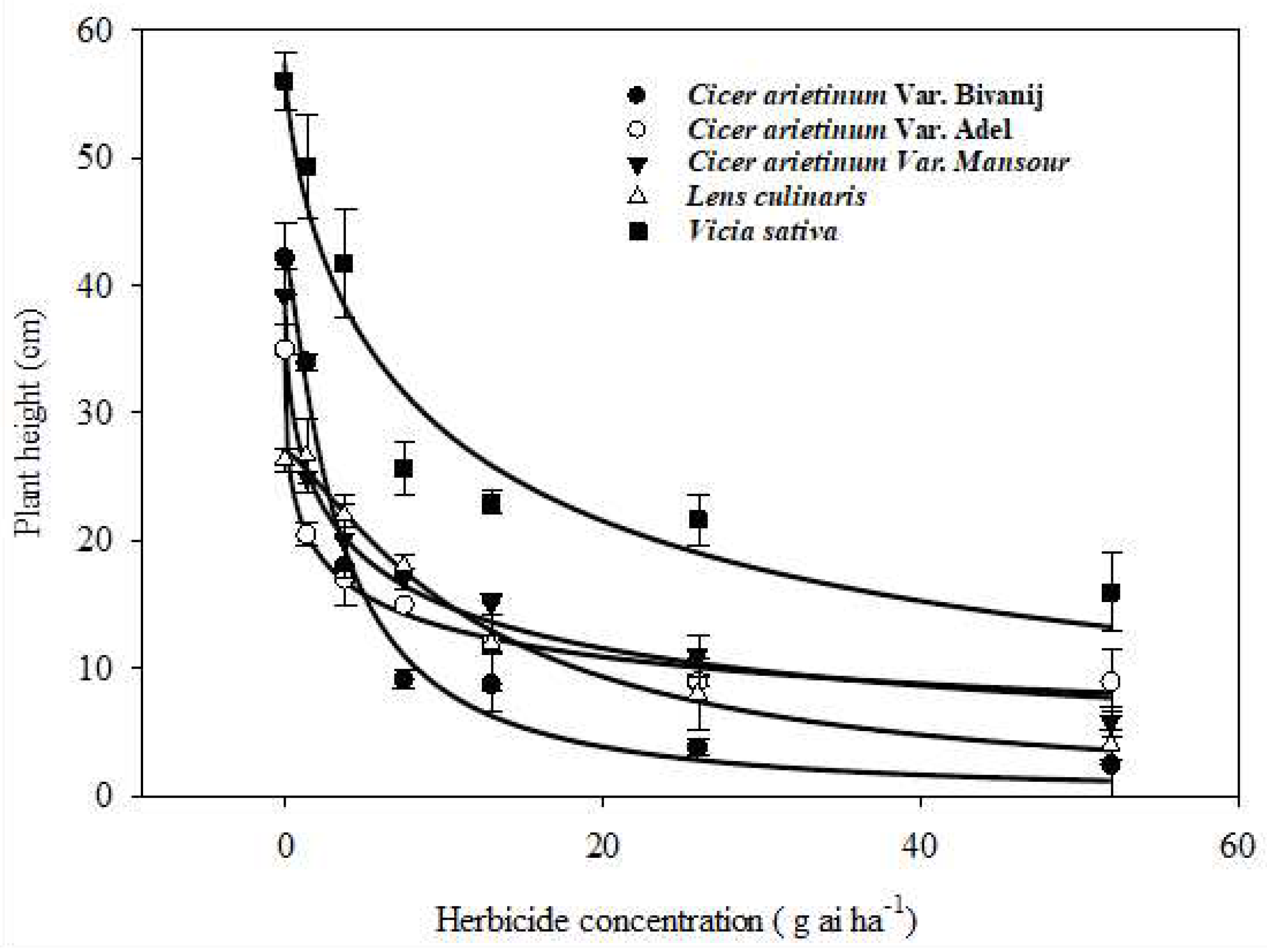
Figure 2.
Leaflet number of Vicia sativa, Lens culinaris and three varieties of Cicer arietinum following applicationof various doses of tribenuron-methyl. Data are fitted to a 3-parameter Sigomidal model.
Figure 2.
Leaflet number of Vicia sativa, Lens culinaris and three varieties of Cicer arietinum following applicationof various doses of tribenuron-methyl. Data are fitted to a 3-parameter Sigomidal model.
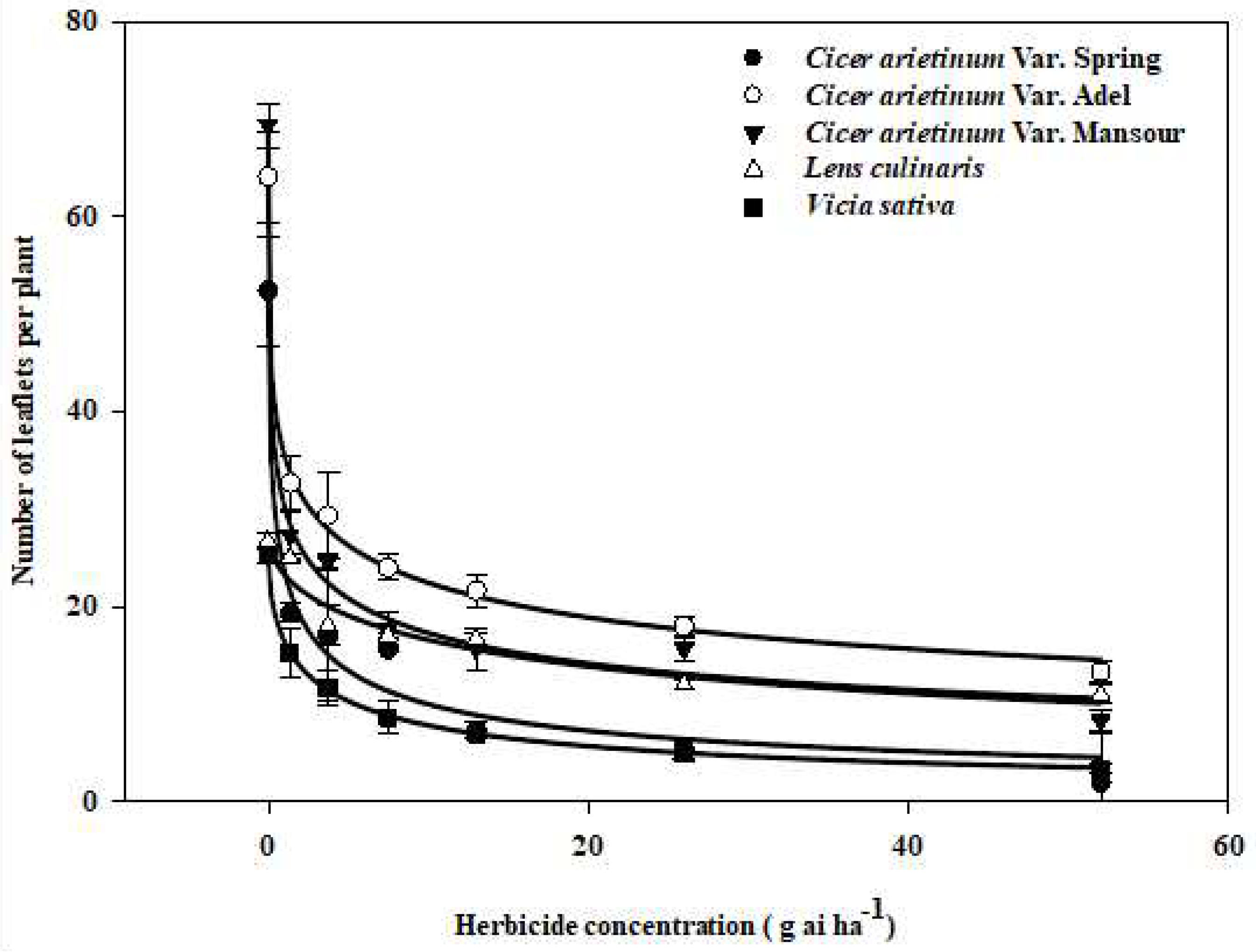
Figure 3.
Stem diameter of Vicia sativa, Lens culinaris and three varieties of Cicer arietinum following applicationof various doses of tribenuron-methyl. Data are fitted to a 3-parameter Sigomidal model.
Figure 3.
Stem diameter of Vicia sativa, Lens culinaris and three varieties of Cicer arietinum following applicationof various doses of tribenuron-methyl. Data are fitted to a 3-parameter Sigomidal model.
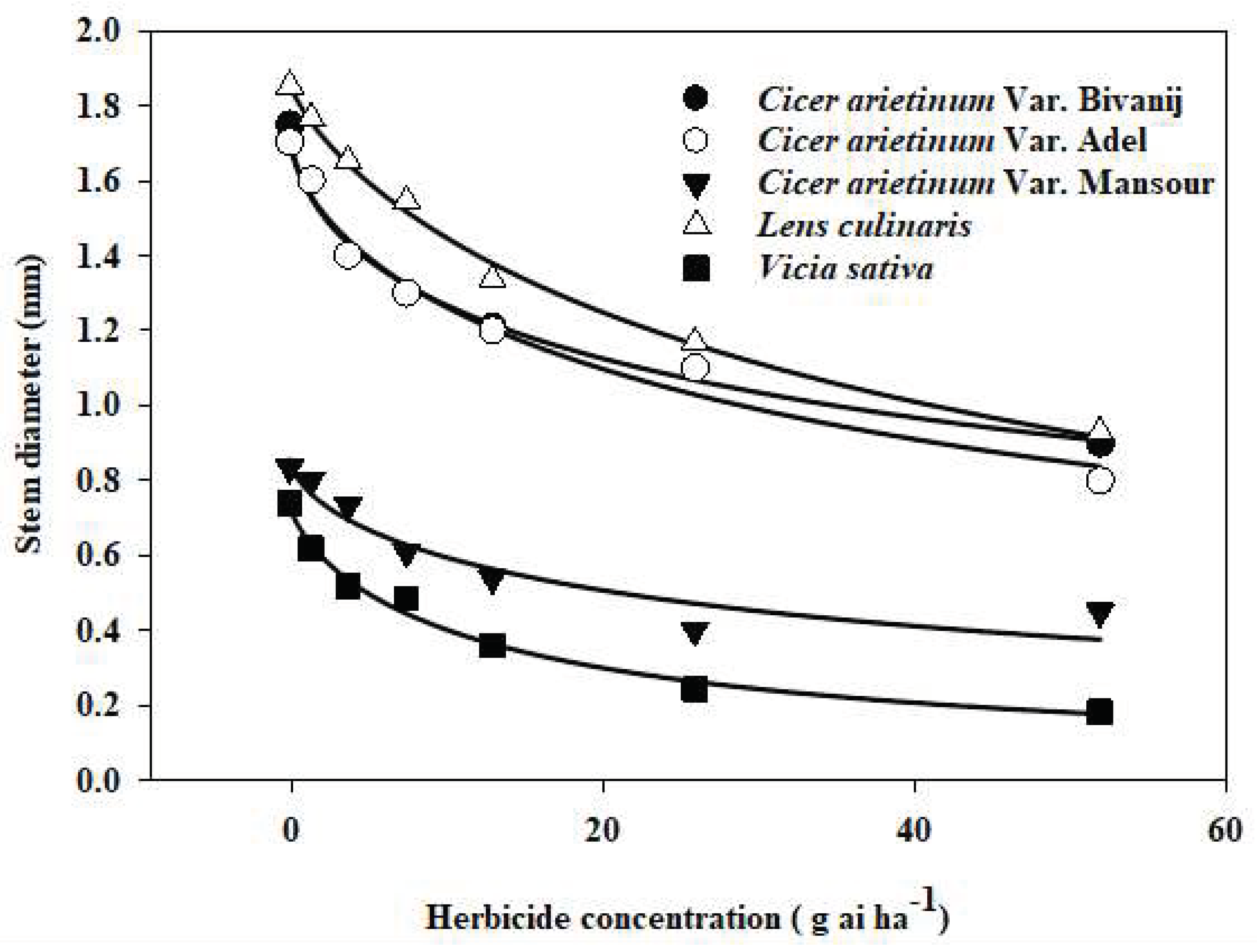

Table 1.
Physical and chemical properties of soil (0-30 cm depth) in the experimental sites.
| Region | O.C (%) |
N (%) |
P (ppm) |
K (ppm) |
Soil texture | PH | EC (ds/m) |
| Khoramabad | 0.59 | 0.08 | 7.4 | 280 | Silty clay loam | 7.8 | 0.84 |
| Meskinabad | 0.63 | 0.06 | 8 | 250 | Clay Loamy | 7.3 | 0.55 |
| Moradabad | 0.75 | 0.05 | 7.3 | 260 | Silty clay loam | 7.6 | 0.81 |
| Heavily tribenuron-methyl-infested Soil Sample | 0.7 | 0.07 | 8.1 | 285 | Silty Clay Loam | 7.4 | 0.6 |
Table 2.
Measured plant height and lateral branch of various chickpea cultivars grown in three regions of Ravansar County as affected by tribenuron-methyl residues applied in preceding rotational wheat.
Table 2.
Measured plant height and lateral branch of various chickpea cultivars grown in three regions of Ravansar County as affected by tribenuron-methyl residues applied in preceding rotational wheat.
| Region | Herbicide usage frequency | Chickpea cultivar | Plant height (cm) | Plant branch (per plant) | |
| Khoramabad | None | Adel | 30.67 ef | 3.33 a-c | |
| Bivanij | 22.33 h-j | 3.67 ab | |||
| Mansour | 40.67 a | 2.33 bc | |||
| Two times | Adel | 33.33 de | 2.33 bc | ||
| Bivanij | 21.00 hi | 4.00 a | |||
| Mansour | 31.67 d-f | 2.33 bc | |||
| once | Adel | 34.00 c-e | 3.00 a-c | ||
| Bivanij | 21.00 hi | 4.00 a | |||
| Mansour | 41.00 a | 2.00 bc | |||
| Meskinabad | None | Adel | 32.00 d-f | 2.67 bc | |
| Bivanij | 23.33 g | 3.33 a-c | |||
| Mansour | 34.67 c-e | 2.33 bc | |||
| Two times | Adel | 30.00 ef | 2.67 a-c | ||
| Bivanij | 17.33 i | 3.00 a-c | |||
| Mansour | 32.00 d-f | 3.33 a-c | |||
| Once | Adel | 29.33 ef | 2.00 bc | ||
| Bivanij | 22.00 h-j | 3.67 ab | |||
| Mansour | 34.33 c-e | 2.33 bc | |||
| Moradabad | None | Adel | 37.00 a-d | 3.33 a-c | |
| Bivanij | 27.00 g | 3.00 a-c | |||
| Mansour | 39.67 ab | 2.67 a-c | |||
| Two times | Adel | 30.33 ef | 2.67 a-c | ||
| Bivanij | 21.67 hi | 3.07 ab | |||
| Mansour | 35.33 c-e | 3.33 a-c | |||
| Once | Adel | 32.67 d-f | 2.67 a-c | ||
| Bivanij | 21.67 hi | 3.00 ab | |||
| Mansour | 40.67 a | 3.00 a-c | |||
| Means with the same letter are not significantly different based on Duncan's Multiple Range Test | |||||
Table 3.
Measured final plant height and grain yield of various chickpea cultivars grown in three regions of Ravansar County as affected by tribenuron-methyl residues applied in preceding rotational wheat.
Table 3.
Measured final plant height and grain yield of various chickpea cultivars grown in three regions of Ravansar County as affected by tribenuron-methyl residues applied in preceding rotational wheat.
| Region | Herbicide usage frequency | Chickpea cultivar | Final Plant height (cm) | Grain yield (g m -1) | |
| Khoramabad | None | Adel | 59.33 de | 178.86 cd | |
| Bivanij | 41.00 hi | 371.21 ab | |||
| Mansour | 68.67 a | 278.33 a-d | |||
| Two times | Adel | 52.00 g | 167.29 d | ||
| Bivanij | 37.67 i-k | 247.27 b-d | |||
| Mansour | 62.33 cd | 259.50 a-d | |||
| Once | Adel | 53.33 gf | 172.50 cd | ||
| Bivanij | 37.67 i-k | 345.42 ab | |||
| Mansour | 64.00 c | 267.84 a-d | |||
| Meskinabad | None | Adel | 56.00 ef | 183.85 cd a | |
| Bivanij | 41.00 hi | 363.32 ab | |||
| Mansour | 68.67 a | 285.01 a-c | |||
| Two times | Adel | 54.33 fg | 170.28 cd | ||
| Bivanij | 37.33 i-k | 334.50 ab | |||
| Mansour | 64.00 c | 264.15 a-d | |||
| Once | Adel | 55.33 fg | 182.77 cd | ||
| Bivanij | 39.00 i-j | 361.96 ab | |||
| Mansour | 69.33 a | 284.17 a-c | |||
| Moradabad | None | Adel | 59e | 178.94 cd | |
| Bivanij | 41.33 hi | 352.55 ab | |||
| Mansour | 69.00 a | 277.50 a-d | |||
| Two times | Adel | 54.67 fg | 172.88 cd | ||
| Bivanij | 35.33 k | 340.72 ab | |||
| Mansour | 65.00 bc | 268.08 a-d | |||
| Once | Adel | 56.33 ef | 178.33 cd | ||
| Bivanij | 35.33 k | 351.64 ab | |||
| Mansour | 69.33 a | 275.95 a-d | |||
| Means with the same letter are not significantly different based on Duncan's Multiple Range Test | |||||
Table 4.
Pearson’s correlation coefficients among studied traits in different chickpea cultivar grown in fields treated with tribenuron-methyl at 0, 2 and three times located in Moradabad, Meskinabd, and Khoramabadad regions of Ravansar County.
Table 4.
Pearson’s correlation coefficients among studied traits in different chickpea cultivar grown in fields treated with tribenuron-methyl at 0, 2 and three times located in Moradabad, Meskinabd, and Khoramabadad regions of Ravansar County.
| Seed yield | Plant height | Number of Plant branch | |
| Seed yield | 1.00 | 0.23* | -0.25* |
| Plant height | 0.23* | 1.00 | -0.44** |
| Number of plant branch | -0.25* | -0.44** | 1.00 |
| *, ** indicates that correlation is significant at the 0.05 and 0.01 probability level, respectively. | |||
Table 5.
Parameter estimates of the three-parameter sigmoid model fitted to the plant height of Vicia sativa, Lens culinaris and three varieties of Cicer arietinum following applicationof various doses of tribenuron-methyl applied in the soil. Data in paranthesis are ± sandard error of each means.
Table 5.
Parameter estimates of the three-parameter sigmoid model fitted to the plant height of Vicia sativa, Lens culinaris and three varieties of Cicer arietinum following applicationof various doses of tribenuron-methyl applied in the soil. Data in paranthesis are ± sandard error of each means.
| Plant species/variety | a | b | X50 | R2 |
| Cicer arietinum Var. Bivanij | 42.81 (0.17) | 1.26 (0.75) | 3.27 (0.46) | 0.98 |
| Cicer arietinum Var. Adel | 35.00 (0.037) | 0.42 (0.08) | 3.18 (0.52) | 0.99 |
| Lens culinaris | 27.11 (0.12) | 1.28 (0.78) | 12.20 (1.03) | 0.99 |
| Cicer arietinum Var. Mansour | 39.02 (0.05) | 0.56 (0.48) | 4.33 (0.74) | 0.99 |
| Vicia sativa | 57.34 (0.16) | 0.72 (0.34) | 9.99 (3.1) | 0.94 |
Table 6.
Parameter estimates of the three-parameter sigmoid model fitted to the leaflet number of Vicia sativa, Lens culinaris and three varieties of Cicer arietinum following applicationof various doses of tribenuron-methyl applied in the soil. Data in paranthesis are ± sandard error of each means.
Table 6.
Parameter estimates of the three-parameter sigmoid model fitted to the leaflet number of Vicia sativa, Lens culinaris and three varieties of Cicer arietinum following applicationof various doses of tribenuron-methyl applied in the soil. Data in paranthesis are ± sandard error of each means.
| Plant species/variety | a | b | X50 | R2 |
| Cicer arietinum Var. Bivanij | 52.21 (0.13) | 0.54 (0.35) | 0.72 (0.39) | 0.97 |
| Cicer arietinum Var. Adel | 63.94 (0.02) | 0.36 (0.06) | 1.89 (0.31) | 0.99 |
| Lens culinaris | 27.13 (0.13) | 0.59 (0.04) | 21.78 (3.03) | 0.99 |
| Cicer arietinum Var. Mansour | 69.30 (0.05) | 0.37 (0.21) | 0.51 (0.23) | 0.99 |
| Vicia sativa | 25.32 (0.16) | 0.62 (0.02) | 2.7 (0.12) | 0.99 |
Table 7.
Parameter estimates of the three-parameter sigmoid model fitted to the stem diameter of Vicia sativa, Lens culinaris and three varieties of Cicer arietinum following applicationof various doses of tribenuron-methyl applied in the soil. Data in paranthesis are ± sandard error of each means.
Table 7.
Parameter estimates of the three-parameter sigmoid model fitted to the stem diameter of Vicia sativa, Lens culinaris and three varieties of Cicer arietinum following applicationof various doses of tribenuron-methyl applied in the soil. Data in paranthesis are ± sandard error of each means.
| Plant species/variety | a | b | X50 | R2 |
| Cicer arietinum Var. Bivanij | 1.75 (0.05) | 0.53 (0.3) | 58 (7.9) | 0.99 |
| Cicer arietinum Var. Adel | 1.7 (0.08) | 0.65 (0.04) | 49.27 (0.31) | 0.98 |
| Lens culinaris | 0.85 (0.18) | 0.64 (0.05) | 35.89 (12.03) | 0.91 |
| Cicer arietinum Var. Mansour | 1.8 (0.05) | 0.78 (0.02) | 50.08 (3.42) | 0.99 |
| Vicia sativa | 0.73 (0.08) | 0.81 (0.02) | 12.96 (1.66) | 0.98 |
Disclaimer/Publisher’s Note: The statements, opinions and data contained in all publications are solely those of the individual author(s) and contributor(s) and not of MDPI and/or the editor(s). MDPI and/or the editor(s) disclaim responsibility for any injury to people or property resulting from any ideas, methods, instructions or products referred to in the content. |
© 2024 by the authors. Licensee MDPI, Basel, Switzerland. This article is an open access article distributed under the terms and conditions of the Creative Commons Attribution (CC BY) license (http://creativecommons.org/licenses/by/4.0/).
Copyright: This open access article is published under a Creative Commons CC BY 4.0 license, which permit the free download, distribution, and reuse, provided that the author and preprint are cited in any reuse.


