

Submitted:
06 September 2023
Posted:
08 September 2023
You are already at the latest version
Abstract
This study examines the impact of weeds on sweet corn, where weeds compete with the main agricultural crops for essential elements such as nutrients, water, sunlight, and space for growth. In general. the use of herbicides is meant to suppress weed growth. Organic matter is important for plant growth and affects herbicide persistence. The study was aimed to explore the interdependence between ametryn herbicide and organic matter content and its impacts on weed growth, herbicide persistence, and sweet corn yield. The experiment was initiated in 2022 at the Experimental Station of the Faculty of Agriculture, Padjadjaran University, Indonesia, using a Split Plot Design in a Randomized Complete Block Design (RCBD) with three replicates. The experiments consisted of three levels of organic matter, i.e. low, medium, and high and 6 levels of ametryn herbicide at 0.0 (control), 0.5, 1.0, 1.5, 2.0, 2.5 kg a.i./ha. The results indicated that the apparent interdependence between ametryn herbicide doses of 1.5, 2.0 and 2.5 kg a.i./ha and the three levels of the organic matter content totally suppressed the weed growth. However, the effects of interdependence between ametryn herbicide and organic matter content on the herbicide persistence and on the sweet corn yield were not obvious. The ametryn herbicide gave excellent effects on sweet corn yield. Bioassay analysis showed that the lowest persistence of ametryn herbicide was in line with the highest content of the organic matter.
Keywords:
bioassay
; chemical weeding
; nutrient competition
; straw compost
; weed suppression
Introduction
Maize is an important food source with great economic value and places second only to rice as the source of carbohydrates and proteins. Apart from being a food ingredient, sweet corn (Zea mays L.) is also utilized for animal feed and raw material for the feed industry [1]. In Indonesia, most of the sweet corn demand is used as raw materials for animal feed (55%), food raw materials (30%), and raw materials for other industries and seeds (15%) [2]. The popularity of sweet corn in Indonesia has been due to its high nutrition contents, high economical values in the market, as well as its relatively rapid production period [3]. Limited production of sweet corn in Indonesia has resulted in the country’s steady import of the commodity. According to data from the [4], the sweet corn imports in Indonesia in 2018 reached 517.5 thousand tons, increasing 42.46% to 737.2 thousand tons in 2019.
One of the reasons for the decline in sweet corn productivity in Indonesia and the dependence on imports is the weed problem in sweet corn fields. Weeds can cause a yield decrease as they compete for resources such as growing space, water, and sunlight with the sweet corn plants [5]. If the weeds are not controlled properly, the productivity of sweet corn will be disrupted [6]. Losses caused by weeds in maize crop areas are around 10-20% [7]. Chemical weeding using herbicides [8] has been a common practice in agriculture. However, to control weeds in sweet corn fields, it is pertinent that the herbicides are used wisely. Utilization of the herbicides must be done appropriately, including the dose, type, target, quality, time of application, and method of application [9]. In addition, continuous use of herbicides should be avoided because it can increase herbicide residues in the soil, which will in turn affect soil fertility and crop productivity. One of the effective herbicides to control weeds in sweet corn fields is ametryn-based herbicides. They are systemic and selective for controlling weeds in a number of crops such as sugar cane, pineapple, banana, corn, and potatoes [10]. Ametryn herbicides are active in the soil for 11 to 110 days [11].
Herbicide persistence, the period in which an herbicide still maintains its activity in the soil, is influenced by many factors including soil organic matter, volatilization, photodecomposition, adsorption, leaching, degradation by microbes and uptake by plants [12,13]. Organic matter can improve soil physical, chemical, and biological properties [14]. Organic matter content in agricultural land in Indonesia is generally low [15]. Organic materials such as rice straw compost can help increase soil organic matter content, improve accessibility of essential nutrients to plants and retain water in the soil [16]. In addition, organic matter can also increase microorganisms in the soil as measured by soil respiration [17]. The higher the organic matter, the more energy sources for soil organisms so that the activity of microorganisms increases [18]. In addition to organic matter, the activity of soil microorganisms is also influenced by moisture, aeration, and energy sources [19]. However, addition of organic matter may reduce herbicide activity in the soil so that the herbicide dose must be increased [20]. The currently reported research was conducted to investigate the effects of ametryn herbicide and soil organic matter content on weed growth, herbicide persistence, and sweet corn yield.
Materials and Methods
This research took place at the Experimental Station of the Faculty of Agriculture, Padjadjaran University, Bandung, Indonesia, at the elevation of approximately 660 meters above sea level with Inseptisol soil classification. This experiment was established in October 2022. In this study, the materials used included sweet corn seeds of the Paragon variety, organic matter from straw compost that had been allowed to stand for 1 month. At the trial establishment, weed coverage of the experimental plots was still low. The dominant weeds in the experimental area were Cynodon dactylon, Ageratum conyzoides, Elephanthopus scaber, and Bidens pilosa. Figure 1 below shows a general view of weed coverage of the treatment plots in the experimental field 5 weeks after application (WAA).
The investigation used a two-factor Split Plot Design in a Randomised Complete Block Design (RCBD) replicated 3 times. The main plot treatments were in the form of 3 levels of organic matter content in the form of rice straw compost, i.e. low (no organic matter was added, b1), medium (4.2 kg/plot of organic matter was added, b2), high (12 kg/plot of organic matter was added, b3). Based on the results of soil laboratory analysis, the C-organic content of the plots in the experimental field was classified as low (1.97%), medium (2.50%) and high (3.50%), respectively. The subplots were in the form of 6 levels of ametryn herbicide doses, namely d0: no herbicide (control), d1: ametryn herbicide dose of 0.5 kg a.i./ha, d2: ametryn dose 1.0 kg a.i./ha, d3: ametryn dose 1.5 kg a.i./ha, d4: ametryn dose 2.0 kg a.i./ha, d5: ametryn dose 2.5 kg a.i./ha. The experimental units were 3x4 m2 plots with the total of 54 plots, randomized based on the experimental design.
Corn seeds were sown in the designated experimental plots at an interplant distance of 70 x 20 cm. Ametryn herbicide application was carried out at 7 days after planting, while the first fertilization was conducted at 7 days after application (DAA) using NPK Phonska fertilizer at the dose of 150 kg/ha. At 28 DAA, the second fertilization was provided using urea at the dose of 150 kg/ha, and at 42 DAA, the last fertilization was completed using urea at the dose of 150 kg/ha. Sweet corn harvesting was recommended when the plants were between 67 and 80 days after planting.
Observations for weed dry weight were made at 2, 4, and 6 WAA by cutting the above the soil parts of the weeds, drying them in an oven at 80 °C for 48 hours and weighing them using an analytical balance. The ametryn herbicide persistence were measured using the bioassay method with indicator plants, namely cucumber [21] at 30, 60, and 90 DAA. Soil sample taken from each of the treatment plots was put into polybags, each polybag was planted with 4-day-old cucumber seedlings, 1 seedling per polybag. At 10 days after planting, cucumbers were harvested to measure their dry weight by baking the cucumbers in the weed laboratory for 48 hours, then weighing them using an analytical balance. Microbial respiration observations in the soil, as evidence for their activity, were subjected to laboratory analysis at the Soil Fertility and Plant Nutrition Laboratory facilities located within the Faculty of Agriculture, Padjadjaran University, at 30, 60, and 90 DAA by taking 500 grams of soil samples in the Experimental Station with the depth of 20 cm from each treatment plot randomly. Observations for corn productivity were made at harvest time by measuring cob length, cob diameter, cob count, cob weight with and without husk, and overall weight of yield per plot.
Data obtained were processed using Analysis of Variance (ANOVA). The Multiple Comparison Test of Duncan Multiple Range Test (DMRT) was employed once significant differences were detected at the P-value of 5%.
Results
Total Weed Dry Weight
Observations for total weed dry weight were made at 2, 4, and 6 WAA. Weed groups included grasses, broad leaves, and sedges. The weeds growing at the experimental establishment included 10 species, i.e. Cynodon dactylon, Elephanthopus scaber, Panicum repens, Paspalum conjugatum, Eleusine indica, Cyperus iria, Ageratum conyzoides, Bidens pilosa, Synedrella nodiflora, and Borreria alata. Analysis of Variance showed that the interdependence between organic matter and ametryn herbicide treatments was apparent. During 2 to 6 WAA, total weed dry weight increased with different magnitudes. The results of total weed dry weight analysis at each observation are shown in Table 1.
Sweet Corn Yield per Plant
Analysis of Variance showed that there was no statistical interdependence between organic matter and ametryn herbicide treatments for the parameters of cob length, cob diameter, number of cobs of the sweet corn per plant. The treatment of organic matter contents did not show significant effects, while the treatment of the dose of ametryn herbicide gave significant impacts on the length of the cob and the diameter of the cob. However, there was no statistically significant impact on the number of cobs. The outcomes of this investigation are presented in the following Table 2.
Weight of Cobs with and without Husk
The Analysis of Variance showed that there was no interdependence between the content of organic matter and ametryn herbicide treatments on the parameters of cob weight with and without husk. The treatment of organic matter content gave no statistically significant impacts on parameters of the cob weight, either with or without husk, while the treatment of herbicide doses resulted in significant impacts on cob weight, both with and without husk. The results of the analysis of the cob weight can be observed in Table 3.
Sweet Corn Plot Yield
Results of the experiments indicated that there was no interaction between the treatments of organic matter content and ametryn herbicide for the sweet corn plot yield. Organic matter provided no significant effects on the plot yield while the effect of herbicide dose on the parameter of the plot yield was statistically significant. The results of the analysis for plot yield are presented in Table 4.
Herbicide Persistence in Soil
The persistence of ametryn herbicide in the soil was assessed bioassay method by observing the dry weight of the indicator plant of cucumber. Soil with high organic matter content has a high absorption of herbicides and reduces the mobility and availability of the herbicides [22]. Bioassay is a simple method to detect the movement of ametryn herbicide in soil [21]. The results indicated the absence of interdependence effects between organic matter content and herbicide dose treatments on cucumber dry weight at 30, 60, and 90 DAA (Figure 2). However, the parameter was affected by the organic matter content treatment. It can be seen in the Figure 2 below that the higher the organic matter content, the higher the cucumber dry weight. Organic matter application increases herbicide degradation due to the increased population of microorganisms in the soil [23].
Microorganism Activity in Soil
A commonly used indicator for microbial activity is soil respiration. The Laboratory of Soil Fertility and Plant Nutrition, Faculty of Agriculture, Padjadjaran University, carried out the respiration analysis of the soil microbes at 30, 60, and 90 DAA. As shown in Figure 3, the microbial respiration in general increased with higher organic matter contents and time.
Discussion
Table 1 shows that ametryn herbicide with the dose rates of starting from 1.0 kg a.i./ha, in conjunction with low, medium, and high organic matter, had significantly lower total weed dry weight than that of the control treatment combined with the three levels of organic matter content. Research by [24] also asserted that ametryn herbicide at the dose of 1.0 kg a.i./ha can inhibit proliferation of unwanted plant species until 12 weeks after application. Furthermore, the table shows that ametryn herbicide application with the dose of 2.5 kg a.i./ha combined with low organic matter gave the lowest total weed dry weight compared to the other treatment combinations at 6 WAA. The low organic matter content limits the availability of nutrients for weed growth, resulting in low weed dry weight. Conversely, the high organic matter treatment gives higher weed dry weight as the availability of nutrients is more abundant [25]. High organic matter content can also adsorb ametryn herbicide [26] and reduce its effectiveness in controlling weeds. Therefore, treatments with high doses of ametryn herbicide combined with low organic matter tend to suppress weed growth best.
As presented in Table 2, the application of ametryn herbicide commencing from the doses of 1.5 kg a.i./ha (d3) has a significant effect on the observed cob length and cob diameter. This may be explained by the fact that effective suppression of the weed growth starts from this dose, leading to reduced competition between sweet corn and weeds for growth factors and subsequently lack of the growth inhibition of length and diameter of the sweet corn cobs [27]. The growth of cobs in corn is related to the size and number of cells that require a lot of photosynthates, which are affected by nutrients absorbed by plants during cob formation [28]. In contrast, the organic matter content treatment did not have a statistically significant impact on the length and diameter of the cob. This is because sweet corn is classified as a short-lived plant and organic matter has a slow-release nature where its nutrients are not quickly available to fulfill plant requirements [29]. However, organic matter has long-term benefits in providing the nutrients needed by plants [30]. The organic matter content and herbicide treatments did not have an impact on the number of cobs produced by the Paragon variety, i.e. 1 cob per plant. This seems to be the genetic characteristic of the variety. Asbur et al. [31] stated that plant growth is not only dependent on the environmental factors such as climate and soil conditions, but is also affected by genetic factors of the plant itself.
The application of ametryn herbicide with the doses of starting from 1.5 kg a.i./ha (d3) had a significantly different effect from the control treatment (d0) on the cob weight, either without or with husk (Table 3). Meanwhile, the treatment at the dose of 2.0 kg a.i./ha (d4) produced the highest cob weight than that of the other treatments, indicating the most optimal dose. An effective dose of ametryn herbicide to control weeds will cause sweet corn to be unable compete with weeds, so that sweet corn can utilize resources for photosynthesis which is useful for sweet corn seed filling and larger cob weights [27]. Meanwhile, the organic matter treatment resulted in no statistically different effects for the cob weight, both without and with husk. This is because organic matter with slow-release properties has not been able to immediately provide nutrients required by the plants. According to Dwidjoseputro [32], a plant can grow well if the nutrients needed are sufficiently available and the better the corn growth, the higher the cob weight.
Results shown in Table 4 indicate significant differences in sweet corn plot yield between plots treated with the ametryn herbicide at the doses starting from 1.5 kg a.i./ha (d3) and the control plots. Maximum results were obtained from the application of ametryn herbicide at the dose of 2.0 kg a.i./ha, which proved that the efficacy of weed control can boost sweet corn production. According to a research by Ningrum et al. [33], the use of ametryn herbicide at the doses of ranging from 1.5 to 3.0 kg a.i/ha is able to reduce weed coverage and subsequently increase crop productivity. On the other hand, dry weight of yield per plot was not significantly affected by organic matter content treatment. Again, this is due to the slow-release characteristics of the organic compounds [29]. The fact that the organic matter was only applied once may have also limited the availability of nutrients required to support faster growth of the sweet corn [34]. The use of chemical fertilizers helps maintain nutrient availability and supply quickly [35].
At 30 DAA, the high organic matter content treatment (b3) without herbicide (d0) produced the highest cucumber dry weight of 9.667 mg (Figure 2, top). This has been attributed to the fact that the cucumber plant received enough nutrients at the b3 and d0 treatments. The low organic matter content treatment (b1) and herbicide dose of 2.5 kg a.i./ha (d5) gave the lowest cucumber dry weight of 8.000 mg because the herbicide at the d5 dose suppressed the cucumber growth the most. It is also obvious that the high organic matter content treatment (b3) without herbicide application (d0) had the lowest ametryn herbicide persistence at 60 (Figure 2, middle) and 90 (Figure 2, bottom) DAA, with cucumber plant dry weights of 11.000 mg and 12.333 mg, respectively. This is in line with the results of the previous work which found that the dry weight of cucumber plants is influenced by the content of organic matter and the herbicide dose [22]. High levels of organic matter content in the soil can promote the growth a cucumber plants, while at the same time decrease the herbicide efficacy [22]. This occurs because the presence of organic matter in the soil is able promote the degradation of herbicides by microorganisms, which lessens the persistence of the herbicides [36]. Rahman et al. [12] mentioned that a number of parameters, including soil organic matter concentration, volatilization, photodecomposition, adsorption, leaching, microbial degradation, and plant uptake, affect herbicide persistence. This explains why the lowest ametryn herbicide persistence is in line with the highest organic matter content as indicated by the highest cucumber dry weight.
The application of low organic matter content with ametryn herbicide treatment dosage of 2.5 kg a.i./ha (b1d5) resulted in the lowest microorganism respiration at 30 DAA, as shown in Figure 3 (top). High microbial respiration was found in treatments with high organic matter content and no herbicide application (b3d0), which amounted to 6 Mg.CO2-C/kg/day. At 60 DAA (Figure 3, middle), high microbial respiration was also observed in the same treatment (b3d0), amounting to 8 Mg.CO2-C/kg/day. The lowest microbial respiration was noted in the treatment with lower organic matter content and highest ametryn herbicide dose treatment, i.e. 2.5 kg a.i./ha (b1d5).) with the value of 4 Mg.CO2-C/kg/day. Similarly, at 90 DAA (Figure 3, bottom), the treatment with high organic matter content without herbicide (b3d0) had the highest microorganism respiration of 13 Mg.CO2-C/kg/day, while treatments with lower levels of organic matter content plus highest dose of ametryn herbicide (b1d5) had the lowest respiration level with the rate of 6 Mg.CO2-C/kg/day. High doses of herbicides interfere with the microorganism’s metabolisms via their cells, their respiration will decrease as the herbicide dose increases [37]. In contrast, the more organic matter available in the soil, the faster the rate of soil respiration will be because organic matter can enhance the microbial activity and assist in decomposition of organic matter in soil [38]. Therefore, the respiration rate of microorganisms is directly proportional to the amount of organic matter in the soil; the more the organic matter content, the higher the respiration rate.
Conclusion
In the current study, the effect of an interdependence between ametryn herbicide dose and organic matter content on total weed dry weight is obvious, but not on herbicide persistence and sweet corn yield. The most effective combination to control total weeds is the ametryn herbicide doses of 1.5 to 2.5 kg a.i./ha with either low, medium or high organic matter content. Ametryn herbicide at the doses of 1.5 to 2.5 a.i./ha provide a good effect on sweet corn yield (cob diameter, cob length, weight of cob with and without husk, and weight of yield per plot) and thus, the doses are recommended to manage weeds of grasses, broad leaves, and sedges in the sweet corn fields.
References
- F. Novira, Husnayetti, and S. Yoseva, “Giving of Bioslurry and Urea, TSP, KCl Fertilizers on the Growth and Production of Sweet Corn (Zea mays saccharata Sturt.),” Jom Faperta, vol. 2, no. 1–15, 2015.
- Amzeri, “A Review of the Development of Maize Farming in Madura and Processing Alternatives Into Biomaterials,” Rekayasa J. Sci. Technol., vol. 11, no. 1, pp. 74–86, 2018.
- E. Kantikowati, Karya, and Iqfini Khotimah Husnul, “Growth and Yield of Sweet Corn (Zea mays SACCHARATA STURT) Paragon Variety Due to Spacing and Seed Number Treatments,” Sci. J. Agric. AgroTatanen, vol. 4, no. 2, pp. 1–10, 2022.
- Central Bureau of Statistics, “Maize Import Volume to Indonesia,” 2020, [Online]. Available: https://www.bps.go.id/indicator/12/1886/1/volume-impor-jagung-keIndonesia.html.
- R. T. Fuadi and K. P. Wicaksono, “Applications Herbicide Atrazne Mesotrion on Weeds and Results of Sweet Corn (Zea Mays L. Saccharata) Varietas Bonanza,” J. Plant Prod., vol. 6, no. 5, pp. 767–774, 2018.
- Ambarwati, Sabahannur, M. Galib, M. S. Gani, and Suhaerah, “Effectiveness of Herbicide in Sugar Control in Growth of Corn Mass (Zea mays Ceratina L.)),” AGrotekMAS Indones. J. J. Agric. Sci., vol. 1, no. 1, pp. 45–50, 2020.
- K. S. A. Assa, P. Tumewu, and A. G. Tulungen, “Weed Inventory in Maize Crops (Zea mays L.) Highlands in Palelon Village amd Lowlands in Kima Atas Village,” COCOS, vol. 1, no. 3, pp. 1–10, 2017.
- S. Chika, R. Sandy, E. Purnomo, and L. Lianah, “Weed Species Diversity and Control in Oil Palm Plantations in Bukit Sejahtera Village Palembang,” J. Life Sci. J. Educ. Nat. Sci., vol. 5, no. 2, pp. 38–44, 2023.
- N. Q. A’yunin, Achdiyat, T. R. Saridew, and I, “Farmer Group Members’Preferences for the Application of the Six Precise Principles (6T) in Pesticide Application,” J. Res. Innov., vol. 1, no. 3, pp. 253–264, 2020.
- V. M. F. Agustanti, “Study on the Effectiveness of Diuron and Ametrin Herbicides to Control Weeds in Sugarcane (Saccharum officinarum. L) Dryland Plantations,” Indones. J. Agric. Sci., vol. 8, no. 1, pp. 19–30, 2006.
- H. Lamid, Z., Adlis, and W.Hermawan, “Assessment of TOT with Glyphosate Herbicide in Maize Cultivation in Drylands,” Proc. VI Natl. Semin. Conversat. Soil Farming, vol. 4, no. 2, pp. 45–54, 1998.
- A. Rahman, T. K. James, M. R. Trolove, and C. Dowsett, “Factors affecting the persistence of some residual herbicides in maize silage fields,” New Zeal. Plant Prot., vol. 64, pp. 125–132, 2011. [CrossRef]
- V. D. P. Sari, “The Effect of Herbicides with Active Bispiribak Sodium and 2,4-D Toward Growth of Trichoderma sp. and Gliacladium sp.,” Dr. Diss. Univ. Jember, pp. 1–44, 2017.
- F. N. Afandi, B. Siswanto, and Y. Nuraini, “The Effect of Various Types of Organic Materials on Soil Chemical Properties on the Growth and Production of Sweet Potato Plants in Entisol Ngrangkah Pawon, Kediri,” J. Soil L. Resour., vol. 2, no. 2, pp. 237–244, 2015.
- Las and S. D, “Land Condition, Technology, Direction and Development of NPK Compound Fertiliser and Organic Fertiliser. In Proceedings of the National Seminar on the Role of NPK and Organic Fertilisers in Increasing Production and Sustainable Rice Self-Sufficiency,” Cent. Agric. L. Res., p. 47, 2010.
- I. Nurmalasari, S. Supriyono, M. T. S. Budiastuti, Sulistyo, T. Djoko, and S. Nyoto, “Composting of Rice Straw for Organic Fertilizer and Manufacturing Rice Husk Charcoal as Planting Medium in Soybean Demonstration Plot,” J. Community Empower. Serv., vol. 5, no. 2, pp. 102–109, 2021.
- S. Antonius and D. Agustiyani, “Effects of Biofertilizer Containing Microbial of N-Fixer, P Solublizer and Plant Growth Factor Procedur on Cabbage (Brasicca oleraceae Var. Capitata) Growth and Soil Enzymatic Activities: A Greenhouse Trial,” J. Biol. Res., vol. 16, no. 2, pp. 203–206, 2011. [CrossRef]
- Susilawati, Mustoyo, E. Budhisurya, R. C. W. Anggono, and B. H. Simanjuntak, “Soil Fertility Analysis with Soil Microorganism Indicator on Various Systems of Land Use at Dieng Plateau,” Agric, vol. 25, no. 1, pp. 64–72, 2013.
- W. Bunada, A. A. I. Kesumadewi, and I. W. D. Atmaja, “Some Biological Soil Propertiesof Orange Orchard (Citrus nobilisTan) under Monoculture and Intercropping System with some Vegetable Crops in Sekaan Village of Kintamani Districts,” Agrotrop J. Agric. Sci., vol. 6, no. 2, pp. 180–190, 2016.
- V. S. Rao, Principles of weed science. Science Publishers, Inc., New Hampshire, USA., 2000.
- N. Sriyani and A. K. Salam, “The Use of Biossay to Detect the Movement of Ametryne and Diuron Herbicides in the Soil,” J. Agrista, vol. 12, no. 2, pp. 90–100, 2008.
- Baidhawi, “Persistence of Metolachlor Herbicide in Different Soils,” J. Agric. Cultiv., vol. 10, no. 2, pp. 59–65, 2014.
- D. Prasetyo, “The Effectiveness of Enisfer meliloti as Glyphosate and Paraquat Degredation Bacteria,” Dr. Diss. IPB (Bogor Agric. Univ., 2017.
- N. Alfredo, N. Sriyani, and D. R. J. Sembodo, “Efficacy of Metsulfuron-Methyl Preemegence Herbicide and Its Combination with 2,4-D Ametryn or Diuron in Controlling Weeds in Upland Sugar Cane Plantation,” J. Agrotropika, vol. 17, no. 1, pp. 29–34, 2012.
- A. Koocheki, L. Nassiri, M., Alimoradi, and R. Ghorbani, “Effect of Cropping Systems and Crop Rotations on Weeds,” Agron. Sustain. Dev., vol. 29, no. 2, pp. 401–408, 2009. [CrossRef]
- D. S. P. S. Sembiring and N. S. Sebayang, “Efficacy Test of Two Herbicides in Control Weeds in Simple Land Processing,” J. Agric., vol. 10, no. 2, pp. 61–70, 2019. [CrossRef]
- R. P. Ginting, Syafrinal, and S. Yoseva, “Effects of Saveral Active Components Herbicides on The Triangular Planting System Against The Growth and The Productions Sweet Corn (Zea Mays var. Saccharata Sturt.),” Jom Faperta, vol. 4, no. 2, pp. 1–15, 2017.
- Djoko, Plant Growth and Development. Yogyakarta. UGM Press, 1983.
- Syafruddin, Nurhayati, and R. Wati, “Effect of Kinds of Fertilizer on Growth and Yield of Several Sweet Corn Varieties,” J. Floratek, vol. 7, no. 1, pp. 107–114, 2012.
- Elfarisna, Organic Matter and its Benefits in Organic Farming. Yogyakarta. Nuta Media, 2023.
- Y. Asbur, Rahmawati, and M. Adlin, “Response of Corn Growth and Yield on the Planting System and Cow Manure,” Agril. J. Agric. Sci., vol. 7, no. 1, pp. 9–16, 2019.
- Dwidjoseputro, An Introduction to Plant Physiology. Jakarta. PT. Gramedia., 1997.
- V. Ningrum, D. R. Sembodo, and R. Evizal, “Efficacy of Amethrin Herbicide to Control Weeds in Sugarcane (Saccharum officinarum L.) Dry Growing.,” J. Trop. Agrotech, vol. 2, no. 2, pp. 264–269, 2014.
- S. Kresnatita, Koesriharti, and M. Santoso, “Effects of Organic Manure on Growth and Yield of Sweetcorn,” Indones. Green Technol. J., vol. 1, no. 3, pp. 8–17, 2012.
- S. A. D. Lestari and H. Kuntyastuti, “Effects of Manure and Inorganic Fertilizer on Several Varieties Mungbean in Acid Soil,” Bul. Palawija, vol. 14, no. 2, pp. 55–62, 2016. [CrossRef]
- D. P. Singh, J. S., Pandey, V. C., & Singh, “Efficient soil microorganisms: A new dimension for sustainable agriculture and environmental development,” Agric. Ecosyst. Environ., vol. 140, no. 3–4, pp. 339–353, 2011. [CrossRef]
- W. A. P. Emalinda, O., “Effect of Glyphosate Herbicide on Growth and Diversity of Microorganisms in Soil and Growth of Soybean (Glicyne max. (L). Merr) on Ultisol,” Stigma, vol. 11, pp. 309–414, 2003.
- E. Pangestuning, S. Yusnaini, A. Niswati, and H. Buchori, “Effect of Tillage System and Herbicide Application on Soil Respiration in Maize (Zea mays) Planting Season Three,” J. Agrotek Trop., vol. 5, no. 2, pp. 113–118, 2017.
Figure 1.
An overview of weed coverage of the treatment plots 5 weeks after application.

Figure 2.
Herbicide persistence 30 (top), 60 (middle), and 90 (bottom) days after application.
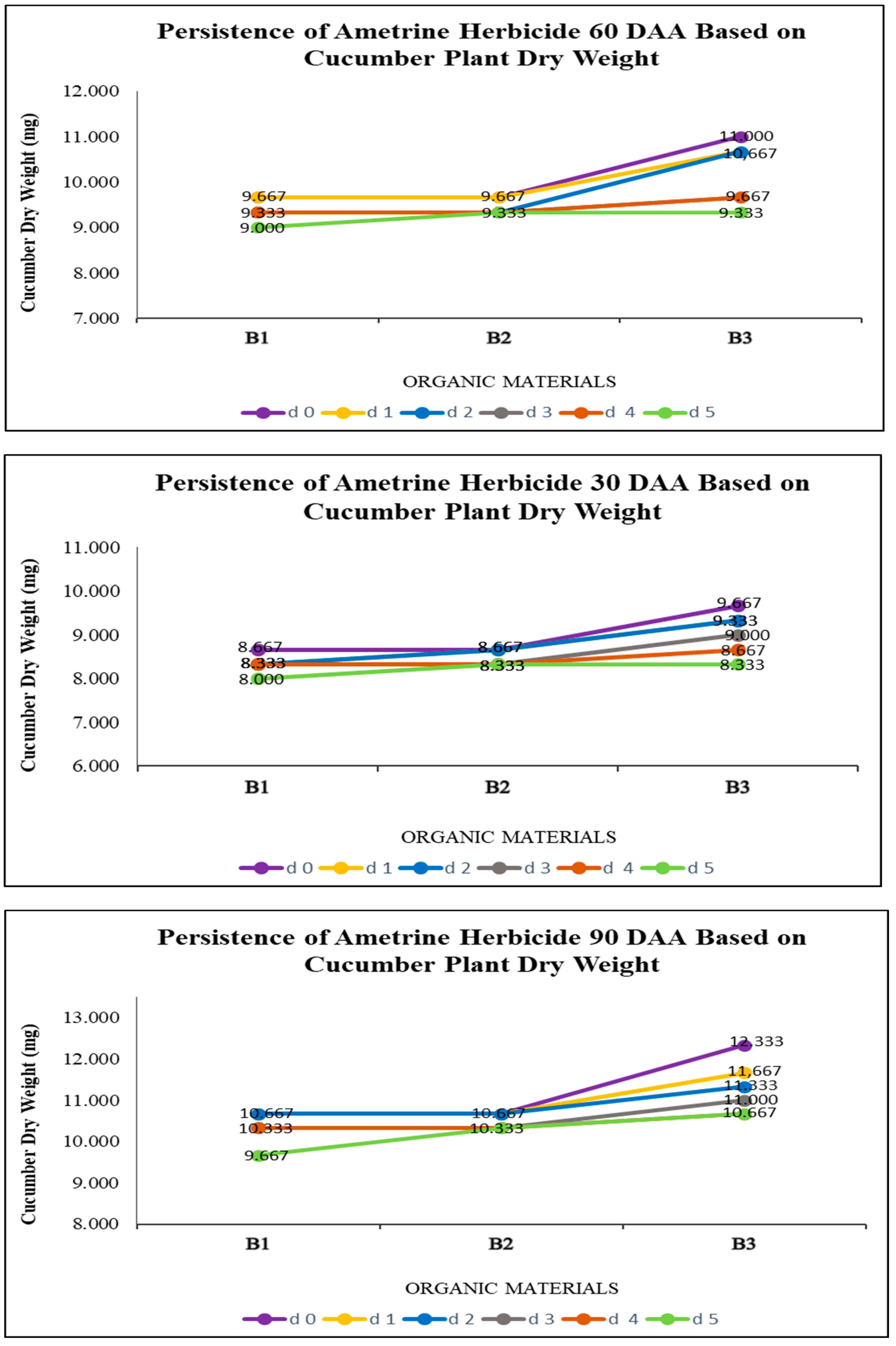
Figure 3.
Respiration activity of soil microorganisms 30 (top), 60 (middle), and 90 (bottom) days after application.
Figure 3.
Respiration activity of soil microorganisms 30 (top), 60 (middle), and 90 (bottom) days after application.
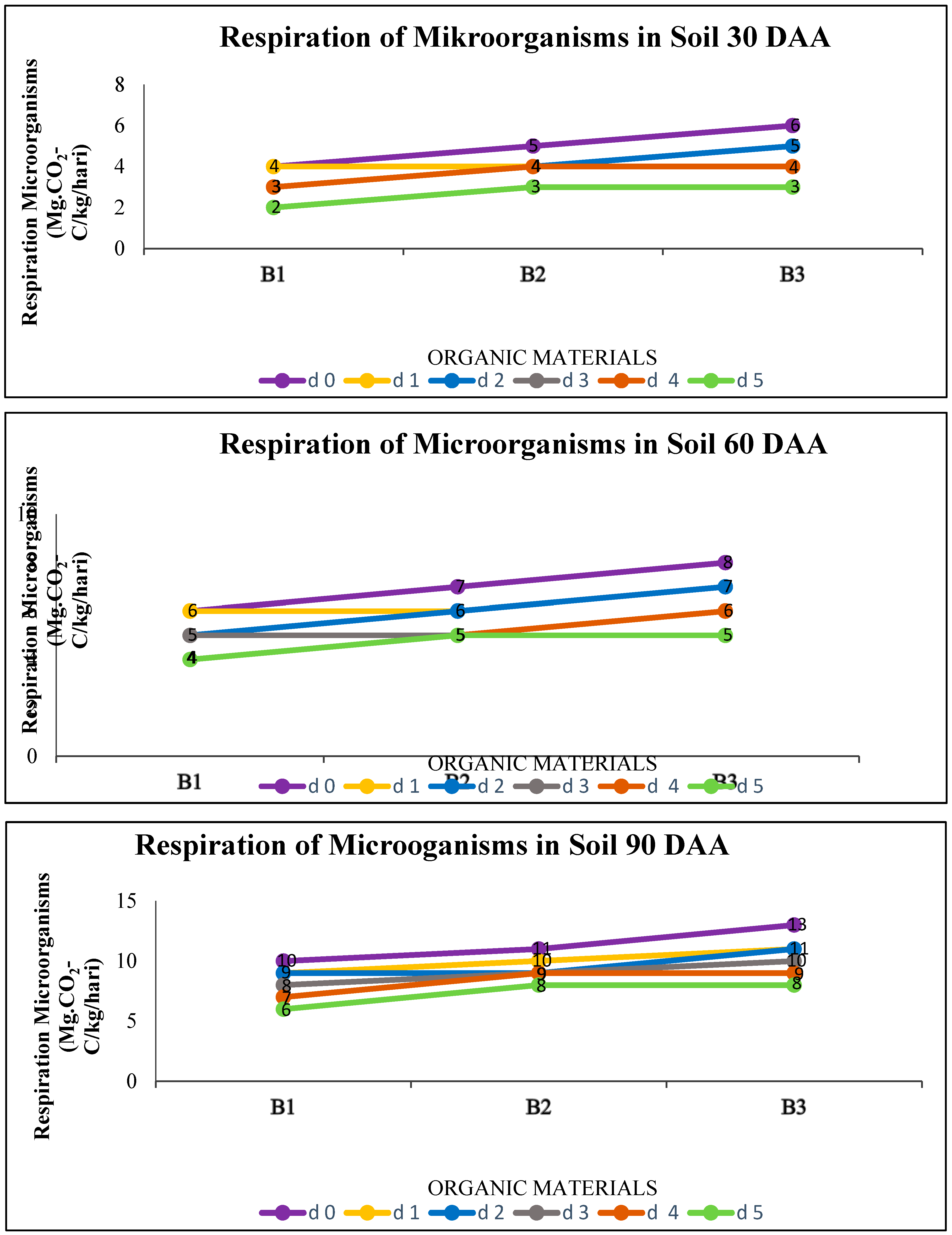

Table 1.
Total weed dry weight at 2, 4, and 6 weeks after application (WAA).
| 2 WAA | 4 WAA | 6 WAA | |||||||
|---|---|---|---|---|---|---|---|---|---|
| Treatments | b1 | b2 | b3 | b1 | b2 | b3 | b1 | b2 | b3 |
| d0 (control) | 2.53 b | 2.90 ab | 4.43 a | 6.93 b | 8.10 b | 13.53 a | 12.73 c | 17.36 b | 22.20 a |
| A | A | A | A | A | A | A | A | A | |
| 1.53 b | 2.56 ab | 3.76 a | 5.53 b | 7.30 b | 11.87 a | 11.90 c | 15.00 b | 20.90 a | |
| d1 | AB | A | A | B | AB | AB | A | AB | A |
| 1.20 a | 0.96 a | 1.80 a | 5.00 b | 6.30 b | 10.36 a | 9.50 b | 13.16 b | 18.00 a | |
| d2 | BC | B | B | B | B | B | B | BC | B |
| d3 | 0.73 a | 0.66 a | 0.96 a | 3.70 c | 4.70 b | 6.20 a | 8.10 c | 11.73 b | 13.56 a |
| BC | B | BC | C | C | C | C | C | C | |
| d4 | 0.46 a | 0.56 a | 0.70 a | 3.26 b | 4.40 ab | 5.90 a | 7.70 b | 11.86 a | 11.73 a |
| BC | B | C | C | C | C | C | C | C | |
| d5 | 0.23 b | 0.56 ab | 1.40 a | 2.70 b | 4.43 a | 5.46 a | 6.53 b | 11.73 a | 11.50 a |
| C | B | BC | C | C | C | D | C | C |
Notes: This study used three levels of C-organic: low (1.97%), medium (2.50%), high (3.50%). In addition, there were six different doses of ametryn application: no herbicide, 0.5 kg a.i./ha, 1.0 kg a.i./ha, 1.5 kg a.i./ha, 2.0 kg a.i./ha, and 2.5 kg a.i./ha. Mean values with the same letter(s) indicate non-significant differences according to Duncan's Multiple Range Test at the 5% significance level at 2, 4 and 6 weeks after application (WAA). Numbers followed by uppercase letters are read vertically indicating the interaction between one particular organic matter content level and various herbicide doses, while numbers followed by lowercase letters are read horizontally indicating the interaction between one particular herbicide dose and various organic matter content levels.
Table 2.
Sweet corn cob length, cob diameter, number of cobs per plant at harvest.
| Treatment | Cob Lenghts (cm) | Cob Diameter (cm) | Number of Plant Cobs per Plant |
|---|---|---|---|
| b1 : C-organic 1.97 % | 18.02 a | 5.18 a | 1.00 a |
| b2 : C-organic 2.50 % | 17.97 a | 5.15 a | 1.00 a |
| b3 : C-organic 3.50 % | 17.76 a | 5.13 a | 1.00 a |
| d0 : Control | 15.88 a | 5.04 a | 1.00 a |
| d1 : Ametryn dose 0.5 kg a.i./ha | 16.35 a | 5.06 a | 1.00 a |
| d2 : Ametryn dose 1.0 kg a.i./ha | 16.38 a | 5.11 a | 1.00 a |
| d3 : Ametryn dose 1.5 kg a.i./ha | 19.22 b | 5.20 b | 1.00 a |
| d4 : Ametryn dose 2.0 kg a.i./ha | 20.63 c | 5.30 c | 1.00 a |
| d5 : Ametryn dose 2.5 kg a.i./ha | 19.05 b | 5.21 b | 1.00 a |
Notes: Mean values denoted by the same symbol in the same column indicate no interaction at the 5% significance level based on Duncan's Multiple Range Test.
Table 3.
Sweet corn cob weight, both with and without husk.
| Treatment | Cob Weight without Husk (gr) | Cob Weight with Husk (gr) |
|---|---|---|
| b1 : C-organic 1.97 % | 289.41 a | 264.79 a |
| b2 : C-organic 2.50 % | 287.40 a | 261.33 a |
| b3 : C-organic 3.50 % | 285.23 a | 258.94 a |
| d0 : Control | 258.24 a | 238.24 a |
| d1 : Ametryn dose 0.5 kg a.i./ha | 264.10 a | 242.66 a |
| d2 : Ametryn dose 1.0 kg a.i./ha | 267.01 a | 246.02 a |
| d3 : Ametryn dose 1.5 kg a.i./ha | 307.03 b | 275.40 b |
| d4 : Ametryn dose 2.0 kg a.i./ha | 317.91 c | 286.07 c |
| d5 : Ametryn dose 2.5 kg a.i./ha | 309.78 bc | 281.72 bc |
Description: Mean values denoted by the same symbol in the same column indicate non-interaction at the 5% significance level based on Duncan's Multiple Range Test.
Table 4.
Sweet corn plot yield of different treatment plots.
| Treatment | Weight of Yield per Plot (kg/12m2) |
|---|---|
| b1 : C-organic 1.97 % | 20.25 a |
| b2 : C-organic 2.50 % | 20.11 a |
| b3 : C-organic 3.50 % | 19.96 a |
| d0 : Control | 18.07 a |
| d1 : Ametryn dose 0.5 kg a.i./ha | 18.48 a |
| d2 : Ametryn dose 1.0 kg a.i./ha | 18.69 a |
| d3 : Ametryn dose 1.5 kg a.i./ha | 21.49 b |
| d4 : Ametryn dose 2.0 kg a.i./ha | 22.25 c |
| d5 : Ametryn dose 2.5 kg a.i./ha | 21.68 bc |
Notes: Mean values denoted by the same symbol in the same column indicate non-interaction at the 5% significance level based on Duncan's Multiple Range Test.
Disclaimer/Publisher’s Note: The statements, opinions and data contained in all publications are solely those of the individual author(s) and contributor(s) and not of MDPI and/or the editor(s). MDPI and/or the editor(s) disclaim responsibility for any injury to people or property resulting from any ideas, methods, instructions or products referred to in the content. |
© 2023 by the authors. Licensee MDPI, Basel, Switzerland. This article is an open access article distributed under the terms and conditions of the Creative Commons Attribution (CC BY) license (http://creativecommons.org/licenses/by/4.0/).
Copyright: This open access article is published under a Creative Commons CC BY 4.0 license, which permit the free download, distribution, and reuse, provided that the author and preprint are cited in any reuse.


