

Submitted:
28 December 2023
Posted:
29 December 2023
You are already at the latest version
Abstract
Nowadays, service sector workers face an increasingly demanding environment in terms of intrapreneurial behaviour due to the key role it plays in the survival of firms and the elimination of threats in the organisational environment. This paper investigates the antecedents of intrapreneurial behaviour in the service sector in southern Spain, analysing the interrelationships between authentic leadership, practised creativity, autonomy and meaningful work. This study employs a quantitative approach through the distribution of a questionnaire. A total of 333 employees in this sector responded to the research questionnaire. The results show that both meaningful work and creativity are direct antecedents of intrapreneurial behaviour. In contrast to these variables, authentic leadership was found to have significant negative effects on intrapreneurial behaviour, although it is essential for promoting employee creativity and autonomy and for fostering the perception of meaningful work. Finally, no significant relationship was found between autonomy and intrapreneurial behaviour. This research provides empirical results that can help broaden the understanding of intrapreneurial behaviour by highlighting the importance of balanced authentic leadership and offering guidance to organisations in designing a work climate that enhances organisational effectiveness.
Keywords:
Authentic Leadership
; Intrapreneurship
; Meaningful Work
; Practised Creativity
; Work Autonomy
1. Introduction
For decades, entrepreneurship has been associated primarily with the establishment of a company or business venture. However, entrepreneurship is fundamentally an attitude as well as a behaviour and a perspective that shapes one’s understanding of the environment and consequent actions [1]. In this context, there is an escalating demand within organisational settings for employees who manifest intrapreneurial conduct [2], owing to its contributions to innovation, performance, and economic growth.
In this regard, the term intrapreneurship behaviour (IB) will refer to the process by which an employee identifies and make the most of opportunities throughout innovation, proactivity and willingness to take risks, so that the organisation develops new products, services or procedures, improving competitiveness and organisational performance [3]. Unlike traditional entrepreneurship, intrapreneurship does not imply that workers leave their organisation or risk their capital to pursue their ideas independently, but that they will use the organisation’s resources to innovate and drive change within the organisation [4]. In this way, intrapreneurial behaviour (IB) arises when employees, characterised by an anticipatory vision, develop new innovative ideas or procedures that add value to the organisation, exerting a positive effect [5].
Consequently, IB has become a critical skill for the success of today’s companies as it allows organisations to identify business opportunities, develop innovative solutions and implement them in the work context [6]. Given its implications for development and growth within organisations and its inherently autonomous and individualistic nature, both scholarly and managerial literature have exhibited burgeoning attention towards the investigation of mechanisms to foster it, as well as the variables that can engender such an orientation among employees [7,8].
Our aim, therefore, in this study will be to analyse these variables and propose an integrated model of IB. Thus, the present study will make several contributions.
Firstly, our study will broaden the understanding of IB from an individual perspective, an area that is less well-studied compared to the more business-oriented approach to entrepreneurial behaviour. Secondly, our work will analyse which variables influence intra-entrepreneurial action, as well as the interactions between them, providing a more complete picture. Finally, this study will have practical implications by enabling managers to implement human resource policies and practices that promote intrapreneurial behaviour among their employees.
The study of Intrapreneurial Behaviour (IB) has become relevant in recent years due to the growing number of employees who have knowledge and skills and whose entrepreneurial spirit is not oriented towards the creation of new companies, but who do present an ideal profile to become intrapreneurs [9]. This is why, as authors such as Soltanifar et al. [10] point out, it is essential to implement organisational policies that promote the IB of its employees, since, if the organisational culture is resistant to change and reluctant to experiment with new ideas, this could discourage the intrapreneurial spirit.
Several studies have found that the antecedents with the greatest impact on IB have been both organisational and employee characteristics [11,12].
Numerous authors have focused their research on the impact of leaders, specifically on how their leadership style influences the IB of their employees. In this regard, authentic leadership (AL) style, which emphasises a positive psychological state and engenders trust among employees, has been posited to stimulate entrepreneurial behaviours [13]. Authentic leaders, through their managerial conduct, could therefore serve as a catalyst for engendering intrapreneurial behaviours among their subordinates, as they establish a work environment conducive to innovation and creativity [14]. Therefore, and taking as a reference previous studies such as the one conducted by [15], our first working hypothesis establishes that:
H1:
Authentic Leadership (AL) influences positively the Intrapreneurial Behaviour (IB) of employees.
As explained above, contemporary organisations allocate substantial resources to boosting the creativity and high-quality, innovative ideas of their workforce [16]. It is crucial to emphasise that, although interrelated, creativity and innovation, are distinct constructs. While practised creativity (PC) is the generation of ideas, innovation involves the efficacious realisation of these conceptualisations [17]. Consequently, creativity is considered a starting point for organisational improvement [18].
Several studies [19,20] have suggested that AL can play an instrumental role in fostering PC. Specifically, it has been argued that an atmosphere characterised by equitable and transparent interactions, facilitated by AL, can engender a work environment wherein employees are endowed with the latitude and autonomy to explore and experiment with their ideas [21,22]. Hence, in line with the existing literature supporting the positive and crucial role of AL in promoting PC, we proffer the following hypothesis:
H2:
Authentic Leadership (AL) will significantly and positively influence the Practised Creativity (PC) of workers.
The influence of AL extends to the formation and preservation of meaning in the occupational endeavours of subordinates [23]. Given that authentic leaders engender a sense of communal belonging through the articulation of a shared vision and objectives, they, consequently, amplify the existential significance ascribed to professional tasks [24]. Furthermore, the presence of an AL pattern of altruistic motivation fosters a greater sense of belonging by developing a stronger identification with the organisation and providing stronger social support [25]. Corroborating this perspective, [26] found that, authentic leaders by empowering their followers, authentic leaders foster an enhanced perception of responsibility and value and, consequently, enrich the meaning attributed to their work (MW). Based on this literature review and existing findings, we propose the following hypothesis:
H3:
Authentic Leadership (AL) has a positive influence on the meaning employees attribute to their work (MW).
Furthermore, to achieve a comprehensive understanding of the multifaceted influence of AL on organisational behaviour, authors such as Leroy et al. [27] have scrutinised the interaction between this style of leadership and the propensity for autonomous conduct among employees in a professional context. This interest is underpinned by the observation that authentic leaders cultivate an occupational environment characterised by heightened degrees of individual freedom, self-assurance, and opportunities for personal growth [28]. Within this framework, AL is postulated to engender elevated work autonomy (WA), thereby empowering employees to more efficiently leverage their skill sets and domain-specific knowledge. This, in turn, precipitates extra-role behaviours [29], redounding to the long-term benefit of the organisation and cultivating a deeper sense of identification with both the institutional entity and its leadership [30]. Therefore, based on the existing literature, we set out the following hypothesis:
H4:
Authentic Leadership (AL) is positively related to greater Work Autonomy (WA).
The concept of autonomy has garnered attention due to its correlation with other salient organisational behaviours, such as employee creativity or meaning ascribed to work. In this sense, previous studies have identified how WA is an antecedent factor that promotes creativity in the workplace [31,32]. Caniels [33] further contend that organisations distinguished by creativity are often associated with environments typified by a high degree of autonomy and minimal structural constraints. This observation stems from the notion that the employees endowed with a creative orientation necessitate circumventing bureaucratic impediments to attain the liberty requisite for conceptual exploration [34]. This facilitative environment gains significance when considering that optimal levels of WA activate a psychological state conducive to the emergence of creative output, as highlighted by recent empirical studies [35]. Therefore, in consonance with the research, we proffer the ensuing hypothesis:
H5:
The greater the Work Autonomy (WA), the greater the Practised Creativity (PC).
Conversely, enhanced WA has been empirically correlated with an augmentation in the existential significance attributed to work, as it engenders an environment conducive to self-determination and thereby amplifies the intrinsic value ascribed to the tasks undertaken [36]. An autonomy of work environment motivates employees to take responsibility for their results, which leads them to experience a greater sense of control and a greater sense of meaning in their work [23]. When levels of autonomy are elevated, employees are afforded a broader latitude to derive substantive benefits from the leadership styles of their supervisors, thereby amplifying the perception of work-related meaningfulness [37,38].
Therefore, based on the existing literature, we propose the following hypothesis:
H6:
Work Autonomy (WA) at work exerts a positive influence on the development of Meaningfulness at Work (MW).
Finally, both variables (MW and PC) are also closely related.
Several researchers [39,40] have found that MW tends to stimulate employees’ creativity. In this line, authors such as Amabile and Pratt [41] argue that the perception of work as meaningful can increase creative persistence. In this context, setbacks are reframed as incremental progress, thereby instilling a belief in the inherent value of creative endeavours. This salient dimension of MW not only stimulates employee engagement in knowledge management processes but also acts as a fulcrum for generating organisational creativity and innovation [42]. Therefore, based on the existing literature, we propose the following hypothesis:
H7:
Meaningfulness of Work (MW) significantly influences employees’ Practised Creativity (PC).
It is pertinent to investigate the synergistic interaction of these multifactorial variables with respect to employees’ intrapreneurial behaviour. Empirical consensus suggests that individuals who associate a high sense of significance with their work tend to exhibit a deeper commitment to their work [43]. This effort leads to an increase in various positive organisational outputs, including innovation [44]. The conception of work as intrinsically meaningful amplifies the predisposition to contribute to collective well-being, thereby boosting the deployment of skills and resources in the realisation of innovative achievements [45]. Recent investigations [46] corroborate that this heightened sense of significance in the work domain translates into an increase in motivation and, consequently, an increase in the effort level of innovative contribution (linked to intrapreneurial behaviour) for the benefit of the organisation. On this basis, we formulate the following hypothesis:
H8:
The perception of Meaningful Work (MW) exerts a significant influence on Intrapreneurial Behaviour (IB).
Furthermore, workplace autonomy emerges as an instrumental construct in facilitating IB as it grants employees the discursive and operational latitude to modify their work patterns in pursuit of objectives that catalyse innovative thinking [47]. Earlier, some authors [48] highlighted the importance of autonomy in their studies, noting that a work environment that promotes autonomy attracts and retains creative talent, motivating employees through freedom in their work tasks. Since then, the relationship between WA and IB has been the subject of study [49,50]. These studies have shown a positive association between high levels of WA and an increase in the generation of IB within the organisation. Therefore, based on the existing literature, we propose the following hypothesis:
H9:
The perception of Work Autonomy (WA) maintains a positive and statistically significant correlation with Intrapreneurial Behaviour (IB).
Finally, in concordance with prior argumentation, it is pivotal to acknowledge another component that significantly intersects with IB, such as PC. In this vein, Amabile [51] posits that PC serves as an essential conduit for the success of innovation, which, in turn, acts as precursor to IB, enabling employees to identify opportunities, formulate innovative solutions and adapt to shifting business landscapes. Aligned with this perspective, creative role identity has also been identified as an important factor in stimulating innovative behaviours [52,53]. Considering the research that demonstrates the positive relationship between PC and IB as outlined in the studies by [54], we hypothesise the following relationship:
H10:
Practised creativity (CP) shows a positive correlation with Intrapreneurial Behaviour (IB)
In summary, taking into consideration intrapreneurial behaviour and the relationship among several variables, we propose in our study the following research model as illustrated in Figure 1:
2. Materials and Methods
2.1. Sample and Data Collection
In order to test each of the working hypotheses, we carried out a study to a sample of workers in three service sector companies in southern Spain.
In total, 615 questionnaires were disseminated, with a response rate of 337 (54.79 %). Nevertheless, four questionnaires (0.65%) were subsequently excluded from the data analysis for various reasons such as incomplete data, multiple responses to the same item or lack of response. Consequently, the final sample for analysis comprised 333 employees, with ages ranging from 18 to 64 years and a mean age of 38 years (SD=2.8). In terms of tenure, the employees had been with the companies for periods ranging from less than one year to 25 years, with the most frequent tenure range being between 1 and 3 years. Regarding gender distribution, there was a slight predominance of females in the sample (55.6% female; 44.4% male).
2.2. Measures
As for the measuring instruments, we used the following standardised questionnaires.
2.2.1. Authentic Leadership
For the assessment of Authentic Leadership, we employed the Spanish version of the Authentic Leadership Questionnaire [55,56]. This instrument is constituted of 16 items and is structured around four key dimensions: Self-Awareness (the leader’s cognisance of how their conduct may influence others); Relational Transparency (the extent to which the leader presents themselves authentically to others); Balanced Processing (the leader’s capacity for objective goal-setting and judicious data analysis prior to decision-making); and Internalised Morality (the leader’s self-regulation of behaviour in accordance with personal values and principles, particularly in the face of external pressures). Responses were garnered using a Likert scale ranging from 1 (Never) to 5 (Always or Almost Always).
2.2.2. Work Autonomy and Meaningful Work (MW)
For the measurement of Work Autonomy (WA) and Meaningful Work (MW), we utilised the corresponding dimension from Spreitzer’s Psychological Empowerment Instrument [57], adapted into Spanish [58]. The dimension WA include four items and assesses the extent to which an individual perceives that he or she can exercise control over his or her work environment and act independently in making work-related decisions. The dimension MW consists of three items that assess the relevance and value an employee attaches to his or her job, referring to his or her personal norms and beliefs. Participants responded on a 7-points scale ranging from 1 (Very Little) to 7 (Too much).
2.2.3. Practised Creativity
For the assessment of the Practised Creativity (PC) variable, we employed the Practised Creativity dimension from the Creative and Potential Creativity Scales, developed by DiLiello and Houghton [59] in its Spanish version [60]. This scale consists of five items and evaluates the extent to which an individual actively engages in creative behaviours within their work environment. Response options were provided on a Likert scale ranging from 1 (Strongly disagree) to 5 (Strongly Agree).
2.2.4. Intrapreneurial Behaviour
Lastly, the variable of Intrapreneurial Behaviour (IB) was assessed utilising the Intrapreneur Behaviour scale developed by Stull and Singh [61] and adapted to Spanish [62]. This 7-item scale is bifurcated into two subscales: Innovation and Risk-taking. All items were measured on a scale ranging from 0 (Strongly disagree) to 4 (Strongly Agree).
2.3. Data Analysis
To test each hypothesis, we conducted various statistical analyses.
Initially, for the descriptive analysis, including measures of central tendency, dispersion, and asymmetry we utilised the statistical software SPSS© v.25.
Subsequently, in order to determine the variance explained and the relationships between the endogenous variables posed in the model, we applied partial least squares structural equation modelling (PLS-SEM), ensuring both its reliability (through Cronbach’s Alpha coefficients), composite reliability (CR) and convergent validity through external loadings and average variance extracted (AVE). In addition, discriminate validity was tested using validated criteria [63]. Finally, this analysis allowed us to estimate the mean variance explained, the effect size and the statistical significance of the coefficients associated with each of the routes that make up the proposed model [64].
3. Results
In order to test our working hypotheses, we carried out various analyses of the data obtained.
Firstly, we examined the factorial structure as well as the loadings of each item from the different questionnaires employed in the study. Upon the analysis, it was decided to eliminate one item from the Intrapreneurship Behaviour variable (IB4 “I find new ways of doing things”) and one from Authentic Leadership (AL1 “My supervisor says exactly what they mean”), due to their factorial loadings being lower than 0.6 [65], thereby validating the remaining items with their respective constructs.
Subsequently, we analysed the reliability of the final items. As we can see in Table 1, all constructs exhibited robust levels of reliability as evidenced by Cronbach’s Alpha, as well as Composite Reliability (CR). In each case, scores exceeded the threshold of 0.7 [66]. Furthermore, we also examined the presence of Common Method Bias, a phenomenon prevalent in studies utilising the PLS-SEM method due to the measurement technique which can impact the relationship between constructs as well as the validity of the study’s conclusions [67]. Collinearity indicative of CMB is deemed significant when the VIF values exceed 5. However, the VIF coefficients in our study remain below this threshold, confirming that our proposed model does not suffer from collinearity issues.
Additionally, to evaluate the convergent validity of the proposed model, an analysis of Average Variance Extracted (AVE) was conducted [63]. Convergent validity assesses whether various items of a construct measure the same underlying dimension and as such, should be highly correlated. The data presented in Table 1 corroborate that all five instruments achieved predictive values exceeding 50% of the variance.
To Evaluate the Discriminant
To evaluate the discriminant validity of the instruments under consideration, we applied the Fornell and Larcker’s criteria whereby the square root of the AVE for each construct must exceed the correlations existing between that construct and all other constructs in the model. In Table 2, the elements on the principal diagonal (highlighted in bold) represent the square root of the AVE for each construct, while the off-diagonal elements represent the correlations between constructs.
Once the reliability and validity of the instruments have been verified, as well as the intercorrelation between each of the variables, we carried out a structural model analysis. We referenced the path coefficient (β) to ascertain the contribution of each of the predictor variables on the endogenous variable. Additionally, we employed the R-squared value to assess the explanatory power of the model. Bootstrap resampling was conducted with 10,000 cases to test the proposed hypothesis. The outcomes of the hypothesis testing can be observed in Table 3 and in Figure 2.
From this table, we can see that all the working hypotheses were significantly confirmed, except for Hypothesis 1 (AL -> IB) which, although we obtained a significant relationship, its effect was negative and contrary to that established in our initial hypothesis. Specifically, elevated levels of authentic leadership engendered a diminution of intrapreneurial behaviour, counter to our original postulation of a positive correlation between the two variables. Furthermore, Hypothesis 9 (WA->IB) could not be substantiated; work autonomy did not maintain a significant relationship with development of intrapreneurial behaviour.
We also assessed the effect size of the variables with respect to the hypotheses (f2) taking as a reference the threshold proposed by Cohen [68] in which values of 0.02, 0.12 and 0.35 indicate small, medium, and large effect size (see Table 3).
The obtained data from the analyses indicate several nuanced relationships among the variables under consideration. Specifically, although AL has a marginal impact on IB and MW as suggested by Hypotheses 1 and 3 respectively, it does manifest a moderate to high effect on both PC and WA, corroborated by Hypotheses 2 and 4. Concurrently, WA wields a moderate influence on PC and MW, as posited in Hypotheses 5 and 6. MW, in contrast, has a low impact on both PC and IB, consistent with Hypothesis 7 and 8. Lastly, it is divergent from WA, which does not exhibit any significant effect on IB as denoted by Hypothesis 9, PC does indeed exert a low effect, proved by Hypothesis 10.
Finally, Figure 2 offers a graphical representation of the relationships among each of the predictor and endogenous variables (β) within the proposed study model, as well as their respective explanatory power (R2) for each relation.
As can be seen in Figure 2, all R2 values were greater than 0.27 [69], supporting the explanatory power of the model. Furthermore, we calculated the goodness-of-fit of the model using the standardised root mean square residual (SRMR), which was 0.064, which, being below the threshold of 0.08 [70], corroborates the satisfactory fit of the proposed model.
In line with the results presented, all the proposed relationships of the model are significant, except for the one established between autonomy and Intrapreneurial Behaviour, thus invalidating its mediating role between this dependent variable and authentic leadership. This result can be seen in Figure 3.
Finally, we analysed the predictive power of the model using the PLS Predict technique with ten folds and a single repetition, following the guidelines set forth by Shmueli et al. [71]. This methodology is recommended since, unlike the correlation coefficient (R2), it allows us to assess both the explanatory power and the predictive capacity of the model in a dataset different from the originally selected sample [72]. To carry out a more accurate assessment, the value of the coefficient of determination (Q2), was considered. In our case, we found that all indicators exceeded the threshold of 0, which confirms the predictive validity of the proposed model [73].
4. Discussion
From the results obtained from our data analysis, several conclusions could be drawn.
In our study, we have investigated four antecedents of intrapreneurial behaviour in the workplace -authentic leadership, practised creativity, work autonomy and meaningful work- within a sample of service sector workers in Spain as well as the interrelationship between them through a theoretical model. This exercise has led us to formulate ten working hypotheses.
The empirical findings of the study have confirmed eight of the hypotheses set out in the research model.
One of the findings was the relationship between authentic leadership style and the development of intrapreneurial behaviour. While our initial working hypothesis suggested a positive relationship between the two, the analysis of the data obtained in our study has revealed a significant yet negatively signed relationship between them. A plausible explanation for this finding may be that, although authentic leadership is generally perceived to inspire and motivate employees towards entrepreneurial behaviour, this approach may have other, less proactive ramifications on employees. This phenomenon can be attributed to the fact that an authentic leader may attach rigidly to their own values and beliefs, which in turn could constrain the generation and exploration of new ideas and approaches among subordinates. Such rigidity could cultivate an environment wherein subordinates feel heightened pressure to conform to these specific beliefs and values. In addition, this leadership style tends to promote team cohesion, which could lead to greater group conformity and complacency, thereby limiting the emergence of more innovative individual ideas that could lead to intragroup conflict or tension. In any case, these findings corroborated some of the results found in other studies with different leadership styles, such as transactional or digital [74,75] where the leader’s characteristics – including the pursuit of the status quo– likewise limit support for risk-taking and innovation and thus constrain the development of intrapreneurial behaviour.
In contrast to the aforementioned effect, authentic leadership does exert a positive effect on other antecedent variables, such as creativity. This aligns with the academic literature, which postulates that the distinctive traits of the authentic leader are fundamental for fostering creativity [76]. This positive relationship can be attributed to the fact that the behaviours of authentic leaders generate an environment of greater emotional security among employees, thus encouraging the generation of innovative and unconventional proposals. On the other hand, our research confirms that authentic leadership style is a key factor in fostering greater meaningfulness at work [77]. This may be attributed to the ability of authentic leaders to generate a sense of belonging that translates into greater identification with the organisation and provides strong social support. Consequently, it is corroborated that leaders within an organisation can represent a key contextual factor, capable of instilling in employees a sense of pride for their affiliation to the organisation and the perception that it contributes to a greater common good [78].
Another antecedent variable was work autonomy, where we found that authentic leadership style has a significant and positive impact. This link can be elucidated by the predilection of authentic leaders to cultivate an organisational environment that prioritises open and honest communication. Within such an environment, employees often feel empowered to make decisions pertinent to their work roles. This finding is congruent with the work of [79] who delineated analogous relationships in their respective research.
Besides, similar to other authors [80], we have scrutinised and corroborated the role of autonomy as a precursor to creativity. This may be attributable to the fact that employees, unencumbered by stringent supervision and endowed with the capacity for self-organisation and self-regulation, experience heightened personal responsibility, which, in turn, catalyses creative thinking and the generation of novel ideas. We have also found that autonomy influences the perception of meaning in work. Specifically, when employees possess the liberty to autonomously select their work activities and tasks, these activities and tasks are perceived as more meaningful.
Furthermore, our proposed model supports the notion that meaningful work positively influences creativity. This relationship underlines the relevance of intrinsic motivation in creative behaviour, aligning with previous research [81,82]. This relationship between meaningful work and creativity can be explained by the fact that when work is perceived as meaningful, it instigates a motivational process that encourages the generation of innovative ideas and strengthens the persistence of creative efforts, even in the face of challenging work circumstances. Simply put, employees operate more efficiently and creatively when they experience a positive emotional state in relation to their work.
In our model, we also postulate that meaning of work and creativity are antecedents of intrapreneurial behaviour, the first and the third of which have been empirically corroborated. In this regard, when individuals perceive their work as intrinsically valuable, they develop a sense of contribution to a broader goal. This sense of contribution, in turn, translates into an increased propensity to deploy skills and resources in innovative activities associated with intrapreneurship.
Finally, the study reveals that work autonomy does not have a significant relationship with intra-entrepreneurial behaviour, contrary to the effect expected in our model. A possible explanation for the absence of a relationship between these variables could be that a high degree of autonomy may result in employees becoming disengaged from established organisational goals and strategies, generating a potential strategic misalignment that may inhibit intrapreneurial initiatives.
It has also been demonstrated that practised creativity is directly related to this variable. Our findings empirically support the argument for the importance of creativity in the entrepreneurial process [83] and in the belief that intrapreneurs must be creative because of what is required or expected of them.
4.2. Implications and Contributions
This study contributes to the theoretical field of intrapreneurship by focusing specifically on four important elements. We have discovered connections between leadership and other organisational behaviours that reveal that, while it promotes creativity and autonomy among subordinates, it can also hinder intra-entrepreneurial behaviour. This leads us to investigate this relationship and its effectiveness within contexts. Furthermore, the lack of a relationship between job autonomy and employee creativity suggests that autonomy may not be sufficient to foster creativity in the workplace. This paves the way for developing frameworks that incorporate several variables to explain the multitude of factors involved in stimulating creativity. Furthermore, this study underlines the importance of meaningful work and creativity in driving intrapreneurship, complementing previous findings with other focused on a specific sector and region.
The results of this research also have practical implications for organisations and their leaders. First, it highlights the importance of supervisors being aware of how their leadership style can influence the intrapreneurial behaviour of their subordinates. To minimise the effect, leaders should adopt a certain level of adaptability in their principles and convictions, which will encourage their team members to think while maintaining a balance between team unity and fostering innovation. In addition, we believe that there is a need to reconsider the way management approaches are applied. We should re-evaluate the idea of giving autonomy to improve creativity, which could lead to the development of more effective organisational policies. It is therefore crucial that organisations and their leaders create working environments that foster creativity and make work meaningful. By adopting these approaches, organisations can develop strategies that encourage intrapreneurial behaviour within their workforce, thereby promoting both innovation and overall effectiveness.
Finally, this study provides evidence that highlights the importance of meaningful work and practised creativity in promoting entrepreneurial behaviour in the workplace. Organisations and leaders that pay attention to these factors and prioritise their development have the potential to cultivate a dynamic work environment and ultimately this can translate into improved performance and sustainable competitive advantage.
4.3. Limitations and Future Recommendations
The study has identified some limitations that should be considered by researchers.
One significant constraint is the sample size and specificity which may affect the generalizability of our findings. While we have made efforts to address this limitation through the use of some complex statistical tools (such as PLSpredict) we suggest expanding the research scope to include regions and economic sectors in future investigations.
A second limitation is related to the survey design, where data was collected at a point, in time potentially allowing for causality or endogeneity issues. When conducting cross-sectional or even traditional longitudinal studies, it is important to keep in mind that research constructs may not remain stable over time. Therefore, in order to draw conclusions and account for these fluctuations, we suggest further longitudinal studies that establish causality and take into account both positive and negative aspects. Additionally, future research should differentiate between intra- and interpersonal levels, employing multi-level analysis to offer a more nuanced understanding of the phenomena under scrutiny.
Finally, there is a vast literature on leadership models, leading to an ongoing debate on the appropriateness of each model. Therefore, we propose that future research should incorporate other models of leadership styles, seeking an integrated approach that allows for a more comprehensive understanding of the interaction between the relational and cognitive variables examined in this study on intrapreneurial behaviour.
Author Contributions
Conceptualization, F.D.B. and A.G.C.; Methodology, A.G.C., A.T. and MMJB; Software, A.G.C.; Validation, F.D.B., M.M.J.B and A.T; Formal Analysis, A.T and F.D.B..; Investigation, M.M.J.B.; Resources, A.G.C.; Data Curation, A.G.C..; Writing – Original Draft Preparation, F.D.B., A.T.; Writing – Review & Editing, A.G.C. M.M.J.B.; Visualization, M.M.J.B.; Supervision, F.D.B; Project Administration, A.T. All authors have read and agreed to the published version of the manuscript.
Funding
This research received no external funding.
Institutional Review Board Statement
Our study did not fall within the scope of medical research and did not involve experiments on human subjects. Instead, it relied on the use of a questionnaire as a data collection tool. Therefore, our institution does not require ethical approval for this type of study. Furthermore, the information gathered is strictly anonymous and confidential and is solely used for research purposes. The study was conducted in accordance with the Declaration of Helsinki.
Informed Consent Statement
Informed consent was obtained from all subjects involved in the study. The author informed the participants about the purpose of the research and explained how the data would be used.
Data Availability Statement
The data serving for the findings of this study are available from the corresponding author upon request.
Acknowledgments
The authors wish to extend their deepest gratitude to the workers who have selflessly participated in this study.
Conflicts of Interest
The authors declare no conflicts of interest.
References
- Bretones, F. D. Entrepreneurial employees. In Why Human Capital is Important for Organizations: People Come First; Manuti, A., De Palma P. D. (Eds.), Palgrave McMillan, London, 2014; pp. 53-61. [CrossRef]
- Portalanza-Chavarría, A.; Revuelto-Taboada, L. Driving intrapreneurial behavior through high-performance work systems. Int. Entrep. Manag. J.: 2023, 19, pp. 897-921. [CrossRef]
- Neessen, P. C.; Caniëls, M. C.; Vos, B.; De Jong, J. P. The intrapreneurial employee: toward an integrated model of intrapreneurship and research agenda. Int. Entrep. Manag: 2019, 15, pp. 545-571. [CrossRef]
- Hernández-Perlines, F.; Ariza-Montes, A.; Blanco-González-Tejero, C. Intrapreneurship research: A comprehensive literature review. J. Bus. Res.: 2022, 153, pp. 428-444. [CrossRef]
- Sieger, P.; Zellweger, T.; Aquino, K. Turning agents into psychological principals: aligning interests of non-owners through psychological ownership. J. Manage. Stud.: 2013, 50, pp. 361-388. [CrossRef]
- Klofsten, M.; Urbano, D.; Heaton, S. Managing intrapreneurial capabilities: An overview. Technovation: 2021, 99, p. 102177. [CrossRef]
- Heinze, K. L.; Weber, K. Toward organizational pluralism: Institutional intrapreneurship in integrative medicine. Organ. Sci.: 2016, 27, pp. 157-172. [CrossRef]
- Howard-Grenville, J.; Golden-Biddle, K.; Irwin, J.;Mao, J. Liminality as cultural process for cultural change. Organ. Sci.: 2011, 22, pp. 522-539. [CrossRef]
- Blanka, C. An individual-level perspective on intrapreneurship: a review and ways forward. Rev. Manag. Sci.: 2019, 13, pp. 919-961. [CrossRef]
- Soltanifar, M.; Hughes, M.; O’Connor, G.; Covin, J. G.; Roijakkers, N. Unlocking the potential of non-managerial employees in corporate entrepreneurship: a systematic review and research agenda. Int. J. of Entrep. Behav. Res.: 2023, 29, pp. 206-24. [CrossRef]
- Crowley, F.; Barlow, P. Entrepreneurship and social capital: a multi-level analysis. Int. J. of Entrep. Behav. Res 2022, 28, pp. 492-519. [CrossRef]
- Yang, M.; Luu, T.; Qian, D. Mediating and moderating effects of task interdependence and creative role identity behind innovation for service: evidence from China and Australia. Int. J. Manpower: 2022, 44, pp. 702-727. [CrossRef]
- Felix, C.; Aparicio, S.; Urbano, D. Leadership as a driver of entrepreneurship: an international exploratory study. J. Small Bus. Manage.: 2019, 26, pp. 397-420. [CrossRef]
- Edú, S.; Moriano, J. A.; Molero, F. Authentic leadership and intrapreneurial behavior: cross-level analysis of the mediator effect of organizational identification and empowerment. Int. Entrep. Manag. J.: 2016, 12, pp. 131-152. [CrossRef]
- Cai, W.; Lysova, E. I.; Khapova, S. N.; Bossink, B. A. Servant leadership and innovative work behavior in Chinese high-tech firms: A moderated mediation model of meaningful work and job autonomy. Front. Psychol.: 2018, 9, p. 1767. [CrossRef]
- Kim, Y. M.; Shin, H. C. The Effect of Small Firm CEOs’ Transformational Leadership on Employees’ Innovative Behavior. J. Korean Soc. Qual. Manag.: 2019, 47, pp. 59-74. [CrossRef]
- Mumford, M. D.; Gustafson, S. B. Creativity syndrome: Integration, applicationand innovation. Psychol. Bull.: 1988, 103, pp. 27. [CrossRef]
- Mueller, J. S.; Melwani, S.; Goncalo, J. A. The bias against creativity: Why people desire but reject creative ideas. Psychol. Sci.: 2012, 23, pp.13-17. [CrossRef]
- Lei, S.; Qin, C.; Ali, M., Freeman, S.; Shi-jie, Z. The impact of authentic leadership on individual and team creativity: a multilevel perspective. Leadership. Org. Dev. J.: 2021, 42, pp. 644-622. [CrossRef]
- Rego, A.; Sousa, F.; Marques, C.; Cunha, M. P. Hope and positive affect mediating the authentic leadership and creativity relationship. J. Bus. Res.: 2014, 67, pp. 200-210. [CrossRef]
- Alzghoul, A.; Elrehail, H.; Emeagwali, O. L.; Al Shboul, M. K. Knowledge management, workplace climate, creativity and performance: The role of authentic leadership. J. Workplace Learn.: 2018, 30, pp. 592-612. [CrossRef]
- Zhou, J. When the presence of creative coworkers is related to creativity: role of supervisor close monitoring, developmental feedback and creative personality. J. Appl. Psychol.: 2003, 88, pp. 413. [CrossRef]
- Rosso, B. D.; Dekas, K. H.; Wrzesniewski, A. On the meaning of work: A theoretical integration and review. Res. Organ. Behav.: 2010, 30, pp. 91-127. [CrossRef]
- Lips-Wiersma, M.; Wright, S. Measuring the meaning of meaningful work: Development and validation of the Comprehensive Meaningful Work Scale (CMWS). Group Organ. Manage.: 2012, 37, pp. 655-685. [CrossRef]
- Jun, K.; Hu, Z.; Lee, J. Examining the Influence of Authentic Leadership on Follower Hope and Organizational Citizenship Behavior: The Mediating Role of Follower Identification. Behav. Sci.: 2023, 13, p. 572. [CrossRef]
- Chaudhary, R. Authentic leadership and meaningfulness at work: role of employees’ CSR perceptions and evaluations. Manage. Decis.: 2021, 59, pp. 2024-2039. [CrossRef]
- Leroy, H.; Anseel, F.; Gardner, W. L.; Sels, L. Authentic leadership, authentic followership, basic need satisfaction and work role performance: A cross-level study. J. Manage: 2015, 41, pp. 1677-1697. [CrossRef]
- Wen, Q.; Liu, R.; Long, J. Influence of authentic leadership on employees’ taking charge behavior: the roles of subordinates’ moqi and perspective taking. Front. Psychol.: 2021, 12, p. 626877. [CrossRef]
- Piccolo, R. F.; Greenbaum, R.; Hartog, D. N. D.; Folger, R. The relationship between ethical leadership and core job characteristics. J. Organ. Behav.: 2010, 31, pp 259-278. [CrossRef]
- Malik, N.; Dhar, R. L. Authentic leadership and its impact on extra role behaviour of nurses: The mediating role of psychological capital and the moderating role of autonomy. Pers. Rev: 2017, pp 277-296. [CrossRef]
- Jaiswal, D.; Dhar, R. L. Impact of human resources practices on employee creativity in the hotel industry: The impact of job autonomy. J. Hum. Resour. Hosp. Tourism.: 2017, 16, pp 1-21. [CrossRef]
- Sia, S. K.; Appu, A. V. Work autonomy and workplace creativity: Moderating role of task complexity. Glob. Bus. Rev.: 2015, 16, pp. 772-784. [CrossRef]
- Caniëls, M. C.; Rietzschel, E. F. Organizing creativity: Creativity and innovation under constraints. Create. Innov. Manag.: 2015, 24, pp. 184-196. [CrossRef]
- Baer, M. Putting creativity to work: The implementation of creative ideas in organizations. Acad. Manage. J.: 2012, 55, pp. 1102-1119. [CrossRef]
- Sia, S. K.; Appu, A.V. Work autonomy and workplace creativity: Moderating role of task complexity. Global Bus. Rev.: 2015, 16, pp. 772-784. [CrossRef]
- Niemiec, C. P.; Ryan, R. M.; Deci, E. L. Self-determination theory and the relation of autonomy to self-regulatory processes and personality development.In Handbook of Personality and Self-regulation 1st ed.; Dr Rick H., Hoyle R.H. Eds.; Wiley Blackwell, 2010, pp. 169-191. [CrossRef]
- Den Hartog, D. N.; Belschak, F. D. When does transformational leadership enhance employee proactive behavior? The role of autonomy and role breadth self-efficacy. J. Appl. Psychol.: 2012, 97, pp. 194. [CrossRef]
- Ho, J.; Nesbit, P. L. Self-leadership in a Chinese context: Work outcomes and the moderating role of job autonomy. Group Organ. Manage.: 2014, 39, pp. 389-415. [CrossRef]
- Akgunduz, Y.; Alkan, C.; Gök, Ö. A. Perceived organizational support, employee creativity and proactive personality: The mediating effect of meaning of work. J. Hum. Resour. Hosp. Tourism.: 2018, 34, pp. 105-114. [CrossRef]
- Hidayat, S.; Febrianto, Z.; Eliyana, A.; Purwohedi, U.; Anggraini, R. D.; Emur, A. P.; Zahar, M. Proactive personality and organizational support in television industry: Their roles in creativity. Plos one: 2023, 18, pp. e0280003. [CrossRef]
- Amabile, T. M., & Pratt, M. G. The dynamic componential model of creativity and innovation in organizations: Making progress, making meaning. Res. Organ. Behav.: (2016), 36, pp. 157-183. [CrossRef]
- Yeh, Y. C.; Lin, C. F. Aptitude-treatment interactions during creativity training in e-learning: How meaning-making, self-regulationand knowledge management influence creativity. J. Educ. Tech. Soc.: 2015, 18, pp. 119-131.
- May, D. R.; Gilson, R. L.; Harter, L. M. The psychological conditions of meaningfulness, safety and availability and the engagement of the human spirit at work. J. Occup. Organ. Psych.: 2004, 77, pp. 11-37. [CrossRef]
- Yuan, F.; Woodman, R. W. Innovative behavior in the workplace: The role of performance and image outcome expectations. Acad. Manage. J.: 2010, 53, pp. 323-342. [CrossRef]
- Wipulanusat, W.; Panuwatwanich, K.; Stewart, R. A.; Parnphumeesup, P.; Sunkpho, J. Unraveling key drivers for engineer creativity and meaningfulness of work: Bayesian network approach. Manag. Prod. Eng. Rev.: 2020, 11, pp. 293-321. [CrossRef]
- Pradhan, S.; Jena, L. K. Does meaningful work explains the relationship between transformational leadership and innovative work behaviour? Vikalpa: 2019, 44, pp. 30-40. [CrossRef]
- Singh, N.; Bamel, U.; Vohra, V. The mediating effect of meaningful work between human resource practices and innovative work behavior: a study of emerging market. Emp. Relat. Int. J.: 2021, 43, pp. 459-478. [CrossRef]
- Morse, C. W. The delusion of intrapreneurship. Long. Range. Plann.: 1986, 19, pp. 92-95. [CrossRef]
- Garg, S.; Dhar, R. Employee service innovative behaviour: The roles of leader-member exchange (LMX), work engagement, and job autonomy. Int. J. Manpower: 2017, 38, pp. 242-258.
- Kuratko, D.F. Corporate Entrepreneurship: An Introduction and Research Review. In Handbook of Entrepreneurship Research. International Handbook Series on Entrepreneurship, 2 ed Acs, Z., Audretsch, D., Eds.; Springer: New York, 2010; pp. 129-163. [CrossRef]
- Amabile, T. M.A model of creativity and innovation in organizations. Res. Organ. Behav.:1988, 10, pp. 123-167.
- Wang, A. C.; Cheng, B. S. When does benevolent leadership lead to creativity? The moderating role of creative role identity and job autonomy. J. Organ. Behav.: 2010, 31, pp.106-121. [CrossRef]
- Woodman, R. W.; Sawyer, J. E.; Griffin, R. W. Toward a theory of organizational creativity. Acad. Manage. Rev.: 1993, 18, pp. 293-321. [CrossRef]
- Smith, R. M.; Sardeshmukh, S. R.; Combs, G. M. Understanding gender, creativityand entrepreneurial intentions. Educ. Train.: 2016, 58, pp. 263-282. [CrossRef]
- Avolio, B.J.; Gardner, W.L. Authentic leadership development: Getting to the root of positive forms of leadership. Leadership. Quart.: 2005, 16, pp. 315-338. [CrossRef]
- Moriano, J. A.; Molero, F.; Lévy, J.P. Authentic leadership. Concept and validation of the ALQ in Spain. Psicothema: 2011, 23, pp 336–341.
- Spreitzer, G. M. Psychological empowerment in the workplace: Dimensions, measurementand validation. Acad. Manage. J.: 1995, 38, pp. 1442-1465. [CrossRef]
- Bretones, F. D.; Jáimez, M. J. Adaptación y validación al español de la Escala de Empoderamiento Psicológico. Interdisciplinaria: 2022, 39, pp. 195-210. [CrossRef]
- DiLiello, T. C.; Houghton, J. D. Creative potential and practised creativity: Identifying untapped creativity in organizations. Creat. Innov. Manag.: 2008, 17, pp. 37-46. [CrossRef]
- Boada Grau, J.; Sánchez García, J. C.; Prizmic Kuzmica, A. J.; Vigil Colet, A. Spanish adaptation of the Creative Potential and Practised Creativity scale (CPPC-17) in the workplace and inside the organization. Psicothema: 2014, 26, pp. 55-62. [CrossRef]
- Stull, M.; Singh, J. Internal Entrepreneurship in Nonprofit Organizations: Examining the Factors that Promote Entrepreneurial Behavior Among Employees. Retrieved May, 2010, pp. 1-13.
- Moriano, J. A.; Topa, G., Valero, E.; Lévy, J. P. Organizational identification and “intrapreneurial” behaviour”. Ann. of Psyc.: 2009, 25, pp. 277-287.
- Fornell, C.; Larcker, D. F. Evaluating structural equation models with unobservable variables and measurement error. J. Marketing Res.: 1981, 18, pp. 39-50.
- Hwang, H.; Sarstedt, M.; Cheah, J. H.; Ringle, C. M. A concept analysis of methodological research on composite-based structural equation modeling: bridging PLSPM and GSCA. Behaviormetrika: 2020, 47, pp. 219-241. [CrossRef]
- Chin, W. W. The partial least squares approach to structural equation modelling. In Modern Methods For Business Research, Marcoulides, G. A. (ed), Erlbaum, Mahwah, 1998, pp. 295-336.
- Hair, J. F.; Hult, G.T.M.; Ringle, C.M.; Sarstedt, M. A Primer on Partial Least Squares Structural Equation Modeling (PLS-SEM), 2nd ed. SAGE, Thousand Oaks, 2017.
- Kock, F.; Berbekova, A.; Assaf, A. G. Understanding and managing the threat of common method bias: Detection, prevention and control. Tourism Manage.: 2021, 86, p. 104330. [CrossRef]
- Cohen, J. Statistical Power Analysis for the Behavioral Sciences, 2nd ed.; Lawrence Erlbaum Associates, 1988.
- Hair, J. F.; Black, W. C.; Babin, B. J.; Anderson, R. E. Multivariate data analysis: Pearson new international edition, 7th ed. Pearson Education Limited, Essex, 2014.
- Henseler, J.; Dijkstra, T. K.; Sarstedt, M.; Ringle, C. M.; Diamantopoulos, A.; Straub, D. W.; Ketchen, D. J.; Hair, J. F.; Jr., Hult, G. T. M.; Calantone, R. J. Common beliefs and reality about PLS: Comments on Ronkko and Evermann. Organ. Res. Methods: 2014, 17, pp. 182–209. [CrossRef]
- Shmueli, G.; Sarstedt, M.; Hair, J. F.; Cheah, J. H.; Ting, H.; Vaithilingam, S.; Ringle, C. M. Predictive model assessment in PLS-SEM: guidelines for using PLSpredict. Eur. J. Marketing: 2019, 53, pp. 2322-2347. [CrossRef]
- Carrión, G. C.; Henseler, J.; Ringle, C. M.; Roldán, J. L. Prediction-oriented modeling in business research by means of PLS path modeling: Introduction to a JBR special section. J. Bus. Res.: 2016, 69, pp. 4545-4551. [CrossRef]
- Woodside, A. G. Moving beyond multiple regression analysis to algorithms: Calling for adoption of a paradigm shift from symmetric to asymmetric thinking in data analysis and crafting theory. J. Bus. Res.: 2013, 66, pp. 463-472. [CrossRef]
- Sagbas, M.; Oktaysoy, O.; Topcuoglu, E.; Kaygin, E.; Erdogan, F.A. The Mediating Role of Innovative Behavior on the Effect of Digital Leadership on Intrapreneurship Intention and Job Performance. Behav. Sci.: 2023, 13, p. 874. [CrossRef]
- Farrukh, M.; Lee, J. W. C.; Shahzad, I. A. Intrapreneurial behavior in higher education institutes of Pakistan: The role of leadership styles and psychological empowerment. J. Appl. Res. Hig. Educ.: 2019, 11, pp. 273-294. [CrossRef]
- Černe, M.; Jaklič, M.; Škerlavaj, M. Authentic leadership, creativity, and innovation: A multilevel perspective. Leadership: 2013, 9, pp. 63-85. [CrossRef]
- Hansen, S. D.; Alge, B. J.; Brown, M. E.; Jackson, C. L.; Dunford, B. B. Ethical leadership: Assessing the value of a multifoci social exchange perspective. J. Bus. Ethics: 2013, 115, pp. 435-449. [CrossRef]
- Tummers, L. G.; Knies, E. Leadership and meaningful work in the public sector. Public Admin. Rev.: 2013, 73, pp. 859-868. [CrossRef]
- Bandura, C. T.; Kavussanu, M. Authentic leadership in sport: Its relationship with athletes’ enjoyment and commitment and the mediating role of autonomy and trust. Int. J. Sports Sci. Coa.: 2018, 13, pp. 968-977. [CrossRef]
- Pashazadeh, F.; Alavinia, P. Teacher creativity in light of autonomy and emotional intelligence. Teach. Engl. Lang.:2019, 13, pp. 177-203. [CrossRef]
- Ghafoor, A.; Haar, J. Organisational-based self-esteem, meaningful workand creativity behaviours: A moderated mediation model with supervisor support. New Zealand J. of Emp. Relat.: 2019, 44, pp. 11-3.
- Balková, M.; Lejsková, P.; Ližbetinová, L. The values supporting the creativity of employees. Front. Psychol.: 2022, 12, p. 805153. [CrossRef]
- Castillo-Vergara, M.; Alvarez-Marin, A.; Placencio-Hidalgo, D. A bibliometric analysis of creativity in the field of business economics. J. Bus. Res.: 2018, 85, pp. 1-9. [CrossRef]
Figure 1.
Research model.
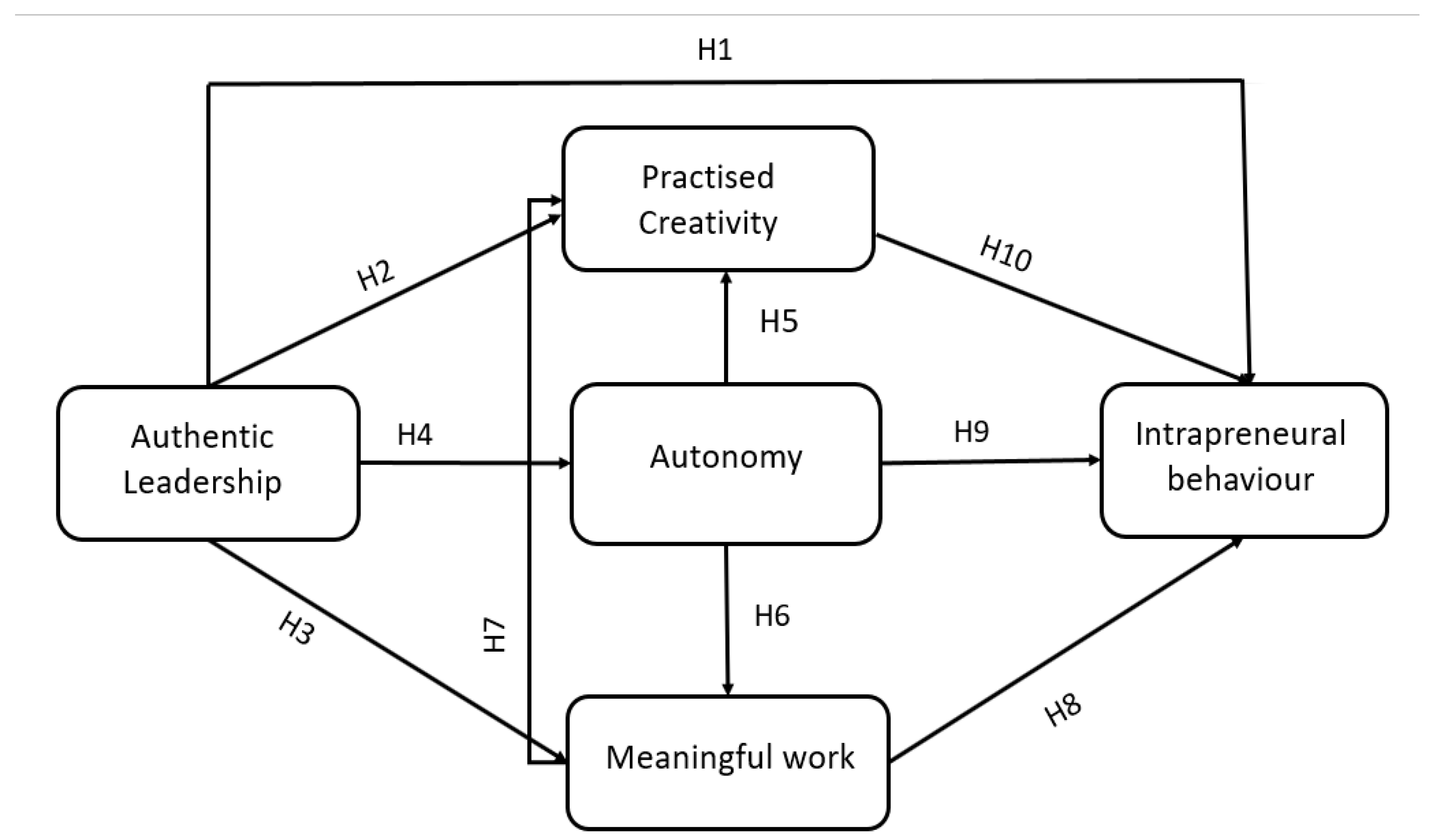
Figure 2.
Structural Model.
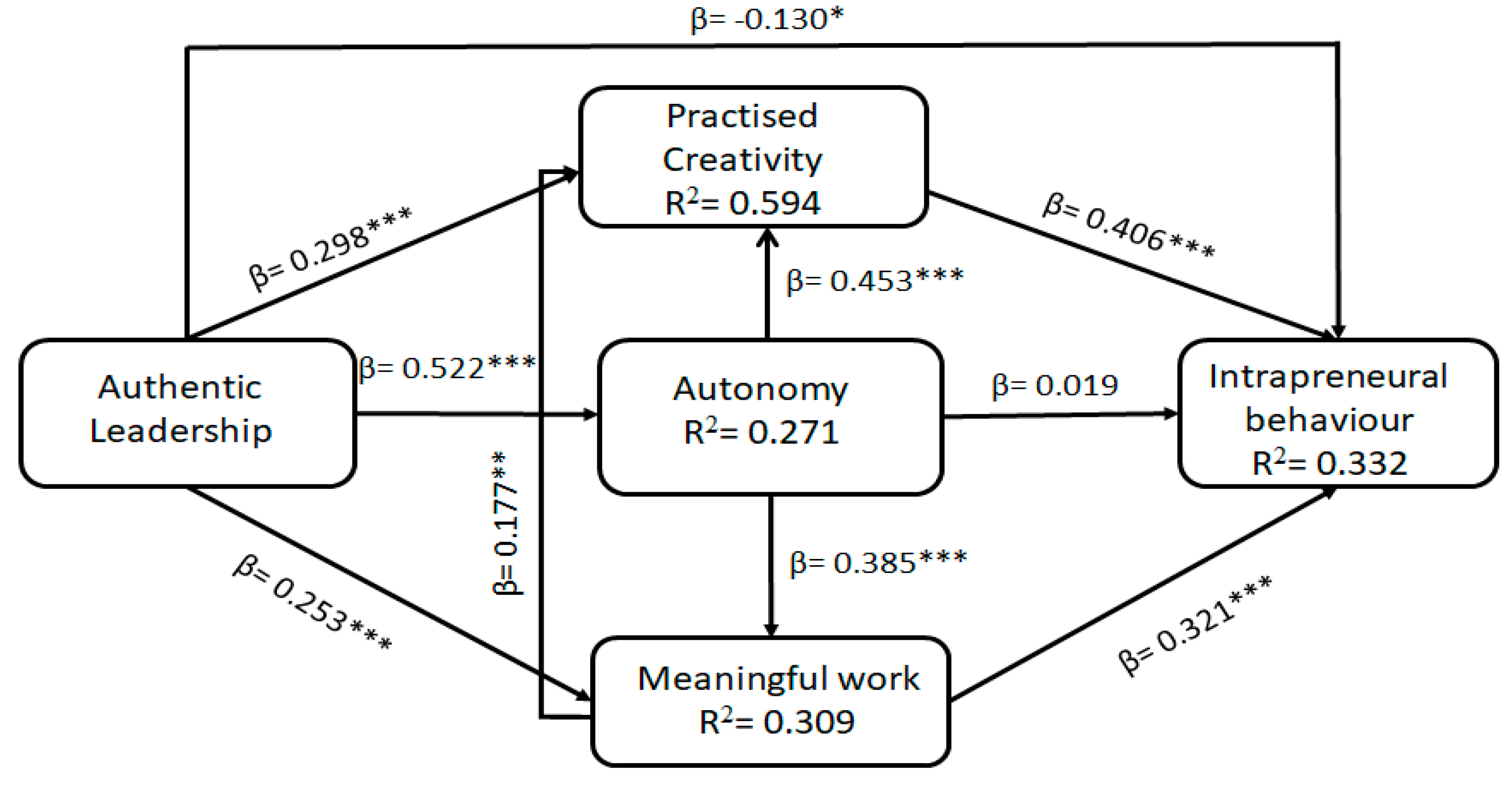
Figure 3.
The Moderating Effect of Work Autonomy.
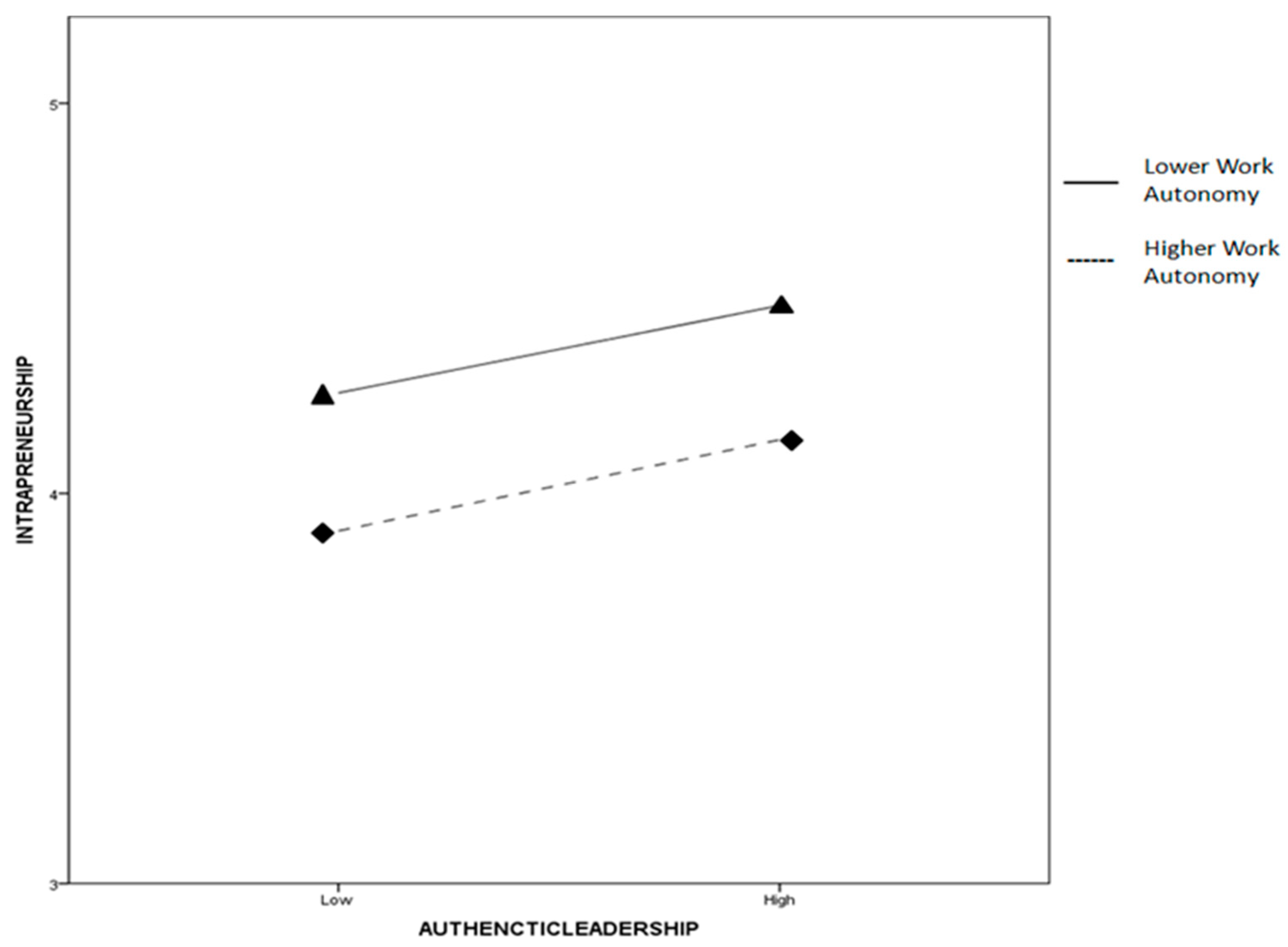

Table 1.
Outler loadings, AVE, Cronbach’s alpha and CR.
| Latent variables | Ítems | Outer loading | VIF | AVE | Alfa Cronbach | CR |
| Authentic leadership | AL_2 | 0.774 | 2.432 | 0.598 | 0.951 | 0.957 |
| AL_3 | 0.841 | 3.524 | ||||
| AL_4 | 0.704 | 1.902 | ||||
| AL_5 | 0.691 | 1.894 | ||||
| AL_6 | 0.816 | 3.003 | ||||
| AL_7 | 0.635 | 1.817 | ||||
| AL_8 | 0.778 | 2.316 | ||||
| AL_9 | 0.826 | 2.894 | ||||
| AL_10 | 0.779 | 2.499 | ||||
| AL_11 | 0.723 | 2.193 | ||||
| AL_12 | 0.853 | 4.599 | ||||
| AL_13 | 0.880 | 2.023 | ||||
| AL_14 | 0.653 | 3.143 | ||||
| AL_15 | 0.829 | |||||
| AL_16 | 0.770 | 2.446 | ||||
| Work Autonomy | WA_1 | 0.825 | 2.434 | 0.763 | 0.895 | 0.928 |
| WA_2 | 0.837 | 3.072 | ||||
| WA_3 | 0.894 | 4.072 | ||||
| WA_4 | 0.933 | 1.996 | ||||
| Practised creativity | PC_1 | 0.842 | 2.291 | 0.624 | 0.848 | 0.892 |
| PC_2 | 0.826 | 2.123 | ||||
| PC_3 | 0.685 | 1.498 | ||||
| PC_4 | 0.765 | 1.630 | ||||
| PC_5 | 0.823 | 1.993 | ||||
| Meaningful Work | MW_1 | 0.876 | 1.975 | 0.714 | 0.798 | 0.882 |
| MW_2 | 0.889 | 2.227 | ||||
| MW_3 | 0.764 | 1.456 | ||||
| Intrapreneurial behaviour | IB_1 | 0.739 | 1.660 | 0.580 | 0.856 | 0.892 |
| IB_2 | 0.796 | 1.917 | ||||
| IB_3 | 0.714 | 1.923 | ||||
| IB_5 | 0.726 | 2.070 | ||||
| IB_6 | 0.755 | 2.168 | ||||
| IB_7 | 0.832 | |||||
| Note:CR= composite reliability; AVE= Average variance extracted | ||||||
Table 2.
Means, standard deviation and correlation.
| Fornell- Larcker | ||||||||
|---|---|---|---|---|---|---|---|---|
| M | SD | WA | PC | IB | AL | MW | ||
| Work Autonomy (WA) | 5.19 | 1.165 | 0.873 | |||||
| Practised Creativity (PC) | 3.72 | 0.787 | 0.683** | 0.790 | ||||
| Intrapreneurial Behaviour (IB) | 3.74 | 0.677 | 0.385** | 0.489** | 0.761 | |||
| Authentic Leadership (AL) | 3.46 | 0.949 | 0.489** | 0.486** | 0.249** | 0.774 | ||
| Meaningful Work (MW) | 5.51 | 0.914 | 0.338** | 0.537** | 0.498** | 0.338** | 0.845 | |
| Note: Square root of AVE on diagonal; correlations between constructs are shown below the diagonal; *p < 0.05. **p < 0.01 | ||||||||
Table 3.
Validation of Research Hypothesis.
| Hypothesis | Coefficient | CI | P Values | T Statistics | F2 | Sig |
|---|---|---|---|---|---|---|
| H1: AL-> IB | -0.130 | (-0.252; -0.004) | 0.040 | 2.054 | 0.015 | Partial |
| H2:AL -> PC | 0.298 | (0.218; 0.380) | 0.000 | 7.368 | 0.151 | Yes |
| H3: AL-> MW | 0.253 | (0.150; 0.359) | 0.000 | 4.743 | 0.068 | Yes |
| H4: AL ->WA | 0.522 | (0.448; 0.594) | 0.000 | 13.853 | 0.375 | Yes |
| H5: WA-> PC | 0.453 | (0.341;0.550) | 0.000 | 8.484 | 0.321 | Yes |
| H6: WA-> MW | 0.385 | (0.253; 0,506) | 0.000 | 5.924 | 0.157 | Yes |
| H7: MW-> PC | 0.177 | (0.062; 0.295) | 0.003 | 3.007 | 0.054 | Yes |
| H8: MW -> IB | 0.321 | (0.203; 0.429) | 0.000 | 5.513 | 0.102 | Yes |
| H9: WA-> IB | 0.019 | (-0.138;0.171) | 0.811 | 0.239 | 0.000 | No |
| H10: PC->IB | 0.406 | (0.269; 0.549) | 0.000 | 5.663 | 0.100 | Yes |
| Note: WA= Work Autonomy; Al= Authentic leadership; PC=Practised Creativity; MW= Meaningful Work; IB= Intrapreneurial behaviour | ||||||
Disclaimer/Publisher’s Note: The statements, opinions and data contained in all publications are solely those of the individual author(s) and contributor(s) and not of MDPI and/or the editor(s). MDPI and/or the editor(s) disclaim responsibility for any injury to people or property resulting from any ideas, methods, instructions or products referred to in the content. |
© 2023 by the authors. Licensee MDPI, Basel, Switzerland. This article is an open access article distributed under the terms and conditions of the Creative Commons Attribution (CC BY) license (http://creativecommons.org/licenses/by/4.0/).
Copyright: This open access article is published under a Creative Commons CC BY 4.0 license, which permit the free download, distribution, and reuse, provided that the author and preprint are cited in any reuse.


