

Submitted:
25 June 2024
Posted:
25 June 2024
You are already at the latest version
Abstract
This study investigates the relationship between authentic leadership and socially responsible behavior among employees in Saudi Arabia's service sector. Utilizing social cognitive theory as the theoretical framework, the research proposes that authentic leadership indirectly influences socially responsible behavior through psychological empowerment and psychological capital as parallel and serial mediators. Additionally, the study examines the moderating effect of CSR perceptions on these relationships. A cross-sectional survey was conducted with 349 professionals from the service sector. The results, analyzed using partial least squares structural equation modeling (PLS-SEM), revealed that authentic leadership does not directly impact SRB. Instead, the relationship is fully mediated by psychological empowerment and psychological capital. Moreover, CSR perceptions significantly moderate the relationship between authentic leadership and psychological empowerment, as well as the indirect effects of authentic leadership on SRB through psychological empowerment and psychological capital. The findings highlight the importance of fostering an authentic leadership style and how psychological resources of empowerment, and psychological capital carry forward this effect to promote SRB in the service sector. Additionally, the study underscores the role of CSR perceptions in strengthening the impact of authentic leadership on employee outcomes. The research contributes to the literature on leadership, CSR, and employee behavior, and offers practical implications for organizations aiming to enhance their social responsibility initiatives.
Keywords:
Socially Responsible Behavior
; Authentic Leadership
; Psychological Empowerment
; Psychological Capital
; CSR Perceptions
1. Introduction
A long haul of research in corporate social responsibility (CSR) has given rise to a general opinion that an organization, as a collective, is solely responsible towards, society, environmental sustainability, and philanthropic endeavors. The social responsibility of an individual employee has received scant attention despite evidence indicating that employees plays an important role in social responsibility (CSR) initiatives, with their perceptions and attitudes significantly impacting the success of these programs [1,2]. Socially responsible behavior (SRB) is the voluntary choice and behavior of employees to improve social well-being (do good) or to prevent social harm (do no harm) [3]. This concept encompasses both in-role discretionary activities like helping a colleague and extra-role voluntary activities such as environmental initiatives or volunteering for a charitable event [4].
Studying employee SRB alongside CSR is imperative for organizations aiming to enhance their CSR initiatives and thereby exert a substantial influence on societal well-being. Socially responsible behavior is important for organizations to achieve sustainability and legitimacy in the current business environment, where stakeholders demand more accountability and responsibility from firms [5]. By fostering socially responsible behaviors among employees, organizations do not just align with their internal CSR goals but also substantially contribute to the overarching aims of global sustainability and well-being [6]. In addition, employee participation in socially responsible actions can enhance organizational reputation, employee satisfaction, and stakeholder trust, further emphasizing the importance of integrating employee CSR behaviors into the broader corporate CSR strategy [7].
The growing trend of self-centered leadership, which prioritizes personal benefits over the long-term well-being of the society and individuals, has highlighted the importance of leadership approaches that emphasize sustainable performance, quality products, and equitable returns to stakeholders in a lasting manner [8]. This shift in focus has catalyzed a burgeoning interest within organizational studies towards the concept of leaders who are caring, authentic and trustworthy [9]. Developed within the framework of positive psychology, Authentic leadership (AL) promotes positive psychological attributes, pro-social behavior, and an ethical climate among followers [10]. Authentic leaders not only exhibit these characteristics themselves but also encourage their followers to develop them, thereby creating an environment where positive organizational behaviors can thrive. These leaders support their team’s growth by demonstrating genuine values, providing honest feedback, and prioritizing the team’s needs [11].
Previous literature shows that AL can enhance various positive workplace outcomes including but not limited to job performance [12,13], subjective wellbeing [14], and citizenship behavior [15]. Recent comprehensive meta-analytic study by Zhang, Guo, Zhang, Xu, Liu and Newman [8] confirmed a strong positive influence of AL on myriad of positive outcomes job attitudes (job satisfaction, organizational commitment, job engagement, psychological empowerment, psychological safety, workplace trust) and job behaviors (organizational citizenship behavior, job performance, employee creativity, leader-member exchange and team performance). The meta analytic study also highlighted its negative correlation with emotional exhaustion and counterproductive work behavior. However, it still unclear how leader’s authenticity influence employees’ propensity for SRB. Therefore the current research aims to confirm the influence of AL on employee SRB.
Furthermore, this study seeks to elucidate the cognitive mechanisms that underlie the relationship between AL and SRB. Previous research has consistently shown that positive cognitive resources of psychological empowerment (PsyEmp) and psychological capital (PsyCap) mediates the effects of authentic leadership on various behavioral outcomes [16,17,18,19]. PsyEmp is a concept that centers around an individual’s sense of control, motivation, and self-efficacy within their work context. It is defined as “an individual’s experience of intrinsic motivation that is based on cognitions about themselves and their work role” [20]. PsyCap, a positive psychological state, represents a core set of four fundamental psychological resources: hope, optimism, self-efficacy and resilience [21]. Both PsyEmp and PsyCap are malleable and developable positive psychological resources that represents an individual strengths and cognitive capabilities [22]. Drawing from social cognitive theory (SCT), which posits a reciprocal interaction between individual cognition, behavior, and environmental factors [23], this study proposes that AL serves as a contextual antecedent to SRB, indirectly influencing it through psychological empowerment and PsyCap
Additionally, this research responds to calls for more nuanced explorations of the role situational factors play in ethical and prosocial organizational behavior [24,25]. There is a positive relationship between employee appraisal and evaluation of their company’s commitment to the socially responsibility and their own SRB [26]. Therefore, Under the principles of SCT, it is plausible that CSR practices would interact with AL as environmental factor that would shape individual cognitions (PsyEmp and PsyCap) and behaviors (SRB). He, et al. [27] also found a positive interactive effect of community-based CSR and ethical leadership on employee green and societal SRB. Therefore, the current research proposes that employee’s perception of their organizational CSR activities has a moderating influence on how AL relates to psychological resources and SRB.
2. Literature and Hypothesis
2.1. Socially Responsible Behavior
Research in SRB is scant and there are limited yet divergent perspectives adopted in the existing literature. Veetikazhi [4] is of the view that SRB encompasses a broad spectrum of actions, ranging from in-role discretionary activity or an extra role voluntary activity. [28] extends the macro-level CSR pyramid framework by Carroll [29], which categorizes corporate responsibilities into economic, legal, ethical, and philanthropic layers, to individual employees. They argue that employees can adopt these layers as part of their job roles, enhancing SREB. Further, they advocate for the application of the seven CSR principles outlined by the International Standard Organization (ISO) in 2010—accountability, transparency, ethical behavior, respect for stakeholder interests, adherence to law, international norms, and human rights—to individual employees as well.
SRB is also seen ethical and responsible conduct towards stakeholders, including the community [1]. De Roeck and Farooq [30] suggest that voluntary and green behaviors outside the workplace also constitute SREB. Stahl and Sully de Luque [24] differentiate socially responsible leadership behaviors into two categories: prescriptive morality, which includes actions like community service and eco-friendly practices, and proscriptive morality, aimed at avoiding harm through actions such as preventing harassment or environmental degradation.
This study adopts Veetikazhi [4] comprehensive SRB framework, which is composed of four dimensions: concern orientation, norm adherence, sociocentric orientation, and perseverance. Concern orientation involves active citizenship and a commitment to ethical conduct. Norm adherence reflects a dedication to legal and moral standards, including those specified by ISO 26000:2010. Sociocentric orientation prioritizes actions beneficial for societal welfare over individual gains, while perseverance represents the resolve to enact ethical principles into action, despite challenges. This streamlined conceptualization integrates both in-role and extra-role behaviors under the umbrella of SREB, providing a cohesive perspective on employee contributions to social responsibility.
2.2. Authentic Leadership and Socially Responsible Behavior
AL represents a leadership approach that prioritizes openness, ethical conduct, and the welfare of employees. Luthans and Avolio [31] initially defined it as a leadership style that combines positive thinking with a well-organized work environment. This helps leaders and team members become more aware of themselves and encourages positive actions, leading to personal growth. According to Walumbwa, et al. [32] AL is a leader’s pattern of behavior using positive psychology and promoting a positive ethical climate. They operationalized AL with four dimensions which involves leaders understanding their strengths and weaknesses (self-awareness), presenting their true selves to followers (relational transparency), aligning behaviors with internal moral standards (internalized moral perspective), and objectively analyzing information before deciding (balanced processing).
Although scant research investigates a relationship between leaders’ authenticity and SRB, existing research suggests that AL significantly influences behaviors akin to SRB, such as pro-social and citizenship behaviors. For instance, Zhang, et al. [33] discovered that supervisors AL led to increased caring behaviors among nurses in China. Similarly, Ribeiro, Duarte, Filipe and David [15] identified a positive influence of AL on citizenship behavior. Further, a study by Hannah, et al. [34] on soldiers found that AL fosters moral courage and self-awareness, which in turn encourages pro-social behavior. Additionally, Teng and O-Yang [35] demonstrated that AL positively affects pro-social behavior through the mediation of job fit.
Drawing from social cognitive theory [23], it’s argued that authentic leaders, by virtue of their transparency, self-awareness, and ethical behavior, serve as role models, encouraging the emulation of pro-social behaviors by their followers. Hannah, Avolio and Walumbwa [34] suggests that a leader’s pro-social behavior can motivate followers to engage in pro-social behavior. Therefore it is plausible that AL would themselves be more socially responsible and would directly influence their followers to be the same [36]. Leaders who are authentic are known for their strong ethical values and their transparent communication [32]. This creates a conducive environment that nurtures moral standards within employees, guiding them towards pro-social decisions. Therefore, we present our first hypothesis
H1:
AL is positively related to SRB.
2.3. Psychological Empowerment as a Mediator
PsyEmp is a psychological state characterized by an individual’s confidence in their capability to influence their surroundings and experiencing a harmony between their own values and those of the organization they are part of. [37]. It reflects an employee’s belief in their ability to influence their work environment and outcomes [20]. According to Spreitzer [37], PsyEmp comprises four key dimensions; 1) Meaning, the perception that one’s work has significance and aligns with personal values 2) Competence, Confidence in one’s skills and abilities to perform tasks effectively 3) Self-Determination: Having sense of autonomy and the freedom to make work-related choices 4) Impact: The belief that one’s actions can create meaningful change within the organization.
AL, known for fostering trust, positive emotions, and honesty, significantly contributes to strengthening employees’ PsyEmp. A plathora of studies has highlighted the close connection between AL and PsyEmp. It shows how authentic leaders, by granting autonomy and encouraging decision-making, equip employees with the necessary resources to feel more empowered [16,33,38]. By offering cognitive, emotional and work-related support such as autonomy and decision making authority, authentic leaders empower employees to gather additional resources, thereby enhancing their sense of empowerment [39]. From the perspective of SCT [23], it’s evident that the supportive environment created by AL positively influences employees’ beliefs in their efficacy and value, thereby fostering a sense of empowerment [40]. This perspective also aligns with Hobfoll, et al. [41] resource gain perspective according to which one resource leads to gain of another resource.
This increased empowerment under the guidance of authentic leaders not only motivates employees towards ethical and responsible behavior but also encourages their active participation in CSR initiatives [42]. Such participation is inherently driven by a deeper alignment with the organization’s ethical climate and a stronger bond with the company [43]. Tao, et al. [44] also supports this, finding that employees granted greater autonomy in engaging with CSR activities tend to exhibit higher levels of prosocial behavior. Through the perspective of social cognitive theory, this dynamic indicates that AL can amplify socially responsible behavior among employees by nurturing their PsyEmp. This discussion culminates in the formulation of our hypotheses:
H2a:
AL positively relates to employee’s PsyEmp
H2b:
PsyEmp positively relates to SRB
H2c:
The effect of AL on SRB is mediated by PsyEmp
2.4. Psychological Capital as a Mediator
Psychological Capital, or PsyCap, encapsulates the synergistic blend of hope, resilience, self-efficacy, and optimism—collectively known as HERO—within an individual [45]. Unlike dispositional traits, the four underlaying psychological resources that formulates PsyCap are state-like and malleable which means they can be influenced and developed with interventions and situational variables. AL is deeply intertwined with PsyCap as it embodies a state of positive psychology characterized by optimal self-esteem and well-being [10]. From the perspective of social learning within the social cognitive theory [23], authentic leaders impart their positive internalized values and dispositions to members during interactions, who, in turn internalize these values through positive role modeling, thereby enriching their PsyCap [38,46]. In addition, authentic leaders showing care towards their subordinates and creating an overall ethical climate within the organization would also cultivate followers PsyCap [39,47].
Moreover, people with higher PsyCap are more psychological resourceful and would be more compassionate and have an intrinsic motivation to help other people leading to higher SRB [48]. For instance, in very recent study, Su and Hahn [49] found that among construction workers, those higher in PsyCap have greater motivation for pro-social activities which leads to enhanced OCB. In another longitudinal study, Zhang, et al. [50] found that PsyCap mediates the link between meaning in life and prosocial behavior of university students. Experimental evidence suggests that individual who have futuristic perspective rather than dwelling upon the past like in those who possess greater hope and optimism tend to be higher in prosocial intentions [51]. A systematic literature review found that individuals high in hope engage more in behaviors that benefits others [52]. In a nut shell and in accordance to the tenets of reciprocal determinism, observational learning and self-regulation and self-efficacy within social cognitive theory, AL would enhance the cognitive resource psycap of their subordinate which would transcend into an enhance tendency for SRB. For instance, Sri Ramalu and Janadari [53] reported that PsyCap mediated the relationship between AL and organizational citizenship behavior. This leads to the following hypothesis:
H3a:
AL positively relates to employees PsyCap
H3b:
PsyCap positively relates to SRB
H3c:
PsyCap mediates the relationship between AL and SRB.
2.5. Serial Mediation
Although we propose that both PsyEmp and PsyCap serve as parallel mediators in the link between AL and socially responsible employee behavior (SRB), emerging insights suggest the potential for a serial mediation pathway as well. Notably, research by Shah, et al. [54] indicates a positive relationship between PsyEmp and PsyCap, hinting at how the elements of PsyEmp might foster the development of PsyCap’s components within the framework of positive psychology and social cognitive theory.
For example, employees who perceive that their work is meaningful—a core aspect of PsyEmp —may experience an enhanced sense of autonomy. This, in turn, can cultivate a stronger sense of self-efficacy, as the feelings of competence and autonomy contribute to an individual’s confidence in their abilities. Moreover, the perception of one’s work having a significant impact and the value assigned to this work can bolster hope. Likewise, the empowerment dimensions of self-determination and perceived impact are critical in reinforcing resilience, as they equip employees to navigate challenges and recover from setbacks [40,54].
Given the established connection between AL and enhanced PsyEmp, and the link between higher levels of PsyCap and increased SRB, the positive relationship between PsyEmp and PsyCap suggests a sequential influence. Specifically, AL may first boost PsyEmp, which in turn elevates PsyCap, ultimately leading to greater SRB. This sequential mediation underscores a more nuanced understanding of how AL can indirectly foster SRB by sequentially enhancing PsyEmp and PsyCap.
H4:
PsyEmp and PsyCap serially mediates the positive influence of AL on SRB
2.6. CSR Perception as a Moderator
Employee CSR perception is defined as ‘the degree to which employee perceive a company supports the activities related to a social cause’ [55]. Evidence from a meta-analytic study illustrates that positive CSR perceptions are linked to beneficial job attitudes and organizational behaviors [56]. According to Stahl and Sully de Luque [24] organizational characteristics, such as corporate culture and ethical climate, play a crucial role in either encouraging or hindering employees’ engagement in socially responsible behaviors. CSR initiatives, especially those aimed at benefiting individuals outside the organization, foster an ethical work environment by signaling the organization’s commitment to broader societal well-being [57]. Haski-Leventhal, et al. [58] emphasized on alignment between employee and organizational CSR efforts, suggesting that congruence in CSR identity and behavior enhances employees’ participation in CSR activities and improves person-organization fit.
Drawing from E. Rupp [57] framework for CSR perceptions, it’s proposed that employees continuously evaluate their environment, using observable cues, including CSR initiatives, to gauge the authenticity of their leaders. Thus, positive CSR perceptions can amplify the effects of AL on employee SRB by bolstering the credibility and perceived genuineness of leaders in their commitment to social causes [59]. Therefore, when employees evaluates organization’s CSR efforts positively, they are more likely to view their authentic leaders as credible and genuinely committed to the cause. This perception strengthens the influence of AL on employee SRB.
Furthermore, it is posited that employees’ CSR perceptions not only enhance the relationship between AL and SRB but also strengthen the links between AL and PsyEmp, as well as between AL and PsyCap. Such perceptions, underpinned by social cognitive theory, suggest that when employees view their organization as committed to societal well-being, they are more likely to feel empowered and utilize their psychological resources for societal benefits, mirroring their organization’s commitment [23]. Therefore, the hypotheses are as follows:
H5a:
The effect of AL on SRB is moderated by CSR Perceptions
H5b:
The effect of AL on PsyEmp is moderated by CSR Perceptions
H5c:
The effect of AL on PsyCap is moderated by CSR Perceptions
Figure 1 summarizes the hypothesis in a theoretical framework
A quantitative, cross-sectional, survey based and non-contrived research design was adopted for this study. A questionnaire was designed using google forms. The questionnaire was translated using the back to back translation approach. Content validity of translated questionnaire was established by sending it to three business management academic faculty members of five universities across Saudi Arabia who were Arabic speakers and hold a doctorate degree in Business Management.
The study population comprised of service sector professional employee in Saudi Arabia. The service sector plays a pivotal role in Saudi Arabia’s economy, contributing significantly to its diversification and growth [60]. As the country embarks on its ambitious Vision 2030 plan, the service sector is expected to become even more crucial in driving economic development and reducing dependency on oil revenues [61]. The sector consists of a wide range of industries, including finance, healthcare, education, tourism, and retail, each of which is undergoing substantial transformation as part of the national development strategy. Moreover, social responsibility is also integrated within Saudi Vision 2030 with government introducing various initiatives in different sectors such as CSR programs, community engagement programs and sustainable development goals (SDG) alignment [62]
To conduct a survey among professionals in the service sector, one of the authors dispatched emails containing an introduction to the research and a link to the Google Forms survey to alumni of the business school currently employed in service sector companies within Saudi Arabia. Additional emails were sent to contacts from a professional network related to service-based companies. In total, 550 emails were dispatched, followed by two reminder emails sent at 15-day intervals. The cut-off date for responses was set two months after the initial emails were sent. By the cutoff date, a total of 382 responses were received. Of these, 25 questionnaires were excluded because the respondents were not relevant to the service sector. Furthermore, an additional 8 responses were removed due to inconsistent responses and missing values exceeding 20 percent. Consequently, 349 questionnaires were retained for analysis.
The demographics analysis of the data (Table 1) revealed that predominantly large number of respondents were males (88%) while 12% were females. The age distribution showed 21.8% were under 30 years, 34.4% were between 31-40 years, 35% were between 41-50 years, 7.4% were between 51-60 years, and 1.4% were over 60 years. Regarding marital status, 79.4% of the respondents were married and 20.6% were unmarried. The educational levels varied, with 7.4% having a high school, 4% holding a diploma, 47.6% with a bachelor’s degree, 31.2% with a master’s degree, and 9.7% with postgraduate qualifications. In terms of work experience, 20.1% had less than 5 years, 13.2% had 6-10 years, 22.3% had 11-15 years, 17.2% had 16-20 years, 16.3% had 21-25 years, and 10.9% had more than 25 years. The current job tenure distribution was as follows: 30.1% had less than 5 years, 14.6% had 6-10 years, 18.3% had 11-15 years, 15.8% had 16-20 years, 11.2% had 21-25 years, and 10% had more than 25 years. In terms of organizational size, 17.2% worked in organizations with fewer than 50 employees, 17.5% in organizations with 51-100 employees, 16.9% in organizations with 101-250 employees, 14% in organizations with 251-500 employees, and 34.4% in organizations with more than 500 employees. The industries represented were Information Technology (26.4%), Hotel and Tourism (24.6%), Financial Services (21.5%), Education (13.2%), and Others (14.3%)
3. Measures
Socially responsible employee behavior (SRB) was measured with a 16 item scale by Veetikazhi [4]. The scale has four sub-divisions of concern orientation, perseverance, sociocentric orientation, and norms adherence orientation. A sample item is for concern orientation dimension is “I am involved in social and volunteer work that benefits my community”. AL was assessed with a16 item scale by Walumbwa, Avolio, Gardner, Wernsing and Peterson [32]. The respondents responded how their managers exhibit the following behaviors of self-awareness, internalized moral perspective, relational transparency and balance processing. Sample item for self-awareness dimension is “my manager seeks feedback to improve interaction with others”. For PsyCap, the 12-item Psychological Capital Questionnaire (PCQ-12) [63] was utilized. This scale comprises four subscales, each measuring a specific dimension of PsyCap: hope, efficacy, resilience, and optimism. The Twelve-item Psychological Empowerment Scale by Spreitzer [37] was employed to assess PsyEmp. The construct of PsyEmp is conceptualized with four dimensions of meaning, competence, self-determination and impact. The operationalization of employee perception of CSR involved measuring the extent to which employees perceived the company’s support for social causes. To measure CSR perception we adopted six questions from Papacharalampous and Papadimitriou [64]. A sample item is “My company encourages its employees to participate in voluntary activities”. Except for AL all scales gauged responses on a five-point Likert scale (1 = Strongly disagree to 5 = Strongly agree). AL was measured on 5-point frequency scale (1- Never to 5- Often).
Analysis Strategy
Preliminary steps included data screening and demographic analysis, which were conducted using the JAMOVI software [65]. For the analysis of the research model, partial least squares estimation of structural equation modeling (PLS-SEM) was chosen. PLS-SEM is a suitable statistical approach to test predictive relationships in a complex models with mediations and moderation while normality is not an assumption as it is a non-parametric technique [66]. Our testing of the research model followed a two-step approach [67]. First, we checked the adequacy of measurement model for reliability, validity and common method bias. Second, we evaluated the structural model for significance of paths (direct, indirect and moderation), explanatory power (R2 and F2) and predictive relevance (PLS Predict). To established the significance of paths coefficients, bootstrapping with 10000 resamples were used to generate confidence intervals [15]. The analysis was done use SMART-PLS version 4 [68].
4. Results
4.1. Measurement Model
All the latent variables were reflective in nature. Internal consistency (reliability) of our constructs were assessed through Cronbach’s alpha (α) and Composite Reliability (CR). As depicted in Table 1, the α values were in the range of 0.9 to 0.98 and CR values ranged from 0.93 to 0.98 indicating high reliability of the constructs as they were greater than 0.7 [66]. The average variance extracted (AVE) greater than 0.5 depicts convergent validity [66,69]. For all the latent constructs, the AVEs ranged from 0.59 to 0.75. Adequate convergent validity was established for our constructs.
Discriminant validity was examined using two approaches. First, we applied the Fornell-Larcker Criterion, which requires that the square root of the AVE for each construct (bolded on the diagonal in the Table 2) should be greater than its highest correlation with any other construct [69]. This was the case in our data as correlation values in upper diagonal were all less than their respective square roots of AVES. Additionally, we used the more accurate Heterotrait-Monotrait Ratio (HTMT) and found all values to be below the conservative threshold of 0.85, suggesting distinct constructs as per the guidelines by Henseler, et al. [70].
We also found that our constructs have sufficient nomological validity. The nomological validity indicates that study constructs are related to each other in the pattern, as depicted in the theory [66]. The correlations between the all variables as depicted in the upper diagonal of Table 2 were positive and varied from moderate to high, which is in line with our theoretical framework, thereby supporting the nomological validity of our constructs.
The potential presence of common method variance in our data was determined using the full collinearity test [71]. The VIF values as indicated in Table 2 within the bracket in upper diagonal ranged from 1.53 to 3.14 which were all below the threshold values of 3.3. Therefore, it can be concluded that common method bias is not a concern in this data. 4.2Structural Model
To improve the accuracy of the results and reduce the bias, we also included the control variables and established their relationship with the endogenous variables of SRB, PsyEmp, and PsyCap. The results for coefficients and their significance for direct paths, indirect paths, moderation and mediated moderations are depicted in Table 3. Among the control variable gender significantly and negatively predicted PsyEmp. This means that males have a higher perception of PsyEmp as compared to females in our sample, β = -.44, p < .01. On the contrary we found that a positive relationship of gender with SRB, β = .22, p = .02, which reveals that females in our sample are more socially responsible then males.
In the direct path analysis, we found that AL is not significantly related to SRB depicting that H1 was not accepted. However, AL was found to have a significant direct effect on PsyEmp (H2a), β = .39, P <.001, with a small effect size of .08. Additionally, PsyEmp significantly predicted SRB (H2b), β= .38, p < .001, and a robust effect size of .12, suggesting that PsyEmp has a strong positive associate with SRB compared to other predictors in the model. Therefore, H2a and H2b were supported. The direct effect of AL on PsyCap (H3a) was not significant, β = .13, p = .08. PsyCap significantly predicted SRB (H3b), p < .001, with a strong effect size of 0.17, demonstrating that PsyCap is an important factor in SRB. Moreover, the path from PsyEmp to PsyCap was highly significant, β = .76, p < .01., with a large effect size of F2 = 1.02, highlighting a substantial association between these constructs.
For the indirect paths, we found several mediations to be significant. AL had a significant effect on SRB through PsyEmp (H2c), β = .29, p < .001. On the contrary, the indirect path from AL to SRB through PsyCap (H3c) was not significant, β = .05, p = .08. Additionally, the results also showed that PsyEmp mediated the effect of AL on PsyCap, β = .05, p = .08 and PsyCap mediated the effect of PsyEmp on SRB. These two mediations were integrated in the hypothesis 4 (H4) which showed that the effect of AL on SRB is sequentially mediated by PsyEmp and PsyCap, β = .13, p < .05.
We had three moderations hypothesis as well. The interaction effect of CSR perceptions and AL on SRB (H5a) was not significant, β = .03, p =.13. However, the moderating effect of CSR perceptions on relationship between AL and PsyEmp was significant β = .25, p < .001, with an effect size of .16 which is considered large for moderation effects [72]. This moderation effect is depicted in Figure 2 at three levels of CSR Perceptions. The graph clearly indicates that as level of CSR perception increase, so the effect of AL on PsyEmp becomes more profound. No significant moderation effect of CSR Perception was detected for AL and PsyCap relationship, β = .03, p =.21.
Finally, we also found evidence for moderated mediation with the interaction of CSR perceptions and AL on the indirect paths to SRB through PsyEmp β = .19, p <.05.and through serial mediation of PsyEmp and PsyCap, β = .08, p < .05. This indicates that just like direct effect of AL on SRB is fully mediated, the interactive effect if CSR and AL is fully mediated by PsyEmp and serial mediators of PsyEmp.
The predictive relevance assessment was done using Q2 and MAE values generated by PLS predict algorithm [66]. A Q² value larger than zero implies that the model has predictive relevance for the particular construct. As a naïve benchmark we can suggest that model has predictive power for all three endogenous variables of PsyEmp (Q2 = .30), PsyCap (Q2 =.19) and SRB (Q2 = .19). However, the more accurate procedure is to contrast the RMSE (or MAE) values between PLS-SEM model and a linear model [60]. Lower values of PLS-SEM values for each indicator indicates more predictive power. Since the prediction error distribution for RMSE values were highly non-symmetric, we used MAE values for prediction statistics. The results in Table 4 shows that for PsyEmp, PsyCap and SRB, the MAE values for PLS-SEM were lower than LM values. This indicate that the model has a high predictive power with respect to the three endogenous variables. Similarly the R2 adj values for PsyEmp (R2 = .36 ) indicates moderate explanatory power which means control variables, AL and CSR-Perception and their interaction explain 36% of variance. For PsyCap (R2 = .66 ) the explanatory power is strong. Control variables, AL, CSR perception, their interaction and PsyEmp explains 66% variance in PsyCap. Finally, for SRB (R 2 = .61) all the predictors explained 61% variance which is indicative of strong explanatory power.
5. Discussion
Our research adds to the expanding field of study concerning employee social responsibility within the leadership context of Saudi Arabia’s service sector. By exploring the mediating roles of PsyEmp and PsyCap, and CSR perceptions as moderator, this research provides a nuanced understanding of how AL can foster socially responsible behavior among employees. On the practical side, this study suggests that organizations should focus on developing authentic leadership at all managerial levels and foster employees’ positive psychological resources to promote SRB. It is also important that organizations CSR practices resonates with employee’s social values [21,31,73]
5.1. Theoretical Implications
Our results provide several theoretical implications for comprehending the interaction among AL, PsyEmp, PsyCap, and SRB. Drawing upon social cognitive theory [23], we found that PsyEmp and PsyCap fully mediate the relationship between AL and SRB [18,32]. Additionally, CSR perceptions moderate the relationships emerging from AL [59]. There is a clear indication of how cognitive resources are important pathways which relates perceptions of external factors (leadership) with behavior (socially responsible). Similarly the study also showed how organizational CSR play a role in relationship of leadership with employee level responsible behaviors.
First, the nonsignificant direct relationship between AL and SRB, coupled with the full mediation effect via PsyEmp and PsyCap, suggests that authentic leaders influence their followers’ SRB indirectly by enhancing their cognitive resources [33]. This aligns with social cognitive theory, where leaders serve as role models, and their authentic behavior influences the psychological state of their followers [10]. Our study makes a significant contribution to the AL literature by demonstrating the crucial roles of PsyEmp and PsyCap as pathways through which AL influences socially responsible behavior (SRB). The influence of AL on SRB operates entirely through these psychological mechanisms. While our hypothesis regarding parallel mediation was partially supported—PsyCap was not a direct mediator—the evidence for serial mediation was compelling. The effect size analysis indicated that AL has a modest impact on PsyEmp, which in turn has a slight effect on SRB. Interestingly, PsyCap has a more substantial influence on SRB compared to PsyEmp. Moreover, PsyEmp exerts a notably large effect on PsyCap. These results underscores the intricate nature of cognitive mechanisms as how one psychological resource give rise to another psychological resource leading to positive behavioral outcomes [74].
Second, our results revealed the moderating effect of CSR perception in the significant direct and indirect paths emerging from AL. The significant moderating effect of CSR perceptions on the direct relationship between AL and PsyEmp suggests that employees’ perceptions of their organization’s CSR efforts can amplify the impact of AL on their PsyEmp. Similarly, CSR perceptions can also influence the strength of indirect relationships between AL and SRB via PsyEmp and PsyEmp and PsyCap as serial mediator. Previous studies such as Lee, Park and Lee [55] has also found that positive CSR perception generate a multiple positive outcomes such as employee attachment and performance. This finding extends the understanding of the contextual factors that influence the effectiveness of AL in promoting positive employee outcomes.
5.2. Practical Implications
The findings of this study have several practical implications for organizations and leaders in the service sector in Saudi Arabia. Firstly, organizations should invest in developing authentic leaders who can inspire and empower their employees. Training programs focusing on self-awareness, ethical decision-making, and transparent communication can help cultivate AL qualities [32].
Organizations should prioritize fostering a psychologically empowering work environment. This can be achieved by providing employees with meaningful work, autonomy, and opportunities for personal and professional growth. Encouraging participation in decision-making and recognizing employees’ contributions can also enhance their sense of empowerment [37]. Encouraging participation in decision-making and recognizing employees’ contributions further strengthens their empowerment. The employees who feel empowered are more likely to engage in behaviors that benefit the organizations, such as SRB.
Furthermore, our findings highlight the interconnectedness between PsyEmp and PsyCap. PsyEmp, characterized by a sense of meaning, competence, self-determination, and impact, lays the foundation for the development of PsyCap, which includes hope, efficacy, resilience, and optimism [63]. This relationship is crucial as PsyCap is not only a critical mediator in the path leading to SRB but also an essential cognitive resource that enhances employees’ capacity to engage in socially responsible behaviors. Therefore, by fostering a psychologically empowering environment, organizations can indirectly bolster SRB through the sequential mediation of PsyEmp and PsyCap. Moreover, research has shown that employees who are high in PsyCap are more like to exhibit positive work beahviors [75]
Subsequently, organizations should actively engage in CSR activities and communicate their efforts to employees. Positive CSR perceptions can strengthen the impact of AL on employees’ PsyEmp, PsyCap and SRB. Therefore, transparent and consistent communication about CSR initiatives is crucial [7]. Moreover, CSR activities that involve employees directly can foster a sense of ownership and pride, further enhancing their commitment to socially responsible behavior [76]. By aligning CSR initiatives with employees’ values and interests, organizations can create a more meaningful and engaging CSR experience, leading to stronger identification with the organization and its social mission [77]. For instance, an organization that is not working in public interest or doing practices that are harmful to environment or wellbeing of public, should not expect their employees to act socially responsible, how authentic the leadership may be. On the contrary, people get inspiration from their leaders and their employers which means organizations CSR practices spillover to individual SR practices.
5.3. Limitation and Future Research Directions
Limitation as part and parcel of every study which should be considered while interpreting the results and act as future research directions for advancement of knowledge. Firstly, the cross-sectional design limits the ability to infer causality. Future researchers can focus on longitudinal studies to establish causal relationships. Secondly, the study’s focus on the service sector in Saudi Arabia may limit the generalizability of the findings to other sectors or cultural contexts. Although service sector in Saudi Arabia is growing rapidly and the kingdom is gradually lowering its dependence on oil sector, we recommend future researchers to expand this research to other sectors. An additional limitation is the underrepresentation of female respondents in our sample. However, this reflects the broader labor force division in Saudi Arabia, where women’s participation is relatively lower [60]. Future research could explore gender differences in the impact of AL on SRB and other outcomes.
Future research could also explore the impact of other emerging and established leadership styles such transformational leadership, ambidextrous leadership and despotic leadership on SRB. Future researchers are also invited to examine additional mediators such as workplace attitudes and moderators such as organizational culture, work ethics and socially responsible human resource practices in the relationship between leadership and employee social responsible behavior. Investigating the long-term effects of AL on prosocial outcomes and exploring the role of cultural factors in shaping the effectiveness of leadership styles are also promising avenues for further research.
Author Contributions
All authors have substantially contributed to the research. Conceptualization, Rajeh Bati Almasardi and Farhan Sarwar; methodology, Rajeh Bati Almasardi and Farhan Sarwar; software and analysis, Farhan Sarwar.; validation of results, Rajeh Bati Almasardi, Farhan Sarwar and Ismail Hussain Doup Adam; Data Acquisition: Rajeh Bati Almasaradi and Ismail Hussain Doup Adam; Project funding and administration, Rajeh Bati Almasardi; writing- original draft preparation, Farhan Sarwar; writing—review and editing, Rajeh Bati Almasardi, Farhan Sarwar and Ismail Hussain Doup Adam; All authors have read and agreed to the published version of the manuscript.”.
Funding
The authors extend their appreciation to the Deanship of Graduate Studies and Scientific Research at University of Bisha for funding this research through the promising program under grant number (UB-Promising - 19 -1445).
Informed Consent Statement
Informed consent was obtained from all subjects involved in the study.
Data Availability Statement
The data set used in the reseach is a part of an ongoing project and is not made publicly available.
Conflicts of Interest
The authors declare no conflict of interest.
References
- Bocean, C.G.; Nicolescu, M.M.; Cazacu, M.; Dumitriu, S. The Role of Social Responsibility and Ethics in Employees’ Wellbeing. International Journal of Environmental Research and Public Health 2022, 19, 8838. [Google Scholar] [CrossRef] [PubMed]
- van Dick, R.; Crawshaw, J.R.; Karpf, S.; Schuh, S.C.; Zhang, X.-a. Identity, importance, and their roles in how corporate social responsibility affects workplace attitudes and behavior. Journal of Business and Psychology 2020, 35, 159–169. [Google Scholar] [CrossRef]
- Crilly, D.; Schneider, S.C.; Zollo, M. Psychological antecedents to socially responsible behavior. European Management Review 2008, 5, 175–190. [Google Scholar] [CrossRef]
- Veetikazhi, R. Socially responsible behaviour at work: the impact of goal directed action and leadership. Dissertation, Duisburg, Essen, Universität Duisburg-Essen, 2021, 2021.
- Carroll, A.B.; Shabana, K.M. The business case for corporate social responsibility: A review of concepts, research and practice. International journal of management reviews 2010, 12, 85–105. [Google Scholar] [CrossRef]
- Schmitz, J.; Schrader, J. Corporate social responsibility: A microeconomic review of the literature. Journal of Economic Surveys 2015, 29, 27–45. [Google Scholar] [CrossRef]
- Glavas, A.; Kelley, K. The effects of perceived corporate social responsibility on employee attitudes. Business ethics quarterly 2014, 24, 165–202. [Google Scholar] [CrossRef]
- Zhang, Y.; Guo, Y.; Zhang, M.; Xu, S.; Liu, X.; Newman, A. Antecedents and outcomes of authentic leadership across culture: A meta-analytic review. Asia Pacific Journal of Management 2022, 39, 1399–1435. [Google Scholar] [CrossRef]
- Caza, A.; Jackson, B. Authentic leadership. The SAGE handbook of leadership 2011, 352–364. [Google Scholar]
- Avolio, B.J.; Gardner, W.L. Authentic leadership development: Getting to the root of positive forms of leadership. The leadership quarterly 2005, 16, 315–338. [Google Scholar] [CrossRef]
- Gardner, W.L.; Avolio, B.J.; Luthans, F.; May, D.R.; Walumbwa, F. “Can you see the real me?” A self-based model of authentic leader and follower development. The leadership quarterly 2005, 16, 343–372. [Google Scholar] [CrossRef]
- Leroy, H.; Anseel, F.; Gardner, W.L.; Sels, L. Authentic leadership, authentic followership, basic need satisfaction, and work role performance: A cross-level study. Journal of management 2015, 41, 1677–1697. [Google Scholar] [CrossRef]
- Wei, F.; Li, Y.; Zhang, Y.; Liu, S. The interactive effect of authentic leadership and leader competency on followers’ job performance: The mediating role of work engagement. Journal of Business Ethics 2018, 153, 763–773. [Google Scholar] [CrossRef]
- Rahimnia, F.; Sharifirad, M.S. Authentic leadership and employee well-being: The mediating role of attachment insecurity. Journal of Business Ethics 2015, 132, 363–377. [Google Scholar] [CrossRef]
- Ribeiro, N.; Duarte, A.P.; Filipe, R.; David, R. Does authentic leadership stimulate organizational citizenship behaviors? The importance of affective commitment as a mediator. Sustainability Accounting, Management and Policy Journal 2022, 13, 320–340. [Google Scholar] [CrossRef]
- Mubarak, F.; Noor, A. Effect of authentic leadership on employee creativity in project-based organizations with the mediating roles of work engagement and psychological empowerment. Cogent Business & Management 2018, 5, 1. [Google Scholar]
- Jang, E. Authentic leadership and task performance via psychological capital: the moderated mediation role of performance pressure. Frontiers in Psychology 2022, 13, 722214. [Google Scholar] [CrossRef]
- Zhang, J.; Song, L.J.; Wang, Y.; Liu, G. How authentic leadership influences employee proactivity: the sequential mediating effects of psychological empowerment and core self-evaluations and the moderating role of employee political skill. Frontiers of business research in China 2018, 12, 1–21. [Google Scholar] [CrossRef]
- Rego, A.; Sousa, F.; Marques, C.; e Cunha, M.P. Authentic leadership promoting employees’ psychological capital and creativity. Journal of business research 2012, 65, 429–437. [Google Scholar] [CrossRef]
- Muduli, A.; Pandya, G. Psychological empowerment and workforce agility. Psychological Studies 2018, 63, 276–285. [Google Scholar] [CrossRef]
- Luthans, F.; Youssef, C.M. Human, Social, and Now Positive Psychological Capital Management:: Investing in People for Competitive Advantage. Organizational Dynamics 2004, 33, 143–160. [Google Scholar] [CrossRef]
- Hobfoll, S.E.; Halbesleben, J.; Neveu, J.-P.; Westman, M. Conservation of resources in the organizational context: The reality of resources and their consequences. Annual Review of Organizational Psychology and Organizational Behavior 2018, 5, 103–128. [Google Scholar] [CrossRef]
- Bandura, A. Social cognitive theory: An agentic perspective. Asian journal of social psychology 1999, 2, 21–41. [Google Scholar] [CrossRef]
- Stahl, G.K.; Sully de Luque, M. Antecedents of responsible leader behavior: A research synthesis, conceptual framework, and agenda for future research. Academy of Management Perspectives 2014, 28, 235–254. [Google Scholar] [CrossRef]
- Kish-Gephart, J.J.; Harrison, D.A.; Treviño, L.K. Bad apples, bad cases, and bad barrels: meta-analytic evidence about sources of unethical decisions at work. Journal of applied psychology 2010, 95, 1. [Google Scholar] [CrossRef]
- Ramkissoon, H.; Mavondo, F.; Sowamber, V. Corporate social responsibility at LUX* resorts and hotels: Satisfaction and loyalty implications for employee and customer social responsibility. Sustainability 2020, 12, 9745. [Google Scholar] [CrossRef]
- He, J.; Morrison, A.M.; Zhang, H. Being sustainable: The three-way interactive effects of CSR, green human resource management, and responsible leadership on employee green behavior and task performance. Corporate Social Responsibility and Environmental Management 2021, 28, 1043–1054. [Google Scholar] [CrossRef]
- Hemphill, T.A.; Laurence, G.A. Employee social responsibility: A missing component in the ISI 26000 social responsibility standard. Business and Society Review 2018, 123, 59–81. [Google Scholar] [CrossRef]
- Carroll, A.B. The pyramid of corporate social responsibility: Toward the moral management of organizational stakeholders. Business horizons 1991, 34, 39–48. [Google Scholar] [CrossRef]
- De Roeck, K.; Farooq, O. Corporate social responsibility and ethical leadership: Investigating their interactive effect on employees’ socially responsible behaviors. Journal of Business Ethics 2018, 151, 923–939. [Google Scholar] [CrossRef]
- Luthans, F.; Avolio, B.J. Authentic leadership development. Positive organizational scholarship 2003, 241, 1–26. [Google Scholar]
- Walumbwa, F.O.; Avolio, B.J.; Gardner, W.L.; Wernsing, T.S.; Peterson, S.J. Authentic leadership: Development and validation of a theory-based measure. Journal of management 2008, 34, 89–126. [Google Scholar] [CrossRef]
- Zhang, G.; Tian, W.; Zhang, Y.; Chen, J.; Zhang, X.; Lin, W.; Li, H.; Sun, L.; Cheng, B.; Ding, H. The mediating role of psychological capital on the relationship between authentic leadership and nurses’ caring behavior: a cross-sectional study. BMC nursing 2023, 22, 441. [Google Scholar] [CrossRef] [PubMed]
- Hannah, S.T.; Avolio, B.J.; Walumbwa, F.O. Relationships between authentic leadership, moral courage, and ethical and pro-social behaviors. Business Ethics Quarterly 2011, 21, 555–578. [Google Scholar] [CrossRef]
- Teng, H.-Y.; O-Yang, Y. How and when authentic leadership promotes prosocial service behaviors: A moderated mediation model. International Journal of Hospitality Management 2022, 104, 103227. [Google Scholar] [CrossRef]
- Tekleab, A.G.; Reagan, P.M.; Do, B.; Levi, A.; Lichtman, C. Translating corporate social responsibility into action: a social learning perspective. Journal of Business Ethics 2021, 171, 741–756. [Google Scholar] [CrossRef]
- Spreitzer, G.M. Psychological empowerment in the workplace: Dimensions, measurement, and validation. Academy of management Journal 1995, 38, 1442–1465. [Google Scholar] [CrossRef]
- Walumbwa, F.O.; Wang, P.; Wang, H.; Schaubroeck, J.; Avolio, B.J. Retracted: Psychological processes linking authentic leadership to follower behaviors. 2010.
- Wang, H.; Sui, Y.; Luthans, F.; Wang, D.; Wu, Y. Impact of authentic leadership on performance: Role of followers’ positive psychological capital and relational processes. Journal of Organizational Behavior 2014, 35, 5–21. [Google Scholar] [CrossRef]
- Wang, D.; Kan, W.; Qin, S.; Zhao, C.; Sun, Y.; Mao, W.; Bian, X.; Ou, Y.; Zhao, Z.; Hu, Y. How authentic leadership impacts on job insecurity: The multiple mediating role of psychological empowerment and psychological capital. Stress and Health 2021, 37, 60–71. [Google Scholar] [CrossRef]
- Hobfoll, S.E.; Johnson, R.J.; Ennis, N.; Jackson, A.P. Resource loss, resource gain, and emotional outcomes among inner city women. Journal of personality and social psychology 2003, 84, 632–643. [Google Scholar] [CrossRef]
- Kang, H.J.A.; Kim, W.G.; Choi, H.-M.; Li, Y. How to fuel employees’ prosocial behavior in the hotel service encounter. International Journal of Hospitality Management 2020, 84, 102333. [Google Scholar] [CrossRef]
- Weinstein, N.; Ryan, R.M. When helping helps: autonomous motivation for prosocial behavior and its influence on well-being for the helper and recipient. Journal of personality and social psychology 2010, 98, 222. [Google Scholar] [CrossRef] [PubMed]
- Tao, W.; Song, B.; Ferguson, M.A.; Kochhar, S. Employees’ prosocial behavioral intentions through empowerment in CSR decision-making. Public Relations Review 2018, 44, 667–680. [Google Scholar] [CrossRef]
- Luthans, F.; Youssef, C.M.; Avolio, B.J. Psychological capital: Investing and developing positive organizational behavior. In Positive organizational behavior, Nelson, D.L., Cooper, C.L., Eds.; 2007; pp. 9–24.
- Walumbwa, F.O.; Peterson, S.J.; Avolio, B.J.; Hartnell, C.A. An investigation of the relationships among leader and follower psychological capital, service climate, and job performance. Personnel Psychology 2010, 63, 937–963. [Google Scholar] [CrossRef]
- Joo, B.-K.; Lim, D.H.; Kim, S. Enhancing work engagement: The roles of psychological capital, authentic leadership, and work empowerment. Leadership & Organization Development Journal 2016, 37, 1117–1134. [Google Scholar]
- Aydin Sünbül, Z.; Aslan Gördesli, M. Psychological capital and job satisfaction in public-school teachers: the mediating role of prosocial behaviours. Journal of Education for Teaching 2021, 47, 147–162. [Google Scholar] [CrossRef]
- Su, W.; Hahn, J. Psychological Capital and Organizational Citizenship Behaviors of Construction Workers: The Mediating Effect of Prosocial Motivation and the Moderating Effect of Corporate Social Responsibility. Behavioral Sciences 2023, 13, 981. [Google Scholar] [CrossRef]
- Zhang, S.; Fu, Y.-N.; Liu, Q.; Turel, O.; He, Q. Psychological capital mediates the influence of meaning in life on prosocial behavior of university students: A longitudinal study. Children and Youth Services Review 2022, 140, 106600. [Google Scholar] [CrossRef]
- Baumsteiger, R. Looking forward to helping: The effects of prospection on prosocial intentions and behavior. Journal of Applied Social Psychology 2017, 47, 505–514. [Google Scholar] [CrossRef]
- Schornick, Z.; Ellis, N.; Ray, E.; Snyder, B.-J.; Thomas, K. Hope that Benefits Others: A systematic literature review of Hope Theory and prosocial outcomes. International Journal of Applied Positive Psychology 2023, 8, 37–61. [Google Scholar] [CrossRef]
- Sri Ramalu, S.; Janadari, N. Authentic leadership and organizational citizenship behaviour: the role of psychological capital. International Journal of Productivity and Performance Management 2022, 71, 365–385. [Google Scholar] [CrossRef]
- Shah, T.A.; Khattak, M.N.; Zolin, R.; Shah, S.Z.A. Psychological empowerment and employee attitudinal outcomes: The pivotal role of psychological capital. Management Research Review 2019, 42, 797–817. [Google Scholar] [CrossRef]
- Lee, E.M.; Park, S.-Y.; Lee, H.J. Employee perception of CSR activities: Its antecedents and consequences. Journal of business research 2013, 66, 1716–1724. [Google Scholar] [CrossRef]
- Wang, Y.; Xu, S.; Wang, Y. The consequences of employees’ perceived corporate social responsibility: A meta-analysis. Business Ethics: A European Review 2020, 29, 471–496. [Google Scholar] [CrossRef]
- Rupp, D.E. An employee-centered model of organizational justice and social responsibility. Organizational Psychology Review 2011, 1, 72–94. [Google Scholar] [CrossRef]
- Haski-Leventhal, D.; Roza, L.; Meijs, L.C. Congruence in corporate social responsibility: Connecting the identity and behavior of employers and employees. Journal of Business Ethics 2017, 143, 35–51. [Google Scholar] [CrossRef]
- Duane Hansen, S.; Dunford, B.B.; Alge, B.J.; Jackson, C.L. Corporate social responsibility, ethical leadership, and trust propensity: A multi-experience model of perceived ethical climate. Journal of Business Ethics 2016, 137, 649–662. [Google Scholar] [CrossRef]
- AlMulhim, A.F. Knowledge management capability and organizational performance: a moderated mediation model of environmental dynamism and opportunity recognition. Business Process Management Journal 2023, 29, 1655–1679. [Google Scholar] [CrossRef]
- Moshashai, D.; Leber, A.M.; Savage, J.D. Saudi Arabia plans for its economic future: Vision 2030, the National Transformation Plan and Saudi fiscal reform. British Journal of Middle Eastern Studies 2020, 47, 381–401. [Google Scholar] [CrossRef]
- Alghamdi, A.A. University social responsibility under the influence of societal changes: Students’ satisfaction and quality of services in Saudi Arabia. Frontiers in Psychology 2022, 13, 976192. [Google Scholar] [CrossRef]
- Luthans, F.; Avolio, B.J.; Avey, J.B.; Norman, S.M. Positive psychological capital: Measurement and relationship with performance and satisfaction. Personnel Psychology 2007, 60, 541–572. [Google Scholar] [CrossRef]
- Papacharalampous, N.; Papadimitriou, D. Perceived corporate social responsibility and affective commitment: The mediating role of psychological capital and the impact of employee participation. Human Resource Development Quarterly 2021, 32, 251–272. [Google Scholar] [CrossRef]
- Jamovi, P. Jamovi (Version 2.3)[Computer Software]. 2022.
- Hair Jr, J.F.; Hult, G.T.M.; Ringle, C.M.; Sarstedt, M. A primer on partial least squares structural equation modeling (PLS-SEM); Sage publications: 2021.
- Anderson, J.C.; Gerbing, D.W. Structural equation modeling in practice: A review and recommended two-step approach. Psychological bulletin 1988, 103, 411–423. [Google Scholar] [CrossRef]
- Ringle, C.M.; Wende, S.; Becker, J.-M. SmartPLS 4. Oststeinbek: SmartPLS GmbH. 2022.
- Fornell, C.; Larcker, D.F. Structural equation models with unobservable variables and measurement error: Algebra and statistics. Journal of marketing research 1981, 18, 382–388. [Google Scholar] [CrossRef]
- Henseler, J.; Ringle, C.M.; Sarstedt, M. A new criterion for assessing discriminant validity in variance-based structural equation modeling. Journal of the academy of marketing science 2015, 43, 115–135. [Google Scholar] [CrossRef]
- Kock, N.; Lynn, G. Lateral collinearity and misleading results in variance-based SEM: An illustration and recommendations. Journal of the Association for information Systems 2012, 13, 546–580. [Google Scholar] [CrossRef]
- Aguinis, H.; Beaty, J.C.; Boik, R.J.; Pierce, C.A. Effect size and power in assessing moderating effects of categorical variables using multiple regression: a 30-year review. Journal of applied psychology 2005, 90, 94. [Google Scholar] [CrossRef] [PubMed]
- Gardner, W.L.; Cogliser, C.C.; Davis, K.M.; Dickens, M.P. Authentic leadership: A review of the literature and research agenda. The leadership quarterly 2011, 22, 1120–1145. [Google Scholar] [CrossRef]
- Gorgievski, M.J.; Halbesleben, J.R.; Bakker, A.B. Expanding the boundaries of psychological resource theories. Journal of occupational and organizational psychology 2011, 84, 1–7. [Google Scholar] [CrossRef]
- Luthans, F.; Youssef-Morgan, C.M. Psychological Capital: An Evidence-Based Positive Approach. Annual Review of Organizational Psychology and Organizational Behavior 2017, 4, 339–366. [Google Scholar] [CrossRef]
- Haski-Leventhal, D.; Pournader, M.; McKinnon, A. The role of gender and age in business students’ values, CSR attitudes, and responsible management education: Learnings from the PRME international survey. Journal of Business Ethics 2017, 146, 219–239. [Google Scholar] [CrossRef]
- Bhattacharya, C.B.; Sen, S.; Korschun, D. Using corporate social responsibility to win the war for talent. MIT Sloan management review 2008, 49. [Google Scholar]
Figure 1.
Schematic Diagram of Research Framework.Participants and Procedure.
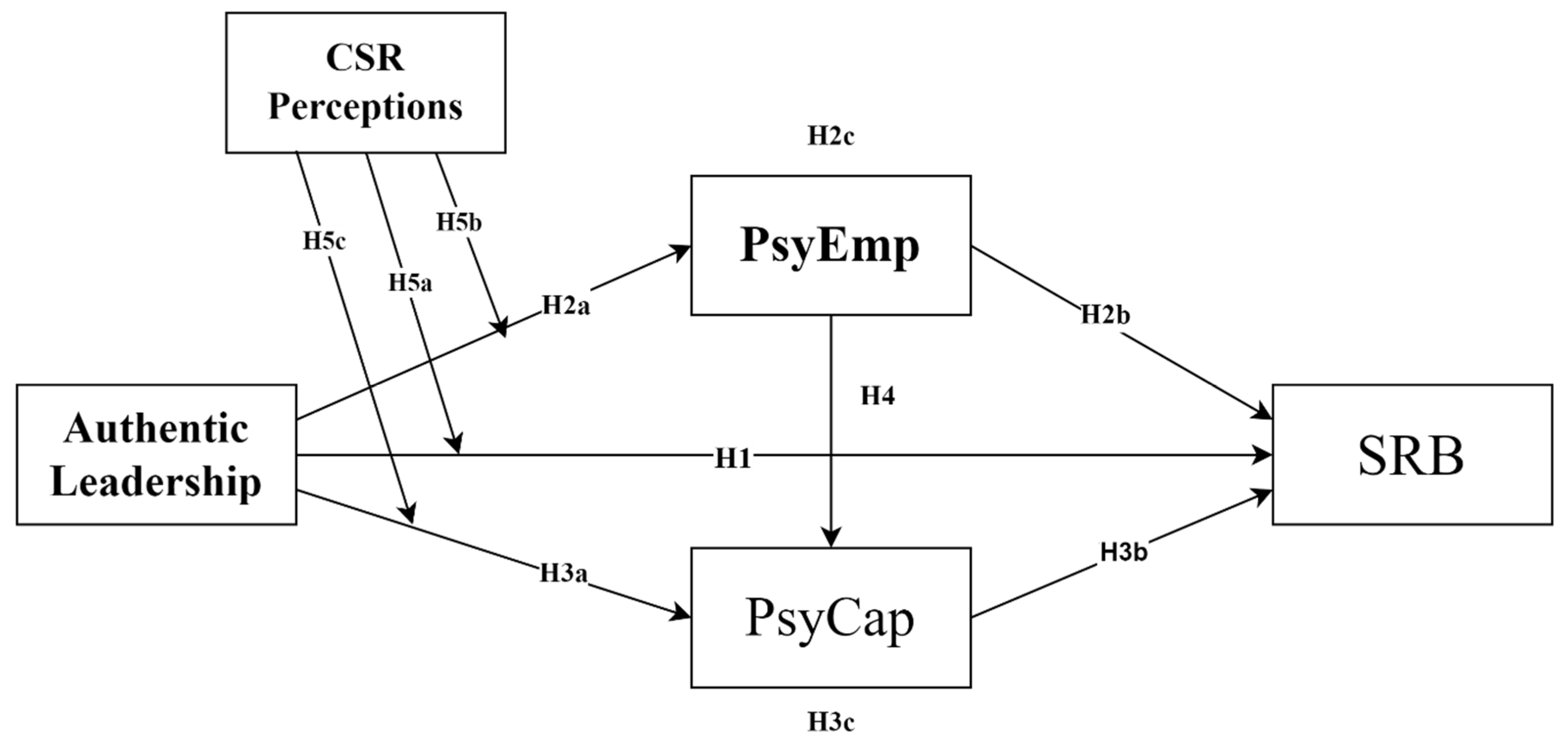
Figure 2.
Slope for moderation effect of CSR Perceptions on Authentic Leadership and Psychological Empowerment.
Figure 2.
Slope for moderation effect of CSR Perceptions on Authentic Leadership and Psychological Empowerment.
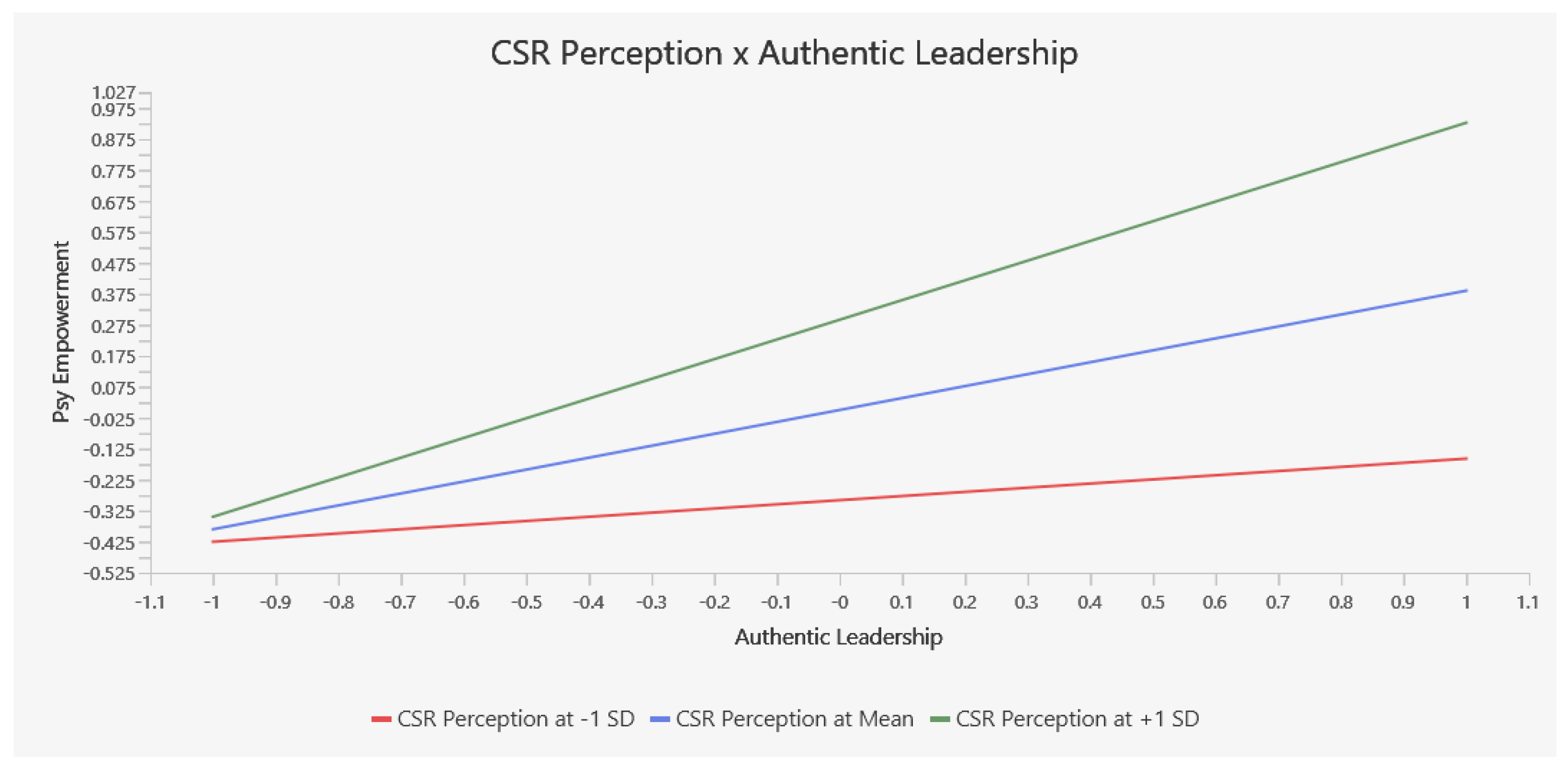

Table 1.
Demographic profile of the respondents.
| Variables | Category | Frequency | Percentage |
|---|---|---|---|
| Gender | Females | 42 | 12.0% |
| Males | 307 | 88.0% | |
| Age (years) | less than 30 | 76 | 21.8% |
| 31-40 | 120 | 34.4% | |
| 41-50 | 122 | 35.0% | |
| 51-60 | 26 | 7.4% | |
| greater than 60 | 5 | 1.4% | |
| Marital Status | Married | 277 | 79.4% |
| Unmarried | 72 | 20.6% | |
| Educational Level | High School | 26 | 7.4% |
| Diploma | 14 | 4.0% | |
| Bachelors | 166 | 47.6% | |
| Masters | 109 | 31.2% | |
| Post Graduate | 34 | 9.7% | |
| Years of Experience | less than 5 | 70 | 20.1% |
| 6 to 10 | 46 | 13.2% | |
| 11 to 15 | 78 | 22.3% | |
| 16 to 20 | 60 | 17.2% | |
| 21 to 25 | 57 | 16.3% | |
| more than 25 | 38 | 10.9% | |
| Current Job Tenure | less than 5 | 105 | 30.1% |
| 6 to 10 | 51 | 14.6% | |
| 11 to 15 | 64 | 18.3% | |
| 16 to 20 | 55 | 15.8% | |
| 21 to 25 | 39 | 11.2% | |
| more than 25 | 35 | 10.0% | |
| Organizational Size | less than 50 | 60 | 17.2% |
| 51-100 | 61 | 17.5% | |
| 101-250 | 59 | 16.9% | |
| 251-500 | 49 | 14.0% | |
| more than 500 | 120 | 34.4% | |
| Industry | Information Technology | 92 | 26.4% |
| Hotel and Tourism | 86 | 24.6% | |
| Financial Services | 75 | 21.5% | |
| Education | 46 | 13.2% | |
| Others | 50 | 14.3% |
Table 2.
Assessment of Measurement Model: Reliability, Validity, Correlation and Bias Indices.
| α | CR | AVE | AL | CSRP | PE | PsyCap | SRB | |
|---|---|---|---|---|---|---|---|---|
| AL | 0.98 | 0.98 | 0.73 | 0.86 | 0.8 | 0.48 (2.86) | 0.37 (3.08) | 0.4 (3.14) |
| CSR_P | 0.9 | 0.93 | 0.68 | 0.85 | 0.82 | 0.46 (2.89) | 0.3 (3) | 0.38 (3.03) |
| PsyEmp | 0.94 | 0.95 | 0.59 | 0.5 | 0.49 | 0.77 | 0.78 (1.53) | 0.74 (3.04) |
| PsyCap | 0.97 | 0.97 | 0.75 | 0.37 | 0.32 | 0.81 | 0.87 | 0.72 (2.57) |
| SRB | 0.95 | 0.96 | 0.6 | 0.41 | 0.4 | 0.78 | 0.75 | 0.77 |
| Note:AL = Authentic Leadership; CSR_P = Corporate Social Responsibility Perceptions, PsyEmp = Psychological Empowerment, PsyCap = Psychological Capital, SRB = Socially responsible Behavior, CR = Composite Reliability, AVE = Average Variance Extracted. The bold values on the diagonal represents square root of AVE. Values above diagonal represents correlations among latent constructs for Fornell-Larcker criteria and values in brackets represents VIF (Variance inflation factors). Values below the diagonal are HTMT values. | ||||||||
Table 3.
Summary of PLS Bootstrapping Results for Direct, Indirect, Moderated and Moderated Mediation Paths.
Table 3.
Summary of PLS Bootstrapping Results for Direct, Indirect, Moderated and Moderated Mediation Paths.
| Direct Paths | β | P values | 95% CI | Effect Size | |
|---|---|---|---|---|---|
| H1 | AL -> SRB | 0.01 | 0.46 | [-.11;.14] | 0 |
| H2a | AL -> PsyEmp | 0.39 | 0 | [.22;.55] | 0.08 |
| H2b | PsyEmp -> SRB | 0.38 | 0 | [.27;.50] | 0.12 |
| H3a | AL -> PsyCap | 0.13 | 0.08 | [-.01;.28] | 0.01 |
| H3b | PsyCap -> SRB | 0.43 | 0 | [.29;.53] | 0.17 |
| PsyEmp -> PsyCap | 0.76 | 0 | [.68;.84] | 1.02 | |
| Gender -> PsyEmp | -0.44 | 0 | [-.68; -.24] | 0 | |
| Gender -> SRB | 0.22 | 0.02 | [.05;.50] | 0.01 | |
| Indirect Paths | |||||
| AL -> PsyEmp -> PsyCap | 0.29 | 0 | [ 0.17;0.42] | ||
| H2c | AL -> PsyEmp -> SRB | 0.14 | 0 | [ 0.08;0.23] | |
| H3c | AL -> PsyCap -> SRB | 0.05 | 0.08 | [ 0;0.12] | |
| PsyEmp -> PsyCap -> SRB | 0.33 | 0 | [ 0.22;0.42] | ||
| H4 | AL -> PsyEmp -> PsyCap -> SRB | 0.13 | 0 | [ 0.06;0.19] | |
| Moderation | |||||
| H5a | CSR_P x AL -> SRB | 0.03 | 0.13 | [-.01;.08] | 0 |
| H5b | CSR_P x AL -> PsyEmp | 0.25 | 0 | [.16;.33] | 0.16 |
| H5c | CSR_P x AL -> PsyCap | 0.03 | 0.21 | [-.02;.10] | 0.01 |
| Moderated Mediations | |||||
| CSR_P x AL -> PsyEmp -> PsyCap | 0.19 | 0 | [ 0.13;0.25] | ||
| CSR_P x AL -> PsyEmp -> SRB | 0.09 | 0 | [ 0.06;0.14] | ||
| CSR_P x AL -> PsyCap -> SRB | 0.01 | 0.2 | [ -0.01;0.04] | ||
| CSR_P x AL -> PsyEmp -> PsyCap -> SRB | 0.08 | 0 | [ 0.05;0.11] | ||
| Note: AL = Authentic Leadership; CSR_P = Corporate Social Responsibility Perceptions, PsyEmp = Psychological Empowerment, PsyCap = Psychological Capital, SRB = Socially responsible Behavior. For control variables only significant relationships are shown. | |||||
Table 4.
Summary of Q2predict, PLS-SEM_MAE, LM_MAE, R2adj.
| Q²predict | PLS-SEM_MAE | LM_MAE | R2 adj | |
|---|---|---|---|---|
| PsyEmp | 0.3 | 0.36 | ||
| EE_1 | 0.47 | 0.5 | ||
| EE_2 | 0.47 | 0.49 | ||
| EE_3 | 0.42 | 0.47 | ||
| EE_4 | 0.44 | 0.51 | ||
| EE_5 | 0.48 | 0.57 | ||
| EE_6 | 0.45 | 0.53 | ||
| EE_7 | 0.49 | 0.5 | ||
| EE_8 | 0.51 | 0.55 | ||
| EE_9 | 0.49 | 0.5 | ||
| EE_10 | 0.48 | 0.52 | ||
| EE_11 | 0.45 | 0.5 | ||
| EE_12 | 0.47 | 0.51 | ||
| PsyCap | 0.19 | 0.63 | ||
| PC1 | 0.46 | 0.48 | ||
| PC2 | 0.46 | 0.47 | ||
| PC3 | 0.45 | 0.47 | ||
| PC4 | 0.45 | 0.48 | ||
| PC5 | 0.5 | 0.53 | ||
| PC6 | 0.47 | 0.5 | ||
| PC7 | 0.45 | 0.46 | ||
| PC8 | 0.5 | 0.53 | ||
| PC9 | 0.46 | 0.49 | ||
| PC10 | 0.48 | 0.5 | ||
| PC11 | 0.48 | 0.48 | ||
| PC12 | 0.51 | 0.52 | ||
| SRB | 0.19 | 0.61 | ||
| SRB_1 | 0.46 | 0.52 | ||
| SRB_2 | 0.47 | 0.49 | ||
| SRB_3 | 0.52 | 0.59 | ||
| SRB_4 | 0.53 | 0.56 | ||
| SRB_5 | 0.51 | 0.56 | ||
| SRB_6 | 0.55 | 0.61 | ||
| SRB_7 | 0.5 | 0.55 | ||
| SRB_8 | 0.48 | 0.49 | ||
| SRB_9 | 0.46 | 0.51 | ||
| SRB_10 | 0.48 | 0.5 | ||
| SRB_11 | 0.56 | 0.59 | ||
| SRB_12 | 0.5 | 0.55 | ||
| SRB_13 | 0.48 | 0.55 | ||
| SRB_14 | 0.52 | 0.59 | ||
| SRB_15 | 0.5 | 0.55 | ||
| Note:, PsyEmp = Psychological Empowerment, PsyCap = Psychological Capital, SRB = Socially responsible Behavior. | ||||
Disclaimer/Publisher’s Note: The statements, opinions and data contained in all publications are solely those of the individual author(s) and contributor(s) and not of MDPI and/or the editor(s). MDPI and/or the editor(s) disclaim responsibility for any injury to people or property resulting from any ideas, methods, instructions or products referred to in the content. |
© 2024 by the authors. Licensee MDPI, Basel, Switzerland. This article is an open access article distributed under the terms and conditions of the Creative Commons Attribution (CC BY) license (http://creativecommons.org/licenses/by/4.0/).
Copyright: This open access article is published under a Creative Commons CC BY 4.0 license, which permit the free download, distribution, and reuse, provided that the author and preprint are cited in any reuse.


