

Submitted:
13 November 2024
Posted:
15 November 2024
You are already at the latest version
Abstract
Ethical management is key to ensuring organizational sustainability, through resources such as autonomy or self-efficacy. However, economic and social uncertainty occasionally leads to adaptive responses that prioritize profit as the primary interest, blurring the integrating role of ethical leadership. There are a number of studies that support this reality in a virtual work environment. This sector-specific and cross-sectional research explores how ethical leadership influences self-efficacy among teleworkers, through active commitment to job autonomy, and how an egoistic climate hinders this influence. The analysis is quantitative and correlational, and the sample includes 448 teleworkers. A model of conditional indirect effects, including both a mediation process and a moderation process, is used. Results support that ethical leadership enhances followers' self-efficacy through a redistribution of responsibilities, which increases the perception of autonomy. However, when ethical leadership coincides with a climate that has opposing interests, such as an egoistic climate, ethical leadership is unable to counteract it, and its effect on self-efficacy gradually diminishes. The benefits of this management style are widely known, but it is crucial to understand under what circumstances it loses efficacy. This research presents a new theoretical model that contributes to the existing literature on ethical leadership.
Keywords:
ethical leadership
; job autonomy
; self-efficacy
; ethical climate
; egoistic climate
Introduction
Colombia is immersed in a political and economic context of instability that has become the main strategic challenge for most organizations. In this sense, ethical leadership is a key factor that tends to balance certain external risks while conserving resources and building new development sources [1]. Colombian industry needs a leadership style capable of articulating the changes in the way most companies operate that resulted from Covid-19. In fact, telework has been incorporated as a necessary adaptative system and this modality of occupation requires a type of behavior supported by strong moral convictions [2]. Therefore, ethical leadership becomes a valuable management style that avoids passive behaviors under hostile or unstable habitats or with limited resources [3].
Dhar [4] clarifies that ethical leadership focuses part of its efforts on defining exchange relations with employees, and this interaction alters characteristics related to the job position. Job autonomy specifically plays a critical role in building trust and contributing to increased individual self-efficacy [5,6]. Autonomy and self-efficacy are interconnected with resilience, and with the individual's ability to regulate and respond with adaptative solutions to a crisis environment [7]. Therefore, both skills have a useful impact on stress management and a positive impact on psychological well-being, allowing employees to face demanding situations with guarantees of success [8]. On the other hand, prolonged periods of imbalance can lead to organic responses that benefit the performance and self-efficacy of organizational structures [9] to the detriment of ethical management. Surely, self-interest and institutional interest, when permanent, shape egoistic ethical climates that primarily rely on competitive states of mind [10]. Consequently, benefit is the main concern, which differs from the integrating criteria of ethical leaders [11].
This research was started under a complex scenario with multiple questions. The first is how to define the relationship between ethical leadership and self-efficacy, considering the critical contextual aspect that this possible affinity is established in virtual work environments. In this sense, Lee [12] introduces the expression e-ethics to describe ethical leadership adapted to a remote work format. The term e-ethics is part of a broader concept of digital leadership called e-leadership that involves the development of certain managerial skills to optimize the management of remote work environments [13]. Therefore, it is of paramount interest to know how ethical leadership, assuming a double function, e-ethics; e-leadership, enables work conditions that keep employees motivated and increases their self-efficacy instead of diminishing it. At the same time, another particularly important aspect this research aims to address is how an egoistic ethical climate, acting as a moderating construct, influences the relationship between ethical leadership and self-efficacy.
Authors such as Tziner et al. [14] conclude that an egoistic ethical climate is not significantly related to the theory of social exchange between leader and follower (LMX). This indicates that a managerial pattern that originates in quality interactions, mutual influence, and respect ceases to be effective when the moral balance focuses exclusively on self-interest or organizational interest. Additionally, the same authors find that an egoistic climate is negatively related to perception of organizational justice. Likewise, Gorsira et al. [15] establish that employees who feel immersed in an egoistic ethical climate have weaker relationships with personal and social norms. This can subordinate their moral conception to dishonest behaviors. Considering that ethical leaders justify their functional character through social relations, justice, and integrity [11], it is possible to conclude that an egoistic climate continuously hinders and limits the scope of ethical leadership on job self-efficacy until this relationship is interrupted.
However, ethics as a moral measure does not prevent a climate with egoistic motivations from being self-effective [9]. The underlying moral currents are unquestionable in most organizations, although there is ambiguity when it comes to defining an approach as ethical or not [16]. Therefore, traits such as responsibility or level of energy devoted to achieving an objective, through positive and useful self-efficacy, are conditioned and depend on organizational behavior and how it faces the uncertainty related to the business. An egotistic climate, for practical purposes, designs a work framework that implies strong rivalry to achieve goals. This fosters a persistent will, ethical or not, to leave behind any difficulties interfering with individual self-efficacy [17]. Therefore, this research considers that an egoistic ethical climate significantly articulates with personal self-efficacy.
Another question this article intends to answer is how job autonomy intervenes to facilitate the correspondence between ethical leadership and self-efficacy in the job position. Considering this, self-determination, or a feeling of autonomy to complete specific tasks fits the definition of psychological empowerment [18]. After all, individual conviction of self-efficacy significantly influences organizational results. Thus, the ethical leader's behavior is decisive, since they become role models giving meaning to the social context. Meaning that the leader provides relevant moral information from two different perspectives: personal and managerial [19]. Therefore, if followers modify their convictions and make them coincide with organizational values, they are more likely to find meaning in their work and become more self-efficient.
Ethical leaders naturally foster analytical and independent work environments where followers take charge of their own decisions. This control over tasks enables employees to be generally autonomous [20]. Finally, and by integrating concepts, ethical leaders have a real interest in caring for the well-being of followers. Consequently, interaction between them and employees is constant, which enables a spiral of questions and answers resulting in more individual and collective self-efficacy [21,22]. This research focuses on the Colombian electricity sector, which is a key part of the sustained development of a territory that had not stopped growing until now.
The economic activity examined has certain peculiarities and standing out among them is the high academic level of its members. In fact, the entire analysis sample is formed by people with university studies and the vast majority are employees who essentially rely on information and communication technologies. Job autonomy is a main component of this perspective, as professional employees have more internal influence potential than other groups of employees [23]. Additionally, work environment flexibility is a central factor of occupational well-being and tends to guarantee greater self-efficacy [24]. Likewise, leadership in this sector constantly faces ethical problems. Therefore, it requires a moral vision as it directly affects people and the rest of the organization [25]. To the same extent, along with ethical leadership, there are variables that have the capacity to reduce its impact [26]. In this sense, an egoistic ethical climate stands out as it relates to corruption [15], job dissatisfaction [27] and low organizational commitment [28].
In conclusion, this article intends to examine how ethical leadership, exercising its function in a virtual work environment, transcends in the self-efficacy of the follower. To give more meaning to this relationship, a scheme is used that includes a mediating factor, generally positive, as job autonomy, and another potentially adverse factor, such as an egoistic ethical climate with a moderating function. This research intends to contribute widely, with original results, to the existing literature in different ways, overcoming several limitations evident within this field of study. First, by using ethical leadership as a construct that improves employee self-efficacy in virtual contexts. Second, by revising how and in what situations, this relationship occurs or stops.
Theoretical Framework
Ethical Leadership, Autonomy and Self-Efficacy
Kalshoven et al. [29] argue that ethical leaders are especially inclined towards work models with a high context of autonomy. In light of this, Contreras et al. [30] indicate that job autonomy enables a free choice of tasks, which directly influences upon an adequate administration of time and improves individual self-efficacy. However, e-leaders have the responsibility of proposing transparent digital disconnection policies to prevent intensifying workloads under the false pretext of labor flexibility [31]. Therefore, ethical leaders are necessary because, in an environment based on self-management, they guide and help followers decide what is most convenient for their well-being [32]. Similarly, the impact of ethical leaders depends on their ability to transfer sufficient authority to employees and to emphasize two basic aspects with this action: shared trust and explicit development of the role of followers [33].
On the other hand, considering the approach of the social learning theory [34,35], job autonomy provides employees with the ability to analyze the effect of their actions, develop points of view, and learn based on experience. Consequently, high job autonomy provides individuals with greater guidance and confidence, which allows them to understand the evolution of their own actions and how these lead them to more self-efficacy [24]. In fact, employees perceive a decrease in their ability to produce positive results when they experience excessive supervision that limits their potential to be able to decide [36].
Thus, by adopting the role of e-leader ethical leadership promotes collaborative work, which feeds on multiple shades and observations, has a significant impact on job autonomy, and, using information and communication technologies, it is very possible for the follower's self-efficacy to improve [37]. Therefore, the following hypothesis is proposed:
H1. Job autonomy, in virtual work environments, is a valuable mechanism that explains how ethical leadership and self-efficacy relate.
Ethical Leadership and Job Self-Efficacy
According to Contreras et al. [30], leaders are obliged to adapt to the new conditions proposed by virtual work environments, through additional skills. Under this perspective, beyond having charisma, ethical leaders influence others through example and are clear transmitters of emotional skills that are essential to face disruptive and volatile scenarios. Their resilient and natural character makes them credible and horizontal persons seeking legitimacy through actions far from self-interest [38]. Undoubtedly, ethical leadership seeks a vertical and transversal distribution of responsibilities, with the help of joint reflections and with a constant transfer of authority [39]. In fact, the ethical leader communicates clear ideals that prevent opportunistic behavior in remote work environments. Thus, moral principles are basic to address problem resolution from an ethical perspective [40].
Additionally, telework raises moral concerns such as information excesses that tend to overlap with family and professional life [41]. An ethical leader can solve these by preventing imbalances that harm employees [42]. This management style, by nature, combines several beneficial traits. These include, for example, benevolence, integrity, joint decisions, and fair treatment, and it is an essential element to address the transition from an on-site environment to an online one [43,44]. Simultaneously, the concern of ethical supervisors for their followers keeps a common psychological connection that prevents any hint of psychological isolation related to telework [45,46]. Ethical leaders guide employees, and this constant support has a positive impact on their conviction to successfully achieve a determined objective [47]. It is probable that sustained feedback and precision in the information provided are two essential characteristics of e-leadership [48]. Therefore, ethical leaders become a guarantee for followers to express their concerns and jointly seek honest solutions in a trust framework.
The transfer of valuable resources between leaders and followers limits emotional concerns from possible threats, which ultimately increases self-efficacy [49]. Finally, ethical leadership is characterized by decentralized and democratic management, which results in effective administration [50]. In fact, technology transforms it into e-leadership that encourages performance by minimizing the digital distance through open communication, idea exchanges and trust development [12,30]. Consequently, the following hypothesis is proposed:
H2. Ethical leadership is positively related to followers' self-efficacy in virtual work environments.
Ethical Leadership, Egoistic Ethical Climate, and Self-Efficacy
A systematic breach of the norms that regulate an organization is considered, in general terms, deviant and unethical conduct that relates to self-interest [51]. However, breaking the rules can also be linked to the will to support the organization so that it fulfills its purposes [52]. In this direction, a high perception of self-efficacy can maximize individual confidence to successfully execute a given task. Therefore, individuals may focus their attention on the potential benefit of their behavior and may not try to understand the ethical risk associated to it [17]. In fact, egoistic climates encourage decision-making based on self-interest and organizational interest. This tends to design work environments where rivalry fosters many initiatives that might go against prosocial norms [53].
On the other hand, ethical climates significantly affect individuals' identification with the organization. Hence, ethical leadership seeks to build an environment that directs its efforts toward a common interest and concern for others. In other words, towards benevolent environments with specific regulations [54]. Under this light, an egoistic climate tends to weaken emotional ties and identification among organization members [55]. Measures promoted by ethical leaders have the goal of fostering mechanisms that improve moral behavior, and go beyond personal interests, as they prioritize the needs raised by followers [56]. Thus, an organizational climate justified by self-interest can continuously hinder and deteriorate ethical prerogatives until these lose their scope [57].
The social cognitive theory is a useful tool to clarify this situation. Self-efficacy is sustained, and increases based on four main aspects: achievement experience, indirect learning, positive feedback and stable emotions [34,35]. In practice, self-efficacy is conditioned by the control of individuals over the performance of a behavior, and it is stable when this self-regulation is independent of any external factor [58]. However, self-efficacy is categorically affected when external forces limit the behavioral domain [10]. Consequently, when an ethical leadership style has to endure an egoistic climate to influence followers' self-efficacy, its characteristics decline until they are invalid and, on the other hand, self-interest prevails. This means individual competences and interests, organizational success, and emotional self-sufficiency [59].
When job alternatives completely ignore collective needs and focus on maximizing a line of behavioral reasoning that prioritizes personal gain and selfishness, a fracture results, leading to moral disconnection [60]. This enables deactivating any acceptable ethical principle. In other words, there is a superior morality supporting what is useful to oneself above any reasonable criteria related to what is just and upright. Ethical leadership and job self-efficacy are gradually dissociated under this scenario until they are completely separated. Therefore, the following hypotheses are proposed:
H3. An egoistic ethical climate positively relates to individual self-efficacy in virtual work environments.
H4. An egoistic climate inversely moderates the positive relationship between ethical leadership and self-efficacy, in virtual work environments. The greater the perception of the egoistic ethical climate, the less positive influence of ethical leadership on individual self-efficacy.
Methods
Participants
The sample is made up of 448 telecommuters employed in the Colombian electricity sector. Specifically, in six companies with offices in Bogotá, Cali, Medellín, Manizales and Pereira. The sampling is done probabilistically, by conglomerates considering the main cities of the country. The response rate was 100%. Regarding gender, 175 (39%) of the participants were women and 273 (61%) were men. The average age is 37.18 years (SD = 10.059; range: 20-69). 364 employees have permanent contracts (81.25%) and 84 have temporary work contracts (18.75%). The mean seniority is 13.06 years (SD = 8.82; range: 0-38 years). Regarding occupation, 86.6% (308) are professionals, 8.9% (40) hold intermediate jobs, and finally, 4.5% (20) are managers. 100% of those surveyed have university studies. 57.4% (257) have graduate studies. 42% (188) do not have children.
Instruments
Control Variables: Seniority and gender are used as control variables. It is possible that employees with high adaptation to organizational idiosyncrasies are more autonomous and self-effective. To measure permanence, survey participants were asked to indicate how long they had been working using a minimum scale of 0 to 1 year. The gender was coded as 0 for men and 1 for women.
Ethical Leadership: One-dimensional scale proposed by Brown et al. [61], composed by 10 reagents and a Cronbach's Alpha of 0.94. It is initially used through a scale of 7 options. This construct is used by Feng et al. [62] with a 7-level Likert scale and a Cronbach's Alpha of 0.91. The perception of organizational leadership is measured through actions, interpersonal relationships, and communication, among other characteristics, to determine if they transmit trust and align with ethical behavior.
Job Autonomy: The one-dimensional scale designed and proposed by Spreitzer [63], with three reagents and a Cronbach's Alpha of 0.72 is used; and used by Santiago-Torner [2], with a Cronbach's Alpha of 0.89. It values if an employee has enough freedom to be able to decide in his job and exercise some control over it.
Self-efficacy: 6-item unidimensional scale suggested by Schaufeli et al. [64], assessed through a 4-point Likert scale and with reliability between 0.76 and 0.90. Used by Salanova and Schaufeli [65] with an α of 0.80. It evaluates skill and capacity to successfully achieve an objective.
Egoistic Ethical Climate: Part of the multidimensional scale proposed by Victor and Cullen was used [66]. Provided is dimension number 1, which is the center of analysis, where the individual, the local and the cosmopolitan coexist together with the egoistic criterion belonging to dimension number 2. Composed of 14 items in three subscales: self-interest (7 questions), business benefit (3 questions) and efficiency (4 questions). The way to perfect individual interest is evaluated above all other considerations. Scale used by Santiago-Torner [67] through a 6-point Likert scale and an internal consistency of 0.77. The initial scale uses 5 Likert points and shows a Cronbach's alpha (α) between 0.69 and 0.85.
Procedure
All the proposed research passed the Ethics Committee of the University of Vic - Central University of Catalonia in July 2021 with codes 2021 and 170. The information was collected during the last four months of 2021. Different privacy agreements were determined in an initial phase and all the study materials were sent to the organizations: objectives, data protection security, participation description, voluntary withdrawal option with the corresponding document to complete, among others. The project began in April 2021, when it was presented to close to 40 companies in the sector at an annual event aimed at promoting leadership and ethical climates as buffers against possible irregularities. The Colombian electricity sector is characterized by its constant desire to generate transparency in results, agreements, associations, etc. The six companies involved in the study represent the sector, as they are subsidiaries of large multinational companies that make up the Colombian electricity community.
Data Analysis
Revised in the first phase using the Hotelling test (T2), in the variables observed, are univariate and multivariate outliers and no outliers were found. Regarding the normality of the variables, asymmetry, and kurtosis values below 2 and close to 0 are sought, which denotes normality according to Kline [68]. Complementarily, a test of homogeneity of variances is conducted through the Levene’s statistic and from the results, p > 0.05, homoscedasticity is determined. The SPSS v.25 statistical program is used.
Descriptive statistics and correlations between study variables were calculated in the second phase (Table 1). Likewise, model relevance is evaluated through convergent and discriminant validity (Table 2). Subsequently, multiple regression analyzes were conducted with PROCESS v.3.5 macro [69] to study the moderating function of the egoistic ethical climate variable (W), along with the mediation of job autonomy (Mi), regarding the relationship between ethical leadership (X) and job self-efficacy (Y) (Table 3). Model 5 (mediation and moderation) is used for this complex function with a confidence interval of 95% and a total of 10,000 bootstrapping samples. The collinearity problem is avoided by determining the Variance Inflation Indices (VIF) that are below 5 [70]. The model required for this analysis is built alongside with the AMOS v.26 macro [69] (Figure 1). Finally, the Johnson-Neyman technique is used to specify the areas of statistical significance, which enables seeing the conditional effects of an egoistic ethical climate (W) regarding ethical leadership (X) – job self-efficacy (Y) (Figure 2 and Figure 3).
Results
Table 1 presents the number of items per scale, means, standard deviations, and bivariate correlations. The significant association between job position and job autonomy stands out in this table. In fact, ethical leadership plays an active role in incorporating autonomy as a basic aspect of work within the organizational context, and it is logical that a higher influence status leads to a wider range of autonomy. Additionally, seniority is related to job autonomy and individual self-efficacy in the job position. The two variables relate to the perception of competence and control. Therefore, people are more likely to develop lasting interests in activities that they perceive themselves to be competent [71]. These correlations are mentioned because they are part of the analyzed model (Figure 1) and do not respond to any hypothesis.
The proposed model was verified using the process suggested by Chin [72]. The following analyses were performed to confirm the solidness of all variables: composite reliability (CFC), average variance extracted (AVE), and discriminant validity (DV). Similarly, the critical coefficients (CR) fit the recommendations of Hair et al. [73] (>1.96; pvalue less than 0.05). CFC and Cronbach's Alpha values are above 0.70, which ensures the reliability of the constructs used. The AVE factors are between 35 and 79%, which is significant [74]. The square root of AVE must be greater than the Pearson correlations between variables to have discriminant validity, which clearly occurs [75]. In fact, the smallest square root is 0.59 and the largest correlation is 0.37 (see Table 2).
Table 3 specifies the mediation and moderation analyzes with non-standardized regression coefficients. The coefficient of determination (R2) explains 32.8% of the variance of the self-efficacy-dependent variable. Two control variables, gender and seniority, are used to give solidness to the model and to the results obtained.
The analyses were done considering the values, higher and lower (LLCI and ULCI) as dimensions. Zero (0), when present within these ranges, defines the invalidity of a regression analysis.
Ethical leadership (X independent variable) is related to job autonomy (mediating variable) through the route ai (β= 0.059; p <.05; [0.023, 0.078]). Job autonomy relates to self-efficacy (Y dependent variable) through the bi route bi (β = 0.369; p < 0.05; [0.228, 0.456]). Furthermore, the indirect effect of job autonomy on the relation between ethical leadership and self-efficacy is positive (β = 0.045; p < 0.05; [0.017, 0.080]). Concluded from this first part of the analysis is that job autonomy fulfills its mediating function, therefore, H1 is supported.
The second part of the analysis corresponds to the moderation process, when an egoistic ethical climate (moderating variable) influences the relation between ethical leadership and self-efficacy. The three direct conditional effects indicate that ethical leadership gradually loses its positive influence on self-efficacy as the perception of an egotistical climate increases: low effect (47) - (β = 0.135; p = 0.001; [0.092, 0.177]); medium effect (56) - (β = 0.105; p = 0.001 [0.072, 0.139]); high effect (64) - (β = 0.079; p = 0.001; [0.038, 0.121]). Simultaneously, route c3' (β = -0.061; p = 0.034; [- .013, -0.001]) confirms H4. Therefore, egoistic climates inversely moderate the positive relationship between ethical leadership and self-efficacy in virtual work environments. The greater the perception of an egotistical ethical climate, the less positive influence of ethical leadership on individual self-efficacy.
Finally, the third part of the analysis corresponds to the direct effect of ethical leadership on self-efficacy. Therefore, route c1' (β = 0.104; p < 0.05; [0.117, 0.459]) verifies H2. Furthermore, the analysis of the c2' routes (β = 0.056; p < 0.05; [0.025, 0.346]) confirms H3. In other words, egoistic climates relate to self-efficacy.
Figure 1 includes the value of the regression coefficients calculated for each of the variables studied.
Figure 2 graphically reproduces the moderation process of the egoistic climate variable (W) considering the relation between ethical leadership (X) and job self-efficacy (Y), respectively. PROCESS provides three scores for the variable (W) considering the mean score (+/-1) of its standard deviation. The values provided are low, medium, and high, and respectively coincide with the following scores 47, 56 and 64. Effects 1, 2 and 3 specify that the greater the perception of W, the lesser the effect of X on Y.
Figure 3 represents the conditional influence of ethical leadership (variable X) on job self-efficacy (Y) with the three values of the moderating variable ethical climate (W). The Johnson-Neyman technique is used to define the zone of relevance of the conditional effect. Figure 3 highlights its importance in the upper left quadrant. Thus, W is important up to 70.922. 69.3% of the sample is in this segment.
Discussion
The first hypothesis tested in this study is the useful mediation of job autonomy, regarding the relationship between ethical leadership and individual self-efficacy. This intermediation effect follows two theoretical assumptions. The first verifies the affinity between ethical leadership and job autonomy, which coincides with Frazier & Jacezko [18], Liu et al. [22] and Santiago-Torner [2], among others. Ethical leaders have a clear inclination to build work contexts where followers can freely choose a self-management model, through alternative and independent forms of behavior. In fact, ethical leaders are shifting away from the conventional scheme where work environments depend on a constant behavioral orientation [29].
In fact, ethical leaders propose a continuous exchange with followers to establish shared responsibility guidelines in the achievement of objectives. Therefore, job autonomy, far from becoming a mechanism that interrupts contact, becomes a source of mutual guidance that stimulates performance and self-efficacy [22]. Besides, the option of sharing workloads indicates maturity in the relationship between leaders and followers and promotes stable support and development of two-way initiatives. Ethical leadership naturally models an organic environment where interpersonal relationships are part of the values transmitted. Autonomy, in this context, becomes a priority tool contributing to organizational efficacy through proactive and persistent approaches [2]. When ethical leaders assume the role of e-leaders, discipline and autonomy are fostered as essential components that simultaneously improve followers' well-being and results [30].
The second theoretical assumption that confirms the mediation process is that job autonomy and self-efficacy are significantly related. This is particularly consistent with Wattoo et al. [6] and Dedahanov et al. [24]. Bakker et al. [36] state that job autonomy and self-efficacy are part of the work, and personal resources employees have to face the difficulties and obstacles of work itself. In fact, job autonomy gives followers the possibility of intentionally redistributing tasks, which increases their individual capacity to set goals and overcome work inconveniences more easily; that is, it increases their level of self-efficacy [6]. Thus, and according to an updated approach of the social learning theory [76], acquiring a skill requires certain transitions in external behavior. These are only perfected using observation, retention, and repetition, along with progress in cognitive processes. Therefore, employees with increasing autonomy have more options to notice the effects and advances of their own actions, even when irregular, Dedahanov et al. [24] compared to employees with less work flexibility. Finally, in virtual work environments, autonomy, and self-efficacy act as potential mitigators of the stressful effects of work overloads on followers' emotional health. In other words, they assume the role of a work resource [77].
Another argument verified by this article is that ethical leadership opportunely manages an environment where job self-efficacy tends to grow. Therefore, the greater the perception of this management style, the better the performance of followers, in agreement with Ren and Chadee [47] and Walumbwa et al. [78]. Bandura et al. [34,35] specify four methods to optimize self-efficacy, specifically: vicarious or modeled experience, verbal persuasion, affective activation, and personal achievements. Considering this, ethical leadership affects these four points through the theory of social learning [78]. The leader, as a moral person, acts as an ethical model. This means that leaders have certain desirable aptitudes that followers want to reproduce and incorporate into their own life. Likewise, ethical leaders insist on the importance of making decisions through moral convictions [79] and emphasize the critical role of followers to achieve important goals [33]. From this angle, employees acquire the ability to strategically analyze, and this complex process enhances their self-efficacy. Therefore, followers advance through observation and imitation of the leader, and also establish a cause-effect relationship that directs their behavior based on the credibility of the model to imitate [47].
In fact, the benevolent stance of ethical leaders places followers in an ideal position where they can progress and correct their perception of self-efficacy, within a context clearly marked by relationships of trust. Consequently, employees lean toward a convincing moral prototype [80]. Ethical leaders on the other side, as safe sources of feedback, promote reactions that extend the signals of self-efficacy in employees beyond results [49]. They focus on how to proceed to reduce tension and intensify reflection and self-efficacy, which awakens feelings of affection in employees. Finally, ethical leaders show sincere interest in their followers. Therefore, ethical leadership builds a work environment in which followers feel emotionally safe. This climate of trust inspires, among other things, a perception of achieving personal goals through greater self-efficacy [33]. The relationship between leadership and performance within a virtual work environment is, of course, conditioned by identification between leader and follower [30]. Consequently, ethical leaders, when having the main aspects needed by e-leaders -specifically: trust, continuous communication, and cooperation [81]- arrive to a virtual management style that goes beyond basic skills and can transform the result of followers' work through a new concept of technological self-efficacy [82].
The third hypothesis corroborated by this article is that an egoistic ethical climate can positively influence self-efficacy. This is consistent with the results obtained by Swanepoel et al. [53] and Tanner et al. [9]. People in egoistic ethical climates have productivity and organizational benefit as their main interest, and, therefore, it is likely that breaking formal rules is not a concern [17]. Actually, an instrumental climate builds a competitive work environment where individual determination to achieve goals depends on an uninterrupted effort able to handle difficult circumstances, with a strong sense of self-efficacy. In fact, Brändle et al. [10] identify that people who are particularly driven by self-interest have highly competitive capacity and are more self-efficient as their vision of a successful professional converges with a high perception of competence. Therefore, self-efficacy is related to personal beliefs and to a reflection of the confidence individuals have to be able to coordinate their abilities and skills, to achieve goals with high performance [53].
The main finding in this research is that an egoistic ethical climate, as a moderating variable, systematically obstructs and attenuates the influence of ethical leadership on job self-efficacy, until this relationship is deactivated. This result fills an important knowledge gap as it explains the circumstances under which ethical leadership loses its usefulness. This can lead to valuable practical implications. Similarly, no contrasting studies with a similar model have been found, which consolidates the importance of this analysis. Ethical leaders are essential pieces in the development of an ethical climate [83]. Thus, their two moral facets -person and manager- seek the common benefit through a shared perception of integrity, justice and ethical standards [11].
Specifically, the character of ethical leaders is sustained by virtue of basic principles such as: responsibility, two-way communication, common feelings of trust, and clear moral guidelines regarding what is perceived as right or wrong. Consequently, ethical leaders transcend self-interest to focus on what is organically beneficial [56,84]. Hence, their transactional efforts clash with egoistical climates. Moral arguments seeking balance solely within oneself are likely to hinder ethical procedures through egoistic behavior. Certainly, an organizational climate cannot be extremely ambivalent. In other words, it cannot predominantly maximize its own interest while simultaneously promoting collective benefits. Therefore, an egoistic climate can distort the norms related to civic management and induce unethical behavior. In fact, Gorsira et al. [15] conclude that an egoistic climate, when having certain organizational hegemony, inclines ethical decisions towards self-interest as the main consideration. This is the reason why employees perceive that behaviors with an individual emphasis are accepted as correct and do not avoid what is amoral. In other words, personal arguments, regardless of their nature, become factors that negatively condition all corporate conduct.
In this context, individual and organizational egoism point to an institutional tension leading to work dissatisfaction, frustration, and low loyalty [85]. Therefore, an organizational climate based on self-interest can decrease the attraction of employees, with a high sense of self-efficacy, towards critical challenges and complex tasks [86]. This in turn disables the role of ethical leadership. Consequently, egoistic principles are occasionally perceived as destructive because decisions can imply potential harm to others, and they also question or deteriorate existing standards and rules [87]. In conclusion, injustice and dehumanization are predominant feelings that represent a setback in job self-efficacy, as a useful response to adverse situations. This scenario obscures the role of ethical leadership, as its essence tries to improve individual efficacy through constant feedback on performance and a clear perception of fairness [88], which egoistic ethical climates halt and even reverse.
Conclusions
Ethical leaders promote a collaborative management style. They empower followers by facilitating the control of their own work. Hence, a stable perception of support transmits enough confidence and autonomy for employees to persist and intensify efforts, which improves their sense of self-efficacy and allows them to challenge the limits of any activity, executing it successfully. Actually, ethical leaders and followers develop each other through constant reflections along with shared adjustment and observation mechanisms that, in addition to improving efficiency, create a climate that processes moods adequately [89].
Ethical leadership drives greater individual self-efficacy from several perspectives. Exchanging valuable resources probably increases trust between leaders and followers, as both perceive that their paths coincide in an honest process [90]. Undoubtedly, both establish learning methods, bidirectional concerns, and stimulation with mutual concessions that lead to higher self-efficacy rates [47]. Likewise, recent studies, such as those by Goswami and Agrawal [91], establish a positive relationship between ethical leadership and psychological capital, which specifically increases self-efficacy. In fact, this context of harmony promotes and strengthens shared emotional security that prevents psychological isolation in virtual work environments [46] and, in turn, may spur a greater technological self-efficacy oriented towards innovative achievements [82].
On the other hand, individuals with high levels of self-efficacy show more creativity, flexible tactical criteria, and alternative ways to achieve challenging personal goals when faced with obstacles that initially prevented them [92]. Therefore, a dominant value system that fosters competitiveness and self-interest is likely to dampen interest in ethical issues but not compromise individual self-efficacy [53].
Finally, an egoistic ethical climate inverts the positive relationship between ethical leadership and job self-efficacy. In fact, a benevolent management style maximizes common interests and the homogeneous distribution of personal resources. On the other hand, a climate that only considers its own interests and the organizational interest tends to weaken affective ties, bidirectional support, and identification with ethical principles, regardless of social adjustment. Thus, the amoral emerges and gradually invalidates the role of the ethical leader
Practical Implications
Individual preferences for cooperation appear to act as dynamic factors that eradicate ethical deviations in the workplace [93].
In this sense, organizations can prevent the presence of unethical behavior through a selection process that prioritizes prosocial values such as equality or equity. In fact, Curran et al. [94] suggest critical incident interviews as an effective tool to identify and measure these key competences, as they enable extracting delimited knowledge and attitudes, and eventually find out where interviewees specifically direct stimuli and their extent of alignment with a particular ethical climate.
Prosocial motivation refers to the will to guarantee and increase the well-being of other people, which improves employee commitment, persistence in achieving objectives and consequently boosts individual self-efficacy [95]. Therefore, employees with socially focused principles act as moral agents who stand in solidarity with ethical leaders and establish shared synergies with them to achieve challenging tasks [96]. Generally, social actions are not born voluntarily and depend on the influence of an ethical leader, through trustworthy attitudes and behavior [97].
Thus, promoting an ethical management style that encourages high-quality interpersonal relationships with followers is essential to guarantee a climate aimed at group learning. Frequently, service-oriented activities strengthen organizational citizenship behavior (OCB) through the bond of mutual attention established between leaders and followers [98].
In Colombia, specifically in its electricity sector, an ethical approach to leadership is key for different reasons. This industry segment is usually public. Therefore, it is dedicated to serving the neediest social spheres [99]. Additionally, ethical leadership affects the behavior of followers who move and impact outside organizational limits. Therefore, individuals with high OCB and prosocial attitudes will help reconfigure a country where 40% of the population lives on the verge of extreme poverty.
At the same time, Colombia is a country with high levels of corruption and with one of the greatest social inequalities in the world [25]. Consequently, it is necessary for the Colombian industrial fabric to look at ethical climates such as the benevolent or normative ones, as the egoistic ethical climate is clearly aligned with behaviors that prevent what is moral, or where ethical conceptions acquire a secondary role [15]. Additionally, this research has shown that a climate that leads to self-interest or organizational interest disables the role of the ethical leader. Considering that employees are the critical aspect to consider when promoting ethical behavior, inside and outside the workplace, it is not possible to do so without this management style [11]. Hence, Colombian organizations, beyond good will, need to grow ethically through two different paths: hiring new ethical leaders and training existing ones. These represent a challenge, as 74% of the population surveyed has extensive seniority and is likely anchored in customs that tend to covertly regulate their day-to-day life. Therefore, change requires the implementation of a system that rewards the ethical and severely disciplines the amoral.
From a perspective of promoting well-being at work, autonomy cannot have the opposite effect of what was initially intended. In other words, organizations without a defined collective structure tend to distort the positive effect of autonomy through work rhythms that extend the work shift, instead of restricting it. Therefore, it is a priority to consider the multidimensional nature of tasks and the complexity of timelines that establish limits and collective temporary structures. In addition, self-efficacy also depends on including truly applicable shared concentration spaces and active breaks [23].
Limitations and Future Research
This study is not exempt from limitations. First, it is based on a self-observation survey; therefore, this can translate into social desirability bias [100]. Likewise, the principal researcher was present in all the surveys and, when communicating the research and its objectives, expressed the importance of responding rigorously, as the validity of the results lies on that. Additionally, a second limitation, cross-sectional studies cannot accurately determine a temporal sequence between variables as the assessment is synchronous. Finally, the possibility of a longitudinal study increases, as it can more clearly corroborate the causality of the results.
Regarding future research, few authors have analyzed the relationship between the different ethical climates and job self-efficacy [53], and none of these authors, at least within the bibliographical review in this article, uses its multiple dimensions with a moderating character to understand, more broadly, under what circumstances ethical leadership activates or neutralizes followers' self-efficacy [101,102,103,104]. Therefore, it is possible to reproduce the model used in this research in other ethical climates, such as benevolent or normative, which can initially boost the effects of ethical management, as they are more similar in their characteristics. Additionally, remote work has been a contextual aspect on this occasion, and it is a priority to specifically know how ethical leadership styles relate to telework and its characteristics, as only Lee [12] establishes some kind of relation.
Author Contributions
Conceptualization: C.S.-T., J.-A.C.-M. and E.T.-P.; methodology, C.S.-T., J.-A.C.-M. and E.T.-P.; validation, C.S.-T.; formal analysis, C.S.-T.; investigation, C.S.-T., J.-A.C.-M. and E.T.-P.; resources, C.S.-T., J.-A.C.-M. and E.T.-P.; data curation, C.S.-T.; writing—original draft preparation, C.S.-T.; writing—review and editing, C.S.-T., J.-A.C.-M. and E.T.-P.; visualization, C.S.-T., J.-A.C.-M. and E.T.-P.; supervision, J.-A.C.-M. and E.T.-P.; project administration, C.S.-T., J.-A.C.-M. and E.T.-P.; funding acquisition, J.-A.C.-M. and E.T.-P. All authors have read and agreed to the published version of the manuscript.
Funding
This research received no external funding.
Institutional Review Board Statement
Approval was obtained from the Research Ethics Committee of the University of Vic—Central University of Catalonia on 7 July 2021.
Informed Consent Statement
Informed consent was obtained from all subjects involved in the study.
Data Availability Statement
The original data presented in the study and the used questionnaire are openly available in The Open Science Framework repository at https://osf.io/w2g5b/?view_only=f8b9995262ed469eab5413f302dd83c4.
Conflicts of Interest
The authors declare no conflict of interest.
References
- Markey:, K. , Ventura, C. A. A., Donnell, C. O., & Doody, O. Cultivating ethical leadership in the recovery of COVID-19. Journal of Nursing Management 2021, 29, 351–355. [Google Scholar] [CrossRef]
- Santiago-Torner, C. Curvilinear relationship between ethical leadership and creativity within the Colombian electricity sector. The mediating role of work autonomy, affective commitment, and intrinsic motivation. Revista iberoamericana de estudios de desarrollo= Iberoamerican journal of development studies 2023, 12, 74–100. [Google Scholar] [CrossRef]
- Allal-Chérif, O. , Guijarro-García, M., Ballester-Miquel, J. C., & Carrilero-Castillo, A. Being an ethical leader during the apocalypse: Lessons from the walking dead to face the COVID-19 crisis. Journal of Business Research 2021, 133, 354–364. [Google Scholar] [CrossRef]
- Dhar, R. L. Ethical leadership and its impact on service innovative behavior: The role of LMX and job autonomy. Tourism Management 2016, 57, 139–148. [Google Scholar] [CrossRef]
- Paredes-Aguirre, M. , Campoverde Aguirre, R., Hernandez-Pozas, O., Ayala, Y., & Barriga Medina, H. The Digital Self-Efficacy Scale: Adaptation and Validation of its Spanish Version. Human Behavior and Emerging Technologies. [CrossRef]
- Wattoo, M. A. , Zhao, S., & Xi, M. High-performance work systems and work–family interface: job autonomy and self-efficacy as mediators. Asia Pacific Journal of Human Resources 2020, 58, 128–148. [Google Scholar] [CrossRef]
- Salanova, M. , Rodríguez-Sánchez, A. M., & Nielsen, K. The impact of group efficacy beliefs and transformational leadership on followers’ self-efficacy: a multilevel-longitudinal study. Current Psychology 2022, 41, 2024–2033. [Google Scholar] [CrossRef]
- Zito, M. , Ingusci, E., Cortese, C. G., Giancaspro, M. L., Manuti, A., Molino, M., Signore, F., & Russo, V. Does the End Justify the Means? The Role of Organizational Communication among Work-from-Home Employees during the COVID-19 Pandemic. International Journal of Environmental Research and Public Health 2021, 18, 3933. [Google Scholar] [CrossRef]
- Tanner, E. C. , Tanner, J. F., & Wakefield, K. Panacea or paradox? The moderating role of ethical climate. Journal of Personal Selling & Sales Management 2015, 35, 175–190. [Google Scholar] [CrossRef]
- Brändle, L. , Berger, E. S. C., Golla, S., & Kuckertz, A. I am what I am - How nascent entrepreneurs’ social identity affects their entrepreneurial self-efficacy. Journal of Business Venturing Insights 2018, 9, 17–23. [Google Scholar] [CrossRef]
- Al Halbusi, H. , Williams, K. A., Ramayah, T., Aldieri, L., & Vinci, C. P. Linking ethical leadership and ethical climate to employees’ ethical behavior: the moderating role of person–organization fit. Personnel Review 2021, 50, 159–185. [Google Scholar] [CrossRef]
- Lee, M. R. E-ethical leadership for virtual project teams. International Journal of Project Management 2009, 27, 456–463. [Google Scholar] [CrossRef]
- Roman, A. v. , van Wart, M., Wang, X., Liu, C., Kim, S., & McCarthy, A. Defining E-leadership as Competence in ICT-Mediated Communications: An Exploratory Assessment. Public Administration Review 2019, 79, 853–866. [Google Scholar] [CrossRef]
- Tziner, A. , Felea, M., & Vasiliu, C. Relating ethical climate, organizational justice perceptions, and leader-member exchange (LMX) in Romanian organizations. Revista de Psicología del Trabajo y de las Organizaciones 2015, 31, 51–57. [Google Scholar] [CrossRef]
- Gorsira, M. , Denkers, A., & Huisman, W. Both Sides of the Coin: Motives for Corruption Among Public Officials and Business Employees. Journal of Business Ethics 2018, 151, 179–194. [Google Scholar] [CrossRef]
- De Cremer, D. , van Dick, R., Tenbrunsel, A., Pillutla, M., & Murnighan, J. K. Understanding Ethical Behavior and Decision Making in Management: A Behavioural Business Ethics Approach. British Journal of Management 2011, 22, S1–S4. [Google Scholar] [CrossRef]
- Vardaman, J. M. , Gondo, M. B., & Allen, D. G. Ethical climate and pro-social rule breaking in the workplace. Human Resource Management Review. [CrossRef]
- Frazier, M. L. , & Jacezko, M. C. Leader Machiavellianism as an Antecedent to Ethical Leadership: The Impact on Follower Psychological Empowerment and Work Outcomes. Journal of Leadership & Organizational Studies 2021, 28, 154–168. [Google Scholar] [CrossRef]
- O'Keefe, D. F. , Peach, J. M., & Messervey, D. L. The combined effect of ethical leadership, moral identity, and organizational identification on workplace behavior. Journal of Leadership Studies 2019, 13, 20–35. [Google Scholar] [CrossRef]
- Dust, S. B. , Resick, C. J., Margolis, J. A., Mawritz, M. B., & Greenbaum, R. L. Ethical leadership and employee success: Examining the roles of psychological empowerment and emotional exhaustion. The Leadership Quarterly 2018, 29, 570–583. [Google Scholar] [CrossRef]
- Bedi, A. , Alpaslan, C. M., & Green, S. A Meta-analytic Review of Ethical Leadership Outcomes and Moderators. Journal of Business Ethics 2016, 139, 517–536. [Google Scholar] [CrossRef]
- Liu, X. , Baranchenko, Y., An, F., Lin, Z., & Ma, J. The impact of ethical leadership on employee creative deviance: the mediating role of job autonomy. Leadership & Organization Development Journal 2020, 42, 219–232. [Google Scholar] [CrossRef]
- Väänänen, A. , Toivanen, M., & Lallukka, T. Lost in Autonomy – Temporal Structures and Their Implications for Employees’ Autonomy and Well-Being among Knowledge Workers. Occupational Health Science 2020, 4, 83–101. [Google Scholar] [CrossRef]
- Dedahanov, A. T. , Rhee, C., & Gapurjanova, N. Job autonomy and employee voice: is work-related self-efficacy a missing link? Management Decision 2019, 57, 2401–2413. [Google Scholar] [CrossRef]
- Páez, I. , & Salgado, E. When deeds speak, words are nothing: a study of ethical leadership in Colombia. Business Ethics: A European Review 2016, 25, 538–555. [Google Scholar] [CrossRef]
- Khan, R. , Naseem, A., & Masood, S. A. Effect of Continuance Commitment and Organizational Cynicism on Employee Satisfaction in Engineering Organizations. International Journal of Innovation, Management and Technology. [CrossRef]
- Gencoglu, M. , & Dinc, M. S. (2017). "Ethical Climate, Job Satisfaction, and Effective Commitment relationship in the Shoes Manufacturing Sector ". [CrossRef]
- Saygili, M. , Özer, Ö., & Karakaya, P. Ö. Paternalistic Leadership, Ethical Climate and Performance in Health Staff. Hospital Topics 2020, 98, 26–35. [Google Scholar] [CrossRef]
- Kalshoven, K. , den Hartog, D. N., & de Hoogh, A. H. B. Ethical leadership and followers’ helping and initiative: The role of demonstrated responsibility and job autonomy. European Journal of Work and Organizational Psychology 2013, 22, 165–181. [Google Scholar] [CrossRef]
- Contreras, F. , Baykal, E., & Abid, G. E-Leadership and Teleworking in Times of COVID-19 and Beyond: What We Know and Where Do We Go. Frontiers in Psychology 2020, 11. [Google Scholar] [CrossRef]
- Gálvez, A. , Tirado, F., & Martínez, M. J. Work–Life Balance, Organizations and Social Sustainability: Analyzing Female Telework in Spain. Sustainability 2020, 12, 3567. [Google Scholar] [CrossRef]
- Janfada, M. Enriching ethical leadership in higher education as advanced learning. Journal of Leadership Studies 2017, 11, 57–59. [Google Scholar] [CrossRef]
- Bai, Y. , Lin, L., & Liu, J. T. Leveraging the employee voice: a multi-level social learning perspective of ethical leadership. The International Journal of Human Resource Management 2019, 30, 1869–1901. [Google Scholar] [CrossRef]
- Bandura, A. Fearful expectations and avoidant actions as coeffects of perceived self-inefficacy. American Psychologist 1986, 41, 1389–1391. [Google Scholar] [CrossRef]
- Bandura, A. , Barbaranelli, C., Caprara, G. V., & Pastorelli, C. Self-Efficacy Beliefs as Shapers of Children’s Aspirations and Career Trajectories. Child Development 2001, 72, 187–206. [Google Scholar] [CrossRef]
- Bakker, A. B. , Albrecht, S. L., & Leiter, M. P. Work engagement: Further reflections on the state of play. European Journal of Work and Organizational Psychology 2011, 20, 74–88. [Google Scholar] [CrossRef]
- Sudiana, K. , & Saputra, N. The Role of e-Leadership on the Productivity of Virtual Work in Higher Education. 2021 Universitas Riau International Conference on Education Technology (URICET). [CrossRef]
- Javed, B. , Rawwas, M. Y. A., Khandai, S., Shahid, K., & Tayyeb, H. H. Ethical leadership, trust in leader and creativity: The mediated mechanism and an interacting effect. Journal of Management & Organization 2018, 24, 388–405. [Google Scholar] [CrossRef]
- Duthely, L. M. Individual flourishing and spiritual leadership: An approach to ethical leadership. Journal of Leadership Studies 2017, 11, 66–68. [Google Scholar] [CrossRef]
- Elkington, R. Ancient wisdom for ethical leadership: Ubuntu and the ethic of ecosophy. Journal of Leadership Studies 2020, 13, 48–52. [Google Scholar] [CrossRef]
- Kanwal, N. , & Isha, A. S. N. B. Identifying the Moderating Effect of Hyperconnectivity on the Relationship between Job Demand Control Imbalance, Work-to-Family Conflict, and Health and Well-Being of Office Employees Working in the Oil and Gas Industry, Malaysia. Human Behavior and Emerging Technologies. [CrossRef]
- Darics, E. E-Leadership or “How to Be Boss in Instant Messaging?” The Role of Nonverbal Communication. International Journal of Business Communication 2020, 57, 3–29. [Google Scholar] [CrossRef]
- Figueiredo, P. C. N. , Leal, S. E., Lopes, I., Cascão, A. F., & Gomes, P. (2022). Transformational and Authentic Leadership in Telework. [CrossRef]
- Segbenya, M. , & Okorley, E. N. A. Effect of teleworking on working conditions of workers: A post-COVID-19 lockdown evaluation. Human Behavior and Emerging Technologies. [CrossRef]
- Afshar Jahanshahi, A. , Rivas, M. I. M., & Castillo, A. Y. Q. The Outcomes of Organizational Fairness among Precarious Workers: The Critical Role of Anomie at the Work. Human Behavior and Emerging Technologies. [CrossRef]
- Saha, R. , Shashi, Cerchione, R., Singh, R., & Dahiya, R. Effect of ethical leadership and corporate social responsibility on firm performance: A systematic review. Corporate Social Responsibility and Environmental Management 2020, 27, 409–429. [Google Scholar] [CrossRef]
- Ren, S. , & Chadee, D. Ethical leadership, self-efficacy and job satisfaction in China: the moderating role of guanxi. Personnel Review 2017, 46, 371–388. [Google Scholar] [CrossRef]
- Toleikienė, R. , Rybnikova, I., & Juknevičienė, V. Whether and How Does the Crisis-Induced Situation Change E-Leadership in the Public Sector? Evidence from Lithuanian Public Administration. Transylvanian Review of Administrative Sciences, 2020. [Google Scholar] [CrossRef]
- Ashfaq, F. , Abid, G., & Ilyas, S. Impact of Ethical Leadership on Employee Engagement: Role of Self-Efficacy and Organizational Commitment. European Journal of Investigation in Health, Psychology and Education 2021, 11, 962–974. [Google Scholar] [CrossRef] [PubMed]
- Latta, G. F. , & Clottey, E. N. Ethical leadership: Understanding ethical failures and researching consequences for practice: Priority 8 of the National Leadership Education Research Agenda 2020–2025. Journal of Leadership Studies 2020, 14, 82–89. [Google Scholar] [CrossRef]
- Renn, R. W. , Allen, D. G., Fedor, D. B., & Davis, W. D. The Roles of Personality and Self-Defeating Behaviors in Self-Management Failure. Journal of Management 2005, 31, 659–679. [Google Scholar] [CrossRef]
- Morrison, E. W. Doing the Job Well: An Investigation of Pro-Social Rule Breaking. Journal of Management 2006, 32, 5–28. [Google Scholar] [CrossRef]
- Swanepoel, S. , Botha, P., & Rose-Innes, R. Organizational Behaviour: Exploring The Relationship Between Ethical Climate, Self-Efficacy and Hope. Journal of Applied Business Research (JABR) 2015, 31, 1419. [Google Scholar] [CrossRef]
- Gumusluoglu, L. , Karakitapoğlu-Aygün, Z., & Hu, C. Angels and devils?: How do benevolent and authoritarian leaders differ in shaping ethical climate via justice perceptions across cultures? Business Ethics: A European Review 2020, 29, 388–402. [Google Scholar] [CrossRef]
- Cheng, M.-Y. , & Wang, L. The Mediating Effect of Ethical Climate on the Relationship Between Paternalistic Leadership and Team Identification: A Team-Level Analysis in the Chinese Context. Journal of Business Ethics 2015, 129, 639–654. [Google Scholar] [CrossRef]
- Ozavize Ayodele, F. , Binti Haron, H., & Ismail, I. (2019). Ethical Leadership, Ethical Leadership Climate and Employee Moral Effectiveness: A Social Learning Perspective. KnE Social Sciences. [CrossRef]
- Morris, L. R. Finding inner harmony in the paradoxical coexistence of leadership innovation and ethics. Journal of Leadership Studies 2016, 10, 55–56. [Google Scholar] [CrossRef]
- Lumpkin, A. , & Achen, R. M. Explicating the synergies of self-determination theory, ethical leadership, servant leadership, and emotional intelligence. Journal of Leadership Studies 2018, 12, 6–20. [Google Scholar] [CrossRef]
- Gruber, M. , & MacMillan, I. C. Entrepreneurial Behavior: A Reconceptualization and Extension Based on Identity Theory. Strategic Entrepreneurship Journal 2017, 11, 271–286. [Google Scholar] [CrossRef]
- Fida, R. , Tramontano, C., Paciello, M., Ghezzi, V., & Barbaranelli, C. Understanding the Interplay Among Regulatory Self-Efficacy, Moral Disengagement, and Academic Cheating Behaviour During Vocational Education: A Three-Wave Study. Journal of Business Ethics 2018, 153, 725–740. [Google Scholar] [CrossRef]
- Brown, M. E. , Treviño, L. K., & Harrison, D. A. Ethical leadership: A social learning perspective for construct development and testing. Organizational Behavior and Human Decision Processes 2005, 97, 117–134. [Google Scholar] [CrossRef]
- Feng, J. , Zhang, Y., Liu, X., Zhang, L., & Han, X. Just the Right Amount of Ethics Inspires Creativity: A Cross-Level Investigation of Ethical Leadership, Intrinsic Motivation, and Employee Creativity. Journal of Business Ethics 2018, 153, 645–658. [Google Scholar] [CrossRef]
- Spreitzer, G. M. Psychological Empowerment in the Workplace: Dimensions, Measurement, and Validation. Academy of Management Journal 1995, 38, 1442–1465. [Google Scholar] [CrossRef]
- Schaufeli, W. B. , Leiter, M. P., Maslach, C. Y., & Jackson, S. E. (1996). Maslach Burnout Inventory - General Survey. En C. Maslach, S.E. Jackson y M.P. Leiter (Eds.) The Maslach Burnout Inventory-Test Manual (3rd ed.) Palo Alto, CA: Consulting Psychologists Press.
- Salanova, M. , & Schaufeli, W. B. Exposure to information technology and its relation to burnout. Behaviour & Information Technology 2000, 19, 385–392. [Google Scholar] [CrossRef]
- Victor, B. , & Cullen, J. B. The Organizational Bases of Ethical Work Climates. Administrative Science Quarterly 1988, 33, 101. [Google Scholar] [CrossRef]
- Santiago-Torner, C. (2023b). Ethical Climate and Creativity: The Moderating Role of Work Autonomy and the Mediator Role of Intrinsic Motivation. Cuadernos de Gestión. [CrossRef]
- Kline, R. B. Software Review: Software Programs for Structural Equation Modeling: Amos, EQS, and LISREL. Journal of Psychoeducational Assessment 1998, 16, 343–364. [Google Scholar] [CrossRef]
- Hayes, A. F. Partial, conditional, and moderated mediation: Quantification, inference, and interpretation. Communication Monographs 2018, 85, 4–40. [Google Scholar] [CrossRef]
- Hu, L. , & Bentler, P. M. Cutoff criteria for fit indexes in covariance structure analysis: Conventional criteria versus new alternatives. Structural Equation Modeling: A Multidisciplinary Journal 1999, 6, 1–55. [Google Scholar] [CrossRef]
- Hitka, M. , & Balážová, Ž. The Impact of Age, Education and Seniority on Motivation of Employees. Verslas: Teorija Ir Praktika 2015, 16, 113–120. [Google Scholar] [CrossRef]
- Chin, W. W. (1998). The partial least squares approach to structural equation modeling. In Modern Methods for Business Research (pp. 295–358). Lawrence Erlbaum Associates.
- Hair, J. F. , Ringle, C. M., & Sarstedt, M. PLS-SEM: Indeed a Silver Bullet. Journal of Marketing Theory and Practice 2011, 19, 139–152. [Google Scholar] [CrossRef]
- Bagozzi, R. P. , Yi, Y., & Nassen, K. D. Representation of measurement error in marketing variables: Review of approaches and extension to three-facet designs. Journal of Econometrics 1998, 89, 393–421. [Google Scholar] [CrossRef]
- Fornell, C. , & Larcker, D. F. Structural Equation Models with Unobservable Variables and Measurement Error: Algebra and Statistics. Journal of Marketing Research 1981, 18, 382–388. [Google Scholar] [CrossRef]
- Rumjaun, A. , & Narod, F. (2020). Social Learning Theory—Albert Bandura. [CrossRef]
- Mihalca, L. , Lucia Ratiu, L., Brendea, G., Metz, D., Dragan, M., & Dobre, F. (2021). Exhaustion while teleworking during COVID-19: a moderated-mediation model of role clarity, self-efficacy, and task interdependence. Oeconomia Copernicana. [CrossRef]
- Walumbwa, F. O. , Mayer, D. M., Wang, P., Wang, H., Workman, K., & Christensen, A. L. Linking ethical leadership to employee performance: The roles of leader–member exchange, self-efficacy, and organizational identification. Organizational Behavior and Human Decision Processes 2011, 115, 204–213. [Google Scholar] [CrossRef]
- Chikeleze, M. C. , & Baehrend Jr, W. R. Ethical leadership style and its impact on decision-making. Journal of leadership studies 2017, 11, 45–47. [Google Scholar] [CrossRef]
- Su, X. , Lin, W., Wu, J., Zheng, Q., Chen, X., & Jiang, X. Ethical Leadership and Knowledge Sharing: The Effects of Positive Reciprocity and Moral Efficacy. SAGE Open 2021, 11, 215824402110218. [Google Scholar] [CrossRef]
- Elyousfi, F. , Anand, A., & Dalmasso, A. Impact of e-leadership and team dynamics on virtual team performance in a public organization. International Journal of Public Sector Management 2021, 34, 508–528. [Google Scholar] [CrossRef]
- Weerawardane, S. D. , & Jayawardana, A. K. L. Factors affecting Virtual Team Performance: A Theoretical Integration. Journal of Management and Research. [CrossRef]
- Mayer, D. M. , Kuenzi, M., & Greenbaum, R. L. Examining the Link Between Ethical Leadership and Employee Misconduct: The Mediating Role of Ethical Climate. Journal of Business Ethics 2010, 95, 7–16. [Google Scholar] [CrossRef]
- Özden, D. , Arslan, G. G., Ertuğrul, B., & Karakaya, S. The effect of nurses’ ethical leadership and ethical climate perceptions on job satisfaction. Nursing Ethics 2019, 26, 1211–1225. [Google Scholar] [CrossRef] [PubMed]
- Atshan, N. A. , Al-Abrrow, H., Abdullah, H. O., Khaw, K. W., Alnoor, A., & Abbas, S. The effect of perceived organizational politics on responses to job dissatisfaction: The moderating roles of self-efficacy and political skill. Global Business and Organizational Excellence 2022, 41, 43–54. [Google Scholar] [CrossRef]
- Asif, M. , Miao, Q., Jameel, A., Manzoor, F., & Hussain, A. How ethical leadership influence employee creativity: A parallel multiple mediation model. Current Psychology 2022, 41, 3021–3037. [Google Scholar] [CrossRef]
- Manning, L. Moving from a compliance-based to an integrity-based organizational climate in the food supply chain. Comprehensive Reviews in Food Science and Food Safety 2020, 19, 995–1017. [Google Scholar] [CrossRef]
- Bashir, M. , & Hassan, S. The need for ethical leadership in combating corruption. International Review of Administrative Sciences 2020, 86, 673–690. [Google Scholar] [CrossRef]
- Chughtai, A. A. Creating safer workplaces: The role of ethical leadership. Safety Science 2015, 73, 92–98. [Google Scholar] [CrossRef]
- Malik, M. , Mahmood, F., Sarwar, N., Obaid, A., Memon, M. A., & Khaskheli, A. (2022). Ethical leadership: Exploring bottom-line mentality and trust perceptions of employees on middle-level managers. Current Psychology. [CrossRef]
- Goswami, A. K. , & Agrawal, R. K. (2022). It’s a knowledge centric world! Does ethical leadership promote knowledge sharing and knowledge creation? Psychological capital as mediator and shared goals as moderator. Journal of Knowledge Management. [CrossRef]
- Nunn, S. G. , & Avella, J. T. Does moral leadership conflict with organizational innovation. Journal of Leadership Studies 2015, 9, 85–87. [Google Scholar] [CrossRef]
- Pletzer, J. L. , Voelpel, S. C., & van Lange, P. Selfishness Facilitates Deviance: The Link Between Social Value Orientation and Deviant Behavior. Academy of Management Proceedings 2018, 2018, 12354. [Google Scholar] [CrossRef]
- Curran, C. , Lydon, S., Kelly, M. E., Murphy, A. W., & O’Connor, P. An analysis of general practitioners’ perspectives on patient safety incidents using critical incident technique interviews. Family Practice 2019, 36, 736–742. [Google Scholar] [CrossRef]
- Li, Y. Leadership styles and knowledge workers’ work engagement: Psychological capital as a mediator. Current Psychology 2019, 38, 1152–1161. [Google Scholar] [CrossRef]
- Arshad, M. , Abid, G., & Torres, F. V. C. Impact of prosocial motivation on organizational citizenship behavior: the mediating role of ethical leadership and leader–member exchange. Quality & Quantity 2021, 55, 133–150. [Google Scholar] [CrossRef]
- Charoensap, A. , Virakul, B., Senasu, K., & Ayman, R. Effect of ethical leadership and interactional justice on employee work attitudes. Journal of leadership studies 2019, 12, 7–26. [Google Scholar] [CrossRef]
- Babič, K. , Černe, M., Connelly, C. E., Dysvik, A., & Škerlavaj, M. Are we in this together? Knowledge hiding in teams, collective prosocial motivation and leader-member exchange. Journal of Knowledge Management 2019, 23, 1502–1522. [Google Scholar] [CrossRef]
- Santiago-Torner, C. , & Rojas-Espinosa, S. R. Pandemia COVID-19 y compromiso laboral: relación dentro de una organización del sector eléctrico colombiano. Revista de Investigación, Desarrollo e Innovación 2021, 11, 437–450. [Google Scholar] [CrossRef]
- Donaldson, S. I. , & Grant-Vallone, E. J. Understanding Self-Report Bias in Organizational Behavior Research. Journal of Business and Psychology 2002, 17, 245–260. [Google Scholar] [CrossRef]
- Santiago-Torner, C. , Corral-Marfil, J. A., & Tarrats-Pons, E. Relationship between Personal Ethics and Burnout: The Unexpected Influence of Affective Commitment. Administrative Sciences 2024, 14, 123. [Google Scholar] [CrossRef]
- Santiago-Torner, C. , Corral-Marfil, J. A., & Tarrats-Pons, E. The Relationship Between Ethical Leadership and Emotional Exhaustion in a Virtual Work Environment: A Moderated Mediation Model. Systems 2024, 12, 454. [Google Scholar] [CrossRef]
- Santiago-Torner, C. , González-Carrasco, M. , & Miranda Ayala, R. A. Ethical Leadership and Emotional Exhaustion: The Impact of Moral Intensity and Affective Commitment. Administrative Sciences 2024, 14, 233. [Google Scholar] [CrossRef]
- Santiago-Torner, C. Creativity and Emotional Exhaustion in Virtual Work Environments: The Ambiguous Role of Work Autonomy. European Journal of Investigation in Health, Psychology and Education 2024, 14, 2087–2100. [Google Scholar] [CrossRef] [PubMed]
Figure 1.
PROCESS regression analysis. Non-standardized coefficients.
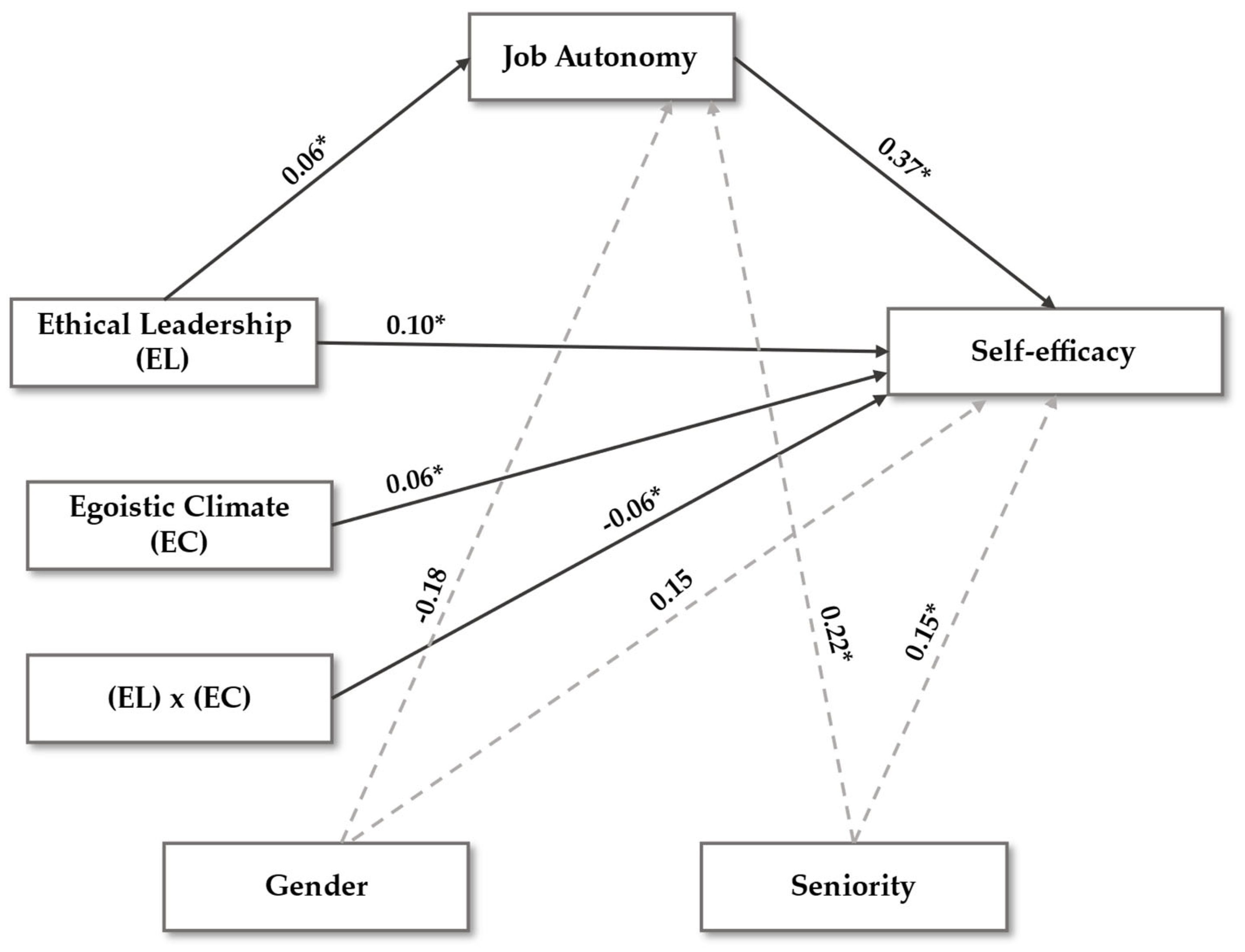
Figure 2.
Moderation of the egoistic ethical climate (low, medium, and high perception) on the relationship between ethical leadership and self-efficacy.
Figure 2.
Moderation of the egoistic ethical climate (low, medium, and high perception) on the relationship between ethical leadership and self-efficacy.
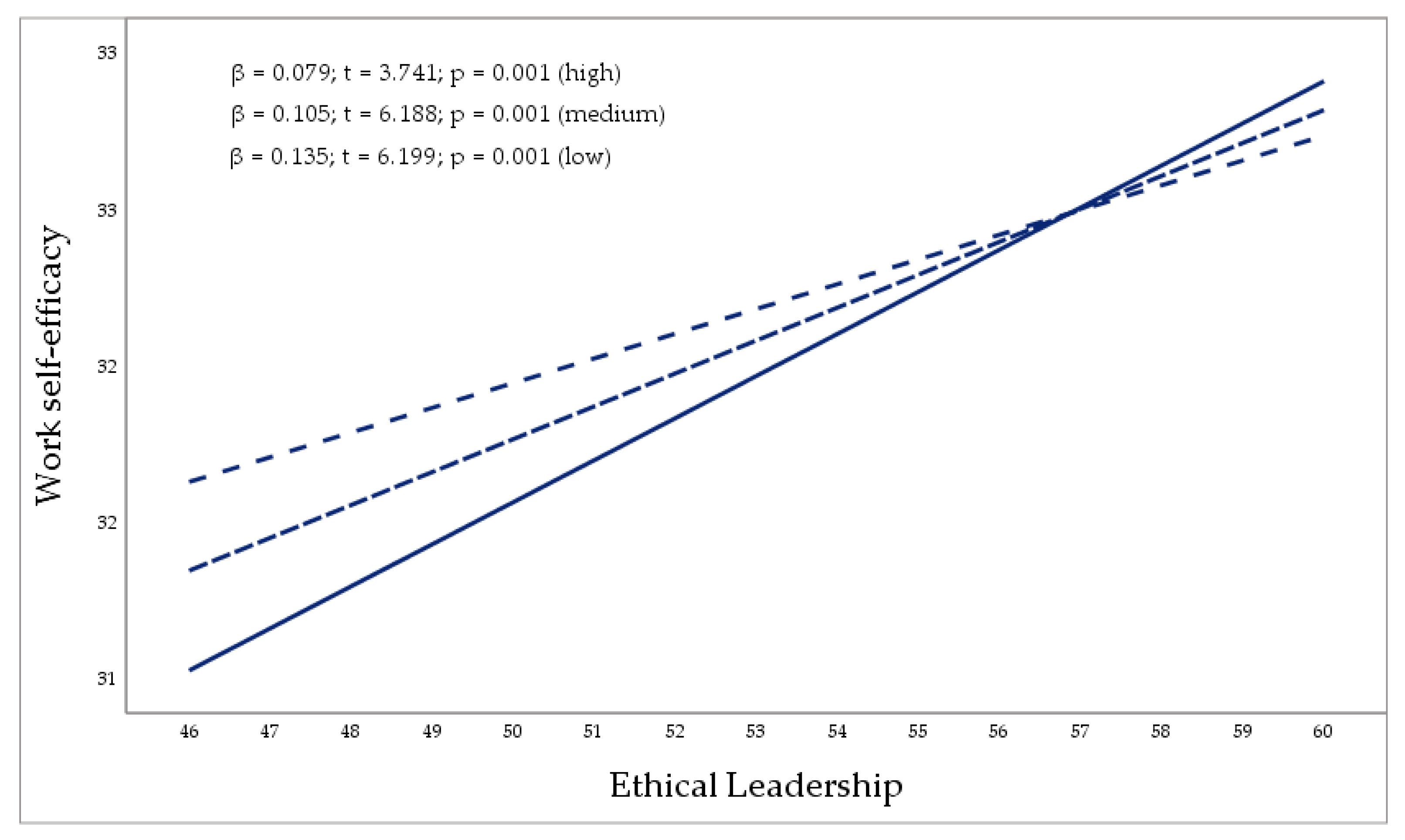
Figure 3.
Conditional effect of ethical leadership on job self-efficacy, depending on the different values of the moderating variable (egoistic ethical climate).
Figure 3.
Conditional effect of ethical leadership on job self-efficacy, depending on the different values of the moderating variable (egoistic ethical climate).
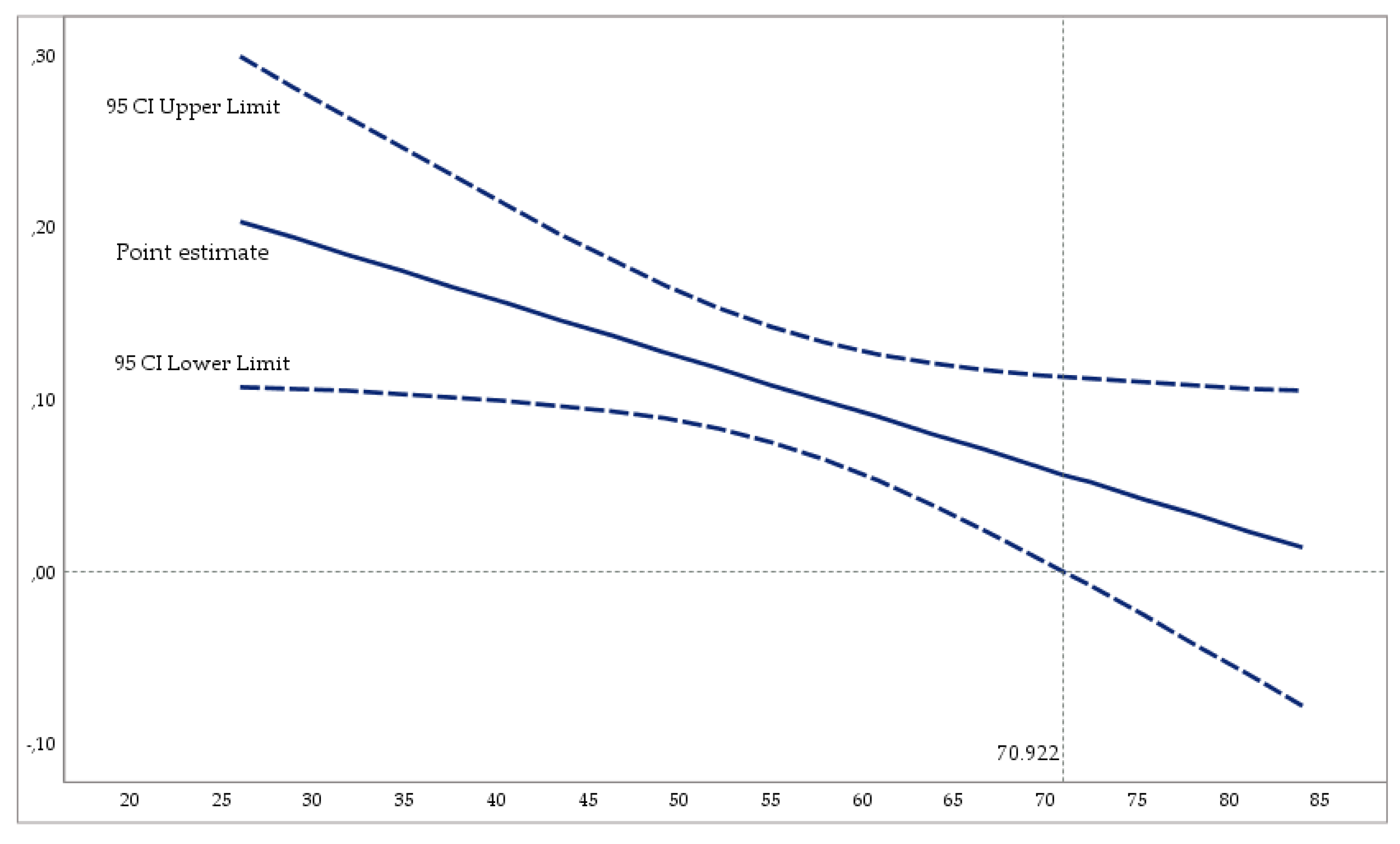

Table 1.
Correlation Between Variables, Mean, Standard Deviation (n=448) CI (95%).
| Constructs | N | M | SD | 1 | 2 | EL | EC | SE | JA |
|---|---|---|---|---|---|---|---|---|---|
| Gender | 1 | 0.39 | 0.488 | ||||||
| Seniority | 1 | 3.58 | 1.839 | -0.038 | |||||
| Ethical Leadership (EL) | 10 | 49.62 | 10.130 | -0.049 | -0.113* | (0.830) | |||
| Egoistic Ethical Climate (EC) | 14 | 55.60 | 8.912 | -0.082 | -0.193** | 0.084* | (0.590) | ||
| Self-efficacy (SE) | 6 | 29.81 | 3.923 | 0.001 | 0.195** | 0.314** | 0.104* | (0.810) | |
| Job Autonomy (JA) | 3 | 14.91 | 2.560 | -0.039 | 0.100* | 0.180** | 0.074 | 0.368** | (0.890) |
General note: All correlations are significant */** (p < .05). Self-prepared.
Table 2.
Convergent and Discriminant Validity.
| ALPHA1 | CR2 | CFC3 | AVE4 | DV5 | |
|---|---|---|---|---|---|
| Egoistic Ethical Climate | 0.77 | > 1.96 | 0.730 | 0.350 | 0.590 |
| Ethical Leadership | 0.92 | > 1.96 | 0.830 | 0.690 | 0.830 |
| Job Self-efficacy | 0.89 | > 1.96 | 0.860 | 0.650 | 0.810 |
| Job Autonomy | 0.87 | > 1.96 | 0.850 | 0.790 | 0.890 |
General note: 1. Cronbach's Alpha. 2. Critical coefficients. 3. Composite reliability. 4. Average variance extracted. 5. Discriminant Validity. Self-prepared.
Table 3.
Mediation and moderation ethical leadership vs. self-efficacy.
| Effect | Route | β | p | t | ES | LLCI | ULCI | |
| Effect EL1 vs JA2 | a1 | 0.059 | 0.001 | 3.636 | 0.014 | 0.023 | 0.078 | |
| Gender Covariate vs JA | --- | -0.181 | 0.522 | -0.641 | 0.229 | -0.596 | 0.303 | |
| Seniority Covariate vs JA | --- | 0.220 | 0.017 | 2.402 | 0.062 | 0.027 | 0.273 | |
| Effect EL vs SE3 | c1’ | 0.104 | 0.001 | 3.302 | 0.087 | 0.117 | 0.459 | |
| Effect JA vs SE | b1 | 0.369 | 0.001 | 5.900 | 0.058 | 0.228 | 0.456 | |
| Effect EEC4 vs SE | c2’ | 0.056 | 0.023 | 2.276 | 0.082 | 0.025 | 0.346 | |
| Effect EL x EEC vs SE | c3’ | -0.061 | 0.034 | -2.129 | 0.034 | -0.013 | -0.001 | |
| Gender Covariate vs SE | --- | 0.152 | 0.558 | 0.586 | 0.277 | -0.382 | 0.706 | |
| Seniority Covariate vs SE | --- | 0.153 | 0.032 | 2.145 | 0.076 | 0.014 | 0.312 | |
| Conditional Effect EEC (XY) | Low (47) | --- | 0.135 | 0.001 | 6.199 | 0.022 | 0.092 | 0.177 |
| Medium (56) | --- | 0.105 | 0.001 | 6.188 | 0.017 | 0.072 | 0.139 | |
| High (64) | --- | 0.079 | 0.001 | 3.741 | 0.021 | 0.038 | 0.121 | |
General note. 1. Ethical leadership. 2. Job autonomy. 3. Self-efficacy. 4. Egoistic ethical climate. f2=.02 (small), f2=.15 (medium), f2=.35 (large). (95%) CI (R2 = .319) (f2 = .531; High). Self-prepared.
Disclaimer/Publisher’s Note: The statements, opinions and data contained in all publications are solely those of the individual author(s) and contributor(s) and not of MDPI and/or the editor(s). MDPI and/or the editor(s) disclaim responsibility for any injury to people or property resulting from any ideas, methods, instructions or products referred to in the content. |
© 2024 by the authors. Licensee MDPI, Basel, Switzerland. This article is an open access article distributed under the terms and conditions of the Creative Commons Attribution (CC BY) license (http://creativecommons.org/licenses/by/4.0/).
Copyright: This open access article is published under a Creative Commons CC BY 4.0 license, which permit the free download, distribution, and reuse, provided that the author and preprint are cited in any reuse.


