

Submitted:
09 August 2024
Posted:
12 August 2024
You are already at the latest version
Abstract
The risk factors and positive factors of teleworking have been widely analyzed. Emotional exhaustion has been one of the most studied among them. However, the impact of ethical leadership in virtual environments has remained completely unnoticed. There is no clear answer to whether the ethical leader is a factor that buffers or accelerates stress-related processes in teleworking. Furthermore, the role of perceived work autonomy as a theoretical mechanism that protects against specific adverse psychological outcomes requires more scientific evidence because the results obtained so far are confusing and contradictory. Therefore, this study explores how and when ethical leadership influences emotional exhaustion through work autonomy and teleworking intensity (TI).
The sample consisted of 448 professionals from six organizations in the Colombian electricity sector. The mediation effect was evaluated through a four-step procedure, and the moderated mediation model was analyzed using statistical tools such as PROCESS and AMOS macros for SPSS.
Surprisingly, our results revealed a positive relationship between ethical leadership and emotional exhaustion, with work autonomy potentially mediating this relationship. However, teleworking intensity (TI) was found to moderate this mediation process. Specifically, the negative impact of ethical leadership on emotional exhaustion was nullified when TI was high. Moreover, a high level of TI strengthened the relationship between ethical leadership and work autonomy, while weakening the positive relationship between work autonomy and emotional exhaustion.
In conclusion, our study suggests a potential positive relationship between ethical leadership and emotional exhaustion from the follower's perspective. However, the number of teleworking days can influence this trend, potentially even reversing it. In other words, teleworking intensity (TI) is a resource as its intensity increases, and it can alter the direction of work autonomy and reconfigure the relationship between ethical leadership and emotional exhaustion. This study, to the best of our knowledge, is the first to analyze these variables, significantly contributing to our understanding of the attributes of ethical leadership and its impact on employee well-being.
Keywords:
ethical leadership
; work autonomy
; teleworking intensity
; teleworking
; emotional exhaustion
; burnout
1. Introduction
The relationship between ethical leadership and individual well-being has gained a central role in organizational psychology [1,2,3,4,5]. Recent research indicates a positive relationship between ethical leadership and followers' well-being. For example, [4] suggest that a high level of ethical leadership provides subordinates with valuable resources that protect them from emotional exhaustion. On the other hand, [2] conclude that emotional work strategies, specifically genuine or suppressed visualization, cause ethical leadership to have a negative relationship with emotional exhaustion [6].
However, the role of ethical leadership in virtual work environments has remained unnoticed. The ability of employees to adapt to this new work modality requires a more versatile digital leadership. Therefore, traditional leaders may pose a risk because of the need to acquire new skills [7]. In this sense, [8] or [9] consider teleworking a threat to employees' emotional health as it is usually related to excessive work climates with significant imbalances between work and family.
Thus, the ethical leader's ability to react to the challenge posed by teleworking is a critical matter without a clear answer. Moreover, it is unknown if an ethical management style positively or negatively influences employees' emotional health in virtual work contexts. This research aims to contribute to the current knowledge of ethical leadership from various perspectives. First, by following the invite of [10] or, more recently, the call of [11]. These authors consider that ethical leadership needs more attention, especially in virtual environments. In this sense, we suggest that ethical leaders buffer followers' emotional exhaustion. The argument is that ethical leadership is a valuable resource that reduces emotional exhaustion through specific mechanisms such as trust or genuine interest in the follower. Furthermore, it is proposed that work autonomy is a factor that explains this relationship when it adopts a mediating role. In a remote environment such as a virtual one where self-management is vital, work autonomy likely serves as a protective factor against emotional exhaustion among employees [12]. In this sense, ethical leadership can be a complementary context resource that affirms the mitigating role of work autonomy.
In a remote environment, such as a virtual one where self-management is a primary responsibility, work autonomy likely serves as a protective factor against emotional exhaustion among employees
Second, the number of teleworking days and the advantages on employees' emotional health have yielded inconclusive results. On one side, [8] found that teleworking relates to extended work hours that deteriorate employees' emotional resources. Consequently, teleworking intensity and emotional exhaustion have a direct and positive relationship. This may occur, for example, due to a low perception of perceived social support or an excess of job demands [13]. Conversely, authors [14] identify that high-intensity teleworking is positively associated with job satisfaction [15] or performance, and negatively associated with role stress or turnover intentions through a high perception of work autonomy. In this direction, [16] go further and relate teleworking to tasks through perceived autonomy and leader-member exchange. Finally, [17] establish a negative relationship between teleworking and emotional exhaustion. The authors consider that organizational trust, flexibility, and effective management of work and life interferences reduce work overload, effectively reducing emotional exhaustion.
Based on all these reasons, we suggest that a greater number of teleworking days facilitates the theoretical attenuating effect of ethical leadership on emotional exhaustion through a mature interaction between leader and follower. In other words, teleworking intensity acquires a moderating function that explains when ethical leadership and burnout relate. Furthermore, teleworking and its intensity are expected to have a specific effect that clarifies the direct or indirect relationships between ethical leadership, work autonomy, and emotional exhaustion.
To our knowledge, no other study has examined the relationship between ethical leadership and emotional exhaustion, considering work autonomy and teleworking intensity. Thus, the present research aims to clarify this relationship. A moderated mediation model is included to understand better the underlying mechanisms contributing to this possible relation.
2. Relationship between Ethical Leadership and Emotional Exhaustion
Ethical leadership is characterized by fair behavior supported by individual actions and personal interactions. Its main objective is to promote ethical conduct, which transfer to followers through two-way communication. This moral context becomes a useful resource for facing any decision [18].
Ethical leadership is characterized by prioritizing essential aspects such as equality of conditions, respect, trust, or sincere interest in the personal situations of the follower [19,20]. Additionally, it constantly informs the organization's scope of standards and ethical expectations regarding employee conduct [1,4,5]. An explicit understanding of the behavior considered “correct” by the organization tends to reduce uncertainty. Therefore, a climate that inspires safety reduces the possible feelings of anxiety that followers may experience [2]. A stimulating and supportive work environment buffers stress and limits emotional exhaustion [21,22].
In this sense, a remote work environment requires horizontal leadership that recognizes the role of followers as a critical part of creating organizational value [23]. From this perspective, ethical leaders can play an essential role in employees' adaptation to virtual work environments and prevent interpersonal distances from becoming an obstacle. The ethical leader approaches the follower not only through proposals that include rewards or punishments, but also by considering the effort to seek ethical solutions when facing difficult-to-solve problems [24]. Therefore, ethical leaders expand followers' satisfaction and confidence in organizational justice by involving them in decision-making. This scenario prevents physical distance, related to virtual work, from being a barrier because the ethical leader acquires sufficient prominence to be aware of the socio-emotional needs of the subordinate [7].
The Conservation of Resources (COR) theory seeks to understand how individuals distribute and maintain their resources under stress, pressure, and excessive effort. Loss of resources due to constant tension sometimes leads to emotional exhaustion [25]. Consequently, we consider that ethical leadership, through its communication skills and orientation to change, is a valuable resource and a mitigating factor that prevents the deterioration of employee resources in virtual environments. We rely on the COR theory to propose that ethical leadership relates to less emotional exhaustion in the follower. Emotional exhaustion refers to the perception of being surpassed and overwhelmed by work and its characteristics. It is associated with repetitive signals, such as fatigue or functional alterations that can lead to depression [26].
Therefore, an ethical leader with a motivating message and a compelling mix of traditional and electronic resources can limit the emotional exhaustion of the follower. [27] define the most critical competencies for virtual leadership to be efficient. Specifically, ease to communicate and to support employees, and ability to manage work teams and to build a change-oriented environment. Lastly, appropriate use of technology and being perceived as credible, honest, coherent, and integral.
We suggest that ethical leaders with an inclusive style foster rewarding working conditions, with constant reactions to the needs of followers, which build a supportive climate [2]. Previous research has shown that social support is negatively related to emotional exhaustion [22]. Similarly, [4] discovered that conscientiousness is an individual personality trait that indirectly contributes to ethical leadership being able to reduce emotional exhaustion through team cohesion. The ability to manage work groups is key in virtual work environments. Finally, ethical leaders transfer credibility and trust. Socio-emotional environments, where feelings of trust predominate, reduce stress in individuals and relate negatively to emotional exhaustion [28]. Based on all these reasons, the following hypothesis is proposed: H1. Ethical leadership is negatively related to emotional exhaustion.
3. The Mediating Role of Work Autonomy
Studies have shown that ethical leadership positively affects employees' work autonomy [29,30,31]. However, a relevant question is whether or not this relationship is kept in a virtual work environment.
Work autonomy indicates the freedom to choose and use work resources independently [32]. When autonomy is high, followers can fully utilize their behavioral criteria. This optimistic scenario opens the possibility of role modeling, where followers are more open to the leader's influence and ethical guidance [30]. Previous research indicates that ethical leaders establish a relationship of trust with followers [33]. Trust usually translates into various proactive behaviors associated with autonomy, which systematically improve work processes [34].
On the other hand, work autonomy is an essential mechanism in virtual work environments. The perception of autonomy is particularly valued in organizations where processes and tasks are standardized to a large extent [35]. Therefore, based on the COR theory, virtual work can be considered a resource that simultaneously leads to additional resources such as autonomy [36]. Furthermore, one of the main characteristics of a virtual leader is orientation to change. Thus, the degree of autonomy influences the follower's predisposition to direct behaviors toward any organizational transformation [37]. However, the ethical leader's integrity remains necessary for followers because it increases their confidence in managing change under a strong perception of support [38].
Likewise, the COR theory proposes that specific resources, such as control over work and, more specifically, work autonomy, relate to emotional exhaustion [25,39]. Emotional exhaustion surges from a drastic resource decrease that drains the employee's physical or emotional energy. Work conditions, especially autonomy, can replenish lost resources and prevent severe emotional deterioration [40]. Autonomy is valued in occupational psychology as an indispensable resource at work. Therefore, autonomy can buffer emotional exhaustion as a construct associated with control over work [41].
Furthermore, a significant body of research has shown that work autonomy positively impacts self-esteem. It is likely that control over work leads followers toward achievement and promotes more involvement in all processes. Consequently, a climate involving employees in decision-making will rarely contribute to employees being depleted of resources and emotionally exhausted [42]. On the contrary, lack of autonomy is associated with low emotional freedom and inhibition of will, which forces excessive use of resources that emotionally exhaust workers [43,44]. Finally, the results of [45] and [46] suggest that virtual work characteristics, including autonomy, predict employee well-being and, consequently, the extent of emotional exhaustion. Work autonomy can explain how ethical leadership and emotional exhaustion are related. Therefore, the following hypothesis is suggested: H2. Work autonomy mediates the relationship between ethical leadership and emotional exhaustion.
4. The Moderating Role of Teleworking Intensity
Although ethical leadership can be negatively related to emotional exhaustion through job autonomy, it is probable for people who are led by an ethical leader to not experience an adequate level of autonomy in some cases and, consequently, to not avoid emotional exhaustion. For this reason, it is critical to identify the factors that explain when, or in what situations, the mediation between ethical leadership, work autonomy, and emotional exhaustion is interrupted or changes orientation.
Teleworking Intensity (TI) indicates the number of days per week an employee works online [13]. The optimal number of teleworking days and its effect on employees' emotional health have yielded confusing and contradictory results. For example, [47] establish a relationship between TI and organizational belonging. They conclude that professional realization or job satisfaction emerges as a way for high-intensity teleworkers to experience their sense of belonging. On the other hand, [13] fail to relate TI with emotional exhaustion. Previous research, in contrast, precisely [48] and [45], suggests that TI is linked to less emotional exhaustion and higher commitment levels.
Furthermore, recent studies suggest that TI conditions well-being and promotes a climate of excessive work that usually ends in emotional exhaustion due to the employees' inability to disconnect from daily tasks [8,49]. Finally, [50] consider that TI increases efficiency and decreases the risk of emotional exhaustion. These results partially agree with the analysis of [51] since the authors conclude that TI and emotional exhaustion are curvilinearly related. Therefore, TI adopts different roles that are often contradictory to each other. For example, depending on the various results, it may be a risk factor, a resource, or have no influence on employees' emotional health. However, to our knowledge, no previous study has examined if TI can improve the impact of ethical leadership on work autonomy and emotional exhaustion.
Based on the resource investment criteria proposed by the COR theory, people allocate energy with the intention that this effort has a positive result. This means that adaptation and coping strategies serve to acquire new capabilities that prevent individuals from going into possible resource deficits [25]. Thus, TI can improve the effects of ethical leadership, work autonomy, and emotional exhaustion. Adapting to a virtual work environment and improving employees' skills likely require an extensive adjustment period [52]. Autonomy can be the resource that extends individual cognitive capacity and improves specific special knowledge necessary to function adequately in a remote, digital context. In other words, TI and work autonomy can expand the employees' capabilities [53].
Furthermore, TI establishes continuity in the roles assumed by leader and follower. In fact, many studies highlight the importance of perceived support from the supervisor for effective implementation of teleworking [54,55]. Therefore, TI can become an appropriate mechanism for ethical leaders to transfer new resources to followers, specifically safety, trust, and adequate follow-up [1]. This scenario is an opportunity for employees to maintain and even increase their resources, which can contribute positively to their interpretation of teleworking and its possible benefits. In that sense, a work context with guarantees and autonomy encourages followers to have an active orientation toward the task and to feel capable of expanding their role [29,31]. Extra-role behaviors are associated with greater job satisfaction [56,57].
On the other hand, resources come in different forms, and followers can identify them through two-way communication with the ethical leader or by having a strong perception of social support. These additional resources can become buffers against stress and emotional exhaustion [3]. Various research supports the importance of communication in virtual work environments. TI can prolong evaluation systems and the exchange between leader and subordinate. This situation could be exceptionally comforting for remote employees who feel that a virtual work environment does not reduce contact with the supervisor nor makes their relationship superficial [58].
Besides, considering the COR theory, TI could mitigate the stressors associated with the pressure and responsibility of dealing with on-site and virtual work activities, as it prevents the loss of resources in constant readjustments [59]. Therefore, the present study suggests that TI is a valuable resource that enhances the relationship between ethical leadership, job autonomy, and emotional exhaustion. The following hypothesis is proposed based on the prior reasoning: H3. Teleworking intensity moderates the relationship between ethical leadership and emotional exhaustion, ethical leadership and work autonomy, and work autonomy and emotional exhaustion. Specifically, the relationships between ethical leadership, work autonomy, and emotional exhaustion optimize when teleworking intensity is high.
5. Presentation of the Study
This research had various objectives. First, it examined the relationship between ethical leadership and employees' emotional exhaustion in the Colombian electricity sector. Second, it analyzed whether work autonomy acted as a mediating construct in this relationship. Third, it verified if teleworking intensity could moderate the effect of ethical leadership on work autonomy and emotional exhaustion, along with the independent effect of work autonomy on emotional exhaustion. Figure 1 represents the moderated mediation model.
6. Methods
6.1. Participants
The study surveyed 448 professionals from six organizations in the Colombian electricity sector. Based on the suggestions proposed by [60] or [61], a probability cluster sampling method was used with a 95% confidence level. This technique is beneficial because specific areas (clusters) can be studied. The cities examined were those that group most of the companies in the sector analyzed. The questionnaire's effective response rate was 100% because the participating organizations provided specific spaces within working hours to accommodate employees and prevent invalid responses. 61% of the total sample was formed by men (273). The average age was 37.18 (SD=10.06), ranging from 20 to 69. Average seniority on the job was 13.06 years (SD=8.82), ranging from 0.5 to 38. In terms of education, 100% of those surveyed had university studies. 57.42% had related specialization, master's, or doctorate degrees. Regarding contract type, 81.25% had permanent work contracts, and the remaining had fixed-term contracts. Finally, 42.40% of the participants did not have children. Distribution of online workdays: 25 (5.60%) – 1 day; 95 (21.20%) – 2 days; 98 (21.90%) – 3 days; 103 (23%) – 4 days; 127 (28.30%) – 5 days.
6.2. Measures
The item scores of all the scales analyzed are highly reliable. Cronbach's alpha is greater than 0.70 [62].
Control Variable: Based on previous research, for example, [48] gender is used as a control variable. Previous studies suggest that the female gender may be more prone to emotional exhaustion, especially in a virtual environment where the female role is likely to be associated with extra-role behaviors. Men were coded 0, and women were coded 1.
Ethical Leadership: The 10-question scale suggested by [18]was used to measure ethical leadership. Recent studies have confirmed its reliability and validity [63]. One of the items used reads: “My leader listens to what employees have to say.” Each item was measured from 1 (strongly disagree) to 6 (strongly agree).
Work Autonomy: The 3-question scale suggested by [64] was used to measure work autonomy. Recent studies have confirmed its reliability and validity [65]. One of the items used reads: “I have significant autonomy to determine how I do my work.” Each item was measured from 1 (strongly disagree) to 6 (strongly agree).
Emotional Exhaustion: The 5-question scale suggested by [66] was used to measure emotional exhaustion. Recent studies have confirmed its reliability and validity [67]. One of the items used reads: “I am emotionally exhausted at my job.” Each item was measured from 1 (strongly disagree) to 6 (strongly agree).
Teleworking Intensity: A single item was used to measure teleworking intensity based on the previous recommendations [13,68]. More specifically, through the following question: How many days a week do you work from home? Response options were established using a scale from 1 to 5, with 1 (one day a week) and 5 (five days a week).
6.3. Procedure
The link with the Colombian electricity sector was established through a collective action of ethics and transparency promoted by XM company in 2021. Specifically, through a presentation and different suggestions, the objectives of this research were established. Validation of the questionnaire and the scales used was conducted by a group of specialists proposed by the organizations studied. An ethics committee approved the research project in July 2021. Documents were emailed to the participating organizations to guarantee confidentiality, authorization, data protection, and possible voluntary abandonment from each participant. The surveys were completed on different [69], and each organization allocated sixty-minute spaces to guarantee a significant number of responses.
6.4. Data Analysis
First, potential atypical data that may affect the analysis of the results is identified through probability identifier (< 0.01) with SPSS v.25 statistical program. The values of asymmetry and kurtosis are defined to determine variable normality. The variables are below 2, which indicates normality according to [70]. Second, homoscedasticity is deduced through the homogeneity of variances test since (p > 0.05). Third, multiple regression analyses are done using the macro PROCESS v. 3.5. Structural Equation Model 59 proposed by [71] – (moderated mediation) is used with a CI of 95% and bootstrapping sampling of 10,000 through the macro AMOS v . 26. Fourth, it is confirmed that the VIF indices are less than 5 to check for collinearity issues.
7. Results
7.1. Descriptive Statistics and Discriminant Validity
The means, standard deviations, and correlations of the research variables are presented in Table 1. Ethical leadership showed significant positive correlations with emotional exhaustion (r = 0.26, p < 0.01), work autonomy (r = 0.18, p < 0.01), and TI (r = 0.14, p < 0.01). Hypothesis 1 was rejected as ethical leadership was positively correlated with emotional exhaustion. Work autonomy showed significant positive correlations with emotional exhaustion (r = 0.20, p < 0.01) but showed negative correlations with TI (r = - 0.11 p < 0.05). Emotional exhaustion showed significant negative correlations with TI (r = - 0.12, p < 0.01). The gender control variable was not significantly related to any studied variables. (N) Number of items. (M) Mean. (SD) Standard Deviation.
The following steps were used to calculate discriminant validity. First, Average Variance Extracted (AVE) values were calculated, representing the total amount of indicator variance captured by the latent variable. All variables had AVE values greater than 0.5 [72]. Second, the square root of AVE was calculated, which, according to [73], must be above the value of the different correlations. Based on the results, it was concluded that there is strong discriminant validity between the constructs studied.
7.2. Mediating Effect Analysis
Hypothesis 2 anticipates that work autonomy mediates the relationship between ethical leadership and emotional exhaustion. To examine this hypothesis, we followed the four-step procedure to establish the mediation effect [74], which requires (a) a significant association between ethical leadership and emotional exhaustion; (b) a significant association between work autonomy and ethical leadership; (c) a significant association between work autonomy and emotional exhaustion after controlling ethical leadership (d) a significant coefficient for the indirect route between ethical leadership and emotional exhaustion through work autonomy. The bias-corrected percentile bootstrap method determines if the last condition is met.
The regression analysis revealed that, in the first step, ethical leadership positively predicted emotional exhaustion, β = 0.35, p < 0.01 [0.12; 0.44] (see Model 1, Table 2). In the second step, ethical leadership positively predicted work autonomy, β = 0.17, p < 0.01 [0.03; 0.18] (Model 2, Table 2). In the third step, after controlling ethical leadership, work autonomy positively predicted emotional exhaustion, β = 0.59, p < 0.01 [0.14; 0.54] (Model 3, Table 2). Finally, the bias-corrected percentile bootstrap method showed that the indirect effect of ethical leadership on emotional exhaustion through work autonomy was significant (ab=0.17*0.59=0.10, SE=0.03, CI of 95% = [0.11; 0.24]). The mediation effect accounted for 32.67% of the total effect. The four criteria above were met to establish a mediation effect supporting Hypothesis 2.
7.3. Moderated Mediation Analysis
Hypothesis 3 in this study assumes that TI moderates the relationship between ethical leadership and emotional exhaustion, ethical leadership and work autonomy, and work autonomy and emotional exhaustion. Estimated were the moderating effects of TI on the relationship between ethical leadership and emotional exhaustion (Model 1); on the relationship between ethical leadership and work autonomy (Model 2); and on the relationship between work autonomy and emotional exhaustion (Model 3). The specifications of the three models are summarized in Table 3 and Figure 2.
Results revealed the following: First, the relationship between ethical leadership and work autonomy was moderated by TI (b=0.02, SE=0.01, CI of 95% = [0.20, 0.34]) (Table 3, Figure 2). Additionally, Figure 3 explains the details of the moderation. The larger the number of teleworking days, the more effective the impact of ethical leadership on work autonomy. The high, medium, and low effects of TI are significant.
Second, the relationship between work autonomy and emotional exhaustion was moderated by TI (b =—0.05, SE = 0.07, CI of 95% = [—0.19,—0.64]) (Table 3, Figure 2). Additionally, Figure 4 explains the details of the moderation. The larger the number of teleworking days, the lower the positive effect of work autonomy on emotional exhaustion. The high, medium, and low effects of TI are significant.
Third, the relationship between ethical leadership and emotional exhaustion was moderated by TI ( b = - 0.02, SE = 0.02, IC of 95% = [- 0.07, - 0.29]) (Table 3, Figure 2). The number of teleworking days reduces the positive impact of ethical leadership on emotional exhaustion until neutralizing it. TI = 5 days (b = 0.11, SE = 0.06, 95% IC = [- 0.02, 0.23]) (Figure 5). Therefore, Hypothesis 3 was supported.
8. Discussion
This research analyzed the relationship between ethical leadership and emotional exhaustion and its implicit mechanisms in Colombia. Surprisingly, the results revealed that ethical leadership was positively related to employees’ emotional exhaustion in the Colombian electricity sector. Work autonomy plays a mediator role in ethical leadership and emotional exhaustion. However, contrary to expectations, it actively influenced employee exhaustion. Finally, teleworking intensity (TI) moderated the mediating effect of work autonomy. These results will be examined in depth next.
Results indicated that ethical leadership is a factor that positively influences the stress and emotional exhaustion perceived by employees of the Colombian electricity sector. Contrary to expectations, this result does not agree with the conclusions of studies in other countries. In fact, we have only found two partially coinciding investigations, specifically, [75,76]. These authors consider that ethical leadership negatively impacts employees' well-being through the anxiety caused by excessively demanding organizational citizen behavior, or through a pessimistic vision of job satisfaction and what is considered a full life.
Based on the social learning theory [77,78,79], followers will tend to want to imitate ethical leaders. In this sense, employees likely use a large part of their resources to internalize the values transmitted by the leader and try to have similar behaviors [80]. Probably, the responsibility associated with a change in moral identity implies a significant emotional burden for followers, not because of the authority exercised by the leader but because of self-imposed pressure [76]. This personal interest in achieving such high role expectations is related to greater effort and difficult-to-achieve standards, requiring a great investment of emotional energy. To fulfill this aspiration, it is foreseeable that the ethical leader and the follower will bond through strong ethical pressure that will result in anxiety and emotional exhaustion [75].
References, especially ethical leaders, are important in Colombia [81]. Additionally, public sectors in the country are exposed to strong social pressure that often translates into stressful work climates. Countless cases of corruption have tarnished the image of public servants and given rise to different reactions. Included among the reactions is an awareness of ethics for employees to perform under standards of transparency and good practices. Many employees, used to a culture that allowed breaking the rules, may see this paradigm shift as an additional motivation to move closer to the standards proposed by the ethical leader [82]. However, organizational change can negatively influence the well-being of subordinates. Drawing on the person-environment fit theory, there is a high probability that a new work context, when accompanied by inconsistent organizational support, affects emotional exhaustion [83].
Therefore, a virtual work environment becomes an additional risk factor because perceived social support (PSS) is not seen as a valuable work resource, as the sense of belonging and bonds of trust are reduced. Loss of protective factors like leader support often leads to emotional exhaustion [84].
On the other hand, the mediating effect of work autonomy helped ethical leadership and emotional exhaustion to be positively related. Our research discovered that ethical leaders promote work autonomy, but in a virtual work environment, this theoretical resource impacts the employee's emotional health by reducing it.
The spatial and temporal flexibility offered by remote work is a factor that improves autonomy. However, the “autonomy paradox” proposed by [85] indicates that an overly energetic predisposition toward work ironically reduces personal autonomy. Certain norms or constant adjustments to job positions make professionals feel obliged to be open-endedly available. This context limits digital disconnection and can negatively affect the employee's emotional health [86].
Recent research concludes that the persistence and proactive behavior associated with high autonomy can challenge employee well-being [87]. The increased work autonomy can lead employees to work more intensely. This additional responsibility requires greater self-regulation efforts that affect their emotional well-being until they are exhausted [88].
Furthermore, this research discovered that TI played a moderating role in the mediating process. TI specifically increased the effect of ethical leadership on work autonomy and drastically reduced the positive relationship between ethical leadership and emotional exhaustion until neutralizing it. Likewise, TI buffered the impact of work autonomy on emotional exhaustion. These results supported the assertion that TI can become an organizational resource instead of a risk factor.
First, the higher the impact of teleworking days, the higher the impact of ethical leadership on work autonomy. Stable work environments and conditions increase the sense of belonging and relationships of trust among group members [30]. In this sense, it has been shown that trust between leader and follower positively affects commitment and motivation [89]. In fact, a deep relationship between ethical leader and follower tends to intensify feelings of adequacy regarding the work activity. This is because the ethical leader does not feel threatened by giving the follower the legitimacy to make decisions through a strong perception of autonomy [90]. Therefore, work autonomy becomes a tool for the follower to reciprocate the equity and justice of the ethical leader, through high doses of proactivity and effort [29,31]. Furthermore, recent studies have shown that TI is intrinsically related to the feeling of increased autonomy to plan and decide [91].
Second, we found that TI inversely moderated the positive relationship between work autonomy and emotional exhaustion. The higher the number of teleworking days, the lower the positive effect of work autonomy on emotional exhaustion.
[92] state that work autonomy is a demand by itself because it requires greater structuring and planning. However, the ability to self-manage is a resource that can help combat autonomy demands. Self-management is related to more skills, feedback, and development opportunities [93]. Self-management means that employees exercise control over their behavior and are fully committed to their decisions. Additionally, it helps to structure the work environment and increases self-motivation. In this direction, TI represents an opportunity for employees to exercise greater control over demands through new behavior patterns [91]. In other words, they can increase their psychological resources and avoid the emotional costs of high work demands.
TI means that employees can adopt a stable rhythm, as they are not obliged to make virtual and in-person spaces compatible. This helps prevent undesirable effects related to high autonomy, such as time pressure or low perception of support [14,16]. From this perspective, the stability offered by uninterrupted virtual work is related to positive moods [94]. The theory of Conservation of Resources [25,39] proposes that a positive mental state increases the individual's capacity to produce resources and well-being, which prevents emotional exhaustion.
Third, we discovered that TI moderated the positive relationship between ethical leadership and emotional exhaustion in the opposite direction. That is to say, the number of teleworking days decreased the negative impact of ethical leadership on the followers' emotional health to a stop.
Ethical leaders play a critical role in designing their followers' work environment, and leader-follower interaction norms affect the emotional well-being of subordinates.
According to the COR and resource depletion theories [25,39,95], people have limited capabilities to regulate their behaviors and exercise self-control. In this sense, a strictly normative vision of the ethical leader (moral administrator) likely requires more control and certain behavioral suppression from the follower [96]. Excessive concentration in one direction consumes self-regulatory resources that emotionally exhaust the individual [97]. However, when this perception changes through a high-quality relationship with the supervisor, the negative effect can be attenuated and even reversed. For years, the principles of [98] have been a conceptual framework that attempts to explain emotional exhaustion. An approach to leadership based on relationships, interactions, and exchanges with followers can be a key aspect to buffer emotional exhaustion. In fact, the most valuable part of this theory focuses on the quality and importance of the exchange [99].
In this sense, TI can amplify the leader-member exchange (LMX). Therefore, this interaction, expanded through the number of teleworking days, can be a lever or a limit condition that optimizes the positive aspects of teleworking and significantly reduces its negative dimensions [100,101].
LMX bonds are defined through two-way trust relationships, satisfying interactions, perceived support, and formal and informal rewards. This favorable context creates a work environment where followers feel more empowered and understood, reinforcing the basic psychological needs of competence and relatedness [102]. Furthermore, TI becomes an optimal scenario for leadership to compensate for the need for autonomy and reduce the follower's possible low perception of belonging [14,16].
In this sense, the self-determination theory [103,104,105,106] stands out for its motivational components. However, it has been widely used to analyze how work characteristics affect organizational outcomes and employees' psychological functioning. Several studies have concluded that adequately satisfying the requirements of autonomy, competence, and relatedness is negatively associated with emotional exhaustion [107].
9. Limitations and Future Research
This research presents significant findings for organizations in the Colombian electricity sector but is not free of limitations. First, this study focused on six public companies that have been subject to tremendous social pressure and have faced changes since 2015. Efforts to eliminate bribery and corruption can foster an excessively rule-oriented management style (moral manager) that overshadows the moral person characteristics of the ethical leader. This factor may explain the positive relationship between ethical leadership and emotional exhaustion. Thus, future research could explore other industrial sectors and non-public organizations.
Second, the problem of social desirability is probably one of the most critical challenges of research with questionnaires where professionals provide information about themselves. According to [69], aspects of the questionnaire can lead to biased responses by respondents to improve their image. A possible solution is to previously measure the respondents' need for social approval [76].
Third, some arguments of this research are based on the LMX theory, which is not a study variable. Future research may include LMX as a construct analyzed with the rest of the variables because it is an essential element in the discussion established between leadership and follower behavior. However, these limitations do not detract from the results obtained by the research. The possible disadvantages of the ethical leader need further exploration to better understand their impact on the followers' well-being. Furthermore, the e-ethical version of this management style has hardly been studied, and new research must focus on the effect of ethical leaders in virtual work environments. Colombian culture is characterized by poor institutional collectivism [81]. Thus, we suggest that future studies continue to insist on the role of ethical leadership within Colombian territory since that perception may change.
Fourth, the cross-sectional design of this research prevents us from accurately knowing the causal impact of ethical leadership. In fact, leadership has a dynamic character that varies with time. Therefore, we propose a longitudinal study with several waves to detect possible oscillations [108].
Fifth, future research may consider other variables that may explain the potential negative impacts of ethical leadership on followers' well-being, such as lack of job security or certain personality traits such as neuroticism [75]. Finally, it would be interesting to use emotional exhaustion as a moderating variable to observe the impact of ethical leaders on other employee behaviors, including organizational commitment or motivation.
10. Practical Implications
This is the first study to our knowledge that establishes a relationship between ethical leadership and emotional exhaustion in Colombia. Although this research is based on a specific sector, the Colombian electricity sector, we consider that important practical implications can be extracted. In this idea, the behaviors of the ethical leader are dynamic and do not necessarily have to be positive [75,76,96].
Considering the COR theory, the ethical leader can promote an increase in the follower's resource consumption until reaching emotional exhaustion. For example, [109] think that ethical leadership is curvilinearly related to Organizational Citizenship Behavior (OCB). Specifically, a high perception of ethical leadership tends to transform into a moral reproach that disconnects followers and neutralizes their intentions to contribute to the organization with extra-role behaviors. [96] establish a relationship between ethical leadership and abusive behavior. Surprisingly, a constant demonstration of moral behavior can lead to emotional exhaustion and unethical behavior through mechanisms such as licenses or moral credits. In this sense, [110] conclude that ethical leaders can feel emotionally overwhelmed when they see themselves surpassed by their beliefs. Monitoring of employees inversely moderates this effect. On the other hand, ethical leaders have barely been analyzed in their virtual version, E-ethical leadership [10].
Therefore, an important question to ask ourselves is to what extent the characteristics of the ethical leader can be beneficial for developing a virtual work environment where face-to-face interaction disappears.
[111] consider that the main challenges faced by virtual leaders are the appropriate choice of communication technologies, cultural diversity, electronic ethics, and trust. On their side, [112] suggest that electronic leadership can influence from different approaches, specifically by supporting employees in managing their emotions or impacting their behaviors.
Ethical leaders and their dynamics can significantly contribute to remote and virtual work under these conditions. First, the ethical leader is fair and balanced. From this angle, they can cushion negative aspects associated with teleworking, particularly climates of excessive work or time pressure that negatively influence work and life balance [113,114,115]. The ethical leader can establish strong digital disconnection policies by rewarding or punishing behaviors [116].
Second, the ethical leader actively listens to employees. This capacity is associated with respect and understanding as it includes emotional, cognitive, and behavioral skills. For this reason, it is a key competence in digital contexts. Developing this skill can help prevent the teleworker's social isolation, guarantee better and more constant feedback, procure acceptance of diversity or better cultural fluency, and even improve the person-job fit or guarantee better task planning.
Third, the ethical leader is trustworthy. In this sense, trust builds environments of psychological safety and empowerment. Improving the follower’s emotional security is an effective strategy to prevent burnout and prepare for future change initiatives [117]. Furthermore, it promotes cooperation and interpersonal communication, which are very important in remote work environments [118]. Ethical leaders, by being accessible, persevering, and inspiring, can establish the necessary conditions for psychological safety to grow.
Fourth, the ethical leader considers employees’ best interests and their values. This aspect can impact virtual environments from several perspectives. To begin, it guarantees inclusive gender equality policies and respect for religious diversity. Additionally, it influences the embeddedness and commitment of the follower. In this sense, support cultures are effective in the fight against emotional exhaustion for supporting an adequate management of emotions [119].
Finally, ethical leaders must manage emotional demands and their personal and administrative facets. Incorporating mentoring processes is a resource that can influence the leader's intrinsic motivation and simultaneously reduce anxiety or emotional exhaustion [120]. The leader's balance directly influences the followers' behavior. It prevents abusive behavior or subordinates from feeling that their moral dimension is undervalued [96,121].
Furthermore, effective leadership in remote, digital environments must promote autonomy by addressing the followers´ psychological needs. It must also provide team members with the necessary tools to deal with the autonomy paradox and prevent adverse effects such as workaholism [85]. In conclusion, ethical leaders are role models of positive and emotionally healthy work behaviors [122].
11. Conclusion
This study unpredictably found that ethical leadership positively influences followers' emotional exhaustion. Work autonomy explains why ethical leadership is positively related to employees' emotional exhaustion in the Colombian electricity sector. As expected, TI is a resource that improves all relationships within the mediation process. Specifically, TI progressively reduced the positive relationship between ethical leadership and emotional exhaustion until its impact stopped. Furthermore, the positive effect of the ethical leader on work autonomy increased as TI increased. Finally, work autonomy buffered its impact on emotional exhaustion as a function of the TI increase. These results could explain the TI inconsistency in previous research. Additionally, these findings suggest that ethical leadership can influence positively and negatively, and TI is a situational aspect that explains orientation changes. In summary, working virtually five days a week is a strategy that amplifies the leader-member relationship and becomes an advantage to effectively combat emotional exhaustion.
References
- Dust, S.B., Resick, C.J., Margolis, J.A., Mawritz, M.B., & Greenbaum, R.L. (2018). Ethical leadership and employee success: Examining the roles of psychological empowerment and emotional exhaustion. The Leadership Quarterly, 29(5), 570–583. [CrossRef]
- Lee, H., An, S., Lim, G.Y., & Sohn, Y.W. (2021). Ethical Leadership and Followers’ Emotional Exhaustion: Exploring the Roles of Three Types of Emotional Labor toward Leaders in South Korea. International Journal of Environmental Research and Public Health, 18(20), 10862. [CrossRef]
- Okpozo, A.Z., Gong, T., Ennis, M.C., & Adenuga, B. (2017). Investigating the impact of ethical leadership on aspects of burnout. Leadership & Organization Development Journal, 38(8), 1128–1143. [CrossRef]
- Zheng, D., Witt, L.A., Waite, E., David, E.M., van Driel, M., McDonald, D.P., Callison, K.R., & Crepeau, L.J. (2015). Effects of ethical leadership on emotional exhaustion in high moral intensity situations. The Leadership Quarterly, 26(5), 732–748. [CrossRef]
- Zhou, H., Sheng, X., He, Y., & Qian, X. (2020). Ethical Leadership as the Reliever of Frontline Service Employees’ Emotional Exhaustion: A Moderated Mediation Model. International Journal of Environmental Research and Public Health, 17(3), 976. [CrossRef]
- Santiago-Torner, C., Corral-Marfil, J.A., & Tarrats-Pons, E. (2024). Relationship between Personal Ethics and Burnout: The Unexpected Influence of Affective Commitment. Administrative Sciences, 14(6), 123. [CrossRef]
- Contreras, F., Baykal, E., & Abid, G. (2020). E-Leadership and Teleworking in Times of COVID-19 and Beyond: What We Know and Where Do We Go. Frontiers in Psychology, 11. [CrossRef]
- Lazauskaitė-Zabielskė, J., Urbanavičiūtė, I., & Žiedelis, A. (2023). Pressed to overwork to exhaustion? The role of psychological detachment and exhaustion in the context of teleworking. Economic and Industrial Democracy, 44(3), 875–892. [CrossRef]
- Raišienė, A.G., Rapuano, V., & Varkulevičiūtė, K. (2021). Sensitive Men and Hardy Women: How Do Millennials, Xennials and Gen X Manage to Work from Home? Journal of Open Innovation: Technology, Market, and Complexity, 7(2), 106. [CrossRef]
- Lee, M.R. (2009). E-ethical leadership for virtual project teams. International Journal of Project Management, 27(5), 456–463. [CrossRef]
- Santiago-Torner, C. (2023a). Ethical leadership and creativity in employees with University education: The moderating effect of high intensity telework. Intangible Capital, 19(3), 393. [CrossRef]
- Doblinger, M., & Class, J. (2023). Does it fit? The relationships between personality, decision autonomy fit, work engagement, and emotional exhaustion in self-managing organizations. International Journal of Selection and Assessment, 31(3), 420-442. [CrossRef]
- Vander Elst, T., Verhoogen, R., Sercu, M., Van den Broeck, A., Baillien, E., & Godderis, L. (2017). Not Extent of Telecommuting, But Job Characteristics as Proximal Predictors of Work-Related Well-Being. Journal of Occupational & Environmental Medicine, 59(10), e180–e186. [CrossRef]
- Gajendran, R.S., & Harrison, D.A. (2007). The good, the bad, and the unknown about telecommuting: Meta-analysis of psychological mediators and individual consequences. Journal of Applied Psychology, 92(6), 1524–1541. [CrossRef]
- Fonner, K.L., & Roloff, M.E. (2010). Why Teleworkers are More Satisfied with Their Jobs than are Office-Based Workers: When Less Contact is Beneficial. Journal of Applied Communication Research, 38(4), 336–361. [CrossRef]
- Gajendran, R.S., Harrison, D.A., & Delaney-Klinger, K. (2015). Are Telecommuters Remotely Good Citizens? Unpacking Telecommuting’s Effects on Performance Via I-Deals and Job Resources. Personnel Psychology, 68(2), 353–393. [CrossRef]
- Junça Silva, A., Almeida, A., & Rebelo, C. (2022). The effect of telework on emotional exhaustion and task performance via work overload: the moderating role of self-leadership. International Journal of Manpower. [CrossRef]
- Brown, M.E., Treviño, L.K., & Harrison, D.A. (2005). Ethical leadership: A social learning perspective for construct development and testing. Organizational Behavior and Human Decision Processes, 97(2), 117–134. [CrossRef]
- Aslam, H.D., Căpușneanu, S., Javed, T., Rakos, I.S., & Barbu, C.M. (2024). The Mediating Role of Attitudes towards Performing Well between Ethical Leadership, Technological Innovation, and Innovative Performance. Administrative Sciences, 14(4), 62. [CrossRef]
- Hamoudah, M.M., Othman, Z., Abdul Rahman, R., Mohd Noor, N.A., & Alamoudi, M. (2021). Ethical leadership, ethical climate and integrity violation: A comparative study in Saudi Arabia and Malaysia. Administrative Sciences, 11(2), 43. [CrossRef]
- Freitas, M., Moreira, A., & Ramos, F. (2023). Occupational stress and turnover intentions in employees of the Portuguese tax and customs authority: Mediating effect of burnout and moderating effect of motivation. Administrative Sciences, 13(12), 251. [CrossRef]
- Li, J., Han, X., Wang, W., Sun, G., & Cheng, Z. (2018). How social support influences university students’ academic achievement and emotional exhaustion: The mediating role of self-esteem. Learning and Individual Differences, 61, 120–126. [CrossRef]
- Cortellazzo, L., Bruni, E., & Zampieri, R. (2019). The Role of Leadership in a Digitalized World: A Review. Frontiers in Psychology, 10. [CrossRef]
- Kim, B.-J., Kim, M.-J., & Kim, T.-H. (2021). “The Power of Ethical Leadership”: The Influence of Corporate Social Responsibility on Creativity, the Mediating Function of Psychological Safety, and the Moderating Role of Ethical Leadership. International Journal of Environmental Research and Public Health, 18(6), 2968. [CrossRef]
- Hobfoll, S.E., Halbesleben, J., Neveu, J.-P., & Westman, M. (2018). Conservation of Resources in the Organizational Context: The Reality of Resources and Their Consequences. Annual Review of Organizational Psychology and Organizational Behavior, 5(1), 103–128. [CrossRef]
- Maslach, C. (2017). Finding solutions to the problem of burnout. Consulting Psychology Journal: Practice and Research, 69(2), 143–152. [CrossRef]
- Van Wart, M., Roman, A., Wang, X., & Liu, C. (2019). Operationalizing the definition of e-leadership: identifying the elements of e-leadership. International Review of Administrative Sciences, 85(1), 80–97. [CrossRef]
- Baer, M.D., Dhensa-Kahlon, R.K., Colquitt, J.A., Rodell, J.B., Outlaw, R., & Long, D.M. (2015). Uneasy Lies the Head that Bears the Trust: The Effects of Feeling Trusted on Emotional Exhaustion. Academy of Management Journal, 58(6), 1637–1657. [CrossRef]
- Dhar, R.L. (2016). Ethical leadership and its impact on service innovative behavior: The role of LMX and job autonomy. Tourism Management, 57, 139–148. [CrossRef]
- Kalshoven, K., Den Hartog, D.N., & de Hoogh, A.H.B. (2013). Ethical leadership and followers’ helping and initiative: The role of demonstrated responsibility and job autonomy. European Journal of Work and Organizational Psychology, 22(2), 165–181. [CrossRef]
- Liu, X., Baranchenko, Y., An, F., Lin, Z., & Ma, J. (2020). The impact of ethical leadership on employee creative deviance: the mediating role of job autonomy. Leadership & Organization Development Journal, 42(2), 219–232. [CrossRef]
- Zhang, N., & He, X. (2022). Role Stress, Job Autonomy, and Burnout: The Mediating Effect of Job Satisfaction among Social Workers in China. Journal of Social Service Research, 48(3), 365–375. [CrossRef]
- Tourigny, L., Han, J., Baba, V.V., & Pan, P. (2019). Ethical Leadership and Corporate Social Responsibility in China: A Multilevel Study of Their Effects on Trust and Organizational Citizenship Behavior. Journal of Business Ethics, 158(2), 427–440. [CrossRef]
- Anand, G., Chhajed, D., & Delfin, L. (2012). Job autonomy, trust in leadership, and continuous improvement: An empirical study in health care. Operations Management Research, 5(3–4), 70–80. [CrossRef]
- Borst, R.T. (2018). Comparing Work Engagement in People-Changing and People-Processing Service Providers: A Mediation Model With Red Tape, Autonomy, Dimensions of PSM, and Performance. Public Personnel Management, 47(3), 287–313. [CrossRef]
- Metselaar, S.A., den Dulk, L., & Vermeeren, B. (2023). Teleworking at Different Locations Outside the Office: Consequences for Perceived Performance and the Mediating Role of Autonomy and Work-Life Balance Satisfaction. Review of Public Personnel Administration, 43(3), 456–478. [CrossRef]
- Li, M., Liu, W., Han, Y., & Zhang, P. (2016). Linking empowering leadership and change-oriented organizational citizenship behavior. Journal of Organizational Change Management, 29(5), 732–750. [CrossRef]
- Sharif, M.M., & Scandura, T.A. (2014). Do Perceptions of Ethical Conduct Matter During Organizational Change? Ethical Leadership and Employee Involvement. Journal of Business Ethics, 124(2), 185–196. [CrossRef]
- Hobfoll, S.E., & Lilly, R.S. (1993). Resource conservation as a strategy for community psychology. Journal of Community Psychology, 21(2), 128–148.
- Park, H.I., Jacob, A.C., Wagner, S.H., & Baiden, M. (2014). Job Control and Burnout: A Meta-Analytic Test of the Conservation of Resources Model. Applied Psychology, 63(4), 607–642. [CrossRef]
- Farfán, J., Peña, M., Fernández-Salinero, S., & Topa, G. (2020). The Moderating Role of Extroversion and Neuroticism in the Relationship between Autonomy at Work, Burnout, and Job Satisfaction. International Journal of Environmental Research and Public Health, 17(21), 8166. [CrossRef]
- Kim, B., Liu, L., Ishikawa, H., & Park, S.-H. (2019). Relationships between social support, job autonomy, job satisfaction, and burnout among care workers in long-term care facilities in Hawaii. Educational Gerontology, 45(1), 57–68. [CrossRef]
- Fernet, C., Austin, S., Trépanier, S.-G., & Dussault, M. (2013). How do job characteristics contribute to burnout? Exploring the distinct mediating roles of perceived autonomy, competence, and relatedness. European Journal of Work and Organizational Psychology, 22(2), 123–137. [CrossRef]
- Fernet, C., Lavigne, G.L., Vallerand, R.J., & Austin, S. (2014). Fired up with passion: Investigating how job autonomy and passion predict burnout at career start in teachers. Work & Stress, 28(3), 270–288. [CrossRef]
- Sardeshmukh, S.R., Sharma, D., & Golden, T.D. (2012). Impact of telework on exhaustion and job engagement: a job demands and job resources model. New Technology, Work and Employment, 27(3), 193–207. [CrossRef]
- Vander Elst, T., Verhoogen, R., & Godderis, L. (2020). Teleworking and Employee Well-Being in Corona Times. Journal of Occupational & Environmental Medicine, 62(12), e776–e777. [CrossRef]
- Belle, S.M., Burley, D.L., & Long, S.D. (2015). Where do I belong? High-intensity teleworkers’ experience of organizational belonging. Human Resource Development International, 18(1), 76–96. [CrossRef]
- Golden, T.D., & Veiga, J.F. (2005). The Impact of Extent of Telecommuting on Job Satisfaction: Resolving Inconsistent Findings. Journal of Management, 31(2), 301–318. [CrossRef]
- Chambel, M.J., Castanheira, F., & Santos, A. (2022). Teleworking in times of COVID-19: the role of Family-Supportive supervisor behaviors in workers’ work-family management, exhaustion, and work engagement. The International Journal of Human Resource Management, 1–36. [CrossRef]
- Moens, E., Lippens, L., Sterkens, P., Weytjens, J., & Baert, S. (2022). The COVID-19 crisis and telework: a research survey on experiences, expectations and hopes. The European Journal of Health Economics, 23(4), 729–753. [CrossRef]
- Santiago-Torner, C., Tarrats-Pons, E., & Corral-Marfil, J.A. (2023a). Teleworking and emotional exhaustion. The curvilinear role of work intensity. International and Multidisciplinary Journal of Social Sciences, 12(2), 123-156. [CrossRef]
- Rodríguez-Modroño, P. (2022). Working Conditions and Work Engagement by Gender and Digital Work Intensity. Information, 13(6), 277. [CrossRef]
- Morgeson, F.P., Delaney-Klinger, K., & Hemingway, M.A. (2005). The Importance of Job Autonomy, Cognitive Ability, and Job-Related Skill for Predicting Role Breadth and Job Performance. Journal of Applied Psychology, 90(2), 399–406. [CrossRef]
- Allen, T.D., Cho, E., & Meier, L.L. (2014). Work–Family Boundary Dynamics. Annual Review of Organizational Psychology and Organizational Behavior, 1(1), 99–121. [CrossRef]
- Allen, T.D., Golden, T.D., & Shockley, K.M. (2015). How Effective Is Telecommuting? Assessing the Status of Our Scientific Findings. Psychological Science in the Public Interest, 16(2), 40–68. [CrossRef]
- Bowling, N.A. (2010). Effects of Job Satisfaction and Conscientiousness on Extra-Role Behaviors. Journal of Business and Psychology, 25(1), 119–130. [CrossRef]
- Ren, T., Fang, R., & Yang, Z. (2017). The impact of pay-for-performance perception and pay level satisfaction on employee work attitudes and extra-role behaviors. Journal of Chinese Human Resource Management, 8(2), 94–113. [CrossRef]
- Mo, S., & Shi, J. (2017). Linking Ethical Leadership to Employee Burnout, Workplace Deviance and Performance: Testing the Mediating Roles of Trust in Leader and Surface Acting. Journal of Business Ethics, 144(2), 293–303. [CrossRef]
- Schall, M.A. (2019). The Relationship Between Remote Work and Job Satisfaction [San Jose State University]. [CrossRef]
- Jing, L., Chen, R., Jing, L., Qiao, Y., Lou, J., Xu, J., Wang, J., Chen, W., & Sun, X. (2017). Development and enrolee satisfaction with basic medical insurance in China: A systematic review and stratified cluster sampling survey. The International Journal of Health Planning and Management, 32(3), 285–298. [CrossRef]
- Sedgwick, P. (2013). Stratified cluster sampling. BMJ, 347(nov22 3), f7016–f7016. [CrossRef]
- Bonett, D.G., & Wright, T.A. (2015). Cronbach’s alpha reliability: Interval estimation, hypothesis testing, and sample size planning. Journal of Organizational Behavior, 36(1), 3–15. [CrossRef]
- Huang, N., Qiu, S., Yang, S., & Deng, R. (2021). Ethical Leadership and Organizational Citizenship Behavior: Mediation of Trust and Psychological Well-Being. Psychology Research and Behavior Management, Volume 14, 655–664. [CrossRef]
- Spreitzer, G.M. (1995). Psychological Empowerment in the Workplace: Dimensions, Measurement, and Validation. Academy of Management Journal, 38(5), 1442–1465. [CrossRef]
- Oliveira, M., Andrade, J.R., Ratten, V., & Santos, E. (2023). Psychological empowerment for the future of work: Evidence from Portugal. Global Business and Organizational Excellence, 42(5), 65–78. [CrossRef]
- Schaufeli, W.B. , Leiter, M.P. , Maslach, C.Y., & Jackson, S.E. (1996). Maslach Burnout Inventory - General Survey. En C. Maslach, S.E. Jackson y M.P. Leiter (Eds.) The Maslach Burnout Inventory-Test Manual (3rd ed.) Palo Alto, CA: Consulting Psychologists Press.
- De Beer, L.T., Schaufeli, W.B., & Bakker, A.B. (2022). Investigating the validity of the short form Burnout Assessment Tool: A job demands-resources approach. African Journal of Psychological Assessment, 4, 1–9. [CrossRef]
- Virick, M., DaSilva, N., & Arrington, K. (2010). Moderators of the curvilinear relation between extent of telecommuting and job and life satisfaction: The role of performance outcome orientation and worker type. Human Relations, 63(1), 137–154. [CrossRef]
- Podsakoff, P.M., MacKenzie, S.B., & Podsakoff, N.P. (2012). Sources of Method Bias in Social Science Research and Recommendations on How to Control It. Annual Review of Psychology, 63(1), 539–569. [CrossRef]
- Kline, R.B. (1998). Software Review: Software Programs for Structural Equation Modeling: Amos, EQS, and LISREL. Journal of Psychoeducational Assessment, 16(4), 343–364. [CrossRef]
- Hayes, A.F. (2018). Partial, conditional, and moderated moderated mediation: Quantification, inference, and interpretation. Communication Monographs, 85(1), 4–40. [CrossRef]
- Bagozzi, R.P., Yi, Y., & Nassen, K.D. (1998). Representation of measurement error in marketing variables: Review of approaches and extension to three-facet designs. Journal of Econometrics, 89(1–2), 393–421. [CrossRef]
- Fornell, C., & Larcker, D.F. (1981). Structural Equation Models with Unobservable Variables and Measurement Error: Algebra and Statistics. Journal of Marketing Research, 18(3), 382–388. [CrossRef]
- Baron, R.M., & Kenny, D.A. (1986). The moderator–mediator variable distinction in social psychological research: Conceptual, strategic, and statistical considerations. Journal of Personality and Social Psychology, 51(6), 1173–1182. [CrossRef]
- Fu, J., Long, Y., He, Q., & Liu, Y. (2020). Can Ethical Leadership Improve Employees’ Well-Being at Work? Another Side of Ethical Leadership Based on Organizational Citizenship Anxiety. Frontiers in Psychology, 11. [CrossRef]
- Yang, C. (2014). Does Ethical Leadership Lead to Happy Workers? A Study on the Impact of Ethical Leadership, Subjective Well-Being, and Life Happiness in the Chinese Culture. Journal of Business Ethics, 123(3), 513–525. [CrossRef]
- Bandura, A. (1979). Self-referent mechanisms in social learning theory. American Psychologist, 34(5), 439–441. [CrossRef]
- Bandura, A. (1985). Model of Causality in Social Learning Theory. In Cognition and Psychotherapy (pp. 81–99). Springer US. [CrossRef]
- Bandura, A., Barbaranelli, C., Caprara, G.V., & Pastorelli, C. (2001). Self-Efficacy Beliefs as Shapers of Children’s Aspirations and Career Trajectories. Child Development, 72(1), 187–206. [CrossRef]
- Zhu, W., Treviño, L.K., & Zheng, X. (2016). Ethical Leaders and Their Followers: The Transmission of Moral Identity and Moral Attentiveness. Business Ethics Quarterly, 26(1), 95–115. [CrossRef]
- Páez, I., & Salgado, E. (2016). When deeds speak, words are nothing: a study of ethical leadership in Colombia. Business Ethics: A European Review, 25(4), 538–555. [CrossRef]
- Santiago-Torner, C. (2023b). Curvilinear relationship between ethical leadership and creativity within the Colombian electricity sector. The mediating role of work autonomy, affective commitment, and intrinsic motivation. Revista iberoamericana de estudios de desarrollo= Iberoamerican journal of development studies, 12(1), 74-100. [CrossRef]
- Turgut, S., Michel, A., Rothenhöfer, L.M., & Sonntag, K. (2016). Dispositional resistance to change and emotional exhaustion: moderating effects at the work-unit level. European Journal of Work and Organizational Psychology, 25(5), 735–750. [CrossRef]
- Girardi, D., Dal Corso, L., Arcucci, E., Di Sipio, A., & Falco, A. (2022). Can perceived social support protect against emotional exhaustion in smart workers? a longitudinal study. 400–404. [CrossRef]
- Mazmanian, M., Orlikowski, W.J., & Yates, J. (2013). The Autonomy Paradox: The Implications of Mobile Email Devices for Knowledge Professionals. Organization Science, 24(5), 1337–1357. [CrossRef]
- Spagnoli, P., & Molinaro, D. (2020). Negative (Workaholic) Emotions and Emotional Exhaustion: Might Job Autonomy Have Played a Strategic Role in Workers with Responsibility during the Covid-19 Crisis Lockdown? Behavioral Sciences, 10(12), 192. [CrossRef]
- Kubicek, B., Paškvan, M., & Bunner, J. (2017). The Bright and Dark Sides of Job Autonomy. In Job Demands in a Changing World of Work (pp. 45–63). Springer International Publishing. [CrossRef]
- Zacher, H., Schmitt, A., Jimmieson, N.L., & Rudolph, C.W. (2019). Dynamic effects of personal initiative on engagement and exhaustion: The role of mood, autonomy, and support. Journal of Organizational Behavior, 40(1), 38–58. [CrossRef]
- Engelbrecht, A.S., Heine, G., & Mahembe, B. (2014). The influence of ethical leadership on trust and work engagement: An exploratory study. SA Journal of Industrial Psychology, 40(1), 1–9. [CrossRef]
- Suifan, T.S., Diab, H., Alhyari, S., & Sweis, R.J. (2020). Does ethical leadership reduce turnover intention? The mediating effects of psychological empowerment and organizational identification. Journal of Human Behavior in the Social Environment, 30(4), 410–428. [CrossRef]
- Schulze, J., Krumm, S., Eid, M., Müller, H., & Göritz, A.S. (2024). The relationship between telework and job characteristics: A latent change score analysis during the COVID-19 pandemic. Applied Psychology, 73(1), 3–33. [CrossRef]
- Kubicek, B., Paškvan, M., & Korunka, C. (2015). Development and validation of an instrument for assessing job demands arising from accelerated change: The intensification of job demands scale (IDS). European Journal of Work and Organizational Psychology, 24(6), 898–913. [CrossRef]
- Breevaart, K., Bakker, A.B., & Demerouti, E. (2014). Daily self-management and employee work engagement. Journal of Vocational Behavior, 84(1), 31–38. [CrossRef]
- Parent-Lamarche, A. (2022). Teleworking, Work Engagement, and Intention to Quit during the COVID-19 Pandemic: Same Storm, Different Boats? International Journal of Environmental Research and Public Health, 19(3), 1267. [CrossRef]
- Baumeister, R.F., Bratslavsky, E., Muraven, M., & Tice, D.M. (1998). Ego depletion: Is the active self a limited resource? Journal of Personality and Social Psychology, 74(5), 1252–1265. [CrossRef]
- Lin, S.H.J., Ma, J., & Johnson, R.E. (2016). When ethical leader behavior breaks bad: How ethical leader behavior can turn abusive via ego depletion and moral licensing. Journal of Applied Psychology, 101(6), 815–830. [CrossRef]
- Baumeister, R.F., Gailliot, M., DeWall, C.N., & Oaten, M. (2006). Self-Regulation and Personality: How Interventions Increase Regulatory Success, and How Depletion Moderates the Effects of Traits on Behavior. Journal of Personality, 74(6), 1773–1802. [CrossRef]
- Graen, G.B., & Uhl-Bien, M. (1995). Relationship-based approach to leadership: Development of leader-member exchange (LMX) theory of leadership over 25 years: Applying a multi-level multi-domain perspective. The Leadership Quarterly, 6(2), 219–247. [CrossRef]
- Lee, A., Thomas, G., Martin, R., Guillaume, Y., & Marstand, A.F. (2019). Beyond relationship quality: The role of leader–member exchange importance in leader–follower dyads. Journal of Occupational and Organizational Psychology, 92(4), 736–763. [CrossRef]
- Chang, Y., Chien, C., & Shen, L.-F. (2023). Teleworking during the COVID-19 pandemic: a leader-member exchange perspective. Evidence-Based HRM: A Global Forum for Empirical Scholarship, 11(1), 68–84. [CrossRef]
- Varma, A., Jaiswal, A., Pereira, V., & Kumar, Y.L.N. (2022). Leader-member exchange in the age of remote work. Human Resource Development International, 25(2), 219–230. [CrossRef]
- Schermuly, C.C., & Meyer, B. (2016). Good relationships at work: The effects of Leader–Member Exchange and Team–Member Exchange on psychological empowerment, emotional exhaustion, and depression. Journal of Organizational Behavior, 37(5), 673–691. [CrossRef]
- Adams, N., Little, T.D., & Ryan, R.M. (2017). Self-Determination Theory. In Development of Self-Determination Through the Life-Course (pp. 47–54). Springer Netherlands. [CrossRef]
- Deci, E.L., & Ryan, R.M. (2012). Self-Determination Theory. In Handbook of Theories of Social Psychology: Volume 1 (pp. 416–437). SAGE Publications Ltd. [CrossRef]
- Gagné, M., & Deci, E.L. (2005). Self-determination theory and work motivation. Journal of Organizational Behavior, 26(4), 331–362. [CrossRef]
- Ryan, R.M., & Deci, E.L. (2020). Intrinsic and extrinsic motivation from a self-determination theory perspective: Definitions, theory, practices, and future directions. Contemporary Educational Psychology, 61, 101860. [CrossRef]
- Giebe, C., & Rigotti, T. (2022). Tenets of self-determination theory as a mechanism behind challenge demands: a within-person study. Journal of Managerial Psychology, 37(5), 480–497. [CrossRef]
- Santiago-Torner, C., Tarrats-Pons, E., & Corral-Marfil, J.A. (2023b). Effects of Intensity of Teleworking and Creative Demands on the Cynicism Dimension of Job Burnout. Employee Responsibilities and Rights Journal, 1-23. [CrossRef]
- Stouten, J., van Dijke, M., Mayer, D.M., De Cremer, D., & Euwema, M.C. (2013). Can a leader be seen as too ethical? The curvilinear effects of ethical leadership. The Leadership Quarterly, 24(5), 680–695. [CrossRef]
- Qi, H., Jingtao, F., Wenhao, W., & Pervaiz, S. (2023). You are “insisting”, or you want to “withdraw”? Research on the negative effect of ethical leadership on leaders themselves. Current Psychology, 42(30), 25968–25984. [CrossRef]
- Gheni, A.Y., Jusoh, Y.Y., Jabar, M.A., Ali, N.M., Abdullah, R. Hj., Abdullah, S., & Khalefa, M.S. (2015). The virtual teams: E-leaders challenges. 2015 IEEE Conference on E-Learning, e-Management and e-Services (IC3e), 38–42. [CrossRef]
- Roman, A.V., Van Wart, M., Wang, X., Liu, C., Kim, S., & McCarthy, A. (2019). Defining E-leadership as Competence in ICT-Mediated Communications: An Exploratory Assessment. Public Administration Review, 79(6), 853–866. [CrossRef]
- Herrera, J., De las Heras-Rosas, C., Rodríguez-Fernández, M., & Ciruela-Lorenzo, A.M. (2022). Teleworking: The Link between Worker, Family and Company. Systems, 10(5), 134. [CrossRef]
- Thulin, E., Vilhelmson, B., & Johansson, M. (2019). New Telework, Time Pressure, and Time Use Control in Everyday Life. Sustainability, 11(11), 3067. [CrossRef]
- Vayre, É., Morin-Messabel, C., Cros, F., Maillot, A.-S., & Odin, N. (2022). Benefits and Risks of Teleworking from Home: The Teleworkers’ Point of View. Information, 13(11), 545. [CrossRef]
- Wibawa, W.M.S., & Takahashi, Y. (2021). The effect of ethical leadership on work engagement and workaholism: examining self-efficacy as a moderator. Administrative Sciences, 11(2), 50. [CrossRef]
- Edmondson, A.C., & Lei, Z. (2014). Psychological Safety: The History, Renaissance, and Future of an Interpersonal Construct. Annual Review of Organizational Psychology and Organizational Behavior, 1(1), 23–43. [CrossRef]
- Smith, S.A., Patmos, A., & Pitts, M.J. (2018). Communication and Teleworking: A Study of Communication Channel Satisfaction, Personality, and Job Satisfaction for Teleworking Employees. International Journal of Business Communication, 55(1), 44–68. [CrossRef]
- Chen, H., & Eyoun, K. (2021). Do mindfulness and perceived organizational support work? Fear of COVID-19 on restaurant frontline employees’ job insecurity and emotional exhaustion. International Journal of Hospitality Management, 94, 102850. [CrossRef]
- Kao, K.-Y., Hsu, H.-H., Lee, H.-T., Cheng, Y.-C., Dax, I., & Hsieh, M.-W. (2022). Career Mentoring and Job Content Plateaus: The Roles of Perceived Organizational Support and Emotional Exhaustion. Journal of Career Development, 49(2), 457–470. [CrossRef]
- Feng, J., Zhang, Y., Liu, X., Zhang, L., & Han, X. (2018). Just the Right Amount of Ethics Inspires Creativity: A Cross-Level Investigation of Ethical Leadership, Intrinsic Motivation, and Employee Creativity. Journal of Business Ethics, 153(3), 645–658. [CrossRef]
- Kranabetter, C., & Niessen, C. (2017). Managers as role models for health: Moderators of the relationship of transformational leadership with employee exhaustion and cynicism. Journal of Occupational Health Psychology, 22(4), 492–502. [CrossRef]
Figure 1.
Proposed moderated mediation model.
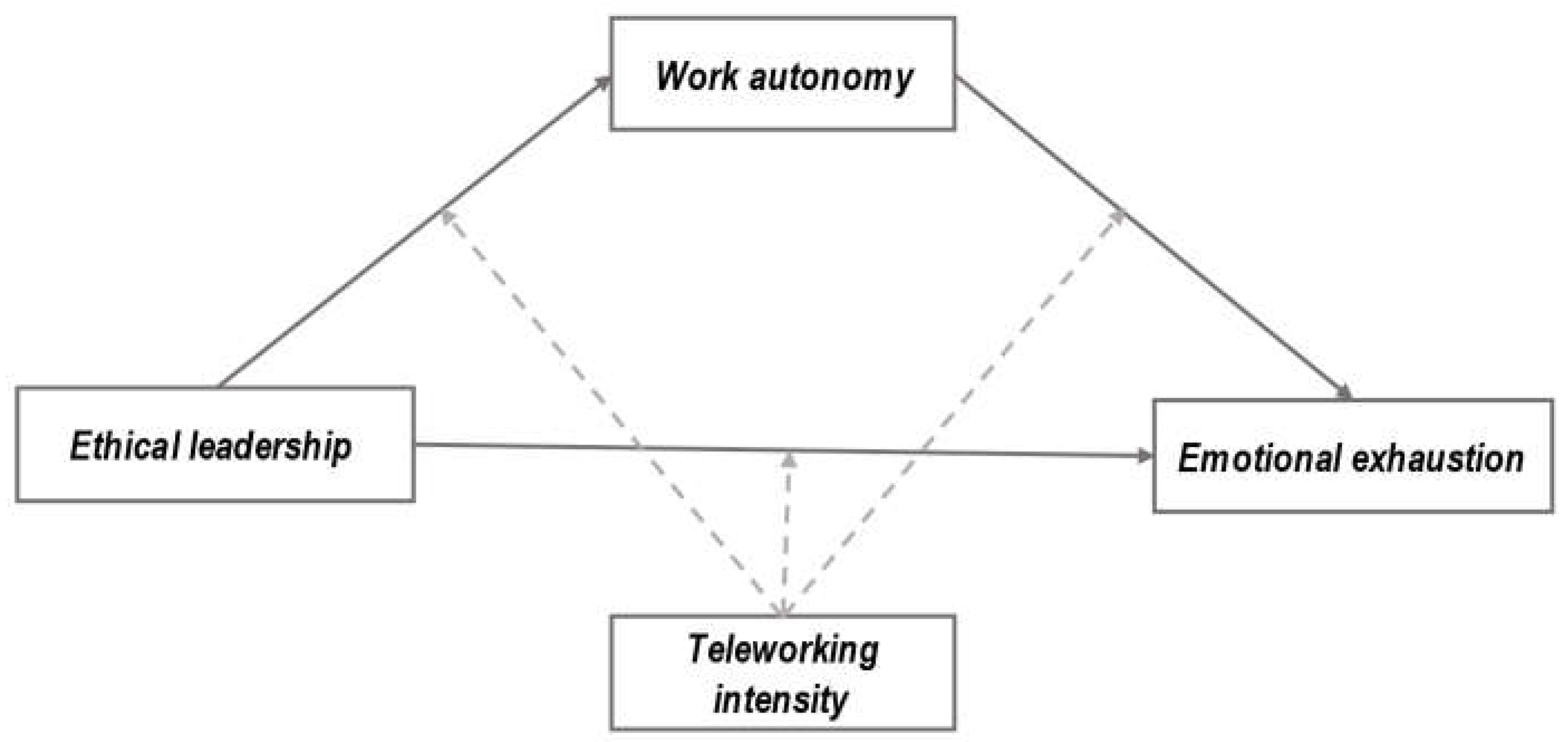
Figure 2.
Proposed moderated mediation model unstandardized coefficients.
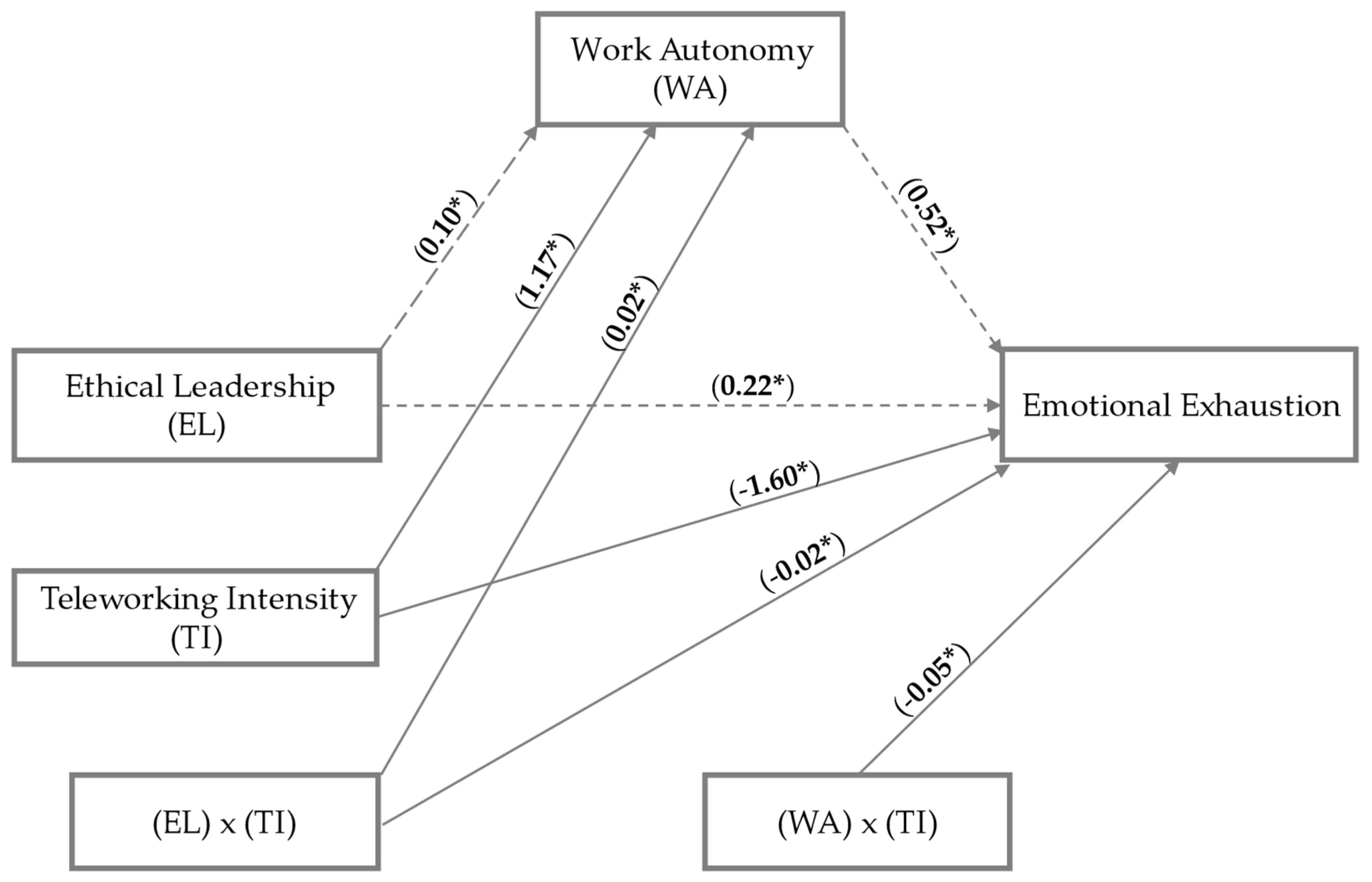
Figure 3.
Moderation process: ethical leadership and work autonomy.
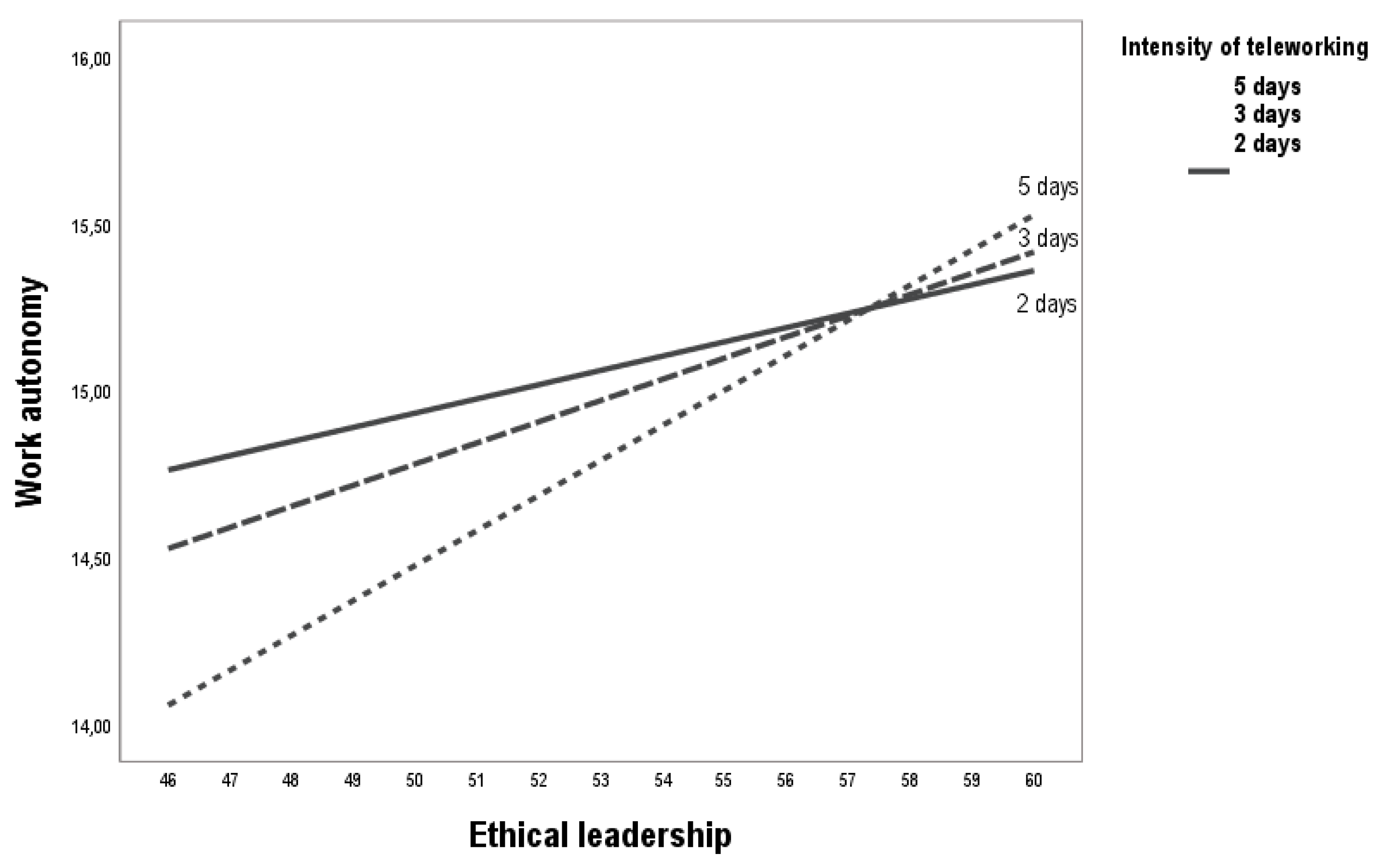
Figure 4.
Moderation process: work autonomy and emotional exhaustion.
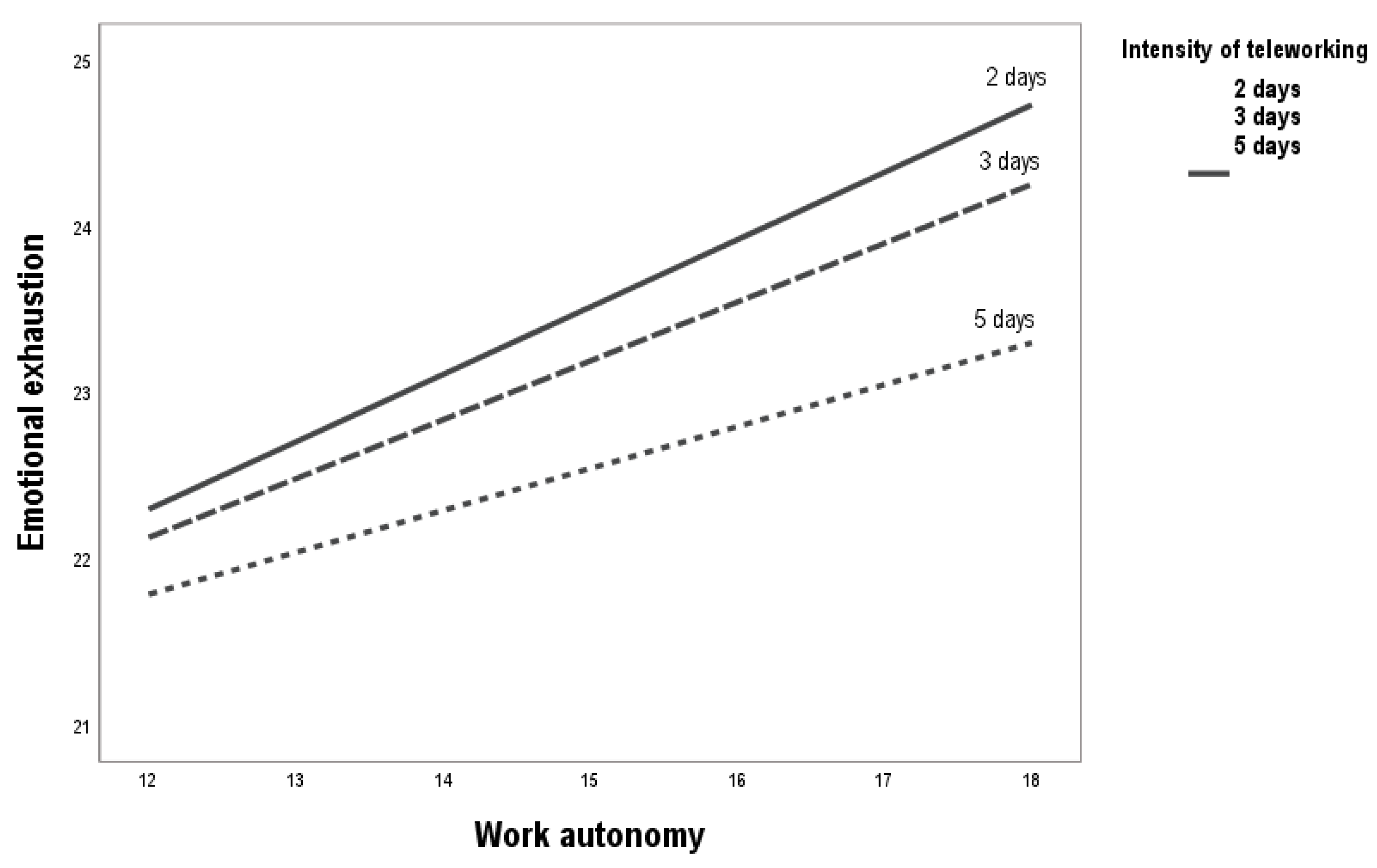
Figure 5.
Moderation process ethical leadership and emotional exhaustion.
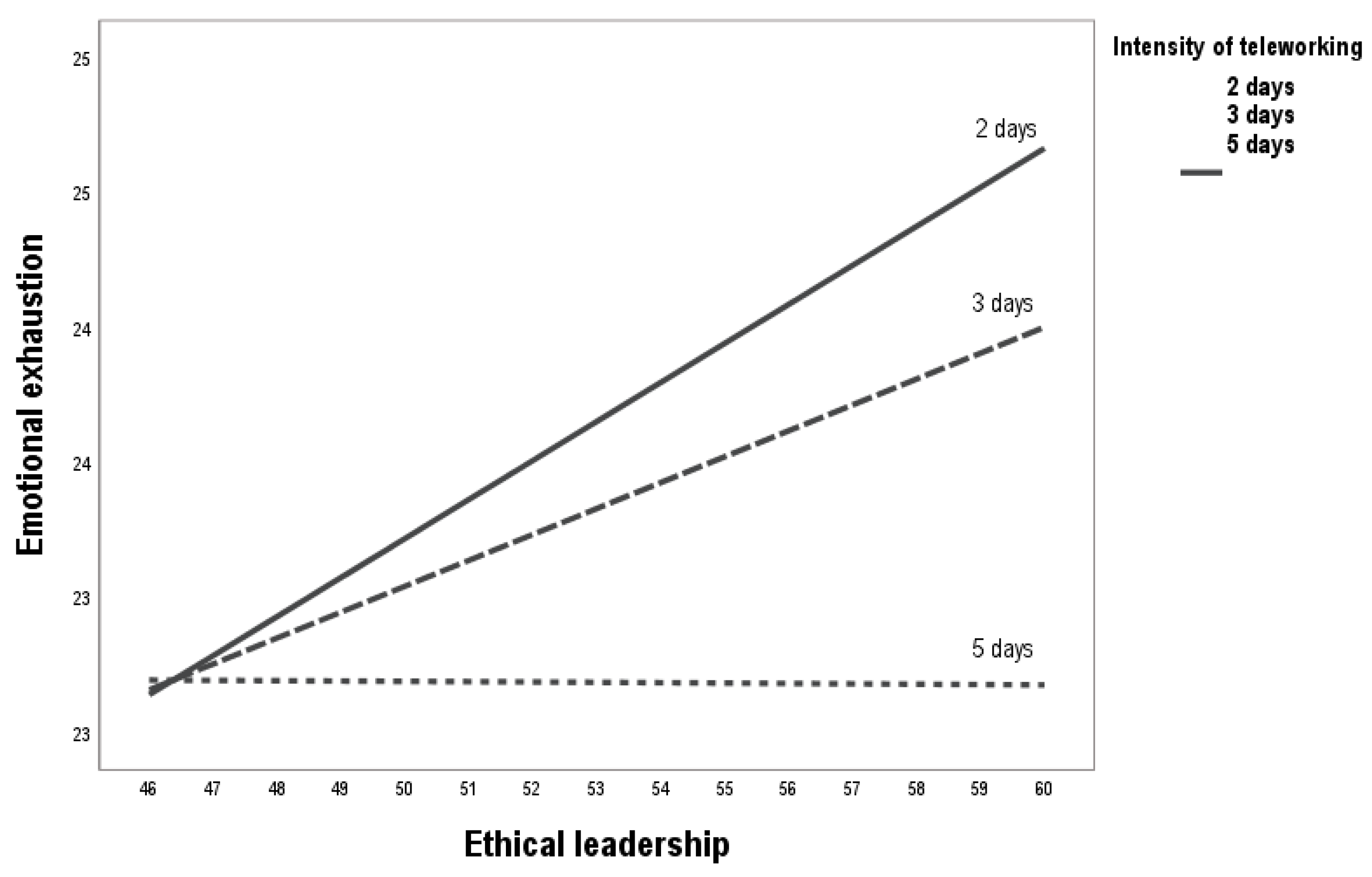

Table 1.
Means, Standard Deviations and Correlations of the Main Study Variables.
| Constructs | N | M | SD | G | EL | TI | WA | EE |
| Gender | 1 | 0.32 | 0.45 | x | ||||
| Ethical Leadership (EL) | 10 | 51.60 | 8.22 | 0.04 | (0.80) | |||
| Teleworking Intensity (TI) | 1 | 3.90 | 1.99 | 0.06 | 0.14** | (0.72) | ||
| Work Autonomy (WA) | 3 | 14.25 | 2.52 | -0.03 | 0.18** | -0.11* | (0.84) | |
| Emotional Exhaustion (EE) | 5 | 23.11 | 5.50 | 0.05 | 0.26** | -0.12** | 0.20** | (0.76) |
Notes: N=448. *p<.05, **p<.01, ***p<.001.
Table 2.
Test of mediation effect of work autonomy on emotional exhaustion.
| Predictors | Model 1 (EE) | Model 2 (WA) | Model 3 (EE) | ||||||
| β | SE | t | β | SE | t | β | SE | t | |
| EL | 0.35** | 0.03 | 5.97** | 0.17** | 0.01 | 6.87** | 0.16** | 0.02 | 4.89** |
| WA | 0.59** | 0.05 | 8.28** | ||||||
| R² | 0.01 | 0.01 | 0.01 | ||||||
| F | 12.83** | 14.96** | 22.50*** | ||||||
Note: N=448. Each column is a regression model that predicts the criterion at the top of the column. EL=ethical leadership; EE=emotional exhaustion; WA=work autonomy. * p<0.05, **p<0.01, ***p<0.001.
Table 3.
Test of the moderated mediation effect of teleworking intensity.
| Predictors | Model 1 (EE) | Model 2 (WA) | Model 3 (EE) | ||||||
| β | SE | t | β | SE | t | β | SE | t | |
| EL | 0.22** | 0.07 | 3.26** | 0.10 | 0.03 | 2.03** | |||
| TI | -1.60** | 1.46 | -2.22** | 1.17** | 0.57 | 2.09** | |||
| EL(x) TI | -0.02** | 0.02 | -3.08** | 0.02** | 0.01 | 2.90** | |||
| WA | 0.52** | 0.26 | 2.89** | ||||||
| WA (x) TI | -0.05** | 0.07 | -3.24** | ||||||
| R² | 0.01 | 0.01 | 0.01 | ||||||
| F | 9.93** | 6.26** | 10.50** | ||||||
Note: N=448. EL=ethical leadership; TI= teleworking intensity; EE=emotional exhaustion; WA=work autonomy. * p<0.05, **p<0.01, ***p<0.001.
Disclaimer/Publisher’s Note: The statements, opinions and data contained in all publications are solely those of the individual author(s) and contributor(s) and not of MDPI and/or the editor(s). MDPI and/or the editor(s) disclaim responsibility for any injury to people or property resulting from any ideas, methods, instructions or products referred to in the content. |
© 2024 by the authors. Licensee MDPI, Basel, Switzerland. This article is an open access article distributed under the terms and conditions of the Creative Commons Attribution (CC BY) license (http://creativecommons.org/licenses/by/4.0/).
Copyright: This open access article is published under a Creative Commons CC BY 4.0 license, which permit the free download, distribution, and reuse, provided that the author and preprint are cited in any reuse.


