

Submitted:
22 December 2023
Posted:
25 December 2023
You are already at the latest version
Abstract
The red palm weevil (Rhynchophorus ferrugineus) inflicts widespread damage in date palm plantations and urban settings, leading to stand loss and safety concerns, intensified by the economic and ecological burdens of synthetic preventive treatments. A novel approach emphasizes detecting weevil-infested palms through sensors and targeting control efforts at colonized trees. The study analyzes two datasets: field manager-reported results from settings with preventive pest control versus seismic sensor-monitored units. Sensor data translates into damage index values, exploring curative treatments, attack likelihood based on infestation history, and the impact of sensor-based management on infestation incidence decline. Findings reveal lower weevil infestation in urban areas and preventive-treated palm settings. A strong correlation exists between sensor indications and grower decisions in date plantations. Palms previously infested are more prone to the damage. Long-term sensor-based management significantly reduces weevil-affected palm numbers. The high infestation in sensor-equipped date palm settings stems from a gap between sensor-identified and preventively treated palms. Controlling weevils based on sensor indications aligns practically with grower curative treatments, preventing significant damage. Weevils target previously infested palms, optimizing pest control through a continuous strategy integrating sensor monitoring with prompt response treatments. This proves highly effective, offering a cost-efficient alternative to preventive treatment reliance.
Keywords:
Red palm weevil
; Rhynchophorus ferrugineus
; date palm
; plantations
; ornamental palm
; management
; seismic sensors
1. Introduction
The date palm Phoenix dactylifera is one of the earliest perennial plants to undergo domestication. The oldest botanical record of the date palm is 19,000 years ago, found in archaeological excavations on the Sea of Galilee [1]. Its presence is documented in the East Mediterranean dating back to biblical times [2]. Thriving in arid and semiarid regions across the globe, this resilient tree plays a pivotal role as a foundational fruit tree in predominantly Eastern and Southern Mediterranean countries, as well as in the Near East, where it stands as a significant cash crop [3]. Beyond its economic importance, the date palm is widely incorporated as a common ornamental tree throughout the Mediterranean basin. The presence of date palms in the area, both in their wild form and under cultivation continuous for thousands of years in the East Mediterranean [4], has contributed to the rich diversity of herbivorous arthropods of this tree.
The modern cultivation of date palm plantations in Israel is believed to have commenced around 1924, marked by a significant influx of offshoots (suckers) from Egypt [5]. The 1950s saw the emergence of notable challenges in plant protection, particularly with the outbreak of two species of armored scale. Since then, the roster of arthropod pests has expanded to encompass 31 species, with approximately half of them being deemed economically significant [6]. Presently, the five primary arthropod pests in date palm plantations in Israel, ranked by their relative economic impact, include the red palm weevil (RPW), Rhynchophorus ferrugineus Olivier, the lesser date moth, Batrachedra amydraula Meyrick, the old world date mite (Oligonychus afrasiaticus McGregor), sap beetles (Nitidulidae, mainly Carpophilus hemipterus L), and a rhinoceros beetle, the bunch stalk borer, Oryctes elegans Prell (Svetlana Dobrinin, unpublished data). The former three species are considered among the top ten arthropod pest of date palm worldwide [7]. To the best of our knowledge, RPW is the sole invasive species within the pest complex affecting the date palm in Israel. In contrast to other major arthropod pests, this species does not target the fruits or their bunch stalk.
The contemporary cultivation of date palm trees in urban areas across Israel is well rooted in the Jewish and Moslem ethnicities. In the Jewish sector, the planting has been primarily motivated by the aspiration to incorporate a tree from 'The Seven Species' (Shiv'at HaMinim in Hebrew), a selection of seven agriculturally significant plants identified in the Hebrew Bible as special products of the ancient Land of Israel. Traditionally, date palms were planted in proximity to synagogues. Noteworthy for their rapid establishment as mature trees post-replanting, they seamlessly integrate into urban spaces, serving as an effective buffer between traffic lanes, and the low maintenance cost of these trees. Until the establishment of RPW, there was no imperative need to address any plant protection issues related to these trees in urban environments.
The tribe Rhynchophorini in the subfamily Dryophthorinae in the weevil family (Curculionidae) brings together species that inhabit various palm species, including the RPW. The natural distribution range of the RPW spread over Southeast Asia and Melanesia. However, the large commercial distribution of palms, mainly coconut and date palms, mainly from the mid-1970s, led to the establishment of the weevil in many countries, directly or following infiltration from neighboring countries [8]. The large economic losses and damage to biodiversity caused by the invasion of the weevil in large areas of the world have earned it the status of a serious major pest that requires the development of effective management strategies to prevent or to stop the damage [9].
The establishment of the weevil in the eastern Mediterranean basin began already at the end of the 1980s, and in Israel, it was discovered in 1999 [10]. The severe damage in Israel and other countries in the region (and in general) was especially manifested in the damage to the date palm and the Canary Island date palm, which are among the palms that are very sensitive to the attack of the weevil [11,12]. The frequency occurrence of the latter palm species as ornamental tree in Israel was steeply reduced due to the loss of most of the conspecific trees to the weevil. The weevil remains the sole significant pest of ornamental date palms in Israel.
The main difficulty in dealing with tree borers is the discovery of the adults during the short activity of egg laying. In addition, the eggs are often hidden in the outer layers of the bark, and the penetration of the larvae into the trunk is usually characterized by no continuously noticeable symptoms. Therefore, in many cases, when dealing with the weevil, the natural tendency was to adopt one of the strategies that would prevent the palms from being inhabited. Hence, application of insecticides that are contact poisons against adults has been usually the considered tactic [13], together with traps' activation for the adult mass capture [14]. The weevil's aggregation pheromone was identified as early as 1993 [15]. However, soon it became clear that these tools are not promising. The use of synthetic pesticides to prevent palm infestation is not quite effective, being expensive when applied to all palms in the setting. The conclusion soon suggested that the discovery of the palms inhabited by the weevil is an essential element for the management [16,17].
In principle, identifying a palm infested by the weevil is not simple. A visual examination of external damage symptoms through a survey from the ground, or the use of remote thermal sensing have not been adopted as an effective interface tool because, in practical terms, such detection is only feasible in very advanced stages of colonization. Often discovery the typical chemical signature of a palm infested by the weevil was studied by employing dogs, but this approach has not proven itself on a commercial scale either. There is no doubt acoustic and seismic sensors bring to light the main scientific and technological efforts to detect the weevil's occupation of the palm [9].
Attempts to develop acoustic sensors represent the majority of reported efforts in this area. An acoustic sensor detects and measures the movement speed of the air particles in response to sound waves, and allows audio signals to be received and analyzed. That is, apparently, with a relatively simple act of inserting a microphone, one can listen to the gnawing sounds made by the weevil larvae inside the monitored stem medium. Despite the extensive reporting in the professional literature, acoustic sensors have not developed into a central tool in weevil monitoring. A seismic sensor is designed to measure vibrations or mechanical vibrations within a solid material, such as soil, rock or wood, and in this case, it is designed to pick up the mechanical vibrations in the stem because of the activity of weevil larvae. The IoTree Agrint seismic sensor (Agrint Rockville, Maryland, USA) is the only product widely used commercially [18]. The widespread use of this sensor in plantations and urban areas began in 2020 (Agrint, personal communication), and therefore, several years of experience have been accumulated in several palm settings of the effect of the sensor employing on the changes in the frequency of palm trees affected by RPW.
The weevil may colonize date palm trees almost at any age. In Israel there are 910,000 fruit-bearing date palms, with the most common varieties are Medjoul 82.3% and Deri 7.4% [19]. About a quarter of plantations are at the susceptible age (4-14 years after planting) for the red palm weevil attack, and among those 25% are sensors installed. Currently, the colonization of very young trees (from the state of rooted high offshoots to 3-year-old trees) or mature trees (> 15-year-old trees) is uncommon. In addition, 36,000 date palms growing in public areas in Israel (as park or street trees, of different varieties, with Hayani as the dominant one). About 27% of these palms are sensors installed (Agrint Ltd, unpublished data). The installation of the sensors in large settings makes it possible to compare the two management strategies against the RPW, sensor-based management vs preventive management based on prophylactic insecticide treatments.
The weevil control practice in Israel is still mainly synthetic pesticide-based. Ground application of Imidacloprid (a systemic neonicotinoid) or cover spray to the lower section of the stem by Imidacloprid + Lambda Cyhalothrin (a pyrethroid) serves as a preventive measure in both public areas and plantations in places where sensors are not in use. Curative measures include the application of both above mentioned insecticides or stem injection of Imidacloprid or Thiamethoxam (another systemic neonicotinoid). In organic plantations and in conventional plantations during fruit set, the preventive measure includes the application of formulation of the entomopathogenic fungus Beauveria bassiana to young trees) up to the maximum age of 12-14 years) and spraying of the entomopathogenic nematode Steinernema carpocapsae as a curative measure [20,21,22,23].
In this report, we compare the RPW infestation picture as revealed by the two management strategies, preventive vs sensor-based management in two kinds of environments, date palm plantations and ornamental trees in the urban area. We also examine three aspects deriving from sensor activation in date palm settings as follows. (1) The relationship between the curative treatments with respect to the damage index in the plantations. (2) The relationships between curative treatments and the damage index information. (3) The probability of occurring an attack event on a certain palm tree as related to its RPW infestation history. (4) The effect of sensor-based management on the decline of RPW infestation incidence over time.
2. Materials and Methods
Agrint Ltd (Hod Hasharon, Israel) provided both the raw data and seismic sensor information for each examined setting. Reports on the incidence of date palm infestation were sourced from land managers, primarily palm growers in major date palm cultivation areas across Israel, as well as from head gardeners overseeing urban environments, specifically cities and towns situated on the Coastal Plain of the country.
2.1. Assessing the Level of Palm Trees Damaged by RPW in the Studied Settings
2.1.1. Study Palm Settings
The tested palm trees were divided between two major environments, fruit plantations and ornamental trees. Each group is further divided between sensor-installed setting and those which are without sensors. Information about the palm plantations, included trees of the age between 4-12 years and their diameter was about 45 cm, the variety was Medjoul (unless otherwise indicated). The studied plantations were located in Beit She'an, Jordan, and the Arava valleys. The urban palm settings were of different ages, ranging between 10-20 year old, and were mostly located in cities along the Coastal Plain. The information about each of the 43 date palm settings (27 plantation and 16 urban settings) were received by the respective grower or the municipality gardener. The frequency distribution of the number of palm trees in each setting in each study environment for each management strategy is presented in Figure 1.
2.1.2. Palm Setting under Preventive Control Measure
Prevention measures using synthetic insecticides were conducted in settings of palm trees without sensors. In these settings, each palm was treated between 2-4 times during the year. A few of the studied plantation were treated up to 10 times annually. Usually, the infested palms were identified when injury symptoms were obvious. Often, the survey of the RPW damaged palms in a certain setting started after a collapse of one of its tree due to the weevil activity. Owing to the wide variety of treatments, we did not distinguish between the various preventive control measures for the current analysis, neither did we consider the preparations that were applied and the different methods of application.
2.1.3. Palm Settings Monitored by Seismic Sensors
Settings whose trees were installed with sensors were not preventively treated with insecticides. All employed devices were Agrint IoTree seismic sensors. The seismic vibrations generated by the larvae are the indication of the weevil activity in the palm stem and the basis of palm health decision-making output. Observations in different areas have indicated that over 85% of the stem colonization by RPW occurs at a height of up to 1.5 meters above ground [9,24,25]. In adult ornamental date palms in the urban area in Israel about 75% of the infestation has been detected in the palm crown [18]. Thus, the sensors were installed in each type of setting accordingly. The sensor-generated data is the basis of palm health decision-making output and is translated to damage indexes, 'healthy', 'susceptible', and 'infested' [18]. The effect of environment and management and their possible interaction on the incidence of infestation was examined with Nominal Logistic Regression.
2.2. Curative Treatments with Respect to the Damage Index Information
The relationships between the actual distributions of curative treatments, in relation to the damage index information, were discerned through sensor operations. The data analysis involved three distinct plantations (A-C, Table 1), each characterized by variations in the number of examined palm trees and the intensity of RPW infestation. The data accumulation spanned 18, 24, and 28 months (2021-2023) for plantations A, B, and C, respectively. Growers reported the number of curative treatments administered to individual trees during the observation period. The analysis categorized treatments per tree into three levels: 0 (non-treated), 1-2 treatments, and three or more treatments. Damage index information was sourced from sensor values reported for each examined palm tree on every plantation.
The sensor-measured value, representing the sum of positive reading events divided by the total reading events over a two-week period, was translated into the damage index, and classified into five categories [18]. For this analysis, we computed the number of two-week periods falling into two categories: 'suspected' and 'infested', with "declining infestation" and "highly infested" collectively considered as "infested". The relationship between the numbers of 'suspected' events and infested events per tree and the level of treatment (0/1-2/3+) was examined for each plantation by Ordinal Logistic Regression. The results were presented in the form of Odds Ratios (OR). The ORs of infested events or 'suspected' events for 1-2 treatments versus 0 treatments show the increase in the odds of going from the level of no treatment to the level of one or two treatments when the number of infested events or 'suspected' events increases by one, respectively. The ORs of infested events or 'suspected' events for 3+ treatments versus 1-2 treatments show the increase in the odds of going from the level of one or two treatments to the level of three or more treatments when the number of infested events or 'suspected' events increases by one, respectively. Odds Ratios significantly greater than one indicate a significantly greater tendency for a higher level of treatment when the number of infected events or 'suspected' events increases.
In order to examine the predictive value of the Ordinal Logistic Regression, trees in each plantation were grouped based on the accumulated number of events in the 'suspected' and "infested" categories separately: 0 events, 1-10 events, 11-20 events, 21-30 events, and 31-40 events. For each plantation, we compared the actual frequency distribution of trees based on their treatment levels within each group of 'suspected' and 'infested' categories. We compared these distributions to those predicted by the Ordinal Logistic Regression model.
2.3. The Probability of Occurring an Attack Event on a Certain Palm Tree
The empirical distribution of the number of attacks per tree was calculated in each of six date palm plantations (Table 1, plantations A-F) each with a different number of tested palm trees and a different frequency of successful colonization (= attacks) characterized by successful infestation incidents by the weevil. The number of RPW attacks per tree was calculated based on the events of damage that were reflected by the number of sequences of several 'infested' and 'suspected' categories, separately, as determined by the seismic sensor. The "Infested" was defined when at least two consecutive events were recorded, and almost in all cases, curative treatment was taken to ascertain the recovery of the tree, consequently reaching the category of "healthy" by the sensor. The 'suspected' category was determined in the same way; curative treatment was rarely taken in these cases.
The hypothesis that an attack on a tree is independent of previous attacks was tested by fitting the Poisson distribution to the number of attacks per tree in each plantation separately overall the observed period of time. The assumption was that RPW tends to target weakened or injured palm trees. In other words, we hypothesize that the probability of a palm experiencing an infestation event is substantially higher if it had been previously colonized by the weevil and subsequently recovered through a control treatment, as opposed to palms that were never colonized by the weevil. This hypothesis would be confirmed if the empirical distribution deviated from a Poisson distribution with a lower than expected frequency of a single attack and a higher than expected frequency of multiple attacks.
The significant of deviation from Poisson distribution was calculated for each of the six tested plantations for the 'suspected' category and the "infected" category separately. Goodness of fit to the Poisson distribution was ascertained by the Chi-square distribution. Fisher's p-value combination method [26] was used in order to calculate the overall significance of the observed deviation from the Poisson distribution for all the plantations together, separately for 'suspected' and "infested" distributions.
2.4. The Effect of Sensor-Based Management on the Decline of RPW Infestation over Time
This chapter of the study delves into the enduring shifts in the percentage of palms colonized by RPW. The trees were installed with seismic sensors for monitoring the RPW activity across five distinct date palm settings. These encompassed three plantations, as well as date palms lining streets and parks in two cities within Israel (Table 1, denoted as settings G-I and J-K, respectively). Across all five settings, the curative treatments focused on addressing infested trees identified through sensor data. The enduring impact is elucidated by graphically representing the percentage of palm trees within each setting, aligned with the 'infested' category on a daily base throughout the timeline of sensor activation in each respective setting.
3. Results
3.1. The Extent of Damage by RPW in Date Palm Settings in Agriculture and Urban Areas
The infestation data, derived from reports by the land managers, paints a clear picture. In urban settings under preventive treatments, the lowest percentage of infested palms (PIP) was observed at 0.25% (ranging from 0 to 4.74%, involving 10,235 trees across 12 settings). Similarly, plantations under preventive treatments showed a relatively low PIP of 0.61% (ranging from 0 to 13.50%, encompassing 34,005 trees in 17 settings). Conversely, urban settings managed by sensors exhibited a relatively high PIP of 4.30% (ranging from 2.95 to 7.19%, involving 4,767 trees across four settings). The highest PIP was recorded in sensor-managed plantations at 9.09% (ranging from 2.06 to 41.07%, with 6,014 trees in 10 settings). The distribution of PIP across various palm settings, considering the growing environment and management strategy, is illustrated in Figure 2.
The results suggest that the studied environment (plantation vs urban) has a significant effect on infection incidence (Odd Ratio (OR) of plantation versus urban=2.3, p < 0.0001). The infection incidence of palm settings, regardless of the environment, in sensor-managed settings was significantly greater than in palm settings under preventive treatments (OR=17.00, p<0.0001). There was no significant interaction between the environment and the type of management strategy (p =0.74).
3.2. The Relationships between the Actual Distributions of Curative Treatments, in Relation to the Damage Index Information
The examination of curative treatment distributions in relation to the 'suspected' damage index information did not reveal any significant association between the two datasets. This lack of association is shown by the Odds Ratios for the transition from 0 to 1-2 treatments and for transition from 1-2 to 3+ treatments not differing significantly from 1 in any of the plantations. For plantation A p-values of 0.9990, and 0.7183, for plantation B of p-values of 0.7610 and 0.8711, and for plantation C p-values of 0.1127 and 0.8191, all respectively. The analysis of curative treatment distributions based on the 'infested' damage index information, categorized into five frequency groups, is depicted in Figure 3. In this context, clear associations emerge between the two datasets in five out of six tests. The significance of the Odds Ratios from 1 for the transition from 0 to 1-2 treatments and for transition from 1-2 to 3+ treatments for plantation A are 0.9801 and 0.0025, for plantation B 0.0081 and 0.0430, and for plantation C are 0.0001 and 0.0001, all respectively. These results indicate a noteworthy relationship between the numbers of curative treatments and 'infested' damage index information in these instances.
3.3. The Probability of Occurring an Attack Event on a Certain Palm Tree
The distribution of RPW attacks per tree was determined based on damage indexes, derived from sequences recorded by seismic sensors in the 'suspected' or 'infested' categories. The resulting distribution was then compared across different infestation levels - 0 (non-attacked trees), 1 (one attack), 2 (two attacks), and three or more attacks per tree- to that expected by a Poisson distribution. Examining the 'suspected' category events, indicated that only plantations C and D (refer to Table 1) exhibited a significant deviation from the Poisson distribution (<0.0001 for both). In these plantations, observed values for two attacks and three or more attacks per tree exceeded expectations, while one attack per tree fell below expectations. Plantations A, E, and F, while not showing significant deviation from Poisson distribution (0.0759, 0.1177, and 0.1202, respectively), displayed differences from expected values for at least one of the infestation frequencies (1, 2, or 3+).
Figure 4 illustrates the comparison between the observed and expected attack events indicated by the 'infested' damage index, calculated using Poisson distribution, for each of the six date palm plantations under examination. Five of the six studied plantations (excluding plantation B, see Table 1) demonstrated significant deviation from the Poisson distribution (<0.0001 for all five). In these five plantations, values for two infestation frequencies (among 0, 2, or 3+) were higher than expected, and the infestation frequency of 'one attack per tree' was lower than expected across all six study plantations.
The overall significance for all six plantations of the deviation of observed 'suspected' and 'infested' categories from expected values, as calculated by Poisson distribution, was highly significant (<0.0001 for both), as determined by Fisher's p-value combination method.
3.4. The Effect of Sensor-Based Management on Decline of RPW Infestation over Time
Figure 5 illustrates the fluctuations in the percentage of date palm trees colonized by RPW, denoted as the 'infested' damage index, as determined by sensor data across the timeline of monitoring for the five distinct palm settings. The timeline of sensor activation in each setting corresponds to the operational period managed by the local manager. The daily percentage of trees categorized as 'infested' provides a comprehensive depiction of the variations in the infestation pattern. This interpretation accentuates two key aspects: the infestation pattern itself and the subsequent decline in infestation.
Within the three examined plantations, a noticeable infestation pattern emerges with distinct waves of activity primarily occurring between the fall and the onset of summer. Notably, during the mid-summer, palm infestation in these settings reaches relatively low levels that become negligible during the winter. In the two cities under examination, infestation persists throughout the entire year, albeit still displaying a wavy pattern. The percentage of RPW-infested trees experiences a decline in all five cases, a direct outcome of curative measures implemented on identified infested palms, guided by the insights derived from the sensor data. In the three plantations under scrutiny, the reduction in the percentage of infested palms over the respective periods unfolded as follows: in setting G, it decreased from 11.68% in May 2022 to 0.93% in September 2023; in setting H, it diminished from 5.44% in June 2021 to a mere 0.17% in September 2023; and in setting I, the decline was from 9.28% in August 2020 to 2.25% in August 2023. In urban areas, for setting J, the percentage of infested date palms dwindled from 3.01% in September 2022 to 0.84% in September 2023. Similarly, in setting K, it dropped from a substantial 54.20% in September 2020 to a significantly lower 2.38% in October 2023 (Figure 5).
4. Discussion
The invasion of the Red Palm Weevil has had far-reaching consequences on both agricultural and urban date palm cultivation in Israel and other regions. This event is a significant turning point in terms of plant protection for date palms and has led to a substantial impact on the economy, affecting both the fruit and ornamental aspects of the tree. The establishment of the weevil population has resulted in notable changes in the economic costs associated with managing date plantations in Israel. For Medjoul date palm plantations, the cost per adult tree has increased by 2%, rising from $350 to $362 [27]. In urban settings, the management expenses for date palm trees have surged by a staggering 40%, soaring from $138 to $192 per adult tree [28]. These shifts underscore the considerable economic challenges faced by both agricultural and urban sectors in the wake of the RPW invasion. The elevated expenses associated with controlling the date palm weevil in urban areas of Israel, coupled with the already high costs of irrigation and the limited shade offered by the palms in the context of global warming, have led to a hesitancy among most municipalities to persist in planting date palms within their territories. The feasibility of this approach is impractical for Israeli date growers, especially considering the relatively modest increase in management expenses attributed to the RPW, even though it constitutes significant economic and environmental costs. Regardless, land managers in both agricultural and urban settings are apprehensive about the cumulative impact of extensive synthetic pesticide use. Consequently, in both environments, there is a shared pursuit among land managers to reduce reliance on chemical pesticides and foster a more environmentally friendly and sustainable landscape.
The implementation of seismic sensors in palm settings in both agricultural and urban areas aims primarily to curtail the widespread use of synthetic insecticides and instead focus extermination efforts on trees inhabited by the weevil. However, current findings indicate that the rate of RPW colonization in settings managed by sensors appears to be considerably higher than in comparable settings employing preventive measures. However, these significant differences may not totally reflect the infestation situation. The seismic sensor sensibility allows pinpointing on an infestation that is usually unrevealed by other detection or monitoring procedures, particularly in the range of the sensor detection, the palm crown, and the lower section of the stem in ornamental and plantation trees, respectively. On the other hand, the monitoring of the palm infestation in settings under preventive measures, as we learned during the collection of information for the preparation of the article, it almost never takes place, and is only manifested when noticeable signs of damage appear, and in many cases only the collapse of the palm spurs the monitoring of its surroundings.
Though, these notable differences may not fully capture the extent of the infestation situation. The heightened sensitivity of seismic sensors allows for precise identification of infestations that often go unnoticed by other detection or monitoring methods. This is especially true within the sensor's detection range, focusing on the palm crown and the lower section of the stem in ornamental and plantation trees, respectively.
The frequent use of pesticides in date plantations, coupled with the weevil's increasing tendency to attack the crown, particularly due to the activity of the bunch stalk borer, O. elegans [7, S. Dobrinin unpublished data], is anticipated to adversely impact the tree's environment, fruit quality, and harm the entomofauna of the tree, particularly the natural enemies guilds of severe pests in this habitat [6]. The extensive use of pesticides in urban environments is also a significant concern [29]. While accumulated experience suggests that some date trees infested by the weevil can overcome the infestation without human intervention, this appears to be the exception rather than the rule. In the cases examined in this study, the number of palms subjected to curative treatments was relatively small, often not exceeding 10% of the total trees. Moreover, the methods employed to eliminate the RPW infestation, such as stem injection of systemic insecticides and, notably, the application of entomopathogenic nematodes, are considerably safer compared to the commonly used preventative spray applications.
The seismic sensor information classifies instances as 'suspected' based on conditions that precede the formal 'infested' designation. However, this categorization is dynamic and may later transition, often marking the initiation of an unsuccessful infestation by weevil larvae that eventually returns to a "healthy" status. It's noteworthy that the 'suspected' category may, in rarer cases, be prompted by activities of other biological agents [18]. Consequently, 'suspected' does not consistently serve as an early indicator of weevil colonization or a signal to take immediate action. This observation may elucidate why an examination of curative treatment distributions in relation to the 'suspected' damage index did not reveal a significant association between the two datasets in our analysis. Specifically, when comparing distributions for one or two treatments versus no treatment and three or more treatments versus one or two treatments, no notable correlations were found. In each of the three plantations studied, the curative treatments eventually led to a "healthy" damage index classification. This suggests a positive dependence in probabilities corresponding to the aforementioned treatment comparisons. This dependency indicates a close relationship between 'infested' damage index information provided by the sensors and the applied curative treatments targeted at the relevant palm trees in each plantation. This underscores the high reliability of the IoTree sensors.
Wood borers, prominent among various beetle families, are naturally drawn to and infest weakened, damaged, dying, or dead trees and wood products. The interaction between indigenous tree species and foreign wood borers, or vice versa, can pose a significant threat, leading to successful attacks on seemingly healthy trees. The RPW is no exception, and its invasive colonization success varies among potential palm host species [30] and even date palm varieties [25,31]. There is little doubt that the invasion of RPW in the Mediterranean had a profound impact, primarily devastating the Canary Island date palm Phoenix canariensis and, to a lesser extent, the date palm [9,11,32,33,34]. The RPW shows a strong preference for the Canary Island date palm, making it highly suitable for its development [35]. Accumulated experience indicates that without proper protection, the Canary Island date palm is significantly affected by the weevil, whereas damage to date palms in similar environments, typically urban and park settings, is not widespread even without preventive measures.
Despite limited knowledge about the genetic factors contributing to tolerance or resistance in date palm varieties against RPW, a recent study by Abdel-Bakya et al. [36] suggests that the varying responses of palm cultivars to palm weevil infestation may be linked to factors such as the chemical composition of nutrient mineral elements in the soil or genetic diversity among cultivated varieties. However, physiological weaknesses and physical wounds likely serve as the primary stimuli for beetle attacks on potential hosts. Volatile compounds released from fresh wounds on palms attract and stimulate RPW females to lay their eggs [25].
In our current investigation, we observed a notable increase in the likelihood of the RPW attack event on a specific date palm tree within a given plantation. This heightened probability was particularly evident in trees previously infested by RPW, subsequently underwent curative treatment, and obtained a 'healthy' damage index. This consistent pattern was observed across all six plantations studied, indicating that the palm's recovery did not eliminate all injury symptoms. These trees probably still emitted cues that made them more attractive targets for RPW females. Collectively, events categorized as 'suspected' occurred more frequently than expected based on Poisson distribution, suggesting that instances where the 'suspected' damage index was determined often involved some form of injury that could later draw the attention of RPW. However, upon closer examination of the 'suspected' category for each plantation individually, it was revealed that in four out of the six studied plantations, this category did not deviate significantly from what would be anticipated by Poisson distribution. It is essential to note the potential influence of the association between 'suspected' and 'infested' categories on these findings. In light of these results, it is imperative to emphasize the connection between previously RPW-affected trees and the need for heightened vigilance among growers. Specifically, growers should focus on monitoring new potential RPW infestations and implement more stringent prevention and protection measures, recognizing the lingering vulnerability of trees that have undergone curative treatment after successful colonization by the weevil. Our previous study has revealed that importance of early detection and fast reaction by applying entomopathogenic nematodes as curative treatment to infested trees [18].
Despite the flight ability of the weevil and the great distances that the adults may travel in a relatively short time [37], the spread pace of the weevil in the area of the date plantations is not fast. For example, in Saudi Arabia, the weevil appeared in 1987, and its spread between the regions of the country continued until 2015 [25]. In Israel, the weevil was recorded for the first time in 1999 and there are still date palm areas in the Arava Valley where it has not reached. Another example is in the village Idan in the Arava Valley (where plantations B and C are located, see Table 1). It took four years until the weevil population moved from the plantations on the eastern side of the village to those on the western side (a distance of 2.5 km) (S. Dobrinin unpublished). The slight movement of the weevil between the growing areas probably indicates that the weevil tends to stick to the place where its population was established. This picture may explain at least in part the reduction of the weevil population in date palm settings under a continuous management of monitoring using the sensors as demonstrated in the present study (Figure 5). It seems that most of the adult weevils in the plantation originate within the site, and the penetration of adult weevils from outside the plantation area is marginal. Then, under meticulous management, when all the trees, marked by the sensors as infested by the weevil, are subjected to curative treatment, the RPW population in the plantation, or in the relevant urban environment, will gradually decrease.
Upon the request of the Investments Directorate of the Israeli Ministry of Agriculture, an economic evaluation for date palm plantations was undertaken [27]. The report indicates that the annual cost of preventive red palm weevil (RPW) management per date tree, employing pesticides as per Ministry recommendations, amounts to $22.5. In contrast, utilizing sensor-based management reduces the cost to $6.7 per tree. This calculation is based on a 5.2-hectare plantation of the Medjoul variety, featuring a tree density of 130 trees per hectare and a sensor equipment lifespan of 10 years. Concurrently, Agrint Ltd conducted an economic assessment for date palms in urban areas [38]. Here, the annual cost of preventive RPW management per date tree using pesticides is $40.4, while the calculated cost of sensor-based management is $18.9 per tree. This evaluation considers a treated area with 1000 trees and a sensor equipment lifespan of 6 years. Importantly, both assessments exclude the costs associated with curative treatments under either strategy when necessary.
The distinctive fluctuation pattern observed in palm infestations across the three studied plantations and two cities under examination appears to be closely tied to the diverse temperature regimes prevalent in these regions. Notably, the observed waves of activity in the plantations, characterized by apparently no infestation during the summer months, likely stem from the exceptionally high temperatures experienced during this period in these areas (with daily maximum temperatures in August reaching between 40-46°C). The RPW population, as established by Peng et al. [39], exhibits susceptibility to extreme temperatures, with an optimal growth temperature around 27 °C; a critical threshold of 44–45 °C at which pupae are effectively eliminated was already suggested by Salama et al. [40]. In contrast, the summer temperature regime in the Israeli coastal plain—where the date palm settings of the two cities under examination are situated—is relatively mild, with daily maximum temperatures in August ranging between 30-33°C. Probably because of this moderate climate, RPW infestations persist throughout the entire year in this region.
5. Conclusions
The apparent high infestation of date palm settings equipped with sensors results from the disparity between the number of palms identified as infected by the sensors and those receiving preventive treatment. The decision to control weevils based on sensor indications aligns practically with the grower's curative treatments, effectively preventing significant damage to the palms. Notably, the RPW exhibits the tendency to target palms previously affected by their infestation rather than those untouched by this pest. This insight enables the optimization of pest control efforts, ensuring a more targeted approach. The accumulated data underscores the efficacy of a continuous management strategy that integrates seismic sensor monitoring with prompt response treatments. This integrated approach proves to be highly effective in significantly reducing weevil damage, offering a cost-efficient alternative to management solely reliant on preventive treatments.
Author Contributions
All authors contributed to the study's conception and design. Z.M. wrote the first draft of the manuscript and all authors commented on versions of the manuscript. Conceptualization: Z.M., D.M.; Methodology: Z.M., H.V., I.N.; Data curation: Z.M., H.V., I.N., M.D.; Formal analysis and investigation: Z.M., H.V.; Writing—original draft preparation: Z.M.; Writing—review and editing: Z.M., H.V., I.N., M.D.; Funding acquisition: D.M.; Resources: Z.M., H.V., I.N., M.D. All authors have read and agreed to the published version of the manuscript.
Funding
This study was partially funded by the Israeli Palm Growers' Desk of the Plant Board, project number 132244823, project title: "Development of a sustainable control of the red palm weevil using microbial control agents", granted to DM.
Data Availability Statement
Correspondence and requests for materials should be addressed to Z.M. and D.M.
Acknowledgments
The authors extend their sincere gratitude to the dedicated team at Agrint Sensing Solution for their invaluable cooperation and generous provision of raw sensor data from numerous palm settings, crucial for the comprehensive analysis conducted in this study. The collaborative efforts of date growers, as well as key personnel in the gardening departments of various municipalities, were indispensable in furnishing the authors with essential information. This data facilitated the analysis of date tree infestation based on the two distinct management approaches implemented in the studied environments. Special acknowledgments are extended to Eli Yezraeli, former director of the gardens department in the Ashkelon Municipality, Haim Gavriel of the Department for the Improvement of the City, Tel Aviv Municipality; to Ronza Amara from the Extension Service, as well as to Avigail Heller from the Forestry and Tree Division, both affiliated with the Ministry of Agriculture and Rural Development. The authors express their sincere appreciation for the valuable assistance provided by Aharon Menirom of the Lev Ganim ve Gananim office in Tel Aviv, Buki Glazner from the Date Palm Marketing Board, Ben Levy of the Nature and Park Authority, Yaara Livne from the Eden Research Station, Omer Zer-Aviv for operation assistance in several plantations, and Dr. Alexei Protasov, Dr. Victoria Reingold for editorial assistance. Their collective support significantly contributed to the successful execution of this research.
Conflicts of Interest
The authors declare that the research was conducted in the absence of any commercial or financial relationships that could be construed as a potential conflict of interest.
References
- Liphschitz, N. The date found in the Land of Israel in ancient times according to dendroarchaeological studies. Hassade, 69: 2022-2024; 1973, (in Hebrew).
- Zohary, D., Spiegel, P.R. Beginnings of fruit growing in the old World. Science, 1975; 187: 319–327. [CrossRef]
- Chao, C.T., Krueger, R.R. The date palm (Phoenix dactylifera L.): overview of biology, uses, and cultivation. HortScience, 2007; 42: 1077–1082. [CrossRef]
- Zohary, D., Hopf, M., Weiss, E. Domestication of Plants in the Old World: The Origin and Spread of Domesticated Plants in Southwest Asia, Europe, and the Mediterranean Basin. Oxford University Press, New York, 2012.
- Bernstein, Z. [The Date Palm.] The Plant Production and Marketing Board, Tel Aviv, Israel 2004 (in Hebrew).
- Blumberg, D. Review: Date palm arthropod pests and their management in Israel. Phytoparasitica, 2008 36:411-448. [CrossRef]
- El-Shafie, H.A.F. List of arthropod pests and their natural enemies identified worldwide on date palm, Phoenix dactylifera L. Agriculture and Biology Journal of North America, 2012; 3(12), 516–524. [CrossRef]
- El-Mergawy R.A.A.M, Al-Ajlan, A.M. Red Palm Weevil, Rhynchophorus ferrugineus (Olivier): Economic Importance, Biology, Biogeography and Integrated Pest Management. Journal of Agricultural Science and Technology, 2011; 1: 1-23.
- El-Shafie H.A.F., Faleiro J.R. Red palm weevil Rhynchophorus ferrugineus (Coleoptera: Curculionidae): global invasion, current management options, challenges and future prospects. In: Invasive Species - Introduction Pathways, Economic Impact, and Possible Management Options, IntechOpen, London, El-Shafie H (ed.), 2020.
- Kehat, M. Threat to date palms in Israel, Jordan and the Palestinian Authority by the red palm weevil, Rhynchophorus ferrugineus. Phytoparasitica, 1999; 27:241-242. [CrossRef]
- Dembilio, Ó, Jacas, J.A. Basic bio-ecological parameters of the invasive red palm weevil, Rhynchophorus ferrugineus (Coleoptera: Curculionidae), in Phoenix canariensis under Mediterranean climate. Bulletin of Entomological Research, 2011; 101:153-163. [CrossRef]
- Kontodimas, D., Soroker, V., Pontikakos, C., Suma, P., Beaudoin-Ollivier, L., Karamaouna, F., Riolo, P. Visual identification and characterization of Rhynchophorus ferrugineus and Paysandisia archon infestation. Handbook of Major Palm Pests. Biology and Managementi, 2016; 11(17): 187–208. [CrossRef]
- Abraham, V.A., Faleiro, J.R., Al-Shuaibim, M.A., Prem Kumar, T. A strategy to manage red palm weevil Rhynchophorus ferrugineus Oliv. on date palm Phoenix dactylifera L. – its successful implementation in Al-Hassa, Kingdom of Saudi Arabia. Pestology, 2000; 24, 23–30.
- Oehlschlager, A.C. Use of Pheromone Baited Traps in Control of Red Palm Weevil in the Kingdom of Saudi Arabia. Consultancy Report submitted to Ministry of Agriculture, Saudi Arabia. 1994; 17 pp.
- Hallett, R.H., Gries, G., Gries, R., Borden, J.H., Czyzewska, E., Oehlschlager, A.C., Pierce, H.D., Jr., Angerilli, N.P.D., Andrauf, A. Aggregation pheromones of two Asian palm weevils, Rhynchophorus ferrugineus and R. vulneratus. Naturwissenschaften, 1993; 80:328–331. [CrossRef]
- Soroker, V., Ment, D., Altman, Y., Goldstein, E., Cohen, Y., Hezroni, A., Alluche, A. Traps and fungi to overcome the red palm weevil. Alon Ha'Notea, 2016; 2:24-29.
- Soroker, V., Suma, P., La Pergola, A., Navarro-Llopis, V., Vacas, S., Cohen, Y. et al. Detection of red palm weevil infestation. In: Al-Dobai S, ElKakhy M, Faleiro R, (eds) Proceedings of the Scientific Consultation and High-Level Meeting on Red Palm Weevil Management; March; Rome, Italy. 2017; FAO. 2017ISBN: 978-92-5-130961-2. pp 29-31.
- Mendel, Z., Voet, H., Modan, N., Naor, R., Ment, D. Seismic sensor-based management of the red palm weevil Rhynchophorus ferrugineus in date palm plantations. Pest Management Science, 2023. [CrossRef]
- Anonymous. Census of date plantations for January, 1st 2021. Palm Grower Marketing Board, Fruit Branch of the Plant Council, Yehud, Israel 2022 (Report, in Hebrew).
- Dobrinin, S., Daniel, S., Luson, B. Recommended treatments against the Red Palm Weevil in commercial date palm plantations. Tamar See Magazine, Annual Magazine of Date Palm Growers, 2021; 78-79.
- Ment, D., Livne, Y., Zer-Aviv, O., Mendel, Z., Glazer, I., Protasov, A., Davidovitz, M., Katz, D., Nakache, Y., Daniel, S., Dobrinin, S., Ginzberg, S., Yaacobi, G., Gal, S., Rivak, O., Levy, L., Ben Hamozeg, Y., Naor, R., Modan, N., Greenberg, A. A Sustainable strategy for Red Palm Weevil management by "protection-monitoring-response-therapeutic" in date plantations. Tamar See Magazine, Annual Magazine of Date Palm Growers, 2022. With English abstract.
- Nazarian, I. Monitoring and identification of Canary palms infested by red pam weevil infestations by Agrint sensors in Tel Aviv. Cod Ilan, Tel Aviv 2020 (unpublished report).
- Yaacobi, G., Salame, L., Glazer, I. Persistence of the entomopathogenic nematode Steinernema carpocapsae on red palm weevil-infested date palm trees in an arid environment. Nematology, 2023; 25, 669–675. [CrossRef]
- Azam, K.M., Razvi, S.A., Al-Mahmuli, I. Survey of Red Palm Weevil (Rhynchophorus ferrugineus Oliver) infestation in Date Palm in Oman. Department of crop sciences. College of Agriculture, Sultan Qaboos University, Sultanate of Oman, 2002; 239-245.
- Abdel-Banat, B.M.A., El-Shafie, H.A.F. Management of the Red Palm Weevil in Date Palm Plantations in Al-Ahsa Oasis of Saudi Arabia. Plant Health Cases, 2023; CABI. [CrossRef]
- Fisher, R.A. Statistical methods for research workers. 4th ed. Oliver and Boyd; 1935; Edinburgh, UK.
- Gal, B. The economic viability of sensors in a date plantation. An internal report submitted to the Investment Financing Department, the Ministry of Agriculture. The unit for Production Economics, the Extension Service, Ministry of Agriculture, Rishon LeZion, Israel 2021; (unpublished report. Hebrew).
- Izraeli, E. Cost pricing of date palm management in the City of Ashkelon amidst the threat of the red palm weevil 2023 (Internal, unpublished document in Hebrew, provided to the authors of this article).
- Meftaul, I.M., Venkateswarlu, K., Dharmarajan, R., Annamalai, P., Megharaj, M. Pesticides in the urban environment: A potential threat that knocks at the door. Science of the Total Environment, 2020; 711(1). [CrossRef]
- Murphy, S.T., Briscoe, B.R. The red palm weevil as an alien invasive: biology and the prospects for biological control as a component of IPM. Biocontrol News and Information, 1999; 20(1): 35 - 46.
- Faleiro, J.R., El-SHAFIE, H.A.F., Ajlan, A.M., Sallam. A.A. Screening date palm cultivars for resistance to red palm weevil, Rhynchophorus ferrugineus (Coleoptera: Curculionidae). The Florida Entomologist, 2014; 97(4): 1529–36. [CrossRef]
- Kontodimas, D.C., Milonas, P.G., Vassiliou, V.A., Thymakis, N., di Milano, P. The occurrence of Rhynchophorus ferrugineus in Greece and Cyprus and the risk against the native Greek palm tree Phoenix theophrasti. Entomologia Hellenica, 2006; 16: 11-15. [CrossRef]
- Sardaro, R., Grittani, R., Scrascia, M., Pazzani, C., Russo, V., Garganese, F., Porfido, C., Diana, L., Porcelli, F. The Red Palm Weevil in the City of Bari: A First Damage Assessment. Forests, 2018; 9(8):452. [CrossRef]
- Castillo, Á.D., Jvan den Bergh, C.J.M., Savin, I., Monteys, V.S. Cost-benefit analysis of conservation policy: The red palm weevil in Catalonia, Spain. Ecological Economics, 2020; 167, 106453. [CrossRef]
- Ju, R.T., Wang, F., Wan, F.H., Li, B. Effect of host plants on development and reproduction of Rhynchophorus ferrugineus (Olivier) (Coleóptera: Curculionidae). Journal of Pest Science, 2011; 84: 33-39. [CrossRef]
- Abdel-Bakya, N.F., Motaweia, M.I., Al-Nujiband, A.A.S., Aldeghairia, M.A., Al-Shurayme, L.A.M., Alharbie, M.T.M., Alsohima, A.S., Rehana, M. Detection of adaptive genetic diversity and chemical composition in date palm cultivars and their implications in controlling red palm weevil, Rhynchophorus ferrugineus Oliver. Brazilian Journal of Biology, 2023; 83. [CrossRef]
- Hoddle, M.S., Hoddle, C.D., Faleiro, J.R., El-Shafie, H.A.F., Jeske, D.R. et al. How far can the red palm weevil (Coleoptera: Curculionidae) fly? computerized flight mill studies with field-captured weevils. Journal of Economic Entomology, 2015; 108: 2599–2609. [CrossRef]
- Cohn, R. The economic viability of a sensor based management in an urban environment. An internal report. Marketing section, Agrint Sensing Solutions LTD. Hod Asharon, Israel, 2023 (unpublished report. Hebrew).
- Peng, L., Miao, Y., Hou, Y. Demographic comparison and population projection of Rhynchophorus ferrugineus (Coleoptera: Curculionidae) reared on sugarcane at different temperatures. Scientific Reports, 2016; 6, 31659. [CrossRef]
- Salama, H.S., Hamdy, M.K., El-Din, M.M. The thermal constant for timing the emergence of the red palm weevil, Rhynchophorus ferrugineus (Oliv.) (Coleoptera, Curculionidae). Journal of Pest Science, 2002; 75: 26–29. [CrossRef]
Figure 1.
Number of date palm trees distribution with respect to the study environment and the management strategy (sensor based and preventive treatment).
Figure 1.
Number of date palm trees distribution with respect to the study environment and the management strategy (sensor based and preventive treatment).
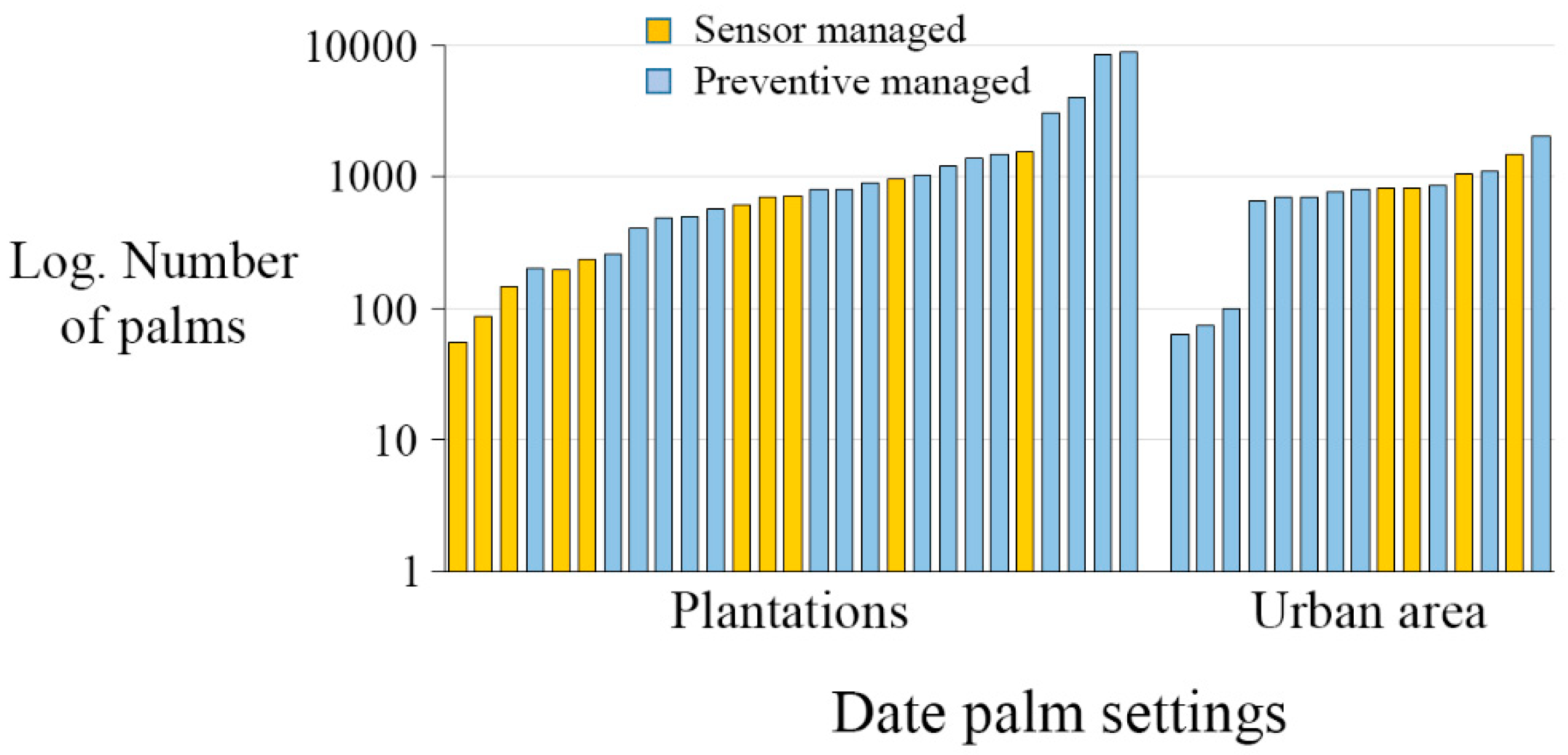
Figure 2.
Frequency distribution of the percentage of RPW-infested date palm trees with respect to the studied environment and management strategy.
Figure 2.
Frequency distribution of the percentage of RPW-infested date palm trees with respect to the studied environment and management strategy.
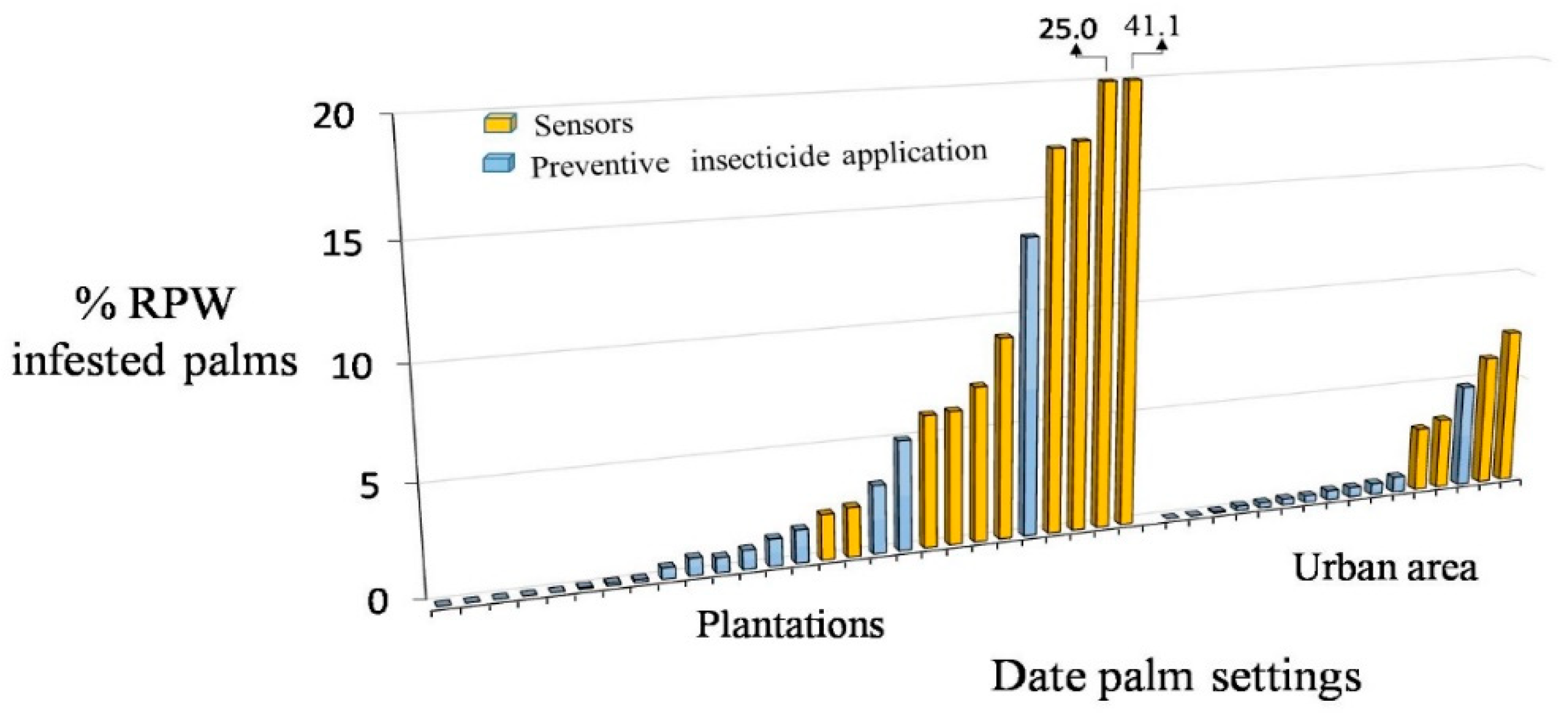
Figure 3.
The relationship between the distribution of curative treatments with respect to 'infested' damage index information of five frequency groups. Each frequency group in each one of the three plantations is compared between the observed and expected distribution of management treatments.
Figure 3.
The relationship between the distribution of curative treatments with respect to 'infested' damage index information of five frequency groups. Each frequency group in each one of the three plantations is compared between the observed and expected distribution of management treatments.
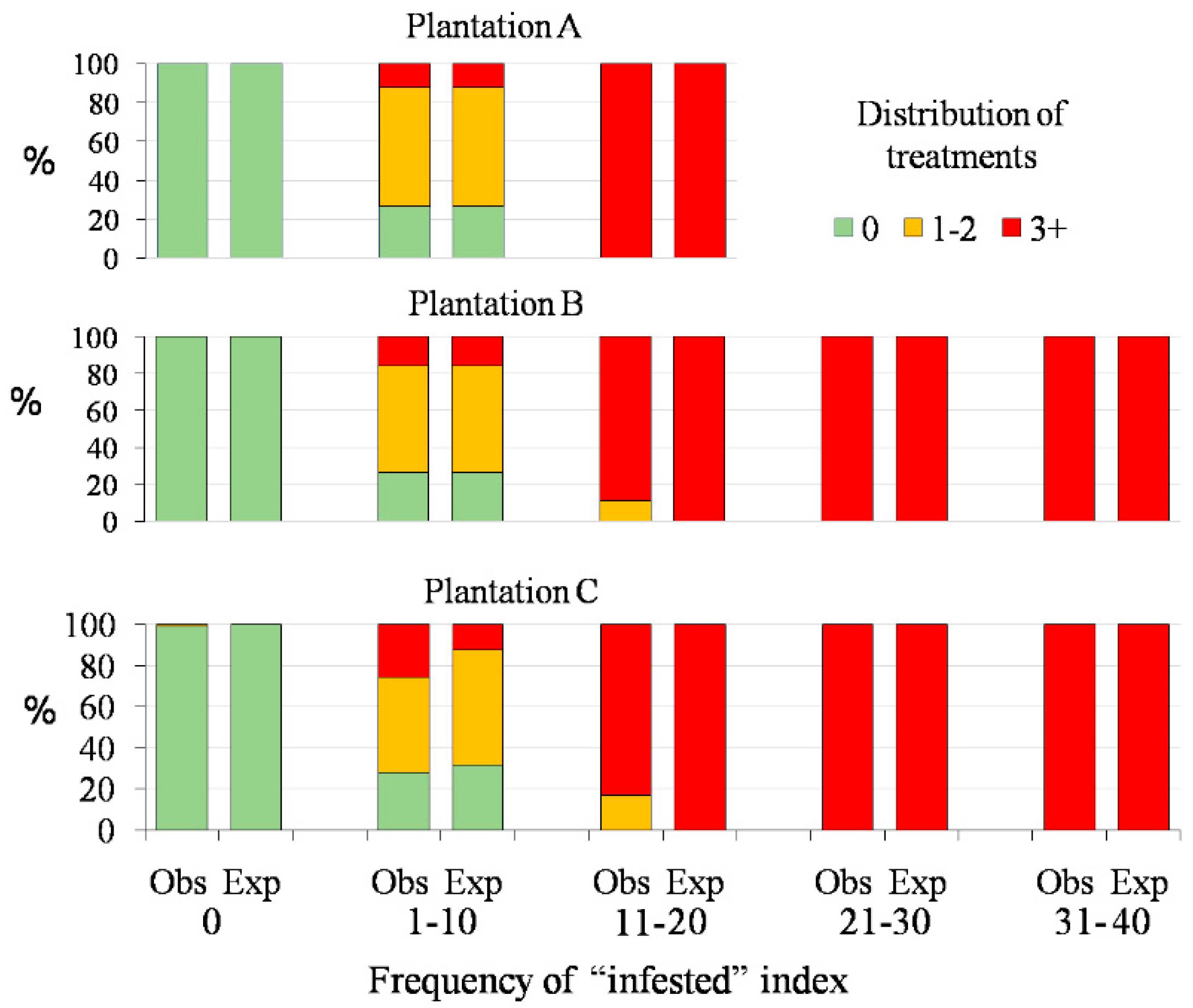
Figure 4.
Comparison of the probability of the observed and expected attack event to occur on a certain palm tree in each of the six examined date palm plantations.
Figure 4.
Comparison of the probability of the observed and expected attack event to occur on a certain palm tree in each of the six examined date palm plantations.
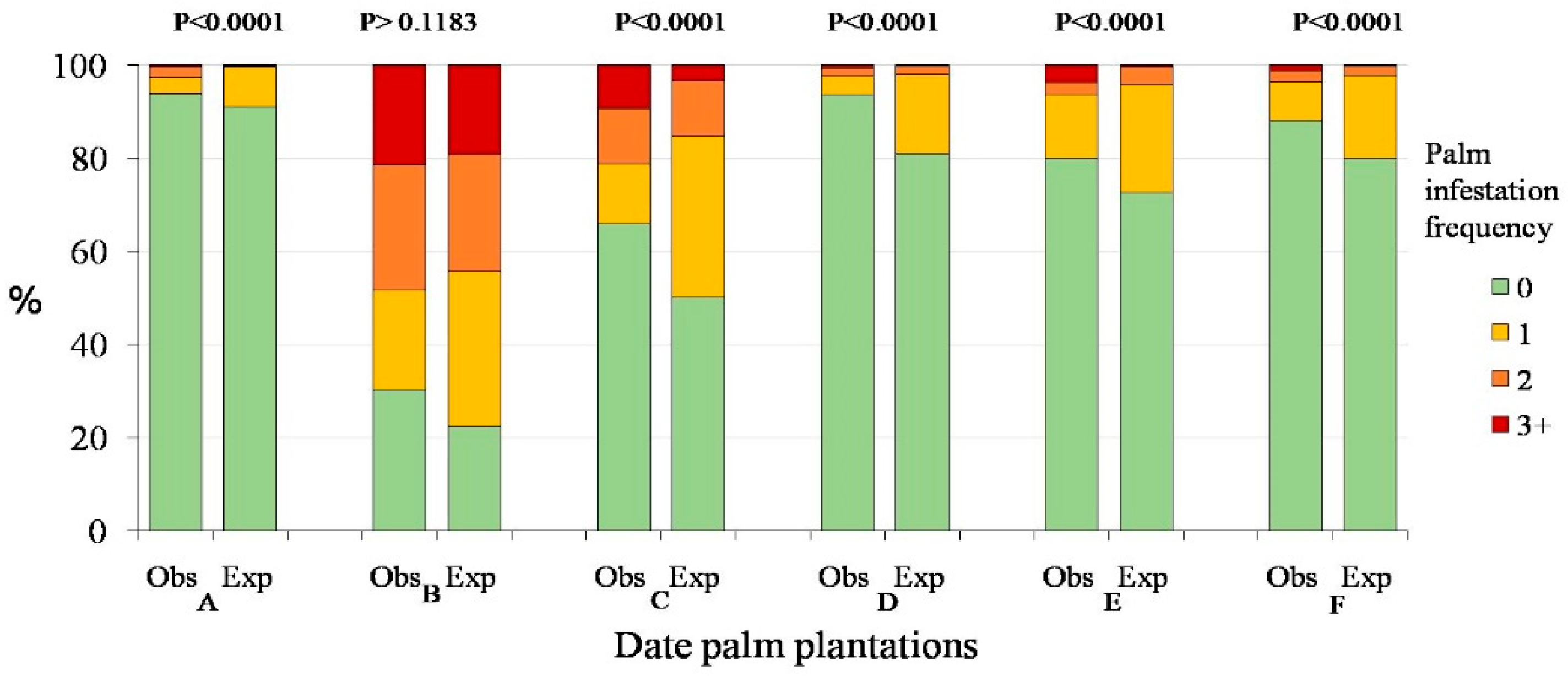
Figure 5.
The changes in the percentage of date palm trees in five palm settings classified as infested by RPW. The Y-axis indicates the % of palms in the examined setting with an indication of infested "damage index", X-axis indicates the spanned time of carrying out of the sensor-based management. Three settings (colored in brown-red) indicate date plantations, and the other in blue, represent palm trees in the urban area of two cities. * refer to the symbol of the setting as appeared in Table 1. .
Figure 5.
The changes in the percentage of date palm trees in five palm settings classified as infested by RPW. The Y-axis indicates the % of palms in the examined setting with an indication of infested "damage index", X-axis indicates the spanned time of carrying out of the sensor-based management. Three settings (colored in brown-red) indicate date plantations, and the other in blue, represent palm trees in the urban area of two cities. * refer to the symbol of the setting as appeared in Table 1. .
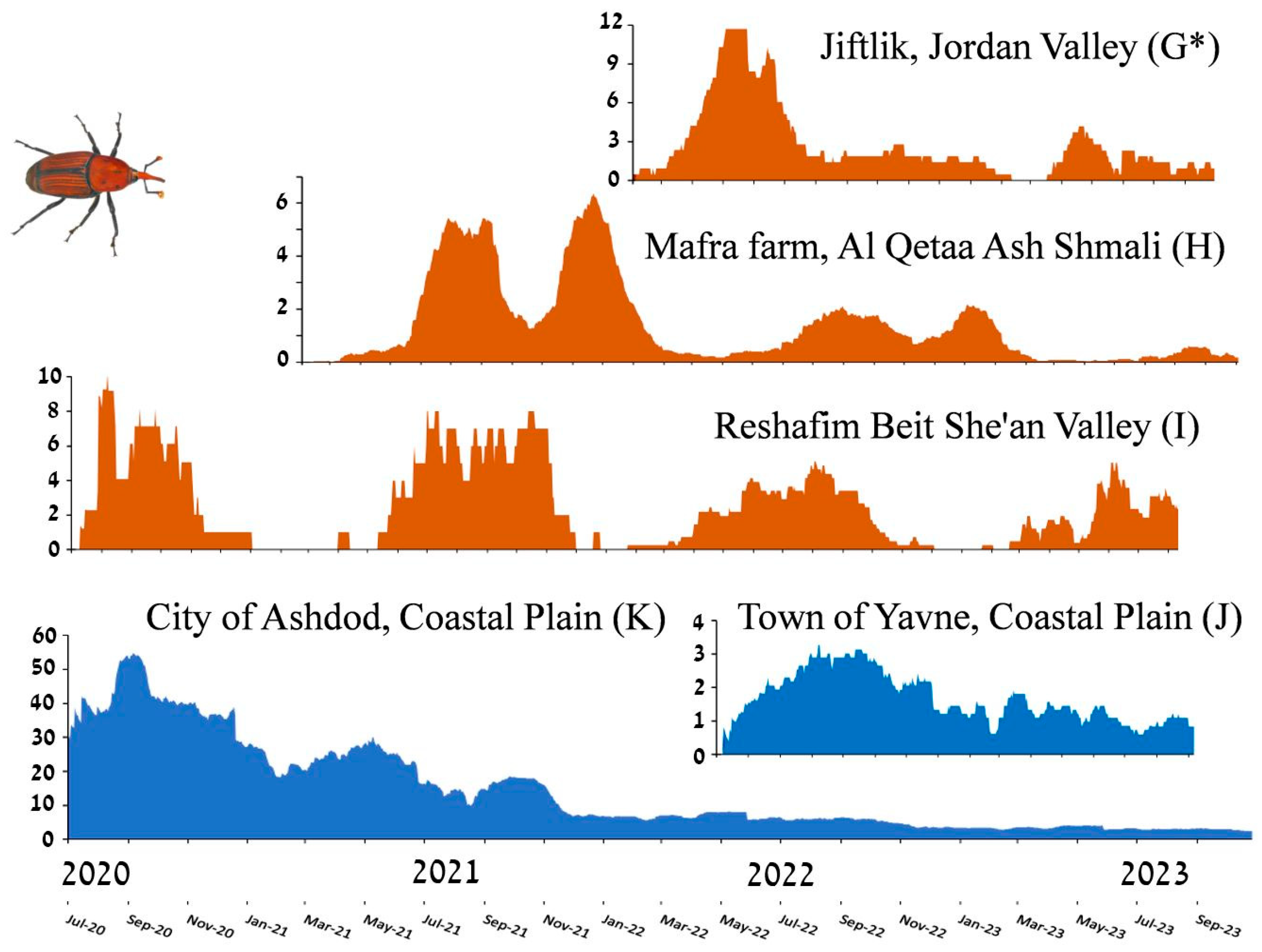

Table 1.
General information about the study areas and tested palm trees.
| Setting Symbol |
Location* | Coordinates | Date palm variety | Number of tested trees |
|---|---|---|---|---|
| A | Masua | N 31°54′25″ E 35°29′15″ |
Medjoul |
730 |
| B | Idan, Central Arava Valley | N 30049'27'' E 35016'31'' |
None, Male trees |
56 |
| C | N 30082'42'' E 35027'53'' |
Medjoul Organic |
250 | |
| D | Ein Yahav | N 30063'90'' E 35021'65'' |
Medjoul |
662 |
| E | Reshafim, Beit She'an Valley | N 32°28'38" E 35°29'18" |
Medjoul |
411 |
| F | N 32°28'59" E 35°29'16" |
Medjoul |
262 | |
| G | Jiftlik, Jordan Valley |
N 32°09'10" E 35°28'47" |
Medjoul mainly | 214 |
| H | Mafra farm, Al Qetaa Ash Shmali, Beheira governorate | N 30°45'29" E 30°10'12" |
Various varieties | 3000 |
| I | Reshafim, Beit She'an Valley | N 32°29'17" E 35°28'59" |
Various varieties | 1145 |
| J | Town of Yavne, Coastal Plain | N 31°52'31" E 34°44'29" |
Various varieties | 827 |
| K | City of Ashdod, Coastal Plain | N 31°48'06" E 34°38'59" |
Various varieties | 1036 |
* Date palm settings A-F and I-K are in Israel, plantations G and H are located in the Palestinian Authority and Egypt, respectively.
Disclaimer/Publisher’s Note: The statements, opinions and data contained in all publications are solely those of the individual author(s) and contributor(s) and not of MDPI and/or the editor(s). MDPI and/or the editor(s) disclaim responsibility for any injury to people or property resulting from any ideas, methods, instructions or products referred to in the content. |
© 2023 by the authors. Licensee MDPI, Basel, Switzerland. This article is an open access article distributed under the terms and conditions of the Creative Commons Attribution (CC BY) license (http://creativecommons.org/licenses/by/4.0/).
Copyright: This open access article is published under a Creative Commons CC BY 4.0 license, which permit the free download, distribution, and reuse, provided that the author and preprint are cited in any reuse.


