

Submitted:
19 December 2023
Posted:
20 December 2023
You are already at the latest version
Abstract
The present study identified the influence of green advertising and eco-labels on the attitude and environmental awareness of millennials who purchase ecological products in shopping centers in Ecuador. The research was quantitative, correlational and with a cross-sectional design. A total of 430 millennials participated in the study. A 20-question survey was applied in person outside the shopping centers of Quito and Guayaquil - Ecuador. The convergent and discriminant validity of the research model was verified using Confirmatory Factor Analysis (CFA) and Structural Equation Models (SEM). SPSS 20 and AMOS 24 programs were used for statistical analysis. The results show that green advertising influences environmental attitudes (β: 0,245) and awareness (β: 0,110) and specifically influences purchasing behaviour (β: 0,154) for green products. Although eco-labels do not directly influence purchasing behaviour (β: 0,128), they influence the attitudes (β: 0,406) and ecological awareness (β: 0,277) of millennials who buy organic products. This article is one of the first studies to identify the relationship between green advertising elements and green product purchasing behaviors among millennials in a developing country, concluding that marketing strategies based on green advertising and eco-labels have an impact on the attitude and environmental awareness of millennials, but only advertising directly affects purchasing behaviour while eco-labels do not. This research has social implications since it corroborates that millennials are concerned about environmental problems and are willing to contribute to sustainability.
Keywords:
Green advertising
; Eco-labels
; Environmental attitudes
; Environmental awareness
; Green purchase intention.
1. Introduction
The increase in consumption of products worldwide has led to the presence of problems such as devastation of the environment and generation of waste, leading to global warming currently being one of the main causes of concern worldwide [1,2]. The levels of environmental deterioration have grown rapidly during the last decades in Latin America, especially in developing countries like Ecuador [3,4], to such an extent that public concern about environmental problems and the need to know the influencing factors in purchasing behaviors, aligned with sustainability, have become topics of high interest for the academic community and for ecuadorian food producing sector [5,6].
The academic literature has used words such as “green consumption”, “adoption of ecological or organic products” or “green purchasing” to describe the different purchasing behaviors that are aligned with the protection of the environment [2,7]. Green consumption refers to the pro-environmental attitude and awareness of environmental problems [3]. For Liobikiene and Bernatoniene [8], this type of consumption does not focus on decreasing the acquisition of products by consumers; its main objective is to reduce the pollution. Over time, several studies agree that environmental concern has led consumers to support green consumption actively [2,5,9,10,11], which has increased the need to acquire that type of products. For this reason, today’s companies must adapt to the competitive Demands of the contemporary market, and think in a “greener” way [12,13].
Marketers continually use promotional strategies to incentivize consumers to pur-chase an ecological product [14]. According to Jäger and Weber [15], within ecological contexts, green advertising is an indispensable tool to publicize the characteristics and benefits of a product and persuade the consumer to purchase a product identified with environmental protections. On the other hand, eco-labels have also become a crucial marketing tool because they are widely used to provide consumers with knowledge about the ecological aspects of a product [16,17]. Companies now employ eco-labels and green advertising as communication techniques to promote the purchasing of environmentally friendly goods [18,19]. However, consumers’ desire to purchase environmentally identified products is hampered by a lack of credibility and trust in advertising [13]. Likewise, consumers’ low acceptance of the term “environmental truth” has created widespread skepticism about green advertising and eco-labels, making communication efforts used by organizations sometimes go unnoticed [20].
Several studies have determined that attitudes and environmental awareness have been determining factors within the intentions to purchase green products [20,21]. According to Jaiswal and Kant [1], the environmental attitude is defined as a consumer’s positive or negative assessment regarding the development of a behavior aligned with environmental protection. On the other hand, environmental awareness is a way of thinking that influences consumers to acquire products aligned with the protection of natural resources and ecosystems [22,23].
Although several authors support that attitudes and environmental awareness are predictive factors for green consumption, the literature review allowed evidence of gaps regarding the influence of the aforementioned factors on purchasing behaviors. Riskos et al. [17] determined that the gap between environmental attitudes and purchasing behavior of organic products is a challenge that marketers must address. Malik et al. [24] stated little evidence exists on the link between environmental awareness and green purchasing behavior. On the other hand, consumers identified with environmental protection are most attracted to the consumption of green products [2,3,5,6]. However, the academic literature has not fully determined whether consumers’ attitudes and environmental awareness result from green advertising developed by companies or eco-labels on products. Given this, Song et al. [25] determined that it is necessary to investigate how eco-labels can affect green purchasing behaviors, considering attitude and environmental awareness as mediating elements. Whereas, Agarwal and Kumar [26] stated that it is necessary to understand whether green advertising promotes environmental awareness of consumers who consume green products.
As a result, the research problem focuses on the lack of studies that have identified whether green advertising and eco-labels motivate consumers to have environmental attitudes and increase awareness about the importance of consuming organic products to protect the environment. Given this, the research question that this research seeks to answer is: ¿Do green advertising and eco labels influence the attitudes and environmental awareness of millennials who purchase organic products?
2. Literature review
2.1. Green purchasing behaviour
Consumers’ propensity towards purchasing food products with ecological characteristics and certifications has increased in recent decades [27]. Therefore, the need to understand the drivers of green purchasing behavior (GPB) has become a research topic widely addressed in the scientific field [7,20,21,28]. Within the academic field, there has also been a need to know about the factors that influence the GPB of millennials [2,11,23,25]. Millennials are considered the largest generation of consumers [20,29], and include all people born between 1979 and 2000 [12]. Their attitudes and consumption habits are characterized by their inclination towards products identified with the environment [6]. Also, environmental awareness concerns are issues that they assume as their responsibilities [1].
2.2. Environmental attitude
The environmental attitude (EAT) is an individual’s positive assessment regarding the behavior that must be adopted so as not to generate a negative impact within the environment [22]. Given this, several studies have determined that consumers with positive attitudes towards organic foods believe that buying this product is important and a good option [20,21]. The study by Kumar et al. [30] determined that the favorable attitude towards environmental and sustainable products mediates the relationship between environmental knowledge and green purchasing. While Jaiswal and Kant [1] determined that consumers are stimulated by cognitive factors that directly and indirectly influence the predisposition to buy green through the mediating function of attitude.
Taufique and Vaithianathan [22] determined that environmental attitudes significantly influence green purchasing and ecologically conscious consumer behavior. Similarly, recent studies have identified a positive relationship between green purchasing attitudes and intentions [2,20]. However, for Sharma et al. [16] and S.h Ahmad et al. [31], there is an attitude-behavior gap since although consumers have attitudes in favor of the environment, their purchasing behaviors are not always aligned towards organic products. Therefore, the gap between EA and GPB of organic products is a challenge that must be addressed by marketers [17]. Given the above, the following hypothesis is developed.
Hypothesis 1 (H1).
Environmental attitudes influence the purchasing behaviors of millennials who consume organic products.
2.3. Environmental awareness
Environmental awareness (EAW) is a cognitive construct that influences a person’s concern and stimulates their behaviors towards actions aligned with environmental protection [1,22,32]. According to Bülbül et al. [33], EAW is made up of two dimensions: (a) the sensitivity dimension that refers to the fact that consumers are sensitive to the problems that arise in the environment, and (b) the willingness dimension that refers to the predisposition to acquire products identified with environmental protection despite the high prices of the products and the low availability.
Several studies have tested the relationship of EAW with green consumption, such as the case of Suárez et al. [34], who analyzed the role of EAW in pro-environmental behaviors and concluded that EAW does not always generate personal actions to preserve the environment. Likewise, Shelest et al. [35] indicated that EAW is an essential predictor of pro-environmental behaviors. Aliman and Astina [36] indicated that EAW motivates people to behave eco-protectively. Recent studies support the influence of EAW within behaviors aligned with environmental protection, determining that the higher the level of environmental awareness in a person, the level of concern for environmental problems increases [37,38] and consequently, this awareness causes individuals to behave ecologically and have a predisposition to buy products that do not pollute the environment [39]. Although the academic literature has shown that some studies have included EAW within extended frameworks that have sought to identify its influence within green purchasing [1,22,37,39,40]; some authors suggest that this relationship must be further investigated, arguing that there is little evidence on the link between EAW and GPB [24]. Because of the above, the following hypothesis is developed.
Hypothesis 2 (H2).
Environmental awareness influences the purchasing behaviors of millennials who consume organic products.
2.4. Green Advertising
Green advertising (GAD) refers to the advertising messages used by companies to highlight the characteristics of their products concerning environmental protection. According to Nguyen [41], GAD emphasizes disseminating attributes and ecological attractions through which a product helps preserve the environment. With this, consumers exposed to GAD shape their judgments and attitudes favoring the environment, aligning their purchasing behaviors towards products that cause the least possible impact on the ecosystem [42,43]. Several studies on green consumption have included GAD within their research models, through which they have determined the influence of advertising messages on purchasing decisions [41]. Given this, it could be manifested that GAD positively relates to consumers’ intentions to buy green products [13,44,45]. However, other authors disagree with the above and have determined that GAD generates a negative perception of a brand and distrust of the attributes offered by a product [46]. Likewise, Pittman et al. [47] determined that the attractiveness of GAD can sometimes be perceived as misleading. The distrust generated by a consumer due to green advertising has been conceptualized as “greenwashing” [48].
The literature review allowed the authors to show the discrepancies regarding the influence of GAD within the scope of green consumption. Likewise, the lack of information on the influence of GAD within EAT, EAW and GPB on millennials could be noted, considering the above and following the recommendation of Agarwal and Kumar [26], who indicated that it is necessary to understand whether green advertising promotes environmental awareness among consumers. The following hypotheses are proposed.
Hypothesis 3 (H3).
Green advertising influences the environmental attitude of millennials who consume organic products.
Hypothesis 4 (H4).
Green advertising influences the environmental awareness of millennials who consume organic products.
Hypothesis 5 (H5).
Green advertising directly influences the buying behaviors of millennials who consume organic products.
2.5. Ecolabel
The eco-label (ECL) is a communication tool companies use to explain to consumers the specific characteristics of products concerning environmental protection [41]. According to Panopoulus et al. [49], this promotional tool has functioned as a strategic method that organizations use to positively influence consumers seeking to purchase products that reduce environmental impact. Recent research has determined that conscious consumption depends on consumers’ knowledge of the environmental impact of consumption. As a result, ECLs are the main sources of information on the ecological characteristics offered by a product [13,17,25,49,50,51]. Given this, an eco-label has become a value proposition that companies offer to consumers [52].
Although several studies related to green purchasing have determined that ECL influences consumers’ intentions to purchase products identified with environmental protection [13,19,49,51], the academic literature on green consumption shows a lack of studies that relate ECL with EAT and EAW. Given this, Song et al. [25] determined that it is necessary to investigate how ECL affects EAT and EAW and consequently influences GPBs. In consideration of the above, the following hypotheses are proposed.
Hypothesis 6 (H6).
Eco-labels influence the environmental attitude of millennials who consume organic products.
Hypothesis 7 (H7).
Eco-labels influence the environmental awareness of millennials who consume organic products.
Hypothesis 8 (H8).
Eco-labels directly influence the purchasing behaviors of millennials who consume organic products.
2.6. Conceptual model
After explaining the findings expressed by the academic community regarding the variables described above, the research model presented in Figure 1 aims to test the influence of green advertising and eco-labels on the attitude and environmental awareness of millennials who purchase organic products.
3. Materials and Methods
3.1. Instrument design and data collection
The research was quantitative-correlational and used a cross-sectional design. A field survey was carried out (self-administered written survey), and data collection took place during May 2023, for which an in-person survey was applied outside shopping centers in Quito and Guayaquil - Ecuador. Through probabilistic sampling, 430 Millennials self-identified as consumers of organic products voluntarily participated in the study. As inclusion criteria, only millennials who have frequently purchased organic products during the last week were considered, and millennials who frequently consume organic products were excluded.
A panel of two marketing experts and two research experts validated the questionnaires, no comments were received from them regarding the survey questions. Then, a pilot test was applied to 30 millennials to verify the relevance and clarity of the questions. A total of 20 questions were part of the survey, extracted from academic articles related to green consumption (See Appendix 1). The measurement of the study questions was developed using a five-point Likert scale.
3.2. Internal consistency of the instrument
After having applied the surveys of the study, it was necessary to determine the instrument’s internal consistency, for which the statistical procedures developed in recent studies on green consumption were applied [2,20]. The instrument’s internal consistency was initially tested through a Cronbach’s alpha test. The consistency analysis determined that discarding four questions (EAT4, EAW1, GAD1, ECL2) was necessary, leaving 16 questions for statistical analysis. Then, the Cronbach’s alpha test of the instrument was calculated again, and the result was 0.824.
3.3. Data analysis
A Confirmatory Factor Analysis (CFA) was performed to measure the convergent and discriminant validity of the variables of the hypothesized model. Regarding the convergent validity, the factorial loads of the indicator variables were calculated, followed by the Composite Reliability (CR) and the Average Variance Extracted (AVE) of the model constructs. For the discriminant validity, the Square Root of the AVEs (SRAVE) was compared with the values of the correlations of the constructs. Excel and SPSS 24 were used to calculate these values. The acceptance or rejection of the hypotheses was determined through the implementation of structural equation models. Multiple indices were used to ensure the fit of the model. Such as the relative value of x2 of the degree of freedom (x2/gl), the Goodness of Fit Index (GFI), the Comparative Fit Index (CFI), the Tucker-Lewis index (TLI), and the Normalized Fit Index (NFI). Finally, the Mean square residue (MSR) and the Mean Square Error of Approximation (MSEA) were calculated. AMOS 24 program was used to calculate these values.
4. Results
4.1. Demographic characteristic of respondents
The study was conducted in the cities of Quito and Guayaquil (Ecuador). A total of 465 millennials were invited to the research and 430 decided to be part of the study. Therefore, a 92% acceptance rate was obtained. According to Carrión et al. [20] a study sample is acceptable when it uses at least 20 surveys for each of the questions posed in the questionnaire, therefore for this study at least 400 people surveyed were needed. Table 1 summarizes the demographic characteristics of the study participants.
4.2. Estimation of the measurement model
The hypothesized model, composed of five variables (environmental attitude, environmental awareness, green purchasing behavior, green advertising, and ecolabels), was tested using a CFA. It was necessary to determine the reliability and convergent validity through values of Cronbach’s alpha ≥ 0.70, CR ≥ 0.70, and AVE ≥ 0.50 [2]. When Cronbach’s alpha values exceed ≥ 0.70, CR values are ≥ 0.7, and AVE values are ≥ 0.50 and lower than AVE values, convergent validity can be confirmed [20]. See Table 2.
To determine the discriminant validity, it was necessary to compare the square root of the values of AVE of each construct with the correlations of each pair of constructs that were part of the model. When the values of the Square Root of AVE (SR AVE) are greater than the correlations between each pair of constructs, the discriminant validity is corroborated [20]. See Table 3.
After testing the criteria of convergent and discriminant validity of the research model, an SEM was developed to determine the acceptance or rejection of the hypotheses. The relationships between the five variables in the hypothesized model were examined.
The results determined by the maximum likelihood estimate showed that the data met the goodness of fi t indices: x2 (df) = 132.704 (96); x2/g = 1.382; NFI = 0.978; TLI = 0.992; CFI = 0.944; root mean square error of approximation (RMSEA) = 0.030. After examining the relationships between the five variables of the hypothesized model, seven hypotheses were accepted, and one was rejected. The estimated values obtained through AMOS 24 allowed us to determine that EAT (β = 0.112 p<0,001), and EAW (β = 0.124 p<0,005), influence GPB. Likewise, it was determined that GAD influences EAT (β = 0.245 p<0,001), also influences EAW (β = 0.110 p<0,001), and also directly influences GPB (β = 0.154 p<0,001). While ECL influences EAT (β = 0.406 p<0,005), they also influence EAW (β = 0.277 p<0,001) but do not directly influence GPB (β =0.128 p>0,005). See Table 4 and Figure 2.
4. Discussion
The literature review has shown that research within Ecuador’s green consumption field is scarce. Therefore, this is one of the first articles to identify the relationship between the elements of green advertising and the green purchasing behaviors of Ecuadorian millennials. The results obtained through SEM allowed us to accept seven hypotheses presented in the model and reject one.
H1 is accepted, indicating that EAT positively influences the GPB of millennials who consume organic products. This finding shows the strong association between EAT and the purchase behaviour of organic products, showing that millennials are concerned about the environment [11,12,21,29] and feel a responsibility for environmental protection [3,6,23,25,29], motivating them to be the population cohort that should develop actions in favor of the environment and promote this type of consumption behaviour in the people around them [2,11,36]. This finding allows us to corroborate the findings of several researchers, who have determined that attitude significantly influences purchase intention and purchase behaviour for organic products [1,2,4,11,20,22,27,32] and that attitude is the factor most associated with green purchasing behaviour [3,7]. In contrast, this finding contradicts previous studies that still question the influential role of attitude within GPB [17], especially those that have claimed that there is an attitude-behaviour gap and that consumers who report having environmental attitudes do not always buy organic products [16,31], presenting inconsistencies between what they say and what they do [2,3,4,5,6,7,8,9,10,11,12,13,14,15,16,17,18,19,20], thus demonstrating that an environmental attitude can not only be reflected through the purchase of organic products but can also be reflected through recycling actions. [5]
H2 is accepted, which means that EAW positively influences the GPB of millennials. Therefore, it is found that EAW is a positive appraisal of the behaviour that a person should adopt to protect and support the environment [6,11,21,22,27], thus showing that millennials think that humanity is abusing nature and consider that disastrous consequences for the environment are occurring [21,35,36]. This finding contradicts research questioning the relationship between EAW and GPB, such as Suárez et al. [34], who found that EAW does not always lead to personal actions to preserve the environment. But it supports the results of other research that has found that millennials are concerned about environmental issues and that this increases their awareness of environmental issues [2,11,20,23,29,37] and that the purchasing behaviour of this consumer group is shaped by their level of awareness of responsible consumption [1,30,34,35,36,37,39]. Therefore, it proves that EAW influences GPB, providing a response to authors who determined that there is little evidence on the influence of EAW on green purchasing behaviour and suggested testing this relationship [24].
Hypothesis H3, which indicates that GAD influences the consumption of green products by the millennial generation, is accepted. This finding supports the idea that millennials focus their attention on advertising messages from companies about the eco-features of organic products [48,55,56]. This corroborates that consumers exposed to GAD shape their attitudes in favor of the environment [42,43]. This finding supports the findings of other research that has determined the existence of a relationship between GAD and EAT by stating that advertising messages stimulate attitudes in favor of the consumption of products identified with environmental protection [48,57,58]. On the other hand, the finding of the present hypothesis opposes the findings of other researchers who have determined that advertising does not influence all types of consumers of organic products [13], since not all consumers positively reciprocate GAD and rather see it as green washing [59,60,61,62], so that EAT is the result of the motivation of other factors and not of GAD [63].
Similarly, H4 is accepted, determining that the GAD influences the EAW of millennials who consume organic products. Corroborating in this way that the GAD fulfils the function of disseminating an ecological image of the products and through brand positioning, stimulates consumer awareness [64,65]. This supports the finding that the GAD raises consumer awareness and stimulates their environmental awareness to encourage them to purchase organic products [48,50]. This finding supports the results of other research that has identified a positive relationship between green advertising and environmental awareness [37,38,55,56,66,67] and contradicts the positions of research that has determined that GAD does not stimulate the EAW of consumers who consume organic products [13,61].
On the other hand, the study demonstrated the direct relationship between GAD and GPB, therefore H5 is accepted, which means that GAD directly influences the GPB of millennials who consume green products. That is, green advertising continues to be an element of marketing that encourages the consumption of products aligned with environmental protection [42]. This verifies the considerable evidence of the direct influence of this marketing strategy on environmentally aligned purchasing behavior [43,50,55,64], thus supporting the findings of other research that has determined the influential power of green advertising. on green purchasing behavior [40,44,48,56,65] and contradictory researchers who still question the role of GAD within organic purchasing behavior [46,47,48,53].
Acceptance of H3, H4 and H5 verified the influence of GAD on EAT, EAW and GPB of millennials who identify with buying organic products. They provide answers that allow to close this knowledge gap that has arisen due to the controversies between authors in favor and against the influence of GAD on GPB. In turn, it provides a response to Agarwal and Kumar [26], who indicated that it is necessary to understand whether green advertising promotes environmental awareness among consumers.
H6 is accepted, indicating that ECL influences the EAT of millennials who consume organic products. Determining that millennials think that ECL is an excellent way to inform consumers about the ecological characteristics of organic products, which increases their credibility and promotes the consumption of those types of products [41,51]. This finding supports the position of several investigations that have determined that ecological labels curb consumers' skepticism [25] and increase their attitude in favor of the consumption of organic products [13,17,25,49,50]. This finding supports research that has determined that ECLs are communication tools that inform consumers about the ecological characteristics of organic products [3,41,49,51], especially those that have demonstrated the existence of a relationship between ECLs and the EAT. [17] and contradicts research that has determined that ECL does not stimulate consumer attitudes [68].
Similarly, H7 is accepted, indicating that the ECL influences the EAW of millennials who consume organic products. Given this, it is confirmed that millennials consider that products with eco-labels are committed to the environment, which is a factor that conditions their environmental awareness [13] since it allows them to trust that the characteristics that the product determines through their label are real [68,69] and in this way this group of consumers is satisfied with the purchase made and aware that their consumption behaviors will not affect the environment [18,19,41,42,43,44,45,46,47,48,49,50,51]. This finding supports the position of research that has shown the influence of the eco-label within consumer awareness [13,25,56] and contradicts research that has questioned the relationship between these two variables [68].
Finally, H8 is rejected; which means that the ECL does not directly influence the GPB. This means that the ecolabel is not an element that alone influences the purchasing behavior of organic products among millennials. This finding contradicts what has been stated by several investigations that have determined that ECL influences GPB [3,13,17,25,49,50,56,68]. Therefore, it is proven in this way that ECL stimulate the attitudes and awareness of consumers of organic products [18,19,41,51], but do not directly affect purchasing behaviors.
Although the study allowed H6 and H7 to be accepted and H8 denied, these compliments highlight the influence of ECL within the purchasing behaviors of organic products in millennials, thus providing a response to Song et al. [25] who determined that it is necessary to investigate how ECL affects EAT and EAW and consequently influences GPBs.
The present study has practical, theoretical, and social implications. From a practical point of view, the results obtained allow organic food-producing companies to become aware of the importance of GAD within the brand positioning of a product, as well as the importance of stimulating attitudes in favor of the environment and the development of consumers’ environmental awareness. On the other hand, this research allows organic food producers better to understand the importance of ECL within product strategies. This tool, in addition to being a visual attraction, allows consumers to learn the characteristics of the environment that the product has. From a theoretical point of view, the study findings allow us to provide empirical knowledge that supports and contradicts previous studies made by other researchers, thereby expanding the field of knowledge about green consumption and providing new information that increases the understanding of green purchasing behaviors of Ecuadorian consumers. Finally, this research has social implications since it corroborates that millennials are concerned about environmental problems and are willing to contribute to sustainability through their consumption behaviors. Because of this, a call is made to government agencies to promote initiatives or public policies that favor small producers and encourage them to adopt production processes aligned with environmental protection and to develop organic products to protect consumers’ health better.
This research has three limitations. First, the study was conducted only with millennials, relegating population cohorts such as Generation X, who, due to their purchasing power and the fact that they are more familiar with traditional advertising, could be consumers whose purchasing behaviors can be influenced by GAD. Second, advertising is only one of the various marketing tools to influence consumer behavior and the study did not consider other communication tools, such as social networks and sales promotion, which could influence attitudes and environmental awareness. Finally, the third limitation of the study is the study sample. The sample units were taken from two cities in Ecuador, which does not allow the results to be generalized to the entire Ecuadorian population.
To overcome the limitations in this study, it is recommended that future research develops comparative studies between different population cohorts, such as centennials, millennials, generation X, and Baby Boomers, to identify which of these population cohorts is most identified with environmental protection and green consumption. On the other hand, it is necessary to broaden the research model presented in this study and identify whether other marketing strategies, such as branding, ecological packaging, sales promotion, or social networks, influence the attitudes of consumers identified with the environment. Finally, future research could expand the sample to include millennials from other cities in Ecuador and compare the sample unit with millennials from other regions.
5. Conclusions
The literature on green consumption has focused on explaining the internal and external factors that influence the purchasing behaviors of organic products, for which a variety of theories have been used such as the Theory of Reasoned Action, the Theory of Planned Behavior and the Theory of Consumption Values, among others. However, the literature on the effects of advertising elements on the purchasing behaviour of millennials identified with organic products is relatively limited, especially in developing countries such as Ecuador, where research on green consumption has barely begun.
In conclusion, research on organic consumption has gained great relevance within academic contexts, and several studies have been developed to identify the factors that influence the purchase behavior of products identified with the environment. Although several studies have proven the influence of EAT and EAW on organic product behaviors, there is little evidence of the influence of ECL and GA on the attitudes and awareness of millennials who consume organic products in developing countries, especially in South America. This study allowed us to demonstrate that Ecuadorian millennials have favorable attitudes towards the environment, and their levels of environmental awareness are aligned with environmental issues, which directly influences their purchase behavior of organic products.
The study answered the proposed research question “Do GAD and ECL influence EAT and EAW of millennials who consume organic products?” and determined that: (a) GAD influences EAT and EAW and subsequently EAT and EAW influence GPB, as well as GAD directly influences the GPB of Ecuadorian millennials, and (b) ECL influences EAT and EAW and subsequently EAT and EAW influence GPB, but ECL does not directly influence GPB of Ecuadorian millennials.
Author Contributions
Conceptualization: Nelson Carrión-Bósquez and Iván Veas-González. Methodology: Nelson Carrión- Bósquez and Mary Llamo Burga. Software: Nelson Carrión-Bósquez Wilfredo Ruiz-García, and Franklin Naranjo-Armijo. Validation: Mary Llamo-Burga, Oscar Ortiz-Regalado, Wilfredo Ruiz-García. Formal analysis: Nelson Carrión-Bósquez, Iván Veas-González, and Cristian Vidal. Investigation: Franklin Naranjo-Armijo, Wilson Guerra-Regalado. Recorses: Nelson Carrión-Bósquez, Iván Veas-González, Mary Llamo Burga, Oscar Ortiz-Regalado, Wilfredo Ruiz-García, Franklin Naranjo-Armijo, Cristian Vidal, Wilson Guerra-Regalado. Data curation: Nelson Carrión-Bósquez, Iván-Veas González, Wilson Guerra-Regalado. Writing—original draft preparation: Cristian Vidal, Oscar Ortiz-Regalado. Writing—review and editing: Nelson Carrión-Bósquez, Iván Veas-González. Visualization: Nelson Carrión-Bósquez and Iván Veas-González. Supervision: Nelson Carrión-Bósquez and Iván Veas-González. Project administration: Nelson Carrión-Bósquez. All authors have read and agreed to the published version of the manuscript.
Funding
This research received no external funding.
Data Availability Statement
Survey, statistical data and analysis of the research available at: https://drive.google.com/drive/folders/1N5lYNAiwx_Q4Uo3vkYDxvquLgIOaesLN?usp=sharing.
Acknowledgments
We thank the College of Economists of Cajamarca - Peru, for having endorsed this research through its college's ethics committee.
Conflicts of Interest
The authors declare no conflict of interest.
Appendix A
Survey qestions
| Variable | Item | Answer option |
| Environmental attitude [54] | EAT1 | I am very concerned about the environment |
| EAT2 | I am willing to reduce my consumption to help the environment. | |
| EAT3 | I would contribute financially to help protect the environment. | |
| EAT4 | I have asked my family to recycle some of the things we use. | |
| Environmental awareness [54] | EAW1 | I believe that humanity is seriously abusing the environment. |
| EAW2 | I think that humans produce disastrous consequences in nature. | |
| EZW3 | I consider that the balance of nature is very delicate and easily upset. | |
| EAW4 | I think that one must live in harmony with nature in order to survive. | |
| Green purchasing behaviour [20] | GPB1 | I buy organic products regularly. |
| GPB2 | I buy organic products for my daily needs. | |
| GPB3 | I have bought organic products for the last few months. | |
| GPB4 | I buy organic products, although there are conventional alternatives. | |
| Green advertising [13] | GAD1 | I tend to focus on advertising messages that relate to the environment. |
| GAD2 | I think brands that use advertising messages about the environment are good. | |
| GAD3 | I pay attention to products that develop advertisements that relate to the environment. | |
| GAD4 | I find green advertising valuable in my opinion. | |
| Ecolabels [17,41] | ECL1 | I consider the eco-labels displayed on the product to be a good way to inform consumers. |
| ECL2 | I believe that eco-labelled products meet reliable environmental quality standards. | |
| ECL3 | The presence of certified organic labels increases my credibility in a product. | |
| ECL4 | I believe that eco-labeled products are really committed to protecting the environment. |
References
- Jaiswal, D.; Kant, R. Green purchasing behaviour: A conceptual framework and empirical investigation of Indian consumers. Journal of Retailing and Consumer Services 2018, 41, 60–69. [Google Scholar] [CrossRef]
- Carrión Bósquez, N.G.; Arias-Bolzmann, L.G.; Martínez Quiroz, A.K. The influence of price and availability on university millennials’ organic food product purchase intention. British Food Journal 2023, 125, 536–550. [Google Scholar] [CrossRef]
- Sun, Y.; Liu, N.; Zhao, M. Factors and mechanisms affecting green consumption in China: A multilevel analysis. Journal of cleaner production 2019, 209, 481–493. [Google Scholar] [CrossRef]
- Opoku, R.; Famiyeh, S.; Kwarteng, A. Environmental considerations in the purchase decisions of Ghanaian consumers. Social Responsibility Journal 2020, 16, 129–143. [Google Scholar] [CrossRef]
- Kautish, P.; Paul, J.; Sharma, R. The moderating influence of environmental consciousness and recycling intentions on green purchase behavior. Journal of Cleaner Production 2019, 228, 1425–1436. [Google Scholar] [CrossRef]
- Nosi, C.; Zollo, L.; Rialti, R.; Ciappei, C. Sustainable consumption in organic food buying behavior: the case of quinoa. British Food Journal 2020, 122, 976–994. [Google Scholar] [CrossRef]
- Joshi, Y.; Rahman, Z. Factors affecting green purchase behaviour and future research directions. International Strategic management review 2015, 3, 128–143. [Google Scholar] [CrossRef]
- Liobikiene, G.; Bernatonien˙e, J. Why determinants of green purchase cannot be treated equally? The case of green cosmetics:˙ Literature review. Journal of Cleaner Production 2017, 162, 109–120. [Google Scholar] [CrossRef]
- Lacy, P.; Hayward, R. A new era of sustainability in emerging markets? Insights from a global CEO study by the United Nations Global Compact and Accenture. Corporate Governance: The international journal of business in society 2011, 11, 348–357. [Google Scholar] [CrossRef]
- Wang, S.; Fan, J.; Zhao, D.; Yang, S.; Fu, Y. Predicting consumers’ intention to adopt hybrid electric vehicles: using an extended version of the theory of planned behavior model. Transportation 2016, 43, 123–143. [Google Scholar] [CrossRef]
- Kashif, U.; Hong, C.; Naseem, S. Assessment of millennial organic food consumption and moderating role of food neophobia in Pakistan Assessment of millennial organic food consumption and moderating role of food neophobia in Pakistan. Current Psychology, Springer 2021.
- Wang, J.; Wang, S.; Xue, H.; Wang, Y.; Li, J. Green image and consumers’ word-of-mouth intention in the green hotel industry: The moderating effect of Millennials. Journal of cleaner production 2018, 181, 426–436. [Google Scholar] [CrossRef]
- Sun, Y.; Luo, B.; Wang, S.; Fang, W. What you see is meaningful: Does green advertising change the intentions of consumers to purchase eco-labeled products? Business Strategy and the Environment 2021, 30, 694–704. [Google Scholar] [CrossRef]
- Farzin, M.; Shababi, H.; Shirchi Sasi, G.; Sadeghi, M.; Makvandi, R. The determinants of eco-fashion purchase intention and willingness to pay. Spanish Journal of Marketing-ESIC 2023. [Google Scholar] [CrossRef]
- Jaeger, A.K.; Weber, A. Can you believe it? The effects of benefit type versus construal level on advertisement credibility and purchase intention for organic food. Journal of Cleaner Production 2020, 257, 120543. [Google Scholar] [CrossRef]
- Sharma, N.K.; Kushwaha, G.S. Eco-labels: A tool for green marketing or just a blind mirror for consumers. Electronic Green Journal 2019, 1. [Google Scholar] [CrossRef]
- Riskos, K.; Dekoulou, P.; Mylonas, N.; Tsourvakas, G. Ecolabels and the attitude–behavior relationship towards green product purchase: A multiple mediation model. Sustainability 2021, 13, 6867. [Google Scholar] [CrossRef]
- Qayyum, A.; Jamil, R.A.; Sehar, A. Impact of green marketing, greenwashing and green confusion on green brand equity. Spanish Journal of Marketing-ESIC 2022. [Google Scholar] [CrossRef]
- Murali, K.; Lim, M.K.; Petruzzi, N.C. The effects of ecolabels and environmental regulation on green product development. Manufacturing & Service Operations Management 2019, 21, 519–535. [Google Scholar]
- Carrión Bósquez, N.G.; Arias-Bolzmann, L.G. Factors influencing green purchasing inconsistency of Ecuadorian millennials. British Food Journal 2022, 124, 2461–2480. [Google Scholar] [CrossRef]
- Taufique, K.M.R.; Vaithianathan, S. A fresh look at understanding Green consumer behavior among young urban Indian consumers through the lens of Theory of Planned Behavior. Journal of cleaner production 2018, 183, 46–55. [Google Scholar] [CrossRef]
- Woo, E.; Kim, Y.G. Consumer attitudes and buying behavior for green food products: From the aspect of green perceived value (GPV). British Food Journal 2019, 121, 320–332. [Google Scholar] [CrossRef]
- Amalia, F.A.; Sosianika, A.; Suhartanto, D. Indonesian millennials’ halal food purchasing: merely a habit? British Food Journal 2020, 122, 1185–1198. [Google Scholar] [CrossRef]
- Malik, M.I.; Nawaz Mir, F.; Hussain, S.; Hyder, S.; Anwar, A.; Khan, Z.U.; Nawab, N.; Shah, S.F.A.; Waseem, M. Contradictory results on environmental concern while re-visiting green purchase awareness and behavior. Asia Pacific Journal of Innovation and Entrepreneurship 2019, 13, 17–28. [Google Scholar] [CrossRef]
- Song, Y.; Qin, Z.; Yuan, Q. The impact of eco-label on the young Chinese generation: The mediation role of environmental awareness and product attributes in green purchase. Sustainability 2019, 11, 973. [Google Scholar] [CrossRef]
- Agarwal, N.D.; Kumar, V.R. Three decades of green advertising–a review of literature and bibliometric analysis. Benchmarking: An International Journal 2021, 28, 1934–1958. [Google Scholar] [CrossRef]
- Hazaea, S.A.; Al-Matari, E.M.; Zedan, K.; Khatib, S.F.; Zhu, J.; Al Amosh, H. Green purchasing: Past, present and future. Sustainability 2022, 14, 5008. [Google Scholar] [CrossRef]
- Testa, F.; Sarti, S.; Frey, M. Are green consumers really green? Exploring the factors behind the actual consumption of organic food products. Business Strategy and the Environment 2019, 28, 327–338. [Google Scholar] [CrossRef]
- Naderi, I.; Van Steenburg, E. Me first, then the environment: Young Millennials as green consumers. Young Consumers 2018, 19, 280–295. [Google Scholar] [CrossRef]
- Kumar, B.; Manrai, A.K.; Manrai, L.A. Purchasing behaviour for environmentally sustainable products: A conceptual framework and empirical study. Journal of Retailing and Consumer Services 2017, 34, 1–9. [Google Scholar] [CrossRef]
- Sh. Ahmad, F.; Rosli, N.T.; Quoquab, F. Environmental quality awareness, green trust, green self-efficacy and environmental attitude in influencing green purchase behaviour. International Journal of Ethics and Systems 2022, 38, 68–90. [Google Scholar] [CrossRef]
- Prakash, G.; Singh, P.K.; Ahmad, A.; Kumar, G. Trust, convenience and environmental concern in consumer purchase intention for organic food. Spanish Journal of Marketing-ESIC 2023. [Google Scholar]
- Bülbül, H.; Büyükkeklik, A.; Topal, A.; Özog˘lu, B. The relationship between environmental awareness, environmental behaviors, and carbon footprint in Turkish households. Environmental Science and Pollution Research 2020, 27, 25009–25028. [Google Scholar] [CrossRef]
- Suárez-Varela, M.; Guardiola, J.; González-Gómez, F. Do pro-environmental behaviors and awareness contribute to improve subjective well-being? Applied Research in Quality of Life 2016, 11, 429–444. [Google Scholar] [CrossRef]
- Shelest, K.D.; Ionov, V.V.; Tikhomirov, L.Y. Environmental awareness raising through universities–city authorities’ cooperation. International Journal of Sustainability in Higher Education 2017, 18, 39–49. [Google Scholar] [CrossRef]
- Aliman, M.; Astina, I.K.; others. Improving Environmental Awareness of High School Students’ in Malang City through Earthcomm Learning in the Geography Class. International Journal of Instruction 2019, 12, 79–94. [Google Scholar] [CrossRef]
- Hansmann, R.; Laurenti, R.; Mehdi, T.; Binder, C.R. Determinants of pro-environmental behavior: A comparison of university students and staff from diverse faculties at a Swiss University. Journal of Cleaner Production 2020, 268, 121864. [Google Scholar] [CrossRef]
- Carducci, A.; Fiore, M.; Azara, A.; Bonaccorsi, G.; Bortoletto, M.; Caggiano, G.; Calamusa, A.; De Donno, A.; De Giglio, O.; Dettori, M.; others. Pro-environmental behaviors: Determinants and obstacles among Italian university students. International Journal of Environmental Research and Public Health 2021, 18, 3306. [Google Scholar] [CrossRef] [PubMed]
- Yuriev, A.; Dahmen, M.; Paillé, P.; Boiral, O.; Guillaumie, L. Pro-environmental behaviors through the lens of the theory of planned behavior: A scoping review. Resources, Conservation and Recycling 2020, 155, 104660. [Google Scholar] [CrossRef]
- Nyilasy, G.; Gangadharbatla, H.; Paladino, A. Perceived greenwashing: The interactive effects of green advertising and corporate environmental performance on consumer reactions. Journal of business ethics 2014, 125, 693–707. [Google Scholar] [CrossRef]
- Nguyen-Viet, B. Understanding the influence of eco-label, and green advertising on green purchase intention: The mediating role of green brand equity. Journal of Food Products Marketing 2022, 28, 87–103. [Google Scholar] [CrossRef]
- Tucker, E.M.; Rifon, N.J.; Lee, E.M.; Reece, B.B. Consumer receptivity to green ads: A test of green claim types and the role of individual consumer characteristics for green ad response. Journal of advertising 2012, 41, 9–23. [Google Scholar] [CrossRef]
- Kim, W.H.; Malek, K.; Roberts, K.R. The effectiveness of green advertising in the convention industry: An application of a dual coding approach and the norm activation model. Journal of Hospitality and Tourism Management 2019, 39, 185–192. [Google Scholar] [CrossRef]
- Rahbar, E.; Wahid, N.A. Investigation of green marketing tools’ effect on consumers’ purchase behavior. Business strategy series 2011, 12, 73–83. [Google Scholar] [CrossRef]
- Chang, H.; Zhang, L.; Xie, G.X. Message framing in green advertising: The effect of construal level and consumer environmental concern. International Journal of Advertising 2015, 34, 158–176. [Google Scholar] [CrossRef]
- Matthes, J.; Wonneberger, A.; Schmuck, D. Consumers’ green involvement and the persuasive effects of emotional versus functional ads. Journal of Business Research 2014, 67, 1885–1893. [Google Scholar] [CrossRef]
- Pittman, M.; Oeldorf-Hirsch, A.; Brannan, A. Green advertising on social media: Brand authenticity mediates the effect of different appeals on purchase intent and digital engagement. Journal of Current Issues & Research in Advertising 2022, 43, 106–121. [Google Scholar]
- Schmuck, D.; Matthes, J.; Naderer, B. Misleading consumers with green advertising? An affect–reason–involvement account of greenwashing effects in environmental advertising. Journal of Advertising 2018, 47, 127–145. [Google Scholar] [CrossRef]
- Panopoulos, A.; Poulis, A.; Theodoridis, P.; Kalampakas, A. Influencing Green Purchase Intention through Eco Labels and User-Generated Content. Sustainability 2022, 15, 764. [Google Scholar] [CrossRef]
- Hameed, I.; Waris, I. Eco labels and eco conscious consumer behavior: the mediating effect of green trust and environmental concern. Hameed, Irfan and Waris, Idrees (2018): Eco Labels and Eco Conscious Consumer Behavior: The Mediating Effect of Green Trust and Environmental Concern. Published in: Journal of Management Sciences 2018, 5, 86–105. [Google Scholar] [CrossRef]
- Nguyen, H.; Le, H. The effect of agricultural product eco-labelling on green purchase intention. Management Science Letters 2020, 10, 2813–2820. [Google Scholar] [CrossRef]
- Alamsyah, D.P.; Mulyani, Y.U.; Othman, N.A.; Ibrahim, N.R.W. Green customer behavior: mediation model of green purchase. Int. J. Psychosoc. Rehabil. 2020, 24, 2568–2577. [Google Scholar] [CrossRef]
- Al-khawaldah, R.; Al-zoubi, W.; Alshaer, S.; Almarshad, M.; ALShalabi, F.; Altahrawi, M.; Al-Hawary, S. Green supply chain management and competitive advantage: The mediating role of organizational ambidexterity. Uncertain Supply Chain Management 2022, 10, 961–972. [Google Scholar] [CrossRef]
- Trivedi, R.H.; Patel, J.D.; Acharya, N. Causality analysis of media influence on environmental attitude, intention and behaviors leading to green purchasing. Journal of cleaner production 2018, 196, 11–22. [Google Scholar] [CrossRef]
- Alamsyah, D.P.; Othman, N.A. Consumer awareness towards eco-friendly product through green advertising: Environmentally friendly strategy. Earth and Environmental Science 2021, 824, 1–19. [Google Scholar] [CrossRef]
- Alamsyah, D.; Aryanto, R.; Utama, I.; Marita, L.; Othman, N. (). The antecedent model of green awareness customer. Management Science Letters, 2020, 10, 2431–2436. [Google Scholar] [CrossRef]
- Alamsyah, D.; Othman, N.; Bakri, M.; Udjaja, Y.; Aryanto, R. Green awareness through consumer awareness of green products and ecological labels in the future environmental knowledge and perceived quality. Management Science Letters. 2021, 11, 271–280. [Google Scholar] [CrossRef]
- Chang, C. (2011). Feeling ambivalent about going green, implications for green advertising processing. Journal of Advertising. 2011, 40, 19–31. [Google Scholar] [CrossRef]
- Chang, C. Are guilt appeals a panacea in green advertising? The right formula of issue proximity and environmental consciousness. International Journal of Advertising. 2013, 31, 741–771. [Google Scholar] [CrossRef]
- Kao, T.F.; Du, Y.Z. A study on the influence of green advertising design and environmental emotion on advertising effect. Journal of Cleaner Production. 2020, 242, 1–19. [Google Scholar] [CrossRef]
- Yu, J. Consumer responses toward green advertising: The effects of gender, advertising skepticism, and green motive attribution. Journal of Marketing Communications, 2020, 26, 414–433. [Google Scholar] [CrossRef]
- Matthes, J.; Wonneberger, A. The skeptical green consumer revisited: Testing the relationship between green consumerism and skepticism toward advertising. Journal of Advertising. 2014, 43, 115–127. [Google Scholar] [CrossRef]
- Schmuck, D.; Matthes, J.; Naderer, B. Misleading consumers with green advertising? An affect–reason–involvement account of greenwashing effects in environmental advertising, Journal of Advertising. 2018, 47, 127–145. [Google Scholar]
- Fernandes, J.; Segev, S.; Leopold, J.K. When consumers learn to spot deception in advertising: testing a literacy intervention to combat greenwashing. International Journal of Advertising. 2020, 39, 1115–1149. [Google Scholar] [CrossRef]
- Hoyos-Vallejo, C.A.; Carrión-Bósquez, N.G.; and Ortiz-Regalado, O. The influence of skepticism on the university Millennials’ organic food product purchase intention. British Food Journal. 2023, 125. No. 10, 3800–3816. [Google Scholar] [CrossRef]
- Herman, L.E.; Udayana, I.B.; Farida, N. Young generation and environmental friendly awareness: does it the impact of green advertising? Business: Theory and Practice. 2021, 22, 159–166. [Google Scholar] [CrossRef]
- Kolović, T.; Vlastelica, T.; Krstić, J. Consumers‘ Perception of Green Advertising and Eco-Labels: The Effect on Purchasing Intentions. Marketing. 2023, 54, 54–66. [Google Scholar] [CrossRef]
- Drăgan, G.B.; Panait, A.A.; Schin, G.C. Tracking precursors of entrepreneurial intention: the case of researchers involved in eco-label industry. International Entrepreneurship and Management Journal, 2021, 18, 1–18. [Google Scholar] [CrossRef]
- Ateş, H. Understanding students’ and science educators’ eco-labeled food purchase behaviors: Extension of theory of planned behavior with self-identity, personal norm, willingness to pay, and eco-label knowledge. Ecology of Food and Nutrition, 2021, 60, 454–472. [Google Scholar] [CrossRef]
Figure 1.
Research hypothesis model.
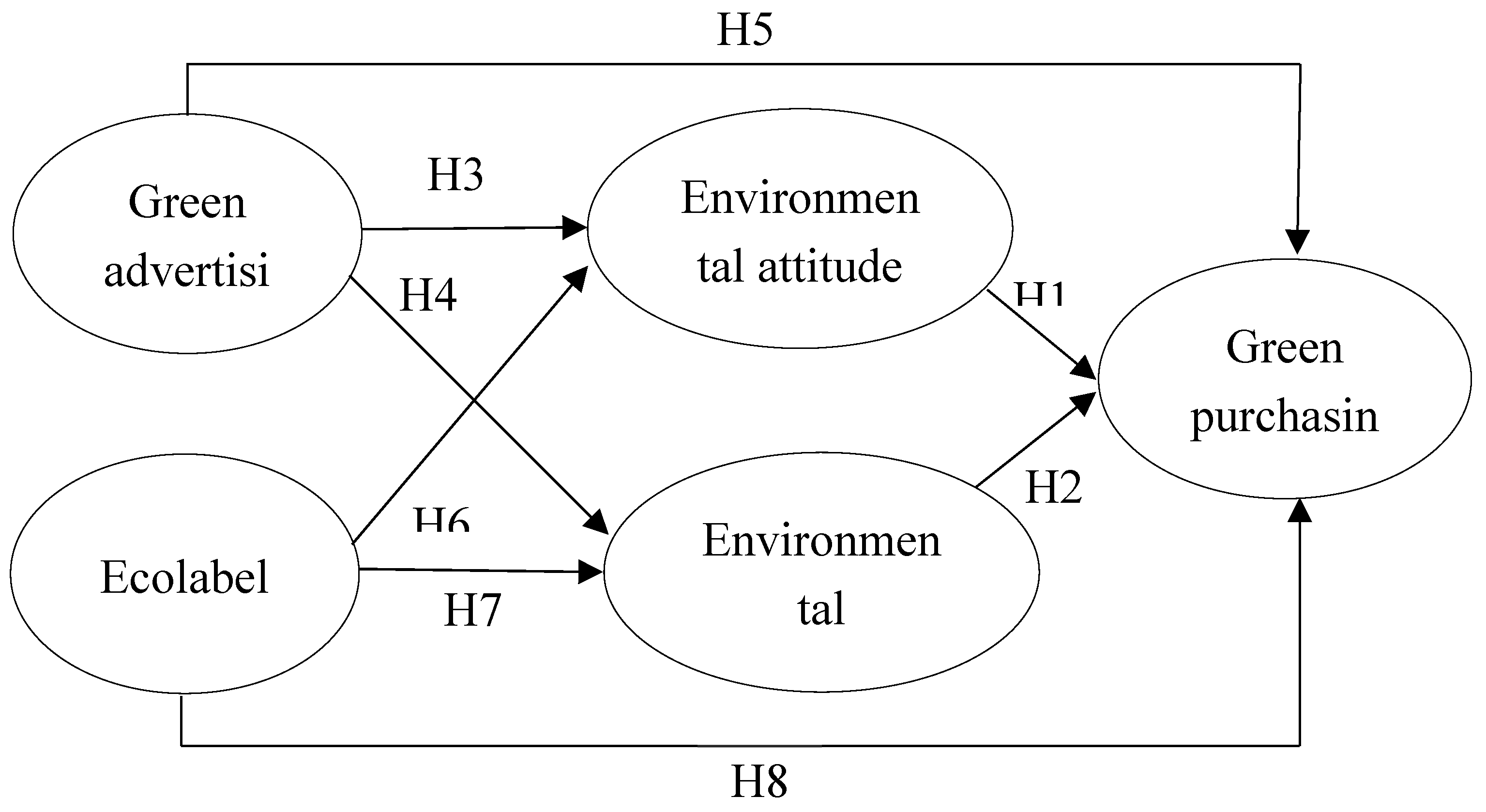
Figure 2.
The figure shows the beta values and significance levels that explain the acceptance and rejection of the relationships tested in the hypothesized model.
Figure 2.
The figure shows the beta values and significance levels that explain the acceptance and rejection of the relationships tested in the hypothesized model.
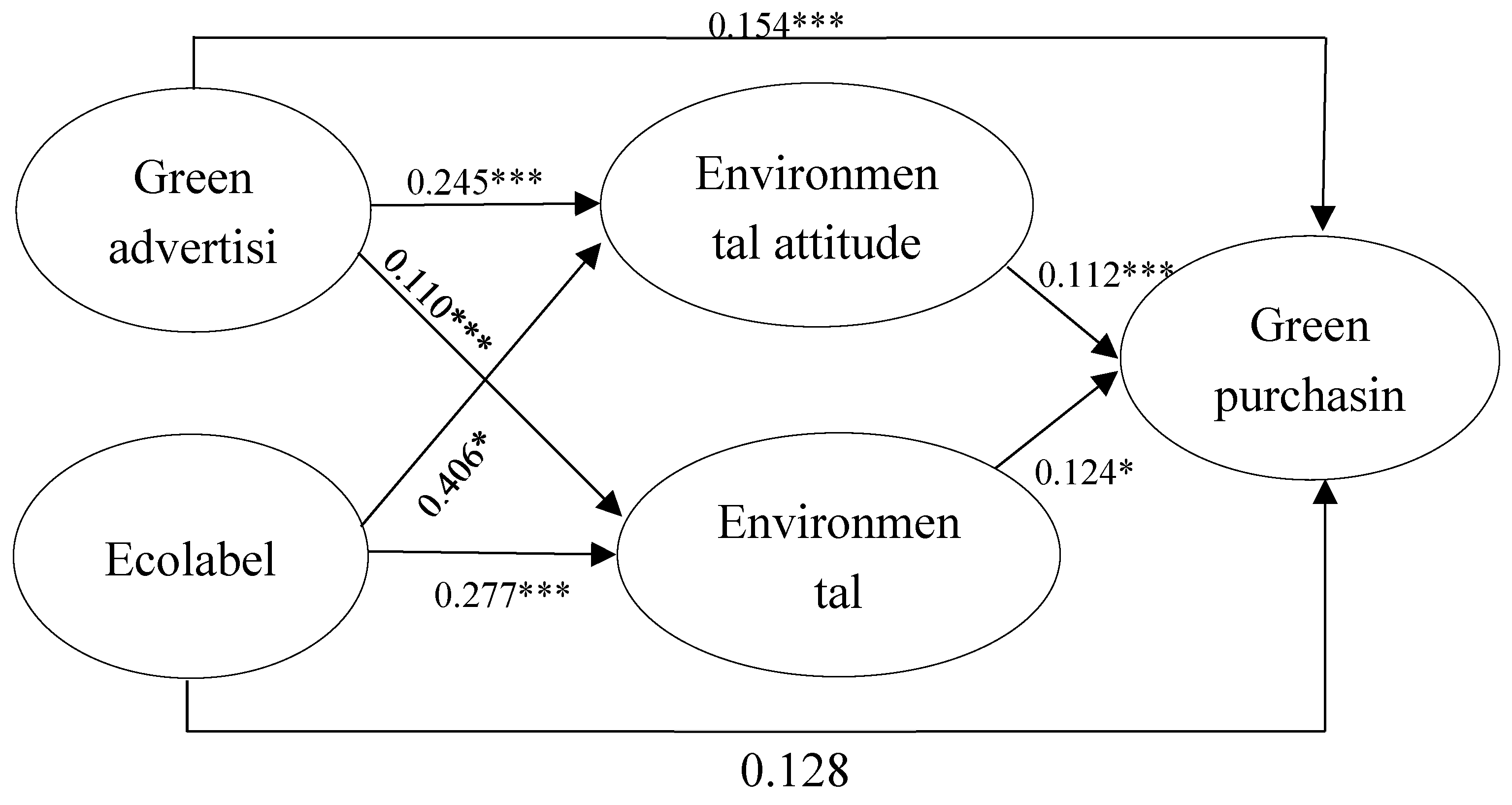

Table 1.
Demographic characteristics of study participants.
| Characteristics | Category | N | % |
|---|---|---|---|
| City | Quito | 218 | 51 |
| Guayaquil | 212 | 49 | |
| Education level | Postgraduate | 155 | 36 |
| Undergraduate | 275 | 64 | |
| Millennial cohort | Older Millennials (35 to 44 years old) | 185 | 43 |
| Mid Millennials (29 to 34 years old) | 130 | 30 | |
| Younger Millennials (23 to 28 years old) | 115 | 27 | |
| Gender | Male | 247 | 57 |
| Female | 183 | 43 | |
| n = 430 | |||
Table 2.
Convergente validity and reliability.
| Variable | Item | Loading factor | Cronbach alpha | CR | AVE |
|---|---|---|---|---|---|
| Environmental attitude (EAT) | EAT1 | 0.955 | 0.943 | 0.948 | 0,86 |
| EAT2 | 0.916 | ||||
| EAT3 | 0.911 | ||||
| Environmental awareness (EAW) | EAW2 | 0.945 | 0.932 | 0.938 | 0.835 |
| EAW3 | 0.871 | ||||
| EAW4 | 0.924 | ||||
| Green purchasing behaviour (GPB) | GPB1 | 0.696 | 0.857 | 0.889 | 0.670 |
| GPB2 | 0.911 | ||||
| GPB3 | 0.730 | ||||
| GPB4 | 0.913 | ||||
| Green advertising (GAD) | GAD2 | 0.906 | 0.881 | 0.894 | 0.739 |
| GAD3 | 0.783 | ||||
| GAD4 | 0.884 | ||||
| Eco-labels (ECL) | ECL1 | 0.866 | 0.825 | 0.864 | 0.680 |
| ECL3 | 0.862 | ||||
| ECL4 | 0.739 | ||||
| Alfa total | 0.824 | ||||
Table 3.
Reliability and validity.
| F1 | F2 | F3 | F4 | F5 | SR AVE | |
|---|---|---|---|---|---|---|
| F1 | 0.860 a | 0.927 | ||||
| F2 | 0.135** | 0.835 a | 0.913 | |||
| F3 | 0.238** | 0.173** | 0.670 a | 0.818 | ||
| F4 | 0.220** | 0.193** | 0.291** | 0.739 a | 0.859 | |
| F5 | 0.105* | 0.224** | 0.137** | 0.048* | 0.680 a | 0.824 |
| a AVE, ** Correlation is significant at 0.01 (bilateral), * Correlation is significant at 0.05 (bilateral). Note: F1: Environmental attitude, F2: Environmental awareness, F3: Green purchasing; F4: Green advertising; F5: Ecolabel. F1-F3; F2-F3; F4-F1; F4-F2; F4-F3; F5-F2, and F5-F3 had significant correlation at bilateral level 0.01. F5-F1 had a significant correlation at bilateral level 0.05 | ||||||
Table 4.
Results of hypotheses testing.
| Hypothesis | Relation | β | p- values | Hypothesis |
|---|---|---|---|---|
| H1 | EAT-GPB | 0.112 | *** | Accepted |
| H2 | EAW-GPB | 0.124 | 0.039* | Accepted |
| H3 | GAD-EAT | 0.245 | *** | Accepted |
| H4 | GAD-EAW | 0.110 | *** | Accepted |
| H5 | GAD-GPB | 0.154 | *** | Accepted |
| H6 | ECL-EAT | 0.406 | 0.010* | Accepted |
| H7 | ECL-EAW | 0.277 | *** | Accepted |
| H8 | ECL-GPB | 0.128 | 0.190 | Rejected |
Disclaimer/Publisher’s Note: The statements, opinions and data contained in all publications are solely those of the individual author(s) and contributor(s) and not of MDPI and/or the editor(s). MDPI and/or the editor(s) disclaim responsibility for any injury to people or property resulting from any ideas, methods, instructions or products referred to in the content. |
© 2023 by the authors. Licensee MDPI, Basel, Switzerland. This article is an open access article distributed under the terms and conditions of the Creative Commons Attribution (CC BY) license (http://creativecommons.org/licenses/by/4.0/).
Copyright: This open access article is published under a Creative Commons CC BY 4.0 license, which permit the free download, distribution, and reuse, provided that the author and preprint are cited in any reuse.


