

Submitted:
05 December 2023
Posted:
06 December 2023
You are already at the latest version
Abstract
The recycling of common soda-lime glass (SLG) is far from being complete, since the material may contain small polymeric, metallic and ceramic contaminations. This has a negative impact on the quality of new glass articles prepared via re-melting. Alternatively, the full reuse of contaminated cullets could be achieved by low-temperature consolidation into geopolymer-like materials. SLG powders, used either as received or pre-washed in acid solution, were added to a sodium aluminate solution at the room temperature for 3 h, under low-speed mechanical stirring. Microporous semi-crystalline monoliths were formed by the casting of suspensions in plastic molds and cured at 75°C overnight. The monoliths featured hydrosodalite as the main crystalline phase for as received SLG and LTA zeolite in the case of pre-washed SLG. The mechanical properties compared well with those of cementitious materials. Moreover, by addition of coarse glass particles as fillers, the methodology successfully yielded Venetian terrazzo-like samples, which could lead to significant material and energy savings in their manufacture. The proposed approach could also be extended to other difficult-to-reuse glass formulations and provide attractive and versatile up-cycled materials.
Keywords:
alkali activation
; geopolymers
; glass waste
; recycling
1. Introduction
Processing of glass waste in 21st century is one of the better-mastered parts of waste management, yet far away from perfected. Only within European Union, on average, more than 18.5 mil tones of glass waste are produced, and more than quarter of this amount remains unaddressed [1] mostly because of specific compositions [2,3,4,5,6] and difficulties emerging during processing of fine fractions of cullet, in which heterogeneous impurities are concentrated [7,8]. These problems are causing serious discrepancy in theoretical energy savings calculated for glass recycling and their comparison to other materials. The energy expense, or embodied energy, per 1 kg of glass is only 10 MJ, which is favourably low compared to 30 MJ per kg of steel or 80 MJ per kg of PET. However, when compared to the material production from virgin resources, using recycled glass is beneficial only by 25% (i.e. in case of aluminium, the saving in embodied energy approaches 90%) [9]. Most of the energy is consumed during the complicated cullet-sorting step [4], which is demotivating for manufacturers.
Easy, cheap and energetically beneficial way of cullet processing could boost the interest of manufacturers in glass recycling and reduce the amount of glass waste. One of the promising ways to process inorganic wastes of beneficial Si/Al ratio is their partial dissolution in alkaline solution, and formation of geopolymers through subsequent condensation reactions at ambient temperature leading to the formation of stable three-dimensional alumino-silicate networks with varying degrees of connectivity [10]. Geopolymers are attractive products for the construction industry [6,11,12,13,14], and even though these studies yielded chemically safe products with excellent mechanical properties, the actual implementation on a large scale is oftentimes limited due to the need for economically and ecologically expensive additives, such as alkali silicates [15]. These additives create a basic environment, essential for the partial dissolution of material and at the same time adjust the final composition supplying part of the missing so-called “active silica”, necessary for the formation of stable geopolymers [13]. However, alkali silicates can be replaced, as shown by Toniolo et al. [16] who successfully prepared geopolymers from soda-lime glass (SLG) and fly ash (FA), through activation in NaOH solutions of different molarities.
As NaOH is comparatively much cheaper and its use yields promising results [5,11,14,17,18], it could be beneficial to pay attention to other cheap chemicals as well. At the same time, it could also be beneficial to explore products based on a single waste stream, due to the generally unpredictable waste production volume, which is one of the most criticized factors in waste-based geopolymers production [13]. Since most glasses feature a high SiO2/Al2O3 ratio, an alumina supply would be needed such as the one provided when using NaAlO2 as an activator [19,20,21].
NaAlO2 is cheaper by nearly two-thirds compared to sodium metasilicate (data obtained through market survey). It can be used for the production of geopolymers from silica waste, as shown in the work of Brew and MacKenzie [22]. The combination of silica fume and NaAlO2 solution yields well-defined, thoroughly polycondensed geopolymers. This study, alongside with Greiser et al. [23], confirmed the formation of geopolymers, by means of NMR analysis, observing the simultaneous presence of tetrahedral 27Al and 29Si Q4 units, forming a three-dimensional network alumino-silicate network as generally observed for more conventional geopolymers [24,25,26]. Different by-products beside sodium aluminosilicate gel might be formed, with possible effects on the particular application of resulting geopolymers [27,28]. Moreover, since the geopolymer formation depends on the kinetics of the dissolution reaction, the presence of readily available silica and its combination to achieve an ideal Si/Al ratio might lead to full conversion of material into sodium alumino-silicate, which could lead to a final material with improved engineering properties [23].
In the hypothesis of reaction between NaAlO2 and glass cullet, it must be noted that commercial glasses contain, besides glass network forming oxides, also glass network modifiers, particularly sodium oxide in the case of SLG. It can therefore be expected that, during alkali-activation, Na+ ions are released into solution, and their excess could cause insufficient polymerization of the gels [20]. However, if Na+ ions were extracted prior geopolymerization (i.e. by acid extraction), in the sites of excess charge a hydrated silica phase (reactive silica) would be formed [19] and this could enhance the connectivity of the alumino-silicate network.
In our research, we compare geopolymers prepared from SLG waste, in the form of fine powders, which were used either as received or pre-washed in acid solution. These powders were activated by NaAlO2. In both cases, both LTA zeolite and hydrosodalite were detected as crystal phases; the pre-washing step of SLG enhanced the formation of LTA zeolite and the network connectivity (as demonstrated by studying the Na+ leaching). The SLG/ NaAlO2 mixture was exploited also as a binder for coarse SLG particles, to further improve the sustainability of the proposed process.
2. Materials and Methods
Discarded soda-lime glass fine powders (SLG, mean particle size 30 µm, courtesy SASIL Srl, Biella, Italy; 71.6 SiO2-1.0 Al2O3-13.5 Na2O-0.4 K2O-3.9 MgO-9.0 CaO-0.1 FeO in wt.%) and sodium aluminate aqueous solution (45 wt.%, NaAlO2 reagent grade, Sigma Aldrich, Gillingham, UK) were the only constituents used in this study.
Two different approaches were tested. In the first approach, SLG powder was cast into a NaAlO2 solution in 50/50 solid/liquid ratio, the suspension was mechanically mixed at 300 rpm for 3 hours, and then poured in closed polystyrene moulds and left at 75°C overnight. In the second approach, SLG powders were subjected to a preliminary washing (‘pre-washing’) step, consisting of the immersion of the same powders, for 3 hours, in an aqueous solution at pH=5, obtained by HCl addition. The pH of the solution was continuously monitored (by means of a pH probe) and kept constant by the dropwise addition of HCl. The glass acid suspensions were centrifuged, washed 6-times in demineralized water (DIW) and finally filtered and dried at 40°C overnight. Afterwards, the pre-washed SLG powders were cast into NaAlO2 solution, and samples were prepared as described above.
The mineralogical analysis on all samples was performed by X-ray diffraction (XRD; Bruker D8 Advance, Karlsruhe, Germany - CuKα radiation, 0.15418 nm, 40 kV-40 mA, 2θ =10-70°, step size 0.05°, 2 s counting time). The phase identification was performed using the semi-automatic Match! ® program package (Crystal Impact GbR, Bonn, Germany), supported by data from the PDF-2 database (ICDD-International Centre for Diffraction Data, Newtown Square, PA, USA). Scanning electron microscopy (SEM, FEI Quanta 200 ESEM, Eindhoven, The Netherlands) was employed for the morphological and microstructural characterizations.
Solid state NMR spectra acquired on finely powdered samples were collected on a Varian 400 spectrometer equipped with a narrow bore, triple resonance T3 Magic Angle Spin (MAS) probe spinning 4 mm rotors and operating at 1H, 27Al and 29Si frequencies of 400.36, 104.32 and 79.53 MHz, respectively. The nominal temperature of the probe was always set to 298 K. Single pulse spectra were acquired at 10 kHz MAS with 800 scans for 27Al and 12 kHz MAS with 1248 scans for 27Al. The repetition delay was set to 2 and the chemical shifts were referenced against aluminium nitrate (27Al) and Q8M (29Si).
The geometric density was evaluated by considering the mass-to-volume ratio of cubic samples (5 mm × 5 mm × 5 mm) and bars (approximately 2 mm × 2 mm × 25 mm) cut from larger specimens. The same samples were used for the determination of elastic modulus, by means non-destructive dynamic resonance testing (GrindoSonic Mk5, Leuven, Belgium), and bending strength (Instron 1121 UTS, Instron, Danvers, MA, operating in a three-point configuration - 16 mm span - with a crosshead speed of 0.5 mm/min). Each data point represents an average value obtained by testing ten specimens.
3. Results and Discussion
The consolidation of glass suspension yielded samples in the form of thick discs, as shown in Figure 1a, which were easily extracted from the polystyrene containers. The achievement of stable geopolymer-like materials was preliminarily assessed by a boiling test, in which the monolithic pieces (4 g each) were boiled in 500 ml of DIW for 30 min. For both types of samples, prepared either from as received or pre-washed SLG, no disintegration or dissolution was observed.
The microstructural details of the fracture surfaces of geopolymer-like samples are shown in Figure 2. The microstructure is homogeneous, consisting of a micro-porous gel (binder) connecting unreacted glass particles, irregularly shaped owing to the original crushing of glass cullet. Samples from as received SLG, shown in Figure 2a, still contain recognizable starting cullet particles. We could assume that a fracture propagating across the gel and glass particles might preferentially expose glass surfaces uncovered by the binder. However, at the higher magnifications (see Figure 2b), no interfacial crack was observed, proving that a strong bond between the binder and particles existed. The many pores shown by Figure 2a,b resulted in a total porosity of about 36%, mostly open, as reported by Table 1.
Geopolymer-like material from pre-washed SLG, shown in Figure 2c, shows less visible cullet particles; the glass fragments exhibited a substantial surface texturing, as shown in the magnified image in Figure 2d. In this case also, the crack propagated mostly in the binder phase. Also in this case the porosity was quite abundant; as reported in Table 1, the porosity was even enhanced (44% total porosity, still mostly open). According to the mineralogical analysis, the differences in the starting glass powders affected the phase evolution. The XRD patterns in Figure 3a show that the starting SLG contained some quartz traces (PDF #46-1045), consistent with the above-mentioned contaminations of discarded cullet fractions. The reaction of SLG with NaAlO2 is testified by the shifting of the amorphous halo, characteristic of silica-based glasses, to higher 2θ angles, known to be correlated, in a glass, with the incorporation of network modifiers [29,30]. Indeed, it can be noted that before the activation the halo was centred at a 2θ value ~25°, while it moved to ~30° after activation). In addition, the reaction led to the precipitation of both hydrosodalite (Na8Si6Al6O24(OH)2]·2 H2O, PDF #72-2329) and zeolite LTA (Na12[(SiO2)12(AlO2)12]·27 H2O, PDF #73-2340) crystals.
The formation of zeolite LTA was enhanced by the use of pre-washed glass. This was expected, since acid attack is known to determine the removal of alkali ions from the glass surface, transforming it into a hydrated silica layer [31]. The Na/Al/Si atomic balance in zeolite LTA (Na/Al/Si=1/1/1) effectively matches the hypothesis of equimolar reaction between NaAlO2 and (hydrated) silica (1 NaAlO2 + 1 SiO2). This is in a good agreement with what was observed in geopolymer composites obtained from the reaction between NaAlO2 and silica fume [23,32]. On the contrary, hydrosodalite features an alkali excess (Na/Al/Si=4/3/3) that could be explained as the effect of Na+ inclusions in the binder, originating from NaAlO2 and dissolved glass.
The more significant evidence of the formation of a (semi-crystalline) geopolymer-like alumino-silicate gel, binding unreacted SLG particles, came from the NMR spectroscopy. The 27Al NMR spectra, shown in Figure 4, featured strong peaks centred around 60 ppm, consistent with the presence of Al ions in tetrahedral coordination (AlIV), forming a SiIV-O-AlIV network (with Na+ fundamental for the stabilization of AlO4 units, by charge compensation), as in conventional geopolymers [33]. The tetrahedral coordination and a strong 27Al NMR peak centred around 60 ppm coordination are also typical of the crystal phases [34,35]. A full reaction of NaAlO2 can be assumed from the absence of the characteristic peak at δ~80 ppm [23]. Both samples also contained some Al in five-fold coordination (δ~74 ppm), as found in other alumino-silicate gels [26]. The signal was weaker for the sample from pre-washed SLG, compared to that from as received glass, which conversely exhibited as small peak at δ~10 ppm, consistent with six-fold coordinated Al ions, attributable to Al(OH)3. The latter side-product had been previously noted in gels from silica/NaAlO2 interaction [22].
The strong peak at δ~60 ppm had itself some differences passing from samples deriving from as received SLG to the ones prepared from pre-washed SLG. In fact, the peak can be attributed to the overlapping of two signals, a main peak and a shoulder positioned at δ~58 ppm and δ~61 ppm, respectively. The sample from pre-washed SLG contained an enhanced ordering of AlO4 units, considering the dominating contribution δ~58 ppm [23], while the peak at δ~61 ppm is typical of less ordered units [26].
Additional information was given by the 29Si spectra, shown in Figure 5. The broad peak was affected by zeolite signals, as previously found in the literature [23,24,25,26,33]. The signal at δ~-86 ppm (marked by a green arrow) is consistent the presence of hydrosodalite, which is dominant in the sample prepared from as received SLG. Similarly, the presence of zeolite LTA is confirmed by the signal at δ~-89 ppm (marked by a red arrow), prevalent in the sample prepared from pre-washed SLG.
Figure 5a suggests possible contributions to the broad peak from Q4 species derived from different Si-O-Al structures, in the alumino-silicate gel (the binder). Signals at δ~-84 ppm, δ~-91 ppm, δ~-96 and δ~-102 ppm are assigned to Si-based Q4 units surrounded by 4 Al ions (Q4 4Al), 3 Al ions (Q4 3Al), 2 Al ions (Q4 2Al) and a single Al ion, respectively [23]. Q4 4Al structures appear dominant in the sample from pre-washed SLG, whereas samples from as received SLG contained more of Q4 3Al and Q4 2Al.
A quantification of the contributions to NMR spectra is hardly applicable, considering the presence of Na+ and Ca2+ ions in SLG. In particular, as shown in Figure 5b, signals at δ~-84 ppm and δ~-93 ppm could be assigned to both Q2 and Q3 units [31]. Interestingly, the geopolymers from pre-washed SLG did not present the shoulder attributable to Q2 and exhibited a weak shoulder at δ~-107 ppm, consistent with Q4 units. In our opinion, the difference is due to the previously mentioned alkali excess in the gel, for the as received SLG. The excess of Na+ compared to Al and Si ions reasonably led to the formation of a less polymerized gel.
The polymerization degree of the alumino-silicate network, in alumino-silicate glasses as well as in geopolymers, affects the mobility of alkali ions. Figure 6 shows the evolution of the pH value of distilled water, initially at pH=7, after the immersion of crushed (<2 mm) geopolymers. The samples from as received SLG immediately reached pH=10, then the pH later increased to a plateau at 12.5.
The samples prepared from the pre-washed SLG recorded a progressive increase of pH, from 7 to 12.5, within 10 minutes from the beginning of experiment. This is reasonable, since the alkali release is typical of geopolymers [37]; anyway, the delay observed at the early stage of the immersion experiment can be motivated by the reduced overall sodium content and by a more polymerized gel, using acid-treated glass particles. The delay could be easily verified even by simple hand contact of bulk pieces: samples from pre-washed SLG were not slippery as those from as-received SLG (in the latter samples, the sudden release of alkali likely induced saponification of epidermal fats).
Table 1 reports data from the preliminary mechanical tests on the obtained ‘glass-based’ geopolymers. The samples from acid treated SLG featured a lower modulus and a lower bending strength, compared to those from as received SLG. However, they were also significantly more porous. Anyway, both materials compared well with recognized construction materials, such as lightweight concrete, and natural stones, such as marble and granite (data extracted from the Cambridge Engineering Selector database [38]), in terms of I and I’ material indices. These indices (I=E1/3/ρ, or I’=σb1/2/ρ) are expected to be maximized for the construction of light and stiff, or light and strong, panels [39]. The newly formed materials exhibited also a good crushing strength (σc), comparable to that of normal and lightweight concrete (the strength-to-density ratio was even higher).
The above-documented cold consolidation of fine glass powder could be exploited beyond the manufacturing of monolithic (or foamed) pieces. For the sake of sustainability, we tested the method also for binding larger SLG granules (300-1400 µm). Diluting the mixture based on SLG fine powders by 50 wt%, with coarse granules, implied definite savings in the activating solution (the overall NaAlO2/SLG ratio passed from 0.31 to 0.14, with 1 g fine SLG corresponding to 0.31 g NaAlO2 and 1.31 g coarse SLG). Extra energy expenses were limited (fine SLG, as written above, came as a waste by-product of the refining of glass cullet; coarse SLG came from crushing of large fragments of container glass, followed by sieving).
The casting of coarse granules in NaAlO2-activated suspensions of fine powders was followed by sonication (5 min). Such treatment led to a homogenous packing of the filler particles, as shown by Figure 1b; it can be noted that the obtained composites had a pleasant aesthetic appearance, resembling that of ‘terrazzo’ tiles [40], with different colours of the large glass fragments resulting from avoiding any expensive sorting step for the glass cullet.
The filler particles had a homogenous packing in all dimensions, as demonstrated by the polished cross-sections shown in Figure 7a. The good bonding of filler particles in the matrix from as-received fine glass powders is confirmed by Figure 7b, showing a crushed piece: it is evident that the fracture propagated mostly in the gel, but it could even pass across coarse particles, without pull-out. Using as-received fine SLG powders resulted in efflorescence at the polished surface, shown in Figure 7c: according to energy dispersive X-ray spectroscopy (not shown), the efflorescence corresponded to the formation of hydrated sodium carbonate, in turn consistent with the lower stabilization of alkali in the gel formed with not acid-treated glass.
Efflorescence is quite typical in geopolymers, and it may be prevented by the introduction of additives (as an example, Provis and co-workers discussed the increase of alumina content in the gel by the addition of Ca aluminate [41] or slag [42]). Interestingly, samples from coarse particles immersed in a gel from acid-treated SLG did not present any efflorescence (Figure 7d). The fracture was confirmed to pass mostly through the gel (Figure 7e), with no pull-out; in addition, the surface of coarse particles presented some texturing (Figure 7f), which could be interpreted as an evidence of reaction with the surrounding gel.
The present investigation is undoubtedly preliminary and further studies will be performed, in the future, to assess the evolution of strength with time and to study the impact of coarse particles (we did not apply any mechanical test on ‘terrazzo-like’ samples considering their limited dimensions: for the sake of data reliability, the thickness should far exceed the size of the fillers). Anyway, we think that the use of a SLG-based binder is promising also for the incorporation of fragments from other types of glass that are currently landfilled (e.g., glasses from dismantled cathode ray tubes, artistic - even Pb-based - glasses, opal glasses, slag-derived glasses). Finally, the activation with NaAlO2 solutions could be also applied to glasses containing Al2O3 and B2O3 (e.g., fiber glass, pharmaceutical glasses); in this case, the stabilization of alkali ions in the gel could be enhanced by the formation of [AlO4] and [BO4] tetrahedral units [6].
4. Conclusions
We may conclude that:
- The combination of fine soda-lime glass powders with NaAlO4 aqueous solutions has a great potential for the production of components based on stable Na-alumino-silicate gels;
- The glass-solution interaction led to semi-crystalline gels, comprising hydrosodalite and LTA zeolite; the formation of AlO4 units (stabilized by alkali ions) was confirmed by means of NMR analysis;
- The process can be tuned by subjecting the SLG glass powders to an acid washing pre-treatment; (surface) de-alkalinized powders led to gels with enhanced content of LTA zeolite, less prone to alkali release;
- The sustainability of the process may be significantly enhanced by using fine soda-lime glass powders with NaAlO4 aqueous solutions for the development of a binder phase connecting coarse glass granules, leading to components with pleasant aesthetic appearance; furthermore, Na-carbonate efflorescence was not present when using a binder containing acid-washed soda-lime glass powders.
Author Contributions
Investigation and formal analysis, Durgaprasad D. Ramteke; data curation, writing- original draft, review and editing Miroslava Hujova, Hamada Elsayed Enrico Bernardo; supervision Enrico Bernardo and Paolo Colombo; project administration and funding acquisition Dusan Galusek. All authors have read and agreed to the published version of the manuscript.
Funding
This paper is a part of dissemination activities of the FunGlass project (Centre for Functional and Surface Functionalized Glass). This project received funding from the European Union´s Horizon 2020 research and innovation programme under grant agreement No 739566.
Institutional Review Board Statement
Not applicable.
Informed Consent Statement
Not applicable.
Acknowledgments
The authors acknowledge the support from Mr. Riccardo Cavinato (Department of Industrial Engineering, University of Padova) and Prof. Federico Rastrelli (Department of Chemical Sciences, University of Padova) for experimental assistance.
Conflicts of Interest
The authors declare no conflict of interest.
References
- Silva, R.V.; De Brito, J.; Lye, C.Q.; Dhir, R-K. The role of glass waste in the production of ceramic-based products and other applications: A review. J. Clean. Prod. 2017, 167, 346–364. [Google Scholar] [CrossRef]
- Ramteke, D.D.; Hujova, M.; Kraxner, J.; Galusek, D.; Rincon Romero, A.; Bernardo, E. Up-cycling of ‘unrecyclable ’ glasses in glass -based foams by weak alkali- activation, gel casting and low-temperature sintering. J. Clean. Prod. 2021, 278, 123985. [Google Scholar] [CrossRef]
- Kim, K.; Kim, K.; Hwang, J. Characterization of ceramic tiles containing LCD waste glass. Ceram. Int. 2016, 42, 7626–31. [Google Scholar] [CrossRef]
- Rincon Romero, A.; Giacomello, G.; Pasetto, M.; Bernardo, E. Novel ‘inorganic gel casting’ process for the manufacturing of glass foams. J. Eur. Ceram. Soc. 2017, 37, 2227–34. [Google Scholar] [CrossRef]
- Rincon Romero, A.; Marangoni, M.; Cetin, S.; Bernardo, E. Recycling of inorganic waste in monolithic and cellular glass-based materials for structural and functional applications. J. Chem. Technol. Biotechnol. 2016, 91, 1946–61. [Google Scholar] [CrossRef]
- Taveri, G.; Tousek, J.; Bernardo, E.; Toniolo, N.; Boccaccini, A.R.; Dlouhy, I. Proving the role of boron in the structure of fly-ash / borosilicate glass based geopolymers. Mater. Lett. 2017, 200, 105–8. [Google Scholar] [CrossRef]
- Waguchi, M.; Kato, T.; Imamura, Y.; Yoshida, N.; Aoki, S. Challenge to improve glass melting and fining process. Ceram. Silikaty 2008, 52, 218–24. [Google Scholar]
- Idir, R.; Cyr, M.; Tagnit-Hamou, A. Pozzolanic properties of fine and coarse color-mixed glass cullet. Cem. Concr. Compos. 2011, 33, 19–29. [Google Scholar] [CrossRef]
- Ashby, M.F. Materials and Environment. Buttersworth-Heinemann, Oxford, UK, 2013.
- Fletcher, R.A.; Mackenzie, K.J.D.; Nicholson, C.L.; Shimada, S. The composition range of aluminosilicate geopolymers. J. Eur. Ceram. Soc. 2015, 25, 1471–7. [Google Scholar] [CrossRef]
- Strozi, M.; Colombo, P.; Raymundo, M. Geopolymer foams by gelcasting. Ceram. Int. 2014, 40, 5723–30. [Google Scholar] [CrossRef]
- He, J.; Zhang, J.; Yu, Y.; Zhang, G. The strength and microstructure of two geopolymers derived from metakaolin and red mud-fly ash admixture: A comparative study. Constr. Build. Mater. 2012, 30, 80–91. [Google Scholar] [CrossRef]
- Provis, J.L. Geopolymers and other alkali activated materials: why, how, and what ? Mater. Struct. 2014, 47, 11–25. [Google Scholar] [CrossRef]
- Bai, C.; Li, H.; Bernardo, E.; Colombo, P. Waste-to-resource Preparation of Glass-containing Foams from Geopolymers Waste-to-resource preparation of glass-containing foams from geopolymers. Ceram. Int. 2019, 45, 7196–202. [Google Scholar] [CrossRef]
- Toniolo, N.; Boccaccini, A.R. Fly ash-based geopolymers containing added silicate waste. A review. Ceram. Int. 2017, 43, 14545–51. [Google Scholar] [CrossRef]
- Rincón Romero, A.; Toniolo, N.; Boccaccini, A.R.; Bernardo, E. Glass-Ceramic Foams from ‘Weak Alkali Activation’ and Gel-Casting of Waste Glass/Fly Ash Mixtures. Materials 2019, 12, 588. [Google Scholar] [CrossRef] [PubMed]
- Hajjaji, W.; Andrejkovičová, S.; Zanelli, C.; Alshaaer, M.; Dondi, M.; Labrincha, J.A.; Rocha, F. Composition and technological properties of geopolymers based on metakaolin and red mud, Mat. & Des. 2013, 52, 648–54. [Google Scholar]
- Rincón Romero, A.; Elsayed, H.; Bernardo, E. Highly porous mullite ceramics from engineered alkali activated suspensions. J. Am. Ceram. Soc. 2017, 101, 1036–41. [Google Scholar] [CrossRef]
- Sturm, P.; Greiser, S.; Gluth, G.J.G.; Jäger, C.; Brouwers, H.J.H. Degree of reaction and phase content of silica-based one-part geopolymers investigated using chemical and NMR spectroscopic methods. J. Mater. Sci. 2015, 50, 6768–78. [Google Scholar] [CrossRef]
- Greiser, S.; Sturm, P.; Gluth, G.J.G.; Hunger, H.; Jäger, C. Differentiation of the solid-state NMR signals of gel, zeolite phases and water species in geopolymer-zeolite composites. Ceram. Int. 2017, 43, 2202–8. [Google Scholar] [CrossRef]
- Phair, J.W.; Van Deventer, J.S.J. Characterization of Fly-Ash-Based Geopolymeric Binders Activated with Sodium Aluminate. Ind. Eng. Chem. Res. 2002, 41, 4242–51. [Google Scholar] [CrossRef]
- Brew, D.R.M.; Mackenzie, K.J.D. Geopolymer synthesis using silica fume and sodium aluminate. J. Mater. Sci. 2007, 42, 3990–3. [Google Scholar] [CrossRef]
- Greiser, S.; Gluth, G.J.G.; Sturm, P.; Jäger, C. 29Si{27Al}, 27Al{29Si} and 27Al{1H} double-resonance NMR spectroscopy study of cementitious sodium aluminosilicate gels (geopolymers) and gel-zeolite composites. RSC Adv. 2018, 70, 40164–71. [Google Scholar] [CrossRef]
- Singh, P.S.; Trigg, M.; Burgar, I.; Bastow, T. Geopolymer formation processes at room temperature studied. Mat. Sci. Eng. A 2005, 396, 392–402. [Google Scholar] [CrossRef]
- Katada, N.; Nakata, S.; Kato, S.; Kanehashi, K.; Saito, K.; Niwa, M. Detection of active sites for paraffin cracking on USY zeolite by Al MQMAS NMR operated at high magnetic field 16 T. J. Mol. Cat. A: Chem. 2005, 236, 239–45. [Google Scholar] [CrossRef]
- Walkley, B.; Rees, G.J.; Nicolas, R.S.; Van Deventer, J.S.J.; Hanna, J.V.; Provis, J.L. New Structural Model of Hydrous Sodium Aluminosilicate Gels and the Role of Charge-Balancing Extra-Framework Al. J. Phys. Chem. C 2018, 122, 5673–85. [Google Scholar] [CrossRef]
- Herisson, J.; Guéguen-Minerbe, M.; van Hullebusch, E.D.; Chaussadent, T. Influence of the binder on the behaviour of mortars exposed to H2S in sewer networks: a long-term durability study. Mater. Struct. 2016, 50, 8. [Google Scholar] [CrossRef]
- Herisson, J.; Guéguen-Minerbe, M.; van Hullebusch, E.D. Chaussadent, Behaviour of different cementitious material formulations in sewer networks. Water Sci. Technol. 2014, 69, 1502–8. [Google Scholar] [CrossRef] [PubMed]
- Luukkonen, T.; Abdollahnejad, Z.; Yliniemi, J.; Kinnunen, P.; Illikainen, M. One-part alkali-activated materials: A review. Cem. Concr. Res. 2017, 103, 21–34. [Google Scholar] [CrossRef]
- Hemmings, R.; Berry, E. On the glass in coal fly ashes: recent advances. Mater. Res. Soc. Symp. Proc. 1988, 113, 3–38. [Google Scholar] [CrossRef]
- Bunker, B.C.; Headley, T.J.; Douglas, S.C. Gel Structures in Leached Alkali Silicate Glass. Mater. Res. Soc. Symp. Proc. 1984, 32, 41. [Google Scholar] [CrossRef]
- Simion, A.; Vasilescu, M.; Filip, C.; Todea, M.; Muresan-Pop, M.; Simon, S. Structural characterization of interfaces in silica core-alumina shell microspheres by solid-state NMR spectroscopy, Sol. St. Nucl. Mag. Res. 2022, 117, 101773. [Google Scholar] [CrossRef] [PubMed]
- Man, P.P.; Peltre, M.J.; Barthomeuf, D. Nuclear Magnetic Resonance Study of the Dealumination of an Amorphous Silica-Alumina Catalyst. J. Chem. Soc., Faraday Trans., 1990, 86, 1599–602. [Google Scholar] [CrossRef]
- Price, L.; Leung, K.; Sartbaeva, A. Local and Average Structural Changes in Zeolite A upon Ion Exchange. Magnetochem. 2017, 3, 42. [Google Scholar] [CrossRef]
- Günther, C.; Richter, H.; Voigt, I.; Michaelis, A.; Tzscheutschler, H.; Krause-Rehberg, R.; Serra, J.M. Synthesis and characterization of a sulfur containing hydroxy sodalite without sulfur radicals. Micropor. Mesopor. Mater. 2015, 214, 1–7. [Google Scholar] [CrossRef]
- Jones, A.R.; Winter, R.; Greaves, G.N.; Smith, I.H. MAS NMR study of soda-lime-silicate glasses with variable degree of polymerization. J. Non-Cryst. Sol. 2001, 295, 87–92. [Google Scholar] [CrossRef]
- Delair, D.; Prud’homme, E.; Peyratout, C.; Smith, A.; Michaud, P.; Eloy, L.; Joussein, E.; Rossignol, S. Durability of inorganic foam in solution: The role of alkali elements in the geopolymer network. Corros. Sci. 2012, 59, 213–21. [Google Scholar] [CrossRef]
- Ansys CES (Cambridge Engineering Selector) Granta EduPack, 2022.
- Ashby, M.F. Materials selection in mechanical design, vol. 86, no. 10. Elsevier Ltd., 1994.
- Al-Zboon, K.; Tahat, M.; Abu-Hamatteh, Z.S.H.; Al-Harahsheh, M.S. Recycling of stone cutting sludge in formulations of bricks and terrazzo tiles. Waste Manag. Res. 2010, 28, 568–574. [Google Scholar] [CrossRef]
- Najafi Kani, E.; Allahverdi, A.; Provis, J.L. Efflorescence control in geopolymer binders based on natural pozzolan. Cem. Concr. Compos. 2012, 34, 25–33. [Google Scholar] [CrossRef]
- Zhang, Z.; Wang, H.; Provis, J.L.; Reid, A. Efflorescence: a critical challenge for geopolymer applications? in ‘Institute of Australia’s Biennial National Conference (Concrete 2013): Understanding Concrete’.
Figure 1.
a) Sample prepared via low-temperature consolidation of fine SLG powders activated in NaAlO2 solution and; b) example of composite comprising coarse glass fragments.
Figure 1.
a) Sample prepared via low-temperature consolidation of fine SLG powders activated in NaAlO2 solution and; b) example of composite comprising coarse glass fragments.
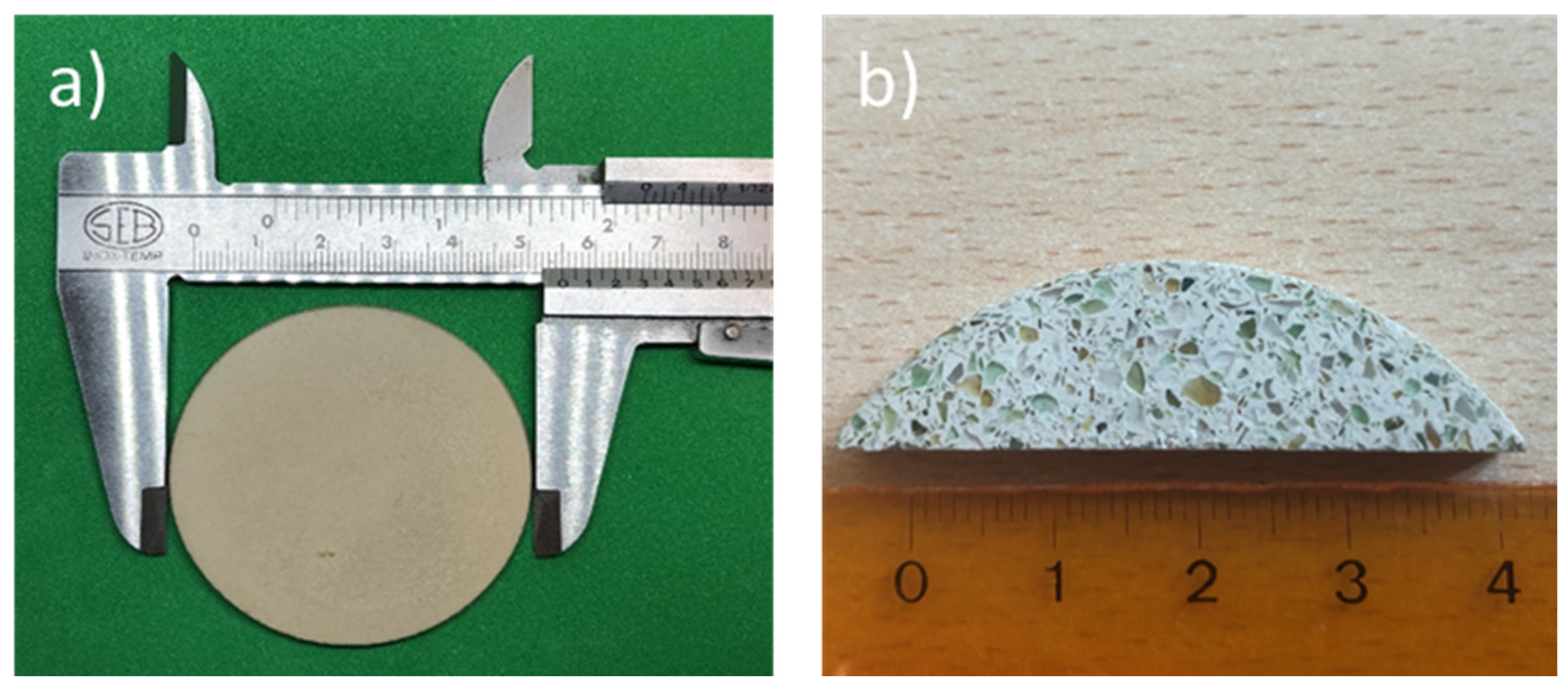
Figure 2.
a,b) sample prepared from as received SLG, arrows highlighting the SLG cullet particles in binder phase; c,d) sample prepared from pre-washed SLG.
Figure 2.
a,b) sample prepared from as received SLG, arrows highlighting the SLG cullet particles in binder phase; c,d) sample prepared from pre-washed SLG.
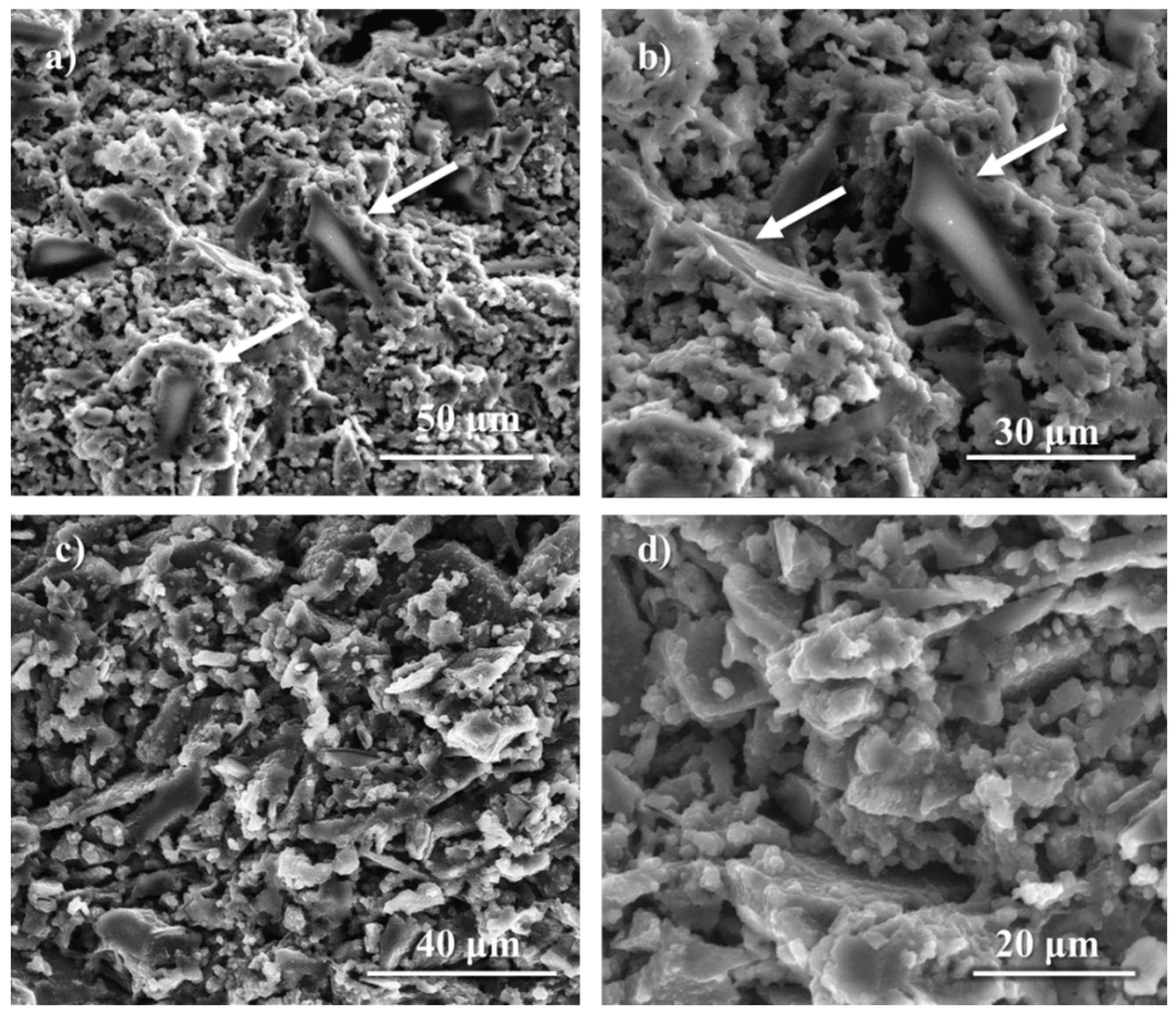
Figure 3.
X-ray diffraction patterns of a) SLG as received and pre-washed; b) geopolymer-like samples prepared from respective material.
Figure 3.
X-ray diffraction patterns of a) SLG as received and pre-washed; b) geopolymer-like samples prepared from respective material.
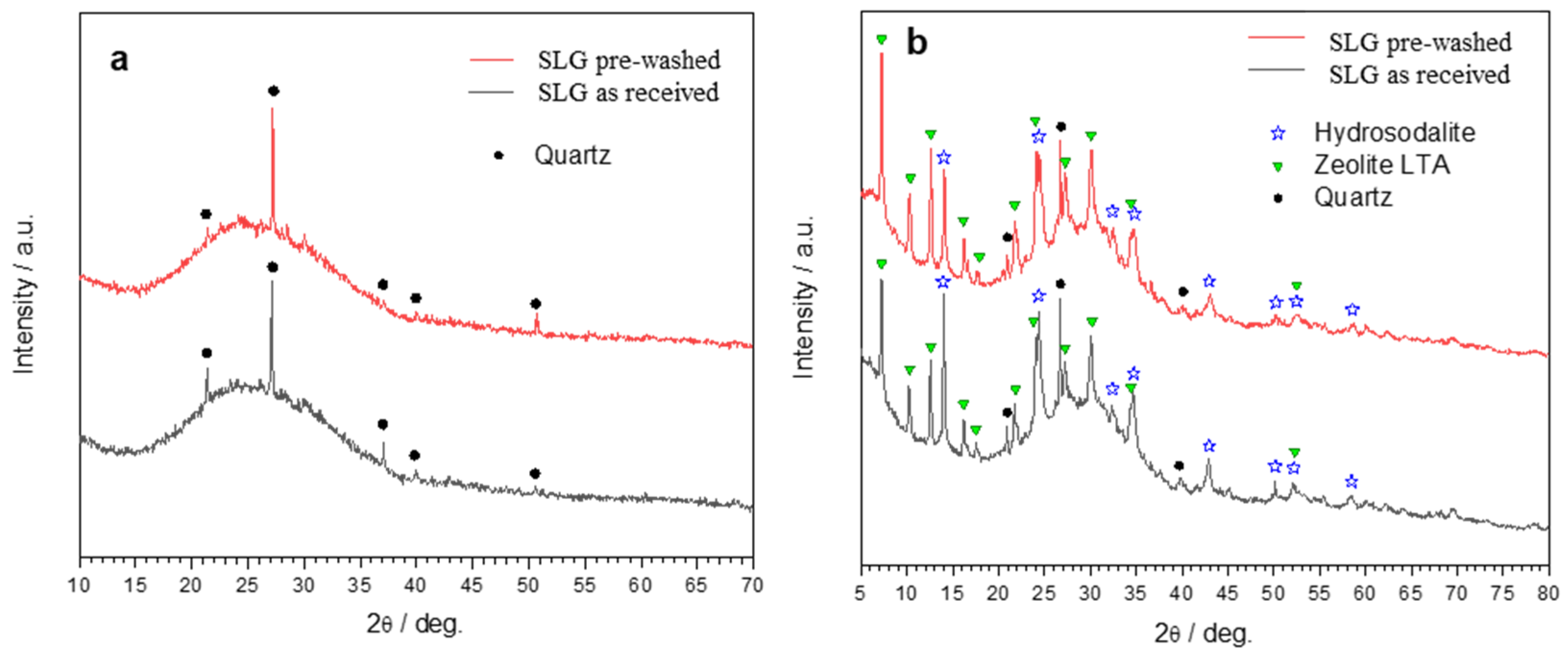
Figure 4.
27Al NMR spectra of geopolymers prepared from as received SLG and pre-washed SLG.
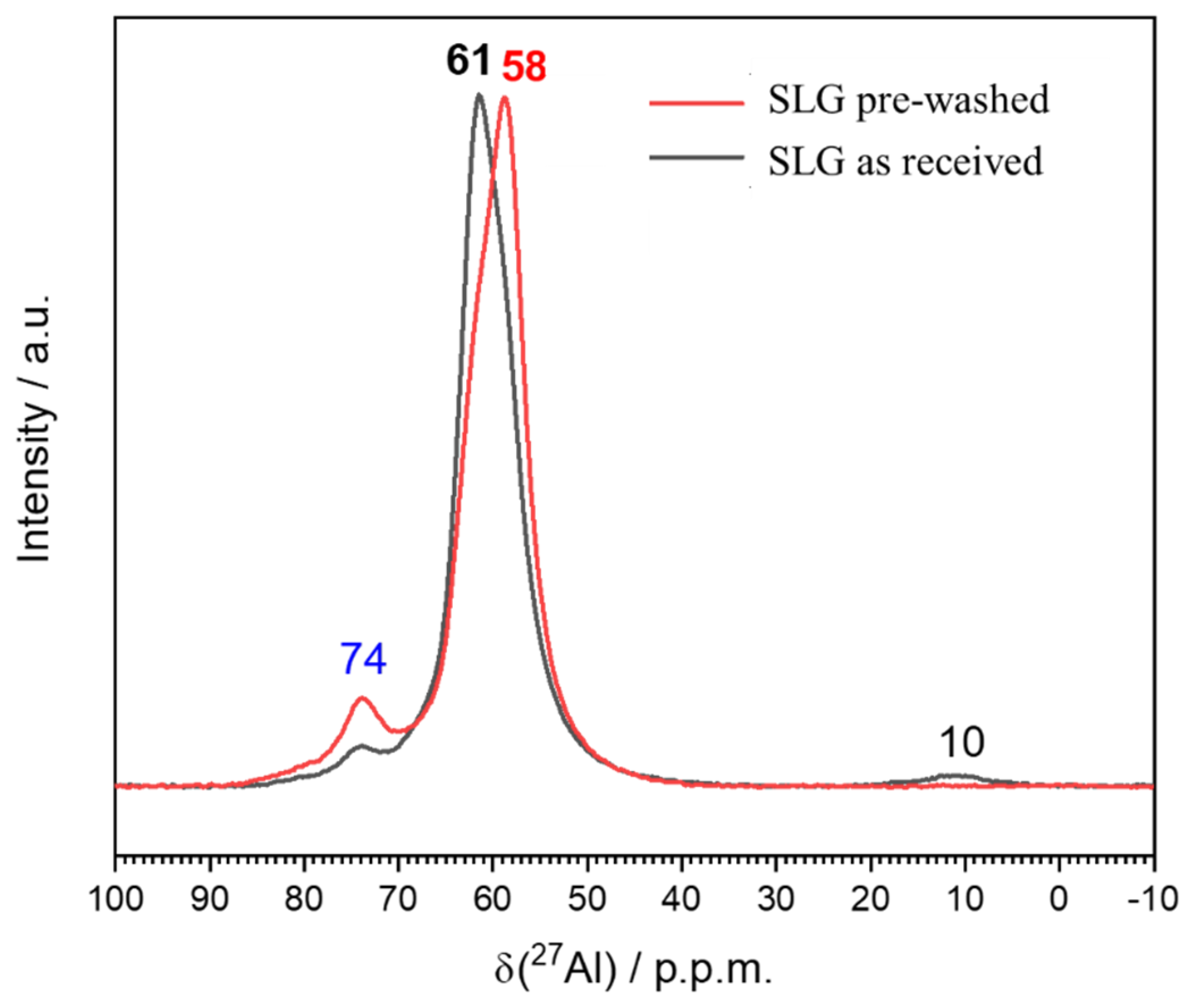
Figure 5.
29Si NMR spectra with studies on a) the coordination of Al-O-Si structures, and b) SiO2 with modifiers.
Figure 5.
29Si NMR spectra with studies on a) the coordination of Al-O-Si structures, and b) SiO2 with modifiers.
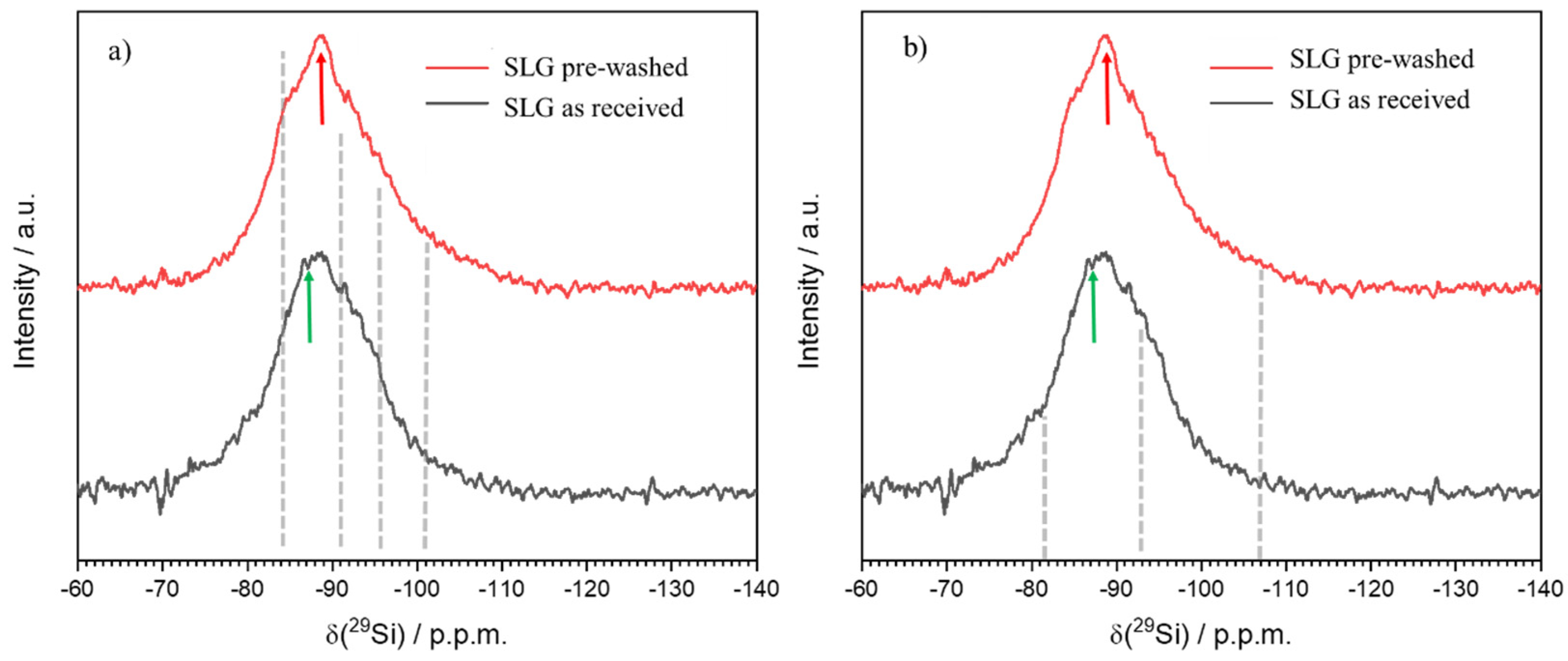
Figure 6.
Evolution of pH in geopolymer leachates prepared from as received SLG and pre-washed SLG.
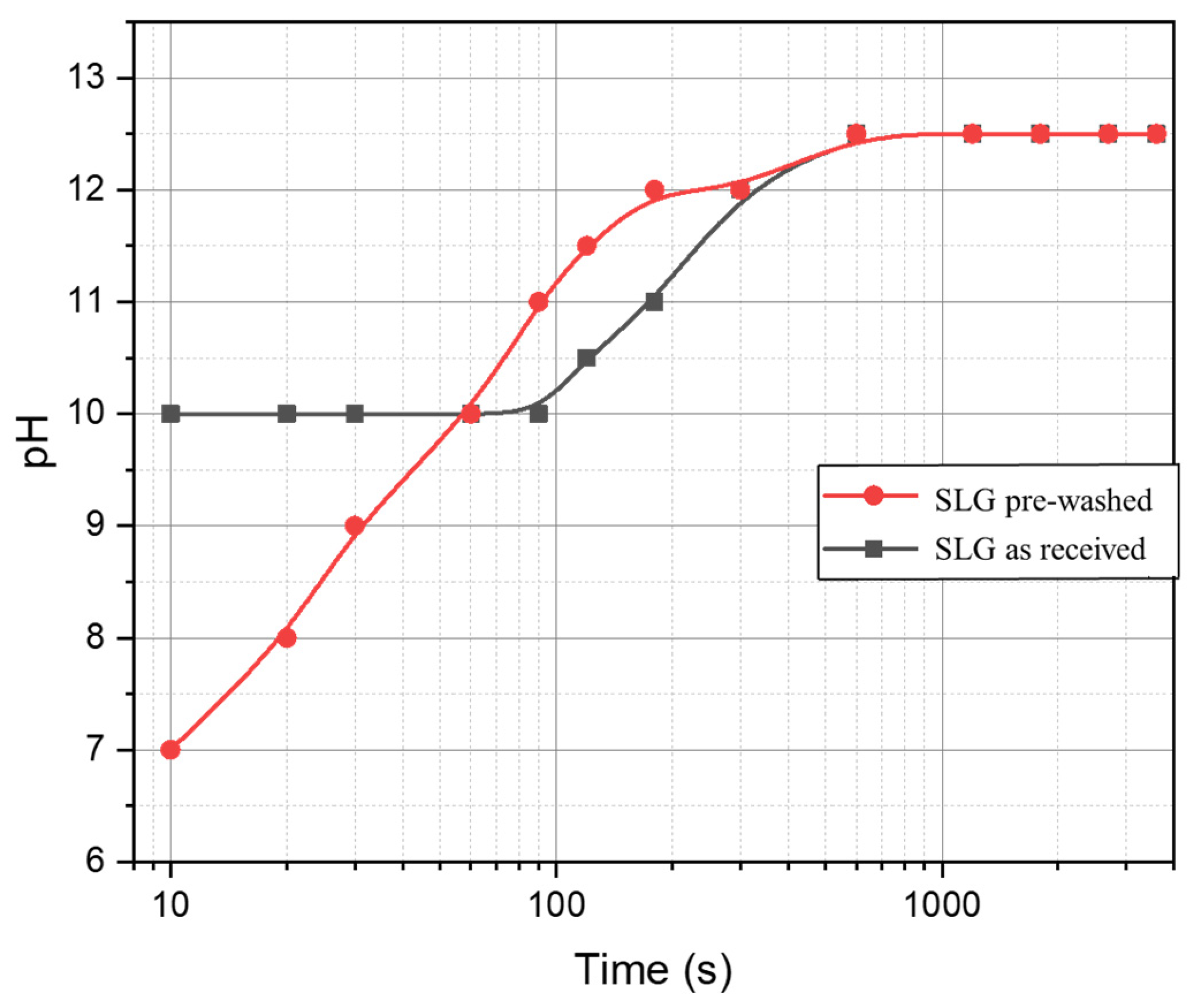
Figure 7.
a) Cross-section of composites prepared from the mixture of coarse glass cullet and binder from as-received or acid washed fine SLG powders; b-c) details of composite from as-received SLG; d-f) details of composite from acid washed SLG.
Figure 7.
a) Cross-section of composites prepared from the mixture of coarse glass cullet and binder from as-received or acid washed fine SLG powders; b-c) details of composite from as-received SLG; d-f) details of composite from acid washed SLG.
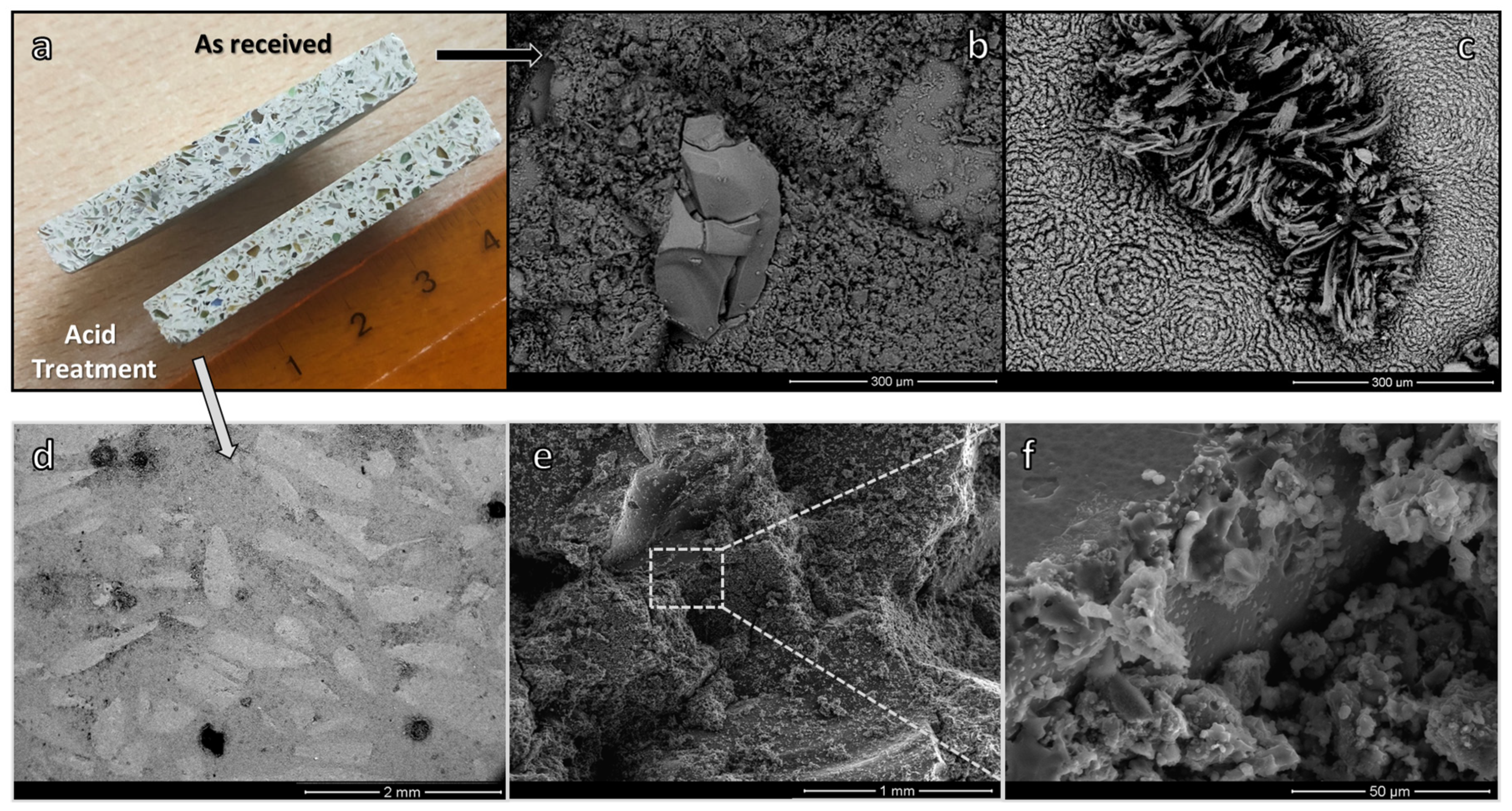

Table 1.
Density and mechanical properties of geopolymers prepared from as received SLG and acid washed SLG.
Table 1.
Density and mechanical properties of geopolymers prepared from as received SLG and acid washed SLG.
| Glass-based geopolymer | Normal concrete | Lightweight concrete | Marble | Granite | ||
| SLS as rec. | washed SLG | |||||
| Density, ρ (g/cm3) | 1.61 ± 0.03 | 1.58 ± 0.03 | 2.2 - 2.6 | 1.4 - 2 | 2.7 - 2.9 | 2.6 - 3.2 |
| Total porosity (vol%) | 36.4 | 43.0 | ||||
| Closed porosity (vol%) | 15 | 16.8 | ||||
| Open porosity (vol%) | 21.4 | 26.2 | ||||
| Elastic modulus, E (GPa) | 11.1 ± 0.6 | 7.6 ± 0.4 | 15 - 25 | 11 - 21 | 50 - 70 | 50 - 70 |
| I=E1/3/ρ (GPa1/3⋅cm3/g) | 1.4 | 1.5 | 1.1 | 1.5 | 1.4 | 1.3 |
| Bending strength, σb (MPa) | 19.9 ± 0.6 | 13.2 ± 1.8 | 1.7 – 2.4 | 3 - 17 | 6 - 10 | 8 - 23 |
| I’=σb1/2/ρ (MPa1/2⋅cm3/g) | 2.8 | 2.3 | 0.6 | 1.6 | 1 | 1.3 |
| Crushing strength, σc (MPa) | 29.4 ± 6.6 | 22.0 ± 6.9 | 13 - 30 | 11 - 28 | 55 - 105 | 110 - 255 |
| I’’=σc/ρ (MPa /g) | 18.2 | 13.9 | 8.4 | 10.6 | 27.3 | 57.7 |
Disclaimer/Publisher’s Note: The statements, opinions and data contained in all publications are solely those of the individual author(s) and contributor(s) and not of MDPI and/or the editor(s). MDPI and/or the editor(s) disclaim responsibility for any injury to people or property resulting from any ideas, methods, instructions or products referred to in the content. |
© 2023 by the authors. Licensee MDPI, Basel, Switzerland. This article is an open access article distributed under the terms and conditions of the Creative Commons Attribution (CC BY) license (http://creativecommons.org/licenses/by/4.0/).
Copyright: This open access article is published under a Creative Commons CC BY 4.0 license, which permit the free download, distribution, and reuse, provided that the author and preprint are cited in any reuse.


