

Submitted:
01 December 2023
Posted:
04 December 2023
You are already at the latest version
Abstract
We use Big Bang Nucleosynthesis (BBN) to probe Beyond Standard Model physics in the neutrino sector. Recently the abundances of primordially produced light elements D and He-4 were determined from observations with better accuracy. The good agreement between the theoretically predicted abundances of primordially produced and derived from observations light elements allows to update the BBN constraints on Beyond Standard Models (BSM) physics. We provide numerical analysis of several BSM models of BBN and obtain precise cosmological constraints and indications for new neutrino physics. Namely, we derive more stringent BBN constraints on electron neutrino-sterile neutrino oscillations corresponding to 1% uncertainty of the observational determination of the primordial He-4. The cosmological constraints are obtained both for the case of zero and non-zero initial population of the sterle neutrino state. Then in a degenerate BBN model with neutrino νe↔νs oscillations we analyze the change of the cosmological constraints in case lepton asymmetry L is big enough to suppress oscillations. We obtain constraints on the lepton asymmetry L . We discuss a possible solution to the dark radiation problem in degenerate BBN models with νe↔νs oscillations in case L is large enough to suppress neutrino oscillations during BBN epoch. Interestingly, the required value of L for solving DR problem is close to L indicated by EMPRESS experiment and close to the value of lepton asymmetry necessary to relax Hubble tension.
Keywords:
BSM physics
; BBN constraints
; neutrino oscillations
; sterile neutrino
; lepton asymmetry
; drak radiation.
1. Introduction
Cosmology presents complimentary and often unique knowledge about neutrino physics. It constrains neutrino characteristics, its mass, number density, the number of different light neutrino types, oscillation parameters, lepton asymmetry in the neutrino sector, etc. This paper is dedicated to cosmological influence of right handed neutrino, further called sterile neutrino , to neutrino oscillations and lepton asymmetry in the neutrino sector, all of which representing BSM neutrino physics.
The study of sterile neutrino is motivated by the important role of in many models of BSM physics and BSM of cosmology. Sterile neutrino is predicted by Grand Unified Theories. Theoretical models use to explain small non-zero neutrino masses, to build models of natural baryogenesis through leptogenesis, etc. Sterile neutrino is the preferred particles candidate for solving Dark Matter problem in cosmology, it plays a role in models of large scale structure formation, etc.
Besides, combined neutrino oscillations data of the reactor experiments +LSND +MiniBooNe +Gallium and Ice Cube experiments hint to the possible presence of light right handed neutrino, participating in oscillations with flavor neutrinos. The neutrino oscillations parameters suggested experimentally, however, are in contradiction with the cosmological constraint on additional radiation during early Universe stage. (This is the so called dark radiation problem.)
In this paper, based on contemporary BBN and recent precise data on primordial He-4, we update several cosmological constraints on the physical characteristics of sterile neutrino. We analyze the following BSM of BBN, namely BBN with late neutrino oscillations, BBN with and non-zero initial population of sterile neutrino and BBN with late and lepton asymmetry in the neutrino sector. We derive cosmological constraints on oscillations parameters for different degrees of sterile neutrino population during BBN. In BBN model with oscillations and neutrino-antineutrino lepton asymmetry we discuss the interplay between the neutrino oscillations and the asymmetry. In case of big asymmetry values BBN constraints on oscillation parameters are changed. In this BBN model constraints on the value of the lepton asymmetry can be obtained. We discuss cosmological and observational indications for non-zero lepton asymmetry during BBN epoch. Cosmological information about the lepton asymmetry is valuable because, unlike the case of baryon asymmetry, which has already been measured with good precision, lepton asymmetry value is still not known.
We obtain updated cosmological constraints on BSM neutrino derived in several previous publications, see refs. [1,2,3,4]. First, in Section 2, after a brief review of BBN and the new precise measurements of primordially produced He-4, we derive updated BBN constraints on electron neutrino-sterile neutrino oscillations parameters corresponding to the recent precise determination of He-4. We discuss the change of the BBN constraints on oscillation parameters in case of non-zero initial population of the sterile neutrino. Then, in Section 3 we discuss lepton asymmetry in degenerate BBN model with neutrino oscillations. We derive also stringent cosmological constraint on the lepton asymmetry in the model of BBN nucleosynthesis with neutrino oscillations. We discuss the change of the BBN constraints on oscillation parameters in case of initially present lepton asymmetry and discuss a solution to the dark radiation problem in such models. Finally we discuss a recently found observational hint for neutrino-antineutrino asymmetry in the electron neutrino sector by EMPRESS experiment, which is close to the value of the lepton asymmetry required to solve the DR problem and close to the value of lepton asymmetry necessary to relax Hubble tension.
2. BBN and updated constraints on electron neutrino-sterile neutrino oscillations parameters
BBN is theoretically and experimentally well established and observationally confirmed model explaining the synthesis of the light elements during the early epoch corresponding to the Universe cooling from MeV until MeV. Precise experimental data on nuclear processes rates relevant for BBN epoch exist, see refs. NACRE-I [7] and NACRE-II [8]. Over 400 nuclear reactions are included in the precise BBN codes, like PArthENoPE, AlterBBN, PRIMAT, etc. [9,10,11,12,13].
The 3 parameters, on which production of elements depend during BBN are determined precisely. Namely, the baryon-to-photon ratio measured independently by CMB , the number of the effective degrees of freedom of light particles during the BBN epoch , the neutron lifetime sec (see ref. [14]).
There exist remarkable agreement between the predicted abundances of light elements produced during BBN for and their derived from observations values. During the last years observational data on helium-4 has reached high precision [15,16,17,18,19]. In particular, the precision of observational data improved considerably due to the inclusion of He10830 infrared emission line of the extremely metal poor galaxy Leo P [20]:
More details can be found in refs [20,21,22]. The theoretically predicted by BBN mass fraction of primordial He-4 is [12]
Hence, BBN is considered one of the most reliable precision probes for physical conditions in early Universe and a unique test for new physics.
The determination of primordial He-4 with 1% accuracy allows to update and strengthen the cosmological constraints on BSM physics. Here we present the BBN constraints on BSM neutrino physics, corresponding to 1% precision. In the following subsections the BBN constraints on electron-sterile neutrino oscillations parameters are derived in case of zero and of non-zero initial population of the sterile neutrino.
2.1. BBN with electron-sterile neutrino oscillations. BBN constraints on neutrino oscillations parameters in case of zero initial population of the sterile neutrino.
We considered the model of BBN with non-equilibrium electron neutrino-sterile neutrino oscillations, , with small mass differences, effective after the electron neutrino decoupling at 2 MeV.
and are particles with masses and and is the mixing angle.
This model was proposed and numerically studied in refs.[26,27,28]. For oscillations to become effective after 2 MeV the following condition between the neutrino squared mass differences and neutrino mixing holds:
In case neutrino oscillations proceed after the electron neutrino decoupling neutrino electron-sterile neutrino oscillations deplete state for the expence of state, hence there is no increase of the radiation density and of the expansion rate of the Universe. 1 Nevertheless, neutrino energy distribution and the number density of electron neutrinos in this model may considerably differ from its equilibrium BBN values - for large number of oscillation parameters the number density of electron neutrino is reduced and the energy spectrum distribution is distorted from its equilibrium Fermi-Dirac form, leading to a considerable reduction both of the number density of electron neutrino and of its energy. These changes in and correspondingly influence the kinetics of nucleons participating in the reactions in the pre-BBN epoch:
Thus, nucleon densities and their values at nucleon freeze-out differ from the standard BBN ones and hence, the primordial yields of He-4 and other light elements are changed. This effect on BBN we call kinetic effect of neutrino oscillations.
Qualitatively, the change in primordial He-4 production is the following: Both the reduction of the number density of electron neutrino and the energy spectrum distortion lead to reduced weak reaction rates of nucleons interactions in eq.2 in comparison with the standard BBN case and hence, lead to their earlier freezing out. This cause an overproduction of primordially synthesized He-4.
We have provided a precise numerical anaysis of neutrino evolution and nucleons freezing in the presence of neutrino oscillations. The evolution of the oscillating and is described numerically accounting simultaneously for Universe expansion, neutrino oscillations and neutrino forward scattering. The governing kinetic equations for the density matrix of neutrino and antineutrino in the momentum space describing the evolution of neutrino and antineutrino ensembles in the early Universe ( see also ref. [5,28,42]) used in our analysis, are:
These equations describe the neutrino and antineutrino ensembles evolution and account simultaneously for the Universe expansion (first term), neutrino oscillations (second term) and neutrino forward scattering. Here , . is the free neutrino Hamiltonian. Q arises as an propagator effect,. , .
The kinetic equation for the neutron number densities in the momentum space is:
Here we provide precise numerical analysis for the evolution of neutrino and nucleons in the pre-BBN period in the presence of effective after neutrino freezing for different sets of oscillation parameters, accounting for the distortion in electron neutrino energy distribution due to neutrino oscillations. Also, both neutrino oscillations cases corresponding to non-resonant and resonant neutrino oscillations were considered. We provide the numerical analysis for large number of neutrino oscillations parameters - 135 sets of and mixing . The evolution of oscillating neutrino and the nucleons was simultaneously numerically followed during the pre-BBN and BBN epoch, for temperatures from 2 MeV till 0.3 MeV. We calculated the primordially synthesised He-4 in this model. The iso-helium contours corresponding to 1-3% 4He overproduction were calculated, corresponding to the contemporary accuracy of observational determination of primordial He-4. BBN constraints on neutrino oscillation parameters – squared mass differences and mixing were obtained for different initial population of the sterile neutrino. (In previous papers [29,30,31] iso-helium contours corresponding to 3-7% 4He overproduction were calculated, which corresponded to the accuracy of determination of helium-4 at that time.)
As far as the sterile neutrino does not have the usual weak interactions, it has decoupled earlier than the active neutrinos, hence it is expected that its number density is lower than the electron neutrino one at the decoupling time of the active neutrino. We discuss different possibilities for the initial population of the sterile neutrino state, namely initially empty sterile neutrino state, and partially filled sterile neutrino state .
In the cases when the distortion of neutrino momentum distribution by oscillations is considerable, the numerical analysis is heavy because precise description of neutrino momenta distribution is needed. We have found that for proper description of the distortion in the neutrino momenta distribution in the non-resonant oscillations case 5000 bins are enough, while in the resonant case up to 10000 bins may be necessary. This complicates the numerical task severely and increases the calculation time considerably, because the number of integro-differential equations to be solved is multiplied correspondingly by 5000 and 10000.
In Figure 1 we present the results for iso-helium contours corresponding to 1% and 3% overproduction. The initial sterile neutrino state was assumed empty . BBN constrains the neutrino oscillations parameters corresponding to the area above the 1% iso-helium contour. BBN constraints are considerably strengthened for 1% helium overproduction in comparison with 3% ones.
The analytical fit to the exact numerical constraints corresponding to 1% helium uncertainty reads:
These BBN constraints update and strengthen the previously existing ones (see refs. [30,31,32,33]. They are half an order of magnitude more stringent at maximal mixing than previous constraints. They excluded totally the low mixing angle electron-sterile solution to the solar neutrino problem in addition to large mixing angle solution excluded in previous papers. Also, these constraints exclude the oscillation parameters range discussed by several neutrino experiments, that have obtained hints for electron sterile oscillations with large mixings and squared mass differences in the range eV2. 2
In the next subsection we discuss the general case of partially filled initially sterile neutrino state.
2.2. BBN constraints on electron-sterile neutrino oscillations in case of non-zero initial population of the sterile neutrino
The effective number of relativistic species is given by . Additional relativistic species or additional light sterile neutrino types increase the expansion rate of the universe , where is the relativistic density. Therefore, it has considerable cosmological effect, in particular it influences BBN synthesis of light elements. Hence, BBN, and in particular He-4 is a sensitive probe to additional species and it tests and constrains new physics, which can be parameterized by .
Although the indicated by BBN and CMB effective number of light neutrino types are consistent with the predicted by the standard cosmological model value within uncertainties, small extra relativistic component is still allowed. Cosmological constraints on based on BBN+CMB considerations [39] read:
For comparison BBN only based constraint from different analyses, based on D and He-4 data [12,16] gives:
While a maximum likelihood analysis on and provides the limit [42]:
For comparison the constraint based on Planck CMB data [12] reads:
In what follows we assume the cosmological constraint . We consider the case when the sterile neutrino state was initially partially filled, corresponding to and study how its presence change the BBN constraints on oscillations parameters, presented in the previous subsection.
The presence of additional sterile neutrino in the BBN model with late oscillations leads to the increase of the expansion rate of the Universe (dynamical effect) and it suppresses the kinetic effects of the non-equilibrium neutrino oscillations (a kinetic effect) [42,43].
Hence, depending on which effect dominates for a certain set of oscillation parameters, additional sterile neutrino population has a non-trivial effect – it may correspondingly increase or decrease the primordial production of He-4. For more details see refs. [33] [42,43].
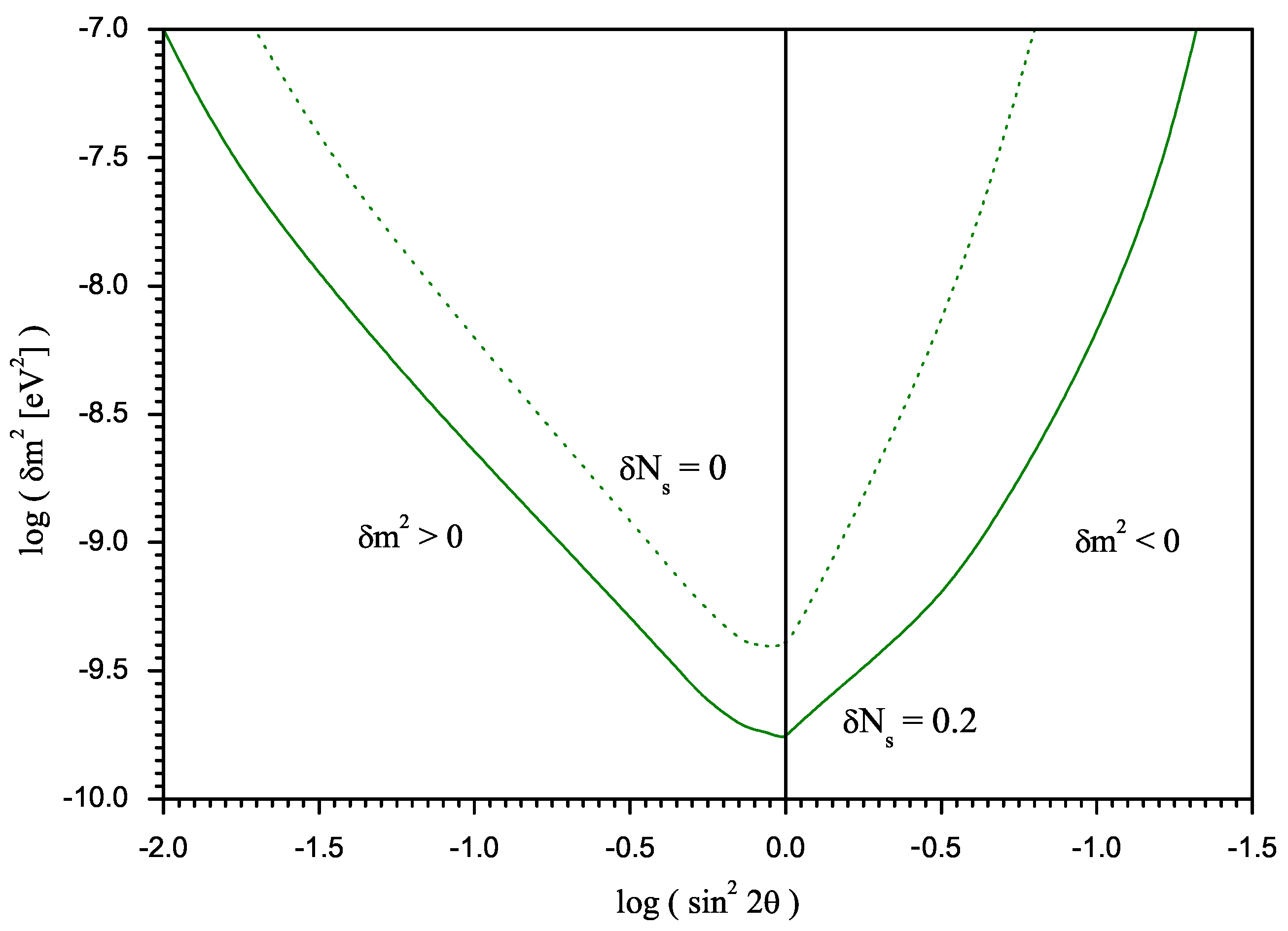
We provided a numerical analysis of the BBN model with late electron-sterile neutrino oscillations in case of non-zero initial population of the sterile neutrino . In this case our analysis proved that the dynamical effect of additional dominates, leading to increased primordial production of He-4 and hence to stronger BBN limits on the neutrino oscillation parameters. Figure 2 presents our results. The lower curve gives the BBN contsraints corresponding to , the upper curve is given for comparison (it shows the BBN constraints corresponding to initially empty sterile state, i.e. ).
As illustrated by the figure BBN constraints are considerably strengthened in case of non-zero initial population of the sterile neutrino . 3.
This analysis also confirms that the suggested by neutrino oscillations experiments existence of light sterile neutrino with such oscillations parameters that lead to its thermalization by oscillations during BBN, is not allowed from BBN. A possible solution to this so called dark radiation problem will be shortly discussed in the next section.
3. BBN with lepton asymmetry and neutrino oscillations
BBN with non-zero lepton asymmetry L has been studied in numerous publications since ref. [44]. L is given by the difference between the number of leptons and antileptons over the number of photons: L increases the radiation energy density, leading to faster universe expansion, thus, influencing BBN. In particular, leading to overproduction of primordially produced He-4. This dynamical effect can be described by changing , namely:
Here is the chemical potential. Large enough L in the electron neutrino sector change the electron neutrino and antineutrino number densities in reactions with nucleons from eq (2) in the pre-BBN epoch and, hence, influences the neutron-proton kinetics during pre-BBN epoch. This allows to use degenerate BBN and on the basis of observational data to constrain L. BBN conservative constraint for all neutrino sectors reads
Due to neutrino flavor oscillations equalization of degeneracies in different neutrino sectors occurs in the early universe plasma [45,46].
In BSM of BBN with late yet another indirect kinetic effect of L is possible. Namely, tiny L in the range , that cannot effect directly BBN kinetics, can influence BBN through oscillations. It was shown that such tiny L can considerably effect neutrino number density, neutrino energy spectrum distribution, neutrino oscillations pattern and thus influence n/p kinetics in pre-BBN epoch and consequently BBN [1,5,30].
We have found in our previous numerical analysis that besides L ability to suppress neutrino oscillations [30,47] tiny L is capable to enhance neutrino oscillations, i.e. lead to resonant enhancement of neutrino transfers [5,30]. The parameter range for which L is able to enhance, suppress or inhibit oscillations has been determined numerically in refs. [1,5]. Thus, depending on its value, L can relax or strengthen BBN constraints on neutrino oscillations, or eliminate the constraints. The latter is possible for
This relation is an analytical fit to the exact constraints obtained numerically in refs. [1,5,30]. It can be used to estimate roughly the value of L necessary to solve the dark radiation problem.
3.1. L and the possible solution of the dark radiation puzzle
Oscillations between sterile neutrino and flavor neutrinos with large mixing and squared mass difference in the range predicted by the small baseline experiments, eV2 to several eV2, lead to thermalization of the sterile neutrino at BBN epoch. However, as discussed in the previous section fully thermalized light inert state is not allowed by BBN . Various solutions to the DR problem have been proposed. Here we will discuss the solution proposed in our works [5,6]. (See also refs [4,48,49,50]. )The idea is the following:
L present during BBN, if it is large enough to suppress neutrino oscillations, prevents the full thermalization of , and thus BBN cosmological constraints on the dark radiation predicted by the small baseline experiments can be avoided. From relations found in ref. [1] we estimate the necessary value of L for that solution to hold: is required to prevent neutrino oscillations between sterile and active neutrinos with eV2 is needed for mass difference of 1 eV2, correspondingly. For bigger mass differences, predicted by some neutrino oscillations experiments, is able to suppress only partially the oscillations. In this case more sophisticated numerical analysis is necessary to calculate the exact degree of thermalization of state .
Thus, it is remarkable that the eventual future detection of sterile to active neutrino oscillations at a higher confidence level may be used to obtain lower limit on L value and might point to the presence of lepton asymmetry during BBN epoch.
Vice versa, measuring L in the early universe it is possible to obtain an upper limit on the squared mass differences according to eq.7. Thus, below we use the value of L obtained in recent survey to estimate squared mass differences of neutrino oscillations. Recently the EMPRESS survey of extremely metal poor systems [51] has reported 3 smaller primordial He-4 abundance than the standard BBN predicted one and than the previous measurements. Namely,
This value can be explained as due to the presence of L in the electron neutrino sector:
Using eq.7 we estimate that L corresponding to this , , can suppress neutrino oscillations with eV2.
3.2. Discussion on L and the Hubble tension
Local measurements (corresponding to observations at low-red shift) of the Hubble constant by different methods indicate a larger value km/s Mpc than the value inferred at large red-shifts, from temperature anisotropy of cosmic microwave background (CMB) by Planck (2018) km/s/Mpc [55] This discrepancy is called the Hubble tension. Analysing the data from Planck, baryon acoustic oscillation, BBN and type-Ia supernovae, it was shown [54] that the Hubble tension can be resolved for and . This value is very close to the estimated value of L required to solve the DR problem and also close to the recently found observational hint by EMPRESS for neutrino-antineutrino asymmetry in the electron neutrino sector.
All these estimations of the L value point to much larger lepton asymmetry than the baryon asymmetry of the local universe.
4. Conclusions
We discuss and numerically analyze several BSM models of BBN and derive cosmological constraints and indications for new neutrino physics. Namely, we study BBN with late neutrino oscillations, BBN with and non-zero initial population of sterile neutrino and BBN with late and lepton asymmetry in the neutrino sector. We account simultaneously for the universe expansion, neutrino oscillations and forward neutrino scattering. A precise description to the distortion of the neutrino energy distribution due to these non-equilibrium oscillations is provided. We derive stringent BBN constraints on oscillations parameters corresponding to uncertainty of the primordial abundance of He-4. Both the case of zero and non-zero initial population of the sterle neutrino state is considered. These BBN constraints strengthen the previously existing cosmological constraunts on oscillation parameters.
In the degenerate BBN model with late neutrino oscillations we discuss the interplay between neutrino oscillations and lepton asymmetry. We present the change of cosmological constraints on oscillation parameters in case lepton asymmetry is big enough to suppress oscillations. We derive cosmological constraints on the lepton asymmetry L for different values of oscillation parameters. We discuss a possible solution to the dark radiation problem in case L is large enough to suppress neutrino oscillations during BBN epoch. The eventual future detection of sterile to active neutrino oscillations at a higher confidence level may be used to obtain lower limit on L value and might point to the presence of lepton asymmetry during BBN epoch.
Interestingly, the required value of L for solving DR problem is close to L indicated by EMPRESS experiment and close to the value of lepton asymmetry necessary to relax Hubble tension. The discussed cosmological and observational indications for non-zero lepton asymmetry during BBN epoch point to lepton asymmetry orders of magnitude bigger than the baryon asymmetry of the universe. Cosmological indications about the lepton asymmetry and estimation of its value are valuable because, unlike the case of baryon asymmetry, which has already been measured with good precision, lepton asymmetry value is not measured.
Funding
This research received no external funding.
Institutional Review Board Statement
Not applicable.
Informed Consent Statement
Not applicable.
Acknowledgments
The authors thank Vassillen Chizhov for the precise mathematical derivation of the analytical fit to the numerically obtained BBN constraints.
Conflicts of Interest
The authors declare no conflict of interest.
Abbreviations
| BSM: | Beyond Standard Model |
| BBN: | Big Bang Nucleosynthesis |
| DR: | Dark Radiation |
References
- Kirilova, D. BBN Cosmological Constraints on Beyond Standard Model Neutrino, inPoS CORFU2018, 2019, 48 Corfu Summer Institute, Aug 31 - Sep 9, 2018.
- Kirilova, D., Chizhov, E. IJ Mod. Phys. A, 2019, 34, N11, 1950065.
- Kirilova, D. , Panayotova, M., Chizhov, E. Proceedings of Science, 11th International Conference of the Balkan Physical Union (BPU11), 2022, 28 August - 1 September, Belgrade, Serbia.
- Kirilova, D., Panayotova, M., Chizhov, E. Several cosmological nucleosynthesis constraints on neutrino and new neutrino physics Proc. of XIII Bulgarian-Serbian Astronomical Conference, Vellingrad, Bulgaria, Oct.3-7, 2023.
- Kirilova, D. JCAP , 2012, 06, 007.
- Kirilova, D. Hyperfine Interactions,2013, 215, 111.
- Angulo, C. , et al. Nucl. Phys. A 1999, 656, 3. [Google Scholar] [CrossRef]
- Xu, Y. , et al. Nucl. Phys. A 2013, 918, 61. [Google Scholar] [CrossRef]
- Pisanti, O. , et al. Comput. Phys. Commun. 2008, 178, 956. [Google Scholar] [CrossRef]
- Consiglio, et al. 2017, arXiv 1712.04378. ???
- Arbey, A. Comput. Phys. Commun. 2012, 183, 1822. [CrossRef]
- Pitrou, C. , Coc A., Uzan, J-P. and Vangioni, E. Physics Reports , 2018, 04, 005. [Google Scholar]
- Mangano, G. , Miele, G., Pastor, S., Pisanti, O., Sarikas, S. JCAP, 2011, 11, 035. [Google Scholar] [CrossRef]
- Serebrov, et al. PDG,2017,2022 ???
- Aver, E. , Olive, K., Skillman, E. JCAP 2015, 7, 011. [Google Scholar] [CrossRef]
- Cooke, R., Pettini, M., Steidel C. Astrophysical Journal, 2017, Volume 855, Issue 2, article id. 102.
- Fields, et al. PDG2022, Big Bang Nucleosynthesis, Particle Data Group ???
- Cooke, R., Fumagalli, M. Nature Astronomy 2018, 15 October.
- Balashev, et al. MNRAS, 2016, 458, 2, 2188. ???
- Aver, E., et. al. JCAP, 2021, 3, 027.
- Hsyu, T., et.al. arXiv:2005.12290 accepted ApJ 2020.
- Valerdi, M., et. al. Astrophys.J.2019, 876 2, 98.
- Dolgov, A. Sov. J. Nucl. Phys. 1981, 33, 700.
- Barbieri, R. , Dolgov, A. Phys. Lett.B , 1990, 237, 440. [Google Scholar] [CrossRef]
- Barbieri, R. , Dolgov, A. Nucl. Phys.B, 1991, 349, 743. [Google Scholar] [CrossRef]
- Kirilova, D. JINR 1988,preprint E2-88-301.
- Kirilova, D. , Chizhov, M. in Neutrino96, 1996,478.
- Kirilova, D. , Chizhov, M. Phys. Lett. B, 1997, 393, 375. [Google Scholar] [CrossRef]
- Kirilova, D., Chizhov, M. Nucl. Phys. B, 1998b, 534, 447.
- Kirilova, D., Chizhov, M. Phys.Rev.D,1998a, 58, 073004,.
- Kirilova, D., Chizhov, M. Nucl.Phys.B , 2000b, 591, 457.
- Dolgov, A. D., Villante, F. Nucl. Phys. B ,2004, 679 pp 261.
- Kirilova, D., Panayotova, M. JCAP ,2006, 12 pp 014.
- Gariazzo, S., et. al. JHEP, 2017 , 06 pp 135.
- Kopp, J., Maltoni, M., Schwetz, T. Phys. Rev. Lett., 2011, 107:091801.
- Dentler, M., et. al. High Energ. Phys., 2018, pp 10.
- Aartsen, M., et. al. Phys. Rev. Lett., 2020, 125(14) pp 141801.
- Gouvêa, A. , Sánchez, G.J., Kelly, K.J. Physical Review D, 2022, 106. pp 055025. [Google Scholar]
- Yeh Tsung-Han, Shelton, J. , Olive, K., Fields, JCAP, 2022, 10:046 ??? [Google Scholar]
- Fields et al.: , JCAP, 2020, 3, 010; Field s et al. :JCAP, 2020, 11, E02. ???
- Kirilova, D. , Panayotova, M. JCAP, 2006, 12. pp 014. [Google Scholar]
- Kirilova, D. Int. J. Mod. Phys. D, 2004, 13. pp 831.
- Kirilova, D. IJMPD,2007, 16 7 pp 1197.
- Wagoner, R. , Fowler, W. , Hoyle, F. Astrophys. J.Supp. 1967, 148, 3. [Google Scholar] [CrossRef]
- Dolgov, A. , et al. Nucl. Phys B 2002, 632, 363. [Google Scholar] [CrossRef]
- Mangano, G. , Serpico, P. Phys.Lett.B, 2011, 701, 296. [Google Scholar] [CrossRef]
- Foot, R. , Volkas, R. Phys.Rev.Lett., 1995, 75, 4350. [Google Scholar] [CrossRef] [PubMed]
- Mirizzi, A. , et al. PRD, 2012, 86, 053009. [Google Scholar] [CrossRef]
- Hannestad, S. , Tamborra, I., Tram, T. JCAP, 2012, 1207, 025. [Google Scholar] [CrossRef]
- Kirilova, D. On lepton asymmetry neutrino oscillations interplay, BBN and the problem of dark radiation, in proceedings of 53rd Rencontres de Moriond, Very High Energy Phenomena in the Universe, 2018 p. 379, La Thuile, Italy, March 17-24.
- Matsumoto, A. , et al. EMPRESS VIII: Astrophys. J. 2022, 941. no. 2 167, arXiv 2203.09617. [Google Scholar]
- Kawasaki, M. , Murai, K. Lepton asymmetric universe, JCAP2022 08, no. 08 041, arXiv:2203.09713].
- Burns, A.-K. , Tait, T. M. P., and Valli, M. Indications for a Nonzero Lepton Asymmetry from Extremely Metal-Poor Galaxies, Phys. Rev. Lett. 2023 130, no. 13 131001, arXiv:2206.00693].
- Seto, O. , Toda, Y. Phys. Rev. D 2021, 104, 063019. [Google Scholar] [CrossRef]
- Aghanim, N. , et al. [Planck], Astron. Astrophys. 2020, 641, A6. [Google Scholar]
- Serebrov, A. , et al. The result of the Neutrino-4 experiment, sterile neutrinos and dark matter, the fourth neutrino and the Hubble constant, arXiv:2302.09958 ???
| 1 | In BBN with fast proceeding before active neutrino decoupling oscillations can bring into equilibrium the sterile neutrino state and thus lead to higher expansion rate of the Universe, which refflects into higher production of He-4. This is the well known dynamical effect of active-sterile neutrino oscillations [23,24,25]. |
| 2 | Namely, several small base line experiments: reactor experiments, LSND, MiniBooNe, Gallium expt, SAGE and recently Ice Cube and NU4 hint to a presence of sterile neutrino participating into oscillations with flavor neutrinos with large mixing and squared mass difference in the range eV2 to several eV2. [35] [34,36] [37,38,56] |
| 3 | This result is in agreement with our preliminary analysis, discussed in ref. [3] |
Figure 1.
BBN constraints on electron-sterile neutrino oscillation parameters corresponding to 1% (lower curve) uncertainty. 3% (upper curve) uncertainty curve is given for comparison with previous constraints.
Figure 1.
BBN constraints on electron-sterile neutrino oscillation parameters corresponding to 1% (lower curve) uncertainty. 3% (upper curve) uncertainty curve is given for comparison with previous constraints.
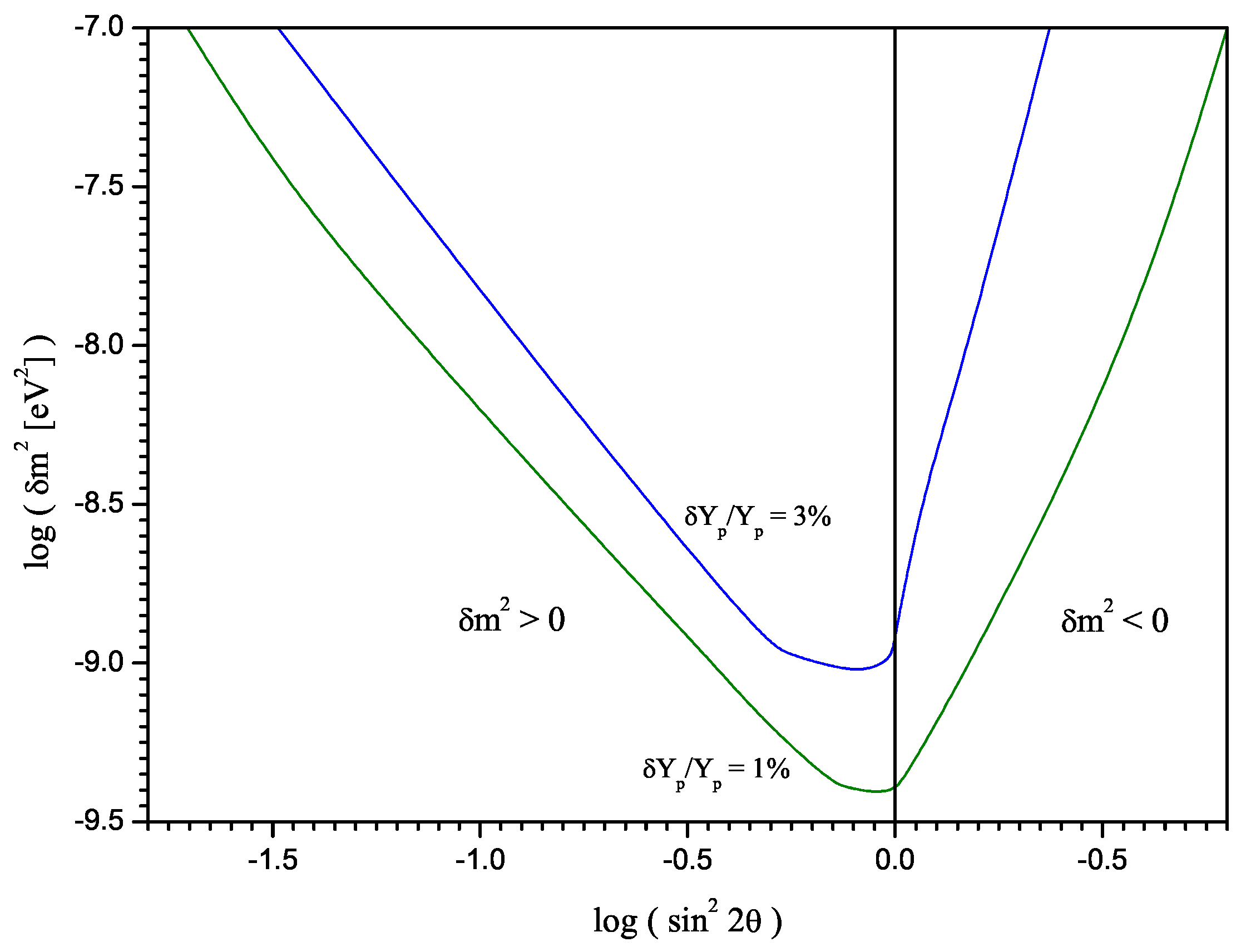
Figure 2.
BBN constraints on electron-sterile neutrino oscillations parameters corresponding to 1% He-4 overproduction and initially empty sterile state (upper dashed curve) and (lower solid curve).
Figure 2.
BBN constraints on electron-sterile neutrino oscillations parameters corresponding to 1% He-4 overproduction and initially empty sterile state (upper dashed curve) and (lower solid curve).
Disclaimer/Publisher’s Note: The statements, opinions and data contained in all publications are solely those of the individual author(s) and contributor(s) and not of MDPI and/or the editor(s). MDPI and/or the editor(s) disclaim responsibility for any injury to people or property resulting from any ideas, methods, instructions or products referred to in the content. |
© 2023 by the authors. Licensee MDPI, Basel, Switzerland. This article is an open access article distributed under the terms and conditions of the Creative Commons Attribution (CC BY) license (http://creativecommons.org/licenses/by/4.0/).
Copyright: This open access article is published under a Creative Commons CC BY 4.0 license, which permit the free download, distribution, and reuse, provided that the author and preprint are cited in any reuse.


