

Submitted:
16 November 2023
Posted:
17 November 2023
You are already at the latest version
Abstract
Wild strawberry (Fragaria vesca L.) leaves possess diverse antioxidant properties, mainly due to the different classes of phenolics. In this study, microwave-assisted extraction (MAE) and accelerated solvent extraction (ASE) of wild strawberry phenolics were carried out to understand the impact of extraction temperature, extraction time and solvent-to-sample ratio (SSR) on the quantitative and qualitative properties of the obtained extracts. The highest total phenolic content (8027 mg GA/100 g DW), as well the highest DPPH• antiradical activity (903 mol TE/g DW) was obtained with ASE at 150 °C, static time 5 min and SSR of 40:1; while the highest ABTS•+ antiradical activity (681 mol TE/g DW,) and FRAP (2389 mol TE/g DW) was obtained with MAE after 5 min at 80 °C and a SSR of 40:1. The correlation analysis showed that phenolics largely contributed to the antioxidant properties of the studied MAE extracts, while correlation was not found in ASE extracts. A total of 54 different phenolics were identified by UPLC/MS-MS in MAE and ASE extracts obtained at optimal extraction conditions. MAE extract was shown to have a higher content of phenolic acids (40%), but lower content of proanthocyanidins (88%), flavonols (29%), flavan-3-ols (50%) and flavones (39%) than ASE extract.
Keywords:
wild strawberry leaves
; microwave-assisted extraction
; accelerated solvent extraction
; phenolic profile
; antioxidant activity
1. Introduction
Fragaria vesca L., commonly known as wild strawberry, is a herbaceous perennial plant from the Rosaceae family. It is widespread throughout Europe and world, where it occurs in forests, on slopes and roadsides. Although wild strawberry is best known for its aromatic small fruits, its leaves are gathered in the wild during the flowering season for domestic use - externally as an antiseptic, anti-inflammatory and skin protectant; while internally for respiratory ailments, gastrointestinal and urinary disorders. In addition, application of leaves for the treatment of diabetes, cancer and cardiovascular diseases has also been reported [1,2,3,4,5]. As previously demonstrated [2], leaves of wild strawberry represent an important source of ellagitannins, proanthocyanidins, quercetin and kaempferol glucuronide derivatives. More precisely, the presence of procyanidin B1, B2, and C1, pyrocyanidin B1, epigallocatechin, (+)-catechin, (−)-epicatechin, astringin, epicatechin-3-gallate, piceid, quercetin, quercetin-4′-glucoside, gallic acid monohydrate, kaempferol 3-β-d-glucopyranoside and trans-resveratrol were identified in the extracts of wild strawberry leaves [4,6]. A strong to moderate correlation between antioxidant capacity evaluated by different methods and the presence of phenolics were demonstrated for in vitro cultured vegetative parts of F. vesca [7]. However, scientific reports validating the antioxidant properties of the F. vesca leaves are still scarce. Due to the presence of a great diversity of phenolics, the growing demand for wild strawberry leaves extracts with additional functional properties requires innovation in the ways to recover bioactive compounds that can be further applied in pharmaceutical or in the food industry. Novel approaches to bioactives’ utilization mostly include application of advanced extraction techniques, among which microwave-assisted (MAE) and accelerated solvent extraction (ASE) are ones of the most widely applied. The principle of MAE involves the conversion of electromagnetic energy into thermal energy, which causes a pressure build up within the cellular matrix, opening the cellular structure, resulting in the formation of pores and the release of inter- and intracellular contents. The disruption of the weak hydrogen bonds is caused by the dipole rotation of the molecules with the release of heat [8]. During ASE or pressurized liquid extraction, solid matrices are dissolved by solvents at temperatures above their boiling point, remaining in a liquid state by pressurization. Sample extraction with green solvents under high pressure (4–20 MPa) and moderately to high temperature (50–250 °C) results in the breaking of secondary bonds and thus acceleration of desorption and solubilisation of matrix-bound species [9]. In contrast to dynamic mode, where fresh solvent flows continuously through the sample, sample in the static mode is extracted with a solvent until equilibrium is attained, followed by collection of analytes through rapid flushing with solvent and compressed gas [8]. Regardless the applied method, extraction parameters must be carefully selected to avoid uncontrolled changes in native structures and co-elution of unwanted compounds. To maximize yield, an optimal ratio between solubilization and degradation of target molecules must be determined empirically [9].
To the best of our knowledge, MAE or ASE were not previously tested for the extraction of phenolics from wild strawberry leaves. Hence, the aim of this study was to examine the effect of extraction temperature, time and solvent-to-sample ratio (SSR) on the total phenolic content (TPC), phenolic profile and antioxidant properties of the obtained extracts in order to determine the best conditions to improve the extraction efficiency.
2. Materials and Methods
2.1. Materials
A commercial air-dried sample of wild strawberry leaves (F. vesca L.) harvested in 2022 was provided by local specialized herbal drug store Suban Ltd., Croatia and stored in the dark and dry place until analyzed. The content of dry matter in the samples was determined to be 91.2 ± 0.2% by drying to constant mass [10].
2.2. Chemicals
All reagents used were analytical grade. Ultrapure water was obtained from a Milli-Q Plus water system (Millipore Corp., Bedford, NY, USA). Ethanol, anhydrous sodium carbonate (≥99.5%) was purchased from Lach-Ner (Neratovice, Czech Republic); methanol and Folin-Ciocalteu reagent were obtained from Merck (Darmstadt, Germany). Trolox (6-hydroxy-2,5,7,8-tetramethylchroman-2-carboxylic acid), galic acid, potassium persulfate, 2,2-diphenyl-1-(2,4,6-trinitrophenyl)hydrazyl (DPPH), 2,4,6-tris(2-pyridyl)-s-triazine (TPTZ), and 2,2’-azinobis (3-ethylbenzothiazoline-6-sulfonic acid) (ABTS) were from Sigma Aldrich (St. Louis, MO, USA). Hydrochloric acid (37%) and glacial acetic acid were provided by Carlo Erba Reagents (Val-de-Reuil, France). Iron (III)-chloride hexahydrate were supplied from Gram-mol d.o.o. (Zagreb, Croatia). Sodium acetate were purchased from Kemika d.d. (Zagreb, Croatia). The HPLC standards of myricetin, caffeic acid, gallic acid, ferulic acid, protocatechuic acid, syringic acid, rosmarinic acid, chlorogenic and p-coumaric acid, quercetin-3-glucoside, quercetin-3-rutinoside, kaempferol-3-glucoside, kaempferol-3-rutinoside, catechin, epigallocatechin gallate, epicatechin gallate, apigenin, procyanidin B2 and luteolin were procured by Biovit d.o.o. (Jalkovec, Croatia).
2.3. Preparation of phenolic extracts
2.3.1. MAE
First series of extracts was obtained by MAE in Ethos Easy reactor (Milestone, Sorisole, Italy). Appropriate sample masses (corresponding to the SSR) were transferred to the extraction cell with added magnetic stirrer and treated with 50 mL of aqueous ethanol solution (30 vol. %). The cells were positioned on the rotor of microwave reactor, time required for temperature achievement was 4 min for 60 °C, 5 min for 70 °C, 6 min for 80 °C at 800 W and an automatic extraction process was started. Extraction parameters were set according to the experimental design listed in subsubsection 3.3.1., at varying extraction SSR (20, 30 and 40), the extraction temperature (60, 70 and 80 °C) and irradiation time (5 and 10 min), meanwhile microwave power was constant throughout all trials (400 W). During the extraction, temperature was selected as the constant extraction parameter versus microwave power, meaning that the selected microwave power was only applied in short time increments required for the temperature maintenance. Afterwards, obtained extracts were filtered through Whatman No. 40 filter paper (Whatman International Ltd., Kent, UK) into volumetric 50 mL flasks, made up to volume with 30% ethanol, and the resulting supernatants were stored in the refrigerator until further analysis.
2.3.2. ASE
Second series of extracts was obtained by ASE using Dionex™ ASE™ 350 Accelerated Solvent Extractor (Thermo Fisher Scientific Inc., Sunnyvale, CA, USA). All extractions were performed in 34 mL stainless steel cells containing two cellulose filters (Dionex™ 350/150 Extraction Cell Filters, Thermo Fisher Scientific Inc., Waltham, MA, USA) to prevent fine suspended particles from entering the solvent lines and collection vials. Various sample masses (corresponding to the SSR) were transferred to the extraction cell with added diatomaceous earth, and additional cellulose filter on the top, to prevent earth particles from entering the solvent injection needle. Ethanol (30 vol. %) was used as the extraction solvent. According to the parameters listed in subsubsection 3.3.1., extractions were done at three different SSRs (20, 30 and 40), three temperatures (100, 125 and 150 °C) and two different static extraction times (5 and 10 min). Extraction was done by filling the cell containing sample with solvent up to a pressure of 10.34 MPa, after which the cell was rinsed with rinse volume of 30%, followed by purging with N2 gas for 30 s. Three extraction cycles were performed for every trial, extracts were collected in 250 mL glass vials, filtered through Whatman No. 40 filter paper (Whatman International Ltd., Kent, UK) into volumetric 50 mL flasks and made up to volume with 30% ethanol. The resulting supernatants were stored in the refrigerator and further analyzed within 10 days.
2.4. Determination of total phenolic content (TPC)
The Folin-Ciocalteu assay with some modifications [11] was carried out in order to determine the TPC of wild strawberry leaves. In brief, 100 µL of extract (or 30% ethanol for blank) was mixed with 200 μL of Folin-Ciocalteu reagent and 2 mL distilled water. After 3 min, 1 mL of 20% sodium carbonate solution was added and the mixture was vortexed. After 25 min incubation in a water bath at 50 °C, the absorbance was measured at 765 nm using VWR UV-1600PC Spectrophotometer (VWR, Wayne, PA, USA). Gallic acid was used to prepare standard curve for TPC and the results were expressed as mg of gallic acid equivalent per 100 g of sample dry weight (mg GAE/100 g DW). Extract with the highest TPC content for individual extraction technique were filtered through 0.45 μm nylon syringe filters and further subjected to the phenolic profile analysis.
2.5. Determination of the individual phenolic content
Identification and quantification of phenolics in wild strawberry leaf extracts obtained under optimized MAE and ASE conditions was performed in positive and negative ionization modes with an ESI ion source on an Agilent 6430 Triple Quad LC /MS mass spectrometer (Agilent, Santa Clara, CA, USA) connected to a UPLC system (Agilent Series 1290 RRLC instrument) and Agilent MassHunter Workstation software (Ver. B.04.01) for data processing and instrument control. N2 was used as desolvation and collision gas with the following parameters: desolvation gas temperature 300 °C, flow rate 11 L/h, capillary voltage kV/−3.5 kV and nebulizer pressure 40 psi. Agilent’s Zorbax Eclipse Plus C18 column (100 × 2.1 mm; particle size 1.8 µm) was used for separations under the following conditions: column temperature 35 °C, injection volume 2.5 µm. The solvent composition and gradient conditions used were previously described [12]. The identification and quantitative determination were carried out on the basis of the calibration curves of the standards: myricetin, caffeic acid, gallic acid, ferulic acid, protocatechuic acid, syringic acid, rosmarinic acid, chlorogenic and p-coumaric acid, quercetin-3-glucoside, quercetin-3-rutinoside, kaempferol-3-glucoside, kaempferol-3-rutinoside, catechin, epigallocatechin gallate, epicatechin gallate, apigenin, procyanidin B2 and luteolin. For compounds lacking reference standards, identification was based on mass spectral data and literature reports of mass fragmentation patterns, while quantification was performed as follows: luteolin-6-C-glucoside and luteolin-7-O-rutinoside according to luteolin, apigenin pentoside and apigenin-6-C-(O-deoxyhexosyl)-hexoside according to apigenin, epicatechin according to catechin, procyanidin trimer and procyanidin B1 according to procyanidin B2, 3-p-caffeoylquinic acid, 3,5-di-caffeoylquinic acid, 4,5-di-caffeoylquinic acid and 4-O-caffeoylquinic acid according to chlorogenic acid, 3-O-ferruylquinic acid according to ferulic acid, 5-O-galloylquinic acid, p-hydroxybenzoic acid and 3,5-di-galloylquinic acid according to gallic acid. Quercetin-3-glucuronide, quercetin-3-rhamnoside, quercetin-3-pentoside, quercetin-acetyl-hexoside, isorhamnetin-3-O-glucoside, quercetin-acetyl-rutinoside, quercetin-3-O-dihexoside, isorhamnetin-pentosylhexoside, quercetin-3-O-vicianoside, quercetin, and quercetin-pentosylhexoside were identified according to quercetin-3-glucoside; kaempferol-3-O-hexoside, kaempferol-3-glucuronide, kaempferol-3-O-deoxyhexoside, kaempferol-3-O-pentoside, kaempferol-pentosyl-hexoside, kaempferol-acetyl-hexoside and kaempferol according to kaempferol-3-O-glucoside, myricetin-3-O-rhamnoside and myricetin-3-O-galactoside according to myricetin, kaempferol-acetyl-rutinoside according to kaempferol-3-rutinoside. Quality parameters including instrumental detection (LOD) and quantification (LOQ) limits, as well as calibration curves, were reported previously [12]. Concentrations of analyzed phenolics were expressed as mg per 100 g of dry leaf as mean value ± standard deviation.
2.6. Determination of antioxidant properties
2.6.1. ABTS
The radical scavenging activity of wild strawberry leaves extracts against ABTS•+ radical was carried out as described previously [13] with some modifications. In brief, the ABTS radical cation (ABTS•+) stable solution was prepared by reacting ABTS stock solution (7mM) with potassium persulfate solution (140 mM) as the oxidizing agent. Next day, the ABTS•+ water solution was diluted with ethanol until reaching an absorbance value of (0.700 ±0.020) at 734 nm. Appropriately diluted extract (160 μL) was mixed with ABTS•+ solution (2 mL), the reaction mixture was vortexed, and after 1 min incubation, the absorbance was measured at 734 nm. Ethanol (96 vol %) was used as a blank. Trolox was used as the standard to establish a standard curve and the results were expressed as μmol of Trolox equivalent per 1 g of sample dry weight (μmol TE/g DW).
2.6.2. DPPH
The radical scavenging activity of wild strawberry leaves extracts against DPPH• radical was conducted as described previously [14] with some modifications. In total, 0.75 mL of the extract was mixed with 1.5 mL of freshly prepared 0.2 mM DPPH solution in methanol and the mixture was stored in dark at room temperature for 20 min. Then, the absorbance of the mixture was measured at 517 nm against methanol as a blank. Trolox was used as the standard and results were given as Trolox equivalent (μmol TE/g DW).
2.6.3. Ferric Reducing Antioxidant Power (FRAP)
The reducing properties of wild strawberry leaves extracts were further evaluated by the FRAP assay with some modifications [11]. The FRAP reagent was produced using the sodium acetate buffer (0.3 M, pH 3.6), TPTZ (0.01 M solution in 0.04 M hydrochloric acid) and FeCl3 × 6H2O aqueous solution (20 mM) in a ratio of 10:1:1. In total, 240 µL of distilled water were mixed with 80 µL of the extract (extraction solvent for blank) and 2080 µL of freshly prepared FRAP reagent. The reaction mixture was incubated for 5 min at 37 °C and absorbance was measured at 593 nm. Trolox was used as the standard and results were given as Trolox equivalent (μmol TE/g DW).
2.7. Statistical analysis
The extractions were performed in two parallels and all the analyses were performed in duplicate. Statistical analysis was conducted by SPSS for Windows (Version 21). Data are presented as means with standard deviations. Values of the tested dependent variables (TPC, ABTS, FRAP, DPPH) were tested for homoscedasticity (Levene’s test) and normality (Shapiro-Wilk test). Normal and homoscedastic data sets were analyzed by one-way analysis of variance (ANOVA), while the samples that did not meet those requirements were analyzed by a non-parametic Kruskal-Wallis test with manual posthoc to identify significant differences (for all tests, p ≤ 0.05). Pearson’s correlation coefficients were used to establish the relationship between studied responses.
3. Results and Discussion
Extraction represents the separation and recovery of the desired compounds from the plant matrix without compromising its functionalities [8]. As discussed in this chapter, the mass transfer can be greatly affected by extraction technique and pre-set factors such as temperature, SSR and the extraction time.
3.1. Effects of extraction parameters on yield of phenolics
TPC results of two green extraction techniques are shown in Figure 1 (MAE) and Figure 2 (ASE). The yields of the extracted phenolics from wild strawberry leaves ranged between 3446 and 6313 mg GA/100 g DW for MAE, meanwhile yield obtained with ASE was higher and it ranged from 5123 to 8027 mg GA/100 g DW.
In the system of MAE, the rupture of the cell walls is caused by the extreme internal pressure generated by the rapid evaporation of the constitutive water, which is hit by the electromagnetic rays [8]. As it can be seen in Figure 1, extraction temperature had a moderate influence on this process. Mutual comparison of treatments, in which temperature was varied and time and SSR were kept constant, showed that similar content of TPC was determined with extraction at 60 and 70 °C. In contrast, the highest extraction temperature (80 °C) resulted in almost one-third higher yield of TPC compared to the 60 °C. As mentioned before [8], high temperature leads to high solubility of the target compounds in the extraction solvent, reduces the viscosity of the extraction solvent, and therefore allows inter- and intramolecular compounds to easily penetrate through the broken cell wall. However, results of this study are not in accordance with recent study [15] performed on Phyllanthus niruri leaves (MAE: 500 W, 2 min, 12:1 mL/g, varying temperature 40 – 70 °C), where the maximum value of phenolics was obtained using a temperature of 50 °C. Since these leaves have a different individual phenolic content than wild strawberry leaves, it is possible that in the mentioned study, a degradation of sensitive compounds occurred as the effect of higher temperatures [16].
Results of this study indicate that SSR is another important parameter that impacts the yield of phenols obtained by MAE technique, 40:1 (hereinafter expressed in mL/g) giving the highest extraction yields of TPC (Figure 1). In contrast to conventional extraction techniques, where more solvent usually coincides with better extraction efficiency, in MAE more solvent can decrease extraction efficiency. If the ratio is too high, microwaves may be mainly absorbed by the main solvent, and a sufficient amount of microwaves cannot reach the sample to affect the internal heating of the matrix, which may hinder the occurrence of cell breakage [17]. In addition, larger amounts require higher microwave energies, which greatly increases the heating of the solvent and/or sample and consequently increases the risk of thermal degradation of the target molecules [9]. Moreover, it can be seen (Figure 1) that trials with the same SSR, did not differ significantly from each other, regardless the extraction temperature and time applied. These results are inconsistent with some previous findings under predetermined conditions (MAE: 500 W, 40 °C, 2 min, varying SSR 10:1 – 16:1) where ratio of 12:1 provided the highest TPC yields from P. niruri leaves [15]. As stated by authors, the reduction in yield observed beyond 12:1 may be due to the higher volume of solvents, which tend to spend more time to reach equilibrium. Similar results were obtained in another study [18], where among the studied factors (almond skin weight, microwave power (100, 200 and 300 W), and irradiation time (20, 40 and 60 s), SSR had the greatest influence on the TPC response, showing a positive effect (SSR ratio 17:1 > 30:1 >> 120:1). Results of this study are more consistent with research on passion fruit peels (MAE: 240 W, 2 min), where among ratio tested (10:1 – 50:1), 30:1 turned out to be optimal [19]. Moreover, study performed on strawberry (Fragaria × ananassa D.) leaves (MAE: 400 W, 40 s) showed that the TPC significantly increased with increase of SSR (20:1 – 70:1), and reached a peak at 60 mL/g. However, direct comparison with the literature is difficult due to differences in materials, target molecules, operating parameters, and extraction conditions.
Figure 1 also presents the impact of extraction time on the recovery of phenolics from wild strawberry leaves. In general, at constant other two parameters, the extraction solvent efficiently absorbed microwave energy and led to increased swelling of the leaves already after 5 min, there was no statistically significant improvement in TPC yield if samples were extracted for 10 min instead of 5 min. However, results of this study indicate that at optimal SSR (40:1), longer extraction resulted in a 5% decrease, 16% increase and 4% increase of TPC yield at 60, 70 and 80 °C, respectively. Similar results were also reported in the literature with P. niruri leaves (MAE: 200 W, 40 °C, 10:1, varying extraction time 1 – 6 min). As indicated by the authors [15], the MAE took place in two phases: the first phase as washing phase and the second as diffusion phase. The washing of phenolics from P. niruri leaves (from 0 to 2 min) increased rapidly and reached maximum yield at 2 min, when the diffusion phase started as the recovery of phenolics from P. niruri leaves slowly increased. These results are consistent with another study performed on passion fruit peels (MAE: 400 W, 30:1, varying extraction time 1 – 5 min), where TPC increased when microwave irradiation time changed from 1 to 2 min, and decreased when time experienced a rise from 3 to 4 min [19]. An even shorter extraction time (10 – 60 s) was tested on strawberry (Fragaria × ananassa D.) leaves (MAE: 300 W, 50:1), TPC reached its maximum value after 40 s [20]. However, the extraction time is closely tied to the dielectric properties of the extraction solvent. Generally, in most cases the amount of analytes increases with increasing extraction time. Nevertheless, extracts of lower quality and yield are possible due to the disruption of the structural integrity of chemically active phenolics within plant matrices [8]. In the present study, 10 min was relatively long extraction time for MAE and it is worth noted that reduction of extraction times protects matrices from the enzymatic degradation [9].
Furthermore, results showed that ASE was a more efficient technique for obtaining higher TPC yields from wild strawberry leaves. Accelerated diffusion of analytes from the inner to the outer surface of the solid matrix is enabled by the breaking of intermolecular forces (Van der Waals forces, dipole-dipole interactions, hydrogen bonds) between the analytes and the active sites of the matrices as a result of the application of high temperatures. The increased pressure keeps the solvent in the liquid state at high temperature, forces the solvent to flow through the solid matrix, even into the small pores and through the filter wherever possible, and ensures a continuous flow of the solvent, which favors mass transfer [8]. According to the results presented in Figure 2, extraction temperature of 125 and 150 °C gave higher extraction efficiency as compared to 100 °C. The higher TPC in the extracts obtained at 125 and 150 °C may be partly related to the generation of Maillard reaction products (such as melanoidins) that can reduce Folin-Ciocalteu reagent [21]. Similar results were also reported for TPC yield from chaga [22], where TPC gradually increased as the extraction temperature increased (40 – 200 °C), to a maximum achieved at 200 °C. Aligning with the results from the above study, it seems, that extraction temperature significantly affects phenolic recovery under ASE.
Due to the non-specificity of Folin-Ciocalteu reagent, it is possible that non-phenolic reducing interferants (some sugars, organic acids, amino acids) produced inaccurate estimations of TPC values. For example, elimination of interferants from strawberry, which is known by high flavonoid and vitamin C content, significantly reduced obtained TPC values [23]. However, this study was performed on leaves, not fruit. On the other hand, compounds generated by caramelization [24] and Maillard reaction [21] may not have phenolic structure but may possess antioxidant properties. In addition, thermal decarboxylation of hydroxycinnamic acids to the corresponding 4-vinyl derivatives should also be considered, since decarboxylation reduces the reduction and antiradical activity of the corresponding phenolic acids in a homogeneous polar medium [25].
Experimental data are in agreement with a similar study [26] performed on brown seaweed Fucus vesiculosus, in which the extraction temperature of 140 °C resulted in a 6-fold higher TPC content compared to 110 °C, whereas the results obtained with DPPH and ABTS methods did not follow this trend. However, others have also pointed out that major shortcomings of ASE are low analytes selectivity during extraction and presence of interferents during the extraction process [27].
Following, Figure 2 shows the impact of static extraction time on the recovery of wild strawberry phenolics obtained by ASE. Despite that no statistical significant differences were observed among treatments with variable time and constant temperature and SSR, some important changes have occurred. Interestingly, at 100 °C and the SSR of 40:1, prolonged extraction resulted in 18.4% higher TPC yield, while at 150 °C and SSR of 30:1 the impact of extraction time was negative (13% decrease). The effect of extraction time was also investigated in previous research [22], in which chaga phenolics was analyzed at six static periods (1, 5, 7, 10, 15, and 20 min). The maximum TPC content was obtained after 7 and 10 min. While 5 min was not yet sufficient for a complete extraction under 130 °C, an extraction time of 15 min already led to a decrease in TPC, probably due to thermal degradation.
In the present study, the effect of SSR on the ASE efficiency of TPC was investigated by extracting different amounts of wild strawberry leaves (1.25, 1.67, 2.50 g) with the same amount of extraction solvent, as all extractions were performed in stainless steel cells of the same size and the final volume was adjusted to 50 mL. As it is shown in Figure 2, the increase in TPC was not proportional to the sample quantity, regardless of extraction temperature or static extraction time. Moreover, opposite results were obtained when the 5-min extraction was performed at 100 °C, when a lower sample mass resulted in a 15% lower TPC yield, and at 150 °C, when a lower sample mass resulted in a 15 % higher TPC yield (comparison between SSR of 40:1 and 20:1). Based on previous reports [28], the reduction in extraction efficiency may be due to poor interaction between the solid and the solvent, possibly due to caking of the sample, which reduces the solubility of the phenolics in the extraction solvent. In the aforementioned study performed on potato peel, the optimal SSR was found to be 80:1, with SSR down to 16:1 tested.
In summary, the highest amount of TPC among all 36 experiments tested was obtained with 5 min ASE at 150 °C and a SSR ratio of 40:1 (8027±194 mg GAE/100 g DW).
3.2. Effects of extraction methods on phenolic profile
In order to investigate the phenolic profile of the wild strawberry leaf extracts obtained at defined optimal MAE and ASE extraction parameters, UPLC/MS-MS analysis was carried out. A total of 54 phenolics, consisting of phenolic acids, proanthocyanidins, flavonols, flavan-3-ols and flavones were identified. Among the phenolic acids, compounds 1, 3, 5, 12, 13 and 39 were identified by comparison with authentic standards as ferulic, rosmarinic, chlorogenic, syringic, caffeic and gallic acid, respectively. Compounds 2, 8, 9, 17, 25, 28 and 53 were identified according to previously described [29] fragmentation patterns as 3-p-caffeoylquinic acid, 3,5-di-caffeoylquinic acid, 4,5-di-caffeoylquinic acid, 4-O-caffeoylquinic acid, 5-O-galloylquinic acid, 3-O-ferruylquinic acid, and 3,5-digalloylquinic acid, respectively. Compound 40 was identified as p-hydroxybenzoic acid [30]. Among proanthocyanidins, compound 10 was identified through comparison with authentic standard as procyanidin B2. Compound 4 was identified according to recently published [30] fragmentation pattern as procyanidin trimer, while compound 30 was identified as procyanidin B1 [29]. Among flavonols, compounds 15, 35, 44 and 47 were identified through comparison with authentic standards as myricetin, quercetin-3-glucoside, rutin and kaempferol-3-rutinoside, respectively. Compounds 26, 34 and 37 were identified [31] as myricetin-3-O-rhamnoside, myricetin-3-O-galactoside and myricetin-3-O-arabinoside, respectively. Compounds 16 and 18 were identified [32] as quercetin-3-glucuronide and kaempferol-3-glucuronide, respectively. Compounds 6, 7, 11, 21 and 27 were identified [30] as isorhamnetin-3-rhamnoside, isorhamnetin-3-hexoside, kaempferol-3-O-hexoside, kaempferol-3-O-deoxyhexoside and kaempferol-3-O-pentoside, respectively. Compounds 19, 23,29, 31, 32, 41, 42 and 51 were identified [31] as quercetin-3-rhamnoside, quercetin-3-pentoside, kaempferol-pentosyl-hexoside, quercetin-acetyl-hexoside, kaempferol-acetyl-hexoside, quercetin-acetyl-rutinoside, kaempferol-acetyl-rutinoside and quercetin-pentosylhexoside, respectively. Compounds 33,43, 45, 49 and 50 were identified [12] as isorhamnetin-3-O-glucoside, quercetin-3-O-dihexoside, isorhamnetin-pentosylhexoside, quercetin and kaempferol, respectively. Compound 46 was identified as quercetin-3-vicianoside [33]. Among flavan-3-ols, compounds 36 and 54 were identified through comparison with authentic standards as epigallocatechin gallate and epicatechin gallate, respectively. Compound 24 was identified as epicatehin [30]. Among flavones, compounds 20 and 22 were identified as luteolin and apigenin through comparison with authentic standards. Compounds 14 and 48 were identified [30] as luteolin-6-C-glucoside and apigenin-6-C-(O-deoxyhexosyl)-hexoside, respectively. Compounds 38 and 52 were identified as apigenin pentoside and luteolin-7-O-rutinoside according to a previously described [12] fragmentation pattern.
As summarized recently [9], MAE is most useful for short-chain phenolics (e.g., phenolic acids, flavonoids), which are stable to microwave heating up to 100 °C. In this study 40% higher content of total phenolic acids were obtained with MAE technique at 80 °C in comparison to ASE at 150 °C (Figure 3). Among the phenolic acids identified (Table 1), the same four compounds were most abundant in both extracts (ranging between 172 and 40 mg/100 g), in different descending order (MAE: p-hydroxybenzoic acid > gallic acid >> 5-O-galloylquinic acid > chlorogenic acid; ASE: p-hydroxybenzoic acid >> 5-O-galloylquinic acid > chlorogenic acid ≈ gallic acid). According to the literature, the number and type of substituents as well as the position of the hydroxyl group affect phenolics thermal stability, but the latter was only partly confirmed in this study, where similar contents of chlorogenic (5-O-caffeoylquinic acid), 3,5-di-caffeoylquinic acid and 4,5-di-caffeoylquinic acid with both extraction techniques were obtained, while MAE found to be considerable (for 109%) better option for extraction of 4-O-caffeoylquinic acid. Further, yield of caffeic acid was more affected by extraction technique (22% increase with MAE) than its esterified form with quinic acid (chlorogenic acid, 9% increase) and that of its dimer (rosmarinic acid, 0%). Interestingly, results of this study showed better extraction efficiency of p-hydroxybenzoic acid (possessing one hydroxyl group) and gallic acid (with three hydroxyl groups) with MAE at 80 °C than with ASE at 150 °C, for 22% and as much as 294%, respectively, indicating that phenolic acids with more hydroxyl group are less stable at high temperatures. In the present case, ASE resulted in 20% higher yield of 3,5-digalloylquinic acid, but this trend was not confirmed for other quinic acid esters identified in this study. In addition, as it has already been reported [9], hydroxylates are more prone to chemical alteration during MAE than methoxylates which is in line with our results for ferulic acid (having one methoxy group) and syringic acid (having two methoxy groups), their ASE resulted in 16 and 62% higher content than MAE, respectively. Further, the UPLC/MS-MS analysis of ethanolic extracts identified three proanthocyanidins (Table 1) and results revealed that under optimal extraction conditions, a total proanthocyanidins content of 397.8 mg/100 g using ASE, whereas only 47.5 mg/100 g was obtained with MAE (Figure 3). Procyanidin B1 represented 94% of total proanthocyanidins in MAE extracts and 84% in ASE extract, and was also found as major proanthocyanidin in aqueous extract of wild strawberry leaves as determined by others [4]. Following, in both extracts presence of several flavonols was confirmed (Table 1), among which quercetin, kaempferol (above 250 mg/100 g), quercetin-3-glucuronide (above 125 mg/100 g), myricetin-3-O-galactoside (above 50 mg/100 g), rutin, myricetin, kaempferol-3-glucuronide (above 30 mg/100 g), and quercetin-3-glucoside (above 10 mg/100 g) were found in greater quantities, regardless the extraction technique. In line with present results for wild strawberry, quercetin and kaempferol and their derivatives were the dominant flavonol groups in strawberry (Fragaria × ananassa) leaves [34,35] and were the major constituents of low-molecular-weight phenolic compounds also in the leaves of black currant and raspberry [34]. The extraction yield of the following flavonols were greatly affected by the type of extraction: for quercetin-3-pentoside, myricetin-3-O-rhamnoside, quercetin-acetyl-rutinoside and kaempferol-acetyl-rutinoside ASE was significantly more efficient technique, while kaempferol-3-O-pentoside and kaempferol-acetyl-hexoside were considerable better extracted with MAE (Table 1). Overall, a 29% higher content of flavonols was obtained with ASE at 150 °C than with MAE at 80 °C (Figure 3). This finding are not fully consistent with the research on Moringa oleifera leaves [36], where it was suggested that MAE (158 °C) allows better recoveries of kaempferol, quercetin, and their glucosides derivatives when compared to ASE (128 °C). However, other glycosylated flavonoids having a higher number of hydroxyl-type substituents were better extracted under ASE conditions in the same study. Despite that extracts obtained under MAE and ASE conditions showed a similar qualitative composition in aforementioned study, authors concluded that the extraction method should be selected depending on the target molecules, since not all derivatives of the flavonoids followed the same trend, which is in accordance with our results.
As per literature [9], more complex phenolics with numerous hydroxyl conjugates are suggested to be unsuitable as MAE targets, since they can be structurally damaged by microwave energy. Flavan-3-ols were also determined in both our extracts, among which epicatechin prevailed, amounting to 84 and 93% for MAE and ASE extract, respectively, but it should be stressed out that much higher absolute content of epicatechin was obtained under ASE (100.3 mg/100 g) than MAE (45.4 mg/100 g) optimal conditions. Epicatechin was also quantified in significant amounts in aqueous extract of wild strawberry leaves, whereby, in contrast to the results of this study, epigallocatechin prevailed [4]. In addition, ASE resulted in 39% higher yield of flavones in comparison to MAE (Figure 3). Luteolin and its derivatives represented 94% of total flavones, regardless the extraction technique, whereby their absolute content amounted to 16.0 and 26.1 mg/100 g in MAE and ASE extract, respectively. Type of extraction also affected apigenin and its derivatives, significantly higher yields were obtained by ASE. ASE seems to be more efficient method for the extraction of flavones than conventional and ultrasound-assisted extraction techniques as well, since yields of flavones were strongly improved by ASE in leaves of bay, sage, thyme and myrtle as published recently [37].
In this study, amounts of individual compounds were found to be approximately 10-fold lower to those observed in the previous work [20], where the following phenolics (in descending order) were identified in the extracts of strawberry (Fragaria × ananassa D.) leaves submitted to MAE (300 W, 40 s, 61.6 mL/g): sinapic acid (55.74 ± 2.45 mg/g), rutin (8.08 ± 0.87 mg/g), epicatechin (5.35 ± 0.94 mg/g), catechins (3.07 ± 0.65 mg/g), chlorogenic acid (2.61 ± 0.34 mg/g), caffeic acid (2.57 ± 0.47 mg/g), p-coumaric acid (0.52 ± 0.01 mg/g) p-hydroxybenzoic acid (0.32 ± 0.02 mg/g); maybe due to the more harsh MAE conditions applied in this study. On the other hand, ASE under higher temperatures and longer exposure times reduced phenolics diversity in thyme extract [38]. The highest extraction yield of hydroxycinnamic acids, flavones, and flavonols/flavanones were achieved at 100 °C (5 – 30 min), while at 150 °C all yields were negatively affected by the exposure time. Moreover, enormous decrease in the extraction yield in aforementioned study were observed at 200 °C. Therefore, as mentioned above, the cumulative effects of the formation, transformation, and decomposition of phenolic derivatives and non-phenolic compounds at high temperatures should be considered when optimizing extraction conditions.
3.3. Effects of extraction parameters on antioxidant properties
3.3.1. ABTS
The radical scavenging activity of wild strawberry leaves extracts against ABTS•+ is presented in Table 2 (MAE) and Table 3 (ASE). As it can be observed, reactivity toward ABTS•+ of the extracted compounds ranged from 312 to 683 μmol TE/g DW for MAE and from 442 to 627 μmol TE/g DW for ASE. It is worth noting that there are two major differences with the TPC results. First, the range of the results obtained with two different extraction methods (MAE, ASE) no longer shows such a large deviation, and second, ASE is no longer superior when it comes to the effectiveness of the extracts against ABTS•+.
Looking first at the results for MAE, comparison between ABTS and Folin-Ciocalteu assays reveal a similar order of samples in terms of their reactivity in individual test (also confirmed by correlation analysis, Table 4), the smallest and the largest values are occupied by the same groups of samples in both methods. Among the tested combinations of conditions within the MAE, 80 °C and SSR of 40:1 proved to be the best (regardless of whether the extraction lasted 5 or 10 min). On the other hand, the minimum efficiency at 80 °C was obtained after 10 min extraction and SSR of 20:1. The latter was not statistically different from most treatments at 60 and 70 °C, considerably lower efficiency was determined for only one extract (MAE: 60 °C, 20:1 mL/g, 10 min), namely for 24%. In addition, comparison of the trials at the same extraction time and SSR showed that there were no differences between 60 and 70 °C.
The impact of SSR on ABTS•+ antiradical activity of MAE extracts was also investigated (Table 2). Generally, the lowest values were determined for samples in which the ratio between the volume of solvent and the mass of wild strawberry leaves was the smallest. Comparison of variable SSR at constant temperature and time treatments showed the strongest effect of SSR at 80 °C, where the difference in ABTS•+ antiradical activity between the minimum and maximum ratios was 45 and 65%, for 5 and 10 min extraction respectively.
The mutual comparison of the MAE experiments at the same extraction temperature and ratio showed an insignificant influence of the extraction time. Contrary results were presented for Garcinia pendunculata Robx. fruits [39], where ABTS•+ antiradical activity was found to decrease with increase in irradiation time (4 – 10 min), while it was not affected by SSR ratio (10:1 – 20:1).
As shown in Table 3, the most rigorous conditions (150 °C, 10 min) applied to ASE had a negative effect on ABTS•+ antiradical activity, which is in accordance with previous findings [40], that severe heat processing (135 – 160 °C) considerable decreased the ABTS•+ antiradical activity of green microalga Chlorella vulgaris extracts. Moreover, our extract with the highest TPC (ASE: 150 °C, 10 min, 40:1) expressed only moderate activity in the ABTS assay. On the other hand, thermal sensitivity of antioxidants decreased when a shorter extraction time was used. The efficacy of those extracts was very similar to all six extracts prepared at 125 °C. Two of them (ASE: 125 °C, 5 min and 10 min, 40:1) had the strongest inhibitory activity against ABTS•+ and were quite effective in reducing the Folin-Ciocalteu reagent as well.
Previous research [41] revealed that with the exception of gallic acid (which only possess more than one hydroxyl group), p-hydroxycinnamic acids (ferulic > sinapic > p-coumaric) are more effective in scavenging ABTS•+ than p-hydroxybenzoic acids (p-hydroxybenzoic ~ vanilic > syringic). The latter is consistent with our results, as despite the 2.5-fold lower content of syringic acid, the MAE extracts still showed a better ability to scavenge ABTS•+ than ASE extracts, possibly due to the 4-fold higher content of gallic acid in the former. As authors reported, their results (absolute and relative values) of analysis carried out in phosphate buffer at pH 7.4 differ from those obtained in ethanol. This is in accordance with findings suggesting, that number of electrons exchanged in Folin-Ciocalteu, and ABTS assays depends on the composition of the solvent, the pH of the reaction medium, the duration of the test, and the chemical structure of the antioxidant [42].
In summary, the highest ABTS•+ antiradical activity among all 36 experiments tested was obtained with MAE at 80 °C and a SSR ratio of 40:1, after both 5 and 10 min (681 and 683 μmol TE/g DW, respectively) and 5 min should be preferred due to lower energy consumption.
3.3.2. DPPH
The radical scavenging activity of wild strawberry leaves extracts against DPPH• is presented in Table 2 (MAE) and Table 3 (ASE). As shown, reactivity of the extracted compounds toward DPPH• ranged from 345 to 711 μmol TE/g DW for MAE and from 512 to 903 μmol TE/g DW for ASE. The greatest effect of temperature was observed with SSR 20:1, where an increase from 60 to 70 °C resulted in a 10% improvement, while a further increase in temperature to 80 °C resulted in a 20% decrease in extract’s reactivity towards DPPH•. Therefore, the results obtained by DPPH analysis indicated different distribution of samples as in ABTS assay (which was confirmed by correlation analysis presented in Table 4). While MAE performed at the highest temperature produced the most effective antioxidants against ABTS•+, the opposite trend was observed in DPPH assay. Although DPPH and ABTS methods are based on the same principle, activity of particular phenolic molecule towards ABTS•+ and DPPH• may be different, as discussed later. According to previous findings [43], optimal MAE conditions differ for two main groups of phenolics, that are expected in leaves of wild strawberry leaves, lower temperature (60 °C) and shorter time (6–9 min) being more convenient for anthocyanins extraction, while higher temperatures (70 °C) and longer time (10 min) for phenolic acids. Last but not least, increasing the extraction temperature leads to rapid cell disruption, which may lead to an increase in impurities in the extracts, thus affecting the antioxidant activity.
In addition, all extracts prepared from the largest sample mass (solvent to sample ratio 20:1) showed lower DPPH• antiradical activity (from 48 to 68%) than the corresponding extracts prepared from the smallest sample mass (ratio 40:1). These increasing TE values with increasing SSR were similarly demonstrated for extracts from strawberry (Fragaria × ananassa D.) leaves (MAE: 400 W, 40 s, 20:1 – 70:1), maximum was determined at 60 mL/g [20]. Contrary results (17:1, 30:1, 120:1) were reported for almond skin [18], while the SSR ratio (10:1 - 20:1) did not have any significant effect on DPPH• radical antiradical activity of Garcinia pendunculata Robx. extracts [39].
Moreover, in this study the irradiation time had no significant impact on DPPH• antiradical activity of wild strawberry leaves (5 and 10 min) which is in agreement with results obtained for almond skin (20, 40, 60 s) [18]. Results of this study are not in line with the results reported for G. pendunculata Robx. fruits [39], where the DPPH• antiradical activity decreased with increasing irradiation time (4 – 10 min). An even shorter extraction time (10 – 60 s) was tested on strawberry (Fragaria × ananassa D.) leaves (MAE: 300 W, 50:1), for which the highest DPPH• antiradical activity was determined after 40 s [20].
In ASE (Table 3), only minor effect of temperature ranging from 100 to 150 °C can be observed in treatments with constant extraction time and SSR. Meanwhile, extracts produced by SSR of 20:1 exhibited almost 40% lower antiradical activity (by inhibiting DPPH•), than those with 40:1. To add, the impact of extraction time for ASE extracts was also investigated, changes amounted to max 10%. Contrary results were reported by others [38]. Powdered thyme leaves were extracted with hot water (20:1) at four temperatures, 50, 100, 150, and 200 °C, and at three extraction times, 5, 15, and 30 min. An increase in extraction temperature from 50 to 200 °C resulted in an increase of DPPH• antiradical activity by a half, whereby different static time within the same temperature regime had no impact it.
It is worth mentioning that a different distribution of ASE extracts efficiency was observed in the DPPH method than in the ABTS method (which was confirmed by correlation analysis presented in Table 4). DPPH and ABTS methods are both based on the hydrogen atom or/and single electron transfer mechanisms. Both reaction pathways can be used simultaneously for deactivation, depending on the properties of the antioxidant and the reaction environment [44,45]. Antioxidants with a simple structure and a reactive group reach equilibrium very fast, while other compounds with more complex structures and possibly multistep action require longer reaction times [46]. However, compounds with similar basic skeleton but different nature of the substituents in the ring structures (structural derivatives) can differ in the reaction mechanism that prevail in particular assay [47]. On the other hand, research performed on caffeic acid and three isomers of its esterified form with quinic acid (caffeoylquinic acid) revealed that all four compounds possess very similar values for bond dissociation enthalpies, proton affinities, electron transfer enthalpies, ionization potentials, and proton dissociation enthalpies, whatever mechanism they follow [44,45]. Those findings are in good agreement with the another study, where quite similar antioxidant activities of three caffeoylquinic acid isomers were determined [48]. According to our results, MAE extract contained higher amounts of caffeic acid and three caffeoylquinic acid isomers (50 mg/100 g) than ASE extract (47 mg/100 g) and expressed better ABTS•+, but not either DPPH• antiradical activity. The same research showed that dicaffeoylquinic acids possessed significantly better antioxidative activities towards DPPH• and ABTS•+ than caffeoylquinic acids. In our study, we found a comparable amount of dicaffeoylquinic acids in both extracts, but due to their low amount (< 2 mg/100 g) they probably did not have a major influence on the overall antioxidant activity of the MAE and ASE extracts. However, it is worth considering, that unfavorable extraction conditions could lead to the formation of derivatives and isomers of the original compounds also in present study. Moreover, in this study, the reactivity of extracts against DPPH• was determined at a higher level than against ABTS•+. Different antiradical activity of the same compounds toward DPPH• and ABTS•+ was confirmed before [44,46]. As documented earlier [47] features such as electron donation and hydrogen supply due to substitutions in the structure of the compounds were found to play an important role in their DPPH• and ABTS•+ antiradical activity. According to the outcomes of the previous study [49], the highest DPPH• antiradical activity in ethanol was determined for phenolics with more hydroxyl group (dihydrocaffeic acid, rosmarinic acid, caffeic acid), followed by monophenolics with methoxy substituents (sinapic acid, ferulic acid). Simple phenolics without an aromatic ring substituent (coumaric acids, cinnamic acid) were almost inactive toward DPPH•, which is in contrast to the ABTS•+ as mentioned earlier. Another comparative study [46] indicated that in the DPPH assay (performed in methanol), a molecule of gallic acid and quercetin showed similar reactivity to Trolox, while ferulic acid, catechin and ascorbic acid were not half as effective as Trolox molecule. In the ABTS assay (applied in methanol, radical solution diluted with ethanol), on the other hand, these standards showed reactivity about 2- to 3-fold higher than Trolox molecules, with the exception of ascorbic acid (which achieved similar reactivity to Trolox).
In summary, the highest DPPH• antiradical activity among all 36 experiments tested was obtained after 5 min ASE at 150 °C and a SSR ratio of 40:1 (903 μmol TE/g DW).
3.3.3. FRAP
The ferric reducing antioxidant power of wild strawberry leaves extracts is presented in Table 2 (MAE) and Table 3 (ASE). Reactivity of the extracted compounds in FRAP assay amounted from 360 to 2461 μmol TE/g DW for MAE and from 742 to 1086 μmol TE/g DW for ASE. It is worth noting that the interval of results for MAE is considerably larger (6.8-fold range) compared to results obtained by ASE within the same method as well in comparison to MAE in any other methods.
With respect to MAE, data show that there were no major differences in the reducing power of the extracts when prepared at 60 or 70 °C. At 80 °C, on the other hand, the potency was enormously increased. In addition, at 80 °C, higher SSR resulted in more effective extracts, namely 15% (SSR 30:1) and 30% (SSR 40:1) after 5 min of extraction, while even higher increases were observed after 10 min, namely 25% (SSR 30:1) and 48% (SSR 30:1). On the other hand, the impact of extraction time at constant temperature and SSR was irrelevant. For comparison, 60 mL/g (MAE: 400 W, 40 s, 20:1 – 70:1) was optimal SSR ratio for FRAP of strawberry (Fragaria × ananassa D.) leaves, while the highest reducing power was determined after 30 s (MAE: 300 W, 50:1, 10 – 60 s) [20]. Similar finding was reported [50] for banana peel (MAE: 720 W, 6 min), where FRAP decreased by a quarter as the solvent-to sample ratio decreased from 50 to 25 mL/g. On the other hand, the same study (MAE: 720 W, 50:1) indicated that the FRAP increases with the extraction time up to 4 min, after which, it starts to decrease.
Back to results of this study, the trend was less pronounced in case of ASE. The least effective samples included those extracted at 100 °C for 5 min or with 20:1 ratio. In contrast, the sample extracted at 100 °C for 10 min with SSR of 40: 1 was among the most effective. Compounds extracted for 10 min at 125 or 150 °C displayed a moderate effect. A higher SSR ratio resulted in a higher reducing power of the compounds obtained after 5 min extraction at 150 °C, namely for 11 and 25%. This result are not in line with results derived from extraction of phenolics from thyme leaves [38], where a simpler trend was observed. At SSR of 20:1, very high extraction temperatures, namely 150 and 200 °C, resulted in significantly improved FRAP in comparison to 50 and 100 °C, with no effect of static time (5-30 min) within the same temperature regime.
In summary, the best reducing properties among all 36 samples were determined for extracts prepared with MAE at 80 °C and a SSR ratio of 40:1 (2389 and 2461 μmol TE/g DW, after 5 and 10 min, respectively) and 5 min should be preferred due to lower energy consumption.
The antioxidant properties were expressed as Trolox equivalent in DPPH, ABTS and FRAP method to enables direct comparison of the results. FRAP is based on an electron transfer mechanism, since ferric 2,4,6-tripyridyl-s-triazine complex reacts with an antioxidant compound, a single electron is transferred to the ferric ion, converting it into ferrous tripyridyltriazine [51]. As it can be seen from the results, some similarity exists in reactivity of extracts between FRAP and ABTS methods. Further, the results revealed that the reducing power of prepared extracts strongly differ from their ability to scavenge DPPH•. Based on literature [52], reducing power of phenolics is greatly pronounced by presence of additional hydroxyl group (hypogallic acid, gentistic acid), being located either in vicinal positions or on opposite sides of the ring (in ortho or para position to each other). Phenolics with more than two hydroxyl group (gallic acid) expressed slightly lower efficiency, while presence of two methoxy groups (syringic acid, sinapic acid) demonstrated only a moderate activity. Methylated phenolic acids (ferulic acid, vanillic acid) derivatives were less efficient compare to their nonmethylated counterparts (caffeic acid, protocatechuic acid), due to the decreasing number of active electron- and hydrogen-donating groups. Researchers found that benzoic acid (protocatechuic acid, vanillic acid) mostly demonstrated lower efficiency over their counterparts derived from cinnamic acid derivatives (caffeic acid, ferulic acid) due to an increase of the carboxylic group electron-withdrawing effect on a radical delocalization. Mono hydroxylated hydroxybenzoic (p-hydroxybenzoic acid) and hydroxycinnamic (p-, o-, m-coumaric acids) acids expressed the lowest activities in the cited study.
3.4. Correlation between the contents of phenolics and their different antioxidant properties
Correlation coefficients between results obtained by different assays are shown in Table 4. A strong significant correlation was found between the TPC, ABTS and FRAP values for MAE extracts. Thus, amount of extracted phenolics may have a role in the observed antioxidant properties of wild strawberry leaves samples.
In addition, compounds that were able to scavenge ABTS•+ were capable of reducing the yellow ferric complex to a blue ferrous complex as well. In contrast, a poor negative correlation between DPPH and FRAP values suggest that compounds with greater DPPH• antiradical activity were less efficient in reducing ferric ions. On the other hand, only poor to moderate positive interrelation among studied responses were observed for ASE extracts. Despite these assays being based on similar chemical mechanisms, a relatively poor correlation observed between most of them indicates that the same ASE extraction parameter has different effect on phenolic antioxidants of wild strawberry leaves. Interestingly, a recent study on M. oleifera leaves [36] has shown that TPC and antioxidant activity measured by ABTS was higher for extracts obtained under MAE than under ASE conditions, while no significant differences between the DPPH results by both extraction methods were observed. Similar trend was observed in this study. However, results suggest that this type of comparison between the two techniques is highly dependent on the extraction conditions chosen. Even a slight change in one parameter can have a significant impact on the extraction performance.
4. Conclusions
Wild strawberry leaves are an important source of phenolics. In an attempt to utilize their antioxidant properties, this study evaluated the influence of extraction conditions using two green extraction techniques. The optimal MAE procedure (80 °C, 5 min, SSR 40:1) showed to be more specific towards the isolation of phenolics able to scavenge ABTS•+ radicals and reduce ferric ions to ferrious ions, while optimal ASE (150 °C, 5 min, SSR 40:1) enabled the highest TPC and produced extracts with the best DPPH• antiradical activity among all 36 experiments tested. Correlation analysis for extracts obtained by MAE showed strong connection between TPC, ABTS•+ scavenging ability and FRAP activity of the present compounds, whereas only a low correlation was found for the DPPH results. On the other hand, unreliable prediction of some antioxidant properties based on TPC or results of other antioxidant methods was observed for ASE extracts. To summarize, according to this study, a change in temperature or/and in SSR can have a significant impact on the extraction performance under MAE and ASE, while extraction time is less relevant. UPLC/MS-MS analysis showed much higher (43%) content of total phenolics in ASE extract than in MAE, both obtained under optimal conditions. ASE resulted in higher yield of proanthocyanidins (397.81 ± 11.25 mg/100 g), flavonols (1446.94 ± 40.93 mg/100 g), flavan-3-ols (108.03 ± 3.06 mg/100 g) and flavones (27.73 ± 0.78 mg/100 g), while MAE was more efficient method for the extraction of phenolic acids (484.71 mg/100 g). In general, procyanidin B1, myricetin, quercetin, kaempferol, rutin, quercetin-3-glucoronide, quercetin-3-glucoside, myricetin-3-O-rhamnoside, kaempferol-3-glucoronide, epicatechin, luteolin, gallic acid, p-hydroxybenzoic acid, chlorogenic acid and 5-O-galloylquinic acid were the major phenolics, regardless the extraction technique.
Author Contributions
Conceptualization, I.E.G. and M.R.; methodology, E.D. and S.P; formal analysis, P.T., E.C., A.D. and S.P.; investigation, P.T. and E.D.; data curation, P.T., E.C. and A.D.; writing—original draft preparation, P.T.; writing—review and editing, I.E.G., M.R. and E.D; supervision, B.L. All authors have read and agreed to the published version of the manuscript.
Funding
This research received no external funding.
Data Availability Statement
Not applicable.
Conflicts of Interest
The authors declare no conflict of interest.
References
- Dias, M.I.; Barros, L.; Fernandes, I.P.; Ruphuy, G.; Oliveira, M.B.P.P.; Santos-Buelga, C.; Barreiro, M.F.; Ferreira, I.C.F.R. A bioactive formulation based on Fragaria vesca L. vegetative parts: Chemical characterisation and application in κ-carrageenan gelatin. Journal of Functional Foods 2015, 16, 243–255. [Google Scholar]
- Liberal, J.; Francisco, V.; Costa, G.; Figueirinha, A.; Amaral, M.T.; Marques, C.; Girão, H.; Lopes, M.C.; Cruz, M.T.; Batista, M.T. Bioactivity of Fragaria vesca leaves through inflammation, proteasome and autophagy modulation. Journal of Ethnopharmacology 2014, 158, 113–122. [Google Scholar] [CrossRef] [PubMed]
- Liberal, J.; Costa, G.; Carmo, A.; Vitorino, R.; Marques, C.; Domingues, M.R.; Domingues, P.; Gonçalves, A.C.; Alves, R.; Sarmento-Ribeiro, A.B.; Girão, H.; Cruz, M.T.; Batista, M.T. Chemical characterization and cytotoxic potential of an ellagitannin-enriched fraction from Fragaria vesca leaves. Arabian Journal of Chemistry 2019, 12, 3652–3666. [Google Scholar] [CrossRef]
- Mudnic, I.; Modun, D.; Brizic, I.; Vukovic, J.; Generalic, I.; Katalinic, V.; Bilusic, T.; Ljubenkov, I.; Boban, M. Cardiovascular effects in vitro of aqueous extract of wild strawberry (Fragaria vesca, L.) leaves. Phytomedicine 2009, 16, 462–462. [Google Scholar] [CrossRef] [PubMed]
- Malheiros, J.; Simões, D.M.; Antunes, P.E.; Figueirinha, A.; Cotrim, M.D.; Fonseca, D.A. Vascular effects of Fragaria vesca L. in human arteries. Natural Product Research 2023. [Google Scholar] [CrossRef] [PubMed]
- Yildirim, A.B.; Turker, A.U. Effects of regeneration enhancers on micropropagation of Fragaria vesca L. and phenolic content comparison of field-grown and in vitro-grown plant materials by liquid chromatography-electrospray tandem mass spectrometry (LC–ESI-MS/MS). Scientia Horticulturae 2014, 169, 169–178. [Google Scholar]
- Dias, M.I.; Barros, L.; Sousa, M.J.; Oliveira, M.B.P.P.; Santos-Buelga, C.; Ferreira, I.C.F.R. Enhancement of nutritional and bioactive compounds by in vitro culture of wild Fragaria vesca L. vegetative parts. Food Chemistry 2017, 235, 212–219. [Google Scholar] [CrossRef] [PubMed]
- Yeasmen, N.; Orsat, V. Green extraction and characterization of leaves phenolic compounds: a comprehensive review. Critical Reviews in Food Science and Nutrition 2023, 63, 5155–5193. [Google Scholar] [CrossRef]
- Gil-Martín, E.; Forbes-Hernández, T.; Romero, A.; Cianciosi, D.; Giampieri, F.; Battino, M. Influence of the extraction method on the recovery of bioactive phenolic compounds from food industry by-products. Food Chemistry 2022, 378, 131918. [Google Scholar] [CrossRef]
- AOAC. In Official Methods of Analysis: Changes in Official Methods of Analysis Made at the Annual Meeting; Association of Official Analytical Chemists: Rockville, MD, USA, 1990; Vol. 15.
- Shortle, E.; O'Grady, M.N.; Gilroy, D.; Furey, A.; Quinn, N.; Kerry, J.P. Influence of extraction technique on the anti-oxidative potential of hawthorn (Crataegus monogyna) extracts in bovine muscle homogenates. Meat Science 2014, 98, 828–834. [Google Scholar] [CrossRef]
- Elez Garofulić, I.; Zorić, Z.; Pedisić, S.; Brnčić, M.; Dragović-Uzelac, V. UPLC-MS2 Profiling of Blackthorn Flower Polyphenols Isolated by Ultrasound-Assisted Extraction. Journal of Food Science 2018, 83, 2782–2789. [Google Scholar] [CrossRef] [PubMed]
- Katalinic, V.; Modun, D.; Music, I.; Boban, M. Gender differences in antioxidant capacity of rat tissues determined by 2,2′-azinobis (3-ethylbenzothiazoline 6-sulfonate; ABTS) and ferric reducing antioxidant power (FRAP) assays. Comparative Biochemistry and Physiology Part C: Toxicology & Pharmacology 2005, 140, 47–52. [Google Scholar]
- Brand-Williams, W.; Cuvelier, M.E.; Berset, C. Use of a free radical method to evaluate antioxidant activity. LWT - Food Science and Technology 1995, 28, 25–30. [Google Scholar] [CrossRef]
- Alara, O.R.; Abdurahman, N.H.; Tade, M.O.; Ali, H.A. Thermodynamics and kinetic studies for the microwave-enhanced extraction of phenolics from Phyllanthus niruri leaves. Chemical Engineering Communications 2022, 1–9. [Google Scholar] [CrossRef]
- Antony, A.; Farid, M. Effect of Temperatures on Polyphenols during Extraction. Applied Sciences 2022, 12. [Google Scholar] [CrossRef]
- Kala, H.K.; Mehta, R.; Sen, K.K.; Tandey, R.; Mandal, V. Critical analysis of research trends and issues in microwave assisted extraction of phenolics: Have we really done enough. TrAC Trends in Analytical Chemistry 2016, 85, 140–152. [Google Scholar] [CrossRef]
- Valdés, A.; Vidal, L.; Beltrán, A.; Canals, A.; Garrigós, M.C. Microwave-assisted extraction of phenolic compounds from almond skin byproducts (Prunus amygdalus): A multivariate analysis approach. Journal of Agricultural and Food Chemistry 2015, 63, 5395–5402. [Google Scholar] [CrossRef] [PubMed]
- Vo, T.P.; Nguyen, N.T.U.; Le, V.H.; Phan, T.H.; Nguyen, T.H.Y.; Nguyen, D.Q. Optimizing ultrasonic-assisted and microwave-assisted extraction processes to recover phenolics and flavonoids from passion fruit peels. ACS Omega 2023. [Google Scholar] [CrossRef]
- Lin, D.; Ma, Q.; Zhang, Y.; Peng, Z. Phenolic compounds with antioxidant activity from strawberry leaves: a study on microwave-assisted extraction optimization. Preparative Biochemistry & Biotechnology 2020, 50, 874–882. [Google Scholar]
- Nooshkam, M.; Varidi, M.; Bashash, M. The Maillard reaction products as food-born antioxidant and antibrowning agents in model and real food systems. Food Chemistry 2019, 275, 644–660. [Google Scholar] [CrossRef]
- Alhallaf, W.; Bishop, K.; Perkins, L.B. Optimization of accelerated solvent extraction of phenolic compounds from chaga using Response Surface Methodology. Food Analytical Methods 2022, 15, 2777–2790. [Google Scholar] [CrossRef]
- Sánchez-Rangel, J.C.; Benavides, J.; Heredia, J.B.; Cisneros-Zevallos, L.; Jacobo-Velázquez, D.A. The Folin–Ciocalteu assay revisited: improvement of its specificity for total phenolic content determination. Analytical Methods 2013, 5, 5990–5999. [Google Scholar] [CrossRef]
- Doi, S.; Higashino, H.; Karatsu, A.; Masuda, A.; Masuda, T. Identification of polyphenol and reductone antioxidants in the caramelization product of N-acetylglucosamine. ACS Food Science & Technology 2022, 2, 1135–1140. [Google Scholar]
- Terpinc, P.; Polak, T.; Šegatin, N.; Hanzlowsky, A.; Ulrih, N.P.; Abramovič, H. Antioxidant properties of 4-vinyl derivatives of hydroxycinnamic acids. Food Chemistry 2011, 128, 62–69. [Google Scholar] [CrossRef]
- Sumampouw, G.A.; Jacobsen, C.; Getachew, A.T. Optimization of phenolic antioxidants extraction from Fucus vesiculosus by pressurized liquid extraction. Journal of Applied Phycology 2021, 33, 1195–1207. [Google Scholar] [CrossRef]
- Alara, O.R.; Abdurahman, N.H.; Ukaegbu, C.I. Extraction of phenolic compounds: A review. Current Research in Food Science 2021, 4, 200–214. [Google Scholar] [CrossRef]
- Luthria, D.L. Optimization of extraction of phenolic acids from a vegetable waste product using a pressurized liquid extractor. Journal of Functional Foods 2012, 4, 842–850. [Google Scholar] [CrossRef]
- Elez Garofulić, I.; Kruk, V.; Martić, A.; Martić, I.; Zorić, Z.; Pedisić, S.; Dragović, S.; Dragović-Uzelac, V. Evaluation of Polyphenolic Profile and Antioxidant Activity of Pistacia lentiscus L. Leaves and Fruit Extract Obtained by Optimized Microwave-Assisted Extraction. Foods 2020, 9, 1556. [Google Scholar]
- Dobroslavić, E.; Elez Garofulić, I.; Zorić, Z.; Pedisić, S.; Dragović-Uzelac, V. Polyphenolic Characterization and Antioxidant Capacity of Laurus nobilis L. Leaf Extracts Obtained by Green and Conventional Extraction Techniques. Processes 2021, 9, 1840. [Google Scholar]
- Carev, I.; Maravić, A.; Ilić, N.; Čikeš Čulić, V.; Politeo, O.; Zorić, Z.; Radan, M. UPLC-MS/MS Phytochemical Analysis of Two Croatian Cistus Species and Their Biological Activity. Life 2020, 10, 112. [Google Scholar] [CrossRef]
- Malin, V.; Elez Garofulić, I.; Repajić, M.; Zorić, Z.; Pedisić, S.; Sterniša, M.; Smole Možina, S.; Dragović-Uzelac, V. Phenolic Characterization and Bioactivity of Fennel Seed (Foeniculum vulgare Mill) Extracts Isolated by Microwave-Assisted and Conventional Extraction. Processes 2022, 10, 510. [Google Scholar]
- Bursać Kovačević, D.; Gajdoš Kljusurić, J.; Putnik, P.; Vukušić, T.; Herceg, Z.; Dragović-Uzelac, V. Stability of polyphenols in chokeberry juice treated with gas phase plasma. Food Chemistry 2016, 212, 323–331. [Google Scholar] [CrossRef] [PubMed]
- Oszmiański, J.; Wojdyl̷o, A.; Gorzelany, J.; Kapusta, I. Identification and Characterization of Low Molecular Weight Polyphenols in Berry Leaf Extracts by HPLC-DAD and LC-ESI/MS. Journal of Agricultural and Food Chemistry 2011, 59, 12830–12835. [Google Scholar] [CrossRef] [PubMed]
- Kårlund, A.; Hanhineva, K.; Lehtonen, M.; McDougall, G.J.; Stewart, D.; Karjalainen, R.O. Non-targeted metabolite profiling highlights the potential of strawberry leaves as a resource for specific bioactive compounds. Journal of the Science of Food and Agriculture 2017, 97, 2182–2190. [Google Scholar] [CrossRef] [PubMed]
- Rodríguez-Pérez, C.; Gilbert-López, B.; Mendiola, J.A.; Quirantes-Piné, R.; Segura-Carretero, A.; Ibáñez, E. Optimization of microwave-assisted extraction and pressurized liquid extraction of phenolic compounds from Moringa oleifera leaves by multiresponse surface methodology. Electrophoresis 2016, 37, 1938–1946. [Google Scholar] [CrossRef] [PubMed]
- Čulina, P.; Cvitković, D.; Pfeifer, D.; Zorić, Z.; Repajić, M.; Elez Garofulić, I.; Balbino, S.; Pedisić, S. Phenolic Profile and Antioxidant Capacity of Selected Medicinal and Aromatic Plants: Diversity upon Plant Species and Extraction Technique. Processes 2021, 9, 2207. [Google Scholar] [CrossRef]
- Vergara-Salinas, J.R.; Pérez-Jiménez, J.; Torres, J.L.; Agosin, E.; Pérez-Correa, J.R. Effects of temperature and time on polyphenolic content and antioxidant activity in the pressurized hot water extraction of deodorized thyme (Thymus vulgaris). Journal of Agricultural and Food Chemistry 2012, 60, 10920–10929. [Google Scholar] [CrossRef] [PubMed]
- Badwaik, L.S.; Borah, P.K.; Deka, S.C. Optimization of microwave assisted extraction of antioxidant extract from Garcinia pedunculata Robx. Separation Science and Technology 2015, 50, 1814–1822. [Google Scholar] [CrossRef]
- Cha, K.H.; Kang, S.W.; Kim, C.Y.; Um, B.H.; Na, Y.R.; Pan, C.-H. Effect of pressurized liquids on extraction of antioxidants from Chlorella vulgaris. Journal of Agricultural and Food Chemistry 2010, 58, 4756–4761. [Google Scholar] [CrossRef]
- Koroleva, O.; Torkova, A.; Nikolaev, I.; Khrameeva, E.; Fedorova, T.; Tsentalovich, M.; Amarowicz, R. Evaluation of the antiradical properties of phenolic acids. International Journal of Molecular Sciences 2014, 15, 16351–16380. [Google Scholar] [CrossRef]
- Abramovič, H.; Grobin, B.; Poklar Ulrih, N.; Cigić, B. Relevance and Standardization of <i>In Vitro</i> Antioxidant Assays: ABTS, DPPH, and Folin–Ciocalteu. Journal of Chemistry 2018, 2018, 4608405. [Google Scholar]
- Elez Garofulić, I.; Dragović-Uzelac, V.; Režek Jambrak, A.; Jukić, M. The effect of microwave assisted extraction on the isolation of anthocyanins and phenolic acids from sour cherry Marasca (Prunus cerasus var. Marasca). Journal of Food Engineering 2013, 117, 437–442. [Google Scholar] [CrossRef]
- Tang, Y.-Z.; Liu, Z.-Q. Free-radical-scavenging effect of carbazole derivatives on DPPH and ABTS Radicals. Journal of the American Oil Chemists' Society 2007, 84, 1095–1100. [Google Scholar] [CrossRef]
- Marković, S.; Tošović, J. Comparative study of the antioxidative activities of caffeoylquinic and caffeic acids. Food Chemistry 2016, 210, 585–592. [Google Scholar] [CrossRef] [PubMed]
- Wołosiak, R.; Drużyńska, B.; Derewiaka, D.; Piecyk, M.; Majewska, E.; Ciecierska, M.; Worobiej, E.; Pakosz, P. Verification of the conditions for determination of antioxidant activity by ABTS and DPPH assays— A practical approach. Molecules 2022, 27. [Google Scholar] [CrossRef]
- Abuelizz, H.A.; Anouar, E.; Marzouk, M.; Taie, H.A.A.; Ahudhaif, A.; Al-Salahi, R. DFT study and radical scavenging activity of 2-phenoxypyridotriazolo pyrimidines by DPPH, ABTS, FRAP and reducing power capacity. Chemical Papers 2020, 74, 2893–2899. [Google Scholar] [CrossRef]
- Xu, J.-G.; Hu, Q.-P.; Liu, Y. Antioxidant and DNA-protective activities of chlorogenic acid isomers. Journal of Agricultural and Food Chemistry 2012, 60, 11625–11630. [Google Scholar] [CrossRef]
- Nenadis, N.; Tsimidou, M. Observations on the estimation of scavenging activity of phenolic compounds using rapid 1,1-diphenyl-2-picrylhydrazyl (DPPH•) tests. Journal of the American Oil Chemists' Society 2002, 79, 1191–1195. [Google Scholar] [CrossRef]
- Vu, H.T.; Scarlett, C.J.; Vuong, Q.V. Maximising recovery of phenolic compounds and antioxidant properties from banana peel using microwave assisted extraction and water. Journal of Food Science and Technology 2019, 56, 1360–1370. [Google Scholar] [CrossRef]
- Christodoulou, M.C.; Orellana Palacios, J.C.; Hesami, G.; Jafarzadeh, S.; Lorenzo, J.M.; Domínguez, R.; Moreno, A.; Hadidi, M. Spectrophotometric methods for measurement of antioxidant activity in food and pharmaceuticals. Antioxidants 2022, 11. [Google Scholar] [CrossRef]
- Spiegel, M.; Kapusta, K.; Kołodziejczyk, W.; Saloni, J.; Żbikowska, B.; Hill, G.A.; Sroka, Z. Antioxidant activity of selected phenolic acids – ferric reducing antioxidant power assay and QSAR analysis of the structural features. Molecules 2020, 25. [Google Scholar] [CrossRef]
Figure 1.
Total phenolic content (TPC) of wild strawberry leaves obtained by microwave-assisted extraction (MAE) at different combinations of extraction parameters: temperature of 60, 70, and 80 °C (T60, T70, T80), time of 5 and 10 min (t5, t10), and solvent-to-sample ratio of 20, 30 and 40 mL/g (r20, r30, r40). Data are expressed as mean ± standard deviation. Different letters indicate statistically significant differences (p < 0.05).
Figure 1.
Total phenolic content (TPC) of wild strawberry leaves obtained by microwave-assisted extraction (MAE) at different combinations of extraction parameters: temperature of 60, 70, and 80 °C (T60, T70, T80), time of 5 and 10 min (t5, t10), and solvent-to-sample ratio of 20, 30 and 40 mL/g (r20, r30, r40). Data are expressed as mean ± standard deviation. Different letters indicate statistically significant differences (p < 0.05).
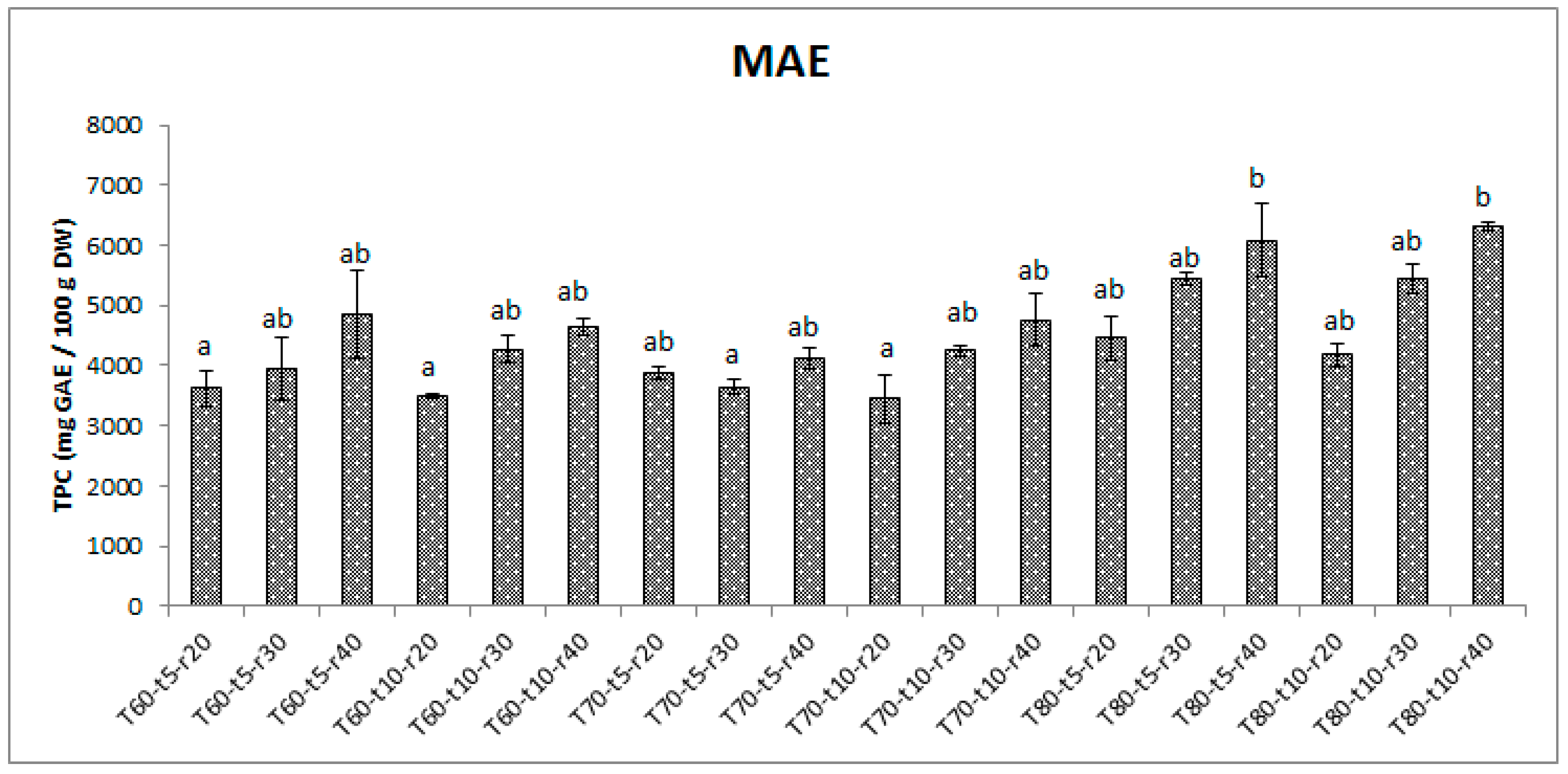
Figure 2.
Total phenolic content (TPC) of wild strawberry leaves obtained by accelerated solvent extraction (ASE) at different combinations of extraction parameters: temperature of 100, 125, and 150 °C (T100, T125, T150), static extraction time of 5 and 10 min (t5, t10), and solvent-to-sample ratio of 20, 30 and 40 mL/g (r20, r30, r40). Data are expressed as mean ± standard deviation. Different letters indicate statistically significant differences (p < 0.05).
Figure 2.
Total phenolic content (TPC) of wild strawberry leaves obtained by accelerated solvent extraction (ASE) at different combinations of extraction parameters: temperature of 100, 125, and 150 °C (T100, T125, T150), static extraction time of 5 and 10 min (t5, t10), and solvent-to-sample ratio of 20, 30 and 40 mL/g (r20, r30, r40). Data are expressed as mean ± standard deviation. Different letters indicate statistically significant differences (p < 0.05).
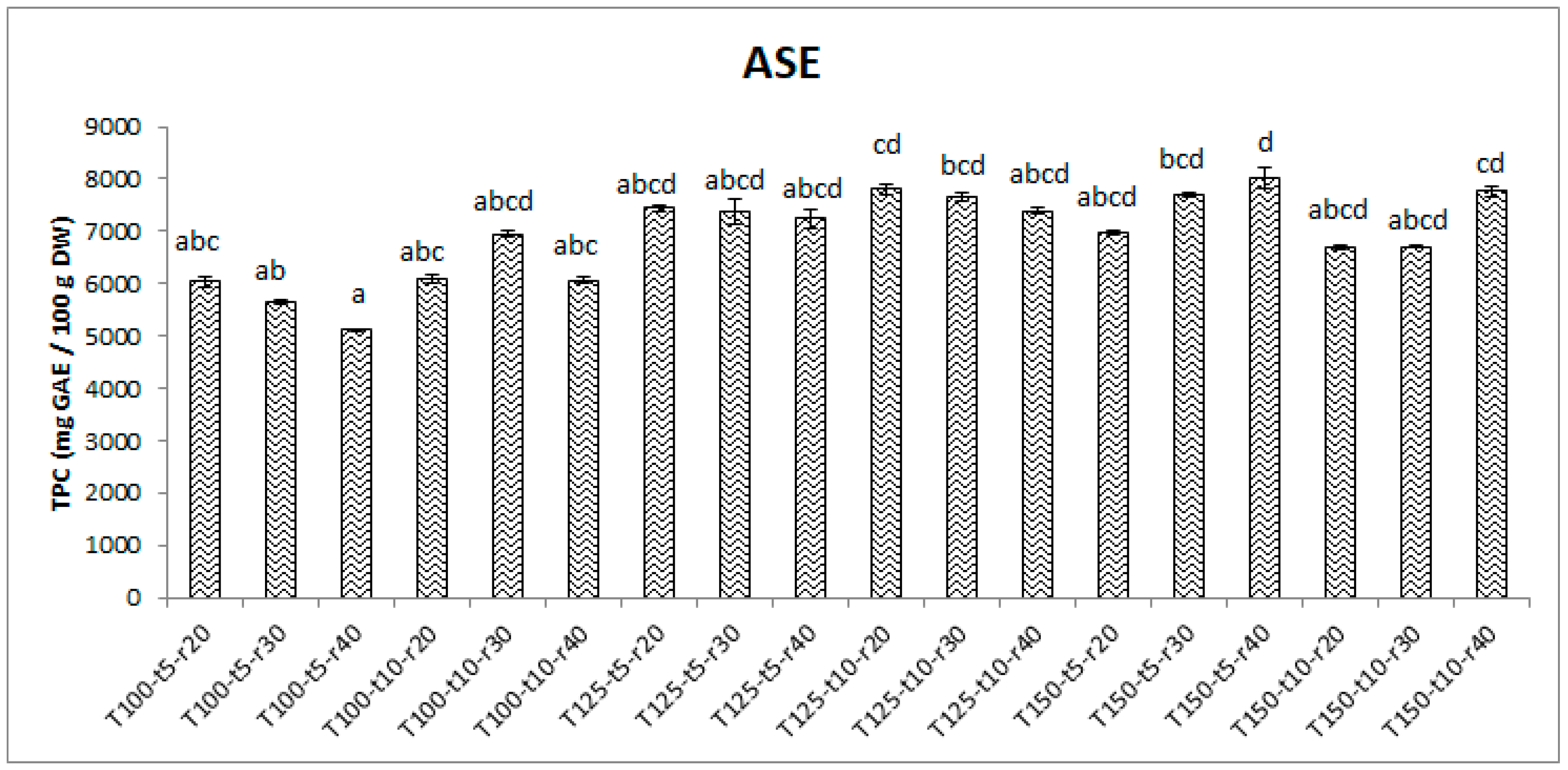
Figure 3.
Content of different classes of phenolics as determined by UPLC/MS-MS in extracts of wild strawberry leaves obtained by microwave-assisted extraction (MAE) and accelerated solvent extraction (ASE) under optimal conditions. Data are expressed as mean ± standard deviation. Different letters indicate statistically significant differences (p < 0.05).
Figure 3.
Content of different classes of phenolics as determined by UPLC/MS-MS in extracts of wild strawberry leaves obtained by microwave-assisted extraction (MAE) and accelerated solvent extraction (ASE) under optimal conditions. Data are expressed as mean ± standard deviation. Different letters indicate statistically significant differences (p < 0.05).
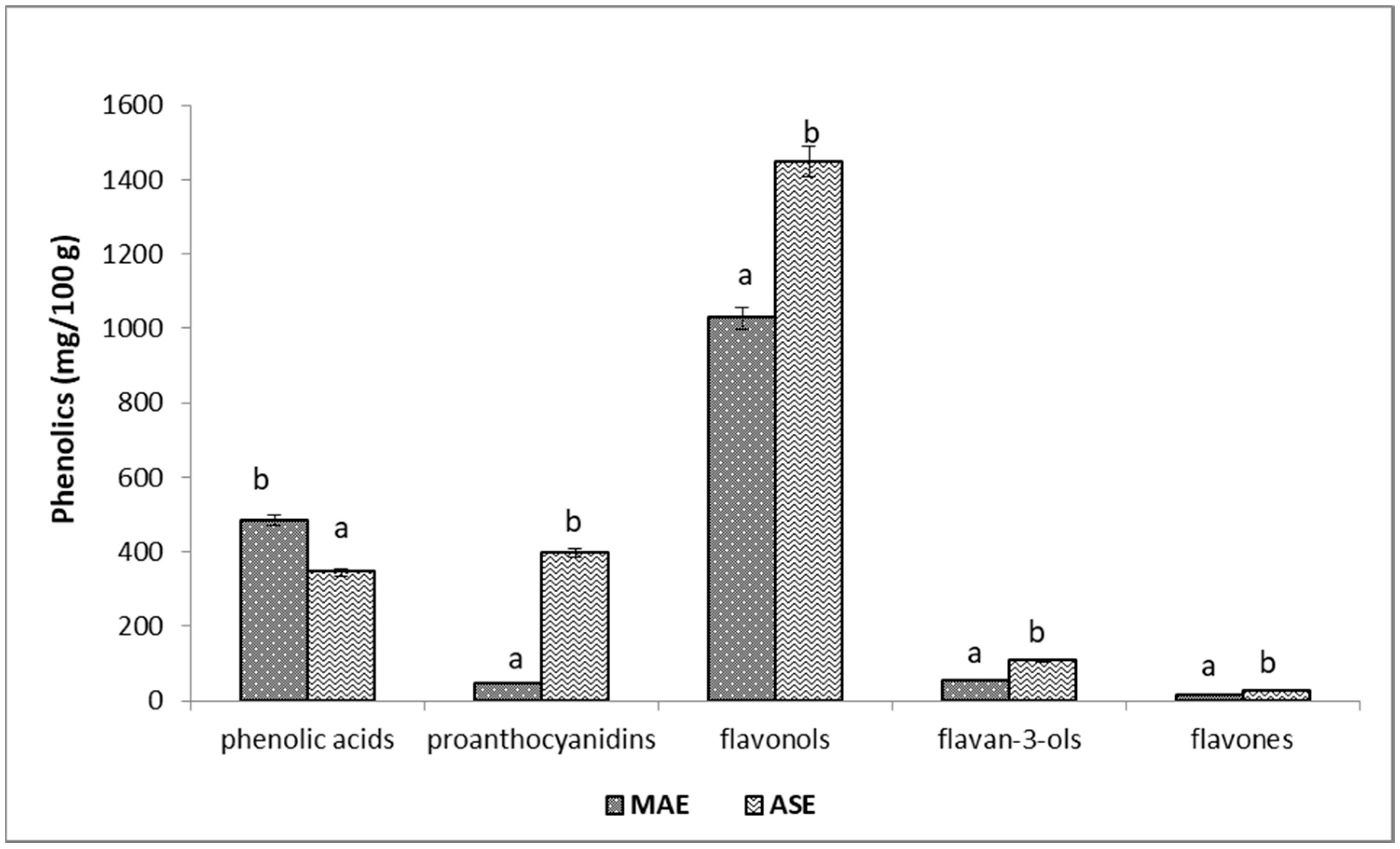

Table 1.
Content of individual phenolic acids, proanthocyanidins, flavonols, flavan-3-ols and flavones determined in extracts of wild strawberry leaves obtained by microwave-assisted extraction (MAE) and accelerated solvent extraction (ASE) under optimal conditions. Data are expressed as mean ± standard deviation. Different letters indicate statistically significant differences (p < 0.05).
Table 1.
Content of individual phenolic acids, proanthocyanidins, flavonols, flavan-3-ols and flavones determined in extracts of wild strawberry leaves obtained by microwave-assisted extraction (MAE) and accelerated solvent extraction (ASE) under optimal conditions. Data are expressed as mean ± standard deviation. Different letters indicate statistically significant differences (p < 0.05).
| No. | Compound name | RT (min) | m/z | m/z (prod.) | MAE mg/100 g |
ASE mg/100 g |
|---|---|---|---|---|---|---|
| PHENOLIC ACIDS | ||||||
| 1 | ferulic acid* | 1.937 | 193 | 178 | 5.13 ± 015 a | 6.07 ± 0.17 b |
| 2 | 3-p-caffeoylquinic acid | 2.906 | 337 | 163 | 3.64 ± 0.10 b | 2.90 ± 0.08 a |
| 3 | rosmarinic acid* | 3.138 | 359.1 | 161 | 16.74 ± 0.47 a | 16.82± 0.48 a |
| 5 | chlorogenic acid* | 4.615 | 353 | 191 | 43.57 ± 1.23 a | 40.06 ± 1.13 a |
| 8 | 3,5-di-caffeoylquinic acid | 5.573 | 515 | 173 | 0.83 ± 0.02 b | 0.76 ± 0.02 a |
| 9 | 4,5-di-caffeoylquinic acid | 5.573 | 515 | 353 | 1.12 ± 0.03 a | 1.13± 0.03 a |
| 12 | syringic acid* | 6.354 | 197 | 182 | 7.39 ± 0.21 a | 19.42± 0.55 b |
| 13 | caffeic acid* | 6.368 | 179 | 135 | 8.44 ± 0.24 b | 6.91± 0.20 a |
| 17 | 4-O-caffeoylquinic acid | 7.821 | 324 | 173 | 0.15 ± 0.00 b | 0.07± 0.00 a |
| 25 | 5-O-galloylquinic acid | 9.775 | 343 | 191 | 61.38 ± 1.74 a | 62.22± 1.76 a |
| 28 | 3-O-ferruylquinic acid | 11.238 | 367 | 193 | 1.77 ± 0.05 a | 1.42± 0.04 a |
| 39 | gallic acid* | 11.528 | 169 | 125 | 156.96 ± 4.44 b | 39.84± 1.13 a |
| 40 | p-hydroxybenzoic acid | 11.538 | 137 | 93 | 172.41 ± 4.88 b | 141.78 ± 4.01 a |
| 53 | 3,5-Digalloylquinic acid | 11.968 | 495 | 343 | 5.19 ± 0.15 a | 6.50 ± 0.18 b |
| PROANTHOCYANIDINS | ||||||
| 4 | procyanidin trimer | 3.438 | 865 | 575 | 1.84 ± 0.05 a | 43.71± 1.24 b |
| 10 | procyanidin B2* | 5.815 | 577 | 289 | 0.92 ± 0.03 a | 21.84± 0.62 b |
| 30 | procyanidin B1 | 11.351 | 579 | 291 | 44.73 ± 1.27 a | 332.26 ± 9.40 b |
| FLAVONOLS | ||||||
| 6 | isorhamnetin-3-rhamnoside | 5.178 | 625 | 317 | 1.13 ± 0.03 a | 1.72 ± 0.05 b |
| 7 | isorhamnetin-3-hexoside | 5.232 | 479 | 317 | 7.84 ± 0.22 b | 2.06 ± 0.06 a |
| 11 | kaempferol-3-O-hexoside | 6.252 | 449 | 287 | 5.36 ± 0.15 a | 5.69 ± 0.16 a |
| 15 | myricetin* | 7.258 | 319 | 273 | 48.33 ± 1.37 b | 33.19 ± 0.94 a |
| 16 | quercetin-3-glucuronide | 7.442 | 479 | 303 | 129.31 ± 3.66 a | 268.97 ± 7.61 b |
| 18 | kaempferol-3-glucuronide | 8.192 | 463 | 287 | 39.79 ± 1.13 a | 70.47 ± 1.99 b |
| 19 | quercetin-3-rhamnoside | 8.213 | 449 | 303 | 2.30 ± 0.06 a | 3.97 ± 0.11 b |
| 21 | kaempferol-3-O-deoxyhexoside | 8.475 | 433 | 286 | 1.40 ± 0.04 a | 1.93 ± 0.05 a |
| 23 | quercetin-3-pentoside | 9.700 | 435 | 303 | 1.68 ± 0.05 a | 11.81 ± 0.33 b |
| 26 | myricetin-3-O-rhamnoside | 9.905 | 465 | 319 | 6.13 ± 0.17 a | 43.71 ± 1.24 b |
| 27 | kaempferol-3-O-pentoside | 10.689 | 419 | 287 | 3.08 ± 0.09 b | 0.91 ± 0.03 a |
| 29 | kaempferol-pentosyl-hexoside | 11.344 | 581 | 287 | 0.25 ± 0.01 a | 0.77 ± 0.02 b |
| 31 | quercetin-acetyl-hexoside | 11.357 | 507 | 303 | 1.41 ± 0.04 a | 2.55 ± 0.07 b |
| 32 | kaempferol-acetyl-hexoside | 11.361 | 491 | 287 | 1.22 ± 0.03 b | 0.34 ± 0.01 a |
| 33 | isorhamnetin-3-O-glucoside | 11.364 | 483 | 317 | 1.41 ± 0.04 b | 0.83 ± 0.02 a |
| 34 | myricetin-3-O-galactoside | 11.368 | 481 | 319 | 68.99 ± 1.95 b | 52.33 ± 1.48 a |
| 35 | quercetin-3-glucoside* | 11.381 | 465 | 303.1 | 11.45 ± 0.32 a | 37.48 ± 1.06 b |
| 37 | myricetin-3-O-arabinoside | 11.395 | 451 | 319 | 8.37 ± 0.24 b | 4.36 ± 0.12 a |
| 41 | quercetin-acetyl-rutinoside | 11.552 | 653 | 303 | 0.28 ± 0.01 a | 1.29 ± 0.04 b |
| 42 | kaempferol-acetyl-rutinoside | 11.556 | 637 | 287 | 0.12 ± 0.00 a | 0.54 ± 0.01 b |
| 43 | quercetin-3-O-dihexoside | 11.559 | 627 | 303 | 2.74 ± 0.08 b | 1.97 ± 0.06 a |
| 44 | rutin* | 11.566 | 611 | 303 | 44.31 ± 1.25 a | 116.04 ± 3.28 b |
| 45 | isorhamnetin-pentosylhexoside | 11.566 | 611 | 317 | 1.23 ± 0.03 b | 0.43 ± 0.01 a |
| 46 | quercetin-3-O-vicianoside | 11.576 | 597 | 434 | 2.77 ± 0.08 b | 1.82 ± 0.05 a |
| 47 | kaempferol-3-rutinoside* | 11.586 | 595 | 287 | 3.56 ± 0.10 a | 7.54 ± 0.21 b |
| 49 | quercetin | 11.681 | 303 | 303 | 336.35 ± 9.51 a | 472.63 ± 13.34 b |
| 50 | kaempferol | 11.698 | 287 | 287 | 296.57 ± 8.39 a | 298.96 ± 8.46 a |
| 51 | quercetin-pentosylhexoside | 11.825 | 597 | 303 | 1.42 ± 0.04 a | 2.67 ± 0.08 b |
| FLAVAN-3-OLS | ||||||
| 24 | epicatechin | 9.727 | 291 | 139 | 45.42 ± 1.28 a | 100.29 ± 2.84 b |
| 36 | epigallocatechin gallate* | 11.388 | 459 | 289 | 5.41 ± 0.15 a | 5.48 ± 0.15 a |
| 54 | epicatechin gallate* | 12.149 | 442.9 | 273 | 3.53 ± 0.10 b | 2.26 ± 0.06 a |
| FLAVONES | ||||||
| 14 | luteolin-6-C-glucoside | 6.978 | 449 | 359 | 2.73 ± 0.08 b | 0.80 ± 0.02 a |
| 20 | luteolin * | 8.264 | 287 | 153 | 9.82 ± 0.28 a | 17.75 ± 0.50 b |
| 22 | apigenin* | 8.758 | 271 | 153 | 0.34 ± 0.01 a | 0.56 ± 0.02 b |
| 38 | apigenin pentoside | 11.429 | 403 | 271 | 0.399 ± 0.01 a | 0.55 ± 0.02 b |
| 48 | apigenin-6-C-(O-deoxyhexosyl)-hexoside | 11.593 | 579 | 459 | 0.24 ± 0.01 a | 0.57 ± 0.02 b |
| 52 | luteolin-7-O-rutinoside | 11.828 | 595 | 287 | 3.45 ± 0.109 a | 7.51 ± 0.21 b |
| TOTAL PHENOLICS | 1632.32 ± 26.17 a | 2326.42 ± 65.80 b | ||||
* Identification confirmed with authentic standards. Values within row marked with different letters are significantly different at p<0.05.
Table 2.
Antioxidant properties (using ABTS, DPPH and FRAP assay) of wild strawberry leaves obtained by microwave-assisted extraction (MAE) at different combinations of extraction parameters: Temperature of 60, 70, and 80 °C (T60, T70, T80), time of 5 and 10 min (t5, t10), and solvent-to-sample ratio of 20, 30 and 40 mL/g (r20, r30, r40). Data are expressed as mean ± standard deviation. Different letters indicate statistically significant differences (p < 0.05).
Table 2.
Antioxidant properties (using ABTS, DPPH and FRAP assay) of wild strawberry leaves obtained by microwave-assisted extraction (MAE) at different combinations of extraction parameters: Temperature of 60, 70, and 80 °C (T60, T70, T80), time of 5 and 10 min (t5, t10), and solvent-to-sample ratio of 20, 30 and 40 mL/g (r20, r30, r40). Data are expressed as mean ± standard deviation. Different letters indicate statistically significant differences (p < 0.05).
| MAE | T (°C) |
t (min) |
R (mL/g) |
ABTS (mmol TE/g) |
DPPH (mmol TE/g) |
FRAP (mmol TE/g) |
|---|---|---|---|---|---|---|
| T60-t5-r20 | 60 | 5 | 20 | 350 ± 12 ab | 444 ± 5 ab | 458 ± 29 abcd |
| T60-t5-r30 | 60 | 5 | 30 | 368 ± 51 abc | 539 ± 33 abc | 536 ± 63 abcd |
| T60-t5-r40 | 60 | 5 | 40 | 433 ± 12 abc | 661 ± 32 bc | 604 ± 79 abcd |
| T60-t10-r20 | 60 | 10 | 20 | 312 ± 8 a | 434 ± 14 ab | 429 ± 12 abc |
| T60-t10-r30 | 60 | 10 | 30 | 466 ± 5 abc | 557 ± 20 abc | 515 ± 49 abcd |
| T60-t10-r40 | 60 | 10 | 40 | 466 ± 42 abc | 669 ± 14 bc | 541 ± 25 abcd |
| T70-t5-r20 | 70 | 5 | 20 | 392 ± 77 abc | 477 ± 28 abc | 427 ± 31 ab |
| T70-t5-r30 | 70 | 5 | 30 | 371 ± 24 abc | 545 ± 1 abc | 360 ± 20 a |
| T70-t5-r40 | 70 | 5 | 40 | 442 ± 47 abc | 711 ± 20 c | 510 ± 73 abcd |
| T70-t10-r20 | 70 | 10 | 20 | 347 ± 19 ab | 470 ± 12 abc | 402 ± 36 ab |
| T70-t10-r30 | 70 | 10 | 30 | 444 ± 43 abc | 617 ± 8 abc | 515 ± 86 abcd |
| T70-t10-r40 | 70 | 10 | 40 | 440 ± 12 abc | 697 ± 3 c | 442 ± 12 abcd |
| T80-t5-r20 | 80 | 5 | 20 | 471 ±31 abc | 352 ± 2 a | 1834 ± 76 abcd |
| T80-t5-r30 | 80 | 5 | 30 | 517 ± 28 bc | 475 ± 7 abc | 2118 ± 34 bcd |
| T80-t5-r40 | 80 | 5 | 40 | 681 ± 11 c | 583 ± 45 abc | 2389 ± 175 cd |
| T80-t10-r20 | 80 | 10 | 20 | 413 ± 29 abc | 345 ± 23 a | 1666 ± 55 abcd |
| T80-t10-r30 | 80 | 10 | 30 | 584 ± 32 bc | 457 ± 1 abc | 2082 ± 143 bcd |
| T80-t10-r40 | 80 | 10 | 40 | 683 ± 73 c | 580 ± 3 abc | 2461 ± 89 d |
Table 3.
Antioxidant properties (using ABTS, DPPH and FRAP assay) of wild strawberry leaves obtained by accelerated solvent extraction (ASE) at different combinations of extraction parameters: Temperature of 100, 125, and 150 °C (T100, T125, T150), static extraction time of 5 and 10 min (t5, t10), and solvent-to-sample ratio of 20, 30 and 40 mL/g (r20, r30, r40). Data are expressed as mean ± standard deviation. Different letters indicate statistically significant differences (p < 0.05). .
Table 3.
Antioxidant properties (using ABTS, DPPH and FRAP assay) of wild strawberry leaves obtained by accelerated solvent extraction (ASE) at different combinations of extraction parameters: Temperature of 100, 125, and 150 °C (T100, T125, T150), static extraction time of 5 and 10 min (t5, t10), and solvent-to-sample ratio of 20, 30 and 40 mL/g (r20, r30, r40). Data are expressed as mean ± standard deviation. Different letters indicate statistically significant differences (p < 0.05). .
| ASE | T (°C) |
t (min) | R (mL/g) |
ABTS (mmol TE/g) |
DPPH (mmol TE/g) |
FRAP (mmol TE/g) |
|---|---|---|---|---|---|---|
| T100-t5-r20 | 100 | 5 | 20 | 503 ± 13 abcd | 514 ± 3 ab | 758±26 a |
| T100-t5-r30 | 100 | 5 | 30 | 483 ± 16 abc | 688 ± 2 abcd | 809±5 abc |
| T100-t5-r40 | 100 | 5 | 40 | 509 ± 35 abcd | 717 ± 8 abcd | 742±69 a |
| T100-t10-r20 | 100 | 10 | 20 | 508 ± 7 abcd | 515 ± 3 abc | 757±8 a |
| T100-t10-r30 | 100 | 10 | 30 | 575 ± 8 abcd | 734 ± 1 abcd | 953±21 abc |
| T100-t10-r40 | 100 | 10 | 40 | 496 ± 10 abcd | 757 ± 4 abcd | 1057±37 c |
| T125-t5-r20 | 125 | 5 | 20 | 581 ± 4 abcd | 514 ± 4 ab | 860±14 abc |
| T125-t5-r30 | 125 | 5 | 30 | 602 ± 23 bcd | 742 ± 4 abcd | 1045±10 bc |
| T125-t5-r40 | 125 | 5 | 40 | 627 ± 14 cd | 839 ± 5 abcd | 786±19 ab |
| T125-t10-r20 | 125 | 10 | 20 | 581 ± 5 abcd | 514 ± 0 ab | 966±3 abc |
| T125-t10-r30 | 125 | 10 | 30 | 595 ± 8 bcd | 756 ± 4 abcd | 853±18 abc |
| T125-t10-r40 | 125 | 10 | 40 | 605 ± 13 cd | 843 ± 2 bcd | 896±23 abc |
| T150-t5-r20 | 150 | 5 | 20 | 540 ± 6 abcd | 512 ± 2 a | 865±19 abc |
| T150-t5-r30 | 150 | 5 | 30 | 595 ± 7 bcd | 754 ± 3 abcd | 959±15 abc |
| T150-t5-r40 | 150 | 5 | 40 | 595 ± 4 bcd | 903 ± 3 d | 1086±15 c |
| T150-t10-r20 | 150 | 10 | 20 | 450 ± 5 ab | 514 ± 1 abc | 893±9 abc |
| T150-t10-r30 | 150 | 10 | 30 | 442 ± 7 a | 706 ± 3 abcd | 928±13 abc |
| T150-t10-r40 | 150 | 10 | 40 | 504 ± 9 abcd | 889 ± 3 cd | 911±14 abc |
Table 4.
Correlation analysis between TPC and antioxidant properties (using ABTS, DPPH and FRAP assay) of wild strawberry leaves obtained by microwave-assisted extraction (MAE) and accelerated solvent extraction (ASE).
Table 4.
Correlation analysis between TPC and antioxidant properties (using ABTS, DPPH and FRAP assay) of wild strawberry leaves obtained by microwave-assisted extraction (MAE) and accelerated solvent extraction (ASE).
| TPC | ABTS | DPPH | FRAP | |
|---|---|---|---|---|
| TPC | 0.894** | 0.261* | 0.790** | |
| ABTS | 0.627** | 0.21 | 0.798** | |
| DPPH | 0.311** | 0.340** | -0.297* | |
| FRAP | 0.524** | 0.21 | 0.373** |
** Correlation is significant at the 0.01 level (2-tailed); * correlation is significant at the 0.05 level (2-tailed).
Disclaimer/Publisher’s Note: The statements, opinions and data contained in all publications are solely those of the individual author(s) and contributor(s) and not of MDPI and/or the editor(s). MDPI and/or the editor(s) disclaim responsibility for any injury to people or property resulting from any ideas, methods, instructions or products referred to in the content. |
© 2023 by the authors. Licensee MDPI, Basel, Switzerland. This article is an open access article distributed under the terms and conditions of the Creative Commons Attribution (CC BY) license (http://creativecommons.org/licenses/by/4.0/).
Copyright: This open access article is published under a Creative Commons CC BY 4.0 license, which permit the free download, distribution, and reuse, provided that the author and preprint are cited in any reuse.


