
Submitted:
09 November 2023
Posted:
10 November 2023
You are already at the latest version
Abstract
In this paper we study the properties of a complete quadrangle in the Euclidean plane. Similarly, as it was done in our previous work the proofs are based on using rectangular coordinates symmetrically on four vertices and four parameters a,b,c,d. Here, we gather many properties of the complete quadrangle known from earlier but proved by the same method together with some new results given.
Keywords:
complete quadrangle
; diagonal triangle
; anticenter
1. Introduction
In the paper [12] we started with the study of the complete quadrangle in the Euclidean plane. We continue in the same style in this paper. In [12] we have shown how to choose suitable coordinate system that allows us easily to prove some known statements, but also to obtain some new results (Theorem 8, Theorem 14). If four points are joined in pairs by six distinct lines, they are called the vertices of a complete quadrangle, and the lines are its six sides. Two sides are said to be opposite if they have no common vertex. In this paper we study properties of a complete quadrangle using rectangular coordinates symmetrically on four vertices and four parameters . In [12] we have proved:
Lemma 1.
Each quadrangle for which the opposite sides are not perpendicular, the rectangular hyperbola can be circumscribed.
2. Materials and Methods
Let be a complete quadrangle and a rectangular hyperbola circumscribed to it. With the suitable choice of the coordinate system it can be achieved that has the equation and the vertices of the quadrangle are of the form
where .
Let be elementary symmetric functions in four variables :
The centroid of the quadrangle is of the form
The sides of have the equations:
3. Results
3.1. The center and anticenter of the quadrangle
In this section we study Euler circles of four triangles of the quadrangle , and define its center and anticenter. The circle with the equation
passes through the midpoint of points A and B. Similarly, it passes through the midpoints of , i.e. , so it is Euler’s circle of the triangle . It obviously passes through the origin O. Analogously, the same is valid for Euler’s circles , and of the triangles , , and . Hence, we proved the following statement from [3]:
Theorem 1.
Euler’s circles of the triangles , , , of the complete quadrangle with circumscribed rectangular hyperbola passes through the center of the hyperbola.
There are several names for the point O in the literature, and we will call it the center of the quadrangle . The point , symmetric to the point O with respect to the centroid G we will call an anticenter of the quadrangle . The asymptotes and of the hyperbola we will call the axes of the quadrangle .
The center of the circle , i. e. Euler’s center of the triangle , is the point
The Euler’s centers of the triangles , , are of similar forms. The distance from to the origin O fulfills
Hence, Euler’s circle of the triangle has the radius
. The other three radii of the Euler’s circles of the other three triangles look like similarly, see [11]. Because of that, the radius of the circumscribed circle of the triangle is given within following analogous formulae
where are the radii of the circumscribed circles of the triangles , , using the following notations
where . The parameters (5) appear in formulae for lengths of sides of the quadrangle . Indeed, for the points A and B we get
i.e. . The other five analogous statements are also valid
From these equalities the next equalities follow
For coordinates of the point from (4) it proves that
The same is valid for as well. Therefore, we have proved the result given in [7] and [11]:
Theorem 2.
The centroid G of the quadrangle is the center of the quadrangle , where are centers of Euler circles , , , , respectively, and the quadrangles and have the parallel axes.
Because the midpoints are symmetric to the midpoints with respect to the centroid G, the circle incident to the midpoints of is symmetric to the Euler circle of the triangle with respect to the centroid G. Hence, that circle is incident to anticenter because the circle is incident to O. We have proved the following:
Theorem 3.
Circles incident to the midpoints of three sides ; ; ; are passing through .
The line has the slope , and connecting line of the origin and the midpoint of has the slope , so these lines are antiparallel with respect to coordinate axes. The same is valid for any side of the quadrangle . We showed the result given in [3] and [13]:
Theorem 4.
The angle of any two sides of the quadrangle is opposite to the angle of connecting lines of the midpoints of these sides and the center of .
Let us study the points
The line with the equation is perpendicular to the line from (3) and it is incident to C and , so the line is height from C of the triangle . Similarly, the lines and are heights from the vertices A and B of the triangle . Therefore, is the orthocenter of that triangle. Hence, see [3]:
Theorem 5.
The orthocenters of the triangles , respectively, are incident to the rectangular hyperbola .
This statement proves the converse of Lemma 2 from [12].
As the orthocenters are incident to hyperbola , its center O is the center of the quadrangle . In [11] the following is proved:
Theorem 6.
Quadrangles and have the same center.
If the point D coincides with , then , , and the quadrangle is the orthocentric quadrangle (see [12]).
3.2. A diagonal triangle of the quadrangle
Diagonal points , , of the quadrangle are given by
These points can be written in the shorter form
where
The following equalities are valid
Therefore, the lines , , with equations
are incident to pairs of points ; ; , respectively. So, they are the diagonals of the quadrangle . Hence, their equations are
The centroid of the triangle is the point
The heights from vertices U and V of the diagonal triangle have the equations
For their intersection point the equalities
are valid. However, it can be checked that
are valid. Hence, the orthocenter of the triangle is the point
The centroid, orthocenter and circumcenter of the triangle fulfill the equality , out of which we get
Let us study now the circle with the center and the equation
We will show that is the circumscribed circle of the triangle . That U is incident to this circle, it is proved by the equality
that can be written in the form
and it is valid because of (9) and (10) and the equalities
Theorem 7.
The circumscribed circle of the diagonal triangle of the quadrangle is incident to its center O.
The line has the equation and the normal from O to this line is given by . The intersection point of these two lines is the point
Out of the equalities (10) and (14), and (11) and (13) the next equalities follow
that can be written in the form
The expression
can be written as
and because of (16) that is equal to . It means that line with the equation
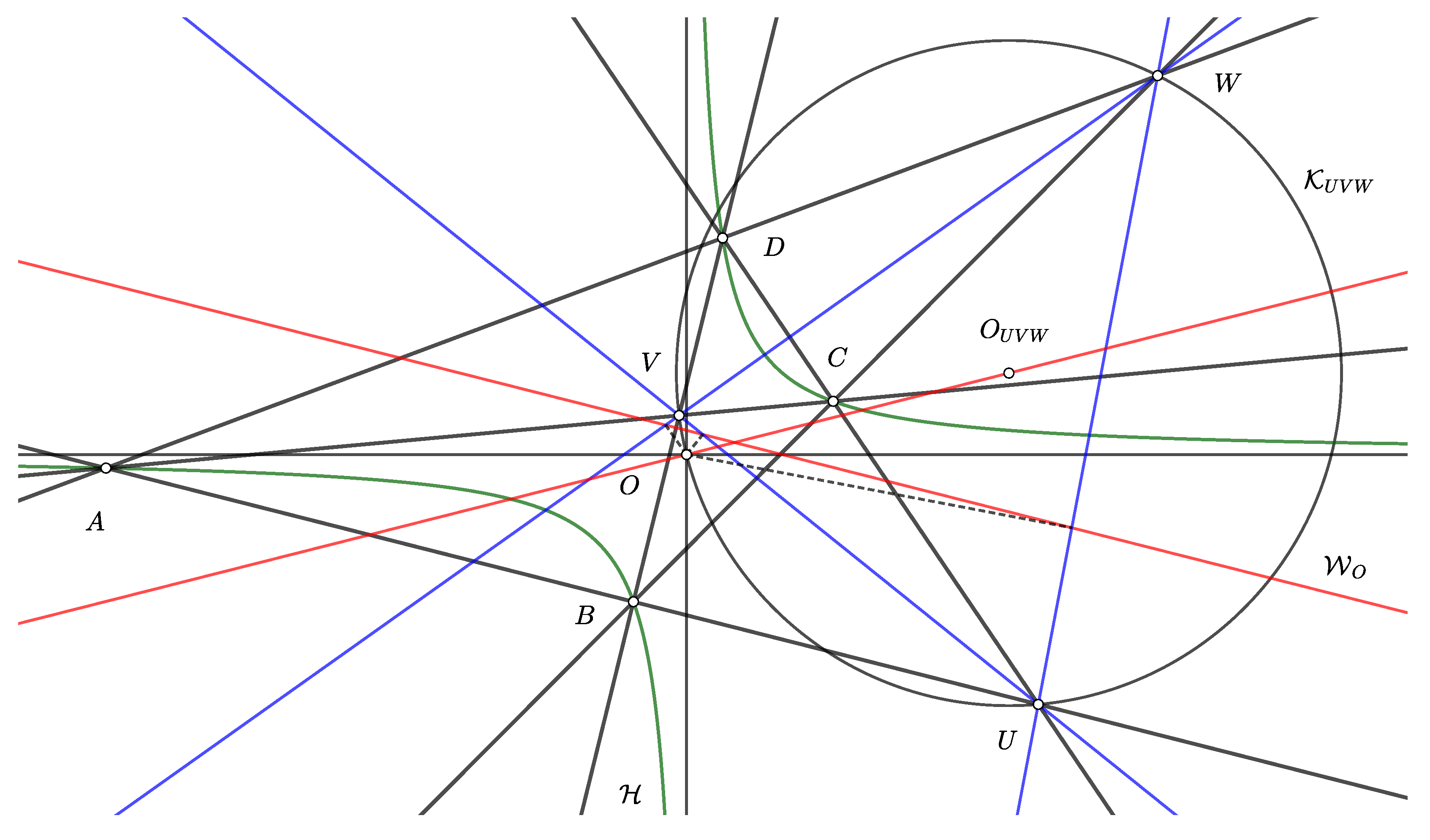
is incident to the point (15), the pedal of the normal to the line from the point O. Because of the symmetry, it is incident to the pedals of the normal to the line and from the point O, respectively. Hence, the line in (17) is the Wallace’s line of the point O with respect to the triangle . Therefore, the new statement is proved, see Figure 1.
Theorem 8.
The Wallace’s line of the center O with respect to the diagonal triangle and the connecting line of the points and O form equal angles with the asymptotes and of the hyperbola .
Namely, their slopes are opposite.
The line through the midpoint of the side and parallel to the line has the equation and it is incident to the point
because
Because of symmetry of coordinates of this point on pairs and , it follows that the line incident to the midpoint of and parallel to the side is incident to as well. The midpoint of and the point are lying on the circle given by
This circle is incident to the midpoint of and obviously to the point O. There are two more such circles obtained in analogously way. As it is stated in [1,3], the following is valid:
Theorem 9.
The circles incident to the midpoints of , and the point ; , , and ; , and are incident to O.
The triangles and have centroids , and their connecting line has the equation . Analogously, the line has the equation . The intersection point is of the form
The orthocenters and from (8) have connecting line with the equation , and analogously the line have the equation . The intersection point is
Let us remind from [12] that the circumcenter of the triangle is the point
The circumcenters and with forms analogous to (19) have the connecting line with the equation , and analogously the line have the equation . For the intersection point we get the form
Out of terms for and it is easy to check that the equality is valid, i.e. or , i. e. . The same iz valid for the analogous intersections. So, we have proved the result that can be found in [9], where Myakishev addressed it to J. Ganin:
Theorem 10.
If are centroids, are orthocenters and are circumcenters of the triangles in the quadrangle and if ; and represent diagonal points of the quadrangles , and , respectively then triples of points ; ; are collinear and is valid.
3.3. Isogonality with respect to the triangles , , ,
If two lines and have slopes and , then for the oriented angle the following formula is valid
The lines have slopes Let be point isogonal to the point D with respect to the triangle and let k be slope of . Then and due to (20) we get
Out of equality it follows
We will show that the point
is isogonal point to the point D with respect to the triangle . Because of symmetry on it is enough to show that the line is isogonal to the line with respect to the lines and , i.e. that the line have the slope k from (21). The points A and have the difference between coordinates
so the line have the slope k in (21). The point can be rewritten as
In the same way we can get the points isogonal to the points with respect to the triangles , respectively. The centroid of these four points is the point
The point from (22) and its analogous point have the midpoint that lies on the line from (3). The line has the slope , hence it is perpendicular to the line . It means that is the bisector of the line segment . Similarly, the same is valid for the analogous elements of the quadrangles and . Because, the sides of the quadrangle are bisectors of sides , respectively. Out of earlier facts it follows that the points are the centers of the circles , , , , that can be directly proved analytically, because for the distance of the point from the point we get
so by analogy we conclude that . We have proved the statement found in [2] and [13]:
Theorem 11.
The points are the centers of the circles , ,
, .
In [5] we find:
Theorem 12.
The points are isogonal to the points with respect to the triangles if and only if the points are centers of the circles .
It means that the role of the quadrangle for the the quadrangle is the same as the role of the quadrangle for the quadrangle . However, the points are isogonal to the points with respect to the triangles . The following theorem stated in [2] and [4] is valid:
Theorem 13.
The points are isogonal to the points with respect to the triangles , , , .
For the point from (19) the next equalities are valid
Hence, this point, as well as points are incident to the rectangular hyperbola with the equation (24) and the center . Due to that, is the center of the quadrangle , and anticenter to . So, the following theorem is valid:
Theorem 14.
The center of the quadrangle is the anticenter of the quadrangle . The center O of this quadrangle is the anticenter of .
Figure 2.
The visualization of Theorem 12 and Theorem 14
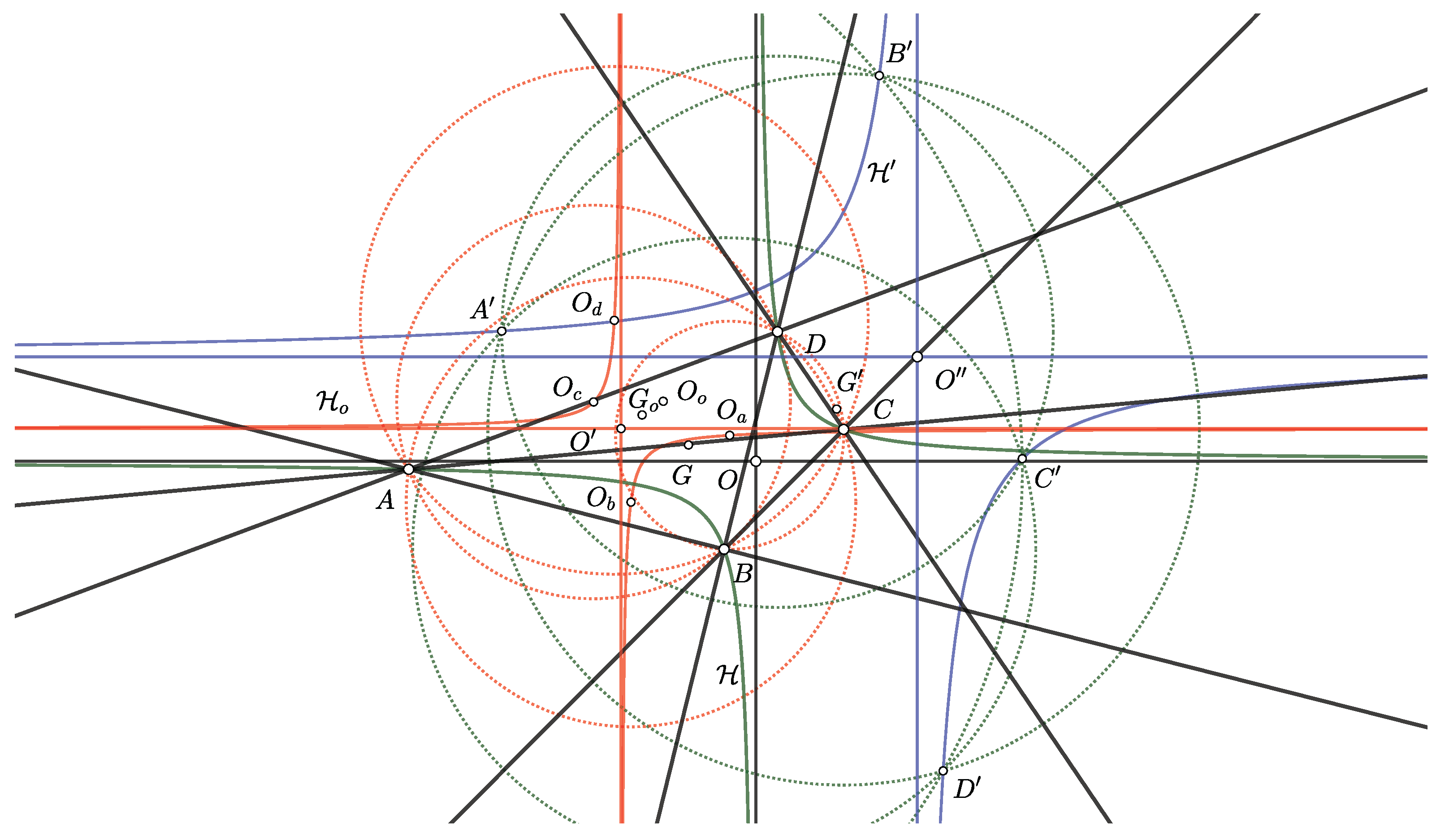
Center of the quadrangle is the point symmetric to the point O with respect to the centroid of this triangle, given by (23), so this center is the point . It is easy to see that the point from (19) and analogous points have the centroid . As is the center of the quadrangle , the anticenter is the point symmetric to the point with respect to the point and that is the point .
If we apply a translation for the vector on the quadrangle , then e.g. the point from (22) transfers to the point . In the same way we can get the points . All the four points have the same product of the coordinates, so they are all incident to the rectangular hyperbola with the centre O and with the same asymptotes as the rectangular hyperbola . Hence, the point O is the center of the quadrangle , so the point is the center of the quadrangle . Symmetric point to the latter point with respect to the centroid from (23) of the quadrangle is the point O.
4. Discussion
Putting the complete quadrangle into such a coordinate system that its circumscribed hyperbola is rectangular and has the equation allows us to prove many known properties by the same method. Thereat we come across some more quadrangles related to the referent one with some old and new results given.
That enables us to prove even more results in rich geometry of a complete quadrangle like an isoptic point, some circles related to the quadrangle etc. planned to be presented in some future papers.
Author Contributions
Conceptualization, V.V., E.J. and M. ŠH.; methodology, V.V.; software, E.J. and M. ŠH.; validation, V.V., E.J. and M. ŠH.; formal analysis, V.V., E.J. and M. ŠH.; investigation, V.V., E.J. and M. ŠH.; resources, V.V., E.J. and M. ŠH.; data curation, V.V., E.J. and M. ŠH.; writing—original draft preparation, E.J. and M. ŠH. ; writing—review and editing, V.V., E.J. and M. ŠH. ; visualization, E.J.; supervision, V.V.; project administration, E.J. and M. ŠH; funding acquisition, E.J. and M. ŠH. All authors have read and agreed to the published version of the manuscript.
Funding
This research received no external funding.
Conflicts of Interest
The authors declare no conflict of interest.
References
- Ayme, J.L. Le point d’Euler-Poncelet d’un quadrilatère, jl.ayme.pagesperso-orange.fr. Geometry 2010, 8, 133. [Google Scholar]
- Baumgartner, D.; Stärk, R. Ein merkwürdiger Punkt des Viereceks. Praxis Math. 2002, 44, 19–27. [Google Scholar]
- Brianchon, C. J.; Poncelet, J.V. Rechearches sur la détermination d’une hyperbole équilatère, au moyen de quatre conditions données. Ann. de Math. 1920-21, 11, 205–220. [Google Scholar]
- Cundy, H.M.; Parry, C.F. Geometrical properties of some Euler and circular cubics.PART 2. J. Geom 2000, 68, 58–75. [Google Scholar] [CrossRef]
- Grinberg, D. Isogonal conjugation with respect to a triangle. Unpublished notes September 23 2006, 56. Available online: https://www.cip.ifi.lmu.de/ grinberg/geometry2.html (accessed on September 7th 2023).
- Lawlor, J.H. Pedal circles. Math.Gaz. 1917, 9, 127–130. [Google Scholar] [CrossRef]
- Majo, A.de. Sur un point remarquable du quadrangle. Mathesis 1954, 63, 236–240. [Google Scholar]
- Mallison, H.V. Pedal circles and the quadrangle. Math. Gaz. 1958, 42, 17–20. [Google Scholar] [CrossRef]
- Myakishev, A. On two remarkable lines related to a quadrilateral. Forum Geom. 2006, 6, 289–295. [Google Scholar]
- Rolinek, M.; Dung, L.A. The Miquel points, pseudocircumcenter, and Euler-Poncelet point of a complete quadrilateral. Forum Geom. 2014, 14, 145–153. [Google Scholar]
- Schmidt, E. Euler-Gerade eines Vierecks. http://eckartschmidt.de/EULER.pdf, 2004, Theme 3, 12 S.
- Volenec, V. , Jurkin E., Šimić Horvath, M. On Quadruples of Orthopoles. Journal of Geometry 2023, 114, article–29. [Google Scholar] [CrossRef]
- Wood, P.W. Points isogonally conjugate with respect to a triangle. Math. Gaz. 1941, 25, 266–272. [Google Scholar] [CrossRef]
Figure 1.
The Wallace’s line of the center O with respect to the triangle and the line form equal angles with the asymptotes of .
Figure 1.
The Wallace’s line of the center O with respect to the triangle and the line form equal angles with the asymptotes of .
Disclaimer/Publisher’s Note: The statements, opinions and data contained in all publications are solely those of the individual author(s) and contributor(s) and not of MDPI and/or the editor(s). MDPI and/or the editor(s) disclaim responsibility for any injury to people or property resulting from any ideas, methods, instructions or products referred to in the content. |
© 2023 by the authors. Licensee MDPI, Basel, Switzerland. This article is an open access article distributed under the terms and conditions of the Creative Commons Attribution (CC BY) license (http://creativecommons.org/licenses/by/4.0/).
Copyright: This open access article is published under a Creative Commons CC BY 4.0 license, which permit the free download, distribution, and reuse, provided that the author and preprint are cited in any reuse.


