

Submitted:
25 July 2025
Posted:
30 July 2025
You are already at the latest version
Abstract
Breaking symmetry is crucial in many areas of physics, mathematics, biology and engineering. We address symmetry of regular convex polygons, non-convex regular polygons (stars) and symmetric Jordan curves/domains. We demonstrate that removing of a single point from the boundary of the regular convex and non-convex polygons and symmetrical Jordan curves reduces the symmetry group of the polygon to the trivial C1 group, when the point does not belong to the axis of symmetry of the polygon. The same is true for solid and open 2D regular convex polygons and symmetric Jordan curves. The only exception is a circle. Removing of a single point from the boundary of a circle gives rise to the curve characterized by C2 group. Symmetry of circles is reduced to the trivial C1 group by removing a triad of non-symmetrical points. The same is true for a solid circle. The “effort” necessary for breaking symmetry of a circle is maximal. 3D generalization of the theorem is trivial. Thus, classification of symmetrical curves following the minimal number of points necessary for breaking their symmetry becomes possible. The demonstrated theorem shows that the symmetry group action on curves and domains becomes trivial when an asymmetric perturbation is introduced, when the curve is not a circle. Information interpretation of the demonstrated theorem, related to the Landauer principle is introduced.
Keywords:
symmetry
; breaking symmetry
; regular polygon
; Jordan curve
; Jordan domain
; symmetry group
1. Introduction
Breaking symmetry is crucial in many areas of physics, mathematics, and even biology and engineering. It often reveals deeper structures, initiates critical transitions, or explains how diversity and complexity emerge from simple rules [1,2]. In the Higgs mechanism, the vacuum is not symmetric even though the laws are [3]. Rigorously speaking, Lagrangian has a symmetry, but the lowest energy state (vacuum) of the system does not respect that symmetry [3,4]. This gives particles mass in the Standard Model. Without symmetry breaking, all particles would remain massless — contradicting reality.
Symmetry breaking plays a central role in phase transitions [5,6,7]. In particular, in second-order (continuous) phase transitions, spontaneous symmetry breaking plays a crucial role [8,9,10,11]. Phase transitions associated with spontaneously broken global symmetries can have important cosmological implications [12]. Symmetry breaking is effectively exploited now in materials engineering; it plays a significant role in 2D layered materials defining their macroscopic electrical, optical, magnetic and topological properties [13].
Ideas of symmetry breaking are intensively discussed in modern chemistry; a catalyst design based on symmetry-breaking sites activating nonpolar CO2 molecules was reported [14]. Symmetry breaking in living matter were addressed [15]. It was suggested, that breaking symmetry is closely related to aesthetics [16]. Our paper is devoted to mathematical aspects of breaking symmetry. We address the fundamental question: what minimal effort is necessary for breaking symmetry of symmetric curves and shapes? The paper is built, as follows: i) breaking symmetry of polygons is addressed. Minimal effort necessary for breaking symmetry is established; ii) breaking symmetry of Jordan curves is investigated; iii) applications of the introduced approach are discussed.
2. Results
2.1. Breaking the Symmetry of Regular Polygons
Consider symmetrical polygon. We pose following fundamental question: how many points should be removed from the polygon in ordered to break its symmetry? Let us start from the simplest example of the equilateral triangle. The symmetry group of the equilateral triangle is the dihedral group This is the group of order six and it includes 3 rotations and 3 reflections namely the elements of this group are:
where is the identity (rotation by 0 rad), is rotation by , is rotation by , is reflection across the axis through vertex “1” and the midpoint of the opposite side, are reflection axes through vertices “2” and “3”, as depicted in Figure 1.
We remove a single point, denoted A (see Figure 1) located on the boundary of the equilateral triangle. The point does not lay on the symmetry axes . Let us analyze this procedure from the topological point of view. The initial boundary of the triangle is homeomorphic to a circle , which is compact, connected, and without boundary. After removing point A the boundary becomes homeomorphic to an open interval (0, 1), which is non-compact, connected, and possessing two “ends” (though no actual boundary points, because the endpoints are missing).
After removing point A the boundary loses all elements of symmetry, with a single exception of the identity element, i.e. rotation by 0 rad. This is easily checked with a sequential check of symmetry of the triangle with the removed point A, relatively to group elements. Thus, as result of the suggested procedure, the dihedral group is reduced to the trivial symmetry group, which is usually labeled or within graph-theoretic notation. We denote removing of a single point from the boundary Thus, the entire process of symmetry breaking is briefly expressed with Eq. 2:
We conclude that removing a single point from the equilateral triangle boundary, which does not lay on the axes of symmetry of the triangle, completely destroys its symmetry. The order of the symmetry group is reduced from six to unity.
The same is true for the isosceles triangle, shown in Figure 2. The dihedral group of the isosceles triangle is usually labeled , and it contains two elements, i.e. the identity element and the symmetry axis (see Figure 2).
We select point A which does not belong to the symmetry axis and remove it from the boundary. After removing point A the boundary becomes homeomorphic to an open interval and the symmetry of the boundary is reduced to the group , including the identity element only. In other words, Eq. 3 is true:
The order of the symmetry group is reduced from two to unity.
Now we consider the solid 2D triangle T, which is homeomorphic to a closed 2-disk , depicted in Figure 3. The symmetry group of this shape is (see Figure 3). We propose to remove a single point A from the triangle (see Figure 3). Point A does not belong to the axes of symmetry of the triangle. If the point is removed from the interior of the triangle the shape is homeomorphic to a punctured disk .
If point A is removed from the boundary the shape is equivalent to a closed disk with a point removed from its boundary, which is topologically homeomorphic to the original triangle. Removing of point A, which does not lay on the axis of symmetry again destroys the symmetry of the isosceles triangle. The same approach is applicable to the open isosceles/equilateral triangle, which is homeomorphic to an open 2-disk. In this case point A to be removed from the triangle belongs to the interior of the triangle and it does not lay on its axis of symmetry.
Thus, we demonstrated the following lemma.
Lemma 1:
Consider the boundary of isosceles/equilateral triangle. Removing of a single point from the boundary (the point does not belong to the axis of symmetry of the triangle) reduces the symmetry group of the triangle to the trivial group. The same is true for solid 2D isosceles/equilateral triangle and open isosceles/equilateral triangle.
Again, as a result of the suggested puncturing of the triangle, the dihedral group is reduced to the trivial symmetry group, labeled .
Now we consider regular polygons. Address regular pentagon depicted in Figure 4. The circumcenter of the pentagon is denoted O. The symmetry group of the regular pentagon is dihedral group , and it includes five rotations (including the identity), and five reflections (through lines that pass through a circumcenter and the midpoint of the opposite side, denoted ).
We remove a single point, denoted A (see Figure 4) located on the boundary of the regular pentagon. The point does not lay on the symmetry axes The initial boundary of the pentagon is homeomorphic to a circle , which is compact, connected, and without boundary. After removing point A the boundary becomes homeomorphic to an open interval , which is non-compact, connected, and possessing two “ends”.
After removing point A the boundary becomes homeomorphic to an open interval and the symmetry of the boundary is reduced to the trivial group , including the identity element only. This is easily demonstrated with the triangulation procedure, shown with dashed lines in Figure 4. Removing point A from the boundary breaks the symmetry of the isosceles triangle (see Figure 4) according to the Lemma 1.Breaking the symmetry of the isosceles triangle breaks the symmetry of entire pentagon. In other words, for regular pentagon Eq. 4 is true:
The order of the symmetry group of pentagon is reduced from five to unity. The approach is easily extended to any regular n-gone. Thus, the following Theorem 1 is demonstrated.
Theorem 1.
Let be a regular polygon/n-gon (for ). Removing a single point from that is not fixed under any non-trivial symmetry operation of reduces its symmetry group to the trivial group . The same is true for solid 2D regular n-gon and open regular n-gon.
The same Theorem is true for the non-convex pentagon, such as five-pointed star, shown in Figure 5.
The symmetry group of the five-point is the same dihedral group . We remove a single point, denoted A (see Figure 5) located on the boundary of the regular pentagon. The point does not lay on the symmetry axes Removing point A from the boundary breaks the symmetry of the star, and Eq. 5 is true. It is trivially demonstrated by dividing the star into five isosceles triangles and pentagon and involving Lemma 1. Consider that a five-point star depicted in Figure 5 is not a convex polygon but it still a Jordan curve.
It is also noteworthy, that the demonstrated Lemma does not work for the set of isolated vertices of regular polygons themselves. Removing of one of the vertices does not reduce the symmetry of the set to the trivial group. Indeed, the vertices of the regular polygons are located on their axes of symmetry.
2.2. Breaking the Symmetry of the Curves
Now consider the ellipse depicted in Figure 6. The ellipse is centered at the origin (or more generally, with its axes aligned with coordinate axes).
The group of symmetry of an ellipse is the dihedral group . An is ellipse centered at the origin. The ellipse has the following symmetries: reflection across the major axis ; reflection across the minor axis (see Figure 6); rotation by 180° around the center; the identity transformation. The order of the symmetry group is four. Removing a single point A from the ellipse breaks the symmetry of the curve, and Eq. 5 is true:
It seems that behavior of symmetrical curves resembles that of the regular polygons; namely, removing of a single point, which does not belong to the axes of symmetry, destroys the symmetry of the shape, and reduces it to the trivial symmetry group Thus, the suggested approach may be easily extended to the symmetric Jordan curves. However, there exists the remarkable exception, and this exception is a circle. The full symmetry group of the circle in the plane is called , the orthogonal group in 2D. It includes: i.e. all rotations about the center (this is a Lie group, topologically a circle) and reflections, i.e. an infinite number of reflections across lines (diameters) through the center. This is an infinite, continuous group, unlike the finite symmetry groups of regular polygons. Any point on a circle belongs to one of its axes of symmetry. Thus, two very different cases, depicted in Figure 7 should be distinguished. Inset A of Figure 7 illustrates the situation when A is removed from the circle. Thus, the opened circle is formed. The symmetry group of the opened circle is and not , which is inherent for the open regular polygon and ellipse. Axes , shown in Figure 7A is the axes of symmetry of the open circle. It is easily seen that even removing of arbitrary pair of points again reduces symmetry of a circle to the symmetry; . It is necessary to remove at least three non-symmetrically located points from the circle in order to reduce symmetry group to the trivial symmetry group , as depicted in inset C of Figure 7. And it should be emphasized, that if a simple closed curve in the plane has the same symmetry group as the circle (i.e., ), then it must be a circle. Thus, all of symmetrical curves may be classified according to the number of points to be removed from the, in order to reduce their symmetry to group, namely:
Symmetrical curves, which is symmetry is reduced to the trivial group by removing of a single point, which does not belong to one of axes of symmetry.
- (i)
- Circles, which is symmetry is reduced to the trivial group by removing of a triad of non-symmetrical points. The same is true for solid and open circles.
Inset B of Figure 7 illustrates the situation, when axis of symmetry is prefixed for the circle (thus initial symmetry of the circle is reduced to and afterwards point A, which does not belong to the fixed axis is removed. In this case, we obtain for the circle with axis attached to the curve, the opened circle characterized by the trivial symmetry group .
2.3. Extension for Symmetrical Jordan Curves
It is possible to extend the suggested approach, for symmetrical Jordan curves, which are not circles. Formal proof is supplied below:
Let be a Jordan curve, which is not a circle. be the symmetry group of assumed to be non- trivial. , and suppose Fix (g) for any non-trivial , i.e., A is not fixed under any symmetry. Consider . We will demonstrate that .
A Jordan curve can have: i) reflection symmetry: with respect to some line l, such that reflection maps to itself; ii) rotational symmetry: about a center O, such that rotation by angle maps to itself. The group G of symmetries of the curve is finite (since Jordan curve is compact) and acts as a finite subgroup of the Euclidean group . Thus or for some .
Let . Then g is a nontrivial isometry such that . Since then , and since , it follows that . Then:
Therefore .
Because so is missing point A, while is missing . Hence:
This is true for all nontrivial . Thus, we conclude:
Thus, we demonstrated Theorem 2.
Theorem 2.
Consider symmetrical Jordan curve which is not a circle. By removing a point A from the symmetric Jordan curve , such that A is not fixed under any symmetry of the curve, the set loses all its symmetries, with only exception of identity symmetry. Hence, its symmetry group is the trivial group .
The proof for the opened or closed Jordan domain is trivial.
2.4. Informational Interpretation of the Suggested Approach: Erasure of the Single Bit Enables Breaking Symmetry of the Entire String Program
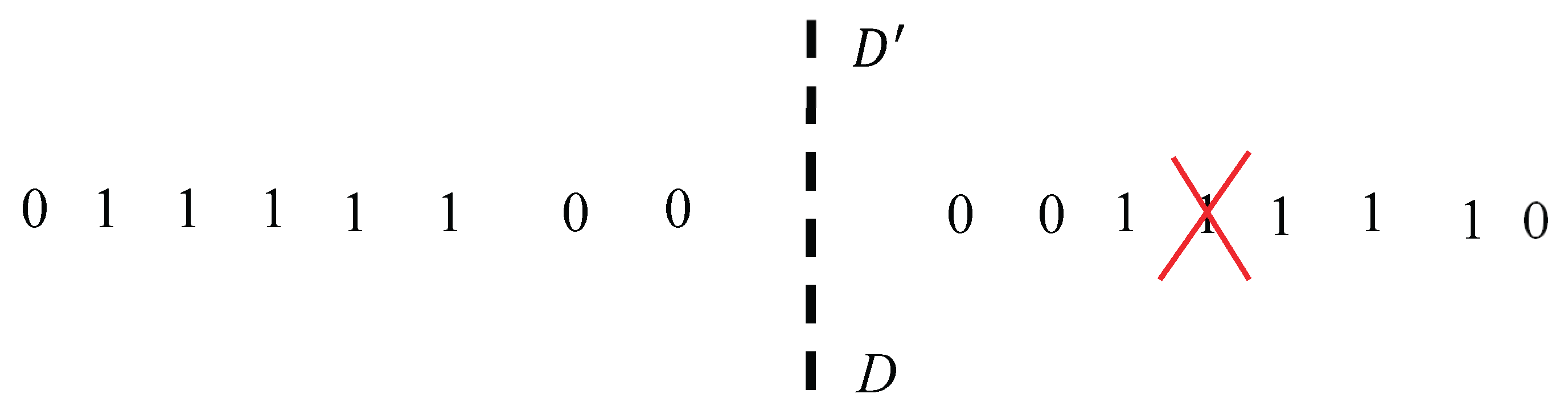
Let us imagine a computer program represented by a symmetrical string of “zeros” and “ones” such as that depicted in Figure 8.
It is sufficient to delete a single bit, in order to break the symmetry of the entire symmetric program, as shown in Figure 8. This re-shaping of the suggested approach is important in a view of its possible physical applications. According to the Landauer principle erasure of one bit of information in the computing device, demands the minimal energy given by Eq. 8:
where is the Boltzmann constant [17,18,19,20,21,22,23,24,25,26,27]. Thus, minimal breaking symmetry effort is established with the Landauer limit and supplied with Eq. 8.
3. Discussion
Let us put the suggested approach in the context of modern mathematics. Symmetry may be seen as automorphism, i.e. transformation of the object that preserves its structure. Symmetry breaking equals to reduction of automorphisms. Thus, the demonstrated theorem relates to distinguishing numbers in graph theory or geometric structures, i.e. the minimum number of labels (or modifications) needed to destroy all nontrivial automorphisms. Removing a point is akin to labeling it differently. In graph theory, the distinguishing number of a graph is a concept related to breaking the symmetries (automorphisms) of the graph using vertex labels [28]. The distinguishing number of a graph G is the smallest number of labels (colors) needed to label the vertices of G such that the only automorphism of G that preserves the labeling is the identity automorphism (i.e., does nothing) [28]. We, in turn, introduce the distinguishing number of the curve/domain , i.e. the smallest number of the points to be removed from the curve/domain such that the only automorphism of that preserves its initial shape is the identity automorphism. The distinguishing number of the curve/domain captures how symmetric a curve/domain is: lower distinguishing number means easier to break its symmetry. We demonstrated that the curve/domain which symmetry is hardest to break is a circle, possessing the infinite set of the symmetry axes. It necessary to remove three asymmetric points in order to break the symmetry of the circle. I do not know the curve, from which two points should eliminated, in order to break its symmetry. In a pure mathematical sense, the demonstrated theorem is important for understanding moduli spaces where small defects change equivalence classes [29].
Now, let us discuss the physical applications of the theorem. The demonstrated theorem has a direct relation to the concept of the modern physics, which is called the spontaneous symmetry breaking, when a tiny local change (removal of a point) destroys the global symmetry [30]. In dynamical systems, even small asymmetries (like removing a point) can destroy integrals of motion related to symmetries [31]. Perhaps the most important aspect of symmetry in theories of physics, is the idea that the states of a system do not need to have the same symmetries as the theory that describes them [30]. System usually contain domains in which symmetry is broken, sometimes it is broken spontaneously. Such spontaneous breakdown of symmetries governs the dynamics of phase transitions, the emergence of new particles and excitations, the rigidity of collective states of matter, and is one of the main ways classical physics emerges in a quantum world [30]. It was noted, that the limit of infinite system size, often called in literature “the thermodynamic limit”, is not a mandatory condition for spontaneous symmetry breaking to occur in practice. And even more stronger principle should be clearly understood: for almost all realistic applications of the theory of symmetry breaking, it is a rather useless limit, in the sense that it is never exactly realized in nature [30]. Even in situations where the object of interest can be considered large, the coherence length of ordered phases is generically small, and a single domain (say “phase”) cannot in good faith be considered to approximate any sort of infinite size [30]. Thus, the reasonable question is: what is the minimal effort necessary for symmetry breaking of the phase structural unit. The presented paper addresses this question and demonstrates that eliminating of a single point, which is not located on the axis of symmetry of the Jordan curve/domain reduces its symmetry to the trivial group, when the curve is not a circle.
In crystals: defect (vacancy or single point) in a lattice breaks symmetry and alters physical behavior [32]. In this case, we deal with the set of the vertices of regular polygons, and the symmetry is decreased, but not reduced to the trivial group , as discussed above. In condensed matter physics, removing a lattice site can change conductivity or magnetic response [33]. Removing symmetry (even at a small scale) introduces mode coupling or splitting in vibrational modes [34]. The fact that the absence of a single feature (point) can reduce a symmetry classification drastically is of a primary importance for image analysis, computer vision, and shape recognition [35].
The challenging goal to be addressed within the future investigations is extension of the introduced approach to non-Jordan curves. For the non-Jordan “figure-eight curve” (also called a lemniscate or self-intersecting loop) the extension is trivial. However, the general case of symmetric non-Jordan curves/domains looks challenging.
4. Conclusions
The paper estimates the minimal “effort” necessary for breaking symmetry of geometrical shapes. The concept of symmetry breaking is one of the most profound and far-reaching ideas in both mathematics and physics. Symmetry breaking is foundational; it explains how complex structures and phenomena emerge from simple laws. Spontaneous symmetry breaking is at the heart of the Standard Model. Without symmetry breaking, mass would not exist in the way we observe it [36]. Thermodynamic phase transitions are classic cases of symmetry breaking [7]. In the Big Bang, the Universe likely underwent a series of symmetry-breaking events: these transitions shaped the structure and content of the universe [37]. Symmetry breaking bridges perfect physical laws to imperfect, observable world. Symmetry breaking a mechanism for emergence, explaining how simpler principles give rise to rich, varied phenomena. The paper is focused on the pure mathematical aspects of symmetry breaking, and poses the following fundamental questions: how many points should be removed from the symmetrical shape (curve or domain) in order to break its symmetry? Or, in other words: what is the minimal “effort”, necessary for breaking symmetry of curves and shapes (opened or closed)? It is demonstrated, that removing of a single point from the boundary of the regular convex and non-convex polygons and symmetrical Jordan curves reduces the symmetry group of the polygon to the trivial group, when the eliminated point does not belong to the axis of symmetry of the polygon. The same is true for solid and open 2D regular convex polygons. The only and remarkable exception is a circle. Removing of a single point from the boundary of a circle gives rise to the curve characterized by group. Symmetry of circles is reduced to the trivial group by removing a triad of non-symmetrical points. Thus, the “effort” necessary for breaking symmetry of a circle is maximal. The same is true for a solid and opened circles. 3D generalization of the theorem is trivial. Thus, classification of symmetrical curves/domains following the minimal number of points necessary for breaking their symmetry becomes possible. The demonstrated theorem shows that the symmetry group action on curves and shapes becomes trivial when a point asymmetric perturbation is introduced.
The demonstrated theorem is applicable for the analysis of the modes of vibration in crystals (the removed point corresponds to a vacancy of a crystal). In dynamical systems, even small asymmetries (like removing a single point) can destroy integrals of motion tied to symmetries. Information interpretation of the demonstrated theorem, related to the Landauer principle, enabling estimation of minimal energy necessary for symmetry breaking within computations is introduced. The fields of future investigations are envisages. The symmetric Jordan curve for which the minimal number of points to be eliminated, thus, providing the symmetry breaking, is two is unknown.
Author Contributions
Conceptualization, E.B.; methodology, E.B.; formal analysis, E.B.; investigation, E.B.; writing—original draft preparation, E.B.; writing—review and editing, E.B. All authors have read and agreed to the published version of the manuscript.
Funding
This research received no external funding.
Data Availability Statement
The data that support the findings of this study are available on request from the corresponding author.
Acknowledgments
The authors are thankful to Yelena Bormashenko for her kind help in preparing this paper.
Conflicts of Interest
The authors declare no conflicts of interest.
References
- Strocchi, F. Symmetry Breaking; Volume 732 of Lecture Notes in Physics; Springer Verlag: Berlin, Germany, 2005. [Google Scholar]
- Nambu, Y. Nobel lecture: spontaneous symmetry breaking in particle physics: a case of cross fertilization. Rev. Mod. Phys. 2009, 81, 1015. [Google Scholar] [CrossRef]
- Higgs, P.W. Spontaneous Symmetry Breakdown without Massless Bosons. Phys. Rev. 1966, 145, 1156. [Google Scholar] [CrossRef]
- Higgs, P. W Broken symmetries and the masses of gauge bosons. Phys. Rev. Lett. 1964, 13, 508–509. [Google Scholar] [CrossRef]
- Trenkwalder, A.; Spagnolli, G.; Semeghini, G.; Coop, S.; Landini, M.; Castilho, P.; Pezzè, L.; Modugno, G.; Induscio, M.; Smerzi, I.A.; Fattori, M. Quantum phase transitions with parity-symmetry breaking and hysteresis. Nature Phys. 2016, 12, 826–829. [Google Scholar] [CrossRef]
- Hanada, M.; Robinson, B. Partial-symmetry-breaking phase transitions. Phys. Rev. D 2020, 102, 096013. [Google Scholar] [CrossRef]
- Izyumov, Y.A.; Syromyatnikov, V.N. Phase Transitions and Crystal Symmetry; Kluwer, Academic Publishers: Boston, 1990. [Google Scholar]
- Landau, L.D.; Lifshitz, E.M. Statistical Physics, 3rd ed.; Course of Theoretical Physics; Elsevier: Oxford, UK, 2011; Volume 5. [Google Scholar]
- Tipeev, A.O.; Schmelzer, J.W.P.; Zanotto, E.D. On thermodynamic and kinetic spinodals in supercooled liquids. Chemical Physics Letters 2024, 836, 141051. [Google Scholar] [CrossRef]
- Abyzov, A.S.; Schmelzer, J.W.P. Nucleation versus spinodal decomposition in confined binary solutions. J. Chem. Physics 2007, 127, 114504. [Google Scholar] [CrossRef]
- Bormashenko, E. Ramsey theory of the phase transitions of the second order. Pramana - J Phys 2025, 99, 52. [Google Scholar] [CrossRef]
- Shafi, Q.; Vilenkin, A. Spontaneously broken global symmetries and cosmology. Phys. Rev. D 1984, 29, 1870. [Google Scholar] [CrossRef]
- Du, L.; Hasan, T.; Castellanos-Gomez, A.; Liu, G.-B.; Yao, Y.; Lau, C.N.; Sin, Z. Engineering symmetry breaking in 2D layered materials. Nat. Rev. Phys. 2021, 3, 193–206. [Google Scholar] [CrossRef]
- Li, H.; Zhao, J.; Luo, L.; Du, J.; Zeng, J. Symmetry-Breaking Sites for Activating Linear Carbon Dioxide Molecules. Acc. Chem. Res. 2021, 54, 1454–1464. [Google Scholar] [CrossRef]
- Korenić, A.; Perović, S.; Ćirković, M.M.; Miquel, P.-A. Symmetry breaking and functional incompleteness in biological systems. Progress Biophysics Molecular Biology 2020, 150, 1–12. [Google Scholar] [CrossRef]
- McManus, I.C. Symmetry and asymmetry in aesthetics and the arts. European Review 2005, 13, 157–180. [Google Scholar] [CrossRef]
- Landauer, R. Minimal energy requirements in communication. Science 1996, 272, 1914–1918. [Google Scholar] [CrossRef]
- Herrera, L. The mass of a bit of information and the Brillouin’s principle. Fluctuation Noise Letters 2014, 13, 1450002-5. [Google Scholar] [CrossRef]
- Bérut, A.; Arakelyan, A.; Petrosyan, A.; Ciliberto, S.; Dillenschneider, R.; Lutz, E. Experimental verification of Landauer’s principle linking information and thermodynamics. Nature 2012, 483, 187–189. [Google Scholar] [CrossRef] [PubMed]
- Piechocinska, B. Information erasure. Phys. Rev. A 2000, 61, 062314. [Google Scholar] [CrossRef]
- Parrondo, J.M.R.; Horowitz, J.M.; Sagawa, T. Thermodynamics of information. Nature Phys. 2015, 11, 131–139. [Google Scholar] [CrossRef]
- Müller, J.G. Events as Elements of Physical Observation: Experimental Evidence. Entropy 2024, 26, 255. [Google Scholar] [CrossRef]
- Vopson, M. The mass-energy-information equivalence principle. AIP Advances 2019, 9, 095206. [Google Scholar] [CrossRef]
- Bormashenko, Ed (Ed.) Landauer Bound in the Context of Minimal Physical Principles: Meaning, Experimental Verification, Controversies and Perspectives. Entropy 2024, 26, 423. [Google Scholar] [CrossRef] [PubMed]
- Witkowski, K.; Brown, S.; Truong, K. On the Precise Link between Energy and Information. Entropy 2024, 26, 203. [Google Scholar] [CrossRef]
- Chattopadhyay, P.; Misra, A.; Pandit, T.; Paul, G. Landauer principle and thermodynamics of computation. Reports Progress Physics 2025, in press. [Google Scholar] [CrossRef]
- Diamantini, M.C. Landauer Bound and Continuous Phase Transitions. Entropy 2023, 25, 984. [Google Scholar] [CrossRef]
- Imrich, W.; Klavžar, S. Distinguishing Cartesian powers of graphs. J. Graph Theory 2006, 53, 250–260. [Google Scholar] [CrossRef]
- Alper, J.; Halpern-Leistner, D.; Heinloth, J. Existence of moduli spaces for algebraic stacks. Invent. Math. 2023, 234, 949–1038. [Google Scholar] [CrossRef]
- Beekman, A.J.; Rademaker, L.; van Wezel, J. An introduction to spontaneous symmetry breaking. SciPost Phys. Lect. Notes 2019, 11, 1–140. [Google Scholar] [CrossRef]
- Chen, C.-Y.; Chiang, H.-W.; Patel, A. Resonant orbits of rotating black holes beyond circularity: Discontinuity along a parameter shift. Phys. Rev. D 2023, 108, 064016. [Google Scholar] [CrossRef]
- Perez, N. Crystal Defects. In Materials Science: Theory and Engineering; Springer: Cham, Switzerland, 2024. [Google Scholar]
- Venkataiah, G.; Prasad, V.; Reddy, P.V. Influence of A-site cation mismatch on structural, magnetic and electrical properties of lanthanum manganites. J. Alloys Compounds 2007, 429, 1–9. [Google Scholar] [CrossRef]
- Simpkins, B.S.; Dunkelberger, A.D.; Vurgaftman, I. Control, Modulation, and Analytical Descriptions of Vibrational Strong Coupling. Chem. Rev. 2023, 123, 5020–5048. [Google Scholar] [CrossRef] [PubMed]
- Zhang, P.; Fan, W.; Chen, Y.; Feng, J.; Sareh, P. Structural symmetry recognition in planar structures using Convolutional Neural Networks. Engineering Structures 2022, 260, 114227. [Google Scholar] [CrossRef]
- Fomin, P.I.; Gusynin, V.P.; Miransky, V.A.; Sitenko, Y.A. Dynamical symmetry breaking and particle mass generation in gauge field theories. Riv. Nuovo Cim. 1983, 6, 1–90. [Google Scholar] [CrossRef]
- Tozzi, A.; Peters, J.F. Symmetries, Information and Monster Groups before and after the Big Bang. Information 2016, 7, 73. [Google Scholar] [CrossRef]
Figure 1.
Symmetry of the equilateral triangle is illustrated. The dihedral symmetry group includes three rotations and three reflections. Point A removed from the triangle breaks the symmetry of triangle and reduces it to group.
Figure 1.
Symmetry of the equilateral triangle is illustrated. The dihedral symmetry group includes three rotations and three reflections. Point A removed from the triangle breaks the symmetry of triangle and reduces it to group.
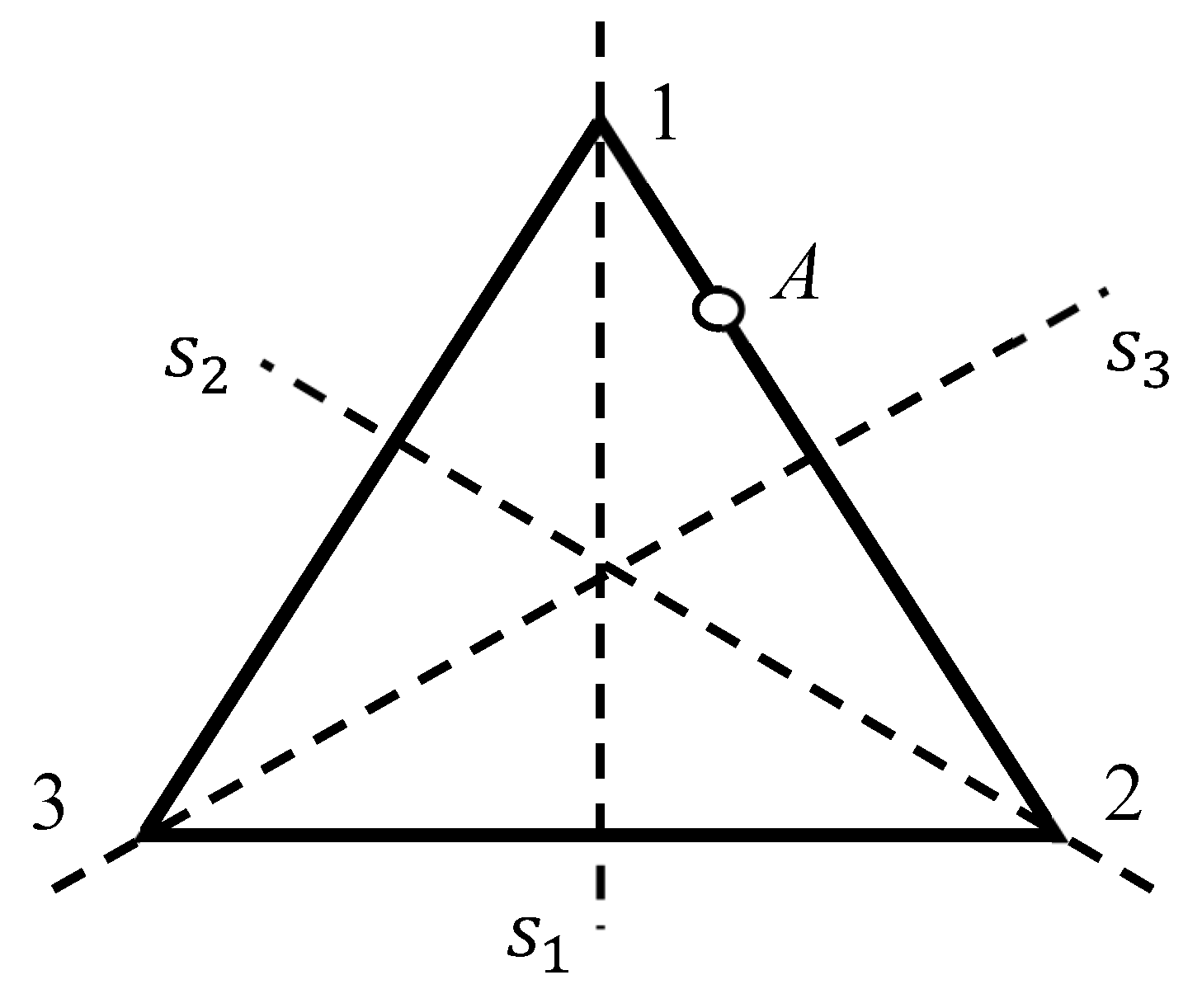
Figure 2.
Symmetry group of an isosceles triangle is illustrated. The group includes the identity element and the reflection axis . Point A removed from the triangle breaks the symmetry of triangle and reduces it to the group.
Figure 2.
Symmetry group of an isosceles triangle is illustrated. The group includes the identity element and the reflection axis . Point A removed from the triangle breaks the symmetry of triangle and reduces it to the group.
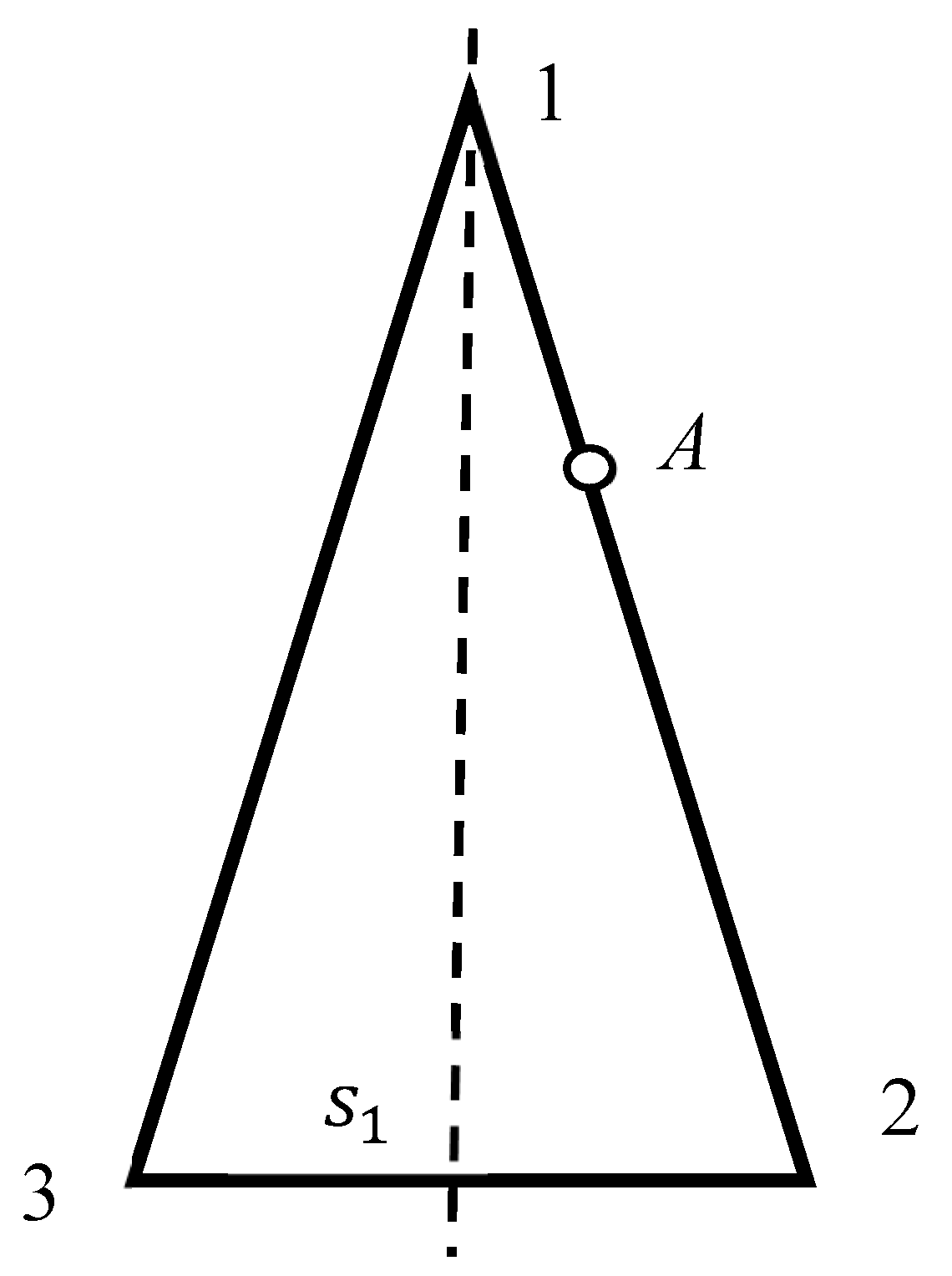
Figure 3.
Solid equilateral triangle is depicted. Point A is removed from triangle. Puncturing of the triangle destroys its symmetry.
Figure 3.
Solid equilateral triangle is depicted. Point A is removed from triangle. Puncturing of the triangle destroys its symmetry.
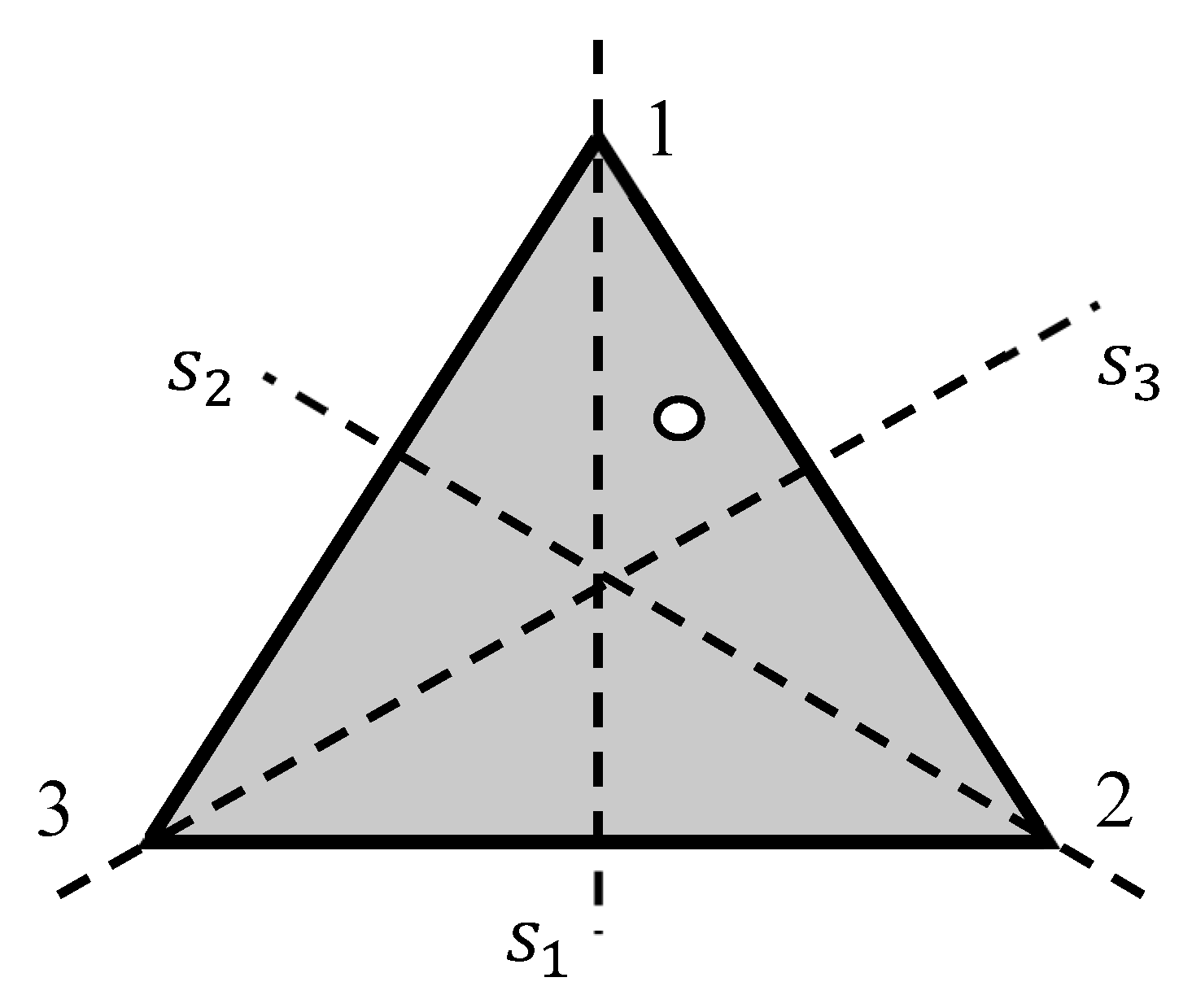
Figure 4.
Regular pentagon is depicted. Point O is the circumcenter of the pentagon. Point A removed from the pentagon breaks the symmetry of pentagon.
Figure 4.
Regular pentagon is depicted. Point O is the circumcenter of the pentagon. Point A removed from the pentagon breaks the symmetry of pentagon.
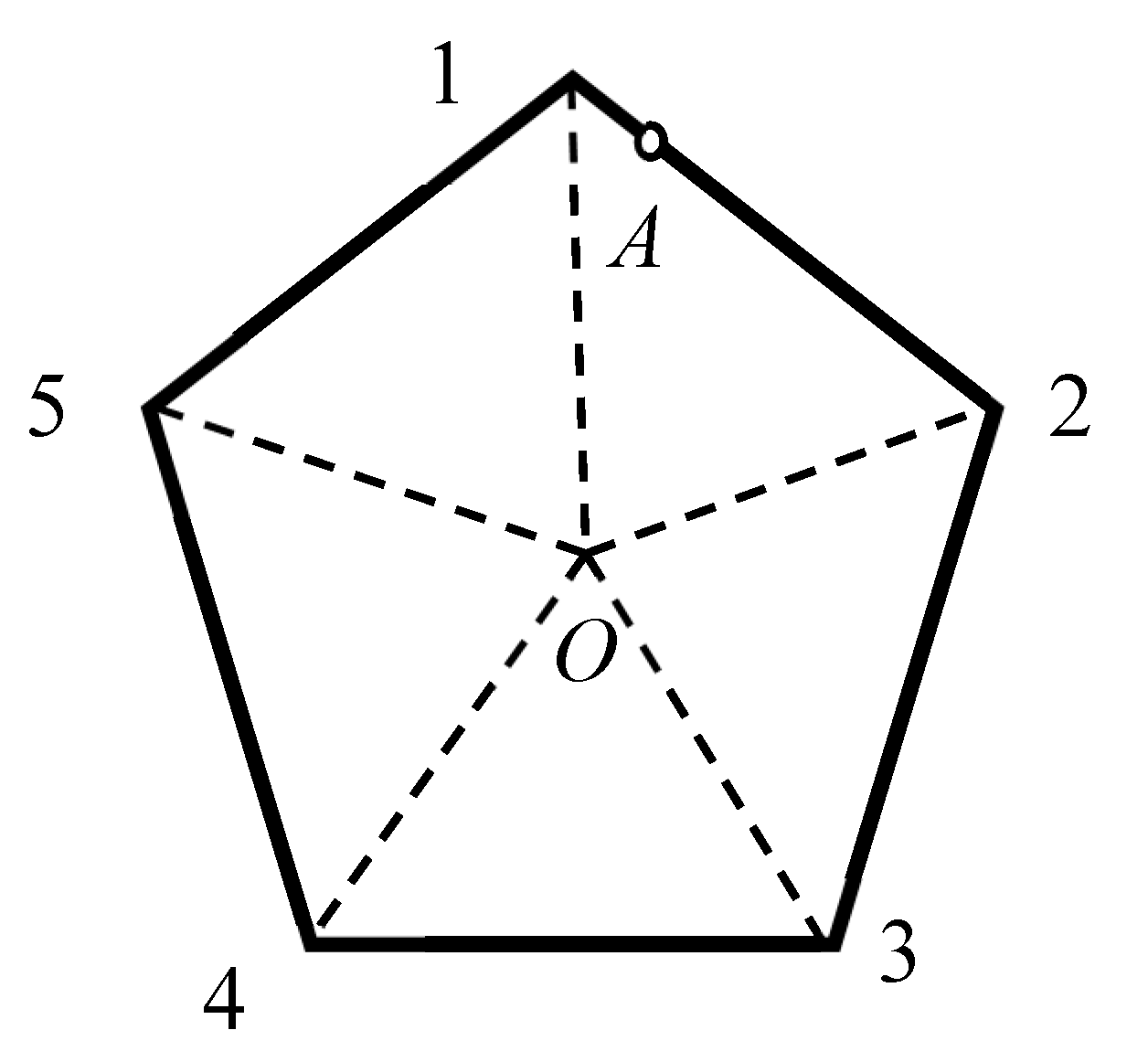
Figure 5.
Breaking symmetry of five-point start by removing from the boundary point A is shown.
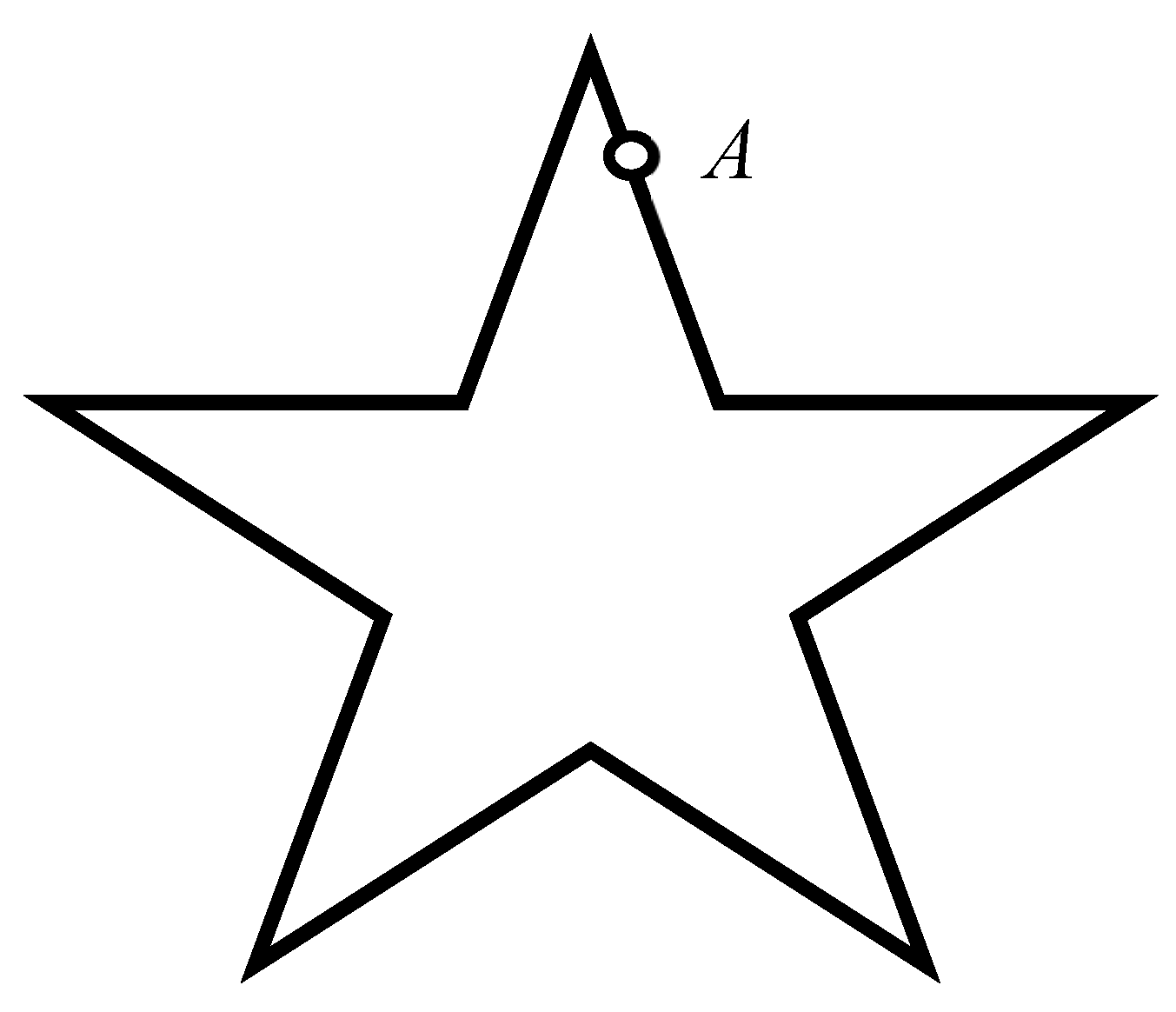
Figure 6.
Breaking symmetry of ellipse by removing from the boundary point A is shown. Removing point A which does not belong to the axes of symmetry of the ellipse reduces the dihedral symmetry group to the trivial group .
Figure 6.
Breaking symmetry of ellipse by removing from the boundary point A is shown. Removing point A which does not belong to the axes of symmetry of the ellipse reduces the dihedral symmetry group to the trivial group .
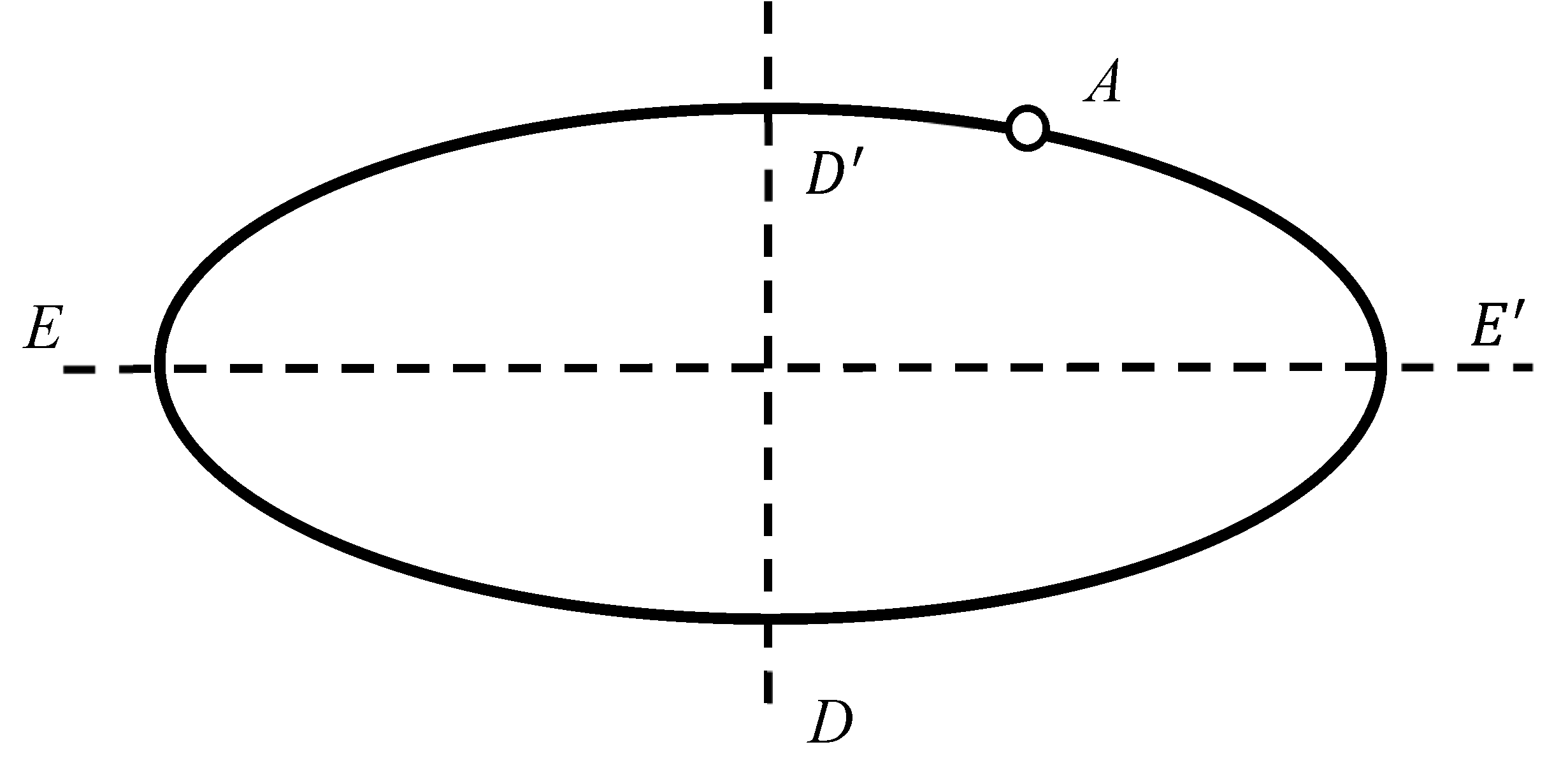
Figure 7.
A. Removing point A from the circle, gives rise to the open circle, possessing the symmetry axis B. Symmetry Axis is attached to the circle. Thus, the symmetry of the circle is reduced from group to . Removing point A reduces the symmetry to the trivial symmetry group. C. Removing three asymmetrically located points reduces the symmetry of the circle to the trivial group .
Figure 7.
A. Removing point A from the circle, gives rise to the open circle, possessing the symmetry axis B. Symmetry Axis is attached to the circle. Thus, the symmetry of the circle is reduced from group to . Removing point A reduces the symmetry to the trivial symmetry group. C. Removing three asymmetrically located points reduces the symmetry of the circle to the trivial group .
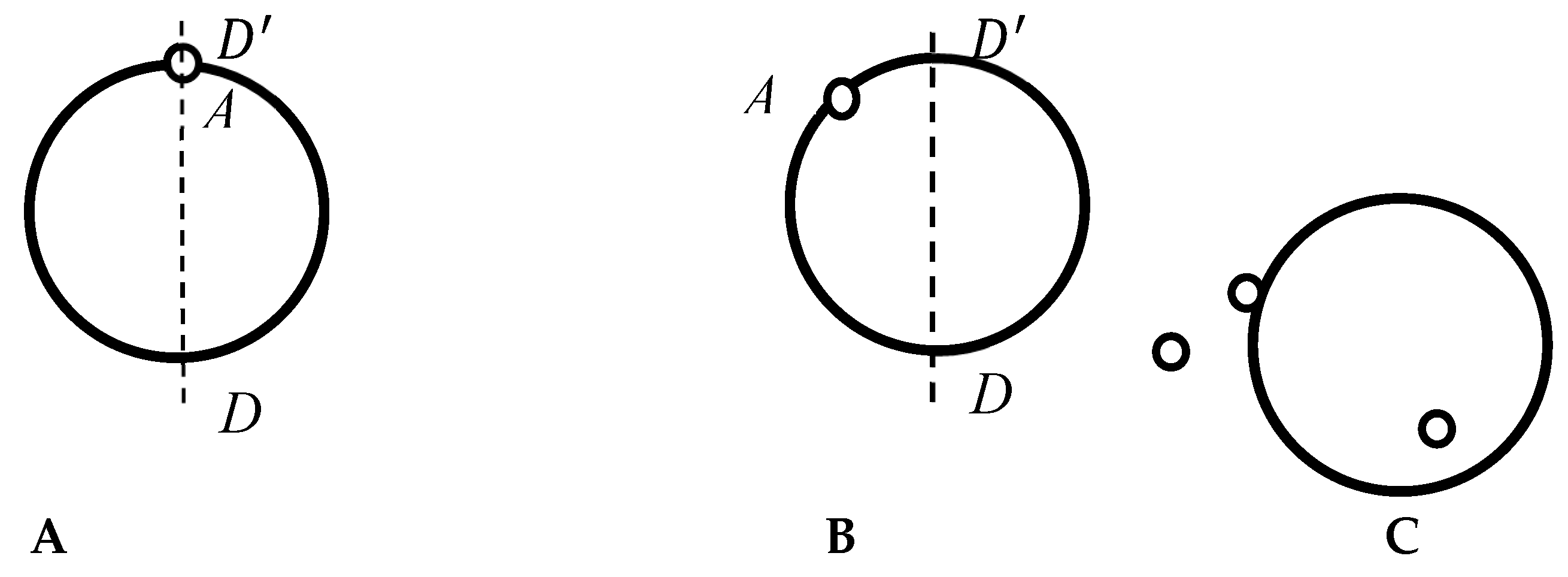
Figure 8.
Computer program represented by a symmetrical string of “zeros” and “ones” is depicted. Erasure of a single bit breaks the symmetry of the program.
Figure 8.
Computer program represented by a symmetrical string of “zeros” and “ones” is depicted. Erasure of a single bit breaks the symmetry of the program.
Disclaimer/Publisher’s Note: The statements, opinions and data contained in all publications are solely those of the individual author(s) and contributor(s) and not of MDPI and/or the editor(s). MDPI and/or the editor(s) disclaim responsibility for any injury to people or property resulting from any ideas, methods, instructions or products referred to in the content. |
© 2025 by the author. Licensee MDPI, Basel, Switzerland. This article is an open access article distributed under the terms and conditions of the Creative Commons Attribution (CC BY) license (http://creativecommons.org/licenses/by/4.0/).
Copyright: This open access article is published under a Creative Commons CC BY 4.0 license, which permit the free download, distribution, and reuse, provided that the author and preprint are cited in any reuse.


