

Submitted:
01 November 2023
Posted:
01 November 2023
You are already at the latest version
Abstract
Modern lifestyle has increased our utilization of pollutants such as heavy metals, aromatic compounds, and contaminants of emerging concern including pharmaceutical and personal products and other materials that may have an important environmental impact. Especially, the ultimate results of intense use of highly stable materials, such as heavy metals and chemical restudies are that they turn into waste materials which, when discharged, accumulate in the environment water bodies. In this context, the present review presents application of metal-organic frameworks (MOFs) in electrochemiluminescent (ECL) sensing for water pollutant detection. MOF composites applied as innovative luminophore or luminophore carriers, materials for electrode modification and enhancement of co-reaction in ECL sensors have enabled sensitive monitoring of some most common contaminants of emerging concern such as heavy metals, volatile organic compounds, pharmaceuticals, industrial chemicals and cyanotoxins. Moreover, we provide future trends and prospects associated with ECL MOF-composites for environmental sensing.
Keywords:
Metal organic frameworks
; luminescence
; electroluminescent detection
; water pollutants.
1. Introduction
Pollution from different sources due to extensive urbanization and industrialization is putting the global water budget under pressure by reducing water available for beneficial use [1]. The demand for water has increased tremendously in agricultural, industrial, and domestic domains resulting in the huge impact of natural and anthropogenic substances that are constantly released into the environment. Prime agricultural land is being lost to urbanization, threatening the aquatic and terrestrial ecosystems by increased use of chemicals. The number of anthropogenic sources of pollution increases in line with progressing human development. The most common sources of pollution include industrial, agricultural (pesticides and fertilizers), and mining activities, construction, traffic emissions (i.e., exhaust gases), fuel and coal burning, and sewage waste.
Among different types of pollutants, heavy metals, even at low concentrations, caused health concerns due to their hazardous bioaccumulation ability through food chains by formation of metal–organic complexes [2]. Most of these non-degradable potentially toxic elements (PTEs), such as Arsenic (As), Cadmium (Cd), Chromium (Cr), Copper (Cu), Mercury (Hg), Nickel (Ni), Lead (Pb), and Zinc (Zn), pose serious damage to the ecosystem [3] when they are above maximum allowable limits and are listed as priority pollutants to control by the U.S. Environmental Protection Agency and the EU Commission. These elements are found in varying amounts throughout the Earth’s crust as naturally occurring components in the water–sediment environment. Their geochemical levels in sediments are, thus, expected to be relatively low [4]. However, when heavy metals are discharged to aquatic environments from anthropogenic sources, they are accumulated between the aqueous phase and the sediments.
Volatile organic compounds (VOCs) are persistent and important organic pollutants that may contaminate groundwater. VOCs include chlorinated solvents (e.g., hydrogen sulfide, trichloroethene, carbon tetrachloride) and petroleum hydrocarbons, especially BTEX (benzene, toluene, ethyl-benzene, and mixtures of o-, m- and p-xylenes) compounds. These volatile aromatic compounds are severely toxic to aquatic organisms if contact is maintained. They are generated by incomplete combustion of organic matter often found in discharges and petroleum products (vehicle exhaust, coal burning and residential heating, waste incineration, petroleum refining processes, and aluminum production). Groundwater contaminated with VOCs has the potential to affect freshwater aquatic ecosystems where it discharges to surface water bodies, and for long periods of time. Gasoline can contain large amounts of BTEX (up to 40 %) and therefore BTEX are used as indicators of gasoline contamination of sediment samples when gasoline contamination is suspected.
Aquatic ecosystems are also under threat of bio-accumulation of other sustainable fresh water contaminants, classified as contaminants of emerging concern (CECs) [5,6,7]. Under this broad family of chemical pollutants, we find synthetic chemicals that may cause ecological or human health impacts. Endocrine disrupting chemicals or endocrine disruptors (EDCs) and non-steroidal anti-inflammatory drugs (NSAIDs) are two main subgroups of CECs. Sources of these pollutants include agriculture, urban runoff, ordinary household products (disinfectants, fragrances, pesticides) and pharmaceuticals that are disposed to sewage treatment plants and subsequently discharged. One main concern with CECs is that existing traditional wastewater treatment processes are ineffective in their removal. The most common CECs are: hormones endocrine disrupting chemicals (estrone, 17ß-estradiol, 17α-ethynylestradiol, testosterone), disinfection byproducts, fluorinated substances (bisphenols, phthalates, synthetic estrogens), pesticides (glyphosate and organophosphorus pesticides), antibiotics.
Finally, waterborne pathogenic bacteria and the mass occurrence of cyanobacteria blooms due to the anthropogenic activities in freshwaters, including drinking water reservoirs, threaten human health and environment because of their toxin producing [8]. The most frequently occurring and studied biologically active cyanobacteria toxins are anatoxins (ATXs) and microcystins (MCs), whose toxicity is a major cause of concern of the scientific community and the World Health Organization [9,10]. Anatoxin-a(S) is the most potent natural neurotoxin produced by freshwater cyanobacteria, while exposure to microcystins, which are chemically very stable, leads to liver dysfunction, hemorrhage, and in acute doses causes cancer. Due to chronic low-dose exposure, microcystins are cancer promoters. MCs stability is attributed to their cyclic structure, which remains unchanged after a few hours in boiling water and even for several years at room temperature if they are in the dry state. Indeed, microcystins are not readily removed from drinking water by conventional treatment methods, which indicates the importance of toxin detection and monitoring in freshwaters [11,12].
With such a vast variety of pollutants, the control of water–sediment environments remains one of the priority problems, which has been highlighted in a considerable number of scientific publications [13] . While prospects to minimize global environmental pollution exist, the contamination of water and sediments is stressing the urgency of technological advances in materials for pollutants sensitive detection and their elimination. New sensing materials and methods with outstanding performance, i.e., high sensitivity, high selectivity, rapid detection, and ease of use, in comparison with traditional expensive chromatography with complex pretreatment and long test times, are decidedly needed. To date, various micro- and nanomaterials with different characteristics have been employed in environmental monitoring sensors, including nanocarbon materials (carbon nanotube and graphene), metals and metal oxides, semiconducting materials, quantum dots, and polymers [14,15,16,17]. Among these advanced novel materials, metal–organic frameworks (MOFs), also known as porous coordination polymers (PCPs), have attracted intense attention due to their excellent physicochemical characteristics owing to the coexistence of crystallinity and porosity [16,18,19,20]. Rational design of MOFs may especially provide innovative emitters or luminophore carriers for the hybrid analytical method of electrochemiluminescence (ECL). ECL combines light-emission detection with an orthogonal electrochemical initiation [21,22,23]. The classical and most exploited ECL system consists of tris(bipyridine)ruthenium (Ru(bpy)32+) and tri-n-propylamine (TPrA) as a luminophore and a sacrificial co-reactant, respectively [24,25,26,27,28,29,30]. This ECL system can be significantly improved by utilizing nanomaterials [31,32,33,34,35,36,37,38,39,40,41,42]. Accordingly, ECL-based MOFs provide a new horizon for highly sensitive targeted bioanalysis with functional nanomaterial design, and controllable and tunable photophysical and photochemical properties through modifications of the structure of organic linkers, metal clusters, and guest species [43]. Among other benefits, ECL MOFs enable re-use of potassium persulfate as a non-toxic co-reactant in comparison to TPrA, while providing the same or better sensitivity, thus making the whole system more environmentally friendly. In addition, the nanoconfinement that occurs in such mesoporous materials on ECL intensity have been imaged and spatially resolved with a remarkable spatial resolution. Liu’s group showed that the ECL signals were very stable even in biological media, allowing single biomolecule imaging [43]. The high sensitivity of ECL sensors based on MOF-luminophores allows efficient detection of water pollutants, which are typically present in low amounts in water bodies. This set off recent development of novel MOF materials for ECL and new applications, especially sensing and imaging [35,39,44,45,46,47].
In this review, we present recent advances in luminescent MOF-based ECL sensors development for the water pollutant detection. First, we provide a brief description of the ECL method. Second, we introduce different MOFs as carriers of ELC emitters, including luminol, Ru(bpy)32+, and their derivatives. Third, we outline promising applications of MOF-based ECL in water monitoring. Finally, we discuss some perspectives on the synthesis and applications of MOFs luminophores for ECL sensors.
2. ECL sensors
Current (bio)sensors for detection of pollutants aim to replace classical detection techniques based on liquid and gas chromatography, or mass spectrometry by providing coupling of the accuracy of measurements equivalent to such instrumental methods with the portability, affordability, and simplicity of analysis. As already mentioned, ECL is an electrochemical process, where light emission is initiated by an electron-transfer reaction occurring at an electrode surface. In co-reactant ECL, the emission of light is generated via charge transfer between the electrochemical reaction intermediates of the emitter and the co-reactant (Figure 1).
The most widely-used system applied for analytical purposes consists of the luminophore species Ru(bpy)32+, or one of its derivatives, and TPrA as a co-reactant. An ECL co-reactant is a reagent that after oxidation or reduction can decompose forming highly reactive reductive or oxidative species (Figure 1), which can undergo an electron-transfer reaction with oxidized or reduced luminophore to generate ECL. As ECL does not require a light source, it simplifies the detection apparatus and most importantly invalidates background signals from scattered light and luminescent impurities, thus providing improved sensitivity.
The smart combination of two analytical methods (electrochemistry and luminescence) gives ECL unique superiorities over other optical sensing methods, as it does not require a light source, which simplifies the detection set-up and most importantly there is no background signal from scattered light and luminescent impurities. However, some specific ECL configurations employing semiconductors and named photo-induced ECL require an excitation light to photogenerate holes and electrons that trigger ECL emission [48,49,50]. Whatever, due to these properties, ECL has become an important detection method in analytical chemistry and microscopy [23,30,51,52,53,54,55,56,57,58,59,60]. Commercial ECL systems for clinical diagnostic using standard ECL pair, Ru(bpy)32+, or one of its derivatives, and TPrA run over 1.3 billion tests per year [26,60].
Organometallic compounds due to their ECL nature are of interest for development of ECL-emitting species. In order to improve the sensitivity, stability, and reproducibility of ECL biosensors, it is particularly important to optimize luminophores in terms of robust ECL signals and stability. Conventional luminophores, such as luminol, Ru(bpy)32+, g-C3N4 and derivatives all have excellent ECL responses, but their utilization in an ECL sensor may be affected by their stability in water solutions, or reduced contact probability with the co-reactant. Ru(bpy)32+ species and its derivatives are the most efficient luminophores due to their excellent electrochemical and spectroscopic properties. Ru(bpy)32+ can be used in water or organic solutions, depending on the counter-ion, and also immobilized on the electrode surface. For instance, Ru(bpy)32+ is stable in solution and the reactive species, Ru(bpy)32+, can be generated by electrochemical oxidation (Figure 1). Classical anodic co-reactants are tertiary, secondary and primary alkyl amine groups (especially, TPrA or DBAE) or oxalate [29,61,62,63]. For instance, after its heterogeneous oxidation at the electrode surface or homogeneous oxidation by Ru(bpy)32+, the TPrA●+ cation radical deprotonates rapidly to form the reducing neutral radical, TPrA●. Ru(bpy)33+ is then reduced exergonically by TPrA● forming the excited state Ru(bpy)32+∗, which will decay to the ground state emitting orange-red light [64,65,66,67]. Thus, in ECL reactions, ruthenium complexes are regenerated after light emission, making the ECL methodology reusable and highly interesting from an analytical point of view. Therefore, they can act as labels for ECL bioassays. In addition, there are several advantages to immobilize luminophores including higher sensitivity due to concentration of emitter centers in the detection region near the electrode surface and lesser consumption of chemicals, which has a special impact in flow systems. Hence, the integration of luminophores in materials having high porosity and specific surface area, such as MOF, may significantly increase ECL sensor analytical performance.
3. MOFs for ECL sensors
Metal–organic frameworks are a fascinating class of highly ordered crystalline coordination polymers formed by the coordination of metal ions/clusters and organic bridging linkers/ligands. Owing to their unique structures and properties, i.e., high surface area, tailorable pore size, high density of active sites, and high catalytic activity, various MOF-based sensing platforms have been reported for environmental contaminant detection and purification including anions, heavy metal ions, organic compounds, and gases. Figure 2 shows articles published for “Environmental pollutant” and “MOF for Environmental Pollutant” along with the future trends according to their publication rate in the last twenty years.
Due to their high chemical stability, MOFs have been exploited not only as a promising sensing material, but also as superior adsorbents of different environmental pollutants from both soil and water. In comparison with MOFs different porous sorbents like zeolites, activated carbon and others, have several disadvantages including material stability, high density, lack of structural tenability and low uptake capacity or selectivity. MOFs of different sizes and morphologies can be controllably produced by various synthesis methods such as sonication, electrochemical, hydro/solvothermal, mechanochemical, microwave etc., [68,69,70,71]. The obtained diverse MOFs, that can be a class of 2D or 3D microporous materials, have emerged as prominent materials for water contaminants research. In these materials porous structures are assembled by metal cation salts or clusters bridged with polydentate organic ligands with coordination type connections. They can also be combined with other materials such as nanoparticles to form advanced nanocomposite materials. For instance, MOFs combined with conductive nanoparticles may show exceptional electron conductivity while MOFs alone have poor conductivity. In this review we explore the relationship between characteristics of ECL-active MOFs and their applications for detection of water pollutants (Figure 3).
Electroactive luminophores may be easily incorporated in MOFs due to their nano-scale and ordered porosity or through metal ion chelation, to generate ECL-active MOF [72]. Luminophores may be incorporated in MOFs during their synthesis or via post-synthesis modifications. Integration of MOFs is achieved through the functional nanomaterial design, and controllable and tunable photophysical and photochemical properties via changing the structure of organic linkers, metal clusters, and guest species. For instance, when Ru complexes were integrated in 2D MOF nanosheets during the synthesis, a significant improvement of ECL luminescence efficiency was obtained [73]. In comparison to Ru-complexes alone, the resulting emitter within the composite had a high level of mobility inside frameworks with restricted intramolecular rotation and exhibited enhanced charge delocalization. Moreover, additional increase in ECL efficiency can be obtained by integrating Ru complexes in MOFs doped with other transition metals. Doping of MOFs with transition metals improves their electrical conductivity. Zhao and coworkers [74] showed that introducing a ruthenium pyridine complex in Ni-MOFs to produce NiRu-MOFs led to a significant boost of ECL efficiency compared to pure Ni-MOFs. Another approach consists in encapsulation of the luminophore during the growth of MOF. For instance, Dong et al., [75] encapsulated Ru(bpy)32+ within mesoporous and hollow MIL-101(Al)–NH2 to which the co-reactant, poly(ethylenimine) was covalently linked. The co-reactant prevented luminophore leakage and enabled a self-enhanced ECL response. Post-synthesis modifications of MOFs are possible due to well-defined pore sizes and charge or via some linkers [44,72,76,77].
Although ECL-based MOFs just recently opened a new horizon for highly sensitive targeted bioanalysis, the performance of each of these MOFs alone does not meet the requirements for signal amplification. Recently, luminescent MOFs, which belong to the group of multifunctional MOFs, were designed as highly crystallized ECL emitters in aqueous medium [78]. These MOFs demonstrated excellent performance with surface state models in both co-reactant and annihilation ECL in aqueous medium. Compared with the individual components, multifunctional MOFs significantly upgrade the ECL emission due to the framework structure. The self-enhanced ECL emission with high stability can be realized by the accumulation of MOF cation radicals via pre-reduction electrolysis. These MOFs provide a proof of concept using molecular crystalline materials as new ECL emitters.
Table 1 shows some recent examples of ECL-active MOFs for sensing of potentially toxic species, linear detection range (LDR), type of co-reactants and type of real sample medium. Sensor performances were in accordance with provisional guideline values for pollutant concentrations in drinking water regarding the limit of detection for the adequate analytical detection method as recommended in the WHO guidelines for drinking-water quality [79].
4. Applying ECL-active MOFs in water pollutant sensing
4.1. ECL MOF sensors for heavy metals detection
Water body contamination with heavy metals is a critical issue, which adversely affects humans, plants and animals. Heavy metal pollution has been found in sediments of rivers, lakes, and other waters, and is a reason for significant concern because of their enrichment, concealment, persistence, and toxicity. A large number of scientific reports deals with the improvement of heavy metal detection systems compared to time-consuming classical analytical techniques such as atomic absorption spectrometry and inductively coupled plasma - optical emission spectrometry). MOFs have seen significant expansion as platforms for sensing and capturing heavy metals to their high surface area, tunable pore chemistry and fast adsorption kinetics. Currently, the most exploited method for detecting heavy metals with MOFs is photoluminescence, where interactions between the pollutants and MOFs alter luminescent properties [98,99]. Among luminescent MOFs, MOFs with luminophores that exhibit ECL signals have attracted a lot of attention as emitters for sensitive detection of heavy metals. Shan and et al. [82] reported on an ECL sensor for highly sensitive and selective detection of Pb2+ based on Ru(bpy)32+ encapsulated UiO66 metal-organic-framework. The nanocomposite contained Ru(bpy)32+ - UiO66 MOF and -NH2 group functionalized silica nano-particles (NH2-SiO2). The NH2-SiO2 with a large surface area provided an excellent platform for ECL sensing. Encapsulation of Ru(bpy)32+ in UiO66 MOF significantly enhanced ECL efficiency of the proposed sensor. Under optimal conditions, the quenched ECL intensity showed a good linear relationship within Pb2+ concentrations in the range from 1.0×10⁻⁶ to 1.0×10² μM, with a detection limit of 1.0×10⁻⁷ μM. The ECL excitation route of Ru(bpy)32+ was the oxidation-initiated reductive excitation pathway (vide supra). The co-reactant used in ECL generation was triethylamine (TEA) dissolved in buffer solution. The sensor operated at pH 7.5. At a pH lower than 7.5 the signal was low due to inhibition of the co-reactant deprotonation, while an alkaline environment caused precipitation of Pb2+. The possible ECL mechanism of Ru(bpy)32+/TEA was proposed, suggesting a similar route as in standard system Ru(bpy)32+/TPrA. Regarding application, the proposed ECL sensor exhibited detection ability with the average concentration of Pb(II) of 9.99 nM in tap water. This was in accordance with the WHO guidelines prescribing 1 µg/l as LOD by AAS and a practical quantification limit in the region of 1–10 µg/L [79]. Moreover, the sensor showed good stability, since the ECL intensity was stable for 14 scan cycles. In another study, Jin et al. [100] synthesized a silver- MOF composite (Ag-MOF) with terephthalic acid. The silver ion was used as the ECL luminophore for an aptamer sensor to detect mercury ions in water. To improve the ECL stability of the Ag-MOF, chitosan and gold nanoparticles (Au NPs) were additionally attached to the composite. The ECL response was obtained using K2S2O8 as a co-reactant.
Recently a di-functional ECL sensor based on Ru-MOFs and the strand-displacement-amplification reaction was proposed for ultrasensitive detection of two heavy metal ions, Hg2+ and Ag+ using K2S2O8 as a co-reactant [80]. Several improvements were proposed. First, the electrochemical method was applied using Ru(bpy)32+ and 1,3,5-benzentriic acid to prepare Ru(bpy)32+-functionalized MOFs (Ru-MOFs) under mild conditions. In most developments, the synthesis processes of functionalized MOF take a long time, as the reaction steps are complex, and the conditions are harsh. Second, the dissolved oxygen in the reaction system and its significant quenching effect on the ECL signal generated by Ru(bpy)32+ was employed in the detection step [101]. For this, a low concentration of hemin was used as a quencher O2 [102,103] in order to ultimately indirectly enhance the ECL signal. Finally, carboxyl groups in Ru-MOFs films formed on a glassy carbon electrode (GCE) were activated by EDC/NHS to immobilized DNA H1 oligomer in solution containing hemin. Hemin was bound to the guanine rich part of DNA H1 that formed a G-quadruplex structure (Figure 4). The ECL signal of Ru(bpy)32+ for trace amounts of Ag+ was recorded after adding EDTA to mask while Hg2+ was detected in the solution containing cytosine-rich cDNA to mask Ag+. This ECL sensor operated at pH 7.4 at 37°C showed the relative standard deviation (2.62%-3.37%), and recovery rates (93.43%-105.49%) when applied in seawater. These values were in acceptable ranges regarding the standard regulative for these two heavy metals. The sensor had reliable storage stability when placed at 4°C, and provided an unchanged signal for 30 cycles of ECL responses.
4.2. ECL MOF sensors for CEC detection
Contaminants of emerging concern (CEC) is a definition for different substances present in the environment that were not detected before at least not in significant amounts [104]. Nowadays, various CECs including personal care products, pharmaceuticals, hormones, and industrial chemicals are released into the environment. Their potential toxicity points out that additional detection methods and new regulations are needed to enable control and prevention. Besides presenting risks to human health, the release of various CECs in nature, even at trace level concentrations have negative effects on animals and the environment. For instance, steroid hormones may induce feminization or masculinization in aquatic fauna, while traces of antibiotics contribute to bacteria becoming more resistant. In the context that most CECs have unknown toxicity, the United States Environmental Protection Agency and the European Commission have initiated EDSP and REACH programs, respectively, to investigate the toxicity and endocrine disruptive properties of different CECs. In contrast, many developing and underdeveloped countries still do not have such programs despite increasing occurrences of pharmaceuticals, chemicals and hormones in the domestic sewage and surface water sources.
Quantitative analysis of CECs requires sophisticated and sensitive analytical instruments as mentioned above. MOF ECL sensors could be the answer to such limitations. In most of them the recognition to target CEC relies on utilization of specific antibodies or aptamers that are immobilized in MOFs. For example, a new competitive ECL immunosensor platform has been designed for detection of diethylstilbestrol (DES) by encapsulation of Ru(bpy)32+ in UiO-67 MOF [91]. The interaction with DES resulted in activation of Ru-UiO-67 MOF, as luminophore, and enhanced ECL signal emission. DES is a synthetic nonsteroidal estrogen causing reduced fertility upon in utero exposure. An electrode surface modified by amino functionalized silica (NH2-SiO2) was coated by the antibody-DES and served as an immunosensing platform. DES competed with bovine serum albumin-diethylstilbestrol (BSA-DES) for binding to antibody-specific sites in the constructed immunosensor (Figure 5a). Increase of the unlabeled DES antigen concentration resulted in a decrease of the number of available paratopes for Ru-MOF labeled antigen and therefore the generated ECL signal. The operating conditions comprised: pH 7.5, 10 mM tripropylamine co-reactor, 15 mg/mL BSA/DES/Ru(bpy)32+/UiO-67 and 2 h incubation time. The novel fabricated immunosensor is a promising candidate for detection of other types of biological hormones with a proven wide linear range 0.01 pg/mL to 50 ng/mL and LOD of 3.27 fg/mL.
Promising 2D ruthenium-MOF nanosheets were synthetized for ultrasensitive detection of fluoropyrimidine 5-fluorouracil (5-FU) in an ECL competitive-type immunosensor [95]. The 5-FU is an anticancer drug that is particularly widely used for the treatment of colorectal cancer. A larger surface area of 2D Ru-MOF nanosheets achieved an increased loading of Ru(dcbpy)32+ exposing more bindable active sites, thus improving the performance of MOFs as the ECL emitters. Electrode surface modification with thin 2D molybustion@graphene oxide (MoS2@GO) improved the electron transfer rate of the electrode used as the sensing platform due to the MoS2 graphene-like structure (Figure 5b). The large specific surface area of MoS2@GO and its piezoelectric catalytic efficiency further provided loading of more 5-FU coating antigens. The competition between free 5-FU and 5-FU coating antigens on the sensor platform for the binding sites in the Ru-MOF/antibodies was the competitive immunoassay strategy. ECL signal was efficiently generated by a cathodic ECL route using persulfate as a co-reactant, with 0.4 mg/mL MoS2@GO and 12 µg/mL 5-FU antibody and 8 µg/mL 5-FU antigen as the operating conditions. The proposed immunosensor showed a high sensitivity, wide detection range (0.0001 ng/mL – 100 ng/mL), and low limit of detection of 0.031 pg/mL. The sensing platform can be adapted for detection of other types of drugs if other specific antibodies are used. The sensor exhibited excellent stability under 5 consecutive scans.
Another example includes an ECL aptamer sensor with NH2-Zr-MOF for ultra-sensitive detection of a plastic additive - di-(2-ethylhexyl)phthalate (DEHP) [94]. Merging a highly efficient electrocatalytic NH2-Zr-MOF and graphdiyne (GDY) composite onto a glassy carbon electrode surface notably enhanced the overall electrochemically active surface area and consequently improved the intensity of the ECL signal. Lamellar GDY was used as the luminescent body, combined with NH2-Zr-MOF to modify the surface of a GCE and then the carboxylated aptamer (COOH-Apt) that could specifically identify the target was fixed on NH2-Zr-MOF via the amide bond (Figure 5c, left panel). Sodium ascorbate (NaAsc) was introduced as a co-reactant accelerator for the GDY/S2O82− system (Figure 5c, right panel). The analytical functionality of the sensor to recognize DEHP was obtained with 16 µM of NaAsc, 3µM of aptamer immobilized onto the electrode, and 20 min incubation time. Ultra-sensitive detection of DEHP in the linear range of 1.0 × 10⁻¹² to 1.0 × 10⁻⁴ mg/mL with the LOD of 2.43 × 10⁻¹³ mg/mL of DEPH was achieved. Practical application of the sensor was demonstrated in river water and urban drinking water samples in which the presence of DEPH pollutant raises potential health hazards.
Li and coworkers [105] developed an ultrasensitive and selective method for detecting bisphenol A (BPA) using a solid-state ECL aptasensor. This aptasensor utilized titanium-based MOFs, named MIL-125, as a carrier for the luminescent Ru(bpy)32+. Ru(bpy)32+ encapsulating MIL-125 (Ru(bpy)32+@MIL-125) was applied onto a glassy carbon electrode and served as the working electrode. The best operating conditions were obtained when the electrode was modified with 2.5 µL of Ru(bpy)32+@MIL-125. To enhance selectivity, a thiol-based aptamer specific to BPA was attached to the working electrode through a Ti-S bond. The specific binding between the aptamer and BPA resulted in significant quenching of the ECL signal. This led to the development of a selective ECL aptasensor for BPA. The ECL aptasensor based on Ru(bpy)32+@MIL-125 demonstrated a strong ECL response for detecting BPA. Under optimal conditions, the aptasensor displayed a wide linear detection range from 1.0 × 10⁻¹² to 1.0 × 10⁻⁶ M, with an excellent detection limit of 6.1 × 10⁻¹³ M. Furthermore, the ECL aptasensor was able to selectively detect BPA even in the presence of other BPA interference compounds in a mixture. Nevertheless, the sensor had a relatively high cost, because MOF synthesis was time consuming and complicated.
In the study by Wen et al. [88], a sensitive and selective ECL aptasensor was developed using Co-Ni/MOF to enhance the detection of chloramphenicol (CAP). Black phosphorus quantum dots (BPQDs) were synthesized and added to the precursor solution to create BPQDs-doped PTC-NH2 nanoparticles (BP/PTC-NH2) as ECL emitters. The Co-Ni/MOF showed a significant improvement in signal amplification compared to BP/PTC-NH2. Under the optimized operating conditions of 25 min incubation time, 100 mV/s scanning rate and 2µM aptamer concentration, the aptasensor successfully detected CAP within a concentration range of 1.0 × 10⁻¹³ M to 1.0 × 10⁻⁶ M, with a low detection limit of 2.9 × 10⁻¹⁴ M. The developed aptasensor also demonstrated selective detection of CAP in the presence of interference compounds, showcasing its potential applications in detecting antibiotics in aquatic environments.
Recently, an innovative method for successful loading and anchoring of CdSe quantum dots in the pores of a Zr-based porphyrin MOF using the solvothermal method was developed for p-nitrophenol (p-NP) detection [96]. p-NP is one of the priority pollutants on the U.S. Environmental Protection Agency list because it is a carcinogen and potential endocrine disruptor, which tends to persist in water. The novel compound material named PCN-222@CdSe, was characterized by a greatly increased ECL signal intensity and luminescence stability in comparison with single CdSe quantum dots. p-NP effectively quenched the ECL signal of PCN-222@CdSe (Figure 6). The operating conditions comprised: 4 mg/mL PCN-222@CdSe, 100°C reaction temperature and 60 minutes reaction time. The ECL sensor was able to identify nitrophenol compounds sensitively and efficiently in the range of 100 ppm to 0.1 ppb, with a LOD as low as 0.03 ppb. It was successfully tested for tap water and lake water samples.
4.3. ECL MOF sensors for VOC detection
Volatile organic compounds, such as acetone, benzene, xylenes, and toluene are primarily emitted from industrial chemical process, vehicles, various home care products, and building/construction materials. In addition, there are some naturally occurring sources of VOCs such as mono- and tri-bromomethane, mono- and di-chloromethane, and chloroform that are metabolically active products of marine organisms. The production of VOCs is influenced by the type of sediment [106]. Typically sediments with more sorptive properties such as muddy sediments capture and accumulate VOCs (like dimethyl sulfide and methyl mercaptan), while less sorptive sandy sediments contain very low amounts of VOCs. Some VOCs are highly toxic when absorbed through the gastrointestinal tract or when they penetrate into the organism by crossing the skin barrier. In addition, VOCs can rapidly evaporate into air and cause severe intoxication via inhalation. Besides causing severe harm to human health, VOCs have a negative environmental effect since they can deplate ozone. Consecutively, highly toxic VOCs are subject to strict regulations and their monitoring is of utmost importance. Besides laboratory-based instruments for VOC detection and quantification, many sensors have been validated and are commercially available such as those based on photo-ionisation or electrochemistry [107]. Although utilization of MOF-based colorimetric sensors for VOC detection was extensively studied, up to now only a few MOF ECL sensors have been explained. Recently, adsorption of small molecules by the porous structure of Ru-MOFs was used for sensitive ECL detection of H2S [83]. Ru(bpy)32+ was encapsulated within a multifunctional MOF together with novel co-reactants, NBD-amine, as a recognition probe. In the presence of H2S, NBD-amine released the secondary amine enhancing the ECL signal of Ru-MOFs immoblized onto GCE (Figure 7). The increased ECL signal was proportional to the concentration of H2S. In this sensor MOFs as nanocarriers efficiently increased the load amount of Ru(bpy)32+, whose large specific surface area could adsorb more H2S on the GCE surface, and thus produce more secondary amine as co-reactants. Encapsulation of Ru(bpy)32+ improved its interaction with the co-reactant, contributing to enhancement of the ECL signal. As a result, the proposed ECL sensor detected H2S with the dynamic range from 10−11 M to 10−4 M and a LOD of 2.5 × 10⁻¹² M upon 180 min of reaction time. Moreover, the sensor was stable under continuous cyclic potential scans for 10 cycles.
4.4. ECL MOF sensors for cyanotoxin detection in water
The rapid proliferation of cyanobacteria in weakly circulating water regularly leads to water contamination with cyanotoxins that can be classified as hepatotoxines, dermatotoxicines, hepatotoxins and neurotoxicines. Anatoxins, and saxitoxins are the most important neurotoxins [108,109]. Anatoxin-a is an alkaloid produced from a variety of cyanobacteria provoking seriously harmful effects that can be fatal. Although currently there is no set low value for the allowed anatoxin-a content in drinking water, its accurate detection enables efficient control of water quality and prevention of poisoning. Xia et al., [84] reported a DNAzyme-based, target-triggered, redox-controlled responsive ECL resonance energy transfer (RET) aptasensor for anatoxin-a detection. The system is based on Ru(bpy)32+-doped MOF as an energy donor and AgNPs/ferrocene as dual-energy acceptors. A Ru(bpy)32+ chromophore was encapsulated into zirconium(IV)-based MOFs followed by coating AgNPs as a primary ECL-RET quencher. Three DNA strands were designed: the first was a thiolated DNAzyme strand that links the formed AgNPs@Ru-MOF, the second was an oligomer modified with ferrocene and the third was an anatoxin-a specific aptamer that served as a secondary quencher. When AgNPs@Ru-MOF and three DNA strands were assembled on the electrode an extremely low ECL background was recorded due to dual quenching. However, binding of anatoxin-a increased significantly the ECL signal intensity by exposing the Ag+ ion and simultaneously moving away ferrocene from Ru-MOFs (Figure 8), that restored ruthenium luminescence. The sensor was operative directly in lake and river waters, and was stable under continuous scanning for 15 cycles.
Microcystins produced by cyanobacterial bloom are the most widely distributed heptapetide toxins and pose a serious threat to drinking water quality. Microcystins are a type of monocyclic heptapeptide and possess many isomers due to different compositions of the two variable amino acids in polypeptides. Among them, MC-LR exhibits the strongest toxicity [110]. A highly sensitive ECL based apta-sensor was developed to detect MC-LR in water [85]. The on−off−on signal strategy relied on Ru-Cu MOF as the ECL signal-transmitting probe and three types of PdPt alloy core−shell nanocrystals as signal-off probes. Bimetallic hybridized MOFs (RuCu MOFs) were synthesized as an ECL signal emitter.
The intrinsic crystallinity and high porosity of the MOFs was achieved by combining the copper-based MOF (Cu-MOF) precursor with ruthenium bipyridyl. Since bipyridine ruthenium in RuCuMOFs could transfer energies to the organic ligand (H3BTC), an ultra-efficient ligand luminescent ECL signal probe was obtained, which exceptionally improved the aptasensor sensitivity. The quenching effects of noble metal nanoalloy particles with different crystal states obtained using a seed-mediated growth method further improved the sensitivity of the aptasensor - PdPt octahedral (PdPtOct), PdPt rhombic dodecahedral (PdPtRD), and PdPt nanocubic (PdPtNC) nanoparticles (Figure 9A). Among them, the PdPtRD nanocrystal exhibited higher activity and excellent durability, stemming from the charge redistribution caused by the hybridization of Pt and Pd atoms.
Furthermore, PdPtRD could also load more −NH2−DNA strands because it exposed more active sites with a large specific surface area. The fabricated aptasensor exhibited outstanding sensitivity and stability in MC-LR detection, with a linear detection range of 0.0001−50 ng/mL (Figure 9B). It was applied in tap water under operating conditions of pH 7.4, a low concentration of the toxic co-reactant TPrA of 7 mM, and only 0.25 mg/mL of RuCu MOFs. The application of alloy nanoparticles of noble metals and bimetallic MOFs opens new perspectives in the field of ECL immunoassays.
5. Conclusions
In this review, we present some developments of ECL sensors using MOF luminophores for water quality assessment. ECL-active MOFs have been developed progressively and the majority of the results presented here have been published recently. Porous MOFs have a large specific surface area and different functional groups, providing a variety of modification strategies for loading ECL molecules. Taking into account that water bodies may be contaminated with toxic pollutants in trace level concentrations, the main requirement of ECL-active MOFs is high sensitivity. Advanced analytical ECL performances can be achieved by incorporation of luminophores and nanoparticles, as functional moieties, in multifunctional MOFs. In addition, the specificity and selectivity can be further promoted by signal amplification and/or on-off quenching strategies. Such ECL-sensors based on multifunctional and multicomponent MOFs benefit the versatile MOF characteristics providing a possibility of fine tuning of donor and acceptors distance in the sensor with a key impact in determining the ECL analytical performances. In addition, MOFs provide good channels for transport of co-reactants, electrons and ions. Indeed, by integrating luminophores into frameworks, the luminescence signal properties are confinement-enhanced due to the arrangement of molecules and intramolecular energy transfer. Moreover, electrochemical activation of luminophore is facilitated in configurations where the luminophore is directly connected to metal within MOFs leading to low potential ECL emission.
In most cases, the recognition of water pollutants relies on a specific antibody or aptamer associated with MOFs. This is a limiting feature for future development of ECL-active MOFs as only restrictive numbers of such molecules are available. In addition, being biological molecules both aptamers and antibodies need to fold into a specific conformation to be active. Variations of pH, temperature, or salt content may unfold and inactivate them. This has to be taken into account when a specific aptamer or antibody is associated with MOFs. Although many studies have shown high selectivity of detection of ECL-active MOFs, their refined selectivity on chemically similar molecules is rarely tested. Future development of MOFs with differentiated affinities towards different toxic species will allow combinations of multiple ECL-active MOFs in a sensor array for more complete water analysis. Finally, sustainable applications of ECL-active MOFs have to consider sensor reusability over efficiency of detection.
Author Contributions
Writing—original draft preparation: M.S., I.T. and J.V.; All authors - writing—review and editing. All authors have read and agreed to the published version of the manuscript.
Funding
This work was funded by the Agence Nationale de la Recherche (ELISE - ANR-21-CE42), the European Union's Horizon 2020 research and innovation program (IPANEMA, N° 872662), the bilateral Franco-Serbian PHC-Pavle Savic and the Ministry for Science, Technological Development and Innovations of the Republic of Serbia, contracts: 451-03-47/2023-1/200053 (M.V.N.) and 451-03-47/2023-1/200026 (M.S. and I.T.).
Conflicts of Interest
The authors declare no conflict of interest.
References
- Inglezakis, V.; Poulopoulos, S.; Arkhangelsky, E.; Zorpas, A.; Menegaki, A. Aquatic environment. In Environment and development, Elsevier: 2016; pp 137-212.
- Miletić, A.; Lučić, M.; Onjia, A. Exposure Factors in Health Risk Assessment of Heavy Metal (loid) s in Soil and Sediment. Metals 2023, 13, 1266. [Google Scholar] [CrossRef]
- Milošković, A.; Branković, S.; Simić, V.; Kovačević, S.; Ćirković, M.; Manojlović, D. The accumulation and distribution of metals in water, sediment, aquatic macrophytes and fishes of the Gruža Reservoir, Serbia. Bulletin of environmental contamination and toxicology 2013, 90, 563–569. [Google Scholar] [CrossRef] [PubMed]
- Sakan, S.; Dević, G.; Relić, D.; Anđelković, I.; Sakan, N.; Đorđević, D. Evaluation of sediment contamination with heavy metals: The importance of determining appropriate background content and suitable element for normalization. Environmental geochemistry and health 2015, 37, 97–113. [Google Scholar] [CrossRef] [PubMed]
- Mishra, R. K.; Mentha, S. S.; Misra, Y.; Dwivedi, N. Emerging pollutants of severe environmental concern in water and wastewater: A comprehensive review on current developments and future research. Water-Ene.g., Nexus, 2023. [Google Scholar]
- Sangkham, S.; Islam, M. A.; Sarndhong, K.; Vongruang, P.; Hasan, M. N.; Tiwari, A.; Bhattacharya, P. Case Studies in Chemical and Environmental Engineering. Face mask and medical waste disposal during the novel Covid-19 pandemic in Asia, 2020. [Google Scholar]
- Knežević, S.; Jovanović, N. T.; Vlahović, F.; Ajdačić, V.; Costache, V.; Vidić, J.; Opsenica, I.; Stanković, D. Direct glyphosate soil monitoring at the triazine-based covalent organic framework with the theoretical study of sensing principle. Chemosphere 2023, 341, 139930. [Google Scholar] [CrossRef] [PubMed]
- Pantelić, D.; Svirčev, Z.; Simeunović, J.; Vidović, M.; Trajković, I. Cyanotoxins: Characteristics, production and degradation routes in drinking water treatment with reference to the situation in Serbia. Chemosphere 2013, 91, 421–441. [Google Scholar] [CrossRef] [PubMed]
- Organization, W. H. Guidelines for drinking-water quality. World Health Organization: 2004; Vol. 1.
- Chorus, I.; Fastner, J.; Welker, M. Cyanobacteria and cyanotoxins in a changing environment: Concepts, controversies, challenges. Water 2021, 13, 2463. [Google Scholar] [CrossRef]
- Sharma, V. K.; Triantis, T. M.; Antoniou, M. G.; He, X.; Pelaez, M.; Han, C.; Song, W.; O’Shea, K. E.; de la Cruz, A. A.; Kaloudis, T. Destruction of microcystins by conventional and advanced oxidation processes: A review. Separation and Purification Technology 2012, 91, 3–17. [Google Scholar] [CrossRef]
- Fatta-Kassinos, D.; Bester, K.; Kümmerer, K. Xenobiotics in the urban water cycle: Mass flows, environmental processes, mitigation and treatment strategies. Springer Science & Business Media: 2010; Vol. 16.
- Jeong, C.; Ansari, Z.; Anwer, A. H.; Kim, S.-H.; Nasar, A.; Shoeb, M.; Mashkoor, F. A review on metal-organic frameworks for the removal of hazardous environmental contaminants. Separation and Purification Technology 2022, 122416. [Google Scholar] [CrossRef]
- Zhang, L.; Fang, M. Nanomaterials in pollution trace detection and environmental improvement. Nano Today 2010, 5, 128–142. [Google Scholar] [CrossRef]
- Govindhan, M.; Adhikari, B.-R.; Chen, A. Nanomaterials-based electrochemical detection of chemical contaminants. RSC Advances 2014, 4, 63741–63760. [Google Scholar] [CrossRef]
- Bobbitt, N. S.; Mendonca, M. L.; Howarth, A. J.; Islamoglu, T.; Hupp, J. T.; Farha, O. K.; Snurr, R. Q. Metal–organic frameworks for the removal of toxic industrial chemicals and chemical warfare agents. Chemical Society Reviews 2017, 46, 3357–3385. [Google Scholar] [CrossRef] [PubMed]
- Ullah, N.; Mansha, M.; Khan, I.; Qurashi, A. Nanomaterial-based optical chemical sensors for the detection of heavy metals in water: Recent advances and challenges. TrAC Trends in Analytical Chemistry 2018, 100, 155–166. [Google Scholar] [CrossRef]
- Grubišić, S.; Dahmani, R.; Djordjević, I.; Sentić, M.; Hochlaf, M. Selective adsorption of sulphur dioxide and hydrogen sulphide by metal–organic frameworks. Physical Chemistry Chemical Physics 2023, 25, 954–965. [Google Scholar] [CrossRef] [PubMed]
- Mohan, B.; Kumar, S.; Kumar, V.; Jiao, T.; Sharma, H. K.; Chen, Q. Electrochemiluminescence metal-organic frameworks biosensing materials for detecting cancer biomarkers. TrAC Trends in Analytical Chemistry 2022, 116735. [Google Scholar] [CrossRef]
- Bobrinetskiy, I.; Radovic, M.; Rizzotto, F.; Vizzini, P.; Jaric, S.; Pavlovic, Z.; Radonic, V.; Nikolic, M. V.; Vidic, J. Advances in nanomaterials-based electrochemical biosensors for foodborne pathogen detection. Nanomaterials 2021, 11, 2700. [Google Scholar] [CrossRef] [PubMed]
- Hesari, M.; Ding, Z. Electrogenerated chemiluminescence: Light years ahead. Journal of The Electrochemical Society 2015, 163, H3116. [Google Scholar] [CrossRef]
- Sojic, N. Analytical electrogenerated chemiluminescence: From fundamentals to bioassays. Royal Society of Chemistry: 2019; Vol. 15.
- Liu, Z.; Qi, W.; Xu, G. Recent advances in electrochemiluminescence. Chemical Society Reviews 2015, 44, 3117–3142. [Google Scholar] [CrossRef] [PubMed]
- Rebeccani, S.; Zanut, A.; Santo, C. I.; Valenti, G.; Paolucci, F. A guide inside electrochemiluminescent microscopy mechanisms for analytical performance improvement. Analytical Chemistry 2021, 94, 336–348. [Google Scholar] [CrossRef] [PubMed]
- Wang, Y.; Ding, J.; Zhou, P.; Liu, J.; Qiao, Z.; Yu, K.; Jiang, J.; Su, B. Electrochemiluminescence Distance and Reactivity of Coreactants Determine the Sensitivity of Bead-Based Immunoassays. Angewandte Chemie International Edition 2023, 62, e202216525. [Google Scholar] [CrossRef]
- Zanut, A.; Fiorani, A.; Canola, S.; Saito, T.; Ziebart, N.; Rapino, S.; Rebeccani, S.; Barbon, A.; Irie, T.; Josel, H.-P. Insights into the mechanism of coreactant electrochemiluminescence facilitating enhanced bioanalytical performance. Nature communications 2020, 11, 2668. [Google Scholar] [CrossRef]
- Ma, X.; Gao, W.; Du, F.; Yuan, F.; Yu, J.; Guan, Y.; Sojic, N.; Xu, G. Rational design of electrochemiluminescent devices. Accounts of Chemical Research 2021, 54, 2936–2945. [Google Scholar] [CrossRef] [PubMed]
- Fiorani, A.; Han, D.; Jiang, D.; Fang, D.; Paolucci, F.; Sojic, N.; Valenti, G. Spatially resolved electrochemiluminescence through a chemical lens. Chemical science 2020, 11, 10496–10500. [Google Scholar] [CrossRef] [PubMed]
- Yuan, Y.; Han, S.; Hu, L.; Parveen, S.; Xu, G. Coreactants of tris (2, 2′-bipyridyl) ruthenium (II) electrogenerated chemiluminescence. Electrochimica acta 2012, 82, 484–492. [Google Scholar] [CrossRef]
- Ma, C.; Cao, Y.; Gou, X.; Zhu, J.-J. Recent progress in electrochemiluminescence sensing and imaging. Analytical chemistry 2019, 92, 431–454. [Google Scholar] [CrossRef]
- Zanut, A.; Palomba, F.; Rossi Scota, M.; Rebeccani, S.; Marcaccio, M.; Genovese, D.; Rampazzo, E.; Valenti, G.; Paolucci, F.; Prodi, L. Dye-doped Silica nanoparticles for enhanced ECL-based immunoassay analytical performance. Angewandte Chemie International Edition 2020, 59, 21858–21863. [Google Scholar] [CrossRef] [PubMed]
- Valenti, G.; Rampazzo, E.; Kesarkar, S.; Genovese, D.; Fiorani, A.; Zanut, A.; Palomba, F.; Marcaccio, M.; Paolucci, F.; Prodi, L. Electrogenerated chemiluminescence from metal complexes-based nanoparticles for highly sensitive sensors applications. Coordination Chemistry Reviews 2018, 367, 65–81. [Google Scholar] [CrossRef]
- Bertoncello, P.; Stewart, A. J.; Dennany, L. Analytical applications of nanomaterials in electrogenerated chemiluminescence. Analytical and bioanalytical chemistry 2014, 406, 5573–5587. [Google Scholar] [CrossRef]
- Lu, Y.; Huang, X.; Wang, S.; Li, B.; Liu, B. Nanoconfinement-Enhanced Electrochemiluminescence for in Situ Imaging of Single Biomolecules. ACS nano 2023, 17, 3809–3817. [Google Scholar] [CrossRef] [PubMed]
- Li, Y.-J.; Cui, W.-R.; Jiang, Q.-Q.; Wu, Q.; Liang, R.-P.; Luo, Q.-X.; Qiu, J.-D. A general design approach toward covalent organic frameworks for highly efficient electrochemiluminescence. Nature Communications 2021, 12, 4735. [Google Scholar] [CrossRef]
- Zhao, Y.; Bouffier, L.; Xu, G.; Loget, G.; Sojic, N. Electrochemiluminescence with semiconductor (nano) materials. Chemical Science 2022, 13, 2528–2550. [Google Scholar] [CrossRef]
- Luo, R.; Lv, H.; Liao, Q.; Wang, N.; Yang, J.; Li, Y.; Xi, K.; Wu, X.; Ju, H.; Lei, J. Intrareticular charge transfer regulated electrochemiluminescence of donor–acceptor covalent organic frameworks. Nature Communications 2021, 12, 6808. [Google Scholar] [CrossRef]
- Zhu, D.; Zhang, Y.; Bao, S.; Wang, N.; Yu, S.; Luo, R.; Ma, J.; Ju, H.; Lei, J. Dual intrareticular oxidation of mixed-ligand metal–organic frameworks for stepwise electrochemiluminescence. Journal of the American Chemical Society 2021, 143, 3049–3053. [Google Scholar] [CrossRef]
- Wang, Y.; Zhao, G.; Chi, H.; Yang, S.; Niu, Q.; Wu, D.; Cao, W.; Li, T.; Ma, H.; Wei, Q. Self-luminescent lanthanide metal–organic frameworks as signal probes in electrochemiluminescence immunoassay. Journal of the American Chemical Society 2020, 143, 504–512. [Google Scholar] [CrossRef] [PubMed]
- Al-Kutubi, H.; Voci, S.; Rassaei, L.; Sojic, N.; Mathwig, K. Enhanced annihilation electrochemiluminescence by nanofluidic confinement. Chemical Science 2018, 9, 8946–8950. [Google Scholar] [CrossRef]
- Li, H.; Daniel, J.; Verlhac, J. B.; Blanchard-Desce, M.; Sojic, N. Bright Electrogenerated Chemiluminescence of a Bis-Donor Quadrupolar Spirofluorene Dye and Its Nanoparticles. Chemistry–A European Journal 2016, 22, 12702–12714. [Google Scholar] [CrossRef]
- Sentic, M.; Virgilio, F.; Zanut, A.; Manojlovic, D.; Arbault, S.; Tormen, M.; Sojic, N.; Ugo, P. Microscopic imaging and tuning of electrogenerated chemiluminescence with boron-doped diamond nanoelectrode arrays. Analytical and bioanalytical chemistry 2016, 408, 7085–7094. [Google Scholar] [CrossRef]
- Huang, X.; Li, B.; Lu, Y.; Liu, Y.; Wang, S.; Sojic, N.; Jiang, D.; Liu, B. Direct Visualization of Nanoconfinement Effect on Nanoreactor via Electrochemiluminescence Microscopy. Angewandte Chemie International Edition 2023, 62, e202215078. [Google Scholar] [CrossRef]
- Luo, R.; Zhu, D.; Ju, H.; Lei, J. Reticular Electrochemiluminescence Nanoemitters: Structural Design and Enhancement Mechanism. Accounts of Chemical Research 2023, 56, 1920–1930. [Google Scholar] [CrossRef]
- Zhao, L.; Song, X.; Li, Y.; Jia, H.; Zhang, N.; Wei, Q.; Wu, D.; Ju, H. Europium-based metal-organic framework with acid-base buffer structure as electrochemiluminescence luminophore for hyperstatic trenbolone trace monitoring under wide pH range. Biosensors and Bioelectronics 2023, 221, 114925. [Google Scholar] [CrossRef] [PubMed]
- Li, B.; Huang, X.; Lu, Y.; Fan, Z.; Li, B.; Jiang, D.; Sojic, N.; Liu, B. High electrochemiluminescence from Ru (bpy) 32+ embedded metal–organic frameworks to visualize single molecule movement at the cellular membrane. Advanced Science 2022, 9, 2204715. [Google Scholar] [CrossRef] [PubMed]
- Wang, C.; Li, Z.; Ju, H. Copper-doped terbium luminescent metal organic framework as an emitter and a co-reaction promoter for amplified electrochemiluminescence immunoassay. Analytical Chemistry 2021, 93, 14878–14884. [Google Scholar] [CrossRef] [PubMed]
- Yu, J.; Saada, H.; Abdallah, R.; Loget, G.; Sojic, N. Luminescence amplification at BiVO4 photoanodes by photoinduced electrochemiluminescence. Angewandte Chemie International Edition 2020, 59, 15157–15160. [Google Scholar] [CrossRef] [PubMed]
- Zhao, Y.; Descamps, J.; Ababou-Girard, S.; Bergamini, J. F.; Santinacci, L.; Léger, Y.; Sojic, N.; Loget, G. Metal-Insulator-Semiconductor Anodes for Ultrastable and Site-Selective Upconversion Photoinduced Electrochemiluminescence. Angewandte Chemie International Edition 2022, 61, e202201865. [Google Scholar] [CrossRef] [PubMed]
- Descamps, J.; Zhao, Y.; Yu, J.; Xu, G.; Léger, Y.; Loget, G.; Sojic, N. Anti-Stokes photoinduced electrochemiluminescence at a photocathode. Chemical Communications 2022, 58, 6686–6688. [Google Scholar] [CrossRef] [PubMed]
- Zanut, A.; Fiorani, A.; Rebeccani, S.; Kesarkar, S.; Valenti, G. Electrochemiluminescence as emerging microscopy techniques. Analytical and bioanalytical chemistry 2019, 411, 4375–4382. [Google Scholar] [CrossRef] [PubMed]
- Han, D.; Goudeau, B.; Manojlovic, D.; Jiang, D.; Fang, D.; Sojic, N. Electrochemiluminescence loss in photobleaching. Angewandte Chemie 2021, 133, 7764–7768. [Google Scholar] [CrossRef]
- Zhang, J.; Arbault, S.; Sojic, N.; Jiang, D. Electrochemiluminescence imaging for bioanalysis. Annual Review of Analytical Chemistry 2019, 12, 275–295. [Google Scholar] [CrossRef] [PubMed]
- Chen, Y.; Gou, X.; Ma, C.; Jiang, D.; Zhu, J.-J. A synergistic coreactant for single-cell electrochemiluminescence imaging: Guanine-rich ssDNA-loaded high-index faceted gold nanoflowers. Analytical Chemistry 2021, 93, 7682–7689. [Google Scholar] [CrossRef] [PubMed]
- Gou, X.; Xing, Z.; Ma, C.; Zhu, J.-J. A Close Look at Mechanism, Application, and Opportunities of Electrochemiluminescence Microscopy. Chemical & Biomedical Imaging.
- Qi, H.; Zhang, C. Electrogenerated chemiluminescence biosensing. Analytical Chemistry 2019, 92, 524–534. [Google Scholar] [CrossRef]
- Ben Trad, F.; Delacotte, J.; Guille-Collignon, M.; Lemaître, F.; Arbault, S.; Sojic, N.; Burlina, F.; Labbé, E.; Buriez, O. Electrochemiluminescence Imaging of Liposome Permeabilization by an Antimicrobial Peptide: Melittin. Chemical & Biomedical Imaging 2023, 1, 58–65. [Google Scholar]
- Guo, M.; Du, D.; Wang, J.; Ma, Y.; Yang, D.; Haghighatbin, M. A.; Shu, J.; Nie, W.; Zhang, R.; Bian, Z. Three-Biomarker Joint Strategy for Early and Accurate Diagnosis of Acute Myocardial Infarction via a Multiplex Electrochemiluminescence Immunoarray Coupled with Robust Machine Learning. Chemical & Biomedical Imaging 2023, 1, 179–185. [Google Scholar]
- Ding, L.; Zhou, P.; Yan, Y.; Su, B. Electrochemiluminescence Imaging of Cellular Contact Guidance on Microfabricated Substrates. Chemical & Biomedical Imaging 2023, 1, 558–565. [Google Scholar]
- Chemiluminescence, A. E. From Fundamentals to Bioassays. In Royal Society of Chemistry, Cambridge: 2019.
- Liu, X.; Shi, L.; Niu, W.; Li, H.; Xu, G. Environmentally friendly and highly sensitive ruthenium (II) tris (2, 2′-bipyridyl) electrochemiluminescent system using 2-(dibutylamino) ethanol as co-reactant. Angewandte Chemie International Edition 2007, 46, 421–424. [Google Scholar] [CrossRef] [PubMed]
- Kebede, N.; Francis, P. S.; Barbante, G. J.; Hogan, C. F. Electrogenerated chemiluminescence of tris (2, 2′ bipyridine) ruthenium (II) using common biological buffers as co-reactant, pH buffer and supporting electrolyte. Analyst 2015, 140, 7142–7145. [Google Scholar] [CrossRef]
- Kerr, E.; Doeven, E. H.; Wilson, D. J.; Hogan, C. F.; Francis, P. S. Considering the chemical energy requirements of the tri-n-propylamine co-reactant pathways for the judicious design of new electrogenerated chemiluminescence detection systems. Analyst 2016, 141, 62–69. [Google Scholar] [CrossRef] [PubMed]
- Miao, W.; Choi, J.-P.; Bard, A. J. Electrogenerated chemiluminescence 69: The Tris (2, 2 ‘-bipyridine) ruthenium (II),(Ru (bpy) 32+)/Tri-n-propylamine (TPrA) system revisited A new route involving TPrA•+ Cation Radicals. Journal of the American Chemical Society 2002, 124, 14478–14485. [Google Scholar] [CrossRef]
- Guo, W.; Ding, H.; Gu, C.; Liu, Y.; Jiang, X.; Su, B.; Shao, Y. Potential-resolved multicolor electrochemiluminescence for multiplex immunoassay in a single sample. Journal of the American Chemical Society 2018, 140, 15904–15915. [Google Scholar] [CrossRef]
- Qiu, R.; Zhang, X.; Luo, H.; Shao, Y. Mass spectrometric snapshots for electrochemical reactions. Chemical Science 2016, 7, 6684–6688. [Google Scholar] [CrossRef]
- Dutta, P.; Han, D.; Goudeau, B.; Jiang, D.; Fang, D.; Sojic, N. Reactivity mapping of luminescence in space: Insights into heterogeneous electrochemiluminescence bioassays. Biosensors and Bioelectronics 2020, 165, 112372. [Google Scholar] [CrossRef]
- Kim, J.; Ha, J.; Lee, J. H.; Moon, H. R. Solid-state phase transformations toward a metal-organic framework of 7-connected Zn 4 O secondary building units. Nano Research 2021, 14, 411–416. [Google Scholar] [CrossRef]
- Zhao, H.; Yi, B.; Si, X.; Cao, L.; Su, L.; Wang, Y.; Chou, L.-Y.; Xie, J. Solid-State Synthesis of Defect-Rich Zr-UiO-66 Metal–Organic Framework Nanoparticles for the Catalytic Ring Opening of Epoxides with Alcohols. ACS Applied Nano Materials 2021, 4, 9752–9759. [Google Scholar] [CrossRef]
- Karve, V. V.; Vieira, A. N.; Stoian, D.; Trukhina, O.; Queen, W. L. Solid-state synthesis of a MOF/polymer composite for hydrodeoxygenation of vanillin. Chemical Communications 2022, 58, 11559–11562. [Google Scholar] [CrossRef] [PubMed]
- Nian, P.; Liu, H.; Zhang, X. Bottom-up synthesis of 2D Co-based metal–organic framework nanosheets by an ammonia-assisted strategy for tuning the crystal morphology. CrystEngComm 2019, 21, 3199–3208. [Google Scholar] [CrossRef]
- Zhou, J.; Li, Y.; Wang, W.; Tan, X.; Lu, Z.; Han, H. Metal-organic frameworks-based sensitive electrochemiluminescence biosensing. Biosensors and Bioelectronics 2020, 164, 112332. [Google Scholar] [CrossRef]
- Yan, M.; Ye, J.; Zhu, Q.; Zhu, L.; Huang, J.; Yang, X. Ultrasensitive immunosensor for cardiac troponin I detection based on the electrochemiluminescence of 2D Ru-MOF nanosheets. Analytical chemistry 2019, 91, 10156–10163. [Google Scholar] [CrossRef] [PubMed]
- Zhao, G.; Dong, X.; Du, Y.; Zhang, N.; Bai, G.; Wu, D.; Ma, H.; Wang, Y.; Cao, W.; Wei, Q. Enhancing electrochemiluminescence efficiency through introducing atomically dispersed ruthenium in nickel-based metal–organic frameworks. Analytical Chemistry 2022, 94, 10557–10566. [Google Scholar] [CrossRef] [PubMed]
- Dong, X.; Zhao, G.; Li, X.; Fang, J.; Miao, J.; Wei, Q.; Cao, W. Electrochemiluminescence immunosensor of “signal-off” for β-amyloid detection based on dual metal-organic frameworks. Talanta 2020, 208, 120376. [Google Scholar] [CrossRef] [PubMed]
- Qin, X.; Zhan, Z.; Ding, Z. Progress in electrochemiluminescence biosensors based on organic framework emitters. Current Opinion in Electrochemistry 2023, 101283. [Google Scholar] [CrossRef]
- Li, C.; Yang, J.; Xu, R.; Wang, H.; Zhang, Y.; Wei, Q. Progress and Prospects of Electrochemiluminescence Biosensors Based on Porous Nanomaterials. Biosensors 2022, 12, 508. [Google Scholar] [CrossRef]
- Jin, Z.; Zhu, X.; Wang, N.; Li, Y.; Ju, H.; Lei, J. Electroactive metal–organic frameworks as emitters for self-enhanced electrochemiluminescence in aqueous medium. Angewandte Chemie 2020, 132, 10532–10536. [Google Scholar] [CrossRef]
- Organization, W. H. Guidelines for drinking-water quality: First addendum to the fourth edition. 2017.
- Cui, J.; Xu, X.; Yang, C.; Wang, J.; Guo, Q.; Nie, G. A difunctional electrochemiluminescence sensor based on Ru-MOFs and strand-displacement-amplification reaction for ultrasensitive detection of Hg2+ and Ag+. Sensors and Actuators B: Chemical 2023, 378, 133141. [Google Scholar] [CrossRef]
- Liu, S.-Q.; Chen, J.-S.; Liu, X.-P.; Mao, C.-J.; Jin, B.-K. An electrochemiluminescence aptasensor based on highly luminescent silver-based MOF and biotin–streptavidin system for mercury ion detection. Analyst 2023, 148, 772–779. [Google Scholar] [CrossRef]
- Shan, X.; Pan, T.; Pan, Y.; Wang, W.; Chen, X.; Shan, X.; Chen, Z. Highly Sensitive and Selective Detection of Pb (II) by NH2− SiO2/Ru (bpy) 32+− UiO66 based Solid-state ECL Sensor. Electroanalysis 2020, 32, 462–469. [Google Scholar] [CrossRef]
- Xiong, C.; Huang, J.; Liu, H.; Chen, M.-M.; Wen, W.; Zhang, X.; Wang, S. Ruthenium (II) complex encapsulated multifunctional metal organic frameworks based electrochemiluminescence sensor for sensitive detection of hydrogen sulfide. Talanta 2022, 249, 123602. [Google Scholar] [CrossRef]
- Xia, M.; Zhou, F.; Feng, X.; Sun, J.; Wang, L.; Li, N.; Wang, X.; Wang, G. A DNAzyme-based dual-stimuli responsive electrochemiluminescence resonance energy transfer platform for ultrasensitive anatoxin-a detection. Analytical Chemistry 2021, 93, 11284–11290. [Google Scholar] [CrossRef]
- Zhao, G.; Du, Y.; Zhang, N.; Li, Y.; Bai, G.; Ma, H.; Wu, D.; Cao, W.; Wei, Q. Bimetallic Metal–Organic Frameworks as an Efficient Capture Probe in Signal On–Off–On Electrochemiluminescence Aptasensor for Microcystin-LR Detection. Analytical Chemistry 2023. [Google Scholar] [CrossRef]
- Qi, H.; Wang, Z.; Li, H.; Li, F. Directionally In Situ Self-Assembled Iridium (III)-Polyimine Complex-Encapsulated Metal–Organic Framework Two-Dimensional Nanosheet Electrode To Boost Electrochemiluminescence Sensing. Analytical Chemistry 2023, 95, 12024–12031. [Google Scholar] [CrossRef]
- Sun, Z.; Lu, J.; Zhang, X.; Shan, X.; Wu, Q.; Li, C.; Li, H.; Yang, S.; Tian, L. Electrospun nanofibers containing CdTe@ ZnNi-MOF for electrochemiluminescent determination of chlorpyrifos. Microchimica Acta 2022, 189, 473. [Google Scholar] [CrossRef]
- Wen, J.; Jiang, D.; Shan, X.; Wang, W.; Xu, F.; Shiigi, H.; Chen, Z. Ternary electrochemiluminescence biosensor based on black phosphorus quantum dots doped perylene derivative and metal organic frameworks as a coreaction accelerator for the detection of chloramphenicol. Microchemical Journal 2022, 172, 106927. [Google Scholar] [CrossRef]
- Liu, H.; Liu, Z.; Yi, J.; Ma, D.; Xia, F.; Tian, D.; Zhou, C. A dual-signal electroluminescence aptasensor based on hollow Cu/Co-MOF-luminol and g-C3N4 for simultaneous detection of acetamiprid and malathion. Sensors and Actuators B: Chemical 2021, 331, 129412. [Google Scholar] [CrossRef]
- Manzoor, R.; Wang, L.; Wang, H.; Lei, Y.; Sehrish, A.; Khan, M. S.; Ali, A.; Wu, D.; Wei, Q. Ultrasensitive competitive electrochemiluminescence immunosensor based on luminol-AuNPs@ Mo2C and upconversion nanoparticles for detection of diethylstilbestrol. Microchemical Journal 2020, 158, 105283. [Google Scholar] [CrossRef]
- Dong, X.; Zhao, G.; Liu, L.; Li, X.; Wei, Q.; Cao, W. Ultrasensitive competitive method-based electrochemiluminescence immunosensor for diethylstilbestrol detection based on Ru (bpy) 32+ as luminophor encapsulated in metal–organic frameworks UiO-67. Biosensors and Bioelectronics 2018, 110, 201–206. [Google Scholar] [CrossRef]
- Zhao, L.; Wang, M.; Song, X.; Liu, X.; Ju, H.; Ai, H.; Wei, Q.; Wu, D. Annihilation luminescent Eu-MOF as a near-infrared electrochemiluminescence probe for trace detection of trenbolone. Chemical Engineering Journal 2022, 434, 134691. [Google Scholar] [CrossRef]
- Zhou, L.; Shan, X.; Jiang, D.; Wang, W.; Chen, Z. Electrochemical luminescence sensor based on CDs@ HKUST-1 composite for detection of catechol. Journal of Electroanalytical Chemistry 2020, 871, 114215. [Google Scholar] [CrossRef]
- Dong, M.; Jiang, D.; Cao, Q.; Wang, W.; Shiigi, H.; Chen, Z. A metal–organic framework regulated graphdiyne-based electrochemiluminescence sensor with a electrocatalytic self-acceleration effect for the detection of di-(2-ethylhexyl) phthalate. Analyst 2023, 148, 4470–4478. [Google Scholar] [CrossRef]
- Ma, G.; Peng, L.; Zhang, S.; Wu, K.; Deng, A.; Li, J. Electrochemiluminescence immunoassay strategies based on a hexagonal Ru-MOF and MoS 2@ GO nanosheets: Detection of 5-fluorouracil in serum samples. Analyst 2023, 148, 1694–1702. [Google Scholar] [CrossRef] [PubMed]
- Li, L.; Chen, J.-S.; Liu, X.-P.; Mao, C.-J.; Jin, B.-K. Functionalized MOF PCN-222-loaded quantum dots as an electrochemiluminescence sensing platform for the sensitive detection of p-nitrophenol. New Journal of Chemistry 2022, 46, 12054–12061. [Google Scholar] [CrossRef]
- Wang, B.; Zhao, L.; Li, Y.; Liu, X.; Fan, D.; Wu, D.; Wei, Q. Porphyrin-based metal-organic frameworks enhanced electrochemiluminescence (ECL) by overcoming aggregation-caused quenching: A new ECL emitter for the detection of trenbolone. Analytica Chimica Acta 2023, 1276, 341616. [Google Scholar] [CrossRef]
- Nguyen, T. N.; Ebrahim, F. M.; Stylianou, K. C. Photoluminescent, upconversion luminescent and nonlinear optical metal-organic frameworks: From fundamental photophysics to potential applications. Coordination Chemistry Reviews 2018, 377, 259–306. [Google Scholar] [CrossRef]
- Wang, X.; Kong, L.; Zhou, S.; Ma, C.; Lin, W.; Sun, X.; Kirsanov, D.; Legin, A.; Wan, H.; Wang, P. Development of QDs-based nanosensors for heavy metal detection: A review on transducer principles and in-situ detection. Talanta 2022, 239, 122903. [Google Scholar] [CrossRef]
- Jin, J.; Xue, J.; Wu, D.; Yang, G.; Wang, Y. Improved performance of the pyrimidine-modified porous In-MOF and an in situ prepared composite Ag@ In-MOF material. Chemical Communications 2022, 58, 7749–7752. [Google Scholar] [CrossRef]
- Zheng, L.; Chi, Y.; Shu, Q.; Dong, Y.; Zhang, L.; Chen, G. Electrochemiluminescent reaction between Ru (bpy) 32+ and oxygen in nafion film. The Journal of Physical Chemistry C 2009, 113, 20316–20321. [Google Scholar] [CrossRef]
- Bian, X.; Guo, B.; Zhao, M.; Han, D.; Cheng, W.; Song, F.; Ding, S. An enzyme-free “ON-OFF” electrochemiluminescence biosensor for ultrasensitive detection of PML/RARα based on target-switched DNA nanotweezer. ACS applied materials & interfaces 2019, 11, 3715–3721. [Google Scholar]
- Deng, S.; Lei, J.; Huang, Y.; Cheng, Y.; Ju, H. Electrochemiluminescent quenching of quantum dots for ultrasensitive immunoassay through oxygen reduction catalyzed by nitrogen-doped graphene-supported hemin. Analytical chemistry 2013, 85, 5390–5396. [Google Scholar] [CrossRef]
- Bai, X.; Lutz, A.; Carroll, R.; Keteles, K.; Dahlin, K.; Murphy, M.; Nguyen, D. Occurrence, distribution, and seasonality of emerging contaminants in urban watersheds. Chemosphere 2018, 200, 133–142. [Google Scholar] [CrossRef]
- Li, J.; Shan, X.; Jiang, D.; Wang, W.; Chen, Z. An electrochemiluminescence aptasensor based on Ru (bpy) 3 2+ encapsulated titanium-MIL-125 metal-organic framework for bisphenol A assay. Microchimica Acta 2020, 187, 1–8. [Google Scholar] [CrossRef]
- Bravo-Linares, C. M.; Mudge, S. M. Analysis of volatile organic compounds (VOCs) in sediments using in situ SPME sampling. Journal of Environmental Monitoring 2007, 9, 411–418. [Google Scholar] [CrossRef]
- Shen, Y.; Tissot, A.; Serre, C. Recent progress on MOF-based optical sensors for VOC sensing. Chemical Science 2022, 13, 13978–14007. [Google Scholar] [CrossRef]
- Huang, I.-S.; Zimba, P. V. Cyanobacterial bioactive metabolites—A review of their chemistry and biology. Harmful algae 2019, 86, 139–209. [Google Scholar] [CrossRef]
- Colas, S.; Marie, B.; Lance, E.; Quiblier, C.; Tricoire-Leignel, H.; Mattei, C. Anatoxin-a: Overview on a harmful cyanobacterial neurotoxin from the environmental scale to the molecular target. Environmental Research 2021, 193, 110590. [Google Scholar] [CrossRef]
- Chia, M. A.; Ameh, I.; George, K. C.; Balogun, E. O.; Akinyemi, S. A.; Lorenzi, A. S. Genetic Diversity of Microcystin Producers (Cyanobacteria) and Microcystin Congeners in Aquatic Resources across Africa: A Review Paper. Toxics 2022, 10, 772. [Google Scholar] [CrossRef]
Figure 1.
Overview of the ECL process for the most common system used, consisting of the luminophore, Ru(bpy)32+, and the co-reactant tri-n-propylamine (TPrA). The ECL reagents are generated in situ at the electrode by sweeping the applied potential, generally by cyclic voltammetry or chronoamperometry. The activated species formed upon the oxidation of both luminophore and co-reactant, further react together to form the excited state Ru(bpy)32+∗ and thus the ECL emission. Ru2+ represents Ru(bpy)32+.
Figure 1.
Overview of the ECL process for the most common system used, consisting of the luminophore, Ru(bpy)32+, and the co-reactant tri-n-propylamine (TPrA). The ECL reagents are generated in situ at the electrode by sweeping the applied potential, generally by cyclic voltammetry or chronoamperometry. The activated species formed upon the oxidation of both luminophore and co-reactant, further react together to form the excited state Ru(bpy)32+∗ and thus the ECL emission. Ru2+ represents Ru(bpy)32+.
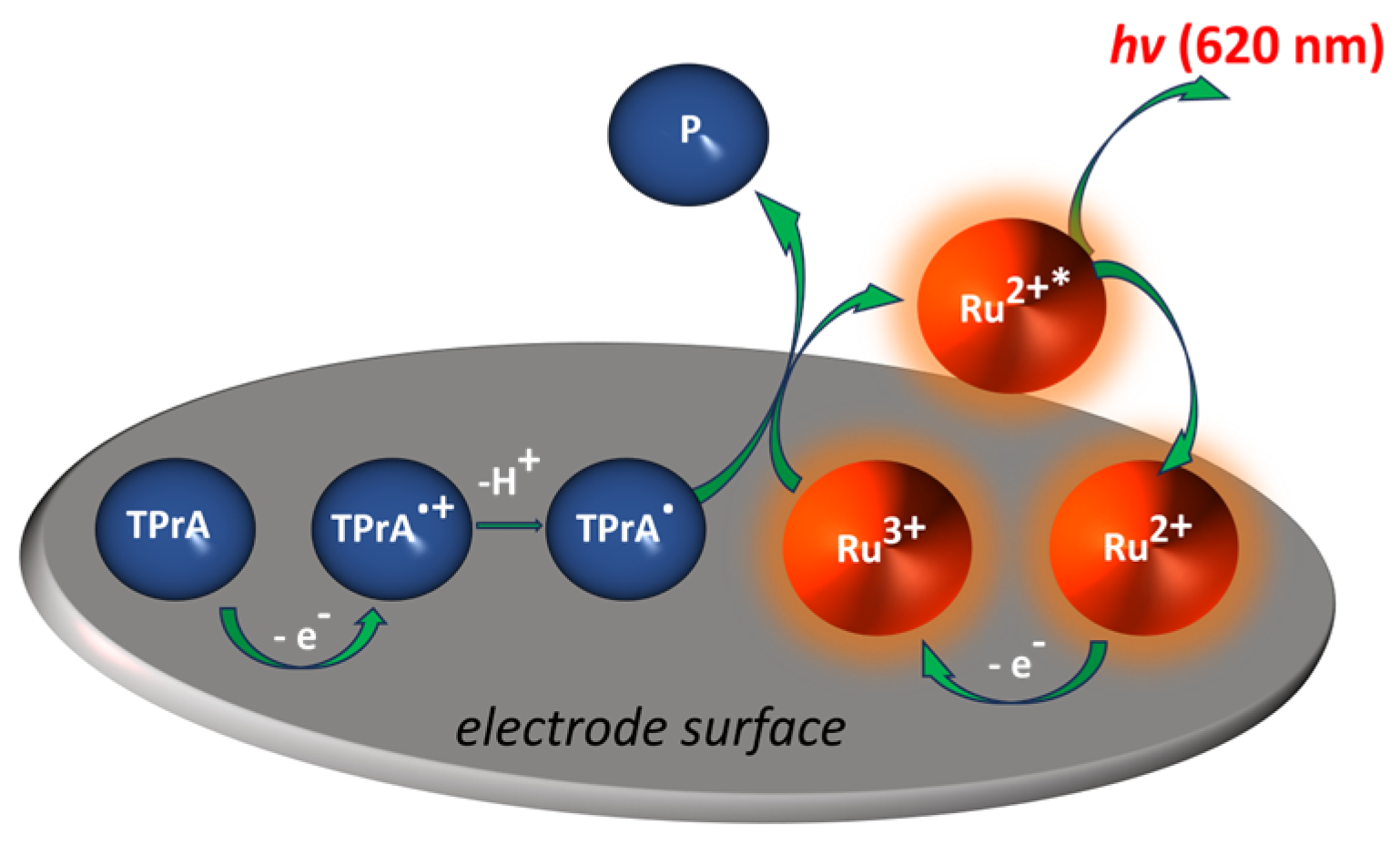
Figure 2.
Environmental pollutants and metal–organic frameworks in the literature in the period 2002–2022. (a) Values were obtained by searching “Environmental pollutants” and (b) “Environmental pollutants-Metal–organic frameworks” in Scopus (solid lines). Trends were obtained by fitting a tendency curve and projecting it for the next 4 years (dotted lines).
Figure 2.
Environmental pollutants and metal–organic frameworks in the literature in the period 2002–2022. (a) Values were obtained by searching “Environmental pollutants” and (b) “Environmental pollutants-Metal–organic frameworks” in Scopus (solid lines). Trends were obtained by fitting a tendency curve and projecting it for the next 4 years (dotted lines).

Figure 3.
Overview of the MOFs structures and applications for water pollutant assessment.
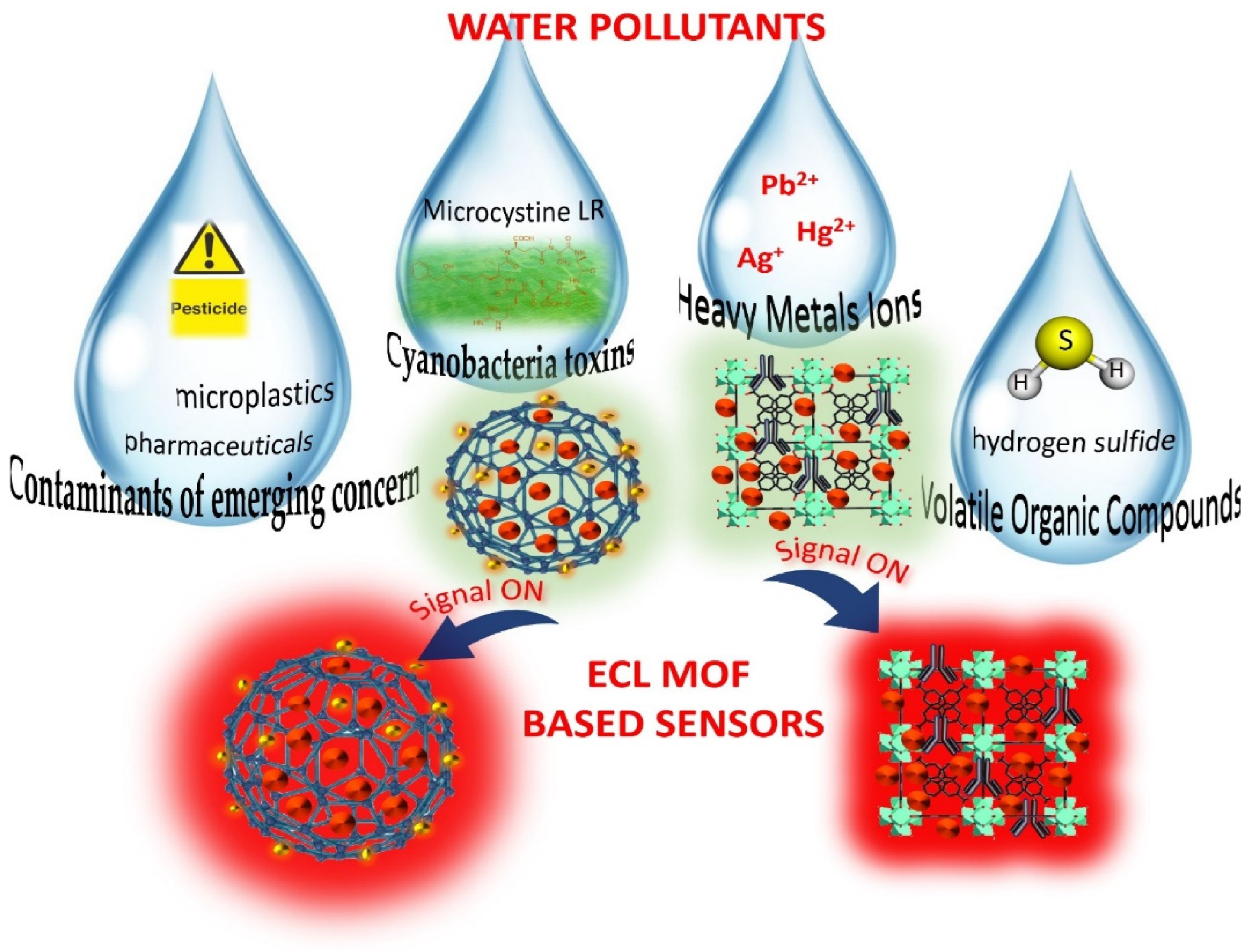
Figure 4.
Schematic diagram of ECL ultrasensitive sensing of Hg2+ and Ag+. Adapted with permission from [80].
Figure 4.
Schematic diagram of ECL ultrasensitive sensing of Hg2+ and Ag+. Adapted with permission from [80].
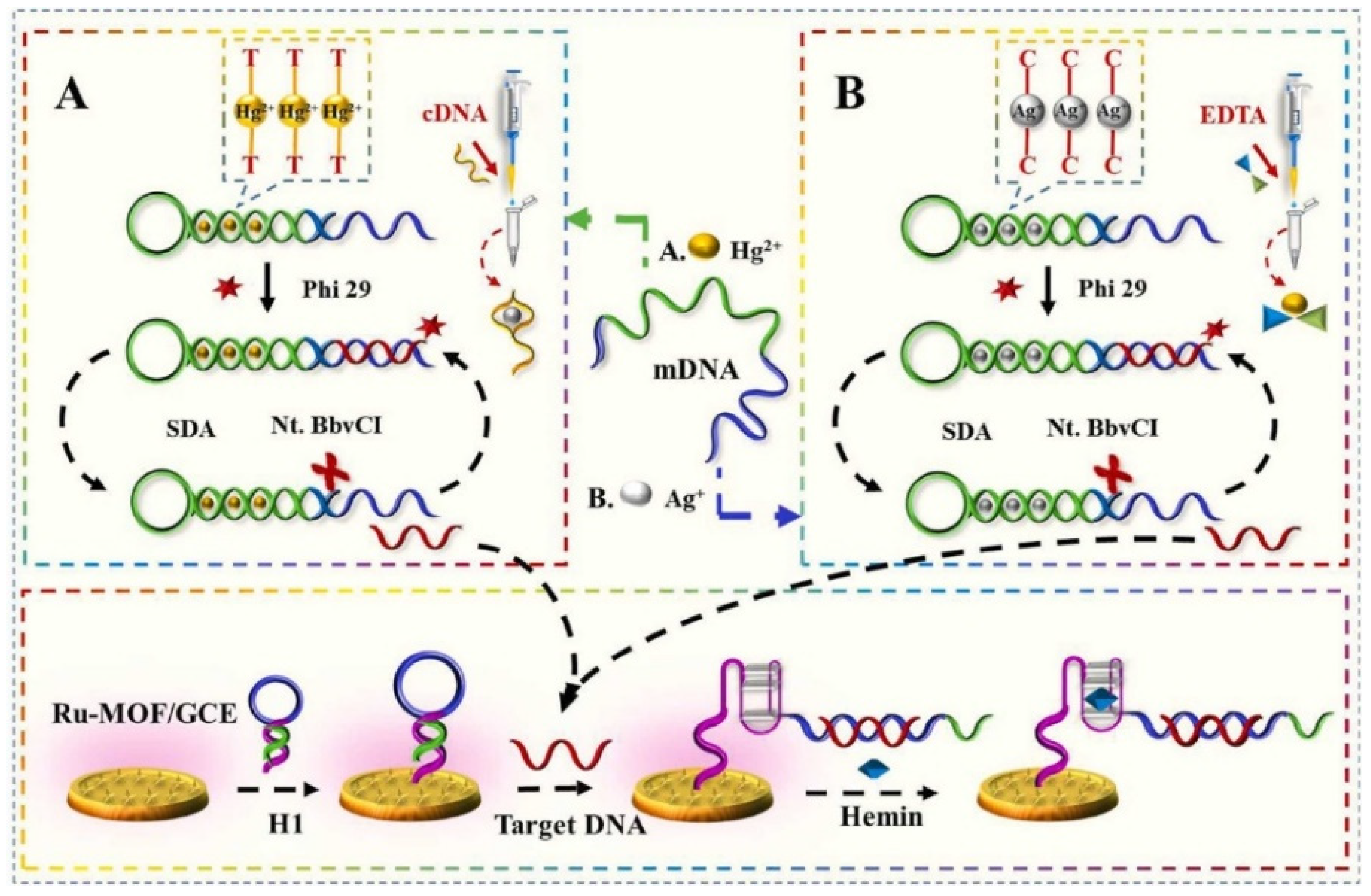
Figure 5.
ECL MOFs for CEC detection. (a) The ECL sensor fabrication and sensing mechanism for DES detection. Adapted with permission from [91]. (b) The ECL immunosensor fabrication process and sensing mechanism for 5-FU detection. Adapted with permission from [95]. (c) The DEHP ELC sensor fabrication steps (left) and schematic diagram of the ECL signaling mechanism (right). Adapted with permission from [94].
Figure 5.
ECL MOFs for CEC detection. (a) The ECL sensor fabrication and sensing mechanism for DES detection. Adapted with permission from [91]. (b) The ECL immunosensor fabrication process and sensing mechanism for 5-FU detection. Adapted with permission from [95]. (c) The DEHP ELC sensor fabrication steps (left) and schematic diagram of the ECL signaling mechanism (right). Adapted with permission from [94].
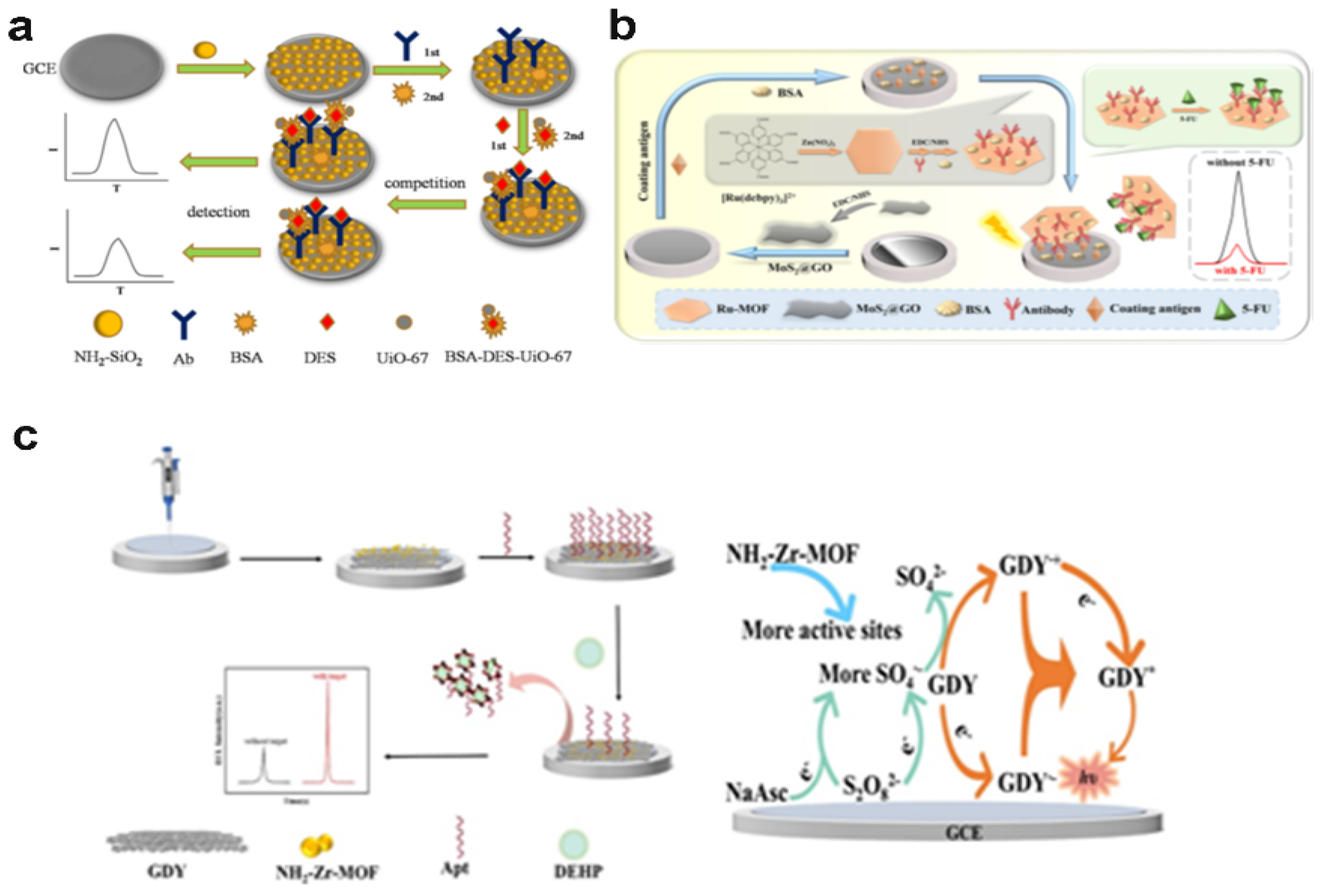
Figure 6.
The ECL composite sensor construction process for PNP detection. Adapted with permission from [96].
Figure 6.
The ECL composite sensor construction process for PNP detection. Adapted with permission from [96].
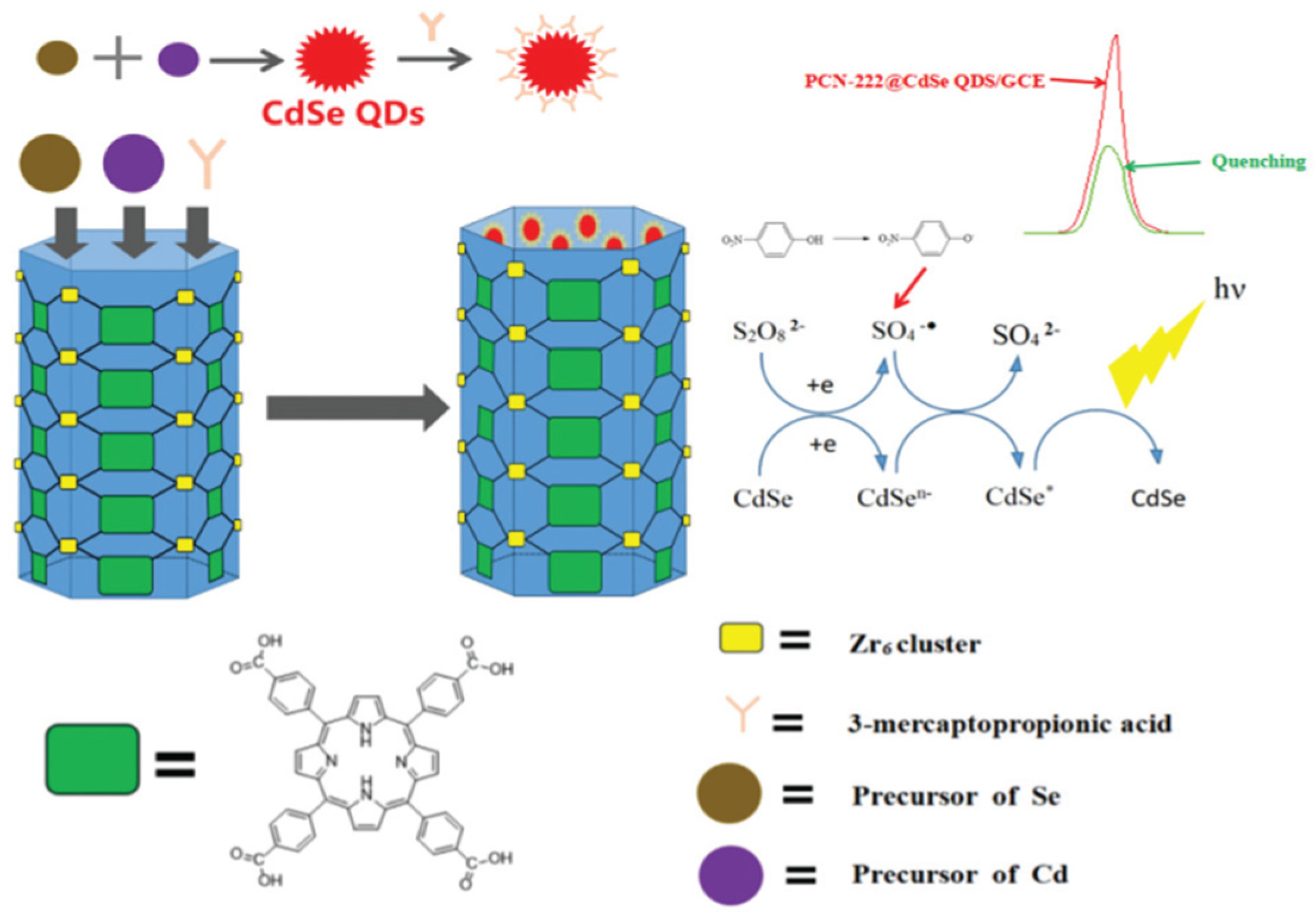
Figure 7.
The construction and sensing mechanism of an ECL sensor for H2S detection. Adapted with permission from [83].
Figure 7.
The construction and sensing mechanism of an ECL sensor for H2S detection. Adapted with permission from [83].
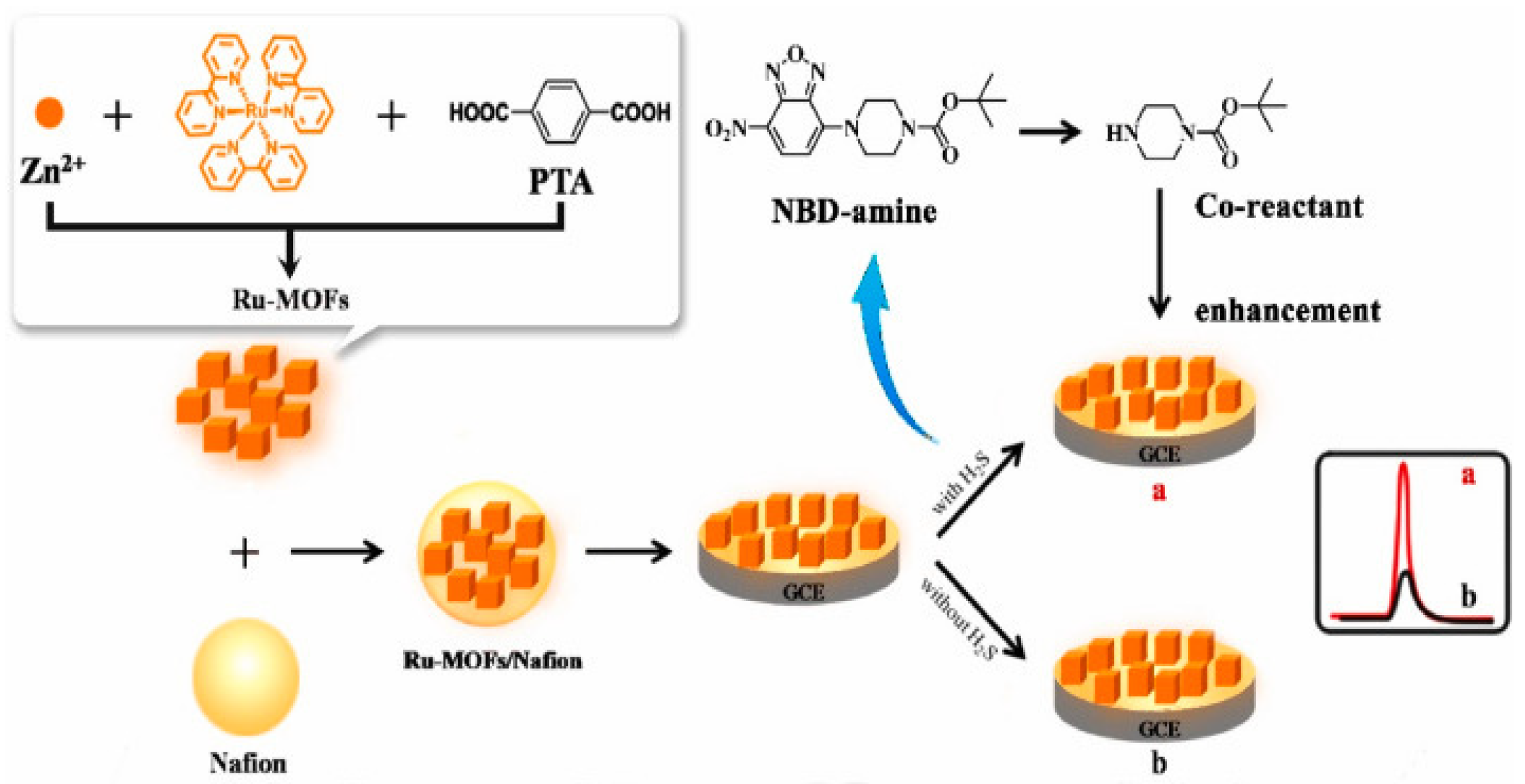
Figure 8.
Schematic presentation of in situ generation of AgNPs@Ru-MOF and progress of ECL-RET (A) and the response process of ECL-RET aptasensor for anatoxin-a (B) Adapted with permission from [84]
Figure 8.
Schematic presentation of in situ generation of AgNPs@Ru-MOF and progress of ECL-RET (A) and the response process of ECL-RET aptasensor for anatoxin-a (B) Adapted with permission from [84]
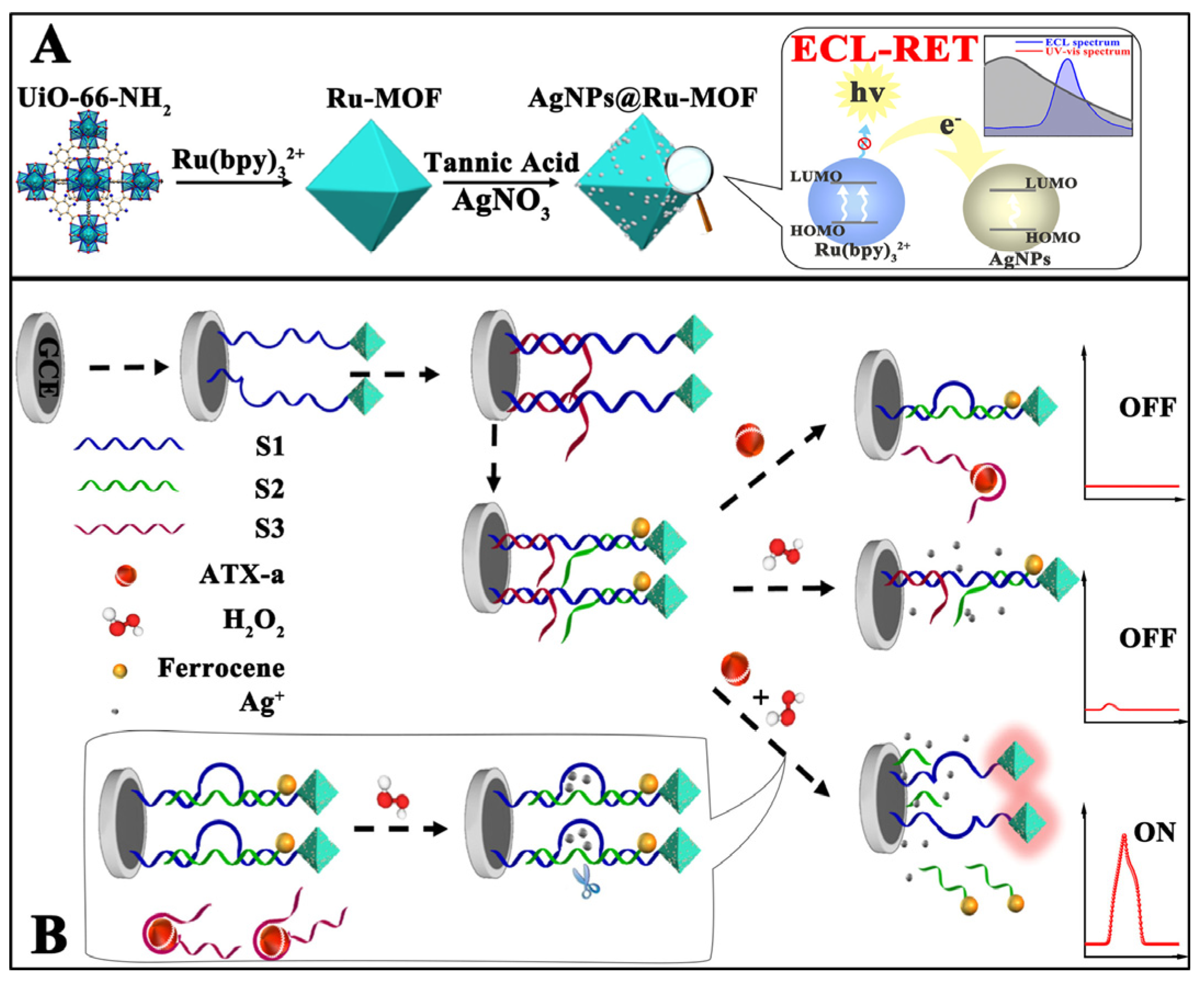
Figure 9.
Left part: synthesis process of different core−shell NPs (A) Illustration of the On−Off−On ECL sensing model. (B) Right part: the HRTEM image (A,B) of Cu-MOFs, the SEM image (D), STEM image (E), different magnification HRTEM images (G−H) of the wire-like RuCu MOFs. Adapted with permission from [85].
Figure 9.
Left part: synthesis process of different core−shell NPs (A) Illustration of the On−Off−On ECL sensing model. (B) Right part: the HRTEM image (A,B) of Cu-MOFs, the SEM image (D), STEM image (E), different magnification HRTEM images (G−H) of the wire-like RuCu MOFs. Adapted with permission from [85].
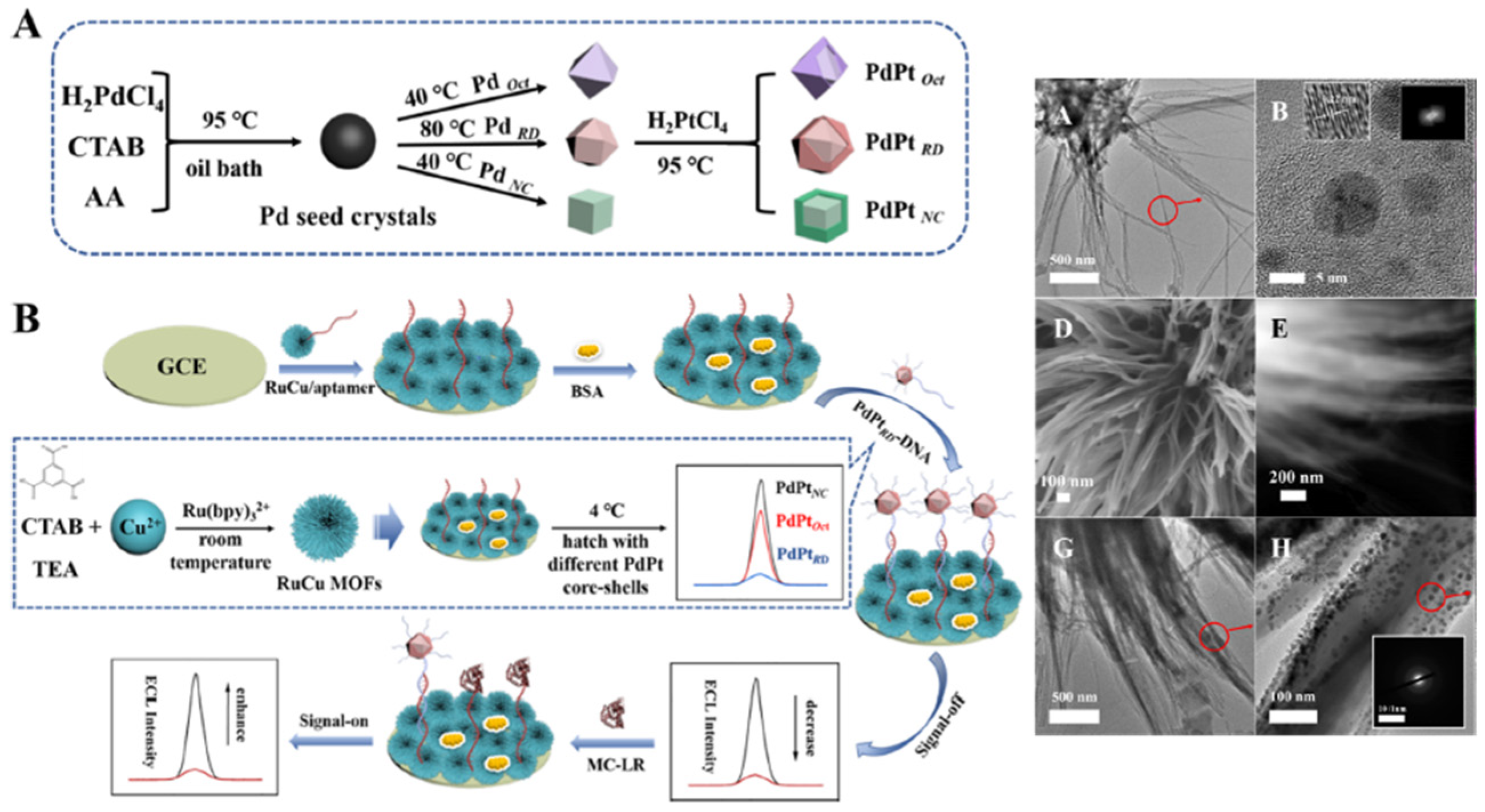

Table 1.
MOF-based ECL sensing of water pollutants.
| MOF type | Analyte | Limit of detection (LOD) | Type of MOF synthesis | Linear detection range (LDR) | Co/reactants | Medium | Reference | |
|---|---|---|---|---|---|---|---|---|
| Ru-Zn: MOF Ru(bpy)32+ 1,3,5-benzentriic acid |
Ag+/Hg2+ | 0.00298 - 0.00032 pM | Electrodeposition, electrochemical synthesis | 0.001–1000 pM/ 0.01–10000 pM |
K2S2O8 | Seawater, water |
[80] | |
| Ag-MOF@CS @(Au-NPs) |
Hg2+ | 66 fM | Ultrasonic, solvothermal |
300 fM – 1 μM | K2S2O8 | Water, lake water | [81] | |
| NH2-SiO2/Ru(bpy)32+- UiO66 | Pb2+ | 1.0 × 10⁻⁷ μM | 1.0×10⁻⁶ – 1.0×10⁻² μM |
TEA | Water, tap water |
[82] | ||
| Ru-MOFs | H2S | 2.5 × 10⁻¹² mol L- 1 | 1.0 × 10⁻¹¹ mol L-1 - 1.0 × 10- 4 mol L-1 |
NBD-amine 7-nitro-1,2,3-benzoxadiazole amine |
Water, human serum samples |
[83] | ||
| S2-Fc/S3/S1-AgNPs @Ru-MOF |
Anatoxin-a | 0.034 µg/mL |
Solvothermal |
0.001-1 mg/mL |
TPrA |
Lake and river water | [84] | |
| Ru-Cu MOF | Microcystin-LR | 0.143 pg/mL | Ultasonication | 0.0001 − 50 ng/mL |
TPrA |
Tap water | [85] | |
| Hf-MOF/Ir2PD/APS/ ITO |
Acetamiprid |
0.0025 nM | Directional self-assembling | 0.01 - 10 nM | TPrA |
Pakchoi |
[86] | |
| CdTe@ZnNi-MOF | Chlorpyrifos | 6.23 x 10⁻¹⁷ M | Blending |
1.0 × 10⁻¹⁴ – 1.0 × 10⁻⁹ M |
Luminol-O2 | Vegetables |
[87] | |
| Co-Ni/MOF | Chloramphenicol | 2.9 × 10 -14 M | Solovothermal |
1.0 × 10⁻¹³ – 1.0 × 10⁻⁶ M |
BP/PTC-NH2)/S2O8with K2S2O8 |
Tap water | [88] | |
| Hollow Cu/Co-MOF | Acetamiprid and malathion |
0.015 pM/0.018 pM |
In situ, solvothermal |
0.1 μM - 0.1 pM | Luminol H2O2, K2S2O8 |
Apple and tomato | [89] | |
| UCNPs / Pt@MOF | Diethylstilbestrol | 3.8 fg/mL | Layer-by-layer growth method |
0.1 pg/mL to 30 ng/mL | CBS H2O2 |
Tap and river water | [90] | |
| Ru(bpy)32+/UiO-67 | Diethylstilbestrol | 3.27 fg/mL |
Solvothermal | 0.01 pg/mL to 50 ng/mL | TPrA | Urine | [91] | |
| Eu(II)-MOFs | Trenbolone | 4.42 fg/mL | 10 fg/mL - 100 ng/mL |
TPrA |
River water | [92] | ||
| CDs@HKUST-1 | Catechol | 3.8 × 10⁻⁹ mol/L | Hydrothermal synthesis | 5.0×10⁻⁹ –2.5×10⁻⁵ mol/L | K2S2O8 | Tea sample | [93] | |
| NH2-Zr-MOF | DEHP | 2.43 × 10⁻¹³ mg/mL | 1.0 × 10⁻¹² – 1.0 × 10⁻⁴ mg/mL |
K2S2O8 | River and urban drinking water | [94] | ||
| Ru-MOF | 5-fluorouracil |
0.031 pg/mL | Ultasonication | 0.0001 –100 ng/mL | K2S2O8 |
Serum |
[95] | |
| PCN-222@CdSe | p-PNP | 0.03 ppb | Solvothermal | 100 ppm to 0.1 ppb | K2S2O8 | Lake and Tap water |
[96] |
|
| PtNPs@Ce-MOFs | Trenbolone | 3.61 fg/mL | One-pot solvothermal | 10 pg/mL - 100 ng/mL | K2S2O8 | River water | [97] | |
Disclaimer/Publisher’s Note: The statements, opinions and data contained in all publications are solely those of the individual author(s) and contributor(s) and not of MDPI and/or the editor(s). MDPI and/or the editor(s) disclaim responsibility for any injury to people or property resulting from any ideas, methods, instructions or products referred to in the content. |
© 2023 by the authors. Licensee MDPI, Basel, Switzerland. This article is an open access article distributed under the terms and conditions of the Creative Commons Attribution (CC BY) license (http://creativecommons.org/licenses/by/4.0/).
Copyright: This open access article is published under a Creative Commons CC BY 4.0 license, which permit the free download, distribution, and reuse, provided that the author and preprint are cited in any reuse.


