

Submitted:
05 October 2023
Posted:
05 October 2023
You are already at the latest version
Abstract
Abrstract: Bacillus spp. it is a genus that is used to biocontrol post-harvest diseases in various vegetables and fruits during transportation and storage. It suppresses the development of pathogens such as gray mold (Botrytis cinerea) in strawberry cultivation. In this work, the molecular characterization of Bacillus spp. species was carried out. in three cities in Peru: Huaura, Chanchamayo and Cañete. The samples were collected from rhizospheric soil from crop areas, subsequently processed for microbiological isolation, molecular analysis using the 16S rRNA gene and bioinformatic analysis. In total, 14 strains were obtained where they were identified with a minimum of 92.05% and a maximum of 100% similarity: 8 strains of Bacillus subtilis, 4 strains of Bacillus licheniformis, 1 strain of Bacillus paralicheniformis and 1 strain of Bacillus cereus, all the strains were related by constructing a phylogenetic tree.
Keywords:
Bacillus
; 16S rRNA
; molecular characterization
; rhizosphere
; biocontroller
1. Introduction
Crops such as vegetables and fruits become diseased between harvesting and consumption, resulting in significant food waste and economic losses. About 45% of harvested fruits, vegetables, roots and tubers are lost. Most of this loss occurs during storage due to the development of pests and pathogens (bacteria, fungi and insects), unfavorable environmental conditions (rain, humidity, frost and heat), water loss, saccharification and sprouting. [1]
Bacteria of the genus Bacillus spp. they are recognized as safe microorganisms for application in the food industry. They occupy the same niche as many pathogens and have the ability to produce a wide range of bioactive substances with antibiotic activity. These substances induce various physiological characteristics in the metabolism of the host plant without causing adverse effects on the environment and human health [2]. Furthermore, Bacillus spp. (i.e., Bacillus subtilis), produce endospores resistant to dynamic physical and chemical treatments, such as heat, desiccation, organic solvents, and ultraviolet radiation, which therefore maintain their ability to trigger defense responses in plants guest, even in unfavorable conditions.[3]; this makes it capable of easily formulating and storing Bacillus-based biological products and serves as a potent bioactive component against pathogens [4].
Currently, the protective effect of Bacillus strains is used in several plant species against a wide variety of biotic (pathogens, pests) [5] and abiotic (drought, salinity, extreme temperatures, metals, stresses toxic) [6].
The purpose of the study is to carry out the molecular identification of Bacillus spp. samples. collected in rhizospheric soil from 3 regions of Peru and the relationship that exists between these species through a phylogenetic tree.
2. Materials and Methods
2.1. Sample collection and isolation
The collection of rhizospheric soil samples was carried out in the areas of 1) Canín Annex of the Checras district of the province of Huaura, 2) Kimiri Sector of the Chanchamayo district of the province of Chanchamayo and 3) Catapalla Annex of the district from Lunahuaná in the province of Cañete. Subsequently, the samples were processed for the isolation of Bacillus spp. strains: 10 g were weighed. of the rhizospheric soil sample and dissolved in physiological saline, then dilutions were carried out in 3 series, subsequently the diluted sample was seeded in the culture medium Glucose Tryptone Meat Extract (TGE) and incubated at 37°C for 24 hours, finally Colonies were selected and purified by streaks [7].
2.2. DNA extraction, quantification and quality
The isolated strains were seeded in the Luria Broth (LB) culture medium and incubated for 18 hours at 37 °C [8]. Subsequently, genomic DNA extraction was carried out according to the instructions of the commercial Genomic DNA Extraction Kit – Gram (+) Bacteria/Yeast/Fungi (Cepham Life Sciences). The samples were then quantified using the Eppendorf BioSpectrometer kinetic spectrophotometer [9] and to verify the quality and integrity of the DNA, a 1% agarose electrophoresis run was performed in a 1X TAE buffer solution [10].
2.3. PCR amplification with the 16S rRNA gene and DNA sequencing
Amplification was performed by polymerase chain reaction (PCR) [11] using 2 μl of the DNA sample with the DreamTaq PCR Master Mix kit (2X) and the 16S rRNA 27 F primers (5 ' AGA GTT TGA TCM TGG CTC AG 3') and 1525 R (5' AAG GAG GTG WTC CAR CC 3') [12]. For a negative control, a mix without sample was used. The mixtures were processed in the Eppendorf Mastercycler minutes, elongation at 72°C for 1 minute and a final extension cycle at 72°C for 15 minutes [13]. The PCR products were visualized by electrophoresis in a 1.5% agarose gel in a 1X TAE buffer solution and were subsequently sent for Sanger sequencing [14] to the University of Minnesota - USA.
2.4. Bioinformatic analysis
The sequences obtained were edited with the Chromas v2.66 software (https://technelysium.com.au/wp/chromas/) [15], then they were analyzed with the online BLAST platform [16], subsequently these were aligned using the ClustalW tool and finally the construction of a phylogenetic tree from the 16S rRNA gene was carried out using the software MEGA 11.0.13 [17] using the following parameters: Analysis (phylogenetic reconstruction), statistical method (Neighbor-Joining), Phylogeny test (Bootstrap method, number of bootstrap replications: 1000), model (Maximun composite likelihood) [18].
3. Results
3.1. Sample collection and isolation
A total of 14 strains of Bacillus spp. were isolated and analyzed: 7 in the Canín annex of the Checras district of the province of Huaura, 5 in the Kimiri sector of the Chanchamayo district of the province of Chanchamayo and 2 in the Catapalla annex of the Lunahuaná district of the province of Cañete.
3.2. DNA quantification and quality
For the DNA quantification of the samples, an average result of 30.35 ng/μl was obtained, with a minimum of 21.4 ng/μl for samples UNDC_06, UNDC_09 and a maximum of 39.5 ng/μl for sample UNDC_05. While in the quality of the extracted genomic DNA, defined bands with a large molecular weight exceeding 10,000 bp were evident, which indicate an acceptable quality for PCR amplification and corroborates the quantification previously carried out. (Figure 1)
3.3. PCR amplification with the 16S rRNA gene and DNA sequencing
The PCR amplification products of the 14 samples were analyzed by 1.5% agarose electrophoresis and visualized amplicons with an expected weight of 1500 bp. (Figure 2). As a result of the sequencing, 14 electropherograms were obtained which were subsequently analyzed.
3.4. Bioinformatic analysis
According to the molecular identification analysis with the BLAST platform, the species of Bacillus subtilis, Bacillus licheniformis, Bacillus paralicheniformis and Bacillus cereus were identified, with a minimum of 92.05% and maximum of 100% similarity (Table 1).
The construction of the phylogenetic tree reveals the evolutionary relationship and homology between the 14 strains worked on. (Figure 3)
4. Discussion
In the collection stage, the strawberry rhizosphere soil was used as a sample to obtain the Bacillus spp strains, similar to a work reported in the rhizosphere of cacti [19]. On the contrary, studies have been carried out where they obtain samples of mites [20], plants [21], fish [22], birds, bovines [23], fungi [24] among others. In this work, rhizospheric soil is used due to the high diversity of microbiota and the environmental conditions that favor the development of the genus Bacillus spp due to its close relationship with the roots of vegetable crops [25]. In the PCR amplification stage, the universal primers of the 16S rRNA gene were used [26], however other authors used different primers such as Bc-Rep-1, Bc-Rep-2 [27] and M-B1 [28].
The sanger sequencing used in this work was efficient for molecular identification, however, the results can be improved using third generation sequencing such as Oxford Nanopore Technologies technology [29], its greatest advantage is the reading length and the speed of the process [30]. This will allow us to expand the database, having more sampling points and repetitions of them. The molecular characterization of species was Bacillus subtilis [31], Bacillus licheniformis [32], Bacillus paralicheniformis [33], Bacillus cereus [34], unlike other authors who found other types of species such as Bacillus amyloliquefaciens, Bacillus vallismortis, Bacillus halotolerans [35], Bacillus thuringiensis [36].
Finally, the phylogenetic tree was built using the Neighbor Joining method, aligned with the Clustal can be improved by increasing the number of primers for the 16S rRNA gene and the number of replications using a specialized server for bioinformatic analysis.
5. Conclusions
The molecular characterization of the genus Bacillus spp. Through the analysis of the 16S rRNA gene, it allowed the identification of 8 strains of Bacillus subtilis, 4 strains of Bacillus licheniformis, 1 strain of Bacillus paralicheniformis, 1 strain of Bacillus cereus; with a minimum of 92.05% and maximum of 100% similarity in the regions of Huaura, Chanchamayo and Cañete.
Author Contributions
Conceptualization, J.V.; methodology, A.Q., M.C. and D.M..; software, J.V.; validation, J.V and A.Q.; writing—original draft preparation, J.V.; writing—review and editing, J.V.; supervision, J.V. All authors have read and agreed to the published version of the manuscript.
Funding
This research was funded by first research seedbed contest with contract N°004-2021-UNDC-PSI
Acknowledgments
We duly appreciate the stipend granted by the vice presidency of research of the National University of Cañete, Cañete, Peru.
Conflicts of Interest
The authors declare no conflict of interest.
References
- FAO. (2015). Technical Platform on the Measurement and Reduction of Food Loss and Waste. Food and Agriculture Organization of the United Nations. Available online: https://www.fao.org/platform-food-loss-waste/en/.
- Maksimov, I.V.; Veselova, S.V.; Nuzhnaya, T.V.; Sarvarova, E.R.; Khairullin, R.M. Plant growth-promoting bacteria in regulation of plant resistance to stress factors. Russ. J. Plant Physiol. 2015, 62, 715–726. [Google Scholar] [CrossRef]
- Gao, H.; Xu, X.; Dai, Y.; He, H. Isolation, Identification and Characterization of Bacillus subtilis CF-3, a Bacterium from Fermented Bean Curd for Controlling Postharvest Diseases of Peach Fruit. Food Sci. Technol. Res. 2016, 22, 377–385. [Google Scholar] [CrossRef]
- Aouadhi, C.; Rouissi, Z.; Kmiha, S.; Mejri, S.; Maaroufi, A. Effect of sporulation conditions on the resistance of Bacillus sporothermodurans spores to nisin and heat. Food Microbiol. 2016, 54, 6–10. [Google Scholar] [CrossRef]
- Egamberdieva, D.; Wirth, S.J.; Shurigin, V.V.; Hashem, A.; Abd_Allah, E.F. Endophytic Bacteria Improve Plant Growth, Symbiotic Performance of Chickpea (Cicer arietinum L.) and Induce Suppression of Root Rot Caused by Fusarium solani under Salt Stress. Front. Microbiol. 2017, 8, 1887. [Google Scholar] [CrossRef] [PubMed]
- Lastochkina, O.; Pusenkova, L.; Yuldashev, R.; Babaev, M.; Garipova, S.; Blagova, D.; Khairullin, R.; Aliniaeifard, S. Effects of Bacillus subtilis on some physiological and biochemical parameters of Triticum aestivum L. (wheat) under salinity. Plant Physiol. Biochem. 2017, 121, 80–88. [Google Scholar] [CrossRef]
- Larrea-Izurieta, I.; Borja, C.F.; Arcos-Andrade, A. Aislamiento y caracterización de cepas de Bacillus spp. Con actividad contra Tetranychus urticae Koch en cultivos comerciales de rosas. Revista Colombiana de Biotecnología 2015, 17, 140–148. [Google Scholar] [CrossRef]
- Valdez-Nuñez, R.A.; Ríos-Ruiz, W.F.; Ormeño-Orrillo, E.; Torres-Chávez, E.E.; Torres-Delgado, J. Caracterización genética de bacterias endofíticas de arroz (Oryza sativa L.) con actividad antimicrobiana contra Burkholderia glumae. Revista Argentina de Microbiología 2020, 52, 315–327. [Google Scholar] [CrossRef]
- Huertas, D. (2013). Caracterizacion molecular de cepas de Bacillus thuringiensis con propiedades entomocidas, para vectores transmisores de enfermedades metaxénicas (dengue) [Tesis de doctorado, Universidad Nacional Mayor de San Marcos]. Available online: https://hdl.handle.net/20.500.12672/3513.
- Rodríguez-Tolosaa, R.; Cifuentes-Vega, R.; Hernández-Fernández, J. Caracterización de cepas nativas de Bacillus thuringiensis como método para predecir la susceptibilidad sobre insectos lepidópteros, dípteros y coleópteros plaga de la agricultura. Rev. Mutis 2023, 13, 1–34. [Google Scholar] [CrossRef]
- Clark, D. P., Pazdernik, N. J., & McGehee, M. R. (2019). Chapter 6—Polymerase Chain Reaction. En D. P. Clark, N. J. Pazdernik, & M. R. McGehee (Eds.), Molecular Biology (Third Edition) (Third Edition, pp. 168-198). Academic Cell. [CrossRef]
- Suárez-Contreras, L.Y.; Yañez-Meneses, L.F. 16S rRNA as an applied tool in the molecular characterization of genera and species of bacteria. Respuestas 2020, 25, 127–137. [Google Scholar] [CrossRef]
- Cattani, F.; Barth, V.C.; Nasário, J.S.; Ferreira, C.A.; Oliveira, S.D. Detection and quantification of viable Bacillus cereus group species in milk by propidium monoazide quantitative real-time PCR. J. Dairy Sci. 2016, 99, 2617–2624. [Google Scholar] [CrossRef]
- Tae, H.; Karunasena, E.; Bavarva, J.H.; Garner, H.R. Updating microbial genomic sequences: improving accuracy & innovation. BioData Min. 2014, 7, 25. [Google Scholar] [CrossRef]
- Rahman, M.Z.; Uematsu, S.; Coffey, M.D.; Uzuhashi, S.; Suga, H.; Kageyama, K. Re-evaluation of Japanese Phytophthora isolates based on molecular phylogenetic analyses. Mycoscience 2014, 55, 314–327. [Google Scholar] [CrossRef]
- Lorenz, L.; Lins, B.; Barrett, J.; Montgomery, A.; Trapani, S.; Schindler, A.; Christie, G.E.; Cresawn, S.G.; Temple, L. Genomic characterization of six novel Bacillus pumilus bacteriophages. Virology 2013, 444, 374–383. [Google Scholar] [CrossRef] [PubMed]
- Wang, M.S.W. Phylogenetic relationships between Bacillus species and related genera inferred from 16s rDNA sequences. Braz. J. Microbiol. 2009, 40, 505–521. [Google Scholar] [CrossRef]
- Mendoza, J. (2022). Caracterizacion molecular de las principales plagas y enfermedades en el cultivo de cacao en la zona nororiental del Perú [Tesis de maestría, Universidad Nacional Toribio Rodríguez de Mendoza]. Available online: https://hdl.handle.net/20.500.14077/2842.
- Chávez-Ambriz, L.A.; Hernández-Morales, A.; Cabrera-Luna, J.A.; Luna-Martínez, L.; Pacheco-Aguilar, J.R. Aislados de Bacillus provenientes de la rizósfera de cactus incrementan la germinación y la floración en Mammillaria spp. (Cactaceae). 2016, 48, 333–341. [Google Scholar] [CrossRef]
- Erban, T.; Nesvorna, M.; Erbanova, M.; Hubert, J. Bacillus thuringiensis var. tenebrionis control of synanthropic mites (Acari: Acaridida) under laboratory conditions. Exp. Appl. Acarol. 2009, 49, 339–346. [Google Scholar] [CrossRef]
- Koilybayeva, M.; Shynykul, Z.; Ustenova, G.; Abzaliyeva, S.; Alimzhanova, M.; Amirkhanova, A.; Turgumbayeva, A.; Mustafina, K.; Yeleken, G.; Raganina, K.; et al. Molecular Characterization of Some Bacillus Species from Vegetables and Evaluation of Their Antimicrobial and Antibiotic Potency. Molecules 2023, 28, 3210. [Google Scholar] [CrossRef]
- Zevallos, M.A.F.; Castañeda, A.; Toledo, O.; Caballero, D.; Cueva, M.; Cedeño, V. Caracterización molecular ómica de una cepa de Bacillus amyloliquefaciens aislada de la microbiota del paiche Arapaima gigas con actividad antagonista contra bacterias patógenas de peces. Revista de Investigaciones Veterinarias del Perú 2019, 3, 90–922. [Google Scholar] [CrossRef]
- Florido, G. M., Rondón, A. J., Pérez, M., Arteaga, F., Bocourt, R., Portilla, Y., Rodríguez, M., Pérez, Y., Beruvides, A., & Laurencio, M. (2017). Methodology for the isolation, identification and selection of Bacillus spp. Strains for the preparation of animal additives Metodología para el aislamiento, identificación y selección de cepas de Bacillus spp. Para la elaboración de aditivos zootécnicos. Cuban Journal of Agricultural Science, 51(2).
- Liu, C.; Yu, P.; Yu, S.; Wang, J.; Guo, H.; Zhang, Y.; Zhang, J.; Liao, X.; Li, C.; Wu, S.; et al. Assessment and molecular characterization of Bacillus cereus isolated from edible fungi in China. BMC Microbiol. 2020, 20, 310. [Google Scholar] [CrossRef]
- Rodríguez-Sahagún, A.; Velasco-Jiménez, A.; Castellanos-Hernández, O.; Acevedo-Hernández, G.; Aarland, R.C. Bacterias rizosféricas con beneficios potenciales en la agricultura. Rev. Terra Latinoam. 2020, 38, 333–345. [Google Scholar] [CrossRef]
- Abdulsalam, R.A.; Ijabadeniyi, O.A.; Cason, E.D.; Sabiu, S. Characterization of Microbial Diversity of Two Tomato Cultivars through Targeted Next-Generation Sequencing 16S rRNA and ITS Techniques. Microorganisms 2023, 11, 2337. [Google Scholar] [CrossRef] [PubMed]
- Galvis, F., & Moreno, L. (2014). Caracterizacion molecular mediante rep-PCR de asilados nativos de Bacillus thuringiensis, obtenidos de muestras de suelo. Agronomía Costarricense, 1(38), 223-229. Available online: https://www.scielo.sa.cr/scielo.php?script=sci_arttext&pid=S0377-94242014000100016.
- Galvis, F.; Carrillo, M. Identificación y Caracterización Molecular de Aislados de Burkholderia glumae: Agente Causante del Añublo Bacterial en el Cultivo de Arroz. Información tecnológica 2015, 26, 33–40. [Google Scholar] [CrossRef]
- Ciuffreda, L.; Rodríguez-Pérez, H.; Flores, C. Nanopore sequencing and its application to the study of microbial communities. Comput. Struct. Biotechnol. J. 2021, 19, 1497–1511. [Google Scholar] [CrossRef] [PubMed]
- Kumburu, H.H.; Shayo, M.; van Zwetslaar, M.; Njau, J.; Kuchaka, D.J.; Ignas, I.P.; Wadugu, B.; Kasworm, R.; Masaki, L.J.; Hallgren, M.B.; et al. Nanopore sequencing technology for clinical diagnosis of infectious diseases where laboratory capacity is meager: A case report. Heliyon 2023, 9, e17439. [Google Scholar] [CrossRef]
- Elegbeleye, J.; Buys, E. Molecular characterization and biofilm formation potential of Bacillus subtilis and Bacillus velezensis in extended shelf-life milk processing line. J. Dairy Sci. 2020, 103, 4991–5002. [Google Scholar] [CrossRef]
- Romo-Barrera, C.M.; Castrillón-Rivera, L.E.; Palma-Ramos, A.; Castañeda-Sánchez, J.I.; Luna-Herrera, J. Bacillus licheniformis and Bacillus subtilis, Probiotics That Induce the Formation of Macrophage Extracellular Traps. Microorganisms 2021, 9, 2027. [Google Scholar] [CrossRef] [PubMed]
- Du, Y.; Ma, J.; Yin, Z.; Liu, K.; Yao, G.; Xu, W.; Fan, L.; Du, B.; Ding, Y.; Wang, C. Comparative genomic analysis of Bacillus paralicheniformis MDJK30 with its closely related species reveals an evolutionary relationship between B. paralicheniformis and B. licheniformis. BMC Genom. 2019, 20, 283. [Google Scholar] [CrossRef]
- Valero, M.; Hernández-Herrero, L.; Fernández, P.; Salmerón, M. Characterization of Bacillus cereus isolates from fresh vegetables and refrigerated minimally processed foods by biochemical and physiological tests. Food Microbiol. 2002, 19, 491–499. [Google Scholar] [CrossRef]
- Ying, T.; Wu, P.; Gao, L.; Wang, C.; Zhang, T.; Liu, S.; Huang, R. Isolation and characterization of a new strain of Bacillus amyloliquefaciens and its effect on strawberry preservation. LWT 2022, 165. [Google Scholar] [CrossRef]
- Rovira, A. G. P. (2014). Aislamiento y caracterización de cepas nativas de Bacillus thuringiensis con miras al desarrollo de un bioinsecticida [Tesis de licenciatura, Universidad ORT]. Available online: https://www.colibri.udelar.edu.uy/jspui/handle/20.500.12008/1593.
Figure 1.
1% agarose gel of genomic DNA extracted from Bacillus spp.
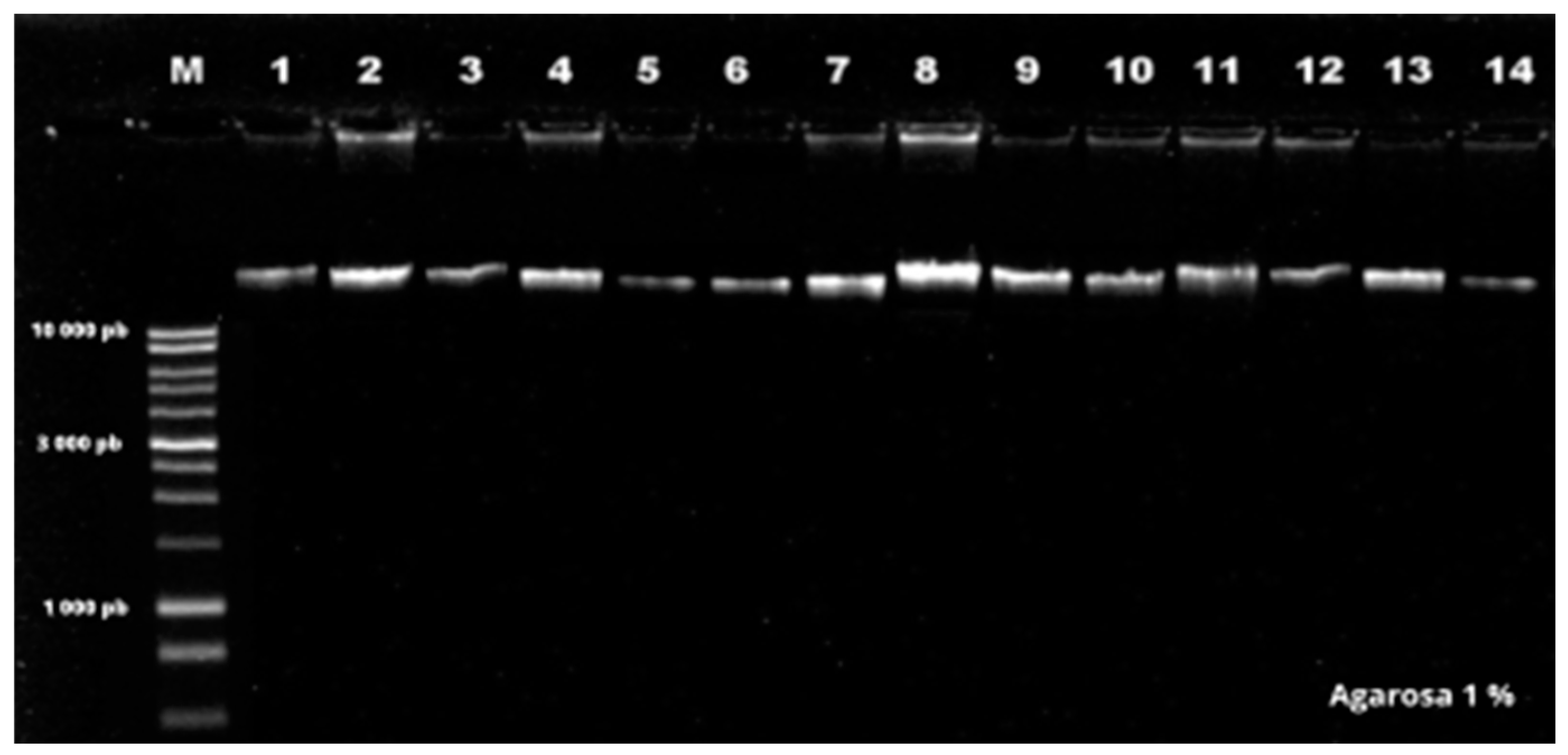
Figure 2.
1.5% agarose gel of PCR products from Bacillus spp. samples.
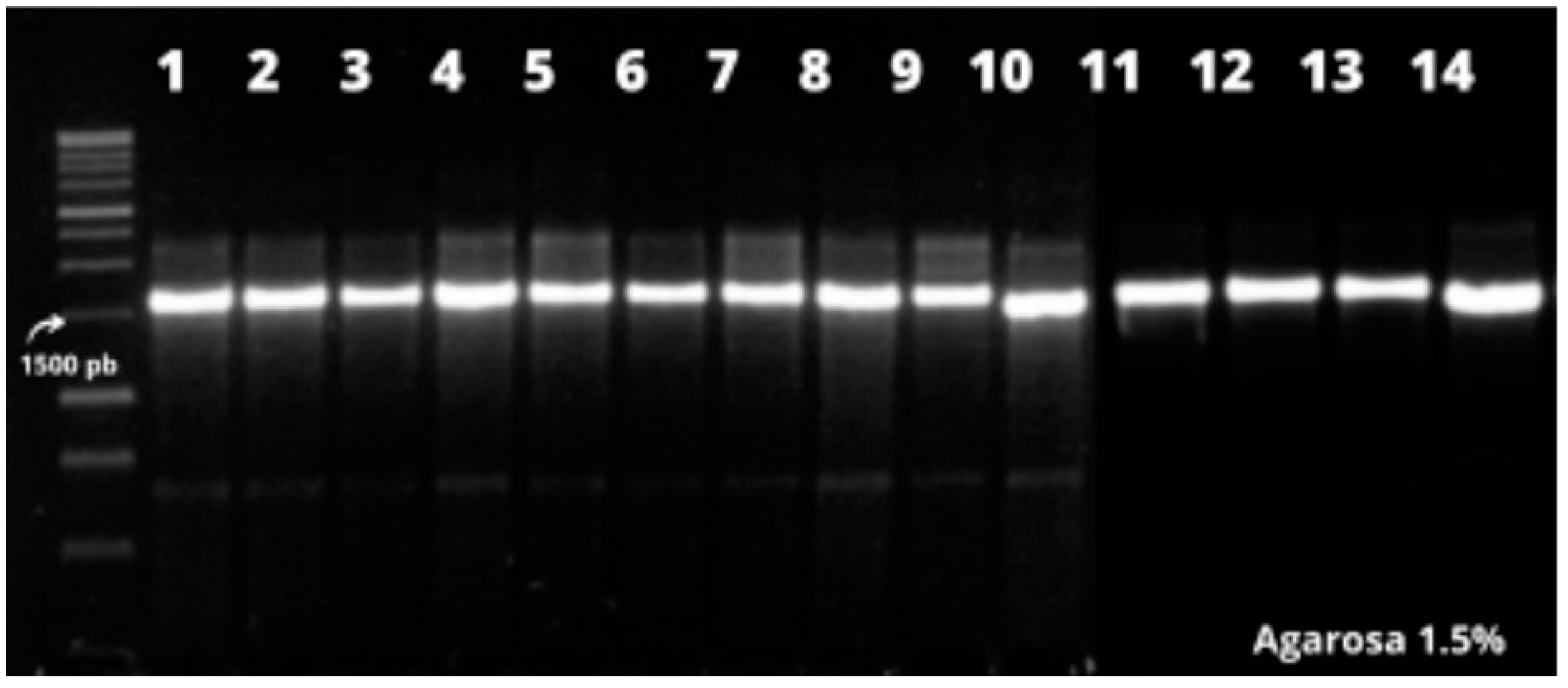
Figure 3.
1.5% agarose gel of PCR products from Bacillus spp. samples.
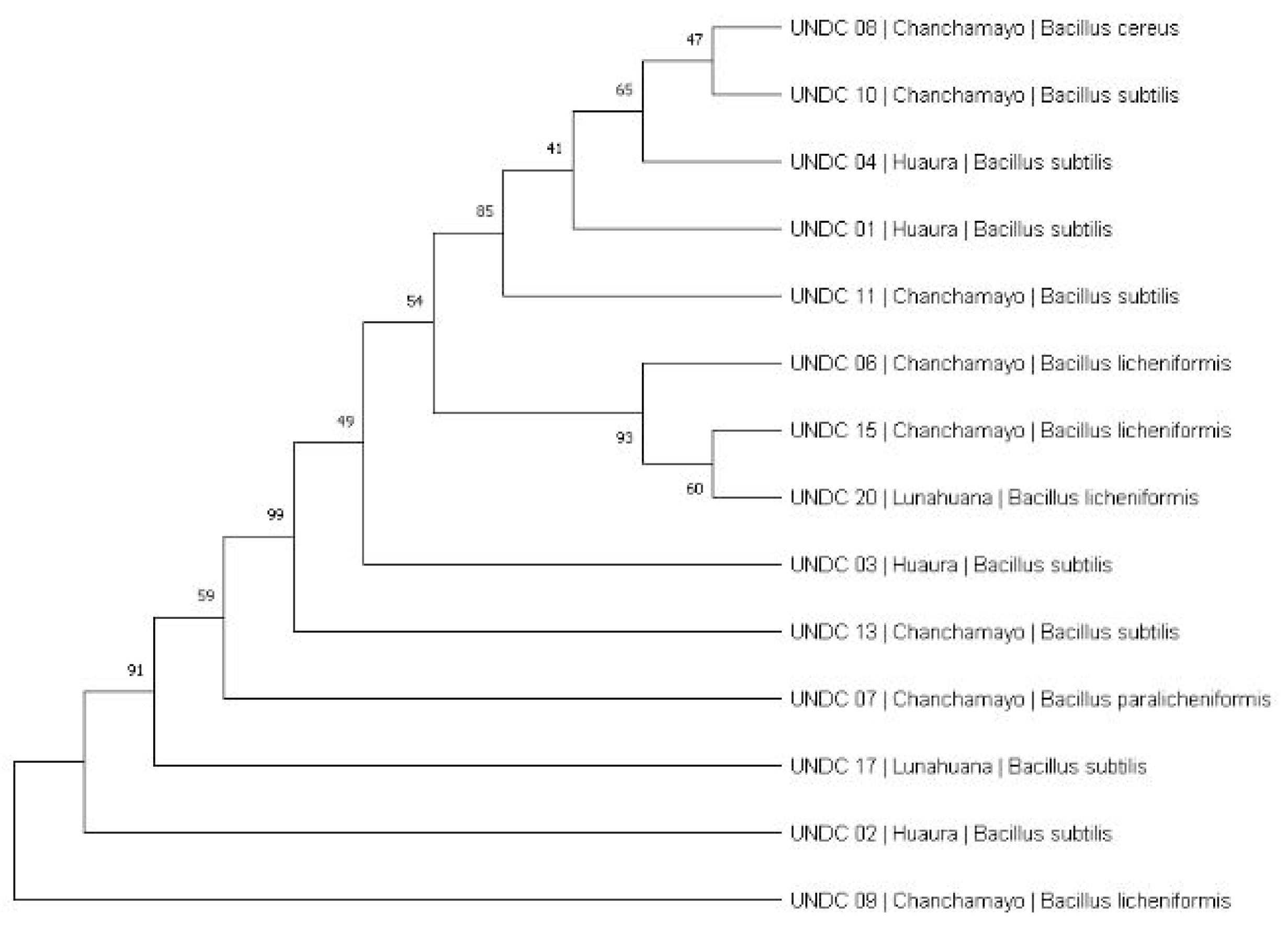

Table 1.
This is a table. Tables should be placed in the main text near to the first time they are cited.
Table 1.
This is a table. Tables should be placed in the main text near to the first time they are cited.
| Code | Species | Location | Identify |
| UNDC_01 | Bacillus subtilis | Huaura | 98,86% |
| UNDC_02 | Bacillus subtilis | Huaura | 95,79% |
| UNDC_03 | Bacillus subtilis | Huaura | 98,09% |
| UNDC_04 | Bacillus subtilis | Huaura | 100,00% |
| UNDC_05 | Bacillus licheniformis | Huaura | 98,18% |
| UNDC_06 | Bacillus paralicheniformis | Huaura | 95,38% |
| UNDC_07 | Bacillus cereus | Huaura | 99,79% |
| UNDC_08 | Bacillus licheniformis | Chanchamayo | 92,05% |
| UNDC_09 | Bacillus subtilis | Chanchamayo | 99,56% |
| UNDC_10 | Bacillus subtilis | Chanchamayo | 98,28% |
| UNDC_11 | Bacillus subtilis | Chanchamayo | 97,91% |
| UNDC_12 | Bacillus licheniformis | Chanchamayo | 97,15% |
| UNDC_13 | Bacillus subtilis | Lunahuaná | 94,05% |
| UNDC_14 | Bacillus licheniformis | Lunahuaná | 98,93% |
Disclaimer/Publisher’s Note: The statements, opinions and data contained in all publications are solely those of the individual author(s) and contributor(s) and not of MDPI and/or the editor(s). MDPI and/or the editor(s) disclaim responsibility for any injury to people or property resulting from any ideas, methods, instructions or products referred to in the content. |
© 2023 by the authors. Licensee MDPI, Basel, Switzerland. This article is an open access article distributed under the terms and conditions of the Creative Commons Attribution (CC BY) license (http://creativecommons.org/licenses/by/4.0/).
Copyright: This open access article is published under a Creative Commons CC BY 4.0 license, which permit the free download, distribution, and reuse, provided that the author and preprint are cited in any reuse.


