

Submitted:
25 September 2023
Posted:
09 October 2023
You are already at the latest version
Abstract
A small but growing body of literature suggests that outdoor experiences during childhood affect environment-related behaviors in adulthood. However, research on the magnitude of the effect (effect size) of outdoor experience on learners’ behaviors remains scarce. In this study, we explore the extent to which outdoor experiences associate with environmentally responsible behaviors. Our sample consisted of 143 ninth- and tenth-grade students living on a Greek island. The data were collected using a properly adjusted environmental literacy instrument. Two different methodological pathways, i.e., a quasi-experimental approach and correlation analysis, were used to analyse the data. A tentative variable representing the frequency and intensity of students’ experiential contact with nature was found to be the strongest available predictor of their self-reported pro-environmental behaviors. The findings of this study support the significance of outdoor, experiential learning during childhood in shaping individuals’ environmental behaviors.
Keywords:
environmental behaviour
; experiential learning
; nature experience
; nature-based learning
; outdoor learning
; outdoor experience
; experiential contact with nature
1. Introduction
In these days of growing public awareness about the state and health of the natural environment, research on what causes people to act pro-environmentally is becoming increasingly urgent. A better understanding of the factors that lead people to adopt pro-environmental behaviors can help us improve the quality of environmental and sustainability education (ESE). However, after 50 years of research in the field of environmental behaviors, the role and specific weight of factors that promote this type of behaviors remain unexplored.
Initially, it was assumed that gains in environmental knowledge would lead to improved environmental attitudes, and eventually to the adoption of environmentally responsible behaviors (Colwell, 1976; Ramsey & Rickson, 1977). This linear assumption became known as the knowledge-attitude-behaviors (KAB) model (Fishbein & Ajzen, 1975). However, this model was proven to be inadequate: research has shown that in most cases, gains in environmental knowledge are not followed by direct improvements in environmental behavior (Loughland et al., 2003).
Indeed, research in the field of ESE suggests that it is relatively easier to provide learners with ecological knowledge and/or knowledge of environmental issues than to influence their behaviors. In a recent study, Stern, Powell, and Hill (2014) conducted a meta-analysis of literature reporting on the evidence-based outcomes of 86 environmental education programs (or groups of programs) in North America. Even though the programs they reviewed were shown to be effective in improving learners’ environmental knowledge, these gains in knowledge could not be linked to direct improvements in environmentally responsible behavior. Indeed, while 82% of the examined programs report positive outcomes in environmental knowledge, and 37% of the programs report positive outcomes in learners’ environmental attitudes, only 16% of the programs report positive outcomes in improving learners’ environmental behavior. On the other hand, those programs that included a strong outdoor component were more effective in changing learners’ behaviors as compared to indoor, knowledge-based programs. These findings are consistent with the earlier, influential meta-analysis of Hines et al. (1987) which concluded that the personality components of behavior prediction models – such as environmental attitudes and behavior – are not as readily influenced through educational efforts.
Decades of research on human psychology and behavior broadly recognize that knowledge gain is not typically a direct cause of behavior change (Kollmuss & Agyeman, 2002; Hungerford and Volk 1990). In the field of environmental education, Hendee (1972, p.1) has characterized the assumption that knowledge could affect respective behaviors as the “folklore of environmental education”. Others found that increased knowledge has a “trivial influence on future commitment” (Borden & Schettino, 1979, p. 38). Hence, scholars have urged us to be sceptical towards the idea that knowledge of environmental issues will lead to behavior change, which would then lead to beneficial environmental impact. However, the insistence on this failed linear approach “continues to vex environmental education” (Henderson, 2019, p. 988).
The tenuous relationship between environmental knowledge and environmentally responsible behaviors has also been confirmed by recent research in program evaluation and planning (Heimlich & Ardoin, 2008; Jacobs et al. 2012). Based on an environmental literacy comparison between eco-schools and ordinary schools in Slovenia, Krnel and Naglic (2009) concluded that, in the sample that they examined, an increased level of environmental knowledge “does not result in greater awareness and environmentally responsible behavior” (p.5). Their finding is consistent with Stern et al. (2014) who concluded in their meta-analysis that “programs that focus primarily on providing new knowledge should not be expected to necessarily influence behavioral outcomes, even though they may measure them” (p.23). Finally, in a recent environmental literacy study with Indonesian middle school students, Maulidya, Mudzakir and Sanjaya (2014) concluded that “behavior is not influenced by the environmental knowledge, but more influenced by [student] attitude towards the environment” (p. 193). But if improving learners’ environmental knowledge is not a sufficiently effective way to achieve behavioral change, then what else might work?
1.1. Environmental Knowledge and Attitudes Explain Only a Small Part of the Variability in Environmental Behaviors
A considerable part of what we currently know about the relationship between environmental knowledge, environmental attitudes, and environmentally responsible behavior draws from an influential meta-analysis published by Hines, Hungerford, and Tomera in 1987. In their original paper published in The Journal of Environmental Education, Hines et al. (1987) analyzed 128 studies, published as far back as 1970. The analyzed studies report on baseline measurements of learners’ environmental knowledge, attitude, and behaviors. The meta-findings of Hines et al. (1987) have been empirically confirmed by Bamberg and Möser (2007). Recently, Marcinkowski and Reid (2019) revisited these earlier works in their review article that focuses on the relationship between Knowledge, Attitude, and Behaviors in environmental education.
Based on the mean correlation strengths reported by Hines et al. (1987) –and confirmed by subsequent research– the coefficient for the environmental knowledge/ environmental behavior correlation is r=.299. This correlation strength corresponds to a small to moderate effect size for the Κ–Β correlation, which suggests a relatively weak relation between environmental Κnowledge and Βehaviors. The A–B correlation (r=.347) is somewhat stronger as compared to the K–B correlation, however this figure still corresponds to a moderate effect size (Cohen, 1988). On this point, Marcinkowski and Reid (2019, p. 465) concur that while the Attitude-Behavior relationship “may be statistically significant, it is often of relatively moderate strength only”.
After the realization that the knowledge to attitude to behavior path is inadequate for interpreting and achieving the espoused behavioral change, researchers moved on to explore alternative paths leading to the adoption of environmentally responsible behaviors (Simmons and Volk, 2002, p.7). Other variables that were found to associate with such behaviors are demographic variables such as income and educational level, and personality variables such as personal responsibility and locus of control (Laidley, 2013). Indeed, locus of control is one of the variables with the highest correlation coefficients with environmentally responsible behavior. Locus of control represents an individual’s perception of whether they have the ability to bring about change through their own behavior (Newhouse, 1990). According to the correlation coefficients reported by Hines et al. (1987) in their meta-analysis, the variability in locus of control explains 13.3% of the variability in environmental behaviors (r=.365). Furthermore, Sia et al. (1986) reported a significant correlation (r=.38, p<.05) between locus of control and environmentally responsible behavior. Further, Smith-Sebasto and Fortner (1994) found a positive significant correlation (r = .33, p < .01) between these two variables. Indeed, locus of control is one of the strongest available predictors of environmentally responsible behavior. As also reported by Hsu and Roth (1999), locus of control correlates with environmentally responsible behavior by r=.27. However, even if locus of control demonstrates the strongest correlation with environmentally responsible behavior as compared to environmental knowledge or attitudes, we still do not have a clear idea on how to influence learners’ locus of control assuming that this will have a secondary effect on their behavior. Even after the consideration of the –moderate in effect size– correlation of locus of control with behaviors, most of the variability in environmentally responsible behaviors still remains unaccounted for.
1.2. Contemporary Research on Environmental Learning and Behavior Change
Since environmental knowledge, environmental attitudes, and the other measured variables explain only a small part of the variability in environmental behaviors, what else could predict environmental behaviors? What accounts for the remaining variability? Is there any additional factor that can help us predict (with the end-goal to improve) environmental behaviors? In their recent review of research on the attitude–behavior relationship, Marcinkowski & Reid (2019) return to the literature to discuss a situational factor that was overlooked by earlier research: direct experience. Delving into non-environmental education literature, Marcinkowski and Reid (2019) identified several personal and situational factors that serve as moderators of the Attitude–Behavior relationship, including social pressure, perceived difficulty (Wallace et al., 2005), or whether “the attitude is formed by direct experience, the attitude is held with certainty” (Kraus 1990, p.1). According to Marcinkowski & Reid (2019) direct, experiential learning is one of the situational factors (or situational moderators) that enhance the attitude-behavior correlation. As they note, the attitude-behavior correlations “tend to be higher when the attitude is formed by direct experience” (Krauss, 1990 in Marcinkowski & Reid, 2019, p. 466). Hence, Marcinkowski & Reid consider direct experience of nature as a situational moderator of the attitude-behavior relationship.
Eventually, one of Marciknowski’s former students, Mehmet Erdogan, proceeded to introduce experience in natural environments as an independent variable. For the needs of his doctoral research in Turkey, Erdogan (2009) designed a scale aiming to capture learners’ exposure to direct, experiential learning. Instead of treating direct experience of nature as a situational moderator of the A–B relationship, Erdogan introduced a variable that encompasses learning by direct experience as an independent predictor of learners’ environmental behaviors. After studying the literature on the role of significant life experiences in shaping pro-environmental behaviors, Erdogan became interested in those experiences that are shaped by direct, experiential contact with nature. Erdogan’s (2009) experience in natural environments variable comprises of the frequency and intensity of learners’ direct, experiential contact with nature, based on their reported participation in a number of natural activities, such as camping and trekking.
In Erdogan’s (2009) sample, students who participated more frequently in outdoor activities in natural settings were more likely to adopt (and demonstrate) pro-environmental behaviors. Indeed, Erdogan (2009) reports experience in the natural environments as one of the strongest predictors of environmentally responsible behaviors in his research sample of (n=1545) grade five students). The purpose of the present study is to offer additional evidence on whether this tentative variable can be considered as an effective predictor of pro-environmental behaviors in different data sets.
Erdogan’s (2009) finding that experiential contact with nature influences environmental behaviors is not surprising. There is already a considerable volume of literature attesting the role of significant life experiences & direct experiential contact with nature in shaping learners’ environmental attitudes, concern, behaviors and life paths (Ernst and Theimer, 2011; Palmer, 1993; Chawla, 1998, 1999; Bögeholz, 2006; Wells & Lekies, 2006).
According to Georgopoulos (2014) “greater contact with nature during childhood improves the likelihood of them adopting environmentally responsible behaviors as adults” (p.159-160). Georgopoulos bases his statement on earlier works by Tanner (1980), Palmer (1998), Chawla, (1998 & 1999), Daskolia & Grillia (2010). In their cross-sectional study, Rosa et al (2018) refer to a similar body of literature to make the case that direct contact with nature is positively associated with pro-environmental behaviors. However, the papers that they use as reference studies are methodologically disparate and draw from different fields of knowledge which impedes meaningful comparisons across research findings. More systematic evidence on the quantitative dimensions of the relationship between (a) experiential contact with nature and (b) environmentally responsible behavior might facilitate the comparability of findings by enriching the available methodological palette.
In the present study, drawing on the typology of an environmental literacy instrument developed for the needs of Erdogan’s doctoral research in Turkey, we attempt to introduce a measure of learners’ experiential contact with nature. To what extent do people who have more frequent and intense direct experiences of the natural environment have better attitudes toward the natural environment or demonstrate improved environmental behaviors? This is the research question that the present research intends to inform.
2. Materials and Methods
2.1. Population and Research Settings
The empirical data presented in this study draw environmental literacy measurements taken from a student population in the island of Kalymnos, Greece. Kalymnos is a rugged Greek island adjacent to Asia Minor, Turkey. The island of Kalymnos has a permanent population of 16 000 residents and a land area of 134.5 km2 – for comparison, Kalymnos is four times smaller than the island of Montréal. The island’s population density is 119 residents per square km, which makes it one of the most densely populated Greek islands (Journal of the Greek Government, 2014).
The sample was taken from the High School and Lyceum of Kalymnos. These are public schools with a capacity of 219 and 232 students respectively, situated in the main settlement and commercial port of the island. The first school-based environmental education program in Kalymnos took place in 1992, following the enactment of the first law in support of environmental education in 1990 (Journal of the Greek Government, 1990). The environmental education program was offered for eight consecutive school years and concluded in the year 2000 with a publication featuring the island’s endemic flora and fauna (Vassiliou, 2000). In the following years, Kalymnos’ educational community embraced environmental education, which is documented by a number of publications featuring Kalymnos-based environmental education programs (e.g., Kalogerakis, 2018; Platsi, 2018).
2.2. Data Collection, Analysis and Research Rationale
In October 2017, the Greek Environmental Literature Instrument (GELI - see the next section for details) was administered to three classes of Grade 9 and three classes of Grade 10 students in the island of Kalymnos. All students of the three Grade 9 classes and three Grade 10 classes who were present at that time consented to participate in the research when the purpose of the study was explained (n=143). At the time of the first data sampling visit, no students were actively taking part in ESE, since the ESE groups for that year had not been formed yet. Hence, the baseline measurements were taken before part of the student population was exposed to ESE for the 2017–2018 school year.
The baseline (pre-test) levels of environmental literacy components within the student population were assessed; demographic variables and information about students’ life stories were collected as well. In this methodological approach, the problem of environmental behavior prediction is being informed by studying the relationships between the baseline levels of demographic variables (e.g., parental education level), situational variables (e.g., outdoor experience) and environmental literacy components (i.e., environmental knowledge, attitudes and behavior). Statistical inferences are made by assessing the extent by which the situational variables (which reflect students’ learning experiences) associate with the baseline levels of selected environmental literacy components (environmental knowledge, attitudes and behavior).
In order to assess the influence of demographic and situational factors on students’ current environmental literacy levels, a correlation analysis was performed. Data analysis included the construction of a correlation matrix where all possible bivariate partial correlations between the baseline variables are tabulated. Two-way correlation analysis was performed and Pearson’s r was calculated for all the statistically significant bivariate correlations with the alpha level set at α=.05.
After a time interval of 6 ½ months, a second data collection visit took place in May 2018. from the same student sample. By then, part of the student population had completed the ESE elective for the 2017–2018 school year. The initial purpose of the second round of data collection visit was to explore whether students’ environmental literacy levels had changed after their exposure to the ESE elective (Author, 2021). However, for the needs of the methodological approach presented in this research article, the data collected in the second round of data collection (post test data) are analyzed solely for reasons of validity and reliability.
2.3. Instrumentation
Environmental literacy instruments differ in the type and amount of environmental literacy components and sub-components that they include, depending on the theoretical frameworks that each instrument follows. Different instruments use adjacent definitions on what environmental knowledge, attitudes, and environmentally responsible behaviors stand for. The instrument that was applied for data collection was a slightly modified version of the Greek Environmental Literacy Instrument (GELI), developed at the University of Athens by doctoral student Julie Kyriazi for the needs of her doctoral research (Kyriazi, 2018; Kyriazi & Mavrikaki, 2013).
In her doctoral thesis, Kyriazi explains that the Greek Environmental Literacy Instrument (GELI) is influenced by the Erdogan and Ok (2011) typology, which includes 41 sub-components of environmental literacy. In turn, this typology draws from earlier works, such as the Erdogan and Marcinkowski (2007) framework of environmental literacy sub-components. In final form, the GELI consists of 79 items which are assigned to one section of demographic information and three major components of environmental literacy: environmental knowledge, environmental attitude and environmentally responsible behavior.
Two novel add-ons appear in the instrument (GELI) that Kyriazi developed in order to assess the environmental literacy levels of first-year Greek University students (n=1010). The first add-on that appears in GELI is a Likert type scale asking about students’ participation in outdoor activities. This add-on draws from Erdogan’s work on the experience in the natural environments (Erdogan, 2009; Erdogan and Ok, 2011). Secondly, Kyriazi (2018) added –in her revised instrument– an open-ended question asking about the “presence of important figures and experiences in students’ life stories” (p. 66). Kyriazi (2018) was apparently influenced by the literature that has substantiated the importance of significant life experiences in shaping learners’ environmental behavior and concern (p.14-15). However, since the purpose of Kyriazi’s doctoral research was to assess baseline environmental literacy levels of first-year Greek University students in order to study (and propose improvements for) the teaching of ecology in formal education settings, she did not proceed to treat these situational variables as predictors of environmental literacy.
Eventually, due to independent doctoral research by Dr. Erdogan and Dr. Kyriazi, the employed instrument (GELI) was already enriched with the components experience in the natural environments and significant life experiences. Before administering the instrument to the Kalymnos students, GELI was modified by including an additional item that requests about students’ previous participation in ESE during their schooling history– the intention was to examine whether previous exposure to ESE could possibly represent an uncontrolled source of variation for the quasi-experimental design.
As a result, three independent studies employed the following three innovations/ novel components to the final instrument, producing the following variables: (a) experience in the natural environments (Erdogan, 2009), (b) significant life experiences (Kyriazi, 2018), and (c) past exposure to ESE (Author, 2021). All three variables include an experiential learning signal. Below, we will provide technicalities how these novel variables were constructed and how they were employed for the purpose and needs of the present study.
Experience in the natural environments is intended to express the frequency and intensity of learners’ experiential contact with nature at the time of measurement. This component refers to “activities that individual[s] are involved in their spare time in the natural region for recreation purposes (e.g., tracking, fishing, hunting, picnicking, canoeing, etc.)” (Erdogan, 2009, p.14). In that sense, the respective variable expresses students’ interaction “with the natural, rural and pristine habitats” (Tanner, 1980, p.21).
For the needs of this study, we constructed the variable based on what we had in hand: the respective component as it appeared on GELI. Apparently, Erdogan’s component initially consisted of nine items each one of which includes four frequency levels for each activity (frequency of time spent in natural regions). However, for reasons of face validity we omitted the items of hunting and fishing from the construction of the variable – this point can be revisited by future research. Further, the items on students’ frequency of participation in team sports (basketball, soccer etc.) and frequency of shopping in a mall were also omitted since these activities do not meet the criterion of interaction “with the natural, rural and pristine habitats” (Tanner, 1980, p.21).
Hence, after excluding the four items for the reasons explained above, we constructed the variable by giving equal weight to each of the following outdoor activities: (a) hiking, (b) camping, (c) nature photography, (d) biking and (e) other outdoor activity that meets the interaction with the natural environment criterion (Tanner, 1980). We will henceforth refer to this algebraic construct as outdoor experience in order to distinguish it from Erdogan’s variable which was most probably constructed somewhat differently.
The significant life experiences component, introduced by Kyriazi (2018), refers to specific events and experiences in students’ lives that have had an impact on their interest or sensitivity to environmental issues (students are also asked to describe these events and at what age did these happen) and/ or the presence of a specific figure in students’ lives (relative, writer, environmentalist/ ecologist, mythological hero, comic character, political leader, teacher, actor or else) who has positively impacted them with respect to environmental protection (students are also asked to name this figure). The significant life experiences variable was constructed by adding the binary responses to these equally weighted questions.
Lastly, past exposure to ESE is constructed based on student responses to a single item that was added to the instrument. The item requests information about students’ previous participation to school-based ESE programs. The past exposure to ESE variable was included on the basis that it reasonably conveys a signal of outdoor, experiential learning in students’ earlier schooling history.
In sum, GELI collects data that produce five numerical variables (environmental knowledge, environmental attitude, environmentally responsible behavior, age and academic performance–GPA), four categories of binary data (including gender and past exposure to ESE), nineteen categories of ordinal data (derived from Likert-type scales of parental educational level and others), and fourteen nominal categories of data.
3. Results
As discussed above, the present study focuses on baseline measurements taken from a sample of 14 and 15 year old students from Kalymnos, Greece, in order to assess the influence of demographic and situational factors on their current environmental literacy levels. A correlation analysis revealed all the possible interaction patterns (two-way correlations) among the variables included in the instrument.
Figure 1 presents all of the statistically significant two-way partial correlations that were identified among the variables measured, as extracted from the questionnaires that were completed by the students. Variables external to the KAB model are classified as either demographic (on the upper half) or situational variables (on the lower half of the graph). All correlations are positive except for the correlation between gender and outdoor experience. Indeed, in this sample female students are less likely to participate in outdoor activities but more likely to demonstrate increased academic performance as well as improved environmental attitudes. In order to make sense of the gender variable, in this study female gender is by convention assigned a higher numerical value (see Appendix A).
The order of the correlation strengths between environmental knowledge to attitude to behavior concurs with the literature, indicating that the KAB model retains its relevance as an explanatory model – if not as a predictive string. However, the visual suggests that paths alternative to the KAB path are also present, as indicated by the correlation of pro-environmental behavior with outdoor experience and significant life experiences.
Observing the upper part of the explanatory model, it follows that the demographic variable with the highest impact on the beginning of the knowledge to attitude to behavior predictive string is academic performance (as represented by students’ GPA). Indeed, a strong correlation appears between academic performance and the outcome variables environmental Knowledge (r = .508) and environmental Attitudes (r = .521).
However, academic performance and the cluster of demographic variables correlate only weakly with pro-environmental behavior, suggesting that other, more decisive factors prevail in shaping behavioral outcomes. Observing the lower part of the explanatory model, it appears that the most potent predictor of environmental behaviors available in the sample is outdoor experience (r=.359). The second most potent predictor of environmentally responsible behaviors in this student sample is environmental Attitudes (r=.324).
The significant life experiences variable also correlates with environmental Behaviors, but more strongly so with environmental Attitude. Students who have had significant environmental experiences in their early or later childhood are more likely to have improved environmental attitude (r= .330) and environmental self-reported behaviors (r=.272) today.
Further, it appears that students who took part in ESE during their early schooling demonstrate improved environmental Attitudes and Behaviors at present time. We will return to this point in the following section.
3.1. Validity and Reliability
In studies where self-reported measures are taken, there is always the risk of social desirability affecting the answers. This threat to validity is common in the studies reviewed above and to which we compare our findings. Even though empirical data suggest that social desirability does not represent a significant validity threat in self-reported measures of environmental attitudes and behavior (Milfont, 2009), it cannot be ruled out. This is why it is important to have converging evidence from different methodological traditions in support of the main findings.
A different validity threat ensues when a correlation between two variables owes to the influence exerted on both variables by a third variable. In this case, the effect of one variable can be mistaken as the effect of another. In order to address this threat to validity, an intercorrelation matrix was constructed so as to reveal the interaction patterns between dependent, independent, and demographic variables (Author, 2021). Results from the intercorrelation matrix indicated whether it is meaningful to control for the effect of nuisance variables that may act as confounders of the explored relationships.
Indeed, a confound does appear in the case of Past exposure to ESE which correlates significantly with academic performance (GPA) as well as with environmental knowledge, attitudes, and behavior, indicating that that students who have been exposed to ESE in the past demonstrate improved environmental knowledge, attitudes, and behavior. However, the correlations of past exposure to ESE with both Knowledge and Attitude drop below significance when academic performance (GPA) is controlled for. The only effect of previous exposure to ESE that can be supported after these corrections is on self-reported Behaviors (albeit with reduced strength, r=.202). On the other hand, the correlation of outdoor experience & significant life experiences with self-reported Behaviors survives the validity checks and remains unaffected by confounding variables: Indeed, no significant validity threat was identified in the case of the correlations between outdoor experience & significant life experiences and the variables of interest.
Eventually, all three situational variables (that apparently convey the signal of outdoor, experiential learning & unmediated contact with nature) correlate significantly with self-reported behaviors, even after the effect of nuisance/ confounding variables was removed. Since school-based ESE in Greece often includes a strong outdoor component, the common thread connecting all three situational variables represents experiential contact with nature.
3.2. Research Limitations
As is the case with many environmental literacy instruments, GELI does not cover the full scope of theoretically conceived environmental literacy components. For example, GELI omits three major environmental literacy components: environmental skills (practical environmental skills), environmental competencies (e.g., to identify, analyze, and propose solutions for environmental issues), and environmental awareness (e.g., awareness of the interdependence between biotic and abiotic ecosystemic components) (Hollweg et al., 2011). Hence, the instrument assesses limited components of environmental literacy, and thus it cannot claim that it has captured a comprehensive representation of students’ environmental literacy.
This research limitation however can be perhaps surpassed by the fact that the present research article focuses on environmental behaviors, which is an environmental literacy component of special interest. Besides being an important environmental literacy component, environmental behaviors (and the improvement thereof) is the intended outcome of ESE. Specifically, the behavioral component of GELI differs from those of its preceding instruments by that it places increased emphasis on learners’ socio-political action. Early environmental literacy instruments such as Cisde, MSELI, and MSELS included few or no questions on learner empowerment and civic action. Instead, the behavioral components of these original instruments focused on individual environmental action; most of the questions in the instruments’ behavioral part centred around learners’ household-related behaviors such as waste management routines at their homes or practices concerning the conservation of energy and tap water in their households (McBeth et al., 2011, p.158). GELI’s behavioral component, on the other hand, differs from the previous instruments in that it mostly comprises of questions on learners’ civic and community action. The difference is that in GELI, most questions in the behavioral component inquire about learners’ collective environmental behaviors (Kyriazi & Mavrikaki, 2013, p.164). For example, GELI’s requests information on whether participants intervene when they take notice that someone is actively harming the environment, as well as whether they spontaneously pick up litter to throw away in the rubbish bin, whether they take part in campaigns for the clean-up of public spaces, and other civic life activities.
4. Discussion
The findings presented here are internally consistent with an earlier quasi-experimental study that was based on the same data set (Author et al., 2020; Author, 2021). In that doctoral study, statistically significant improvement in students’ environmental behaviors were observed after their exposure to outdoor, experiential learning over the course of 6 ½ months.
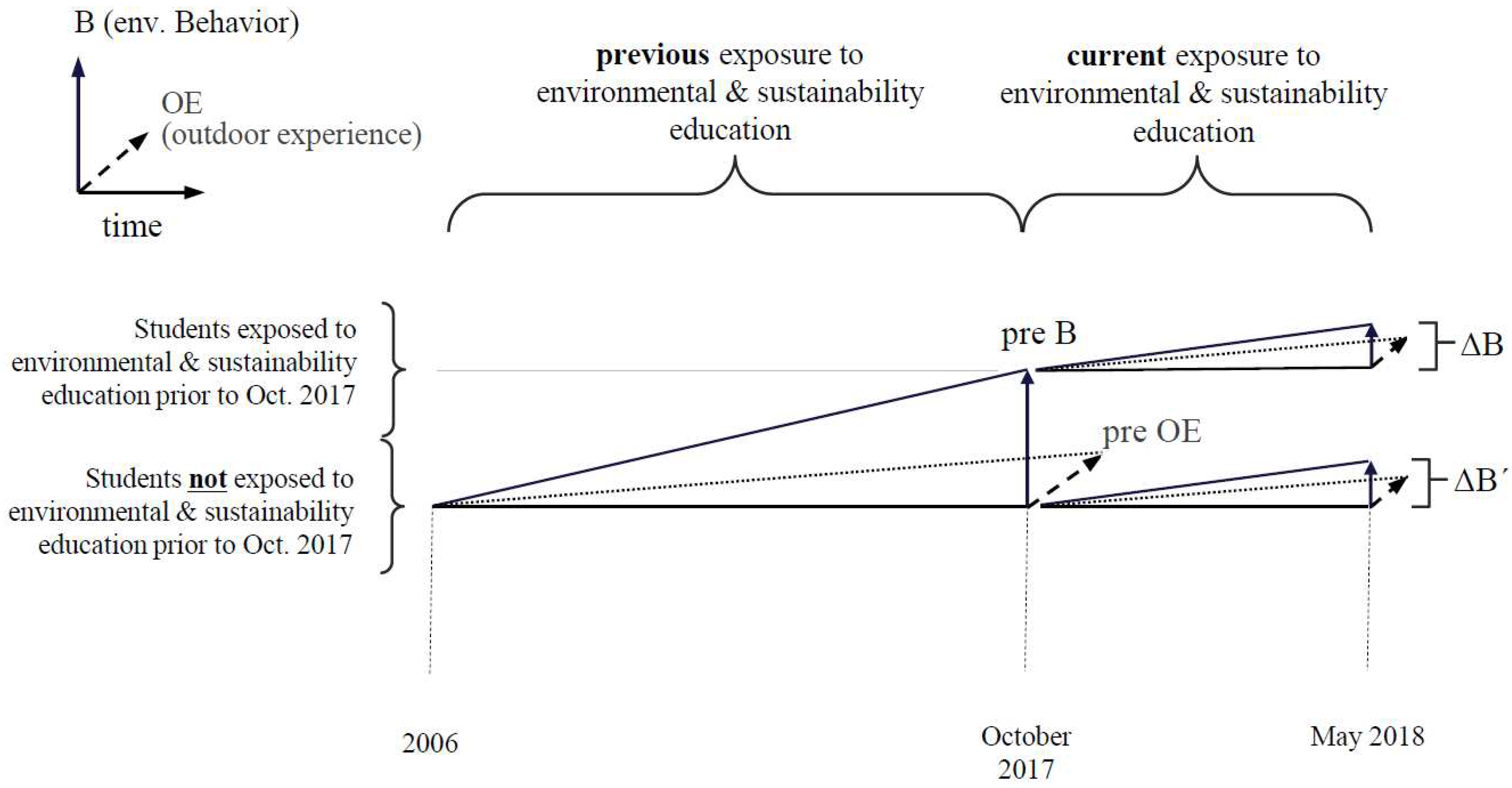
In the findings of the doctoral thesis, it was demonstrated that the environment-related behaviors of students who participated in outdoor ESE programs improved significantly compared to the control group (i.e., students who were not exposed to ESE). Indeed, in those quasi-experimental findings, a moderate (significant at the 99.5% confidence level) improvement in self-reported behaviors was recorded after the students were exposed to 6 ½ months of outdoor environmental education as compared to a control group. The effect size (a 9% improvement) appears plausible when compared with the effect of past exposure on present-day environmental behaviors, which accounts for a 4.1% improvement after adjusting for the effect of confounding variables. Indeed, it is to be expected that the effect of ESE (and its experiential learning component) wanes to some extent, unless the signal is renewed (Figure 2).
Hence, our data from Kalymnos can serve two distinct approaches concerning the relationship between outdoor experience and environmental behavior. One is the quasi-experimental approach, which measured the change in environmental literacy components in response to treatment that took place after October 2017 (Author et al., 2020; Author, 2021). The results from the quasi-experimental approach (where a significant improvement in environmental behaviors was observed) are consistent with the ones from similar research by Bogner (1998). Research by Bogner and others aimed to capture the effect of ESE quasi-experimentally in meso-scale (Bogner, 1999; Leeming et al, 1997).
Another approach is the correlation analysis presented in the present research article. In our baseline data (collected in October 2017) the variability in outdoor experience explains 12.9% (r= .359) of the variability in environmental Behavior (partial correlation). We can relate this finding with research in psychology that has demonstrated that outdoor experience during childhood was found to be the strongest predictor of adult environmental concern (Gifford & Nilsson, 2014, p.142). Moreover, in earlier research based on a large sample (n=1545) of grade five students suggests that experiences of natural regions (frequency of experiences) is the strongest available predictor of their environmentally responsible behavior (Erdogan, 2009, page v, 155-156).
In conclusion, the empirical data from this study demonstrate that outdoor experience directly supports pro-environmental behavior. What we make out of both quasi-experimental and baseline data (as well as the relevant literature) is a confirmation of the statement that we used as a hypothesis for the present research: “greater contact with nature during childhood improves the likelihood of them adopting environmentally responsible behaviors as adults” (Georgopoulos, 2014, p.159-160).
Future research is needed to confirm this finding using different data sets. One available data set that could be used to compare the figures reported by this study figure is Kyriazi’s large sample of first year university students where the research instrument (GELI) has already been applied (Kyriazi, 2018). We also encourage researchers to include a section that asks about students’ outdoor activities (hiking etc.) in future environmental literacy assessment instruments internationally. By expanding the research rationale to broader data sets we can test the relationship between outdoor experiential learning and environmental behaviors in different age groups and learning settings.
This study contributes to the body of research that explores the relationship between outdoor, experiential learning and environmentally responsible behaviors. Again, more research is needed in order to improve our understanding on the educational stimuli and learning mechanisms that lead to improved environmental behaviors.
These findings are in line with previous research that has used both qualitative and quantitative methods to demonstrate the significance of outdoor experience during childhood in shaping individuals’ environmental concerns and behaviors, including their participation in environmental action and the adoption environmental life paths (Palmer, 1993; Chawla, 1998, 1999). Further, experiential contact with nature has been shown to positively influence learners’ physical and mental health (Engemann 2019; Braus & Milligan-Toffler, 2018; Adams & Savahl, 2017; Hartig, Mitchell, de Vries, & Frumkin, 2014; Louv, 2008). Based on these observations, parents, educators as well as education specialists at various levels of decision making are encouraged to provide children with more opportunities for direct, experiential contact with nature.
Funding
[to be completed after the blind review].
Acknowledgments
[to be completed after the blind review because names of contributors are mentioned here].
IEthics statement
[to be completed after the blind review]
Word count
This manuscript is at 6975 words as a main document, 7280 words including the abstract, references, figures and figure captions.
Appendix A. Correlation coefficients and levels of statistical significance of bivariate partial correlations between demographic, situational variables and baseline levels of environmental knowledge, attitude and behaviors (all correlations that are statistically significant at the 0.05 level are featured in Figure 1)
| Knowledge (Max: 42) | Attitude (Max:60) | Behaviors (Max:55) | Gender (1=girl, 0=boy) | Academic performance (GPA) |
Past_exposure_to_environmental_ and_sustainability_education |
Maternal_education_level |
Outdoor_ experience |
Significant_life_ experiences |
||
| Knowledge (Max: 42) | Pearson Correlation | 1 | .462** | .230** | -.058 | .508** | .210* | .240** | .259** | .212* |
| Sig. (2-tailed) | .000 | .007 | .492 | .000 | .013 | .004 | .003 | .012 | ||
| N | 141 | 131 | 135 | 141 | 135 | 139 | 140 | 129 | 141 | |
| Attitude (Max:60) | Pearson Correlation | .462** | 1 | .324** | .260** | .521** | .336** | .257** | .298** | .330** |
| Sig. (2-tailed) | .000 | .000 | .002 | .000 | .000 | .003 | .001 | .000 | ||
| N | 131 | 133 | 128 | 133 | 128 | 131 | 132 | 123 | 133 | |
| Behaviors (Max:55) | Pearson Correlation | .230** | .324** | 1 | .047 | .193* | .308** | .101 | .359** | .272** |
| Sig. (2-tailed) | .007 | .000 | .587 | .026 | .000 | .241 | .000 | .001 | ||
| N | 135 | 128 | 137 | 137 | 132 | 135 | 136 | 125 | 137 | |
| Gender (1=girl, 0=boy) | Pearson Correlation | -.058 | .260** | .047 | 1 | .212* | .173* | .007 | -.222* | .156 |
| Sig. (2-tailed) | .492 | .002 | .587 | .013 | .040 | .936 | .011 | .063 | ||
| N | 141 | 133 | 137 | 143 | 137 | 141 | 142 | 131 | 143 | |
| Academic performance (GPA) | Pearson Correlation | .508** | .521** | .193* | .212* | 1 | .350** | .331** | .083 | .333** |
| Sig. (2-tailed) | .000 | .000 | .026 | .013 | .000 | .000 | .357 | .000 | ||
| N | 135 | 128 | 132 | 137 | 137 | 135 | 136 | 126 | 137 | |
| Past_exposure_to_environmental_and_sustainability_education | Pearson Correlation | .210* | .336** | .308** | .173* | .350** | 1 | .230** | .166 | .193* |
| Sig. (2-tailed) | .013 | .000 | .000 | .040 | .000 | .006 | .060 | .022 | ||
| N | 139 | 131 | 135 | 141 | 135 | 141 | 140 | 129 | 141 | |
| Maternal_education_level | Pearson Correlation | .240** | .257** | .101 | .007 | .331** | .230** | 1 | -.032 | .084 |
| Sig. (2-tailed) | .004 | .003 | .241 | .936 | .000 | .006 | .720 | .321 | ||
| N | 140 | 132 | 136 | 142 | 136 | 140 | 142 | 130 | 142 | |
| Outdoor_experience | Pearson Correlation | .259** | .298** | .359** | -.222* | .083 | .166 | -.032 | 1 | -.003 |
| Sig. (2-tailed) | .003 | .001 | .000 | .011 | .357 | .060 | .720 | .971 | ||
| N | 129 | 123 | 125 | 131 | 126 | 129 | 130 | 131 | 131 | |
| Significant_life_experiences | Pearson Correlation | .212* | .330** | .272** | .156 | .333** | .193* | .084 | -.003 | 1 |
| Sig. (2-tailed) | .012 | .000 | .001 | .063 | .000 | .022 | .321 | .971 | ||
| N | 141 | 133 | 137 | 143 | 137 | 141 | 142 | 131 | 143 | |
| **. Correlation is significant at the 0.01 level (2-tailed). | ||||||||||
| *. Correlation is significant at the 0.05 level (2-tailed). | ||||||||||
References
- Author et al. (2020).
- Author (2021).
- Adams, S., & Savahl, S. (2017). Nature as children's space: A systematic review. The Journal of Environmental Education, 48(5), 291–321. [CrossRef]
- Bamberg, S., & Möser, G. (2007). Twenty years after Hines, Hungerford, and Tomera: A new meta-analysis of psycho-social determinants of pro-environmental behaviour. Journal of Environmental Psychology, 27(1), 14–25. [CrossRef]
- Bögeholz, S. (2006). Nature experience and its importance for environmental knowledge, values and action: Recent German empirical contributions. Environmental Education Research, 12(1), 65-84. [CrossRef]
- Bogner, F. X. (1998). The Influence of Short-Term Outdoor Ecology Education on Long-Term Variables of Environmental Perspective. The Journal of Environmental Education, 29(4), 17–29. [CrossRef]
- Bogner, F. X. (1999). Empirical evaluation of an educational conservation programme introduced in Swiss secondary schools. International Journal of Science Education, 21(11), 1169–1185. [CrossRef]
- Borden, R. J., & Schettino, A. P. (1979). Determinants of environmentally responsible behavior. The Journal of Environmental Education, 10(4), 35-39. [CrossRef]
- Braus, J., & Milligan-Toffler, S. (2018). The children and nature connection: Why it matters. Ecopsychology, 10(4), 193–194. [CrossRef]
- Chawla, L. (1998). Significant life experiences revisited: A review of research on sources of environmental sensitivity. Environmental Education Research, 4(4), 369–382. [CrossRef]
- Chawla, L. (1999). Life paths into effective environmental action. Journal of Environmental Education, 31(1), 15–26. [CrossRef]
- Cohen, J. (1988). Statistical power analysis for the behavioral sciences. Hillsdale, NJ: Lawrence Erlbaum Associates.
- Colwell Jr, T. B. (1976). A critique of behavior objectives methodology in environmental education. The Journal of Environmental Education, 7(3), 66–71. [CrossRef]
- Daskolia & Grillia (2010). Proceedings from the 5th Conference of the Hellenic Association for Environmental Education (PEEKPE): Significant Life Experiences and Environmental Education. Analyzing the Relationship Through the Perspective of Education for Sustainable Development (in Greek). Ioannina, Greece: PEEKPE.
- Engemann, K., Pedersen, C. B., Arge, L., Tsirogiannis, C., Mortensen, P. B., & Svenning, J.-C. (2019). Residential green space in childhood is associated with lower risk of psychiatric disorders from adolescence into adulthood. Proceedings of the National Academy of Sciences, 116(11), 5188–5193. [CrossRef]
- Erdoğan, M. (2009). Fifth grade students’ environmental literacy and the factors affecting students’ environmentally responsible behaviors. Unpublished doctoral dissertation, Middle East Technical University, Turkey.
- Erdogan, M., & Marcinkowski, T. (2007, November). An analysis of K-8 environmental education research in Turkey, 1997–2007. NAAEE Annual Conference. Talk presented at 36th North American Association for Environmental Education Annual Conference and Research Symposium, Virginia Beach, USA.
- Erdogan, M., & Ok, A. (2011). An assessment of Turkish young pupils’ environmental literacy: A nationwide survey. International Journal of Science Education, 33(17), 2375-2406. [CrossRef]
- Ernst, J., & Theimer, S. (2011). Evaluating the effects of environmental education programming on connectedness to nature. Environmental Education Research, 17(5), 577-598. [CrossRef]
- Fishbein, M., & Ajzen, I. (1975). Belief, attitude, intention and behaviour: An introduction to theory and research. Addison-Wesley.
- Gifford, R., & Nilsson, A. (2014). Personal and social factors that influence pro-environmental concern and behaviour: A review. International journal of psychology, 49(3), 141-157. [CrossRef]
- Georgopoulos, A. (2014). Environmental education: Issues of identity. Athens: Gutenberg (in Greek).
- Hartig, T., Mitchell, R., De Vries, S., & Frumkin, H. (2014). Nature and health. Annual review of public health, 35, 207-228.
- Heimlich, J. E., & Ardoin, N. M. (2008). Understanding behavior to understand behavior change: A literature review. Environmental Education Research, 14(3), 215-237. [CrossRef]
- Hendee, J. C. (1972). Challenging the folklore of environmental education. The Journal of Environmental Education, 3(3), 19-23. [CrossRef]
- Henderson, J. A. (2019). Learning to teach climate change as if power matters. Environmental Education Research, 25 (6), 987-990. [CrossRef]
- Hines, J. M., Hungerford, H. R., & Tomera, A. N. (1987). Analysis and synthesis of research on responsible environmental behavior: A meta-analysis. The Journal of Environmental Education, 18(2), 1–8. [CrossRef]
- Hollweg, K. S., Taylor, J.R., Bybee, R. W., Marcinkowski, T. J., McBeth, W. C. and Zoido, P. (2011). Developing a framework for assessing environmental literacy. North American Association for Environmental Education. https://cdn.naaee.org/sites/default/files/inline-files/devframewkassessenvlitonlineed.pdf.
- Hsu, S. J., & Roth, R. E. (1999). Predicting Taiwanese secondary teachers' responsible environmental behavior through environmental literacy variables. The Journal of Environmental Education, 30(4), 11-18. [CrossRef]
- Hungerford, H. R., & Volk, T. L. (1990). Changing learner behavior through environmental education. The Journal of Environmental Education, 21(3), 8-21. [CrossRef]
- Jacobs, W. J., Sisco, M., Hill, D., Malter, F., & Figueredo, A. J. (2012). Evaluating theory-based evaluation: Information, norms, and adherence. Evaluation and program planning, 35(3), 354-369. [CrossRef]
- Journal of the Greek Government (2014). Results of the 2011 census of buildings and the country’s permanent population. Athens: author (In Greek).
- Journal of the Greek Government (1990). Act 1892/1990 (ΦΕΚ 101 τ. A), article 111 par. 13 (In Greek).
- Journal of the Greek Government (1990). Results of the 2011 census of buildings and the country’s permanent population. Athens: author (In Greek).
- Kalogerakis (2018). Memories of the Earth: Getting to know the geophysical environment of Kalymnos. In E. Moula, & I. Papadomarkakis (Eds.), Cultivating 21st century skills through school-based activities (pp. 191-204). Rhodes, Greece: Editors (In Greek). ISBN: 978-618-84160-0-0.
- Kollmuss, A., & Agyeman, J. (2002). Mind the gap: why do people act environmentally and what are the barriers to pro-environmental behavior? Environmental Education Research, 8(3), 239-260. [CrossRef]
- Krnel, D., & Naglic, S. (2009). Environmental literacy comparison between eco-schools and ordinary schools in Slovenia. Science Education International, 20, 5–24.
- Kraus, S. (1990). Attitudes and the Prediction of Behavior: A Meta-analysis. Paper presented at the annual convention of the American Psychological Association, Boston, MA, August 10–14, 1990.
- Kyriazi (2018). Ecology Teaching as a framework for the Development of the Goals of Environmental Education/Education for Sustainable Development. Doctoral dissertation, University of Athens.
- Kyriazi, P., & Mavrikaki, E. (2013). Proceedings from the 10th biannual Conference of the European Science Education Research Association (ESERA): Development of an instrument to measure environmental literacy of post-secondary Greek students – Pilot testing and preliminary result (pp. 164–171). Nicosia, Cyprus: ESERA.
- Laidley, T. M. (2013). The influence of social class and cultural variables on environmental behaviors: Municipal-level evidence from Massachusetts. Environment and Behavior, 45(2), 170-197. [CrossRef]
- Leeming, F.C., Porter, B.E., Dwyer, W.O., Cobern, M.K. & Oliver, D.P. (1997). Effects of participation in class activities on children’s environmental attitudes and knowledge. The Journal of Environmental Education, 28(2), 33-42. [CrossRef]
- Loughland, T., Reid, A., Walker, K., & Petocz, P. (2003). Factors influencing young people's conceptions of environment. Environmental Education Research, 9(1), 3–19. [CrossRef]
- Louv, R. (2008). Last child in the woods: Saving our kids from nature deficit disorder. New York, NY: Algonquin Books.
- Maulidya, F., Mudzakir, A., & Sanjaya, Y. (2014). Case study the environmental literacy of fast learner middle school students in Indonesia. International Journal of Science and Research, 1(0), 6.
- Marcinkowski, T., & Reid, A. (2019). Reviews of research on the attitude–behavior relationship and their implications for future environmental education research. Environmental Education Research, 25 (4), 459-471. [CrossRef]
- Marcinkowski, T., Giannoulis, C., Howell, J., & Braus, J. (2014). Secondary Analyses of the National Environmental Literacy Assessment: Phase One & Phase Two Student, Teacher, Program, and School Surveys. https://naaee.org/sites/default/files/finalresearchreport.pdf.
- McBeth, B., Hungerford, H., Marcinkowski, T., Volk, T., Cifranick, K., Howell, J., & Meyers, R. (2011). National environmental literacy assessment, phase two: Measuring the effectiveness of North American environmental education programs with respect to the parameters of environmental literacy (Report No. NA08SEC4690026). Carbondale, IL: North American Association for Environmental Education.
- Milfont, T. L. (2009). The effects of social desirability on self-reported environmental attitudes and ecological behaviour. The Environmentalist, 29(3), 263–269. [CrossRef]
- Newhouse, N. (1990). Implications of attitude and behavior research for environmental conservation. The Journal of Environmental Education, 22(1), 26-32. [CrossRef]
- Palmer, J. A. (1993). Development of concern for the environment and formative experiences of educators. Journal of Environmental Education, 24(3), 26–30. [CrossRef]
- Palmer, J. (1998). Environmental education in the 21st century: Theory, practice, progress and promise. New York, NY: Routledge.
- Platsi (2018). Fresh water: A source of life. In E. Moula, & I. Papadomarkakis (Eds.), Cultivating 21st century skills through school-based activities (pp. 191-204). Rhodes, Greece: Editors (In Greek). ISBN: 978-618-84160-0-0.
- Ramsey, C., & Rickson, R. (1976). Environmental Knowledge and Attitudes. The Journal of Environmental Education 8(1):10–18. [CrossRef]
- Rosa, C. D., Profice, C. C., & Collado, S. (2018). Nature experiences and adults’ self-reported pro-environmental behaviors: the role of connectedness to nature and childhood nature experiences. Frontiers in Psychology, 9, 1055. [CrossRef]
- Sia, A. P., Hungerford, H. R., & Tomera, A. N. (1986). Selected predictors of responsible environmental behavior: An analysis. The Journal of Environmental Education, 17(2), 31-40. [CrossRef]
- Simmons, B., & Volk, T. (2002). Environmental Educators a Conversation with Harold Hungerford. The Journal of Environmental Education, 34(1), 5-8. [CrossRef]
- Smith-Sebasto, N. J., & Fortner, R. W. (1994). The environmental action internal control index. The Journal of Environmental Education, 25(4), 23-29. [CrossRef]
- Stern, M. J., Powell, R. B., & D. Hill. (2014). Environmental education program evaluation in the new millennium: What do we measure and what have we learned? Environmental Education Research, 20 (5), 581–611. [CrossRef]
- Tanner, T. (1980). Significant life experiences: A new research area in environmental education. The Journal of Environmental Education, 11(4), 20-24. [CrossRef]
- Vassiliou, I (2000). The wild nature of Kalymnos. Rhodes, Greece: 2nd high school of Kalymnos & Municipality of Kalymnos (in Greek).
- Wallace, D. S., Paulson, R. M., Lord, C. G., & Bond Jr, C. F. (2005). Which behaviors do attitudes predict? Meta-analyzing the effects of social pressure and perceived difficulty. Review of General Psychology, 9(3), 214-227. [CrossRef]
- Wells, N. M., & Lekies, K. S. (2006). Nature and the life course: Pathways from childhood nature experiences to adult environmentalism. Children Youth and Environments, 16(1), 1-24. [CrossRef]
Figure 1.
Bivariate partial correlations between the variables measured by the Greek Environmental Literacy Instrument (GELI) in the pre-test sample [N=143]. The variables in the (environmental) Knowledge, Attitudes, Behavior predictive string are considered as environmental literacy components. The variables at the upper part of the graph are treated as demographic variables while the variables at the lower part of the graph are considered as situational variables. All featured correlations are statistically significant with the alpha level set at α=.05. The width of the arrows is proportional to the strength of the respective correlations (see the Appendix A for correlation coefficients).
Figure 1.
Bivariate partial correlations between the variables measured by the Greek Environmental Literacy Instrument (GELI) in the pre-test sample [N=143]. The variables in the (environmental) Knowledge, Attitudes, Behavior predictive string are considered as environmental literacy components. The variables at the upper part of the graph are treated as demographic variables while the variables at the lower part of the graph are considered as situational variables. All featured correlations are statistically significant with the alpha level set at α=.05. The width of the arrows is proportional to the strength of the respective correlations (see the Appendix A for correlation coefficients).
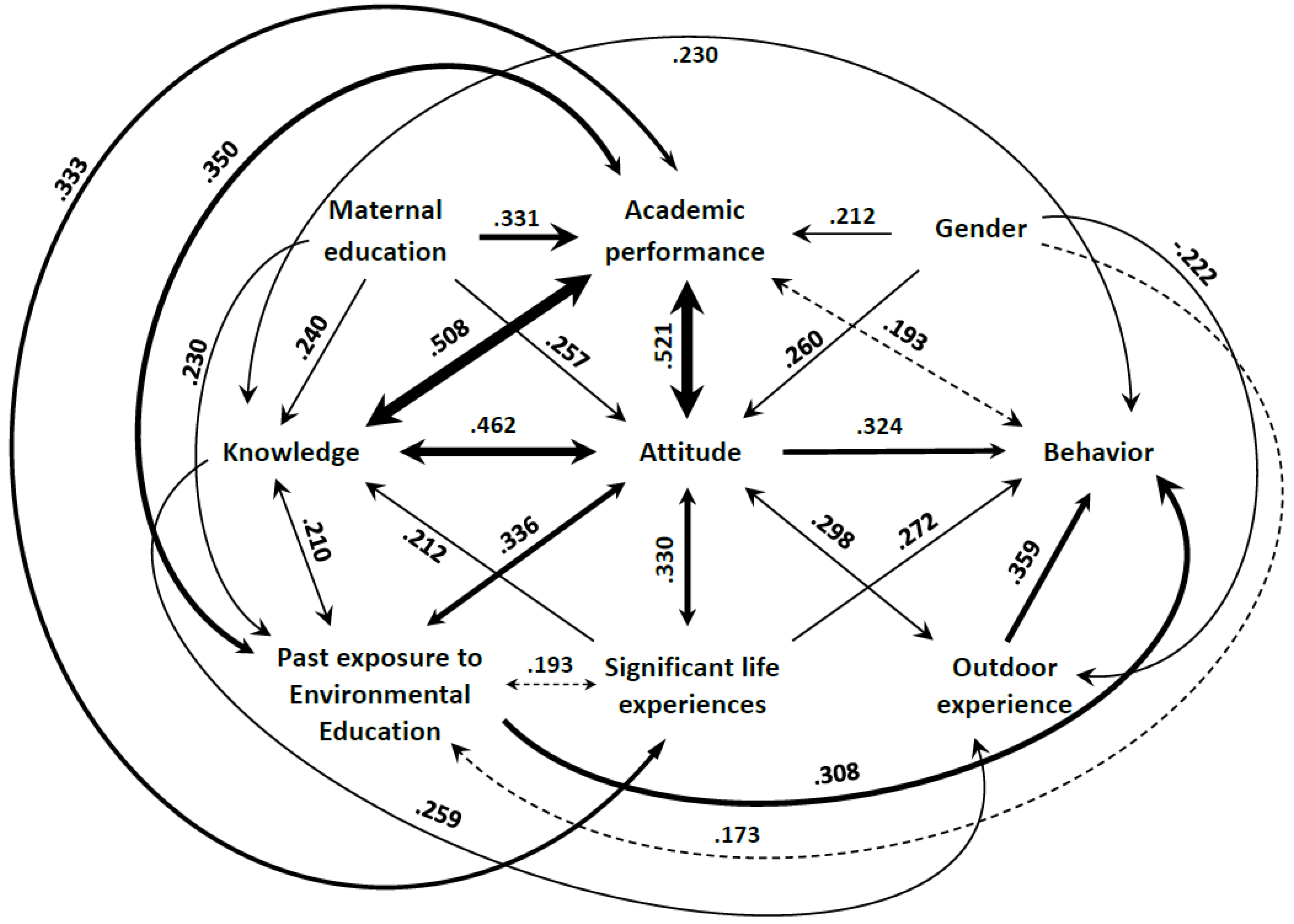
Figure 2.
The primary analysis presented in this paper uses data collected in October 2017 and refers to the effect of antecedent influences on students’ baseline environmental behaviors. On the other hand, ΔΒ is the observed improvement in environmental behaviors, after an educational intervention that started after October, 2017. The effects of that educational intervention are discussed in author, 2021.
Figure 2.
The primary analysis presented in this paper uses data collected in October 2017 and refers to the effect of antecedent influences on students’ baseline environmental behaviors. On the other hand, ΔΒ is the observed improvement in environmental behaviors, after an educational intervention that started after October, 2017. The effects of that educational intervention are discussed in author, 2021.
Disclaimer/Publisher’s Note: The statements, opinions and data contained in all publications are solely those of the individual author(s) and contributor(s) and not of MDPI and/or the editor(s). MDPI and/or the editor(s) disclaim responsibility for any injury to people or property resulting from any ideas, methods, instructions or products referred to in the content. |
© 2023 by the authors. Licensee MDPI, Basel, Switzerland. This article is an open access article distributed under the terms and conditions of the Creative Commons Attribution (CC BY) license (http://creativecommons.org/licenses/by/4.0/).
Copyright: This open access article is published under a Creative Commons CC BY 4.0 license, which permit the free download, distribution, and reuse, provided that the author and preprint are cited in any reuse.


