

Submitted:
19 September 2023
Posted:
21 September 2023
You are already at the latest version
Abstract
The use of medicinal plants for the therapy of diseases of the digestive system; where the Andean peoples developed various forms of administration. The objective being the identification of medicinal plants used in the therapy of ailments of the digestive system by the Andean inhabitants of Pampas, Tayacaja, Huancavelica, Peru. Methods, non-probabilistic sampling, using the “snowball” technique, carrying out semi-structured surveys, allowing information to be collected on the prevalence of ailments or diseases of the digestive system treated with medicinal plants, with inhabitants over 20 years of age participating and using the medicinal plants in the therapy of your digestive system ailments; and, exclude those inhabitants who do not comply with it. Results, 16 families, 33 genera and 34 species are reported; where the families that present the greatest abundance of species are Asteraceae, Lamiaceae; Likewise, the widely used species are Minthostachys mollis (11.9%), Aloe vera (10.4%), Clinopodium bolivianum (9%), Artemisia absinthium (9%) and Matricaria chamomilla (8.2%). Concluding with the identification of a diversity of medicinal flora, used in the therapy of diseases of the digestive system, such as stomach pain, constipation, gallbladder ailments, gastritis, gastrointestinal and liver diseases.
Keywords:
phytotherapy
; digestive system
; andean community
; traditional medicine
; peruvian andes
1. Introduction
There are a large number of disorders of the digestive system, which impose a substantial influence on morbidity and mortality rates, throughout the world. These disorders of the digestive system, known collectively as gastrointestinal disorders, are most frequently cited in communities living in areas of the Andes, where poor sanitation practices are more common [1]. These disorders range from short-term indigestion or flatulence to long-term structural abnormalities and chronic diseases that have a substantial influence on morbidity and mortality. According to the World Health Organization (WHO), gastrointestinal disorders caused nearly 1 million adult deaths worldwide during 2019, with diarrhea alone responsible for 370,000 deaths in children under 5 years of age [2].
During recent years, there has been a global trend in renewed interest in a traditional system of treatments [3,4,5,6,7]. Studies of ethnomedicinal plants have become of particular interest and increasingly valuable in the development of health care and conservation programs in different parts of the world, where the WHO has recognized the role of traditional medicine in the health care system. primary health [8]. In developing countries, medicinal plants continue to be a major source of medicines. It has been estimated that approximately 88% of people in underdeveloped countries rely primarily on traditional medicine for their primary form of health care [7].
The use of herbs as medicines to treat digestive tract ailments is widespread [2,9]. In digestion, food and drink are transported in the digestive tract, broken down into small parts, called nutrients, which the body can absorb and use as energy and building blocks for cells. Digestive diseases are disorders of the digestive or gastrointestinal tract, which interfere with the digestive process that includes ingestion, propulsion, mechanical or physical digestion, chemical digestion, absorption and defecation [2,3,5,9,10]. Considering that disorders of the digestive system are often closely interrelated, medicinal plants used for treatment tend to have multiple purposes and can be used for a variety of digestive symptoms and disorders [10].
Thus, people can treat many problems related to the digestive system by regularly using herbal preparations in the diet that can improve the function of the digestive system [2,3,5,9,11]. These herbal digestive preparations work in various ways, for example, healing the lining of the intestine, activating the digestive process and promoting easy bowel movements, increasing the frequency of bowel movements, detoxification and elimination of toxins, helps calm discomfort stomach and reduces gas, bloating and digestive discomfort [11].
Peru has a variety of ecological floors, presenting diverse climates, thus conserving a high biodiversity of flora and fauna; with a variety of medicinal plants, used mostly by Andean inhabitants [8,12]. The Peruvian Andes preserve their traditions and culture regarding the usefulness of medicinal plants, using language to transfer their knowledge through generations [13,14].
Reason that motivated the present study, whose objective was to identify the medicinal plants used in the therapy of ailments of the digestive system by the Andean inhabitants of Pampas, in the Huancavelica region of Peru; which is very far from the big cities of the country, being abandoned by the rulers, presenting high levels of poverty and extreme poverty [15], frequently resorting to the use of nature to treat their health problems, using plants to do so. medicinal in the therapy of various ailments or diseases presented by the inhabitants.
2. Materials and Methods
Study area
Study carried out in the Andean community of Pampas, Tayacaja province, Huancavelica region, Peru; located in the mountains of the center of the country, at 3276 meters above sea level, surface of 109.07km2, 12°23'42'' L.S. and 74°'52'02'' L.W., presenting a temperate climate with moderate rains and dry winters, annual rainfall ranges from 500 – 1500 mm, with its main source of income being livestock and agriculture.
Sample
The sample consisted of 370 inhabitants (n), determined through the population and unknown variance, where the population was 10,061 inhabitants (N), margin of error of 0.05 (d), confidence level of 0.95 (Z), success of 0.50 (p) and q=1-p [16].
Sampling method
The sampling was of the non-probabilistic type, selecting the study subjects to be surveyed, comprising mostly buyers and sellers of medicinal plants from the markets of the community of Pampas; considering the inclusion criteria, such as being an inhabitant over 20 years of age and using medicinal plants in the therapy of their digestive system ailments; and, the exclusion criterion, are those inhabitants who do not meet the inclusion criteria or present signs of falsehood in their answers.
The surveys were carried out monthly from January 2021 to December 2022, obtaining information on the medicinal plants used in the therapy of ailments of the digestive system. Using the “snowball” technique, which included asking questions to the first respondent, classifying him as “knowledgeable”, at the end of the interview he proposed the name of the next inhabitant to be interviewed, calling him “knowledgeable” and following that methodology until finishing the 370 surveys [17].
Technique and instrument of collecting information
Using semi-structured interviews, where prior to this the validation and reliability of the instrument was carried out. Then, the collection of medicinal plants made known by the inhabitants was carried out, with taxonomic determinations being carried out in the Department of Botany and in the Herbarium Truxillensis of the National University of Trujillo; collecting information regarding the use of medicinal plants of the Andean inhabitants of Pampas in the therapy of ailments of the digestive system, regarding the Classification of diseases and conditions of the World Health Organization (WHO) [18].
Analysis of data
The information was organized in Microsoft Excel spreadsheets; complemented through various sources in the area of interest [19].
Ethical aspects
In this research, the informed consent of the Andean inhabitants of Pampas was obtained, maintaining the anonymity of the respondents.
3. Results
16 families, 33 genera and 34 species are reported; used in phytotherapy for ailments of the digestive system by the Andean inhabitants of Pampas; where the families that have the greatest number of species are Asteraceae, Lamiaceae and Apiaceae with 6, 6 and 5 species respectively; and, the families that have the smallest number of species are Amaranthaceae, Bromeliaceae, Fabaceae, Gentianaceae, Monimiaceae, Plantaginaceae, Rubiaceae, Rutaceae, Solanaceae and Xanthorroeaceae, with one species each; Likewise, the ethnomedicinal usefulness of each reported species is detailed (Table 1).
Figure 1 details the percentage of ethnobotanical families reported by the Andean inhabitants of Pampas, in the therapy of their ailments presented in the digestive system; where the families Lamiaceae (32.8%; 121 reports) and Asteraceae (28.4%; 105 reports) are the widely used ones; and, the families with the least use are the Rubiaceae, Plantaginaceae, Monimiaceae, Bromeliaceae and Brassicaceae with 0.7% and 3 reports each.
Figure 2 reports the ethnobotanical species used in the therapy of ailments of the digestive system by the Andean inhabitants of Pampas; where the most used species are Minthostachys mollis (11.9%; 44 reports), Aloe vera (10.4%; 37 reports), Clinopodium bolivianum (9%; 33 reports), Artemisia absinthium (9%; 33 reports) and Matricaria chamomilla (8.2%; 30 reports); and, the species of lesser use are Uncaria tormentosa, Tillandsia cacticola, Smallanthus sonchifolius, Rorippa nasturtium-aquaticum, Plantago major, Piper aduncum, Pimpinella anisum, Peumus boldus, Petroselinum crispum, Peperomia inaequalifolia, Hedeoma mandoniana, Foeniculum vulgare, Eryngium foetidum, Cynara cardunculus, Corryocactus odoratus and Austrocylindropuntia floccosa with 0.7% and 3 reports each.
4. Discussion
34 species of plants were identified to be used in the therapy of ailments of the digestive system; such as stomach pain, constipation, gallbladder ailments, gastritis, gastrointestinal and liver diseases (table 1; figure 2). The results suggest that locals prefer herbal remedies for the treatment of ailments of the digestive system, as in most cases, herbal preparations provide instant relief without any significant side effects. One of the reasons associated for the excessive use of plants for the treatment of digestive system ailments is a taboo related to certain ailments; such as the case of people who often hesitate to share some ailments with doctors, such as intestinal gas and piles. Instead, they consult family elders, who recommend using locally available medicinal plants or a herbal remedy for the multi-plant preparation according to their folklore. Other reasons include the remoteness of the area and the lack of modern sanitation facilities [20].
Likewise, of the 16 families reported, those most used by locals are the Lamiaceae and Asteraceae (figure 1); However, Asteraceae and Lamiaceae have also been recorded as families widely used in traditional medicine in other ethnomedicinal studies in the rest of the world. The predominance of these families could be due to their herbaceous life, extensive distribution form and richness in the study area, and the members of this family are well known for their aromatic quality. Despite their diversity, members of each family are distinguished by their ability to synthesize secondary metabolites with potentially significant biological activity. As a result, they are used in a variety of ways in the traditional health system, such as in the therapy of ailments of the digestive system [20].
The recurrent use of medicinal plants by local communities in the region can be interpreted as a result of the rich diversity of herbs they present [20]. People who use medicinal plants in their health system believe that materials collected from deep forests and regions less accessible to humans have more curative properties for different types of diseases [21].
Recently, ailments of the digestive system have attracted the attention of the scientific community and a new conception of the brain-gut-functional axis has emerged to maintain the balance of nature's well-being [21]. The role of plants and their derivatives is reiterated in some way not only for the treatment of ailments of the digestive system, but also for the mitigation of various neurological disorders and known psychological conditions that could be aggravated by intestinal discomfort. Therefore, there is a need to extend research on medicinal plants to deduce tangible results for human well-being in a holistic manner [2].
However, the present studies have shown that in addition to the use of these plants for the cure of gastrointestinal disorders, they have wide applications in the local treatment and management of many ailments such as dermatological disorders, urogenital diseases, respiratory tract infections, musculoskeletal disorders, etc [9]. In fact, on many occasions, the study observed that Andean inhabitants value plants more for their ethnomedicinal uses than others; Therefore, Andean peoples developed several ways to collect, process and administer preparations of these medicinal plants, in the cure of different ailments related to the stomach [11].
5. Conclusions
A diversity of medicinal flora was identified, used by the Andean inhabitants of Pampas, in the therapy of ailments of the digestive system, the most used species being Minthostachys mollis, Aloe vera, Clinopodium bolivianum, Artemisia absinthium and Matricaria chamomilla. Likewise, the Lamiaceae and Asteraceae families are the most widely used.
The evidence provided by the Andean inhabitants of Pampas, based on medicinal plants, encourages further research in anticipation of developing alternative treatments for digestive diseases.
The present information about these medicinal plants can serve as reference data to initiate research for the discovery of new compounds and the biological activities of these possible plant remedies.
Author Contributions
Conceptualization, C.F.S.C. and M.A.R.; methodology, J.L.C.Z.; software, J.L.C.Z.; validation, J.T.H. and J.L.C.Z; formal analysis, C.F.S.C.; investigation, C.F.S.C.; resources, C.F.S.C, M.A.R., J.T.H. and J.L.C.Z.; data curation, M.A.R.; writing—original draft preparation, C.F.S.C, M.A.R.; writing—review and editing, C.F.S.C, M.A.R.; visualization, C.F.S.C, M.A.R.; supervision, C.F.S.C.; project administration, C.F.S.C.; All authors have read and agreed to the published version of the manuscript.
Funding
This research received no external funding.
Institutional Review Board Statement
Not applicable.
Informed Consent Statement
En la presente investigación, se tuvo el consentimiento informado de los habitantes andinos de Pampas, manteniendo la reserva del anonimato de los encuestados.
Data Availability Statement
Not applicable.
Acknowledgments
To the Andean Community of Pampas, Tayacaja-Peru.
Conflicts of Interest
The authors declare no conflict of interest.
References
- Lemfadli Y, Abderrahmane J, Adil A, Sofia O, Zouhour S, Khadija K. Medicinal Plants in the Treatment of Digestive Diseases in Morocco : Knowledge and Practices. Glob J Nutr Food Sci. 2022;3(4):1–5. [accessed on 1 July 2023]. [CrossRef]
- Wali R, Khan M, Mahmood A, Mahmood M, Qureshi R, Ahmad K, et al. Ethnomedicinal appraisal of plants used for the treatment of gastrointestinal complaints by tribal communities living in Diamir district, Western Himalayas, Pakistan. PLoS One . 2022;17(6):1–21. [accessed on 1 July 2023]. [CrossRef]
- Valenzuela-Oré F, Romaní-Romaní F, Monteza-Facho BM, Fuentes-Delgado D, Vilchez-Buitron E, Salaverry-García O. Prácticas culturales vinculadas al cuidado de la salud y percepción sobre la atención en establecimientos de salud en residentes de centros poblados alto-andinos de Huancavelica, Perú. Rev Peru Med Exp Salud Publica . 2018;35(1):84–92. [accessed on 10 July 2023]. [CrossRef]
- Manchego JV. Necesidad de provisión de servicios de medicina tradicional, alternativa y complementaria en el Perú. Rev Peru Med Integr. 2022;7(4):5–6. [accessed on 10 July 2023]. Available online: http://rpmi.pe/index.php/rpmi/article/view/5/5. [CrossRef]
- Menéndez EL. Orígenes y desarrollo de la medicina tradicional: una cuestión ideológica. Salud Colect . 2022;18(1):1–25. [accessed on 10 July 2023]. Available online: https://scielosp.org/pdf/scol/2022.v18/e4225/es. [CrossRef]
- Lima Y, Guzmán V, López Y, Satchwell R. La medicina tradicional herbolaria en los sistemas de salud convencionales. Humanidades médicas . 2018;19(1):201–18. [accessed on 15 July 2023]. Available online: http://scielo.sld.cu/scielo.php?script=sci_arttext&pid=S1727-81202019000100201.
- Mukonowenzou N, Adeshina K, Donaldson J, Ibrahim K, Usman D, Erlwanger K. Medicinal Plants, Phytochemicals, and Their Impacts on the Maturation of the Gastrointestinal Tract. Front Physiol . 2021;12(4):1–8. [accessed on 15 July 2023]. [CrossRef]
- OPS. Sintuaciones de las plantas medicinales en Perú. Informe de reunión del grupo de expertos en plantas medicinales . Primera ed. Organización Panamericana de la Salud, Lima, Perú; 2019. 1–13 p. [accessed on 15 July 2023]. Available online: https://iris.paho.org/handle/10665.2/50479.
- Singh A. Medicinal plants used in the treatment of gastrointestinal disorders in rupandehi district , western Nepal. Butwal Campus J . 2021;4(1):103–14. [accessed on 20 July 2023]. [CrossRef]
- Es-Safi I, Mechchate H, Amaghnouje A, Jawhari F, Bari A, Cerruti P, et al. Medicinal plants used to treat acute digestive system problems in the region of fez-meknes in Morocco: An ethnopharmacological survey. Ethnobot Res Appl . 2020;20(25):1–14. [accessed on 20 July 2023]. [CrossRef]
- Cheema H, Singh M. The Use of Medicinal Plants in Digestive System Related Disorders- A Systematic Review. J Ayurvedic Herb Med . 2021;7(3):182–7. [accessed on 20 July 2023]. [CrossRef]
- Ramos L. Uso de los saberes ancestrales, para el cuidado de la salud en la Comunidad Campesina de Acoria, Huancavelica - 2018 . Universidad Nacional del Centro del Perú; 2019. [accessed on 20 July 2023]. Available online: http://repositorio.uncp.edu.pe/bitstream/handle/UNCP/5547/T010_71523595_T.pdf?sequence=1&isAllowed=y.
- Viena LR, León JM, Medina EL, De La Cruz Castillo AJ, Rivero AEG. Ethnobotanical aspects of Cuspon, Peru: A peasant community that uses 57 species of plants in its various needs. Sci Agropecu . 2020;11(1):7–14. [accessed on 25 July 2023]. Available online: http://www.scielo.org.pe/scielo.php?pid=S2077-99172020000100007&script=sci_arttext.
- Mostacero J, Zavaleta K, Taramona L, De La Cruz A, Gil E. Valor de uso medicinal de la flora empleada por el poblador de Victor Larco, Trujillo, La Libertad, Perú. Rev Investig la Univ Le Cordon Bleu . 2020;7(2):67–77. [accessed on 25 July 2023]. Available online: https://revistas.ulcb.edu.pe/index.php/REVISTAULCB/article/view/182. [CrossRef]
- MIDIS. Reporte regional de indicadores sociales del departamento de Huancavelica. Ministerio de Desarrollo e Inclusión Social. Dirección General de Seguimiento y Evaluación - DGE. Lima. Perú; 2021. 5 p.
- Bocanegra L, Bocanegra F, Mostacero J. Efectividad de la medicina herbolaria y su impacto en la calidad de vida de los pobladores de Curgos, Perú. Scientia . 2011;3(1):23–34. [accessed on 25 July 2023]. Available online: http://repebis.upch.edu.pe/articulos/ucvsci/v3n1/a3.pdf.
- Bailley K. Methods of social research. Fourth edi. Maxwell Macmillan International. Nwe York. USA; 1994. 804 p.
- OMS. CIE-11: Clasificación Internacional de Enfermedades para Estadísticas de Mortalidad y Morbilidad . Undécima r. WHO Librery Cataloguing in Publication Data. Malta; 2019. [accessed on 25 July 2023]. Available online: http://id.who.int/icd/entity/1581976053.
- Mostacero J, De la Cruz A, López E, Gil A, Alfaro E. Efecto de la medicina herbolaria en la calidad de vida: inventario de especies etnomedicinales y percepción del poblador de Laredo, Perú. Agroindustrial Sci . 2020;10(2):181–90. [accessed on 25 July 2023]. Available online: https://revistas.unitru.edu.pe/index.php/agroindscience/article/view/2979/3314. [CrossRef]
- Mir T, Jan M, Jan H, Bussmann R, Sisto F, Fadlalla I. A Cross-Cultural Analysis of Medicinal Plant Utilization among the Four Ethnic Communities in Northern Regions of Jammu and Kashmir, India. Biology (Basel) . 2022;11(11):1–24. [accessed on 25 July 2023]. [CrossRef]
- Karakose M. An ethnobotanical study of medicinal plants in Güce district, north-eastern Turkey. Plant Divers. 2022;44:577–97. [accessed on 25 July 2023]. [CrossRef]
Figure 1.
Ethnobotanical families reported by the Andean inhabitants of Pampas.
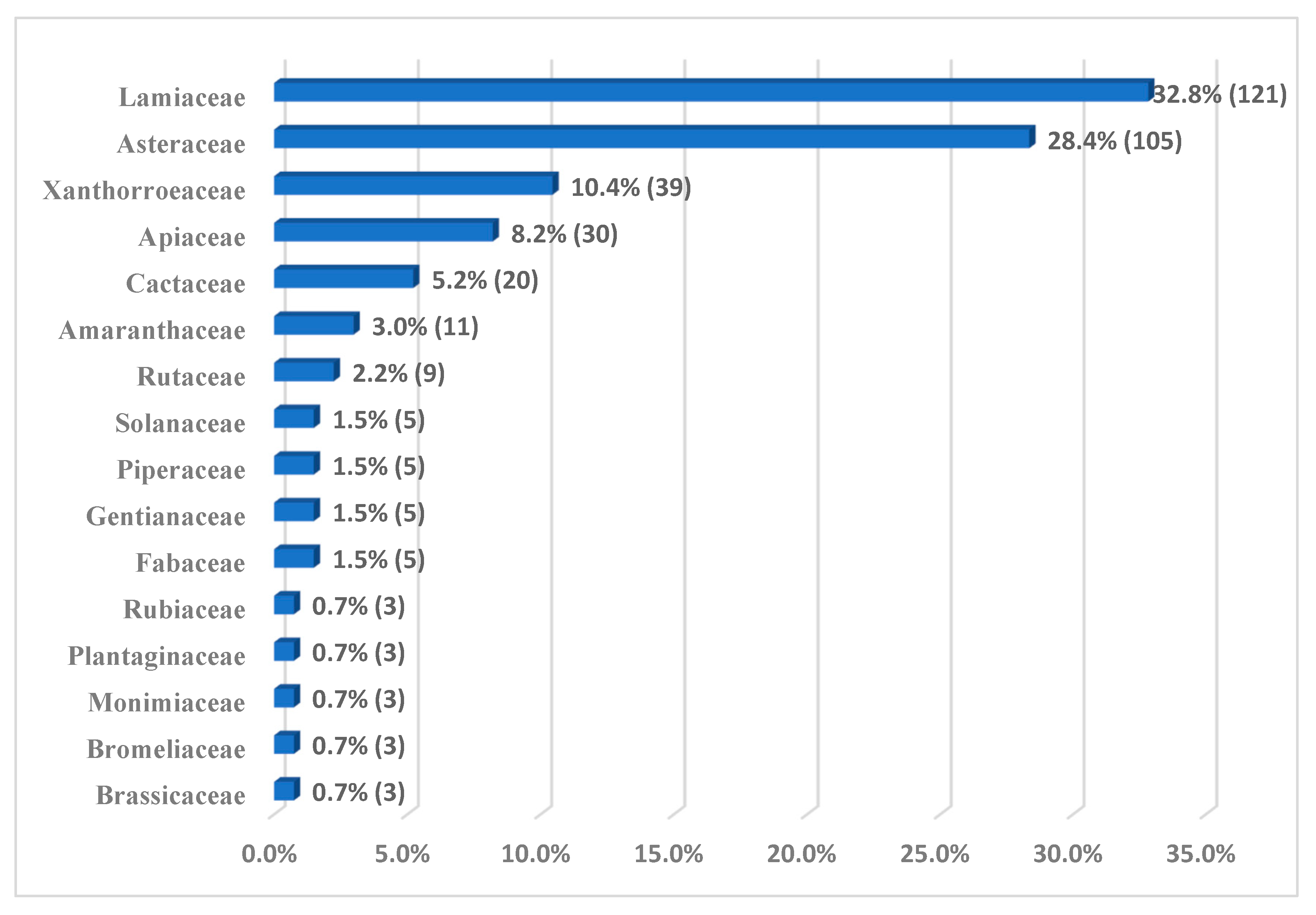
Figure 2.
Ethnobotanical species reported by the Andean inhabitants of Pampas, in the therapy of ailments of the digestive system.
Figure 2.
Ethnobotanical species reported by the Andean inhabitants of Pampas, in the therapy of ailments of the digestive system.
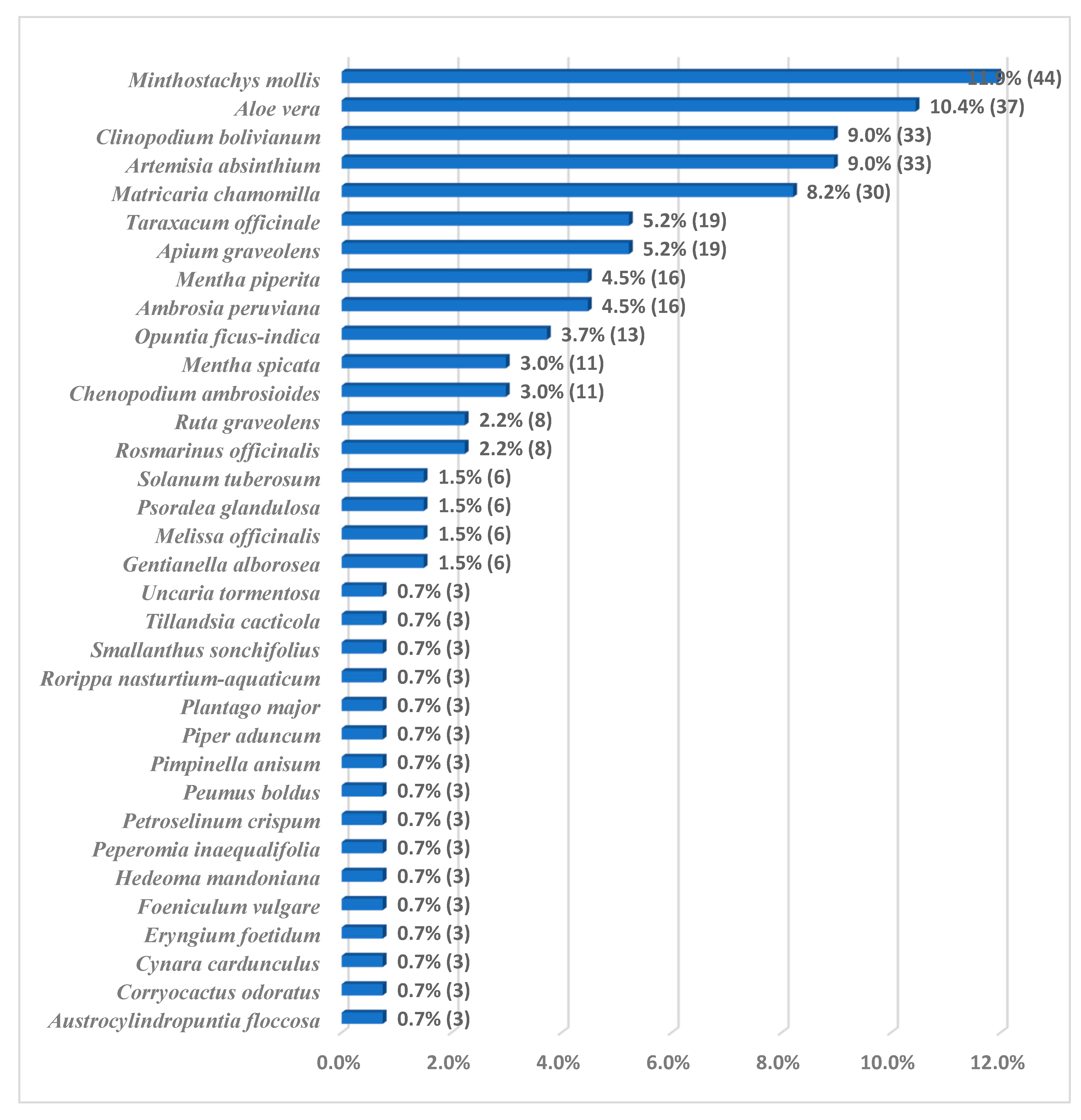

Table 1.
Taxonomy and ethnobotanical utility of medicinal plants reported by the Andean inhabitants of Pampas.
Table 1.
Taxonomy and ethnobotanical utility of medicinal plants reported by the Andean inhabitants of Pampas.
| Family | Scientific name | Common name | Ethnomedicinal utility |
|---|---|---|---|
| Amaranthaceae | Chenopodium ambrosioides L. | "paico" | Stomachache |
| Apiaceae | Apium graveolens L. | "apio" | Stomachache, constipation |
| Eryngium foetidum L. | "sacha culantro" | Stomachache | |
| Foeniculum vulgare P. Miller | "hinojo" | Stomachache | |
| Petroselinum crispum Fuss | "perejil" | Stomachache | |
| Pimpinella anisum L | "anís" | Stomachache | |
| Asteraceae | Ambrosia peruviana Willd. | "marco" | Stomachache |
| Artemisia absinthium L. | "ajenjo" | Stomachache, gallbladder infection | |
| Cynara cardunculus L. | "alcachofa" | Gastritis | |
| Matricaria chamomilla L. | "manzanilla" | Gastritis, Stomachache, Gastrointestinal infection | |
| Smallanthus sonchifolius H. Rob. | "yacón", "llacón" | Gastritis | |
| Taraxacum officinale Wiggers | "diente de león" | Liver inflammation, Stomachache, gastritis | |
| Brassicaceae | Rorippa nasturtium-aquaticum Hayek | "berro" | Liver inflammation |
| Bromeliaceae | Tillandsia cacticola L.B. Sm | "siempreviva" | Gastritis |
| Cactaceae | Austrocylindropuntia floccosa F.Ritter | "huaracco", "huaraco", "waraqu" | Gastritis |
| Corryocactus odoratus F. Ritter | "cactus" | Gastritis | |
| Opuntia ficus-indica Miller | "tuna" | Stomachache, gastritis | |
| Fabaceae | Psoralea glandulosa L. | "huallhua", "wallwa", "culé", "culén", "hierba de san agustín" | Stomachache |
| Gentianaceae | Gentianella alborosea Jabrís | "hercampuri" | Stomachache |
| Lamiaceae | Clinopodium bolivianum Kuntze | "inka muña" | Gastritis, Stomachache |
| Hedeoma mandoniana Wedd | "pacha muña" | Stomachache | |
| Melissa officinalis L. | "toronjil" | Gastritis, Stomachache | |
| Mentha piperita L. | "menta" | Stomachache, gastritis | |
| Mentha spicata L. | "hierba buena" | Stomachache, intestinal parasites | |
| Minthostachys mollis Griseb. | "muña" | Stomachache, gastritis. | |
| Rosmarinus officinalis L. | "romero" | Stomachache, colon infection, liver inflammation | |
| Monimiaceae | Peumus boldus Molina | "boldo" | intestinal parasites |
| Piperaceae | Peperomia inaequalifolia R. & P. | "congona" | Stomachache |
| Piper aduncum L. | "matico" | Stomachache | |
| Plantaginaceae | Plantago major L. | "llantén" | intestinal gases |
| Rubiaceae | Uncaria tormentosa L. | "uña de gato" | Gastritis |
| Rutaceae | Ruta graveolens L. | "ruda" | Stomachache |
| Solanaceae | Solanum tuberosum L. | "papa" | Gastritis |
| Xanthorroeaceae | Aloe vera Burm f. | "sábila" | Gastritis, burns, scars, wounds |
Disclaimer/Publisher’s Note: The statements, opinions and data contained in all publications are solely those of the individual author(s) and contributor(s) and not of MDPI and/or the editor(s). MDPI and/or the editor(s) disclaim responsibility for any injury to people or property resulting from any ideas, methods, instructions or products referred to in the content. |
© 2023 by the authors. Licensee MDPI, Basel, Switzerland. This article is an open access article distributed under the terms and conditions of the Creative Commons Attribution (CC BY) license (http://creativecommons.org/licenses/by/4.0/).
Copyright: This open access article is published under a Creative Commons CC BY 4.0 license, which permit the free download, distribution, and reuse, provided that the author and preprint are cited in any reuse.


