

Submitted:
06 September 2023
Posted:
15 September 2023
You are already at the latest version
Abstract
Dairy calves are susceptible to a great range of welfare and health issues up to the age of weaning. The aim of the current pilot study was to evaluate incidence of the main health disorders affecting dairy calves up to one year of age. The study was carried out at the Experimental Farm of the Research and Development Institute for Bovine Balotesti, Romania, were health data was collected for two consecutive years, between November 2017 and October 2019, from a number of 176 purebred Romanian Black and White calves. Diarrhea had the highest incidence in un-weaned calves (0-3months old), of 29.55±0.34%, significantly higher (p≤0.001) compared to 3-6 months (2.16±1.24) and 6-12 months age groups (5.88±2.17), respectively. Coccidiosis incidence was on average of 39.20±0.36% in un-weaned calves, 1.44±1.01% in the 3-6 months group and of 5.04±2.01% in the 6-12 months group, significantly higher (p≤0.001) in the 0-3 months age group, compared to older calves.
Keywords:
dairy calves
; animal welfare
; cattle health
; Romanian Black Spotted breed
; farm health
1. Introduction
Good health is one of the main concerns in animal welfare, given that health traits are reliable indicators of the animals physiological functioning [1,2]. Cattle farmers are devoted to good health and nutrition of their livestock, as these approaches result in higher levels of milk yields and growth rates, lower veterinary related costs, and thereby increasing the overall efficiency and profitability of dairy farms [3].
Veterinary researchers underlined the importance of promoting good health as a major component of efficient farm management system and welfare practices, as well as its strong relationship with productivity [4]. High mortality and morbidity rates are the main animal-based indicators of poor quality when dairy cattle farms efficiency is concerned [5].
The current challenge is directed by the dairy calves susceptibility to health issu up to the age of weaning. These risks include high rates of mortality, reduced health, social deprivation, abnormal behaviors and stressful practices (e.g. dam-isolation, vaccinations, dehorning). Furthermore, given the implications of rearing calves practices under current conventional systems on animal welfare, the EU Directive laying down minimum standards for the protection of calves was published and put into place in all European Member States (Council Directive 2008/119/EC).
Health disorders in calves have a major impact on the economic viability of dairy cattle farms, on one hand because of the costs of calf mortality and veterinary treatments, and on the other hand, because of the long-term effects of calves health on the performance efficiency as heifers (e.g. impaired growth and development) [6]. Morbidity and mortality represent reasons of concern in all cattle breeds; however, this is a particular problem in Holstein-Friesian dairy derived breeds, which have a lower organic resistance, due to intense selection for high yields [7]. The most common causes of dairy calves diseases are parasitological, bacteriological or viral neonatal calf diarrhea (NCD) and bovine respiratory disease (BRD), both having a significant negative impact on welfare and growth rates [8,9,10]. Prevention and control are the main measures that can be taken in order to provide optimal health management in cattle farming, with a positive influence on the overall herd health and production efficiency [11,12].
In calf-rearing systems, hygiene and biosecurity measures have a significant impact on proper physiological functioning and therefore on welfare [13].
Assessment of clinical health, physiology and behavior, requires animal-based measurements, some of which are directly related to management and environmental conditions [14]. Clinical health is one of the major aspects of farming system, and can be easily evaluated using visual indicators such as behavior, fecal consistency and respiration rates.
Moreover, calves' robustness is influenced by a series of factors such as genetic information, housing system, environment and nutrition. [15] observed higher dry matter intake (DMI) and final body weights in group-housed calves, when compared with individually housed calves. When it comes to environmental factors, such as extreme temperatures, limited measures can be taken to alleviate such stressors in animal husbandry (e.g. provide shade and cool water during heat stress exposure).
The aim of the current pilot study was to evaluate incidence of the main health disorders affecting dairy calves up to one year of age.
2. Materials and Methods
2.1. Farm description
The study was carried out at the Experimental Farm of the Research and Development Institute for Bovine Balotesti (44°36′46″N 26°4′43″E) Romania, were health data was collected for two consecutive years, between November 2017 and October 2019, from a number of 176 purebred Romanian Black and White calves (Holstein Friesian group, national name Bălţată cu Negru Românească), managed under identical conditions (91 males and 85 females, 102 born in the 1th year of study and 74 in the 2nd year, respectively). The data were collected from all the calves born during this period on the experimental farm. The higher standards on this farm were associated with a well-managed farm of a research institute being financed from own resources based on the quality of the products sold. The second reason of maintaining the standards, it is about the status of the farm that belongs to the Romanian government.
2.2. Calves management
After birth, the calves were ear tagged and separated from their dams and housed in the maternity compartment until the age of 10 days. In the first 3 days of life, calves were fed with 4 kg of colostrum per day, in two equal meals at 12 hours intervals. The following 7 days they received two meals per day consisting of 3 kg of milk replacement (Eurolac 22/16, 125g/liter of water) per head. Eurolac formula - analyses: Crude protein 21.5%, Crude fat 16.0%, Fat content 9.0%, Crude cellulose 0.8%, Sodium 0.6%; - addition of vitamins / Kg: Vitamin A 25,000 I.U.; Vitamin D3 4000 I.U.; Vitamin E 80 mg; Iron, iron sulfate, monohydrate 80 mg; Iodine, calcium iodide 0.8 mg; Copper, copper sulfate, pentahydrate 7 mg; Manganese, manganese sulfate, monohydrate 44mg; Zinc, zinc sulfate, monohydrate 56mg; Selenium, sodium selenite 0.2 mg. At 10 days of age, the calves were moved to outdoor individual hutches with deep straw bedding, being fed with 6 kg of milk replacement per day, in two equal meals. The calves diets were supplemented with ad libitum starter concentrates and alfalfa hay until the age of 3 months, when the weaning took place, regardless of sex. The concentrates feed contained 18.5% crude protein, 9% fibre, 0.36% methionine, 0.9% lysine, 2.96% calcium, 0.69% phosphorus, 0.9% salt and 1.00% fats, with unrestricted access to clean water.
Transition to weaning took 7 days, with calves receiving half of the milk replacement ration once per day, during the morning feed, in order to avoid agitation and intense vocalizations during daytime.
Immediately after weaning, calves were moved to a separate barn, and housed in groups of 10-15 individuals, based on their sex, age and body weight. Between 3 to 6 months of age they received a diet consisting of 1.75 kg concentrates, 1.5 kg of alfalfa hay and 3 kg of corn silage. When self- or inter-suckling behaviors were observed, nose rings were fitted to calves (maximum 3 calves/year in the first year of study and 2 calves for the second year of study).
After the age of 6 months, calves were moved to a different barn, where they were kept until the age of 12 months or slaughter age. Animals had free access to outside paddocks, however, they had no access to pasture. Between 6 to 12 months the daily feed rations consisted of 2.2 kg concentrates, 2.5 alfalfa hay and 6 kg of corn silage. The housing was done on deep straw litter, allocating on average 8-10 m2 per head.
2.3. Veterinary care
As veterinary prevention, anthrax vaccination was used at the age of two months and vitamin therapy (A, D3, E) was applied only to the weak and ill calves. The main treatments were applied for symptomatic effects such as diarrhea and respiratory diseases (BRD), these being the most common in the studied calves. Fluid therapy was an important part in diarrhea management (electrolytes solutions). Deworming procedures were made after the age of weaning.
Dehorning was carried out at the age of two months, only on female calves because they remained on farm for replacement, while the male calves were sold for further fattening.
The research activities were performed in accordance with the European Union’s Directive for animal experimentation (Directive 2010/63/EU).
2.4. Data Analysis
The study was carried out on the 4 main issues, recorded from November 2017 to October 2020 by a trained research team with three members, focusing on the targeted conditions (year, affection, calves age categories and mortalities). Data on the epidemiological situation of coccidiosis, diarrhea, rickets and respiratory diseases, were collected from the official register of the farm and included the whole calves population in both years of study. An infected animal is represented by a calf with specific symptoms of each studied affections. For data analysis, descriptive statistics such as incidence of the studied affections, with three different calves age categories tables were calculated. Parameters such as coccidiosis, diarrhea, rickets and respiratory diseases for the entire period were used to calculate the incidence of each affection per age categories in our studied farm. Coccidiosis was defined as a parasitosis caused by the protozoan Eimeria, which affect enteric tract mucosa causing diarrhea. Diarrhea was defined as a passage of three or more loose or liquid stools per day (or more frequent passage than is normal for the individual). Rickets was defined as a failure of calcification of osteoid and cartilage in young growing animals, caused by a calcium, phosphorus or vitamin D deficiency. Bovine respiratory disease (BRD) was define as a complex, bacterian or viral infection that causes pneumonia in calves which can be fatal. The number of tested animals was based on official veterinarian of the farm requests for these main issues tacked into account evaluation of the calves in our experimental farm. In order to exclude infections with rotaviruses, coronaviruses, E. coli or Cryptosporidium from the differential diagnoses, we were using diarrhea test, brand Kerbl (Albert Kerbl, Felizenzell 9, 84428 Buchbach, Germany), for every calf with enteric symptoms. To determine the coccidiosis infestation, Willis method was used [16]. For BRD and rickets diagnostic, we were considering the symptomatology of the calves and the clinic investigations. Frequency of calf assessments was done visually daily, scouring systems or tests applying when clinical signs appear. The evaluation of diarrhea in dairy calves it was used a fecal consistency scoring system, where a score of 1 is considered normal (firm, not hard, original form is distorted slightly after dropping to floor and settling), 2 is soft (does not hold form, piles spreads slightly), 3 is runny (spreads readily to about 6 mm depth), and 4 is watery (liquid consistency, splatters). The evaluation of respiratory diseases it was used scoring system based on clinical signs (UC-Davis), as follows: Cough - 2 points, eye discharge - 2 points, fever (> 39.2oC) - 2 points, abnormal respiration - 2 points, nasal discharge - 4 points, ear droop or head tilt - 5 points [17].
The outcome consisted in the daily checking of calves health status for normality, along symptomatology, treatments employed and differential diagnostic. The sample size was established conform to the calves management system, targeting the 0 to 12 months of age and housing. Collected data for this study was carried up for two years daily all year around.
Decisions about the acceptance or rejection of statistical differences have been made at the 0.05 level of significance. Observation with implausible values were removed and were checked for double entries. At the end of the experiment the Bartlett test was employed to verify whether the experimental data had a normal distribution. Since no assumption could be made, and normality was not fulfilled, a non-parametric test Mann–Whitney (MiniTab18® version 18 Pennsylvania USA) was employed to evaluate the difference between two groups (0-3month vs. 3-6months; 0-3months vs. 6-12months; 3-6months vs. 6-12months). The incidence was calculated using cumulative incidence, as the number of new cases of an affection in a specified time period (Incidence = (new cases) / (population x specified time period). To calculate the semple size, the following five steps were employed: first the calves population size was defined, and design the margin of error, folowed by determination of level of confidance, followed by expected variance prediction and lastly sample size was obtained.
3. Results
Affections with coccidiosis, diarrhea, rickets and respiratory diseases occurred in both studied years from oct 2017 and nov 2020. Means (±SEM) for issues incidence in Romanian Black Spotted calves from the research farm, based on their age groups are presented in Table 1.
Incidence of coccidiosis was significantly higher (p≤0.001) in the 0-3 months age group (39.20±0.36%), compared to the 3-6 months (1.44±1.01%) and 6-12 months (5.04±2.01%) age groups.
Incidence of diarrhea was significantly higher (p≤0.001) in the 0-3 months age group (29.55±0.34%), compared to the 3-6 months (2.16±1.24%) and 6-12 months (5.88±2.17%) age groups. Although, diarrhea incidence was two folded higher in 6-12 month of age calves, there were no statistical differences (p>0.05).
The rickets incidence was most predominant in un-weaned calves (6.25±1.83%), significantly higher (p≤0.05) when compared with the 3-6 month group (1.44±1.01%), and with no inferences (p>0.05) when compared to 6-12 months group (4.20±1.85%).
Respiratory diseases (BRD) incidence fluctuated between age groups, with calves of 0-3 months (3.98±1.48%) being more at risk, compared with the 3-6 months (0.71±0.71%) age group, although there were no statistical inferences (p>0.05), a tendency towards significance (p=0.068) was observed. BRD incidence was statistically higher (p≤0.05) in 6-12 months age group (5.04±2.01%), compared to the 3-6 months age group.
Mortality rates were not considered for the current study, because during the two years of data collection, only one stillbirth was registered in the experimental herd. This could attribute to the higher level of veterinary care given to animals, compared to commercial dairy farms.
Colibacillosis and haemorrhagic diarrhea was only found in un-weaned calves, up to the age of 3 months, with an average incidence of 8.52±2.11% and 1.13±0.80%, respectively.
Considering that calves had the highest affection incidences during the first 3 months of life, further investigations were conducted, in order to identify the precise weeks with the highest risks for developing health issues. Day 0 for each of the affections was considered the day in which the diagnosis was made.
Coccidiosis incidence in 0-3 months of age calves was predominant in week 1 (23.86±3.22%) and week 2 (17.05±2.84%), and to a lesser extent, affected calves in week 3 (1.70±0.97%) and week 6 (0.56±0.56%) after birth, respectively (Figure 1).
When diarrhea incidence was concerned, up to the age of weaning of calves, the highest risk of developing the affections was on the 1th (19.89±0.30%) and 2nd (7.95±0.20%) weeks after calving. Considerably lower incidences for diarrhea was recorded on weeks 3 to 9 and 11 to 12, with limits ranging between 0.05% and 0.56%/week (Figure 1).
Un-weaned calves were affected by rickets with an incidence of 2.84±1.26% on 1th week of life, 0.56±0.56% in the 3rd week, 1.70±0.97% 5th week, 0.56±0.56% on 6th and 7th week and 2.27±1.13% on week 12 of life (Figure 2). Bovine respiratory affections were observed with an incidence of 2.27±1.13% on the 1st week of life, 1.13±0.80% on the 4th week and 0.56±0.56% on week 12 after calving (Figure 2).
Daily weight gains of calves were on average of 621.3±0.61 g, 643.2±2.73 g and 751.0±2.68 g in 0-3, 3-6 and 6-12 months of age groups, respectively.
4. Discussion
Dairy calves are susceptible to a great series of affections, particularly during the suckling period, when compared to weaned calves up to the age of 12 months, mainly due to the placental inhibition of immunoglobulins (Ig) transport and protection from foreign antigen in utero, calves being born with an immune system that is antigenically immature [18]. As a result, the adaptive immune cells in newborn calves are incapable of recognizing and fighting foreign antigens until the foreign cells are first recognized, phagocytosed, digested, transported, and the antigens are recognized by innate the immune cells. The immune system in calves is not completely functional until 4 to 5 weeks of age [19]. Current results are in accordance with previous reports [7,8], which outlined the higher risk rates that un-weaned calves are facing when health and welfare is concerned.
In the present study, the incidence of coccidiosis in new-born calves was lower than previously published data, where incidence of up to 70% were reported [20], with the coccidiosis being reported to have the highest incidence between 1 and 6 months of age. In coccidiosis, adverse environmental rearing conditions play a major role in both parasite pressure and the host susceptibility to infestation. The calves immune response plays a major role in maintaining low incidence of coccidiosis [21] and is being modulated by stressful environmental conditions, including thermal and humidity extreme ranges. One of the main factors that influence significantly the calves resistance and resilience to pathogens is colostrum management, which in dairy calves represents the only source for passive immunity transfer and the association with calf health has been well documented up-to-date [22].
Incidence of coccidiosis in calves was found to widely fluctuate between geographic locations, across herds and different age groups. The highest incidences being reported in dairy farms with poor housing and biosecurity management, especially in those where the colostrum feeding was deficient and no coccidiostatic drugs were included in the concentrates fed. Furthermore, mortality caused by coccidiosis in calves was estimated to be of up to 50% in animals displaying major clinical signs, when no treatment was administrated [23].
Diarrhea is considered one of the most common affection in calves, with most of the enteric pathogens being transmitted throughout the fecal route. Environmental risk factors for diarrhea in dairy calves include climatic conditions [24,25], housing [25,26], stocking density [24] and farm hygiene [26].
Current results on diarrhea incidence are in accordance with those published by [8], which found a similar pattern for incidence when un-weaned and older calves age groups are compared. Moreover, our data is in accordance with those published by [8], concerning the higher incidence risk for developing diarrhea during the first 14 days after birth.
Housing on uncontaminated bedding, appropriate air quality and ventilation are important for the enteric health management [24]. [27] found a significant lower incidence of diarrhea in un-weaned calves housed indoors compared with calves housed outdoors. While [26] found higher diarrhea incidence in dairy calves kept in groups when compared to calves kept in individual hutches.
Moreover, economic implications of diarrhea were highlighted by [8], with losses estimates ranging between 14.7 $ and 33.4 $ per calf.
Rickets in calves and heifers is manifested by suboptimal growth and occurs in rapidly growing calves fed large amounts of milk or milk substitutes, with no access to quality supplementary feed and a lack of direct sun exposure. The severity of rickets might compromise the future development of calves, with most severe cases leading to an early culling of the animal, since this disease impairs both longevity and fertility, as well as the milk production potential [28]. In our study the rickets incidence was the highest in un-weaned calves, 4 and 1.5 times folded compared to 3-6 and 6-12 months of age, respectively. Thus, special attention to the feeding regime, supplementation with vitamin D and phosphorous of diets and to direct sun exposure, should be given to suckling calves, in order to prevent high incidences of rickets and to mitigate potential negative effects. Regrettably, no previous published articles presenting the incidence of rickets in dairy calves was available, for comparison with current results.
The main risk factors for BRD development identified in calves are the cold climate, mechanical ventilation and drafts. In our study the incidence of BRD is in accordance with data published by [29], which investigated BRD calves reared in France, Italy and Netherlands, and found an average incidence of 7% in dairy calves.
Conversely, reports by [30] on morbidity attributed to BRD accounted for over 3/4 of the total health problems in calves and the authors found that the associated costs of BRD in dairy calves are ranging between 50$ and 250$ per calf. Furthermore, BRD was the most prevalent calf disease found in Holstein Friesian breed, which lead to a significant reduction in calves survival rates according to North American authors [31,32]. The differences between our results and those published by North American authors could be attributed to the climatic differences between the two continents, given that our data are comparable to those registered in Central European countries. Thus, highlighting the significant influence of the environment on BRD, considering that in both continents, Holstein cattle are being the dominant dairy breed and, moreover, given the intense use of frozen semen exchanges, the European and North American breeds are closely related.
Calves issues have a detrimental effect on the overall animal welfare and also to the direct farm returns, due to mortality rates, costs associated with veterinary treatments and prevention, and indirectly due to decreased growth performances and feed efficiency, an increase in the number of days on feed and lower market values of the calves. Economically, these negative effects reflect especially on female calves, kept for farm replacement or to be sold for reproduction, and to a lesser extent to dairy male calves, which generally are considered as a by-pass product and have significantly lower market values. However, from the animal welfare point of view, both sexes represent importance, in equal measure.
Housing, feeding regime, ventilation and on-farm biosecurity measures could be used as prediction indicators for dairy calves morbidity [33]. Moreover, the [34] published a report containing recommendations on targeted morbidity rates for calves, with the gold standard proposed being less than 25%. Given that in the current study 2/3 of calves were diagnosed with a form of affections, results being in accordance with the literature published on affections incidence in dairy calves, in which affections incidence ranged between roughly 40% and up to 80% under commercial practices, a great deal of efforts and improvements are needed to achieve such welfare and health thresholds.
Future research is needed in order to establish the heritability levels and consequently, the feasibility of inclusion of issues resistance in calves as selection traits in Holstein Friesian breed strains. Thus, incorporating organic resistance of dairy calves and heifers in the estimated breeding values (EBVs) of bulls used for artificial insemination, in order to have an integrated approach on both productivity and animal welfare.
5. Conclusions
The highest number of health affections in our study were attributed to coccidiosis and diarrhea, altogether affecting over two thirds of the calves. The calves in first week of life poses the highest risk associated with developing affections, thus health monitoring and veterinary care being crucial at this point.
The results could prove useful for setting-up future alarm thresholds especially for the farm under study, however also for dairy farmers and veterinarians, when rearing un-weaned calves and female replacements are concerned. Good veterinary and health practices should be put in place at farm level in order to mitigate the effects of issues on productivity and animal welfare.
Author Contributions
All authors listed have made a substantial, direct and intellectual contribution to the work, and approved it for publication.
Funding
The article was supported by the University of Agronomic Science and Veterinary Medicine Bucharest, Romania.
Informed Consent Statement
Not applicable.
Data Availability Statement
The original contributions presented in the study are included in the article/supplementary material, further inquiries can be directed to the corresponding author.
Acknowledgments
In The authors would like to thank Dr. Ioana Nicolae for her valuable and constructive suggestions during the English reviewing process
Conflicts of Interest
The authors declare that the research was conducted in the absence of any commercial or financial relationships that could be construed as a potential conflict of interest.
References
- Fraser, D.; Weary, D.M.; Pajor, E.A.; Milligan, B.N. A scientific conception of animal welfare that reflects ethical concerns. Anim. Welf. 1997, 6, 187–205. [Google Scholar] [CrossRef]
- Neamt, R.I.; Gavojdian, D.; Neciu, F.C.; Cziszter, L.T.; Ilie, D.E. Effects of some factors on calves viability and growth. In Proceedings of the 7th International Conference on the Assessment of Animal Welfare at the Farm and Group Level, Ede, The Netherlands, 5-8 September 2017; p. 53. [Google Scholar]
- Te Velde, H.T.; Aarts, N.; Van Woerkum, C. Dealing with ambivalence: Farmers’ and consumers’ perceptions of animal welfare in livestock breeding. J. Agric. Environ. Eth. 2002, 15, 203–219. [Google Scholar] [CrossRef]
- Spooner, J.M.; Schuppli, C.A.; Fraser, D. Attitudes of Canadian beef producers toward animal welfare. Anim. Welf. 2012, 21, 273–283. [Google Scholar] [CrossRef]
- Von Keyserlingk, M.A.G.; Rushen, J.; De Passille, A.M.; Weary, D.M. Invited review: The welfare of dairy cattle—Key concepts and the role of science. J. Dairy Sci. 2009, 92, 4101–4111. [Google Scholar] [CrossRef] [PubMed]
- Lorenz, I.; Mee, J.F.; Earley, B.; More, S.J. Calf health from birth to weaning. I. General aspects of disease prevention. Ir. Vet. J. 2011, 64, 10. [Google Scholar] [CrossRef] [PubMed]
- Mee, J.F.; Berry, D.P.; Cromie, A.R. Prevalence of, and risk factors associated with, perinatal calf mortality in pasture-based Holstein-Friesian cows. Animal. 2008, 2, 613–620. [Google Scholar] [CrossRef]
- Windeyer, M.C.; Leslie, K.E.; Godden, S.M.; Hodgins, D.C.; Lissemore, K.D.; Leblanc, S.J. Regional management practices and prevalence of bovine respiratory disease in California’s preweaned dairy calves. Prev. Vet. Med. 2014, 113, 231–240. [Google Scholar] [CrossRef]
- Catalina, M.G.; Stephen, J.L.; Andria, J.B.; Trevor, J.D.; Jeffrey, R.; Anne, M.D.P.; Marcia, I.E.; Derek, B.H. Associations between management practices and within-pen prevalence of calf diarrhea and respiratory disease on dairy farms using automated milk feeders. J. Dairy Sci. 2018, 101, 2293–2308. [Google Scholar] [CrossRef]
- Sidi, M.A.S.; Mokhtaria, K.; Belkacem, T.B.; Amar, A.A.; Ahmed, R.B.; Si, M.H.; Rachid, K.; Laid, B. Enteropathogens associated with neonatal calves diarrhea in Tiaret area (Western Algeria). Veterinaria. 2018, 67, 2. [Google Scholar] [CrossRef]
- Uetake, K. Newborn calf welfare: A review focusing on mortality rates. Anim. Sci. J. 2013, 84, 101–105. [Google Scholar] [CrossRef]
- Dawkins, M.S. Animal welfare and efficient farming: Is conflict inevitable? Perspectives on Animal Biosciences. Anim. Prod. Sci. 2017, 57, 201–208. [Google Scholar] [CrossRef]
- Al Mawly, J.; Grinberg, A.; Prattley, D.; Moffat, J.; Marshall, J.; French, N. Risk factors for neonatal calf diarrhoea and enteropathogen shedding in New Zealand dairy farms. Vet. J. 2015, 203, 155–160. [Google Scholar] [CrossRef]
- Cummins, C.; Berry, D.P.; Sayers, R.; Lorenz, I.; Kennedy, E. Questionnaire identifying management practices surrounding calving on spring-calving dairy farms and their associations with herd size and herd expansion. Anim. 2016, 10, 868–877. [Google Scholar] [CrossRef]
- Bernal-Rigoli, J.C.; Allen, J.D.; Marchello, J.A.; Cuneo, S.P.; Garcia, S.R.; Xie, G.; Duff, G.C.; et al. Effects of housing and feeding systems on performance of neonatal Holstein bull calves. Journal Anim Sci. 2012, 90, 2818–2825. [Google Scholar] [CrossRef] [PubMed]
- Mesquita, J.R.; Esteves, F.; Santos, C.; Mega, C.; Coelho, C.; Cruz, R.; Vala, H.; Nóbrega, C. ABC series on diagnostic parasitology part 1: The Willis method. The Veterinary Nurse 2017, 8, 398–402. [Google Scholar] [CrossRef]
- Maier, G.U.; Rowe, J.D.; Lehenbauer, T.W.; Karle, B.M.; Williams, D.R.; Champagne, J.D.; Aly, S.S. Development of a clinical scoring system for bovine respiratory disease in weaned dairy calves. J. Dairy Sci. 2019, 102, 7329–7344. [Google Scholar] [CrossRef]
- Gelsinger, S.L.; Heinrichs, J. Comparison of immune responses in calves fed heat-treated or unheated colostrum. J. Dairy Sci. 2017, 100, 4090–4101. [Google Scholar] [CrossRef]
- Nonnecke, B.J.; Waters, W.R.; Goff, J.P.; Foote, M.R. Adaptive immunity in the colostrum-deprived calf: Response to early vaccination with Mycobacterium bovis strain bacille Calmette Guerin and ovalbumin. J Dairy Sci. 2012, 95, 221–239. [Google Scholar] [CrossRef] [PubMed]
- Grandi, G.; Kramer, L.H.; Quarantelli, A.; Righi, F. Influence of oregano essential oil (OEO) on prevalence and oocyst shedding dynamics of naturally acquired Eimeria spp. infection in replacement dairy heifers. Ann. Anim. Sci. 2016, 16, 171–179. [Google Scholar] [CrossRef]
- Daugschies, A.; Najdrowski, M. Eimeriosis in cattle: Current understanding. J. Vet. Med. B. 2005, 52, 417–427. [Google Scholar] [CrossRef]
- Furman-Fratczak, K.; Rzasa, A.; Stefaniak, T. The influence of colostral immunoglobulin concentration in heifer calves’ serum on their health and growth. J. Dairy Sci. 2011, 94, 5536–5543. [Google Scholar] [CrossRef]
- Lassen, B.; Ostergaard, S. Estimation of the economical effects of Eimeria infections in Estonian dairy herds using a stochastic model. Prev. Vet. Med. 2012, 106, 258–265. [Google Scholar] [CrossRef]
- Barrington, G.M.; Gay, J.M.; Evermann, J.F. Biosecurity for neonatal gastrointestinal diseases. Vet. Clin. North Am. Food Anim. Pract. 2002, 18, 7–34. [Google Scholar] [CrossRef]
- Gulliksen, S.M.; Jor, E.; Lie, K.I.; Hamnes, I.S.; Loken, T.; Akerstedt, J.; Osteras, O. Enteropathogens and risk factors for diarrhea in Norwegian dairy calves. J. Dairy Sci. 2009, 92, 5057–5066. [Google Scholar] [CrossRef]
- Klein-Jobstl, D.; Iwersen, M.; Drillich, M. Farm characteristics and calf management practices on dairy farms with and without diarrhea: A case-control study to investigate risk factors for calf diarrhea. J. Dairy Sci. 2014, 97, 5110. [Google Scholar] [CrossRef]
- Hanninen, L.; Hepola, H.; Rushen, J.; De Passille, A.M.; Pursiainen, P.; Tuure, V.M.; Syrjala-Qvist, L.; Pyykkonen, M.; Saloniemi, H. Resting behaviour, growth and diarrhoea incidence rate of young dairy calves housed individually or in groups in warm or cold buildings. Acta Agric. Scand. Anim. Sci. 2003, 53, 21–28. [Google Scholar] [CrossRef]
- Dittmer, K.E.; Thompson, K.G. Vitamin D metabolism and rickets in domestic animals: A review. Vet. Pathol. 2011, 48, 389–407. [Google Scholar] [CrossRef] [PubMed]
- Brscic, M.; Leruste, H.; Heutinck, L.F.M.; Bokkers, E.A.M.; Wolthuis Fillerup, M.; Stockhofe, N.; Gottardo, F.; Lensink, B.J.; Cozzi, G.; Van Reenen, C.G. Prevalence of respiratory disorders in veal calves and potential risk factors. J. Dairy Sci. 2012, 95, 2753–2764. [Google Scholar] [CrossRef]
- Wilson, B.K.; Richards, C.J.; Step, D.L.; Krehbiel, C.R. Best management practices for newly weaned calves for improved health and well-being. J. Anim. Sci 2017, 95, 2170–2182. [Google Scholar] [CrossRef] [PubMed]
- Stanton, A.L.; Kelton, D.F.; Leblanc, S.J.; Wormuth, J.; Leslie, K.E. The effect of respiratory disease and a preventative antibiotic treatment on growth, survival, age at first calving, and milk production of dairy heifers. J. Dairy Sci. 2012, 95, 4950–4960. [Google Scholar] [CrossRef]
- Closs, G.; Dechow, C. The Effect of Calf-Hood Pneumonia on Heifer Survival and Subsequent Performance. Livest. Sci. 2017, 205, 5–9. [Google Scholar] [CrossRef]
- Callan, R.J.; Garry, F.B. Biosecurity and bovine respiratory disease. Vet. Clin. N. Am.: Food A. 2002, 18, 57–77. [Google Scholar] [CrossRef] [PubMed]
- Dairy Calf and Heifer Association - DCHA SUA (2010): Gold Standards. Available online: http://calfandheifer.org/gold-standards/index.php (accessed on 15 April 2020).
Figure 1.
Weekly coccidiosis and diarrhea incidence in 0-3 months of age un-weaned calves.
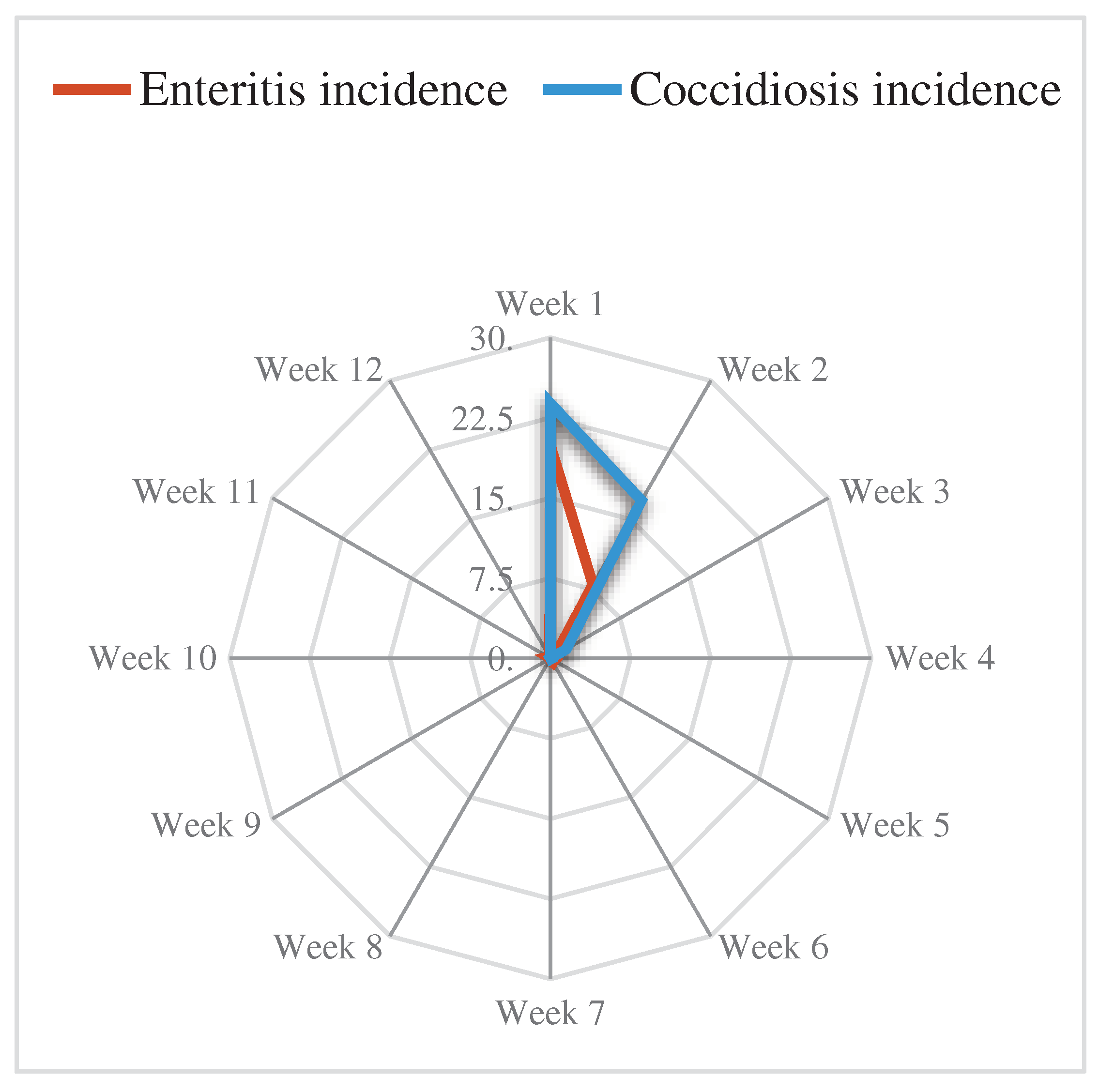
Figure 2.
Weekly rickets and respiratory diseases incidence in 0-3 months of age un-weaned calves.
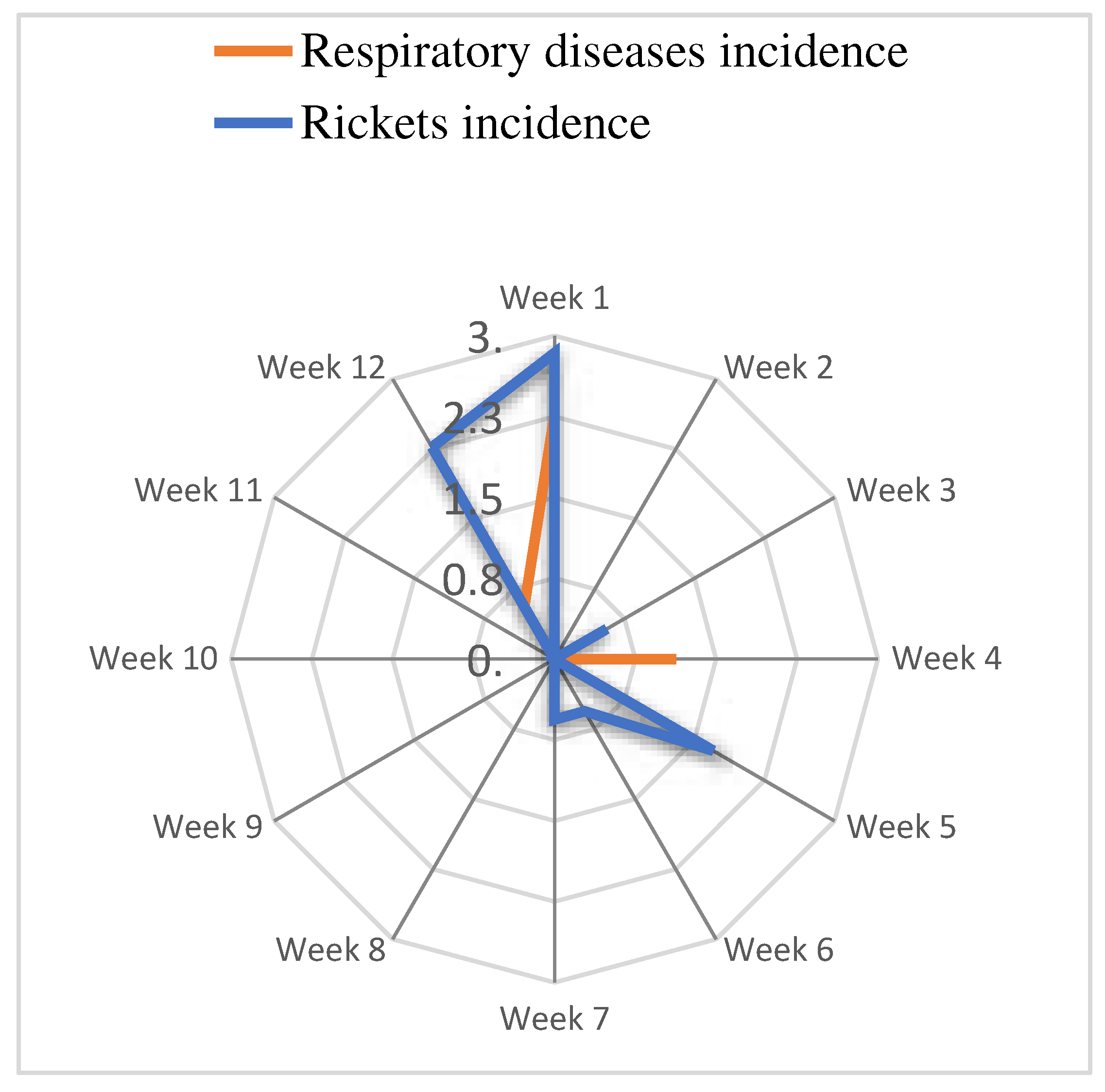

Table 1.
Means (±SEM) for disease incidence in Romanian Black Spotted calves.
| Calves age group | n | Coccidiosis (%) | Diarrhea (%) | Rickets (%) | Respiratory diseases (%) |
|---|---|---|---|---|---|
| 0-3 months | 176 | 39.20±0.36 | 29.55±0.34 | 6.25±1.83 | 3.98±1.48 |
| 3-6 months | 139 | 1.44±1.01 | 2.16±1.24 | 1.44±1.01 | 0.71±0.71 |
| 6-12 months | 119 | 5.04±2.01 | 5.88±2.17 | 4.20±1.85 | 5.04±2.01 |
| Statistical differences (p value) | |||||
| 0-3 vs. 3-6 | *** (p=0.0000) | *** (p=0.0000) | * (p=0.0335) | NS (p=0.0688) | |
| 0-3 vs. 6-12 | *** (p=0.0000) | *** (p=0.0000) | NS (p=0.4479) | NS (p=0.6640) | |
| 3-6 vs. 6-12 | NS (p=0.0972) | NS (p=0.1237) | NS (p=0.1751) | * (p=0.0337) | |
NS p>0.05; * p≤0.05; ** p≤0.005; *** p≤0.001.
Disclaimer/Publisher’s Note: The statements, opinions and data contained in all publications are solely those of the individual author(s) and contributor(s) and not of MDPI and/or the editor(s). MDPI and/or the editor(s) disclaim responsibility for any injury to people or property resulting from any ideas, methods, instructions or products referred to in the content. |
© 2023 by the authors. Licensee MDPI, Basel, Switzerland. This article is an open access article distributed under the terms and conditions of the Creative Commons Attribution (CC BY) license (http://creativecommons.org/licenses/by/4.0/).
Copyright: This open access article is published under a Creative Commons CC BY 4.0 license, which permit the free download, distribution, and reuse, provided that the author and preprint are cited in any reuse.


