

Submitted:
03 October 2023
Posted:
03 October 2023
Read the latest preprint version here
Abstract
Dark energy and dark matter are described as different manifestations of vacuum energy within the framework of Extra Dimensional Symmetry (EDS) that doubles large spatial dimensions with microscopic partners. In this framework, the bare vacuum energy component exists in a gravitationally inert state where actual gravitational constant Go= 0G, while real particles oscillate between this inert state and the active state where Go = 2G. Neutrinos induce small component of the gravitational constant in the inert state, causing the gravitation of virtual particles as dark matter. A small component of vacuum energy from the inert state also spills into the gravitationally active state as dark energy due to an energy density constraint and a speed limit asymmetry. This form of dark energy and dark matter, are parameterized by a gravitational potential suppressed asymmetry parameter. The dynamics of dark matter is further parameterized by the flavour, phase and kinetic energy parameters of its neutrino substrate. This results in the existence of a dominant light form of dark matter and a detectable heavy form of dark matter. EDS predicts a curvature suppressed Gravitational Wave Reheating (GWR) mechanism, enhanced by negative pressure. It converts gravitational wave energy to photon energy.
Keywords:
dark energy
; dark matter
; extra dimension
; gravity
; neutrino
; vacuum energy
1. Introduction
Dark energy is a mysterious energy component that
has been observed to be driving the accelerated expansion of the universe, and
have defied several explanations since its discovery in supernova observations [1] Its existence has since been confirmed by
several independent observations like the Planck measurements of the Cosmic
Microwave Background (CMB), indicating that it accounts for about 68.3% of the
gravitating energy content of the universe [2].
This is in addition to the older dark matter mystery of gravitationally
attractive but invisible energy component constituting about 26.8% of the
gravitating energy content of the universe. Only about 4.6% is in the form of
visible baryonic matter.
The cosmological constant (Λ) earlier introduced
into Einstein’s Field Equations, while being the simplest solution, results in
a conflict between measured density of dark energy and the 120 orders of
magnitude larger value predicted from quantum field theory [3]. The Λ problem has defied logical solution from
supersymmetric cancellation approach, relaxation of vacuum energy [4] and anthropic approach [5]. It also defies an approach that simply makes
the spacetime metric insensitive to Λ [6].
Slowly evolving scalar field models like quintessence
is one of the prominent alternative approaches to solve the dark energy mystery
without the Λ route. We also have modified gravity models and unification of
dark energy and dark matter. See Ref. [7] for
detailed review and Refs.[8,9] for recent review.
The amount of theoretical and observational efforts
that has been applied to understand dark energy and dark matter shows that they
require new physics beyond the existing standard model of cosmology and
particle physics. Attempts to resolve the dark matter mystery can be mainly
classified as either a modification of gravity or introduction of new particles
beyond the standard model of particle physics. However, both approaches of
modified gravity and particle dark matter have failed to provide consistent
explanations to the dark matter mystery even though each approach tends to
explain some observations and fail at some others.
There is an approach that explains dark matter as
gravitational polarization of vacuum energy by baryonic matter without invoking
new particle or modifying gravity in the traditional sense [10]. It is based on the idea that matter and
antimatter have opposite gravitational charges which requires a violation of
the Weak Equivalence Principle. Preliminary findings from measurements of
antiproton to proton charge to mass ratio imply that matter and antimatter
gravitate the same way [11]. Furthermore, the
recent result from the ALPHA collaboration has ruled out the possibility of
gravitationally repulsive antimatter [12].
In this paper, the dark energy and dark matter
puzzle are tackled using the framework of Extra Dimension Symmetry (EDS) that
doubles the number of large extra dimensions with microscopic partners. EDS
provides a solution to the dark energy puzzle by placing the bare vacuum energy
component in a gravitationally inert state where the actual gravitational
constant Go= 0G. Due to
a speed limit asymmetry and energy density constraint, a non zero component
spills into the gravitationally active state where Go= 2G, as
dark energy. For dark matter, it relies on the background effect of neutrinos
which induces a nonzero gravitational constant in the inert state, enabling the
gravitation of virtual particles which appears as dark matter. This neutrino
substrate approach for dark matter neither requires the polarization of the
quantum vacuum nor opposite gravitational charges for particles and
antiparticles like in [10].
This paper is organized as follows. Section 2 discusses the key dimensional
symmetry that doubles the number of large spatial dimensions with microscopic
partners. It also discusses the speed constraint, the two on and off
gravitational states, their speed limit asymmetry and density constraint, which
is then applied in section 4 to provide a solution to the Λ problem. Section 3 discusses General Relativity in a
large extra dimension and explores its unique features of gravitational
inversion as well as the chain of causality in gravitation. It is shown that
the expansion of a time-like spatial dimension is quantitatively equivalent to
the curvature of our visible spatial dimensions. Section 4 discusses the emergence of dark
energy due to a speed limit asymmetry and energy density constraint discussed
in section 2, while in section 5, the key reheating prediction is discussed. Section 6 discusses the gravitation of virtual
particles which appears as dark matter due to the background effect of neutrino
substrates which induces nonzero gravitational constant in the inert state.
Discussion and conclusion follows in Section 7.
2. Extra Dimensional Symmetry Framework
In this framework, the number of large spatial
dimensions is described by the dimension number such that,
.
where corresponds to which is a time like spatial dimension that is
invisible due to speed constraint discussed in Section
2.1.
corresponds to which is the visible set of spatial dimensions.
The EDS framework doubles large spatial dimensions
with microscopic dimensional partners with opposite dimension numbers such that
the total dimension number of the universe is zero as illustrated in Figure 1. While the dimensional partner of S0,
is a Planck size dimension, the dimensional partner of S1
is denoted . If there is perfect symmetry, . It is assumed that the large spatial dimensions S1
and S0 where inflated in the early universe at the expense of their
dimensional partners and SP which contracted to their
microscopic sizes becoming invisible.
In resolving the mysteries of dark energy and dark
matter, this paper focuses on the S0 dimension and its microscopic
dimensional partner SP as well as their interactions with the
visible spatial dimension S1.
2.1. Speed Constraint and Invisibility of S0
Despite its cosmic size, the S0
dimension is invisible due to its time like behavior from the speed constraint
illustrated in Equation (2) and Figure 2.
Consistent with Special Relativity, the speed constraint requires that a
particle’s velocity must always equal the maximum speed limit c in the S1
– S0 dimension. Massless particles like photons have zero velocity
component along S0, while massive particles and antiparticles travel
in opposite directions along S0. This motion along S0 is
quantitatively equivalent to the passage of time such that,
where µ is particle velocity along S0,
and ν is particle velocity along visible spatial dimension S1.
When for massive particles, and conversely, when ν , for massless particles, , to satisfy the speed constraint. This suggests
that time can be an emergent temporal dimension driven by the velocity of a
particle along S0 dimension. How fast time appears to pass for a
massive particle can be equivalent to the ratio of its S0 component
of velocity to the speed limit c as,
where is the equivalent Lorentz factor for the S0 dimension. Since ,
2.2. Speed Limit Asymmetry
The asymmetry in speed limits c and c0 is described by the asymmetry parameter which is the ratio of the Planck size of SP to the size of S0 dimension, illustrated in Figure 3. such that,
where is the size of S0 in Planck unit. And
where , is the value of in flat spacetime. The increase in size is proportional to the absolute value of the gravitational potential such that,
where is a constant. The asymmetry relationship between the two speed limits c and c0, as shown in Figure 3 can be expressed as,
2.3. Gravitational State Oscillation
In EDS, Standard Model particles oscillates between the two speed states which are also opposite gravitational on and off states. This is such that for a particle of energy E, with the exception of neutrinos, the state life time for such particle is,
where is the reduced Planck constant and is the Planck energy. The oscillation of neutrinos between the active and the inert phase is regulated by a different mechanism.
The oscillation of Standard Model particles between the two gravitational states and , makes gravity discrete on microscopic spacetime scale. It however appears smooth on macroscopic spacetime scale with an average gravitational constant G.
2.4. Energy Density Constraint
The energy density constraint essentially constrains the total energy density in a given volume of spacetime to always equal the upper limit of the Planck density . This is only obtainable in the gravitational active state where the speed limit is c while the bare vacuum energy component exists in the inert state with lower speed limit and hence lower Planck density
where is the vacuum energy density, and is the total baryonic matter density. The key significance of this, is in the emergence of non zero Λ dark energy in section 4. However, such energy density constraint implies a Planck density limit to the density of black holes like that suggested in [13], where Planck stars replace black hole singularities.
3. General Relativity in S0Dimension
Solution of Einstein’s Field Equation in 1+1 dimensionality is being used as a pedagogical tool [14] and reveals some interesting properties of the equation in such dimensionality. In this section, the focus is on General Relativity in -1+1 dimension which have some inverted features not seen in 1+1 dimensionality because of the negative dimension number of S0. The negative dimension number of the S0 dimension gives it some features such as appearance of positive energy density as negative energy density and the inversion of positive pressure to negative pressure. Eintein’s Field Equation in S0 can be expressed as
where is the equivalent Einstein Tensor in S0 dimension. is the equivalent cosmological constant and is the stress energy tensor as seen in S0 dimension. In -1+1 dimensionality, just as in 1+1, the curvature term is zero, and Equation (11) becomes
3.1. Features of General Relativity in S0Dimension
The negative one dimensionality of the S0 dimension from Equation (1), when applied in the context of General Relativity, confers on it some unique features such as:
- i.
- Positive energy density in S1 is equivalent to negative energy density everywhere in S0.
An energy density associated with a given Planck volume of 3d space S1 appears as an equivalent negative energy density everywhere along S0 dimension associated with it as a positive cosmological constant as illustrated in Figure 4.
- ii.
- Positive pressure in S1 is equivalent to negative pressure in S0
Any form of positive pressure in S1 appears as negative pressure in S0 for the same reason of negative dimensionality. The result is a positive cosmological constant expansion of S0.
- iii.
- Negative pressure in S1 is equivalent to a positive pressure in S0
The same negative dimensionality causes the inversion of negative pressure in S1 appearing as positive pressure in S0 driving its negative cosmological constant contraction. The result is that the curvature of S1 () is equivalent to the cosmological constant expansion of S0 as illustrated in Figure 5, such that,
and a positive cosmological constant term () in S1 is equivalent to a negative cosmological constant term () in S0 such that,
3.2. Gravitational Chain of Causality
The inversion of gravitation discussed in the previous section suggests that at a more fundamental level, gravity is the expansion or contraction of S0 dimension. This then manifests in an inverted form as curvature or expansion of S1 dimension as illustrated in Figure 4 and Figure 5. The existence of gravitational on and off states acts as a filter in this gravitational chain of causality enabling real particles to gravitate while virtual particles remain inert as illustrated in Figure 6.
The existence of the bare vacuum energy component in the gravitationally inert state ensures that it does not gravitate. This partly solves the cosmological constant problem. The second part of the problem about the nonzero value is addressed in the next section.
4. Emergence of Nonzero Cosmological Constant
The asymmetry in speed limit described in Equation (8) between the two gravitational states also reflects in the values of their Planck densities such that
where is the lower Planck density in C0 state and is the Planck density in the C state.
The existence of the bare vacuum energy component in the lower C0 state implies that
which is less than the Planck density and the energy density constraint requires that the total vacuum energy density should be equal to the Planck density in the absence of matter.
Since the gravitationally inert lower speed state lacks the capacity to contain all the vacuum energy components, a small component spills into the gravitationally active state as dark energy as illustrated in Figure 7, such that,
in the gravitationally active state C to satisfy the energy density constraint so that the total vacuum energy density equals the Planck density . The lower Planck density is associated with speed state C0.
Since is suppressed with the expansion of S0 in the gravitational well of massive objects (Equation (6) and Figure 4), the density of this form of dark energy varies spatially according to this suppression by gravitational potential wells. The deeper the gravitational well the more the suppression. And substituting the value of from Equation (5),
where is the size of S0 dimension in Planck unit, which increases with the absolute value of the gravitational potential according to Equation (7).
5. Gravitational Wave Reheating (GWR) Prediction
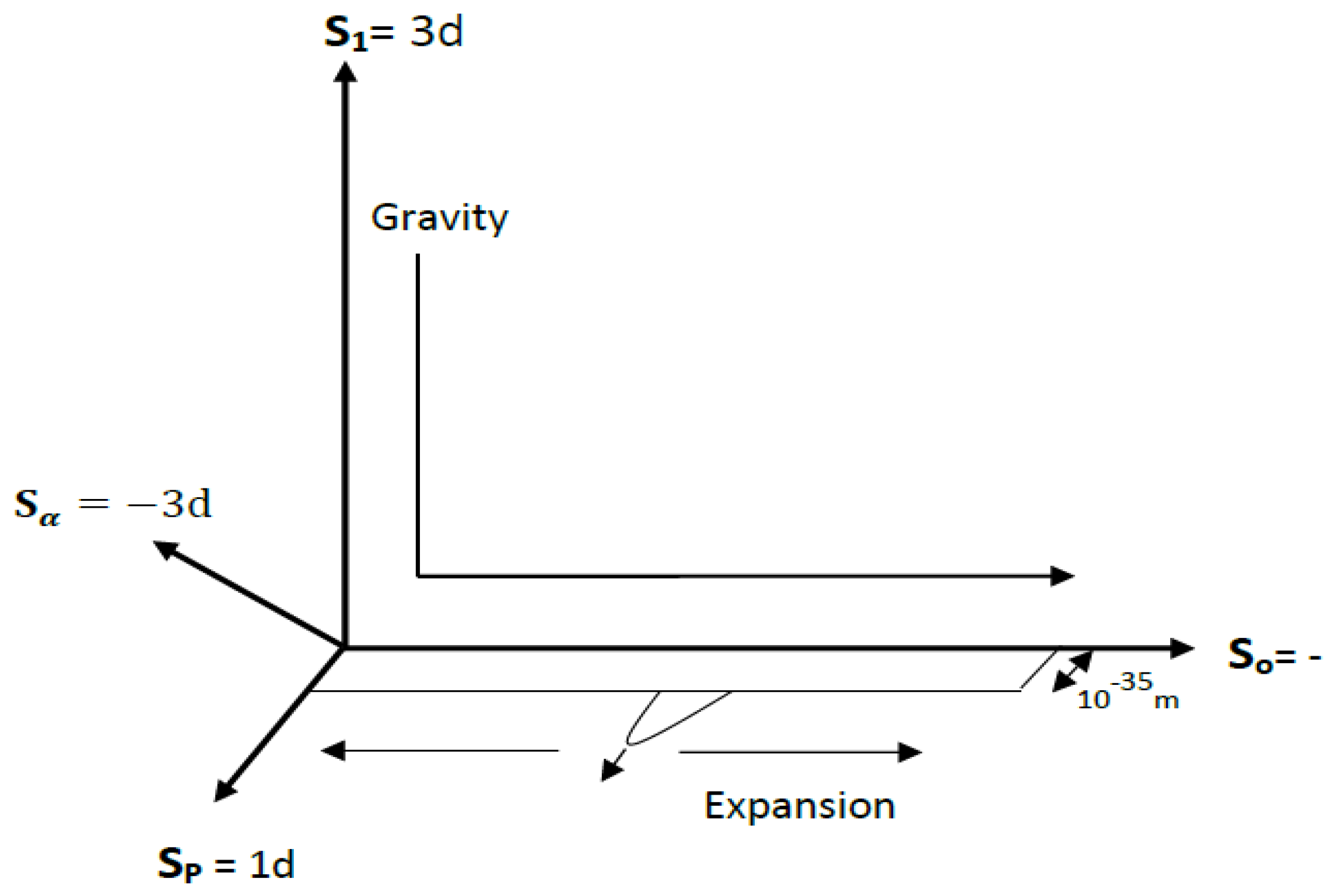
The propagation of gravitational waves along the visible 3d space S1 should also vibrate any extra spatial dimension such as the SP and S0 dimensions. The stretching of SP dimension during such vibration should cause the creation of real photons out of vacuum energy. This is the Gravitational Wave Reheating (GWR) mechanism of EDS. However as illustrated in Figure 8, the expansion of S0 dimension in gravitational potential wells suppresses the possible stretching of SP dimension resulting in a threshold value of strain below which reheating cannot occur.
This is such that for reheating to occur, the gravitational wave strain must be greater than the gravitational strain of S0 expansion as
and
where is the increase in the size of S0 dimension and it is proportional to the absolute value of the gravitational potential from Equation (7). is the size of S0 in flat spacetime. hardens the SP dimension against gravitational wave oscillation.
5.1. Energy Scale of Reheat Photons
The maximum energy of the reheat photons that can be emitted in the resulting spectrum can be described by
where is the Planck energy and is the effective stretching strain of the resulting SP oscillation once the threshold gravitational wave strain is exceeded such that .
5.2. Magnetic Softening of the SP Dimension
Magnetic fields produce negative pressure that can flatten curvature and even dampen gravitational waves [15]. Within the EDS framework, the gravitational strain of expansion () of the S0 dimension is a measure of spatial curvature. Therefore, the flattening of spacetime curvature softens the SP dimension which becomes more sensitive to gravitational wave oscillation. In essence, a strong magnetic field like that obtainable around magnetars, softens the SP dimension by lowering the threshold strain required for reheating to occur with incident gravitational waves.
From energy conservation perspective, the energy lost by gravitational waves passing through a strongly magnetized region has to be released in some form and GWR provides the mechanism for converting the gravitational wave energy into electromagnetic one. It is expected that the brief burst of electromagnetic waves radiated while the gravitational waves passes through a strongly magnetized region such as magnetars, should be in the form of radio waves.
6. Dark Matter from Vacuum Energy
The bare vacuum energy component should always be gravitationally inert with its existence in the state where the gravitational field is effectively switched off. However, in this framework, neutrinos affects their background in the inert state such that . Within such background in the inert state, neutrinos provide some gravitational illumination described by Equation (22) that enables virtual particles to gravitate with positive pressure appearing as dark matter.
where is the neutrino induced gravitational constant in the inert state. is the asymmetry parameter involved in the emergence of dark energy. is the flavour parameter. It varies with neutrino flavour such that . is a dimensionless phase parameter that varies between zero and one (), with zero being a ground phase where it always gets stuck until it experiences a disturbance of the microscopic dimensions such as reheating described in the previous section. It remains in this active phase for a life time and falls back to the phase. is a dimesionless parameter that varies with neutrino kinetic energy. and it is described by,
where is the neutrino kinetic energy and is the Planck energy. Substituting and from Equation (5) and Equation (23), Equation (22) becomes,
where is the size of the S0 dimension (in Planck unit) which increases with the absolute value of the gravitational potential , hence the suppression of dark matter effect of neutrinos in deep gravitational potential wells.
It is assumed that the value of the gravitational constant in both gravitationally active and inert state, is constrained such that,
where and are the gravitational constants in the active and the inert states respectively.
While hot dark matter is the form of dark matter that can be produced by relativistic neutrinos, cosmic neutrinos are nonrelativistic. Such nonrelativistic cosmic neutrino substrates should be further slowed down by the Higgs like drag from its self induced gravitational interaction with virtual particles within its background. This enhances the clustering of cosmic neutrino substrates and the gravitating virtual particles in their background appear as cold dark matter.
The gravitational potential suppression of enables this substrate dependent form of dark matter to have hybrid behaviour by mimicking modified gravity form of dark matter such as Modified Newtonian Dynamics (MOND) while also exhibiting some particle behavior of its neutrino substrates like the gravitational polarization of vacuum energy approach [10] and superfluid dark matter described in [16].
6.1. Categories of Neutrino Substrate Dependent Dark Matter
Heavy and light dark matter are two categories of neutrino substrate dependent dark matter that exists within the EDS frame work depending on the neutrino energy scale and phase parameter. Equation (22) consists of a rest term and a kinetic term . The kinetic term can be active or inert depending on the phase parameter which varies between one and zero where it freezes. can be unfrozen from its zero value, activating the kinetic term, gravitational disturbances such as sudden change in negative pressure above a threshold and falls back to its frozen phase within a life time . Such gravitational disturbances can also trigger reheating discussed in section 5.
- i.
- Heavy dark matter
From Equation (22), an Ultra High Energy neutrino with a kinetic energy of 1015 eV and a phase parameter , will have an active kinetic term. It can induce a gravitational constant close to 10-13 G in the gravitationally inert state where the bare vacuum energy exists. With the gravitation of vacuum energy of the order the Planck density with such value of G within the neutrino background, it can manifest as detectable heavy dark matter. As the high energy neutrino substrate falls back to the frozen phase with the kinetic term becomes inactive, making it become light form of dark matter. A micro-resolution digital scale should have the sensitivity to detect the gravitational effect of such heavy dark matter while it is still active.
- ii.
- Light dark matter
Neutrinos in the state, particularly cosmic neutrinos can induce close to 10-120 G in the gravitationally inert state, resulting in light and cold dark matter, clustered within and around galaxies. Such light form of dark matter which dominates the total dark matter density in this framework, can only be detected through the CMB, gravitational lensing and the dynamics of wide stellar binaries, galactic and extra galactic structures.
7. Discussion and Conclusion
EDS provides an elegant framework for the resolution of the cosmological constant problem of dark energy and the nature of dark matter. In doing so it provides deeper insights into the dimensional structure of spacetime and chain of causality involved in gravitation. Specifically, it places the bare vacuum energy component in a state where the gravitational field is switched off with actual gravitational constant G0 = 0G, while real standard model particles, oscillate between this gravitationally inert state and the active state.
Due to an energy density constraint and a speed limit asymmetry that limits the capacity of the inert state to contain the entire vacuum energy component, a small component spills into the active state as dark energy. The asymmetry parameter is the ratio of the size of the spatial equivalent of time (S0 dimension) and its microscopic partner SP.
The illuminating effect of neutrino substrates particularly cosmic neutrinos, induces non zero gravitational constant in the inert state, providing gravitation for virtual particles which appears as dark matter. This neutrino substrate dependent form of dark matter exhibits hybrid behaviour of particle dark matter and modified gravity form of dark matter like the gravitational polarization of vacuum energy approach [10] and superfluid dark matter [16]. The heavy form of dark matter that can be activated by the gravitational disturbance of the microscopic dimension SP, provides an opportunity for direct detection of such form of dark matter while it is active.
The reheating prediction in which gravitational waves produce electromagnetic secondary with negative pressure from strong magnetic fields of magnetars and dark energy might be the sources of Fast Radio Bursts [17] and Excess Radio Background [18].
Expected results from the trio of the JWST, Euclid and upcoming Nancy Grace Roman Telescope and Vera Rubin Observatory, are expected to provide precision measurements of dark energy density as well as the dynamics of dark matter. Such precision measurements should glean out the predicted suppression of dark energy density in the deep gravitational potential wells of baryonic matter like it apparently does to dark matter.
There are a number of potential insights that are beyond the scope of this paper. For instance it is possible that the fine structure constant just like , is simply the ratio of the Planck scale to the size of the dimension. It is also possible that the rest term in Equation (24), might be the source of neutrino mass. These possibilities as well as others like baryon asymmetry from net spin with respect to the S0 dimension (Figure 3), shall be investigated in future work.
In conclusion, the EDS framework offers new physics explanations for dark energy and dark matter as different manifestations of vacuum energy that can be tested and provides potential insights into the dimensional structure of spacetime and gravity.
Author Contributions
Kabir Adinoyi Umar: Conceptualization, Investigation, Writing-original draft, Writing-review and editing, Resources. Benjamin Gbenga Ayatunji: Supervision.
Data availability: No data was used for the research described in the article
Acknowledgments
The author gratefully acknowledges Benjamin G. Ayatunji for his criticisms, encouragement and mentorship and S. X. K. Howusu for his inspiring advice and initial motivation for this work. This work was funded by the author.
Declaration of competing interest: The authors declare that they have no known competing financial interests or personal relationships that could have appeared to influence the work reported in this paper.
References
- Riess, A.G.; Filippenko, A.V.; Challis, P.; Clocchiatti, A.; Diercks, A.; Garnavich, P.M.; Gilliland, R.L.; Hogan, C.J.; Jha, S.; Kirshner, R.P.; et al. Observational Evidence from Supernovae for an Accelerating Universe and a Cosmological Constant. Astron. J. 1998, 116, 1009–1038. [Google Scholar] [CrossRef]
- Ade P. A., R. et al., Planck 2013 results. XVI. 2013; arXiv:1303.5076[astro-ph.CO]. [Google Scholar]
- Carroll, S. M. , The cosmological constant, Living Rev. Rel. a: 4:1, (2001), arXiv, 2001; :1. [Google Scholar]
- Kachru, S. et al., de Sitter vacua in string theory, Phys. Rev. D68 (2003) 046005, arXiv:hep-th/0301240.
- Banks, T.; Dine, M.; Motl, L. On anthropic solutions of the cosmological constant problem. J. High Energy Phys. 2001, 2001, 031–031. [Google Scholar] [CrossRef]
- Arkani-Hamid, N. , A small cosmological constant from a large extra dimension, Phys. Lett. B480 (2000) 193-199, arXiv:hep-th/000197.
- Copeland, E. J. et al., Dynamics of dark energy, Int. J. Mod. Phys. D15 (2006) 1753-1936, arXiv:hep-th/0603057.
- Oks, E. Brief review of recent advances in understanding dark matter and dark energy. New Astron. Rev. 2021, 93, 101632. [Google Scholar] [CrossRef]
- Arun, K. et al. Dark matter, dark energy and alternate models: a review, Advances in Space Research, 60, (2017) 166-186, arXiv: 1704.06155[physics.gen-ph]. 2017, arXiv:1704.06155[physics60. [Google Scholar]
- Hajdukovic D., S. Quantum vacuum and dark matter, Astrophysics and Space Science 337 (2012)9-14.
- Borchert M., J. , Devlin J. A., Ulmer S., et al. A 16 parts per trillion measurement of the antiproton to proton charge-mass ratio, Nature 601 (2022) 53-57.
- Anderson, E.K.; Baker, C.J.; Bertsche, W.; Bhatt, N.M.; Bonomi, G.; Capra, A.; Carli, I.; Cesar, C.L.; Charlton, M.; Christensen, A.; et al. Observation of the effect of gravity on the motion of antimatter. Nature 2023, 621, 716–722. [Google Scholar] [CrossRef] [PubMed]
- Rovelli, C. , Vidoto, F., Planck Stars, Int. J. Mod. Phys. D23 (2014) 1442026, arXiv:1401.6562.
- Boozer, A.D. General relativity in (1 + 1) dimensions. Eur. J. Phys. 2008, 29, 319–333. [Google Scholar] [CrossRef]
- Tsagas, C.G. Magnetic Tension and the Geometry of the Universe. Phys. Rev. Lett. 2001, 86, 5421–5424. [Google Scholar] [CrossRef] [PubMed]
- Hossenfelder, S.; Mistele, T. The Milky Way’s rotation curve with superfluid dark matter. Mon. Not. R. Astron. Soc. 2020, 498, 3484–3491. [Google Scholar] [CrossRef]
- Zhang, B. The physics of fast radio bursts. Rev. Mod. Phys. 2022, 95, 035005. [Google Scholar] [CrossRef]
- Fialkov, A.; Barkana, R. Signature of excess radio background in the 21-cm global signal and power spectrum. Mon. Not. R. Astron. Soc. 2019, 486, 1763–1773. [Google Scholar] [CrossRef]
Figure 1.
Large spatial dimensions S1 and S0 and their microscopic dimensional partners and SP. Gravitational inversion symmetry implies that SP and were contracted to their minimum microscopic sizes to inflate S0 and S1 in the early universe. It is assumed that before then, they were all comparable in size.
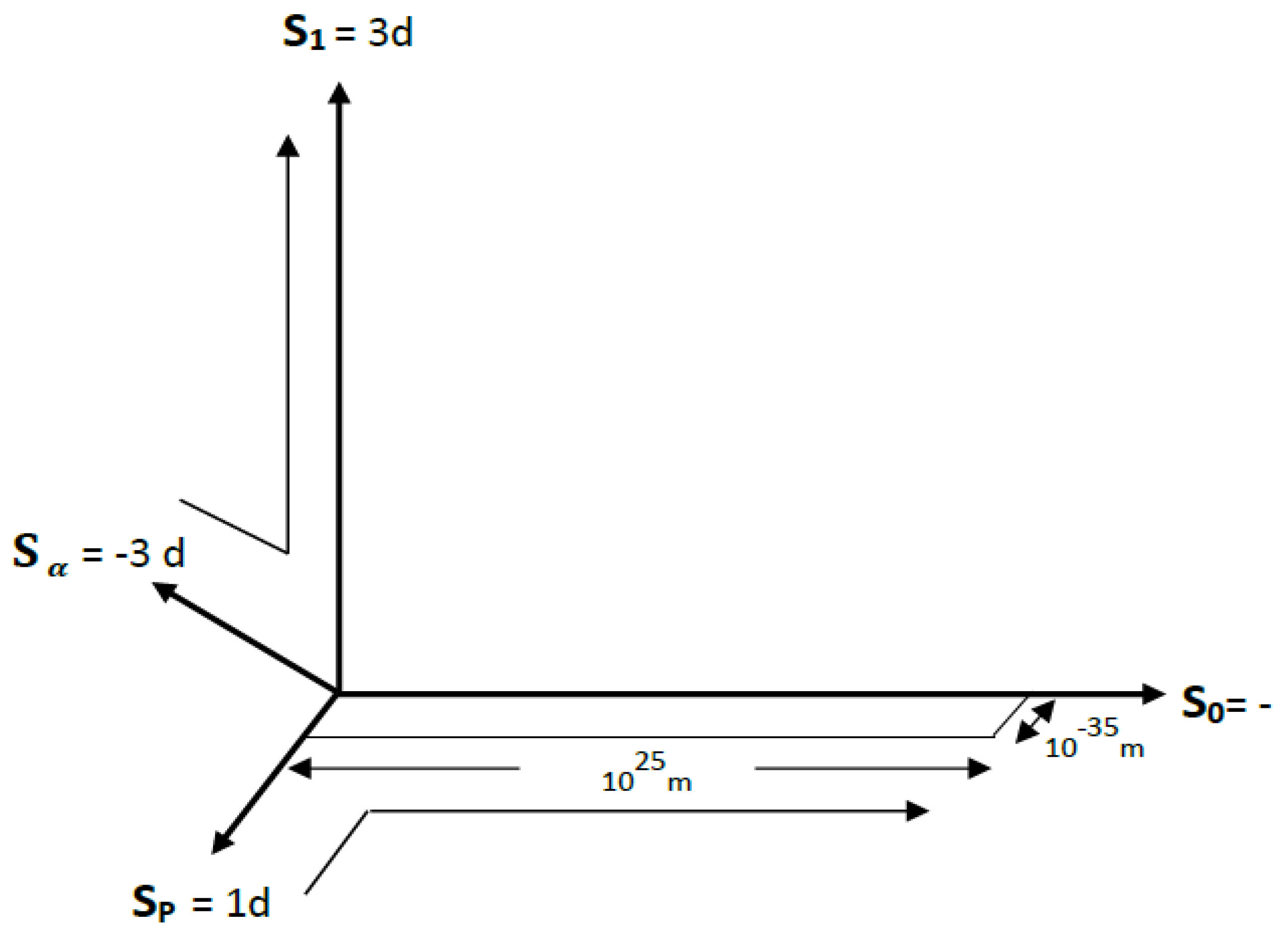
Figure 2.
The speed constraint relationship between visible spatial dimensions S1 and time like spatial dimension S0.
Figure 2.
The speed constraint relationship between visible spatial dimensions S1 and time like spatial dimension S0.

Figure 3.
Ring structure of S0 - SP dimensions with two unequal speed limit states C and C0, at the two ends of SP dimension. Traveling in opposite directions of S0 represents particle and antiparticle states.
Figure 3.
Ring structure of S0 - SP dimensions with two unequal speed limit states C and C0, at the two ends of SP dimension. Traveling in opposite directions of S0 represents particle and antiparticle states.
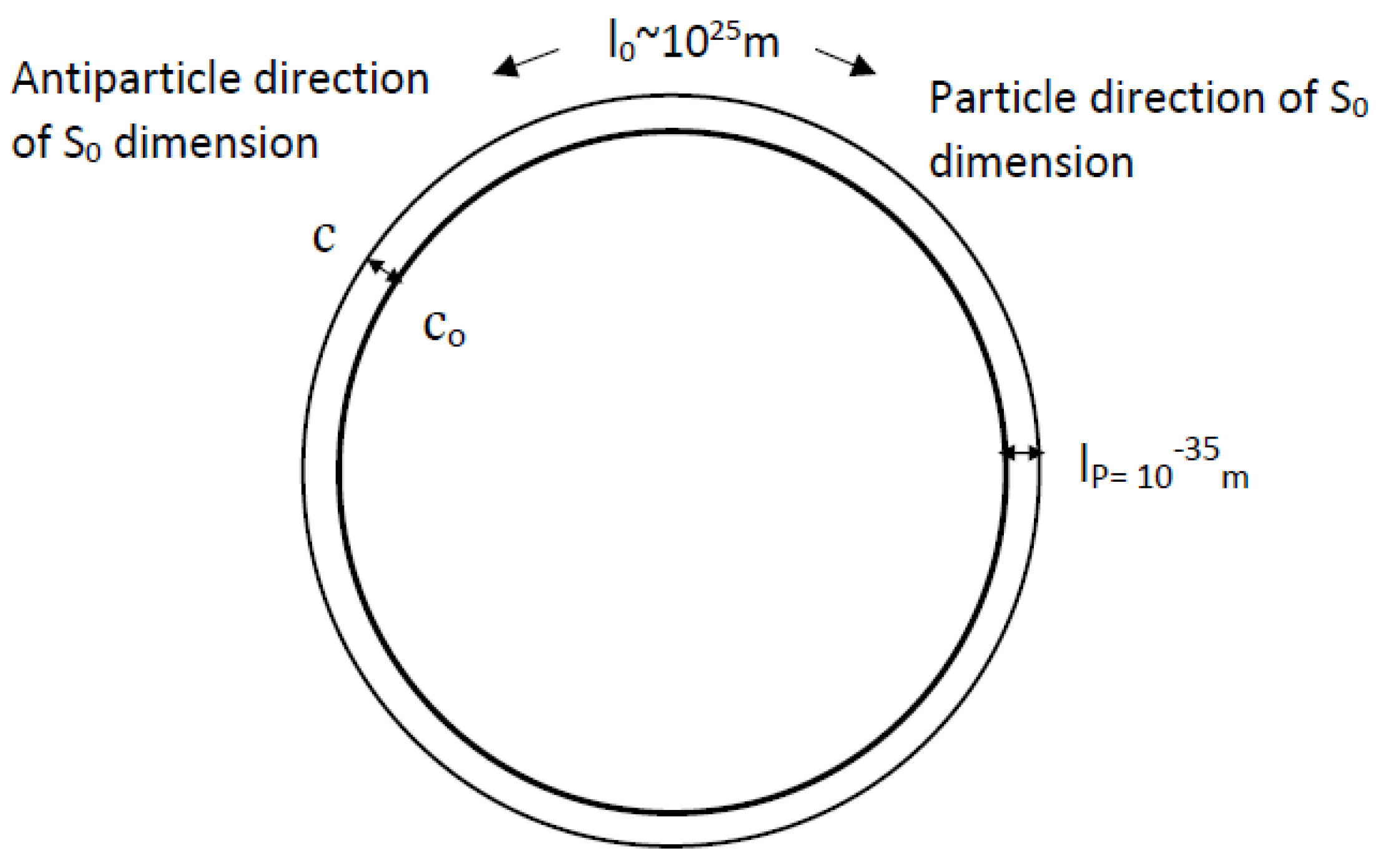
Figure 4.
A gravitational well in S1 is inverted into a gravitational hill with the expansion of S0 by a test particle. The test particle is replicated over 1060 times everywhere along S0 dimension.
Figure 4.
A gravitational well in S1 is inverted into a gravitational hill with the expansion of S0 by a test particle. The test particle is replicated over 1060 times everywhere along S0 dimension.
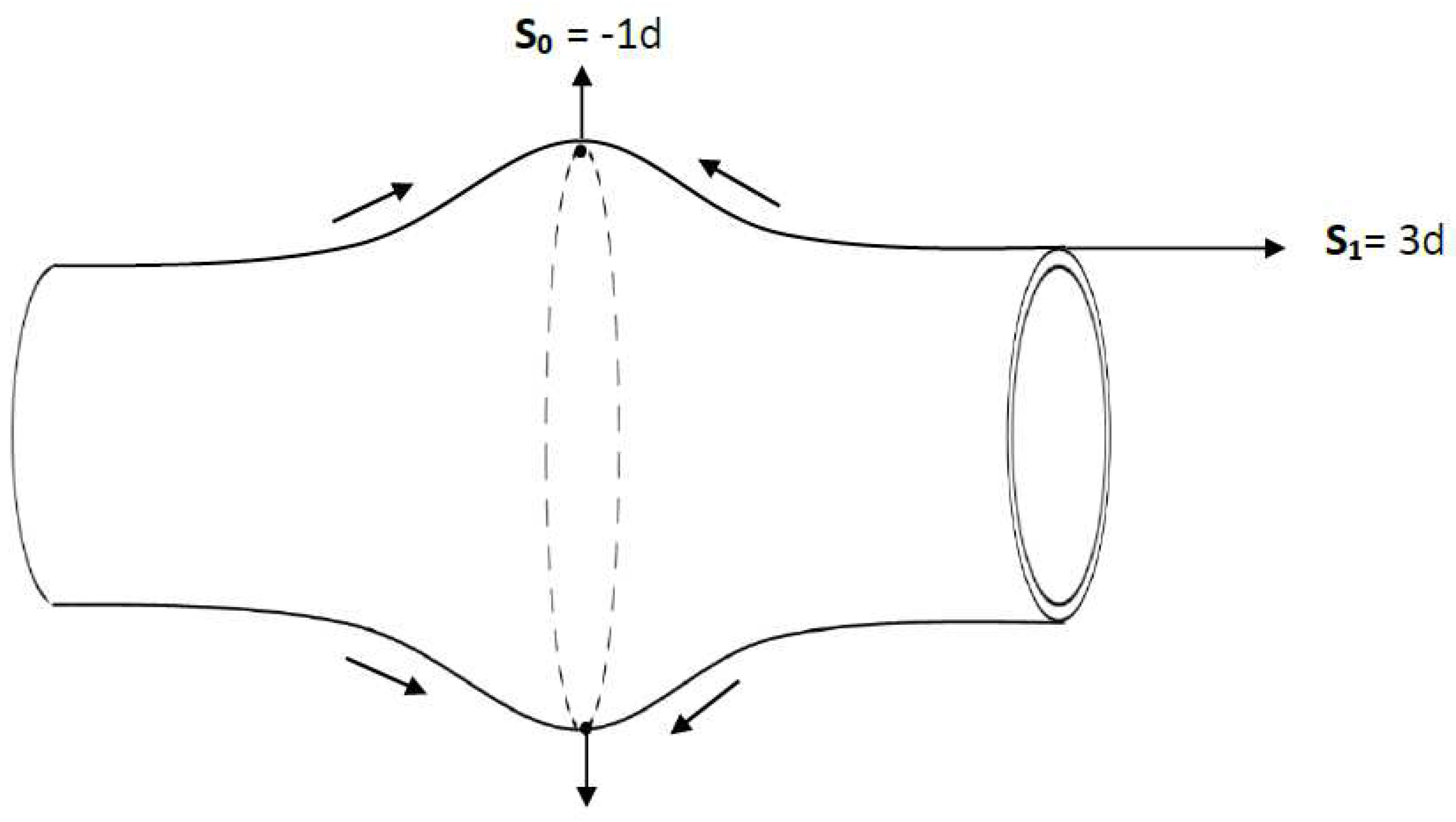
Figure 5.
Gravitational inversion. A positive cosmological constant expansion of S0 is equivalent to curvature of S1. Also, a negative cosmological constant contraction of S0 is equivalent to a positive cosmological constant expansion of S1.
Figure 5.
Gravitational inversion. A positive cosmological constant expansion of S0 is equivalent to curvature of S1. Also, a negative cosmological constant contraction of S0 is equivalent to a positive cosmological constant expansion of S1.
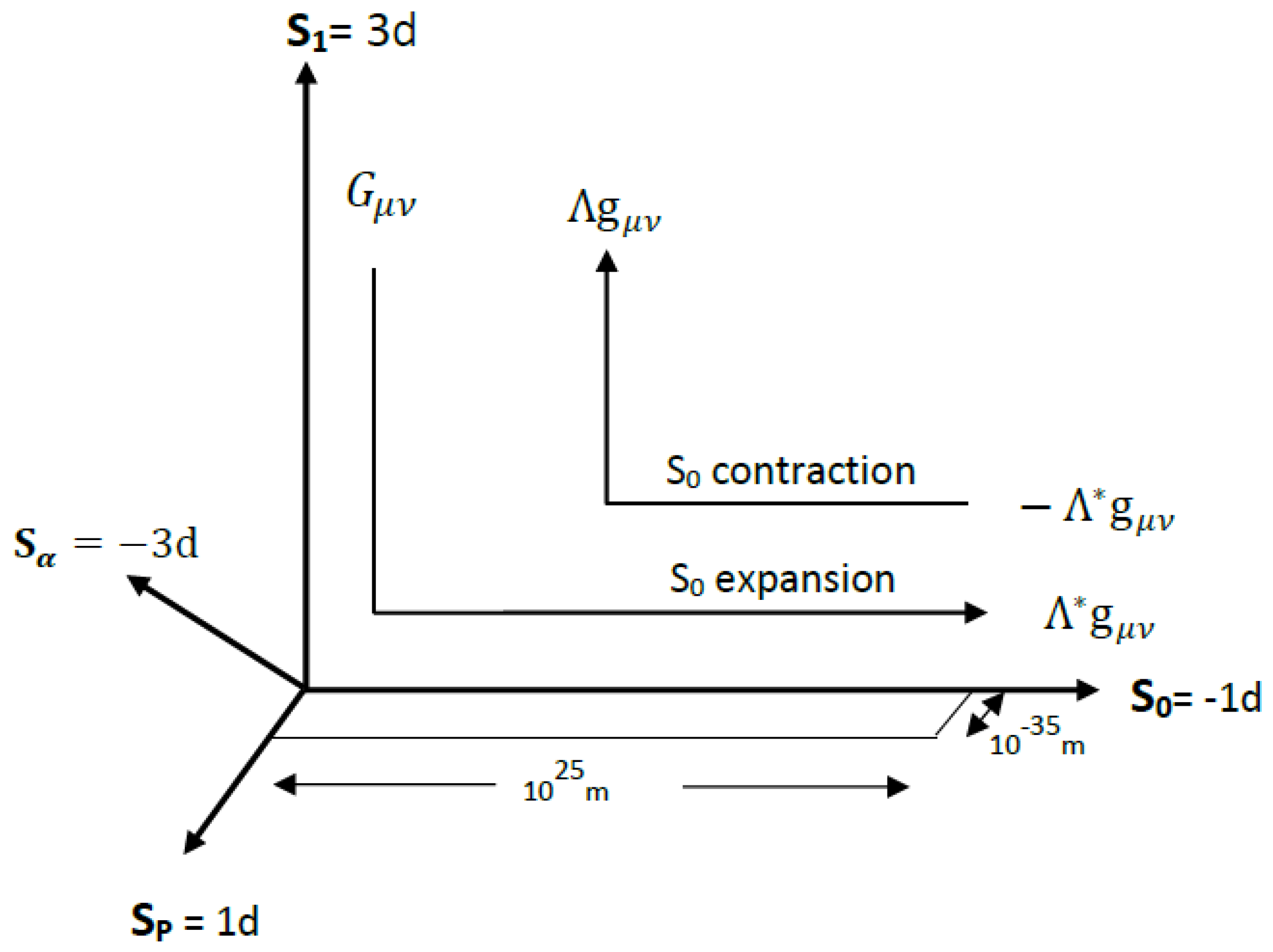
Figure 6.
Gravitational chain of causality. Gravity at a more fundamental level is about expansion or contraction of S0 which manifests invertedly in S1 as curvature or expansion respectively. Also gravitation of particles depends on if they are in a gravitationally active or inert state.
Figure 6.
Gravitational chain of causality. Gravity at a more fundamental level is about expansion or contraction of S0 which manifests invertedly in S1 as curvature or expansion respectively. Also gravitation of particles depends on if they are in a gravitationally active or inert state.
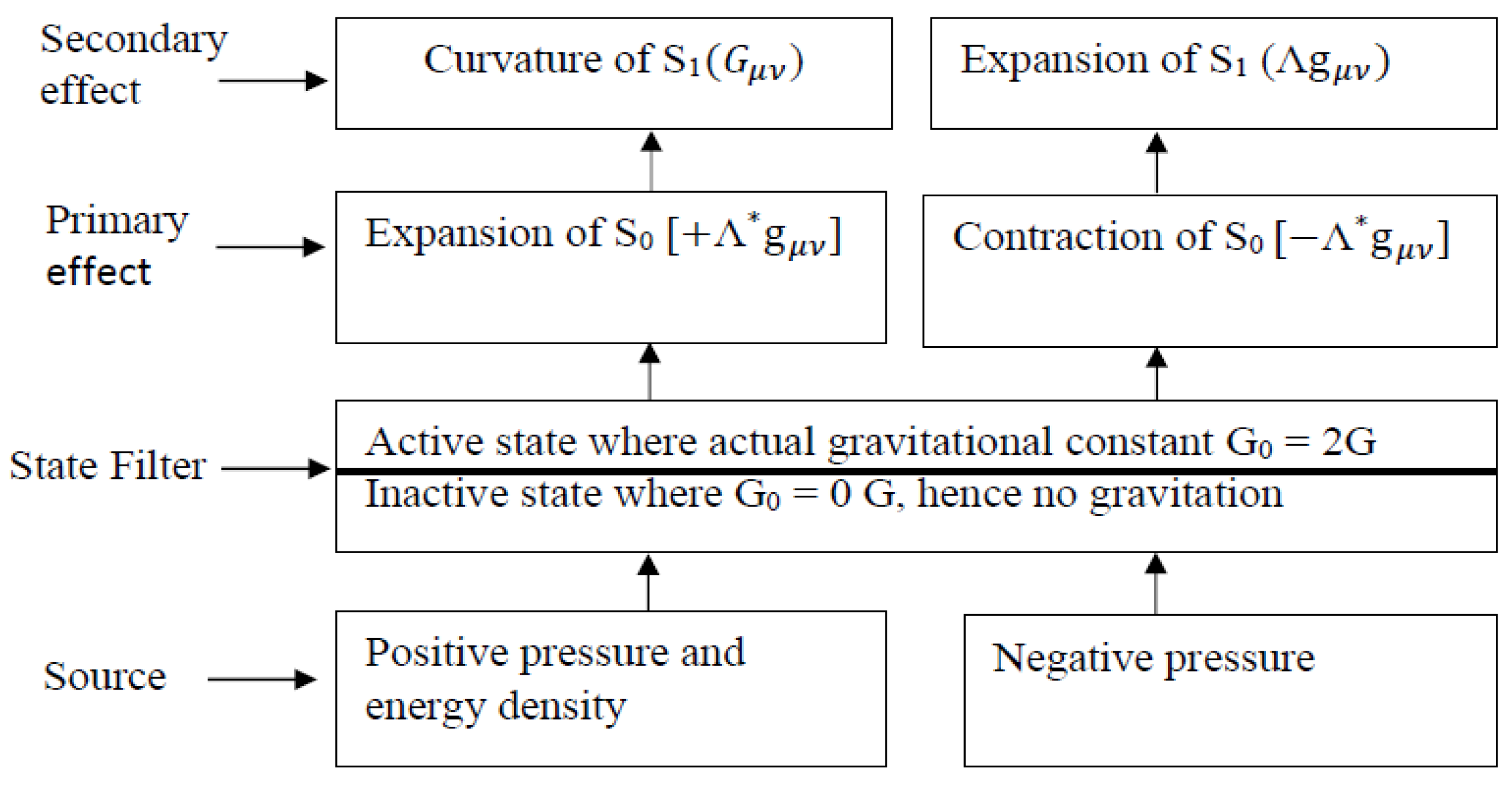
Figure 7.
While the bare vacuum energy component occupy the gravitationally inert state C0 to its limit, there has to be a component
Figure 7.
While the bare vacuum energy component occupy the gravitationally inert state C0 to its limit, there has to be a component
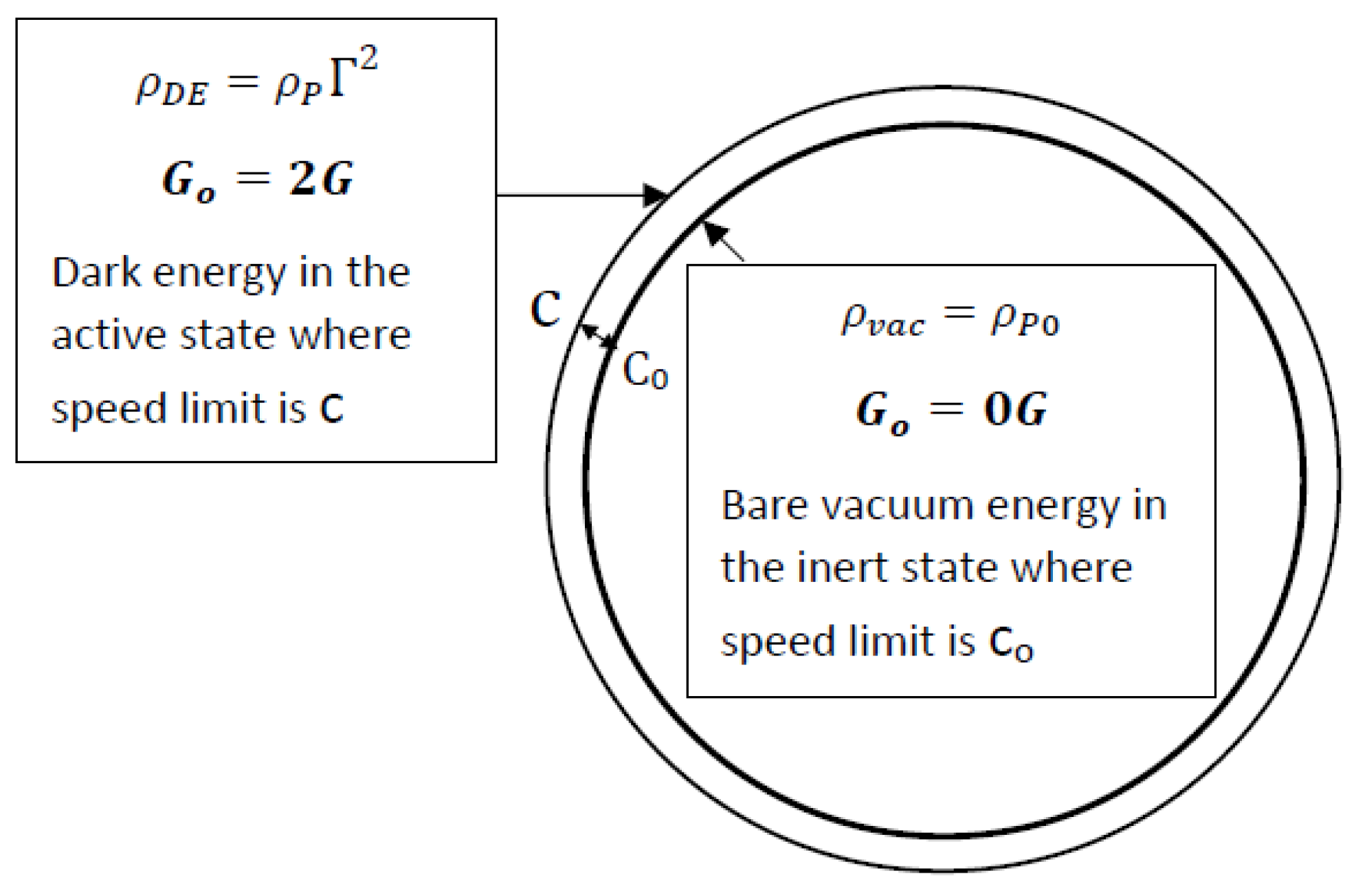
Figure 8.
The expansion of the S0 dimension in gravitational potential wells, suppresses the possible stretching of SP dimension by gravitational waves oscillations.
Figure 8.
The expansion of the S0 dimension in gravitational potential wells, suppresses the possible stretching of SP dimension by gravitational waves oscillations.
Disclaimer/Publisher’s Note: The statements, opinions and data contained in all publications are solely those of the individual author(s) and contributor(s) and not of MDPI and/or the editor(s). MDPI and/or the editor(s) disclaim responsibility for any injury to people or property resulting from any ideas, methods, instructions or products referred to in the content. |
© 2023 by the authors. Licensee MDPI, Basel, Switzerland. This article is an open access article distributed under the terms and conditions of the Creative Commons Attribution (CC BY) license (http://creativecommons.org/licenses/by/4.0/).
Copyright: This open access article is published under a Creative Commons CC BY 4.0 license, which permit the free download, distribution, and reuse, provided that the author and preprint are cited in any reuse.