
Submitted:
21 August 2023
Posted:
23 August 2023
You are already at the latest version
Abstract
We measure the accelerated cosmic expansion rate of the late-time Universe and derive constraints on cosmological parameters from the final baryon acoustic oscillation (BAO) uncorrelated measurements of different surveys after two decades of dedicated spectroscopic observation combined with the Pantheon sample of Type Ia supernovae, the Hubble diagram of gamma-ray bursts & quasars data, the Cosmic Chronometers data, and the recent Hubble constant value measurement from the Hubble Space Telescope and the SH0ES Team as an additional prior. In Λ cold dark matter (ΛCDM) scenario, the model fit yields Ωm=0.313±0.034 and ΩΛ=0.672±0.025. Combining BAO with CC+Pantheon+QSR+GRB data sets we get H0=69.21±1.22 km s−1 Mpc−1, rd=133.46±2.49 Mpc. For the a flat wCDM model, we get w=−1.111±0.030. For a dynamical evolution of dark energy in a flat w0waCDM cosmology, we get wa=−0.292±0.167. We apply the Akaike information criteria probe to compare the three models, and see that all models are favored and cannot be discarded from the current data.
Keywords:
dark energy
; cosmological parameters
; numerical methods
1. Introduction
The values of cosmological parameters of the standard model of cosmology have been estimated and highly constrained through various observational experiments [1,2] with unprecedented accuracy. The observational measurements results from Planck 2018 define the "cornerstone" of constraints for the cosmological key parameters, such as the Hubble constant . Although the Hubble constant cannot be measured directly by the cosmic microwave background (CMB) Planck satellite, it is measured once the other cosmological parameters are known through a global analysis fitting in the CDM scenario. In the LCDM scenario, [1] estimated the value of the Hubble constant at km s Mpc whose uncertainty is below 1 km s Mpc. However, measurements in the local neighborhood at low redshifts of the Hubble constant [3,4,5,6,7] have caused tension and, ironically, a window of opportunity to test alternative models beyond the CDM model. In particular, SH0ES project [4] developed a distance ladder method from standard candles known as cepheids stars to estimate . Currently, they have been improving the value of with more precision and obtain the updated results as km s Mpc[7]. Despite the success of the LCDM model, the current measurements of late-time accelerated cosmic expansion [7] and early-time measurements [1] countered each other, causing a crisis in cosmology known as Hubble tension whose discrepancy between them is situated in the range of 4–5.7. Such discrepancy implicates that either early-and-late time measurements have systematics and calibration issues or the standard cosmological model fails to describe the universe. Furthermore, this tension may provide a hint of new physics beyond the standard model. Following this motivation, a wide range of alternative cosmological models have been proposed to alleviate inconsistencies between data surveys [8,9,10,11,12,13,14,15,16,17,18,19,20]. In the opposite case, many studies have been made to provide estimates of the Hubble constant on other observations, such as quasar lensing [21,22], gravitational-wave events [23,24,25], fast radio bursts (FRBs) [26,27], Megamaser [28,29,30], red giant branch tip method (TRGS) [31,32,33], BAOs [34], etc [35]. For example, the H0LiCOW research group [36] exhibits another method to estimate by the time delay from gravitational lensing effects. In a flat CDM scenario, they estimate a value of km s Mpc[37]. The Advanced LIGO and Virgo research teams detected a gravitational-wave event GW170817 coming from the merger of a binary neutron-star system. They determine the Hubble constant to be km s Mpc[38]. These observations do present an advantage: they are independent from the CMB surveys and distance ladder measurements, allowing to offer an answer to the different observed tensions. As for baryons acoustic oscillations (BAOs), which are a matter of interest in our study, they are sound waves traveling in the primordial baryon-photon fluid, frozen at the recombination epoch. These oscillations are found in the clustering of large-scale structures by different independent observational surveys. Such BAOs surveys give measurement results in terms of , , and , where is the comoving size of sound horizon at drag epoch. As it is well-known, at recombination era, the photons decouple from the baryons at first, at , giving rise to the CMB. The baryons do not feel the drag of photons until , which sets the standard ruler for the BAOs. The Hubble constant and the sound horizon are strongly related, forming the so called plane, linking the early-and-late time universe. In general, relies on the physical conditions of the early universe, which can be constrained by precise CMB observations. In most all of BAO measurements, the constraint on the Hubble constant by using BAO data is not entirely independent on the CMB data [39]. Instead of early time physical calibration of , an alternative method is to combine BAO measurements with other low-redshift observations.
In this study, we select the final BAO measurements results from different observational experiments [40,41,42,43,44,45,46,47,48,49,50] covering 17 BAO data points and test whether these BAO points could be correlated or not. According to [51], despite the existence of large galaxy survey data sets, it is recommendable to use a small sample to minimize correlations among the selected data points, thus reducing the errors. One way is to test the concordance of the set against the incorporation of random correlations and perform the analysis on the cosmological parameters. Furthermore, in our analysis we consider the CDM, wCDM, and CDM cosmological models. Combining the final BAO measurements with the Pantheon type Ia supernovae, the cosmic chronometers data set, the Hubble diagram of gamma-ray bursts and quasars, and the latest measurement of the Hubble constant [7] as an additional prior, we estimate the sound horizon and the Hubble constant . The structure of the paper is the following: In Section 2 we present the cosmological models under study. The data sets and methodology are presented in Section 3. In Section 4 we present our estimated results from the latest low-redshift surveys data sets. In Section 5 we discuss our results and present their implications for the cosmological models under study. Finally, we present our conclusions in Section 6.
2. Theoretical Background
2.1. Standard Cosmological Model
The cold dark matter (CDM) model takes the simplest form of dark energy as the cosmological constant with equation-of-state , acting as a negative pressure to counteract the effect of gravity. The Friedmann equation for the CDM model expressed in terms of the expansion function is written as
where we have set , with EOS . The Friedmann equation (1) depends on free parameters , , . Although the radiation parameter is usually not considered for a flat late-universe, we include it for a complete description. The term is the function rate and is the ratio , where is the Hubble parameter at redshift z and is the Hubble parameter today.
2.2. Flat-Constant-wCDM Model
For this model, we assume that dark energy has a constant equation-of-state w. The Friedmann equation for the wCDM model expressed in terms of the expansion function is written as
where equation (2) depends on free parameters , , and w.
2.3. w0waCDM Model or CPL Parametrization
The parametrization of the dark energy equation-of-state w can be a function of redshift z or the scale factor of the Friedmann-Lemaitre-Robertson-Walker metric universe, noticing that , where is the present value of the scale factor. Here, we consider a dynamical dark energy equation-of-state w parametrization called Chevallier-Polarski-Linder (CPL) model. This model introduces a parametrization that varies as a function of time. This model is given by [52,53,54]
or in terms of redshift z,
where represents the cosmological constant or the current value of the dark energy equation-of-state, that means, and noticing that one can regard this as a free time parameter. From the CPL parametrization, we can write the Friedmann equation in terms of the expansion function as
where equation 5 depend on free parameters , , , and . The measured redshifts and angles on the celestial sphere need to be converted to cosmological distances by adopting a fiducial cosmological model, and the analysis measures the ratio of the observed BAO scale to that predicted in the fiducial cosmological model. The studies of the BAO feature in the transverse direction provide a measurement of , with the comoving angular diameter distance in a flat-space,
Furthermore, BAO data are also expressed in cosmological observables such as angular diameter distance and the , which encodes the BAO peak coordinates information,
where is the cosmic sound horizon at the drag epoch measured by [1] in Mpc.
3. Data and Methodology
For the exploration of the late-time cosmic expansion of the Universe, we use a main collection of points of the latest BAO measurements from different observational experiments. The data points come from the Sloan Digital Sky Survey (SDSS) [42,49], BOSS [43] , eBOSS [45,46,47,48]. In addition, we also include data measurements from the WiggleZ Dark Energy Survey [41], the Dark Energy Survey (DES) [50], the Dark Energy Camera Legacy Survey (DECaLS) [44], and 6dFGS BAO [40]. The BAO data points are listed in Table 1 with their corresponding redshifts , observables, measurements, and errors. Although these observational surveys are independent from each other, it is possible that these measurements could be correlated between them.
Generally, one needs to perform tests simulations in order to evaluate systematic errors and find suitable covariance matrices. Since we use a collection of measurements from different observational surveys, we do not use a precise covariance matrix between them. To overcome this, we follow the covariance analysis given in [51]. The covariance matrix for uncorrelated points is
To simulate the impact of possible correlations among data points, we can introduce non-diagonal elements in an aleatory manner in the covariance matrix but keeping it symmetric. Based on this method, we establish non-negative correlations in up to twelve pairs of chosen data points aleatory which represents around of the whole BAO data set given in Table 1. The magnitude of these aleatory chosen covariance matrix element is set to
where are the errors of the data points . We implemented a nested sampling algorithm tailored for high-dimensional parameter space called Polychord developed by [55] to perform the calculations. The prior we select is with a uniform distribution given by
Furthermore, the latest measurement of the Hubble constant estimated by [7] km s Mpc has been integrated into our analysis as an additional prior, which we refer it as R22. The "full-data set" encodes the sum of BAO+CC+Pantheon+QSR+GRB data sets.
4. Results
The results for BAO and the BAO+R22 in the context of random correlations can be observed in Figure 1 and Table 2.
By introducing some random correlated pairs change the values of some cosmological parameters. However, the difference between the values from null correlated pairs () and 66.66% correlated points () is surprisingly about 1%, allowing us to consider our BAO data set as uncorrelated, which is very low compared to the discrepancy given in [51]. In order to constraint our models, aside the collection of BAO data points listed in Table 1, we use the latest data set of Pantheon sample from the Supernovae Type Ia [56], the Hubble parameter measurements from the Cosmic Chronometers (CC) containing 30 uncorrelated data points [57], the measurements from the Hubble diagram of quasars referred as QSR [58], the measurements from the Hubble diagram of gamma-ray bursts referred as GRB [59], and latest Hubble constant measurement referred as R22 [7] as an additional prior.
4.1. Standard Cosmological Model
We can start evaluating the cosmological models based on the data measurements. For the standard model of cosmology CDM we set , , , , as free parameters. The estimated values for the cosmological parameters in the CDM scenario for different combinations of data sets can be depicted in Figure 2, including the contours of and .
In Figure 2 is reported the 68% and 95% confidence levels for the posterior distribution. The numerical results of the evaluated cosmological parameters under CDM scenario are listed in Table 3.
When BAO data set alone is regarded, the estimated values of the cosmological parameters are in agreement with [1] measurement results except for . When we incorporate the R22 prior, the fit gives a estimated value for away from [1] and closer to the measured one in the SNe sample by [7]. Once again, when we incorporate cosmic chronometers and Pantheon-QSR-GRB samples into BAO, the value of the Hubble constant is closer to that value estimated by [1]. We also observe that the matter-energy density is similar to the value estimated by [1] when we consider BAO and BAO + R22 and smaller when BAO+CC+Pantheon-QSR-GRB and BAO+CC+Pantheon-QSR-GRB+R22 are taken into account . In the framework of the BAO scale, it is set by the cosmic sound horizon imprinted in the cosmic microwave background at the drag epoch when the see of baryons and photons decouple from each other, according to
where the speed of sound is expressed as , where . The data from [1] gives the redshift at the drag epoch . For a flat CDM, [1] measurements estimate Mpc. In our analysis, the posterior distribution of the contour plane is exposed at the bottom of the first column in Figure 2. [60] finds Mpc. [63] reports that using Binning and Gaussian methods to combine measurements of 2D BAO and SNe data, the values of the absolute BAO scale range from 141.45 Mpc 159.44 Mpc (Binning) and 143.35 Mpc 161.59 Mpc (Gaussian). The above results demonstrate a clear discrepancy between early-and-late times observational measurements, analogously to the tension. It should be noticed that our results depend on the range of priors for and , shifting the estimated values in the contour plane. A noticeable feature is when we don’t include the additional prior: the results tend to be in an excellent agreement with [1] results and to the SDSS results, and to [63] when BAO data set alone is considered.
4.2. Models Beyond Standard Model
Aside the standard CDM cosmological model, we test two more cosmological models whose dark energy equation-of-state are non-dynamical, dynamical, and different from : the wCDM model and CDM model. For the wCDM model, we use , while for the CDM model, we use and . For the rest of the priors are the same as for CDM.
4.2.1. wCDM Model
This model considers a constant dark energy equation-of-state . The results for different combinations of data-sets surveys can be seen in Figure 3 and listed in Table 4. We clearly observe that the dark energy equation-of-state obtained tends to be compatible with the one estimated by [1] which results in all data sets combinations.
The above results imply that we cannot rule out when we consider all the combinations of different data sets from cosmological objects. In Figure 4 we observe the in the framework of wCDM model.
When BAO and BAO+CC+Pantheon-QSR-GRB are considered, our values are in agreement with those values obtained by [61] . Mpc. However, when we incorporate R22 to BAO and BAO+CC+Pantheon-QSR-GRB data sets the sound horizon at drag epoch yields Mpc and Mpc, respectively. Our estimated results for are clearly in tension with those estimated by [60] Mpc, [62] independent of CMB data Mpc (from ), and [1].
4.2.2. w0waCDM Model
Our estimated values of the () parameters for various data combinations can be seen in Figure 5 and listed in Table 5. It is interesting to observe that our values are in agreement with those obtained by [1] with TT,TE,EE+lowE+lensing with other data-sets: , (from Planck+SNe+BAO) even though we take different combinations of data-sets. The plane in the framework of CDM model is presented in Figure 6.
The fit for BAO leads 132.68 ± 8.66 Mpc. Adding CC and Pantheon-QSR-GRB data-sets result 132.79 ± 2.21 Mpc and taking all the data-sets plus R22 prior leads to , creating a tension with [1] results Mpc and our late-time measurements.
5. Discussion
Our study select 17 data points that represent the latest and final BAO measurements from different observational survey in the last two decades in combination with the cosmic chronometers (30 data points), and the Pantheon type Ia supernova (40 data points), the Hubble diagram for quasars (24 data points), and gamma-ray bursts (162 data points). Although our results based on the latest measurements from different observational tests demonstrate that Hubble tension is still there it has been alleviated: for the . By introducing the sound horizon as a free parameter we find for the full-data set (BAO+Pantheon-QSR-GRB+CC) Km s Mpc and Mpc in CDM model, Km s Mpc and Mpc in wCDM model, and Km s Mpc and Mpc in CDM model. Additionally, to test the statistical performance of both wCDM and CDM models to the standard CDM model, we use the well-known information criteria [64,65,66] called the Akaike information criteria, namely AIC, which defined as [67]
and BIC which defined as [68]
where k is the number of free parameters our our model and N is the overall number of data points (in this study ). Thus we can calculate the AIC and BIC for the standard CDM, wCDM, and CDM models. We find for CDM, wCDM, and CDM, respectively, AIC = [264.5, 266.8, 268.8 ]. On the other hand, we find, respectively, BIC =[266.7, 269.4, 271.8]. The difference between standard CDM and wCDM, CDM in terms of AIC and BIC units are =[2.3, 4.3] and =[2.7, 5.1], respectively. These results imply that wCDM and CDM models have strong support in favor of them and weak evidence against them.
6. Conclusions
The standard model of cosmology faces several issues with observational experiments, specifically the 5 difference between early [1] and late measurements of the Hubble constant [3,4,5,6,7].These observational discrepancies, motivate us to test the standard model and its extensions with the recent measurements of the local expansion, . We have presented 17 uncorrelated final BAO measurements from different mission surveys listed in Table 1 in order to minimize the errors due to possible correlations between different measurements. Comparing our results with the DES collaboration [50] and eBOSS collaboration [69] final results we observe that our results are consistent. Although the estimated value of the sound horizon is lower than CMB results [1], it is still in agreement with other studies [70].
Funding
This research received no external funding
Institutional Review Board Statement
Not applicable
Informed Consent Statement
Not applicable
Data Availability Statement
The data underlying this article will be shared on reasonable request to the corresponding author
Acknowledgments
We would like to thank to CONAHCYT for sponsoring this project.
Conflicts of Interest
The authors declare no conflict of interest. The funders had no role in the design of the study; in the collection, analyses, or interpretation of data; in the writing of the manuscript; or in the decision to publish the results.
References
- Planck Collaboration. Planck 2018 results - VI. Cosmological parameters. A&A 2020, A6, 641.
- C. L. Bennett et al. Nine-year Wilkinson microwave anisotropy probe (WMAP) observations: final maps and results. ApJS 2013, 208, 20. [CrossRef]
- Adam G. Riess et al. Observational Evidence from Supernovae for an Accelerating Universe and a Cosmological Constant. ApJ 1998, 116, 1009. [CrossRef]
- Adam G. Riess et al. A 3% solution: determination od the Hubble constant with the Hubble space telescope and wide field camera 3. ApJ 2011, 730, 119.
- Adam G. Riess et al. A 2.4% determination of the local value of the Hubble constant. ApJ 2016, 826, 56. [CrossRef]
- Adam G. Riess et al. Large Magellanic Cloud Cepheid Standards Provide a 1% Foundation for the Determination of the Hubble Constant and Stronger Evidence for Physics beyond ΛCDM. ApJ 2019, 876, 55.
- Adam G. Riess et al. A Comprehensive Measurement of the Local Value of the Hubble Constant with 1 km/s/Mpc Uncertainty from the Hubble Space Telescope and the SH0ES Team. ApJL 2022, 934, L7. [CrossRef]
- Huang, QG.; Wang, K. How the dark energy can reconcile Planck with local determination of the Hubble constant. Eur. Phys. J. 2016, C 76, 506. [CrossRef]
- E. Di Valentino; A. Melchiorri; J. Silk. Reconciling Planck with the local value of H0 in extended parameter space. Physics Letters B 2016, 761, 242-246. [CrossRef]
- Xu, L.; Huang, QG. Detecting the neutrinos mass hierarchy from cosmological data. Sci. China Phys. Mech. Astron. 2018, 61, 039521. [CrossRef]
- W. Yang; S. Pan; E. Di Valentino; E. N. Saridakis; S. Chakraborty. Observational constraints on one-parameter dynamical dark-energy parametrizations and the H0 tension. Phys. Rev. D 2019, 99, 043543.
- V. Poulin; Tristan L. Smith; T. Karwal; M. Kamionkowsk. Early Dark Energy can Resolve the Hubble Tension. Phys. Rev. Lett. 2019, 122, 221301. [CrossRef]
- Sunny Vagnozzi. New physics in light of the H0 tension: An alternative view. Phys. Rev. D 2020, 102, 023518.
- Liu, M.; Huang, Z.; Luo, X. et al. Can non-standard recombination resolve the Hubble tension?. Sci. China Phys. Mech. Astron. 2020, 63, 290405. [CrossRef]
- Ding, Q.; Nakama, T.; and Wang, Y. A gigaparsec-scale local void and the Hubble tension.Sci. China Phys. Mech. Astron. 2020, 63, 290403. [CrossRef]
- Joseph Ryan; Yun Chen; Bharat Ratra. Baryon acoustic oscillation, Hubble parameter, and angular size measurement constraints on the Hubble constant, dark energy dynamics, and spatial curvature. MNRAS 2019, 488, 3844–3856. [CrossRef]
- Zhao, GB.; Raveri, M.; Pogosian, L. et al. Dynamical dark energy in light of the latest observations. Nat Astron 2017, 1, 627–632. [CrossRef]
- Xiaolei Li; Arman Shafieloo. A Simple Phenomenological Emergent Dark Energy Model can Resolve the Hubble Tension. ApJL 2019,883, L3. [CrossRef]
- Eleonora Di Valentino. Investigating Cosmic Discordance. ApJL 2021, 908, L9. [CrossRef]
- Haitao M.; Zhiqi H. The H0 Tension in Non-flat QCDM Cosmology. ApJ 2018, 868, 20.
- M. Millon et al. An exploration of systematic uncertainties in the inference of H0 from time-delay cosmography. A& A 2020, 639, A101.
- Kenneth C. Wong et al. H0LiCOW – XIII. A 2.4 per cent measurement of H0 from lensed quasars: 5.3σ tension between early- and late-Universe probes. MNRAS 2019, 498, 1420–1439. [CrossRef]
- Mooley, K.P.; Deller, A.T.; Gottlieb, O. et al. Superluminal motion of a relativistic jet in the neutron-star merger GW170817. Nature 2018, 561, 355–359. [CrossRef]
- The LIGO Scientific Collaboration and The Virgo Collaboration.; The 1M2H Collaboration.; The Dark Energy Camera GW-EM Collaboration; the DES Collaboration et al. A gravitational-wave standard siren measurement of the Hubble constant. Nature 2017, 551, 85–88.
- Hotokezaka, K.; Nakar, E.; Gottlieb, O. et al. A Hubble constant measurement from superluminal motion of the jet in GW170817. Nat Astron 2019, 3, 940–944. [CrossRef]
- Qin Wu et al. An 8 per cent determination of the Hubble constant from localized fast radio bursts. MNRAS:Letters 2022, 515, L1–L5. [CrossRef]
- C. W. James et al. A measurement of Hubble’s Constant using Fast Radio Bursts. MNRAS 2022, 516, 4862–4881. [CrossRef]
- D. W. Pesce et al. The Megamaser Cosmology Project. XIII. Combined Hubble Constant Constraints ApJL 2020, 891, L1.
- J. Reid et al. An Improved Distance to NGC 4258 and Its Implications for the Hubble Constant. ApJL 2019, 886, L27.
- C. Y. Kuo et al. The Megamaser Cosmology Project. VI. Observations of NGC 6323. ApJ 2015, 800, 26. [CrossRef]
- Wendy L. Freedman et al. The Carnegie-Chicago Hubble Program. VIII. An Independent Determination of the Hubble Constant Based on the Tip of the Red Giant Branch. ApJ 2019, 882, 34. [CrossRef]
- Wendy L. Freedman et al. Calibration of the Tip of the Red Giant Branch. ApJ 2020, 891, 57. [CrossRef]
- Wendy L. Freedman. Measurements of the Hubble Constant: Tensions in Perspective. ApJ 2021, 919, 16. [CrossRef]
- G. E. Addison et al. Elucidating ΛCDM: Impact of Baryon Acoustic Oscillation Measurements on the Hubble Constant Discrepancy. ApJ 2021, 853, 119.
- Moresco, M.; Amati, L.; Amendola, L. et al. Unveiling the Universe with emerging cosmological probes. Living Rev Relativ 2022, 25, 6. [CrossRef]
- S. H. Suyu et al. H0LiCOW – I. H0 Lenses in COSMOGRAIL’s Wellspring: program overview. MNRAS 2017, 468, 2590–2604.
- Kenneth C. Wong et al. H0LiCOW – XIII. A 2.4 per cent measurement of H0 from lensed quasars: 5.3σ tension between early- and late-Universe probes. MNRAS 2020, 498, 1420–1439. [CrossRef]
- The LIGO Scientific Collaboration and The Virgo Collaboration.; The 1M2H Collaboration.; The Dark Energy Camera GW-EM Collaboration; the DES Collaboration et al. A gravitational-wave standard siren measurement of the Hubble constant. Nature 2017, 551, 85–88.
- Zhang, X.; Huang, Q.G.; Measuring H0 from low-z datasets. Sci. China Phys. Mech. Astron. 2020, 63, 290402. [CrossRef]
- Florian Beutler et al. The 6dF Galaxy Survey: baryon acoustic oscillations and the local Hubble constant. MNRAS 2011, 416, 3017–3032. [CrossRef]
- Eyal A. Kazin et al. The WiggleZ Dark Energy Survey: improved distance measurements to z = 1 with reconstruction of the baryonic acoustic feature. MNRAS 2014, 441, 3524–3542. [CrossRef]
- Ashley J. Ross et al. The clustering of the SDSS DR7 main Galaxy sample – I. A 4 per cent distance measure at z = 0.15. MNRAS 2015, 449, 835–847.
- Shadab Alam et al. The clustering of galaxies in the completed SDSS-III Baryon Oscillation Spectroscopic Survey: cosmological analysis of the DR12 galaxy sample. MNRAS 2017, 470, 2617–2652. [CrossRef]
- Srivatsan Sridhar et al. Clustering of LRGs in the DECaLS DR8 Footprint: Distance Constraints from Baryon Acoustic Oscillations Using Photometric Redshifts. ApJ 2020, 904, 69. [CrossRef]
- Héctor Gil-Marín et al. The Completed SDSS-IV extended Baryon Oscillation Spectroscopic Survey: measurement of the BAO and growth rate of structure of the luminous red galaxy sample from the anisotropic power spectrum between redshifts 0.6 and 1.0. MNRAS 2020, 498, 2492–2531. [CrossRef]
- Anand Raichoor et al. The completed SDSS-IV extended Baryon Oscillation Spectroscopic Survey: large-scale structure catalogues and measurement of the isotropic BAO between redshift 0.6 and 1.1 for the Emission Line Galaxy Sample. MNRAS 2021, 500, 3254–3274. [CrossRef]
- Jiamin Hou et al. The completed SDSS-IV extended Baryon Oscillation Spectroscopic Survey: BAO and RSD measurements from anisotropic clustering analysis of the quasar sample in configuration space between redshift 0.8 and 2.2. MNRAS 2021, 500, 1201–1221. [CrossRef]
- Hélion du Mas des Bourboux et al. he Completed SDSS-IV Extended Baryon Oscillation Spectroscopic Survey: Baryon Acoustic Oscillations with Lyα Forests. ApJ 2020, 901, 153.
- E. de Carvalho; A. Bernui; F. Avila; C. P. Novaes; J. P. Nogueira-Cavalcante. BAO angular scale at zeff = 0.11 with the SDSS blue galaxies. A& A 2021, 649, A20. [CrossRef]
- T. M. C. Abbott et al. (DES Collaboration). Dark Energy Survey Year 3 results: A 2.7% measurement of baryon acoustic oscillation distance scale at redshift 0.835. Phys. Rev. D 2022, 105, 043512. [CrossRef]
- Lavrentios Kazantzidis; Leandros Perivolaropoulos. Evolution of the fσ8 tension with the Planck15/ΛCDM determination and implications for modified gravity theories Phys. Rev. D 2018, 97, 103503.
- Eric V. Linder. Probing gravitation, dark energy, and acceleration Phys. Rev. D 2004, 70, 023511.
- M. Chevallier; D. Polarski. Accelerating universes with scaling dark matter. International Journal of Modern Physics D 2001, 10:02, 213-223. [CrossRef]
- Eric V. Linder. Exploring the Expansion History of the Universe. Phys. Rev. Lett. 2003, 90, 091301. [CrossRef]
- W. J. Handley et al. POLYCHORD: nested sampling for cosmology. MNRAS:Letters 2015, 450, L61–L65. [CrossRef]
- D. M. Scolnic et al. The Complete Light-curve Sample of Spectroscopically Confirmed SNe Ia from Pan-STARRS1 and Cosmological Constraints from the Combined Pantheon Sample. ApJ 2018, 859, 101. [CrossRef]
- Michele Moresco. Raising the bar: new constraints on the Hubble parameter with cosmic chronometers at z≈2. MNRAS:Letters 2015, 450, L16–L20. [CrossRef]
- G. Risaliti; E. Lusso. A Hubble diagram for quasars. ApJ 2015, 815, 33. [CrossRef]
- Marek Demianski; Ester Piedipalumbo; Disha Sawant; Lorenzo Amati. Cosmology with gamma-ray bursts - I. The Hubble diagram through the calibrated Ep,i–Eiso correlation. A& A 2017, 598, A112.
- Licia Verde et al. The length of the low-redshift standard ruler. MNRAS 2017, 467, 731–736. [CrossRef]
- José Luis Bernal et al. The trouble with H0. JCAP 2016, 10, 019.
- Nunes, R.C.; Bernui, A. BAO signatures in the 2-point angular correlations and the Hubble tension. Eur. Phys. J. C 2020, 80, 1025. [CrossRef]
- Lemos, T. et al. Low-redshift estimates of the absolute scale of baryon acoustic oscillations. Eur. Phys. J. C 2023, 83, 495. [CrossRef]
- Andrew R. Liddle. Information criteria for astrophysical model selection. MNRAS:Letters 2007, 377, L74–L78. [CrossRef]
- Fotios K. Anagnostopoulos; Spyros Basilakos; Emmanuel N. Saridakis. Bayesian analysis of f(T) gravity using fσ8 data. Phys. Rev. D 2019, 100, 083517.
- Burnham, K. P.; Anderson, D. R. Multimodel Inference: Understanding AIC and BIC in Model Selection. Sociological Methods and Research 2004, 33(2), 261–304.
- H. Akaike. A new look at the statistical model identification. IEEE Transactions on Automatic Control 1974, 19(6), 716-723. [CrossRef]
- Gideon Schwarz. Estimating the Dimension of a Model. Ann. Statist. 1978, 6(2), 461-464. [CrossRef]
- Shadab Alam et al. Completed SDSS-IV extended Baryon Oscillation Spectroscopic Survey: Cosmological implications from two decades of spectroscopic surveys at the Apache Point Observatory. Phys. Rev. D 2021, 103, 083533. [CrossRef]
- Radosław Wojtak ; Adriano Agnello. The Hubble–Lemaître constant and sound horizon from low-redshift probes. MNRAS 2019, 486, 5046–5051.
Figure 1.
The figure exhibits the posterior distribution for CDM with and without a randomly test covariance matrix with twelve correlated components. The discrepancy between null uncorrelated and twelve correlated components is almost negligible.
Figure 1.
The figure exhibits the posterior distribution for CDM with and without a randomly test covariance matrix with twelve correlated components. The discrepancy between null uncorrelated and twelve correlated components is almost negligible.
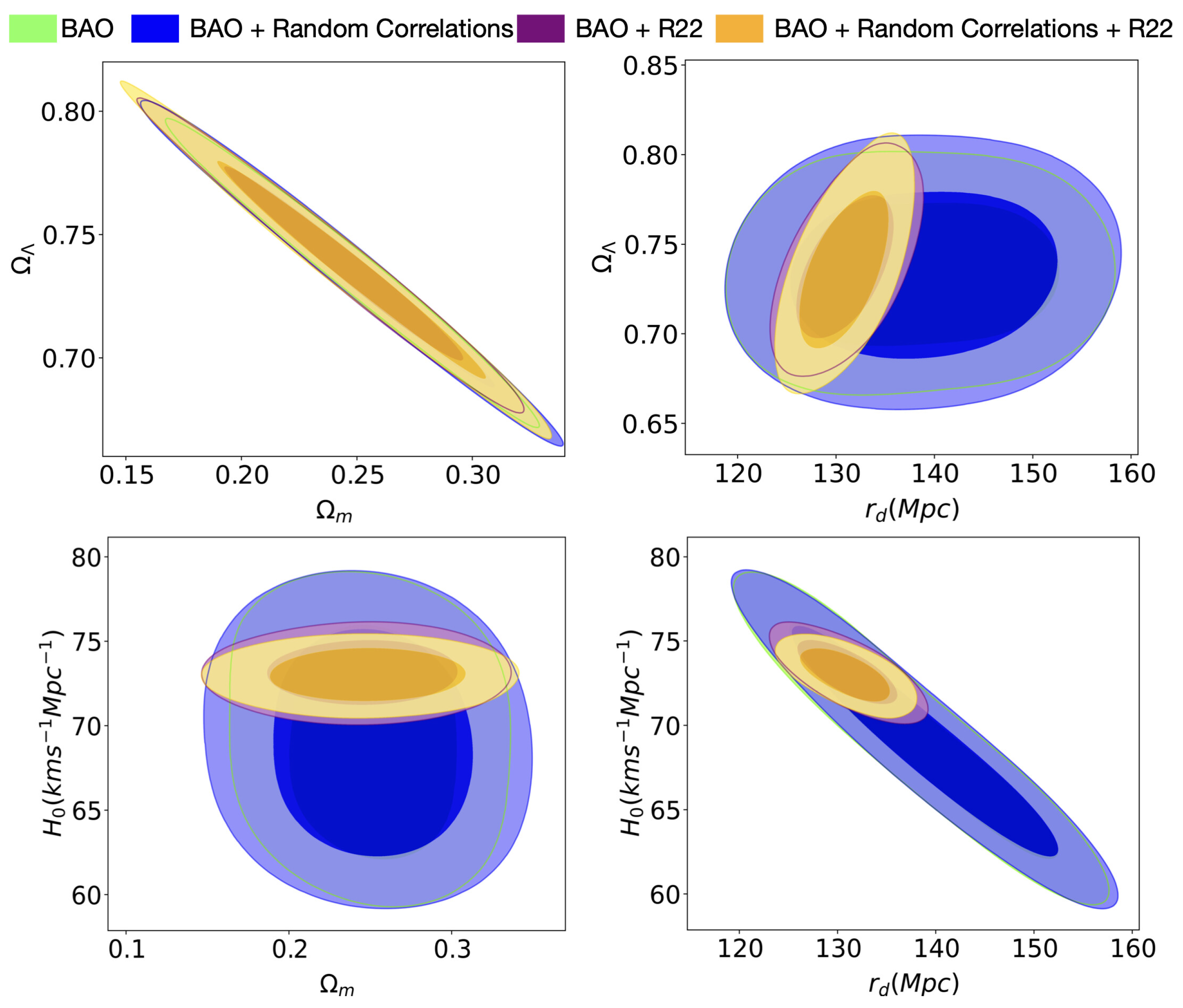
Figure 2.
The figure exhibits the posterior distribution for different observational data measurements with the CDM with and . The BAO refers to the baryon acoustic oscillations data set from Table 1. The CC data set refers to the cosmic chronometers and Pantheon refers to the Hubble diagram from type Ia supernovae, quasars measurements as QSR, and gamma-ray bursts measurements as GRB. R22 denotes [7] measurement of the Hubble constant as a Gaussian prior.
Figure 2.
The figure exhibits the posterior distribution for different observational data measurements with the CDM with and . The BAO refers to the baryon acoustic oscillations data set from Table 1. The CC data set refers to the cosmic chronometers and Pantheon refers to the Hubble diagram from type Ia supernovae, quasars measurements as QSR, and gamma-ray bursts measurements as GRB. R22 denotes [7] measurement of the Hubble constant as a Gaussian prior.
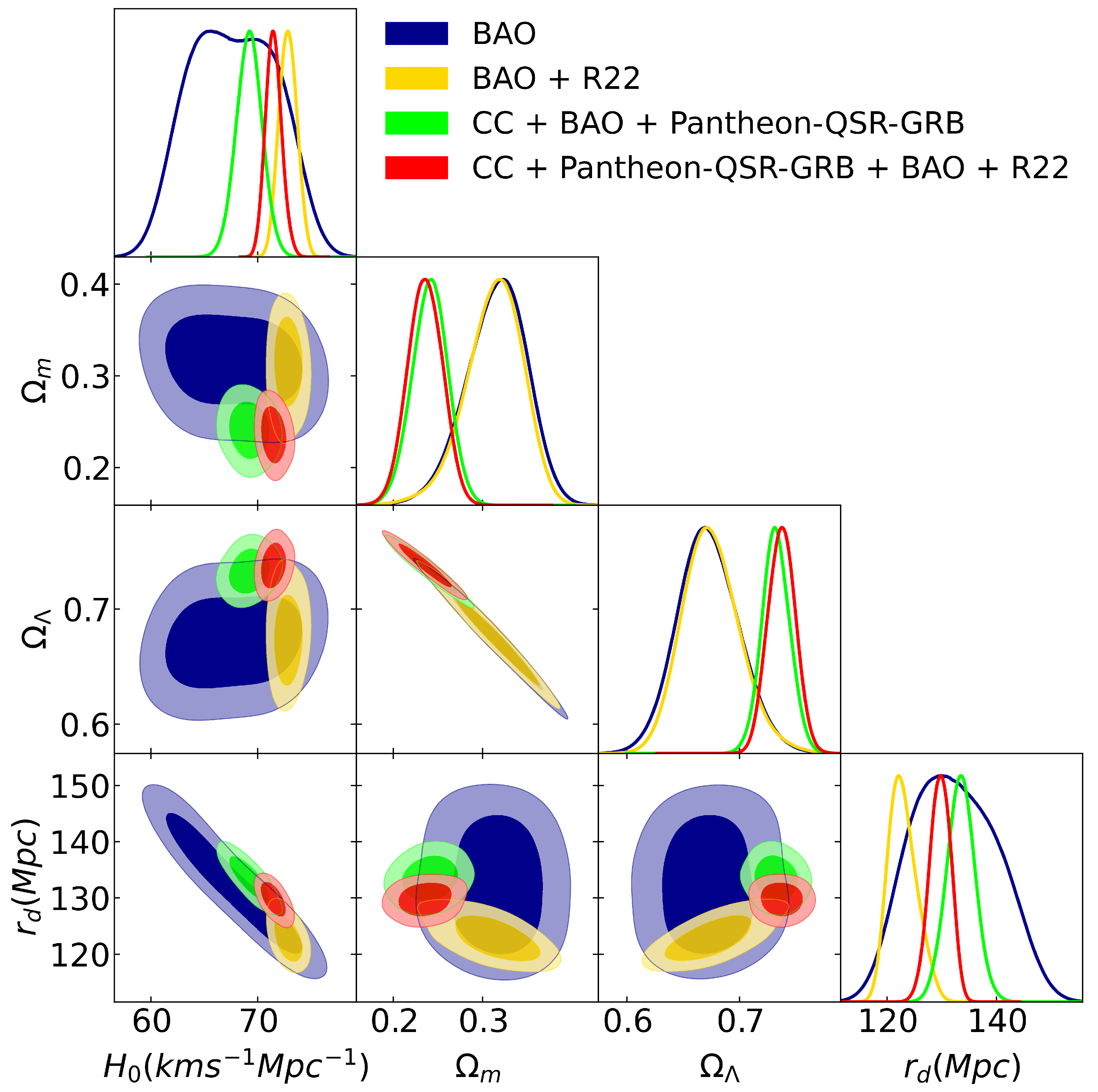
Figure 3.
The figure exhibits the posterior distribution for different observational data measurements with the wCDM model with and . The BAO refers to the baryon acoustic oscillations dataset from Table 1. The CC data set refers to the cosmic chronometers and Pantheon refers to the Hubble diagram from type Ia supernovae, quasars measurements as QSR, and gamma ray bursts as GRB. R22 denotes [7] measurement of the Hubble constant as a Gaussian prior.
Figure 3.
The figure exhibits the posterior distribution for different observational data measurements with the wCDM model with and . The BAO refers to the baryon acoustic oscillations dataset from Table 1. The CC data set refers to the cosmic chronometers and Pantheon refers to the Hubble diagram from type Ia supernovae, quasars measurements as QSR, and gamma ray bursts as GRB. R22 denotes [7] measurement of the Hubble constant as a Gaussian prior.
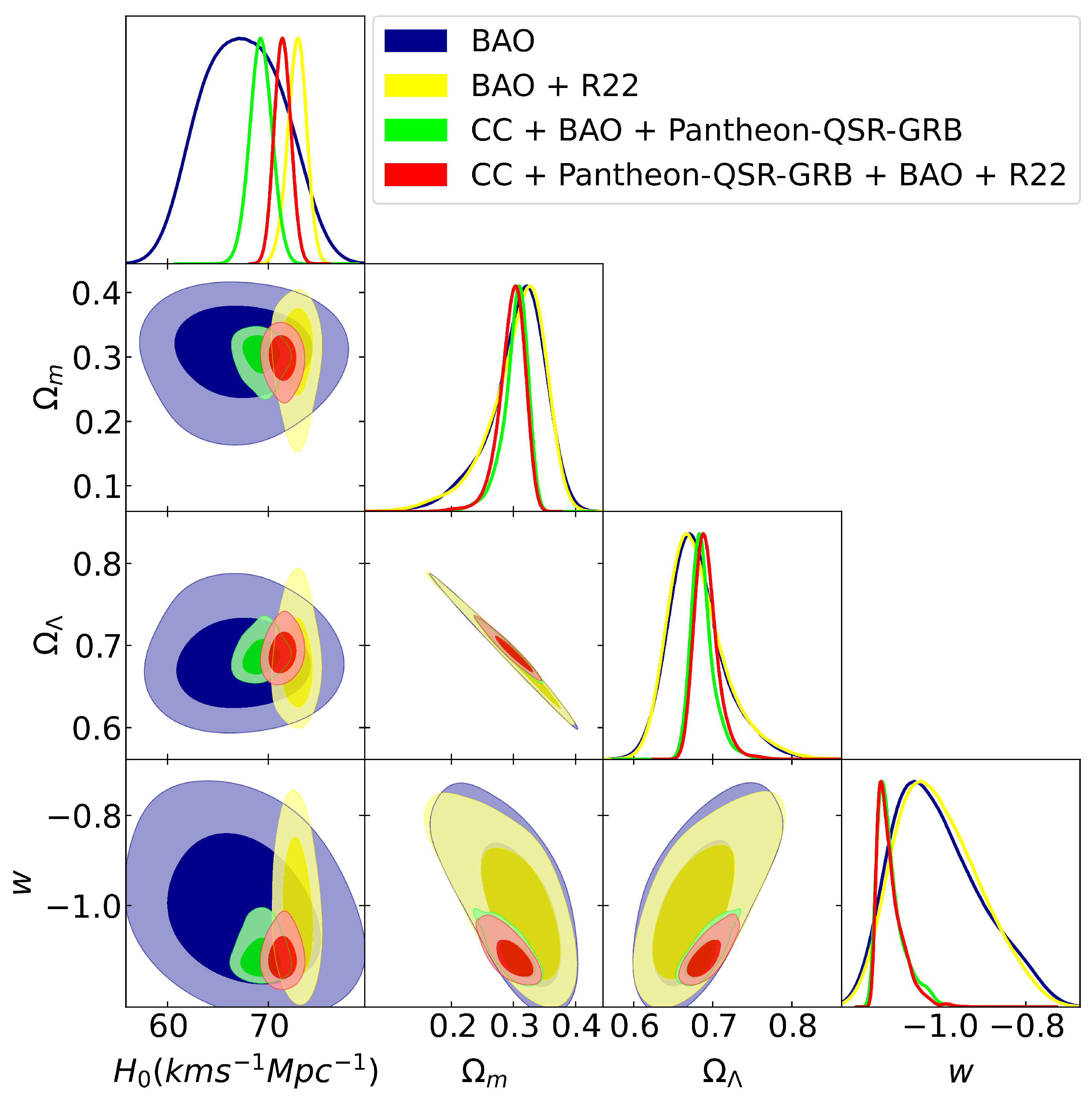
Figure 4.
The figure exhibits the posterior distribution for different observational data measurements with the wCDM with and in the contour plane. The BAO refers to the baryon acoustic oscillations data set from Table 1. The CC dataset refers to the cosmic chronometers and Pantheon refers to the Hubble diagram from type Ia supernovae, quasars measurements as QSR, and gamma ray bursts as GRB. R22 denotes [7] measurement of the Hubble constant as a Gaussian prior.
Figure 4.
The figure exhibits the posterior distribution for different observational data measurements with the wCDM with and in the contour plane. The BAO refers to the baryon acoustic oscillations data set from Table 1. The CC dataset refers to the cosmic chronometers and Pantheon refers to the Hubble diagram from type Ia supernovae, quasars measurements as QSR, and gamma ray bursts as GRB. R22 denotes [7] measurement of the Hubble constant as a Gaussian prior.
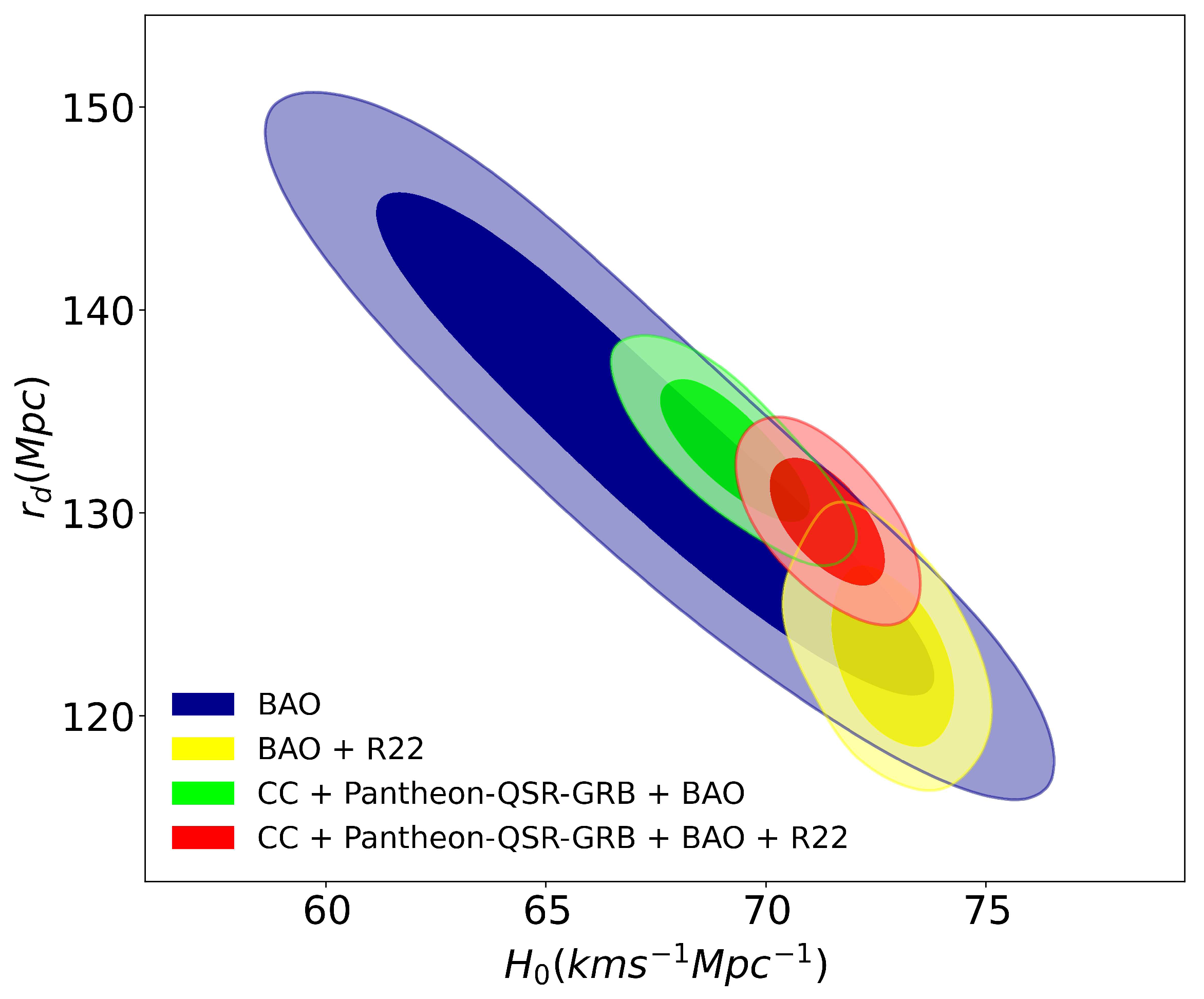
Figure 5.
The figure exhibits the posterior distribution for different observational data measurements with the CDM model with and . The BAO refers to the baryon acoustic oscillations dataset from Table 1. The CC data set refers to the cosmic chronometers and Pantheon refers to the Hubble diagram from type Ia supernovae, quasars, and gamma ray bursts. R22 denotes [7] measurement of the Hubble constant as a Gaussian prior.
Figure 5.
The figure exhibits the posterior distribution for different observational data measurements with the CDM model with and . The BAO refers to the baryon acoustic oscillations dataset from Table 1. The CC data set refers to the cosmic chronometers and Pantheon refers to the Hubble diagram from type Ia supernovae, quasars, and gamma ray bursts. R22 denotes [7] measurement of the Hubble constant as a Gaussian prior.
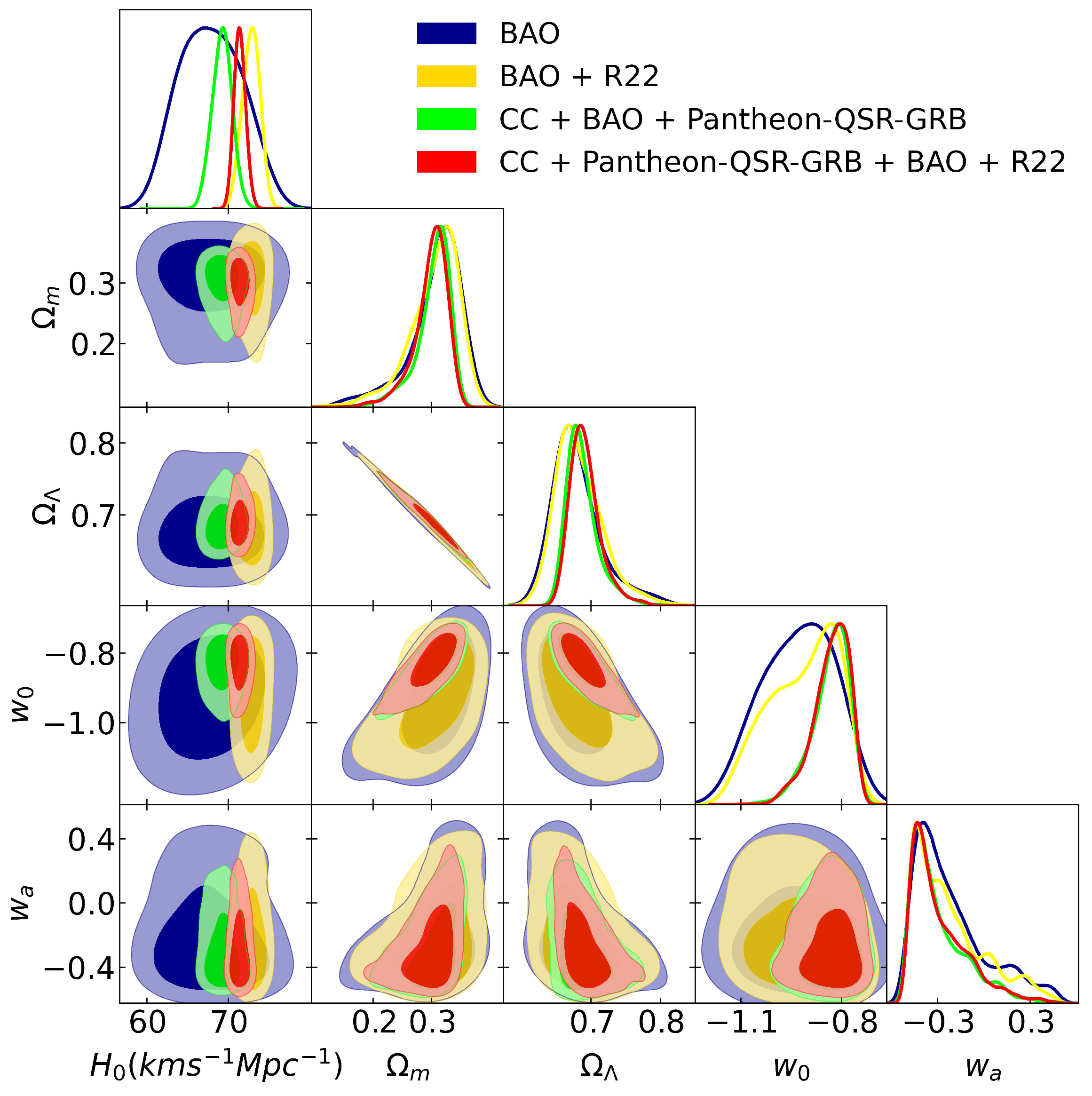
Figure 6.
The figure exhibits the posterior distribution for different observational data measurements with the CDM with and in the contour plane. The BAO refers to the baryon acoustic oscillations data-set from Table 1. The CC data set refers to the cosmic chronometers and Pantheon refers to the Hubble diagram from type Ia supernovae, quasars, and gamma ray bursts. R22 denotes [7] measurement of the Hubble constant as a Gaussian prior.
Figure 6.
The figure exhibits the posterior distribution for different observational data measurements with the CDM with and in the contour plane. The BAO refers to the baryon acoustic oscillations data-set from Table 1. The CC data set refers to the cosmic chronometers and Pantheon refers to the Hubble diagram from type Ia supernovae, quasars, and gamma ray bursts. R22 denotes [7] measurement of the Hubble constant as a Gaussian prior.
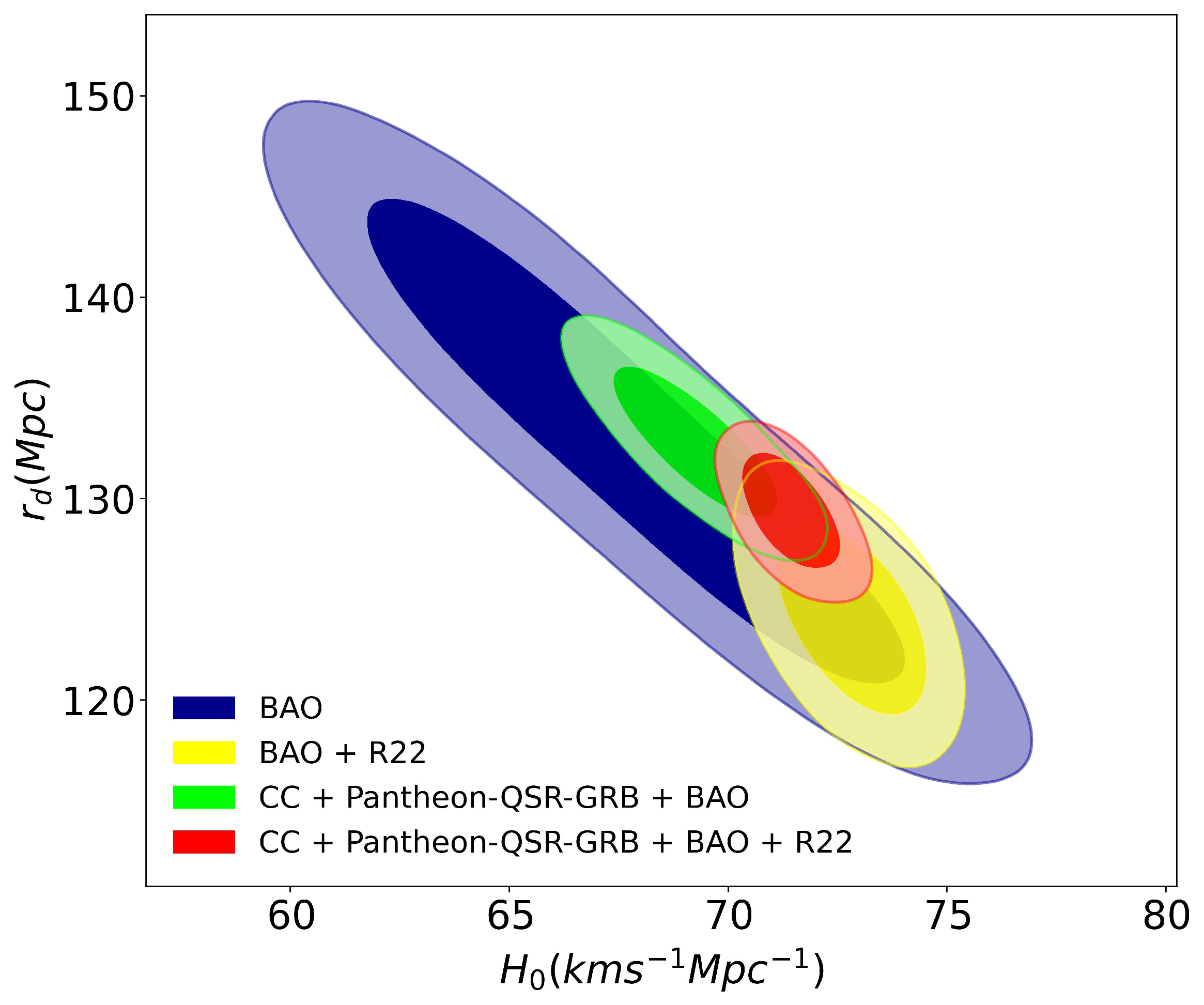

Table 1.
Sample of BAO uncorrelated data points on which we perform our analysis.
| Observable | Measurement | Error | Year | Data Set Survey | Reference | |
|---|---|---|---|---|---|---|
| 0.106 | 0.3366 | 0.015 | 2011 | 6dFGS BAO | [40] | |
| 0.11 | 2.607 | 0.138 | 2021 | SDSS Blue Galaxies sample | [49] | |
| 0.15 | 664 | 25 | 2015 | SDSS Main Galaxy Sample | [42] | |
| 0.38 | 1477 | 16 | 2017 | BOSS DR12 Galaxies | [43] | |
| 0.44 | 1716 | 83 | 2014 | WiggleZ Dark Energy Survey | [41] | |
| 0.51 | 1877 | 19 | 2017 | BOSS DR12 Galaxies | [43] | |
| 0.6 | 2221 | 101 | 2014 | WiggleZ Dark Energy Survey | [41] | |
| 0.61 | 2140 | 22 | 2017 | BOSS DR12 Galaxies | [43] | |
| 0.697 | 1529 | 73 | 2020 | DECaLS DR8 Footprint LRG Sample | [44] | |
| 0.698 | 19.77 | 0.47 | 2020 | eBOSS DR16 LRG Sample | [45] | |
| 0.73 | 2516 | 86 | 2014 | WiggleZ Dark Energy Survey | [41] | |
| 0.835 | 18.92 | 0.51 | 2022 | DES Year 3 | [50] | |
| 0.845 | 18.32 | 0.58 | 2020 | eBOSS DR16 LRG Sample | [46] | |
| 0.874 | 1674 | 102 | 2020 | DECaLS DR8 Footprint LRG Sample | [44] | |
| 1.48 | 13.11 | 0.52 | 2020 | eBOSS DR16 Quasar Sample | [47] | |
| 2.33 | 37.5 | 1.1 | 2020 | eBOSS DR16 Ly-Quasar | [48] | |
| 2.33 | 8.99 | 0.19 | 2020 | eBOSS DR16 Ly-Quasar | [48] |
Table 2.
Variation of some cosmological parameters according to the number of correlated pairs. The values with uncorrelated pairs () are slightly different when correlated pairs () are introduced.
Table 2.
Variation of some cosmological parameters according to the number of correlated pairs. The values with uncorrelated pairs () are slightly different when correlated pairs () are introduced.
| n correlated pairs | BAO | BAO + R22 |
|---|---|---|
| n=0 | = 0.2502 ± 0.0321 | = 0.2474 ± 0.0381 |
| = 0.7338 ± 0.0257 | = 0.7359 ± 0.0280 | |
| n=12 | = 0.2587 ± 0.0178 | = 0.2571 ± 0.0290 |
| = 0.7355 ± 0.0274 | = 0.7371 ± 0.0239 |
Table 3.
Constraints at 95% CL on the cosmological parameters for the standard CDM model based on baryon acoustic oscillations (BAO), cosmic chronometers (CC), Pantheon-QSR-GRB, and additional prior R22.
Table 3.
Constraints at 95% CL on the cosmological parameters for the standard CDM model based on baryon acoustic oscillations (BAO), cosmic chronometers (CC), Pantheon-QSR-GRB, and additional prior R22.
| Parameters | BAO | BAO + R22 | BAO+CC+Pantheon-QSR-GRB | BAO+R22+CC+Pantheon-QSR-GRB |
|---|---|---|---|---|
| [Km s Mpc] | 67.74 ± 4.40 | 72.85 ± 1.21 | 69.21 ± 1.22 | 71.50 ± 1.096 |
| 0.3157 ± 0.0341 | 0.3132 ± 0.0310 | 0.2411 ± 0.0290 | 0.2358 ± 0.0281 | |
| 0.6724 ± 0.0254 | 0.6748 ± 0.0243 | 0.7325 ± 0.0121 | 0.7376 ± 0.0125 | |
| [Mpc] | 132.28 ± 8.66 | 122.85 ± 2.58 | 133.46 ± 2.49 | 129.72 ± 2.90 |
| 0.9932 ± 0.0647 | 0.9218 ± 0.0141 | 0.9913 ± 0.0179 | 0.9620 ± 0.0102 |
Table 4.
Constraints at 95% CL on the cosmological parameters for the wCDM model based on baryon acoustic oscillations (BAO), cosmic chronometers (CC), Pantheon-QSR-GRB, and additional prior R22.
Table 4.
Constraints at 95% CL on the cosmological parameters for the wCDM model based on baryon acoustic oscillations (BAO), cosmic chronometers (CC), Pantheon-QSR-GRB, and additional prior R22.
| Parameters | BAO | BAO + R22 | BAO+CC+Pantheon-QSR-GRB | BAO+R22+CC+Pantheon-QSR-GRB |
|---|---|---|---|---|
| [Km s Mpc] | 67.43 ± 4.36 | 72.82 ± 1.47 | 69.25 ± 1.06 | 71.39 ± 1.11 |
| 0.3062 ± 0.0433 | 0.3055 ± 0.0447 | 0.3026 ± 0.0197 | 0.2974 ± 0.0187 | |
| 0.6799 ± 0.0325 | 0.6803 ± 0.0346 | 0.6871 ± 0.0134 | 0.6918 ± 0.0147 | |
| w | -1.006 ± 0.107 | -1.003 ± 0.101 | -1.111 ± 0.030 | -1.112 ± 0.0286 |
| [Mpc] | 133.29 ± 8.30 | 122.95 ± 2.74 | 133.08 ± 2.29 | 129.57 ± 2.64 |
| 0.9999 ± 0.0637 | 0.9231 ± 0.0164 | 0.9939 ± 0.0151 | 0.9663 ± 0.0106 |
Table 5.
Constraints at 95% CL on the cosmological parameters for the CDM model based on baryon acoustic oscillations (BAO), cosmic chronometers (CC), Pantheon-QSR-GRB, and additional prior R22.
Table 5.
Constraints at 95% CL on the cosmological parameters for the CDM model based on baryon acoustic oscillations (BAO), cosmic chronometers (CC), Pantheon-QSR-GRB, and additional prior R22.
| Parameters | BAO | BAO + R22 | BAO+CC+Pantheon-QSR-GRB | BAO+R22+CC+Pantheon-QSR-GRB |
|---|---|---|---|---|
| [Km s Mpc] | 67.88 ± 4.32 | 72.82 ± 1.20 | 69.25 ± 1.24 | 71.43 ± 1.01 |
| 0.3074 ± 0.0403 | 0.3058 ± 0.0408 | 0.3033 ± 0.0250 | 0.2989 ± 0.0268 | |
| 0.6802 ± 0.0331 | 0.6826 ± 0.0315 | 0.6871 ± 0.0216 | 0.6914 ± 0.0213 | |
| -0.926 ± 0.126 | -0.910 ± 0.123 | -0.830 ± 0.0925 | -0.828 ± 0.095 | |
| -0.214 ± 0.230 | -0.225 ± 0.227 | -0.292 ± 0.167 | -0.285 ± 0.169 | |
| [Mpc] | 132.68 ± 8.66 | 124.09 ± 2.94 | 132.79 ± 2.21 | 129.33 ± 2.71 |
| 1.000 ± 0.062 | 0.9334 ± 0.0202 | 0.9961 ± 0.0162 | 0.9680 ± 0.0109 |
Disclaimer/Publisher’s Note: The statements, opinions and data contained in all publications are solely those of the individual author(s) and contributor(s) and not of MDPI and/or the editor(s). MDPI and/or the editor(s) disclaim responsibility for any injury to people or property resulting from any ideas, methods, instructions or products referred to in the content. |
© 2023 by the authors. Licensee MDPI, Basel, Switzerland. This article is an open access article distributed under the terms and conditions of the Creative Commons Attribution (CC BY) license (http://creativecommons.org/licenses/by/4.0/).
Copyright: This open access article is published under a Creative Commons CC BY 4.0 license, which permit the free download, distribution, and reuse, provided that the author and preprint are cited in any reuse.


