

Submitted:
29 June 2023
Posted:
03 July 2023
You are already at the latest version
Preprints on COVID-19 and SARS-CoV-2
Abstract
With the global outbreak of COVID-19, the panic buying incidents triggered by the variants of the Omicron strain have severely affected the normal social order. This paper considers the complex interest game and interactive relationship among multiple subjects in the mass panic buying event caused by rumors and constructs a three-party evolution game model of local government, rumor-monger, and public. Based on the theory of evolution game, the evolutionary process of the strategy selection of game subjects is studied, and the strategy selection of the three-game subjects under different scenarios is compared and analyzed. Taking the example of the montmorillonite powder panic buying caused by the XBB virus strain rumor in China, the evolutionary game model constructed in this study is simulated and analyzed. The study shows that: the evolution process of the mass panic buying event is characterized by six stages: the initial stage E1(0,0,0); the outbreak stage E3(0,1,0);the spread stage E7(0,1,1);the climax stage E8(1,1,1);the relief stage E5(1,1,0);and the recovery stage E4(1,0,0); there are four stable points in the evolutionary game of the three game subjects, namely (no intervention, no rumor, no panic buying), (no intervention, rumor, no panic buying), (intervention, no rumor, no panic buying), and (intervention, rumor, no panic buying), and the strategy of government intervention will be adjusted according to the strategy selection of the public and the rumor-monger; under the mechanism of reward and punishment of the higher-level government, increasing the punishment and reward intensity of the higher-level government will promote the local government to intervene in the rumor-mongering event faster, but increasing the reward intensity has a more significant impact on the intervention behavior of the local government than punishment, and increasing punishment intensity has a more significant impact on the non-rumor-mongering behavior of the rumor-monger than reward; the parameters of social risk-bearing cost, risk transmission coefficient, rumor-mongering income and cost, and public drug purchase cost have different degrees of influence on the evolutionary behavior of game subjects. This study provides new ideas for effectively responding to mass panic buying events in the context of public emergencies.
Keywords:
group panic buying incidents
; evolutionary mechanisms
; evolutionary game
; strategy equilib-rium
; simulation
MSC: 91-10
1. Introduction
With the full outbreak and spread of the COVID-19 pandemic, there have been numerous panic buying around the world. These events not only threaten the safety and property of consumers but also have a serious impact on social security and order. Panic buying typically refers to excessive behavior by individuals or groups in a certain social context to obtain specific goods, leading to phenomena such as shortage of supplies, price increases, and social disorder. Such events usually occur under certain specific circumstances, such as during a pandemic when people scramble to purchase protective equipment such as masks, disinfectants, and antigen tests; or during natural disasters when people scramble to purchase essential survival items such as food and water. The characteristic of such events is their large scale, strong impact and harm, and the behavior of the shoppers is easily extreme, such as fighting, shoving, and trampling.
In the situation of information asymmetry, some businesses take advantage of the opportunity to spread rumors, causing short-term price increases for related goods, seriously affecting normal purchasing orders in society, and causing serious harm to public safety. For example, during the SARS period in 2003, rumors appeared on some websites and social media claiming that Isatis Root [1] was a drug that could prevent and treat SARS, leading to many citizens scrambling to buy it. In 2011, the nuclear leakage accident caused by the tsunami at the Fukushima nuclear power plant in Japan affected the Chinese salt market. Rumors claim that 'salt safety will be affected by nuclear radiation ', resulting in a large number of coastal residents hoarding salt [2]. Similar events also occurred on January 31, 2020, when a rumor about 'Shuanghuanglian' [3]is an effective drug for treating COVID-19 was spread on Internet social media, causing many citizens to rush to buy. In 2023, the Omicron variant XBB.1.5 [4,5] is spreading widely in the United States, causing rumors to spread urging people to stockpile diarrhea drugs such as montmorillonite powder [6], norfloxacin, and intestinal micro-ecological agents. The above events demonstrate that the spread of rumors can cause sudden rushes and hoarding of goods by the public, resulting in a shortage of supplies and seriously affecting normal purchasing order in society. It is of great practical significance to explore the causes and evolution mechanism behind such events for the effective prevention and control of panic buying in sudden public crises.
The remainder of this paper is organized as follows. Section 2 reviews the relevant literature in terms of the causes, influencing factors and evolutionary mechanisms of panic buying behavior. Section 3 presents the basic assumptions and construction of the relevant game model in this article. The calculation and discussion of the three-party game in Section 4. The analysis of the relevant equilibrium points according to the Jacobi equation of the game in Section 5. The case study of the rumor-induced Montmorillonite powder panic buying in Section 6. The MATLAB simulation in Section 7. Finally, conclusions and recommendations are proposed for the sudden mass panic buying events.
2. Literature Review
Currently, research in the academic field on panic buying can be summarized into three main categories. The first category mainly studies the causes of panic buying events. For example, items are divided into categories such as medical drugs, personal protective equipment, and daily necessities. Panic buying occurs when items that have a good curative effect or can play a critical protective role in this sudden crisis event are widely publicized through various information channels, triggering large-scale panic buying by the public. Scholars such as He [7], and Xu [8] have analyzed the reasons behind the panic buying of Shuanghuanglian from the perspective of journalism and professional media, and sorted out the process of the entire event and its spread. Some news media have caused items to be madly snapped up just to gain more views and exposure by promoting false information. During the rampant COVID-19 pandemic, masks were the most effective way to block the spread of the virus and faced the situation of one mask is hard to find. Using the example of the Korean government's restrictive purchasing policy for masks during the COVID-19 pandemic, Paek et al. [9] argued that the main cause of an excessive shortage of masks was due to people's panic buying and suppliers' hoarding of items. To more effectively solve this problem, it requires the cooperation of multiple stakeholders such as government departments, suppliers, retailers, and the public, and start with six key elements of product supply, price, promotion, distribution, cooperation, and policy. Similarly, edible salt as a necessary item for daily life is also sought after by the public. Wei et al. [10] constructed an evolutionary dynamics theory model of panic buying behavior by introducing the theory of group behavior dynamics and analyzed the reason why the iodized salt was snapped up in coastal areas of China due to the nuclear leakage crisis caused by the earthquake in Japan. The study showed that during the COVID-19 pandemic, following expert guidance, spreading false information, creating panic, personal hoarding behavior, and caring for family and friends can indirectly trigger the occurrence of group panic buying behavior. During the COVID-19 pandemic, most products experienced a shortage to some extent. Chen et al. [11] analyzed the reasons for this phenomenon. External environmental stimuli, home confinement measures, the intensity of pandemic information dissemination, perception of the crisis, and commodity prices can all cause the public to panic buy different types of items. Most scholars only focus on the reasons for the panic buying of physical products, and only a very few have realized the reasons for panic buying and digital hoarding of virtual products such as paid social Q&A during the COVID-19 pandemic. Wang et al. [12] found through their study using the SOBC (Surprise, Opportunity, Belongingness, and Control) framework model that online paid Q&A can create emotional resonance among platform users, thereby stimulating their willingness to pay and ultimately lead to digital hoarding and panic buying behavior. From the above research, it can be seen that the causes of triggering buying frenzies include social media, dissemination of harmful information, public panic buying, supplier hoarding for profit, and conformity bias, among others.
The second type of research focuses on the influencing factors of panic buying and hoarding behavior, and many scholars have analyzed the influencing factors based on mathematical models. Sun et al. [13] demonstrated through the construction of a binary logistic regression model using panic buying of masks as a case study that factors such as age, education level, occupation, reference group influence, and product scarcity all have a significant impact on panic buying behavior in crises. The research results indicate that in emergencies, people's consumption behavior may be different from usual, and non-economic factors may become the main influencing factors in purchasing decisions. Wang et al. [14] analyzed and demonstrated that the actual demand for drugs by the public is the objective reason for the occurrence of panic buying behavior, and it will be influenced by other key factors such as public fear and herd mentality. Panic buying behavior has also been referred to as panic buying and competitive buying by other scholars. He and Hu [15] analyzed the purchase of masks from an economic perspective and concluded that competitive buying during the COVID-19 pandemic is a kind of hoarding behavior taken when people's perception of the reserve value of the purchased item is higher than its retail price, and this behavior will ultimately lead to further tightening of medical resource supply. Panic buying behavior will also have a certain impact on the retail industry in the market and will affect the different behavioral strategy decisions of retail industry merchants. Kogan and Herbon [16] assuming that the supply chain was disrupted globally, demonstrated from the perspective of the retail industry in the market the psychological and optimal behavioral strategy choices of corresponding retailers triggered by consumer panic buying during the COVID-19 pandemic. In the initial stage of panic buying, retailers will adopt a wait-and-see (intentional scarcity) strategy to suppress the inventory in the market, and ultimately, the price of retained products will increase based on the supply-demand relationship. The government can increase retail prices in the initial stage and then lower them to improve the supply efficiency of goods in the market. Yang and Ren [17] taking the epidemic control policy adopted during the domestic Omicron variant period in China as an example, analyzed through the Protection-Adoption-Decision-Making (PADM) model and found that panic buying behavior is a stress response taken by the public in a dangerous situation, and society will implement coping behaviors based on the perception and decisions of policy decision-makers corresponding to their risks. They also believe that panic buying behavior will be influenced by factors such as media exposure, public protective cognition, public risk cognition, and stakeholders. When local governments adopt control policies, the public's freedom is often restricted. Xu et al. [18] took the control policy adopted by the Chinese government in epidemic prevention and control as a case study and established a game model of evolution for both local governments and the public. They used the cost-benefit analysis method in economics to study the behavioral evolution trend of all parties in responding to sudden major public health events. When implementing a series of epidemic prevention and control measures, people's mental health can also be affected to a certain extent. Prolonged implementation of lockdown policies in a region often triggers a series of psychological illnesses. Some scholars have analyzed this phenomenon through online survey questionnaires. Using an online survey questionnaire as a source of quantitative data analysis, Niu et al. [19] constructed a three-stage individual behavior decision-making model of information input-information processing-behavior output based on nearly 20,000 survey questionnaires, demonstrating that panic buying behavior during major public health events is influenced by education level, family background, gender, age, and many other factors. To further explore the factors behind panic buying behavior, Lavuri and Jaiswal [20] demonstrated through sampling surveys based on the stimulus theory and the dual-factor theory that consumers' panic buying behavior during the COVID-19 pandemic is influenced by both internal factors (promotion activities and marketing environment) and external factors (hedonism and materialism). During the COVID-19 pandemic, consumers' income has a very important impact on their panic buying behavior. Based on sales data from 144 retail stores in the state of Sao Paulo, Brazil, de Brito and Yoshizaki [21] compared sales data of various product categories before and after the epidemic, and combined them with regression models to analyze data on demographic information, actual sales, and per capita income. They found that panic buying behavior has a minimal impact on areas where per capita income is below average, but it will increase with the increase in per capita income. The GNPOs (government non-profit organization) played a crucial role in the supply chain during the COVID-19 pandemic and had unique advantages in resource mobilization, integration, and allocation [22]. From an enterprise perspective, increasing research and development in green intelligent supply technology will enhance the efficiency of procurement and supply processes, thus reducing environmental pollution caused by the supply chain [23]. Therefore, the government's policies during the epidemic should start with maintaining the basic daily life of the people, to alleviate consumer panic and ultimately reduce panic buying behavior. The above studies indicate that consumers' personal characteristics, payment willingness, product scarcity, supply chain congestion, and other factors can all affect panic buying behavior, but the above literature lacks consideration of the impact of the cost of public panic buying, the cost of rumor-mongering, and the cost of government intervention.
The third type of research focuses on the evolving mechanism behind the panic buying events. Most scholars explore the emergence, development, and evolutionary mechanisms of mass panic buying events by analyzing the game theory relationship between the participating entities in the panic buying events. Wang et al. [24] took the edible iodized salt event caused by the 2011 Japanese nuclear leak as an example, constructed a two-party game model between the government and the public based on the prospect theory and the benchmark situation and the panic buying situation, and calculated the payoff matrices and stable equilibrium points for both parties based on considering public perception, and analyzed their stability. The government plays an indispensable leading role in sudden collective events and mainly exerts the macro-control function of the government through punishment or incentive means. With the increasingly complex social environment, sudden collective events occur from time to time. Luo et al. [25] divided sudden collective events into six stages: pre-crisis, crisis, mid-crisis, end of the crisis, post-crisis, and termination of crisis, and constructed the static structural diagram and dynamic flow chart of the evolutionary mechanism based on the causes, participating entities, and conflicting points of the events, providing suggestions for the prevention and handling of collective sudden events. Some scholars have also studied the evolutionary laws and behavioral tendencies of collective sudden events. Wei et al. [26] divided the process of mass panic buying into four stages: formation, reinforcement, implementation, and dissolution, each of which has different characteristics and performances. He believes that the behavior pattern of the participating group needs three elements, namely, activity is how participating entities express their personal demands in collective events, mutual influence is the interaction between different participating entities, and emotion reflects the psychological activities of participating entities. Some scholars have studied the mechanism of panic buying. Xu et al. [27] regarded panic buying as a process of limited rationality-irrationality-returning to rationality, and combined with the emergency management operation modes of the United States, Russia, Japan, and other countries, analyzed the current situation of emergency management in China and put forward improvement suggestions. Wang and Li [28] used the set description method to explore the phenomenon of looting in a truck accident. Based on the cumulative prospect theory and game theory, they constructed an evolutionary game model and calculated the corresponding payoff matrices and relevant equilibrium points. Based on this, they also verified their conclusions through simulation. Some scholars have summarized the mechanism, evolution process, and stages of sudden panic buying events. Xie et al. [29] accurately defined the concept of sudden panic buying. Such sudden panic buying events have the characteristics of uncertainty, concentration, panic and abnormal purchasing, etc., and occur after the spread of information triggered by social events or natural disasters. The entire process goes through four stages: the occurrence period, development period, peak period, and subsiding period. Therefore, the earlier the government takes measures to intervene, the lower the peak of panic buying behavior, the duration of panic buying, and the harm caused to society can be reduced. Regarding the relationships between multiple stakeholders in a sudden public crisis event, Shufeng et al. [30] found through research that when there are conflicting interests between the government, social organizations, and the public, a systematic approach should be taken to focus on the points of conflict of interest among multiple stakeholders and pay attention to the interaction between different stakeholders within the system. Shan et al. [31] studied the possible impacts of panic buying behavior in public health emergencies, such as resource waste, price fluctuations, and unequal distribution of epidemic prevention materials. And applying evolutionary games theory to analyze the optimal strategic choices of different stakeholders (the public, government, and enterprises) can help reduce the likelihood of panic buying.
In summary, although the above-mentioned studies have studied the evolutionary process of large-scale panic buying events, they still lack the analysis of the subject of the rumor-monger and the analysis of real cases. Compared with the previous studies, the primary contributions of this thesis are as follows: (1) From the perspective of large-scale panic buying caused by online rumors, an evolutionary game model between local governments, rumor mongers and the public is constructed considering the analysis of rumor mongers; (2) The influence of various factors on strategy choice is analyzed, the evolutionary process of strategic choice of each game party under the government reward and punishment mechanism is considered, and the evolutionary stable equilibrium of the behavioral strategies of the three game parties is compared; (3) Through a case study of panic buying in Montelukast, the panic buying event is divided into different stages and verifies each stage in the evolutionary game process, and simulating the game evolution process using MATLAB software to analyze the impact of various factors on the choice of strategies.
3. Basic assumptions and model construction
The existence of rumor-mongers in sudden public health events who create and spread rumors can cause public panic and induce rush events, resulting in social disorder and affecting social stability. Active government intervention in crisis events is an effective measure that can solve sudden mass panic buying events. Therefore, the government and the rational public are the basic factors that promote social stability, while the existence of certain rumor-mongers becomes a negative factor that affects social security and stability. Therefore, this paper assumes that the three parties of the game in the analysis of the emergency public health event-related goods rush process are the local government, the rumor-monger, and the public who make panic buying or not. The specific variables that define the different behavioral choices of the relevant stakeholders are as follows shown in Table 1:
Assumption 1.
Relevant parameter settings regarding local government.
The local government weighs the advantages and disadvantages after the occurrence of a sudden mass purchase incident and considers whether to intervene, including the release and adjustment of policies, the regulation of drug prices, the disinformation of rumors, and the punishment of rumor-mongers.
The local government adopts the policy of intervention and non-intervention in response to the incident of sudden mass rush events. (1) The probability of adopting the intervention policy strategy is, and the main intervention behaviors are to dispel rumors and take a series of punishments against the rumor-monger. (2) The probability of adopting the no intervention policy is, meaning that the government does not regulate and adjust the rumor monger whether he chooses to make a rumor or not.
Where the assumptions about whether the local government intervenes are as follows: when the government intervenes in the rumor of disinformation, it will incur certain intervention costs related to human and material resources is. At the same time, the local government will give certain rewards to the higher government when it can carry out certain intervention behaviors in the event of disinformation, and the higher government will carry out certain penalties when the local government carries out inaction without intervention, and as the disinformation situation emergence will cause social instability and leads to social risk which government needs to bear the loss of is.
Assumption 2.
Parameters related to whether the disinformation agent is a rumor monger or not.
Rumor mongers are people who consider whether to spread and pass on rumors in order to make profits in sudden mass buying events. They spread rumors on certain platforms and networks to gain attention and popularity in order to make profits. And their specific behaviors include exaggerating the effects and efficacy of the drugs concerned to trigger buying behavior, and taking further speculation in response to the adjustment of national policies.
It is assumed that the rumor-monger adopts the behavior of rumor without disinformation in response to the situation of the sudden mass rush event. (1) The probability of adopting the strategy of disinformation behavior is, which refers to the ability to distort the facts and further exaggerate the spread of the situation of the sudden public health event, to obtain certain attention and gain. (2) The probability of adopting a non-disinformation strategy is, which refers to the ability, to be honest, and trustworthy, abide by national policies, and consciously maintain a good network environment during emergencies.
Among them, the assumptions about whether the rumor monger creates a rumor are as follows: when the rumor monger makes a rumor, it will incur certain material resources such as time and financial resources related to the cost of the rumor is, but it will also gain certain traffic and fans and other benefits is At the same time, if the local government intervenes to dispel the rumor and punish the situation, the rumor-monger will have to pay the corresponding cost penalty , and because rumor-mongering may cause social risk problems, which is not conducive to social stability, and considering the problems related to the spread of rumors. It is assumed that the coefficient of social risk transmission is, , then the social risk of public panic buying due to rumor-mongering the rumor-monger needs to bear the responsibility for the loss is.
Assumption 3.
Relevant parameter settings for the social public.
The public mainly refers to the group of people who consider whether to purchase the relevant goods normally and cooperate with the government's relevant policies and measures due to external factors and cognitive level in the sudden mass purchasing event.
It is assumed that the social public adopts the behavior of panic buying and not panic buying in response to the situation of sudden mass rush events. (1) The probability of adopting the strategy of panic buying behavior is, which mainly refers to the behavior of snapping up a large number of items due to the wrong cognitive level of sudden rush events; (2) The probability of adopting the strategy of not snapping behavior is , which refers to the behavior of buying the relevant items normally.
The following assumptions are made about whether or not the public will rush to buy: the cost of the public's normal purchase of goods is; the cost of the public's purchase of goods under the panic of the emergency without rumors is ; the cost of the public's rush to buy goods in large quantities when the rumor-mongers start rumors is ; after the local government intervenes, the rush to buy is partially reduced in which the cost of public buying is . The parameter size relationship is. The parameter size relationship is.
Based on the above assumptions, the evolutionary game model among three types of subjects, namely, local government, rumor mongers, and the public is constructed, and the benefits of different strategy combinations of the three types of subjects are shown in Table 2.
4. Evolutionary game model construction
4.1. Stability of local government evolutionary strategies
According to the benefits of the strategy combinations in Table 2., it is possible to obtain the local government intervention strategy is with the no intervention strategy is. The expected benefits and the average benefits of the local government subject strategy are, respectively:
The dynamic equation for whether the local government subject intervenes in the strategy replication is
Let , then.
Let , then ,According to the stability theorem of the differential equation, if the probability of a local government entity choosing an intervention strategy is in a steady state, then the conditions and be satisfied. When, one obtains , and any value of is an evolutionarily stable strategy for a government subject whose strategy does not change over time. When , two scenarios occur:
(1) When ,then ,, At this point is the stabilization strategy that evolves and the government will choose the intervention strategy.
(2) When 时,then , , At this point is the stabilization strategy that evolves and the government will choose the non-intervention strategy.
4.2. Stability of the evolutionary strategy of rumor mongers
According to the benefits of the strategy combinations in Table 2, the rumor monger disinformation strategy can be obtained and the no rumor strategy is the expected benefit and the average benefit of the disinformation subject strategy are as follows, respectively:
The dynamic equation for whether the rumor subject replicates the choose disinformation strategy is
According to the stability theorem of the differential equation, if the probability that the subject of a disinformation campaign chooses a disinformation strategy is in a steady state, then the conditions and be satisfied.
(1) When , ,is stable at this point for any;
(2) When , ,then ,is an evolutionary stabilization strategy;
(3) When 时,,then , is an evolutionary stabilization strategy. The phase diagram of the evolution of the disinformation agent's strategy is shown in Figure 1.
4.3. Stability of public evolutionary strategies
According to the benefits of the strategy combinations in Table 2, we can obtain the expected benefit of the public rush strategy is and the expected benefit of the public no panic buying strategy is, and the average benefit of the social public subject strategy is, respectively:
The dynamic equation for whether the social public subject replicates the strategy of snapping up is:
According to the stability theorem of the differential equation, if the probability of a social public subject choosing a snapping strategy is in a steady state, then the conditions and be satisfied.
(1) When ,,is stable at this point for any ;
(2) When ,,then , is an evolutionary stabilization strategy;
(3) When ,,then , is an evolutionary stabilization strategy. The phase diagram of the evolution of the strategy of the social public subject is shown in the Figure 2.
5. The stability analysis of the hybrid strategy
The system of replication equations (4) is obtained from equations (1) (2) (3) above and analyzed by Jacobi matrix (5).
It is known that there are nine equilibrium points in the game process between the local government, the rumor-monger, and the public, which are:E1 (0,0,0),E2 (0,0,1),E3 (0,1,0),E4 (1,0,0),E5 (1,1,0),E6 (1,0,1),E7 (0,1,1),E8 (1,1,1),E9 ; E9 ∈V,V={, for whether the nine equilibrium points of the above system of equations evolve stable, can be determined by the eigenvalues of the Jacobi matrix corresponding to each equilibrium point, when its eigenvalues are all less than 0, the equilibrium point is stable, and the Jacobi matrix of this game system is:
Taking the equilibrium point E1 (0,0,0) as an example, its Jacobi matrix can be abbreviated as
The eigenvalues of this Jacobi matrix are.
Similarly, the eigenvalues of the other eight equilibrium points corresponding to the Jacobi matrix are shown in Table 3; the eigenvalues of E9 are the solutions of the replicated system of equations.
Based on the expressions of the eigenvalues of each equilibrium point corresponding to the Jacobi matrix in Table 3, under the above assumptions. Because considering, the eigenvalues of E1 (0,0,0), E3 (0,1,0), E4 (1,0,0), E5 (1,1,0) , while the other equilibrium points have, so they are not involved in the discussion consideration. According to the range of values of each parameter in the expression, mainly are and, the stability of each equilibrium point can be discussed in the following four cases as Table 4.
5.1. Scenario 1
If means that the payoff cost of government intervention is greater than the reward the government receives when it intervenes and the penalty the government receives when it does not intervene. Therefore,, then the eigenvalues of E1 (0,0,0) and E3 (0,1,0) are.
(1). If, the gain for the rumor monger is less than the cost and penalty for the rumor monger. Therefore,, then the eigenvalues of E1 (0,0,0) is, the corresponding eigenvalues of the Jacobi matrix meet the condition that all are less than 0. E1 (0,0,0) is the evolutionary stability point; At this time corresponds to the strategic combination of (no intervention, no rumor, no panic buying), similar to what happens in the normal state, in the public does not rush, the rumor monger disinformation gain is less than the cost and punishment when the choice of no rumor and government At this time, the cost of non-intervention is the lowest and the society is in a stable state.
(2). If means that when the gain of the rumor monger is greater than the cost paid by the rumor monger. Therefore,, then the eigenvalues of E3 (0,1,0) is, and the corresponding eigenvalues of Jacobi matrix satisfy the condition that all are less than 0. E3 (0,1,0) is the evolutionary stability point; at this time, it corresponds to the strategic combination of (no intervention, rumor, and no panic buying), in which the rumor will choose disinformation when the gain is greater than the cost paid. The public will not choose panic buying when the government the cost of intervention is greater than the sum of the rewards of intervention and the penalties of non-intervention In this strategy, the government chooses not to intervene because the cost of intervention is greater than the sum of the reward of intervention and the penalty of non-intervention, and the government chooses not to intervene because the society is still in a stable state and the cost is the lowest.
5.2. Scenario 2
If means that the payoff cost of government intervention is smaller than the reward the government receives when intervening and the penalty the government receives when not intervening. Therefore,, then the eigenvalues of E4(1,0,0) and E5(1,1,0) are.
(1). If, the gain for the rumor monger is less than the cost and penalty for the rumor monger. Therefore,, then the eigenvalues of E4 (1,0,0) is, the corresponding eigenvalues of the Jacobi matrix satisfy the condition that they are all less than 0. E4 (1,0,0) is the evolutionary stability point; At this time, corresponding to the strategic combination of (intervention, no rumor, and no panic buying), this strategy in which the rumor monger gains less than the cost and penalty paid by the rumor monger will choose not to create rumors, and the public chooses not to panic buy in the case of social stability in the cost of government intervention is less than the sum of the rewards of intervention and the penalties of non-intervention, and the government gets the highest benefit by choosing to intervene, thus strengthening the role of social stability as a stabilization strategy.
(2). If, the gain of the rumor monger is greater than the cost of the rumor monger and the penalty. Therefore,, then the eigenvalues of E5 (1,1,0) is , and the eigenvalues of the corresponding Jacobi matrix satisfy the condition that they are all less than 0. E5 (1,1,0) is the evolutionary stability point; At this time, it corresponds to the strategic combination of (intervention, rumor, no panic buying), in which the gain of disinformation is greater than the cost of disinformation and the penalty of disinformation will choose rumor, and the public will choose no panic buying when society is in a stable state. The cost of government intervention is less than the sum of the rewards of intervention and the penalties of non-intervention, and the government gets the highest benefit by choosing to intervene while avoiding the social risk loss caused by disinformation can strengthen social stability, which is a stabilization strategy.
In summary, according to the above research hypotheses, the stable points of scenario 1-(1), scenario 1-(2), scenario 2-(1), and scenario 2-(2) are E1 (0,0,0), E3 (0,1,0), E4 (1,0,0), and E5 (1,1,0), respectively, and the public chooses the strategic of no panic buying in the combination of these stable points, and the society is in a relatively stable state at this time. Rumor mongers will consider their own costs and benefits and penalties when they choose to create disinformation and will choose to create disinformation if the benefits of disinformation outweigh the costs and penalties, and vice versa. If the costs of government intervention are less than the benefits and penalties, the government will choose to intervene in order to enhance social stability by avoiding the possible social risks caused by disinformation, and vice versa. Therefore, the government's intervention strategy will be adjusted according to the different situations of public snapping and disinformation, and the dynamic game of the three-game subjects will be in the process of continuous adjustment.
6. Case Study
This section takes the panic-buying of Montmorillonite powder in China in 2023 as an example to verify the validity of the above theoretical study and analyzes the evolution of strategic choices between the government, the rumor monger, and the public in the context of the introduction of the XBB variant into China.
Since the beginning of 2020, due to the impact of the new coronavirus epidemic, countries have adopted certain prevention policies to curb the large-scale outbreak, and according to the coronavirus database, scientists determined that the first mutant strain of XBB1.5 was born in 2022.on August 3, 2022, XBB was first discovered in India and has now spread to more than 70 countries and become a major epidemic strain in Singapore. The earliest sample of the XBB1.5 variant was found in New York in October 2022, and XBB.1.5 has become the dominant strain in the United States by the end of 2022.A new variant of Omicron was found in China in August 2022, the first case was introduced in October, and a total of 16 cases of indigenous XBB were detected in December. On December 20, at the press conference of the Joint Prevention and Control Mechanism of The State Council, the director of the Institute of Viral Diseases of the Chinese Center for Disease Control and Prevention, introduced that BQ.1 and XBB were new mutated branches of Omicron, which opened the beginning of the panic-buying for Montmorillonite powder caused by XBB.1.5 strain.
The panic-buying roughly went through the evolutionary process of "the beginning stage (December 20), the outbreak stage (December 31), the spread stage (January 1), the climax stage (January 3), the mitigation stage (January 22), and the recovery stage (after February 3)" (as shown in Figure 3). Among them, the public's motivation for the snapping up of Montmorillonite powder and probiotics originated from a screenshot of a rumor that "The XBB1.5 strain is rampant in the United States, this strain mainly attacks the heart, brain, and stomach, it is recommended to prepare Montmorillonite powder", which began to arouse people's attention on XBB.1.5 strain and gradually subsided with time (as shown in Figure 4.). In this panic buying wave, the government's emergency decision-making behavior evolved from no intervention to active intervention, the core reason is that it has the goal of maintaining social stability, and the rumor-mongering behavior of rumor-mongers also gradually evolved to no rumor under the government's active intervention, and the masses snapped up or not in the complex social environment to protect their own interests by choice. It can be seen that the case of the panic-buying satisfies the equilibrium points E1 (0,0,0), E3 (0,1,0), E7 (0,1,1), E8 (1,1,1), E5 (1,1,0), and E4 (1,0,0), respectively.
At the press conference of the joint prevention and control mechanism of the State Council on December 20, director of the Institute of Viral Diseases of the Chinese CDC, introduced that BQ.1 and XBB are new mutant branches of the Omicron mutation branch. During that period, the public trust in rumors is low in the face of a potentially abrupt change in the gain-loss situation (Point A in Figure 5 is shown), while the government focuses on incident investigation and public opinion monitoring, so the payment pattern of the game satisfies the equilibrium point E1 (0,0,0) and the game equilibrium outcome is (no intervention, no rumor, no panic buying).
On the evening of 31 December, a screenshot of "XBB1.5 strain tops the list in the United States, this strain attacks the heart, brain, and stomach, it is recommended to prepare Montmorillonite powder" quickly circulated, and then "Montmorillonite powder" became a hot search. During this period, the government did not intervene because the rumor had a small spread and the cost of the intervention was high, which led to the rumor and public opinion spreading, but the public's trust in the rumor was still relatively low (Point B in Figure 5 is shown), so it did not lead to a large-scale rush to buy and the payment pattern of the game satisfied the equilibrium point E3 (0,1,0), and the equilibrium result of the game was (no intervention, rumor, no panic buying).
On January 1 2023, some people were concerned that the XBB series of neo-coronavirus mutant strains would attack the intestinal tract, and subsequently Montmorillonite powder and probiotics were once out of stock, and even antibiotic drugs and gammaglobulinemia were "rushed" as some people feared that neo-coronavirus infections combined with bacterial infections would cause serious illness. And according to information released by the CDC, for XBB.1.5 evolutionary branch, although there is no evidence that it is more likely to cause severe diarrhea or other clinical manifestations of the gastrointestinal tract than other strains if infected with the new coronavirus, appropriate use of drugs such as Montmorillonite powder and flavivirid to relieve diarrhea symptoms, probiotics can also improve the intestinal flora, this information also exacerbated the rush phenomenon to a certain extent (Point C in Figure 5 is shown). During that period, the public trust in rumors is high, so the payment pattern of the game satisfies the equilibrium point E7 (0,1,1) and the equilibrium result of the game is (no intervention, rumor, panic buying).
On January 3, microblogs, postings, and other forums were flooded with rumors of snapping up information, and drug stores in various regions erupted with Montmorillonite powder and other drugs being snapped up. Although the local government began to hold press conferences and issued information to dispel the rumors, it still failed to effectively persuade the public to consume rationally (Point D in Figure 5 is shown). The government had to actively intervene to avoid further deterioration of the situation. In this period, the payment pattern of the game satisfies the equilibrium point E8 (1,1,1), and the equilibrium outcome of the game is (intervention, rumor, panic buying).
On January 22, the CDC released information showing that the population in China is generally susceptible to BA.5.2, BF.7 and XBB series of Omicron mutant strains, and BA.5.2 and BF.7 are dominant, and the antibodies produced by most people recently infected with BA.5.2 or BF.7 have a protective effect against XBB series of mutant strains in the short term. Therefore, at this stage, the XBB series variant strains will not cause a large-scale local epidemic. Meanwhile, medical experts and other kinds of scholars have dispelled rumors against the net rumors that the XBB strain will cause vomiting and diarrhea. Some people infected with the new coronavirus do have symptoms of vomiting and diarrhea, which can usually be relieved by themselves in 1-3 days, and medications for treating respiratory and digestive tract infections can be properly prepared, and there is no need to stock up in large quantities. During that period, public trust in rumors decreases because the government actively intervenes in social opinion and actively dispels rumors out of concern for maintaining social stability (Point E in Figure 5 is shown). Therefore, the payment pattern of the game satisfies the equilibrium point E5 (1,1,0) and the equilibrium outcome of the game is (intervention, rumor, no panic buying).
After 3 February, as the government stepped in to take measures to dispel the rumors, public trust in the local government was restored and rationality returned, with the level of trust in the rumors minimized (Point F in Figure 5 is shown). At the same time, local governments at all levels start to increase their administrative penalties to avoid accountability and criticism from the central government, and the rumor-monger concerned have an increased cost of rumor-mongering and therefore stop doing so. At this point, the payment pattern of the game satisfies the equilibrium point E4 (1,0,0), and the equilibrium outcome of the game is (intervention, no rumor, no panic buying).
7. Simulation Analysis
7.1. Simulation analysis of the evolution of the equilibrium point of the three-game subjects
According to the above analysis of the ESS stability point of the evolution of the tripartite game analysis of the sudden mass panic buying event under the public emergency, to verify whether the ESS stability point and the stability conditions are valid and analyze their validity. We assign values to the real situation and set a certain number of local government, rumor mongers, and the public, each type of subject has the corresponding attributes and inscribes its level with parameters, and each subject has its strategy, and the iteration and strategy update is simulated by MATLAB2019b software to simulate the dynamic evolution of its strategic choice. According to the problem description and parameter assumptions, the model parameters are set reasonably for each of the four scenarios, and the initial values are as follows:
The initial values of,, and are also selected as,, and, and the step size is set to 0.1, the evolution process is simulated through the program settings. The four stabilization points, i.e., E1 (0,0,0), E3 (0,1,0), E4 (1,0,0), and E5 (1,1,0) correspond to the four evolutionary stabilization strategies of (no intervention, no rumor, no panic buying), (no intervention, rumor, no panic buying), (intervention, no rumor, no panic buying), (intervention, rumor, no panic buying), and (intervention, rumor, no panic buying), respectively, and the three stakeholders in the four scenarios The strategy evolution results are shown in Figure 6. As can be seen from Figure 6. , regardless of the values of,, and, when certain conditions are met, the behavioral strategies of the three stakeholders are consistent with the situation of the analyzed equilibrium point. In other words, regardless of the initial set values of the three stakeholders, their behaviors will eventually evolve to a stable state, where the parameter magnitudes do not affect the evolutionary results.
Changing the initial values of ,, and i.e., the strategy choice of the government, the rumor monger and the public, to 0.4, the evolutionary trend of the three-party game over time can be obtained as shown in Figure 7. In the equilibrium point E1 (0,0,0) of scenario 1-(1), the evolutionary stability point of all three stakeholders is 0, i.e., the government does not intervene, the rumor monger does not make rumors, and the public does not rush to buy; in the equilibrium point E3 (0,1,0) of scenario 1-(2), the evolutionary stability point of the rumor monger In the equilibrium point E4 (1,0,0) of scenario 2-(1), the evolutionary stability point of the government is 1, the evolutionary stability point of the rumor monger and the public is 0, i.e., the government intervenes, the rumor monger does not make rumors, and the public does not rush to buy; in the equilibrium point E5 (1,1,0) of scenario 2-(2), the evolutionary stability point of the government and the rumor monger is 1, and the public is 0. The evolutionary stability point is 1, and the public evolutionary stability point is 0, i.e., the government intervenes, the rumor monger creates rumors, and the public does not rush to buy.
7.2. Analysis of the evolution of the strategy for the three subjects under the change of reward, punishment, and cost conditions
According to the current degree of influence of rumors on the degree of stability of the social environment, it is known that the current government should invest certain costs in disinformation work, and at this time the local government should assume its due responsibility to stabilize the social order and provide the guarantee of stability in the special period. Among the above four stability points, the local government-rumor-monger-public tripartite game evolution stability point is E4 (1,0,0) under the condition of situation 2-(1)., when the local government plays its due role in the rumor control work, and at this time the potential rumor-monger finds that the cost of rumor-mongering is much more than the benefit and chooses. At this time, the potential rumor-monger finds that the cost of rumor-mongering is much greater than the benefit, and chooses the behavioral strategy of "no rumor", and the public will choose not to rush to buy, creating a healthy and orderly social order, and the strategy choice at this time is the optimal strategy.
Setting the initial values of,, and at E4 (1,0,0) of scenario 2-(1) to be 0.1-0.9 with a step size of 0.1, the evolution conditions and evolution paths of the three-party evolutionary game model are investigated and evolve 50 times over time from different strategy combinations, and the results are shown in Figure 8(a). From Figure. 8(b) 8(c) 8(d), it can be seen that regardless of the values of,, and, the strategy choices of the three stakeholders eventually evolve into strategy combinations (intervention, no rumor, no panic buying) when they satisfy the conditions discussed above. Therefore, regardless of the initial choice of strategy of the three parties, their behavior will eventually evolve to a steady state.
The strategy choices of local governments are influenced by the complex social environment and the policies of higher-level governments, and government subjects will weigh the costs and benefits and adopt different choices. Therefore, we choose to study and analyze the evolutionary paths of the reward and punishment behaviors of the higher-level government on the three stakeholders in the evolutionary game model under scenario 2-(1)., and adjust the size of the parameters of the reward and punishment to the local government to analyze the degree of the three stakeholders affected, as shown in Figure 9.
7.2.1. Analysis of local government strategy choices under different reward and punishment conditions
In the case of scenario 2-(1) conditional evolution game model initially unchanged, for different reward and punishment conditions on the specific impact of local government subjects as shown in Figure 10, the evolution rate of government choice strategy varies, but eventually, the government strategy choice will tend to 1, that is intervention behavior. Changing the rewards and punishments of the higher level government to the local government, we can see that increasing the incentive for the government, the local government's strategy choice tends to be stable at t=0.13, which means that the higher reward condition will increase the local government's motivation to intervene and speed up the intervention work such as timely disinformation to stop the further spread of rumors; increasing the punishment for the government will also prompt the local government to speed up the intervention behavior at t=0.21. The strategy choice stabilizes at t=0.21, indicating that punishment also increases the speed of local government intervention, but the rate of punishment guidance is lower than the rate of reward guidance, and the incentive effect of reward is greater than that of punishment, indicating that local government is worried about the punishment of higher-level government for a decision mistake, so it will be more cautious and less motivated than the benefit of reward, so the incentive effect of reward is better for local governments.
7.2.2. Analysis of the strategy choice of rumor mongers under different reward and punishment conditions
With the initial unchanged conditional evolution game model of Scenario 2-(1), adjusting the parameter size of reward and punishment from the higher level government to the local government affects the subject of rumor as shown in Figure 11. the evolution rate of the rumor monger’s choice of strategy varies, but eventually, the rumor monger still chooses to converge to 0, i.e., no disinformation behavior. The higher-level government's choice of either incentives or penalties will promote the local government's involvement in the intervention, which in turn affects the rate of disinformation. If the higher level government punishes the local government, the rumor mongers' strategy choice tends to be stable at t=0.15; if the higher level government rewards the local government, the rumor mongers' strategy choice tends to be stable at t=0.21, indicating that the higher level government's punishment guidance is more effective in curbing rumor-mongering. When the local government is rewarded or punished, it will strengthen intervention measures, such as strengthening control, which will cause the cost of rumor-mongering to increase further, so the rumor-mongers will tend not to make rumors faster; while, because the local government is punished to improve its credibility, it will take measures such as increasing the punishment of rumor mongers and holding press conferences to release information to dispel rumors, which will prompt the rumor-mongers to tend not to make rumors faster.
To further argue the correctness of the above conclusions and to clarify the impact of the cost of rumor, the costs and benefits of disinformation are analyzed by comparing the costs and benefits of rumor mongers under the condition of E3 (0,1,0) of scenarios 1-(2) when the government does not intervene. The study analyzes the evolutionary paths of the costs and benefits of the rumor monger on the three stakeholders in the evolutionary game model and adjusts the size of the parameters of the costs and benefits of the rumor monger to have different degrees of impact on all three stakeholders, as shown in Figure 12. Among them, the specific impact rate change for the rumor monger is shown in Figure 13., where the evolution rate of the rumor monger's choice of strategy varies, but will eventually stabilize at 1, i.e., the disinformation behavior. As can be seen from the Figure 13., an increase in the benefits of disinformation accelerates the rate at which the rumor monger is chosen, and tends to be a stable strategy for disinformation at t=0.25, suggesting that the rumor monger is driven to choose disinformation at a faster rate under the condition that higher benefits can be obtained; while an increase in the costs of disinformation slows down the rate at which disinformation is chosen, and tends to be a stable strategy for disinformation at t=0.8, indicating that increasing the cost of disinformation can effectively control rumor behavior.
7.3. Analysis of mass strategy selection under different reward and punishment conditions
With the initial constant of the evolutionary game model, adjusting the values of rewards and punishments, the results are shown in Figure 14. Whether the higher government chooses rewards or punishments will promote the local government to intervene, which in turn will affect the strategy choice of the public, and as long as the local government chooses to intervene, the public will make the strategic choice of not panic buying up out of absolute trust in the local government. Changing the values of penalties and rewards does not affect the optimal outcome of the three-party game, which eventually remains stable at the optimal strategy of (1,0,0).
8. Conclusions and recommendations
8.1. Conclusions
This paper presents a case study of a sudden public mass panic-buying event caused by a variant of the Omicron strain in the context of the New Crown Pneumonia epidemic. The findings are as follows:
8.1.1. The evolutionary process of mass rush events in the context of public health emergencies is expressed in six stages, and the evolutionary process is expressed in the starting stage E1 (no intervention, no rumor, no panic buying) - the outbreak stage E3 (no intervention, rumor, no panic buying) - the spreading stage E7 (no intervention, rumor, panic buying) - climax phase E8 (intervention, rumor, panic buying) - mitigation phase E5 (intervention, rumor, no panic buying) - recovery phase E4 (intervention, no rumor, no panic buying) six stages. The analytical discussion of the ESS equilibrium point leads to four evolutionary stabilization strategies, namely E1, E3, E4, and E5.
8.1.2. In the case of the initial three-party game model, when the conditions are satisfied that the cost of government intervention is less than the sum of the reward and punishment, the gain of the rumor monger is less than the cost and punishment, and the public chooses not to buying, the society is in a stable state at this time, and the three parties of the game can reach the optimal stable point E4 (1,0,0), when the government, the rumor-monger, and the public respectively choose the behavioral strategies of intervention, no rumor and no panic buying are conducive to building a harmonious and stable social environment and are optimal strategy.
8.1.3. After simulating the three-party game model, we choose the optimal strategy option 2-(1) for analysis, and by adjusting the rewards and penalties for sensitivity analysis, we can conclude that both incentives and punishments from higher levels of government motivate local governments to accelerate their intervention of rumor-mongering, with incentives having a better effect than punishments. Therefore, the incentive behavior for local governments is the most effective.
8.1.4. In Scenario 2-(1), changes in rewards and punishments to the government have an impact on rumor mongers, the government will increase its intervention behavior and intensity under changes in rewards and punishments. Further increasing the cost of rumor for rumor mongers, and will increase the punishment for rumor mongers to maintain and improve their credibility, prompting rumor mongers to prefer non-rumor behavior. To compare the effects of the costs and benefits of rumor, discussing scenarios 1-(2), it is clear that under the condition of no government intervention, increasing the benefits will speed up the rumor, while increasing the costs will decrease the speed of rumor, which is more significant compared to the effects of costs. Therefore, controlling the cost of rumor for rumor mongers is an effective measure for conducting control.
8.2. Recommendations
According to the above conclusions, this paper analyzes the subjects and behaviors related to the sudden public mass rush events to realize the rumor control work in the context of the epidemic can form a joint action of up and down, active intervention, parallel rewards and punishments, mass supervision, mass self-regulation, and other multi-body participation and puts forward the following suggestions.
8.2.1. Broaden the information publication channels and improve the supervision mechanism
First, the government should attach great importance to information disclosure work, take information disclosure work as an important guarantee to boost rumor control work, continue to adhere to the concept of passive disclosure to active disclosure, from negative disclosure to active disclosure, and continuously improve the participation of various local governments and units of multiple parties to fundamentally avoid the spread of rumors caused by information asymmetry. Secondly, broaden information disclosure channels, establish and improve effective information filtering and screening system, and make full use of intelligent, modern, and technological mass communication media so that the government and the public can get real, scientific, and effective information in time and cut off the source of spreading online rumors. Finally, we encourage multiple parties to report rumor spreaders on time. At the same time, the public can be trained as "cyber police" to effectively strengthen the review and supervision of online information, and to stop online rumors in their bellies.
8.2.2. Strengthen the two-tier linkage mechanism between the higher-level and local government
Firstly, the roles of the higher government and local government should be rationalized. When emergencies occur, the higher government should focus on macro-control and policy guidance, and the local government should resolutely carry out the tasks explained by the higher level, but the scope of authority and responsibility of the higher level and the local level should be well defined, and they should not overstep their authority. Secondly, the higher government should strengthen the criminal legislation under sudden events and give legal protection to the local workers. The local government should strictly administer justice, but should not abuse its power and overdo it, and should guarantee the people's right to freedom of expression. Finally, local governments should strengthen their credibility, and as representatives of higher governments, they should work seriously and serve the people wholeheartedly.
8.2.3. Strengthen the construction of the reward and punishment system
In emergency handling emergencies not only need to strengthen supervision and monitoring but also needs a corresponding reward and punishment system to effectively mobilize enthusiasm. First, a reward and punishment mechanism should be set up for local governments and rumor-mongers. By rewarding and punishing local governments for effective intervention, local governments should pay attention to the control of rumors and take action. Secondly, by increasing the penalties and supervision for individuals or enterprises that create rumors, the costs and penalties for rumor-mongers can be further increased, so that rumor-mongers can be reduced or even dare not create rumors, and the existence and spread of rumors can be eliminated at the source. Finally, the higher government should guide the local government to carry out intervention activities with incentives to stimulate the local government public officials to work actively, grasp the principle of moderation, and avoid excessive harshness, leading to the local government to take action in fear, while triggering inaction and other bad behavior, while the local government should also respond positively to the requirements of the higher government, dare to act and dare to take charge.
8.2.4. Improve public information discernment
First, strengthen rumor prevention education for the public, guide the public to start from objective facts, and always keep rational thinking to avoid widespread rumors and their adverse effects on society. Second, cultivate the public's ability to think and discern, to be good at identifying rumors, digging out the truth, and pursuing the truth, and to avoid becoming rumor generators or spreaders from the scientific thinking of Marxism. Finally, to channel the public's psychology and avoid the existence of herd mentality that triggers sudden social snafus.
Author Contributions
Conceptualization, X.W. and N.Z.; Methodology, N.Z. and R.L.; Software, H.Z.; Validation, X.W., X.H. and N.Z.; Formal Analysis, X.W.; Investigation, R.L.; Resources, N.Z; Writing – Original Draft Preparation, X.W.; Writing – Review & Editing, X.W. and R.L.; Visualization, H.Z. All authors have read and agreed to the published version of the manuscript.
Funding
This research was funded by the National Natural Science Foundation of China (Grant No. 72274111,72073082), by the National Natural Science Foundation of Shandong (Grant No. ZR2021MG025).
Institutional Review Board Statement
Not applicable.
Informed Consent Statement
Not applicable.
Data Availability Statement
Data can be obtained from the corresponding author upon reasonable request.
Conflicts of Interest: The authors declare no conflict of interest.
References
- Fan, C. , & Ma, M. The occurrence of panic buying in sudden crisis and its coping strategies. Adv. Psychol. Sci. 2003, 4, 368–374. [Google Scholar]
- Guo, Y. Emergency response capability analysis of urban risk reporting by media: A case study of "salt panic buying" reports. Press Circ. 2011, 2, 66–68. [Google Scholar]
- Zhu, J. Research on rumor dissemination from the perspective of social psychology: A case study of the "Shuanghuanglian" incident during the COVID-19 epidemic. J. News Res. 2021, 12, 68–70. [Google Scholar]
- Grabowski, F. , Kochańczyk, M., Lipniacki, T. The Spread of SARS-CoV-2 Variant Omicron with a Doubling Time of 2.0–3.3 Days Can Be Explained by Immune Evasion. Viruses. 2022, 14, 294. [CrossRef]
- Ngiam, J. , Al-Mubaarak, A., Maurer-Stroh, S., Tambyah, P. Does the COVID-19 XBB Omicron subvariant signal the beginning of the end of the pandemic? Singapore Med. J. 0, 0. 2023, SMJ-2022-180. [CrossRef]
- Bao, Y. T. , Wang, J. J., & Han, Y. Clinical effect of Xiaoer Xiesuting granules combined with montmorillonite powder in the treatment of infantile diarrhea. Clin. Res. Pract. 2022, 7, 155–158. [Google Scholar]
- He, X. Media professionalism review in the "Shuanghuanglian panic buying" incident. Journal. Commun. 2022, 11–13. [Google Scholar]
- Xu, L. Revisiting the "strong effect" of mass communication: A case study of the "Shuanghuanglian panic buying" incident. Media. 2020, 18, 94–96. [Google Scholar]
- Paek, H.-J. , Hove, T. Partnerships supporting policies: A social marketing case study of mask supply solutions in South Korea during the COVID-19 pandemic. Front. Public Health, 2023, 10, 1065310. [CrossRef]
- Wei, J. C. , Zhou, L., & Zhou, X. Research on the evolution mechanism of group panic buying behavior under public crisis: A case study of the salt panic buying incident in China during the Japan nuclear crisis. J. Manag. Case Stud. 2021, 4, 478-486.
- Chen, T. , Jin, Y., Yang, J., Cong, G. Identifying emergence process of group panic buying behavior under the COVID-19 pandemic. J. Retail. Consum. Serv. 2022, 67, 102970. [CrossRef]
- Wang, Y. , Ding, A.S., Xu, C. The impact of paid social Q&A on panic buying and digital hoarding at the stage of coexistence with COVID-19: The moderating role of sensitivity to pain of payment. Int. J. Disaster Risk Reduct. 2023, 84, 103472. [CrossRef]
- Sun, C. , & Li, H. Analysis of influencing factors of individual panic buying behavior under emergency situations: Taking mask consumption during the COVID-19 epidemic as an example. Bus. Econ. 2021, 66-68.
- Wang, X. , Hao, Y., Wu, Q., Ning, N., Xu, W., Wang, X., Dai, Y., & Chen, C. Analysis of factors influencing public panic buying behavior during influenza epidemic in 2017-2018. Chin. J. Public Health. 2019, 35, 746-749.
- He, G. , Hu, Z. A Model of Panic Buying and Workforce under COVID-19. Int J Env. Res Public Health. 2022, 19, 16891. [CrossRef]
- Kogan, K. , Herbon, A. Retailing under panic buying and consumer stockpiling: Can governmental intervention make a difference? Int. J. Prod. Econ. 254, 108631. [CrossRef]
- Yang, Y. , Ren, H., Zhang, H. Understanding Consumer Panic Buying Behaviors during the Strict Lockdown on Omicron Variant: A Risk Perception View. Sustainability. 2022, 14, 17019. [CrossRef]
- Xu, M. , Zhong, D., & Gai, Y. Analysis of the evolutionary game strategies between government and public in major epidemic prevention and control. J. Univ. Chin. Acad. Soc. Sci. 2022, 42, 126-141+146.
- Niu, J. , Han, Q., Hao, Y., Ning, L., Liu, Z., Zhang, Q., Bi, X., & Wu, Q. Analysis of public emergency supplies panic buying and hoarding behaviors during the COVID-19 epidemic. Chin. J. Public Health. 2021, 37, 1101-1106.
- Lavuri, R. , Jaiswal, D., Thaichon, P. Extrinsic and intrinsic motives: panic buying and impulsive buying during a pandemic. Int. J. Retail Distrib. Manag. 2023, 51, 190–204. [CrossRef]
- De Brito Junior, I. , Yoshizaki, H.T.Y., Saraiva, F.A., Bruno, N. de C., da Silva, R.F., Hino, C.M., Aguiar, L.L., Ataide, I.M.F. de. Panic Buying Behavior Analysis according to Consumer Income and Product Type during COVID-19. Sustainability. 2023,15, 1228. [CrossRef]
- Yuan, Y. , Du L., Li X., Chen F. An Evolutionary Game Model of the Supply Decisions between GNPOs and Hospitals during a Public Health Emergency. Sustainability,2022,14,1156. [CrossRef]
- Xu, R. , Yan, C., Wang, C., Zhao, H. The Game Analysis among Governments, the Public and Green Smart Supply Chain Enterprises in Necessity Purchase and Supply during COVID-19 Pandemic. Sustainability, 2023, 15, 7229. [CrossRef]
- Wang, Z. , Nie, H. , & Yang, X. Analysis of the evolutionary game of sudden panic buying events considering public perceived value. J. Syst. Eng. 2020, 28, 71–79. [Google Scholar]
- Luo, C. , & Li, X. Analysis of sudden group events and its evolution mechanism. China Soft Sci. 2009, 163-171+177.
- Wei, J. , Wei, Y., & Zhou, L. Study on the evolutionary trend of group behavior in mass emergencies. Journal of University of Electronic Science and Technology of China (Social Sciences Edition), 2011, 13, 25-30.
- Xu, L. Analysis and countermeasures of "panic buying" of special commodities in emergencies. Foreign Invest. Chin. 2013, 156+159.
- Wang, Z. , & Li, Y. Mechanism and evolutionary law of looting phenomenon in truck accidents. J. Syst. Eng. 2017, 32, 19–29. [Google Scholar]
- Xie, L. , Chen, J., & Zhang, M. Research on the identification of vulnerable groups for sudden panic buying under public crisis. Journal of Xi'an Technological University. 2012, 33,403-407.
- Shufeng, C. , Siddartha, K., & Paul, J. Analyzing national responses to COVID-19 pandemic using STPA. Saf. Sci. 2021, 138 (prepublish). [CrossRef]
- Shan, H. , Pi, W. Mitigating panic buying behavior in the epidemic: An evolutionary game perspective. J. Retail. Consum. Serv. 2023, 73,103364. [CrossRef]
Figure 1.
Phase diagram of the evolution of rumor-monger strategies.
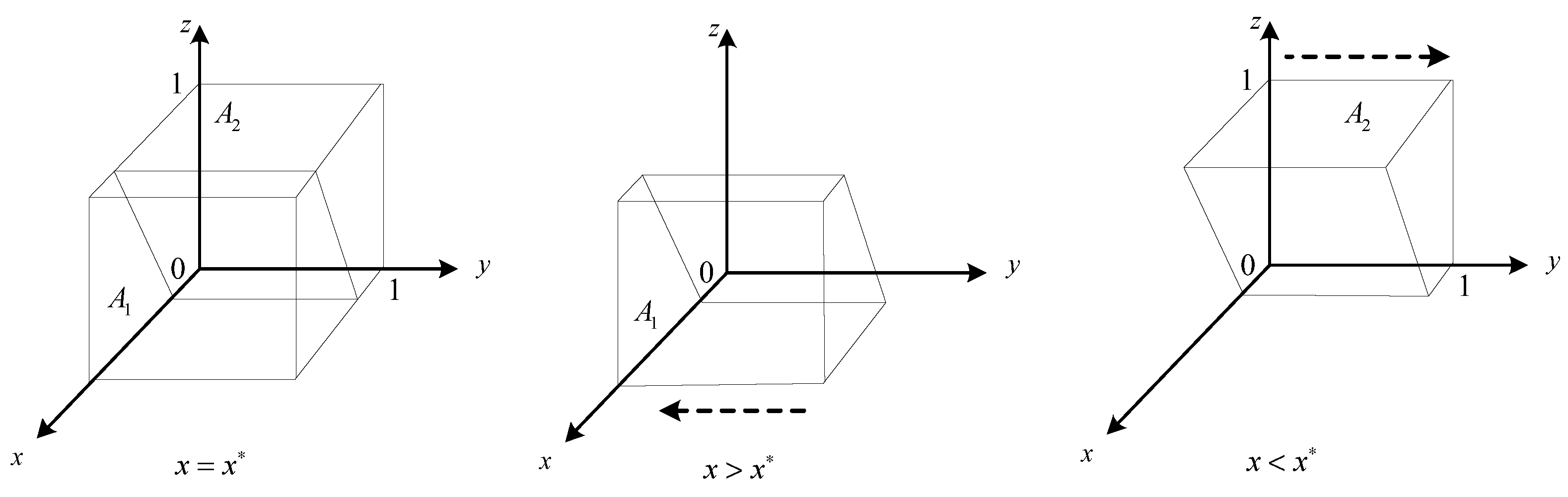
Figure 2.
Phase diagram of the evolution of public strategies.
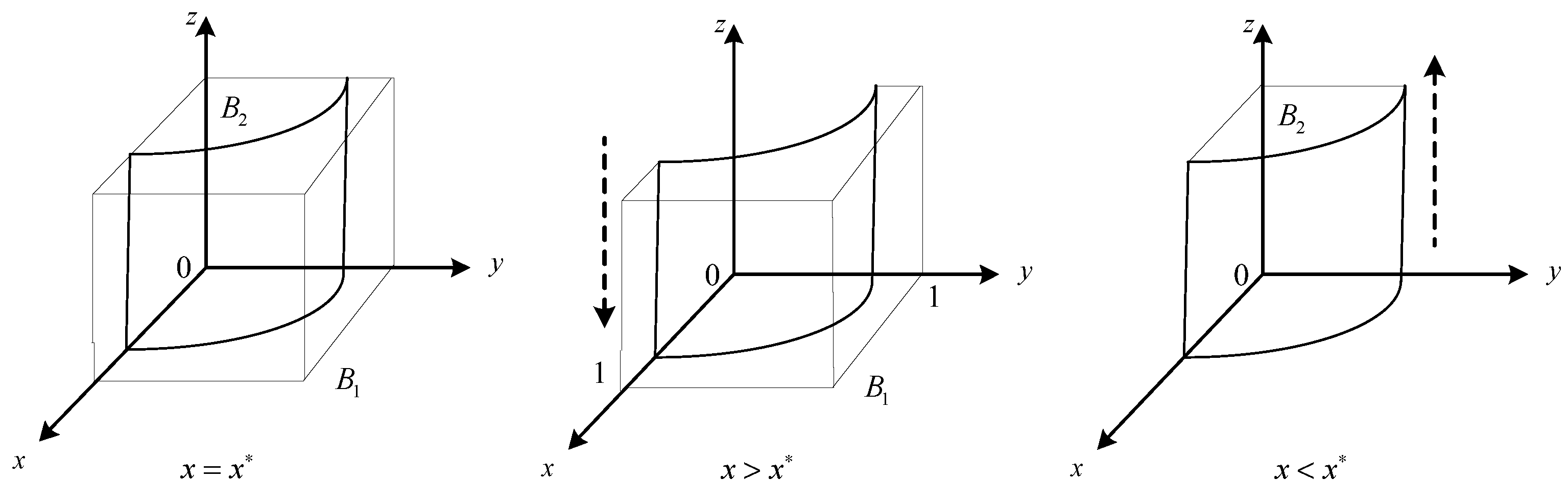
Figure 3.
XBB.1.5 strain caused the evolution of Montmorillonite powder panic-buying event.
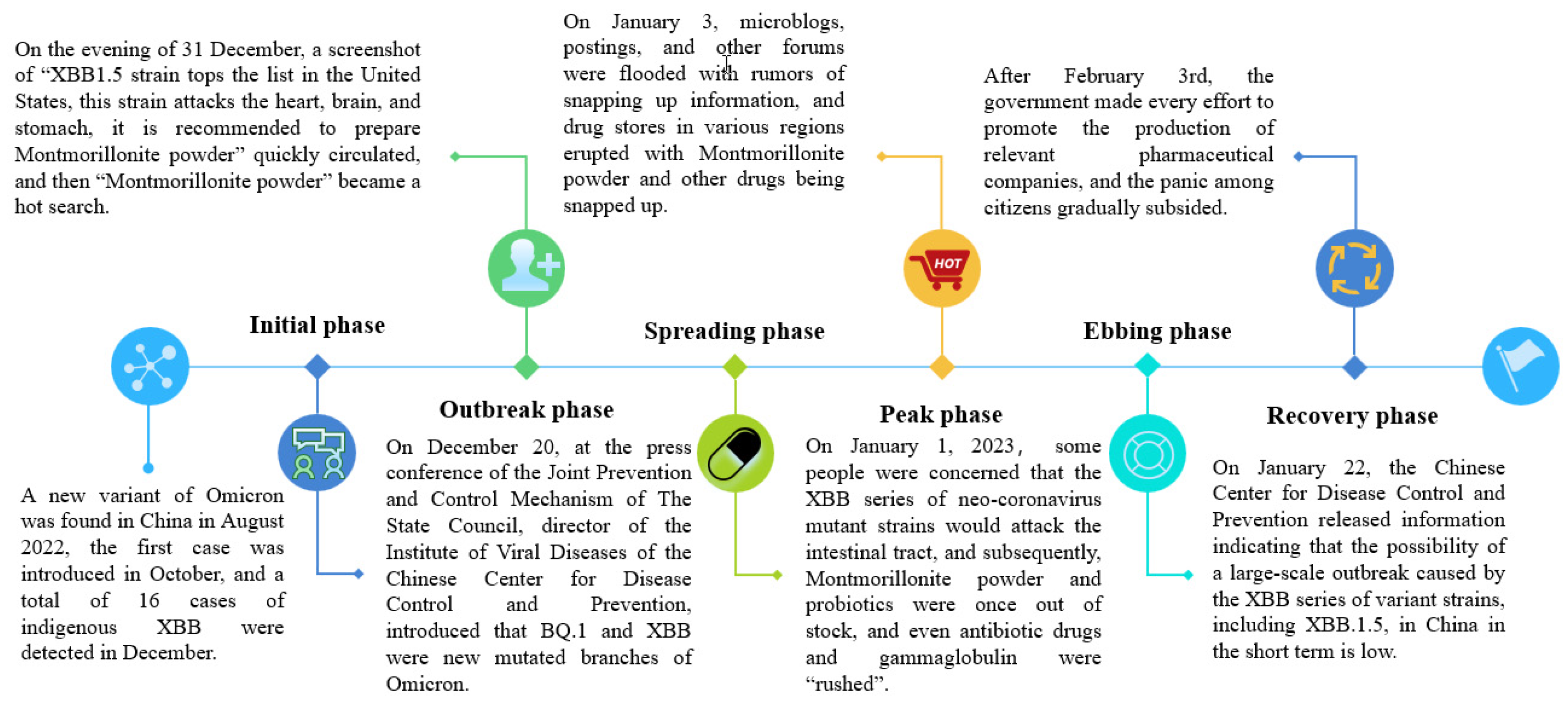
Figure 4.
Baidu index search hotness map of XBB strain.
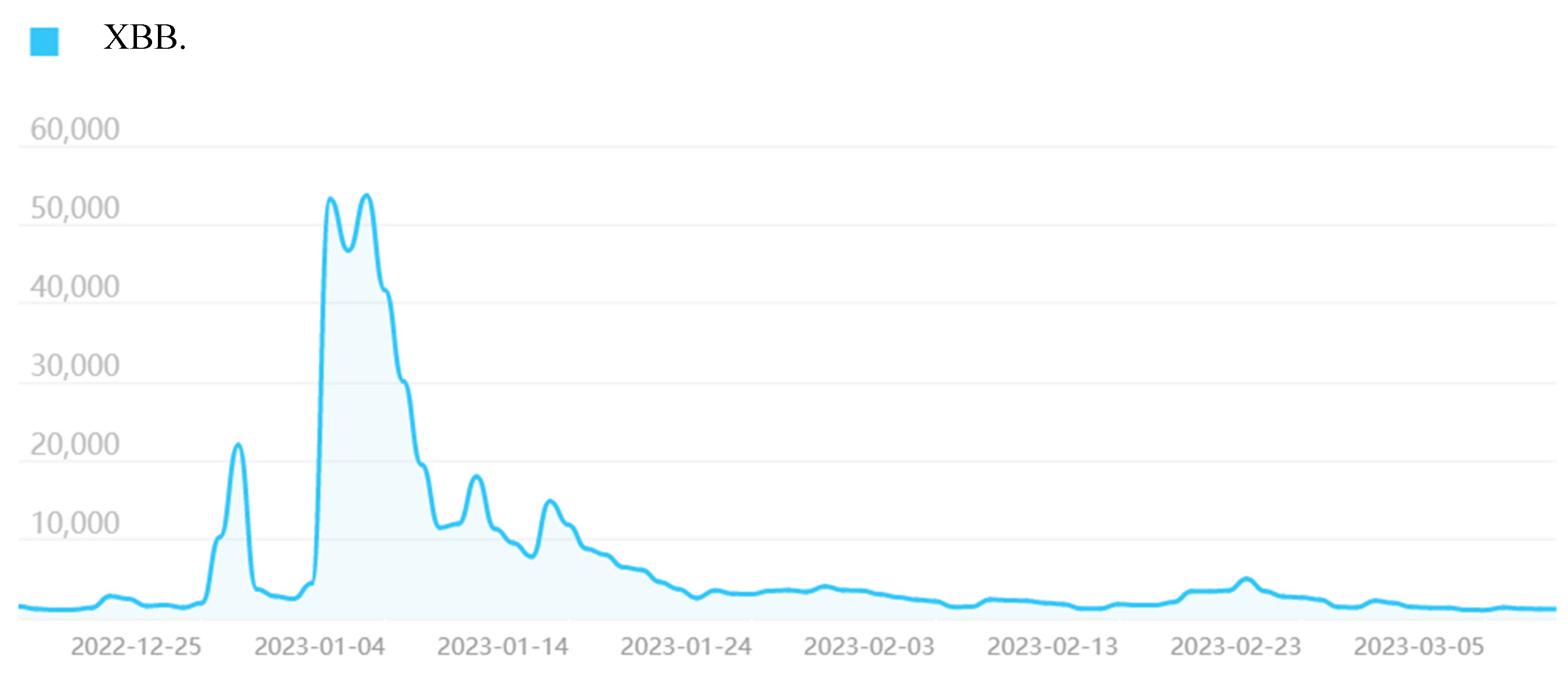
Figure 5.
Baidu index search hotness map of Montmorillonite powder.
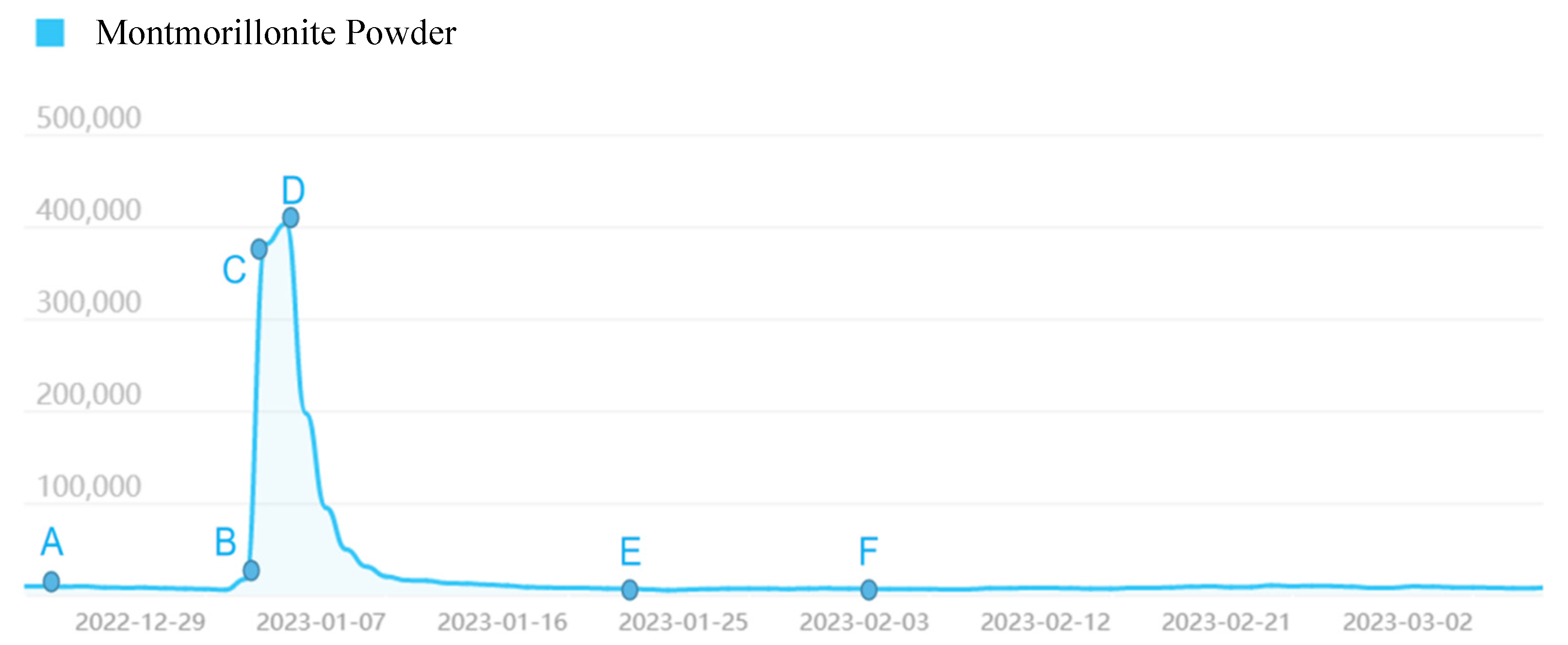
Figure 6.
Evolution simulation of three different parties under four situations.
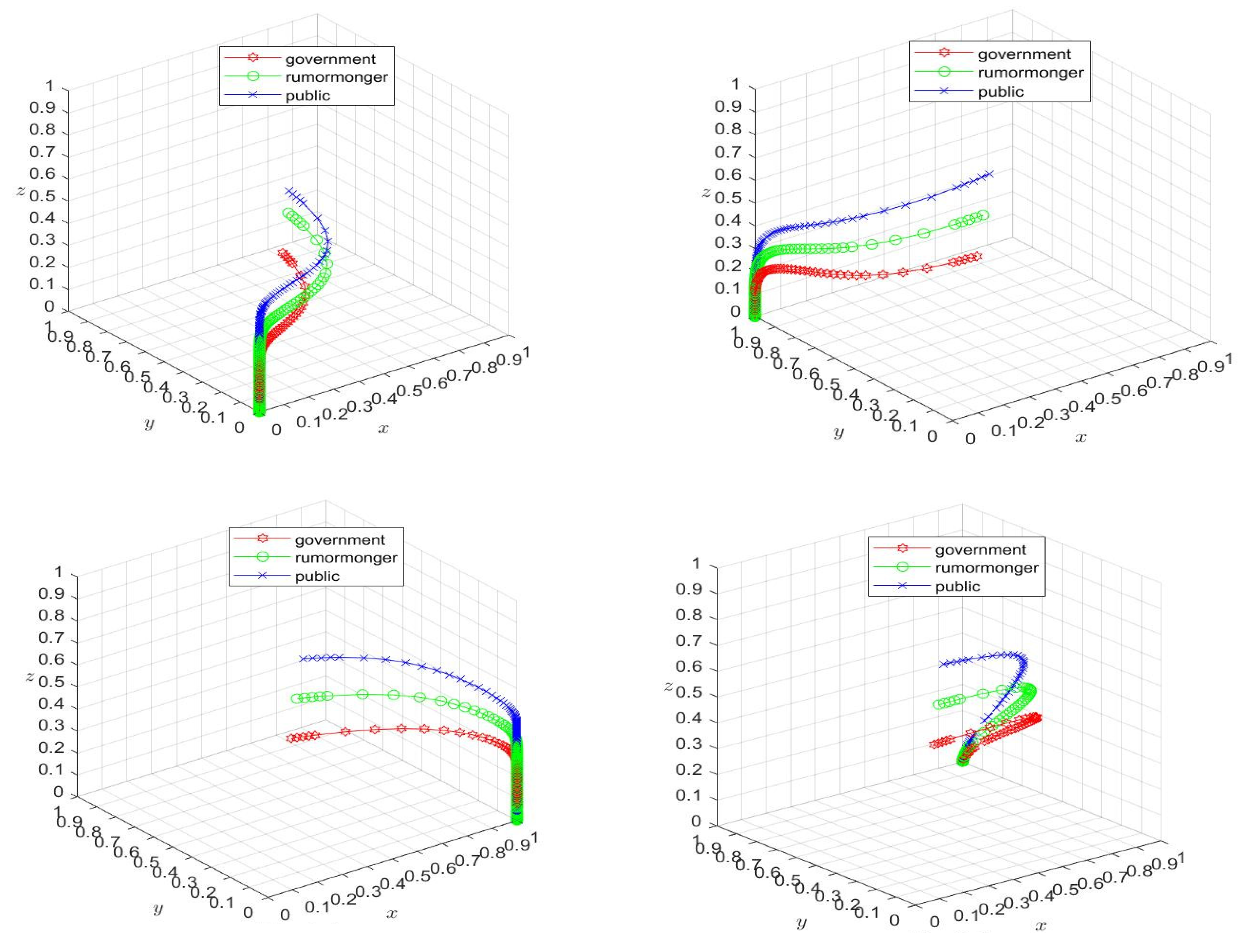
Figure 7.
Evolution simulation of three different parties under four situations.
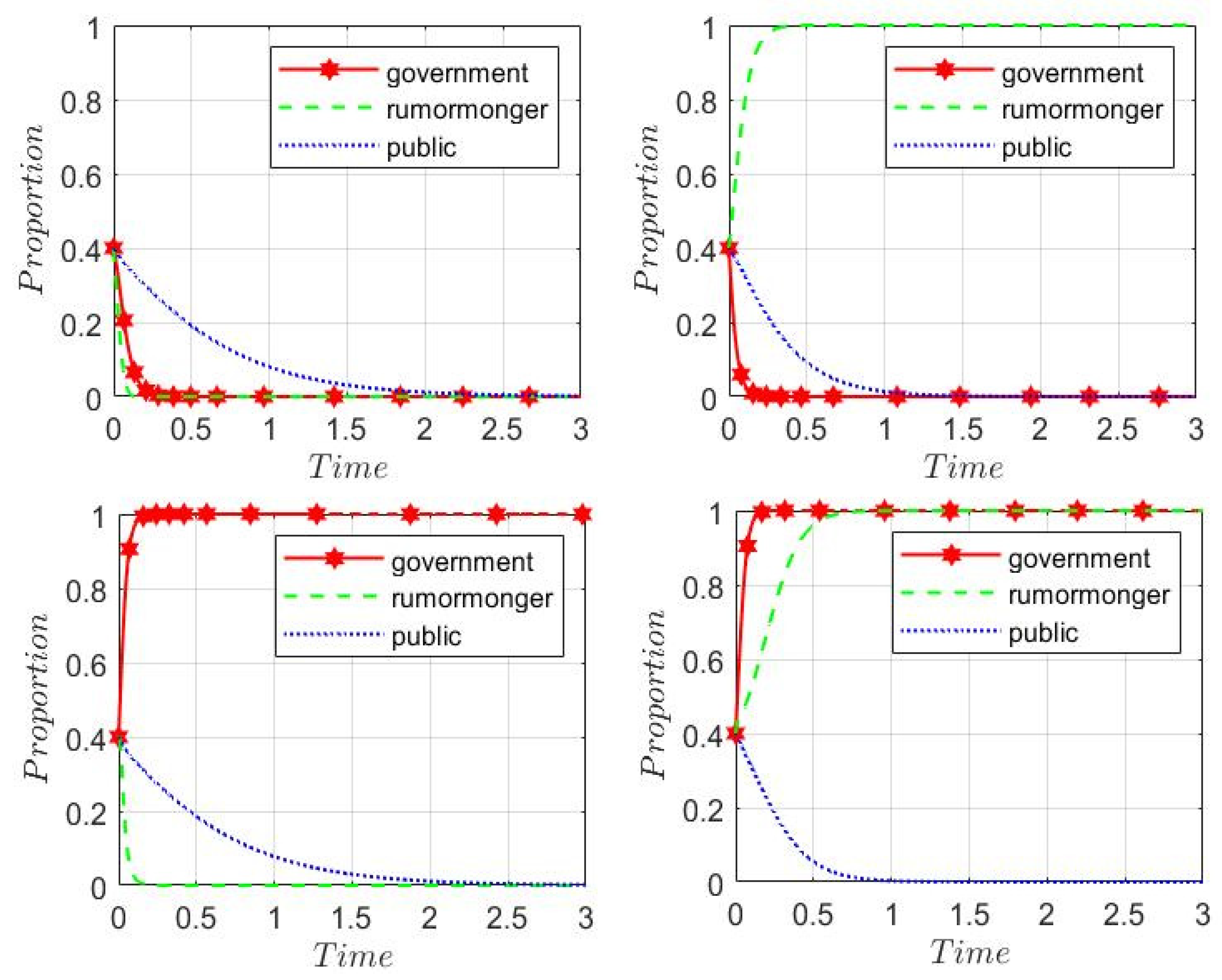
Figure 8.
Scenario 2-(1) evolves 50 times.
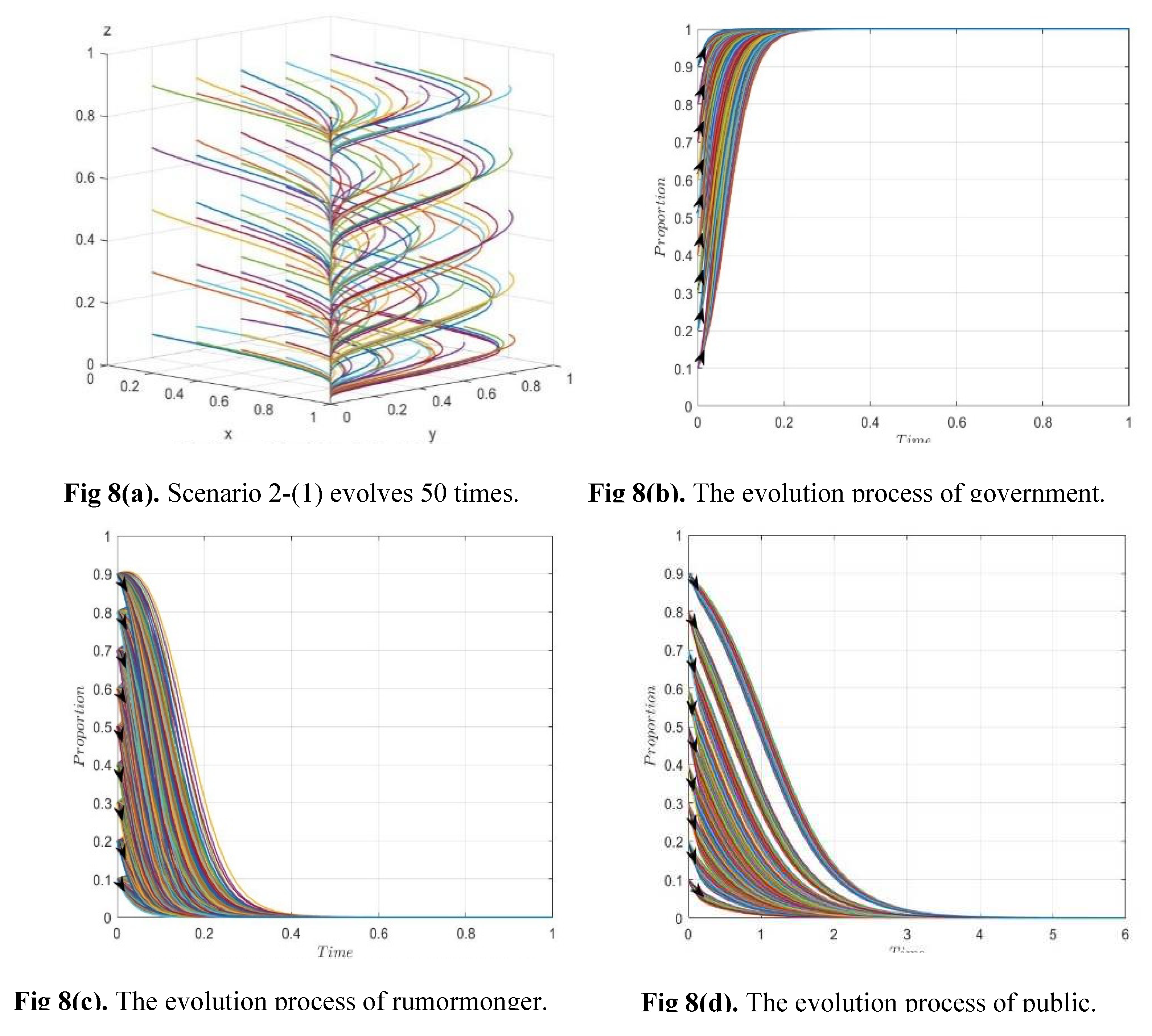
Figure 9.
Government rewards and punishments have different effects.
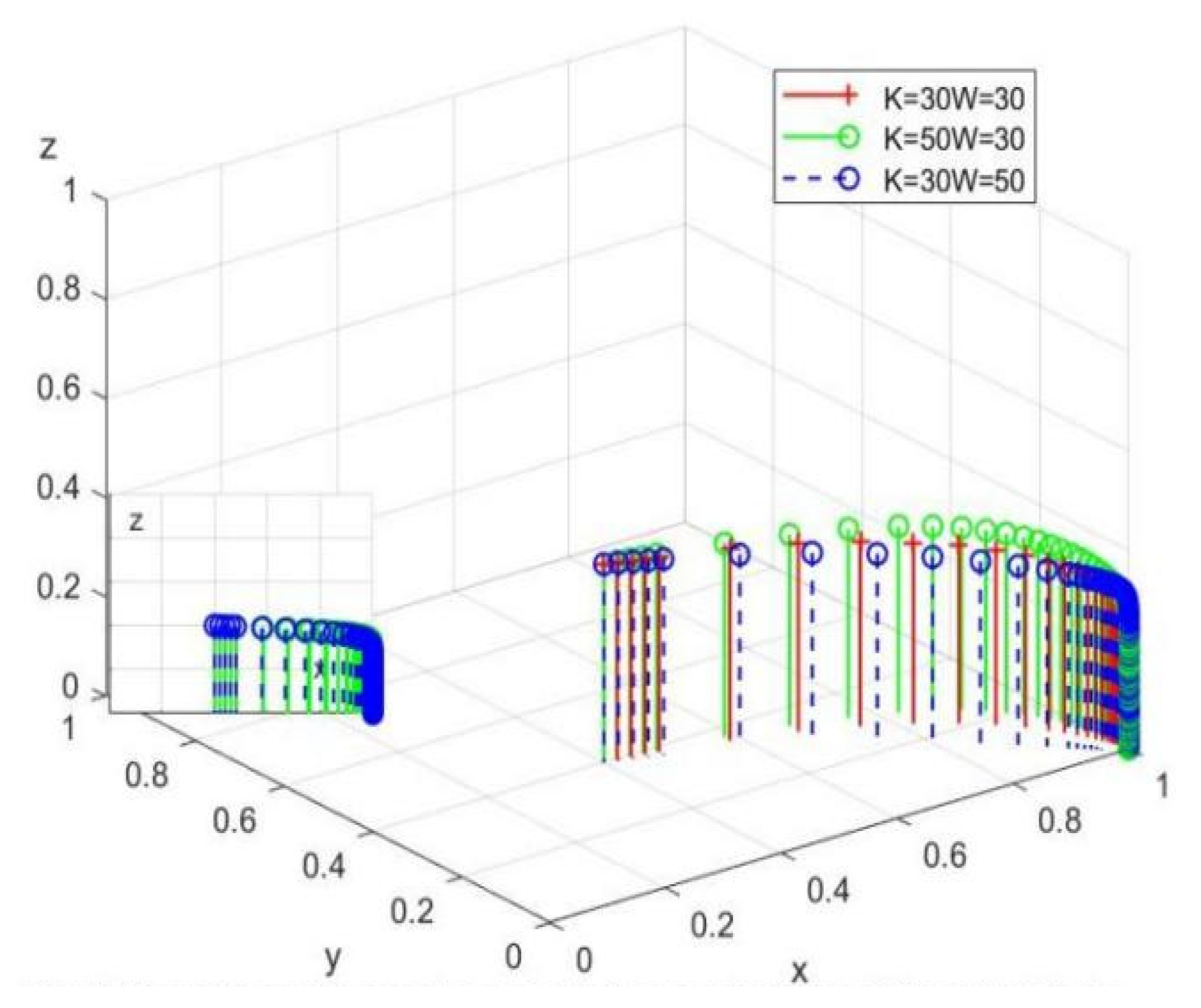
Figure 10.
The evolutionary results of the influence of K/W change on government.
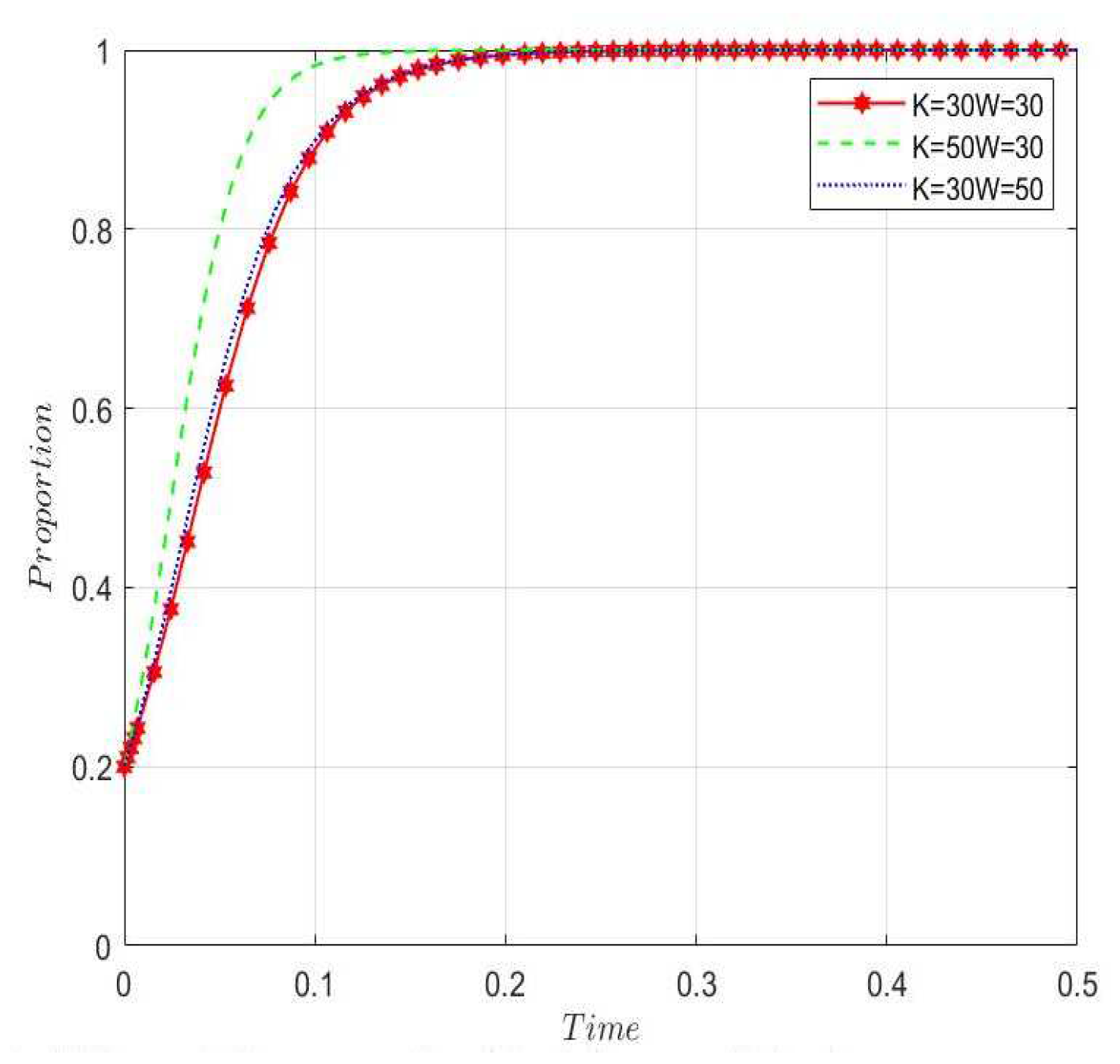
Figure 11.
The evolutionary results of the influence of K/W change on rumor mongers.
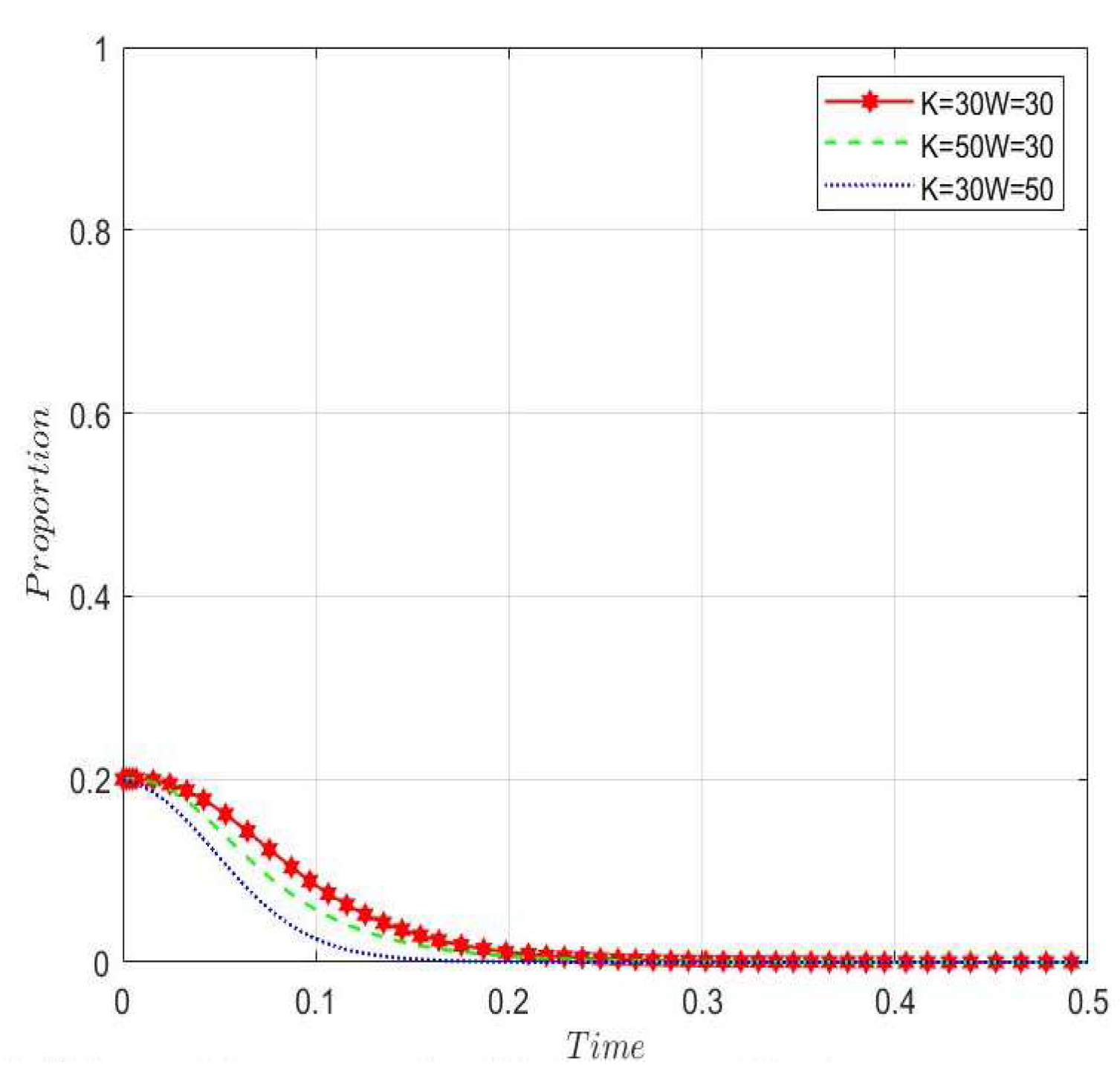
Figure 12.
Scenario 1-(2) evolves 50 times.
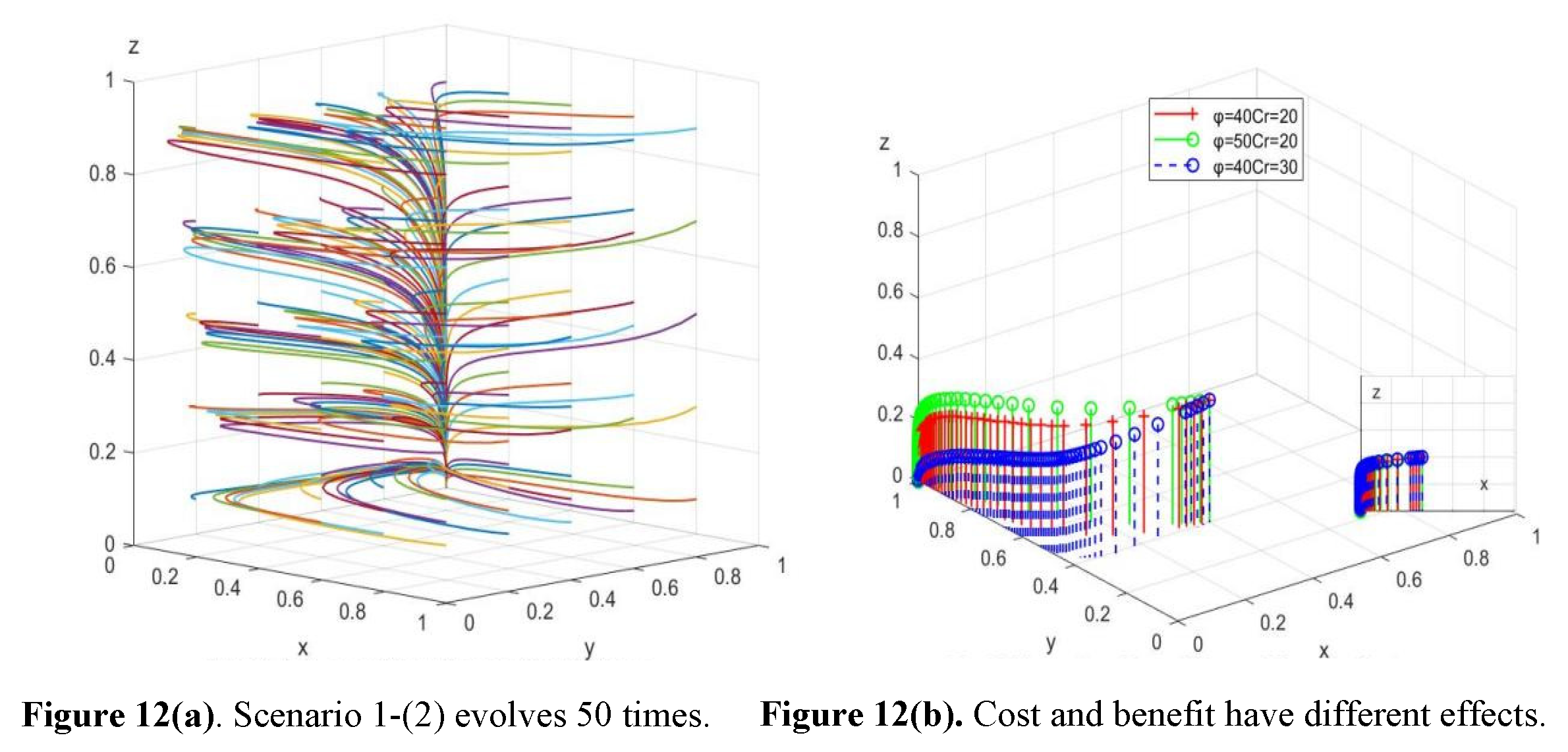
Figure 13.
The evolutionary results of the influence of φ/Cr change on rumor monger.
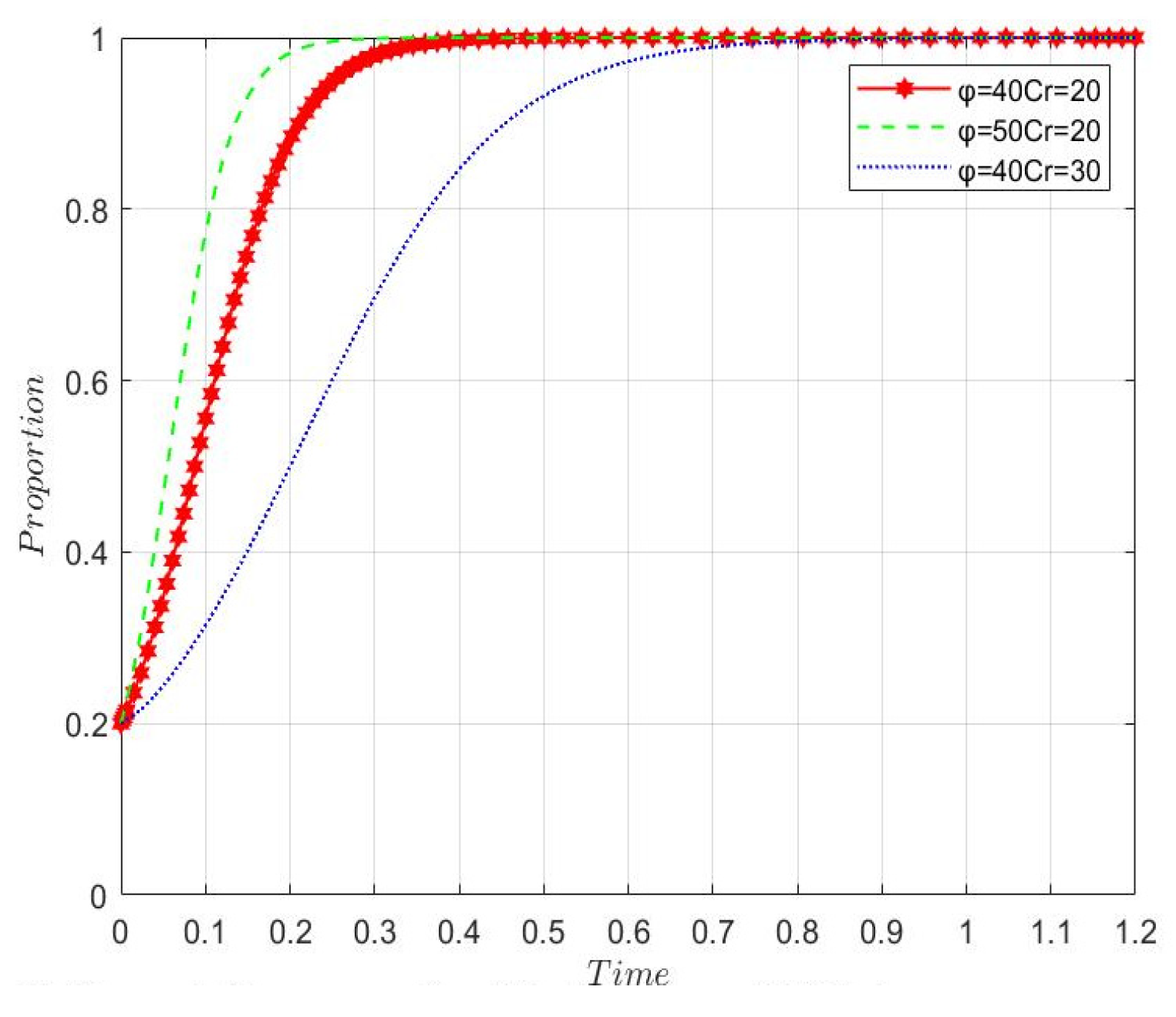
Figure 14.
The evolutionary results of the influence of K/W change on public.
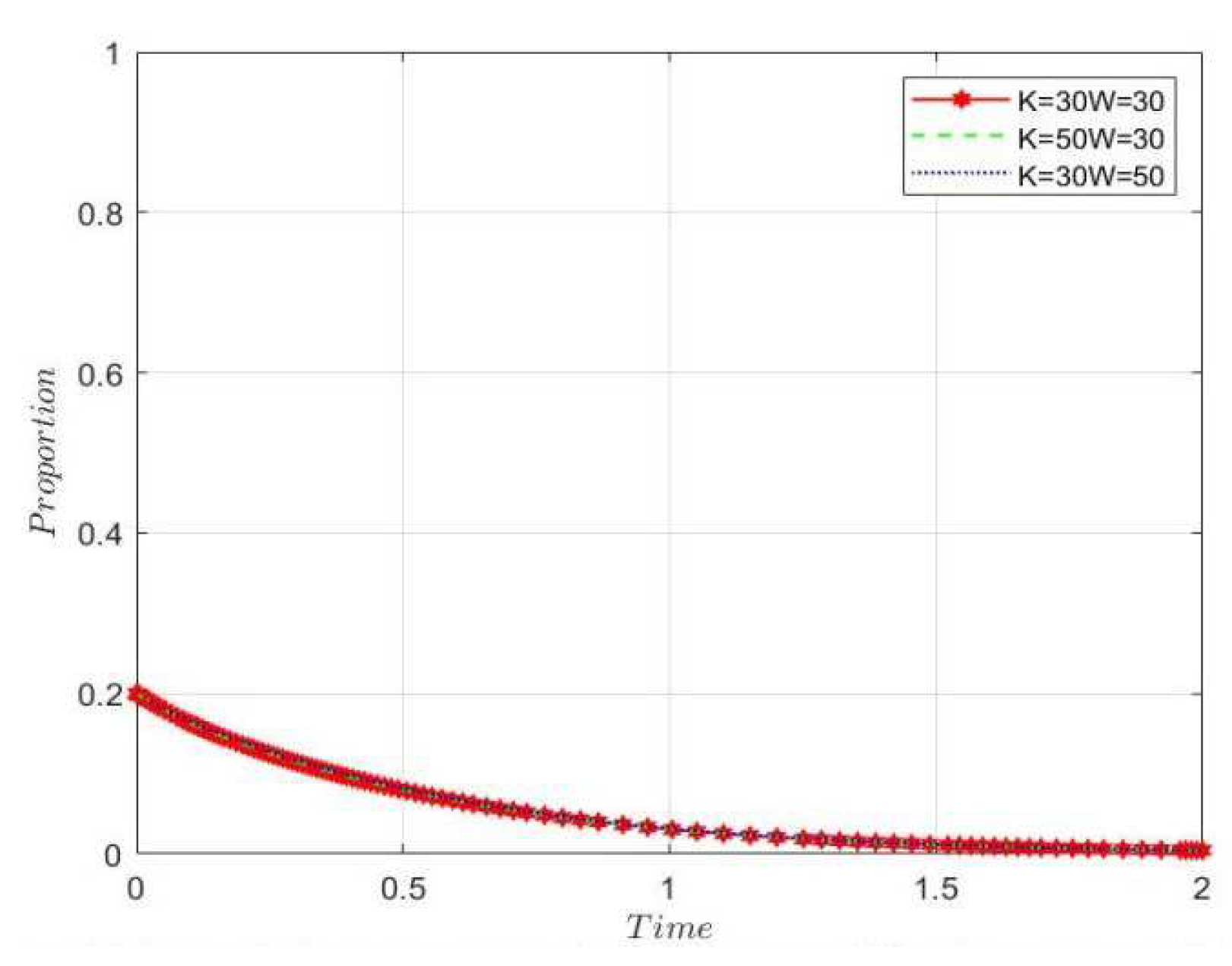

Table 1.
Main parameters and explanations.
| Parameters | Meanings of parameters |
|---|---|
| Costs paid when government intervenes | |
| Gain awards for government intervention | |
| The government does not interfere with the upper level of punishment | |
| The government bears the social risk of loss from the rush | |
| The cost of rumor for rumor-mongers | |
| Proceeds from rumor | |
| Punishment for rumor | |
| Risk Cost Transfer Factor | |
| The rumor-monger bears the social risk loss caused by the robbery | |
| The cost of drugs normally purchased by the public | |
| The cost of drugs for the public to grab | |
| The cost of drugs by the public after listening to rumors of government intervention | |
| The cost of drugs snapped up by the public on the basis of rumors | |
| Probability of government intervention | |
| Probability of rumor by the rumor-monger | |
| Probability of public snapping up |
Table 2.
Benefit matrix of the three game subjects.
| Local government\ public |
||||
|---|---|---|---|---|
| Panic buying | No panic buying | Panic buying | No panic buying | |
| Intervention | ||||
| 0 | 0 | |||
| Non-intervention | ||||
| 0 | 0 | |||
Table 3.
Eigenvalues of each equilibrium point corresponding to the Jacobi matrix.
| Balancing point | ||||
|---|---|---|---|---|
| E1(0,0,0) | ||||
| E2(0,0,1) | ||||
| E3(0,1,0) | ||||
| E4(1,0,0) | ||||
| E5(1,1,0) | ||||
| E6(1,0,1) | ||||
| E7(0,1,1) | ||||
| E8(1,1,1) | ||||
| E9 | ||||
Table 4.
Sign judgment of the eigenvalues of each equilibrium point corresponding to the Jacobi matrix.
Table 4.
Sign judgment of the eigenvalues of each equilibrium point corresponding to the Jacobi matrix.
| Balancing point | Scenario 1-(1) | Scenario 1-(2) | Scenario 2-(1) | Scenario 2-(2) |
|---|---|---|---|---|
| E1 (0,0,0) | --- | -+- | +-- | ++- |
| E2 (0,0,1) | --+ | -++ | +-+ | +++ |
| E3 (0,1,0) | -+- | --- | ++- | +-- |
| E4 (1,0,0) | +-- | ++- | --- | -+- |
| E5 (1,1,0) | ++- | +-- | -+- | --- |
| E6 (1,0,1) | +-+ | +++ | --+ | -++ |
| E7 (0,1,1) | +-+ | --+ | +++ | +-+ |
| E8 (1,1,1) | +++ | +-+ | -++ | --+ |
| E9 | Existence of eigenvalues with different signs | |||
Disclaimer/Publisher’s Note: The statements, opinions and data contained in all publications are solely those of the individual author(s) and contributor(s) and not of MDPI and/or the editor(s). MDPI and/or the editor(s) disclaim responsibility for any injury to people or property resulting from any ideas, methods, instructions or products referred to in the content. |
© 2023 by the authors. Licensee MDPI, Basel, Switzerland. This article is an open access article distributed under the terms and conditions of the Creative Commons Attribution (CC BY) license (http://creativecommons.org/licenses/by/4.0/).
Copyright: This open access article is published under a Creative Commons CC BY 4.0 license, which permit the free download, distribution, and reuse, provided that the author and preprint are cited in any reuse.


