
Submitted:
21 June 2023
Posted:
21 June 2023
You are already at the latest version
Abstract
Elevated indoor CO2 levels might have adverse effects on human health. However, the introduction of outdoor air to lower indoor CO2 concentrations results in significant HVAC energy consumption. Aligning with office hours and the natural light cycle, the utilization of photosynthesis in living walls offers an energy-efficient and sustainable solution for the mitigation of high CO2 levels in office spaces. This study experimentally investigates the impacts of the carbon fixation pathways, light intensity, and substrate moisture content on the CO2 removal rate of living walls at the room scale. Furthermore, the fresh air energy-saving effects of living walls under different scenarios are accurately simulated in EnergyPlus. The results demonstrate that choosing C3 plants over CAM plants in living walls yields higher CO2 removal efficiency. In a 30-m2 office room accommodating 2-3 occupants, living walls can reduce the demand for fresh air by 12.3%-27.8% and decrease fresh air energy consumption by 11.2%-28.2%. The city with the highest energy savings has energy savings that are 4.5 times greater than those of the city with the lowest energy savings. The findings of this research promote the application and development of living walls, thus providing a viable solution for improving indoor air quality.
Keywords:
CO2 concentration
; living walls
; fresh air energy consumption
; Energyplus
; indoor air quality
1. Introduction
Poor indoor air quality results in various building-related illnesses that negatively impact human health [1,2,3]. Extremely high concentrations of CO2 (>20,000 ppm) have the potential to be fatal [4,5]. In typical indoor environments in non-industrial buildings (<5000 ppm), elevated CO2 levels impair lung gas exchange function [6], leading to worker fatigue and drowsiness [7], headaches [8,9], and negative effects on cognition and decision-making [10,11,12]. The acceptable upper limit for the CO2 concentration in non-industrial buildings in China is 1000 ppm [13], and ASHRAE standard 62.1-2019 recommends that indoor CO2 concentrations should not exceed this level [14]. The outdoor CO2 concentration typically remains around 400 ppm [15], posing no harm to human health. However, in enclosed spaces, CO2 levels can rapidly rise due to human respiration, which can potentially harm human well-being.
The commonly used CO2 capture technologies are challenging to implement in civil buildings. Absorption is unsuitable indoors due to high energy consumption, the large equipment size, and potential air pollution concerns [16]. Adsorption exhibits reduced CO2 adsorption capacity in humid indoor conditions due to the effects of surface water vapor [17]. Membrane separation faces obstacles in terms of low efficiency at low CO2 concentrations and high costs [18]. In contrast, a relatively simple approach involves the introduction of outdoor air to dilute indoor CO2 concentrations. However, for this approach, the impact of natural ventilation on the thermal comfort of occupants [19] and the potential introduction of outdoor pollutants into indoor spaces [20] must be considered. Mechanical ventilation, while effective, requires energy consumption [21]. Additionally, HVAC systems are necessary to condition the outdoor air for human thermal comfort, which includes processes such as heating, humidification, cooling, and dehumidification. These HVAC processes contribute to approximately half of the energy consumption in HVAC systems [22,23]. Therefore, it is crucial to explore energy-saving and sustainable approaches for the reduction of indoor CO2 concentrations.
Phytoremediation provides an effective method for air purification [24,25,26]. Remarkably, researches in the aerospace field have shown that a closed system integrating plants and humans can achieve a balanced carbon cycle [27,28,29]. However, in civil buildings, the limited space indoors may not allow for a complete balance between plant absorption and human respiration. Nonetheless, the presence of plants can still significantly decrease indoor CO2 levels. Pegas et al. [30] placed six plants in a classroom and observed an average decrease in indoor CO2 concentration from 2004 to 1121 ppm. Tudiwer et al. [31] found that a classroom with living walls exhibited a 3.5% faster reduction in CO2 concentration compared to a classroom without plants. Meng et al. [32] placed living walls in an air-conditioned room and observed a reduction in indoor CO2 concentration of approximately 10%. Yungstein et al. [33] observed that the implementation of living walls in actual workplace led to an average decrease of 4.8% in the CO2 concentration. While qualitative studies have demonstrated the potential of plants in to purify CO2 in indoor environments, practical implementation remains challenging.
Due to their specific characteristics, office spaces are well-suited for the utilization of the living walls to purify CO2. In these environments, workers inhale O2 and exhale CO2, while plants perform photosynthesis, absorbing CO2 and releasing O2, thereby creating a carbon cycle within the confined space [28]. The working hours of employees [34] align with the natural light cycle, thus allowing plants to utilize natural light for air purification. Despite the potential impact on human thermal comfort [35] and equipment aging [36], areas with concentrated solar radiation in offices are viable locations for the installation of the living walls. Temperatures in offices are regulated to ensure the thermal comfort of employees [37,38], and most plants can adapt to air-conditioned rooms [39,40]. Furthermore, interaction with plants can enhance productivity of workers [41]. Shao et al. [42] observed that 100 heads of pakchoi could reduce the indoor CO2 concentration in a 30-m2 office by 25.7%-34.3%. However, Pennisi et al. [43] suggested that under office lighting conditions, most plants have limited impact on indoor CO2 levels. Gubb et al. [44] found that the influences of dry and wet substrates on the plant CO2 purification capacity under typical office lighting levels could be ignored, as plants generally fail to reach their LCP. In conclusion, living walls are suitable for CO2 purification in office spaces, but further research on plant selection, lighting design, and irrigation management is needed to provide practical guidelines.
Living walls that absorb CO2 can reduce fresh air energy consumption. In office spaces, the occupants' respiration releases CO2, which can lead to a rapid increase in indoor CO2 concentration. If left uncontrolled, the elevated release of CO2 from the respiration of occupants in an office setting can potentially lead to air pollution [45]. When the concentration of CO2 released by workers exceeds the required standards, outdoor air is introduced to dilute the indoor CO2 levels, which results in energy consumption by the HVAC system to process outdoor air. By absorbing CO2, living walls can decrease the demand for outdoor air and consequently reduce fresh air energy consumption. Torpy et al. [46] estimated that 15 pots of Dypsis lutescens could potentially reduce the outdoor air demand by approximately 6%. Parhizkar et al. [47] found that the incorporation of 5 m2 of Azolla per person in a typical office building could decrease the outdoor air requirement by about 30%. Shao et al. [42] demonstrated that 100 heads of pakchoi could reduce fresh air energy consumption by approximately 12.7%-58.4%. Currently, researchers mainly estimate the fresh air energy-saving impact of the living walls by calculating the balance between the CO2 absorption rate of plants and the CO2 generation rate of humans. However, this approach makes it challenging to accurately evaluate the fresh air energy-saving capacity of the living walls. EnergyPlus is a simulation tool capable of calculating the transient building loads required to maintain the temperature and ventilation setpoints for a full year under specific conditions [48]. Nonetheless, there have been limited studies on the use of EnergyPlus to accurately assess the fresh air energy savings of the living walls.
Based on these reviews, living walls are suitable for indoor CO2 removal and the reduction of fresh air energy consumption in office spaces. This study consists of two main parts, namely (1) the experimental investigation of the impacts of adjustable factors in office spaces on the indoor CO2 removal rate of the living walls, and (2) the simulation-based evaluation of the fresh air energy savings achieved by CO2 removal from living walls under different scenarios. The primary objective of this work is to improve the CO2 removal efficiency of the living walls in office spaces and accurately assess their fresh air energy savings, with the aim of promoting the practical implementation of the living walls.
2. Materials and Methods
2.1. Experiment
The experiment was conducted with the aim of enhancement the CO2 removal efficiency of the living walls in office spaces. It consisted of three steps. Firstly, the natural CO2 infiltration rate in the two experimental rooms was confirmed to be the same, allowing for a comparative analysis. Secondly, the impacts of adjustable factors of office spaces such as carbon fixation pathways, light intensity, and substrate moisture content, on the CO2 removal rate of the living walls were examined in the two experimental rooms. Finally, the significant factor was further investigated to explore its impact on the CO2 removal efficiency of the living walls.
2.1.1. Experimental set up
The experimental site was located in Guangzhou, Guangdong Province, southern China, with geographic coordinates of 23°10′ N, 113°21′ E. The fluctuating outdoor wind environment and indoor-outdoor temperature difference have significant impacts on the natural CO2 infiltration rate of the room [49,50], thereby affecting the calculated CO2 removal rate of the living walls. To minimize the impact of external weather conditions and accurately measure the CO2 removal rate of the living walls, two experimental rooms with the same structure were built on the rooftop (Figure 1 (a)). Room A, as the experimental group, was equipped with living walls, while room B, as the control group for comparison experiments, was a conventional air-conditioned room without living walls. Both experimental rooms had an exterior-facing west wall with interior walls on the remaining three sides. Each room measured 1.9 m× 1.9 m× 3.0 m (width × depth × height). The walls were constructed with a 2-mm metal sheet, a 100-mm EPS foam board, and another 2-mm metal sheet. The original windows of the rooms were sealed with black polypropylene (PP) sheets to improve airtightness and block natural light. This ensured that all light used in the experiment was provided by a stable artificial light source.
An air conditioner (710 W) was utilized to regulate the air temperature in the room, and was positioned 2.2 m above the ground. The air temperature was set at 25 °C, which is suitable for human thermal comfort [51]. An air quality monitor capable of measuring the air temperature, relative humidity, and CO2 concentration was centrally placed at a height of 1.2 m, consistent with the breathing height of the occupant. A fan (40 W) on the ground was used to enhance air mixing, and a CO2 release device, consisting of dry ice and a container, was placed in front of the fan. Dry ice was added to the boiling water in the container to accelerate its sublimation. The layout of the instruments in the room is shown in Figure 1(b), and the specific instruments are listed in Table 1.
2.1.2. Experimental materials
Sansevieria trifasciata and Epipremnum aureum were selected as experimental plants in this study due to their widespread use in relevant studies [52] and their potentially high CO2 removal efficiency. They are commonly used as indoor plants in the local area where field surveys were conducted, and can adapt to low-light conditions indoors. Additionally, they can represent different carbon fixation pathways. Further details about the selected plant species are presented in Table 2.
The plants used in this study were of the same species, with similar health, age, and size characteristics. However, because the plants were purchased from different cultivation sites, there were variations in the composition of the growth substrate and cultivation methods. The substrate can significantly impact the indoor CO2 concentration and, in some cases, can even surpass the CO2 absorption of certain plant species [53]. To minimize this effect, the plants were transplanted into a uniform nutrient soil containing natural organic matter, rooting powder, polyoxin, perlite, and vermiculite. The diameter of the flower pot was 10 cm.
After transplantation, the plants were placed in the room for 14 days to acclimate to the new environment. The plants received artificial light (5-10 μmol·m-2·s-1) for a 12-hour light/dark cycle (07:00-19:00 light period) to simulate natural light conditions. During the maintenance period of the plants, the room was kept ventilated, and no fertilizers were used. The E. aureum was watered every 3 days, while the S. trifasciata was watered every 7 days. Watering sessions were performed between 08:00 and 09:00, with each session continuing until water overflowed from the bottom of the flower pot. During the experiment, ventilation was stopped, and humidity was not controlled. The temperature was set to 25 °C to allow the plants to acclimate to the experimental environment for 24 h. After the experiment, the plants were destructively measured to determine their leaf area.
Living walls were constructed in a modular manner and could hold 48 plants, and had an overall size of 0.84 m× 0.25 m× 1.606 m (width × depth × height). The living walls included a water tank and plant modules (Figure 2). The height of the plant modules was 1.276 m, and the total area of the living walls was 1.07 m2.
2.1.3. Experimental process
2.1.3.1. Confirmation of identical natural infiltration in two rooms
During the experiment, high-concentration CO2 was released once, after which the indoor CO2 concentration gradually decreased. The decline in the CO2 concentration in the room with living walls was caused by two factors, namely the net photosynthesis of the living walls and the natural infiltration of the room. At the room scale, meteorological conditions such as the wind speed, the wind direction, and indoor-outdoor temperature differences can significantly affect the natural CO2 infiltration rate of the room. These changes could have impacted the CO2 removal rates of the living walls measured in the experiment.
In a single experimental room, it is challenging to measure the decrease in CO2 concentration caused by natural infiltration. Multiple experiments conducted under similar and relatively stable outdoor meteorological conditions are necessary to determine the natural CO2 infiltration rate of the room.
Prior to each experiment, the current outdoor meteorological conditions were assessed. Moreover, after the experiment, the meteorological conditions during the experiment were reviewed to avoid the significant impacts of sudden changes in the meteorological conditions on the measurement of the CO2 removal rates of the living walls.
A comparative experiment of the two rooms was conducted. Room A, as the experimental group, was equipped with living walls while Room B without living walls was used as the control group. CO2 was simultaneously released in both rooms, and the same outdoor meteorological conditions were applied to both rooms. The changes in the CO2 concentration in both rooms were measured, and the decrease in CO2 concentration in the control Room B during the experiment was used to estimate the decrease caused by natural infiltration in the experimental Room A. The CO2 removal rates of the living walls were calculated by subtracting the estimated natural infiltration rate from the total decrease in CO2 concentration in Room A.
To measure the CO2 removal rates of the living walls, it is necessary to confirm that the two identically constructed rooms had the same natural infiltration rate of CO2 before conducting the experiment. Before placing living walls in Room A, three random experiments were conducted in both empty rooms without selecting specific outdoor meteorological conditions. The initial CO2 concentration and duration of the experiments were consistent with those of the measurement experiment. After each experiment, the decrease in CO2 concentration in both rooms without living walls was compared, and adjustments were made to ensure that the difference in CO2 concentration reduction was within an acceptable range. Once confirmed, living walls were placed in Room A, and the measurement experiment began.
2.1.3.2. Optimization of the impacts of the adjustable factors of office spaces on CO2 removal efficiency
The carbon fixation pathways, light intensity, and substrate moisture content were selected as controlled variables to investigate their impacts on the CO2 removal efficiency of the living walls. The reasons for this selection are as follows.
- Plants absorb CO2 via photosynthesis, which is influenced by both internal and external factors. Internal factors refer to the carbon fixation pathways of plants (C3, C4, and CAM), while external factors include light, the environmental CO2 concentration, the temperature, mineral elements, and water [54]. In office spaces, the temperature is usually set to ensure thermal comfort, while humidity is often difficult to regulate. Therefore, in the experiment, the temperature was controlled at 25 °C but the humidity was not regulated.
- Due to the unsuitability of C4 plants for indoor environments, C3 and CAM plant species were selected as the experimental subjects. This selection was based on their distinct carbon fixation efficiency and adaptability to different environmental conditions.
- Supplemental lighting was installed to ensure the function of the living walls due to the variability of the natural light intensity influenced by factors such as the weather, season, and orientation. Thus, it was necessary to examine the effect of light intensity on the living walls and adjust the supplementary illumination.
- The substrate moisture content is closely related to the irrigation system and maintenance of the living walls, and insufficient and excessive watering are common issues in the management of the living walls [44]. The investigation of the effects of different substrate moisture levels on the CO2 removal efficiency of the living walls can help to optimize the maintenance procedures and reduce associated costs.
The following four light intensities were set during the experiment: dark (0 μmol·m-2·s-1), low light (10 μmol·m-2·s-1), medium light (50 μmol·m-2·s-1), and high light (400 μmol·m-2·s-1). Low light was chosen to simulate the typical lighting conditions in office spaces, which commonly have an illuminance level of not less than 300 lx to support the productivity of workers [55]. Moderate light is sufficient for most plants to lower indoor CO2 concentrations [46], as their net photosynthesis rate surpasses the CO2 release rate from substrate microorganisms. High light is the maximum light intensity achievable on the plane under laboratory conditions. The maximum light intensity was provided by eight high-efficiency and energy-saving LEDs (300 W, 6500 K white light), while the other light intensities were achieved by adjusting the number of lamps and their distance from the living walls. Four points on the living walls were evenly sampled, and the photosynthetic photon flux density (PPFD) was measured by the Apogee MQ-500 instrument placed at the highest point of the canopy, with the average value used to determine the experimental light intensity.
In the experiment, the substrate moisture content was divided into two moisture levels: dry and wet. Pre-experimental findings revealed that watering plants daily greatly increased the risk of root rot and death. Therefore, watering was carried out every 3 days. During this period, the lowest volumetric water content (VWC) measured for S. trifasciata and E. aureum was 0.15 m3/m3, which was defined as a wet substrate. If the soil was not watered for a certain period of time, it would become dry and clumpy, and the plants would not wilt immediately. The highest VWC measured during this period was 0.05 m3/m3, which was defined as a dry substrate. During the wet substrate experiment, three randomly selected plants on the living walls were measured using a 5TE VWC sensor before the start of each experimental day. If the VWC was below 0.15 m3/m3, watering was carried out. After the wet substrate experiment, no further watering was performed until the soil was dry for the dry substrate experiment.
The experiment lasted for 2 hours. The duration of the experiment was determined based on several factors. If the duration was too brief, the impact of the living walls on indoor CO2 removal would be insignificant, which would also lead to potential errors in data analysis and measurement. On the other hand, if the duration was too long, the decrease in the indoor CO2 concentration could lead to the reduction of the CO2 removal rate of the living walls. Previous studies have suggested a duration of 40 minutes for the measurement of the CO2 removal rate of plants, as within this period, the decrease in the CO2 concentration is linear [46,56,57]. However, in the present study, the experimental scale was expanded, and pre-experiments revealed that even under high light conditions, the indoor CO2 concentration changed nearly linearly within 2 hours. Thus, the change in the indoor CO2 concentration over 2 hours was measured to calculate the CO2 removal rate of living walls.
To prepare for the experiment, the living walls were exposed to the experimental light intensities for 15 minutes to adapt to the experimental conditions. A CO2 generator was created by placing dry ice in boiled water, and the fan was turned on for 10 minutes to evenly mix the indoor air. Once the indoor CO2 concentration reached 1000 ppm on the air quality monitor, the CO2 generator was removed, and the outer door was tightly closed. The same process was repeated for the control room. The initial CO2 concentration set in this experiment was the standard limit of 1000 ppm. Due to the disorderliness of gas diffusion, the actual initial CO2 concentration was 1000±100 ppm. Once the indoor gas was uniformly mixed and the indoor CO2 concentration no longer exhibited sudden changes, the timer was started. Each experiment lasted for 2 hours, and each condition was repeated three times.
Theoretically, the CO2 removal rate from photosynthesis is influenced by the environmental CO2 concentration. However, the range of the CO2 concentration changes caused by living walls within 2 hours is limited, and thus the impact can be considered negligible. The decay of the indoor CO2 concentration over 2 hours was regarded as linear. The data were analyzed using Origin 2021 software to perform linear regression analysis and minimize the impact of outliers. The CO2 removal rate of the living walls was calculated. To illustrate the trend of CO2 concentration changes and facilitate comparisons between different conditions, the indoor CO2 concentration variation was expressed as a percentage of the initial concentration.
Statistical analysis was conducted on the data using the Shapiro-Wilk test to check for a normal distribution. If the data met the assumptions, analysis of variance (ANOVA) was performed. For non-normal data, a rank transformation was applied, and non-parametric tests were used. The Mann-Whitney test was used for the analysis of two independent samples, while the Kruskal-Wallis test was used for the analysis of more than two independent samples. A p-value above 0.05 indicates no significant differences between the groups.
2.1.3.3. Optimization of the impact of the significant factor of office spaces on the CO2 removal efficiency
Among the adjustable factors of office spaces, light intensity significantly affects the CO2 removal rate of the living walls. To analyze its influence, the light response curve of the living walls was measured in this study. The light saturation point (LSP) and light compensation point (LCP) of the plants were determined from the curve, offering valuable insights for the design of supplemental lighting.
The E. aureum living walls with a wet substrate were selected for the experiment, as they exhibited better performance in the previous experiments. The light intensities were set as, 0, 10, 50, 100, 200, 300, and 400 μmol·m-2·s-1. The CO2 removal rate of the living walls was measured using consistent experimental and data processing methods from previous experiments. The light response curve was fitted using a rectangular hyperbolic model described by the following equations [58,59]:
where is the net photosynthesis rate, I is the light intensity, α is the initial slope of the light response curve at I=0, which is known as the initial quantum efficiency, is the maximum net photosynthesis rate, and is the dark respiration rate.
To estimate the light compensation point (), a linear equation was fitted to the data under low light conditions (≤100 μmol·m-2·s-1) to obtain the apparent quantum efficiency (AQE). The following equation was then solved [59].
2.2. Simulation
A simulation was carried out with the aim of accurately assessing the potential fresh air energy savings of the living walls in office spaces and providing a reference for practical applications. The optimal CO2 removal rate of the living walls determined in the experimental research was utilized in the simulation. EnergyPlus was employed to simulate the reduction in energy consumption associated with fresh air intake when implementing living walls in office spaces. The simulation included various numbers of occupants and mechanical ventilation systems across seven climate regions in China.
2.2.1. Simulation conditions
The office room was modeled in OpenStudio 3.5.1 and imported into EnergyPlus 22.2.0. The work schedule for occupants was set from 08:00 to 17:00, 5 days a week [34]. An ideal HVAC system was used, and its equipment parameters and capacities were determined based on the corresponding Chinese Standard Weather Data (CSWD). The outdoor CO2 concentration was set as 400 ppm [60], and the indoor CO2 concentration was maintained below the standard limit of 1000 ppm [14]. The design parameters for indoor air were set to 26 °C in summer, 20 °C in winter, and a relative humidity of 60% [61]. In the simulation, a 1-minute time step was used to calculate fresh air energy consumption for each minute of the year. This study focused on fresh air energy consumption, which refers to the energy consumed by the HVAC system for heating, cooling, humidification, and dehumidification of outdoor air. The building orientation, envelope construction, and HVAC equipment were set to default parameters as they were not relevant.
2.2.2. Modeling description
An office room measuring 3.25 m× 7.70 m× 4.00 m (width × depth × height) and located on the middle floor of an office building, was considered as the case study (Figure 3). The room had one exterior wall and three interior walls, with two windows on the exterior wall measuring 2.75 m× 2.80 m (width × height). Two living walls were installed in the room, each measuring 1.2 m× 2.5 m (width × height). The room was a typical mechanically ventilated office with natural infiltration set to 0.175 air changes per hour (ACH) [62].
2.2.3. Indoor CO2 concentration
Assuming that the air is uniformly mixed in a room with a volume of V and there are no chemical reactions of contaminants, the CO2 emission rate is m ̇, the outdoor CO2 concentration is , the indoor CO2 concentration is , and the ventilation rate of the room is Q. According to the law of conservation of mass, the differential equation for the change in indoor CO2 concentration C after a very short time τ is as follows [63].
The analytical solution for the transient process of Equation (3) is given by the following [48,63]:
where is the CO2 concentration in the space after time τ, and is the initial CO2 concentration in the room.
When τ→∞, Equation (4) can be written as follows.
Equation (5) indicates that the indoor CO2 concentration reaches a steady state and becomes a constant value after a long period of time. Therefore, when the CO2 emission rate () and the acceptable indoor CO2 concentration () are known, the minimum ventilation rate () of the room can be calculated as follows [64].
The CO2 emission rate () in an office with occupants and living walls can be calculated as
where is the CO2 generation rate from human respiration, n is the number of occupants in the room, and represents the CO2 removal rate from the net photosynthesis of the living walls.
The CO2 generation rate from human respiration can be calculated as follows [65]:
where ε is the correction coefficient, ε = 0.85 for adult males and ε = 0.75 for adult females. Moreover, RQ is the respiratory quotient, which is taken as 0.83 for light or sedentary activities in adults. M is the metabolic rate, which is 60 W/m2 for sedentary activities, and H and W are respectively the height and weight of the occupant.
According to the 2022 report [66], the average height and weight of Chinese males aged 20-24 are 172.6 cm and 70.4 kg, respectively. This gives a CO2 generation rate from human respiration of 452.4 mg/min.
In an office, occupants are the only source of CO2 emissions. Before entering, indoor and outdoor CO2 concentrations are equal. As occupants breathe, the indoor CO2 concentration gradually rises. When there is a higher difference between the CO2 concentrations of the indoor and outdoor environments, there is a faster exchange of gases. This exchange leads to a gradual slowing of the rate at which the indoor CO2 concentration increases, until it reaches a steady state. The steady-state indoor CO2 concentration can be calculated by Equation (5). Figure 4(a) presents the change in indoor CO2 concentration without a ventilation system. Without any control measures, natural infiltration in an office with occupants leads to the steady-state CO2 concentration exceeding the standard limit. For example, when three occupants work in the office, the steady-state CO2 concentration is 2996 ppm, which is approximately three times higher than the standard limit.
2.2.4. Mechanical ventilation types
To maintain a healthy indoor working environment, a ventilation system can be employed to introduce outdoor air into the office, thereby diluting the indoor CO2 concentration to an acceptable level. Demand-controlled ventilation (DCV) based on CO2 is an intelligent ventilation strategy that can improve indoor air quality and reduce energy consumption. This strategy entails the installation of CO2 concentration sensors in the room, which activate the ventilation system when the CO2 concentration level exceeds the standard limit [67]. Generally, DCV automatically adjusts ventilation rates based on the indoor CO2 concentration, which requires the support of a variable air volume (VAV) system [68]. However, mechanical ventilation in many individually controlled or split air-conditioned offices is often designed with a constant air volume (CAV) [69]. Because living walls might be used with both systems, both types of mechanical ventilation systems, namely VAV and CAV, were investigated.
In offices with VAV systems with living walls, plants absorb the CO2 from occupants through photosynthesis, which lowers the rate of increase of indoor CO2 concentration (Equation (7)). As a result, the time it takes for the indoor CO2 concentration to reach the standard limit is postponed (Equation (4)) (in Figure 4(b), the time is postponed from TV1 to TV1-LW), and the required ventilation rates to maintain indoor CO2 concentration within the standard limit decreases (Equation (6)) (in Figure 4(b), the ventilation rate decreases from QV to QV- LW). This results in a decrease in the required outdoor air volume during working hours and a reduction in the energy consumption of the ventilation system.
In offices with CAV systems, it is necessary to set upper and lower limits of the indoor CO2 concentration (Figure 4(d)). The upper limit is the standard limit, while the setting of the lower limit should be determined based on the actual needs, energy consumption, and equipment durability [69]. Market research shows that there are two CAV systems suitable for 30-m2 offices, with ventilation rates of 120 m3/h and 210 m3/h, respectively. According to the derivation of Equation (4), a larger difference between indoor and outdoor CO2 concentrations leads to a faster decay rate of the indoor CO2 concentration (Figure 4(c)); thus, setting a higher lower limit can achieve greater energy reduction. To ensure the durability of the equipment, the CAV system should not be turned on and off with an interval of less than 10 minutes [70]. Considering these three requirements, a CAV system with ventilation rates of 120 m3/h and a lower CO2 concentration limit set to 900 ppm was set in the simulation. The ventilation system operated with a minimum interval of 12 minutes between on and off cycles.
In offices with CAV systems with living walls, the CO2 concentration changes similarly to that in offices with VAV systems before the ventilation system is activated. The ventilation system operates at a constant ventilation rate and reduces the indoor CO2 concentration. When the CO2 concentration reaches the lower limit, the ventilation system stops, and the indoor CO2 concentration subsequently rises to the upper limit. One cycle is completed when the indoor CO2 concentration changes from the upper limit to the lower limit and back to the upper limit. After this, a new cycle begins. Living walls prolong the time needed to reach the upper limit (in Figure 4(d), the time is prolonged from TC1 to TC1-LW and from TC3 to TC3- LW) and shorten ventilation system operation (in Figure 4(d), the time is shortened from TC2 to TC2- LW). Living walls may also reduce the number of cycles within working hours. Notably, it is more energy-efficient if the working hours finish when the indoor CO2 concentration reaches the standard limit and the CAV system is about to turn on (in Figure 4(d), TE =TC3). Living walls may alter CO2 levels at the end of working hours, thereby impacting energy efficiency. EnergyPlus can calculate the difference in fresh air energy consumption in 1-minute intervals.
2.2.5. Climate and locations
Typical cities were selected based on the Climate Region of Building (Figure 5), and their corresponding meteorological conditions are provided in Table 3. In the field of civil buildings in China, there are two climate classification methods, namely the Climate Region for Building Thermal [71] and the Climate Region of Building [72]. The former divides China into five zones based solely on the average temperatures of the coldest month (January) and the hottest month (July), while the latter considers both these factors and the average relative humidity in July, resulting in a division of the country into seven zones. Fresh air energy consumption in a building is influenced by both the outdoor temperature and humidity. Therefore, fresh air energy consumption in the selected typical cities was calculated in EnergyPlus based on the Climate Region of Building.
3. Results
3.1. Experimental research
3.1.1. Confirmation of identical natural infiltration in two rooms
The confirmation results are reported in Table 4. The indoor CO2 concentration in the two experimental rooms decreased at different rates within 2 hours due to variable weather conditions, including the wind speed, the wind direction, and indoor-outdoor temperature differences. These factors affected the calculation of the CO2 removal rate of the living walls. Nevertheless, the changes in the indoor CO2 concentration between Rooms A and B were relatively small during the same period. The accuracy of the CO2 sensor (SenseAir S8) used in the experiment is ±40 ppm, and the difference in indoor CO2 concentration changes between the two rooms was within this range. Therefore, it was assumed that the two rooms had the same natural infiltration rate of CO2. The decrease in the CO2 concentration in Room B without living walls can be used as a substitute for the natural infiltration rate of CO2 in Room A with living walls. By subtracting the natural infiltration rate in Room A from the total decrease in the CO2 concentration, the CO2 removal rate of the living walls could be calculated.
The comparative experiment in the two rooms helped to reduce the impact of variable outdoor meteorological conditions on the experimental results, resulting in more precise outcomes. Furthermore, the experiment was not constrained by season, weather, or local solar time, which enhanced the flexibility of the selection of the experimental time.
3.1.2. Optimization of the impacts of the adjustable factors of office spaces on CO2 removal efficiency
The change in the indoor CO2 concentration within 2 hours is shown in Figure 6. Among the 16 experimental conditions, the indoor CO2 concentration decreased in eight conditions, remained stable under two conditions (the range of CO2 concentration change is within the reference line of y=100%), and increased under six conditions. The E. aureum living walls respectively exhibited the highest and lowest indoor CO2 removal rates within a 2-hour period under high light intensity and dark conditions with a wet substrate. Additionally, the highest CO2 removal rate was associated with a slower reduction in the indoor CO2 concentration, potentially indicating a decrease in the net photosynthesis rate as the indoor CO2 concentration decreased.
The results of the CO2 removal rates of the living walls are shown in Figure 7. The statistical analysis indicated no significant differences (p > 0.05) in the impacts of CAM plants represented by S. trifasciata, C3 plants represented by E. aureum, and dry/wet substrates on the CO2 removal rates. However, significant differences (p < 0.05) were observed between the medium/high light intensity and low light intensity/dark conditions, highlighting the greater influence of light intensity on CO2 removal rates as compared to the carbon fixation pathways, and substrate moisture level.
The maximum CO2 removal rates for plants with different carbon fixation pathways were observed under high light intensity, with the removal rates of S. trifasciata and E. aureum reaching 795 and 1176 mg/h, respectively. As the light intensity increased from medium to high, the CO2 removal rates exhibited varying degrees of improvement. For S. trifasciata, the rates respectively increased by 134.9% and 20.3% under the dry and wet substrate conditions. For E. aureum, the rates respectively increased by 91.8% and 98.8% in the dry and wet substrate conditions. However, when transitioning from the dark conditions to low light intensity, the CO2 removal rate of the E. aureum living walls increased, while that of the S. trifasciata living walls decreased. This observation may be attributed to the CAM carbon fixation pathway, in which the photo-related signal inhibits the CAM metabolism [73].
The maximum CO2 removal rates for plants with different carbon fixation pathways occurred under varying substrate moisture levels. The C3 plant E. aureum thrives in a well-hydrated soil environment, while the CAM plant S. trifasciata can adapt to drought conditions. Due to insufficient moisture, under the medium/high light intensity conditions, the CO2 removal rates for the E. aureum living walls decreased by 18.4% and 21.3%, respectively. Under medium light intensity, the S. trifasciata living walls exhibited a 22.2% reduction in the CO2 removal rate due to water deficiency. Surprisingly, under high light intensity, S. trifasciata living walls showed a 52.0% increase in the CO2 removal rate despite an inadequate substrate moisture supply. CAM is a typical ecophysiological adaptation of plants to arid conditions [74], and the experimental results confirm the drought tolerance of CAM plants.
3.1.3. Optimization of the impact of the significant factor of office spaces on the CO2 removal efficiency
The light response curve results of the E. aureum living walls in a wet substrate are shown in Figure 8. The calculation of the net photosynthetic rate () in relation to light intensity (I) is given by Equation (9).
The linear regression result of net photosynthetic rate () in relation to light intensity (I) for plants under low-light conditions (≤100 μmol·m-2·s-1) were obtained by Equation (10).
Based on Equation (2), the estimated the LSP is 176 μmol·m-2·s-1, and the LCP is 13 μmol·m-2·s-1.
3.2. Simulation
3.2.1. CO2 concentration and fresh air volume
Figure 9 and Figure 10 respectively display the variations of the CO2 concentration variations and the fresh air volumes in the offices with the VAV or CAV systems, with different numbers of occupants, and with or without living walls on a typical working day.
When two and three occupants are working, living walls delay the activation of the ventilation system by 17 and 9 minutes, respectively. When only one occupant is in the office, living walls make it unnecessary to activate the ventilation system as the indoor CO2 concentration is within acceptable levels.
In an office with a CAV system and living walls, the number of ventilation system activations remains unchanged with three occupants, but the operating time decreases by 14.3%. With two occupants, the number of activations decreases from 9 to 8, and the operating time decreases by 27.8%.
In an office with a VAV system and living walls, the fresh air volume decreases by 22.2% and 12.3% for two and three occupants, respectively. The ventilation rate required to control the CO2 concentration within the standard limit (Equation (6)) decreases from 75.6 to 69.5 m3/h for three occupants and from 50.4 to 44.3 m3/h for two occupants.
3.2.2. Fresh air energy consumption
Figure 11 presents the annual energy consumption for the cooling and heating of outdoor air in offices with VAV or CAV systems, with different numbers of occupants, and with or without living walls in typical cities. In offices with three occupants, living walls result in an annual reduction in fresh air energy consumption ranging from 17 to 93 kW·h, achieving energy savings of 11.2% to 14.8%. For two occupants, living walls contribute to an annual reduction in fresh air energy consumption ranging from 15 to 72 kW·h, achieving energy savings of 19.8% to 28.2%. Compared to VAV systems, CAV systems exhibit higher energy savings in terms of fresh air energy consumption when using living walls to lower indoor CO2 concentrations, with CAV systems achieving 1.26 times the energy savings of VAV systems.
The fresh air energy savings achieved by living walls vary significantly due to differences in climate conditions. The city with the highest energy savings is Harbin, with 4.5 times the energy savings of the city with the lowest energy savings, namely Kunming. In humid regions, cities have a higher fresh air energy savings of 17.8% to 29.1% as compared to dry regions at the same temperature. Among cities with extremely cold climates and an average temperature below -10 °C in the coldest month, Harbin and Urumqi have different air humidities [71]. Harbin, with higher air humidity, has a fresh air energy savings of 17.8% to 19.6% higher than those of Urumqi. Beijing and Lhasa both require the consideration of both winter insulation requirements and summer heat prevention [71]. Because Beijing is closer to the ocean than Lhasa, its fresh air energy savings are 18.7% to 29.1% higher than those of Lhasa.
4. Discussion
4.1. Comparison to other methods of indoor CO2 removal
Compared to absorption and membrane separation, adsorption has the potential for room-level CO2 capture [17,75]. In high-density and poorly ventilated environments like airplanes and submarines, where tackling high indoor CO2 levels is critical, high-cost and efficient CO2 adsorption methods are required. Living walls are less efficient than adsorption methods for purifying CO2.
In offices, occupant respiration increases indoor CO2 levels, thus impacting work efficiency [41]. Ventilation rapidly reduces CO2 concentrations but consumes significant HVAC energy. Given the synchronization of office occupancy with the natural light cycle, the utilization of natural light for photosynthesis to purify indoor air offers an energy-efficient and sustainable solution to mitigate high indoor CO2 levels in office environments.
In addition, unlike adsorption, which solely captures CO2, plants engage in simultaneous CO2 absorption and O2 release via photosynthesis. Prolonged work in an enclosed space can lead to decreased indoor O2 levels, thus affecting cognitive abilities [76]. Plants not only purify indoor air but also generate beneficial air ions [77], remove contaminants such as volatile organic compounds (VOCs) [78,79] and particulate matter (PM) [80], enhance thermal comfort [81], and create a sense of safety and relaxation when in proximity to them [26]. Additionally, plants hold aesthetic value in architectural environments [82].
4.2. Optimization of the CO2 removal efficiency in office spaces
The plant selection, lighting design, and irrigation management of the living walls are crucial for air purification in office spaces. This study experimentally investigated the impacts of the carbon fixation pathways, light intensity, and substrate moisture level on the CO2 removal rate of the living walls, providing valuable insights for designers. Botanical research has examined the impacts of light conditions and soil moisture on the net photosynthetic rates of various plant species, as the CO2 absorption rate reflects their physiological characteristics and productivity [83]. Researchers have explored the potential of plants to reduce indoor CO2 concentrations in chambers [44] and conducted experiments in actual rooms [56], providing a theoretical basis for the implementation of living walls to lower indoor CO2 levels. However, further targeted research is needed, particularly for practical applications in real office buildings.
The selection of plant species plays a vital role in the CO2 removal rate of the living walls, with C3 plants offering higher rates than CAM plants. Botanical studies have shown that C3 plants exhibit higher productivity than CAM plants [84]. The experimental results of the present study demonstrate a 48.0% higher CO2 removal rate in the C3 plant, E. aureum, than in the CAM plant, S. trifasciata, under identical high lighting conditions. Moreover, even under similar wet substrate conditions, the E. aureum living wall under medium light intensity exhibited a higher CO2 removal rate than the S. trifasciata living wall under high light intensity. This highlights the significant impact of plant selection on the CO2 removal rate. Additionally, comparing the findings of the present study with those of the study conducted by Torpy et al. [56], the CO2 removal rate of Chlorophytum comosum living walls was found to be 3.2 times higher than that of the E. aureum living walls, emphasizing the potential for substantial enhancement in the CO2 removal rate via appropriate plant selection. While plant selection for the living walls often prioritizes aesthetic considerations [57], the present research provides an alternative perspective for interior designers.
The light intensity significantly influences the CO2 removal rate of the living walls. Studies have shown that increasing light intensity enhances the CO2 removal rate of plants [44,56,57,85,86], which is consistent with the findings of the present work. When transitioning from medium to high light intensity, the CO2 removal rate of the living wall increased by 20.3% to 134.9%. However, plants have a saturation point, beyond which providing additional ligh no longer increases the CO2 removal rate. For the E. aureum living walls in the wet substrate, the measured LSP was 176 μmol·m-2·s-1. Therefore, when natural light exceeds the saturation point, artificial lighting is unnecessary. Additionally, researches indicate that under typical office lighting, most plants are unable to significantly reduce indoor CO2 concentrations [43,44]. The results of the present research demonstrate that under typical office lighting conditions, the living walls released CO2. The LCP of the E. aureum living walls in a wet substrate was measured as 13 μmol·m-2·s-1. To prevent plants from adversely affecting indoor air quality, it is necessary to activate supplemental lighting when the natural light falls below the compensation point while people are present in the office.
The utilization of natural light to enhance CO2 absorption in living walls is an energy-efficient solution for the reduction of indoor CO2 levels in offices. If artificial lighting is used exclusively, energy-efficient lamps with a photon efficiency of 1.5 μmol/J [87] would require 117 W and 9 W to reach the LSP and LCP, respectively. The annual lighting energy consumption required to achieve the LSP would be 2.96 times higher than the highest energy savings associated with ventilation. Shao et al. [42] measured the average daily PPFD inside a window sill at 250 μmol·m-2·s-1, exceeding the LSP of the living wall. Therefore, our research suggests that living walls primarily rely on natural light, activating supplemental lighting when the surface light falls below the LCP of 13 μmol·m-2·s-1. While areas with concentrated solar radiation in an office may impact human thermal comfort [35] and lead to equipment aging [36], they are suitable for placing living walls, thus providing a new perspective for interior design based on our research.
Irrigation and maintenance management are key considerations for the operation and management of living walls. Under typical office lighting conditions, substrate moisture has a negligible impact on plant CO2 removal efficiency [44], as was confirmed in this study. However, water deficit can lead to stomatal closure [88] reducing the CO2 removal rate s of living walls with C3 plants like E. aureum by 18.4% to 21.3% under medium and high light intensities , respectively. Therefore, irrigation management is crucial for C3 plants used in air purification. In the present experiment, the plants were watered every 3 days to maintain optimal substrate moisture. For CAM plants, the CO2 removal rate of the living walls remained unaffected by drought under high light intensity but decreased by 22.2% under medium light intensity. Choosing living walls with CAM plants for air purification allows for a reduction in irrigation frequency, thus lowering maintenance costs.
5. Conclusions
The utilization of living walls for CO2 removal is an energy-efficient and sustainable solution to address high CO2 levels in office spaces. To promote the practical application of the living walls and provide guidance to designers, this study experimentally investigated the impacts of adjustable factors of office environments on the CO2 removal rate of the living walls. Additionally, EnergyPlus was innovatively employed to evaluate the fresh air energy-saving potential of the living walls under different scenarios. The following conclusions were drawn.
- The selection of C3 plants for living walls was found to achieve higher CO2 removal efficiency than CAM plants.
- Natural light is primarily used for CO2 removal in living walls. The activation of artificial lighting is recommended when the surface light intensity of living walls drops below the LCP of 13 μmol·m-2·s-1.
- The reduction of the irrigation frequency was found to have no impact on the CO2 removal efficiency of CAM plant living walls, but decreased the CO2 removal efficiency by 18.4%-21.3% for C3 plant living walls.
- In a 30-m2 office with two and three occupants, living walls can reduce the fresh air demand by 12.3%-27.8% and decrease fresh air energy consumption by 11.2%-28.2%.
- The fresh air energy savings of the living walls varied significantly across climate regions. The city with the highest savings, Harbin, was found to have 4.2 times the energy savings of Kunming, the city with the lowest savings. Humid regions were found to exhibit 17.8%-29.1% higher energy savings as compared to dry regions.
This study focused on the optimization of CO2 removal via living walls for office spaces. However, further research is needed to explore their application in residential, educational, and commercial buildings. Additionally, while this study accurately calculated the fresh air energy savings of living walls, future research should integrate other lighting analysis software to evaluate the overall energy-saving effects of the living walls.
Author Contributions
Conceptualization, Lei Zhang; methodology, Danni Zhang; software, Danni Zhang; validation, Danni Zhang; formal analysis, Danni Zhang.; investigation, Danni Zhang; resources, Lei Zhang; data curation, Danni Zhang; writing—original draft preparation, Danni Zhang; writing—review and editing, Lei Zhang; visualization, Danni Zhang; supervision, Lei Zhang; project administration, Lei Zhang; funding acquisition, Lei Zhang. All authors have read and agreed to the published version of the manuscript.
Funding
This project was supported by the National Natural Science Foundation of China (No. 52178075)
Data Availability Statement
The data presented in this study are available on request from the corresponding author.
Conflicts of Interest
The authors declare no conflict of interest.
References
- Tran, V. V.; Park, D.; Lee, Y.-C. , Indoor air pollution, related human diseases, and recent trends in the control and improvement of indoor air quality. International journal of environmental research and public health 2020, (8), 2927. [Google Scholar] [CrossRef] [PubMed]
- WHO Air pollution; 2023.
- Chujit, W.; Wiwatanadate, P.; Deesomchok, A.; Sopajaree, K.; Eldeirawi, K.; Tsai, Y. I. , Air pollution levels related to peak expiratory flow rates among adult asthmatics in Lampang, Thailand. Aerosol and Air Quality Research 2020, (6), 1398–1410. [Google Scholar] [CrossRef]
- Langford, N. J. , Carbon dioxide poisoning. Toxicological reviews 2005, 24, 229–235. [Google Scholar] [CrossRef] [PubMed]
- Permentier, K.; Vercammen, S.; Soetaert, S.; Schellemans, C. , Carbon dioxide poisoning: a literature review of an often forgotten cause of intoxication in the emergency department. International journal of emergency medicine 2017, (1), 14. [Google Scholar] [CrossRef] [PubMed]
- Shriram, S.; Ramamurthy, K.; Ramakrishnan, S. , Effect of occupant-induced indoor CO2 concentration and bioeffluents on human physiology using a spirometric test. Building and Environment 2019, 149, 58–67. [Google Scholar] [CrossRef]
- Chae, Y. S.; Park, S.; Kang, D. W.; Kim, D. W.; Kang, M.; San Choi, D.; Choe, J. H.; Hong, C. S. , Moisture-tolerant diamine-appended metal–organic framework composites for effective indoor CO2 capture through facile spray coating. Chemical Engineering Journal 2022, 433, 133856. [Google Scholar] [CrossRef]
- Law, J.; Watkins, S.; Alexander, D. , In-flight carbon dioxide exposures and related symptoms: Association, susceptibility, and operational implications. NASA technical paper 2010, 216126, 2010. [Google Scholar]
- Law, J.; Van Baalen, M.; Foy, M.; Mason, S. S.; Mendez, C.; Wear, M. L.; Meyers, V. E.; Alexander, D. Relationship between carbon dioxide levels and reported headaches on the international space station. Journal of occupational and environmental medicine 2014, 56, 477–483. Available online: https://www.jstor.org/stable/48500627. [CrossRef]
- Allen, J. G.; MacNaughton, P.; Satish, U.; Santanam, S.; Vallarino, J.; Spengler, J. D. , Associations of Cognitive Function Scores with Carbon Dioxide, Ventilation, and Volatile Organic Compound Exposures in Office Workers: A Controlled Exposure Study of Green and Conventional Office Environments. Environ Health Perspect 2016, (6), 805–12. [Google Scholar] [CrossRef]
- Satish, U.; Mendell, M. J.; Shekhar, K.; Hotchi, T.; Fisk, W. B. J. , Is CO2 an Indoor Pollutant? Direct Effects of Low-to-Moderate CO2 Concentrations on Human Decision-Making Performance. Environmental Health Perspectives 2012, (12), 1671–1677. [Google Scholar] [CrossRef]
- Jacobson, T. A.; Kler, J. S.; Hernke, M. T.; Braun, R. K.; Meyer, K. C.; Funk, W. E. , Direct human health risks of increased atmospheric carbon dioxide. Nature Sustainability 2019, 2. [Google Scholar] [CrossRef]
- Commission, N. H. a. W. Indoor Air Quality Standard. In China Standard Publishing House: Beijing, 2022; Vol. GB/T 18883-2022.
- ASHRAE, Ventilation for Acceptable Indoor Air Quality. In 2019; Vol. ANSI/ASHRAE Standard 62.1-2019.
- Bala, G. , Digesting 400 ppm for global mean CO2 concentration. Curr Sci 2013, (11), 1471–1472. [Google Scholar]
- Wang, S.; Lee, Y. R.; Won, Y.; Kim, H.; Jeong, S. E.; Hwang, B. W.; Cho, A. R.; Kim, J. Y.; Park, Y. C.; Nam, H. , Development of high-performance adsorbent using KOH-impregnated rice husk-based activated carbon for indoor CO2 adsorption. Chemical Engineering Journal 2022, 437, 135378. [Google Scholar] [CrossRef]
- Zhao, Y.; Zhou, J.; Fan, L.; Chen, L.; Li, L.; Xu, Z. P.; Qian, G. Indoor CO2 Control through Mesoporous Amine-Functionalized Silica Monoliths. Industrial & Engineering Chemistry Research 2019, (42), 58. [Google Scholar] [CrossRef]
- Shiue, A.; Hsu, T. H.; Chang, S. M.; Leggett, G. , Using polyvinyl alcohol (PVA):poly(allylamine) (PAA) coated on reverse osmosis membrane for separating carbon dioxide from indoor air. International Journal of Environmental Science and Technology 2022, (5), 19. [Google Scholar] [CrossRef]
- Omrani, S.; Garcia-Hansen, V.; Capra, B. R.; Drogemuller, R. , Effect of natural ventilation mode on thermal comfort and ventilation performance: Full-scale measurement. Energy and Buildings 2017, 156, 1–16. [Google Scholar] [CrossRef]
- Amoatey, P.; Omidvarborna, H.; Baawain, M. S.; Al-Mamun, A. , Indoor Air Pollution and Exposure Assessment of the Gulf Cooperation Council Countries: A Critical Review. Environment International 2018, 121, 491–506. [Google Scholar] [CrossRef]
- Lai, D.; Qi, Y.; Liu, J.; Dai, X.; Zhao, L.; Wei, S. , Ventilation behavior in residential buildings with mechanical ventilation systems across different climate zones in China. Building and Environment 2018, 143, 679–690. [Google Scholar] [CrossRef]
- Xue, D. , Air Conditioning. Tsinghua University Press: Beijing, 2000.
- Liddament, M. W. , A review of ventilation and the quality of ventilation air. Indoor air 2000, (3), 193–199. [Google Scholar] [CrossRef]
- Irga, P.; Pettit, T.; Torpy, F. The phytoremediation of indoor air pollution: a review on the technology development from the potted plant through to functional green wall biofilters. Reviews in Environmental Science and Bio/Technology 2018, 17, 395–415. [Google Scholar] [CrossRef]
- Matheson, S.; Fleck, R.; Irga, P. J.; Torpy, F. R. Phytoremediation for the indoor environment: a state-of-the-art review. Reviews in Environmental Science and Bio/Technology 2023, 22, 249–280. [Google Scholar] [CrossRef]
- Liu, F.; Yan, L.; Meng, X.; Zhang, C. , A review on indoor green plants employed to improve indoor environment. Journal of Building Engineering 2022, 53, 104542. [Google Scholar] [CrossRef]
- Bowman, R. O.; Thomae, F. W. , Long-term nontoxic support of animal life with algae. Science 1961, (3471), 55–56. [Google Scholar] [CrossRef] [PubMed]
- Gitelson, J. I.; Okladnikov, Y. N. In Human Functions in a Biological Life Support System, International Conference on Environmental Systems, 1997; 1997.
- Berkovich, Y. A.; Krivobok, N.; Sinyak, Y. E. , Project of conveyer-type space greenhouse for cosmonauts' supply with vitamin greenery. Advances in Space Research 1998, (10), 1401–1405. [Google Scholar] [CrossRef]
- Pegas, P. N.; Alves, C. A.; Nunes, T.; Bate-Epey, E. F.; Evtyugina, M.; Pio, C. A. Could houseplants improve indoor air quality in schools? J Toxicol Environ Health A 2012, 75, 1371–1380. [Google Scholar] [CrossRef]
- Tudiwer, D.; Korjenic, A. , The effect of an indoor living wall system on humidity, mould spores and CO2-concentration. Energy and Buildings 2017, 146, 73–86. [Google Scholar] [CrossRef]
- Meng, X.; Yan, L.; Liu, F. , A new method to improve indoor environment: Combining the living wall with air-conditioning. Building and Environment 2022, 216. [Google Scholar] [CrossRef]
- Yungstein, Y.; Helman, D. , Cooling, CO2 reduction, and energy-saving benefits of a green-living wall in an actual workplace. Building and Environment 2023, 236. [Google Scholar] [CrossRef]
- Research, C. A. o. B. , Design standard for energy efficiency of public buildings. In China Architecture & Building Press: Beijing, 2015; Vol. GB50189-2015.
- Zhang, H.; Yang, R.; You, S.; Zheng, W.; Zheng, X.; Ye, T. , The CPMV index for evaluating indoor thermal comfort in buildings with solar radiation. Building and Environment 2018, 134, 1–9. [Google Scholar] [CrossRef]
- Andrady, A. L.; Hamid, S.; Hu, X.; Torikai, A. Effects of increased solar ultraviolet radiation on materials. Journal of photochemistry and photobiology B: Biology 1998, 46, 96–103. [Google Scholar] [CrossRef]
- Kosonen, R.; Tan, F. , Assessment of productivity loss in air-conditioned buildings using PMV index. Energy and buildings 2004, (10), 987–993. [Google Scholar] [CrossRef]
- Zhang, F.; Haddad, S.; Nakisa, B.; Rastgoo, M. N.; Candido, C.; Tjondronegoro, D.; de Dear, R. , The effects of higher temperature setpoints during summer on office workers' cognitive load and thermal comfort. Building and environment 2017, 123, 176–188. [Google Scholar] [CrossRef]
- Medlyn, B.; Dreyer, E.; Ellsworth, D.; Forstreuter, M.; Harley, P.; Kirschbaum, M.; Le Roux, X.; Montpied, P.; Strassemeyer, J.; Walcroft, A. Temperature response of parameters of a biochemically based model of photosynthesis. II. A review of experimental data. Plant, Cell & Environment 2002, 25, 1167–1179. [Google Scholar] [CrossRef]
- Sage, R. F.; Kubien, D. S. The temperature response of C3 and C4 photosynthesis. Plant, cell & environment 2007, 30, 1086–1106. [Google Scholar] [CrossRef]
- Al Horr, Y.; Arif, M.; Kaushik, A.; Mazroei, A.; Katafygiotou, M.; Elsarrag, E. , Occupant productivity and office indoor environment quality: A review of the literature. Building and Environment 2016, 105, 369–389. [Google Scholar] [CrossRef]
- Shao, Y.; Li, J.; Zhou, Z.; Hu, Z.; Zhang, F.; Cui, Y.; Chen, H. , The effects of vertical farming on indoor carbon dioxide concentration and fresh air energy consumption in office buildings. Building and Environment 2021, 195, 107766. [Google Scholar] [CrossRef]
- Pennisi, S. V.; van Iersel, M. W. , Quantification of carbon assimilation of plants in simulated and in situ interiorscapes. HortScience 2012, (4), 468–476. [Google Scholar] [CrossRef]
- Gubb, C.; Blanusa, T.; Griffiths, A.; Pfrang, C. Can houseplants improve indoor air quality by removing CO2 and increasing relative humidity? Air Quality, Atmosphere & Health 2018, 11, 1191–1201. [Google Scholar] [CrossRef]
- Lee, Y.-K.; Kim, Y. I.; Lee, W.-S. Development of CO2 Concentration Prediction Tool for Improving Office Indoor Air Quality Considering Economic Cost. Energies 2022, 15. [Google Scholar] [CrossRef]
- Torpy, F. R.; Irga, P. J.; Burchett, M. D. , Profiling indoor plants for the amelioration of high CO2 concentrations. Urban Forestry & Urban Greening 2014, 13, 227–233. [Google Scholar] [CrossRef]
- Parhizkar, H.; Khoraskani, R. A.; Tahbaz, M. , Double skin façade with Azolla; ventilation, Indoor Air Quality and Thermal Performance Assessment. Journal of Cleaner Production 2020, 249. [Google Scholar] [CrossRef]
- Ben-David, T.; Waring, M. S. , Impact of natural versus mechanical ventilation on simulated indoor air quality and energy consumption in offices in fourteen U.S. cities. Building and Environment 2016, 104, 320–336. [Google Scholar] [CrossRef]
- Ng, L. C.; Ojeda Quiles, N.; Dols, W. S.; Emmerich, S. J. Weather Correlations to Calculate Infiltration Rates for U. S. Commercial Building Energy Models. Building & Environment 2018, 127, 47. [Google Scholar] [CrossRef]
- Sherman, M. H. , Estimation of infiltration from leakage and climate indicators. Energy and buildings 1987, (1), 81–86. [Google Scholar] [CrossRef]
- Research, C. A. o. B. , Design Code for Heating Ventilation and Air Conditioning of Civil Buildings. In China Architecture & Building Press: Beijing, 2012; Vol. GB 50736-2012.
- Chatakul, P.; Janpathompong, S. , Interior plants: Trends, species, and their benefits. Building and Environment 2022, 222. [Google Scholar] [CrossRef]
- Armijos-Moya, T.; de Visser, P.; Ottelé, M.; van den Dobbelsteen, A.; Bluyssen, P. M. , Air Cleaning Performance of Two Species of Potted Plants and Different Substrates. Applied Sciences 2021, (1), 284. [Google Scholar] [CrossRef]
- Pan, R. , Plant Physiology. Veision 7 ed.; Higher Education Press: Beijing, 2012. [Google Scholar]
- Research, C. A. o. B. , Standard for lighting design of buildings. In China Architecture & Building Press: Beijing, 2013; Vol. GB 50034-2013.
- Torpy, F. R.; Zavattaro, M.; Irga, P. J. Green wall technology for the phytoremediation of indoor air: a system for the reduction of high CO2 concentrations. Air Quality, Atmosphere & Health 2016, 10, 575–585. [Google Scholar] [CrossRef]
- Dominici, L.; Fleck, R.; Gill, R. L.; Pettit, T. J.; Irga, P. J.; Comino, E.; Torpy, F. R. , Analysis of lighting conditions of indoor living walls: Effects on CO2 removal. Journal of Building Engineering 2021, 44. [Google Scholar] [CrossRef]
- Baly, E. C. C. The kinetics of photosynthesis. Proceedings of the Royal Society of London. Series B-Biological Sciences 1935, 117, 218–239. [Google Scholar] [CrossRef]
- YE, Z.-P. , A review on modeling of responses of photosynthesis to light and CO2. Chinese Journal of Plant Ecology 2010, (6), 727. [Google Scholar] [CrossRef]
- Persily, A. K. Evaluating building IAQ and ventilation with indoor carbon dioxide. Transactions-American society of heating refrigerating and air conditioning engineers 1997, 103, 193–204. [Google Scholar]
- Research, Z. P. I. o. A. D. a.; Hengzun Group Co., L. , Standard for design of office building. In China Architecture & Building Press: Beijing, 2019; Vol. JGJ/T 67-2019.
- CIBSE, TM23 Testing buildings for air leakage. In CIBSE: UK, 2022; Vol. 9781914543173.
- Zhu, Y. , Built Environment. Veision 4 ed.; China Architecture & Building Press: Beijing, 2015. [Google Scholar]
- Lu, Y. , Heating, Ventilation and Air Conditioning. Veision 3 ed.; China Architecture & Building Press: Beijing, 2015. [Google Scholar]
- Qi, M. W.; Li, X. F.; Weschler, L. B.; Sundell, J. , CO2 generation rate in Chinese people. Indoor Air 2014, (6), 559–66. [Google Scholar] [CrossRef] [PubMed]
- Administration, G. S. The 5th national physical fitness monitoring bulletin; People's Sports Press: Beijing, 2022. [Google Scholar]
- Guyot, *!!! REPLACE !!!*; Gaelle, *!!! REPLACE !!!*; Sherman, *!!! REPLACE !!!*; Max, *!!! REPLACE !!!*; H., *!!! REPLACE !!!*; Walker, *!!! REPLACE !!!*; Iain, *!!! REPLACE !!!*; S., *!!! REPLACE !!!*. Smart ventilation energy and indoor air quality performance in residential buildings: A review. Energy & Buildings 2018. [Google Scholar] [CrossRef]
- Lu, X.; Pang, Z.; Fu, Y.; O'Neill, Z. , The nexus of the indoor CO2 concentration and ventilation demands underlying CO2-based demand-controlled ventilation in commercial buildings: A critical review. Building and Environment 2022, 218. [Google Scholar] [CrossRef]
- Zhang, S.; Ai, Z.; Lin, Z. , Novel demand-controlled optimization of constant-air-volume mechanical ventilation for indoor air quality, durability and energy saving. Applied Energy 2021, 293. [Google Scholar] [CrossRef]
- Sherman, M. H.; Walker, I. S. , Meeting residential ventilation standards through dynamic control of ventilation systems. Energy and Buildings 2011, (8), 1904–1912. [Google Scholar] [CrossRef]
- Research, C. A. o. B. , Code for Thermal Design of Civil Building. In China Architecture & Building Press: Beijing, 2016; Vol. GB50176-2016.
- Research, C. I. o. B. S. D. , Uniform Standard for Design of Civil Building. In China Architecture & Building Press: Beijing, 2019; Vol. 5035. [Google Scholar]
- Lee, J. S. , Stomatal Opening Mechanism of CAM Plants. Journal of Plant Biology 2010, (1), 19–23. [Google Scholar] [CrossRef]
- Grams, T. E. E.; Thiel, S. , High light-induced switch from C-3-photosynthesis to Crassulacean acid metabolism is mediated by UV-A/blue light. Journal of Experimental Botany 2002, (373), 1475–1483. [Google Scholar] [CrossRef]
- Chu, Y.; Xu, P.; Jia, Y.; Lin, M.; Dou, Q. , An adsorption-based CO2 treatment unit for ultra-low fresh air HVAC system using solid amine. Energy and Buildings 2021, 111148. [Google Scholar] [CrossRef]
- Liu, Y.; Huang, L.; Song, C.; Wang, D.; Suolang, B.; Duan, G. , Effect of hypoxia on human cognitive ability and indoor oxygen environment demand for sojourners at high altitude. Building and Environment 2021, 194. [Google Scholar] [CrossRef]
- Jiang, S.-Y.; Ma, A.; Ramachandran, S. Negative Air Ions and Their Effects on Human Health and Air Quality Improvement. International Journal of Molecular Sciences 2018, 19. [Google Scholar] [CrossRef]
- Torpy, F.; Clements, N.; Pollinger, M.; Dengel, A.; Mulvihill, I.; He, C.; Irga, P. Testing the single-pass VOC removal efficiency of an active green wall using methyl ethyl ketone (MEK). Air Quality, Atmosphere & Health 2018, 11, 163–170. [Google Scholar] [CrossRef]
- Treesubsuntorn, C.; Thiravetyan, P. , Botanical biofilter for indoor toluene removal and reduction of carbon dioxide emission under low light intensity by using mixed C3 and CAM plants. Journal of Cleaner Production 2018, 194, 94–100. [Google Scholar] [CrossRef]
- Irga, P.; Paull, N.; Abdo, P.; Torpy, F. , An assessment of the atmospheric particle removal efficiency of an in-room botanical biofilter system. Building and Environment 2017, 115, 281–290. [Google Scholar] [CrossRef]
- Mangone, G.; Kurvers, S. R.; Luscuere, P. G. , Constructing thermal comfort: Investigating the effect of vegetation on indoor thermal comfort through a four season thermal comfort quasi-experiment. Building and Environment 2014, 81, 410–426. [Google Scholar] [CrossRef]
- Altman, A.; Shennan, S.; Odling-Smee, J. , Ornamental plant domestication by aesthetics-driven human cultural niche construction. Trends in Plant Science 2022, (2), 124–138. [Google Scholar] [CrossRef]
- Poorter, H.; Nagel, O. , The role of biomass allocation in the growth response of plants to different levels of light, CO2, nutrients and water: a quantitative review. Functional Plant Biology 2000, (12), 1191–1191. [Google Scholar] [CrossRef]
- Luettge, U. Stem CAM in arborescent succulents. Trees-Structure and Function 2008, 22, 139–148. [Google Scholar] [CrossRef]
- Irga, P. J.; Torpy, F. R.; Burchett, M. D. , Can hydroculture be used to enhance the performance of indoor plants for the removal of air pollutants? Atmospheric Environment 2013, 77, 267–271. [Google Scholar] [CrossRef]
- Zainorizuan, M. J.; Suhaimi, M. M.; Leman, A. M.; Afandi, A.; Hariri, A.; Idris, A. F. a.; Dzulkifli, S. N. M.; Gani, P.; Yee Yong, L.; Alvin John Meng Siang, L.; Mohamad Hanifi, O.; Siti Nazahiyah, R.; Mohd Shalahuddin, A. In Effectiveness of Indoor Plant to Reduce CO2 in Indoor Environment, MATEC Web of Conferences, 2017; 2017.
- Nelson, J. A.; Bugbee, B. , Economic analysis of greenhouse lighting: light emitting diodes vs. high intensity discharge fixtures. PloS one 2014, (6), e99010. [Google Scholar] [CrossRef] [PubMed]
- Tambussi, E. A.; Bort, J.; Araus, J. L. , Water use efficiency in C-3 cereals under Mediterranean conditions: a review of physiological aspects. Annals of Applied Biology 2007, (3), 307–321. [Google Scholar] [CrossRef]
Figure 1.
The appearance and plan of the experimental room: (a) appearance of the experimental room; (b) settings of the instruments.
Figure 1.
The appearance and plan of the experimental room: (a) appearance of the experimental room; (b) settings of the instruments.
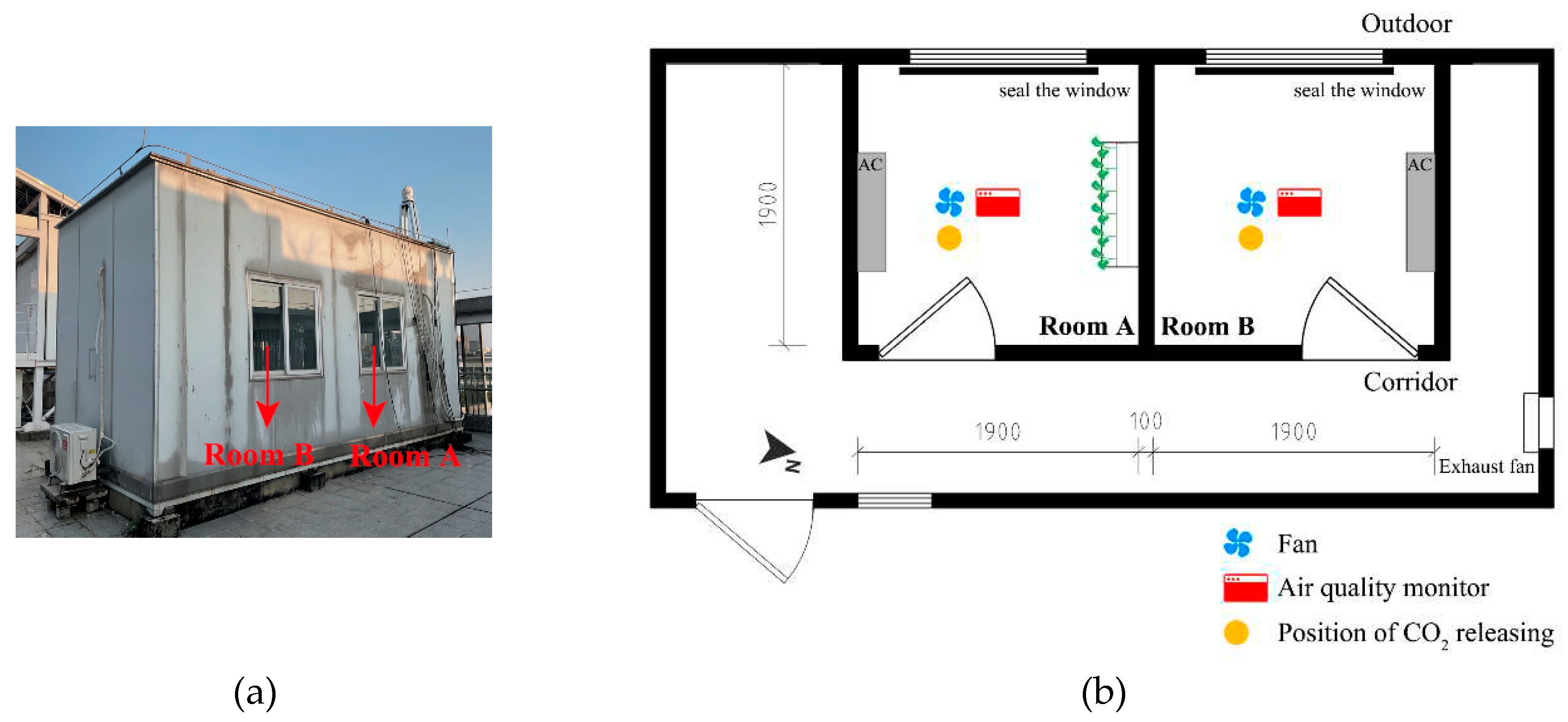
Figure 2.
The living walls in the experimental room: (a) the structure of the living walls; (b) photos of the living walls.
Figure 2.
The living walls in the experimental room: (a) the structure of the living walls; (b) photos of the living walls.
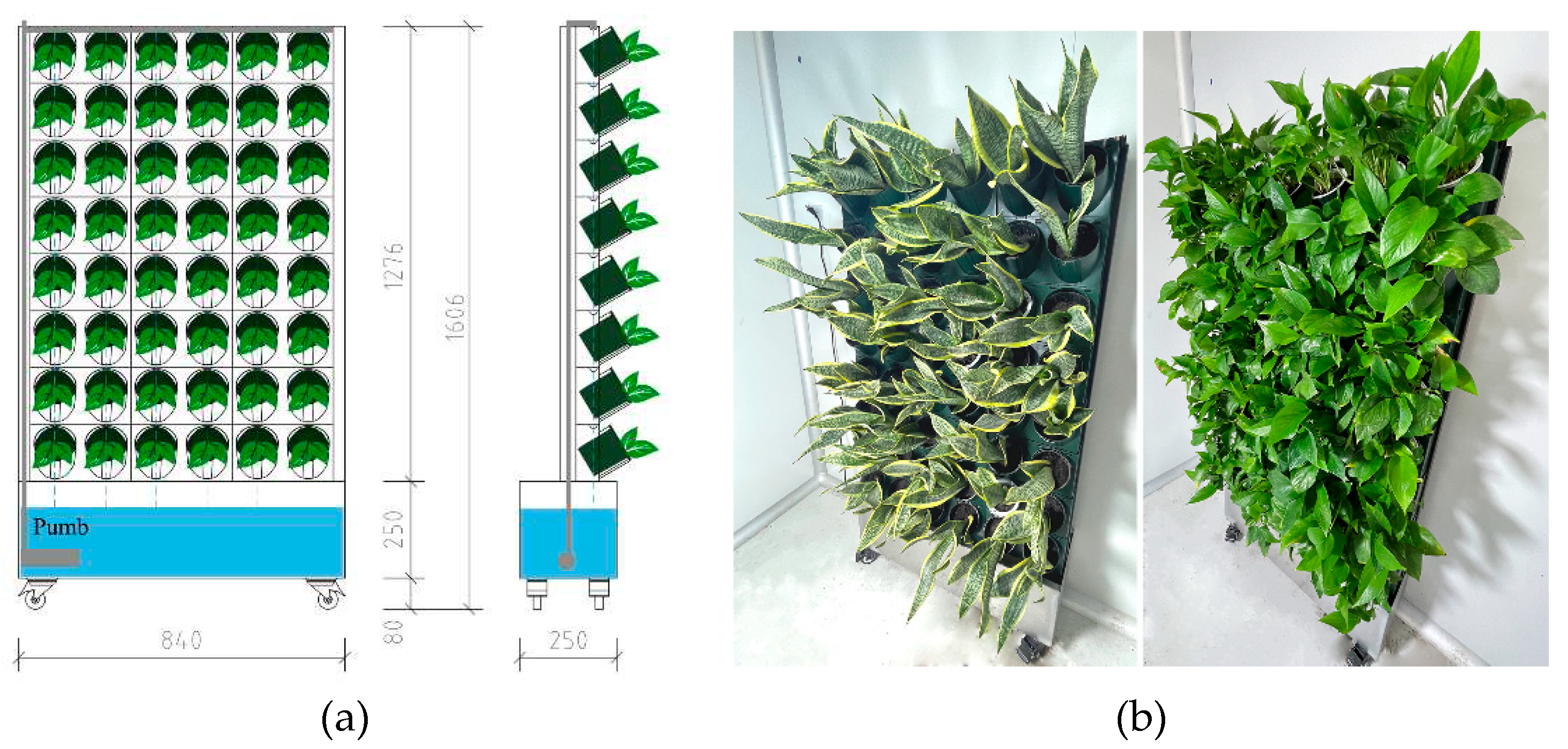
Figure 3.
The plan of the simulated office.
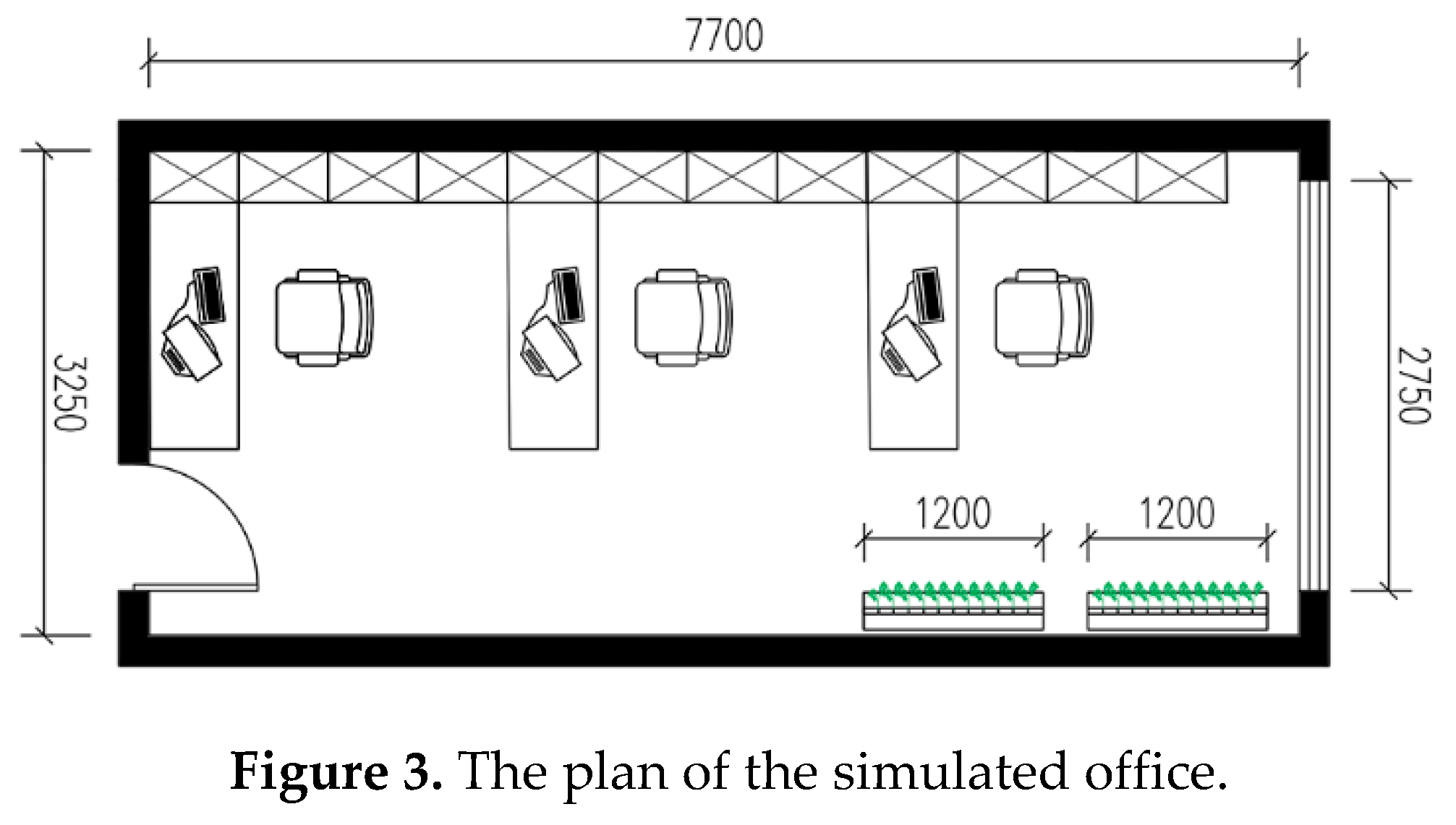
Figure 4.
The changes in the indoor CO2 concentration (a) before the ventilation turns on, (b) during working hours with a VAV system, (c) after the CAV system turns on, (d) and during working hours with a CAV system. Note: C1 is the initial CO2 concentration, Cst is the steady-state CO2 concentration, and CU and CL respectively denote the upper and lower limits of the CO2 concentration of the CAV system.
Figure 4.
The changes in the indoor CO2 concentration (a) before the ventilation turns on, (b) during working hours with a VAV system, (c) after the CAV system turns on, (d) and during working hours with a CAV system. Note: C1 is the initial CO2 concentration, Cst is the steady-state CO2 concentration, and CU and CL respectively denote the upper and lower limits of the CO2 concentration of the CAV system.
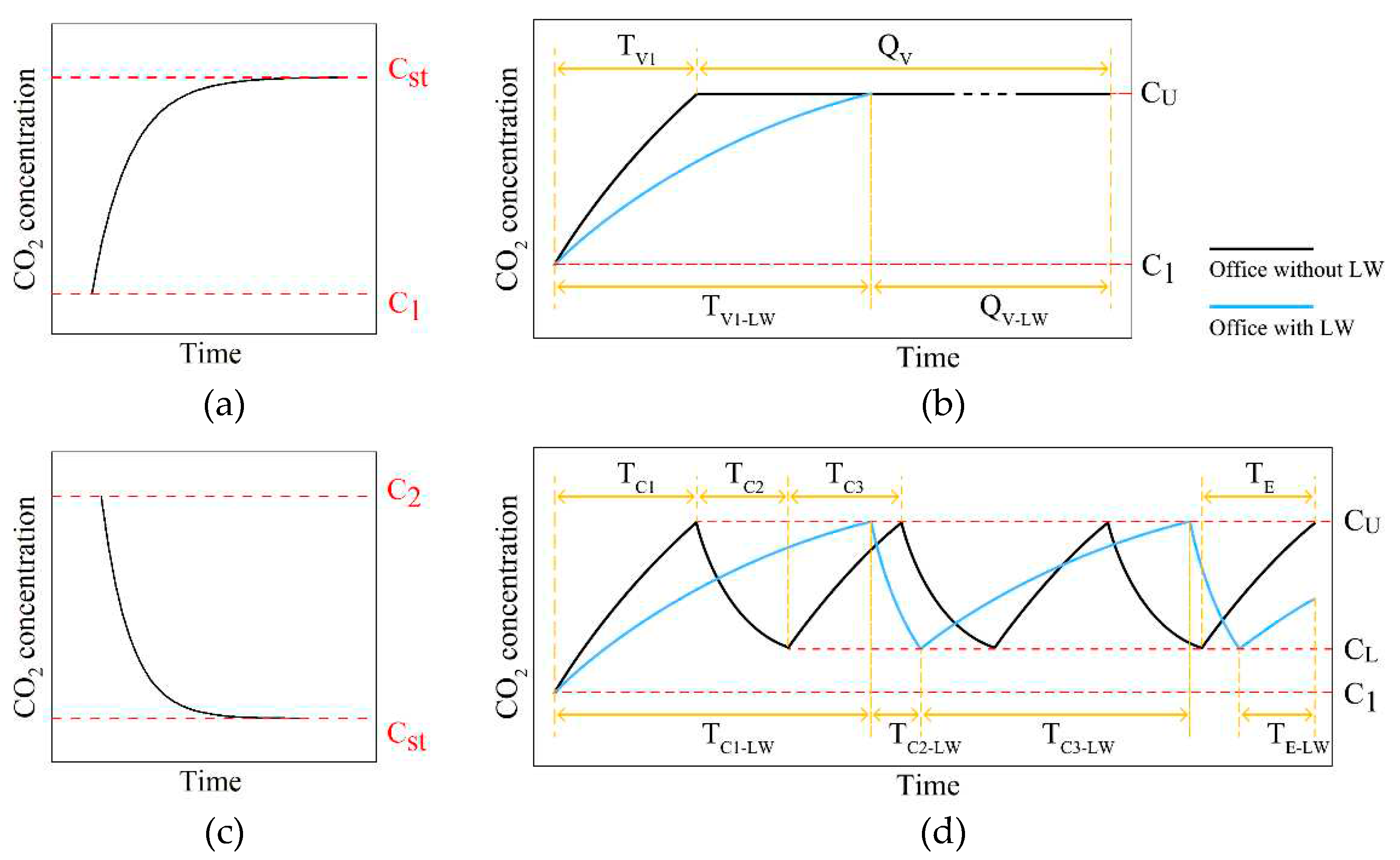
Figure 5.
The division of the Climate Region of Building in China and typical cities.
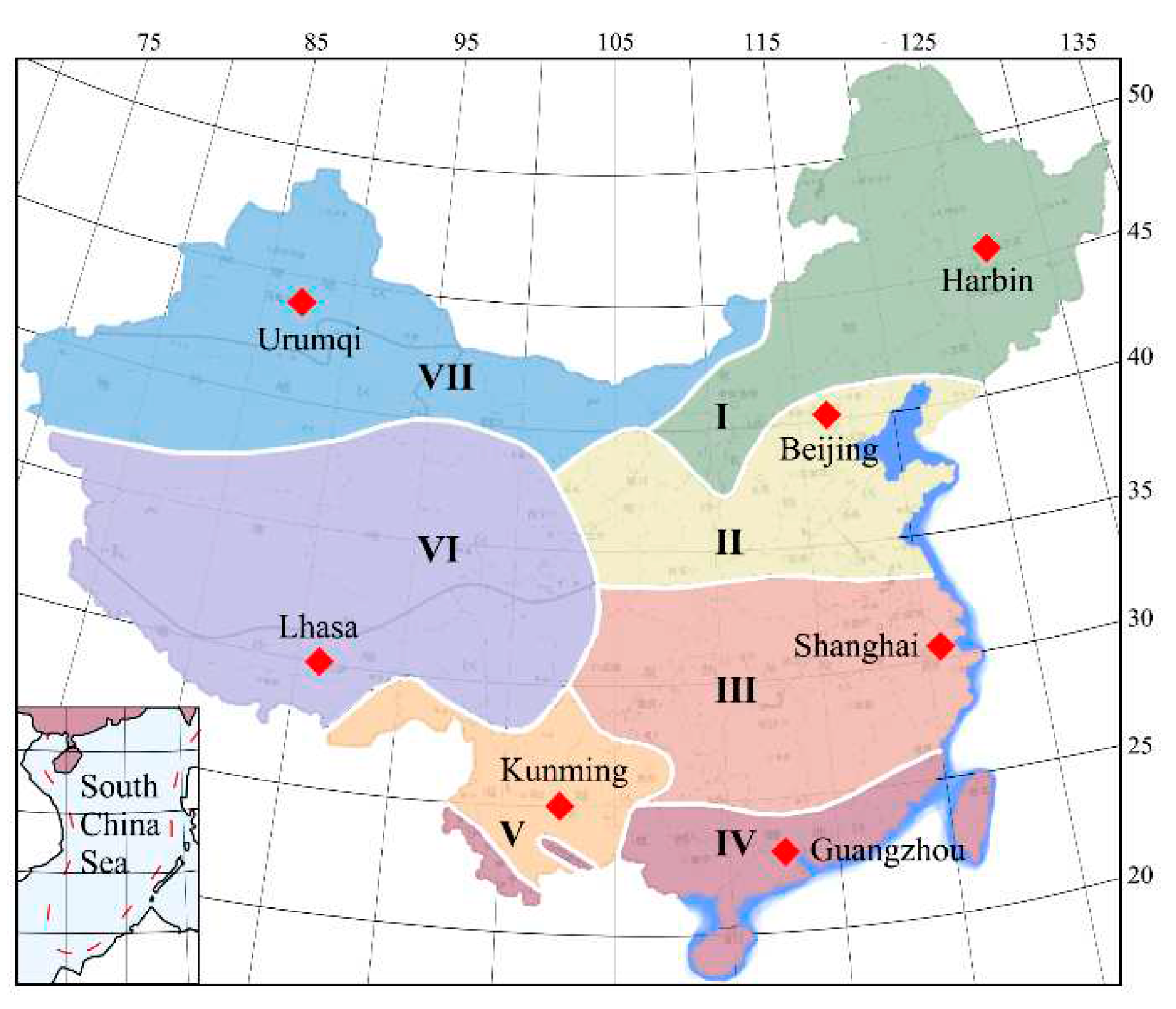
Figure 6.
The mean CO2 concentration (%) changes from the input concentration (1000±100 ppm) within 2 hours under different conditions: S. trifasciata (S), E. aureum (E), Dry (D), Wet (W), High light intensity (H), Medium light intensity (M), Low light intensity (L), Dark (DA). Shaded areas represent the SEM (n = 3).
Figure 6.
The mean CO2 concentration (%) changes from the input concentration (1000±100 ppm) within 2 hours under different conditions: S. trifasciata (S), E. aureum (E), Dry (D), Wet (W), High light intensity (H), Medium light intensity (M), Low light intensity (L), Dark (DA). Shaded areas represent the SEM (n = 3).
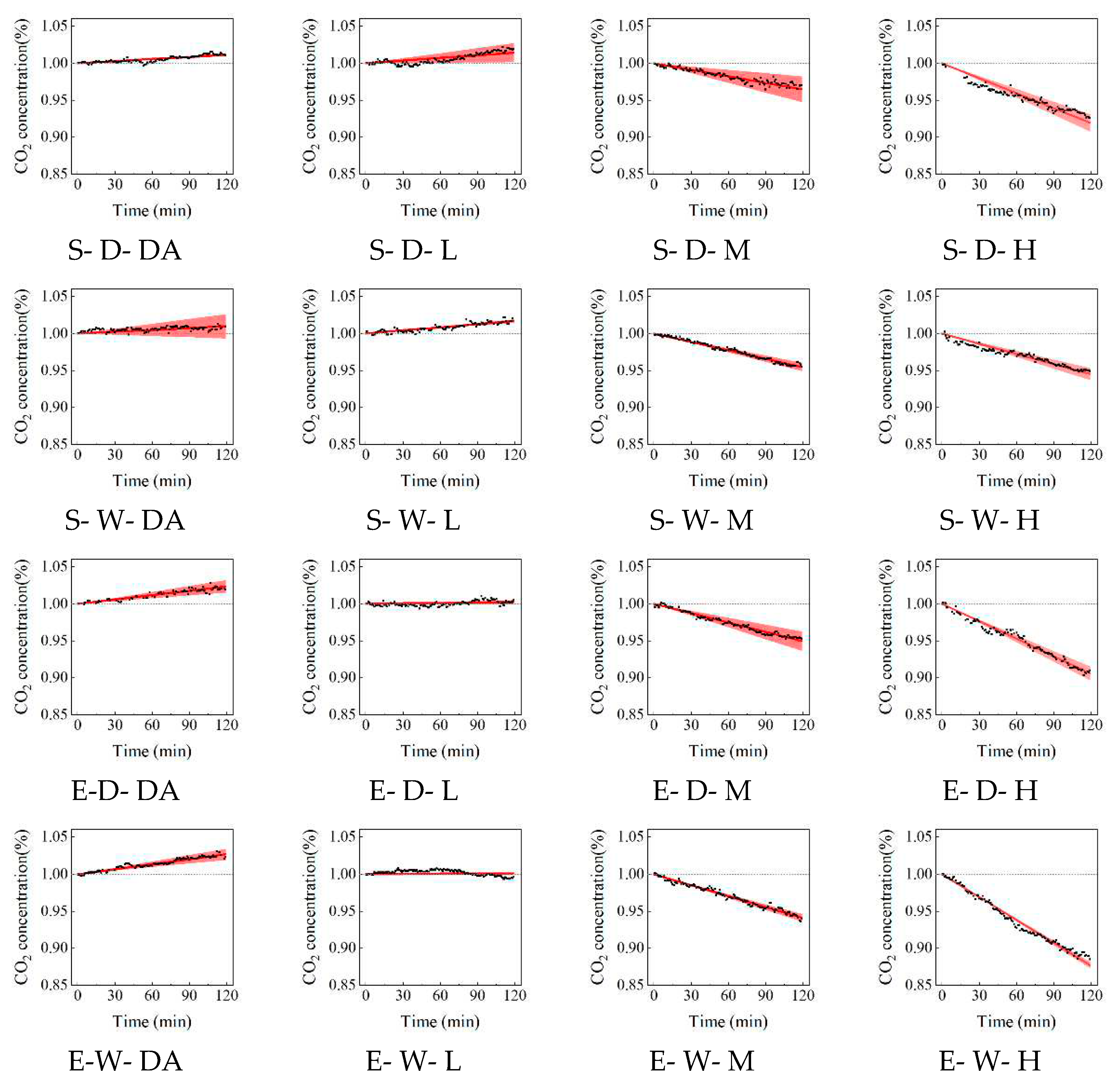
Figure 7.
The CO2 removal rates are presented as the mean ± SEM (n=3). Notes: lowercase letters indicate significant differences (p=0.05).
Figure 7.
The CO2 removal rates are presented as the mean ± SEM (n=3). Notes: lowercase letters indicate significant differences (p=0.05).
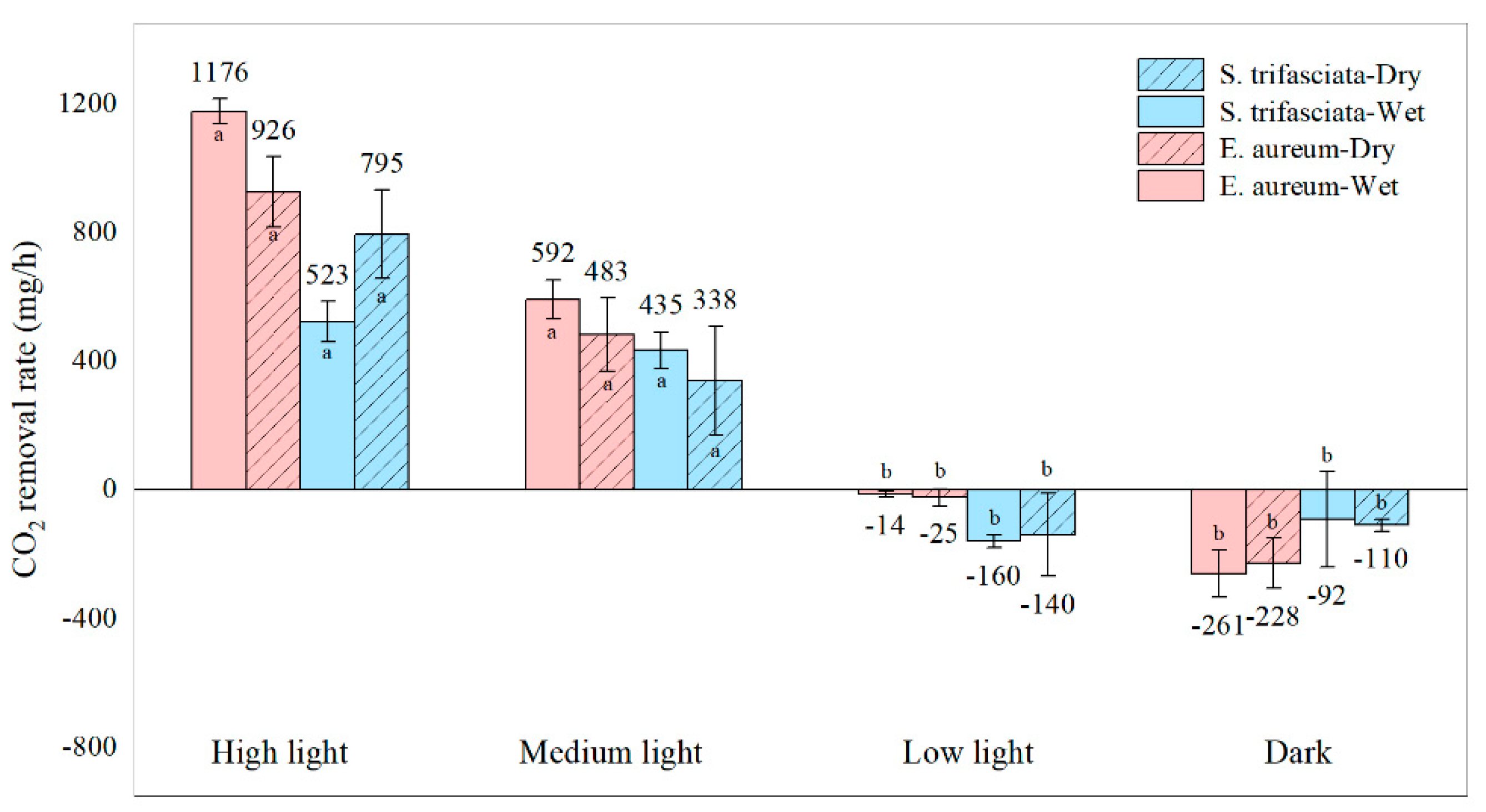
Figure 8.
The light response curve of the E. aureum living walls in a wet substrate.
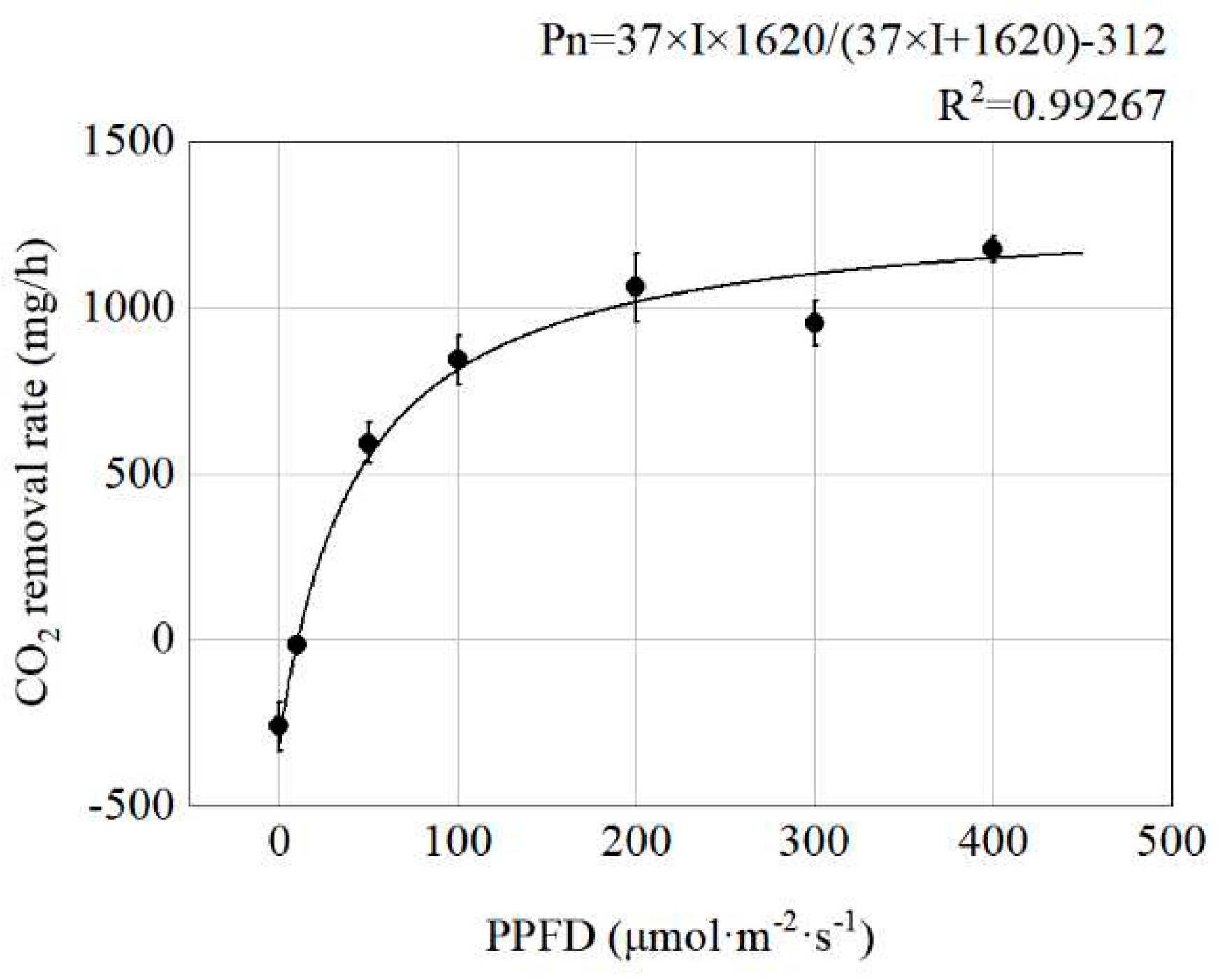
Figure 9.
The variations of the CO2 concentration in the offices with VAV or CAV systems, with different numbers of occupants, and with or without living walls, on a typical working day.
Figure 9.
The variations of the CO2 concentration in the offices with VAV or CAV systems, with different numbers of occupants, and with or without living walls, on a typical working day.
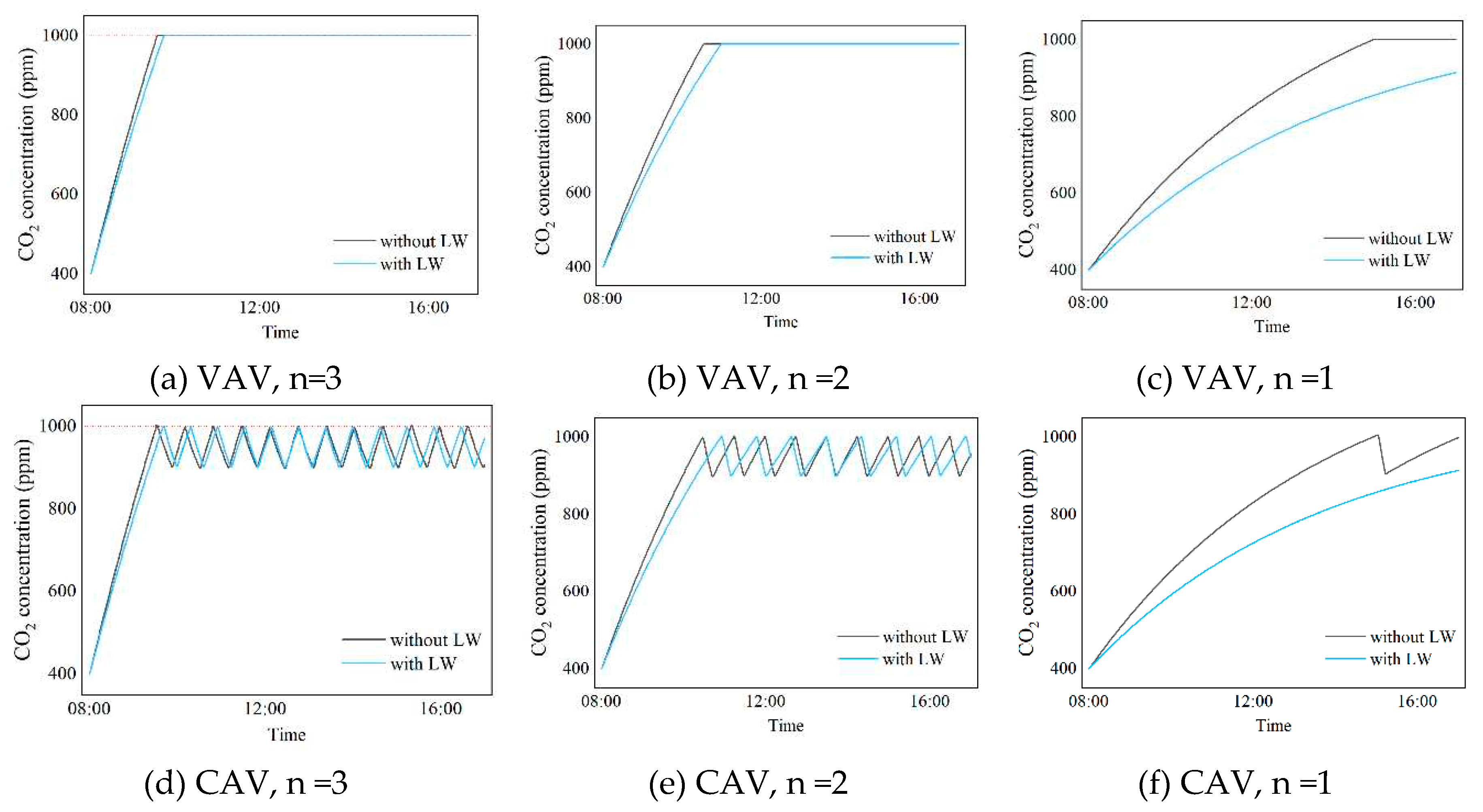
Figure 10.
The fresh air volumes in the offices with VAV or CAV systems, with different numbers of occupants, and with or without living walls on a typical working day.
Figure 10.
The fresh air volumes in the offices with VAV or CAV systems, with different numbers of occupants, and with or without living walls on a typical working day.
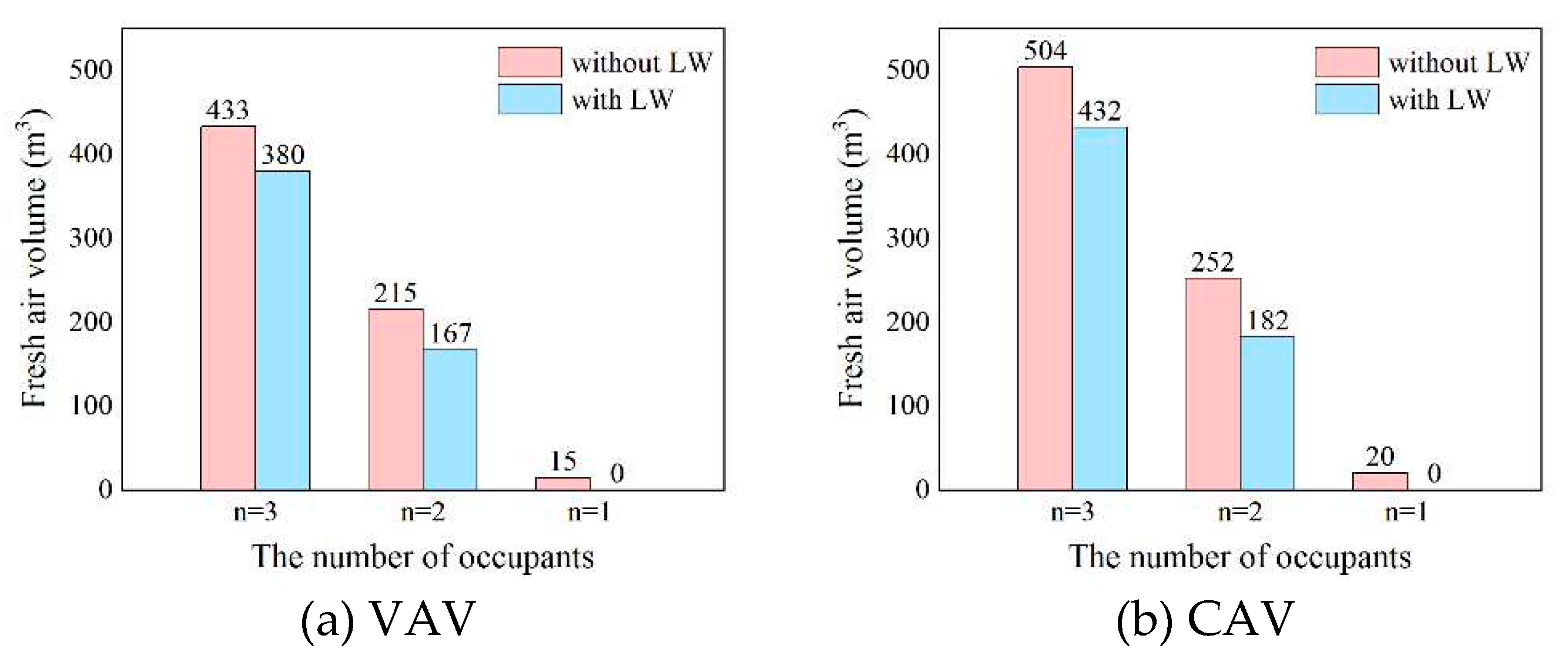
Figure 11.
The annual energy consumption for outdoor air cooling and heating in the offices with VAV or CAV systems, with different numbers of occupants, and with or without living walls, in typical cities.
Figure 11.
The annual energy consumption for outdoor air cooling and heating in the offices with VAV or CAV systems, with different numbers of occupants, and with or without living walls, in typical cities.
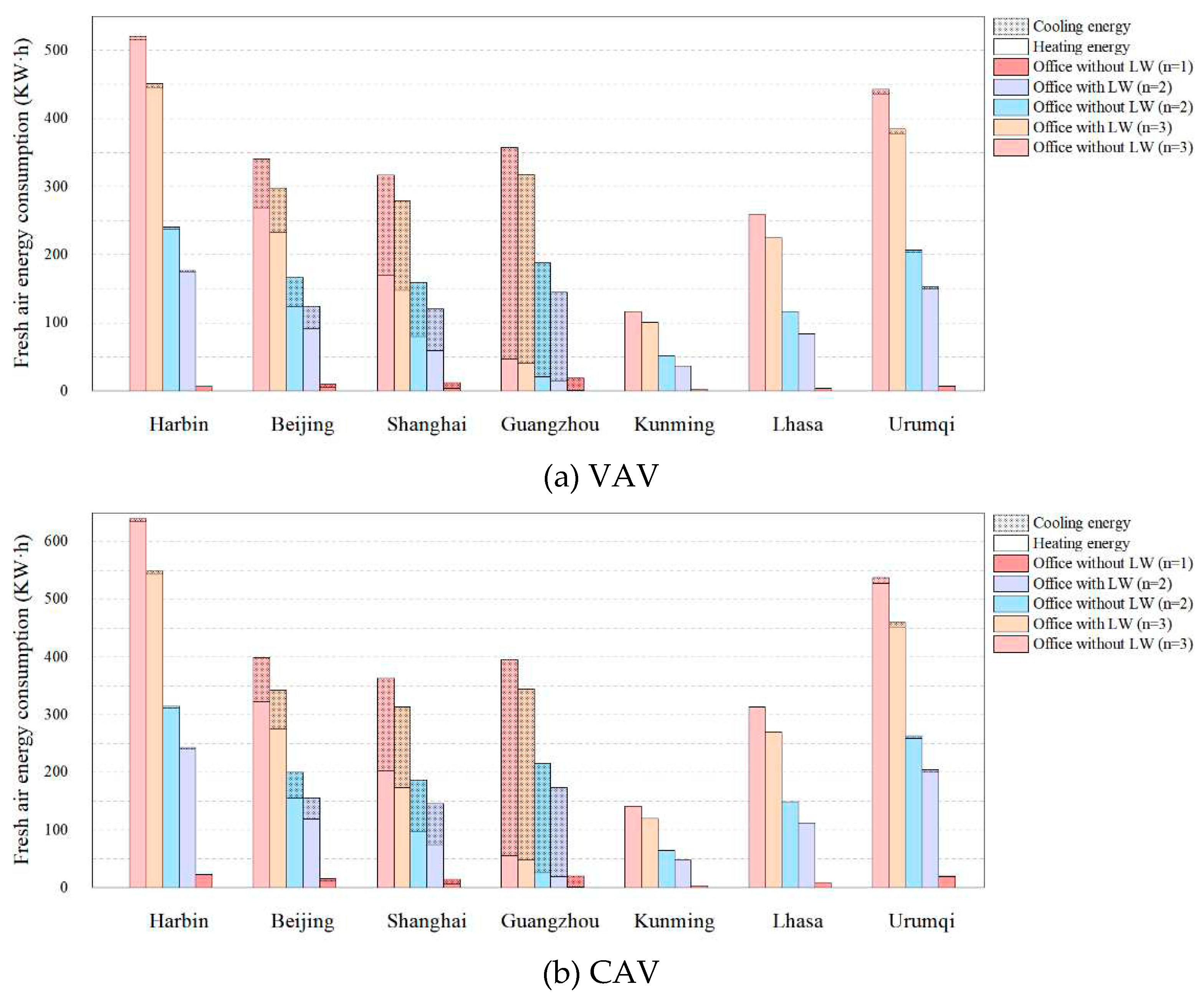

Table 1.
The instruments used in the tests.
| Instrument | Model | Parameters | Accuracy | Setting Points |
|---|---|---|---|---|
| Air quality monitor | SenseAir S8 | CO2 (ppm) | ±40 ppm | Indoor: In the center of the room, 1.2 m above the ground |
| SensenSHT20 | Temperature (°C) | ±0.3 °C | ||
| Relative humidity (%) | ±3% | |||
| Photosynthetic photon flux density (PPFD) meter | Apogee MQ-500 | PPFD/(μmol·m-2·s-1) | ±5% | On the top of canopy |
| Apogee SQ-520 | Outdoor: Roof | |||
| CO2 sensor | RS-BYH-CO2-M | CO2 (ppm) | ±40 ppm (25 °C) | Outdoor: Roof |
| Weather station | Campbell 81000 | Wind speed (m/s) | ±1% | Outdoor: Roof |
| Campbell CS215 | Temperature (°C) | ±0.3 °C (25 °C) | ||
| Relative humidity (%) | ±2% (25 °C) | |||
| Volumetric water content (VWC) sensor | Decagon Devices 5TE | VWC (m3/m3) | ±3% | Substrate |
Table 2.
The characteristics of the plant species selected for experiments. The leaf area and plant height (n = 6) are presented as the means ± standard error of the mean (SEM).
Table 2.
The characteristics of the plant species selected for experiments. The leaf area and plant height (n = 6) are presented as the means ± standard error of the mean (SEM).
| Species | Family | Metabolism | Leaf Type | Leaf Area (cm2 ) | Plant Height (cm) |
|---|---|---|---|---|---|
| Sansevieria trifasciata | Asparagaceae | CAM | succulent | 537±77 | 28±1 |
| Epipremnum aureum | Araceae | C3 | herbaceous | 614±111 | 22±1 |
Table 3.
The outdoor meteorological parameters of typical cities in different climate regions [51].
Table 3.
The outdoor meteorological parameters of typical cities in different climate regions [51].
| Climate Region | City | Average Temperature in Winter (°C) |
Dry Bulb Temperature in Summer (°C) |
Relative Humidity in Summer |
Atmospheric Pressure in Summer (kPa) |
Moisture Content in Summer (g/kg) |
Enthalpy in Summer (kJ/kg) |
|---|---|---|---|---|---|---|---|
| Ⅰ | Harbin | -27.1 | 30.7 | 62% | 98.8 | 17.7 | 76.2 |
| Ⅱ | Beijing | -9.9 | 33.5 | 61% | 100.0 | 20.2 | 85.7 |
| Ⅲ | Shanghai | -2.2 | 34.4 | 69% | 100.5 | 24.1 | 96.5 |
| Ⅳ | Guangzhou | 5.2 | 34.2 | 68% | 100.0 | 23.6 | 95.0 |
| Ⅴ | Kunming | 0.9 | 26.2 | 68% | 80.8 | 18.3 | 73.0 |
| Ⅵ | Lhasa | -7.6 | 24.1 | 38% | 65.3 | 11.0 | 52.4 |
| Ⅶ | Urumqi | -23.7 | 33.5 | 34% | 91.1 | 12.2 | 65.2 |
Table 4.
The confirmation results of the two experimental rooms.
| Date | Wind Speed (m/s) | Leading Wind Direction | Outdoor and Indoor Temperature Difference (°C) | CO2 Concentration (ppm) | CO2 Concentration Difference (ppm) | |||
|---|---|---|---|---|---|---|---|---|
| Room A | Room B | Room A | Room B | |||||
| 1 | 2022/10/14 11:00-13:00 | 2.3 | WSW/SSW/WNW | 4.1 | 3.4 | 150 | 171 | 21 |
| 2 | 2022/10/15 0:00-2:00 | 2.3 | WSW/SSW | 4.6 | 3.5 | 47 | 49 | 2 |
| 3 | 2022/10/16 10:30-12:30 | 4.6 | WSW/SSW | 4.9 | 3.8 | 164 | 182 | 18 |
Disclaimer/Publisher’s Note: The statements, opinions and data contained in all publications are solely those of the individual author(s) and contributor(s) and not of MDPI and/or the editor(s). MDPI and/or the editor(s) disclaim responsibility for any injury to people or property resulting from any ideas, methods, instructions or products referred to in the content. |
© 2023 by the authors. Licensee MDPI, Basel, Switzerland. This article is an open access article distributed under the terms and conditions of the Creative Commons Attribution (CC BY) license (http://creativecommons.org/licenses/by/4.0/).
Copyright: This open access article is published under a Creative Commons CC BY 4.0 license, which permit the free download, distribution, and reuse, provided that the author and preprint are cited in any reuse.


