
Submitted:
05 June 2023
Posted:
06 June 2023
You are already at the latest version
Abstract
A number of sustainable and environmental issues are caused by consumer's behavior. Consumers' consumption pattern plays an increasingly important role in environmental conservation and adopting to a more sustainable community. This study used planned behavior theory and structural equation model to quantifies individual purchasing behavior of electronic vehicles based on perceived health risk cased by air pollution in Kunming, China. The findings showed that (1)for residents in Kunming, the perceived air pollution risk, the willingness to purchase new energy vehicles, and actual purchase behavior are low; (2) perception of health risks has a significant positive impact on purchase willingness, behavioral attitude and subjective norms play a significant positive mediating role between perception of health risks and purchase willingness, and perception of behavioral control plays a significant negative role, purchase willingness has significant positive impact on purchase behavior, the direct effect of perceived behavioral control on purchase behavior is insignificant; (3) for highly educated groups, risk controllability has a significant impact on the perception of health risk, subjective norms and behavioral attitude have significant impacts on purchase willingness, while for low-income gourp, risk controllability has significant impacts on the perception of health risk.
Keywords:
sustainable consumption behavior
; electronic vehicles
; SEM
; Kunming
Introduction
Carbon mitigation is not only critical for China to meet its carbon peak and carbon neutrality commitments, but also for addressing public concern over air pollution. In 2019, the air quality of 157 of 337 Chinese cities (46.6%) met the quality standard [1]. Air pollution has a significant negative impact on public health, which is a major public concern. Air pollution affects the subjective and objective quality of life of the public, causes a wide range of diseases in the respiratory system, nervous system, circulatory system, digestive system and urinary syste [2]. In addition, life satisfaction is significantly negatively affected by perceived air pollution[3]. In China, the number of vehicles reached 348 million in 2019, and the total emission of carbon monoxide (CO), hydrocarbon (HC), nitrogen oxide (NOx) and particulate matter (PM), reached 16.04 million tons [4]. New energy vehicles make up a key part of plans to reduce vehicular emissions [5]. Governments could reduce automobile exhaust pollution on a large scale by encouraging customers to purchase new energy vehicles. Additionally, individuals could reduce automobile emission-caused health risks by adopting greener consumption behaviors, though not everyone would be willing to. The factors that dictate whether an individual adopts more environmentally friendly consumption behaviors relating to perceived air pollution risks are vague.
This study used questionnaires to investigate the willingness of residents in Kunming to purchase new energy vehicles. We employed the theory of planned behavior to explore the factors of individual purchasing behavior based on the individual’s perception of the risks of air pollution. In Kunming the total number of vehicles has reached 2.5 million [4].
The economic costs of air pollution and its impact on human health
The air pollution has attracted wide interests from scholars, policy makers and sustainable practitioners, which caused human health cost and economic cost. The scholars had made considerable contribution to literature. These researchers found that various diseases for adult are related to air pollution, including diseases in respiratory system, Nervous system, circulatory
system, digestive system, urinary system [2,6,7,8,9]. Infant development delays and birth defects are also closely related to air pollution [10]. Worldwide, every year, 4.2 million deaths are caused by ambient air pollution and 90% of the global population live in places where air quality doesn’t meet the guidelines of the WHO [11]. In a long term, air pollution reduced life expectancy [12]. Therefore, air pollution significantly affected human health.
Globally, in 2013, air pollution deaths caused US$225 billion lost, and reduced annual labor income, equivalent to almost 1% of local GDP in South Asia, East Asia and the Pacific [13]. In China, haze related total direct cost on health was 23 billion Yuan in 2013 [14]. Air pollution is a challenge that threatens basic human welfare, damages natural and physical capital, and constrains economic growth [13].
Sustainable consumption behavior
The factors of sustainable consumption patterns have received intense interest from scholars. Previous literature discussed factors of sustainable consumption patterns in a broad context of psychology, economic-social, culture and policy etc., covering specific variables such as knowledge of sustainable consumption or environment, age group, attitudes, motivation, intentions, social norms, behavior ability, technologies, personal values, worldview, perceived consumer effectiveness, emotional values and information factors [15,16,17,18,19,20,21,22,23,24,25,26,27,28,29,30,31,32,33,34,35,36,37,38,39,40,41,42,43,44,45]. Marjolein C. et al. combined personal egoistic, altruistic, and biospheric values with purchasing intentions, behavior, and experiences, with the results showing personal values, specifically biospheric values, determine consumer sustainable patterns, while personal worldview plays a mediating role [15]. Zhengxia He et al. explored thefactors of green purchasing behavior through grounded theory. The findings showed that behavior motivation, behavior intentions, residential characteristics, social norms, behavior ability, and institutional and technological context are the main factors in green purchasing. Personal characteristics, behavioral ability, social norms, and the institutional and technological context play a moderating role in the relationship between behavior intention and green purchasing [16]. Gabriel Bratucu et al. investigated the consumption patterns of university students in Romania, and found that almost half of respondents had no knowledge of sustainable consumption, with older students showing more interest in sustainable consumption issues [17]. Xianchuan Yang et al. applied goal-framing theory to explore egoistic and altruistic appeals for green purchasing patterns among consumers in China. The results showed that media suggestions affect sustainable consumption behavior, and normative goals play a mediating role. Additionally, egoistic appeals push consumers to adopt a sustainable purchase behavior to help themselves, while altruistic appeals reduce consumers’ green purchase intensions [18]. Joseph Agebase Awuni1 et al., using structural equation modeling and consumption value theory, investigated 309 respondents and found that social and emotional values positively affect sustainable consumption intentions, but the influence of functional, conditional and epistemic values are not significant [19]. In the research of Camillo De Camillis and Malgorzata Goralczyk, they, taking life cycle thinking into account, proposed and verified a taxation framework towards sustainable consumption [45]. Jacopo Cerri et al. identified the role of information in the theoretical framework of consumption behavior, claiming that a consumer’s ecological knowledge could increase the predictive power of the theoretical framework. In addition, product labels, which provide product sustainability information, could effectively foster positive sustainable consumption attitudes in consumers [22]. Cultural and psychological factors were investigated in the research of Y. Ricky. and K. Chan. They investigated two major cities in China, and their findings suggested that subjects’ man–nature orientation,degree of collectivism, ecological affect and, marginally, ecological knowledge affected their attitudes toward sustainable consumption behavior. Their attitude, in turn, drove them toward more sustainable purchasing behaviors [23]. From 399 respondents in Hong Kong, China, F.Y Millisa. et al. found that environmental consciousness and values, as well as green product information, positively affected consumers’ sustainable consumption behavior, and green product quality played a mediating role in this relationship [24]. J.A.Corraliza and J.Berenguer found that environmental behavior depends on personal and situational variables in an interactive way. When a high level of conflict is generated between personal dispositions and situational conditions, the predictive power of attitudes tend to be minimal, whereas in the case of consistency between them it tends to be maximal [25]. Annika M.et al. identified the importance of personal norms for willingness to cooperate in social dilemmas [33]. A.Pagiaslis and A.K. Krontalis found that consumers’ environmental concerns positively and directly affect environmental knowledge, beliefs and behavioral intentions [35]. J.Pape et al. established that political conditions and policy frameworks alter consumers’ daily consumption behaviors [36]. U.S. Pawaskar et al. found that awareness of environmental problems and knowledge of remedial alternatives affect consumers’ sustainable behavior [41]. K.M. Taufique and S. Vaithianathan suggested that attitudes and perceived consumer effectiveness both have a significant direct and indirect positive influence on consumers’ ecologically conscious consumer behavior [43]. H.H. Zhao et al. identified that attitude is the most significant factor of green purchasing behavior [44].
In summary of the discussion above, consumers’ sustainable purchasing behavior is determined by multi-faceted and complex factors, including technical, social, psychological, institutional and financial facets. Scholars have identified a wide range of factors, such as personal values, behavior motivation, behavior intention, residential characteristics, social norms, behavior ability, information (regarding sustainable consumption, the environment, pollution and green products), media, personal egoistic appeals, taxation frame, the subjects’ man–nature orientation, degree of collectivism, ecological affect etc.
However, how individual’s health risk perception affects consumers’ sustainable purchasing behavior is vague. This study investigated consumers’ purchasing behavior of electronic vehicles based on perceptions of the link between air pollution and health risk in Kunming, Yunnan, China. Kunming is the capital of Yunnan Province. By the end of 2019, the number of motor vehicles were 2.85 million, 2.25 million of which are private vehicles [46]. In 2019, the air quality of 184 days was excellent and air quality of 172 days was good.[47]
Materials and Methods
The questionnaire includes three parts. The first is perception of health risk, which is the public’s objective evaluation of the subjective air pollution caused health risks. Refereed the Slovic Psychometric Paradigm [48], the indicators include knowledge of air pollution, air pollution impact level, possibility of air pollution occurrence etc.. After interviews and pre-investigation, 11 indicators were selected. The second part is the decision to purchase new energy vehicles, including purchase willingness and actual purchase. In addition, the purchase decision mechanism was explored by using the theory of planned behavior. The theory of planned behavior suggests that individual behavior is primarily determined by behavioral intentions, which are influenced by behavioral attitudes, subjective norms, and perceived behavioral control. Behavioral attitudes refer to the individual’s overall evaluation of behavior, both positive and negative; Subjective norms refer to the social pressures felt on individual actual behavior; Perceived behavioral control refers to the individual’s perceived self-control based on the resources and opportunities available, and indicates the individual’s perception of factors that facilitate or hinder the behavior [49]. The third part is the socioeconomic characteristics,including: gender, age, education level, income, and occupation.
The result of this section of the questionnaire showed that 49.5% of respondents were male; 40.1% were between 19 and 29 years old, 36.1% were between 30 and 49 years old, 19.8% were between 50 and 69 years old, 3.9% were older than 70; 6.3% had received junior high school education or below, 25.3% had received high school or college education, 68.2% held a bachelor’s degree or above; 37.9% had an annual income of less than 20,000 Yuan, 15.4% were between 20,000 Yuan and 50,000 Yuan, 33.0% were between 50,000 Yuan and 120,000 Yuan, 10.4% were between 120,000 Yuan and 240,000 Yuan, and 3.4% were above 240,000 Yuan; 35.6% were students, 21.5% worked in state agencies or enterprises, and 16.4% worked in foreign companies.
Results discussion
Description of samples
Excluding Whether have purchased a new energy vehicle, all questions were measured by the Likert five-point scale, and set in positive direction. The options for Whether have purchased a new energy vehicle were 1, which denotes hasn’t purchased, or 2, which denotes has purchased; The options for the willingness to purchase were 1 to 5, with increments of 1, which denote very reluctant, reluctant, average, willing and very willing. The results of the reliability test showed that Cronbach’s α coefficient was 0.85, and the Cronbach’s α coefficient of each part was greater than 0.61. Therefore the reliability met requirements. The data for health risk perception and decision to purchase are shown in Table 1.
Under perception of health risk, the average value of air pollution impact level, possibility of air pollution occurrence, consequence severity of air pollution, duration of air pollution, and relevance to daily life were all relatively high; The average value of controllability of air pollution, acceptability of air pollution and adaptability of air pollution was relatively low. This indicated that perceptions of air pollution caused health risks were low. In purchase willingness, the mean was 3.08 (a medium level), however only 8% of respondents have purchased a new energy vehicle. The explanation might be the ‘good’ or above air quality rating for 98% the year in 2019 in Kunming [47]. The means of low battery time and availability of charging piles were
3.47 and 3.54, which indicated consumer concerns for the usability of electronic vehicles. This reduced purchase willingness.
Theoretical modelling
The actual life is full of uncertainty, and early research considered the decision under risk is choice that maximize expectation. The expected utility theory sets the possibility of each possible result as objective known [50]. However, in most cases, the possibility is unknown. The subjective expected utility theory [51] and the state-dependent expected utility model [50] were developed, which take individual subjectivity into account, namely that perception of health risks might influence behavioral decisions. Scholars have conducted some empirical studies, for example, researching how risk perception of SARS significantly affects mental health and behaviors [52].
The planned behavior theory, which was initially applied in psychology and sociology to explore how individuals make behavioral decisions, asserts that behavior is primarily determined by an individual’s willingness, while behavioral attitudes, subjective norms, and behavioral control influence the individual’s willingness [49].
In this study, we assume that the different risk perceptions vary based on the individual’s attention to air pollution, thus behavioral attitudes and perceived behavioral control may be different. Additionally, perceptions of risk are transmissible. When individuals have higher risk perceptions, their family members or friends may share higher risk perceptions, which in turn influences the individual’s behaviors and raises pressure. As such, subjective norms might be stronger. Risk perception may impact behavioral attitudes, subjective norms and perceptions of behavioral control.
Based on the above, modelling is shown as Figure 1, and hypothesis are as follows:
Hypotheses:
- H1: Perception of health risk has a significant positive effect on purchase willingness;
- H2: Behavioral attitude plays a significant mediating role between risk perception and purchase willingness;
- H3: Subjective norms play a significant mediating role between risk perception and purchase willingness;
- H4: Perception of behavioral control plays a significant mediating role between perception of health risk and purchase willingness;
- H5: Perception of behavioral control plays a significant mediating role between perception of health risk and purchase behavior;
- H6: Purchase willingness has a significant positive effect on purchase behavior;
Model analysis
This study used AMOS to analyze data. First-order latent variable analysis may cause loss of measured variables, because perception of health risk is multidimensional, thus dimensionality reduction was applied on perception of health risk. The results of KMO factor analysis showed that KMO was 0.877, the Chi-Square test statistic of Bartlett sphericity test was 1786.74, with a significant P < 0.05. This indicates factor analysis was feasible. Furthermore, when maximal rotation of variance was applied, the principal components where eigenvalue was greater than 1 were selected, as shown in Table 2. Knowledge of air pollution, impacts of air pollution, possibility of air pollution occurrence, severity of consequences, duration, perceptibility, relevance to daily life, and acceptability were under components 1,which affect risk; controllability, equality, and adaptability, which were under components 2, were controllability of risk. Based on this, the second order latent variable model was built.
To ensure convergent validity and adequate model fit, varialbles, those are insignificant and factor loading is less than 0.4, were removed. Additionally, model modification was applied based on modification index (which is greater than 10) and model modification principals. The results are shown in Table 3. The GFI was 0.95, CFI was 0.95, and RMSEA was 0.05, meeting the requirement and indicating the model is reasonable and fit. For factor loading of measured variables on latent variables, 8 items of risk impacts were retained, standardized factor loading of adaptability was less than 0, while others were greater than 0; 1 item of controllability was retained. The factor loading of behavioral attitudes, subjective norms, and perception of behavioral control were greater than 0.
Perception of health risk has significant impacts on purchase willingness (H1 is verified), and a standardized coefficient of
0.50. Perception of health risk has significant positive impacts on behavioral attitudes, and a standardized coefficient of 0.36. Behavioral attitudes have significant positive impacts on purchase willingness, and a standardized coefficient of 0.24. This indicates that behavioral attitudes play a significant positive mediating role between perception of health risk and purchase willingness (H2 is verified). Perception of health risk has significant impacts on subjective norms, the standardized coefficient was 0.55. Subjective norms have significant positive impacts on purchase willingness, with a standardized coefficient of 0.31. This indicates that subjective norms play a significant positive mediating role between perception of health risk and purchase willingness (H3 is verified). Perception of health risk has significant impacts on behavioral control perception, the standardized coefficient was 0.67, perception of behavioral control has significant impacts on purchase willingness, standardized coefficient was 0.39, indicating perception of behavioral control plays a significant negative mediating role between perception of health risk and purchase willingness (H4 is verified). Perception of behavioral control has significant impacts on purchase behavior at 10% level, standardized coefficient was 0.08, indicating perception of behavioral control plays a significant negative mediating role between perception of health risk and purchase behavior (H5 is verified). Purchase willingness has significant impacts on actual purchase behavior (H6 is verified), with a standardized coefficient of 0.19, so purchase willingness weakly supports actual purchase behavior.
Heterogeneity analysis
We focused on socio-economic characteristics moderating effects on hypothesis paths. Heterogeneity analysis was done on education level and income. Education level was classified into two groups: under bachelor’s degree (low education), and bachelor’s degree and above (high education). Income was classified into two groups, low income (annual income less than 50, 000 Yuan) and high income (annual income more than 50, 000 Yuan). The results are shown in Table 4. For factor loading of measured variables on latent variables, 8 items of risk impacts were retained, standardized factor loading of adaptability was
less than 0, while others was greater than 0; 1 item of controllability was retained. The factor loading of behavioral attitudes, subjective norms, and perception of behavioral control were greater than 0.
For the high education group, risk controllability has significant impacts on perception of health risk; subjective norms and behavioral attitudes have significant impacts on purchase willingness; Perception of behavioral control has insignificant impacts on behavior. The explanation for these might be that high-education group have more knowledge of air pollution and high-risk controllability.
For the low-income group, risk controllability has significant impacts on perception of health risk; Perception of health risk has significant impacts on behavioral attitudes, subjective norms, perception of behavioral control, and purchase willingness. The explanation for these might be that the high-income group have more information and more methods to control risks. For the high-income group, behavioral attitudes and subjective norms significantly impact purchase willingness. The explanation might be that the high income group members have higher budgets, thus ignoring hinderances to purchasing.
Conclusions
This study investigated residents in Kunming and explored the factors of new energy vehicle purchase behavior based on perceived air pollution-caused health risks. The results showed that (1) the perceived air pollution risk by residents in Kunming is low, the willingness to purchase new energy vehicles is low, and actual purchase behavior is low; (2) perception of health risks has a significant positive impact on purchase willingness, behavioral attitude and subjective norms play a significant positive mediating role between perception of health risk and purchase willingness, perception of behavioral control acts in a significant negative role, purchase willingness has significant positive impact on purchase behavior, and the direct effect of perceived behavioral control on purchase behavior is insignificant; (3) in heterogeneity analysis, for the high education group risk controllability has a significant impact on perception of health risk, subjective norms and behavioral attitude have a significant impact on purchase willingness, while for the low-income group risk controllability has significant impacts on the perception of health risk, and perception of health risk has significant impacts on behavioral attitudes, subjective norms, perception of behavioral control, and purchase willingness.
For public policy, publicity of air pollution-caused health risks, as well as ecological and environmental knowledge, is an efficient way to improve public understanding and to shape consumers’ behavior. Senior students showed more interest in sustainable consumpti [28], so a curriculum addition for senior university students is an ideal way to transform their knowledge into actual behavior. Improving battery performance [53] and deploying more charging piles could meet the consumers’ concerns relating to usability of electronic vehicles.
Author Contributions
Conceptualization, Ji.Chen. and Ji.Chen.; methodology, Ji.Chen.; software, Ji.Chen.; validation, Yuexin.Dou., Ji.Chen. and Ji.Chen.; formal analysis, Ji.Chen.; investigation, Ji.Chen., Ji.Chen. and Yuexin.Dou; resources, Yuexin.Dou.; data curation, Yuexin.Dou. and Ji.Chen.; writing—original draft preparation,Ji.Chen. and Ji.Chen.; writing—review and editing,Ji.Chen. and Yuexin.Dou.; visualization, Ji.Chen.; supervision,Yuexin.Dou.; project administration, Yuexin.Dou.; funding acquisition, Yuexin.Dou. All authors have read and agreed to the published version of the manuscript.
Funding
This research was fully funded by Yunnan Provincial Department of Education, grant number 2017ZZX045.
Acknowledgments
This study received kindly supports from colleagues of College of Economic and Management, Yunnan Agricultural University.
References
- Ministry of Ecology and Environment of the People’s Republic of China. 2019 China Ecological Environment Status Bulletin. http://www.cnemc.cn/jcbg/zghjzkgb/202007/P020200716568022848361.pdf.
- Hu, F. & Guo, Y. Health impacts of air pollution in China. Front. Environ. Sci. & Eng. 15, 74. 2021. [CrossRef]
- Mackerron, G. & Mourato, S. Life satisfaction and air quality in London. Ecol. Econ. 68, 1441–1453. 2009. [CrossRef]
- Ministry of Ecology and Environment of the People’s Republic of China. China Mobile Source Environmental Management Annual Report (2020). http://www.mee.gov.cn/hjzl/sthjzk/ydyhjgl/202008/P020200811521365906550.pdf.
- Zou, C. et al. The role of new energy in carbon neutral. PETROLEUM EXPLORATION AND DEVELOPMENT 48, 411–420. 2021.
- Zhang, J. et al. Environmental health in China: progress towards clean air and safe water. The Lancet 375, 1110–1119. 2010. [CrossRef]
- Yu, F. et al. Review on studies of environmental impact on health from air pollution in China. Zhonghua Yi Xue Za Zhi 93, 2695–2698. 2013.
- Lin, H., Wang, X., Tao, L., Xing, L. & Ma, W. Air pollution and mortality in china. Adv. Exp. Medicine Biol. 1017, 103–121. 2017. [CrossRef]
- Niu, Y., Chen, R. & Kan, H. Air pollution, disease burden, and health economic loss in china. In Advances in Experimental Medicine and Biology, vol. 1017, 233–242. 2017. [CrossRef]
- González-Díaz, S., Arias-Cruz, A., Macouzet-Sánchez, C. & , A. P.-O. Impact of air pollution in respiratory allergic diseases. Medicina Univ. 18, 212–215. 2016. [CrossRef]
- Air pollution. https://www.who.int/health-topics/air-pollution#tab=tab_1.
- Guan, W. J., Zheng, X. Y., Chung, K. F. & Zhong, N. S. Impact of air pollution on the burden of chronic respiratory diseases in China: time for urgent action. Lancet (London, England) 388, 1939. 1939. [CrossRef]
- Air Pollution Deaths Cost Global Economy US$225 Billion.
- Mu, Q. & Zhang, S.-Q. An evaluation of the economic loss due to the heavy haze during january 2013 in china. Zhongguo Huanjing Kexue/China Environ. Sci. 33, 2087–2094 (2013).
- Caniëls, M. C. J., Lambrechts, W., Platje, J. J., Motylska-Kuz´ma, A. & Fortun´ski, B. 50 Shades of Green: Insights into Personal Values and Worldviews as Drivers of Green Purchasing Intention, Behaviour, and Experience. Sustainability 13, 4140. 2021. [CrossRef]
- He, Z. et al. The impact of motivation, intention, and contextual factors on green purchasing behavior: New energy vehicles as an example. BUSINESS STRATEGY AND THE ENVIRONMENT 30, 1249–1269. 2021. [CrossRef]
- Bratucu, G. et al. Acquisition of Electric Vehicles A Step towards Green Consumption. Empirical Research among Romanian Students. Sustainability 11, 6639. 2019. [CrossRef]
- Yang, X., Chen, S.-C. & Zhang, L. Promoting sustainable development: A research on residents’ green purchasing behavior from a perspective of the goal-framing theory. Sustain. Dev. 28, 1208–1219. 2020. [CrossRef]
- Awuni, J. A. & Du, J. Sustainable Consumption in Chinese Cities: Green Purchasing Intentions of Young Adults Based on the Theory of Consumption Values: Green Purchasing in Chinese Cities. Sustain. Dev. 24, 124–135. 2016. [CrossRef]
- Axsen, J., Orlebar, C. & Skippon, S. Social influence and consumer preference formation for pro-environmental technology: The case of a UK workplace electric-vehicle study. Ecol. Econ. 95, 96–107. WOS:000326776100010. 2013. [CrossRef]
- De Camillis, C. & Goralczyk, M. Towards stronger measures for sustainable consumption and production policies: proposal of a new fiscal framework based on a life cycle approach. Int. J. Life Cycle Assess. 18, 263–272. WOS:000313165600024. 2013. [CrossRef]
- Cerri, J., Testa, F. & Rizzi, F. The more I care, the less I will listen to you: How information, environmental concern and ethical production influence consumers’ attitudes and the purchasing of sustainable products. J. Clean. Prod. 175, 343–353. WOS:000423635500032. 2018. [CrossRef]
- Chan, R. Y. K. Determinants of Chinese consumers’ green purchase behavior. Psychol. & Mark. 18, 389–413. WOS:000167596400004. 2001. [CrossRef]
- Cheung, M. F. Y. & To, W. M. An extended model of value-attitude-behavior to explain Chinese consumers’ green purchase behavior. J. Retail. Consumer Serv. 50, 145–153. WOS:000471928200017. 2019. [CrossRef]
- Corraliza, J. A. & Berenguer, J. Environmental values, beliefs, and actions - A situational approach. Environ. Behav. 32, 832–848. 2000. [CrossRef]
- Dagher, G. K. & Itani, O. Factors influencing green purchasing behaviour: Empirical evidence from the Lebanese consumers. J. Consumer Behav. 13, 188–195. WOS:000340382100004. 2014. [CrossRef]
- Diamantopoulos, A., Schlegelmilch, B. B., Sinkovics, R. R. & Bohlen, G. M. Can socio-demographics still play a role in profiling green consumers? A review of the evidence and an empirical investigation. J. Bus. Res. 56, 465–480. WOS:000182643500005. 2003. [CrossRef]
- Dobson, A. Environmental citizenship: Towards sustainable development. Sustain. Dev. 15, 276–285. WOS:000250932400002. 2007. [CrossRef]
- Doran, R. & Larsen, S. The Relative Importance of Social and Personal Norms in Explaining Intentions to Choose Eco-Friendly Travel Options. Int. J. Tour. Res. 18, 159–166. WOS:000371746000006. 2016. [CrossRef]
- Fehr, E. & Fischbacher, U. Third-party punishment and social norms. Evol. Hum. Behav. 25, 63–87. WOS:000221036800001. 2004. [CrossRef]
- Fuentes, C. Managing green complexities: consumers’ strategies and techniques for greener shopping. Int. J. Consumer Stud. 38, 485–492. 2014. [CrossRef]
- Wang, J., Wang, X. & Jiang, B. Structural Equation Models:Methods and Applications (Higher Education Press, 2011).
- Nordlund, A. M. & Garvill, J. Effects of values, problem awareness, and personal norm on willingness to reduce personal car use. J. Environ. Psychol. 23, 339–347. WOS:000186823100001. 2003. [CrossRef]
- ölander, F. & ThØgersen, J. Understanding of consumer behaviour as a prerequisite for environmental protection. J. Consumer Policy 18, 345–385. 1995. [CrossRef]
- Pagiaslis, A. & Krontalis, A. K. Green Consumption Behavior Antecedents: Environmental Concern, Knowledge, and Beliefs. Psychol. & Mark. 31, 335–348. WOS:000334017200003. 2014. [CrossRef]
- Pape, J., Rau, H., Fahy, F. & Davies, A. Developing Policies and Instruments for Sustainable Household Consumption: Irish Experiences and Futures. J. Consumer Policy 34, 25–42. 2011. [CrossRef]
- Sang, Y.-N. & Bekhet, H. A. Modelling electric vehicle usage intentions: an empirical study in Malaysia. J. Clean. Prod.
- 92, 75–83. WOS:000351649900008. 2015. [CrossRef]
- Wei, C.-F., Chiang, C.-T., Kou, T.-C. & Lee, B. C. Y. Toward Sustainable Livelihoods: Investigating the Drivers of Purchase Behavior for Green Products. Bus. Strateg. Environ. 26, 626–639. WOS:000405389500005. 2017. [CrossRef]
- Aagerup, U. & Nilsson, J. Green consumer behavior: being good or seeming good? J. Prod. & Brand Manag. 25, 274–284. 2016. [CrossRef]
- Arli, D., Tan, L. P., Tjiptono, F. & Yang, L. Exploring consumers’ purchase intention towards green products in an emerging market: The role of consumers’ perceived readiness. Int. J. Consumer Stud. 42, 389–401. 2018. [CrossRef]
- Pawaskar, U. S., Raut, R. D. & Gardas, B. B. Assessment of Consumer Behavior Towards Environmental Responsibility: A Structural Equations Modeling Approach: Analyses the Elements of Environmental Responsibility of Consumer. Bus. Strateg. Environ. 27, 560–571. 2018. [CrossRef]
- Reimers, V., Magnuson, B. & Chao, F. Happiness, altruism and the Prius effect: How do they influence consumer attitudes towards environmentally responsible clothing? J. Fash. Mark. Manag. An Int. J. 21, 115–132. 2017. [CrossRef]
- Taufique, K. M. & Vaithianathan, S. A fresh look at understanding Green consumer behavior among young urban Indian consumers through the lens of Theory of Planned Behavior. J. Clean. Prod. 183, 46–55. 2018. [CrossRef]
- Zhao, H.-h., Gao, Q., Wu, Y.-p., Wang, Y. & Zhu, X.-d. What affects green consumer behavior in China? A case study from Qingdao. J. Clean. Prod. 63, 143–151. 2014. [CrossRef]
- De Camillis, C. & Goralczyk, M. Towards stronger measures for sustainable consumption and production policies: proposal of a new fiscal framework based on a life cycle approach. Int. J. Life Cycle Assess. 18, 263–272. WOS:000313165600024. 2013. [CrossRef]
- Statistical of economic and social development of Kunming in 2019.
- Ministry of Ecology and Environment of the People’s Republic of China. Bulletin on ecological environment of Kunming in 2019. http://www.km.gov.cn/c/2020-06-04/3567146.shtml.
- Slovic, P. Perception of risk. Science 236, 280–285. https://science.sciencemag. org/content/236/4799/280.full.pdf. 1987. [CrossRef]
- Ajzen, I. The theory of planned behavior. Organ. Behav. Hum. Decis. Process. 50, 179–211. 1991. [CrossRef]
- Schilirò, D. Economics versus psychology. Risk, uncertainty and the expected utility theory. J. Math. Econ. Finance 1, 77–96. 2017. [CrossRef]
- Stommel, E. Reference-Dependent Preferences: A Theoretical and Experimental Investigation of Individual Reference-Point Formation (Springer Gabler, Wiesbaden, 2013).
- Shi, K. et al. The Risk Perceptions of SARS Socio-psychological Behaviors of Urban People in China. Acta Psychol. Sinica 546–554 (2003).
- Chéron, E. & Zins, M. Electric vehicle purchasing intentions: The concern over battery charge duration. Transp. Res. Part A: Policy Pract. 31, 235–243. 1997. [CrossRef]
Figure 1.
The path of health risk perception influence on purchase behavior.
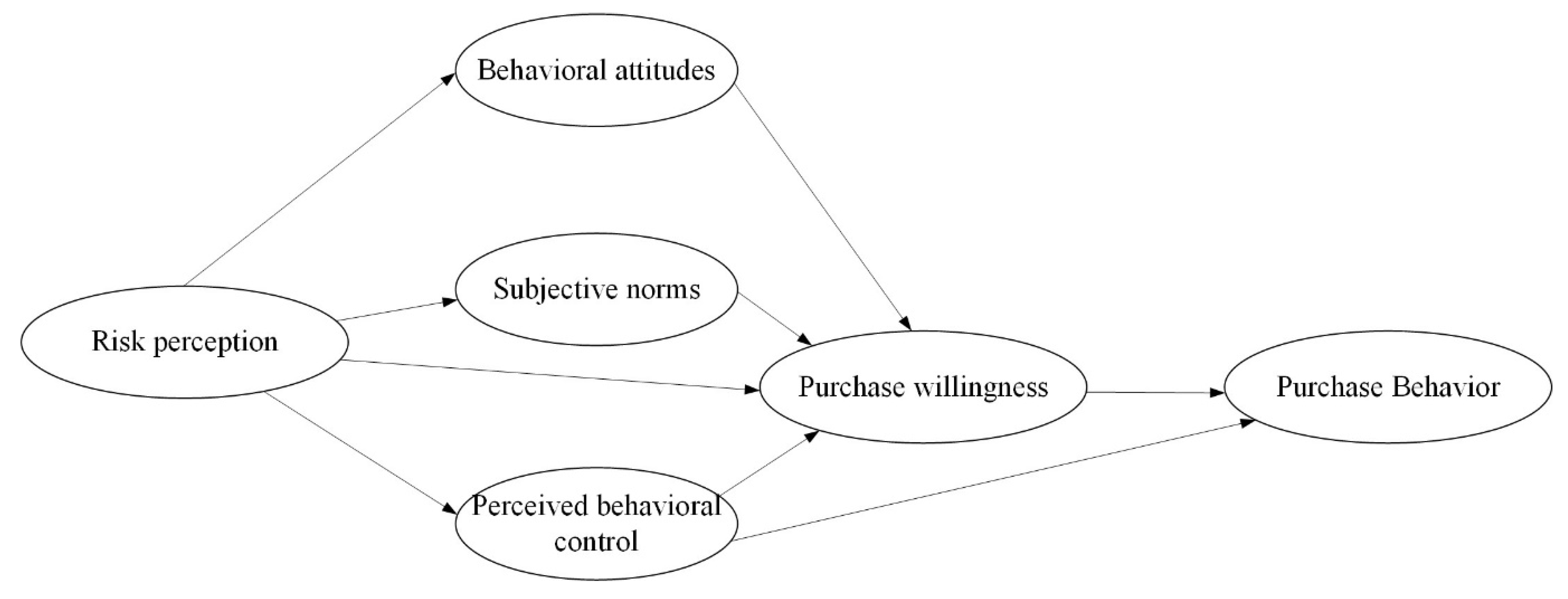

Table 1.
Samples description statistics.
| Health Risk Perception | Purchase new energy vehicle | ||||
|---|---|---|---|---|---|
| Indicator Average | Standard deviation | Indicator Average Standard deviation | |||
| Knowledge of air pollution 3.1 | 0.89 | Willingness to purchase 3.08 1.07 | |||
| Air pollution impact level 3.76 | 0.86 | Whether have purchased a new energy vehicle 0.08 0.27 | |||
| Possibility of air pollution occurrence 3.73 | 0.9 | Risk reduction role 3.06 0.98 | |||
|
Severity of consequences Duration |
3.63 3.81 |
0.84 0.85 |
subsidies can reduce the cost of purchasing Family pressure |
a car 3.15 3.26 |
0.95 0.96 |
| Controllability | 2.78 | 0.91 | Friend pressure | 3.22 | 0.94 |
| Equality | 3.11 | 1.04 | Public media pressure | 3.36 | 0.92 |
| Perceptibility | 3.21 | 1.03 | Low battery time | 3.47 | 0.88 |
| Relevance to daily life | 3.83 | 0.96 | Availability of Charging Piles | 3.54 | 0.88 |
| Acceptability | 2.47 | 0.87 | |||
| Adaptability | 2.64 | 0.87 | |||
Table 2.
Perception of health risk rotating components matrix.
| Variables | Components 1 | Components 2 |
|---|---|---|
| Knowledge of air pollution | 0.49 | -0.03 |
| Impacts of air pollution | 0.78 | -0.03 |
| Possibility of air pollution occurrence | 0.78 | -0.01 |
| Severity of consequences | 0.85 | -0.02 |
| Duration | 0.71 | -0.09 |
| Controllability | -0.01 | 0.71 |
| Equality | 0.27 | 0.47 |
| Perceptibility | 0.62 | 0.09 |
| Relevance to daily life | 0.79 | 0.07 |
| Acceptability | -0.54 | 0.35 |
| Adaptability | -0.43 | 0.56 |
| Explanation of variance (%) | 38.78 | 10.39 |
Table 3.
Model path regression.
| Path | Non-standardized coefficient | Standard Error | P value | Standardized coefficient |
|---|---|---|---|---|
| Perception of health risk->risk impacts | 1 | 0.55 | ||
| Perception of health risk->Risk Controllability | -0.22 | 0.14 | 0.11 | -0.09 |
| Perception of health risk->Perception of behavioral control | 1.25 | 0.26 | 0.00*** | 0.67 |
| Perception of health risk->Subjective norms | 0.66 | 0.15 | 0.00*** | 0.55 |
| Perception of health risk->Behavioral attitudes | 0.93 | 0.19 | 0.00*** | 0.36 |
| Perception of health risk->Purchase willingness | 1.41 | 0.58 | 0.02** | 0.5 |
| Perception of behavioral control->Purchase willingness | -0.6 | 0.19 | 0.00*** | -0.39 |
| Subjective norms->Purchase willingness | 0.75 | 0.19 | 0.00*** | 0.31 |
| Behavioral attitudes->Purchase willingness | 0.26 | 0.05 | 0.00*** | 0.24 |
| Purchase willingness->Purchase behavior | 0.05 | 0.01 | 0.00*** | 0.19 |
| Perception of behavioral control->Purchase behavior. | -0.03 | 0.02 | 0.08* | -0.08 |
Table 4.
Heterogeneity analysis.
| Path | Under BSc | BSc and above | Low income | High income |
| Perception of health risk->Risk impacts | 0.51 | 0.53 | 0.48 | 1.12 |
| Perception of health risk->Risk Controllability | 0.1 | -0.14** | -0.13* | -0.07 |
| Perception of health risk->Perception of behavioral control | 0.51*** | 0.83*** | 0.72*** | 0.36 |
| Perception of health risk->Subjective norms | 0.72*** | 0.54*** | 0.66*** | 0.26 |
| Perception of health risk->Behavioral attitudes | 0.37** | 0.33*** | 0.39*** | 0.26 |
| Perception of health risk->Purchase willingness | 0.63** | 0.61** | 0.76** | 0.09 |
| Perception of behavioral control->Purchase willingness | -0.39** | -0.54*** | -0.52** | -0.13* |
| Subjective norms->Purchase willingness | 0.27 | 0.26*** | 0.19 | 0.40*** |
| Behavioral attitudes->Purchase willingness | 0.13 | 0.30*** | 0.18** | 0.36*** |
| Purchase willingness->Purchase behavior | 0.32*** | 0.12** | 0.11* | 0.25*** |
| Perception of behavioral control->Purchase behavior. | -0.16** | -0.03 | -0.06 | -0.1 |
Disclaimer/Publisher’s Note: The statements, opinions and data contained in all publications are solely those of the individual author(s) and contributor(s) and not of MDPI and/or the editor(s). MDPI and/or the editor(s) disclaim responsibility for any injury to people or property resulting from any ideas, methods, instructions or products referred to in the content. |
© 2023 by the authors. Licensee MDPI, Basel, Switzerland. This article is an open access article distributed under the terms and conditions of the Creative Commons Attribution (CC BY) license (http://creativecommons.org/licenses/by/4.0/).
Copyright: This open access article is published under a Creative Commons CC BY 4.0 license, which permit the free download, distribution, and reuse, provided that the author and preprint are cited in any reuse.


