

Submitted:
03 June 2023
Posted:
05 June 2023
You are already at the latest version
Abstract
β-glucosidases (BGLs) play a crucial role in the degradation of lignocellulosic biomass as well as in industrial applications such as pharmaceuticals, foods, and flavors. However, the application of BGLs has been largely hindered by issues such as low enzyme activity, product inhibition, low stability, etc. Many approaches have been developed to engineer BGLs to improve these enzymatic characteristics to facilitate industrial production. In this article, we review the recent advances in BGL engineering in the field, including the efforts from our laboratory. We summarize and discuss the BGL engineering studies according to the targeted functions as well as the specific strategies used for BGL engineering.
Keywords:
β-glucosidase
; biocatalysis
; biosynthesis
; enzyme engineering
1. Introduction
β-glucosidases (BGLs) are a class of enzymes that hydrolyze the β-1,4-glycosidic bond of the non-reducing terminal residue of β-D-glucoside while releasing glucose. BGLs have been applied in many biotechnological processes, such as the saccharification of lignocellulosic biomass for the production of bioethanol [1], the wine and juice production to enhance flavor [2], and the addition to feed to improve the digestion of cellulose in farm animals [3]. Additionally, BGLs play a role in cellulose digestion and phytohormones activation and participate in the hydrolysis of mammalian glucosyl ceramides [2].
There are two widely acknowledged classifications of BGLs at present: one based on substrate specificity and the other on BGL structural features. According to substrate specificity, BGLs are classified as aryl-BGLs (hydrolyzing only aryl-β-glucoside bonds), cellobiases (hydrolyzing only cellobiose), and BGLs with broad substrate specificity (hydrolyzing a wide range of substrates with different bonds, e.g., β(1→4), β(1→3), β(1→6), and α(1→6) bonds) [4]. In terms of BGL structural features, BGLs are mostly classified into two families: the glycoside hydrolase (GH) family 1, which presents a typical (α/β)8 TIM-barrel structure and pocket-like catalytic channel [5] (Figure 1A), and the GH family 3, which has a more complicated structure including the (β/α)8 TIM-barrel fold, the (α/β)6 sandwich domain, and the FnIII domain of unknown function [6] (Figure 1B). In general, BGLs from the GH1 family are widely found in archaea, plants, and animals, while GH3 BGLs are mostly from bacteria, fungi, and yeasts [4].
BGLs catalyze the hydrolytic reactions using either the “retention” or “inversion” mechanism (Figure 2). The inversion mechanism includes only a single step where the catalytic nucleophilic reagent of BGL deprotonates a water molecule (Figure 2A). This activated water molecule directly attacks the glycosidic bond to displace the aglycone and releases sugar moiety with inversion of the configuration of the anomeric carbon [4].The retention mechanism consists of two steps: glycosylation and deglycosylation (Figure 2B). In the first step, the catalytic nucleophilic reagent attacks the allosteric carbon of the glucose residue as the glycosyl donor and forms the enzyme–glucose intermediate with the help of the catalytic acid that protonates the glycosidic oxygen [7]. The second step (orange box) involves a water molecule attacking the carbohydrate–enzyme linkage, transferring the proton to the active site acid/base carboxylate and releasing glucose.
In addition to breaking the glycosidic bonds in sugars, BGLs can also lead to the formation of glycosidic bonds (i.e., transglycosylation) in non-aqueous media with hydroxyl groups [8]. The reaction mechanism is similar to the BGL hydrolysis process, with a slight difference in the second step (Figure 2B, red box) which involves the attack of another sugar molecule (receptor A) rather than a water molecule, leading to transglycosylation [9]. The high added-value biomolecular products, such as alkyl-β- and aryl-β-glucosides as well as small-molecule oligosaccharides, have many promising applications in pharmaceuticals, chemicals, cosmetics, food, and detergents [10].
BGLs are most active at 40–70 °C and pH 4.5-5, but industrial applications frequently go beyond these boundaries. For instance, the pre-treatment steps for removing lignin and other secondary wall components at the biofuel production typically work at temperatures above 80°C [11]. In flavor enhancement of fruit juice, enzymes with optimal activity at acidic pH 2.8–3.8 would be better adapted to release the glycosidically bound volatiles [7]. Besides, in the tandem cellulolysis process, the hydrolytic end product, glucose, inhibits BGL, leading to the accumulation of cellobiose, which in turn inhibits endo-1,4-β-D-glucanase (EG) and cellobiohydrolase (CBH). This phenomenon renders BGL the most critical enzyme for bioethanol production through biomass conversions [4].
To broaden the applications of BGLs in industry, it is beneficial to enhance the capability of BGLs to tolerate non-mild conditions such as high temperatures, high concentrations of glucose, extreme pH, high concentrations of organic solvents, to name a few [12-15]. In this paper, we review the recent advances in engineering BGLs with enhanced enzymatic properties. We outline the strategies used for BGL engineering as well as discuss the structural features and molecular mechanisms that lead to improved enzymes.
2. BGL Engineering Strategies
Enzyme engineering strategies can be classified as nonrational, rational, or semirational, depending on the degrees of the sequence, structure, and function information of a target enzyme taken into account (Figure 3). The most typical nonrational strategy is directed evolution [16, 17], pioneered by Frances H. Arnold, laureate of the 2018 Nobel Prize in Chemistry. A common and effective strategy for rational or semi-rational design is computer-aided design, which can help reduce experimental costs and shorten development cycles [5]. All three strategies have been applied to engineer BGLs to improve their functionality (Table 1).
2.1. Directed Evolution
Directed evolution, an artificial procedure designed to mimic natural evolution, is an effective strategy for protein engineering in the absence of structural and functional knowledge. It accelerates the pace of mutagenesis, recombination, and protein selection in an explicit manner to obtain desired properties. The approach typically comprises an iterative cycle of mutagenesis to generate diverse mutants followed by high-throughput screening [38].
2.1.1. Generation of Diverse Mutants
With advances in molecular biology tools and techniques, several mutagenesis strategies have been developed for DNA sequence diversification. Two natural evolutionary processes, random mutation and genetic recombination, have been employed to generate sequence diversification in vitro. Random mutagenesis is a non-recombination process in which one or more point mutations, additions, deletions, or inversions of the genome take place due to improper DNA replication or damage repairing. The methods for generating sequence diversity of BGLs include error-prone PCR [39] and cassette mutagenesis [40]. Our laboratory has improved multiple enzymatic characteristics of 16BGL using error-prone PCR, including enhanced activity and product tolerance[20]. However, it is difficult for random mutagenesis to obtain highly active mutants. To address this, DNA shuffling similar to the homologous recombination method was introduced, which is a technique including Dnase I limited treatment of targeted DNA for primer-less PCR, PCR with primers, and construction of a mutant library. This technique was successfully utilized increase the affinity of substrates to BGL [41]. Other recombination methods include the staggered extension process (StEP) [42], random-priming in vitro recombination (RPR) [43], and phage-assisted continuous evolution (PACE) [44], to name a few.
2.1.2. Mutants Screening
Directed evolution necessitates a sensitive and efficient method for high-throughput screening of the huge number of mutants. Agar plate and 96-well microplate screening mainly account for traditional library screening. The agar plate-based screening exploits the direct correlation between host growth on selective agar plates and exocytosis of enzymes from cells into the solid medium with specific substrates for rapid screening of improved variants by the size of halo [45]. The 96-well microplate is currently dominating the screening tests due to its flexibility in sample manipulation, low cost, and simple operation. A large number of protocols have been implemented by machine automation; however, in practice, the micro-titration plate method is limited to screening tens of thousands of clones [46].
In recent years, researchers have developed many efficient, precise, and sensitive methods for screening mutant libraries such as fluorescence-activated cell sorting (FACS), microfluidics technology, and deep mutation scanning (DMS). FACS, an advanced high-throughput screening technique, allows rapid screening and sorting of cells or other suspension particles according to their fluorescent features [47]. Hardiman et al. used FACS to screen BGL mutants with higher specificity and catalytic efficiency [48]. However, due to its high non-specific background, FACS necessitates further rescreening and can only be used to analyze intracellular or membrane-bound products that produce a fluorescent signal associated with target compounds. The analysis of extracellular products is challenging with FACS [49]. All these advanced methods require complex setups and sufficient expertise in microfluidics, optics, electronics, and programming to fully operate the functional sorting equipment. Recently, Yao et al. reported a red-emission probe for the determination of BGL synthesized through conjugating glucoside to an aggregation-induced emission (AIE) fluorophore, which offers intriguing ideas about screening for highly active BGLs [50].
2.1.3. Machine Learning-Assisted Directed Evolution
Most of the time, directed evolution is limited by the fact that even the most high-throughput screening or selection methods sample only a small portion of the sequence space for hits with improved function and discard unimproved sequences. It has been shown that machine learning (ML)-assisted directed evolution methods can use the information extracted from these unimproved mutants to accelerate evolution and expand the number of enzymes that can be optimized for desired performance [51]. Computational power is consistently increased, while the sequencing costs and time continue to decline. Therefore, ML-based targeted evolutionary applications will become more feasible and fuel engineering BGL enzymes.
2.2. Rational Design
Though directed evolution is powerful, it is still challenging to obtain improved mutants because of the complexity of building a sensitive and efficient screening system as well as the high workload of screening huge mutant libraries. Computer-aided rational design has become a favored strategy. It entails a thorough comprehension of active sites and functions of enzymes, and specific residues are selected for targeted mutagenesis. The three main methods used to help identify mutation-specific residues are structural analysis, multiple sequence alignment (MSA), and robust computational techniques [38].
2.2.1. Structural Analysis
In most cases, molecular modeling of proteins is the first step in structural analysis. Currently, a significant number of protein structures is being registered in the Protein Data Bank (PDBs) and the AlphaFold Protein Structure Database [52] to facilitate homology modeling studies. The sequence similarity of newly discovered proteins can model structures based on sequence comparisons with similar protein sequences as long as the sequence similarity is high enough (>25%). There are several famous homology modeling tools available, such as Yang Zhang Lab (https://zhanggroup.org/), Swiss-Model [53], or Rosetta [54]
Subsequently, structural analysis method can select mutation sites by comparing structures with high/low protein sequence homology or by observing the structures surrounding active pockets. In general, observation of the structures around active pockets can be achieved by docking the substrate to the enzyme. Commonly used docking tools are AutoDock [55], AutoDock Vina [56], Glide [57], and GOLD [58].
2.2.2. Multiple Sequence Alignment (MSA)
For desired modifications, conserved amino acid residues are identified by alignment with other related sequences. Residues with low conserved scores, which are not essential for enzymatic structure and function, can be utilized as targeted sites for modification. Common MSA tools include ClustalW, Clustal Omega, MAFFT, T-Coffee, etc. [59]. Since proteins’ structures evolve more slowly than sequences, integrating structural information in MSA can enhance the quality of alignment and provide more reliable data for analysis. Structure-based MSA tools include 3D-COFFEE, EXPRESSO and MICAlign [60].
2.2.3. Computational Approaches
With advances in computational biology, many strategies for identifying protein engineering hotspots have been developed. Molecular dynamics (MD) simulations, which help predict mutation sites by providing atomic information about dynamic molecular interactions that determine protein properties, have achieved significant breakthroughs with the use of graphical processing units over the years [61]. Virtual screening is used to find potential candidates through a fast search of large enzyme libraries based on computational simulations, which is considered a promising alternative computational design approach before the experimental screening of mutant libraries [62]. The neural network-based model AlphaFold2 [63] provides help in identifying amino acid substitution sites by accurately predicting protein structures, while Rosetta, developed by Baker, also provides assistance by modeling protein–protein complexes, docking small molecule ligands into proteins [64].
However, it is impossible for MD simulations or Rosetta to typically capture the data about the overall global behavior and properties of proteins [65]. A data-driven approach of ML combined with statistics overcame this disadvantage by inferring the numerous and possibly unknown factors which map from sequence to function according to the above data and provided superior predictive accuracy for predicting mutation sites in BGL [66]. Due to the lack of negative sequence examples in the DMS dataset, and the inability to learn directly from the large-scale sequence function DMS dataset with the ML-supervised method, a method was developed to classify the DMS dataset as positive unlabeled data and successfully applied to design thermally stable BGLs [67]. It is believed that the availability of computational tools such as ML will become more crucial along with screening capacity, computational power, and increased workload.
2.2.4. Site-Directed Mutagenesis (SDM)
SDM is an important tool in protein engineering and is also known as oligonucleotide-specific mutagenesis or site-specific mutagenesis. Typical SDM methods are the overlapping extension PCR (OEP) and the whole-plasmid single-round PCR. OEP uses complementary primers to amplify two DNA fragments with overlapping ends [68]. Sun et al. used OEP to obtain a BGL mutant with higher glucose tolerance than the wild type [13]. However, the long-length PCR products, which are used as primers, limit the amplification efficiency in OEP. Guo et al. introduced an improved OEP method to increase the amplification efficiency of long-length multisite directed fragments by providing primers continuously [69]. The whole-plasmid single-round PCR method is involved in PCR replication of double-stranded plasmid DNA template using two complementary primers with the desired mutation for better glucose tolerance [38].
2.3. Semi-Rational Design
Semi-rational design exploits the advantages of directed evolution and rational design and requires the information of protein sequence, structure and function with predictive algorithms. Several targeted sites are identified and mutated to form “smart” libraries and to obtain the desired mutants [70]. Therefore, the mutant libraries generated by this approach are usually small. Semi-rational design is generally achieved by directed evolution and site-saturated mutagenesis. Two web-based computational tools are worth mentioning, the HotSpot Wizard server which combines information from extensive sequence and structure database searches with functional data to create a map of mutation candidate residues for enzymatic activity of BGL [71, 72], and Consensus Finder which uses a consensus sequence approach to identify the most frequently occurring amino acids, to replace rarely occurring amino acids, and to achieve BGL with high thermostability [37, 73]. In addition to sequence-based design strategies, there exists in effective methods based on protein structural information, such as combinatorial active-site saturation test [74], and focused rational iterative site-specific mutagenesis [75]. Similarly, both MD simulations and ML are valuable tools for efficiently exploring the effects of amino acid substitutions on protein structure and function in semi-rational design.
3. Engineering of BGL Functionalities
3.1. Enhancing Activity
Table 2 summarizes examples of BGL activity enhancement in recent years. Currently, computer-assisted semi-rational design is considered a very promising strategy for improving BGLs activity based on its advantage of balancing the size of the mutant library to reduce screening effort while obtaining the desirable results [72]. In addition, the molecular mechanisms of BGL activity enhancement have been revealed in order to engineer BGL [72, 76]. Some studies focus on engineering the active-site tunneling residues. The BGL–cellobiose complex is mainly stabilized by hydrogen-bonding and hydrophobic interactions between cellobiose and side chains of amino acids located at the glycone (−1) and aglycone (+1) sites, such as the conserved Tyr320 from Neosartorya fischeri (NfBGL) [34]. BGL activity is also shown to be related to high glycosylation, as deglycosylation results in a significant decrease in enzymatic activity [10]. BGL has also been studied to focus on the loops and residues interacted with substrates. The higher substrate affinity with BGL may be that the F256 binding residue is located on a shorter loop [77]. The Exiguobacterium marinum BGL was found to be able to process longer cello-oligosaccharides, which is atypical in the GH1 family, and the discovery of this structure at the topologically specific catalytic interface provides a theoretical basis for designing BGLs with strong capacity of cleaving cellulose oligosaccharides [78].
3.2. Improving Product Tolerance
The tandem enzymatic saccharification of lignocellulose releases the product (glucose) that inhibits BGLs, leading to the accumulation of cellobiose which further inhibits CBH and EG. Therefore, excellent BGL enzymes should be able to tolerate high-concentration glucose. Here, we summarize some mechanisms and strategies of the glucose-tolerant and stimulated BGL action discovered in recent years.
The majority of glucose-tolerant BGLs belong to the GH1 family, because most GH1 BGLs have a narrow and deep substrate binding pocket which is difficult for glucose to enter, and this binding pocket can be binned into three regions: glycone-binding site (−1 subsite), aglycone-binding site (+1 and +2 subsites), and the gatekeeper region [83]. Based on this property, the molecular mechanism of BGL product tolerance suggests that increasing the hydrophobicity of the aglycone-binding sites (+1 and +2 subsites) in the active site tunnel and the hydrophobicity and steric of the non-conserved residues in the gatekeeper region can improve BGL product tolerance. Other inactive sites are also associated with high tolerance of BGL products, including separate glucose binding sites [84] and some active channel residues [85]. Table 3 summarizes examples for enhancing product tolerance of BGLs in recent years.
A low concentration of glucose stimulates BGL activity, which may be caused by alleviating substrate inhibition [87]. A novel mechanism of BGL stimulation by “saccharide capture” through the response of the monosaccharide secondary binding region to alter the size of the catalytic gap entrance has also been recently proposed [92]. Indeed, the stimulation of BGL activity in response to glucose is sometimes not clearly explained by a single mechanism. The stimulation phenomenon may be explained by a competitive mechanism of glucose with the nonproductive binding of substrate and by transglycosylation, and the possible contribution of the two mechanisms in the activation by inhibitor was dependent on the rate-limiting step of glycosidic bond hydrolysis as well as on whether and which glucose-unit-binding subsites are interacting [93].
In brief, studies on glucose tolerance and stimulation of BGL have attributed this phenomenon to several mechanisms, including metastable effects, transglycosylation, disinhibition of substrates, and unbinding of nonproductive substrates. In addition, a relatively complete database of glucose tolerance of BGL products, Glutantβase, provides valid information for its rational design [90].
3.3. Improving Transglycosylation
In nature, glycosylation is mainly accomplished by Leloir glycosyltransferases [94]. However, glycosyltransferases are not ideal enzymes for glycosylation reactions due to their costly and complex processing. Glycosidic bonds also come to be formed through kinetically controlled transglycosylation of BGLs (Figure 2) with broad specificity and high stereoselectivity for natural or engineered substrates [95]. To improve the transglycosylation-to-hydrolysis (T/H) ratio, an effective strategy is to restrict the hydrolysis reaction to transglycosylation. As shown in Table 4, the rational design of targeted BGL catalytic tunneling of subsite residues provides methodological strategies: 1) reducing the binding in glycone (−) subsites; 2) increasing the affinity in aglycone (+) subsites; and 3) disrupting the binding of catalytic water: mainly by removing the hydrogen-bonding interactions with the catalytic water and the retention of nucleophilic water molecules at key amino acid residues, or enhancing the hydrophobicity at the active site entry or acceptor subsite [94]. For example, the Hydropathy Index For Enzyme Activity (HIFEA) strategy to reduce the hydrophilic index of BGL amino acid residues has been used for the rational design of oligosaccharide synthesis [28].
3.4. Improving Thermostability
BGL plays a key role in consolidated bioprocessing; however, high temperature cause BGL denaturation [11, 97]. A comparative analysis on the enzymatic properties and amino acid composition of mesophilic, thermophilic, and hyperthermophilic BGLs revealed a number of factors that contribute to the thermal stability of proteins, such as hydrophobic effects [98, 99], hydrogen-bonding and electrostatic interactions [98, 100], aromatic interactions [98, 101], protein structural densification [98], reduction of unfolding entropy [97, 99], etc.
Structural comparison revealed that thermophilic and hyperthermophilic enzymes are more rigid than mesophilic enzymes. Since high temperatures unfold the highly flexible regions of the proteins at the first, flexibility can be used as an indicator to identify potential areas for modification to improve the thermal stability of BGLs [102]. Most of the current studies target mutations in flexible regions to increase protein rigidity and thermal stability. Common experimental methods used to determine protein flexibility include high-resolution ultrasound spectroscopy, pressure perturbation calorimetry, and nuclear magnetic resonance spectroscopy [98]. With the improvement of algorithm optimization and computational capacity, a series of bioinformatics software has been developed for analyzing protein structures and predicting flexible regions, as shown in Table 5.
After the flexible regions are identified, two main strategies are used to rigidize the flexible region to improve thermostability. One strategy is to enhance the stability of the enzyme by reducing the conformational entropy in the unfolded state [98], and common methods include introducing disulfide bonds in the flexible region or replacing glycine with the most rigid proline. It has been proposed that truncating the flexible loops of the protein can also reduce the conformational entropy of BGL [102]. Another strategy is to stabilize the folded state by increasing favorable interactions (including hydrophobic interactions and hydrogen bonds, etc.) or removing negative interactions. There are also studies focused on increasing the densification of the BGL structure (by truncating the carbohydrate-binding domain) [109].
The most crucial thing is to assess the thermostability of mutants at high temperatures. A common strategy is to perform melting temperature (Tm) analysis by differential scanning fluorescence or differential scanning calorimetry. In addition, the unfolded Gibbs free energy (ΔG) can also measure stability. Tm and ΔG can be predicted by computational tools based on force fields and ML, such as FoldX, Rosetta Design, etc. [105]. However, studies also urge the needs for new computational tools that can not only more accurately predict significant changes in thermal stability, but also extend to more refined moderate changes [110].
In brief, the factors affecting enzyme thermal stability propose a series of methods and strategies for identifying flexible regions and protein rigidity, as well as computational methods for assessing thermal stability properties of mutants. Table 6 summarizes the instances on BGL thermal stability engineering in recent years. We hope this summary will benefit the development of computational predictors for engineering the thermostability of enzymes including BGLs.
3.5. Improving Catalytic Performance in Unconventional Phase
Maintaining high activity in unconventional phase (e.g., ionic liquid (IL), saline concentrated seawater, or organic solvents) is critical for applications of BGLs in lignocellulosic biocatalysis, saline land improvement, and marine cellulose biomass utilization [15, 115]. Therefore, it is important to understand the mechanisms that BGLs can tolerate the unconventional environment during catalysis and use these mechanisms to guide the discovery of BGLs with higher activity/stability.
Surface charge engineering is a promising approach from the perspective of IL tolerance. Mutants with increased negative surface charge showed higher catalytic efficiency in IL due to the electrostatic repulsion between IL and the salt-bridge network of BGL [15]. Besides, the salt tolerance of mutants is improved by increasing the acidic amino acids on the protein surface and near the entrance of the active site to hinder the entry of high concentrations of salt ions into the active site [13, 76]. Also, the increased electrostatic interactions may be responsible for organic solvent tolerance [116]. In addition, semi-rational design would be a promising approach to further de-explore the molecular basis of the BGL activity and stability in unconventional phase catalysis.
3.6. Improving pH Stability
The pH stability of BGLs is crucial for industrial applications including brewing, feed making, and paper making [117]. However, most natural BGLs are limited to a relatively narrow pH range (4.5-5) with optimal activity. It is necessary to engineer BGLs with altered or broadened pH performance. The optimal pH value of BGLs is widely attributed to the pKa of catalytic residues. Although the PROPKA software make it simple to estimate the pKa’s of ionizble residues [118], the estimation may not be sufficiently accurate for practical use becuase pKa is regulated by a few complex factors and the active-site microenvironment. Therefore, it is still challenging to alter the pH performance of an enzyme by merely changing the pKa value of the catalytic residue [14]. The high pH tolerance of BGLs may be related to the presence of a large number of surface-accessible negatively charged residues that keep the protein hydrated and protect the protein core from hydroxyl ion attack [112]. SDM of charged amino acids near the catalytic residues has broadened the pH activity distribution of BGLs [119]. With more detailed molecular mechanisms uncovered, BGL mutants with better pH properties can be designed in the future.
4. Conclusions
In conclusion, we provide a brief review of recent advances in approaches and functionality studies for engineering BGLs with better properties for biotechnological and industrial applications. Directed evolution continues as a valuable solution for BGL engineering, but it is of note that a sensitive and efficient method must be developed for high-throughput screening of large mutant libraries. Advances in screening strategies will further strenghten the application of directed evolution for BGL optimization. With the rapid advancement of structural and computational biology, the experimental structures as well as the high-quality structural models (e.g., AlphaFold2 models) for BGL enzymes are now available, making computer-aided rational design as a more preferred choice for BGL engineering by biochemists. Besides, with more and more functional assay data accumulated, it is also desirable to develop data-driven approaches such as ML algorithms fuel BGL engineering.
Author Contributions
Conceptualization, X.Z., B.O. and G.W.; methodology, X.Z., B.O. and G.W.; validation, X.Z., B.O. and G.W.; formal analysis, B.O. and G.W.; investigation, N.Z., B.O. and G.W.; resources, B.O. and G.W.; data curation, B.O. and G.W.; writing—original draft preparation, B.O. and G.W.; writing—review and editing, X.Z., Y.H. and J.Z.; visualization, B.O. and G.W.; supervision, X.Z.; project administration, X.Z.; funding acquisition, X.Z. All authors have read and agreed to the published version of the manuscript.
Funding
This research was funded by the National Natural Science Foundation of China (22068014, 21666010), and the Doctoral Starting up Foundation of Jiangxi Normal University (5451).
Institutional Review Board Statement
Not applicable.
Informed Consent Statement
Not applicable.
Data Availability Statement
Not applicable.
Acknowledgments
We thank Xiaoqiang Huang at the University of Michigan, Ann Arbor for the invitation of this article.
Conflicts of Interest
The authors declare no conflict of interest.
References
- Sharma, J.; Kumar, V.; Prasad, R.; Gaur, N.A. Engineering of Saccharomyces cerevisiae as a consolidated bioprocessing host to produce cellulosic ethanol: Recent advancements and current challenges. Biotechnol. Adv. 2022, 56, 107925. [Google Scholar] [CrossRef]
- Gutierrez-Gutierrez, D.A.; Fuentes-Garibay, J.A.; Viader-Salvado, J.M.; Guerrero-Olazaran, M. Biochemical characterization of the beta-glucosidase Glu1B from Coptotermes formosanus produced in Pichia pastoris. Enzym. Microb. Technol. 2023, 163, 110155. [Google Scholar] [CrossRef]
- Wang, H.; Lin, X.; Li, S.; Lin, J.; Xie, C.; Liu, D.; Yao, D. Rational molecular design for improving digestive enzyme resistance of beta-glucosidase from Trichoderma viride based on inhibition of bound state formation. Enzym. Microb. Technol. 2020, 133, 109465. [Google Scholar] [CrossRef]
- Amer Ahmed, F. Microbial β-Glucosidase: Sources, Production and Applications. Sci. Educ. Publ. Co. Ltd. 2017. [Google Scholar]
- Zhang, R.; Cao, C.; Bi, J.; Li, Y. Fungal cellulases: Protein engineering and post-translational modifications. Appl. Microbiol. Biotechnol. 2022, 106, 1–24. [Google Scholar] [CrossRef] [PubMed]
- Wang, K.; Huang, Q.; Li, H.; Zhao, X. Co-evolution of beta-glucosidase activity and product tolerance for increasing cellulosic ethanol yield. Biotechnol. Lett. 2020, 42, 2239–2250. [Google Scholar] [CrossRef] [PubMed]
- Godse, R.; Bawane, H.; Tripathi, J.; Kulkarni, R. Unconventional beta-Glucosidases: A Promising Biocatalyst for Industrial Biotechnology. Appl. Biochem. Biotechnol. 2021, 193, 2993–3016. [Google Scholar] [CrossRef]
- Chen, H.; Jin, X.; Zhu, L.; Lu, Y.; Ma, Z.; Liu, S.; Chen, X. Glycosyl hydrolase catalyzed glycosylation in unconventional media. Appl. Microbiol. Biotechnol. 2020, 104, 9523–9534. [Google Scholar] [CrossRef] [PubMed]
- Yang, J.; Wang, Q.; Zhou, Y.; Li, J.; Gao, R.; Guo, Z. Engineering T. naphthophila β-glucosidase for enhanced synthesis of galactooligosaccharides by site-directed mutagenesis. Biochem. Eng. J. 2017, 127, 1–8. [Google Scholar] [CrossRef]
- Boudabbous, M.; Ben Hmad, I.; Saibi, W.; Mssawra, M.; Belghith, H.; Gargouri, A. Trans-glycosylation capacity of a highly glycosylated multi-specific beta-glucosidase from Fusarium solani. Bioprocess. Biosyst. Eng. 2017, 40, 559–571. [Google Scholar] [CrossRef]
- Rocha, R.E.O.; Mariano, D.C.B.; Almeida, T.S.; CorreaCosta, L.S.; Fischer, P.H.C.; Santos, L.H.; Caffarena, E.R.; da Silveira, C.H.; Lamp, L.M.; Fernandez-Quintero, M.L.; et al. Thermostabilizing mechanisms of canonical single amino acid substitutions at a GH1 beta-glucosidase probed by multiple MD and computational approaches. Proteins 2023, 91, 218–236. [Google Scholar] [CrossRef] [PubMed]
- Gonzalez-Blasco, G.; Sanz-Aparicio, J.; Gonzalez, B.; Hermoso, J.A.; Polaina, J. Directed evolution of beta -glucosidase A from Paenibacillus polymyxa to thermal resistance. J. Biol. Chem. 2000, 275, 13708–13712. [Google Scholar] [CrossRef] [PubMed]
- Sun, J.; Wang, W.; Ying, Y.; Hao, J. A Novel Glucose-Tolerant GH1 beta-Glucosidase and Improvement of Its Glucose Tolerance Using Site-Directed Mutation. Appl. Biochem. Biotechnol. 2020, 192, 999–1015. [Google Scholar] [CrossRef] [PubMed]
- Li, S.F.; Cheng, F.; Wang, Y.J.; Zheng, Y.G. Strategies for tailoring pH performances of glycoside hydrolases. Crit. Rev. Biotechnol. 2023, 43, 121–141. [Google Scholar] [CrossRef] [PubMed]
- Mu, Y.; Ju, X.; Fu, J.; Meng, F.; Yan, L.; Li, L. Surface charge engineering of β-glucosidase using rational design improves catalytic capacity and ionic liquid tolerance. J. Mol. Liq. 2022, 367, 120577. [Google Scholar] [CrossRef]
- Arnold, F.H. Directed Evolution: Bringing New Chemistry to Life. Angew. Chem. Int. Ed. Engl. 2018, 57, 4143–4148. [Google Scholar] [CrossRef]
- Romero, P.A.; Arnold, F.H. Exploring protein fitness landscapes by directed evolution. Nat. Rev. Mol. Cell Biol. 2009, 10, 866–876. [Google Scholar] [CrossRef]
- Yoav, S.; Stern, J.; Salama-Alber, O.; Frolow, F.; Anbar, M.; Karpol, A.; Hadar, Y.; Morag, E.; Bayer, E.A. Directed Evolution of Clostridium thermocellum beta-Glucosidase A Towards Enhanced Thermostability. Int. J. Mol. Sci. 2019, 20, 4701. [Google Scholar] [CrossRef]
- Liu, X.; Cao, L.; Zeng, J.; Liu, Y.; Xie, W. Improving the cellobiose-hydrolysis activity and glucose-tolerance of a thermostable beta-glucosidase through rational design. Int. J. Biol. Macromol. 2019, 136, 1052–1059. [Google Scholar] [CrossRef]
- Huang, Q.; Wang, K.; Li, H.; Yi, S.; Zhao, X. Enhancing cellulosic ethanol production through coevolution of multiple enzymatic characteristics of beta-glucosidase from Penicillium oxalicum 16. Appl. Microbiol. Biotechnol. 2020, 104, 8299–8308. [Google Scholar] [CrossRef]
- Cao, L.; Chen, R.; Huang, X.; Li, S.; Zhang, S.; Yang, X.; Qin, Z.; Kong, W.; Xie, W.; Liu, Y. Engineering of beta-Glucosidase Bgl15 with Simultaneously Enhanced Glucose Tolerance and Thermostability To Improve Its Performance in High-Solid Cellulose Hydrolysis. J. Agric. Food Chem. 2020, 68, 5391–5401. [Google Scholar] [CrossRef]
- Santos, C.A.; Morais, M.A.B.; Terrett, O.M.; Lyczakowski, J.J.; Zanphorlin, L.M.; Ferreira-Filho, J.A.; Tonoli, C.C.C.; Murakami, M.T.; Dupree, P.; Souza, A.P. An engineered GH1 beta-glucosidase displays enhanced glucose tolerance and increased sugar release from lignocellulosic materials. Sci. Rep. 2019, 9, 4903. [Google Scholar] [CrossRef] [PubMed]
- Lenz, F.; Zurek, P.; Umlauf, M.; Tozakidis, I.E.P.; Jose, J. Tailor-made β-glucosidase with increased activity at lower temperature without loss of stability and glucose tolerance. Green. Chem. 2020, 22, 2234–2243. [Google Scholar] [CrossRef]
- Yin, B.; Hui, Q.; Kashif, M.; Yu, R.; Chen, S.; Ou, Q.; Wu, B.; Jiang, C. Simultaneous Enhancement of Thermostability and Catalytic Activity of a Metagenome-Derived beta-Glucosidase Using Directed Evolution for the Biosynthesis of Butyl Glucoside. Int. J. Mol. Sci. 2019, 20, 6224. [Google Scholar] [CrossRef] [PubMed]
- Sneha Sawant, N.A. Annamma Anil Odaneth,Sanjeev Kumar Chandrayan, Syed Shams Yazdani,Arvind Lali, Role of N166 residue in β–glucosidase catalysis and glucose tolerance. Appl. Biotechnol. Bioeng. 2019. [Google Scholar]
- Mendez-Liter, J.A.; Nieto-Dominguez, M.; Fernandez de Toro, B.; Gonzalez Santana, A.; Prieto, A.; Asensio, J.L.; Canada, F.J.; de Eugenio, L.I.; Martinez, M.J. A glucotolerant beta-glucosidase from the fungus Talaromyces amestolkiae and its conversion into a glycosynthase for glycosylation of phenolic compounds. Microb. Cell Fact. 2020, 19, 127. [Google Scholar] [CrossRef]
- Noguchi, T.; Saito, H.; Nishiyama, R.; Yoshida, N.; Matsubayashi, T.; Teshima, Y.; Yamada, C.; Hiramatsu, S.; Yamada, K.; Kagawa, Y. Isolation of a cellulase hyperproducing mutant strain of Trichoderma reesei. Bioresour. Technol. Rep. 2021, 15, 100733. [Google Scholar] [CrossRef]
- Niu, K.; Liu, Z.; Feng, Y.; Gao, T.; Wang, Z.; Zhang, P.; Du, Z.; Gao, D.; Fang, X. A novel strategy for efficient disaccharides synthesis from glucose by β-glucosidase. Bioresour. Bioprocess. 2020, 7, 45. [Google Scholar] [CrossRef]
- Deng, P.; Meng, C.; Wu, Y.; Xu, J.; Tang, X.; Zhang, X.; Xiao, Y.; Wang, X.; Fang, Z.; Fang, W. An unusual GH1 beta-glucosidase from marine sediment with beta-galactosidase and transglycosidation activities for superior galacto-oligosaccharide synthesis. Appl. Microbiol. Biotechnol. 2020, 104, 4927–4943. [Google Scholar] [CrossRef]
- Fang, W.; Yang, Y.; Zhang, X.; Yin, Q.; Zhang, X.; Wang, X.; Fang, Z.; Yazhong, X. Improve ethanol tolerance of beta-glucosidase Bgl1A by semi-rational engineering for the hydrolysis of soybean isoflavone glycosides. J. Biotechnol. 2016, 227, 64–71. [Google Scholar] [CrossRef]
- Chen, J.J.; Liang, X.; Chen, T.J.; Yang, J.L.; Zhu, P. Site-Directed Mutagenesis of a beta-Glycoside Hydrolase from Lentinula Edodes. Molecules 2018, 24, 59. [Google Scholar] [CrossRef]
- Zong, Z.; Gao, L.; Cai, W.; Yu, L.; Cui, C.; Chen, S.; Zhang, D. Computer-Assisted Rational Modifications to Improve the Thermostability of β-Glucosidase from Penicillium piceum H16. BioEnergy Res. 2015, 8, 1384–1390. [Google Scholar] [CrossRef]
- Lundemo, P.; Adlercreutz, P.; Karlsson, E.N. Improved transferase/hydrolase ratio through rational design of a family 1 beta-glucosidase from Thermotoga neapolitana. Appl. Env. Microbiol. 2013, 79, 3400–3405. [Google Scholar] [CrossRef] [PubMed]
- Shanmugam, R.; Kim, I.W.; Tiwari, M.K.; Gao, H.; Mardina, P.; Das, D.; Kumar, A.; Jeya, M.; Kim, S.Y.; Kim, Y.S.; et al. Tyr320 is a molecular determinant of the catalytic activity of beta-glucosidase from Neosartorya fischeri. Int. J. Biol. Macromol. 2020, 151, 609–617. [Google Scholar] [CrossRef] [PubMed]
- Ehrenreich, C.L. Site-directed mutagenesis studies on a novel dual domain β-galactosidase/ β-glucosidase open reading frame identified from a dairy run-off metagenome. Stellenbosch Univ. 2021. [Google Scholar]
- Gao, X.; Wu, J.; Wu, D. Rational design of the beta-galactosidase from Aspergillus oryzae to improve galactooligosaccharide production. Food Chem. 2019, 286, 362–367. [Google Scholar] [CrossRef]
- Li, S.; Yang, X.; Wu, X.; Xu, S.; Liu, Y. Simultaneously optimizing multiple properties of beta-glucosidase Bgl6 using combined (semi-)rational design strategies and investigation of the underlying mechanisms. Bioresour. Technol. 2023, 374, 128792. [Google Scholar] [CrossRef]
- Bansal, S.; Kundu, B. Protein engineering: Methods and applications. In Advances in Protein Molecular and Structural Biology Methods, 2022; pp 641–668.
- McCullum, E.O.; Williams, B.A.; Zhang, J.; Chaput, J.C. Random mutagenesis by error-prone PCR. Methods Mol. Biol. 2010, 634, 103–109. [Google Scholar] [PubMed]
- James, A.; Wells, M.V.; David, B. Powers, Cassette mutagenesis: An effkient method for generation of multiple mutations at defined sites. Gene 1985. [Google Scholar]
- Joyce, H.G.; Lebbink, T.K. Improving Low-Temperature Catalysis in the Hyperthermostable Pyrococcus furiosus β-Glucosidase CelB by Directed Evolution. BIOCHEMISTRY 2000. [Google Scholar]
- Zhao, H.; Giver, L.; Shao, Z.; et al. , Molecular evolution by staggered extension process (StEP) in vitro recombination. Nat. Biotechnol. 1998, 16, 258–261. [Google Scholar] [CrossRef]
- Zhixin Shao, H.Z. Random-priming in vitro recombination: An effective tool for directed evolution. Nucleic Acids Res. 1998, 26, 2. [Google Scholar]
- Packer, M.S.; Rees, H.A.; Liu, D.R. Phage-assisted continuous evolution of proteases with altered substrate specificity. Nat. Commun. 2017, 8, 956. [Google Scholar] [CrossRef] [PubMed]
- Madhavan, A.; Sindhu, R.; Binod, P.; Sukumaran, R.K.; Pandey, A. Strategies for design of improved biocatalysts for industrial applications. Bioresour. Technol. 2017, 245 Pt B, 1304–1313. [Google Scholar] [CrossRef]
- Yi, D.; Bayer, T.; Badenhorst, C.P.S.; Wu, S.; Doerr, M.; Hohne, M.; Bornscheuer, U.T. Recent trends in biocatalysis. Chem. Soc. Rev. 2021, 50, 8003–8049. [Google Scholar] [CrossRef] [PubMed]
- Madhavan, A.; Arun, K.B.; Binod, P.; Sirohi, R.; Tarafdar, A.; Reshmy, R.; Kumar Awasthi, M.; Sindhu, R. Design of novel enzyme biocatalysts for industrial bioprocess: Harnessing the power of protein engineering, high throughput screening and synthetic biology. Bioresour. Technol. 2021, 325, 124617. [Google Scholar] [CrossRef]
- Hardiman, E.; Gibbs, M.; Reeves, R.; Bergquist, P. Directed evolution of a thermophilic beta-glucosidase for cellulosic bioethanol production. Appl. Biochem. Biotechnol. 2010, 161, 301–312. [Google Scholar] [CrossRef]
- Zeng, W.; Guo, L.; Xu, S.; Chen, J.; Zhou, J. High-Throughput Screening Technology in Industrial Biotechnology. Trends Biotechnol. 2020, 38, 888–906. [Google Scholar] [CrossRef]
- Yao, B.; Zhao, J.; Ding, S.; Giel, M.C.; Zhang, G.; Ding, D.; Tang, Y.; Weng, Z.H.; Hong, Y. A novel red-emitting aggregation-induced emission probe for determination of beta-glucosidase activity. Biomaterials 2023, 295, 122046. [Google Scholar] [CrossRef]
- Yang, K.K.; Wu, Z.; Arnold, F.H. Machine-learning-guided directed evolution for protein engineering. Nat. Methods 2019, 16, 687–694. [Google Scholar] [CrossRef]
- Varadi, M.; Anyango, S.; Deshpande, M.; Nair, S.; Natassia, C.; Yordanova, G.; Yuan, D.; Stroe, O.; Wood, G.; Laydon, A. AlphaFold Protein Structure Database: Massively expanding the structural coverage of protein-sequence space with high-accuracy models. Nucleic Acids Res. 2022, 50, D439–D444. [Google Scholar] [CrossRef]
- Arnold, K.; Bordoli, L.; Kopp, J.; Schwede, T. The SWISS-MODEL workspace: A web-based environment for protein structure homology modelling. Bioinformatics 2006, 22, 195–201. [Google Scholar] [CrossRef]
- Das, R.; Baker, D. Macromolecular modeling with rosetta. Annu. Rev. Biochem. 2008, 77, 363–382. [Google Scholar] [CrossRef]
- Morris, G.M.; Huey, R.; Lindstrom, W.; Sanner, M.F.; Belew, R.K.; Goodsell, D.S.; Olson, A.J. AutoDock4 and AutoDockTools4: Automated docking with selective receptor flexibility. J. Comput. Chem. 2009, 30, 2785–2791. [Google Scholar] [CrossRef]
- Trott, O.; Olson, A.J. AutoDock Vina: Improving the speed and accuracy of docking with a new scoring function, efficient optimization, and multithreading. J. Comput. Chem. 2010, 31, 455–461. [Google Scholar] [CrossRef] [PubMed]
- Richard, A. Glide: A New Approach for Rapid, Accurate Docking and Scoring. 1. Method and Assessment of Docking Accuracy. J. Med. Chem. 2004, 47, 1739–1749. [Google Scholar]
- Marcel, L.; Verdonk, J.C.C.; Michael, J. Improved Protein–Ligand Docking Using GOLD. Proteins-Struct. Funct. Bioinform. 2003, 52, 609–623. [Google Scholar]
- Amorim, A.R.; Zafalon, G.F.D.; Contessoto, A.G.; Valencio, C.R.; Sato, L.M. Metaheuristics for multiple sequence alignment: A systematic review. Comput. Biol. Chem. 2021, 94, 107563. [Google Scholar] [CrossRef] [PubMed]
- Daugelaite, J.; O’ Driscoll, A.; Sleator, R.D. An Overview of Multiple Sequence Alignments and Cloud Computing in Bioinformatics. ISRN Biomath. 2013, 2013, 1–14. [Google Scholar] [CrossRef]
- Hospital, A.; Goni, J.R.; Orozco, M.; Gelpi, J.L. Molecular dynamics simulations: Advances and applications. Adv. Appl. Bioinform. Chem. 2015, 8, 37–47. [Google Scholar]
- Lidan, Y.; Hongwei, Y. From molecular engineering to process engineering: Development of high-throughput screening methods in enzyme directed evolution. Appl. Microbiol. Biotechnol. 2017. [Google Scholar]
- Jumper, J.; Evans, R.; Pritzel, A.; Green, T.; Figurnov, M. Highly accurate protein structure prediction with AlphaFold. Nature 2021, 596, 583–589. [Google Scholar] [CrossRef] [PubMed]
- Leman, J.K.; Weitzner, B.D.; Lewis, S.M.; Adolf-Bryfogle, J.; Alam, N.; Alford, R.F.; Aprahamian, M.; Baker, D. Macromolecular modeling and design in Rosetta: Recent methods and frameworks. Nat. Methods 2020, 17, 665–680. [Google Scholar] [CrossRef]
- Chowdhury, R.; Maranas, C.D. From directed evolution to computational enzyme engineering—A review. AIChE J. 2019, 66. [Google Scholar] [CrossRef]
- Jonathan Greenhalgh1, A.S. Data-driven Protein Engineering. John Wiley Sons Ltd. 2021. [Google Scholar]
- Song, H.; Bremer, B.J.; Hinds, E.C.; Raskutti, G.; Romero, P.A. Inferring Protein Sequence-Function Relationships with Large-Scale Positive-Unlabeled Learning. Cell Syst. 2021, 12, 92–101. [Google Scholar] [CrossRef]
- Robert, M.; Horton, H.D.H.; Steffan, N. Engineering hybrid genes without the use of restriction enzymes: Gene splicing by overlap extension. Gene 1989. [Google Scholar]
- Guo, W.; Xie, B.; Jiang, M.; Zhu, X.J.; Qiu, M.; Dai, Z.M. An improved overlap extension PCR for simultaneous multiple sites large fragments insertion, deletion and substitution. Sci. Rep. 2019, 9, 15637. [Google Scholar] [CrossRef]
- Dadwal, A.; Sharma, S.; Satyanarayana, T. Progress in Ameliorating Beneficial Characteristics of Microbial Cellulases by Genetic Engineering Approaches for Cellulose Saccharification. Front. Microbiol. 2020, 11, 1387. [Google Scholar] [CrossRef]
- Ali, M.; Ishqi, H.M.; Husain, Q. Enzyme engineering: Reshaping the biocatalytic functions. Biotechnol. Bioeng. 2020, 117, 1877–1894. [Google Scholar] [CrossRef]
- Zhou, H.Y.; Chen, Q.; Zhang, Y.F.; Chen, D.D.; Yi, X.N.; Chen, D.S.; Cheng, X.P.; Li, M.; Wang, H.Y.; Chen, K.Q.; et al. Improving the catalytic activity of beta-glucosidase from Coniophora puteana via semi-rational design for efficient biomass cellulose degradation. Enzym. Microb. Technol. 2023, 164, 110188. [Google Scholar] [CrossRef] [PubMed]
- Jones, B.J.; Kan, C.N.E.; Luo, C.; Kazlauskas, R.J. Consensus Finder web tool to predict stabilizing substitutions in proteins. Methods Enzym. 2020, 643, 129–148. [Google Scholar]
- Manfred, T.; Reetz, M.B. Expanding the Range of Substrate Acceptance of Enzymes: Combinatorial Active-Site Saturation Test. Angew. Chem. Int. Ed. 2005. [Google Scholar]
- Li, D.; Wu, Q.; Reetz, M.T. Focused rational iterative site-specific mutagenesis (FRISM). Methods Enzym. 2020, 643, 225–242. [Google Scholar]
- Contreras, F.; Pramanik, S.; Rozhkova, A.M.; Zorov, I.N.; Korotkova, O.; Sinitsyn, A.P.; Schwaneberg, U.; Davari, M.D. Engineering Robust Cellulases for Tailored Lignocellulosic Degradation Cocktails. Int. J. Mol. Sci. 2020, 21, 1589. [Google Scholar] [CrossRef] [PubMed]
- Kao, M.R.; Kuo, H.W.; Lee, C.C.; Huang, K.Y.; Huang, T.Y.; Li, C.W.; Chen, C.W.; Wang, A.H.; Yu, S.M.; Ho, T.D. Chaetomella raphigera beta-glucosidase D2-BGL has intriguing structural features and a high substrate affinity that renders it an efficient cellulase supplement for lignocellulosic biomass hydrolysis. Biotechnol. Biofuels 2019, 12, 258. [Google Scholar] [CrossRef]
- Sousa, A.S.; Melo, R.R.; Miyamoto, R.Y.; Morais, M.A.B.; Andrade, L.P.; Milan, N.; Avila, M.C.; Souza, C.M.; Adão, R.C.; Scarpassa, J.A.; et al. A rationally identified marine GH1 β-glucosidase has distinguishing functional features for simultaneous saccharification and fermentation. Biofuels Bioprod. Biorefining 2020, 14, 1163–1179. [Google Scholar] [CrossRef]
- Sinha, S.K.; Goswami, S.; Das, S.; Datta, S. Exploiting non-conserved residues to improve activity and stability of Halothermothrix orenii beta-glucosidase. Appl. Microbiol. Biotechnol. 2017, 101, 1455–1463. [Google Scholar] [CrossRef]
- Kao, M.R.; Yu, S.M.; Ho, T.U.D. Improvements of the productivity and saccharification efficiency of the cellulolytic beta-glucosidase D2-BGL in Pichia pastoris via directed evolution. Biotechnol. Biofuels 2021, 14, 126. [Google Scholar] [CrossRef]
- Xia, W.; Bai, Y.; Shi, P. Improving the Substrate Affinity and Catalytic Efficiency of beta-Glucosidase Bgl3A from Talaromyces leycettanus JCM12802 by Rational Design. Biomolecules 2021, 11, 1882. [Google Scholar] [CrossRef]
- Larue, K.; Melgar, M.; Martin, V.J. Directed evolution of a fungal beta-glucosidase in Saccharomyces cerevisiae. Biotechnol. Biofuels 2016, 9, 52. [Google Scholar] [CrossRef]
- Sinha, S.K.; Das, S.; Konar, S.; Ghorai, P.K.; Das, R.; Datta, S. Elucidating the regulation of glucose tolerance in a beta-glucosidase from Halothermothrix orenii by active site pocket engineering and computational analysis. Int. J. Biol. Macromol. 2020, 156, 621–632. [Google Scholar] [CrossRef]
- Pang, P.; Cao, L.C.; Liu, Y.H.; Xie, W.; Wang, Z. Structures of a glucose-tolerant beta-glucosidase provide insights into its mechanism. J. Struct. Biol. 2017, 198, 154–162. [Google Scholar] [CrossRef] [PubMed]
- Jiang, Z.; Long, L.; Liang, M.; Li, H.; Chen, Y.; Zheng, M.; Ni, H.; Li, Q.; Zhu, Y. Characterization of a glucose-stimulated beta-glucosidase from Microbulbifer sp. ALW1. Microbiol. Res. 2021, 251, 126840. [Google Scholar] [CrossRef] [PubMed]
- Goswami, S.; Das, S.; Datta, S. Understanding the role of residues around the active site tunnel towards generating a glucose-tolerant beta-glucosidase from Agrobacterium tumefaciens 5A. Protein Eng. Des. Sel. 2017, 30, 523–530. [Google Scholar] [CrossRef] [PubMed]
- Guo, B.; Amano, Y.; Nozaki, K. Improvements in Glucose Sensitivity and Stability of Trichoderma reesei beta-Glucosidase Using Site-Directed Mutagenesis. PLoS ONE 2016, 11, e0147301. [Google Scholar]
- Meleiro, L.P.; Salgado, J.C.S.; Maldonado, R.F.; Carli, S.; Moraes, L.A.B.; Ward, R.J.; Jorge, J.A.; Furriel, R.P.M. Engineering the GH1 beta-glucosidase from Humicola insolens: Insights on the stimulation of activity by glucose and xylose. PLoS ONE 2017, 12, e0188254. [Google Scholar] [CrossRef]
- Goswami, S.; Manna, B.; Chattopadhyay, K.; Ghosh, A.; Datta, S. Role of Conformational Change and Glucose Binding Sites in the Enhanced Glucose Tolerance of Agrobacterium tumefaciens 5A GH1 beta-Glucosidase Mutants. J. Phys. Chem. B 2021, 125, 9402–9416. [Google Scholar] [CrossRef] [PubMed]
- Mariano, D.; Pantuza, N.; Santos, L.H.; Rocha, R.E.O.; de Lima, L.H.F.; Bleicher, L.; de Melo-Minardi, R.C. Glutantbetaase: A database for improving the rational design of glucose-tolerant beta-glucosidases. BMC Mol. Cell Biol. 2020, 21, 50. [Google Scholar] [CrossRef]
- Kaushal, G.; Rai, A.K.; Singh, S.P. A novel beta-glucosidase from a hot-spring metagenome shows elevated thermal stability and tolerance to glucose and ethanol. Enzym. Microb. Technol. 2021, 145, 109764. [Google Scholar] [CrossRef]
- Correa, T.L.R.; Franco Cairo, J.P.L.; Cota, J.; Damasio, A.; Oliveira, L.C.; Squina, F.M. A novel mechanism of beta-glucosidase stimulation through a monosaccharide binding-induced conformational change. Int. J. Biol. Macromol. 2021, 166, 1188–1196. [Google Scholar] [CrossRef]
- Kuusk, S.; Valjamae, P. When substrate inhibits and inhibitor activates: Implications of beta-glucosidases. Biotechnol. Biofuels 2017, 10, 7. [Google Scholar] [CrossRef] [PubMed]
- Lundemo, P.; Karlsson, E.N.; Adlercreutz, P. Eliminating hydrolytic activity without affecting the transglycosylation of a GH1 beta-glucosidase. Appl. Microbiol. Biotechnol. 2017, 101, 1121–1131. [Google Scholar] [CrossRef] [PubMed]
- Xue, Y.; Xue, M.; Xie, F.; Zhang, M.; Zhao, H.; Zhou, T. Engineering Thermotoga maritima beta-glucosidase for improved alkyl glycosides synthesis by site-directed mutagenesis. J. Ind. Microbiol. Biotechnol. 2021, 48, 5–6. [Google Scholar] [CrossRef]
- Lyu, J.; Zhang, J.; Zhu, J.; Chen, S.; Han, T.; Zhang, Y.; Gao, R.; Xie, G.; Guo, Z. Molecular dynamics simulation guided distal mutation of Thermotoga naphthophila beta-glucosidase for significantly enhanced synthesis of galactooligosaccharides and expanded product scope. Int. J. Biol. Macromol. 2022, 210, 21–32. [Google Scholar] [CrossRef] [PubMed]
- Anica Dadwal, S.S. Tulasi Satyanarayana Thermostable cellulose saccharifying microbial enzymes: Characteristics, recent advances and biotechnological applications. Int. J. Biol. Macromol. 2021, 188, 226–244. [Google Scholar] [CrossRef] [PubMed]
- Rahban, M.; Zolghadri, S.; Salehi, N.; Ahmad, F.; Haertle, T.; Rezaei-Ghaleh, N.; Sawyer, L.; Saboury, A.A. Thermal stability enhancement: Fundamental concepts of protein engineering strategies to manipulate the flexible structure. Int. J. Biol. Macromol. 2022, 214, 642–654. [Google Scholar] [CrossRef] [PubMed]
- Watanabe, M.; Matsuzawa, T.; Yaoi, K. Rational protein design for thermostabilization of glycoside hydrolases based on structural analysis. Appl. Microbiol. Biotechnol. 2018, 102, 8677–8684. [Google Scholar] [CrossRef]
- Sharma, S.; Vaid, S.; Bhat, B.; Singh, S.; Bajaj, B.K. Thermostable Enzymes for Industrial Biotechnology. In Advances in Enzyme Technology, 2019; pp. 469–495.
- Ahmed, A.; Sumreen, A.; Bibi, A.; Nasim, F. u. H.; Batool, K. In silico Approach to Elucidate Factors Associated with GH1 β-Glucosidase Thermostability. J. Pure Appl. Microbiol. 2019, 13, 1953–1968. [Google Scholar] [CrossRef]
- Hu, Y.; Kang, G.; Wang, L.; Gao, M.; Wang, P.; Yang, D.; Huang, H. Current Status of Mining, Modification, and Application of Cellulases in Bioactive Substance Extraction. Curr. Issues Mol. Biol. 2021, 43, 687–703. [Google Scholar] [CrossRef]
- Prakash Chandra Rathi, D.M. A GUI for interactive Constraint Network Analysis and protein engineering for improving thermostability. Bioinformatics 2015, 31, 2394–2396. [Google Scholar] [CrossRef]
- Mamonova, T.B.; Glyakina, A.V.; Kurnikova, M.G.; Galzitskaya, O.V. Flexibility and mobility in mesophilic and thermophilic homologous proteins from molecular dynamics and FoldUnfold method. J. Bioinform. Comput. Biol. 2010, 8, 377–394. [Google Scholar] [CrossRef]
- Modarres, H.P.; Mofrad, M.R.; Sanati-Nezhad, A. Protein thermostability engineering. RSC Adv. 2016, 6, 115252–115270. [Google Scholar] [CrossRef]
- Wijma, H.J.; Floor, R.J.; Jekel, P.A.; Baker, D.; Marrink, S.J.; Janssen, D.B. Computationally designed libraries for rapid enzyme stabilization. Protein Eng. Des. Sel. 2014, 27, 49–58. [Google Scholar] [CrossRef] [PubMed]
- Goldenzweig, A.; Goldsmith, M.; Hill, S.E.; Gertman, O.; Laurino, P.; Ashani, Y.; Dym, O.; Unger, T.; Albeck, S.; Prilusky, J.; et al. Automated Structure- and Sequence-Based Design of Proteins for High Bacterial Expression and Stability. Mol. Cell 2016, 63, 337–346. [Google Scholar] [CrossRef]
- Mazurenko, S. Predicting protein stability and solubility changes upon mutations: Data perspective. ChemCatChem 2020, 12, 5590–5598. [Google Scholar] [CrossRef]
- Mendez-Liter, J.A.; Gil-Munoz, J.; Nieto-Dominguez, M.; Barriuso, J.; de Eugenio, L.I.; Martinez, M.J. A novel, highly efficient beta-glucosidase with a cellulose-binding domain: Characterization and properties of native and recombinant proteins. Biotechnol. Biofuels 2017, 10, 256. [Google Scholar] [CrossRef] [PubMed]
- Peishan Huang, S.K.S.C. Evaluating Protein Engineering Thermostability Prediction Tools Using an Independently Generated Dataset. ACS Omega 2020, 5, 6487–6493. [Google Scholar] [CrossRef]
- Okereke, O.E.; Gupta, M.; Ogunyewo, O.A.; Sharma, K.; Yazdani, S.S. Profiling of the β-glucosidases identified in the genome of Penicillium funiculosum: Insights from genomics, transcriptomics, proteomics and homology modelling studies. bioRxiv 2022. [Google Scholar] [CrossRef]
- Sinha, S.K.; Datta, M.; Datta, S. A glucose tolerant β-glucosidase from Thermomicrobium roseum that can hydrolyze biomass in seawater. Green. Chem. 2021, 23, 7299–7311. [Google Scholar] [CrossRef]
- Cao, L.; Li, S.; Huang, X.; Qin, Z.; Kong, W.; Xie, W.; Liu, Y. Enhancing the Thermostability of Highly Active and Glucose-Tolerant beta-Glucosidase Ks5A7 by Directed Evolution for Good Performance of Three Properties. J. Agric. Food Chem. 2018, 66, 13228–13235. [Google Scholar] [CrossRef]
- Matsuzawa, T.; Watanabe, M.; Yaoi, K. Improved thermostability of a metagenomic glucose-tolerant beta-glycosidase based on its X-ray crystal structure. Appl. Microbiol. Biotechnol. 2017, 101, 8353–8363. [Google Scholar] [CrossRef]
- Amaike Campen, S.; Lynn, J.; Sibert, S.J.; Srikrishnan, S.; Phatale, P.; Feldman, T.; Guenther, J.M.; Hiras, J.; Tran, Y.T.A.; Singer, S.W.; et al. Expression of naturally ionic liquid-tolerant thermophilic cellulases in Aspergillus niger. PLoS ONE 2017, 12, e0189604. [Google Scholar] [CrossRef]
- Batra, J.; Mishra, S. Organic solvent tolerance and thermostability of a β-glucosidase co-engineered by random mutagenesis. J. Mol. Catal. B: Enzym. 2013, 96, 61–66. [Google Scholar] [CrossRef]
- Li, Y.; Hu, X.; Sang, J.; Zhang, Y.; Zhang, H.; Lu, F.; Liu, F. An acid-stable beta-glucosidase from Aspergillus aculeatus: Gene expression, biochemical characterization and molecular dynamics simulation. Int. J. Biol. Macromol. 2018, 119, 462–469. [Google Scholar] [CrossRef] [PubMed]
- Michał Rostkowski, M.H.O. Graphical analysis of pH-dependent properties of proteins predicted using PROPKA. BMC Struct. Biol. 2011, 11, 6. [Google Scholar] [CrossRef] [PubMed]
- Solhtalab, M.; Flannelly, D.F.; Aristilde, L. Substrate binding versus escape dynamics in a pH-affected fungal beta-glucosidase revealed by molecular dynamics simulations. Carbohydr. Res. 2019, 472, 127–131. [Google Scholar] [CrossRef]
Figure 1.
The three-dimensional structure of BGL. (A) Structure of PcBGL1A (PDB ID: 2e3z) from the GH1 Phanerodontia chrysosporium with α-helices, β-sheets, and loops shown in red, yellow, and green, respectively. (B) Structure model of 16BGL from the GH3 Penicillium oxalicum with α-helices, β-sheets, and loops shown in red, yellow, and green, respectively. The FnIII domain of unknown function is shown in blue.
Figure 1.
The three-dimensional structure of BGL. (A) Structure of PcBGL1A (PDB ID: 2e3z) from the GH1 Phanerodontia chrysosporium with α-helices, β-sheets, and loops shown in red, yellow, and green, respectively. (B) Structure model of 16BGL from the GH3 Penicillium oxalicum with α-helices, β-sheets, and loops shown in red, yellow, and green, respectively. The FnIII domain of unknown function is shown in blue.
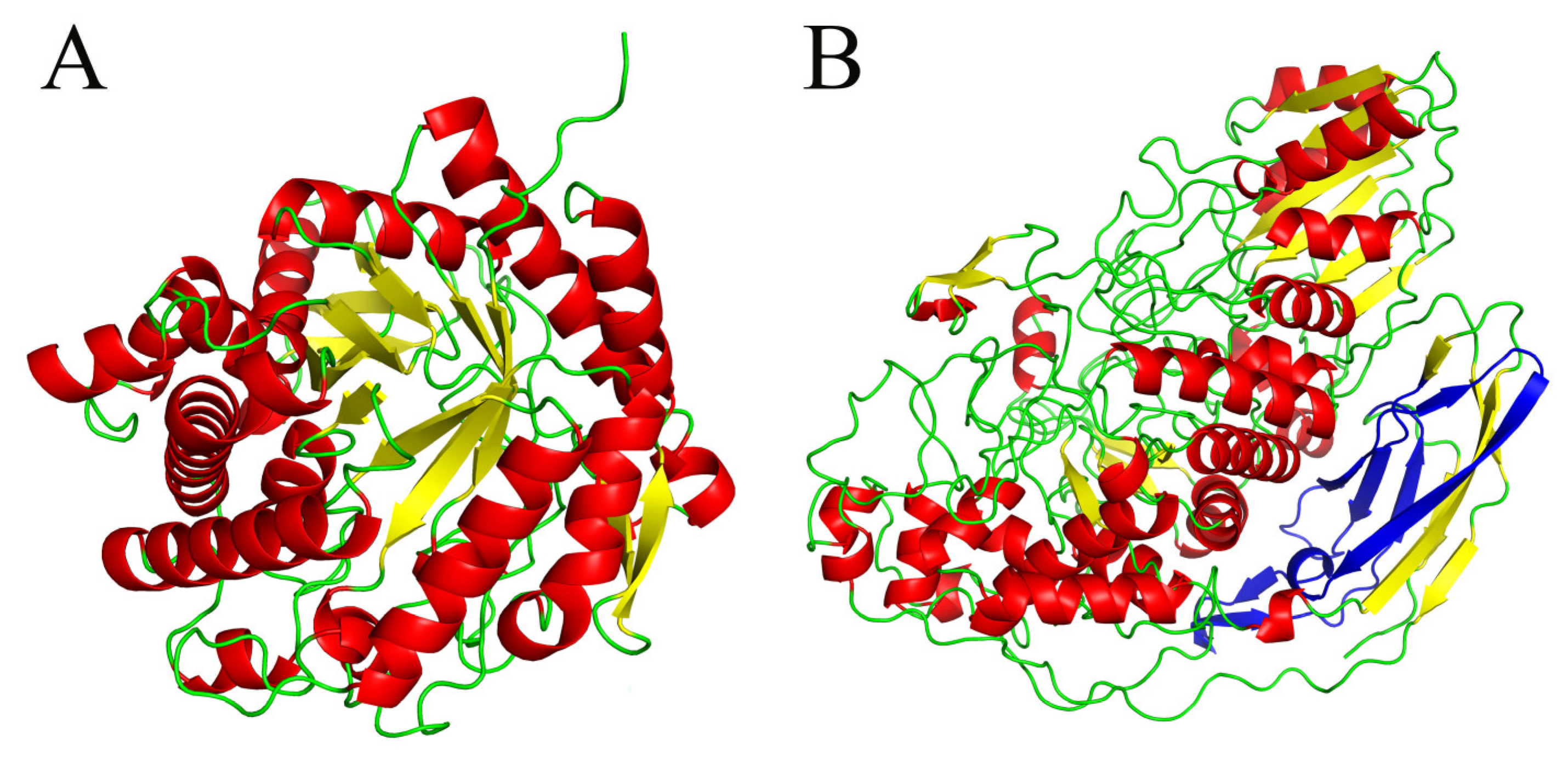
Figure 2.
Reaction mechanism of BGL. (A) The “inversion” mechanism. (B) The “retention” mechanism. Both the leaving group (R) and the acceptor (A) are different glycosyl molecules.
Figure 2.
Reaction mechanism of BGL. (A) The “inversion” mechanism. (B) The “retention” mechanism. Both the leaving group (R) and the acceptor (A) are different glycosyl molecules.
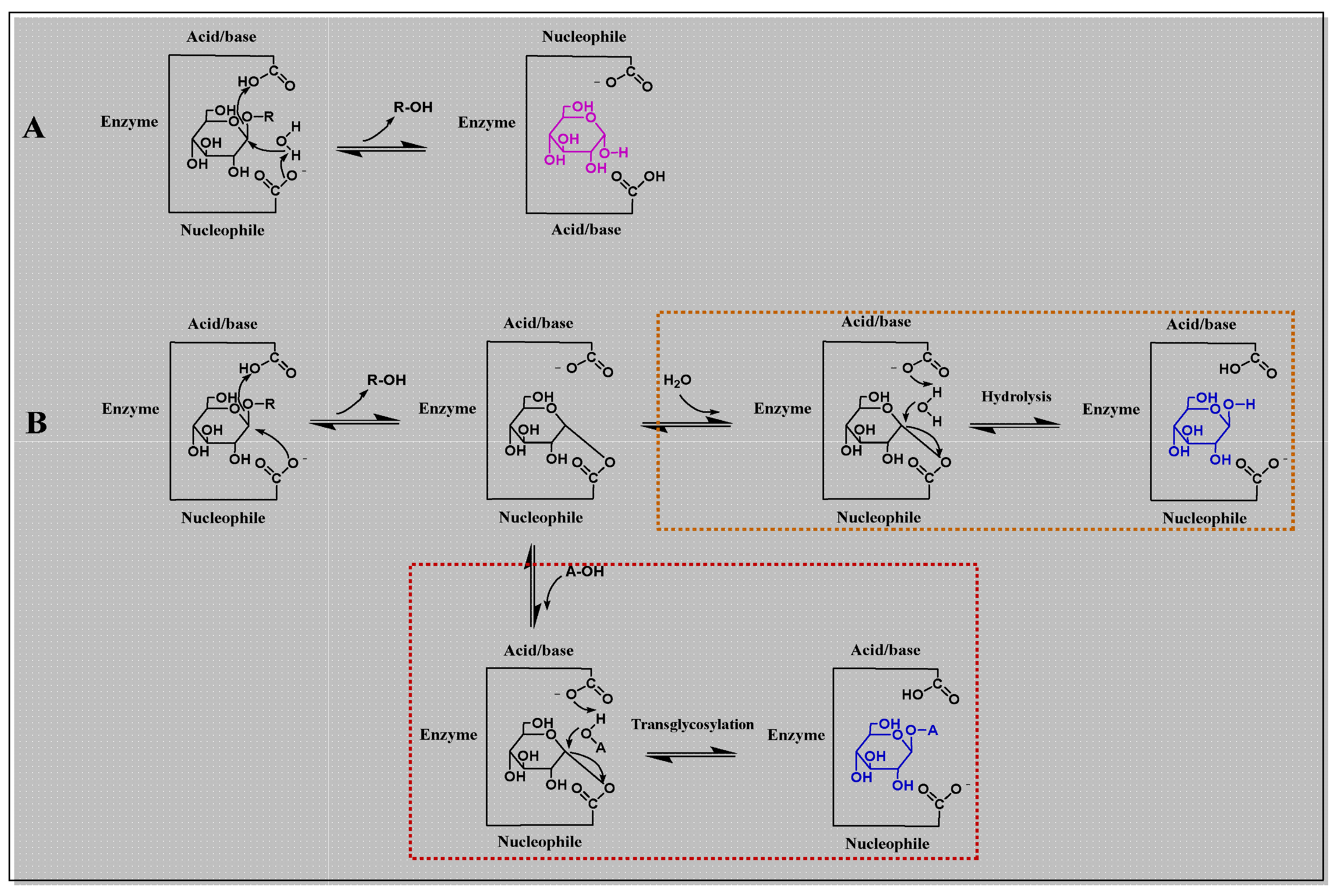
Figure 3.
Directed evolution, computer-aided rational design and semi-rational design strategies for enzyme engineering.
Figure 3.
Directed evolution, computer-aided rational design and semi-rational design strategies for enzyme engineering.
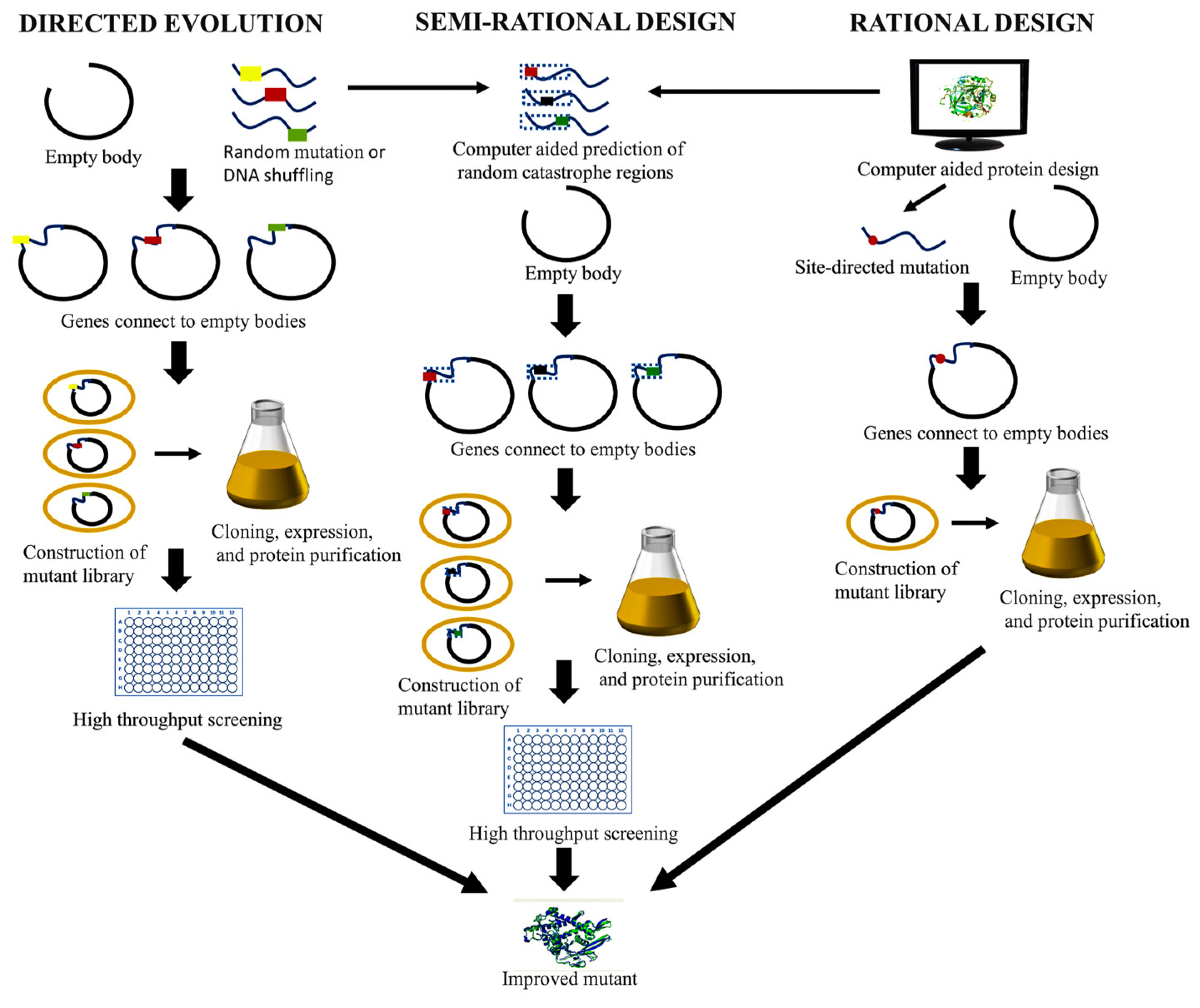

Table 1.
Summary of BGL engineering approaches.
| Organism source | Engineering methods | High throughput screening method | Reference |
|---|---|---|---|
| Clostridium thermocellum | Directed evolution Error-prone PCR |
Assay medium screening method(0.02% Magenta GlcA) | [18] |
| Alteromonas sp. L82 | Rational design Site-Directed Mutation |
--- | [13] |
| Metagenomic library of Turpan Depression | Rational design Site-Directed Mutation |
--- | [19] |
| P. oxalicum 16 | Directed evolution Error-prone PCR |
Assay medium screening method 6-(β-D-glucopyranosyloxy)-7-hydroxy-2H -1-benzopyran-2-one | [20] |
| Thermotoga naphthophila RKU-10 | Rational design Site-Directed Mutation |
--- | [9] |
| Soil Macrogenome Library | Directed evolution Error-prone PCR |
Double assay medium screening method (0.1% hesperidin) | [21] |
| Trichoderma harzianum | Rational design Site-Directed Mutation |
--- | [22] |
| Caldicellulosirutor saccharolyticus | Semi-rational design Site-Directed Mutation |
Cell Surface Display Fluorescence detection medium screening method (pNPG) |
[23] |
| GenBank FJ686869 | Directed evolution Error-prone PCR |
Assay medium screening method (0.1% hesperidin) | [24] |
|
Paenibacillus polymyxa |
Rational design Site-Directed Mutation |
--- | [25] |
|
Talaromyces amestolkiae |
Rational design Site-Directed Mutation |
--- | [26] |
| Trichoderma reesei | Directed evolution (UV light, N-methyl-N′-nitro-N-nitrosoguanidine) |
Detection medium screening method (phosphoric acid-swollen cellulose) | [27] |
| T. reesei | Rational design (Hydropathy index for enzyme activity) Site-Directed Mutation |
--- | [28] |
| Bacillus sp. D1 | Semi-rational design Site-Directed mutagenesis |
--- | [29] |
| Marine microbial metagenomic library | Semi-rational design Site-Directed mutagenesis |
--- | [30] |
| Lentinula edodes | Rational design Site-Directed mutagenesis |
--- | [31] |
| Penicillium piceum H16 | Rational design Site-Directed Mutation |
--- | [32] |
|
Thermotoga neapolitana |
Rational design Site-Directed Mutation |
--- | [33] |
|
Neosartorya fischeri |
Rational design Site-Directed Mutation |
--- | [34] |
| A dairy run-off metagenome | Rational design Site-Directed Mutation |
--- | [35] |
| Aspergillus oryzae | Rational design Site-Directed Mutation |
--- | [36] |
| Metagenomic library of Turpan Depression |
Semi-rational design Site-Directed Mutation |
--- | [37] |
Table 2.
Summary of protein engineering studies to improve BGL activity.
| Organism | Strategy | Mutations | Molecular effects | References |
|---|---|---|---|---|
| Halothermothrix orenii | Rational design OEP |
V169C, I246A | Lack of stable polar contacts; Reduction of side chain volume |
[79] |
| Coniophora puteana | Semi-rational design (HotSpot, Alanine scanning technique) SDM |
Q20C, A240S | A combination of structural changes in the active pocket and protein-ligand interactions | [72] |
|
Chaetomella raphigera (D2-BGL) |
Directed evolution Error-prone PCR |
F256M/Y260D /D224G |
F256 and Y260 on a short loop related to the high substrate affinity of the enzyme | [80] |
| Metagenomic library of Turpan soil (Bgl1317) |
Rational design SDM |
A397R, L188A, A262S | Increase in the polarity of residues and hydrogen bonding contacts | [19] |
| Talaromyces leycettanus JCM12802 | Rational design OEP |
M36E, M36N, F66Y, E168Q | Increase in hydrophobic stacking interactions and hydrogen bonding networks of active centers | [81] |
| Marine bacteria (bgla) |
Rational design OEP |
F171W | Increase in volume of side chains near the active site | [13] |
| P. oxalicum 16 | Directed evolution Error-prone PCR |
M280T/V484L /D589E |
Increase in the number of hydrogen bonds formed by the substrate to increase the binding free energy | [6] |
| C. saccharolyticus | Directed evolution Error-prone PCR, Random drift mutagenesis |
--- | Smaller residues near catalytic residues allow more flexibility in the active site or more access to the substrate | [48] |
| Aspergillus niger (BGL1) | Directed evolution Error-prone PCR |
Q140L A480V, K494Q N557D |
Multiple hydrogen bond numbers to improve substrate affinity in the substrate binding pocket | [82] |
| P. oxalicum 16 | Directed evolution Error-prone PCR |
G414S/D421V/ T441S |
Tighter active site pockets | [20] |
| Pyrococcus furiosus (CelB) | Directed evolution DNA shuffling |
N415S | --- | [41] |
| C. saccharolyticus (CsBglA) | Semi-rational design (SDM combined with Random mutagenesis) |
L64R/Y73F/ T221N/H324L |
--- | [23] |
Table 3.
Summary of protein engineering studies for enhancing product tolerance of BGLs.
| Organism source | Improved engineering methods | Mutation sites | Molecular effects | References |
|---|---|---|---|---|
| Metagenomic library of Turpan soil |
Rational design SDM |
L188A,A262S | Active site metastable interactions | [19] |
| H. orenii | SDM MD simulation |
--- | Conservative + 2 subsite hydrophobic residues | [83] |
|
Agrobacterium tumefaciens 5A |
Rational design SDM OEP |
W127F, C174V, V176A, L178A, L178E, H229S |
Increase in the hydrophobicity of the aglycone-binding sites and gatekeeper regions | [86] |
|
Trichoderma Harzianum |
Rational design SDM |
L167W/P172L | Replacement of gatekeeper residues to alter active site accessibility | [22] |
| T. Cel1A (Bgl II) | Rational design SDM OEP |
L167W/P172L | Replacement of gatekeeper residues to narrow the entrance to the active pocket | [87] |
| Humicola insolens (Bglhi) | Directed evolution Error-prone PCR |
H307Y, D237V, N235S |
Increasing trans-glycosylation Unbinding of unproductive substrates |
[88] |
| A. tumefaciens 5A | --- | --- | Presence of separate glucose binding sites | [89] |
| Marine microbial metagenome |
Rational design SDM |
H228T | Interaction leading to glucose excretion by slingshot mechanism | [90] |
| H. orenii | Rational design SDM |
V169C/E173L/ I246A |
Increasing backbone kinetics of active channel residues and flexibility of active site pockets | [83] |
| GenBank MK490918 (Bgl15) |
Directed evolution Error-prone PCR Petri-dish-based double-layer high-throughput screening |
S167V/W178L | Increasing transglycosylation activity | [21] |
| Hot-spring metagenome (BglM) | --- | --- | The narrow space between the remnants of the gatekeeper’s base | [91] |
Table 4.
Protein engineering to enhance BGL transglycosylation.
| Organism source | Improved engineering methods | Mutation sites | Molecular effects |
References |
|---|---|---|---|---|
| T. amestolkiae | Rational design SDM |
E521G | Stimulating glycosyl donor departure Absence of side chains to reduce steric hindrance | [26] |
|
T. naphthophila RKU-10 (Tn0602) |
Rational design SDM |
F226G/F414S | Reducing steric hindrance and removing interactions at the aglycone-binding sites | [96] |
|
T. naphthophila RKU-10 (Tn0602) |
Rational design SDM |
F414S | Improving hydrophilicity of the lumen of the -1 subsite | [9] |
| Thermotoga maritima (TmBglA) | Rational design SDM |
N222F/Y295F / F414S |
Creating a more suitable environment for hexanol in the active center pocket to inhibit hydrolysis | [95] |
| A. niger (BGL1) | Directed evolution Error-prone PCR |
Y305C | Reducing hydrolytic activity | [82] |
| T. neapolitana | Rational design SDM |
N220F, N220R, N220Y | Inhibiting hydrolysis | [94] |
|
T. reesei (TrCel1b) |
Rational design SDM HIFEA Strategy |
I177S/I174S/ W173H |
Inhibition of hydrophilicity of key amino acid residues in the catalytic sites | [28] |
Table 5.
Methods for improving protein stability.
| Method | Access | Description | Reference |
|---|---|---|---|
| Constraint network analysis (CAN) |
--- | Local and global flexibility/stiffness properties of proteins calculated by the graph theory-based rigidity analysis of thermal unfolding simulation. | [103] |
| MD simulation | e.g., GROMACS | Analysis of protein unfolding pathways at higher temperatures. | [70] |
| B-Fitter | https://www.kofo.mpg.de/en/research/organic-synthesis | Calculate and average the B-factor values for all atoms in an amino acid. | [70] |
| FoldUnfold | http://bioinfo.protres.ru/ogu/ | Use the expected average number of contacts per residue calculated from the amino acid sequence as an indicator of whether a given region is folded or unfolded. | [104] |
| PredyFlexy | https://www.dsimb.inserm.fr/dsimb_tools/predyflexy/ | Combine the B-factor with the state of motion of amino acid residues during molecular dynamics simulations. | [102] |
| FIRST | -- | Representation of protein structure as a set of constraints on bond-angle interactions, identification of rigid and flexible regions of protein conformation by CAN. | [105] |
| FlexPred | https://kiharalab.org/flexPred/ | Flexibility in predicting elastic residues using SVM algorithm. | [102] |
| Rosetta Design | Rosetta software | Design of thermally stable proteins based on iterative sidechain optimization and backbone relaxation through optimizing packing and idealizing backbone conformation |
[98] |
| FRESCO | --- | Combined with MD simulations to predict flexible regions of proteins that can incorporate stable disulfide bonds. | [106] |
| HINGEprot | http://bioinfo3d.cs.tau.ac.il/HingeProt/ | Predict the hinge region of a protein. | [102] |
| PROSS | http://pross.weizmann.ac.il | Calculation of ΔΔG and thus analysis of potential stable mutation locations using Rosetta combination sequences. | [107] |
| FireProtDB | https://loschmidt.chemi.muni.cz/fireprotdb/ | Numerical data, structural information for mutation experiments with a variety of proteins. | [108] |
Table 6.
Protein engineering for enhancing the thermal stability of BGL.
| Organism source | Improved engineering methods | Mutation sites | Molecular effects | References |
|---|---|---|---|---|
| Penicillium funiculosum (PfBgl3A) | Rational design SDM |
--- | --- | [111] |
| A. tumefaciens 5A | Rational design SDM OEP |
W127F, V176A, L178A, L178E | Enhancement of hydrophobic interactions | [86] |
| Metagenomic library of Turpan Depression |
Directed evolution Quikchange |
V174C/A404V/ L441F |
Enhancement of hydrophobic interactions within the enzyme | [84] |
| Thermomicrobium roseum (B9L147) | Rational design SDM OEP |
V169C | -- | [112] |
| H. orenii | Rational design SDM |
V169C/E173L/ I246A |
Increase in hydrophobic interactions | [83] |
| GenBank MK490918 (Bgl15) |
Directed evolution Error-prone PCR Petri-dish-based double-layer high-throughput screening |
S39T/L42N/ V167C/W178L/ A251L/E319A/ E326P/A396V/ L433F |
Increasing hydrophobic interactions and formation of more additional hydrogen bonds | [21] |
| P. piceum H16 | Rational design Proline theory Computer-assisted virtual saturation mutation |
S507F/Q512W/ S514W |
Mutation of glycine by proline reducing conformational entropy Increased hydrophobic interactions |
[32] |
| C. thermocellum | Directed evolution Error-prone PCR |
A17S/K268N | Increasing hydrophobic interactions | [18] |
| GenBank FJ686869 (Bgl1D) |
Directed evolution DNA shuffling |
S28T/Y37H/ D44E/R91G/ L115N |
Enhancing interaction with protein structure around water molecules and introduction of more hydrogen bonds | [24] |
| GenBank HV348683 (Ks5A7) |
Directed evolution Error-prone PCR |
T167I/V181F/ K186T/A187E/ A298G |
Increasing hydrophobic interactions with the protein core | [113] |
| MeBglD2 | Rational design Directed evolution |
His8/Asn59/ Gly295 |
Increasing hydrophobic interactions with the protein core | [114] |
Disclaimer/Publisher’s Note: The statements, opinions and data contained in all publications are solely those of the individual author(s) and contributor(s) and not of MDPI and/or the editor(s). MDPI and/or the editor(s) disclaim responsibility for any injury to people or property resulting from any ideas, methods, instructions or products referred to in the content. |
© 2023 by the authors. Licensee MDPI, Basel, Switzerland. This article is an open access article distributed under the terms and conditions of the Creative Commons Attribution (CC BY) license (http://creativecommons.org/licenses/by/4.0/).
Copyright: This open access article is published under a Creative Commons CC BY 4.0 license, which permit the free download, distribution, and reuse, provided that the author and preprint are cited in any reuse.


