

Submitted:
01 June 2023
Posted:
02 June 2023
You are already at the latest version
Abstract
In recent years, more and more attention has been paid to the behavior of tourists and their intention to travel after certain natural disasters or social unrest. The aim of the research was to establish the influence of psychological profiles of tourists on their decision to choose a tourist destination, using three psychographic techniques BFI-10 (Big Five Inventory), AIO (Activities, Interests, Opinions), and VALS 2 (Values and lifestyle), and a freely determined six-level scale of risk and tourist attractiveness of the imagined destinations. By analyzing the results through structural modeling-path analysis, it was determined that almost all psychographic orientations derived from lifestyles negatively perceive destinations with a high degree of risk and attractiveness, while with the VALS 2 technique, only members of the action orientation tend to accept the risk and challenge of visiting high-risk destinations. The results of the research have a degree of innovation in the application of the combination of the mentioned models, as well as in the theoretical and applied aspects in supplementing the building and strategic planning of the future business.
Keywords:
environmental risk
; attractiveness of the destination
; tourist behavior
; lifestyle
; psychographic orientation
1. Introduction
There are different forms of environmental risks, starting with climate disturbances, including pollution, radiation, noise, land use patterns, or climate change [1]. The European Commission is constantly working to identify new forms of environmental and social risks, and The EU 7th Environment Action Program included an integrated approach to risk management, recording them all in scientific and technical data for the purpose of planning strategic activities to prevent or reduce the strongest forms of these risks [2]. Some of the environmental risks leave huge negative consequences on the planet, in that context, destroying cities, changing the climate, and destroying everything that man has created, but they also have a huge impact on people's awareness of their future behavior, both in life and in decision-making about the future movement. Determining the actual impact of risk on the behavior of tourists and on their intention to choose a destination and travel are increasing topics of research in the world. Environmental risks have a large share in the formation of tourists' behavior models, and regardless of whether the risk was constant at the time of the trip, it is virtually embedded in human consciousness [3], because the perception of risk is such an image among tourists that they create the probability that they will something negative also happens, caused if nothing, at least by environmental consequences during the trip [4]. Also, apart from environmental risks, it was determined that international attitude, risk of terrorism, level of risk perception, and income directly affect the choice of destination for an international vacation [5]. The perception of the impact of environmental risks on tourists' decisions is very often established on the basis of various factors, such as lifestyle, personality traits, demographic factors, experience, etc.
Precisely, the goal of this research was to determine how personality traits, lifestyles, and psychographic orientations of tourists can be a defense or a response to environmental risks in their future behavior, and in the survival of destinations that may suffer some of the potential consequences of natural or social disasters. The results we reached undoubtedly show that the majority of tourists, of almost all psychographic orientations, do not accept challenges such as traveling to high-risk destinations. Also, it is only shown that the members of the action-oriented psychological group are ready for this kind of challenge.
The research has a wide theoretical and applied significance, primarily as an informative basis for supplementing existing knowledge and research on the issue of the impact of environmental risks on tourists' decisions and their intentions. However, the application significance is reflected primarily in the utilization of the obtained results for implementation in the existing documentation, which depends on strategic activities in influencing the management of the tourism development of the destination and business during or after catastrophic situations. Also, by understanding the behavior in risky situations, it is possible to influence the awareness of tourists and their decisions about traveling to risky destinations. Studying the influence of lifestyles and personality traits has been fruitfully used in the field of marketing communication, where it has been shown that they have an intense impact on both consumption patterns and the processing of different forms of marketing communication.
2. Theoretical background and conceptual framework
2.1. Perception of risks as (co)creators of tourist movements
Risk perception is very often used to analyze the psychological state during travel and tourist activities in the destination [6]. Proponents of cognitive psychology developed the term tourist risk perception [7, 8] which is created by observing conditions and situations from the negative consequences of environmental risks and influencing the decisions and expectations of tourists [9]. Cater [10] points out that even if there is an objective risk, the subjective perception of risk is much more pronounced, and the behavior of tourists also depends on the strength of the risk [11,12,13]. The perception of risk is a psychological experience and plays a key role in the behavior of tourists, and the transfer of information about risk is very often subjective to the extent that the risk turns into a disaster [14], which further influences the avoidance of going on the trip itself [15,16,17]. However, some authors point out that, although tourists are extremely sensitive to certain risks during travel and stay in a destination, risk perception is still a quantitative assessment of safety [17]. Furthermore, the same authors claim that tourists should have prior knowledge about a destination and possible types of risks in it. Accordingly, Sharifpour et al. [18] reached the same results, arguing that different dimensions and levels of knowledge dictate different perceptions about the type and strength of risk during travel or in the destination itself. It has been observed that during the trip, tourists always notice negative situations, prepared by the media or other people's similar experiences, and based on the preconceived image, they create an image of the security situation [19,20,21,22,23]. Natural disasters and unexpected events are the best examples of decisive factors because they have profound effects on individuals and society, and as a result, have the potential to significantly and negatively affect tourism flows [24,25,26,27]. Individual hazards, such as earthquakes, severe storms, floods and droughts, plus biophysical and technological processes, create particular impacts on tourists' awareness but also create certain challenges [28]. Mazzochi [29], points out that after the great earthquake in September 1997 in Italy, tourist traffic dropped sharply, which is also confirmed by the results of research in Taiwan in 1999, where tourism did not recover even a year after the earthquake [30].
Sonmez et al. [31] point out that environmental risks do not allow a quick recovery of the destination, while on the other hand, tourists' awareness of the negative effects and fears also slow down the recovery of tourism, and the negative impact of environmental disasters creates indirect consequences for travel in other nearby destinations [32]. Neumayer and Barthel [33], after 30 years of studying the impact of climate disasters on tourism growth trends, proved that the consequences of economic damage are long-lasting, the tourism trend slowed down long after the risk, and that a stronger growth trend of fear of disasters can be observed. More recently, the impacts of environmental risks have increased significantly, partly due to the worsening effects of climate change, but also due to the growing complexity of socio-ecological systems in a highly connected and globalized world [34, 35]. Many authors dealt with terrorist risks and their influence on the adoption and selection of the destination [36,37,38,39,40], while hazards risk [41,42,43]. Ghmire [44] claims with his research in Nepal that there is no destination immune to crisis situations such as earthquakes, wars, floods and other natural and social disasters, and the fear among tourists arises from the fact that they cannot be evacuated quickly in some destinations.
2.2. Risk perception factors determined through various psychographic techniques
Ankomah et al. [45] point out that the choice of destination, under normal conditions, is based on the relationship between tourist attributes and destination characteristics, while if there is a certain degree of risk, tourists choose a destination based on their individual perceptions [46]. Some studies show that the perception of a destination's level of risk changes over time, depending on the home country [47], the location of the destination in a wider geographic region [16, 48] or between international and domestic destinations [20]. The perception of cultural risks has been investigated by many authors and it has been established that there are significant differences in the perception of risk and travel safety, anxiety and travel intentions among tourists from different countries. Tourists from the United States, Hong Kong, and Australia perceived higher travel risk, felt less safe, and were more anxious and reluctant to travel than tourists from the United Kingdom, Canada, and Greece [49]. Cultural differences are shown to be an important demographic segment in tourist behavior and risk awareness [50]. The same authors examined the behavior of Asians and non-Asians on the perception of reducing carbon dioxide emissions in traffic and preference for green hotels, where it was shown that 11 different nations feels safe in destinations where such types of environmental protection are offered. Also, repeated visits reduce fears of environmental risks [51]. Many authors have investigated the impact of environmental risks on the perception and intention of tourists depending on sociodemographic factors [16, 52–55], where some authors emphasize the factor age [56,57,58], then the factor of tourists' psychological readiness to accept risks [59]. The same authors found that for women and for men, there are seven factors associated with psychological and material preparedness: awareness of psychological preparedness, prior emergency training or experience, prior exposure to natural hazards, higher awareness scores, higher active engagement coping style scores, low-stress scores, and low depression scores. Two types of risk factors stand out in the minds of tourists, namely subjective [11, 16, 60–62] and objective risk factors [63, 64]. Blešić et al. [62] examine the relationship between subjective risk factors and objectively perceived risks, and claim that more educated people perceive all the dangers of environmental risks, as well as more subjective risk perceptions. Subjective risk factors include: demographic variables and individual cognitive abilities (temperament, personality, emotions, views, values, cognitive and meta-cognitive) [65], while objective factors include: psychological risk, financial risk, performance risk, health risk and social risk [66]. Physical characteristics and psychological processes (such as attention, perception, representation effect, memory, thinking and language abilities) of tourists have a significant influence on how they perceive the danger associated with travel [65].
The study of the influence of lifestyle and personality traits on the behavior of tourists in special situations was studied by many authors [67,68,69,70] and pointed out that the lifestyle of a group or a phenomenon permeates all aspects of human life, and that lifestyle is a conceptualization of the central life and interests of individuals [71, 72], and according to certain psychographic characteristics, the perception of risky situations is also made [73, 74]. Lifestyle, personality traits and experience increase the level of self-confidence and cognitive skills of tourists, which leads to a reduced level of perceived risk [16, 20, 75, 76]. Cohen [77] emphasizes the influence of lifestyle by which individuals frame the concept and stylize their lives around the choice of travel, while some authors claim that personality traits and lifestyles, then family problems, various types of failures and crises connect travel with an escape from everyday life [78]. Individuals who seek sensation and adventure are more prone to risk and going to risky destinations [20, 48, 75, 76, 79].
Contrary to all claims about the negative impact of environmental risks, some authors in their research came to the conclusion that the existence of a certain type of risk in some tourist profiles is an attraction that attracts them to that destination [80], and that controlled risk, when perceived as a challenge, contributes to the general enjoyment of the risky experience [81]. Also, the claim of the author Brida et al. [82] is followed up, who also claim that the desire to travel does not stop during certain risky situations, in their research case, it was the situation of the COVID-19 pandemic. In addition to their claim, the same authors point out that sociodemographic characteristics and personality characteristics of tourists had a great influence on tourists' decisions. Hamilton et al. [83] claim that climate and environmental risk changes in general can even have positive effects on the perception of tourists, and become an attraction for tourists.
2.3. Aim of the present study and conceptual framework
The goal of this research was to determine the influence of personality traits, lifestyle and psychographic orientations on the choice of imagined tourist destinations that differ in the degree of environmental risk and tourist attractiveness.
Most of the research on the influence of personality traits on the choice of a tourist destination in relation to the degree of potential risk uses The Big Five Inventory model of personality traits (BFI -10), where personality types are distinguished: extroversion, agreeableness, conscientiousness, neuroticism and openness [73, 84–90]. Some research presents risk perception using the psychographic technique VALS 2 (Values and Lifestyles) [91,92,93,94,95]. The same authors emphasize four types of personality: traditional idealists, modern idealists, traditional materialists, and modern materialists. For the purposes of researching the tourist market, the psychographic technique AIO (Activities, Interests, Opinions) was first applied by Darden and Perreault [96] and also Blackwell, Miniard, & Engel [97]. Chen et al (2009) also examined the perception of risk using the AIO technique, highlighting five psychographic dimensions: relaxation, outdoor recreation, first class, family orientation and social orientation, which were also used for the purposes of this research.
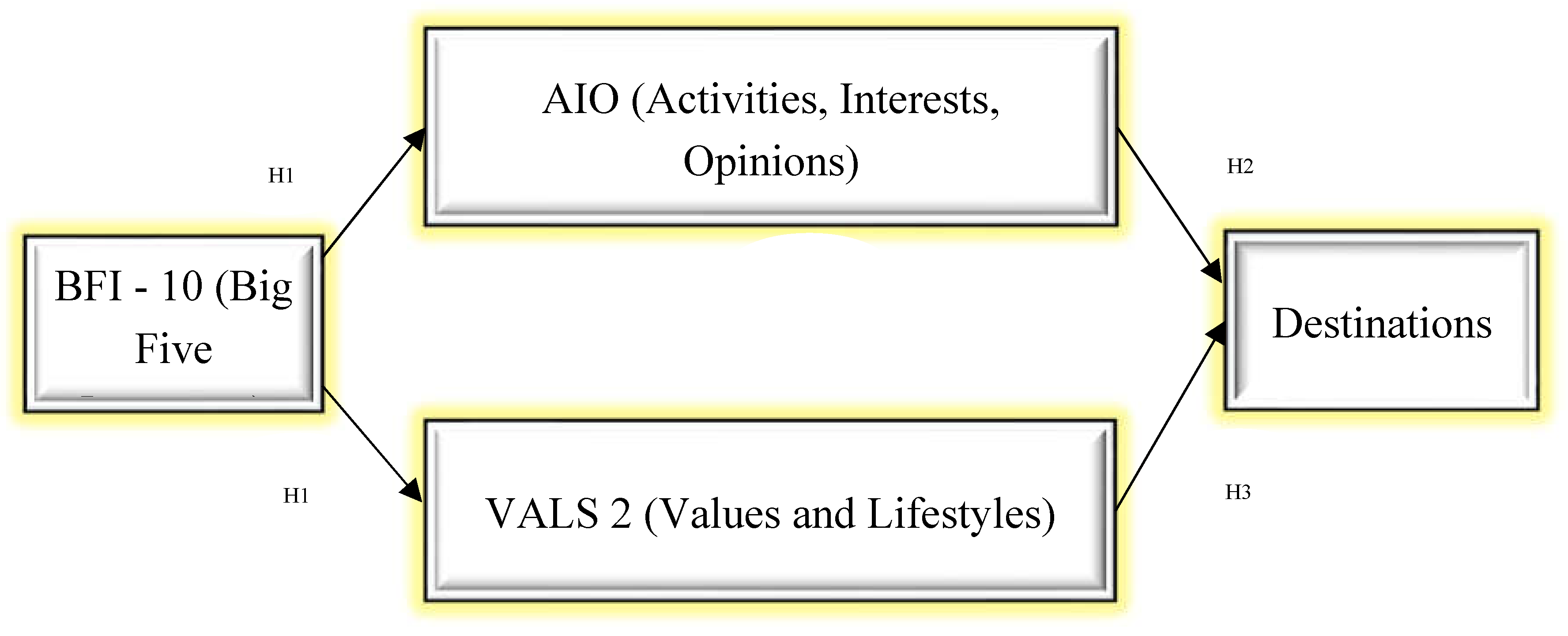
H1: Personality traits (BFI-10) create a strong relationship with psychographic lifestyle orientations.
H2: Psychographic orientations, AIO lifestyle techniques, have a significant influence on the choice of destinations according to the degree of environmental risk and tourist attractiveness.
H3: Psychographic orientations, VALS 2 lifestyle techniques, play a strong role in the selection of destinations according to the degree of environmental risk and tourist attractiveness.
Figure 1.
Conceptual framework of setting hypotheses.
3. Methodology
3.1. Procedure and Participants
For the purposes of the research, a volunteer survey of tourists was carried out in seven hotels in Novi Sad (the second largest city in Serbia - a total of 218 respondents) and Belgrade (the capital of Serbia - a total of 322 respondents), in the period from January to April 2023. Out of a total of 800 questionnaires distributed, 540 with complete answers were taken into analysis, and the time period of the research was determined by the researchers, by statistical determination of a possible representative sample. A random sampling technique was used, because the probability of being included in the sample is the same for each individual. The required sample size was calculated using G*power test. Taking into account that there was a total of 8 predictors 6 criteria, the required effect size was set to η2 = 0.15, with a statistical power of 0.95, and it was calculated that a sample size of 138 respondents may be appropriate for this research. The researchers had the task of surveying exclusively adult visitors to the hotel. Table 1 provides an insight into the demographic characteristics of tourists. It can be seen that the largest percentage of visitors are women, about 60% and men a little less than 39.9%, aged over 56, and those with a university degree 67.7% and an average salary of 74.8%.
Looking at the data on the frequency of travel, it is noticeable that 46.5% of the surveyed visitors belong to the group that travels several times a year, and that they are mostly from the neighboring countries from the region of Bosnia and Herzegovina (31.1%), Croatia (18.4) and Montenegro (29 %).
3.2. Measures
For the purposes of this manuscript, the standard BFI-10 scale (Big Five Inventory Model) of 10 items was used, which measures personality traits of the Big Five dimensions: extraversion, agreeableness, conscientiousness, neuroticism, and openness [98, 99]. Also, two psychographic models were applied: AIO (attitude, interest, opinion) and VALS 2 (values and life-style), primarily for measuring lifestyle, which are adapted to the goal and technical possibilities of field research. Also, the authors took over the AIO questionnaire with minor modifications, to identify the activities, interests and opinions of consumers (16 items) from the authors Chen et al. [100] in a manuscript entitled Vacation Life Style and Travel Behaviors. All items of the AIO questionnaire are grouped into five orientations (relaxation, outdoor recreation, first class, family orientation, social orientation). Then, the VALS 2 (values, attitudes and life-styles) questionnaire was taken and modified by the authors: Maričić [101], Mitchell and Olson [102] and Mitchell [103] (39 items). All items of the VALS 2 technique are grouped into three psychographic orientations (social orientations, action orientations and principal orientations). A seven-point Likert scale was used to determine the intensity of the visitors' attitudes. In six situations, the authors varied the degree of risk and attractiveness of the destinations, and tourists could choose from the given description a destination that they would visit more or less (items for each dimension given in attachment 1, description of destinations in attachment 2).
3.3. Data analisys
The obtained data were processed in the program software IBM SPSS AMOS version 26.00. With the help of Cronbach's alpha, reliability was determined for all dimensions whose values are shown in Table 2. Path analysis was used for the interpretation of previously established effects or relationships, as a kind of continuation of regression analysis, which is done in the aforementioned software. The AIO lifestyle dimension gathers a total of 10 questions, then the VALS 2 lifestyle dimension gathers a total of 39 items, and the BFI-10 personality traits dimension gathers a total of 10 items (Questions given in the attachment). Adequacy or model fit conditions are met with the following values: X2=3066.431, df=28, p=0.00, CMIN/df= 2.820, TLI= 0.901, CFI= 0.932, NFI=0.962, IFI=0.939, RMSEA = 0.041, AIC= 305, 830 and BIC= 306, 777.
4. Results and Discussion
Table 2 shows the results of the average ratings for the dimensions that will be used to determine their effects on the selection of six imagined tourist destinations according to the determined degree of risk and tourist attractiveness.
The social orientation dimension has the highest average score (m=3.59), which belongs to the AIO lifestyle group. Also, from the VLAS 2 psychographic technique group, the action orientation dimension (m=3.35) has the highest average rating, while from the BFI-10 personality traits group, the highest average value of the arithmetic mean is the conscientiousness dimension (m=3.49). It is observed that the highest percentage of tourists opted for the destination of the lowest degree of risk and high attractiveness D1 (53.6), while the lowest percentage of tourists chose destination D6 (20.9%), which belongs to the category of the highest degree of environmental risks and high attractiveness.
4.1. Relationships between personality traits and psychographic orientations
Path analysis determined the strength of influence of five personality traits (BFI-10) on lifestyle dimensions (AIO and VALS 2), which were grouped into psychographic orientations. Correlation values can be seen in Figure 2, while Estimate values, S.E. (standard error), C.R. (critical ratio) and statistical significance (P) in Table 3.
The neuroticism dimension proved to be statistically significant in its influence on the following psychographic lifestyle orientations: relaxation (AIO) (p=0.15, ß=-0.141), first class (AIO) (p=0.32, ß= -0.125), social orientation (AIO) ) (p=0.06, ß= -0.190), status orientation (VALS 2) (p=0.03, ß= 0.097) and principal orientation (VALS 2)(p=0.00, ß=0.133). It is about the situation that the more neurotic they are, the less they evaluated the psychographic dimensions, except for the VALS 2 lifestyle, where it is an invitational correlation: the more neurotic they are, the more inclined they are to the status and principal orientation dimensions.
In the extroversion dimension, statistical significance was achieved only with VALS 2 relations in the positive direction: status orientation (p=0.05, ß=0.146), action orientation (p=0.00, ß=0.218) and principal orientation (p=0.04, ß=0.145) ). The conscientiousness dimension shows a significant and positive influence only on the AIO lifestyle dimensions: relaxation (p=0.00, ß= 0.262), outdoor orientation (p=0.00, ß=0.208), first class (p=0.00, ß= 0.283), family orientation (p=0.00, ß=0.511), social orientation (p=0.00, ß=0.591). A very strong correlation was expressed only in the family orientation and social orientation dimensions.
Agreeableness shows a statistically significant influence on the dimensions of the psychographic orientation of AIO: relaxation (p=0.00, ß=0.190), outdoor recreation (p=0.024, ß=0.114), first class (p=0.06, ß=0.135), family orientation (p =0.04, ß=0.128), status orientation (p=0.00, ß=0.084) and on only one dimension VALS 2, which is principal orientation with values p=0.038 and lower correlation ß= 0.100.
The openness dimension shows statistical significance in relation to two VALS 2 dimensions: status orientation (p=0.067, ß=0.107) and principal orientation (p=0.018, ß=0.135). The obtained data confirmed the first hypothesis that personality traits have a significant influence on psychographic lifestyle orientations.
4.2. The relation of psychographic orientations to the selection of tourist destinations
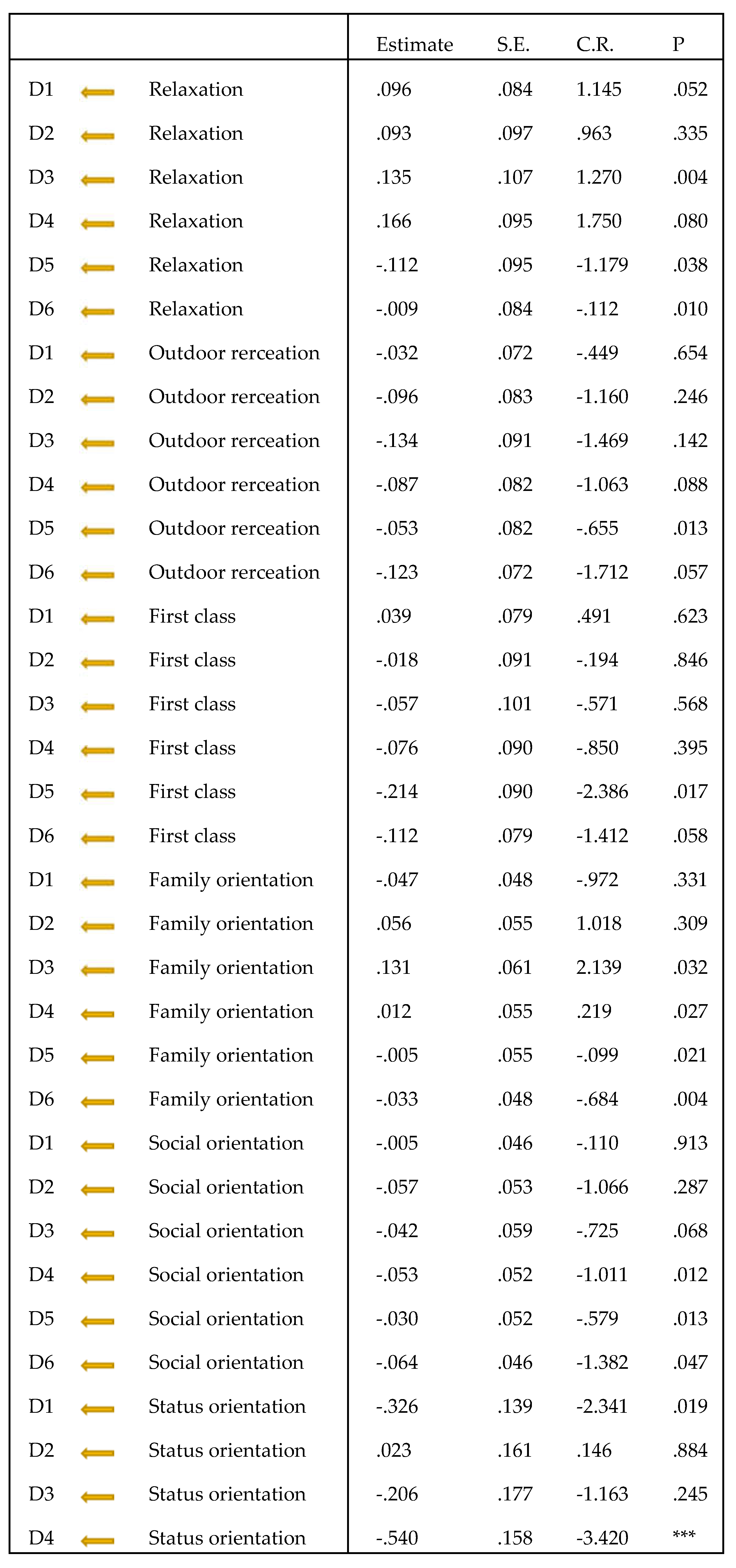
The values of the direct influence of psychographic orientations on the choice of a tourist destination are given in Table 4, while the correlations are visible in Figure 2. Psychographic orientation relaxation from the lifestyle group AIO, shows a significant influence on destination D1 of low risk (p=0.052, ß= 0.065). Then, the impact on destination D3 with values p=0.04 and correlation ß=0.072. Also, it has a significant and positive influence on D4 (p=0.080, ß=0.098), while on the last two destinations D5 and D6, with high attractiveness and a high degree of risk, it has a significant and negative influence (D5: p=0.038, ß= -0.066; D6: p=0.010, ß=-0.346). The more tourists are in favor of this psychographic group of the AIO lifestyle, the less they decide to choose high-risk destinations. The outdoor recreation dimension proved to be significant in influencing the selection of only high-risk destinations D5 (p=0.013, ß= -0.234) and D6 (p=0.057, ß=-0.291). The influence is in a negative direction, which means that the more inclined they are to this psychographic group, the harder they choose destinations with high attractiveness and high environmental risk.
The first class dimension from the AIO lifestyle group shows a significant impact also only on high-risk destinations: D5 (p=0.017, ß=-0.115) and D6 (p=0.058, ß= -0.069), and in a negative direction, which indicates that members of this psychographic orientation are less likely to choose high-risk destinations. In the family orientation dimension, a significant influence on the choice of destination is in D3 (p=0.032, ß=0.131), D4 (p= 0.027, ß=0.013), D5 (p=0.021, ß= -0.406) and D6 (p=0.04, ß= -0.542). Members of this lifestyle group are less likely to choose the riskiest destination, while they are more determined for those with low environmental risk. The last AIO dimension of social orientation has a significant influence on D4 (p=0.012, ß= -0.055), D5 (p=0.013, ß= -0.032) and D6 (p=0.047, ß= -0.076). The correlations are negative and low, which confirms that members of this psychographic orientation also negatively evaluate risky destinations and are less likely to opt for them.
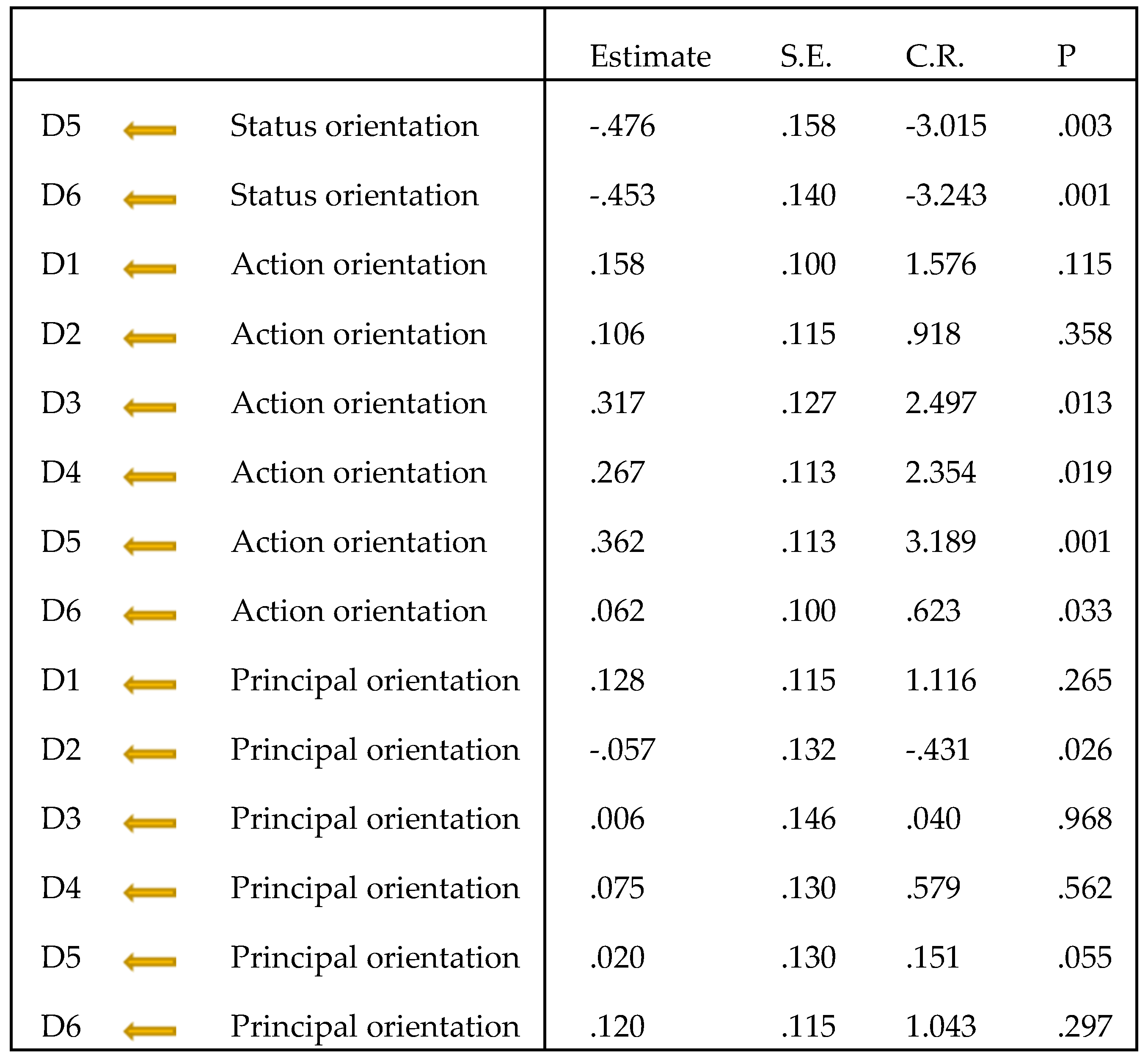
Observing the psychographic dimensions of VALS 2, it is observed that the status orientation dimension significantly affects the choice of destination D1 (p=0.19, ß= -0.152), then D4 (p=0.00, ß= -0.218), D5 (p=0.003, ß= -0-192) and D6 (p=0.01, ß= -0.208). The correlations are negative and quite low. The relationship of the action orientation dimension is as follows: it shows an influence on D3 (p=0.013, ß=0.135), D4 (p=0.019, ß=0.125), D5 (p=0.01, ß= 0.169), and D6 (p=0.033 , ß=0.233). Members of the action psychographic orientation are more willing to take private risks and choose destinations with a higher degree of environmental risk. The principal orientation dimension shows a significant influence with very low correlations on destinations D2 (p=0.026, ß= -0.026) and D5 (p=0.055, ß=0.009). Hypotheses H2 and H3 have confirmed, that the psychographic orientations of AIO and VALS 2 lifestyle techniques have an influence on the choice of a tourist destination in relation to the degree of environmental risk and tourist attractiveness.
Woodsidem & Pitts [104] (1976) claim that in addition to demographic characteristics, personality traits (BFI-10) influence the perception of risk, which is created during travel, where they emphasize two forms of behavior in relation to personality traits: one in the place of residence, the other in the tourist destination. Similar research shows that personality traits largely indicate the behavior of tourists when choosing a tourist destination, especially if it is about destinations with an existing degree of risk. Research has confirmed that people with pronounced extraversion and conscientiousness traits, make important decisions easier and faster, both at work and in certain specific risk situations (Erjavec et al., 2019), while those with openness choose special services [105, 106]. A high level of novelty seeking can either attract novelty seekers or repel those seeking familiarity from certain destinations due to risk and uncertainty [20]. Sensationalists, adventurers, extroverts and those in the openness group, aware of the consequences, may be attracted to certain destinations with potential risks [37, 75]. Maričić et al. [101] indicate that personality types according to lifestyle and style are completely diametrically different in tourist behavior, and materialists and status-oriented people may prefer fun, idealists and action-oriented people may be interested in news and learning, and choose such destinations accordingly, in contrast to those who are principally oriented, who are less likely to choose challenges and deviation from established principles. Chen et al. [100], also indicate that social orientation, relaxation and family orientation groups of people are more dedicated to fun, socializing and traveling where they would achieve social interaction, in contrast to outdoor recreation, which aims to get to know something new and are more ready for challenges.
5. Conclusions
Technological and digital innovations are changing the way people live, work, travel, and communicate with each other and how they spend their free time, but the boundaries between digital, social, physical and environmental environments are increasingly intertwined [107]. Environmental risks have the potential to affect the natural environment, but also the social environment in terms of influencing the behavior of tourists in choosing tourist destinations. In addition, tourism as an economic branch is sensitive to all kinds of risks, especially when dealing with environmental risks, and can deter visitors from traveling [79, 108, 109]. The cause of the increase in environmental risks, apart from natural causes, can also be the increased number of inhabitants, as well as all their activities [110, 111]. Disasters and other forms of crises (e.g. epidemics, conflicts, pollution) can lead to a decrease in visitation to the affected area [57, 62, 109]. Tourist risk perception includes awareness of the state of the social and natural environment in tourist destinations and the security situation of "food, housing, transportation, travel, shopping, entertainment" in the travel process [112]. Researching the perception of environmental risk is an important segment of the tourism development of any destination in unstable and threatened areas, and on the other hand in areas where tourism is developed [18, 113], and it is crucial for attracting tourists after major disasters [54]. However, it is considered that the excessive development of tourism can damage the ecology of the environment. Uncontrolled conventional tourism is a potential threat to many natural areas around the world. It can put enormous pressure on an area and lead to impacts such as soil erosion, increased pollution, discharges to the sea, loss of natural habitat, increased pressure on endangered species and increased susceptibility to wildfires.
Based on the literature research of domestic and foreign scientists who deal with systemic risk perception in tourism, from the aspect of concepts, factors and evaluation of tourist risk perception, this manuscript investigates progress in the evaluation of risk perception in tourism in relation to the psychological characteristics of tourists. The paper summarizes the basic idea, general methodology and conclusions of risk perception of travel to attractive and risky destinations. The authors aimed to determine to what extent personality traits and psychographic orientation of lifestyles influence the choice of a tourist destination in relation to the degree of risk and attractiveness. The BFI-10, AIO and VALS 2 scales were used to determine the perception of risk by tourists. The diagram of the estimated model is shown in Figure 2, where the relationship between established psychographic dimensions and the selection of destinations with different varieties of risk and tourist attractiveness is investigated. It was established that personality traits obtained from a scale with ten established questions have a significant impact on lifestyles and formed psychographic orientations, which further influence the choice of destinations and the behavior of tourists in relation to varieties of risk and attractiveness. Observing the results of the psychographic orientation of the AIO lifestyle, it is observed that tourists showed a negative statistical correlation towards the selection of high-risk and attractive destinations, and they choose them less. In the VALS 2 lifestyle dimension, action orientations are more willing to take private risks and choose destinations with a higher degree of environmental risk.
5.1. Limitations
Like any type of research, this author's research in the field also had appropriate limiting circumstances. This study used a large-scale survey to provide empirical evidence of environmental risk perception on tourist behavior. However, although the statistical sample is representative, we believe that an even larger sample would be much more valid and therefore more important in the theoretical and applied direction. Also, one of the limiting circumstances is the non-cooperation of tourists with researchers and the non-filling of surveys. It is also interesting that the largest percentage of respondents ask for an explanation of the type of risk before reading the description of the destination, because for them the first association with risk is a pandemic. We encourage future research to include other variables, because we used the BFI-10 model with ten questions, while the BF model with all 44 questions from authors who dealt with the theory of personality traits can be included. We dare to claim that the results would be more valid by observation or experimentally, and that we would get more valid results if we played films of the destination and therefore saw on the spot the reactions of tourists to the perceptions of the destination in relation to the pictorial representation of the degree of risk and attractiveness.5.2. Theoretical implications
Some authors claim that there is not enough research on the topic of the perception of environmental risk in the selection of a tourist destination (Grant, 20159), which reinforces the importance of this research. The results obtained can serve to expand the existing literature on the topic of the influence of environmental risks on the behavior of tourist consumers.
With that, information would be strengthened in many segments of the economy in the domain of theoretical studies. A large number of sciences such as economics, management, spatial planning, etc. could use the data for further study of this issue. Further study of this issue and the study of the obtained results should be related to a detailed review of risk management methods, criteria for the selection of measures and determination of the effectiveness of these measures that can determine the behavior of tourists when choosing high-risk tourist destinations. Certainly, the obtained results can complete the theory about psychology and types of tourist profiles. By observing such profiles, it is possible to predict in advance the reactions of tourists and propose an offer to their demand.
5.2. Practical implications
For the purposes of marketing and management, important characteristics of consumers are personality and lifestyle characteristics. Personality traits are long-lasting, deeply ingrained, and reflect consistent patterns of response that have been developed since childhood. Lifestyle is expressed through the consumer's activities, interests and opinions. The findings can be used as methodological support and practical recommendations for tourism and other industries when developing business strategies, taking into account the impact of environmental risks on consumer behavior. Studying the strength of the impact of environmental risks on tourist behavior is a complex and challenging task, requiring the coordination of resources and expertise of various stakeholders, including governments, businesses and community organizations. The obtained data can be used by organizations that manage the development of the tourist destination, which would effectively identify and assess potential risks, implement prevention and mitigation measures, as well as react and recover from risks when they occur. It is known that environmental risks are very difficult to predict, because they can arise from different sources, and their impacts can be very variable and difficult to quantify. Given this fact, it is necessary to have data obtained directly from the field, in order to facilitate the allocation of resources and the prioritization of risk management efforts. Environmental risks have a wider impact on society and the economy, and improving destination management based on research results can reduce the negative consequences on the existence of local communities. These impacts can have long-lasting effects on communities and economies and can be challenging for tourism and the economy to recover from them.
Author Contributions
Conceptualization, T.G. and I.B.; methodology, I.M.; software, M.V.; validation, F.Đ., V.N.K and I.M. and T.G.; formal analysis, M.V.; investigation, T.G., F.Đ..; resources, I.B.; data curation, I.M.; writing—original draft preparation, M.V.; writing—review and editing, T.G.; visualization, I.B.; supervision, T.G.
Funding
This research received no external funding.
Conflicts of Interest
The authors declare no conflict of interest.
References
- Prüss-Ustün, A. Environmental risks and non-communicable diseases. BMJ, 2019, 365, 17–19. [Google Scholar] [CrossRef] [PubMed]
- Environment. European Comission. Available online: https://ec.europa.eu/environment/risks/index_en.htm (accessed on 15 February 2023).
- Beck, U. Risk society: towards a new modernity; Sage: London, 1992. [Google Scholar]
- Mowen, J.; Minor, M. Consumer behavior: A framework; Prentice Hall: Upper Saddle River, NJ, 2001. [Google Scholar]
- Sönmez, S.; Apostolopoulos, Y.; Tarlow, P. Tourism in crisis: Managing the effects of terrorism. Journal of Travel Research, 1999, 38, 13–18. [Google Scholar] [CrossRef]
- Ammann, W.J. Risk concept, integral risk management and risk governance. In Risk 21-coping with risk due to natural hazards in the 21st century; Ammann, W., Dannenmann, S., Vulliet, L, Eds.; Taylor & Francis Group: London, 2006; pp. 3–24. [Google Scholar]
- Schiffman, L.; O'Cass, A.; Paladino, A.; Carlson. Consumer behaviour; Pearson Higher Education AU, 2013; pp. 45–50. [Google Scholar]
- Vuković, D.B.; Zobov, A.M.; Degtereva, E.A. The Nexus Between Tourism and Regional Real Growth: Dynamic Panel Threshold Testing. Journal of Geographical Institute “Jovan Cvijić” SASA, 2022, 71, 111–116. [Google Scholar] [CrossRef]
- Fuchs, G.; Reichel, A. Tourist destination risk perception: the case of Israel. Journal of Hospitality and Leisure Marketing, 2006, 14, 81–106. [Google Scholar] [CrossRef]
- Cater, C.I. Playing with risk? Participant perceptions of risk and management implications in adventure tourism. Tourism Management, 2006, 27, 317–325. [Google Scholar] [CrossRef]
- Moreira, P. Stealth risks and catastrophic risks: On risk perception and crisis recovery strategies. Journal of Travel & Tourism Marketing 2008, 23, 15–27. [Google Scholar] [CrossRef]
- Neuburger, L.; Egger, R. Travel risk perception and travel behaviour during the COVID-19 pandemic 2020: A case study of the DACH region. Current Issues in Tourism, 2021, 24, 1003–1016. [Google Scholar] [CrossRef]
- Gajić, T.; Petrović, D.M.; Blešić, I.; Radovanović, M.; Syromjatnikowa, J. The Power of Fears in the Travel Decisions: COVID-19 vs. Lack of Money. Journal of Tourism Futures 2021, 1–22. [Google Scholar]
- Prashant, B.; Nicholas, D.F. Problem solving in social interactions on the internet: rumor as social cognition. Social Psychology Quarterly, 2004, 67, 33–49. [Google Scholar]
- Fuchs, G.; Reichel, A. Tourist destination risk perception: The case of Israel. Journal of Hospitality & Leisure Marketing, 2006, 14, 83–108. [Google Scholar] [CrossRef]
- Kozak, M.; Crotts, J.C.; Law, R. The impact of the perception of risk on international travelers. International Journal of Tourism Research 2007, 9, 233–242. [Google Scholar] [CrossRef]
- Cui, F.; Liu, Y.; Chang, Y. An overview of tourism risk perception. Natural Hazards, 2016, 82, 643–658. [Google Scholar] [CrossRef]
- Sharifpour, M.; Walters, G.; Ritchie, N.B. Risk perception, prior knowledge, and willingness to travel. Journal of Vacation Marketing, 2014, 20, 111–123. [Google Scholar] [CrossRef]
- Fischer, G.W.; Morgan, M.G.; Fischhoff, B. What risks are people concerned about. Risk Analysis, 1991, 11, 303–315. [Google Scholar] [CrossRef]
- Lepp, A.; Gibson, H. Tourist roles, perceived risk and international tourism. Annals of Tourism Research, 2002, 30, 606–624. [Google Scholar] [CrossRef]
- Chen, Y. Q.; Zhang, H. Investigation of sports tourism visitors risk perception and coping behavior. Journal of Hebei Institute of Physical Education, 2012, 26, 38–43. [Google Scholar] [CrossRef]
- Garg, A.; Kumar, J. The Impact of Risk Perception and Factors on Tourists’ Decision Making for Choosing the Destination Uttarakhand/India. Journal of Tourism and Management Research, 2017, 12, 144–160. [Google Scholar] [CrossRef]
- Heitz, C.; Spaeter, S.; Auzet, A.V.; Glatron, S. Local stakeholders’ perception of muddy flood risk and implications for management approaches: A case study in Alsace (France). Land Use Policy, 2009, 26, 443–451. [Google Scholar] [CrossRef]
- Foley, M.; Lennon, J. JFK and dark tourism: Heart of darkness. Journal of International Heritage Studies, 1996, 2, 195–197. [Google Scholar] [CrossRef]
- Shondell, M. D. Disaster tourism and disaster landscape attractions after Hurricane Katrina. International Journal of Culture, Tourism and Hospitality Research, 2008, 2, 115–131. [Google Scholar] [CrossRef]
- Ghaderi, Z.; Mat Som, A.P.; Henderson, J.C. When disaster strikes: The Thai floods of 2011 and tourism industry response and resilience. Asia Pacific Journal of Tourism Research, 2014, 20, 399–415. [Google Scholar] [CrossRef]
- Rosselló, J.; Becken, S.; Santana-Gallego, M. The effects of natural disasters on international tourism: A global analysis. Tourism Management 2020, 79, 104080. [Google Scholar] [CrossRef]
- Smith, K. Environmental Hazards: Assessing Risk and Reducing Disaster; Routledge: London, UK, 2013; pp. 1–504. [Google Scholar]
- Mazzocchi, M.; Montini, A. Earthquake effects on tourism in central Italy. Annals of Tourism Research, 2001, 28, 1031–1046. [Google Scholar] [CrossRef]
- Huang, J.; Min, J.C. Earthquake Devastation and Recovery in Tourism: The Taiwan Case. Tourism Management, 2002, 23, 145–154. [Google Scholar] [CrossRef]
- Sönmez, S.; Apostolopoulos, Y.; Tarlow, P. Tourism in crisis: Managing the effects of terrorism. Journal of Travel Research 1999, 38, 13–18. [Google Scholar] [CrossRef]
- Jin, X.; Qu, M.; Bao, J. Impact of crisis events on Chinese outbound tourist flow: A framework for post-events growth. Tourism Management, 2019, 74, 334–344. [Google Scholar] [CrossRef] [PubMed]
- Neumayer, E.; Barthel, F. Normalizing economic loss from natural disasters: A global analysis. Global Environmental Change, 2011, 21, 13–24. [Google Scholar] [CrossRef]
- Cohen, E. Tourism and disaster: The tsunami waves in southern Thailand in Tourism in science research; Academy of Physical Education in Kraków, University of Information Technology and management in Rzeszów: Kraków-Rzeszów, 2005. [Google Scholar]
- Becken, S.; Zammit, C.; Hendrikx, J. Developing Climate Change Maps for Tourism: Essential Information or Awareness Raising? Journal of Travel Research, 2015, 54, 430–441. [Google Scholar] [CrossRef]
- Floyd, M.F.; Gibson, H.; Pennington-Gray, L.; Thapa, B. The effect of risk perceptions on intentions to travel in the aftermath of September 11, 2001. Journal of Travel & Tourism Marketing 2004, 15, 19–38. [Google Scholar] [CrossRef]
- Adam, I. Backpackers' risk perceptions and risk reduction strategies in Ghana. Tourism Management, 2015, 49, 99–108. [Google Scholar] [CrossRef]
- Jiang, Y.; Ritchie, B.W.; Benckendorff, P. Bibliometric visualisation: An application in tourism crisis and disaster management research. Current Issues in Tourism, 2017, 63, 1–33. [Google Scholar] [CrossRef]
- Tasci, A.D.A.; Sönmez, S. Lenient gun laws, perceived risk of gun violence, and attitude towards a destination. Journal of Destination Marketing & Management, 2019, 13, 24–38. [Google Scholar] [CrossRef]
- Perpiña, L.; Prats, L.; Camprubí, R. Image and risk perceptions: An integrated approach. Current Issues in Tourism 2020, 1–18. [Google Scholar] [CrossRef]
- Gray, J.M.; Wilson, M.A. The relative risk perception of travel hazards. Environment and Behavior, 2009, 41, 185–204. [Google Scholar] [CrossRef]
- Law, R. The perceived impact of risks on travel decisions. International Journal of Tourism Research, 2006, 8, 289–300. [Google Scholar] [CrossRef]
- Fuchs, G.; Reichel, A. Tourist destination risk perception: The case of Israel. Journal of Hospitality & Leisure Marketing, 2006, 14, 83–108. [Google Scholar] [CrossRef]
- Ghimire, H. Disaster management and post-quake impact on tourism in Nepal. The Gaze: Journal of Tourism and Hospitality, 2016, 7, 37–57. [Google Scholar] [CrossRef]
- Ankomah, P.K.; Crompton, J.L.; Baker, D. Influence of cognitive distance in vacation choice. Annals of Tourism Research, 1996, 23, 138–150. [Google Scholar] [CrossRef]
- Mansfeld, Y. The role of security information in tourism crisis management: The missing link. In Tourism, security and safety. Elsevier Butterworth-Heinemann; Mansfeld, Y., Pizam, A., Eds.; Amsterdam, 2006; pp. 271–290. [Google Scholar] [CrossRef]
- Wolff, K.; Larsen, S. Flux and permanence of risk perceptions: Tourists' perception of the relative and absolute risk for various destinations. Scandinavian Journal of Psychology, 2016, 57, 584–590. [Google Scholar] [CrossRef]
- Lepp, A.; Gibson, H. Sensation seeking and tourism: Tourist role, perception of risk and destination choice. Tourism Management, 2008, 29, 740–750. [Google Scholar] [CrossRef]
- Reisinger, Y.; Mavondo, F. Cultural differences in travel risk perception. Journal of Travel & Tourism Marketing, 2006, 20, 13–31. [Google Scholar] [CrossRef]
- Mayo, E. J.; Jarvis, L. P. The psychology of leisure travel: Effective marketing and selling of travel services; CBI Publishing Company: Boston, 1981. [Google Scholar]
- Sarman, I.; Scagnolari, S.; Maggi, R. Acceptance of life-threatening hazards among young tourists: A stated choice experiment. Journal of Travel Research, 2016, 55, 979–992. [Google Scholar] [CrossRef]
- Mavondo, F. Cultural Differences in Travel Risk Perception. Journal of Travel & Tourism Marketing, 2005, 20, 13–31. [Google Scholar] [CrossRef]
- Mavondo, F.; Reisinger, Y. Cultural consequences on traveler risk perception and safety. Tourism Analysis, 2006, 11, 265–284. [Google Scholar] [CrossRef]
- Park, K.; Reisinger, Y. Differences in the perceived influence of natural disasters and travel risk on international travel. Tourism Geographies, 2010, 12, 1–24. [Google Scholar] [CrossRef]
- Zhanghao, K.; Liu, W.; Li, M. High-dimensional super-resolution imaging reveals heterogeneity and dynamics of subcellular lipid membranes. Natural Community, 2020, 11, 5890. [Google Scholar] [CrossRef]
- Roehl, W.S.; Fesenmaier, D.R. Risk perceptions and pleasure travel: An exploratory analysis. Journal of Travel Research. 1992, 30, 17–26. [Google Scholar] [CrossRef]
- Petrović, M.; Lukić, D.; Radovanović, M.; Blešić, I.; Gajić, T.; Demirović Bajrami, D.; Julia, A. Syromiatnikova.; Miljković, Đ.; Kovačić, S.; Kostić, M. How Can Tufa Deposits Contribute to the Geotourism Offer? The Outcomes from the First UNESCO Global Geopark in Serbia. Land 2023, 12, 285. [Google Scholar] [CrossRef]
- Ritchie, B.W.; Chien, P.M.; Sharifpour, M. Segmentation by travel related risks: An integrated approach. Journal of Travel & Tourism Marketing, 2017, 34, 274–289. [Google Scholar] [CrossRef]
- Every, D.; McLennan, J.; Reynolds, A.; Trigg, J. Australian householders’ psychological preparedness for potential natural hazard threats: An exploration of contributing factors. International Journal of Disaster Risk Reduction 2019, 38, 1–10. [Google Scholar] [CrossRef]
- Weinstein, N. The precaution adoption process. Health Psychology, 1998, 7, 355–386. [Google Scholar] [CrossRef]
- Brun, W. Cognitive components in risk perception: natural versus manmade risks. Journal of Behavior Decision Making, 1992, 5, 117–132. [Google Scholar] [CrossRef]
- Blešić, I.; Ivkov, M.; Tepavčević, J.; Popov Raljić, J.; Petrović, M.; Gajić, T.; Tretiakova, T.N.; Syromiatnikova, J.; Demirović Bajrami, D.; Aleksić, M.; et al. Risky Travel? Subjective vs. Objective Perceived Risks in Travel Behaviour—Influence of Hydro-Meteorological Hazards in South-Eastern Europe on Serbian Tourists. Atmosphere, 2022, 13, 1671. [Google Scholar] [CrossRef]
- Wahlberg, A. A.; Sjöberg, L. Risk perception and the media. Journal of Risk Research, 2000, 3, 31–50. [Google Scholar] [CrossRef]
- Sjöberg, L.; Moen, B. E.; Rundmo, T. Explaining risk perception. An evaluation of the psychometric paradigm in risk perception research. Rotunde, 2004, 84, 1–33. [Google Scholar] [CrossRef]
- Ahmad, F.A.; Mohd, N.I.I.; Toh, P.S. Sustainable Tourist Environment: Perception of international women travelers on safety and security in Kuala Lumpur. Procedia Social Behavior Science, 2015, 168, 123–133. [Google Scholar] [CrossRef]
- Zheng, X.M. Travel safety introduction; China Tourism Press: Beijing, 2009; pp. 60–76. [Google Scholar]
- Feldman, S. D.; Thielbar, G. W. Life styles: Diversity in American society. A psychographic and sociodemographic analysis of state park inn users. Journal of Travel Research, 1975, 28, 15–20. [Google Scholar] [CrossRef]
- Perreault, D. W.; Darden, D. K.; Darden, W. R. A psychographic classification of vacation life styles. Journal of Leisure Research, 1977, 9, 208–224. [Google Scholar] [CrossRef]
- Gladwell, N. J. A psychographic and sociodemographic analysis of state park inn users. Journal of Travel Research, 1990, 28, 15–20. [Google Scholar] [CrossRef]
- Liu, J.; Gao, J. Based tourism risk perception conceptual model—a case study of Shanghai residents. Tourism Science, 2008, 22, 37–43. [Google Scholar] [CrossRef]
- Plummer, J. T. The concept and application of lifestyle segmentation. Journal of Marketing, 1974, 38, 33–37. [Google Scholar] [CrossRef]
- Hawes, D. K. Travel-related lifestyle profiles of older women. Journal of Travel Research, 1988, 27, 22–33. [Google Scholar] [CrossRef]
- Blešić, I.; Petrović, MD.; Gajić, T.; Tretiakova, T.N.; Syromiatnikova, J.A.; Radovanović, M.; Popov-Raljić, J.; Yakovenko, N.V. How the Extended Theory of Planned Behavior Can be Applied in the Research of the Influencing Factors of Food Waste in Restaurants: Learning from Serbian Urban Centers. Sustainability 2021, 13, 9236. [Google Scholar] [CrossRef]
- Gajić, T.; Blešić, I.; Petrović, M.D.; Radovanovć, M.M.; Ðoković, F.; Demirović Bajrami, D.; Kovaˇci´c, S.; Jošanov Vrgović, I.; Tretyakova, T.N.; Syromiatnikova, J.A. Stereotypes and Prejudices as (Non) Attractors for Willingness to Revisit Tourist-Spatial Hotspots in Serbia. Sustainability 2023a, 15, 5130. [Google Scholar] [CrossRef]
- Pizam, A.; Jeong, G.-H.; Reichel, A.; van Boemmel, H.; Lusson, J.M.; Steynberg, L.; Montmany, N. The relationship between risk-taking, sensation-seeking, and the tourist behavior of young adults: A cross-cultural study. Journal of Travel Research 2004, 42, 51–260. [Google Scholar] [CrossRef]
- Morakabati, Y.; Kapuściński, G. Personality, risk perception, benefit sought and terrorism effect. International Journal of Tourism Research, 2016, 18, 506–514. [Google Scholar] [CrossRef]
- Cohen, S.A. Lifestyle travellers: Backpacking as a way of life. Annals of Tourism Research, 2011, 38, 1535–1555. [Google Scholar] [CrossRef]
- Cohen, S.; Taylor, L. Escape attempts: The theory and practice of resistance to everyday life; Routledge: London, 1992. [Google Scholar]
- Đoković, F.; Pejanović, R.; Mojsilović, M.; Boljanović, J.; Plećić, K. Opportunities to revitalise rural tourism through the operation of agrarian cooperatives. Economics of Agriculture 2017, 64, 1115–1132. [Google Scholar] [CrossRef]
- Cater, C.I. Playing with risk? Participant perceptions of risk and management implications in adventure tourism. Tourism Management, 2006, 27, 317–325. [Google Scholar] [CrossRef]
- Csikszentmihalyi, M. Beyond boredom and anxiety, 1st ed.; Jossey-Bass Publishers in English: San Francisco, 1975. [Google Scholar]
- Brida, J. G.; Meleddu, M.; Pulina, M. Factors Influencing Length of Stay of Cultural Tourists. Tourism Economics, 2013, 19, 1273–1292. [Google Scholar] [CrossRef]
- Hamilton, J.M.; Tol, R.S.J. The impact of climate change on tourism in Germany, the UK and Ireland: a simulation study. Regional Environmental Change, 2007, 7, 161–172. [Google Scholar] [CrossRef]
- Rice, M.; Harris, G. The treatment of mentally disordered offenders. Psychology, Public Policy, and Law, 1997, 3, 126–183. [Google Scholar] [CrossRef]
- Black, J. Personality testing and police selection: Utility of the 'Big Five.' New Zealand. Journal of Psychology, 2000, 29, 2–9. [Google Scholar] [CrossRef]
- Teng, C. C. The effects of personality traits and attitudes on student uptake in hospitality employment. International Journal of Hospitality Management 2008, 27, 76–86. [Google Scholar] [CrossRef]
- Saihani, S.B.; Alam, S.S.; Abdul, A.J.; Sarbini, S. The Effect of Big Five Personality in Creative Decision Making. In Creativity, Innovation and Management Proceedings of the 10th International Conference, Sousse, Tunisia, 25–28 November 2009; pp. 1157–1168. [Google Scholar]
- Tanasescu, V.; Jones, C.B.; Colombo, G.; Chorley, M.J.; Allen, S.M. The Personality of Venues: Places and the Five-Factors ('Big Five') Model of Personality. 2013 Fourth International Conference on Computing for Geospatial Research and Application; 2013; pp. 76–81. [Google Scholar] [CrossRef]
- Power, R.A.; Pluess, M. Heritability estimates of the Big Five personality traits based on common genetic variants. Translational Psychiatry, 2015, 5, e604. [Google Scholar] [CrossRef] [PubMed]
- Chien, M.Y. Personality of Travel Opinion Leaders. Paideuma Journal, 2019, 12, 7–16. [Google Scholar] [CrossRef]
- Hawes, D. K. Psychographics are meaningful... not merely interesting. Journal of Travel Research, 1977, 15, 1–7. [Google Scholar] [CrossRef]
- Shih, D. VALS As A Tool of Tourism Market Research: The Pennsylvania Experience. Journal of Travel Research, 1986, 24, 2–11. [Google Scholar] [CrossRef]
- Kahle, L.R.; Beatty, S.E.; Homer, P. Alternative measurement approaches to consumer values: the List of Values (LOV) and Values and Life Style (VALS). Journal of Consumer Research 1986, 13, 405–409. [Google Scholar] [CrossRef]
- Dalen, E. Research into values and consumer trends in Norway. Tourism Management, 1989, 10, 183–186. [Google Scholar] [CrossRef]
- Mehmetoglu, M.; Hines, K.; MGraumann, C.; Greibrokk, J. The relationship between personal values and tourism behaviour: A segmentation approach. Journal of Vacation Marketing, 2010, 16, 17–27. [Google Scholar] [CrossRef]
- Darden, W. R.; Rao, C. P. A Linear Covariate Model of Warranty Attitudes and Behaviors. Journal of Marketing Research, 1979, 16, 466–477. [Google Scholar] [CrossRef]
- Blackwell, R. D.; Miniard, P. W.; Engel, J. F. Consumer behavior, 9th ed.; Harcourt College Publishers: Fort Worth, TX, 2001. [Google Scholar]
- John, O. P.; Donahue, E. M.; Kentle, R. L. The Big-Five Inventory-Version 4a and 54; Berkeley Institute of Personality and Social Research, University of California: Berkeley, CA, 1991. [Google Scholar]
- Rammstedt, B.; John, O. Kurzversion des Big Five Inventory (BFI-K). Diagnostica, 2005, 51, 195–206. [Google Scholar] [CrossRef]
- Chen, J.S.; Huang, Y.C.; Cheng, J.S. Vacation Lifestyle and Travel Behaviors. Journal of Travel & Tourism Marketing 2009, 26, 494–506. [Google Scholar] [CrossRef]
- Maričić, B. Ponašanje potrošača; CID: Belgrade, 2008. [Google Scholar]
- Mitchell, A. A.; Olson, J. C. Are product attribute beliefs the only mediator of advertising effects on brand attitude? Journal of Marketing Research, 1981, 18, 318–332. [Google Scholar] [CrossRef]
- Mitchell, A. A. Case and situation analysis. The Sociological Review, 1983, 31, 187–211. [Google Scholar] [CrossRef]
- Woodside, A. G.; Pitts, R. E. Effects of consumer life styles, demographics, and travel activities on foreign and domestic travel behavior. Journal of Travel Research, 1976, 14, 13–15. [Google Scholar] [CrossRef]
- Kvasova, O. The Big Five personality traits as antecedents of eco-friendly tourist Behavior. Personality and Individual Differences, 2015, 83, 111–116. [Google Scholar] [CrossRef]
- Verma, V. Big five personality traits and tourist’s intention to visit green hotels. Conference: International Conference on Contemporary issues in Science, Engineering & Management (ICCI-SEM-2017), Bhubaneswar, Odisha, February, 2017.
- Gajić, T.; Đoković, F.; Blešić, I.; Petrović, M.D.; Radovanović, M.; Vukolić, D.; Mandarić, M.; Dašić, G.; Syromiatnikova, J.A.; Mićović, A. Pandemic Boosts Prospects for Recovery of Rural Tourism in Serbia. Land 2023b, 12, 624. [Google Scholar] [CrossRef]
- Jónsdóttir, A.A. Impact of Eyjafjallajökull on tourism and international flights, B.S. thesis, Líf-ogumhverfisvísindadeild, Verkfræði- ognáttúruvísindasvið, HáskóliÍslands, Reykjavík. 2011. https://skemman.is/handle/1946/8507. 1946. [Google Scholar]
- Bhati, A.; Upadhayaya, A.; Sharma, A. National disaster management in the ASEAN-5: An analysis of tourism resilience. Tourism Review 2016, 71, 148–164. [Google Scholar] [CrossRef]
- Richardson, B. Crisis management and the management strategy: Time to &loop the loop. Disaster Prevention and Management, 1994, 3, 59–80. [Google Scholar] [CrossRef]
- Wachinger, G.; Renn, O.; Begg, C.; Kuhlicke, C. The risk perception paradox—implications for governance and communication of natural hazards. Risk Analysis, 2012, 33, 1049–1065. [Google Scholar] [CrossRef] [PubMed]
- Chi, Z.; Qian, L.; Haihua, L.; Nuoxun, L. The Impact of Chinese College Students' Perceived Stress on Anxiety During the COVID-19 Epidemic: The Mediating Role of Irrational Beliefs. Frontiers in Psychiatry 2021, 12, 731874. [Google Scholar] [CrossRef] [PubMed]
- Chien, P.M.; Sharifpour, M.; Ritchie, B.W.; Watson, B. Travelers health risk perceptions and protective behavior: A psychological approach. Journal of Travel Research, 2017, 56, 744–759. [Google Scholar] [CrossRef]
Figure 2.
Analysis of direct and indirect effects of psychographic dimensions on destination selection.
Figure 2.
Analysis of direct and indirect effects of psychographic dimensions on destination selection.
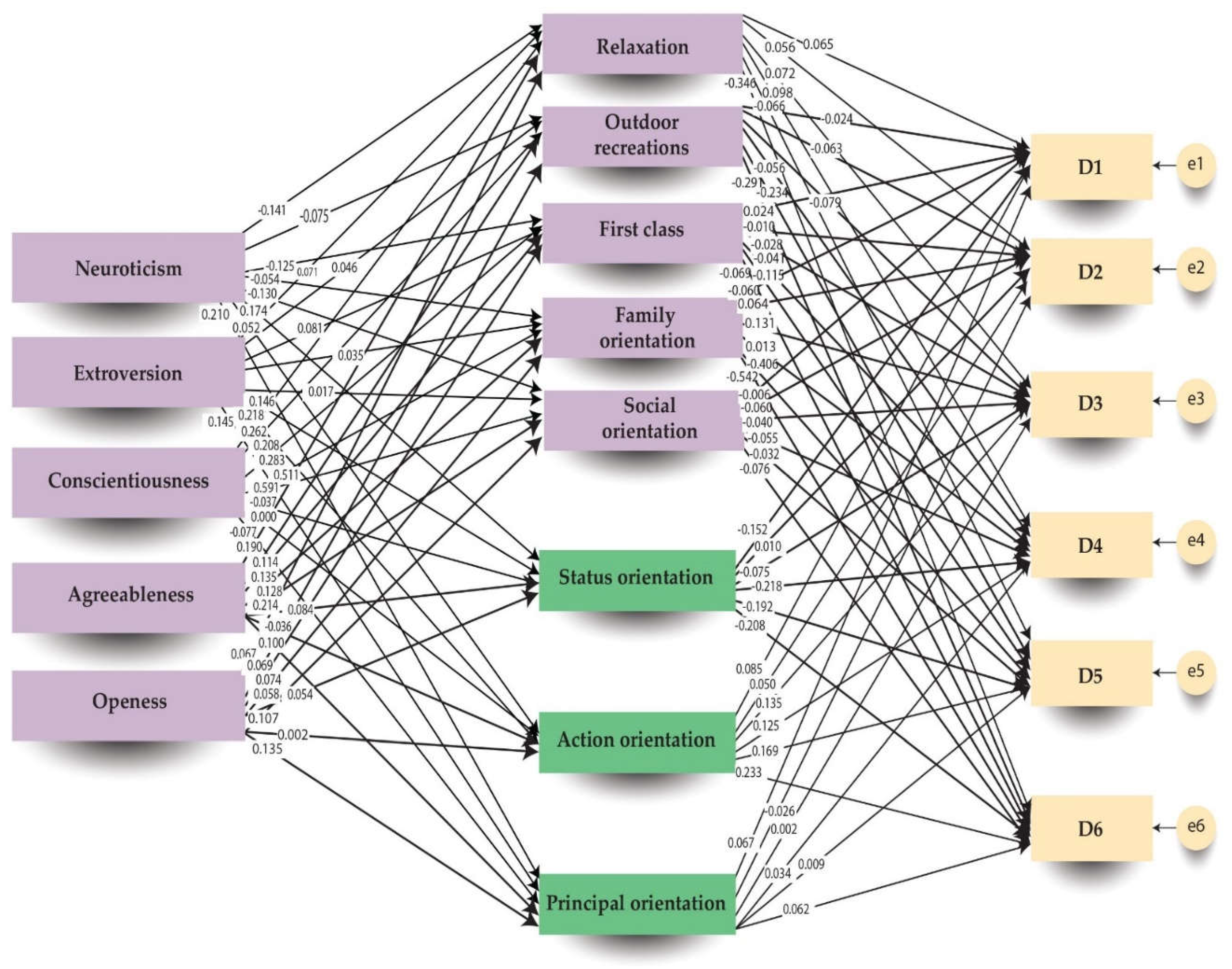

Table 1.
Sociodemographic description of tourists.
| Gender Male 39.9% Female 60.1% |
Frequency of traveling I have traveled abroad several times 34.7% I travel abroad once a year 18.8% I travel abroad several times a year 46 .5% |
| Education High school 24% Faculty 67.7% MSc, PhD 8.3% |
Earning Low (≤300*) 0.7% Average (300-1.000*) 24.5% High (>1.000*) 74.8% |
| Age 18-30 26.2% 31-55 30% >56 43.8% |
Country of residence Bosnia 31.1% Hungary 3.6% Croatia 18.4% Italy 2.3% Slovenia 9.6% Montenegro 29% Austria 4.9% Germany 1.1% |
Table 2.
Descriptive dimension values and reliability level.
| Dimensions | m | sd | α |
| BIF-10 - Neuroticism | 2.27 | 1.238 | 0.956 |
| BIF-10 - Extroversion | 3.19 | 1.252 | 0.922 |
| BIF-10 - Conscientiousness | 3.49 | 1.827 | 0.811 |
| BIF-10 - Agreeableness | 3.34 | 1.275 | 0.725 |
| BIF-10 - Openness | 2.11 | 1.130 | 0.858 |
| AIO - Relaxation | 2.56 | 1.000 | 0.828 |
| AIO - Outdoor recreations | 2.13 | 1.084 | 0.737 |
| AIO - First class | 3.21 | 0.910 | 0.797 |
| AIO - Family orientation | 3.41 | 1.891 | 0.897 |
| AIO - Social orientation | 3.50 | 1.813 | 0.903 |
| VALS 2 - Status orientation | 3.01 | 0.677 | 0.852 |
| VALS 2 - Action orientation | 3.35 | 0.773 | 0.849 |
| VALS 2 - Principal orientation | 3.13 | 0.767 | 0.749 |
| Destination selection percentage values | |||
| Destination level risk 1 | 53.6% | ||
| Destination level risk 2 | 46.1% | ||
| Destination level risk 3 | 35.5% | ||
| Destination level risk 4 | 31% | ||
| Destination level risk 5 | 25.25% | ||
| Destination level risk 6 | 20.9% | ||
*m-arithmetic men; sd-standard devition; α – reliability.
Table 3.
Values of significance of the influence of BFI-10 dimensions on psychographic orientations.
Table 3.
Values of significance of the influence of BFI-10 dimensions on psychographic orientations.
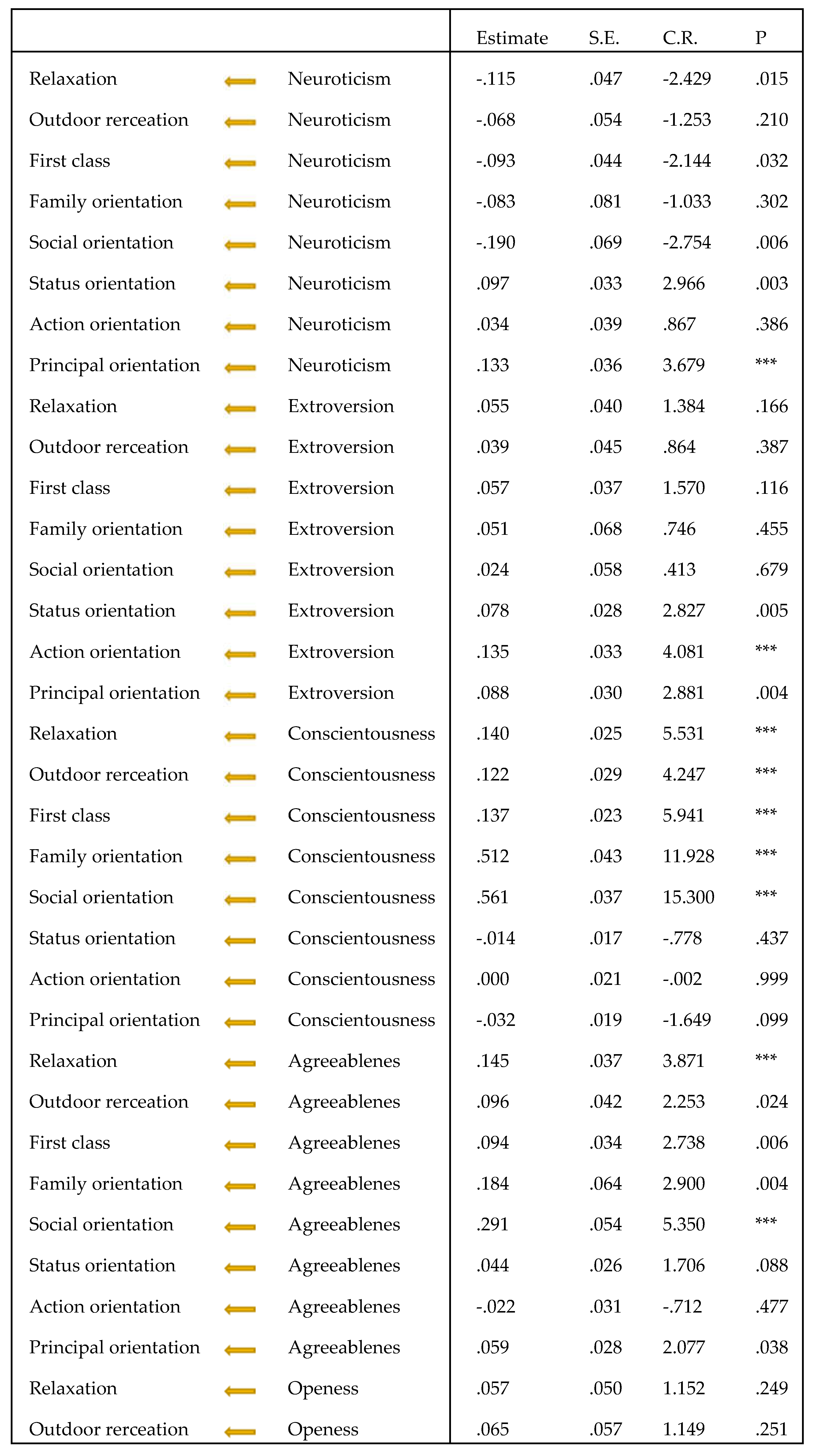
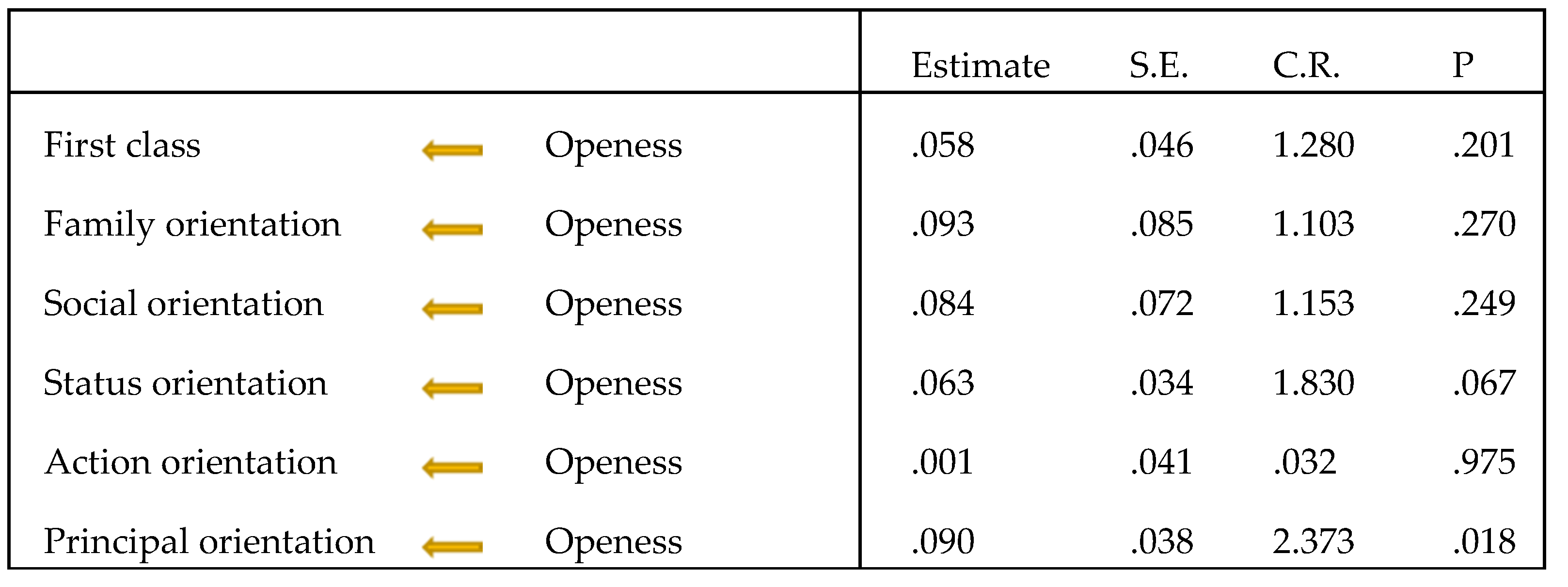
Table 4.
Values of the direct influence of psychographic orientations on the choice of a tourist destination.
Table 4.
Values of the direct influence of psychographic orientations on the choice of a tourist destination.
Disclaimer/Publisher’s Note: The statements, opinions and data contained in all publications are solely those of the individual author(s) and contributor(s) and not of MDPI and/or the editor(s). MDPI and/or the editor(s) disclaim responsibility for any injury to people or property resulting from any ideas, methods, instructions or products referred to in the content. |
© 2023 by the authors. Licensee MDPI, Basel, Switzerland. This article is an open access article distributed under the terms and conditions of the Creative Commons Attribution (CC BY) license (http://creativecommons.org/licenses/by/4.0/).
Copyright: This open access article is published under a Creative Commons CC BY 4.0 license, which permit the free download, distribution, and reuse, provided that the author and preprint are cited in any reuse.


