

Submitted:
25 September 2024
Posted:
26 September 2024
You are already at the latest version
Abstract
With consumers increasingly aware of the effects of human activity on the environment, tourism products and destinations are increasingly marketed as sustainable and socially responsible. As most sustainable practices lead to additional costs, and tourists’ decisions tend to be price sensitive, achieving sustainability goals necessarily involves understanding how much tourists are willing to pay extra for sustainable practices, as well as the antecedents of such Willingness to Pay (WTP). The present study aims to advance knowledge on the antecedents of WTP for Sustainable Destinations (WTP-4-SD), for which it builds on previous studies employing the Theory of Planned Behavior (TPB) and the New Environmental Paradigm (NEP). In this context, a theoretical model involving Ecotourism Attitudes, Environmental Beliefs, Climate Change-Related Risk Perceptions (CC-RRP), Environmental Concern During trip (ECDT), and Sustainable Consumption Behavior (SCB) as antecedents of WTP-4-SD is proposed. The model was tested based on data collected through an online survey, form a sample of 1,545 Spanish and Portuguese tourists, and analyzed through Structural Equations Modelling (SEM). The findings suggest that a cohesive set of attitudes and beliefs regarding the man-nature relationship, the risks of climate change and the role of tourism – which have been labelled “No Planet-B Attitudes” – is the main driver of WTP-4-SD.
Keywords:
willingness to pay for sustainable destinations
; environmental beliefs
; ecotourism attitudes
; sustainable consumption behavior
; environmental concern
; climate change
1. Introduction
For several decades, consumers are increasingly aware of the effects of human activity on the environment and the people inhabiting it. To cater to these green and socially responsible consumers, companies within all industries increasingly market their products and services as sustainable and socially responsible. The tourism and hospitality industries are no exception. Sustainable hotels, for instance, are no longer a market niche, as most hotels highlight environmentally and socially responsible practices in their communication material, and the same obtains in the destination level. In this context, many researchers have focused on how to enhance sustainability in a wide range of tourism settings, from wine tourism [1] to cruise excursions [2].
Although it may be argued that purely market-led sustainability might be an incentive for greenwashing [3], the logic of the market dictates that products not aligned with consumers’ wants and needs – and managers’ willingness to invest in them – are not viable. Therefore, as argued by Font and Mccabe [4], sustainable destinations and services need the support of consumers, who must be convinced to choose responsible products rather than their non-responsible counterparts. In other words, to be truly sustainable, tourism destinations must be competitive [5], a connection corroborated by recent studies that examine tourism sustainability from the supply [6,7] and demand [8] sides. In this context, achieving sustainability goals within tourism destinations necessarily involves effectively affecting tourists’ behaviors. Moreover, as most sustainable practices lead to additional costs [9], and tourists’ decisions tend to be price sensitive [10,11], achieving such goals also involves understanding how much tourists are willing to pay extra for sustainable practices, and as well as the antecedents of such willingness to pay (WTP).
Considering the addressed context, the present work aims to advance knowledge on the antecedents of WTP for Sustainable Destinations (WTP-4-SD). To this end, the investigation builds on the contributions of previous studies employing the Theory of Planned Behavior (TPB) and the New Environmental Paradigm (NEP) to understand which personal beliefs, attitudes, perceptions, consumption habits, and travel considerations are associated with a higher WTP-4-SD. Upon a thorough literature review, a theoretical model was proposed including five predictors of WTP-4-SD: Environmental Beliefs, Ecotourism Attitudes, Climate-Change-Related Risk Perceptions (CC-RRP), Environmental Concern During Trip (ECDT) and Sustainable Consumption Behavior (SCB).
To submit the model to empirical scrutiny, data was collected, via an online survey, from a convenience sample of 1,545 Spanish and Portuguese travelers. The questionnaire measured WTP-4-SD and each of its predictors through sets of items based on previous studies, which were operationalized though 7-point Likert type scales. The data were subsequently subjected, first to Exploratory Factor Analysis (EFA), then, to Structural Equations Modelling (SEM) through Maximum Likelihood Estimation (MLE), following Anderson and Gerbing’s [12] two-step approach.
The findings suggest that Environmental Beliefs, Ecotourism Attitudes, and CC-RRP act as a single factor, which was called “No Planet-B Attitudes”, representing a new paradigmatic view of the world, which reflects contemporary beliefs and values regarding science on the climate crisis, tourism and the man-nature relationship. This set of attitudes, in turn, is the main driver of WTP-4-SD. The findings also support the effect of all the other tested predictors, as well as the hypothesized relationships among some of them. The results generate useful insights for sustainable tourism product design and communication, which must be fine-tuned to potential tourists with high No Planet-B Attitudes.
2. Literature Review
2.1. Tourists’ Willingness to Pay for Sustainable Destinations
Studies on tourists’ willingness to pay extra for sustainability typically examine the concept in the context of either tourism services, such as hotels [13,14] or air travel [15]; or specific destinations or tourism products. Within the destination level, more relevant to the present study, research tend to focus on contexts more closely associated with sustainable tourism, such as visits to protected areas and ecotourism. Studies examining WTP for visiting protected areas show that the construct is favored by tourists’ higher levels of consumer and citizen behavior participation affecting their preferences [16], attitudes towards environmental protection [17], the very awareness of being in a protected area [18,19], higher income levels [18], and the number of animal species sighted [19].
Studies on ecotourism, in turn, show that WTP is favored by environmental beliefs [20,21], attitudes [20] and subjective norms [21]. They also show that the construct is negatively affected by materialistic values [20] and the attitude to admire wealthy people [21]. In cultural destinations, tourists have been found to be more willing to pay extra for sustainability aspects that enhance their own experiences [22], which has also been shown to be truth for general tourists’ destination choice [23]. Moreover, WTP has been shown to be positively associated with perceptions of risk related to climate change, in the context of nature-based tourism [24], and to vary according to demographic factors, such as age, gender, place of origin and education level [25].
In a recent attempt to explore the antecedents of WTP for the general tourist, de Araújo, Marques, Candeias, and Viera [26] found that in addition to attitudes and environmental beliefs, WTP is also positively associated with SCB, that is, the inclination to consider sustainability aspects in everyday consumption decisions, not only when travelling. Finally, studies also suggest that WTP is affected by tourists’ level environmental concern on the context of trip organization [27]. In fact, as concluded by Agag, Brown, Hassanein, and Shaalan [28] no single factor can drive a person’s WTP, as it is explained by a complex combination of demographic variables, values, normative influence, personality traits, and beliefs.
In sum, the addressed studies either demonstrate or suggest that, like other aspects of tourists’ behavior, WTP is affected by psychological constructs such as environmental attitudes, environmental beliefs, perceptions – such as those regarding to climate change-related risks –, environmental concerns during travel, and tourists’ general SCB. Each of those constructs is addressed in the following sections.
2.2. Sustainable Consumption Behaviou (SCB)
Sustainable consumption takes two main forms: reducing consumption and consuming mindfully [29,30]. Thus, the responsible consumer analyses various social and environmental elements of products and services, such as the manufacturing process [31], working conditions, respect for human rights, the experimental use of animals, and contributions to society [32]. Moreover, they reuse glass and plastic containers, recycle at home, buy reusable products, prioritize glass packages, and reduce the use of household appliances [33,34,35]. The perceived product attributes sustainability-inclined consumers value include: the indication of its environmental impact, the way it should discarded, the social impact of consumption, and the use of animals in the manufacturing process [36,37,38].
The awareness that the success of strategies for tackling some of humanity’s current greatest challenges depends on changes on public behavior has led to new perspectives on consumption behavior change strategies [39,40]. These strategies consider that, according to the Theory of Planned Behavior (TPB), attitudes and beliefs play a significant role on people’s choices [41,42]. Several studies have also shown that, although there are attitude-behavior gaps [43], often associated with economic hindrances [44], as well as differences associated with gender and generation [30], SCB is indeed affected by attitudes and beliefs [45], as well as values [46]. Therefore, it is not surprising that education [47] and marketing campaigns – which try to influence behavior by changing attitudes and beliefs [48] – significantly impact consumers’ intentions to purchase environmentally friendly products [49].
Naturally, tourists’ behavior is also impacted by attitudes and beliefs [50]. However, attitude-behavior gaps have also been found among tourists, as tourists’ information on issues such as climate change not always translate into choosing more sustainable tourism products [51,52,53], which Hall [54] associates with an over-reliance on the utilitarian approach to consumer change. Such realization has led authors to consider other approaches to behavior change, such as promoting desired behaviors as social norms [55] and nudging [56], or even other approaches to tourism development itself, such as degrowth [57]. On the other hand, studies employing the TBP suggest that despite these limitations, tourists’ sustainable consumption intentions are indeed favored by environmental attitudes and knowledge [58,59], and might integrate tourists’ own motivations [60]. Other relevant contributions include the conclusion that habitual behavior (i.e., one’s behavior at home) is the main driver of urban tourists’ pro-environmental behavior [61], and that there is some degree of consistency across sustainable consumption behavior across sectors, including travel [62]. These last contributions lead us to hypothesize that a general tendency to consume sustainably must translate into tourists’ willingness to choose and pay extra for sustainable destinations. In this context,
- H1a: Willingness to pay for Sustainable Destinations is positively affected by Sustainable Consumption Behavior.
2.3. Environmental Concern During Trip (ECDT)
Definitions of environmental concern are diverse, and can be generally divided in two main approaches, the policy and the theoretical. For the purposes of this study, the latter is adopted. Within this approach one’s environmental concern is described as ones’ general attitude towards environmental issues, of which their attitudes toward specific environmental topics, although potentially slightly different, will ultimately reflect [63]. As Cruz and Manata [64] exemplify, one’s attitude toward a policy to protect a certain natural reserve is likely a one facet of a broader attitude on the protection of endangered species, which in turn, reflects one’s more general attitude on biodiversity conservation, and so on. Although it might be explained in such simple terms, there is a multitude of approaches to measure it, despite attempts to build reliable scales dating back to the 1970’s (i.e., Weigel & Weigel [65]).
In psychology literature, environmental concern has shown to be influenced by personal factors – e.g., knowledge, political and world view, values, and personality – and social factors – e.g., urban-rural differences, norms, and social class [66]. In terms of personality, agreeableness and openness showed to be positively correlated with environmental concern [67]. In terms of values, environmental concern is related to egoistic, social-altruistic, and biospheric value orientations [68]. On the other hand, difficulties in obtaining information – direct or mediated – about environmental issues and with the mental appraisal process concerning environmental problems – the severity and probability of threat, responsibility and affectedness, and coping – are pointed as barriers to environmental concern [69].
In the tourism field, the concept of environmental concern is rarely addressed as a construct, although several studies have examined the role of environmental values, environmental knowledge and environmental sensitivity in tourists’ environmentally responsible behavior. These studies have shown that different levels of environmental value are associated with different motivations to attend events related to environmental issues [70], and that environmental knowledge positively affects environmental sensitivity, which in turn, leads tourists to exhibit more environmentally responsible behavior [71]. One tourism study that does address environmental concern as a construct is Hedlund [27,27], which operationalizes it as the extent to which tourists consider the impact of each facet of their consumption during the trip, i.e., transport, hospitality, attractions, etc. on their decisions, which the author demonstrate that is positively associated with the willingness to accept economic sacrifices to impact the environment. Considering this contribution,
- H1b: Willingness to pay for Sustainable Destinations is positively affected by Environmental Concern During Trip.
Additionally, considering the contributions addressed in the last two topics,
- H2a: Environmental Concern During Trip is positively affected by Sustainable Consumption Behavior.
2.4. Environmental Beliefs
Environmental beliefs are understood as the general beliefs people have regarding the natural environment. A theoretical milestone on environmental beliefs is the proposal of the NEP scale [63], which has been employed by many studies subsequent studies [72,73,74]. The NEP’s basic concept is the metaphor of the earth as a spaceship, in which the planet is viewed as delicate and with limited resources, there is limited possibilities for economic growth, and human dominance over nature is believed to lead to problems. This view contrasts with that of the pre-existing Human-Exception Paradigm (HEP), which refer to the anthropocentric view of mankind as separate and superior to the rest of nature, coupled with a belief in economic growth and material abundance [75].
Studies on environmental beliefs have shown that these are affected by media messages, particularly those regarding the global climate crisis [76], and that although they seem to be affected by class and education – as well as by situational aspects [77], such effects are not linear and unambiguous [78]. In terms of their role on every-day pro-environmental behavior, environmental beliefs are shown to favor recycling – which is also favored by collectivist values and locus control [79] –, and general environmental behavior – which are hindered by materialist values [80]. Moreover, studies have shown that NEP values are related to supporting conservation action [81], and that environmental beliefs affect environmentally responsible behavior like conscious water consumption [82]. Considering those contributions, along with those addressed in section 1.2,
- H3a: Sustainable Consumption Behavior is positively affected by Environmental Beliefs.
Tourism investigation has shown that employees’ environmental norms and beliefs are essential for hotels’ adoption of green practices [83]. Studies on tourists’ behavior, in turn, show that NEP views are associated with pro-environmental decision-making process [84], and that environmental beliefs play a significant role on tourists’ environmentally responsible behavior [85], and more specific, on support for tourism green accreditation systems as well as intention to purchase accredited products, and willingness to consider personal impact on the earth and other cultures when making travel decisions [86]. Environmental beliefs also seem to be associated with more responsible forms of travel, as ecotourists express more pro-environmental beliefs than nature tourists, which in turn, express them more than city tourists [87]. Moreover, environmental attitudes have also been shown to positively affect environmental behavior and, indirectly, purchase intention of environmentally friendly wine, in the context of wine tourism [88]. Based on some of these findings, Dolnicar [89] suggests guidelines to develop more environmentally friendly tourism products, which involves leveraging tourists’ beliefs. Considering these contributions, along with those addressed in 1.3,
- H2b: Environmental Concern during trip is positively affected by Environmental Beliefs.
Concerning the role on WTP-4-SD, studies [21,90,91] show that Environmental Beliefs positively affect tourists’ WTP a premium price for ecotourism. Considering these contributions,
- H1c: Willingness to pay for Sustainable Destinations is positively affected by Environmental beliefs.
2.5. Ecotourism Attitudes
In the context of studies addressing the role of tourists’ beliefs and attitudes regarding their behavior, ecotourism attitudes refer to beliefs and attitudes they hold about ecotourism and sustainable tourism in general. Attitudes on the role on tourism on sustainability are also addressed by studies outside the specific scope of ecotourism, however, those tend to focus on residents’ attitudes on sustainable tourism [92,93,94,95,96], or those of local government [97], tourism industries [98,99], or even students [100]. One exception of this trend is Firth and Hing [101,101], which provides an early example of the previously addressed attitude-behavior gap, as it shows that most backpackers do not consider sustainable practices on their choice of hostel.
In this context, the theoretical contributions that provide the basis for addressing tourists’ attitudes towards sustainable tourism and their role WTP come from studies that examine ecotourism attitudes. Such studies have shown that these attitudes are positively related to ecotourism interest [102], environmental advocacy [103], and perceived value of visited protected areas [104]. Studies also show that ecotourism attitudes effectively mediate the effect of ecotourism knowledge on ecotourist satisfaction [105], and that they are positively affected by environmental belief and nature-based destination image [106].
More relevant to the present study, consumer awareness and attitudes towards sustainability have been shown to play a significant role in determining WTP for sustainable hotel practices [107]. Regarding ecotourism attitudes, specifically, those have also been shown to be positively associated with WTP a premium price for ecotourism products [20,108], and with tourists’ preferences and WTP for sustainable tourism development in Small Island Developing States [109], and subsequently, on Portuguese general tourists’ WTP for sustainability practices in tourism destinations [26]. Considering these contributions,
- H1d: Willingness to pay for Sustainable Destinations is positively affected by Ecotourism Attitudes.
Moreover, considering the contributions addressed in section 1.2, namely those related to the role of attitudes on SCB,
- H3b: Sustainable Consumption Behavior is positively affected by Ecotourism Attitudes.
Finally, considering ECDT, as operationalized by Hedlund [27], that is, as a specific type of consumption behavior,
- H2c: Environmental Concern During Trip is positively affected by Ecotourism Attitudes.
2.6. Climate Change-Related Risk Perceptions (CC-RRP)
Considering the state of the art and mainstream knowledge on the climate crisis, another factor to consider in comprehending consumers’ sustainable behavior and their choice for sustainable destinations is their perception of risks related to such crisis. Many areas around the globe face significant environmental hazards, like air pollution and ozone layer depletion, but they remain popular destinations for tourists. In this context, tourists who visit destinations with environmental risks show less fear and negative feelings towards these destinations compared to people who do not [110]. Such risks, however, might cause both physical and mental health problems, as well as negatively impact tourists’ experiences, as is the case of fog caused by pollution in China [111].
Regarding risks related to climate change specifically, research has shown that they can vary significantly among both local tourists and other tourism stakeholders. Regarding tourists’ perceptions of risks, a study [112] conducted in Mount Desert Island, in the US – where perceived risks are mainly extreme weather and sea level rise – segmented visitors in three different groups based on their level of risk perception related to climate change: Skeptics, Believers, and Cautious. Regarding other industry, government and NGO representatives, a study in the Maldives has shown that international audiences are more attuned to these risks, while domestic stakeholders are less concerned [113].
Concerning the effects of climate change-related risk perceptions on WTP, multiple studies suggest that individuals who believe in climate change are more inclined to spend extra money on their consumption to mitigate the global risks associated with it [114,115,116]. However, research indicates that WTP can differ based on gender [117], age [118], environmental attitudes [119] and perceptions of risk [115]). McCreary et al. (2018), for instance, indicated that, in the context of visits to a natural park, individuals who recognized the place’s importance and felt a strong attachment to it were more inclined to contribute a designated fee to aid climate adaptation efforts in the area. In this context,
H1e: Willingness to pay for Sustainable Destinations is positively affected by Climate change-related risk perceptions.
Environmental risk perception, along with environmental knowledge, social pressure and health consciousness, have also been found to be an antecedent of sustainable behavioral intention among millennials [120]. Moreover, environmental risk perception and environmental knowledge impact environmental concern significantly, which in turn, strongly affects behavioral intention, and all these constructs mediate sustainable consumption behavior [121,122]. These contributions allow us to raise both following hypotheses:
- H3c: Sustainable Consumption Behavior is positively affected by Climate change-related risk perceptions.
- H2d: Environmental Concern During Trip is positively affected by Climate change-related risk perceptions.
The conceptual model encompassing all the hypothesized relationships is graphically represented in Figure 1.
3. Materials and Methods
The present study proposes and tests a causal model of the antecedents of tourists’ WTP-4-SD, encompassing Ecotourism attitudes, Environmental Beliefs, CC-RRP, ECDT, and SCB. To this end, data was collected from a sample of Spanish and Portuguese travelers.
3.1. Questionnaire Development
The adopted data collection instrument was of a survey questionnaire, which was developed based on contributions from previous studies. To measure WTP-4-SD, three items adapted from Lee, Hsu, Han, and Kim [123], who employ it to measure consumers’ WTP a premium price for green hotels, were used. Ecotourism Attitudes have been measured through a set of items adapted from Castellanos-Verdugo et al. [104]. The scale had also been previously adapted by Grilli et al. [109]. Environmental Beliefs were measured through five items of the New Environmental Paradigm (NEP) [63], which as discussed in section 1.4, is widely used to measure environmental beliefs and attitudes, including in tourism studies. The version applied in the present study was adapted by Hultman et al. [20]. CC-RRP were measured using Atzori, Fyall, Tasci, and Fjelstul’s [124] adaptation of the items originally employed by Leiserowitz, Maibach, Roser-Renouf, Feinberg, and Howe [125] and Lorenzoni, Leiserowitz, De Franca Doria, Poortinga, & Pidgeon [126]. SCB was measured through a list of four items validated by de Araújo et al. [26], and ECDT was measured through five items adapted from Hedlund [27]. The selection of each scale was corroborated by reliability tests made prior to any other analysis procedure, as all scales had Cronbach’s Alpha values above .80.
The wording of the items was lightly tailored to adapt their semantic meanings to Spanish and Portuguese respondents. The items were originally developed in English and then translated to the two languages (Spanish and Portuguese) in which they were applied through reverse translation, with the collaborations of researchers fluent in English who had each of these languages as mother tongues. All items were operationalized through statements to which respondents were solicited to demonstrate their level of agreement in a 7-point Likert type scale, where 1 = “Totally disagree” and 7 = “Totally agree”. To minimize instrument bias via respondents’ suggestion, taking advantage of the resources of online surveys, all items were presented in a single section, and their order was randomized, resulting in a different random order for each respondent. This aimed to avoid leading respondents to give identical or similar scores to similar items simply because they were presented consecutively or understood as intending to measure the same variable. Also aiming to minimize bias and filter out potential responses from people who did not properly read the instructions and items, several reverse items were employed throughout the scales.
3.2. Data Collection Procedures
Prior to initiating the data collection, aiming to detect potential issues, a pre-test was carried out with a smaller sample of travelers. After the necessary adjustments, the questionnaire was applied online through Google Forms to a convenience sample of Spanish and Portuguese residents who had travelled within the last twelve months. Data collection took place between April and May 2022. The questionnaire was disseminated in travel-related social media groups as well as on marketing survey platforms. The previous knowledge respondents potentially had about sustainability, sustainable tourism or climate change was deliberately not assessed. This was in line with the study’s goal of measuring travelers’ ecotourism attitudes, environmental beliefs and CC-RRP – as well as their SCB patterns, ECDT and WTP-4-SD – regardless of their theoretical knowledge on the subjects. In the same vein, the questionnaire was not disseminated in groups that listed sustainability related issues among its topics of interest. A total of 1,545 valid responses were collected. Table 1 summarizes the sample’s sociodemographic and travel behavior profile.
3.3. Data Analysis Procedures
The analyzed data were first subjected to an Exploratory Factor Analysis (EFA) for measure purification [127]. Subsequently, Confirmatory Factor Analysis (CFA) was conducted using AMOS, to assess dimensionality, reliability, and convergent validity. Additionally, a complete discriminant validity analysis was carried out to produce the metrics not given by AMOS. Prior to the CFA, however, a data screening process, including a thorough check for missing and extreme values, as well as collinearity and distribution analysis, was carried out. Then, the final model was assessed through Structural Equations Modelling (SEM) and the hypotheses were tested via the analysis of the path estimates. The methodological aspects of the analysis are further discussed in along with their results in the following chapter.
4. Results
4.1. Assessment of the Measurement Model
The measurement model was assessed through an EFA – Principal Component Analysis with Varimax rotation. An examination of Bartlett’s test of sphericity (p = .000) and Kaiser-Neyer-Olkin measure of sampling adequacy (KMO = .947) values suggests that factor analysis is adequate for exploring the data. The proposed conceptual model encompassed six latent variables: three exogenous, two mediating (dependent in relation to the exogenous and independent in relation to the endogenous), and the main endogenous variable do to be explained: WTP-4-SD. However, the EFA rendered a four-factor solution explaining over 79% of total variances, which according to Hair, Black, Babin, and Anderson [128], is a good value. In this context, the items of Ecotourism Attitudes, Environmental Beliefs, and CC-RRP, showed to have such high correlation, that they all loaded under one single factor. Nevertheless, as these were the three exogenous variables within the model, all hypotheses could still be verified considering the new single factor, which was named “No Planet-B Attitudes”, as the only exogenous variable. Moreover, no item presents a particularly low value of commonality, and each item loads significantly to its respective factor, which suggests that none should be excluded. The final structural model is represented in Figure 2.
After the model assessment, Anderson and Gerbing’s [12] two-step approach was employed for the model validation. Therefore, the sample was randomly divided into two parts, each corresponding to approximately 50% of the total observations: the calibration sample and the confirmation sample. The first of the two steps, the CFA, was then carried out using the Maximum Likelihood Estimation approach, with the calibration sample. Before proceeding with the analysis, however, it was necessary to carry out the data screening process.
4.2. Data Screening
As the data was collected through Google Forms and all the model items were mandatory, missing values were not an issue. However, this same procedure might lead to incoherent responses, and consequently, outliers. In this context, a Mahalanobis distance analysis was carried out to check for outliers, after which 83 observations were discarded for model validation purposes. Next, collinearity was assessed. Tolerance values for all independent variables were higher than .1, while their Variance Inflation Factors (VIF) were all safely under 10, which indicate that there are no problems with collinearity [129]. Next, Skewness and Kurtosis were observed. Skewness values vary between -1.655 (RP_3) and -295 (RC_5), that is, they are negatively skewed, however, within Kline’s [130] recommended interval (between -2 and 2). Kurtosis values range between -1.143 and 2,226, with three items having above 2 values. Regarding the out of range values, Bollen’s [131] conclusion about MLE being robust in relation to several types of violation of the multivariate normality assumption was considered. Moreover, Barnes, Cote, Cudeck, and Malthouse [132] suggest that, for practical purposes, as long as the distribution of the sample does not vary radically from normality, such deviations do not represent an impediment to carrying out MLE. Once missing and extreme values were ruled out, as well as potential obstacles to MLE due to problems with collinearity or abnormal distribution of the sample, the model’s dimensionality, convergent validity, reliability and discriminant validity were assessed.
4.3. Dimensionality, Convergent Validity, Reliability, and Discriminant Validity Tests
In terms of model fit, the overall statistics suggest that the constructs are indeed unidimensional. The chi-square value is indeed significant (p=.000). However, that tends to be the case with large samples, and therefore, Bollen [131] highlights the importance of considering the ratio chi-squared/degrees of freedom (X2/df). For the present model, the ratio is 2.836, therefore, within the “2 to 3” interval suggested by Cote, Netemeyer, and Bentler [133]. Moreover, the Goodness of Fit Index (GFI = ,905), Comparative Fit Index (CFI = ,978), and Normed Fit Index (NFI = ,966) are all above .90, the threshold recommended by Tabachnick and Fidell [134]. The only index below .90 is the Adjusted Goodness of fit index (AFGI = ,882), which is however in close vicinity to the threshold. Moreover, the Root Mean Square Error of Approximation (RMSEA = ,053) also indicates a great fit according to Hu and Bentler’s [135] cut-off criterion.
To explore potential additional issues with unidimensionality, the absolute values in the matrix of standardized residuals and the modification indices were also reviewed. In line with Anderson and Gerbing’s [12] recommendations, when AMOS highlighted possible dimensionality concerns, unidimensionality was enhanced by addressing the pairs of items that posed the greatest problems. Following this adjustment, both standardized residuals exceeding 2.58 and modification indices above 5.0 appeared in less than 6% of all pairs [136]. Based on the reported model fit results and the fact that each item loaded significantly onto only one factor, the data indicates evidence of unidimensionality for both factors.
All items loaded significantly to the variable they were supposed to measure. Namely, factorial loads were all above Hair et al.‘s. [128] threshold (.50). Moreover, all t-values are statistically significant at a 99.9% confidence interval (p≤.001), which implies that the items under each factor significantly contribute to measure the corresponding constructs. Finally, all Average Variance Extract (AVE) values are higher than .50, which corroborates the evidence of the constructs’ convergent validity [137].
The constructs’ Cronbach’s Alpha (CA) values are all well above .70 (in fact, they are all above .90), showing that the scales are reliable [138]. As additional indicators of reliability, all Composite Reliability (CR) values should be higher than .70 [139], and each construct’s Maximum Reliability (H) (MaxR(H)) should be higher than its CR [140,141], both of which obtain in the present study. All dimensionality, convergent validity, and reliability results are summarized in Table 2.
Finally, discriminant validity was assessed. Each item’s AVE is higher than its Maximum Shared Variance (MSV) and then its Average Shared Variance (AVS). Moreover, the square root of each construct’s AVE value is higher than the correlation values of that construct with others in the model. According to Fornell and Larcker [142], these are sufficient evidence of the constructs’ discriminant validity. Discriminant validity results, namely AVE, MSV, ASV, and a factor correlation matrix with the square root of AVE on the diagonal, are summarized in Table 3.
4.4. Hypothesis Testing
To test the hypothesized relationships between the latent variables - No Planet-B Attitudes, ECDT, SCB, and WTP-4-SD – the structural model was assessed on AMOS using the confirmation sample. Regarding the effects on the main endogenous variable that the model aimed to explain, WTP-4-SD, all other three latent variables present significant effects. Namely, SCB exerts a significant (p≤.001) and large (β=.361) effect, which offers supports for H1a. Environmental concern during trip exerts the most modest effect (β=.082), but still significant at a 99% confidence interval (p≤.01), thus, supporting H1b. Finally, No Planet-B Attitudes exerts a significant (p≤.001) and strong (β=.425) effect on WTP-4-SD, which renders support for H1c, H1d, and H1e. Moreover, WTP-4-SD’s Square Multiple Correlation (R2) value (.609) shows that its predictors explain 60.9% of its variances, which is a very good value in the context of social sciences [128].
Regarding ECDT, SCB exerts a significant (p≤.001) and strong (β=.449) effect, which corroborates H2a. Accordingly, No Planet-B Attitudes showed to have a quite small effect (β=.122), which is however still significant at a 95% confidence interval (p≤.05), and thus provides support to H2b, H2c, and H2d. ECDT’s R2 however, is quite low (.297), which does represent a limitation of the model. Finally, SCB is significantly (p≤.001) and very strongly (β=.740) affected by No Planet-B Attitudes, which provides support for H3a, H3b, and H3c. Moreover, SCB’s R2 is also quite high (.547), indicating that No Planet-B Attitudes explain over 50% of its variances. SEM results are summarized in Table 4. The hypotheses testing is summarized in Table 5.
It should be noted that the effect of No Planet-B Attitudes on SCB can be considered very close to being too large, which could indicate potential problems with the model. There is no exact threshold above which a path estimate is definitely too large. Kline [130] states that path estimates close to or exceeding .90 can indicate multicollinearity or overfitting problems. Diamantopoulos and Siguaw [143] mention paths close to 1.0 as indicators of multicollinearity problems or incorrect specification. Hair et al. [128] refer to path estimates above .80 or .90 as potential indicators of issues with the model or the data. Within the present case, considering that the path estimate does not reach any of the mentioned values, and that the model performs well within all validity tests, including discriminant validity, the very high path estimate was not considered an issue.
Besides the addressed direct effects, the model also includes three indirect effects. Namely, No Planet-B Attitudes exerts a strong indirect effect (β=.332) on ECDT, which added to its small direct effect (β=.122), results in a very large total effect (β=.507). No Planet-B Attitudes also exerts a large indirect effect (β=.304) on WTP-4-SD, which added to its already large direct effect (β=.425), results in a very large total effect (β=.730). Finally, SCB also exerts an indirect effect on WTP-4-SD, although a very small one (β=.037). Therefore, the total effect (β=.398) is not much larger than the direct effect. All direct, indirect, and total effects are summarized in Table 6.
5. Discussion
The present study aimed to advance knowledge on the antecedents of WTP-4-SD. Upon a thorough literature review on the topic, five potential predictors of WTP-4-SD were selected: Environmental Beliefs, Ecotourism Attitudes, CC-RRP, SCB, and ECDT. On the one hand, the findings do support the hypotheses regarding the effect of each of those constructs on WTP-4-SD, which corroborates and expands on the contributions of many previous studies. On the other hand, they suggest that in the observed context, Environmental Beliefs, Ecotourism Attitudes, and CC-RRP can be seen as indicators of a unique and consistent view upon of world, which in this work is called “No Planet-B Attitudes”.
Perhaps this can be seen as indicative of a new paradigm, or at least, the current evolutionary stage of a paradigm that starts dates back to the NEP. According to Kuhn [144], a paradigm is a group’s way of looking at the world, which encompasses its’ whole set of beliefs and values. The data suggest that, in the 2020’s, people who believe that the earth’s balance is fragile, that there are limits to economic growth, and that excessive human intervention leads to catastrophe – the outlook described by Dunlap and Van Liere’s [63] NEP –, also tend to think that sustainable tourism has a role to play in nature conservation and in generating liquid benefits for local populations – that is, they have favorable Ecotourism Attitudes –, and that the climate crisis represents a real threat to which world leaders should canalize their efforts – that is, they have high CC-RRP. Looking back at the past half century, this seems quite logic.
The NEP scale was proposed in the end of the 1970’s, in the beginning of the global shift to neo-liberal globalized economics, and reflected the new ideas brought about by the emergence of the global environmental social movement. Since then, climate change has become much more critical – as demonstrated by subsequent International Pannel for Climate Chage (IPCC) reports. Awareness of such phenomenon already existed in the 1970’s within the scientific community [145] and even major oil companies [146]. However, mainstream awareness grew significantly since the first IPCC reports, and especially after the rise of the new social environmental movement, from 2018, and general acknowledgement of the media, which for quite long, treated it as a matter of opinion, equivalating the position of scientists and deniers [147].
In parallel, the massification of global tourism, another aspect of globalization, also took place during this period, and specially within the last three decades [148]. Naturally, awareness of tourism’s impact on the planet and its people in terms of gentrification [149], water pollution [150], and more directly linked to the topic of climate change, carbon emissions [151], have also increased and become a mainstream topic. Therefore, it is only logical that, in the 2020’s, the system of beliefs that includes those described in the NEP also include the acceptance of the scientific state of the art on anthropogenic climate change, and the role of tourism in this and other global issues. Naturally, the NEP has indeed been revised in 2000 [152], but as discussed, the mainstream knowledge and acknowledgement of climate change has increased exponentially since then, and no Planet-B attitudes also reflect this world view in the context of tourists’ choices.
More than a mere correlation, the data show that these traits are indistinguishable in terms of the responses, and effectively all measure one single construct (No Planet-B Attitudes). That is, they represent a single, coherent way of looking at the world, or a paradigm. Naturally, this is not an exhaustive list of traits within this paradigm, but merely, an incomplete representation of how it can be observed in the context of sustainable tourism. Nor the present work is the first to point to this new paradigm. The contributions of many studies addressed in the literature review point to a more complex profile of travelers that tend to behave more sustainably in terms of their travel decisions. This complex profile encompasses the variables included in the tested model, but also traits whose nature was not covered by the present study, such as materialist values [20] and admiration towards the wealthy [21] – both shown to be negatively related to sustainable tourist choices –, collectivist and materialist values – shown to be positively [79] and negatively [80] associated with environmental beliefs, respectively –, and egoistic social-altruistic, and biospheric value orientations – shown to be positively associated with environmental concern, which in turn affect WTP-4-SD [68]. Considering this role of values on tourists’ environmental concern and sustainable choices, exploring the role of collectivism and other values on WTP-4-SD, potentially as part of No Planet B Attitudes, is a fertile avenue for future studies.
In the same vein, other sociopsychological traits might be included in No Planet-B attitudes, such as political views – as they are closely related to personal values [153] –, attitudes towards corporations’ social and environmental accountability and government regulation – also shown to be related to personal values [154] –, etc. Accordingly, personality traits, such as agreeableness and openness, which have been associated with environmental concern [67], should be considered. Some of these might be part of No Planet-B Attitudes per se (i.e., they would also be together in the same factor within EFA and CFA procedures), while some might be correlated or even predict it. Looking into which other traits might be part of or influence No Planet-B Attitudes, as well as how they affect tourist’s sustainable choices and behaviors is also a fertile path for future research.
Considering some of the study’s specific hypotheses, the support for the effect of SCB on WTP-4-SD corroborates previous findings regarding the role of habitual behavior as a driver for tourists’ sustainable consumption [61], as well as those about a certain degree of consistency in consumers’ sustainable behavior across different sectors [62]. The support for the role of Environmental beliefs on WTP-4-SD corroborates findings on NEP values’ positive association with tourists’ pro-environmental decision-making process [84], environmentally responsible behavior [85], support for accreditation systems [86], and more responsible forms of travel [87]. The confirmation of Ecotourism attitudes’ role on WTP-4-SD expands on previous findings regarding their importance for willing to pay a premium price for ecotourism products [90,108] and tourists’ preferences for sustainable tourism development in Small Island Developing States [109]. Finally, the support for the connection between CC-RRP and WTP-4-SD reinforces the findings of several studies indicating that belief in anthropogenic changes to global climate leads to a bigger inclination to spending more to mitigate them [114,115,116].
In sum, considering that no single factor can totally explain WTP-4-SD [28], the present study advances the understanding of the factors that play a role in it, suggesting that some of them tend to act together as a single construct.
6. Conclusion
By shedding light on the antecedents of WTP-4-SD, the present study provides some useful insights for tourism destination (and business) marketeers. The implications include the necessity to fine tune messages to a receiver who has high No Planet-B Attitudes, as described earlier. A promotional destination video, for instance, should highlight the destinations’ effort to maintain (or preferably regenerate) its ecological balance – and thus appeal to viewers’ environmental beliefs – and highlight the role of tourism in this goal. When relevant, education about the role of local tourism activity in contributing to tackle (or at least not worsening) the climate crisis is also desirable, especially for destinations based on or connected to natural resources particularly relevant to this context, such as the Amazon Forest, the Great Barrier Rief, or glaciers.
Additionally, the present study’s insights must be considered jointly with those from previous investigations. This includes, for instance, Aydın and Alvarez’s [22] conclusion, corroborated by de Araújo et. al. [23], regarding tourists’ tendency to be more willing to pay for sustainable practices that do enhance their experiences. In this context, sustainable tourism marketing should seek to associate sustainability performance and high-quality experiences. Moreover, efforts should be made to educate tourists about the less explicit role of certain sustainable practices normally not directly associated with the quality of tourists’ experiences, such as good wages, benefits, and working conditions in the hospitality industry. The implications are not restricted, however, to communication. These same considerations should be taken when designing sustainable tourism products, which as argued by Dolnicar (2020), and reinforced by this study’s findings, should leverage on tourists’ beliefs.
The findings should also be considered with caution. Just like, there are attitude-behavior gaps regarding sustainable consumption [43], including in the tourism industry [51,52,53], there must also be a gap between self-reported WTP and actual WTP. Nevertheless, understanding which attitudes and behaviors are associated with even agreeing that it is acceptable to pay a premium price for tourism destinations that employ sustainable practices generate valuable insights for sustainable tourism product design and communication. Moreover, there is reason to believe that the limitations of self-reported WTP are not as big as one may initially think. In Araújo, et. al. [23], while respondents tended to rate the importance of various sustainability practices undistinguishably high, WTP for the same set of practices showed some clear patterns, which seems to indicate some level of honesty and thoughtfulness in the responses. Moreover, being able to better communicate sustainability-related benefits to tourists willing to pay a premium price for them does not make other approaches to enforcing sustainable practices less relevant. Market-led sustainability is important but also has its risks and limitations, including leading to greenwashing [3]. If the tourism industry is to fulfil its role in the achievement of the United Nations’ Sustainable Development Goals (SDGs), every tool available must be used, including, naturally, the promotion of the desired behavior as social norms [53], regulations, nudging [89], and eventually, even degrowth [57].
Despite its contributions, the present study also has its shortcomings. First, its cross-sectional nature limits the generalizability of its results, and such limitation is exacerbated by its convenience sampling method. Therefore, future studies are necessary to verify whether No Planet-B Attitudes also behave as a single construct in populations other than Iberian tourists. Moreover, as discussed above, despite the presented reasons to mitigate this preoccupation, self-report research also has its inherent limitations. In this context, future studies should seek to verify the suggestions that the present investigation allows to emerge based on observational data. Finally, as discussed, No Planet-B Attitudes seem to be a photograph of the current zeigieist. In this context, longitudinal studies are also desirable to verify how those views, and their effect on WTP-4-SD, may change over time.
Author Contributions
Conceptualization, A.F.A., I.A.M. and L.L.M.; methodology, A.F.A. and L.L.M.; validation, A.F.A.; formal analysis, A.F.A.; investigation, A.F.A., I.A.M. and L.L.M.; data curation, A.F.A. and L.L.M.; writing—original draft preparation, A.F.A. and I.A.M.; writing—review and editing, A.F.A.; visualization, A.F.A. All authors have read and agreed to the published version of the manuscript.
Funding
This research received no external funding.
Informed Consent Statement
Informed consent was obtained from all subjects involved in the study.
Data Availability Statement
The data analysed in this study can be accessed through the following link: https://drive.google.com/file/d/1p9ifqVSbPxECn--3y40_n3ED6FmjBaqC/view?usp=drive_link
Acknowledgments
The authors thank the students of the Lusofona University and University of Granada who participated in the data collection procedures.
Conflicts of Interest
The authors declare no conflicts of interest.
References
- Montella, M.M. Wine Tourism and Sustainability: A Review. Sustainability 2017, 9. [CrossRef]
- Paiano, A.; Crovella, T.; Lagioia, G. Managing Sustainable Practices in Cruise Tourism: The Assessment of Carbon Footprint and Waste of Water and Beverage Packaging. Tour. Manag. 2020, 77. [CrossRef]
- Delmas, M.A.; Burbano, V.C. The Drivers of Greenwashing. Calif. Manage. Rev. 2011, 54, 64–87. [CrossRef]
- Font, X.; Mccabe, S. Sustainability and Marketing in Tourism: Its Contexts, Paradoxes, Approaches, Challenges and Potential. J. Sustain. Tour. 2017, 0, 1–15. [CrossRef]
- Ritchie, J.R.B.; Crouch, G.I. The Competitive Destination: A Sustainable Tourism Perspective; CABI, 2003; ISBN 0851996647.
- Khalifa, G.S.A. Factors Affecting Tourism Organization Competitiveness: Implications for the Egyptian Tourism Industry. African J. Hosp. Tour. Leis. 2020, 9. [CrossRef]
- Cucculelli, M.; Goffi, G. Does Sustainability Enhance Tourism Destination Competitiveness? Evidence from Italian Destinations of Excellence. J. Clean. Prod. 2016. [CrossRef]
- López-sánchez, Y.; Pulido-fernández, J.I. In Search of the Pro-Sustainable Tourist: A Segmentation Based on the Tourist “Sustainable Intelligence”. Tour. Perspect. 2016, 17, 59–71. [CrossRef]
- Moeller, T.; Dolnicar, S.; Leisch, F. The Sustainability–Profitability Trade-off in Tourism: Can It Be Overcome? J. Sustain. Tour. 2011, 19, 155–169. [CrossRef]
- Masiero, L.; Nicolau, J.L. Price Sensitivity to Tourism Activities: Looking for Determinant Factors. Tour. Econ. 2012, 18, 675–689. [CrossRef]
- Dellaert, B.G.C.; Lindberg, K. Variations in Tourist Price Sensitivity: A Stated Preference Model to Capture the Joint Impact of Differences in Systematic Utility and Response Consistency. Leis. Sci. 2003, 25, 81–96. [CrossRef]
- Anderson, J.C.; Gerbing, D.W. Structural Equation Modeling in Practice: A Review and Recommended Two-Step Approach. Psychol. Bull. 1988, 103, 411–423. [CrossRef]
- Galati, A.; Thrassou, A.; Christofi, M.; Vrontis, D.; Migliore, G. Exploring Travelers’ Willingness to Pay for Green Hotels in the Digital Era. J. Sustain. Tour. 2021. [CrossRef]
- Manaktola, K.; Jauhari, V. Exploring Consumer Attitude and Behaviour towards Green Practices in the Lodging Industry in India. Int. J. Contemp. Hosp. Manag. 2007, 19, 364–377. [CrossRef]
- Seetaram, N.; Song, H.; Ye, S.; Page, S. Estimating Willingness to Pay Air Passenger Duty. Ann. Tour. Res. 2018, 72, 85–97. [CrossRef]
- Mathieu, L.F.; Langford, I.H.; Kenyon, W. Valuing Marine Parks in a Developing Country: A Case Study of the Seychelles. Environ. Dev. Econ. 2003, 373–390. [CrossRef]
- Reynisdottir, M.; Song, H.; Agrusa, J. Willingness to Pay Entrance Fees to Natural Attractions: An Icelandic Case Study. Tour. Manag. 2008, 29, 1076–1083. [CrossRef]
- Wang, P.; Jia, J. Tourists’ Willingness to Pay for Biodiversity Conservation and Environment Protection, Dalai Lake Protected Area: Implications for Entrance Fee and Sustainable Management. Ocean Coast. Manag. J. 2012, 62, 24–33. [CrossRef]
- Surendran, A.; Sekar, C. An Economic Analysis of Willingness to Pay (WTP) for Conserving the Biodiversity. Int. J. Soc. Econ. 2013, 37, 637–648. [CrossRef]
- Hultman, M.; Kazeminia, A.; Ghasemi, V. Intention to Visit and Willingness to Pay Premium for Ecotourism: The Impact of Attitude, Materialism, and Motivation. J. Bus. Res. 2015, 68, 1854–1861. [CrossRef]
- Meleddu, M.; Pulina, M. Evaluation of Individuals’ Intention to Pay a Premium Price for Ecotourism: An Exploratory Study. J. Behav. Exp. Econ. 2016, 65, 67–78. [CrossRef]
- Aydın, B.; Alvarez, M.D. Understanding the Tourists’ Perspective of Sustainability in Cultural Tourist Destinations. Sustainability 2020, 12. [CrossRef]
- de Araújo, A.F.; Andrés Marques, I.; Ribeiro Candeias, T. Tourists’ Willingness to Pay for Environmental and Sociocultural Sustainability in Destinations: Underlying Factors and the Effect of Age. In Proceedings of the Transcending Borders in Tourism Through Innovation and Cultural Heritage; Katsoni, V., Şerban, A.C., Eds.; Springer International Publishing: Cham, 2022; pp. 33–56. [CrossRef]
- McCreary, A.; Fatoric, S.; Seekamp, E.; Smith, J.W.; Kanazawa, M.; Davenport, M.A. The Influences of Place Meanings and Risk Perceptions on Visitors’ Willingness to Pay for Climate Change Adaptation Planning in a Nature-Based Tourism Destination. J. Park Recreat. Admi. 2018, 36, 121–140. [CrossRef]
- Jurado-Rivas, C.; Sánchez-Rivero, M. Willingness to Pay for More Sustainable Tourism Destinations in World Heritage Cities: The Case of Caceres, Spain. Sustainability 2019, 11. [CrossRef]
- de Araújo, A.F.; Marques, M.I.A.; Candeias, M.T.R.; Viera, A.L. Willingness to Pay for Sustainable Destinations: A Structural Approach. Sustainability 2022, 14. [CrossRef]
- Hedlund, T. The Impact of Values, Environmental Concern, and Willingness to Accept Economic Sacrifices to Protect the Environment on Tourists’ Intentions to Buy Ecologically Sustainable Tourism Alternatives. Tour. Hosp. Res. 2011, 11, 278–288. [CrossRef]
- Agag, G.; Brown, A.; Hassanein, A.; Shaalan, A. Decoding Travellers’ Willingness to Pay More for Green Travel Products: Closing the Intention-Behaviour Gap. J. Sustain. Tour. 2020, 28, 1551–1575. [CrossRef]
- Dragolea, L.L.; Butnaru, G.I.; Kot, S.; Zamfir, C.G.; Nuţă, A.C.; Nuţă, F.M.; Cristea, D.S.; Ştefănică, M. Determining Factors in Shaping the Sustainable Behavior of the Generation Z Consumer. Front. Environ. Sci. 2023, 11, 1–21. [CrossRef]
- Bulut, Z.A.; Kökalan Çımrin, F.; Doğan, O. Gender, Generation and Sustainable Consumption: Exploring the Behaviour of Consumers from Izmir, Turkey. Int. J. Consum. Stud. 2017, 41, 597–604. [CrossRef]
- Groening, C.; Sarkis, J.; Zhu, Q. Green Marketing Consumer-Level Theory Review: A Compendium of Applied Theories and Further Research Directions. J. Clean. Prod. 2018, 172, 1848–1866. [CrossRef]
- Ertz, M.; Durif, F.; Lecompte, A.; Boivin, C. Does “Sharing” Mean “Socially Responsible Consuming”? Exploration of the Relationship between Collaborative Consumption and Socially Responsible Consumption. J. Consum. Mark. 2018, 35, 392–402. [CrossRef]
- Cesarina Mason, M.; Pauluzzo, R.; Muhammad Umar, R. Recycling Habits and Environmental Responses to Fast-Fashion Consumption: Enhancing the Theory of Planned Behavior to Predict Generation Y Consumers’ Purchase Decisions. Waste Manag. 2022, 139, 146–157. [CrossRef]
- Stănescu, C.G. The Responsible Consumer in the Digital Age: On the Conceptual Shift from ‘Average’ to ‘Responsible’ Consumer and the Inadequacy of the ‘Information Paradigm’ in Consumer Financial Protection. Tilbg. Law Rev. 2018, 24, 49–67. [CrossRef]
- Robinson, V.M.; Schänzel, H.A. A Tourism Inflex: Generation Z Travel Experiences. J. Tour. Futur. 2019, 5, 127–141. [CrossRef]
- Jham, V.; Malhotra, G. Relationship between Ethics and Buying: A Study of the Beauty and Healthcare Sector in the Middle East. Int. J. Serv. Technol. Manag. 2019, 25, 36–52.
- Nittala, R. Green Consumer Behavior of the Educated Segment in India. J. Int. Consum. Mark. 2014, 26, 138–152. [CrossRef]
- Song, Y.; Qin, Z.; Yuan, Q. The Impact of Eco-Label on the Young Chinese Generation: The Mediation Role of Environmental Awareness and Product Attributes in Green Purchase. Sustainability 2019, 11. [CrossRef]
- Jackson, T. Sustainable Consumption. In Handbook of sustainable development; Atkinson, G., Dietz, S., Neumayer, E., Eds.; MPG Books: Cheltenham, 2007; pp. 254–268. [CrossRef]
- Lehner, M.; Mont, O.; Heiskanen, E. Nudging – A Promising Tool for Sustainable Consumption Behaviour? J. Clean. Prod. 2016, 134, 166–177. [CrossRef]
- Ajzen, I.; Fishbein, M. The Influence of Attitudes on Behavior. 2014.
- Kaiser, F.G.; Schultz, P.W. The Theory of Planned Behavior Without Compatibility? Beyond Method Bias and Past Trivial Associations. J. Appl. Soc. Psychol. 2007, 37, 1522–1544. [CrossRef]
- Terlau, W.; Hirsch, D. Sustainable Consumption and the Attitude-Behaviour-Gap Phenomenon - Causes and Measurements towards a Sustainable Development. Proc. Food Syst. Dyn. 2015. [CrossRef]
- Guzmán Rincón, A.; Carrillo Barbosa, R.L.; Martín-Caro Álamo, E.; Rodríguez-Cánovas, B. Sustainable Consumption Behaviour in Colombia: An Exploratory Analysis. Sustainability 2021, 13. [CrossRef]
- Lazaroiu, G.; Andronie, M.; Uţă, C.; Hurloiu, I. Trust Management in Organic Agriculture: Sustainable Consumption Behavior, Environmentally Conscious Purchase Intention, and Healthy Food Choices. Front. Public Heal. 2019, 7. [CrossRef]
- Sharma, R.; Jha, M. Values Influencing Sustainable Consumption Behaviour: Exploring the Contextual Relationship. J. Bus. Res. 2017, 76, 77–88. [CrossRef]
- Al-Nuaimi, S.R.; Al-Ghamdi, S.G. Sustainable Consumption and Education for Sustainability in Higher Education. Sustainability 2022, 14. [CrossRef]
- Kurtz, D.L. Contemporary Marketing; 15th ed.; South-Western Cengage Learning: Mason, Ohio, 2012; ISBN 9781111221782.
- Majeed, M.U.; Aslam, S.; Murtaza, S.A.; Attila, S.; Molnár, E. Green Marketing Approaches and Their Impact on Green Purchase Intentions: Mediating Role of Green Brand Image and Consumer Beliefs towards the Environment. Sustainability 2022, 14. [CrossRef]
- Chang, R.C.Y. The Influence of Attitudes towards Healthy Eating on Food Consumption When Travelling. Curr. Issues Tour. 2014, 1–22. [CrossRef]
- Cohen, S.A.; Higham, J.E.S. Eyes Wide Shut? UK Consumer Perceptions on Aviation Climate Impacts and Travel Decisions to New Zealand. Curr. Issues Tour. 2011, 14, 323–335. [CrossRef]
- Budeanu, A. Sustainable Tourist Behaviour – A Discussion of Opportunities for Change. Int. J. Consum. Stud. 2007, 31, 499–508. [CrossRef]
- Juvan, E.; Dolnicar, S. The Attitude–Behaviour Gap in Sustainable Tourism. Ann. Tour. Res. 2014, 48, 76–95. [CrossRef]
- Hall, C.M. Framing Behavioural Approaches to Understanding and Governing Sustainable Tourism Consumption: Beyond Neoliberalism, “Nudging” and “Green Growth”? J. Sustain. Tour. 2013, 21, 1091–1109. [CrossRef]
- Juvan, E.; Dolnicar, S. Drivers of Pro-Environmental Tourist Behaviours Are Not Universal. J. Clean. Prod. 2017, 166, 879–890. [CrossRef]
- Dolnicar, S. Tourist Behaviour Change for Sustainable Consumption (SDG Goal12): Tourism Agenda 2030 Perspective Article. Tour. Rev. 2023, 78, 326–331. [CrossRef]
- Hall, C.M. Degrowing Tourism: Décroissance, Sustainable Consumption and Steady-State Tourism. Anatolia 2009, 20, 46–61. [CrossRef]
- Nekmahmud, M.; Ramkissoon, H.; Fekete-Farkas, M. Green Purchase and Sustainable Consumption: A Comparative Study between European and Non-European Tourists. Tour. Manag. Perspect. 2022, 43, 100980. [CrossRef]
- Matharu, M.; Jain, R.; Kamboj, S. Understanding the Impact of Lifestyle on Sustainable Consumption Behavior: A Sharing Economy Perspective. Manag. Environ. Qual. An Int. J. 2021, 32, 20–40. [CrossRef]
- Testa, R.; Galati, A.; Schifani, G.; Di Trapani, A.M.; Migliore, G. Culinary Tourism Experiences in Agri-Tourism Destinations and Sustainable Consumption—Understanding Italian Tourists’ Motivations. Sustainability 2019, 11. [CrossRef]
- Miller, D.; Merrilees, B.; Coghlan, A. Sustainable Urban Tourism: Understanding and Developing Visitor pro-Environmental Behaviours. J. Sustain. Tour. 2015, 23, 26–46. [CrossRef]
- McDonald, S.; Oates, C.; Thyne, M.; Alevizou, P.; McMorland, L.A. Comparing Sustainable Consumption Patterns across Product Sectors. Int. J. Consum. Stud. 2009, 33, 137–145. [CrossRef]
- Dunlap, R.E.; Van Liere, K.D. The “New Environmental Paradigm”. J. Environ. Educ. 1978, 9, 10–19. [CrossRef]
- Cruz, S.M.; Manata, B. Measurement of Environmental Concern: A Review and Analysis. Front. Psuchology 2020, 11. [CrossRef]
- Weigel, R.; Weigel, J. Environmental Concern: The Development of a Measure. Environ. Behav. 1978, 10, 3–15. [CrossRef]
- Gifford, R.; Nilsson, A. Personal and Social Factors That Influence Pro-Environmental Concern and Behaviour: A Review. Int. J. Psychol. 2014, 49, 141–157. [CrossRef]
- Hirsh, J.B. Personality and Environmental Concern. J. Environ. Psychol. 2010, 30, 245–248. [CrossRef]
- Stern, P.C.; Dietz, T. The Value Basis of Environmental Concern. J. Soc. Issues 1994, 50, 65–84. [CrossRef]
- Takács-Sánta, A. Barriers to Environmental Concern. Hum. Ecol. Rev. 2007, 14, 26–38.
- Kim, H.; Borges, M.C.; Chon, J. Impacts of Environmental Values on Tourism Motivation: The Case of FICA, Brazil. Tour. Manag. 2006, 27, 957–967. [CrossRef]
- Cheng, T.-M.; Wu, H.C. How Do Environmental Knowledge, Environmental Sensitivity, and Place Attachment Affect Environmentally Responsible Behavior? An Integrated Approach for Sustainable Island Tourism. J. Sustain. Tour. 2015, 23, 557–576. [CrossRef]
- Corral-Verdugo, V.; Armendáriz, L.I. The “New Environmental Paradigm” in a Mexican Community. J. Environ. Educ. 2000, 31, 25–31. [CrossRef]
- Gooch, G.D. Environmental Beliefs and Attitudes in Sweden and the Baltic States. Environ. Behav. 1995, 27, 513–539. [CrossRef]
- Wiidegren, Ö. The New Environmental Paradigm and Personal Norms. Environ. Behav. 1998, 30, 75–100. [CrossRef]
- Catton, W.R.; Dunlap, R.E. Environmental Sociology: A New Paradigm. Am. Sociol. 1978, 13, 41–49.
- Huang, H. Media Use, Environmental Beliefs, Self-Efficacy, and pro-Environmental Behavior. J. Bus. Res. 2016, 69, 2206–2212. [CrossRef]
- Corraliza, J.A.; Berenguer, J. Environmental Values, Beliefs, and Actions: A Situational Approach. Environ. Behav. 2000, 32, 832–848. [CrossRef]
- Buttel, F.H.; Flinn, W.L. Social Class and Mass Environmental Beliefs: A Reconsideration. Environ. Behav. 1978, 10, 433–450. [CrossRef]
- McCarty, J.A.; Shrum, L.J. The Influence of Individualism, Collectivism, and Locus of Control on Environmental Beliefs and Behavior. J. Public Policy Mark. 2001, 20, 93–104. [CrossRef]
- Kilbourne, W.; Pickett, G. How Materialism Affects Environmental Beliefs, Concern, and Environmentally Responsible Behavior. J. Bus. Res. 2008, 61, 885–893. [CrossRef]
- Edgell, M.C.R.; Nowell, D.E. The New Environmental Paradigm Scale: Wildlife and Environmental Beliefs in British Columbia. Soc. Nat. Resour. 1989, 2, 285–296. [CrossRef]
- Corral-Verdugo, V.; Bechtel, R.B.; Fraijo-Sing, B. Environmental Beliefs and Water Conservation: An Empirical Study. J. Environ. Psychol. 2003, 23, 247–257. [CrossRef]
- Chou, C.-J. Hotels’ Environmental Policies and Employee Personal Environmental Beliefs: Interactions and Outcomes. Tour. Manag. 2014, 40, 436–446. [CrossRef]
- Park, E.; Lee, S.; Lee, C.-K.; Kim, J.S.; Kim, N.-J. An Integrated Model of Travelers’ pro-Environmental Decision-Making Process: The Role of the New Environmental Paradigm. Asia Pacific J. Tour. Res. 2018, 23, 935–948. [CrossRef]
- Patwary, A.K. Examining Environmentally Responsible Behaviour, Environmental Beliefs and Conservation Commitment of Tourists: A Path towards Responsible Consumption and Production in Tourism. Environ. Sci. Pollut. Res. 2023, 30, 5815–5824. [CrossRef]
- Perkins, H.E.; Brown, P.R. Environmental Values and the So-Called True Ecotourist. J. Travel Res. 2012, 51, 793–803. [CrossRef]
- Wurzinger, S.; Johansson, M. Environmental Concern and Knowledge of Ecotourism among Three Groups of Swedish Tourists. J. Travel Res. 2006, 45, 217–226. [CrossRef]
- Barber, N.; Taylor, D.C.; Deale, C.S. Wine Tourism, Environmental Concerns, and Purchase Intention. J. Travel Tour. Mark. 2010, 27, 146–165. [CrossRef]
- Dolnicar, S. Designing for More Environmentally Friendly Tourism. Ann. Tour. Res. 2020, 84, 102933. [CrossRef]
- Hultman, M.; Kazeminia, A.; Ghasemi, V. Intention to Visit and Willingness to Pay Premium for Ecotourism: The Impact of Attitude, Materialism, and Motivation. J. Bus. Res. 2015, 68, 1854–1861. [CrossRef]
- Pham, H.S.T.; Khanh, C.N.T. Ecotourism Intention: The Roles of Environmental Concern, Time Perspective and Destination Image. Tour. Rev. 2021, 76, 1141–1153. [CrossRef]
- Choi, H.C.; Murray, I. Resident Attitudes toward Sustainable Community Tourism. J. Sustain. Tour. 2010, 18, 575–594. [CrossRef]
- Hsu, C.-Y.; Chen, M.-Y.; Yang, S.-C. Residents’ Attitudes toward Support for Island Sustainable Tourism. Sustainability 2019, 11. [CrossRef]
- Kitnuntaviwat, V.; Tang, J.C.S. Residents’ Attitudes, Perception and Support for Sustainable Tourism Development. Tour. Hosp. Plan. Dev. 2008, 5, 45–60. [CrossRef]
- Yu, C.-P. (Simon); Chancellor, H.C.; Cole, S.T. Measuring Residents’ Attitudes toward Sustainable Tourism: A Reexamination of the Sustainable Tourism Attitude Scale. J. Travel Res. 2009, 50, 57–63. [CrossRef]
- Zhu, H.; Liu, J.; Wei, Z.; Li, W.; Wang, L. Residents’ Attitudes towards Sustainable Tourism Development in a Historical-Cultural Village: Influence of Perceived Impacts, Sense of Place and Tourism Development Potential. Sustainability 2017, 9. [CrossRef]
- Godfrey, K.B. Attitudes towards ‘Sustainable Tourism’ in the UK: A View from Local Government. Tour. Manag. 1998, 19, 213–224. [CrossRef]
- Bramwell, B.; Alletorp, L. Attitudes in the Danish Tourism Industry to the Roles of Business and Government in Sustainable Tourism. Int. J. Tour. Res. 2001, 3, 91–103. [CrossRef]
- Forsyth, T. Business Attitudes to Sustainable Tourism: Self-regulation in the UK Outgoing Tourism Industry. J. Sustain. Tour. 1995, 3, 210–231. [CrossRef]
- Arrobas, F.; Ferreira, J.; Brito-Henriques, E.; Fernandes, A. Measuring Tourism and Environmental Sciences Students’ Attitudes towards Sustainable Tourism. J. Hosp. Leis. Sport Tour. Educ. 2020, 27, 100273. [CrossRef]
- Firth, T.; Hing, N. Ecotourism Intention: The Roles of Environmental Concern, Time Perspective and Destination Image. Tour. Manag. 1999, 20, 251–254. [CrossRef]
- Faleh Hunitie, M.; Saraireh, S.; Salem Al-Srehan, H.; Zakariya Al- Quran, A. Ecotourism Intention in Jordan: The Role of Ecotourism Attitude, Ecotourism Interest, and Destination Image. Inf. Sci. Lett. 2022, 11.
- Singh, T.; Slotkin, M.H.; Vamosi, A.R. Attitude towards Ecotourism and Environmental Advocacy: Profiling the Dimensions of Sustainability. J. Vacat. Mark. 2007, 13, 119–134. [CrossRef]
- Castellanos-Verdugo, M.; Vega-Vázquez, M.; Oviedo-García, M.Á.; Orgaz-Agüera, F. The Relevance of Psychological Factors in the Ecotourist Experience Satisfaction through Ecotourist Site Perceived Value. J. Clean. Prod. 2016, 124, 226–235. [CrossRef]
- Oviedo-García, M.Á.; Castellanos-Verdugo, M.; Vega-Vázquez, M.; Orgaz-Agüera, F. The Mediating Roles of the Overall Perceived Value of the Ecotourism Site and Attitudes Towards Ecotourism in Sustainability Through the Key Relationship Ecotourism Knowledge-Ecotourist Satisfaction. Int. J. Tour. Res. 2017, 19, 203–213. [CrossRef]
- Thi Khanh, C.N.; Phong, L.T. Impact of Environmental Belief and Nature-Based Destination Image on Ecotourism Attitude. J. Hosp. Tour. Insights 2020, 3, 489–505. [CrossRef]
- Gupta, V.; Sharma, S.; Sinha, S.K. How Sustainable Practices Influence Guests’ Willingness to Pay a Price Premium in Fiji. Worldw. Hosp. Tour. Themes 2023, 15, 269–278. [CrossRef]
- Lu, A.C.C.; Gursoy, D.; Del Chiappa, G. The Influence of Materialism on Ecotourism Attitudes and Behaviors. J. Travel Res. 2014, 55, 176–189. [CrossRef]
- Grilli, G.; Tyllianakis, E.; Luisetti, T.; Ferrini, S.; Turner, R.K. Prospective Tourist Preferences for Sustainable Tourism Development in Small Island Developing States. Tour. Manag. 2021, 82, 104178. [CrossRef]
- Böhm, G.; Pfister, H.-R. Tourism in the Face of Environmental Risks: Sunbathing under the Ozone Hole, and Strolling through Polluted Air. Scand. J. Hosp. Tour. 2011, 11, 250–267. [CrossRef]
- Cheng DeNian, C.D.; Zhou YongBo, Z.Y.; Wei XiangDong, W.X.; Wu Jian, W.J. A Study on the Environmental Risk Perceptions of Inbound Tourists for China Using Negative IPA Assessment. 2015.
- De Urioste-Stone, S.M.; Le, L.; Scaccia, M.D.; Wilkins, E. Nature-Based Tourism and Climate Change Risk: Visitors’ Perceptions in Mount Desert Island, Maine. J. Outdoor Recreat. Tour. 2016, 13, 57–65. [CrossRef]
- Shakeela, A.; Becken, S. Understanding Tourism Leaders’ Perceptions of Risks from Climate Change: An Assessment of Policy-Making Processes in the Maldives Using the Social Amplification of Risk Framework (SARF). J. Sustain. Tour. 2015, 23, 65–84. [CrossRef]
- Jones, N.; Clark, J.R.A.; Malesios, C. Social Capital and Willingness-to-Pay for Coastal Defences in South-East England. Ecol. Econ. 2015, 119, 74–82. [CrossRef]
- Viscusi, W.K.; Zeckhauser, R.J. The Perception and Valuation of the Risks of Climate Change: A Rational and Behavioral Blend. Clim. Change 2006, 77, 151–177. [CrossRef]
- Yang, Z.J.; Kahlor, L.A.; Griffin, D.J. I Share, Therefore I Am: A U.S.−China Comparison of College Students’ Motivations to Share Information about Climate Change. Hum. Commun. Res. 2014, 40, 112–135. [CrossRef]
- Cameron, T.A. Individual Option Prices for Climate Change Mitigation. J. Public Econ. 2005, 89, 283–301. [CrossRef]
- Hamed, A.; Madani, K.; Von Holle, B.; Wright, J.; Milon, J.W.; Bossick, M. How Much Are Floridians Willing to Pay for Protecting Sea Turtles from Sea Level Rise? Environ. Manage. 2016, 57, 176–188. [CrossRef]
- Joireman, J.; Barnes Truelove, H.; Duell, B. Effect of Outdoor Temperature, Heat Primes and Anchoring on Belief in Global Warming. J. Environ. Psychol. 2010, 30, 358–367. [CrossRef]
- Ghaffar, A.; Islam, T. Factors Leading to Sustainable Consumption Behavior: An Empirical Investigation among Millennial Consumers. Kybernetes 2024, 53, 2574–2592. [CrossRef]
- Saari, U.A.; Damberg, S.; Frömbling, L.; Ringle, C.M. Sustainable Consumption Behavior of Europeans: The Influence of Environmental Knowledge and Risk Perception on Environmental Concern and Behavioral Intention. Ecol. Econ. 2021, 189, 107155. [CrossRef]
- Zeng, Z.; Zhong, W.; Naz, S. Can Environmental Knowledge and Risk Perception Make a Difference? The Role of Environmental Concern and Pro-Environmental Behavior in Fostering Sustainable Consumption Behavior. Sustainability 2023, 15. [CrossRef]
- Lee, J.S.; Hsu, L.T.; Han, H.; Kim, Y. Understanding How Consumers View Green Hotels: How a Hotel’s Green Image Can Influence Behavioural Intentions. J. Sustain. Tour. 2010, 18, 901–914. [CrossRef]
- Atzori, R.; Fyall, A.; Tasci, A.D.A.; Fjelstul, J. The Role of Social Representations in Shaping Tourist Responses to Potential Climate Change Impacts: An Analysis of Florida ’ s Coastal Destinations. 2019. [CrossRef]
- Leiserowitz, A.; Maibach, E.W.; Roser-Renouf, C.; Feinberg, G.; Howe, P. Climate Change in the American Mind: Americans’ Global Warming Beliefs and Attitudes in April 2013; 2013. [CrossRef]
- Lorenzoni, I.; Leiserowitz, A.; De Franca Doria, M.; Poortinga, W.; Pidgeon, N.F. Cross-National Comparisons of Image Associations with “Global Warming” and “Climate Change” Among Laypeople in the United States of America and Great Britain1 . J. Risk Res. 2006, 9, 265–281. [CrossRef]
- Vieira, A.L. Interactive LISREL in Practice: Getting Started with a SIMPLIS Approach; Springer: London, 2011;
- Hair, J.F.; Black, W.C.; Babin, B.J.; Anderson, R.E. Multivariate Data Analysis; 7th ed.; Pearson, 2014;
- Hair, J.; Anderson, R.; Tatham, R.; Black, W. Multivariate Data Analysis; 5th ed.; Prentice Hall International: London, 1998;
- Kline, R.B. Principles and Practice of Structural Equation Modeling; 4th ed.; Guilford Press, 2015;
- Bollen, K.A. Structural Equations with Latent Variables; Wiley: New York, 1989;
- Barnes, J.; Cote, J.; Cudeck, R.; Malthouse, E. Factor Analysis - Checking Assumptions of Normality Before Conducting Factor Analysis. J. Consum. Psychol. 2001, 10, 79–81.
- Cote, J.; Netemeyer, R.; Bentler, P. Structural Equations Modeling - Improving Model Fit by Correlating Errors. J. Consum. Psychol. 2001, 10, 87–88.
- Tabachnick, B.G.; Fidell, L.S. Using Multivariate Statistics; Pearson Education: Boston, MA, 2007;
- Hu, L.; Bentler, P.M. Cutoff Criteria for Fit Indexes in Covariance Structure Analysis: Conventional Criteria versus New Alternatives. Struct. Equ. Model. A Multidiscip. J. 1999, 6, 1–55. [CrossRef]
- Gerbing, D.W.; Anderson, J.C. An Updated Paradigm for Scale Development Incorporating Unidimensionality and Its Assessment. J. Mark. Res. 1988, 25, 186–192. [CrossRef]
- Malhotra, N.K. Marketing Research: An Applied Orientation; Prentice Hall: New Jersey, 1996;
- Nunnally, J. Psychometric Theory; 2nd ed.; McGraw-Hill: New York, 1978;
- Bagozzi, R.P.; Youjae Yi On the Evaluation of Structural Equation Models. J. Acad. Mark. Sci. 1988, 16, 74–94. [CrossRef]
- Hancock, G.R.; Mueller, R.O. Rethinking Construct Reliability Within Latent Variable Systems. In Structural Equation Modeling: Present and Future; Cudeck, R., du Toit, S., Sörbom, D., Eds.; Scientific Software International, 2001; pp. 195–216.
- Raykov, T. Applied Psychological Measurement. 1997. [CrossRef]
- Fornell, C.; Larcker, D.F. Evaluating Structural Equation Models with Unobservable Variables and Measurement Error. J. Mark. Res. 1981, 18, 39. [CrossRef]
- Diamantopoulos, A.; Siguaw, J.A. Introducing LISREL; SAGE Publications: London, 2000;
- Kuhn, T. The Structure of Scientific Revolutions; The University of Chicago Press: Chicago, 1966; ISBN 0226458075.
- Lewis, S.L.; Maslin, M. The Human Planet: How Humans Caused the Anthropocene; Penguin and Yale University Press, 2018;
- Oreskes, N.; Conway, M. Merchants of Doubt: How a Handful of Scientists Obscured the Truth on Issues from Tobacco Smoke to Global Warming; Bloomsbury, 2012;
- Maslin, M. Climate Change: A Very Short Introduction; 4th ed.; Oxford University Press: Oxford, 2021; ISBN 978–0–19–263863–2.
- World Bank Group. International Tourism, Number of Arrivals: World Tourism Organization, Yearbook of Tourism Statistics, Compendium of Tourism Statistics and Data Files Available online: https://data.worldbank.org/indicator/ST.INT.ARVL?end=2020&start=1995.
- Lo, J.S.K.; McKercher, B. Tourism gentrification and neighbourhood transformation. Int. J. Tour. Cities 2023, 9, 923–939. [CrossRef]
- Pásková, M.; Štekerová, K.; Zanker, M.; Lasisi, T.T.; Zelenka, J. Water Pollution Generated by Tourism: Review of System Dynamics Models. Heliyon 2024, 10. [CrossRef]
- Yang, G.; Jia, L. Estimation of Carbon Emissions from Tourism Transport and Analysis of Its Influencing Factors in Dunhuang. Sustainability 2022, 14. [CrossRef]
- Dunlap, R.E.; Van Liere, K.D.; Mertig, A.G.; Jones, R.E. New Trends in Measuring Environmental Attitudes: Measuring Endorsement of the New Ecological Paradigm: A Revised NEP Scale. J. Soc. Issues 2000, 56, 425–442. [CrossRef]
- Caprara, G.V.; Schwartz, S.; Capanna, C.; Vecchione, M.; Barbaranelli, C. Personality and Politics: Values, Traits, and Political Choice. Polit. Psychol. 2006, 27, 1–28. [CrossRef]
- Fukukawa, K.; Shafer, W.E.; Lee, G.M. Values and Attitudes Toward Social and Environmental Accountability: A Study of MBA Students. J. Bus. Ethics 2007, 71, 381–394. [CrossRef]
Figure 1.
Conceptual model.
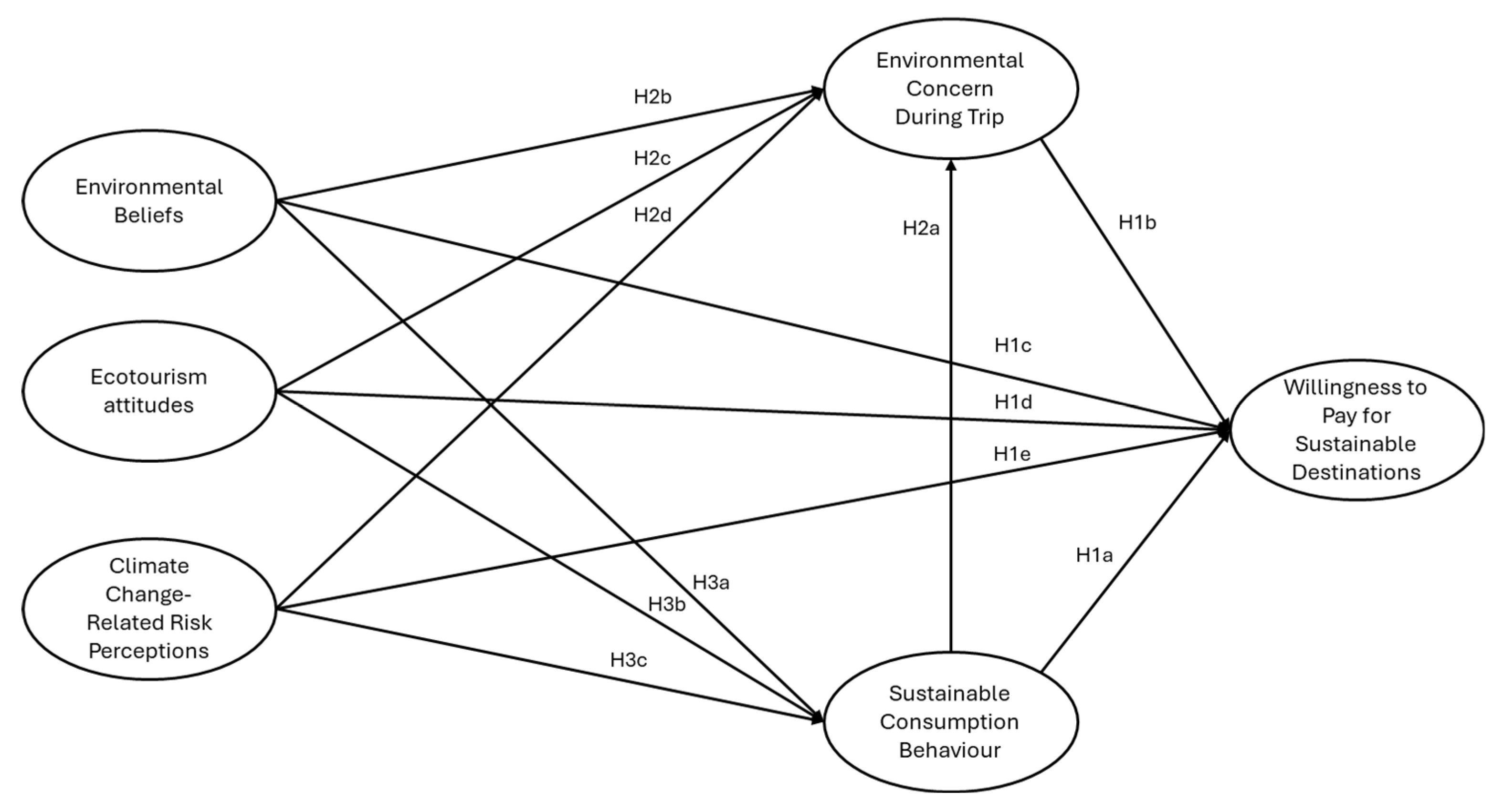
Figure 2.
Structural model.
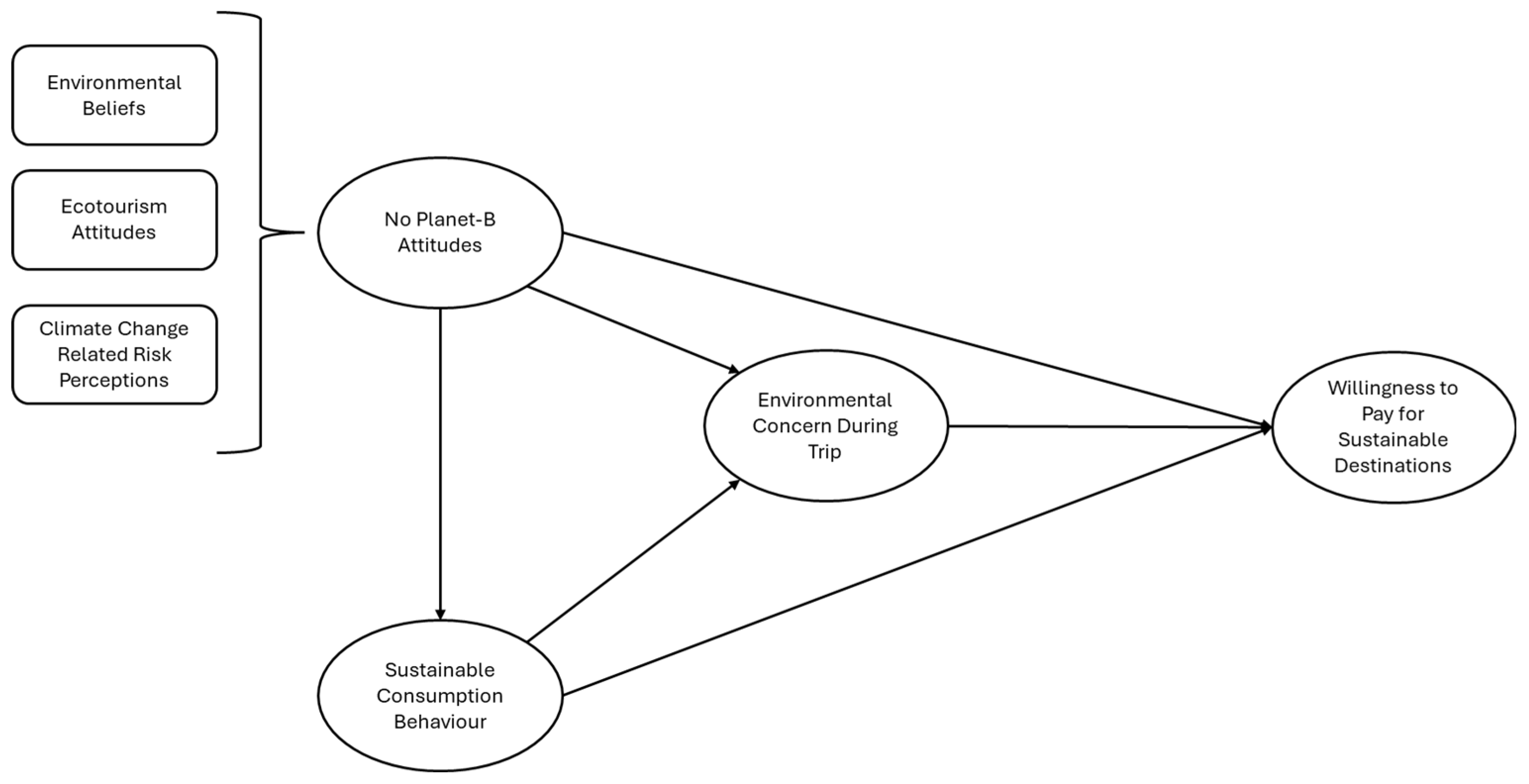

Table 1.
Sample Characterization.
| N (1545) | n | % |
|---|---|---|
| Gender | ||
| Female | 571 | 37,0 |
| Male | 970 | 62,8 |
| Other/preferred not to say | 4 | ,3 |
| Country of residence | ||
| Spain | 1313 | 85,0 |
| Portugal | 232 | 15,0 |
| Age | ||
| 18 to 24 years | 847 | 54,8 |
| 25 to 34 years | 157 | 10,2 |
| 35 to 44 years | 168 | 10,9 |
| 45 to 54 years | 241 | 15,6 |
| 55 to 64 years | 114 | 7,4 |
| 65 years or more | 18 | 1,2 |
| Formal education | ||
| University degree | 734 | 47,5 |
| Secondary school | 575 | 37,2 |
| Masters’ degree or PhD | 157 | 10,2 |
| Primary school | 70 | 4,5 |
| No formal education | 9 | ,6 |
| Monthly family income | ||
| Up to 1,000€ | 307 | 20,4 |
| 1000 to 1500€ | 370 | 24,6 |
| 1051€ to 2000€ | 288 | 19,1 |
| 2001€ to 2500€ | 201 | 13,3 |
| 2501€ to 3000€ | 143 | 9,5 |
| Over 3000€ | 198 | 13,1 |
Table 2.
Confirmatory Factor Analysis (CFA) results.
| Item | Standard Beta | SE | t-Value | p | ||
|---|---|---|---|---|---|---|
| No Planet-B Attitudes | → | Countries around the world should take action to address climate change. | .952 | |||
| → | Nature has great value which makes its conservation important for current and future generations. | .948 | .016 | 60.447 | *** | |
| → | Governments should take action on climate change. | .952 | .013 | 75.296 | *** | |
| → | Human activities are a major cause of climate change. | .928 | .018 | 51.955 | *** | |
| → | All citizens have a responsibility to act against climate change. | .908 | .020 | 47.875 | *** | |
| → | The balance of nature is very delicate and easily upset. | .874 | .021 | 41.875 | *** | |
| → | Plants and animals have as much right as humans to exist. | .884 | .021 | 43.532 | *** | |
| → | Humans are severely abusing the environment. | .829 | .024 | 35.996 | *** | |
| → | Nature has great value which makes its conservation important for current and future generations. | .833 | .024 | 36.594 | *** | |
| → | Sustainable tourism can enhance the personal development of visitors. | .832 | .023 | 36.466 | *** | |
| → | Climate change will harm me and my family. | .835 | .025 | 36.670 | *** | |
| → | When humans interfere with nature, it often produces disastrous consequences. | .710 | .029 | 25.942 | *** | |
| → | Sustainable tourism must avoid interfering with local habitat, flora and fauna. | .760 | .029 | 29.594 | *** | |
| → | The role of sustainable destination management goes beyond the economic function. | .750 | .027 | 28.826 | *** | |
| → | I am willing to sacrifice some of my comfort in order to stop climate change (e.g., by using more public transport, using less water, electricity and gas). | .844 | .023 | 37.756 | *** | |
| → | Sustainable tourism destinations must restrict the volume of visitors to preserve their cultural identity. | .659 | .032 | 22.823 | *** | |
| Environmental concern during trip | → | The environmental impact of the main means of transport and mobility at the destination. | .921 | |||
| → | The environmental impact of trip’s duration. | .846 | .029 | 32.938 | *** | |
| → | The environmental impact of the activities to be carried out (outings, visits, shows, etc.). | .888 | .026 | 36.077 | *** | |
| → | The accommodation has a label showing its environmental friendliness. | .858 | .028 | 34.263 | *** | |
| → | Plan departure times to reduce their environmental impact (e.g., by avoiding traffic jams, etc.). | .821 | .030 | 30.332 | *** | |
| Sustainable Consumption Behaviour | → | I give preference to products from organisations that pay their employees fairly. | .934 | |||
| → | I give preference to products from organisations that offer good conditions to their workers. | .953 | .019 | 52.571 | *** | |
| → | I give preference to organisations that care about working conditions throughout their supply chain. | .944 | .019 | 51.391 | *** | |
| → | I give preference to products that have a lower environmental impact. | .863 | .024 | 37.729 | *** | |
| Willingness to pay for Sustainable Destinations | → | I am willing to pay more to visit a destination that adopts sustainable practices. | .954 | |||
| → | I am willing to pay more for tourism services (hotels, restaurants, tours, etc.) in destinations that adopt sustainable practices. | .873 | .023 | 40.935 | *** | |
| → | I am willing to pay more to visit a destination that is more environmentally friendly. | .949 | .018 | 54.729 | *** | |
| Constructs’ convergent validity and reliability | CA | CR | MaxR(H) | AVE | ||
| No Planet-B Attitudes | .974 | 0.976 | 0.983 | 0.722 | ||
| Environmental concern during trip | .945 | 0.939 | 0.944 | 0.756 | ||
| Sustainable Consumption Behaviour | .951 | 0.976 | 0.965 | 0.957 | ||
| Willingness to pay for Sustainable Destinations | .948 | 0.947 | 0.957 | 0.947 | ||
| Model fit statistics: | X2/df=2.836; GFI=.905; NFI=.966; AGFI=.882; RMSEA=.053 | |||||
*** Significant at the 0.001 level (two-tailed).
Table 3.
This is a table.
| AVE | MSV | ASV | 1 | 2 | 3 | 4 | |
|---|---|---|---|---|---|---|---|
| 1. Sustainable Consumption Behaviour | 0,849 | 0,561 | 0,447 | 0,921a | |||
| 2. No Planet-B Attitudes | 0,722 | 0,578 | 0,439 | 0,749 | 0,850 a | ||
| 3. Environmental Concern During Trip | 0,756 | 0,258 | 0,228 | 0,508 | 0,423 | 0,870 a | |
| 4. Willingness to pay for Sustainable Destinations | 0,858 | 0,578 | 0,449 | 0,722 | 0,760 | 0,498 | 0,926 a |
Table 4.
Structural Equations Modelling (SEM) results.
| Std. Beta | SE | t | p | R2 | |||
|---|---|---|---|---|---|---|---|
| No Planet-B Attitudes | → | Sustainable Consumption Behaviour | .740 | .028 | 26.735 | *** | .547 |
| No Planet-B Attitudes | → | Environmental Concern During Trip | .122 | .055 | 2.492 | .013 | .297 |
| Sustainable Consumption Behaviour | → | Environmental Concern During Trip | .449 | .055 | 9.021 | *** | |
| No Planet-B Attitudes | → | Willingness to pay for Sustainable Destinations | .425 | .038 | 11.539 | *** | .609 |
| Sustainable Consumption Behaviour | → | Willingness to pay for Sustainable Destinations | .361 | .041 | 9.149 | *** | |
| Environmental concern during trip | → | Willingness to pay for Sustainable Destinations | .082 | .028 | 2.750 | .006 | |
| Model fit statistics: X2/df = 2.2856; GFI = .923; NFI = .970; AGFI = 900; RMSEA = .050 | |||||||
Table 5.
Summary of hypotheses testing.
| H1a | Willingness to pay for Sustainable Destinations is positively affected by Sustainable Consumption Behaviour. | Supported |
| H1b | Willingness to pay for Sustainable Destinations is positively affected by Environmental Concern During Trip. | Supported |
| H1c | Willingness to pay for Sustainable Destinations is positively affected by Environmental beliefs. | Supported |
| H1d | Willingness to pay for Sustainable Destinations is positively affected by Ecotourism Attitudes. | Supported |
| H1e | Willingness to pay for Sustainable Destinations is positively affected by Climate change-related risk perceptions. | Supported |
| H2a | Environmental Concern During Trip is positively affected by Sustainable Consumption Behaviour | Supported |
| H2b | Environmental Concern during trip is positively affected by Environmental Beliefs. | Supported |
| H2c | Environmental Concern During Trip is positively affected by Ecotourism Attitudes. | Supported |
| H2d | Environmental Concern During Trip is positively affected by Climate change-related risk perceptions. | Supported |
| H3a | Sustainable Consumption Behaviour is positively affected by Environmental Beliefs. | Supported |
| H3b | Sustainable Consumption Behaviour Destinations is positively affected by Ecotourism Attitudes. | Supported |
| H3c | Sustainable Consumption Behaviour is positively affected by Climate change-related risk perceptions. | Supported |
Table 6.
Summary of hypotheses testing.
| Effects on Sustainable Consumption Behaviour | Direct | Indirect | Total |
| No Planet-B Attitudes | .740 | - | .740 |
| Effects on Environmental Concern During Trip | Direct | Indirect | Total |
| No Planet-B Attitudes | .122 | .332 | .507 |
| Sustainable Consumption Behaviour | .449 | - | .449 |
| Effects on Willingness to pay for Sustainable Destinations | Direct | Indirect | Total |
| No Planet-B Attitudes | .425 | .304 | .730 |
| Sustainable Consumption Behaviour | .361 | .037 | .398 |
| Environmental Concern During Trip | .082 | - | .082 |
Disclaimer/Publisher’s Note: The statements, opinions and data contained in all publications are solely those of the individual author(s) and contributor(s) and not of MDPI and/or the editor(s). MDPI and/or the editor(s) disclaim responsibility for any injury to people or property resulting from any ideas, methods, instructions or products referred to in the content. |
© 2024 by the authors. Licensee MDPI, Basel, Switzerland. This article is an open access article distributed under the terms and conditions of the Creative Commons Attribution (CC BY) license (http://creativecommons.org/licenses/by/4.0/).
Copyright: This open access article is published under a Creative Commons CC BY 4.0 license, which permit the free download, distribution, and reuse, provided that the author and preprint are cited in any reuse.


