
Submitted:
24 May 2023
Posted:
25 May 2023
You are already at the latest version
Abstract
Fires are the leading cause of death, serious injury and property damage. In the past, schools, temples and government offices had more frequent fires than they should. Statistics showed that the number of fires between 2017 to 2022 amounted 13,593 cases which mostly occurred in the school, temple and government offices (40.0% of all buildings). Moreover, it causes more damage among disabled especially the blinds who has a limited vision. Therefore, this cross-sectional purpose of this study was to assess fire risk including management model in school for the blind. The fire checklists, brainstorming and Analytic Hierarchy Process (AHP) were applied to estimate the fire risk in school for the blind building. The findings revealed an inherent fire hazard factors with a risk score equal to 3.2830 and evacuation factors with a risk score equal to 3.3178 were acceptable risk except the fire control factors with a risk score equal to 1.4320 was unacceptable risk may cause an impact on life, health, property and public communities. Eventually, efforts should be made to supervise those risk factors by designing suitable activities to reduce undesirable conditions in school for the blind.
Keywords:
fire probabilistic risk
; fire safety factor
; fire checklist
; analytic hierarchy process
1. Introduction
Fires in Thailand tend to happen more frequently and severely mainly because of unsafe acts and unsafe conditions. For megacity with a high permanent and temporary population like Bangkok, fire management becomes more crucial. Fires may cause many injuries and casualties as well as damage to property and assets, let alone harm to the overall economic system. Department of Disaster Prevention and Mitigation, Ministry of Interior of Thailand [1], as the administrative body responsible for the city, undertakes the mission to protect population from public disasters and make life safer, report the number of fires between 2017 to 2022 amounted 13,593 cases which mainly occurred in the school, temple and government offices (40% of all buildings). Moreover, it causes more damage among disabled especially the blinds who has a limited vision.
Previous studies in the fire probabilistic risk assessment sector has predicted the risk status in the building where has the occupants to able the fire evacuation when fire occurred such as Prashant A/L Tharmarajan [2] studied on the essential aspects of fire safety management in high-rise buildings, John A. Moore and M. Phil [3] conducted a study on the assessment of fire safety and evacuation assessment in nursing home, Yeung Cho Hung [4] was to study on fire safety management of public rental housing in Hong Kong, Tanima Abdul Wahed [5] was to focus on impact of facility management on fire safety crisis in industry. There is also a study by Ayyappa Thejus Mohan [6] focused on risk acceptance in fire safety engineering. All above research focused on the fire probabilistic risk assessment and management in different buildings but there is no focus on a new tool used for calculating the level of risk. It obviously can be seen that there is still a lack of reliable assessment tool for fire safety. This is an important thing to ensure the safety of occupants in the building especially blind people who have limited vision. Assessing the fire risk is important in occupational health and safety. Therefore, this study aimed to assess fire risk including management model in school for the blind building including applying fire probabilistic risk assessment technique using the checklist method, which is a hazard identification technique used to reduce failure by compensating for potential limits of human memory and attention. It helps to ensure consistency and completeness in carrying out a task. This technique examines fire hazards according to laws and standards and therefore appropriate and consistent with the task of applying it for risk assessment as compared to other techniques. However, the checklist has limitations in determining the probability of the event, which sometimes some fire safety factors are unable to determine these values. Therefore, it is necessary to apply other techniques to determine the probability of events. The Analytic Hierarchy Process (AHP) proposed by Thomas Saaty [7] is a versatile tool for dealing with complex decision-making problems. It is a hierarchical structure of goals, objectives, main criteria, sub-criteria, and alternative. The AHP assists deciders look for one the best matches for their goal by eliminating biased decision. It provides an extensive and methodical structure for construction a decision issue, for illustrating and estimating its elements, for implicating those elements to overall goals, and for assessing alternative solutions. This study eventually has applied an AHP to determine the relative weight of each fire hazard factors from checklist and to determine the probabilistic risk of fire. It also proposed measures for managing the fire risk in school for the blind building.
2. Materials and Methods
2.1. Study design and setting
A cross-sectional study was conducted between June and December 2022 in school for the blind building in Bangkok, Thailand. The study area was a classroom of a blind school building according to the Building Act, B.E. 2522 of Thailand. This classroom is ventilated air natural. There are three stories layer, 79.5 m. long, 16 m. wide and 3 m. high as shown in Figure 1. In this study, the classroom was selected by considering the prioritization of fire safety problems, namely attention to problem of staffs, attention of management to problem solving and problem size.
2.2. Instrument development
An instrument for data collection consisted of checklist and using Expert Choice Version 11 in computing the relative weight from an AHP structure and to determine the risk of fire in school for the blind building.
Expert Choice software for cooperative decision-making solution that is based on multi-criteria decision making. This software helps organizations make better decisions and manage risk with speed, transparency and alignment. Expert Choice implements the AHP [8] and has been used in fields such as manufacturing, [9] environmental management, [10,11] shipbuilding [12] and agriculture [13]. This collaboration software was created by Thomas Saaty and Ernest Forman in 1983 [14] and supplied by Expert Choice Corporation. This research used this tool to compute the relative weight by brainstorming from the checklist. The AHP provided a structural framework as shown in Figure 2 for setting priorities on each level of the hierarchy using pairwise comparisons that were quantified using 1-9 scale in Table 1. The pairwise comparisons between the m decision criteria can be conducted by asking fire safety experts’ questions. The answers to those questions of m×m pairwise comparison matrix was stated as follows in Equation (1).
where aij denoted a numerical judgment on wi/wj with aii =1 and aij =1/aji for i,j=1, … ,m. On condition that the pairwise comparison matrix A= (aij)m×m fulfilled aij =aik akj for any i,j,k=1, … ,m, afterwards A is said to be magnificently consistent; differently it was said to be inconsistent. The pairwise comparison matrix A, the weight vector W can be computed by solving as follows in Equation (2).
where λmax is the maximum eigenvalue of A. The answers from experts may be incompetent to contribute ideally accordant pairwise comparisons, it was dictated that the pairwise comparison matrix A must be an acceptable consistency, which can be examined by the following consistency ratio (C.R.), as expressed in Equation (3).
where RI is a random inconsistency index, those values were deviated with the order of pairwise comparison matrix. The RI values for the pairwise comparison matrices with the order from 1 to 10 was shown in Table 2. Whether or not C.R.≤0.1, the pairwise comparison matrix was considered to have an acceptable consistency; on the other hand, it must be corrected.
AW = λmaxW
Decision alternatives can be considered pairwise with regard to each decision criterion. After the weights of decision criteria and the weights of decision alternatives were achieved by using pairwise comparison matrices, the overall weight of each decision alternative with regard to the decision goal can be produced by following addition weighting method [7], as expressed in Equation (4).
where wj (j=1,...,m) are the weights of decision criteria, wij (i=1, … ,n) are the weights of decision alternatives with regard to criterion j, and wAi (i=1, … ,n) are the overall weights of decision alternatives. The best decision alternative is the one that has the greatest overall weight relative to the decision goal.
Expert Choice implemented the AHP was used for computing the relative weight instead of calculating by hand according to Equations (1) to (4).
2.3. Order of operations steps
There were three different stages of the research process. The purpose of the first stage was to identify the fire risk using the fire checklist. This contextual information was then used in the second stage of the research for fire probabilistic risk assessment using analytic hierarchy process and brainstorming for obtaining the weight of each factors. Last stage, the results were finally compiled the fire risk scores into a decision for conducting the fire management model to solve the problems in order to reduce the fire risk in school for the blind building. An order of operation steps was shown in Figure 3.
First stage: exploratory the primary and secondary data for design the fire checklist. Exploratory the primary and secondary data including review the legal and other requirements of fire for design the fire checklist. This fire checklist was then taken to give the fire experts. The fire checklist was used to collect data for identifying the hazard in school for the blind building.
Second stage: fire probabilistic risk assessment. Quantifying the risk of the common tasks with consideration of probability and relative weight of fire safety factors. Fire probabilistic risk assessment using the brainstorming and analytic hierarchy process for obtaining the weight of each factors in the fire checklist.
Third stage: fire probabilistic risk scores into a decision for conducting the fire mitigation. The results from the stage of quantification of fire probabilistic risk assessment were compiled the fire risk scores to compared with risk standard. Finally, unacceptable risk has to conduct the fire mitigation to solve the problems in order to reduce the fire risk in school for the blind building.
Fire probabilistic risk assessment in school for the blind building can be calculated in the Equation 5. The results of fire probabilistic risk assessment were shown in the Table 3, Table 4 and Table 5.
R = Fire probabilistic risk score
n = The number of fire probabilistic risk assessment index
Wci = Weight of fire probabilistic risk assessment indicator i, the range is 0 to 1
Pci = Score of fire probabilistic risk assessment indicator i, the value is an integer between is 1 to 5.
The fire risk score was considered in two elements. Namely, the assessment grade scores were based on brainstorming and with meaning that the probability level was remote possibility (Score=5), possible but not possibility (Score=4), moderately possibility (Score=3), important possibility (Score=2), and most possibility (Score=1), respectively. The scores of fire probabilistic risk assessment were shown in Table 3 and relative weights of fire probabilistic risk assessment indicator were obtained from the calculation by Expert Choice V.11. The probabilistic risk assessment was performed in Equation (5) and unacceptable risk level (score less than 2.5) requires further mitigation measures.
3. Results
Assessment the scores were based on brainstorming from fire experts. Expert Choice V.11 implemented the AHP for computing the relative weight each fire safety factors. The results were shown in Figure 4, Figure 5 and Figure 6 and Table 4, Table 5 and Table 6.
Figure 4.
Pairwise comparisons of an inherent fire hazard factors: (a) Pairwise comparisons in Expert Choice V.11 program.; (b) Relative weight calculation using Expert Choice V.11 program.
Figure 4.
Pairwise comparisons of an inherent fire hazard factors: (a) Pairwise comparisons in Expert Choice V.11 program.; (b) Relative weight calculation using Expert Choice V.11 program.
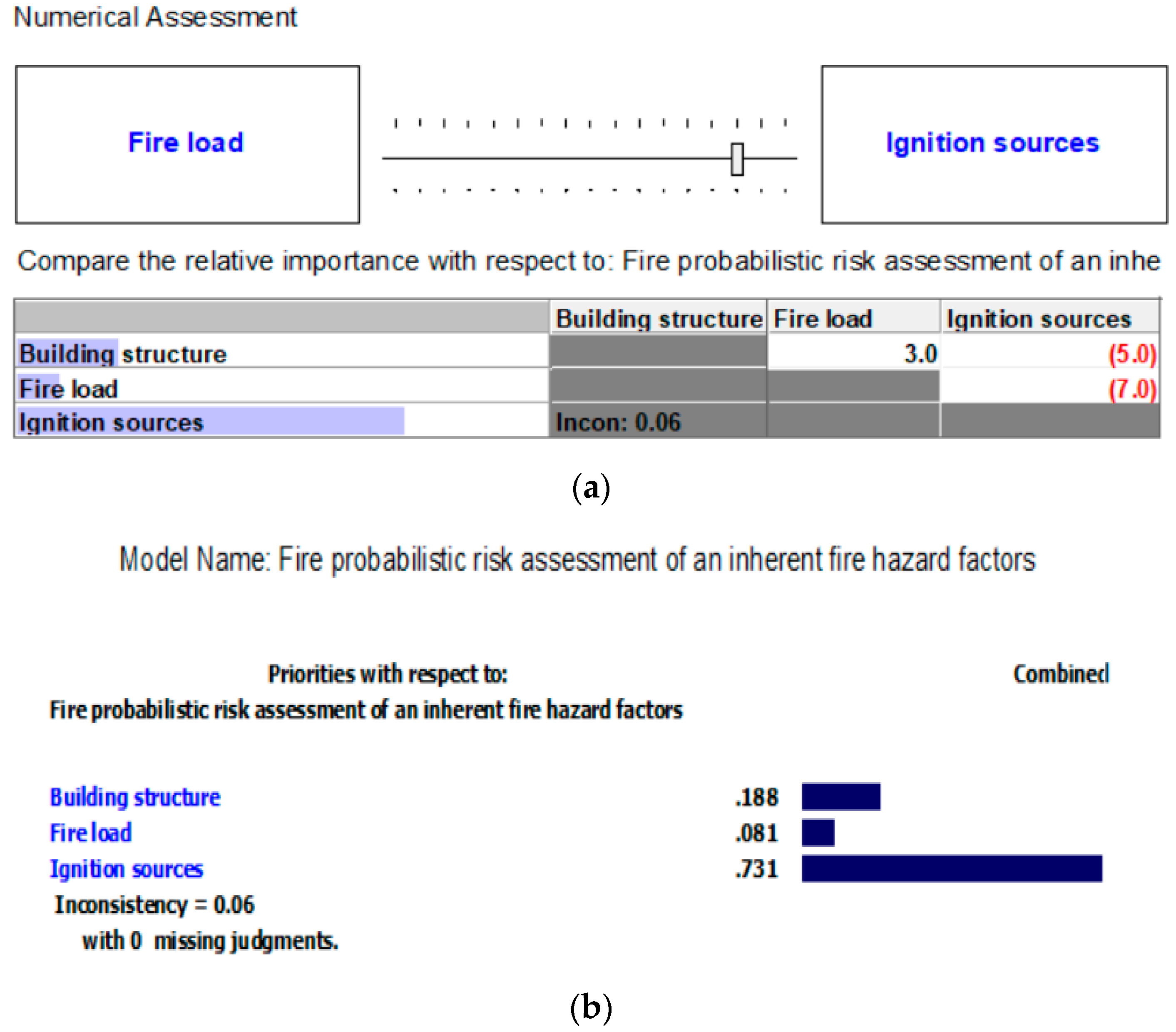
Figure 5.
Pairwise comparisons of fire control factors: (a) Pairwise comparisons in Expert Choice V.11 program.; (b) Relative weight calculation using Expert Choice V.11 program.
Figure 5.
Pairwise comparisons of fire control factors: (a) Pairwise comparisons in Expert Choice V.11 program.; (b) Relative weight calculation using Expert Choice V.11 program.
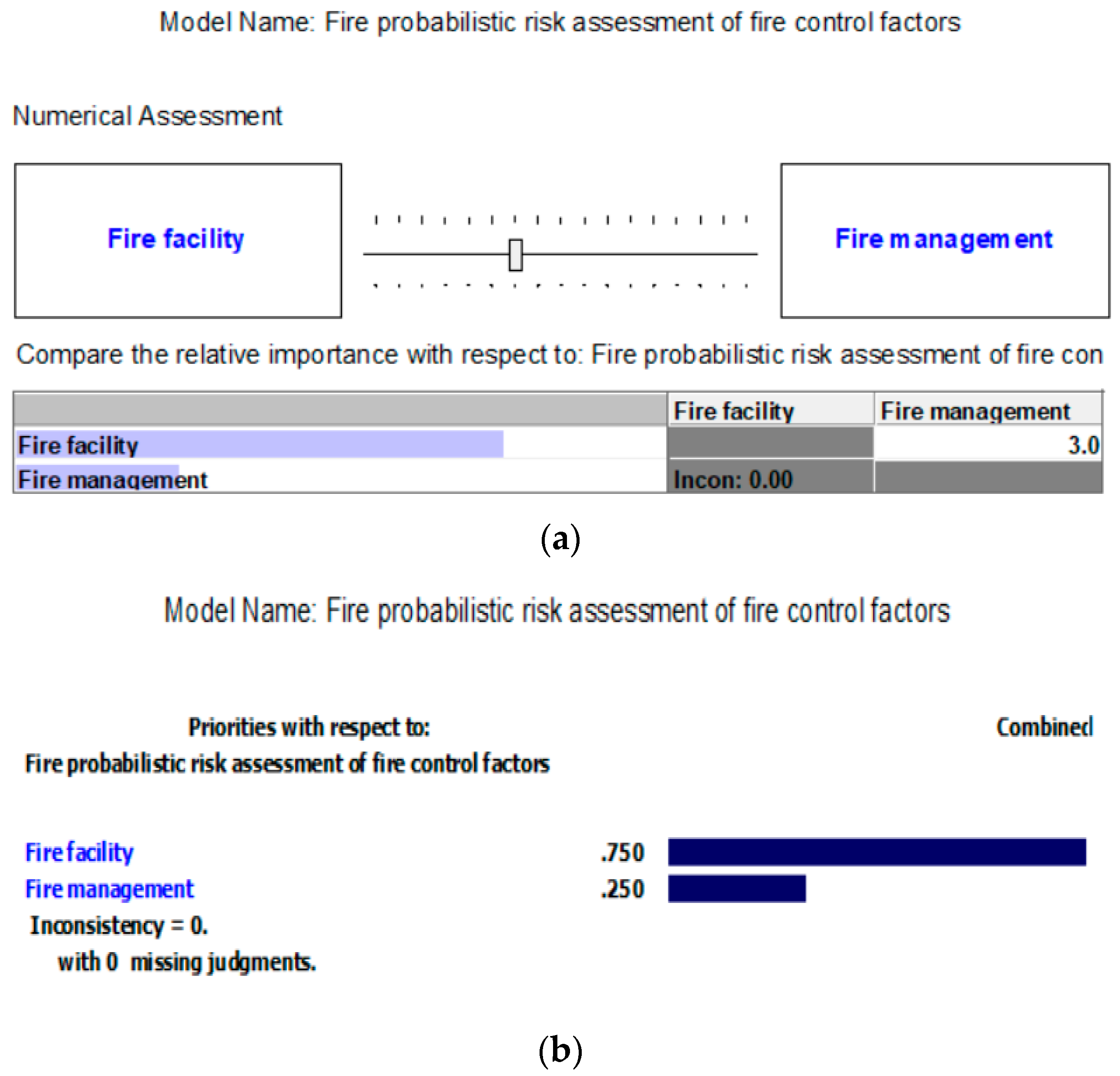
Figure 6.
Pairwise comparisons of evacuation factors: (a) Pairwise comparisons in Expert Choice V.11 program.; (b) Relative weight calculation using Expert Choice V.11 program.
Figure 6.
Pairwise comparisons of evacuation factors: (a) Pairwise comparisons in Expert Choice V.11 program.; (b) Relative weight calculation using Expert Choice V.11 program.
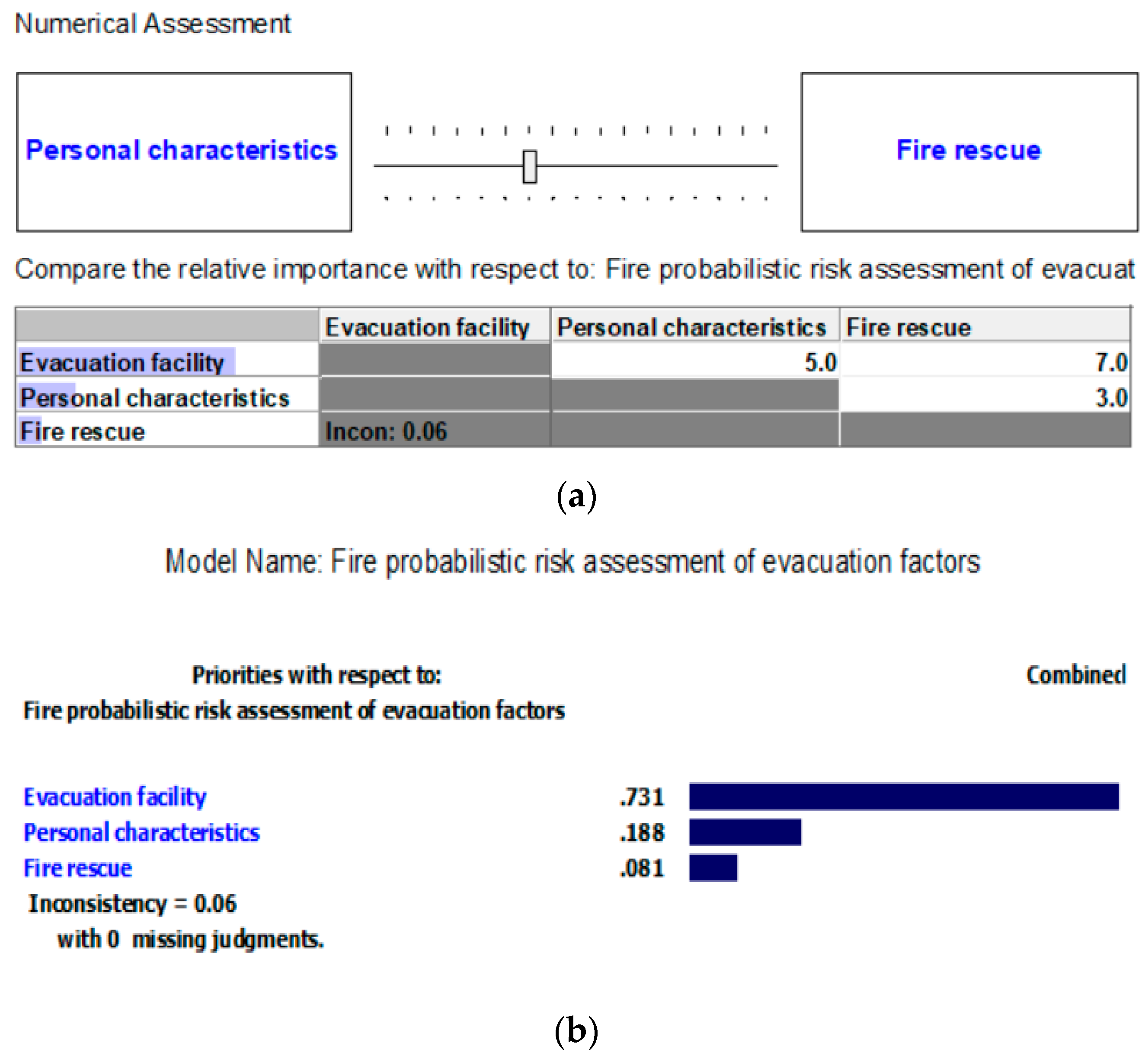

Table 4.
Fire probabilistic risk assessment of an inherent fire hazard factors.
| Criteria | Inherent fire hazard factors |
Grade assessment (A) |
Weighting attribute (B) |
Score attribute (A x B) |
|---|---|---|---|---|
| Building structure | ||||
| 1 | Height of the blind school building | 4 |
0.0625 |
0.2500 |
| 2 | Multilayer | 4 | 0.1375 | 0.5500 |
| 3 | Fire resistance rating | 3 | 0.3250 | 0.9750 |
| 4 | Hazard classification | 1 | 0.4750 | 0.4750 |
| Sum of A x B | (C) | 2.2500 | ||
| Relative weight of building structure | (D) | 0.1880 | ||
| Building structure scores | (C) x (D) | 0.4230 | ||
| Fire load | ||||
| 1 | Location area | 3 | 0.1700 | 0.5100 |
| 2 | Interior decoration | 3 | 0.8300 | 2.4900 |
| Sum of A x B | (C) | 3.0000 | ||
| Relative weight of fire load | (D) | 0.0810 | ||
| Fire load scores | (C) x (D) | 0.2430 | ||
| Ignition sources | ||||
| 1 | Electrical equipment | 3 | 0.6330 | 1.8990 |
| 2 | Type of combustible gas supply | 3 | 0.1070 |
0.3210 |
| 3 | External fire | 5 | 0.6330 | 1.3600 |
| Sum of A x B | (C) | 3.5800 | ||
| Relative weight of ignition sources | (D) | 0.7310 | ||
| Ignition sources scores | (C) x (D) | 2.6170 | ||
| Building structure scores + Fire load scores + Ignition sources scores | 3.2830 | |||
Table 5.
Fire probabilistic risk assessment of fire control factors.
| Criteria | Fire control factors | Grade assessment (A) |
Weighting attribute (B) |
Score attribute (A x B) |
|---|---|---|---|---|
| Fire facility | ||||
| 1 | Fire alarm and fire control linkage system | 1 | 0.3520 | 0.3520 |
| 2 | Portable fire extinguisher | 3 | 0.2020 | 0.6060 |
| 3 | Floor plan | 1 | 0.0930 | 0.0930 |
| 4 | Safety sign | 1 | 0.1780 | 0.1780 |
| 5 | Emergency lighting | 1 | 0.1320 | 0.1320 |
| 6 | Lightning protection system | 5 | 0.0430 | 0.2150 |
| Sum of A x B | (C) | 1.5760 | ||
| Relative weight of fire facility | (D) | 0.7500 | ||
| Fire facility scores | (C) x (D) | 1.1820 | ||
| Fire management | ||||
| 1 | Fire safety inspection | 1 | 0.5400 | 0.5400 |
| 2 | Basic fire fighting | 1 | 0.2300 | 0.2300 |
| 3 | Fire drill | 1 | 0.0725 | 0.0725 |
| 4 | Fire emergency plan | 1 | 0.1575 | 0.1575 |
| Sum of A x B | (C) | 1.0000 | ||
| Relative weight of fire management | (D) | 0.2500 | ||
| Fire management scores | (C) x (D) | 0.2500 | ||
| Fire facility scores + Fire management scores | 1.4320 | |||
Table 6.
Fire probabilistic risk assessment of evacuation factors.
| Criteria | Evacuation factors | Grade assessment (A) |
Weighting attribute (B) |
Score attribute (A x B) |
|---|---|---|---|---|
| Evacuation facility | ||||
| 1 | Indoor fire exit stair | 5 | 0.1300 | 0.6500 |
| 2 | Fire exit door | 2 | 0.1040 | 0.2080 |
| 3 | Fire exit discharge | 1 | 0.0830 | 0.0830 |
| 4 | Emergency radio | 3 | 0.0390 | 0.1170 |
| 5 | Capacity of means of egress | 4 | 0.4540 | 1.8160 |
| 6 | Dead end corridors | 5 | 0.1630 | 0.1630 |
| 7 | Escape equipment | 1 | 0.0270 | 0.0270 |
| Sum of A x B | (C) | 3.0640 | ||
| Relative weight of evacuation facility | (D) | 0.7310 | ||
| Evacuation facility scores | (C) x (D) | 2.2398 | ||
| Personal characteristics | ||||
| 1 | Crowd density | 3 | 0.1400 | 0.4200 |
| 2 | Number of blind students per teacher | 5 | 0.2900 | 1.4500 |
| 3 | Degree of familiarity with building | 3 | 0.5700 | 1.7100 |
| Sum of A x B | (C) | 3.5800 | ||
| Relative weight of personal characteristics | (D) | 0.1880 | ||
| Personal characteristics scores | (C) x (D) | 0.6730 | ||
| Fire rescue | ||||
| 1 | Distance from fire brigade | 5 | 0.5730 | 2.865 |
| 2 | Distance from hospital | 5 | 0.1400 | 0.700 |
| 3 | First aid kit | 5 | 0.2870 | 1.435 |
| Sum of A x B | (C) | 5.000 | ||
| Relative weight of fire rescue | (D) | 0.081 | ||
| Fire rescue scores | (C) x (D) | 0.4050 | ||
| Evacuation facility + Personal characteristics + Fire rescue | 3.3178 | |||
All fire safety factors from Expert Choice V.11 showed the value of Consistency Ratio (C.R.) less than 0.1, the pairwise comparison matrix was assumed to have an acceptable consistency. The probabilistic risk of each fire safety factors was compared with the fire risk score in order to realize the risk status as shown in Table 7.
Inherent fire hazard and evacuation factors were acceptable risk (good level of risk status) except the fire control factors were unacceptable risk (worst level of risk status). The three factors of fire hazard risk scores were 3.2830, 3.3178 and 1.4320 respectively as shown in Figure 7. Therefore, the fire control factors were mitigated by the practical recommendations. The suggestions for reducing the fire risk included check and test all fire emergency protection and response equipment according to monthly preventive maintenance plan, design and installation of portable fire extinguisher as NFPA10 [15] standard, make a suitable new floor plan including safety sign for the blind, and most importantly fire drills and basic firefighting must be carried out according to fire emergency plans in order for the blind to learn how to survive in the event of a fire.
4. Discussion
Fires are the leading cause of death, serious injury and property damage. Moreover, it causes more damage among disabled especially the blinds who has a limited vision. Therefore, there is a need to assess the fire probabilistic risk in school for the blind building. Assessment the scores were based on brainstorming from fire experts. Expert Choice V.11 implemented the AHP for computing the relative weight each fire safety factors. Similarly, Ki-Chang Hyun et al. [16], Alberto Petruni et al. [17], Ali Kokangül, Ulviye Polat and Cansu Dağsuyu [18] and Maria Garbuzova-Schlifter and Reinhard Madlener [19] they were applied the AHP for calculating the relative weight for their decision goal. For this study applied an AHP to determine the relative weight of each fire safety factors from checklist and to determine the probabilistic risk in school for the blind building. This is the first application of AHP with fire checklist. No other research has been found to apply, but most of them would find applications of AHP to Fault Tree Analysis: FTA and Event Tree Analysis: ETA techniques. However, the reliability of the information has been conducted through extensive research and expert judgments to gain the relative weight of fire safety factors for assessing the fire probabilistic risk. As a result of the probability of occurrence is even more clearly defined without having to make sense of probabilistic risk assessment. In addition, Emre Akyuz, Ozcan Arslan, and Osman Turan [20] also applied the fuzzy logic to fault tree and event tree analysis of the risk for cargo liquefaction on board ship. This study is very similar to this one, but the technique used was simple to practice for the general public. Therefore, it is easy to assess the fire probabilistic risk. AHP technique is also suitable for the application. Finally, Meghann Valeo et al. [21], Abbas Bahrami et al. [22], and Mohammad Hossein Memary Nashalji, Abbas Bahrami, and Habibollah Rahimi [23] also found that checklist is a technique that can be applied for simple bridge security, occupational medicine status and performance of industrial occupational health experts respectively. This is similar to this study that has been applied checklist technique for assessing the fire probabilistic risk. However, there are differences between these studies: The implementation of AHP was used to make decisions for determining the relative weight for reducing bias assessments (subjective probability) including the scores of assessing the grade were obtained by brainstorming.
5. Conclusions
Assessing the fire risk of control is important in occupational health and safety, the results of the fire probabilistic risk assessment must be reliable. Consequently, this paper focused on conducting an AHP by Expert Choice V.11 for determining the relative weight from fire safety factors in order to estimate fire probabilistic risk in school for the blind building. As a result of the findings, school authorities (school director, deputy director of the school, staff, etc.) must set up a risk management plan or standard operating procedures. The procedures should include potential failures of measures to prevent fire hazards and actions to be conducted to prevent injury and death in order to efficiently address the risks that are likely to arise from routine operational procedures. Limitations of this study are based on the survey of only one school and brainstorming of fire expert for determining the grade assessment. Therefore, it may not represent the actual of the situation because of limited time and resources available. However, it represents the generalize facts.
In conclusion, this paper will help researchers and school administrator for decreasing potential risks during study in the school. The further studies may be extended with quantitative risk assessment and Fuzzy Analytic Hierarchy Process (FAHP) approach to manipulate uncertainty in a better way.
Author Contributions
Conceptualization, A.K. and R.P.; methodology, A.K.; software, R.P.; validation, A.K.; investigation, A.K.; data curation, R.P.; writing—original draft preparation, R.P.; writing—review and editing, A.K.; visualization, R.P.; supervision, A.K.; project administration, A.K. All authors have read and agreed to the published version of the manuscript.
Funding
This research received no external funding.
Institutional Review Board Statement
This study is reviewed and exempted by the Office of the Human Research Ethics Committee of Bangkok.
Informed Consent Statement
Not applicable.
Data Availability Statement
Data will be made available on request.
Acknowledgments
We thank the blind school that was the subject of this study, and it has not refrained from supporting the determination of assessing the fire probabilistic risk in our study. We also wish to thank the reviewers and editor in charge for their very constructive feedback.
Conflicts of Interest
The authors declare no conflict of interest.
References
- Fire Accident Reports during 2015-2022. 2022. Available online: http://www.disaster.go.th/ (accessed on 5 December 2022).
- Prashant A/L, T. The essential aspects of fire safety management in high-rise buildings; Universiti Teknologi Malaysia, Selangor Darul Ehsan, 2007.
- John, AM.; Phil, M. Assessment of fire safety and evacuation management in nursing homes; Dublin Institute of Technology, Dublin, 2012.
- Yeung, CH. ; A study on the fire safety management of public rental housing in Hong Kong; The City University of Hong Kong, Kowloon Tong, 2012.
- Tanima, AW. Impact of facility management on fire safety crisis in Bangladesh’s AEC industry; Metropolia University of Applied Sciences: Helsinki, 2018. [Google Scholar]
- Ayyappa, TM. Risk acceptance in fire safety engineering: Development of reference case studies; Ghent University,: Belgium, Ghent, 2019. [Google Scholar]
- Saaty, TL. How to make a decision: The analytic hierarchy process. European Journal of Occupational Research 1990, 48, 9–26. [Google Scholar] [CrossRef]
- Saaty, TL. The Analytic Hierarchy Process; Mc Graw Hill: New York, NY, USA, 1980; ISBN 978-0-070-54371-3. [Google Scholar]
- Chan, FTS.; Chan, HK. An AHP model for selection of suppliers in the fast-changing fashion market. The International Journal of Advanced Manufacturing Technology 2010, 51, 9–12.
- Najafi, A.; Afrazeh, A. Analysis of the environmental projects risk management success using Analytical Network Process Approach. International Journal of Environmental Research. 2011, 5, 277–284. [Google Scholar]
- Yatsalo, BI.; Kiker, GA.; Kim, J.; Bridges, TS.; Seager, TP.; Gardner, K.; et al. Application of multicriteria decision analysis tools to two contaminated sediment case Studies. Integrated Environmental Assessment and Management. 2007, 3, 223–233. [Google Scholar] [CrossRef] [PubMed]
- Saracoglu, BO. Selecting industrial investment locations in master plans of countries. European Journal of Industrial Engineering. 2013, 7, 416–441. [Google Scholar] [CrossRef]
- Pažek, K.; Rozman, Č.; Bavec, F.; Borec, A.; Bavec, M. A multi-criteria decision analysis framework tool for the selection of farm business models on organic mountain farms. Journal of Sustainable Agriculture. 2010, 34, 778–799. [Google Scholar] [CrossRef]
- French, S.; Xu, DL. Comparison study of multi-attribute decision analytic software. Journal of Multi-Criteria Decision Analysis. 2005, 13, 65–80. [Google Scholar] [CrossRef]
- NFPA. NFPA 10: Standard for Portable Fire Extinguishers; Massachusetts: NFPA, 2018; ISBN 978-1-455-91659-7. [Google Scholar]
- Hyun, KC.; Min, S.; Choi, H.; Park, J.; Lee, IM. Risk analysis using fault-tree analysis (FTA) and analytic hierarchy process (AHP) applicable to shield TBM tunnels. Tunnelling and Underground Space Technology. 2015, 49, 121–129. [Google Scholar] [CrossRef]
- Alberto, P.; Evanthia, G.; Ewan, D.; Jie, G.; Maria, CL. Applying analytic hierarchy process (AHP) to choose a human factors technique: Choosing the suitable human reliability analysis technique for the automotive industry. Safety Science. 2019, 119, 229–39. [Google Scholar]
- Ali, K.; Ulviye, P.; Cansu, D. A new approximation for risk assessment using the AHP and Fine Kinney methodologies. Safety Science. 2017, 91, 24–32. [Google Scholar]
- Maria, GS.; Reinhard, M. AHP-based risk analysis of energy performance contracting projects in Russia. Energy Policy. 2016, 97, 559–581. [Google Scholar]
- Emre, A.; Oacan, A.; Osman, T. Application of fuzzy logic to fault tree and event tree analysis of the risk for cargo liquefaction on board ship. Applied Ocean Research. 2020, 101, 1–10. [Google Scholar]
- Valeo, M.; Nassif, H.; Issa, L.; Harry Capers, Jr.; Ozbay, K. Analytic hierarchy process to improve simple bridge security checklist. Transportation Research Record Journal of the Transportation Research Board. 2012, 2313, 201–207. [Google Scholar] [CrossRef]
- Bahrami, B.; Ghorbani Pour, R.; Rahimi, H.; Memari Nashalji, M. Occupational medicine status of Kashan industries by weighted checklist to analytic hierarchy process method 2019. Occupational Hygiene and Health Promotion. 2021, 5, 200–207. [Google Scholar]
- Memari Nashalji, M.; Bahrami, B.; Rahimi, H. Weighting the checklist for evaluating the performance of industrial occupational health experts using the analytic hierarchy process. Health and Development Journal. 2020, 9, 254–262. [Google Scholar]
Figure 1.
School for the blind building floor plan: (a) The first-floor plan; (b) The second-floor plan; (c) The third-floor plan.
Figure 1.
School for the blind building floor plan: (a) The first-floor plan; (b) The second-floor plan; (c) The third-floor plan.
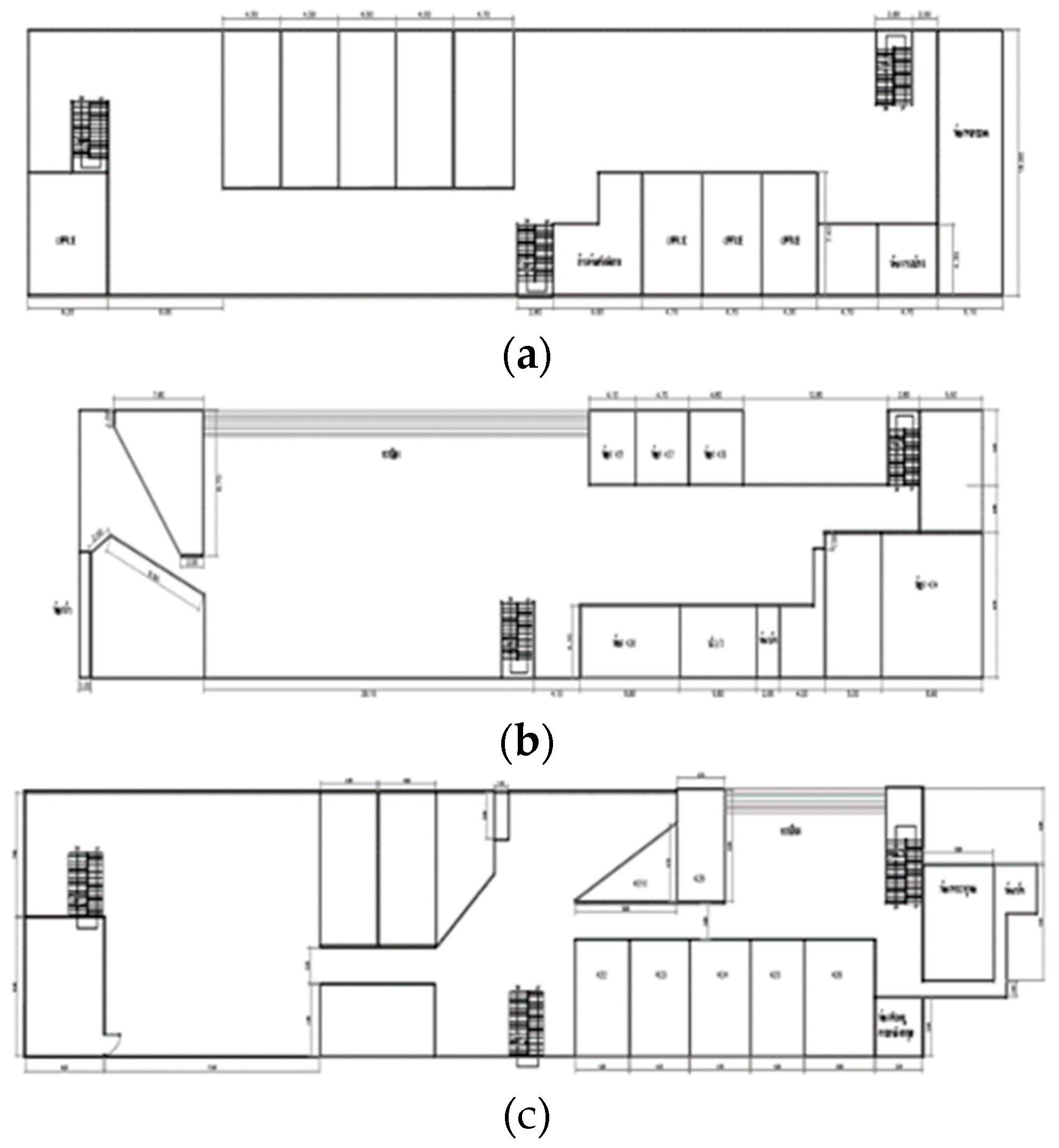
Figure 2.
A three-level decision hierarchy.
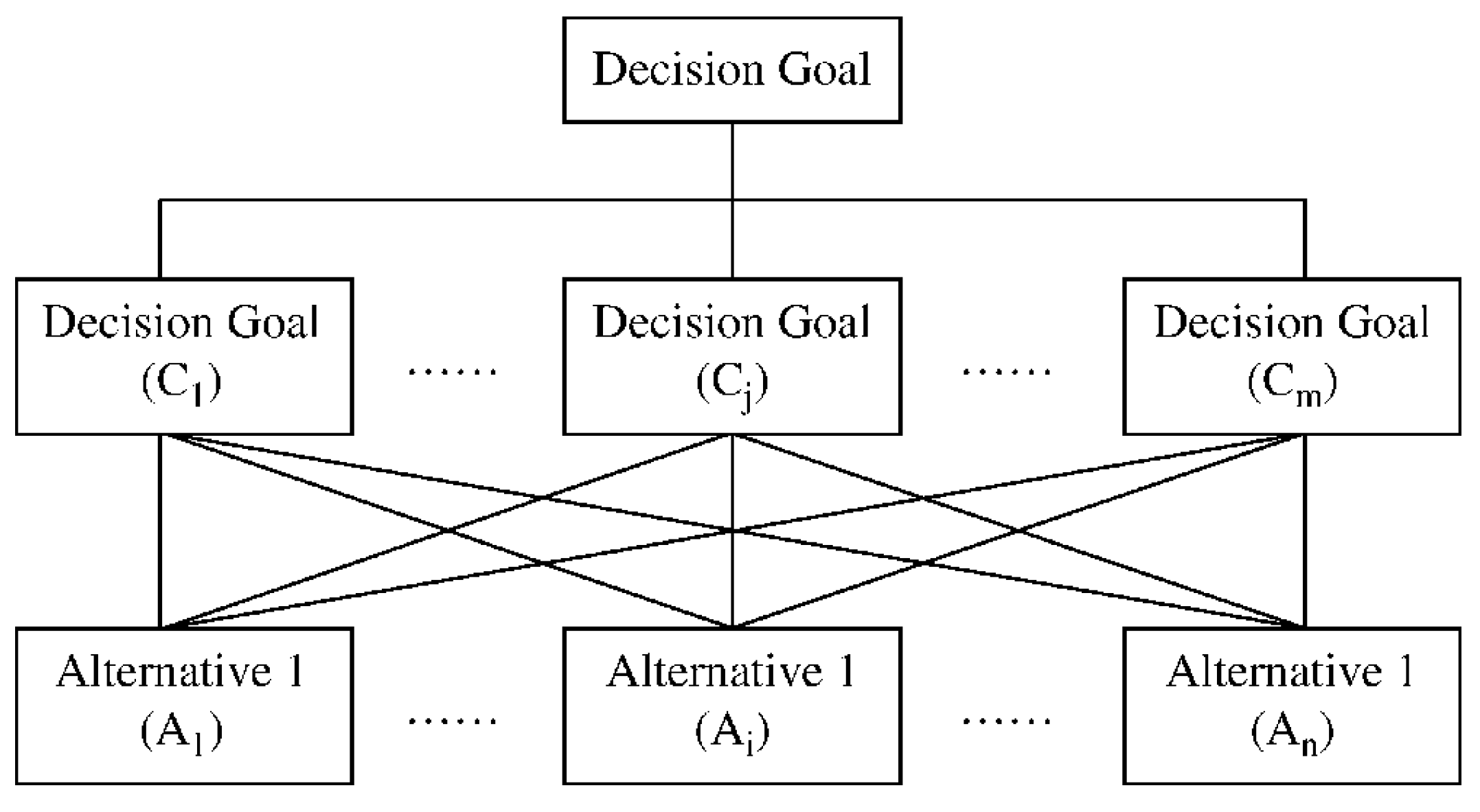
Figure 3.
Order of operation steps.
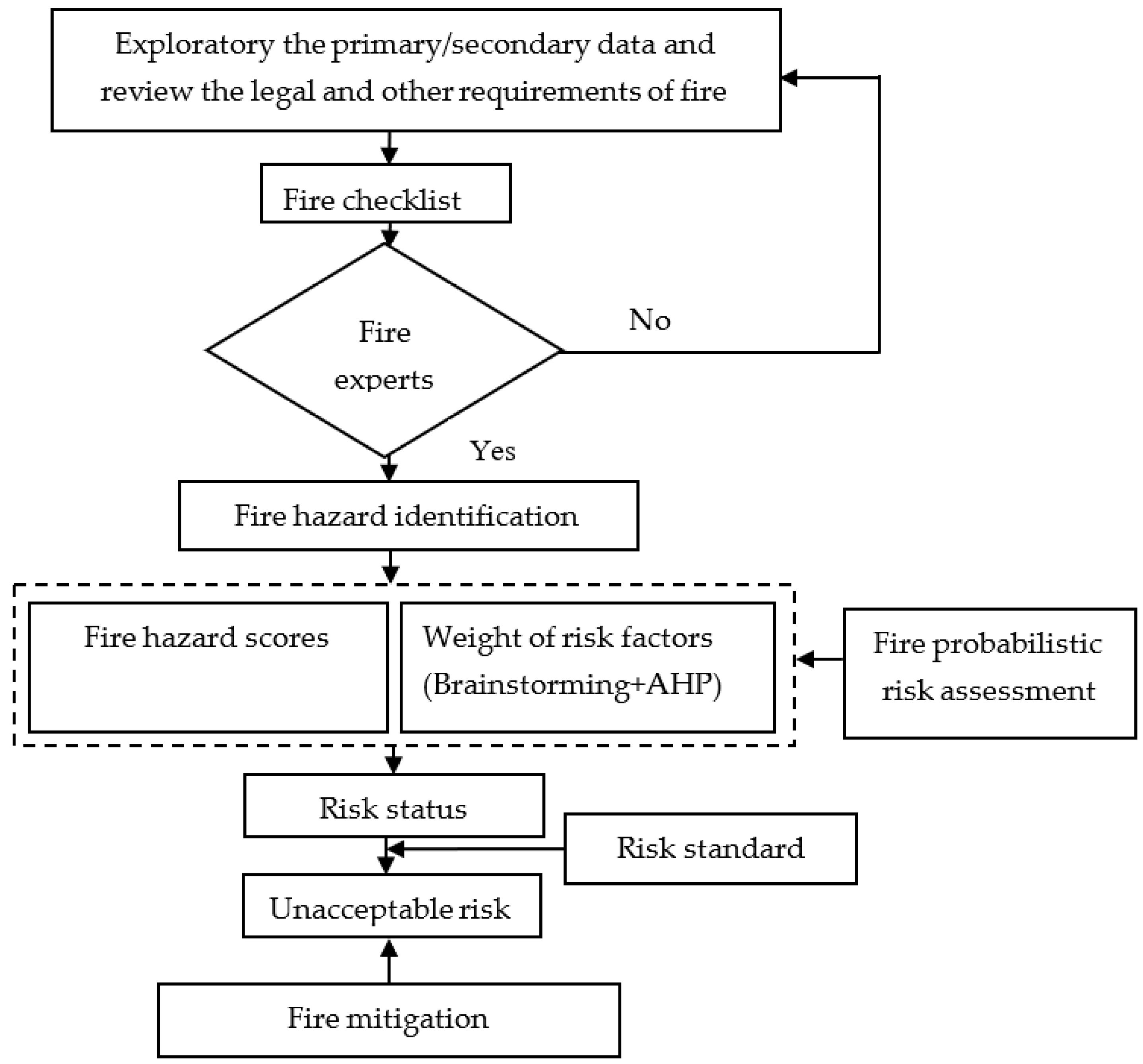
Figure 7.
Fire hazard risk scores.
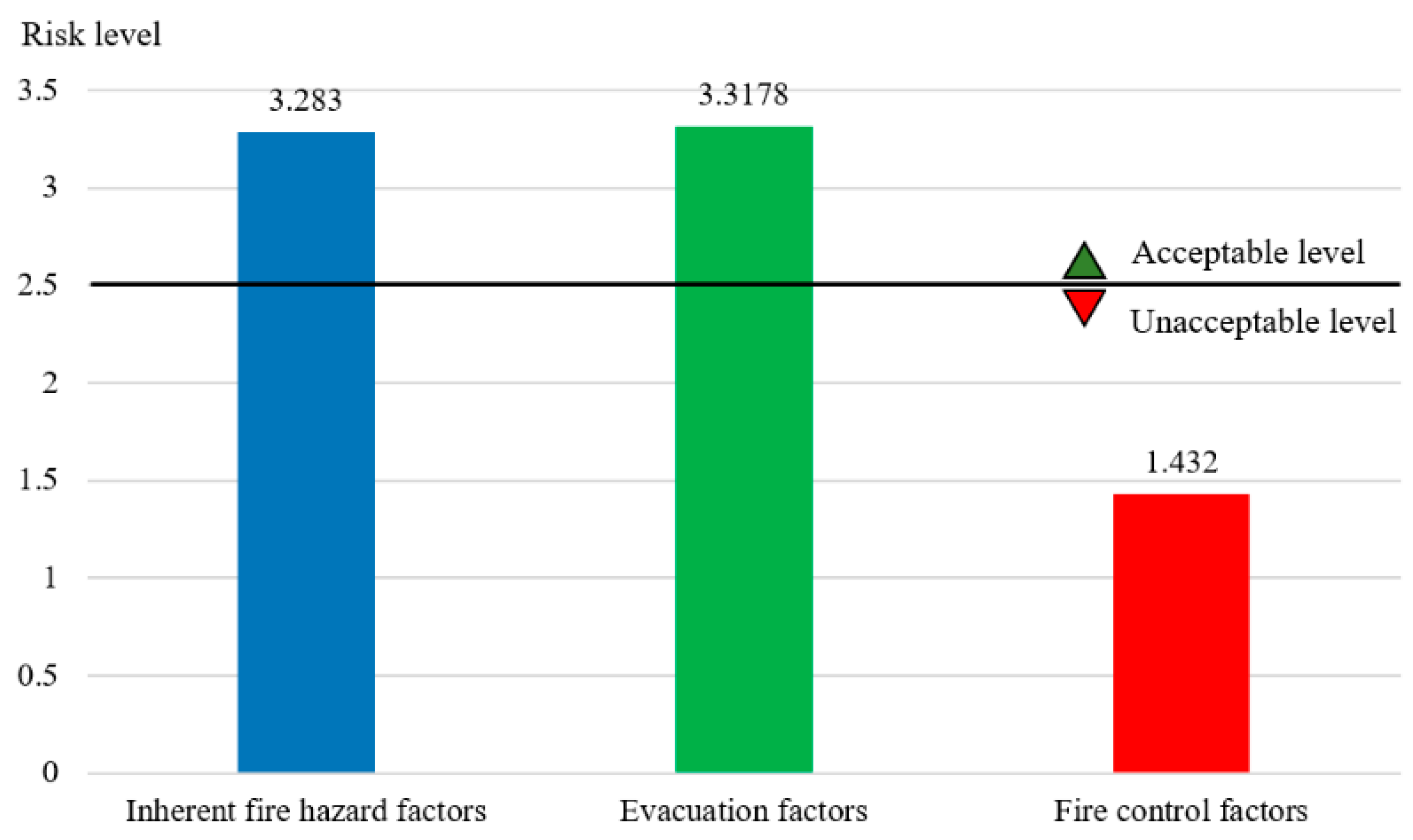
Table 1.
Numerical value pairwise comparison scale [7].
Table 1.
Numerical value pairwise comparison scale [7].
| Numerical rating | Description for risk factor evaluation |
|---|---|
| 1 | Equivalently |
| 2 | Equivalently to neutrally more |
| 3 | Neutrally more |
| 4 | Neutrally to greatly more |
| 5 | Greatly more |
| 6 | Greatly to very greatly more |
| 7 | Very greatly more |
| 8 | Very greatly to extremely more |
| 9 | Extremely more |
Table 2.
Random inconsistency index for pairwise comparison matrices [7].
Table 2.
Random inconsistency index for pairwise comparison matrices [7].
| Order (n) | Random inconsistency index (RI) |
|---|---|
| 1 | 0 |
| 2 | 0 |
| 3 | 0.58 |
| 4 | 0.90 |
| 5 | 1.12 |
| 6 | 1.24 |
| 7 | 1.32 |
| 8 | 1.41 |
| 9 | 1.45 |
| 10 | 1.49 |
Table 3.
The meaning and score of fire probabilistic risk [15].
Table 3.
The meaning and score of fire probabilistic risk [15].
| Score | Description |
|---|---|
| 1 | Remote possibility |
| 2 | Possible but not possibility |
| 3 | Moderately possibility |
| 4 | Important possibility |
| 5 | Most possibility |
Table 7.
Fire probabilistic risk score.
| Fire probabilistic risk score | 1≤R≤1.5 | 1.5<R≤2.5 | 2.5<R≤3.5 | 3.5<R≤4.5 | 4.5<R≤5 |
|---|---|---|---|---|---|
| Risk ranking | Class 1 | Class 2 | Class 3 | Class 4 | Class 5 |
| Risk status | worst | worse | good | better | best |
Disclaimer/Publisher’s Note: The statements, opinions and data contained in all publications are solely those of the individual author(s) and contributor(s) and not of MDPI and/or the editor(s). MDPI and/or the editor(s) disclaim responsibility for any injury to people or property resulting from any ideas, methods, instructions or products referred to in the content. |
© 2024 by the authors. Licensee MDPI, Basel, Switzerland. This article is an open access article distributed under the terms and conditions of the Creative Commons Attribution (CC BY) license (https://creativecommons.org/licenses/by/4.0/).
Copyright: This open access article is published under a Creative Commons CC BY 4.0 license, which permit the free download, distribution, and reuse, provided that the author and preprint are cited in any reuse.


