

Submitted:
03 June 2023
Posted:
05 June 2023
You are already at the latest version
Abstract
Understanding how the public perceives various risks and hazards associated with our well-being and health is crucial for government and policymakers. The present research aimed to assess the public's perception of various risks and hazards associated with their well-being and health. The study combined two well-known approaches to risk assessment, namely, the analytical hierarchical process (AHP) and the psychometric paradigm. Seven risk attributes were chosen from the risk perception literature to evaluate 27 risks and hazard activities using a survey questionnaire developed based on the psychometric paradigm literature. The collected data was then analyzed using AHP to determine the priority weight for each risk attribute. The results showed that the most important risk attribute was voluntariness of risk, followed by chronic-catastrophic and newness of risk. Furthermore, the study found that natural hazards were ranked the highest, followed by refugee influx and fire hazards. In contrast, the mobile phone was perceived as the lowest type of risk. The findings can be used by policymakers to develop effective and sustainable risk communication strategies. Policymakers can use the research findings to create effective and sustainable risk communication strategies that help the government to inform and educate the public about potential risks, improve coordination among agencies and stakeholders, and enhance public trust in government decision-making.
Keywords:
risk communication
; resilience
; psychometric paradigm
; analytical hierarchal process.
; risk perception
; natural hazards
1. Introduction
In recent years, the field of risk analysis has received growing attention from academics and practitioners. Researchers from various disciplinary backgrounds (e.g., management, psychology, engineering, environmental sciences, and statistics) have been investigating risk analysis from two main perspectives: risk assessment and risk management. Researchers within the risk assessment stream of research have focused on identifying and quantifying risks and hazards associated with induvial and organizational activities [1,2,3,4,5]. While the latter stream or research focused on the process of mitigating and communicating risks and decision-making under uncertainty [6,7,8,9,10]. A growing body of literature recognizes the critical role of risk communication in the success of risk management [6,7,11,12,13,14,15,16,17,18,19,20,21,22,23,24,25,26,27,28,29].
The World Health Organization (WHO) defines risk communication as exchanging real-time information, advice, and opinions between experts and individuals facing health, economic, or social threats. In order to have an effective and sustainably risk communication strategy, it is essential to deal with all the issues and problems related to the key components of the message, source, channel, and receiver. However, according to Vincent et al.’s research in [28], the most critical issues that policymakers need to address while designing and executing an effective risk communication strategy are related to the receiver component. This component includes individuals’ perception of risks and their ability to assess the risks’ severity accurately. Communication problems from the receiver side can often arise due to misconceptions, misinformation, or a lack of understanding of the risks involved. These factors can significantly impact the effectiveness of any risk communication strategy. Therefore, addressing these issues related to the receiver component is crucial to ensure that people receive accurate and reliable information on time, which can help them make informed decisions to protect themselves and their communities [6,28].
The way individuals perceive risks has a significant impact on the decisions they make. Disagreement about the best course of action often arises between experts and laypeople due to their differences in risk perception [5,30,31]. Studies have shown that both individual and group differences in risk perception are associated with how people perceive the relative risk of different options rather than with their general attitude towards risk or tendency to approach or avoid risky options [9,10]. Policymakers have been interested in understanding laypeople’s risk perceptions for several decades, as it appears to be central to political agendas in many countries. Risk perception is crucial for understanding public involvement in environmental issues and opposition to new technologies [29].
The main focus of this research is to investigate the public’s perceptions of various activities and technologies concerning risks using a psychometric paradigm and analytical hierarchical process. The research aims to examines the possibility of utilizing expert risk assessment methods for gaining a more in-depth understanding of public risk perception to provide valuable insights into how individuals perceive risks associated with various activities and technologies. Using a psychometric paradigm and analytical hierarchical process, the study hopes to shed light on the factors influencing public risk perception and how these perceptions. This research will be outlined as follows: section 2 includes reviewing previous studies on risk perception and highlighting different approaches used in these studies. Section 3 describes the process of collecting the necessary information for the study, including details about the research instrument used. In section 4, the feedback results will be presented, while section 5 provides a discussion of the research findings, including the limitations and contributions of the study. Finally, suggestions for future research will also be included in section 5.
2. Background
The psychometric paradigm
The study of risk perception originated in the 1960s during the nuclear debate, as noted by Sjöberg [29]. During this time, Sowby [32] developed risk comparisons that were initially considered to be crucial for effective risk communication. However, in 1969, Starr demonstrated that risk acceptance was not only related to technical estimations of risks and benefits but also to subjective factors such as risk voluntariness or individual knowledge of exposure. While Starr’s empirical data was later criticized, his research opened up a new field of study, highlighting the importance of perceived risks. This curious phenomenon prompted social scientists to explore and explain the concept of perceived risk further. Various approaches have been used in studying risk perception, with the revealed preferences approach by Starr [33] being the first and most influential model. However, the limitations of this approach led to the development of other methods, including the heuristic and biases, psychometric, and cultural paradigms.
Despite its early criticisms, Starr’s work was seminal in initiating research into understanding how individuals perceive and evaluate different risks [18]. Subsequent developments in research methods have allowed for deeper insights into how people process and respond to risk information, which is essential for developing effective risk communication strategies that take into account the diverse perspectives and values of individuals and communities[28,34]. Therefore, research into risk perception continues to be an essential area of study, enabling policymakers and organizations to understand public perceptions of risk better and develop more informed decision-making processes [28].
The psychometric paradigm is a well-established and widely used approach in risk perception studies. It was developed by Paul Slovic and his team of researchers from Oregon, who sought to build upon the research conducted by Starr [17]. In their study, they incorporated personality theory to understand risk perception and acceptance. This involved asking participants to rate hazards based on different qualities or characteristics that could influence their risk perception[16,17,18,35,36]. The qualities listed in Table 1 were carefully chosen as they had been hypothesized to affect people’s perceptions of risk. After gathering responses from participants using various psychometric scaling methods, the researchers analyzed the data using factor analysis [37]. Through this process, they were able to identify several factors or dimensions related to people’s perceptions of risk sources. One of the key factors identified was the frequency and probability of risks, and this suggests that people may be more likely to perceive risks that are more common as being more severe than those that occur less frequently[10,37,38,39]. Other factors that were found to influence risk perception included the nature of the hazard[39], its potential consequences, and the extent to which it is controllable. Ultimately, the researchers aimed to understand the extent to which people’s risk perceptions are biased or inaccurate. They recognized that understanding these biases was crucial since individuals’ risk perceptions can significantly impact their behavior and decision-making processes.
Slovic’s work in 1992 highlighted the importance of considering multiple dimensions in shaping people’s perceptions of risk[16]. By incorporating personality theory into their study, the researchers were able to gain a better understanding of how these dimensions interact to influence risk perception and acceptance. The psychometric paradigm has been a valuable tool in risk perception studies as it has demonstrated that perceived risks can be measured and anticipated[14,15,17,18]. This approach uses psychometric scaling techniques to develop quantitative measures of perceived risk based on various qualities or characteristics. Through this approach, researchers have been able to identify variations in risk perceptions between different groups, making it particularly useful for examining cross-cultural differences in risk perception[14,40]. These findings are crucial in developing effective risk communication strategies that take into account the unique perspectives and biases of different groups. In addition to uncovering variations in risk perception, studies utilizing the psychometric paradigm have also highlighted the complexity of the term "risk" itself. For instance, experts’ assessments of risk tend to focus on technical estimates of annual fatalities, whereas laypeople’s judgments of risk center more on other characteristics of hazards, such as their potential for catastrophic events and their impact on future generations.
This distinction is particularly relevant when considering the potential emotional responses that may be elicited by different types of risk. For example, a hazard that poses a low probability of fatality, but has high catastrophic potential may elicit stronger emotional reactions than a hazard with a higher probability of fatality but lower catastrophic potential. Overall, the psychometric paradigm has advanced our understanding of risk perception by demonstrating its quantifiability and predictability while highlighting the importance of considering the diverse perspectives that shape our risk judgments. However, psychometric paradigm, has received criticism for its tendency to adopt a top-down approach. This approach involves applying preconceived theoretical models to empirical data, which can sometimes lead to the results reflecting the researcher’s initial assumptions or beliefs. Scholars have argued that this limits the scope of the study and makes the findings less objective [38]. Overall, while the psychometric paradigm has helped understand human behavior and mental processes, it is important to acknowledge its limitations and strive towards more objective and representative research practices and strive towards more objective and representative research practices.
Analytical hierarchical process
The analytical hierarchy process (AHP) is one of the multiple criterial decision making methods (MCDM) that was developed by Thomas Saaty in the early 1980s as a means of dealing with situations that required consideration of multiple criteria or features [35,41,42,43,44,45]. The technique has been used widely by risk managers to evaluate experts’ assessment of various risks and hazards. The AHP engages in comparing and ranking a set of options based on predetermined criteria and/or their relative importance based on respondents’ preferences. This generates a hierarchical structure through pairwise comparisons of decision alternatives, which can be used in complex decision-making scenarios.
The AHP is particularly useful in situations where both qualitative and quantitative criteria need to be addressed, such as in risk assessment and management. However, it has been criticized for being time-consuming and difficult to manage when there are many alternatives to consider. For instance, making a decision with ten options would require 45 pairwise comparisons (i.e., 45 = 10 (10-1)/2). To arrive at a final list of priorities or weights, the AHP analysis goes through four major stages, which are explained in detail in the analysis section. Despite criticisms, the AHP’s simplicity has made it popular in many applications that require a multi-criterion decision-making process.
3. Materials and Methods
A questionnaire based on previous literature was adapted [6,11,12,13,14,15,16,17,18,36]. The questionnaire included 14 questions distributed into eight main sections. The first section aimed at obtaining socio-demographic characteristics of the study sample, including, age, gender, level of education. While the other seven sections comprised of seven aimed at measuring the respondents perception of the 27 risks and hazard using seven point Likert scale as shown it table 1. The data were gathered and monitored to identify any missing data or outliers. Each participant was asked to assess a list of risks and hazards shown in figure 1 based on seven risk characteristics (e.g., knowledge of exposure, the newness of risk, risk commonness, risk controllability, risk immediacy of consequence, catastrophic-chronic, and activity voluntariness). The evaluation was done through individual judgment considering these risk characteristics and the participants’ prior experience with risk. Following this, the data was analyzes using the AHP procedure outlined in section 2.
As shown in Table 1, regarding the respondent gender, around 32% of the respondents were female, while 35% were male. Regarding the responds age group, 18% of the participants were in the age group (20-24) years, 42% were between 26 and 34, 32% were between 34 and 45, and 8% were older that 44. Considering education, around 17% had a high school certificate, while 73% hold an undergraduate degree, and only 10% or respondents hold a post graduate degree.
4. Application of the AHP in measuring public risk perception.
Step1: Hierarchy construction
The structure of the assessment process can be visualized in the hierarchy diagram presented in Figure 1. The first level of the hierarchy outlines that the primary objective of the analysis is to evaluate the proposed list of risks and hazards. The level tow of the structure comprises seven criteria or risk attributes used in the assessment: including knowledge of exposure, the newness of risk, common- dread, control over risk, immediacy of effect, chronic-catastrophic, and voluntariness of risk. The third level represents the decision alternatives, which include a list of proposed risks and hazards that commonly encountered by individuals.
Step 2: Computing the Pairwise Comparison Matrix
The second stage of the process involves gathering data from a representative sample by the mean of survey a questionnaire. During this phase, participants were requested to rank each type of risk and hazards based on predetermined criteria using 7- point Likert scale. Then, collected data was transformed to facilitate risks comparison based on a subjective scale developed by Saaty [43], which is outlined in appendix 1.
After comparing the complete list of risk and hazards, the geometric mean of all participants’ ratings was calculated using the Equation (1) and used to fill out the comparison matrix indicated by equation (2). The values in the comparison matrix (At_1 vs. At_2) displayed in equation (2) represent the geometric mean of participants’ preferences when reflecting the alternative (At_1) versus alternative (At_2). The matrix was then utilized to determine the average weight of chosen criteria and options by applying equation (2).
Table 2 show the pairwise comparison for the previously mentioned seven risk attributes.
Next, the values in the comparison matrix for all seven risk attributes listed in Table 2 were normalized. To achieve this, all values in the comparison matrix was divided by the sum of the column values using Equation (3), a normalization formula.
Once the comparison matrix had been normalized, both Eigenvalue and Eigenvector were computed for the pairwise comparison matrix. The criteria weights for all risk attributes were calculated and presented in Table 3 by calculate the values mean for each raw using Equation (4). For instance, the criteria weightings for the risk attributes Knowledge to Exposed in Table 3 were obtained by averaging all the elements in the first row and dividing them by the total number of risk attributes (e.g., 0.061+0.059+0.053+0.053+0.052+0.069+0.071/7= 0.060).
Step 3: Consistency vector
The next step in the process entails creating a weighted sum matrix, which is achieved by multiplying the comparison matrix with the criteria weight to produce matrix D. Once the comparison matrix has been normalized, the Eigenvalue and Eigenvector are calculated for the pairwise comparison matrix.
After that, we obtain the consistency vector was calculated using equation 5.
where lambda max () is the maximum eigenvalue of the comparison matrix. Next, lambda max was calculated by means of equation (5) for all risks attributes to generate the analysis consistency vector (WI/w). The (W) signifies the matrix eigenvalue.
= maximum eigenvalue
The concluding step in conducting an AHP analysis involves assessing the accuracy of the results obtained[46]. This is achieved by checking whether the expert judgments in the pairwise comparisons are consistent. The AHP methodology outlines several steps for testing consistency. Firstly, the relative weight or highest eigenvector for all criteria must be computed, as in the previous stage. Secondly, the consistency index (CI) value can be determined using Equation 6.
To proceed with the third step, it is required calculating the final solution consistency ratio (CR) [47]. To do so, we need to determine the random consistency value based on the alternatives used in this study using Equation (7). Appendix B illustrates that the Random Index number (RI) for AHP analysis with seven alternatives is RI = 1.32[48].
4.1. Public risk perception
To complete the analysis, the tested list of hazards and risks are ranked based on the respondent average score for each risk attribute and the criteria weights obtained through AHP. These criterion weights are presented in Table 3. The risk scores for all hazards and risks that were tested were calculated using Equation (8). For example, the Risk Score (RS) for natural hazards is determined by adding the product of each criterion weighting (CW) and the corresponding risk average (RA)
Risk Score for Natural Hazards=
RS= 2.58*.06+5 *.165+5.35*.152+1.72*.095+2.53*.116+5.35*.188+5.64*.224 =4.518
Accordingly, table 6 shows all risk score for all studied risks and hazards alongside with their ranking. Figure 2 also shows the final ranking for all risks and hazards. As can been seen, from table 6, and figure2 and 3, the priority weight for risk attributes was as follows; Voluntariness of Risk (22.5%), Risk Chronic- Catastrophic (18.8%), Newness of Risk (16.8%), Control Over Risk (9.5%), and Knowledge to Exposed (6%). Furthermore, the risk score for Natural Hazards were ranked as the highest, with an average risk score of (4.518) followed by refugee influx (4.427) and fire (4.422). At the same time, Aircraft Travel (3.377) and mobile phones (3.267) ranked as the lowest type of risk for the present respondent sample.
5. Discussion and Conclusion
In order to fulfil the study objectives, which was to investigate the public’s risk perceptions of various activities and technologies using a psychometric paradigm and analytical hierarchical process. Furthermore, it examines the possibility of utilizing expert risk assessment methods for gaining a more in-depth understanding of public risk perception. An empirical data collected by the mean of questionnaire and analyzed suing analytical hierarchical process method (AHP). By undertaking this analysis, the researchers aimed to identify the structure of risk perception. As pointed out by Slovic [49], the use of factor analysis to analyze multiple risk attributes, early research conducted within the psychometric paradigm resulted in a two-dimensional representation of hazards. The produced factors reflect the degree to which the risk from a particular hazard is understood and the degree to which the risk evokes a feeling of dread. However, reducing the risk attributes into only two factorial dimensions (e.g., knowledge and dread) narrows our understanding of how individuals form their risk perception. Therefore, preserving risk attributes through using AHP will expand our understanding of how individuals in society form their risk perception. Accordingly, a list of seven risk attributes were evaluated using data collected from a sample of 430 respondents. Data were analyzed following analytical hierarchical process traditions. Following is the most prominent finding to emerge from the analysis.
With regard to the initial research objectives, the outcomes of this AHP analysis indicate that the priority for risk attributes was as follows; voluntariness of risk, risk chronic- catastrophic, newness of risk, control over risk, and knowledge to exposed. The study also found that natural hazards were ranked as the highest, followed by refugee influx and fire. At the same time, aircraft travel and mobile phones ranked as the lowest type of risk for the present respondent sample. Furthermore, previous literature on the public risk perception has established the fundamental function knowledge plays in shaping individuals’ risk perceptions for different technologies and activities [7,12,50,51,52]. Our findings have aligned with existing literature, indicating that chronic-catastrophic events and voluntariness play a significant role in shaping an individual’s perception of risk.
This study addresses some of the gaps in the existing literature, but it is important to understand that risk communication is an essential component in achieving sustainability in any organization or community[53] and support sustainable behavior change during hazardous events [54]. An effective risk communication strategy ensures that risks and potential hazards are identified, assessed, and communicated to the relevant stakeholders in a timely and transparent manner. This enables organizations to make informed decisions on how to manage risks and minimize their impact on the environment, society, and the economy and eventually meets its sustainability goals. Accordingly, the current research findings offer valuable insights for policy and decision makers in developing effective risk communication strategies and policies pertaining to risk management and public safety.
Furthermore, this study highlights the importance of considering the public’s perspective when evaluating risks and hazards associated with their well-being and health. Understanding how the public perceives various risks and hazards associated with our well-being and health is crucial for government and policymakers. By taking a more sustainable perspective, policymakers and government agencies can consider not only the immediate impacts of risks and hazards on public health but also their long-term implications for the environment and future generations.
This study is the first to evaluate public risk perception using the psychometric paradigm and analytical hierarchical process, which provides a comprehensive understanding of how people perceive different types of risks and hazards. Therefore, it’s challenging to compare this study’s findings with previous ones since many prior studies only used psychometric paradigm [6,9,11,12,13,14,15,18,30,39,48,55,56]. Finally,Since our study was grounded on the psychometric paradigm, it is important to acknowledge that the well-established limitations of this approach may apply. One notable limitation is the underlying assumption that individuals are able to provide meaningful responses to complex and sometimes unanswerable questions (e.g., What are the risks of gene technology?). This study will focus just on the risks inherent with 27 items or activities and technologies. Those are regarded the most relevant to people in in the literature. However, it must be acknowledged that many more risks could have been considered.
Author Contributions
Conceptualization, M.A. and A.L.; methodology, M.A and M.A.A.; software, M.A and M.A.A.; validation, H.M.A., M.A.A. and I.A.E.; formal analysis, M.A and A.A; investigation, M.A, A.L, M.A.A, and Y.S; resources, M.A and H.M.A. data curation,Y.S.; writing—original draft preparation, M.A.; writing—review and editing, A.L., M.A.A. and Y.S.; visualization, M.A and I.A.E.; supervision, M.A. project administration, M.A.; funding acquisition, M.A. and H.A All authors have read and agreed to the published version of the manuscript.
Funding
King Faisal University, Saudi Arabia [Grant No. 3500].
Data Availability Statement
The data presented in this study are available on request from the corresponding author.
References
- Burstein, G.; Zuckerman, I. Deconstructing Risk Factors for Predicting Risk Assessment in Supply Chains Using Machine Learning. J. Risk Financ. Manag. 2023, 16. [Google Scholar] [CrossRef]
- Kasap, Y.; Subaşı, E. Risk Assessment of Occupational Groups Working in Open Pit Mining: Analytic Hierarchy Process. J. Sustain. Min. 2017, 16, 38–46. [Google Scholar] [CrossRef]
- Moosavi, S.; Namdar, P.; Moghaddam Zeabadi, S.; Akbari Shahrestanaki, Y.; Ghalenoei, M.; Amerzadeh, M.; Kalhor, R. Healthcare Workers Exposure Risk Assessment in the Context of the COVID-19: A Survey among Frontline Workers in Qazvin, Iran. BMC Health Serv. Res. 2023, 23. [Google Scholar] [CrossRef] [PubMed]
- Rizkiani, D.O.; Modjo, R. Health Risk Assessment of Workers at the Mining Company PT. HIJ Site in South Kalimantan: An Overview. KnE Life Sci. 2018, 4, 616. [Google Scholar] [CrossRef]
- Rivers, L.; Arvai, J.; Slovic, P. Beyond a Simple Case of Black and White: Searching for the White Male Effect in the African-American Community. Risk Anal. 2010, 30, 65–77. [Google Scholar] [CrossRef]
- Alrawad, M.; Lutfi, A.; Alyatama, S.; Elshaer, I.A.; Almaiah, M.A. Perception of Occupational and Environmental Risks and Hazards among Mineworkers: A Psychometric Paradigm Approach. Int. J. Environ. Res. Public. Health 2022, 19, 3371. [Google Scholar] [CrossRef]
- Jenkins, S.C.; Harris, A.J.L.; Osman, M. What Drives Risk Perceptions? Revisiting Public Perceptions of Food Hazards Associated with Production and Consumption. J. Risk Res. 2021, 1–15. [Google Scholar] [CrossRef]
- Khalid, U.; Sagoo, A.; Benachir, M. Safety Management System (SMS) Framework Development – Mitigating the Critical Safety Factors Affecting Health and Safety Performance in Construction Projects. Saf. Sci. 2021, 143, 105402. [Google Scholar] [CrossRef]
- Slovic, P.; Weber, E.U. Perception of Risk Posed by Extreme Events. Regul. Toxic Subst. Hazard. Waste 2nd Ed. Gabba Laitos Sachs Ed. Found. Press Forthcom. 2013. [Google Scholar]
- Weber, E.U.; Milliman, R.A. Perceived Risk Attitudes: Relating Risk Perception to Risky Choice. Manag. Sci. 1997, 43, 123–144. [Google Scholar] [CrossRef]
- You, M.; Ju, Y. A Comprehensive Examination of the Determinants for Food Risk Perception: Focusing on Psychometric Factors, Perceivers’ Characteristics, and Media Use. Health Commun. 2017, 32, 82–91. [Google Scholar] [CrossRef] [PubMed]
- Bassarak, C.; Pfister, H.-R.; Böhm, G. Dispute and Morality in the Perception of Societal Risks: Extending the Psychometric Model. J. Risk Res. 2017, 20, 299–325. [Google Scholar] [CrossRef]
- Bronfman, N.C.; Cifuentes, L.A.; deKay, M.L.; Willis, H.H. Accounting for Variation in the Explanatory Power of the Psychometric Paradigm: The Effects of Aggregation and Focus. J. Risk Res. 2007, 10, 527–554. [Google Scholar] [CrossRef]
- Fife-Schaw, C.; Rowe, G. Research Note: Extending the Application of the Psychometric Approach for Assessing Public Perceptions of Food Risk: Some Methodological Considerations. J. Risk Res. 2000, 3, 167–179. [Google Scholar] [CrossRef]
- Marris, C.; Langford, I.; Saunderson, T.; O’Riordan, T. Exploring the “Psychometric Paradigm”: Comparisons between Aggregate and Individual Analyses. Risk Anal. 1997, 17, 303–312. [Google Scholar] [CrossRef]
- Slovic, P. Perception of Risk: Reflections on the Psychometric Paradigm. In; 1992.
- Slovic, P.; Fischhoff, B.; Lichtenstein, S. The Psychometric Study of Risk Perception. In Risk Evaluation and Management; Covello, V.T., Menkes, J., Mumpower, J., Eds.; Springer US: Boston, MA, 1986; ISBN 978-1-4612-9245-6. [Google Scholar]
- Fischhoff, B.; Slovic, P.; Lichtenstein, S.; Read, S.; Combs, B. How Safe Is Safe Enough? A Psychometric Study of Attitudes towards Technological Risks and Benefits. Policy Sci. 1978, 9, 127–152. [Google Scholar] [CrossRef]
- Kim, T.; Ha, J. Applying a Goal-Directed Behavior Model to Determine Risk Perception of COVID-19 and War on Potential Travelers’ Behavioral Intentions. Int. J. Environ. Res. Public. Health 2023, 20, 2562. [Google Scholar] [CrossRef]
- Alrawad, M.; Lutfi, A.; Almaiah, M.A.; Alsyouf, A.; Al-Khasawneh, A.L.; Arafa, H.M.; Ahmed, N.A.; AboAlkhair, A.M.; Tork, M. Managers’ Perception and Attitude toward Financial Risks Associated with SMEs: Analytic Hierarchy Process Approach. J. Risk Financ. Manag. 2023, 16, 86. [Google Scholar] [CrossRef]
- Valente, J.-P.; Gouveia, C.; Neves, M.-C.; Vasques, T.; Bernardo, F. Small Town, Big Risks: Natural, Cultural and Social Risk Perception ( Ciudad Pequeña, Grandes Riesgos: Percepción Del Riesgo Natural, Cultural y Social ). PsyEcology 2021, 12, 76–98. [Google Scholar] [CrossRef]
- Liu, H.; Li, J.; Li, H.; Li, H.; Mao, P.; Yuan, J. Risk Perception and Coping Behavior of Construction Workers on Occupational Health Risks—A Case Study of Nanjing, China. Int. J. Environ. Res. Public. Health 2021, 18, 7040. [Google Scholar] [CrossRef]
- Jensen, M.; Combariza Bayona, D.A.; Sripada, K. Mercury Exposure among E-Waste Recycling Workers in Colombia: Perceptions of Safety, Risk, and Access to Health Information. Int. J. Environ. Res. Public. Health 2021, 18, 9295. [Google Scholar] [CrossRef] [PubMed]
- Siegrist, M.; Árvai, J. Risk Perception: Reflections on 40 Years of Research. Risk Anal. 2020, 40, 2191–2206. [Google Scholar] [CrossRef]
- Luís, S.; Lima, M.L.; Poggio, L.; Aragonés, J.I.; Courtier, A.; Roig, B.; Blanchard, C. Lay People and Experts’ Risk Perception of Pharmaceuticals in the Environment in Southwestern Europe. Regul. Toxicol. Pharmacol. 2020, 117, 104783. [Google Scholar] [CrossRef]
- Han, G.; Yan, S. Does Food Safety Risk Perception Affect the Public’s Trust in Their Government? An Empirical Study on a National Survey in China. Int. J. Environ. Res. Public. Health 2019, 16, 1874. [Google Scholar] [CrossRef]
- Namian, M.; Albert, A.; Feng, J. Effect of Distraction on Hazard Recognition and Safety Risk Perception. J. Constr. Eng. Manag. 2018, 144, 04018008. [Google Scholar] [CrossRef]
- Covello, V.T.; von Winterfeldt, D.; Slovic, P. Risk Communication. In Carcinogen Risk Assessment; Travis, C.C., Ed.; Contemporary Issues in Risk Analysis; Springer US: Boston, MA, 1988; ISBN 978-1-4684-5484-0. [Google Scholar]
- Sjoberg, L. Factors in Risk Perception. Risk Anal. 2000, 20, 1–12. [Google Scholar] [CrossRef]
- Slovic, P. The Perception of Risk. In Scientists Making a Difference: One Hundred Eminent Behavioral and Brain Scientists Talk about their Most Important Contributions; 2016; pp. 179–182.
- Sjöberg, L. Political Decisions and Public Risk Perception. Reliab. Eng. Syst. Saf. 2001, 72, 115–123. [Google Scholar] [CrossRef]
- Sowby, F.D. Radiation and Other Risks. Health Phys. 1965, 11, 879–887. [Google Scholar] [CrossRef] [PubMed]
- Starr, C. Social Benefit versus Technological Risk: What Is Our Society Willing to Pay for Safety? Science 1969, 165, 1232–1238. [Google Scholar] [CrossRef]
- Cox, D.F. The Audience as Communicators. In Risk Taking and Information Handling in Consumer Behavior; Cox, D.F., Ed.; Graduate School of Business Administration, Harvard University: Boston, 1967; pp. 172–187. [Google Scholar]
- Saaty, T.L. A Scaling Method for Priorities in Hierarchical Structures. J. Math. Psychol. 1977, 15, 234–281. [Google Scholar] [CrossRef]
- Nunnally, J.C. Psychometric Theory 3E; Tata McGraw-hill education, 1994.
- Slovic, P. Perception of Risk. Science 1987, 236, 280–285. [Google Scholar] [CrossRef] [PubMed]
- Otway, H.; Thomas, K. Reflections on Risk Perception and Policy 1, 2. Risk Anal. 1982, 2, 69–82. [Google Scholar] [CrossRef]
- Keown, C.F. Risk Perceptions of Hong Kongese vs. Americans. Risk Anal. 1989, 9, 401–405. [Google Scholar] [CrossRef] [PubMed]
- Milfont, T.; Fischer, R. Testing Measurement Invariance across Groups: Applications in Cross-Cultural Research. Int. J. Psychol. Res. 2010, 3, 111–130. [Google Scholar] [CrossRef]
- Saaty, T.L.; Vargas, L.G. Decision Making with the Analytic Network Process; Springer, 2006; Vol. 282.
- Saaty, T.L. Decision-Making with the AHP: Why Is the Principal Eigenvector Necessary. Eur. J. Oper. Res. 2003, 145, 85–91. [Google Scholar] [CrossRef]
- Saaty, T.L. Some Mathematical Concepts of the Analytic Hierarchy Process. Behaviormetrika 1991, 18, 1–9. [Google Scholar] [CrossRef]
- Saaty, T.L. What Is the Analytic Hierarchy Process? In Mathematical models for decision support; Springer, 1988; pp. 109–121.
- Saaty, R.W. The Analytic Hierarchy Process—What It Is and How It Is Used. Math. Model. 1987, 9, 161–176. [Google Scholar] [CrossRef]
- Milošević, D.M.; Milošević, M.R.; Simjanović, D.J. Implementation of Adjusted Fuzzy AHP Method in the Assessment for Reuse of Industrial Buildings. Mathematics 2020, 8, 1697. [Google Scholar] [CrossRef]
- Chou, T.-Y.; Chen, Y.-T. Applying Fuzzy AHP and TOPSIS Method to Identify Key Organizational Capabilities. Mathematics 2020, 8, 836. [Google Scholar] [CrossRef]
- Khan, H.U.; Ali, Y.; Khan, F. A Features-Based Privacy Preserving Assessment Model for Authentication of Internet of Medical Things (IoMT) Devices in Healthcare. Mathematics 2023, 11, 1197. [Google Scholar] [CrossRef]
- Slovic, P. The Perception of Risk; Earthscan: London, 2000. [Google Scholar]
- Renn, O.; Benighaus, C. Perception of Technological Risk: Insights from Research and Lessons for Risk Communication and Management. J. Risk Res. 2013, 16, 293–313. [Google Scholar] [CrossRef]
- Al-Rawad, M.; Al Khattab, A. Risk Perception in a Developing Country: The Case of Jordan. Int. Bus. Res. 2014, 8, p81. [Google Scholar] [CrossRef]
- Martinez-Fiestas, M.; Rodríguez-Garzón, I.; Delgado-Padial, A.; Lucas-Ruiz, V. Analysis of Perceived Risk among Construction Workers: A Cross-Cultural Study and Reflection on the Hofstede Model. Int. J. Occup. Saf. Ergon. 2017, 23, 307–317. [Google Scholar] [CrossRef] [PubMed]
- Lindenfeld, L.; Smith, H.M.; Norton, T.; Grecu, N.C. Risk Communication and Sustainability Science: Lessons from the Field. Sustain. Sci. 2014, 9, 119–127. [Google Scholar] [CrossRef]
- Porat, T.; Nyrup, R.; Calvo, R.A.; Paudyal, P.; Ford, E. Public Health and Risk Communication During COVID-19—Enhancing Psychological Needs to Promote Sustainable Behavior Change. Front. Public Health 2020, 8, 573397. [Google Scholar] [CrossRef]
- Slovic, P. Trust, Emotion, Sex, Politics, and Science: Surveying the Risk-Assessment Battlefield. Risk Anal. 1999, 19, 689–701. [Google Scholar] [CrossRef]
- Teigen, K.H.; Brun, W.; Slovic, P. Societal Risks as Seen by a Norwegian Public. J. Behav. Decis. Mak. 1988, 1, 111–130. [Google Scholar] [CrossRef]
Figure 1.
The proposed AHP structured model for evaluating public risks perception.
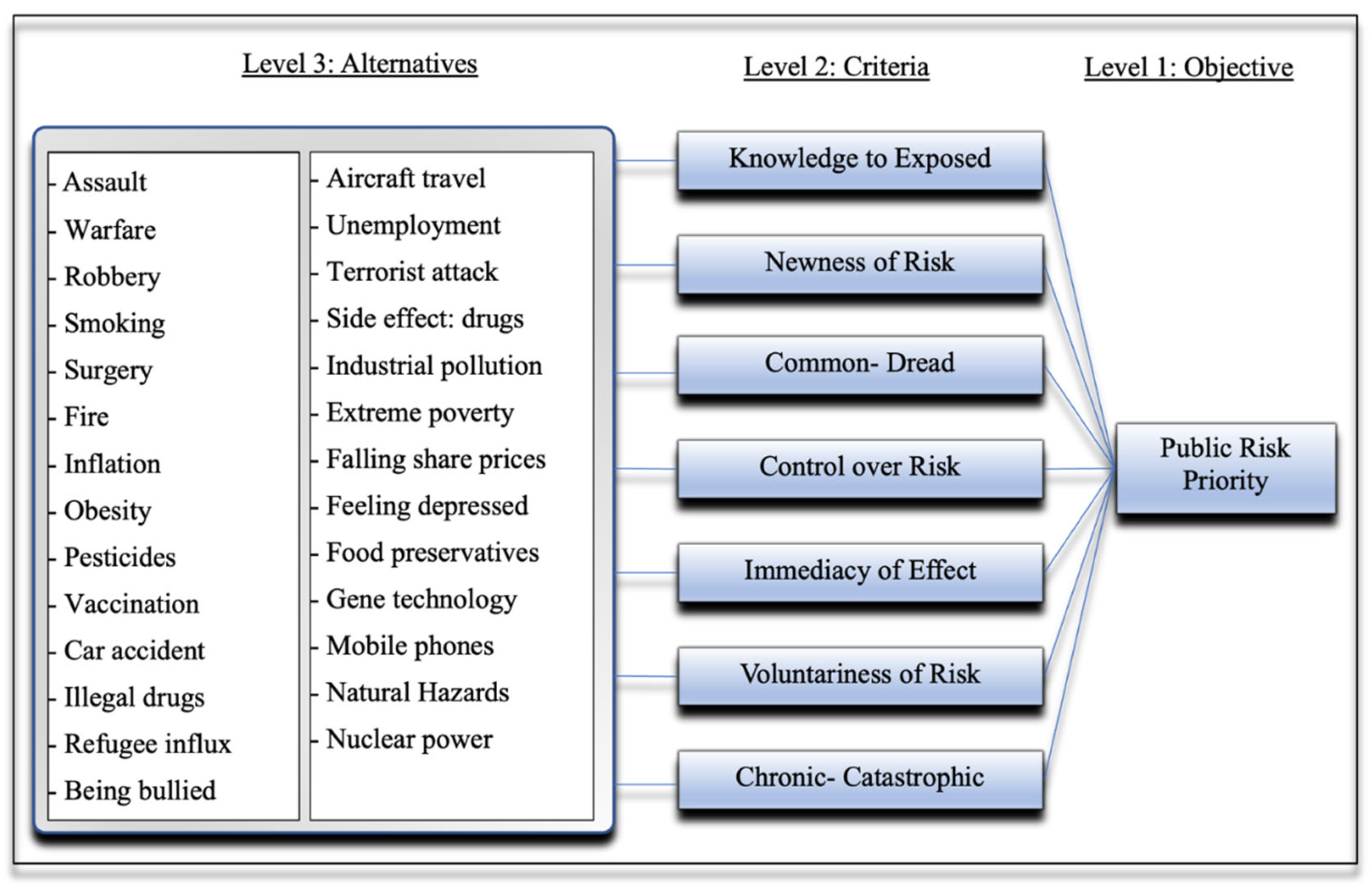
Figure 2.
Public Risk Ranking.
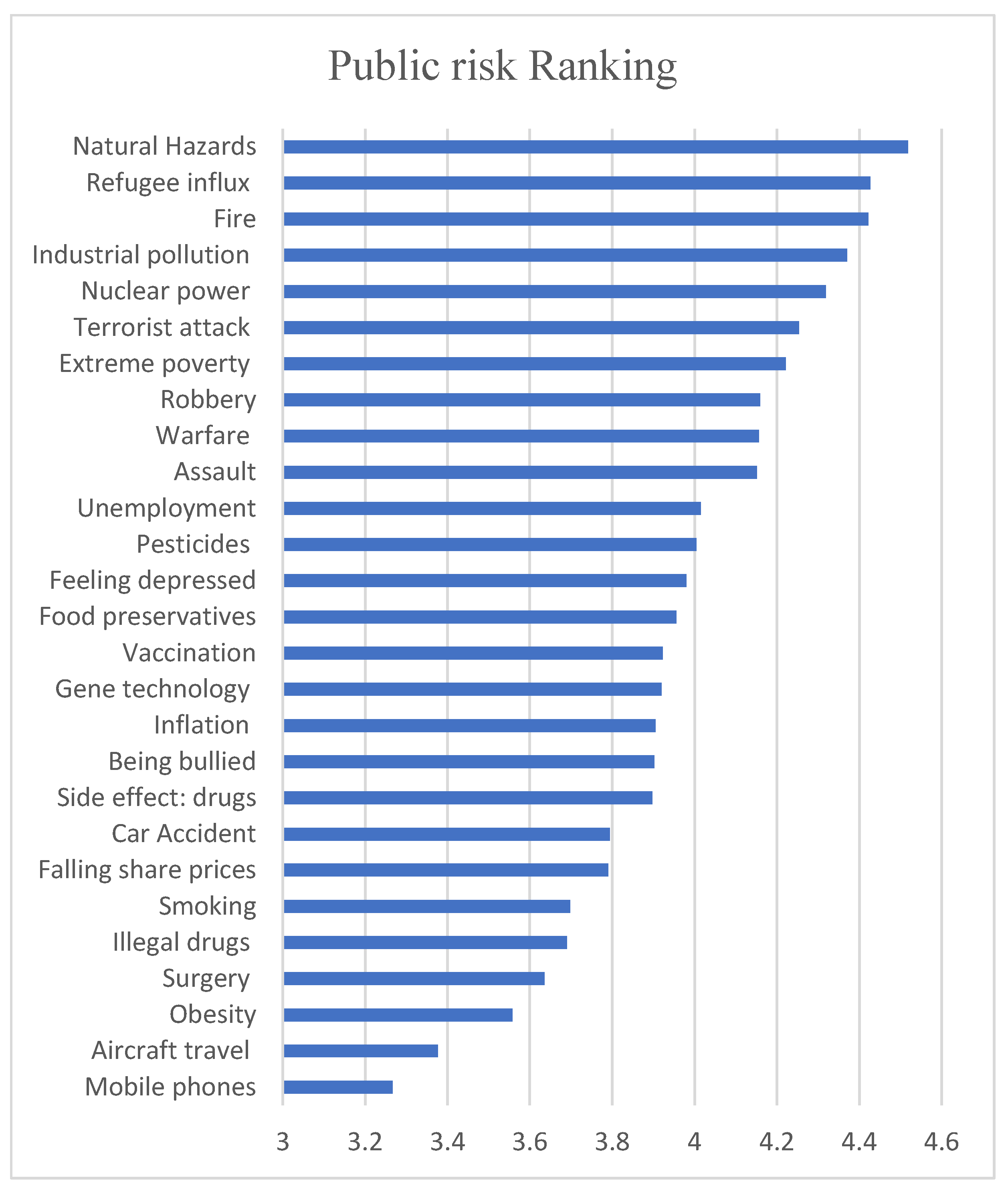
Figure 3.
Risk Attributes Weightings.
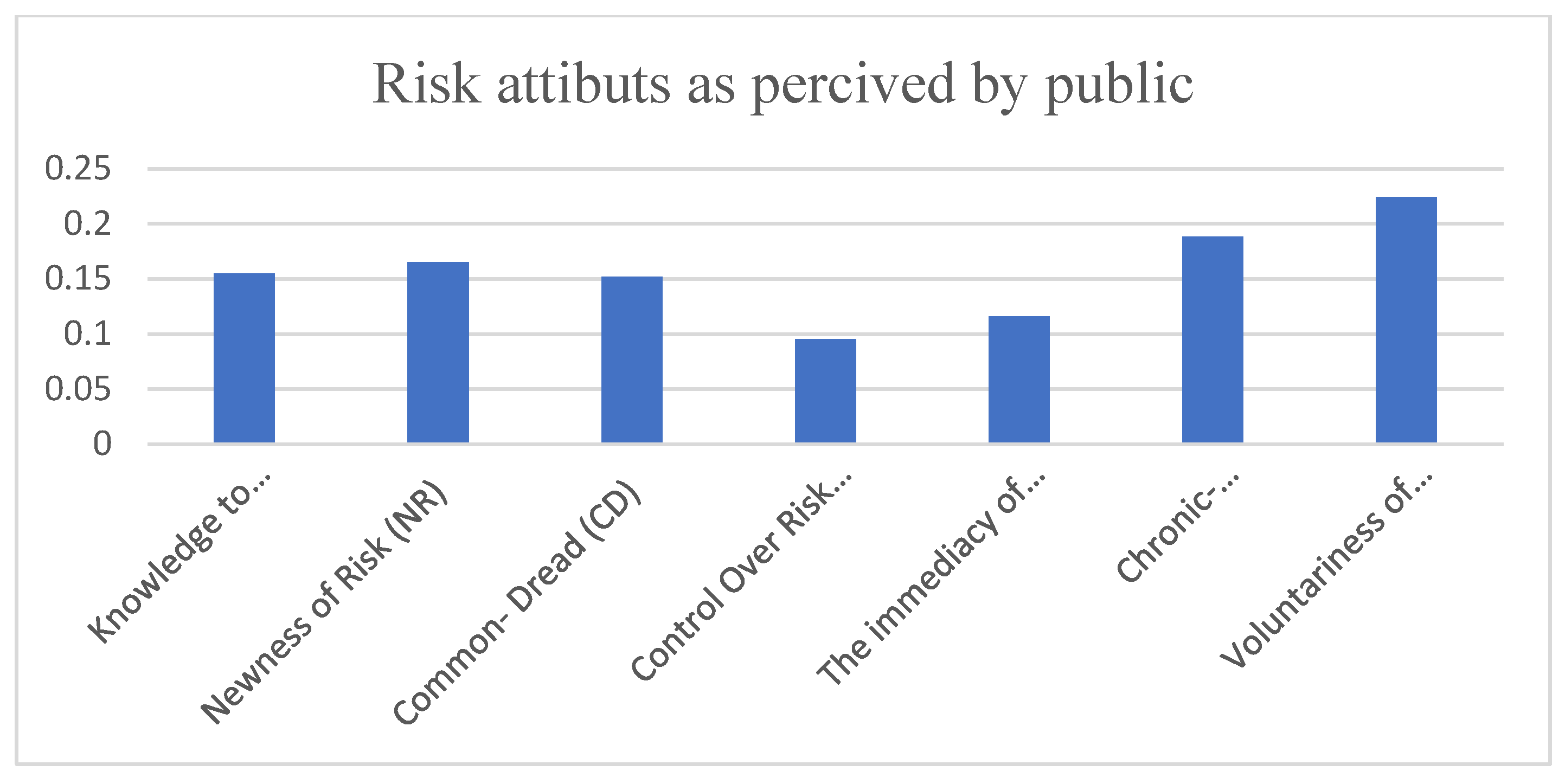

Table 1.
Risk Attributes.
| Attribute | Scale Description | Low (1) | High (7) |
|---|---|---|---|
| Knowledge to exposed | How well do you understand the level of risk involved with each activity, substance, or technology. | Known | Unknown |
| Newness of risk | Is the risk associated to the following activities, substance, or technology something unfamiliar and new to you or not? | New | Old |
| Common- dread | Do these activities, substance, and technology pose a common or sever risk and hazard? | Common | Dreaded |
| Control over risk | How can induvial or groups avoid the risk linked with each activity, substance, or technology? | Uncontrollable | Controllable |
| Immediacy of effect | Do the consequences of engaging in any particular activity, using a specific substance, or adopting a technology occur immediately, or are they delayed? | Immediate | Delayed |
| Chronic- catastrophic | Does the risk linked to the following activities, substances, or technologies pertain to a novel and unfamiliar situation, or does it involve chronic or catastrophic consequences? | Chronic | Catastrophic |
| Voluntariness of risk | To what extent do individuals willingly confront this risk involved in engaging in a particular activity, using a particular substance, or adopting a specific technology? | Voluntary | Involuntary |
Table 1.
Respondents’ Profile.
| Category | Group | Frequency | % |
|---|---|---|---|
| Gender | Male | 292 | 68 |
| Female | 138 | 32 | |
| 20-24 | 77 | 18 | |
| Age group | 26-34 | 180 | 42 |
| 36-44 | 138 | 32 | |
| 45 and above | 35 | 8 | |
| Education | High school certificate | 73 | 17 |
| Undergraduate degree | 313 | 73 | |
| Post Graduate degree | 44 | 10 |
Table 2.
Comparison matrix perceived risk attributes.
| KE | NR | CD | CR | IE | CC | VR | |
|---|---|---|---|---|---|---|---|
| Knowledge to Exposed (KE) | 1 | 0.353 | 0.350 | 0.563 | 0.464 | 0.372 | 0.316 |
| Newness of Risk (NR) | 2.832 | 1 | 0.944 | 1.609 | 1.370 | 0.971 | 0.848 |
| Common- Dread (CD) | 2.857 | 1.059 | 1 | 1.428 | 1.219 | 0.726 | 0.692 |
| Control Over Risk (CR) | 1.775 | 0.622 | 0.700 | 1 | 0.757 | 0.470 | 0.373 |
| The immediacy of Effect (IE) | 2.157 | 0.730 | 0.820 | 1.321 | 1 | 0.515 | 0.462 |
| Chronic- Catastrophic (CC) | 2.686 | 1.030 | 1.378 | 2.129 | 1.942 | 1 | 0.758 |
| Voluntariness of Risk (VR) | 3.169 | 1.179 | 1.445 | 2.678 | 2.167 | 1.319 | 1 |
| Sum | 16.475 | 5.974 | 6.637 | 10.728 | 8.918 | 5.373 | 4.449 |
Table 3.
Normalized matrix for risk attributes .
| KE | NR | CD | CR | IE | CC | VR | Wi | |
|---|---|---|---|---|---|---|---|---|
| Knowledge to Exposed (KE) | 0.061 | 0.059 | 0.053 | 0.053 | 0.052 | 0.069 | 0.071 | 0.060 |
| Newness of Risk (NR) | 0.172 | 0.167 | 0.142 | 0.150 | 0.154 | 0.181 | 0.191 | 0.165 |
| Commoner- Dread (CD) | 0.173 | 0.177 | 0.151 | 0.133 | 0.137 | 0.135 | 0.156 | 0.152 |
| Controls Over Risk (CR) | 0.108 | 0.104 | 0.105 | 0.093 | 0.085 | 0.087 | 0.084 | 0.095 |
| Immediacy of Effect (IE) | 0.131 | 0.122 | 0.124 | 0.123 | 0.112 | 0.096 | 0.104 | 0.116 |
| Chronic- Catastrophic (CC) | 0.163 | 0.172 | 0.208 | 0.198 | 0.218 | 0.186 | 0.170 | 0.188 |
| Voluntariness of Risk (VR) | 0.192 | 0.197 | 0.218 | 0.250 | 0.243 | 0.246 | 0.225 | 0.224 |
| Sum | 1 | 1 | 1 | 1 | 1 | 1 | 1 | 1 |
Table 5.
Consistency test results.
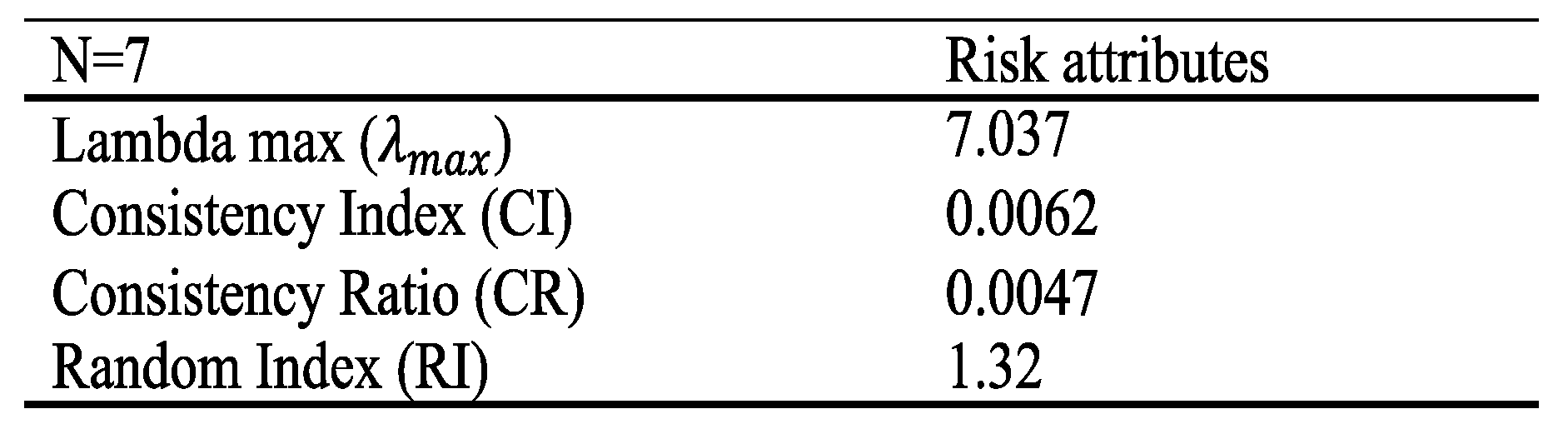 |
Table 6.
Public Risk assessment rank .
| Risk | KE | NR | CD | CR | IE | CC | VR | Risk S | Rank |
|---|---|---|---|---|---|---|---|---|---|
| (0.06) | (0.165) | (0.152) | (0.095) | (0.116) | (0.188) | (0.224) | 1 | ||
| Natural Hazards | 0.155 | 0.825 | 0.813 | 0.163 | 0.293 | 1.005 | 1.264 | 4.518 | 1 |
| Refugee influx | 0.153 | 0.821 | 0.679 | 0.236 | 0.431 | 0.924 | 1.183 | 4.427 | 2 |
| Fire | 0.130 | 0.924 | 0.745 | 0.280 | 0.290 | 0.840 | 1.213 | 4.422 | 3 |
| Industrial pollution | 0.159 | 0.728 | 0.710 | 0.247 | 0.479 | 0.881 | 1.166 | 4.370 | 4 |
| Nuclear power | 0.200 | 0.635 | 0.790 | 0.209 | 0.363 | 0.868 | 1.254 | 4.319 | 5 |
| Terrorist attack | 0.158 | 0.563 | 0.829 | 0.202 | 0.309 | 0.897 | 1.295 | 4.253 | 6 |
| Extreme poverty | 0.155 | 0.838 | 0.725 | 0.328 | 0.382 | 0.860 | 0.933 | 4.221 | 7 |
| Robbery | 0.160 | 0.829 | 0.970 | 0.323 | 0.320 | 0.666 | 0.891 | 4.159 | 8 |
| Warfare | 0.191 | 0.517 | 0.813 | 0.194 | 0.322 | 0.819 | 1.300 | 4.156 | 9 |
| Assault | 0.173 | 0.746 | 0.914 | 0.313 | 0.304 | 0.715 | 0.986 | 4.151 | 10 |
| Unemployment | 0.155 | 0.737 | 0.646 | 0.285 | 0.372 | 0.846 | 0.974 | 4.015 | 11 |
| Pesticides | 0.175 | 0.726 | 0.580 | 0.330 | 0.407 | 0.817 | 0.969 | 4.004 | 12 |
| Feeling depressed | 0.173 | 0.777 | 0.620 | 0.445 | 0.461 | 0.752 | 0.752 | 3.980 | 13 |
| Food preservatives | 0.190 | 0.628 | 0.547 | 0.326 | 0.494 | 0.860 | 0.911 | 3.956 | 14 |
| Vaccination | 0.169 | 0.739 | 0.615 | 0.402 | 0.448 | 0.772 | 0.777 | 3.922 | 15 |
| Gene technology | 0.262 | 0.536 | 0.601 | 0.292 | 0.469 | 0.832 | 0.928 | 3.920 | 16 |
| Inflation | 0.187 | 0.671 | 0.443 | 0.256 | 0.417 | 0.940 | 0.991 | 3.905 | 17 |
| Being bullied | 0.175 | 0.820 | 0.501 | 0.349 | 0.395 | 0.783 | 0.879 | 3.902 | 18 |
| Side effect: drugs | 0.181 | 0.638 | 0.605 | 0.295 | 0.426 | 0.875 | 0.877 | 3.897 | 19 |
| Car Accident | 0.117 | 0.855 | 0.375 | 0.456 | 0.496 | 0.711 | 0.784 | 3.794 | 20 |
| Falling share prices | 0.225 | 0.585 | 0.643 | 0.247 | 0.358 | 0.807 | 0.925 | 3.790 | 21 |
| Smoking | 0.124 | 0.938 | 0.357 | 0.440 | 0.551 | 0.431 | 0.857 | 3.698 | 22 |
| Illegal drugs | 0.194 | 0.662 | 0.659 | 0.334 | 0.376 | 0.476 | 0.989 | 3.690 | 23 |
| Surgery | 0.160 | 0.771 | 0.410 | 0.366 | 0.385 | 0.830 | 0.713 | 3.635 | 24 |
| Obesity | 0.137 | 0.866 | 0.446 | 0.450 | 0.430 | 0.488 | 0.740 | 3.557 | 25 |
| Aircraft travel | 0.145 | 0.739 | 0.400 | 0.355 | 0.409 | 0.521 | 0.808 | 3.377 | 26 |
| Mobile phones | 0.145 | 0.570 | 0.332 | 0.465 | 0.538 | 0.589 | 0.628 | 3.267 | 27 |
Disclaimer/Publisher’s Note: The statements, opinions and data contained in all publications are solely those of the individual author(s) and contributor(s) and not of MDPI and/or the editor(s). MDPI and/or the editor(s) disclaim responsibility for any injury to people or property resulting from any ideas, methods, instructions or products referred to in the content. |
© 2024 by the authors. Licensee MDPI, Basel, Switzerland. This article is an open access article distributed under the terms and conditions of the Creative Commons Attribution (CC BY) license (https://creativecommons.org/licenses/by/4.0/).
Copyright: This open access article is published under a Creative Commons CC BY 4.0 license, which permit the free download, distribution, and reuse, provided that the author and preprint are cited in any reuse.


