

Submitted:
12 April 2023
Posted:
13 April 2023
You are already at the latest version
Abstract
Low pasture biomass production and fodder scarcity are among the major challenges affecting productivity of dairy cattle farms in Sri Lanka. As a potential solution to this, two Napier hybrid cultivars CO-5 and Sampoorna were recently introduced and a field experiment was conducted to evaluate their growth, dry matter production and nutritional composition during May to September 2020. Plant measurements and samples were collected at five harvest intervals (4, 6, 8, 10 and 12 weeks after planting), with the plant samples subjected to biomass and nutritional assessments. The number of tillers and leaf length differed (P=0.01) between the two cultivars at 4 weeks harvesting interval (HI) whilst number of leaves differed at 12 HI respectively. Dry matter yield increased (P=0.16) almost linearly whilst crude protein declined exponentially with CO-5 greater than Sampoorna (P=0.057; 9.3% vs 8.7%), with increasing harvesting intervals respectively. In-vitro Organic Matter Digestibility and In-vitro Metabolizable Energy contents were similar across weeks 4, 6 and 8 but then decreased. This study demonstrates that higher dry matter yields (12.54 t/ha) can be obtained by harvesting both cultivars at 12 HI, but from a nutritional perspective harvesting at 6 HI during Yala season of the year would be optimum for farmers.
Keywords:
dry matter yield
; CO-5
; harvesting interval
; In-vitro gas fermentation
; nutritional composition
; pasture quality
; Sampoorna
1. Introduction
Per animal milk production has to be increased in Sri Lanka to achieve self-sufficiency in milk production [1]. However, there are several constraints to overcome, particularly a shortage of good quality natural pasture, fodder and crop residues to feed the animals [2]. Pasture and fodder availability is affected by rainfall patterns in Sri Lanka which mainly depends on Yala (May to September) and Maha (December to February) monsoon rains. Native grasses decline in nutritional quality (crude protein content and digestibility) during the dry season whilst forage growth increases with the wet season [3].
Cultivation of perennial high yielding pasture and fodder cultivars was considered one of the immediate solutions to feed the increasing dairy herd in Sri Lanka [4]. This resulted in the introduction of Napier hybrid (Pennisetum sp.) fodder cultivars to Sri Lanka a decade ago. They were previously widely grown across Africa and Southeast Asian countries including India [5] due to their adaptability to a wide range of soil conditions, and high photosynthetic and water use efficiency [6]. In addition, they exhibit profuse tillering, are easy to establish, have few pest diseases, and are considered superior in terms of dry matter production and nutritional quality (e.g., crude protein, energy) [7,8,9,10]. These attributes have been observed in different agroclimatic zones in Sri Lanka where Napier hybrid cultivars are prevalent as the main fodder in cut and fed dairy management systems [10]. Despite this, milk production from these pastures is still not considered sufficient to fulfil domestic requirements.
Consequently, improved high yielding multi-cut perennial fodder crops like Napier hybrid grass Sampoorna /DHN-6 (Bajra Line-(IPM14188) × Napier line (FD 184) and Cumbu Napier hybrid CO (BN)-5: (Pennisetum glaucum × P. purpureum Schumach) were introduced to Sri Lanka during early 2020. They have previously been widely distributed in tropical and sub-tropical regions of Asia, Africa, southern Europe and India [11,12] where their rate of establishment is higher compared to other Napier hybrid cultivars which is an important and desirable feature as far as a perennial forage crop is concerned [13]. Hence, if improved CO-5 and Sampoorna cultivars can be maintained throughout the year in Sri Lanka in areas with similar climatic conditions this could be advantageous for livestock industries.
Napier hybrid CO-5 ranked highest in green fodder yield, dry matter yield, crude protein yield and crude protein content compared to older Napier hybrids (CO-3 and CO-4) during a trial (2009 to 2010) in India [13]. Similarly, Sampoorna (DHN- 6) has shown higher nutritional value, crude protein (CP) and metabolizable energy (ME) of green fodder throughout the year with minimum inputs in terms of fertilizer and irrigation on repeated fodder cultivation [11]. In addition, both cultivars exhibit profuse tillering, and have soft stems with high sugar content, making the fodder more palatable and productive than other forage crops which rapidly reduce in quality with maturity of the forage. Stage of maturity significantly affects the yield, CP and fiber concentration, ME and digestibility of fodder, which has a significant effect on feed intake and hence the productivity of the animal [14]. In addition, consideration of anti-nutritive factors is also important to safeguard animal’s health, as they can affect the growth and performance of ruminants. Both cultivars have minimum nitrate and oxalate concentrations, but they do increase slightly with increased maturity [11,15].
Napier hybrid cultivars of CO-3 (Pennisetum Americanum × Pennisetum purpeuruem schum), CO-4 (Pennisetum glaucum× Pennisetum purpeuruemschum) and Pakchong (Pennisetum purpeuruem × Pennisetum glaucum) have been available in Sri Lanka for the last two decades and optimum stages of harvest have been identified based on agronomic characters, dry matter yield and nutritive values (e.g. dry matter, CP, fiber and ME concentration) [7,9,10]. However, similar information has not been collected on the newly introduced CO-5 and Sampoorna cultivars and forms the basis of the current study. Therefore, this study aimed to determine the agronomic characteristics, dry matter yield, and nutritional composition of CO-5 and Sampoorna during Yala season of the year in Sri Lanka and at five different harvesting intervals after planting to obtain the optimum stage of harvest to maximize livestock production for farmers.
2. Materials and Methods
2.1. Study Site
The study site was located at the Veterinary Research Farm (VRF), Gannoruwa, Kandy, Sri Lanka (latitude. 7° 16’44.74’’N and longitude 80° 35’ 40.32’’E; altitude of 516 m above mean sea level). Mean annual rainfall is 1773 mm, with the majority occurring between October to November. The mean annual temperature is 23.5°C, with maximums (March) and minimums (December), averaging 29°C and 19°C, respectively [16]. The soil type in the study site was a sandy clay loam with pH of 6.2 (VRI).
The study was conducted under rainfed conditions between May to September 2020, during the Yala season (Southwest Monsoon). Monthly total precipitation and average minimum and maximum temperatures recorded at VRF during the year are shown in Figure 1. Total rainfall recorded during the trial was 524 mm, which is 104.8 mm below average compared to the long-term average (628.8mm) for that period [16].
2.2. Planting material, experimental design and plant establishment
Two Napier hybrids cultivars were used for the experiment i.e; Cumbu Napier hybrid CO (BN) 5 (Pennisetum glaucum × P. purpureum schumach) released at Tamil Nadu University, Coimbatore and Sampoorna / DHN-6 (Bajra Line-(IPM14188) × Napier line (FD184) developed and released by Indian Grassland and Forage Institute (IGFRI), Dharward [17]. Mature healthy stem cuttings of Napier hybrid CO5 and Sampoorna were obtained from the VRF.
A 2 × 5 factorial experiment was undertaken using a randomized complete block design (RCBD), with each treatment replicated three times. Factor A consisted of two Napier Hybrid cultivars (CO5 and Sampoorna) and factor B five harvesting intervals (4, 6, 8, 10 and 12 weeks after planting). Ten plots (5 m × 2 m) were prepared in each block, making a total of 30 plots. In each block, the plots were spaced 1 m apart and 1 m wide rows separated each parallel located block. Within plots, ten pits (0.6 m long × 0.6 m wide × 0.6 m deep) were established in accord with the ‘Tambukiza’ method (Figure 2) [10]. Fertilizer was then applied to each pit using a blend of urea (20%), triple super phosphate (30%) and muriate of potash (50%) at an equivalent rate of 100 kg/ha [10]. Planting was undertaken by inserting two stem cuttings (30 – 45 cm long) 20-25 cm apart into the pit and then backfilling with the soil that had been previously removed. Two nodes were inserted into the soil leaving a single internode at about 45⁰ angle slanted to the ground. Weeding was done manually at the time of each harvest.
2.3. Plant measurement and biomass sampling procedures
Measurements of plant height (to the tip of the top leaf), number of tillers, tiller diameter, number of leaves, leaf length and leaf width were undertaken on 3 plants/plot, just before each of the five designated harvest times. Tiller diameter was measured at the first internodes 5 cm above the ground level using a Vernier caliper (Mitutoyo Corporation, 965 Corporate Blvd, Aurora, IL 60502). Total number of leaves was estimated by multiplying the tiller number per plant and leaf number per tiller. The fourth leaf from the tiller’s tip was used to measure leaf length and leaf width, respectively [18].
Sampoorna and CO5 were harvested at respective harvesting intervals 5 cm above the ground level and plot fresh weights were measured. A sub sample of 500 g was packed, labeled and transported to the pasture laboratory, VRI for nutrient analysis and determination of fresh and dry matter (DM) content.
2.4. Forage sample laboratory analysis
Sub samples were oven dried at 60 °C (until a constant weight was achieved) and then weighed. Afterwards they were ground through a 1 mm sieve in preparation for analysis of DM [19] content and forage quality (ash, crude protein (CP), neutral detergent fibre (NDF), acid detergent fibre (ADF), in-vitro organic matter digestibility (IVOMD) and in-vitro metabolizable energy (IVME).
Ash was determined by combusting the samples in a muffle furnace at 550°C for 6 hours [19]. The modified-Kjeldahl method [19] was used for nitrogen determination, which was then multiplied by 6.25 to determine CP content. NDF and ADF were determined according to methods of Van soests [20]. OMD and ME contents were determined using the in-vitro procedure described by Menke [21] and OMD and ME were calculated based on the 24 hours net gas production according to Makkar [22].
2.5. Data analysis
The data were analyzed using Minitab 16 [25] using a general linear model with two factor ANOVA to compare the mean differences between two Napier Hybrids and five harvesting intervals. Turkey’s LSD test was used to test the differences between means. Differences between means were considered significant if P values were less than 0.05.
3. Results
3.1. Forage growth characters
Stem height and leaf width were similar (P > 0.05) between cultivars, but there was a significant difference between harvesting interval (HI; P < 0.05) (Table 1). For stem height, it increased with increasing HI albeit at a slightly decreasing rate over time. Leaf width only significantly increased between the 4th to 8th HI, but not thereafter.
Tiller number, leaf number, average basal tiller circumference and leaf length all exhibited significant cultivar C × HI interactions (P < 0.01). Napier hybrid CO-5 had more tillers (56 versus 30.33) and leaves (552.6 versus 299.2) than Sampoorna at week 4 harvest, but not during other harvesting intervals (Table 1). In contrast, Sampoorna had a significantly greater (P < 0.01) leaf length than CO5 at the 12-week HI (117 cm versus 96.44 cm), but they were similar for all shorter HI’s.
3.2. Forage Production
DM content, DM yield and Leaf Stem Ratio (LSR) were not significantly different between cultivars (P > 0.05) but they were between HI’s (P < 0.01), and for DM content there was a significant C × HI interaction (P < 0.05) (Table 2). Despite some variability across HI’s, overall, there was a greater increase in DM content between the 4th to 12th week HI for CO5 than Sampoorna. For DM yield, it tended to increase almost linearly with increasing HI across both cultivars (Table 2). Across both species, maximum LSR tended to occur between the 6 and 8-week HI’s, when it averaged 2.09 and 2.05, respectively.
3.3. Nutrient composition
CP, ash, ADF, NDF, IVOMD, IVME and WSC content were similar (P > 0.05) for both CO5 and Sampoorna, but they were all significantly affected by HI (Table 3).
Furthermore, a significant C × HI interaction (P < 0.05) occurred for ash, NDF, and WSC. For both cultivars, CP content decreased exponentially from an average maximum of 17.9% at the 4-week HI to a minimum of 3.9% at the 12-week HI. Ash % was significantly greater for Sampoorna (15.2%) than CO5 (13.1%) at 4 weeks, but it then declined more rapidly in Sampoorna, such that the two cultivars were not significantly different (P > 0.05) from the 8-week HI onwards. For both cultivars, NDF% was lowest at the 4-week HI. It remained relatively low for CO5 (67.7%) at the 6-week HI but was significantly higher for Sampoorna (73.9%). For all longer HI’s, NDF% was similar (P > 0.05), ranging between 73.3 to 77.6%. Similarly, ADF for both cultivars was lowest (37.5 to 38.7%) for the two shortest HI’s and greatest at the three longest HI’s (42.8 to 49.9%). Both IVOMD% and IVOME content were not significantly different between cultivars (P > 0.05) and was highest at 6-to-8-week HI’s. Initially, WSC content increased for both cultivars with increasing HI, but Sampoorna and CO5 reached maximum WSC at the 8 and 10-week HI, respectively. Napier hybrid CO5 had higher (P=0.00) oxalate content than Sampoorna at the 8-week HI, but both cultivars were similar (P > 0.05) at other HI’s.
4. Discussion
This study has provided information on growth, yield and nutritional quality of CO5 and Sampoorna at different harvesting intervals. The variations and similarities in different parameters among CO5 and Sampoorna suggest room for selection of harvest intervals to improve yields and nutritional values under Sri Lanka’s prevailing environmental conditions.
4.1. Forage growth characters
Stem height of the two cultivars increased with maturity from 1.28 m - 2.72 m between 4 to-8-week HI’s, which is consistent with earlier studies [16,26,27,28]. Like previous studies on the older Napier hybrid cultivars CO-4 and CO-3, CO-5 and Sampoorna exhibited slow growth at the 4 and 8-week HI’s due to their slow establishment using stem cuttings, but once established they grew rapidly (Table 1) [16,29,30] under the prevailing environmental conditions (e.g. climate and soil) at the experimental site [31]. The ability of both CO-5 and Sampoorna to produce more than 30 tillers within 4 weeks from being transplanted is also similar to other Napier hybrid cultivars and promotes persistence and high yields [10,29,32]. Tiller numbers for Sampoorna at the 6, 8 and 10-week HI’s were higher than those reported by Anthony [15] and may be attributed to physiological factors and their interaction with the environment [33]. Number of leaves for both cultivars within the study period was not affected by HI due to persistent moisture period during the Yala season, which was also illustrated by Anthony [15] in a previous study. Both CO5 and Sampoorna had highest basal tiller circumference at the 8 week HI and gradually declined with maturity in agreement with previous records of Napier hybrid cultivars (Pennisetum sp ) [34]. Average leaf width and leaf length of both cultivars within five harvesting intervals ranged between 2.5 - 4.2 cm and 95-115 cm respectively, and was comparable with studies at 6, 8 and 10-week HI’s in India [16,35]. In the current study, leaf width and leaf length were not affected by HI due to environmental stability and the genetic variations except at the 4-week HI which can be attributed to slow early growth of the two cultivars [16]. Overall, the similarities between CO5 and Sampoorna growth parameters, such as stem height, basal tiller circumference and leaf width, suggests that both of the cultivars could be selected for use in livestock production systems in Sri Lanka.
4.2. Forage biomass production
DM content for both cultivars increased with maturity due to the accumulation of fibrous tissues and cell wall structure [36,37]. Sampoorna recorded 19.97% DM content at the 12-week HI in the current study which was comparable with a similar experiment undertaken at Karnatake, India [26,38] Similarly, DM yield of both cultivars increased with increasing HI, from 1.87 to 12.58 between 4-to-12-week HI’s and was consistent with records for several other Napier hybrid cultivars [29,39]. However, in the current study, average DM yield of both cultivars at the 12-week HI (12.58 t/ha) was superior to 5.32 t/ha reported at a similar stage in India [26,39]. In general, with most Napier hybrid cultivars prevailing in the country (CO-3, CO-4 and Pakchong) having similar numbers of tillers and leaves at respective HI’s, it is not surprising that there is minimal difference in DM yield between Napier hybrid cultivars in Sri Lanka [7,8,9]. However, current values of DM yield of CO5 and Sampoorna were higher than previously introduced cultivars (CO-3, CO-4, Pakchong) at 8 and 10-week HI’s in Sri Lanka [7,8]. This may be attributed to the genetic variations of Napier hybrids and rainfall pattern of different agro-climatic zones.
LSR is an important parameter that influences the nutritive value and voluntary feed intake of animals [40]. There was no difference in LSR between cultivars, with the highest ratio observed between the 6 to 8 week HI’s, averaging 2.09 and 2.05, respectively which were comparable with previous records in India at similar HI’s and then declined with maturity [27,35]. The differences in LSR with increasing HI are associated with greater leaf production in the early growth stage (HI’s) and greater stem growth at long HI’s respectively [34,41,42,43]. However, variations of LSR may also be attributed to prevailing environmental conditions, soil fertility and water stress of the plants [44,45].
4.3. Nutritional quality Parameters
Nutritional quality of forage is as important as yield in the selection of the optimal grasses for livestock production. Average ash content of both Napier hybrids decreased progressively from the 4 to 12-week HI (between 14.1% - 6.4%) (Table 3), with advancement of maturity due to natural dilution processes and translocation of minerals to the roots [37,46]. For Sampoorna, average ash content at the 6-week HI was 10.2% higher than at a comparable stage in an Indian study (6.06%), which could be attributed to differences in the mineral content of the soil and the forage [16]. Similar to ash content, average CP content of both cultivars declined with increasing HI due to increased accumulation of structural carbohydrates of the cell wall [35,47]. Average CP content of both cultivars at the 6-week HI was 17.9% comparable with similar HI’s in India [26]. However, the differences between the 8 and 10-week HI for both cultivars may be attributed to differences in soil conditions and environmental factors between the locations [16,48]. The CP content for both cultivars was only above the critical level (> 7% CP) at the two shortest HI’s (ie. 4 and 6-weeks), which is vital for sustaining the rumen microflora and consequently for voluntary feed intake in ruminants [37,49].
According to Van [47], maturity of forage causes a progressive increase in cell wall contents, as occurred with average NDF and ADF contents in the current study, which increased from 63.70% to 75.70% and 37.5% to 49.90% between the 4 and 12-week HI’s, respectively. This is consistent with Basyble [46] who observed a similar trend when hybrid Napier grass (Pennisetum purpeureum) was harvested at 8 and 12-week HI’s. However, the fibre composition of forages depends on many factors such as genotypic characters, environmental conditions and harvesting stages of the plant [51,52]. Digestibility of the plant tissues depends on the proportion of cell contents and cell wall constituents (Table 3). This is illustrated in our study with the highest average IVOMD content for both cultivars at 6th and 8th week, 58.60% and 59.80% respectively which then progressively declined [47]. This may be attributed to the declines in CP content, and an increase in detergent fibers similarly observed in in-vitro digestibility studies of hybrid Napiers (CO-3, CO-4 and Pakchong) harvested at 6, 8 and 10-week intervals in Sri Lanka [7,9]. In addition to nutritional composition, stress factors such as fertilizer, water, and climate may cause variances in digestibility [37,47].
Moir [52] indicated that the quantity of ME is the first limiting factor for milk production. Average IVME values of CO5 and Sampoorna ranged between 7.83 MJ/kg DM to 8.92 MJ/kg DM during 4 to-12-week HI’s and were higher than average energy production of Napier hybrids (7.1MJ/kg DM) reported by Turano [53]. IVME values of the present study during the five harvesting intervals followed the similar pattern of IVOMD contents, hence ME is a derivative of IVOMD and the main factors affecting the ME value of forages also influences its digestibility [36].
Water soluble CHO content of the forages determine the quality of the ensiled forages [54]. The highest WSC concentration was found in the 12th week of harvest for both cultivars. Compared to the WSC content of Pakchong and CO-4 hybrid Napiers in Sri Lanka, CO-5 and Sampoorna recorded the higher WSC concentration at each harvesting interval respectively [8]. Therefore, it is evident in this study irrespective of the harvesting interval, CO-5 and Sampoorna cultivars are both suitable to be used for silage production due to their higher WSC content.
Oxalate, an anti-nutritive factor, of the present study averaged between 0.30% to 0.58% for both cultivars during the 4 to-12-week HI’s and was below the permissible limit of 4% [55], which were comparable with earlier records in India [56]. The oxalate concentration of both cultivars was reduced with increasing HI and height of the plants in agreement with Sridhar and Rahman [57,58]. However, Oxalate content varies with seasonality and genotype of the Napier hybrids [59,60].
5. Conclusions
Both CO5 and Sampoorna performed well at the experimental site, but they varied in terms of some growth characteristics and nutritional composition. CO5 was superior to Sampoorna in terms of tiller number and number of leaves whereas Sampoorna was superior in leaf length to CO5. Highest DM yield and DM content of CO5 and Sampoorna can be obtained by harvesting both cultivars using a 12-week HI, but in terms of nutritional composition, a 6-week HI appears to be the optimum harvesting interval. However, further research with animal performance trials considering detailed economic analysis is recommended for more concrete results.
Author Contributions
Conceptualization, D.W. and P.W.; methodology, D.W and P.W.; software, D.W.; Data collection; D.W. and D.U.; formal analysis, D.W, and D.U.; writing—original draft preparation, D.W; writing—review and editing, D.W, P.W, S.C and D.B.; visualization, D.W. and P.W.; supervision, P.W.; project administration, P.W.; funding acquisition, D.W and P.W. All authors have read and agreed to the published version of the manuscript.
Funding
This research was funded by the Department of Animal Production and Health, Sri Lanka which is aligned to vote Number -2020-02-02-07(2507) 02.
Institutional Review Board Statement
Not applicable.
Informed Consent Statement
Not applicable.
Data Availability Statement
Not applicable.
Acknowledgments
The authors would like to acknowledge laborers at the Veterinary Research farm for maintaining the research plots and Inoka, for assisting the laboratory analysis.
Conflicts of Interest
The authors declare no conflict of interest.
References
- Anonymous; DAPH Annual Report 2020. Department of Animal Production & Health, Sri Lanka.
- Houwers, W.; Wouters, B.; Vernooji, A. Sri Lanka fodder study: An overview of potential, bottlenecks and improvements to meet the rising demand for quality fodder in Sri Lanka; Published by Wageningen UR Livestock Research, 2015; 1-38.
- Ibrahim, M.N.M.; Staal, S.J.; Daniel, S.L.A.; Thorpe, W. Appraisal of the Sri Lanka dairy sector. Main Report. Ministry of Livestock Development and Estate Infrastructure, Sri Lanka 1999, 1, 97.
- Hegde, N.G. “Positive Attitude for Good Health and Happiness”. Nature Cure Ashram, Urulikanchan, Pune 2006.
- Hanna, W.W.; Chaparro, C.J.; Mathews, B.W.; Burns, J.C.; Sollenberger, L.E.; Carpenter, J.R. Perennial Pennisetums. Warm-Season (C4) grasses; Moser, L.E., Burson, B.L., Sollenberger, L.E., Eds.; American Society of Agronomy Monograph Series: Madison, WI, USA, 2004; Volume 45, pp. 503–553. [Google Scholar]
- Anderson, W.F.; Dien, B.S.; Bradson, S.K.; Peterson, J.D. Assessment of Bermuda grass and bunch grasses as feed stocks for conversion to ethanol. Applied Biochemistry and Biotechnology 2008, 145, 13–21. [Google Scholar] [CrossRef] [PubMed]
- Jothirathna, M.W.H.H.; Weerasinghe, W.M.P.B.; Seresinghe, T.; Manawadu, A.; Kumara Mahipala, M.B.P. Growth performance and nutritive value of three improved fodder varieties under different harvesting intervals grown in southern province of Sri Lanka. In Proceedings of the Wayamba University International Conference, Wayamba University, Sri Lanka, 377, 24-25 August 2018. [Google Scholar]
- Bandara, P.G.G.; Premalal, G.G.C.; Nayananjalie, W.A.D. Comparison of yield, nutritive value and silage quality of fodder sorghum (Sorghum bicolor) and maize (Zea mays) with hybrid napier variety CO-3. Rajarata University Journal 2016, 4, 26–31. [Google Scholar]
- Sarmini, M.; Premaratne, S. Yield and nutritional quality potential of three fodder grasses in the northern region of Sri Lanka. Sri Lanka. Tropical Agricultural Research 2017, 28, 175–182. [Google Scholar] [CrossRef]
- Premaratne, S.; Premalal, G.G.C. A resourceful fodder grass for dairy development in Sri Lanka. Journal of Agriculture Science 2006, 2, 22–33. [Google Scholar]
- Kadam, S.S.; Kumar, A.; Arif, M. Hybrid Napier for round the year quality fodder supply to the dairy industry-A review. International Journal of Current Microbiology and Applied Science 2017, 6, 47–78. [Google Scholar] [CrossRef]
- Hossain, A.; Sherasia, P.; Phondba, B. Effect of feeding green fodder-based diet in lactating buffaloes: Milk production, economics and methane emission. Indian J Dairy Sci 2017, 70, 767–773. [Google Scholar]
- Babu, C.; Iyanar; K. ; Kalamani, A. High green fodder yielding new grass varieties. Electronic Journal of Plant Breeding 2014, 5, 220–229. [Google Scholar]
- Anthony, S.; Thomas, C. G. Nutritive quality of hybrid Napier cultivars grown under rainfed ecosystem. Journal of Tropical Agriculture 2014, 52, 90–93. [Google Scholar]
- Antony, S. “Performance of Hybrid Napier Cultivars under Rainfed Conditions.”, M.Sc. thesis, Kerala Agricultural University, Kerala, 2012.
- Weather forecast, Department of meterology, Sri Lanka. metdpa@meteo.gov.lk Accessed on 25/08/2021.
- Anonymous, International livestock research Institute, Demonstration of New varieties of fodder crops. Fodder and fodder production in different Agro climatic Zones and its utilization of livestock of Odisha 2018.
- Gardner, F.P.; Pearce, R.B.; Mitchell, R.L. Physiology of crop plants: The Iowa University Press 1995,327.
- AOAC, Official Methods of Analysis of AOAC International, 18th Ed: Association of Official Analytical Chemists, Maryland, USA, 2005.
- Van Soest, P.J.; Robertson, J.B. Analysis of forages and fibrous foods. A laboratory manual for animal science 1985, 613. [Google Scholar]
- Menke, K.H.; Steingass, H. Estimation of the energetic feed value obtained from chemical analysis and in vitro gas production using rumen fluid. Animal Research and Development 1988, 28, 7–55. [Google Scholar]
- Makkar, H.P.S. In vitro gas methods for evaluation of feeds containing physiochemicals. Anim. Feed Sci. Technol. 2005, 123-124, 291–302. [Google Scholar] [CrossRef]
- Australian Fodder Industry Association Inc, AFIA-Laboratory Methods Manual 2011, Melbourne, Victoria, Australia.
- Adeniyi, S.A.; Orjiekwe, C.L.; Ehiagbonare, J.E. (2009). Determination of alkaloids and oxalates in some selected food samples in Nigeria African Journal of Biotechnology 2009, 8, 110–112. [Google Scholar]
- Minitab Statistical Software, Version 16. Minitab Incorporation, State College, 2016.
- Sharma, S.; Korake, R.; Bharad, R.; Singh, R. Effect of climate change on production of hybrid Napier (DHN-6) grass on milk yield. Journal of Pharmacognosy and Phytochemistry 2019, 8, 3064–3066. [Google Scholar]
- Biradar, S.A.; Shreedhar, J.N.; Ubhalee, P. Economics and varietal performance of hybrid Napier and guinea grass under irrigated conditions of northern Karnataka. Forage Research 2014, 40, 95–97. [Google Scholar]
- Maleko, D.; Mwilawa, A.; Msalya, G.; Pasape, L.; Mtei, K. Forage growth, yield and nutritional characteristics of four varieties of napier grass (Pennisetum purpureum Schumach) in the west Usambara highlands, Tanzania. Scientific African 2019, 6. [Google Scholar] [CrossRef]
- Wangchuk, K.; Rai, K.; Nirola, H.; Thukten, Dendup C.; Mongar, D. Forage growth, yield and quality responses of Napier hybrid grass varieties to three cutting intervals in the Himalayan foothills. Tropical Grasslands – Forrajes Tropicales 2015, 3, 142–150. [Google Scholar] [CrossRef]
- Samarawickrama, L.L.; Jayakody, J.D.G.K.; Premaratne, S.; Herath, M.P.S.K.; Somasiri, S.C. Yield, nutritive value and fermentation characteristics of pakchong-1(Pennisetum purpureum × Pennisetum glaucum) in Sri Lanka. Sri Lanka Journal of Animal Production 2015, 10, 25–37. [Google Scholar]
- Hozumi, E.; Weston, R.H.; Hesketh, J. Factors limiting the intake of feed by sheep: studies with wheat hay. Aust J Agric Res. 1965, 18, 983–1002. [Google Scholar]
- Shedrack, C.; Ansah, T.; Kadyampakeni, D. Comparative yield performance and fodder quality of Napier grass varieties in the dry Savanna, Region of Ghana. Ghanaian Journal of Animal Science 2019, 10, 2019. [Google Scholar]
- Assuero, S.G.; Tognetti, J.A. Tillering regulation by endogenous and environmental factors and its agricultural management. The American Journal of Plant Science and Biotechnology 2010, 4, 35–48. [Google Scholar]
- Ansah, T.; Osafo, E.L.K.; Hansen, H.H. Variety, harvest date after planting and plant fraction of Napier grass influence in vitro gas production. Livestock Research for Rural Development 2013, 25. [Google Scholar]
- Ramya, S.; Ramesh, V.; Muralidharan, J.; Purushothaman, M.R. Fodder yield and chemical composition of hybrid Napier and multi-cut Sorghum fodder at different stages of cutting. Indian Journal of Small Ruminants 2017, 23, 181–185. [Google Scholar] [CrossRef]
- Mc Donald, P.; Edwards, R.A.; Greenhalgh, G.F.D; Morgan, C.A. Animal Nutrition2002 (6th Ed.),496-504.
- Minson, D.J. Forage in ruminant nutrition1990, Academic Press, San Diego, CA, 482.
- Singh, D.; Garg, A.K. Herbage yield, quality and nutrients composition of Bajra Napier (BN) hybrid grass varieties under Central Gujarat condition. XXIII International Grassland Congress, 2015.
- Tessema, Z.; Alemayehu, M. Management of Napier Grass (Pennisetum Purpureum (L.)Schumach) for High Yield and Nutritional Quality in Ethiopia: A Review. Eth. J. Anim. Prod 2010, 10, 73–94. [Google Scholar]
- Minson, D.J.; Milford, R. The voluntary intake and digestibility of diets containing different proportions of legume and mature Pangola grass (Digitaria decumbens). Australian Journal of Agriculture and Animal Husbandry 1967, 7, 546–551. [Google Scholar] [CrossRef]
- Smart, A.J.; Schacht, W.H.; Moser, L.E.; Volesky, J.D. Prediction of Leaf/Stem Ratio Using Near-Infrared Reflectance Spectroscopy (NIRS). Agronomy Journal 2004, 96, 316–318. [Google Scholar] [CrossRef]
- Tessema, Z. Effect of plant density on morphological characteristics, yield and chemical composition of Napier grass (Pennisetum purpureum (L.) Schumach). East African Journal of Sciences 2008, 2, 55–61. [Google Scholar]
- Butt, N.M.; Donart, G.B.; Southward, M.G.; Pieper, R.D.; Mohammad, N. Effects of defoliation on plant growth of Napier grass. Tropical Science 1993, 33, 111–120. [Google Scholar]
- Dapaah, H.K. Environmental influences on the growth, development and yield of pinto beans (Phaseolus vulgaris L.). Ph.D. Thesis, Lincoln University, Christchurch, New Zealand.
- Hoogenboom, G. Contribution of agro-meteorology to the simulation of crop production and its application. Agricultural and Forest Meteorology 2000, 103, 137–157. [Google Scholar] [CrossRef]
- Basyble, T.; Melaku, S.; Prasad, N.K. Effects of cutting dates on nutritive value of Napier (Pennisetum purpureum) grass planted sole and in association with Desmodium (Desmodium intortum) or Lablab (Lablab purpureus). Livestock Res. Rural Develop 2007, 19, 120–136. [Google Scholar]
- Van Soest, P.J. Nutritional Ecology of the Ruminant. Comstock Publishing Associates, Division of Cornell University Press, Ithaca, NY, USA,1994.
- Mohamed, O. E.; Satter, L. D.; Grummer, R. R.; Ehle, F. R. Influence of dietary cottonseed and soyabean on milk production and composition. J. Dairy Sci. 1988, 71, 2677–2688. [Google Scholar] [CrossRef]
- Nori, H.; Sani, S.A.; Tuen, A.A. Chemical and physical properties of Sarawak (East Malaysia) rice Straws. Livestock Research for Rural Development 2009, 21, 122. [Google Scholar]
- Rotili, P.; Gnocchi, G.; Scotti, C.; Kertikova, D. Breeding of the alfalfa plant morphology for quality. Proceedings of the XIV Eucarpia Medicago sp. Group Meeting, Zaragoza 2001 45,25-28.
- Lamb, F.S.J.; Sheaffer, C.C.; Rhodes, H.L.; Sulc, R.M.; Undersander, J.D.; Brummer, E.C. Five Decades of Alfalfa Cultivar Improvement: Impact on Forage Yield, Persistence, and Nutritive Value. Crop Science 2006, 46, 902–909. [Google Scholar] [CrossRef]
- Moir, K.W.; Dougherty, H.G.; Goodwin, P.G.; Humphreys, F.J.; Martin, P.R. An assessment of whether energy was the first factor limiting production of dairy cows grazing Kikuyu grass pasture. Australian Journal of Experimental Agriculture and Animal Husbandry 1979, 19, 530–534. [Google Scholar] [CrossRef]
- Turano, B.; Tiwari, U.P.; Jha, R. Growth and nutritional evaluation of Napier grass hybrids as forage for ruminants. Tropical Grasslands-Forrajes Tropicales 2016, 4, 168–178. [Google Scholar] [CrossRef]
- Amer, S.; Hassanat, F.; Berthiaume, R.; Seguin, P.; Mustafa, A.F. Effects of water-soluble carbohydrate content on ensiling characteristics, chemical composition and in vitro gas production of forage millet and forage sorghum silages. Animal Feed Science Technology 2012, 177, 23–29. [Google Scholar] [CrossRef]
- Patel, P.A.S.; Alagundagi, S.C.; Salakinko, S.R. The anti-nutritional factors in forages - A review. Current Biotica 2013, 6, 516–526. [Google Scholar]
- Soumya, P. “Evaluation of Promising Hybrid Napier Cultivars under Varying Plant Population.” M.Sc. thesis, Kerala Agricultural University, Kerala,2011.
- Sridhar, K.; Biradhar, N.; Karthigeyn, S.; Rao, D.V.K.N.; Roy, A.K. Tryst with Destiny: Research Initiatives for Fodder Resources Development in Pennisular India. Indian Grassland and Fodder research Institute, Regional Research Station, Dharward, 2008, p 30.
- Rahman, M.M.; Ishii, Y.; Niimi, M.; Kawamura, O. Effect of clipping interval and nitrogen fertilization on oxalate content in pot-grown napier grass (Pennisetum purpureum). Tropical Grassland 2009b, 43, 73–78. [Google Scholar]
- Chaudhary, D.P.; Bhardwaj, B.L.; Sreevastava, M.; Singh, A. Comparative evaluation of forage pearl millet genotypes for dry matter and fodder quality. Forage Res. 2007, 33, 111–113. [Google Scholar]
- Abu-Zanat, M.M.W.; Al-Hassanat, M.F.M.; Alawi, M.; Ruyle, G.B. Oxalate and tannins assessment in Atriplexhalimus L. and A. nummularia L. Journal of Range Management 2003, 56, 370–374. [Google Scholar] [CrossRef]
Figure 1.
Monthly total precipitation (mm) and average temperature (°C) at the study site during 2020.
Figure 1.
Monthly total precipitation (mm) and average temperature (°C) at the study site during 2020.
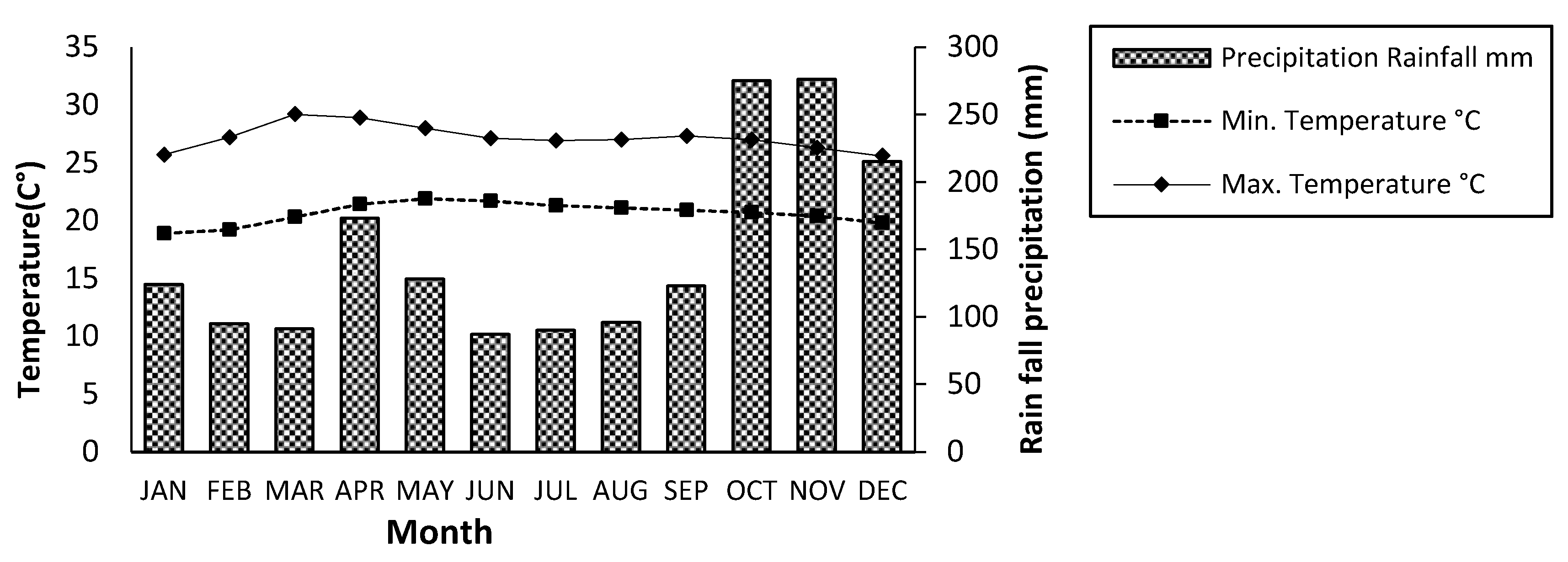
Figure 2.
(a) Establishment of stem cuttings using single pit ‘Tambukiza’ method, (b) Planting of two stem cuttings at an angle of 45º.
Figure 2.
(a) Establishment of stem cuttings using single pit ‘Tambukiza’ method, (b) Planting of two stem cuttings at an angle of 45º.
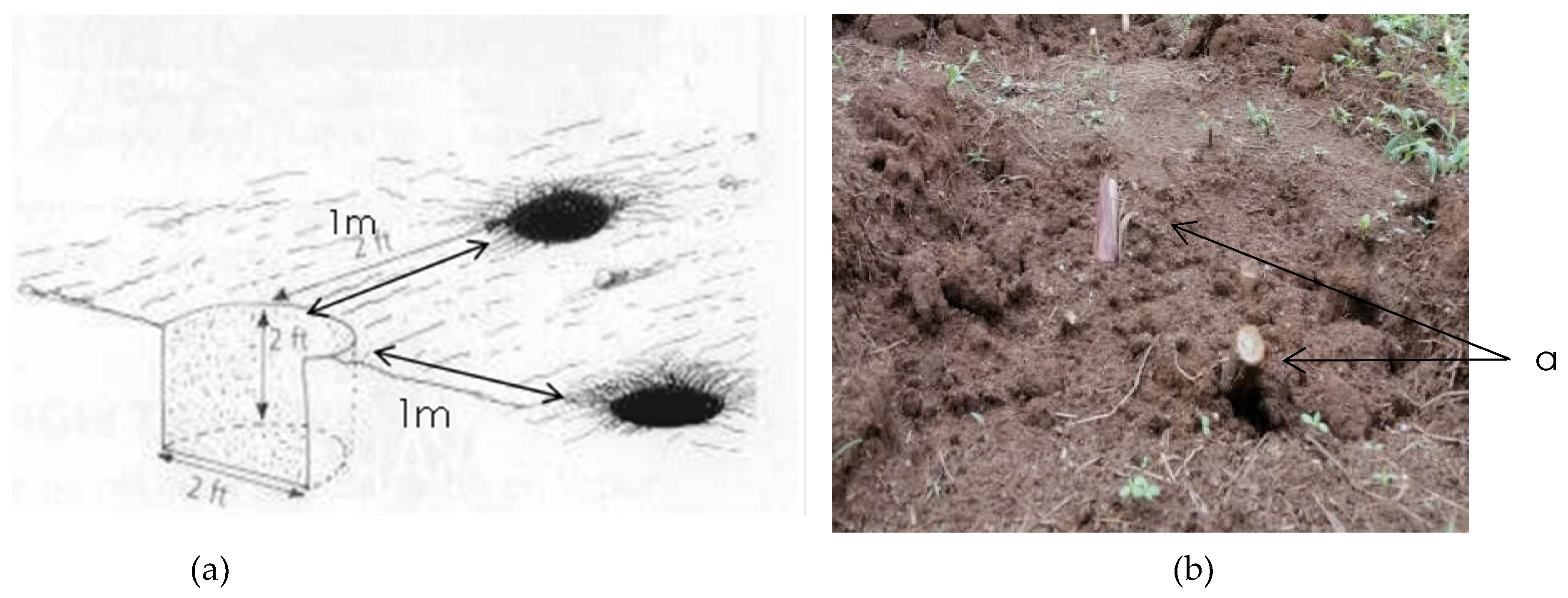

Table 1.
Growth characters of two Hybrid Napier cultivars at five harvesting intervals during Yala season 2020.
Table 1.
Growth characters of two Hybrid Napier cultivars at five harvesting intervals during Yala season 2020.
| Parameter | Cultivar | HI (weeks) | S.E.M | Level of Significance | |||||||
| 4 | 6 | 8 | 10 | 12 | C | HI | C × HI | ||||
| Stem height (cm) | CO5/Sam2 | 127.29f | 186.55de | 224.0bcd | 243.8abc | 272.80a | 5.80 | 0.17 | 0.00 | 0.17 |
|
| Tiller number | CO5 | 56.00a | 51.00ab | 35.44bcd | 49.11ab | 40.22abcd | 2.50 | 0.00 |
0.00 | 0.00 | |
| Sam | 30.33d | 41.00abcd | 32.78cd | 49.00abc | 40.67abcd | ||||||
| Mean | 43.16b | 46.00abcd | 34.11bcd | 49.05abc | 40.445abcd | ||||||
| Number of leaves | CO5 | 552.60abc | 574.00abc | 508.70abc | 656.80a | 519.20abc | 29.68 | 0.00 |
0.00 | 0.00 | |
| Sam | 299.20d | 450.20bcd | 406.20cd | 636.20ab | 582.70abc | ||||||
| Mean | 425.9b | 512.10abc | 457.45abc | 646.50a | 550.95abc | ||||||
| Basal tiller Circumference (cm) | CO5 | 4.47d | 5.60abc | 5.62abc | 4.94bcd | 4.12d | 0.19 | 0.62 |
0.00 | 0.00 | |
| Sam | 4.78cd | 5.89ab | 6.46a | 5.68abc | 4.84cd | ||||||
| Mean | 4.62cd | 5.74ab | 6.04ab | 5.31abc | 4.48cd | ||||||
| Leaf Length (cm) | CO5 | 88.33d | 110.89ab | 109.67abc | 113.33ab | 96.44cd | 2.11 | 0.03 |
0.00 | 0.00 | |
| Sam | 100.94bcd | 117.44a | 114.11a | 117.44a | 117.00a | ||||||
| Mean | 94.63cd | 114.16a | 111.86a | 115.38a | 106.72b | ||||||
| Leaf width (cm) | CO5/Sam2 | 2.47d | 3.39c | 4.23ab | 4.03ab | 3.94abc | 0.00 | 0.16 |
0.00 | 0.11 |
|
1Values are means, Means within a variable with similar superscripts are not significantly different based on a Duncan’s multiple range test, (p=0.05); C; Cultivar, HI; Harvesting Interval, SEM; Standard Error of Mean, Sam :Sampoorna. 2Average of cultivar means (i.e. HI main effect means)
Table 2.
Forage yield performance of two Napier hybrid cultivars at five harvesting during Yala season 2020.
Table 2.
Forage yield performance of two Napier hybrid cultivars at five harvesting during Yala season 2020.
| Parameter | Cultivar | HI (weeks) | S.E.M | Level of Significance | |||||||||||
| 4 | 6 | 8 | 10 | 12 | C | HI | C × HI | ||||||||
| DM (%) | CO5 | 14.64e | 16.33cde | 14.42e | 17.36bcd | 22.19a | 0.54 | 0.54 |
0.00 | 0.01 | |||||
| Sam | 16.00e | 16.21cde | 14.96de | 18.86bc | 19.97ab | ||||||||||
| Mean | 15.32e | 16.27cde | 14.69de | 18.11bc | 21.08a | ||||||||||
| DM yield (t/ha) | CO5/Sam2 | 1.87d | 4.19cd | 6.04c | 8.41ab | 12.54a | 89.12 | 0.16 |
0.00 | 0.61 | |||||
| LSR | CO5/Sam2 | 1.16d | 2.09a | 2.05ab | 1.67bc | 1.51abc | 0.13 | 0.06 | 0.00 | 0.63 | |||||
1Values are means, Means within a variable with similar superscripts are not significantly different based on a Duncan’s multiple range test, (p=0.05); DM; Dry Matter, LSR; Leaf Stem Ratio, C; Cultivar, HI; Harvesting Interval, SEM; Standard Error of Mean, Sam ; Sampoorna. 2Average of cultivar means (i.e. HI main effect means).
Table 3.
Nutritional values of two Hybrid Napier cultivars at five harvesting interval during Yala season 2020.
Table 3.
Nutritional values of two Hybrid Napier cultivars at five harvesting interval during Yala season 2020.
| Parameter | Cultivar | HI (weeks) |
S.E.M |
Level of Significance | ||||||
| 4 | 6 | 8 | 10 | 12 | C | HI | C ×HI | |||
| CP (%) | CO5/Sam2 | 17.90a | 11.90b | 6.80c | 4.60d | 3.90d | 0.41 | 0.05 | 0.00 | 0.18 |
| Ash (%) | CO5 | 13.10b |
10.39c |
8.44de |
7.33ef |
6.54ef |
||||
| Sam | 15.19a | 10.12cd | 6.81ef | 5.49f | 6.55ef | |||||
| Mean | 14.1a | 10.2b | 7.6c | 6.5cd | 6.4d | 0.34 | 0.22 | 0.00 | 0.00 | |
| ADF (%) | CO-5/Sam2 | 37.50c | 38.70c | 42.80b | 48.90a | 49.90a | 0.83 | 0.11 | 0.00 | 0.27 |
| NDF (%) | CO5 | 64.78d | 67.70cd | 73.51ab | 75.65ab | 77.61a | ||||
| Sam | 62.72d | 73.86ab | 73.28ab | 75.85ab | 73.67ab | |||||
| Mean | 63.70c | 70.80b | 73.40ab | 75.60a | 75.70a | 1.34 | 0.97 | 0.00 | 0.00 | |
| IVOMD (%) | CO-5/Sam2 | 54.00b | 58.60a | 59.80a | 50.40c | 46.20d | 1.16 | 0.19 | 0.00 | 0.23 |
| IVME (MJ/kg DM) | CO-5/Sam2 | 7.83b | 8.63a | 8.92a | 7.51bc | 6.91c | 0.17 | 0.38 | 0.00 | 0.08 |
| WSC (%) |
CO5 | 14.47cd | 17.97bc | 16.64c | 21.53ab | 22.10ab | ||||
| Sam | 11.85d | 15.95cd | 22.41ab | 23.08a | 23.62a | |||||
| Mean | 13.16c | 16.96bc | 19.52a | 22.30ab | 22.86ab | 0.90 | 0.15 | 0.00 | 0.00 | |
| Oxalate (%) | CO5 | 0.58a | 0.58a | 0.49ab | 0.44abc | 0.29bc | 0.04 | 0.00 | 0.00 | 0.05 |
| Sam | 0.58a | 0.44abc | 0.26c | 0.34bc | 0.31bc | |||||
| Mean | 0.58a | 0.51ab | 0.37c | 0.39bc | 0.30c | |||||
1Values are means, Means within a variable with similar superscripts are not significantly different based on a Duncan’s multiple range test, (p=0.05). 2Average of cultivar means (i.e. HI main effect means) DM; Dry Matter, CP; Crude Protein, NDF; Neutral Detergent Fiber, ADF; Acid Detergent Fiber, IVOMD; In-vitro Organic Matter Digestibility, IVME; In-vitro Metabolizable Energy, WSC; Water Soluble Carbohydrate, C; Cultivar, HI; Harvesting Interval, SEM; Standard Error of Mean, Sam ; Sampoorna.
Disclaimer/Publisher’s Note: The statements, opinions and data contained in all publications are solely those of the individual author(s) and contributor(s) and not of MDPI and/or the editor(s). MDPI and/or the editor(s) disclaim responsibility for any injury to people or property resulting from any ideas, methods, instructions or products referred to in the content. |
© 2023 by the authors. Licensee MDPI, Basel, Switzerland. This article is an open access article distributed under the terms and conditions of the Creative Commons Attribution (CC BY) license (http://creativecommons.org/licenses/by/4.0/).
Copyright: This open access article is published under a Creative Commons CC BY 4.0 license, which permit the free download, distribution, and reuse, provided that the author and preprint are cited in any reuse.


