

Submitted:
09 January 2023
Posted:
10 January 2023
You are already at the latest version
Abstract
This paper discusses and reviews the current taxonomic status and zoogeographical distribution of the mammals of Yemen. Data were collected from previous literature in addition to field observations during 2017–2018. This checklist includes 100 species of wild (terrestrial and marine) mammals currently occurring and those that went extinct within the last century in Yemen. Only wild mammals were included and domesticated species were excluded. These 100 species belong to 11 orders, 28 families, and 64 genera. In this paper, the current status and distribution of three Erinaceomorphs, seven Soricomorphs, 34 Bats, 16 Carnivores, seven Artiodactyls, one Lagomorph, 20 Rodents, one Hyracoidea, nine Cetaceans, one Sirenia, and one Primate were reported. According to the evaluation of the International Union for the Conservation of Nature and Natural Resources (IUCN): 70 species were listed as Least Concern (LC), two as Extinct (EX), one as Critically Endangered (CR), two as Endangered (EN), eight as Vulnerable (VU), five as Near Threatened (NT), and 12 as Data Deficient (DD). This paper also discusses the current main threats to the wild mammals in Yemen.
Keywords:
mammals
; Yemen
; checklist
; distribution
; Southern Arabia
Introduction
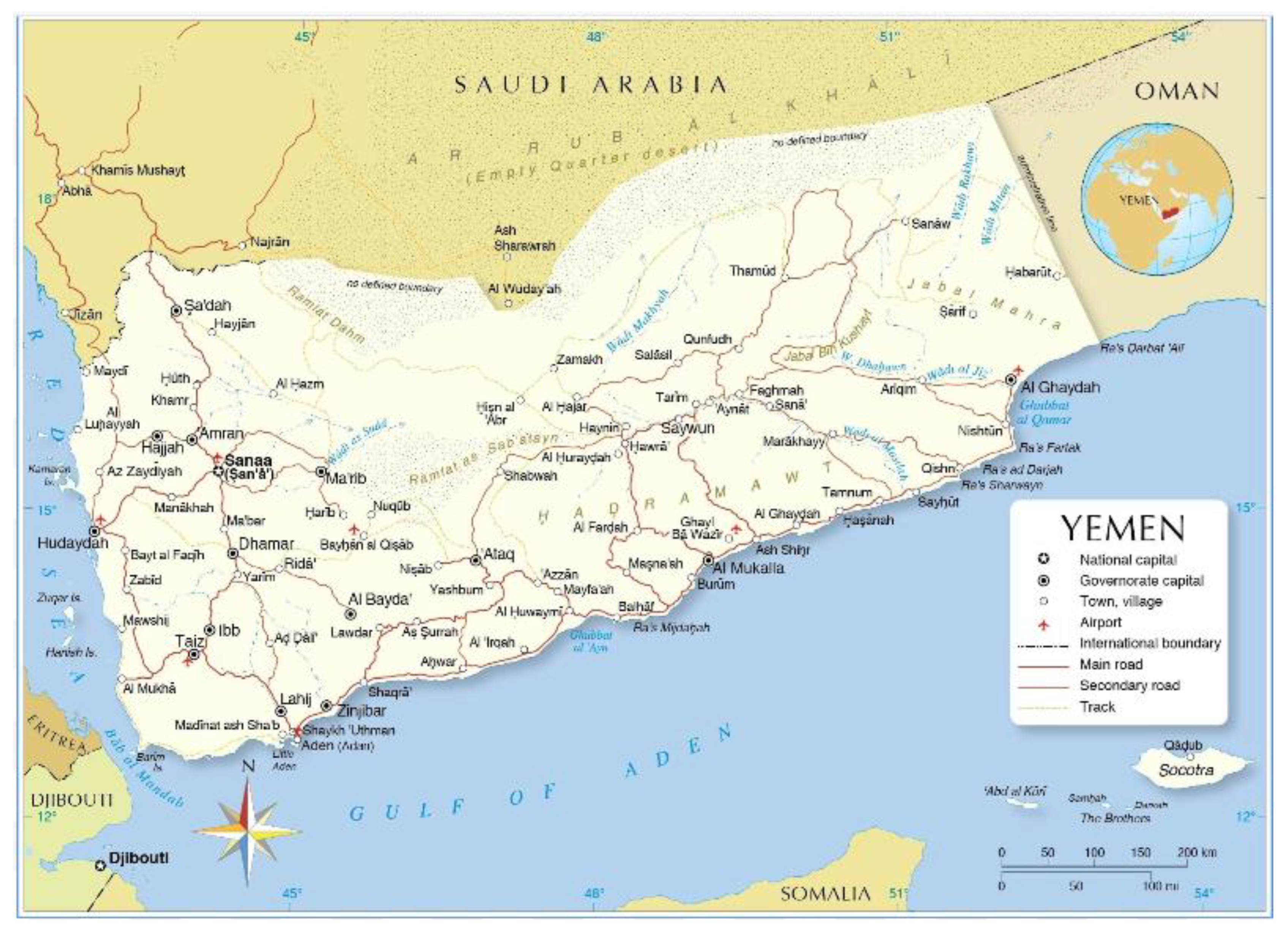
Yemen is located in the southwestern part of the Arabian Peninsula and covers a total land area of 527.970 km2. It is bordered by the Red Sea to the east, Gulf of Aden and the Arabian Sea to the south, Saudi Arabia to the north and Oman to the east (Romano 2003). The shoreline spreads over nearly 2500 km. The northern and eastern borders face the Rub'a Al-Khali desert (Busais 2011). The climate of Yemen is usually classified as semiarid to arid with high temperatures especially in the coastal regions and with low precipitation throughout most of the country. The eastern and southern coastal plains enjoy a high temperature that may reach 42 C and fall to 25 C. The highlands of Yemen, on the other hand, are characterized by a temperate, rainy summer with an average high temperature of 21° C and a cool, moderately dry winter with temperatures occasionally dropping below 4° C. The highest mountainous areas of southern Yemen receive about 520 to 760 mm of rain every year (Al-Masawa et al. 2018). Yemen is divided into five regions: mountains, high plains, shoreline, deserts, and islands. From a zoogeographical perspective, Yemen includes two regions: Afrotropical and Palearctic. Interestingly, the fauna of Yemen includes species from three biogeographical biomes: the Palaearctic, the Oriental, and the Ethiopian or Afrotropical regions (Scott 1942). The variety and richness of the mammalian fauna in Yemen can be attributed to its vast area, diverse biomes, and special geographic location (UNDP, UNEP and GEF 2001).
Figure 1.
Map of Yemen © Nations Online Project.
Many researchers explored and studied the fauna of Yemen. But, no doubt, Pehr Forsskål (1732-1763) was among the first orientalists and explorers who gave valuable and important descriptions on some terrestrial and marine mammals in Yemen (Krupp et al. 2006). Later observational and systematic reviews on mammals of Yemen came from several other explorers and scholars such as Eduard Glaser (1855-1908) in his four trips to Yemen in (1882-1884, 1885-1886, 1887-1888, and 1892-1894) (Glaser 1913). William Fleming (1838) reported some mammal species in his geographical, historical, and statistical account of Yemen. In his report of a trip he made to Yemen, Botta (1841) described some mammals like baboons and wolves. Tomlins (1845) mentioned some mammals in his geographical description of ancient and modern Arabia. Hunter (1877) talked about some mammals in his account of Aden. Doughty (1888) described few species found in Yemen while he was travelling in Arabia. Matschie (1893) noted on some species in his study of mammals in Arabia. Yerbury & Thomas (1895) provided more systematic and zoogeographical description in their notes on the mammals of Aden. Noack (1896) reported in his research new canids in Arabia. Thomas (1900) wrote about the mammals in southwestern Arabia. Anderson & De Winton (1901) reported in their notes on a new species of hedgehog. Anderson & De Winton (1902) described some mammals found in Yemen in their reference book on zoology. De Winton et al. (1903) described the mammals in Socotra Island. Neumann (1906) wrote about the Arabian gazelle in Yemen. Andersen (1907, 1912) provided further descriptive notes on some bats in Arabia. Bury (1911, 1915) described gazelle and oryx in his works on Yemen. Chessman & Hinton (1924) provided detailed notes on the mammals in Arabia. Al-Tha’alibi (1924) talked about how he encountered some mammals in his exploratory trip to Yemen. Dollman (1927) provided more remarks on Arabian gazelles in Yemen. De Beaux (1931) talked about some mammals in Yemen in his commentaries on an Italian expedition. Dollman (1932) developed a list of mammals distributed in Yemen. Pocock (1934, 1935, 1944) provided detailed description in his notes on some Arabian mammals. Morrison-Scott (1939) added more species in his records of mammals in Arabia. Hayman (1941) focused the living rodents of Yemen. Scott (1942) talked about some mammals found in southern Arabia in his profile of Yemen. Ellerman (1948) listed important rodents found in Yemen in his key to the rodents of southwest Asia. Thesiger (1949, 1959) provided more details about some mammals in his journey chronicles across Arabia. Hayman & Harrison (1950) described in their notes some newly recorded mammals from Arabia. Ellermann & Morrison-Scott (1951) listed Yemeni mammals in their checklist of Palearctic mammals. Hyaman (1952) reviewed the distribution of the sand cat in Arabia. Sanborn & Hoogstraal (1953) provided important notes in their records of some mammals in Yemen. Hoeck (1962) described some Yemeni mammals in her diary on working as a physician in Yemen. Stewart (1964) reported in his notes on the Arabian oryx. Harrison (1964, 1968, 1972) was the first to provide an updated systematic review on the mammals of Yemen in his three-volume monograph “Mammals of Arabia”. Atallah & Harrison (1967) described new records of some mammals in the Arabian Peninsula. Seargent (1974) talked about porcupines in Yemen. Scaramella (1975) provided systematic research on Yemeni mammals. Seargent (1976) wrote in his book on animals hunting in Yemen. Nader (1982, 1990) developed a checklist of mammals in Arabia. Nader & Kock (1980, 1982, 1987, 1990) reported on the bats of Arabia. Stookey (1982) talked about some mammals in his descriptive account of southern Yemen, Harrison & Bates (1984) provided more details on the bats of Yemen in their account on bats of Arabia. Groves & Lay (1985) wrote a paper on gazelles in Arabia. Hutterer & Harrison (1988) described in their note the shrews in Arabia. Delany (1989) provided more details on the mammals of Yemen in his zoogeographical account of southwestern Arabian mammals. Al-Safadi (1990, 1991, 1992, 1994) described more species in his works on the mammals of Yemen. Nader & Al-Safadi (1991, 1993) listed some species found in Yemen in their descriptions of some mammals in Arabia. Ubadi (1993) provided updated zoogeographic distribution and records in his book on the mammals of Yemen. Greth et al. (1993) wrote about the Bilkis gazelle in Yemen. Showler (1996) described some species in his observational study of mammals in Yemen. Al-Jumaily (1998) developed a checklist of mammals of Yemen. Benda & Nasher (2006) provided a new record of a shrew species in Yemen. Benda et al. (2011) listed all bat species found in Yemen.
Since Al-Jumaily’s checklist of mammals (1998), very little information was added about the distribution of mammals in Yemen. Prior to that checklist, Ubadi (1993) and Al-Safadi (1992) listed some mammals in their studies. The current checklist describes the taxonomic status and zoogeographical distribution of nine orders, 24 families, 64 genera and 100 species of terrestrial and marine mammals in Yemen. Distribution maps of all species except bats were included.
Materials and Methods
Information on the distribution and occurrence of mammal species in Yemen was obtained from field observations that were conducted in 2018 and 2019 in addition to previous literature and records. Specimen holdings from mammals’ collections of the following natural history museums have been reviewed: American Museum of Natural History (AMNH), Field Museum of Natural History (FMNH), Smithsonian National Museum of Natural History (USNM), Natural History Museum in London (BMNH), Muséum National D'histoire Naturelle (MNHN), Naturmuseum Senckenberg (SMF), Natural History Museum of Kansas University (KU), Museums Victoria, National Museum, Prague (NMP), Harvard Museum of Comparative Zoology (MCZ), and Zoologisches Forschungsmuseum Alexander Koenig, Bonn (ZFMK). Photo identification of species was conducted using an EOS 7 D mark II Canon digital SLR camera bodies attached to a Canon 200-400mm f/4 L IS USM with built-in 1.4x telephoto lens and Bushnell IR remote camera traps. The identification of the species that were collected during the current study was based on the following references: Harrison & Bates (1991), Jefferson et al. (1994), Stone (1995), Wilson & Mittermeier (2009), Kingdon et al. (2013), and Taylor (2019). The orders, families, genera, species and subspecies were listed according to the 3rd edition of Wilson & Reeder (2005). For the conservation status of species, the current study relied on the most recent assessments of the International Union for the Conservation of Nature (IUCN 2020). All distribution maps were prepared using ArcGIS ver. 10.8 (Windows Version). For each map, closed circles denote previous records while open circles represent new records.
Species Accounts
Order ERINACEOMORPHA
Family Erinaceidae
Paraechinus hypomelas– Brandt's Hedgehog (Brandt 1836)
Subspecies: P. h. sabaeus (Thomas 1922)
Figure 2.
Records of Paraechinus hypomelas.
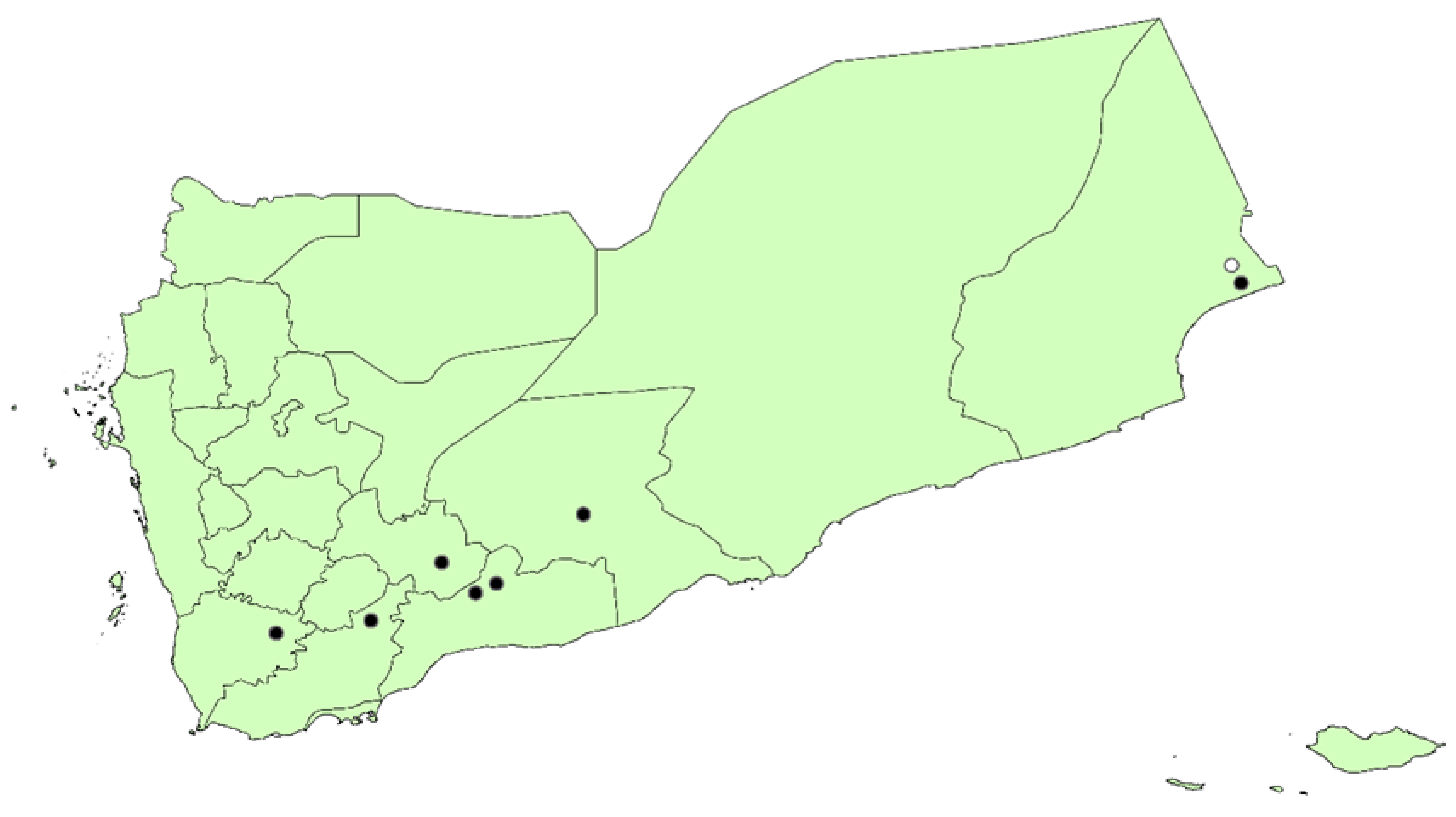
Distribution: Common in the foothills of Yemen. Recently recorded from Hawf. Previously reported from Mukeiras (Harrison 1961); Lawdar, Mudiyah, Ataq, Habil Jabr (Ubadi 1993); Taiz (Bates 1995); Hawf (Al-Khorozyan et al. 2014).
Paraechinusaethiopicus- Desert Hedgehog (Ehrenberg 1832)
Subspecies: P. a. dorsalis (Anderson & de Winton 1901)
Figure 3.
Records of Paraechinus aethiopicus.
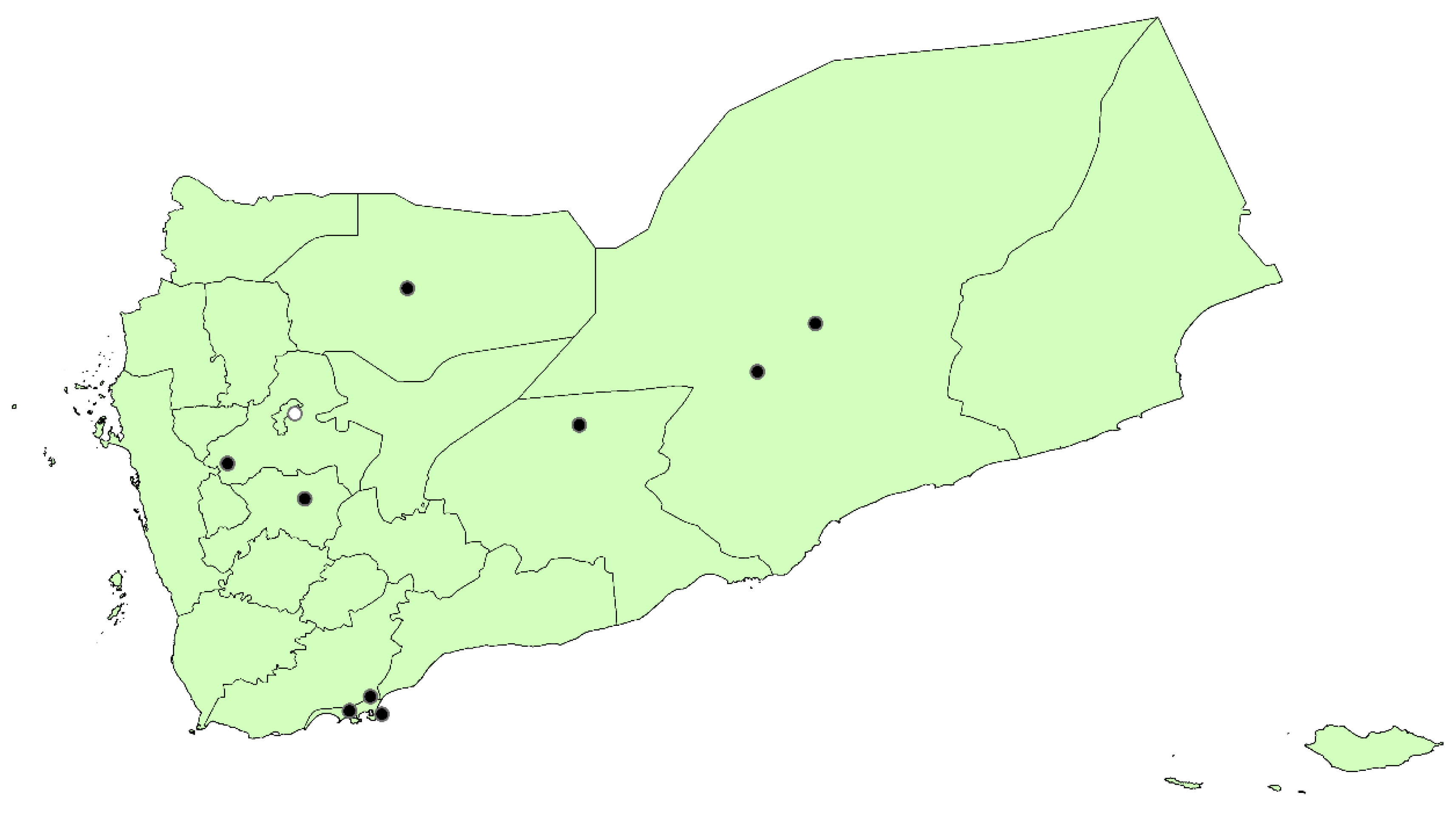
Distribution: A widespread hedgehog that can be found in desert areas, dry scrublands, and vegetated wadis in Yemen. Recently recorded from northern San’a. Previously reported from Hadramaut by Anderson & de Winton (1901) as Erinaceus dorsalis; reported by Thomas (1922) as P. a. oniscus from Fayush, 30 km north of Aden; from Dhamar (Pocock 1934); San’a (Scaramella 1975); Aden (Stone 1995); Aden, Al-Jawf, Haraz wildlife sanctuary, and Hadramaut (Bates 1995); al-Qatn, Shabwah (Showler 1996); and Al-Haswa (Baker & Al-Balam 2016). Specimens collected by H. W. Setzer in (1961) from the province of Hadramaut are included in the collection of the USNM.
Hemiechinus auratus - Long-eared Hedgehog (Gmelin 1770)
Figure 4.
Records of Hemiechinus auratus.
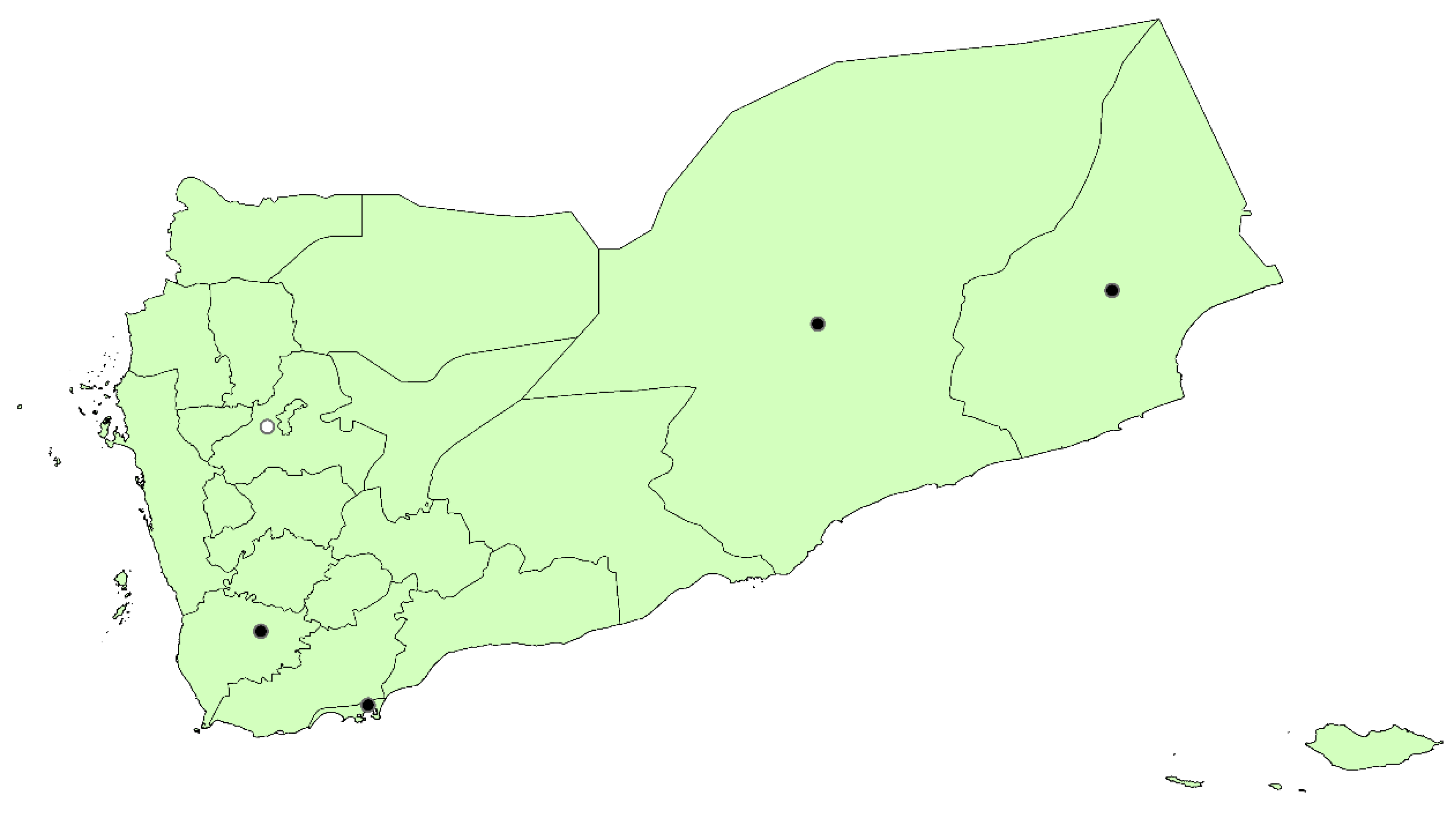
Distribution: Recently recorded from Western areas of San’a. Previously reported from Aden (Popov 1960); Ta’iz, Al-Mahra, Hadramaut, and northwestern areas of Yemen (Bates 1995). Abdel-Wasae & El (2009) collected 10 specimens from Ta’iz.
Order SORICOMORPHA
Family: Soricidae
Suncus murinus- Asian House Shrew (Linnaeus 1766)
Subspecies: S. m. sacer (Ehrenberg 1832)
Figure 5.
Records of Suncus murinus.
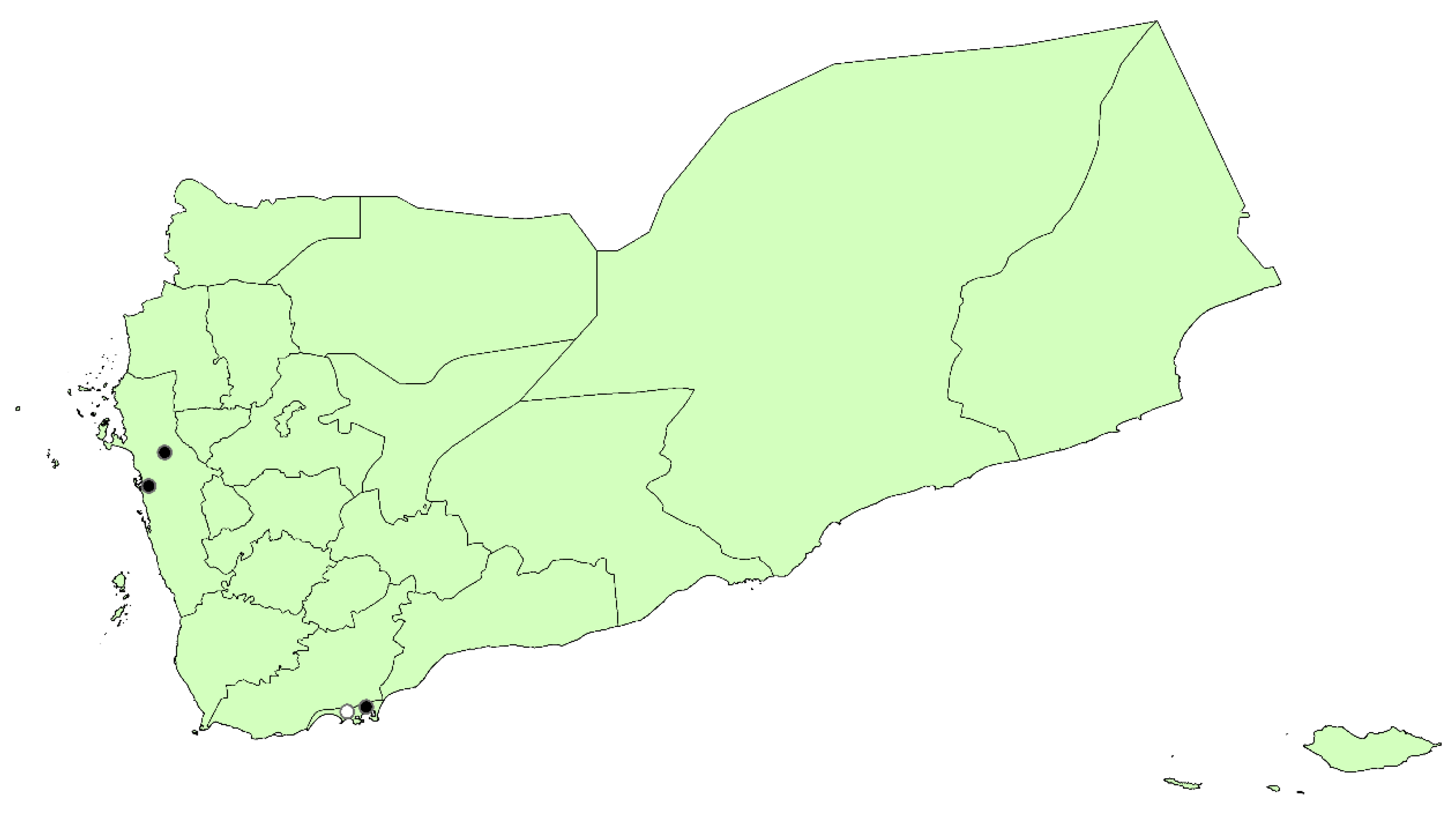
Distribution: A common shrew. Recently recorded from Al-Haswa. Previously recorded from Hodeida (Hoogstraal & Kaiser 1959, Kuntz & Myers 1968); Aden (Harrison 1964, Hutterer & Harrison 1988); Aden and Hodeida (Ubadi 1993); Bajil (Showler 1996).
Suncus etruscus - Etruscan Shrew (Savi 1822)
Figure 6.
Records of Suncus etruscus.
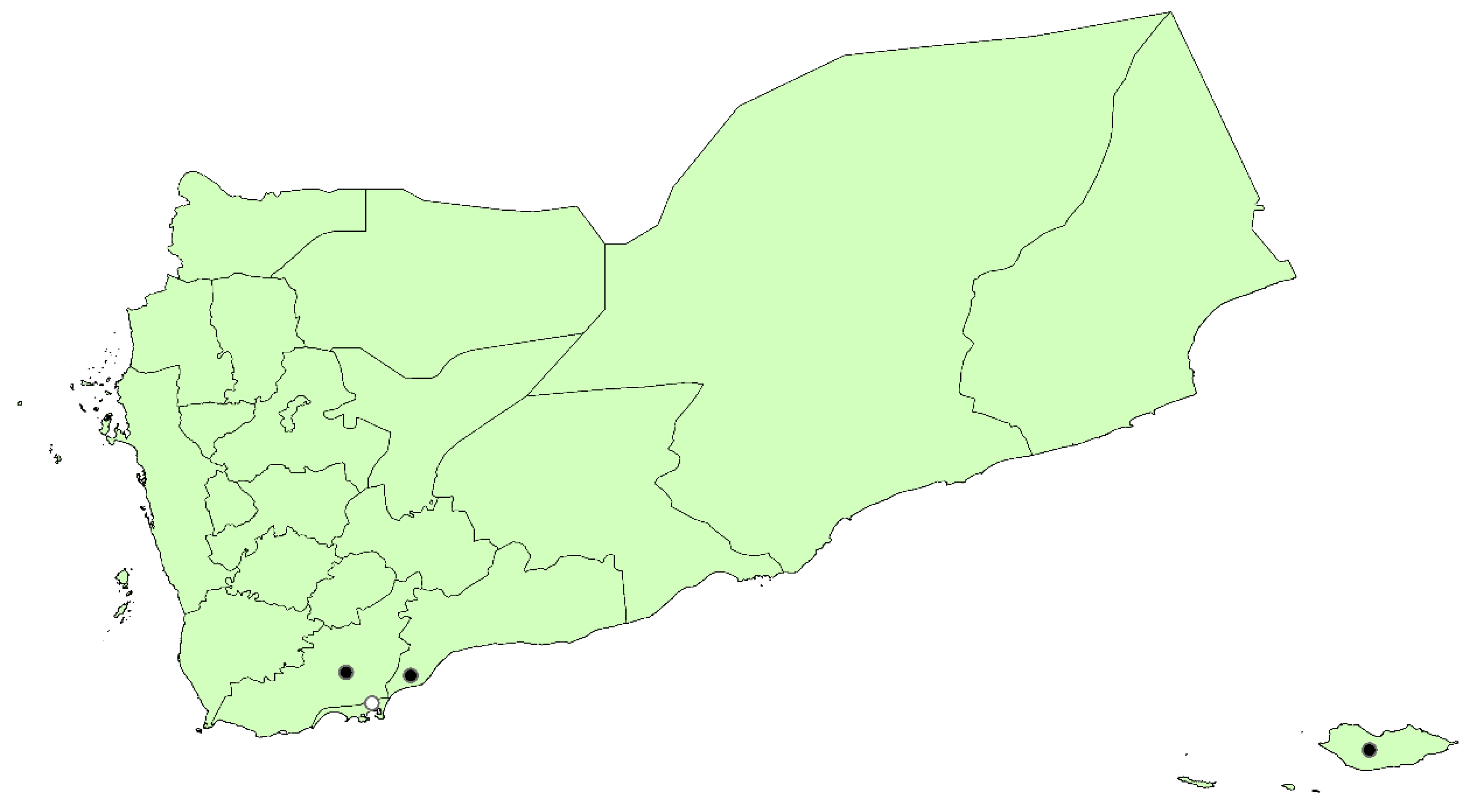
Distribution: Recently recorded from Aden. Harrison (1964) reported this shrew from Aden and Lahej. Guichard (1992) collected this species in (1967????) from Socotra Island (Hutterer & Harrison 1988). Ubadi (1993) recorded this shrew from Aden, Lahej, and Al-Kawd.
Crocidura dhofarensis- Dhofar Shrew (Hutterer & Harrison 1988)
Distribution: Benda & Nasher (2006) reported this shrew from Hawf. Recently also recorded by the current study from Hawf.
Crocidura arabica – Arabian shrew (Hutterer & Harrison 1988)
Figure 7.
Records of Crocidura dhofarensis.
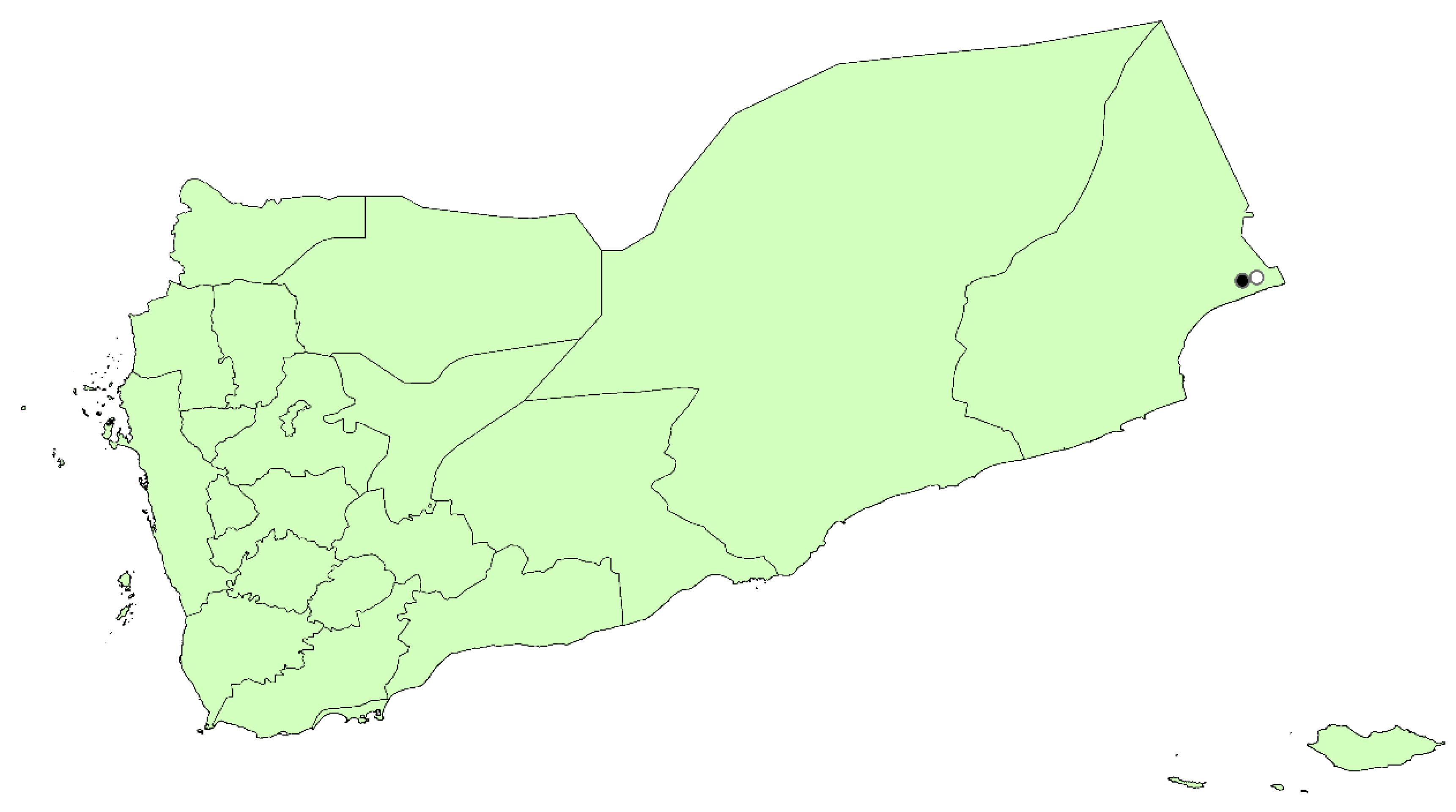
Distribution: Common in the southern coastal areas of Yemen. Recently recorded from Aden, Shoqra, Hawf. Previously recorded from Aden (Hutterer & Harrison 1988).
Suncus madagascariensis - Madagascan Pgymy Shrew (Coquerel 1848)
Distribution: Socotra (Hutterer 2005).
Crocidura suaveolens - Lesser White-toothed Shrew (Pallas 1811)
Figure 8.
Records of Crocidura arabica.
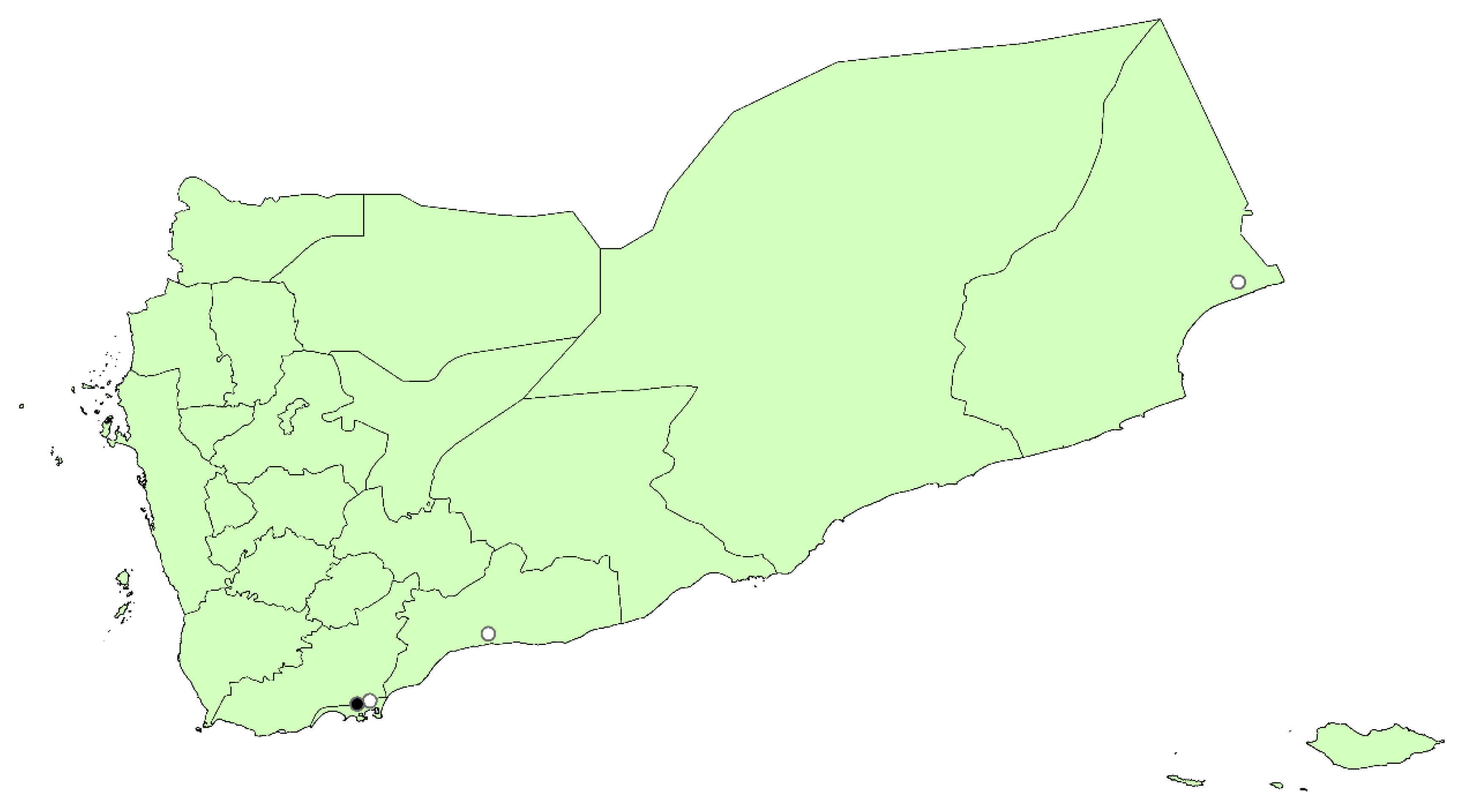
Distribution: Originally collected from Aden by Yerbury & Thomas (1895), and also Bates (1987) reported this shrew from Aden. The zoology collections of the BNHM include a specimen that was collected from Aden in 1986 by M. I. Evans.
Order CHIROPTERA
Family Pteropodidae
Rousettus aegyptiacus- Egyptian Rousette (Geoffroy 1810)
Subspecies: R. a. arabicus (Anderson & de Winton 1902)
Figure 9.
Records of Suncus madagascariensis.
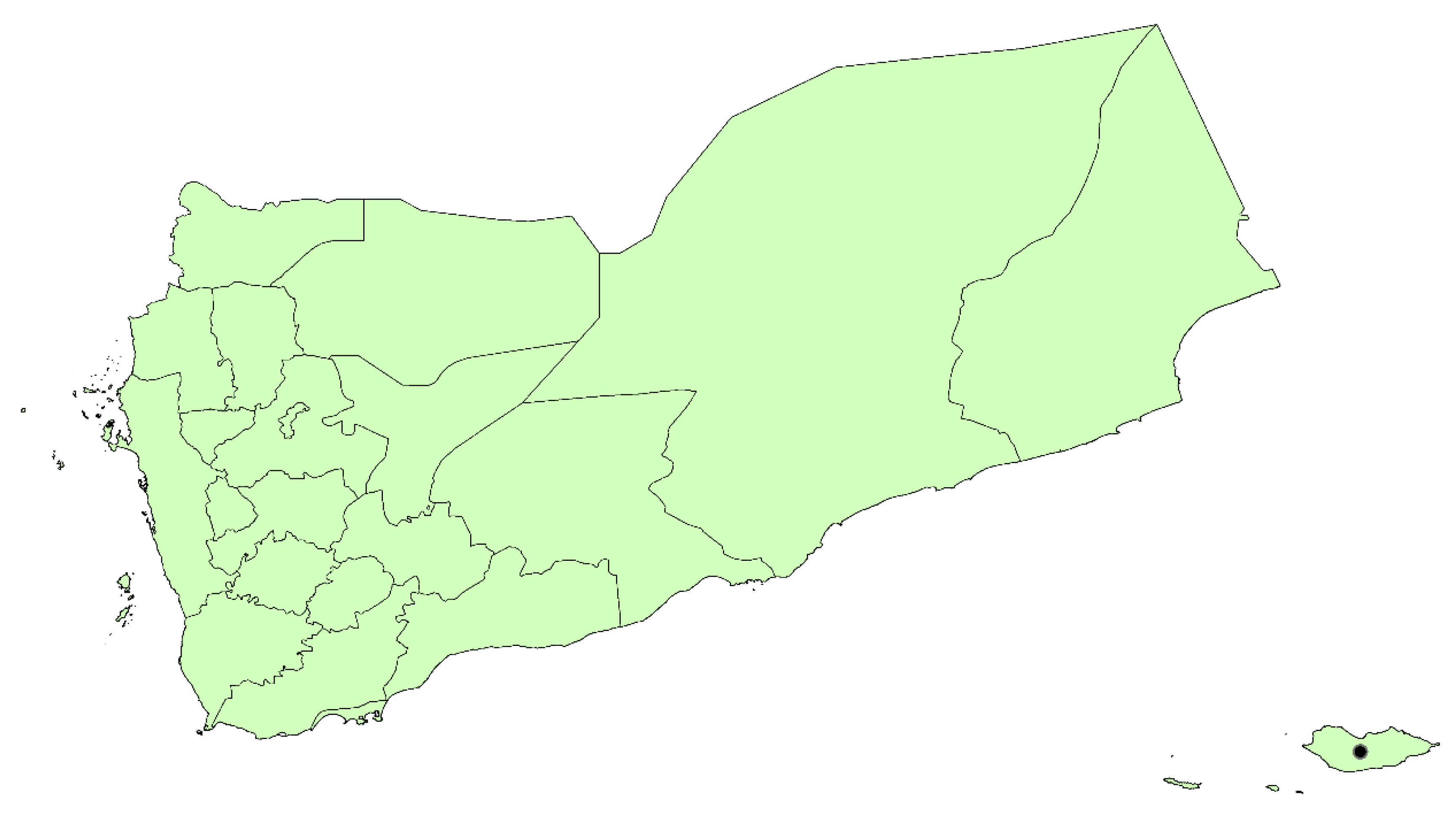
Distribution: Recorded from Aden (Anderson and de Winton 1902; Eisentraut 1960); Lahej (Nader 1975); Ta’iz and Al-Turbah (Scaramella 1975); Wadi Bana in Ba Tays, Damqawt, Ghayl Ba Wazir, Halhal, 5 km W of Hammam Ali, Hawf, Jebel Bura, Marib, Ta’iz, Wadi Adim, Al Mahwit, Hadramaut, San’a, Ibb, Al Mawqir (Benda et al. 2010); Wadi Dhahr, Marib, Hawf, Wadi Dawan, Wadi Maytam, Jebel Bura, Wadi Al Lahm, Hammam Ali, Sah (Dundarova 2011). Van Damme et al. (2018) found a fossil record of R. aegyptiacus in Hoq Cave on the northeastern coast of Socotra Island.
Epomophorus labiatus - Little Epauletted Fruit Bat (Temminck 1837)
Figure 10.
Records of Crocidura suaveolens
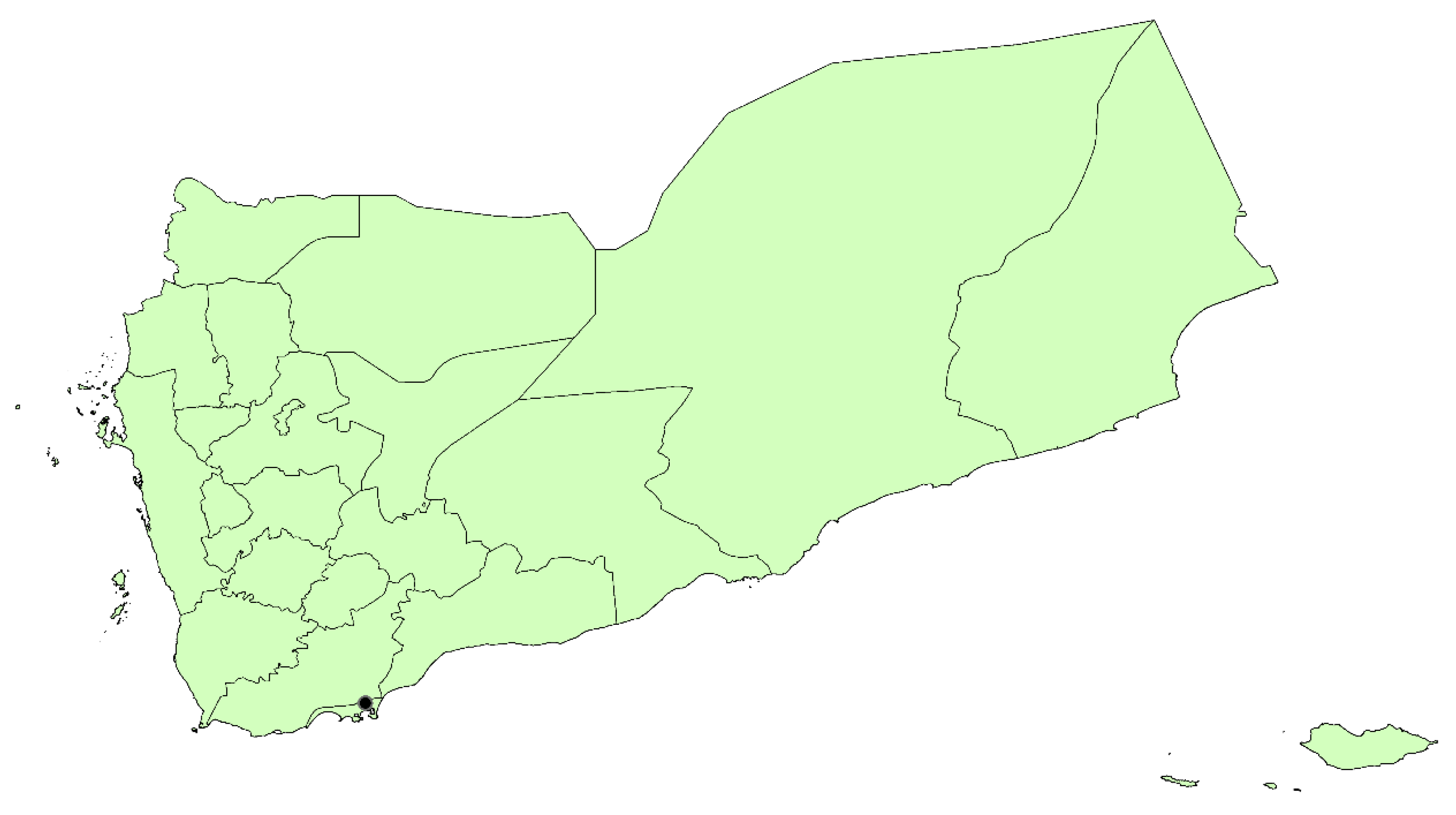
Distribution: Recorded from Halhal, 5 km W of Hammam Ali, 7 km S of Najd An Nashamah, Wadi Al Lahm, Wadi Dhahr, Wadi Maytam (Benda et al. 2010).
Eidolon helvum - African Straw-colored Fruit Bat (Kerr 1792)
Subspecies: E. h. sabaeum (Andersen 1907)
Distribution: Recently recoded from Aden and San’a. Previously recorded from San’a (Scott 1942); Ta’iz (Kuntz and Myers 1968); Ta’iz, wadi Dhabab, wadi Warazan, wadi Bana, Sana'a, Mafhaq, Al-Kadan, Hajah, wadi Khaifah (Al-Safadi 1991); Aden, Lahej, San’a, Ta’iz, Ibyan (Ubadi 1993); Al-Haswa (Baker and Al-Balam 2016).
Family Rhinolophidae
Rhinolophus clivosus - Geoffroy's Horseshoe Bat (Cretzschmar 1828)
Subspecies: R. c. acrotis (Heuglin 1861)
Distribution: Recorded from Ta’iz (Sanborn & Hoogstraal 1953; Radford 1954); Ta’iz, San’a (Macy et al. 1961; Kuntz and Myers 1968). Ellermann & Morrison-Scott (1966) noted this is a common bat in Yemen and it is distributed from the eastern parts of Hadramaut to the southwestern areas of Yemen. Scaramella (1975) noted this bat is distributed in the western parts of Yemen and also can be found southern Yemen. Benda et al. (2017) recorded this bat from six sites in Socotra. Specimens collected by A. D. Forbes-Watson in (1964) from Hadibu in Socotra island are included in the collection of the USNM. Specimens collected by A. R. M. Rickards in (1932) from Aden are included in the collection of the FMNH. Another specimen is in the collection of the SMF.
Rhinolophus blasii - Blasius's Horseshoe Bat (Peters 1866)
Distribution: Recorded from Al-Asr in San’a, near Ma’bar (Hoogstraal & Kaiser 1959); near San’a (Macy et al. 1961); San’a, Ma’bar (Kuntz and Myers 1968). The collection of the natural history museum of Kansas University (KU) included a specimen collected by Hoogstraal from San’a in (1951). Another specimen is in the collection of the SMF.
Family Rhinopomatidae
Rhinopoma cystops - Egyptian Mouse-tailed Bat (Thomas 1903)
Distribution: Forbes (1903) reported this bat as Rhinopoma microphyllum from Hadibu in Socotra. Benda et al. (2017) recorded this species from 32 sites in Socotra.
Rhinopoma hardwickii – Lesser Mouse-tailed Bat (Gray 1831)
Subspecies: R. h. arabium (Thomas 1913)
Distribution: Thomas (1913) recorded this bat from Wasl. The USNM collection included a specimen collected in (1933) from Shibam in Hadramaut. Specimens obtained by A. R. M. Rickards in (1933) from Wadi Shibam, Nisab, and Wadi Dhahr are kept in the collection of the FMNH. Another specimen is in the collection of the SMF. Popov (1960) recorded this bat from Aden.
Rhinopoma hadramauticum – Yemeni Mouse-tailed Bat (Benda et al. 2009)
Distribution: Kock et al. (2001) recorded this bat as R. muscatellum from Ash-Sheher on the coast of the Hadramaut Province. Benda et al. (2009) collected this bat from unoccupied house in the town of Ash-Sheher. These specimens are kept in the collection of the NMP (Mlíkovský et al. 2011).
Family Nycteridae
Nycteris thebaica - Egyptian Slit-faced Bat (Geoffroy 1818)
Subspecies: N. t. adana (Andersen 1912) and N. t. damarensis (Peters 1870)
Distribution: Recorded from Myba, near Aden (Andersen 1912); Al-Asr as Nycteris capensis damarensis (Kuntz & Myers 1968); Aden (Scaramella 1975); Al-Kadan (Al-Safadi 1991). Specimens collected by H. H. Hoogstraal in 1951 from San’a are included in the collections of the FMNH.
Family Hipposideridae
Hipposideros tephrus – (Cabrera 1906)
Distribution: Recorded from Jabal Harir near Lahej (Hayman 1941); Al-Asr and Rawdha in the San’a area (Sanborn and Hoogstraal 1953); Ma’bar (Knutz and Myers 1968); Beni Khawli near Hajjah (Al-Jumaily 1998); Sana village (Benda et al. 2010).
Asellia tridens – Trident bat (Geoffroy 1813)
Distribution: Recorded from Aden (Harrison 1957; Popov 1960); Lahej (Cheesman 1926; Owen and Qumsiyeh 1987). Specimens collected by A. D. Forbes-Watson in (1964) from Hadibu in Socotra island are included in the collection of the USNM.
Asellia italosomalica – Somalian trident bat (De Beaux 1931)
Distribution: Recorded from nine sites in Socotra (Benda et al. 2017).
Asellia arabica – Arabian trident bat (Benda et al. 2011)
Distribution: Recorded from Hawf and Damqawt in Al-Mahra province (Benda et al. 2011).
Triaenops parvus - Yemeni trident leaf-nosed bat (Benda & Vallo 2009)
Distribution: Recorded from Hawf by Benda and Vallo (2009) as a new species. Benda et al. (2011) found this bat in Wadi Zabid. Harrison (1964) and Delaney (1989) included this species in their checklist of bats occurring in Yemen. The collection of the NMP included a specimen collected from Hawf (Mlíkovský et al. 2011).
Family Emballonuridae
Taphozousperforatus - Egyptian Tomb Bat (E. Geoffroy 1818)
Subspecies: T. p. perforatus (E. Geoffroy 1818)
Distribution: Recorded from Lahej (Yerbury and Thomas 1895; Thomas 1900; Harrison 1964; Wranik et al. 1991); Bir Fuqum (Harrison 1964); Aden (Ellermann & Morrison-Scott 1966); Al-Hodeida (Harrison 1964; 1985); Mocca, Shuhayr, Zabid (Benda et al. 2010).
Coleura afra - African Sheath-tailed Bat (Peters 1852)
Subspecies: C. a. gallarum (Thomas 1915)
Distribution: Recorded from Aden, Ras Fakum Bay island (Yerbury & Thomas 1895); Al-Kawd, Lahj and Aden (Harrison 1964); Aden (Ellermann & Morrison-Scott 1966); Mocha (Scaramella 1975); a cave in Shikhawi, Al-Hadhan, Al-Didi (Al-Jumaily 2004); Aden, Shuhayr (Benda et al. 2010).
Family Vespertilionidae
Eptesicus nasutus - Sind Bat (Dobson 1877)
Subspecies: E. n. matschiei (Thomas 1905)
Distribution: Recorded from Wadi Zabid (Benda et al. 2010).
Hypsugo ariel - Fairy Pipistrelle (Thomas 1904)
Distribution: Recorded from Seiyun, Wadi Hadramaut (Harrison 1960); Jazirat al Abid (Harrison 1964); Socotra (Menu 1987; Guichard 1992); Al-Nueimah, Damqawt, Hawf, Wadi Daw’an, Socotra (Benda et al. 2010).
Hypsugo lanzai (Benda et al. 2010)
Subspecies: None. This is a new species discovered by Benda et al. (2010)
Distribution: Recorded from Wadi Es Gego in Socotra Island (Benda et al. 2010). Also, this bat was reported from five other localities in Socotra (Benda et al. 2017). These specimens are kept in the collection of the NMP (Mlíkovský et al. 2011)
Myotis bocagii - Rufous Mouse-eared Bat (Peters 1870)
Distribution: Restricted to the extreme southwestern parts of Yemen. Listed as a bat species occurring in Yemen by Harrison (1964); Wilson & Reeder (2005); and Taylor (2019).
Myotis emarginatus - Geoffroy's Myotis (Geoffroy 1806)
Distribution: Kock et al. (2002) suggested this bat might occur in Yemen. Al-Jumaily (2003) recorded this bat species for the first time in Yemen from San’a.
Neoromicia guineensis - Guinean Serotine (Bocage 1889)
Distribution: Recorded from 20 km north northwest of Ash Shuqayrah, Wadi Bani Khawlan, Jabel Bura, 5 km W of Riqab (Benda et al. 2010).
Nycticeinopsschlieffeni - Schlieffen's Twilight Bat (Peters 1859)
Distribution: Recorded from areas between Al-Kawd and Durayhimy (Matschie 1893; Yerbury & Thomas 1895; Thomas 1900; Harrison 1985; Harrison & Bates 1991; Wranik et al. 1991) Bayhan Al-Qisab (Harrison 1964); Aden, Ba Tays, Wadi Bana, Wadi Zabid (Benda et al. 2010).
Scotophilus dinganii - Yellow-bellied House Bat (Smith 1833)
Distribution: Recorded from Lahej (Harrison 1964); Hodeida area, Al-Kadan, Wadi Qualaiah (Al-Safadi 1991); Saber (Wranik et al. 1991); near Hodeida (Harrison & Bates 1991); mountain areas of Ibb, from the Al-Thahar quarter (Al-Jumaily 2004); Kadamat Al-Abdali, Wadi Tuban, Mashgab, 7 km south of Najd An-Nashamah, 5 km S of Suq Ad-Dabab, Wadi Maytam, Wadi Zabid, Al Hadr, Lahj Al-Hutah (Benda et al. 2010). Scaramella (1975) noted this bat can be found southern Yemen.
Scotophilus leucogaster - White-bellied House Bat (Cretzschmar 1830)
Distribution: Recorded from Lahej (Harrison 1964); Al-Kadan, wadi Qualaiah (Al-Safadi 1991).
Plecotus balensis - Bale Long-eared Bat (Kruskop & Lavrenchenko 2000)
Distribution: Recorded from Al-Masajjid (Al-Jumaily 2004); Al-Ahjur (Benda et al. 2010).
Pipistrellus kuhli - Kuhl's Pipistrelle (Kuhl 1817)
Subspecies: P. k. kuhlii (Kuhl 1817)
Distribution: Recorded from San’a, Ma'bar (Hoogstraal & Kaiser 1959; Kuntz and Myers 1968). Specimens collected from San’a and Ma'bar by Hoogstraal in (1951) are included in the collection of the FMNH.
Pipistrellus dhofarensis – Dhofar Pipistrelle (Benda et al. 2016)
Subspecies: None.
Distribution: This is a new species discovered by Benda et al. (2016). It was recorded from Hawf by Benda et al. (2016).
Family Miniopteridae
Miniopterus natalensis – Natal Long-fingered Bat (Smith 1834)
Subspecies: M. n. natalensis (Smith 1834)
Distribution: Recorded from At-Tur (Nader and Kock 1987); Hud Sawa Cave at Al-Mahwit (Al-Jumaily 2004); Halhal, Jebel Bura (Benda et al. 2010). The zoology collections of the ZFMK included specimens collected from Yemen.
Miniopterus schreibersii - Schreibers's Long-fingered Bat (Kuhl 1817)
Subspecies: M. s. arenarius (Heller 1912)
Distribution: Recorded from Al-Tur area by F. Schutte and H.P. Fritz in (1985) and these specimens are included in the collection of the ZFMK.
FamilyMolossidae
Tadaridaaegyptiaca - Egyptian Free-tailed Bat (Geoffroy 1818)
Subspecies: T. a. aegyptiaca (Geoffroy 1818)
Distribution: Recorded from Ta’iz (Al-Safadi 1991); 5 km west of Hammam Ali, Hawf, Jebel Bura, Kadamat Al-Abdali, Wadi Tuban (Benda et al. 2010).
Chaerephon nigeriae - Nigerian Free-tailed Bat (Thomas 1913)
Subspecies: C. n. nigeriae (Thomas 1913)
Distribution: Recorded from Bani Khawli, Quful Shammar, Hajja region, northwestern Yemen (Al-Jumaily 2002); Jebel Bura, Wadi Zabid (Benda et al. 2010).
Chaerephon pumilus - Little Free-tailed Bat (Cretzschmar 1831)
Subspecies: C. p. pumilus (Cretzschmar 1831)
Distribution: Recorded from Bajil (Hoogstraal & Kaiser 1959); Hodeida and Hajah by (Sanborn and Hoogstraal 1953; Nader and Kock 1980; Al-Safadi 1991; Harrison and Bates 1991; Al-Jumaily 1998; 2002; 2004). Benda et al. (2010) observed this bat from the following localities: Ash Shuqayrah, Wadi Bani Khawlan, Wadi Am Rija’, Ba Tays, Halhal, Kadamat Al-Abdali, Wadi Al-Lahm, and Wadi Zabid. Specimens collected from Bajil by Hoogstraal in (1951) are included in the collection of the FMNH.
Otomops martiensseni - Large-eared Free-tailed Bat (Matschie 1897)
Subspecies:O. m. martiensseni (Matschie 1897)
Distribution: Al-Jumaily (1999) found this bat for the first time roosting in Hud Sawa caves in the province of Al-Mahwit. Benda et al. (2011) included this species in his checklist of bats of Yemen. However, Taylor (2019) did not list this bat as a species occurring in Yemen. Collection of Harrison Zoological Museum included a specimen. Another specimen is in the possession of the SMF.
OrderCARNIVORA
Family:Canidae
Canis aureus- Golden jackal (Linnaeus 1758)
Subspecies: C. a. aureus (Linnaeus 1758)
Figure 11.
Records of Canis aureus.
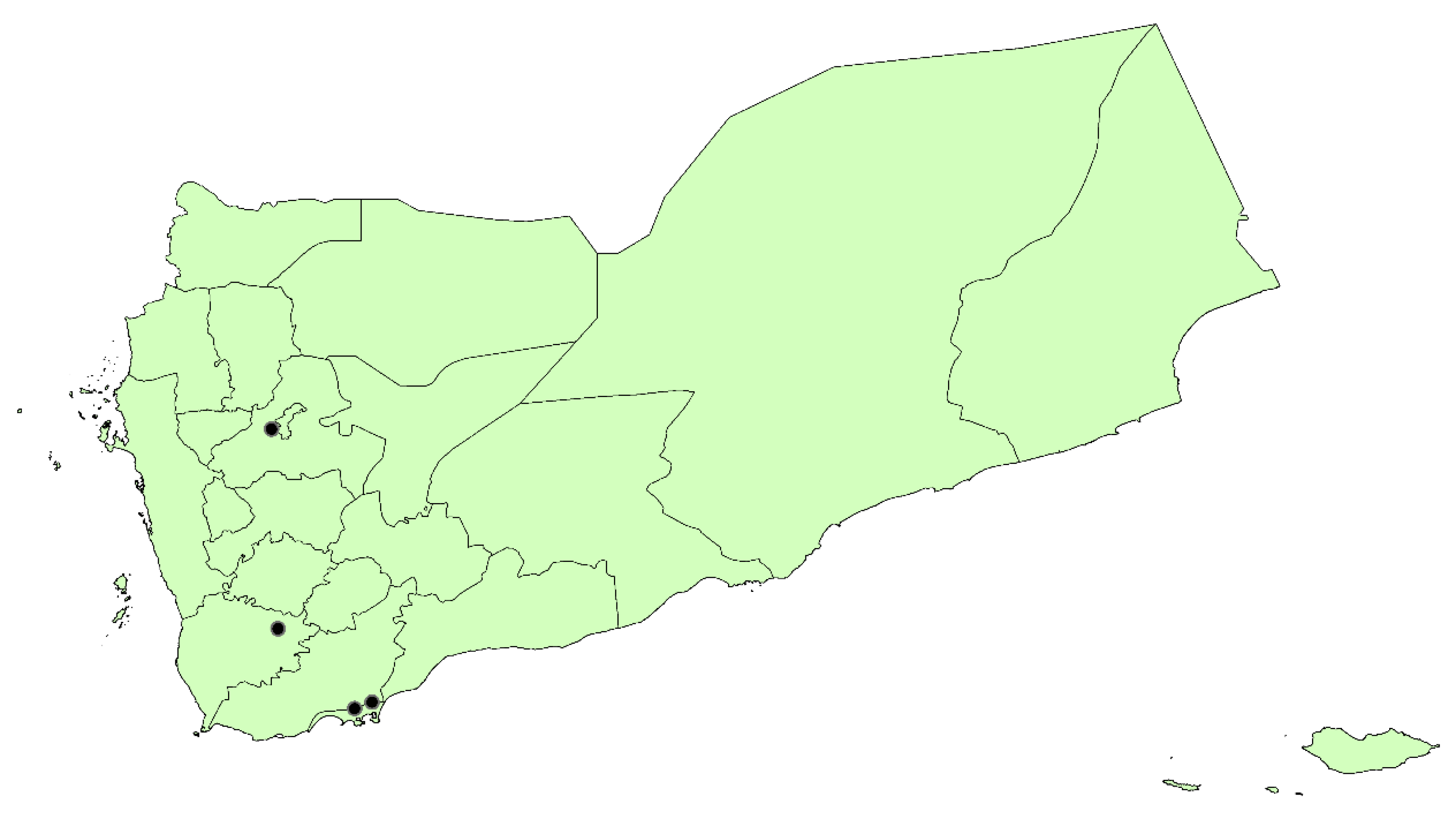
Distribution: This is a very rare carnivore in Yemen. Hunter (1877) saw few jackals in Aden. Yerbury and Thomas (1895) reported this species near the municipal bungalow at Sheikh Othman district and near the isthmus of Aden. Hoogstraal (1952) indicated jackals are common in Yemen as he observed these animals slinking in towns and fields in the western areas of Yemen. Scaramella (1975) reported this jackal from areas around San’a. According to Al-Safadi (1992), jackals are restricted to the southeastern areas of north Yemen and some areas southern Yemen. Al-Safadi (1995) reported unconfirmed records of Canis aureus from Warzan. According to Al-Jumaily (1998) and Mallon and Budd (2011), the distribution status of this species is unknown in Yemen. The MCZ has a specimen collected from Yemen.
Canis lupus – Grey wolf (Linnaeus 1758)
Figure 12.
Records of Canis lupus.
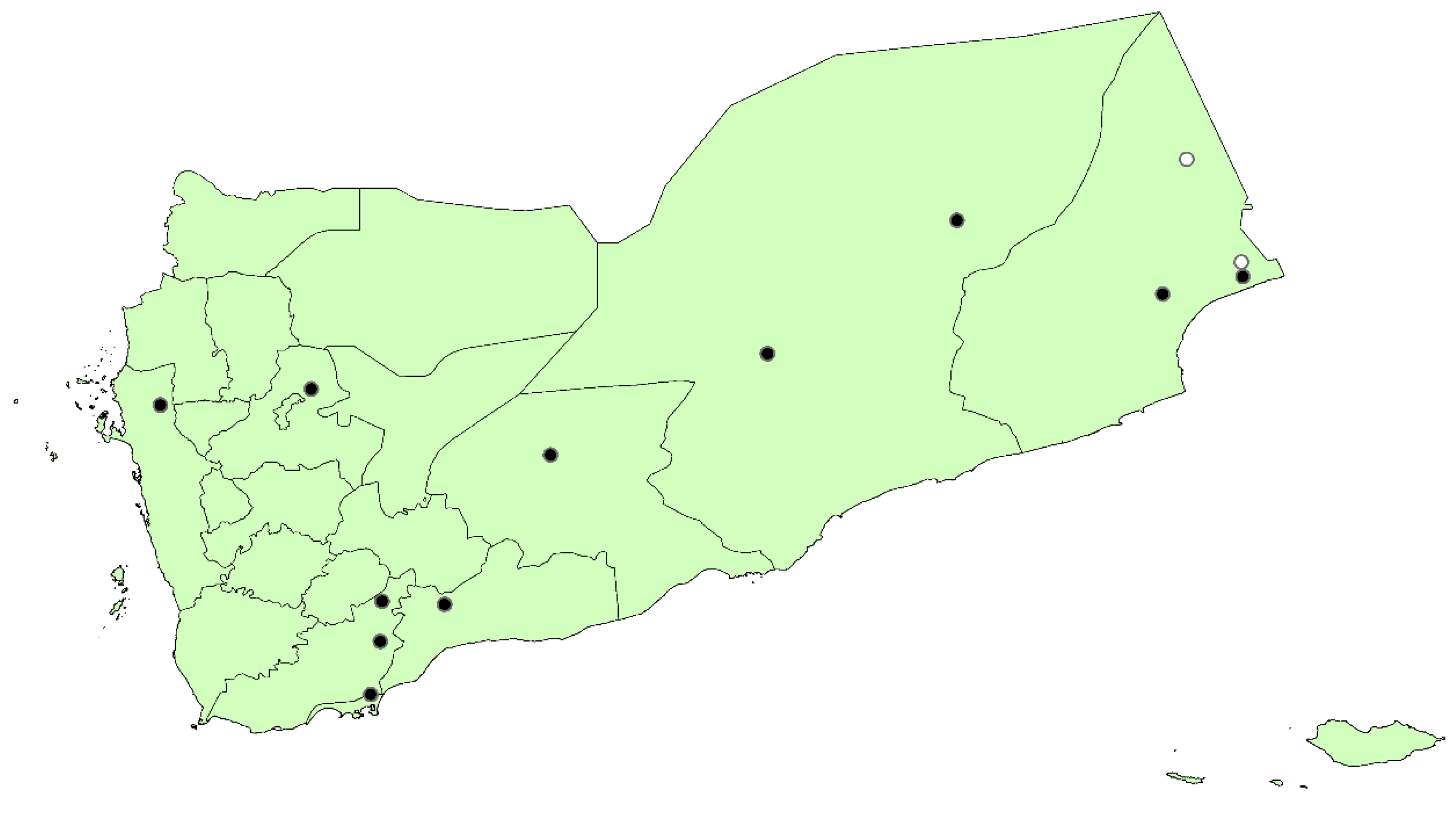
Subspecies: C. l. arabs (Pocock 1934)
Distribution: Used to be very common in Yemen and now very rare. Recently recorded from the northern desert areas of Al-Mahra. Another record came from the eastern regions of Hawf. Previously recorded from Aden as C. hadramauticus by (Noack 1896) and (Thomas 1900). De Winton (1899) and Schwarz (1926) recorded this wolf also from Aden as C. pallipes. Thomas (1900) noted this wolf is widespread in the hills of Yemen. Reported from Aden and north of Lahej (Pocock 1935); Hadramaut and possibly Aden (Popov 1960); outside Aden (Jennings 1992); rocky hills northern Lahej, Seiyun, Radfan, Jiheen, Wadi Shafwat, Rumah (Ubadi 1993); unconfirmed records from Nahim and Makhala (Al-Safadi 1995); Hawf (Pittet 2011; Al-Khorozyan et al. 2014). According to Al-Safadi (1992), wolves are restricted to the mountainous areas of southeastern Ta’iz, Ib and Sa’da. Stuart & Stuart (1996) noted wolves in Yemen can be found in the mountainous areas. Pittet (2011) noted this wolf is common in Al-Mahra province. According to Mallon and Budd (2011), wolves may occur in northern Yemen but their distribution has not been properly documented. They reported one wolf was killed in Shabwa in 2006 and it was photographed in Hawf between September 2010 and January 2011.
Vulpes cana - Blanford’s Fox (Blanford 1877)
Subspecies: None
Figure 13.
Records of Vulpes cana.
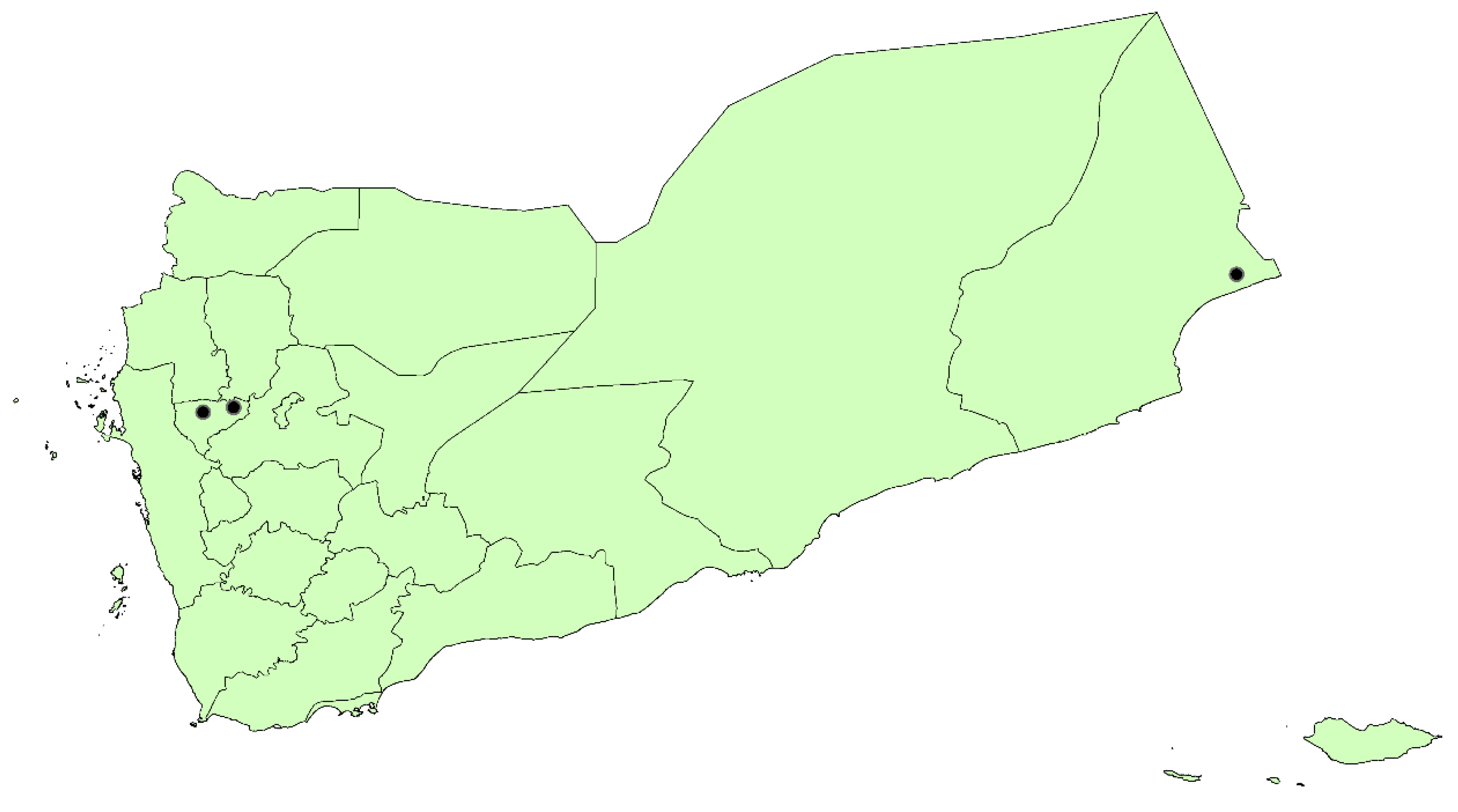
Distribution: Very rare. Known from rocky terrains and steep cliffs in the eastern parts of Yemen that border Oman. Recently reported from an area near Hawf. Geffen et al. (1993) predicted this fox could occur in Yemen. Al-Safadi (1995) reported this fox from two localities in the province of Mahweet: Al-Ahgor and Makhala. Mallon and Budd (2011) suggested this fox might occur in the northwestern areas of Yemen. Al-Jumaily et al. (2012) recorded for the first time a Blanford’s Fox from Hawf forest. Al-Khorozyan et al. (2014) came later to confirm this record with photographs of this species from Hawf protectorate.
Vulpes rueppellii - Rüppell's Fox (Schinz 1825)
Subspecies: V. r. sabaea (Pocock 1934)
Figure 14.
Records of Vulpes rueppellii.
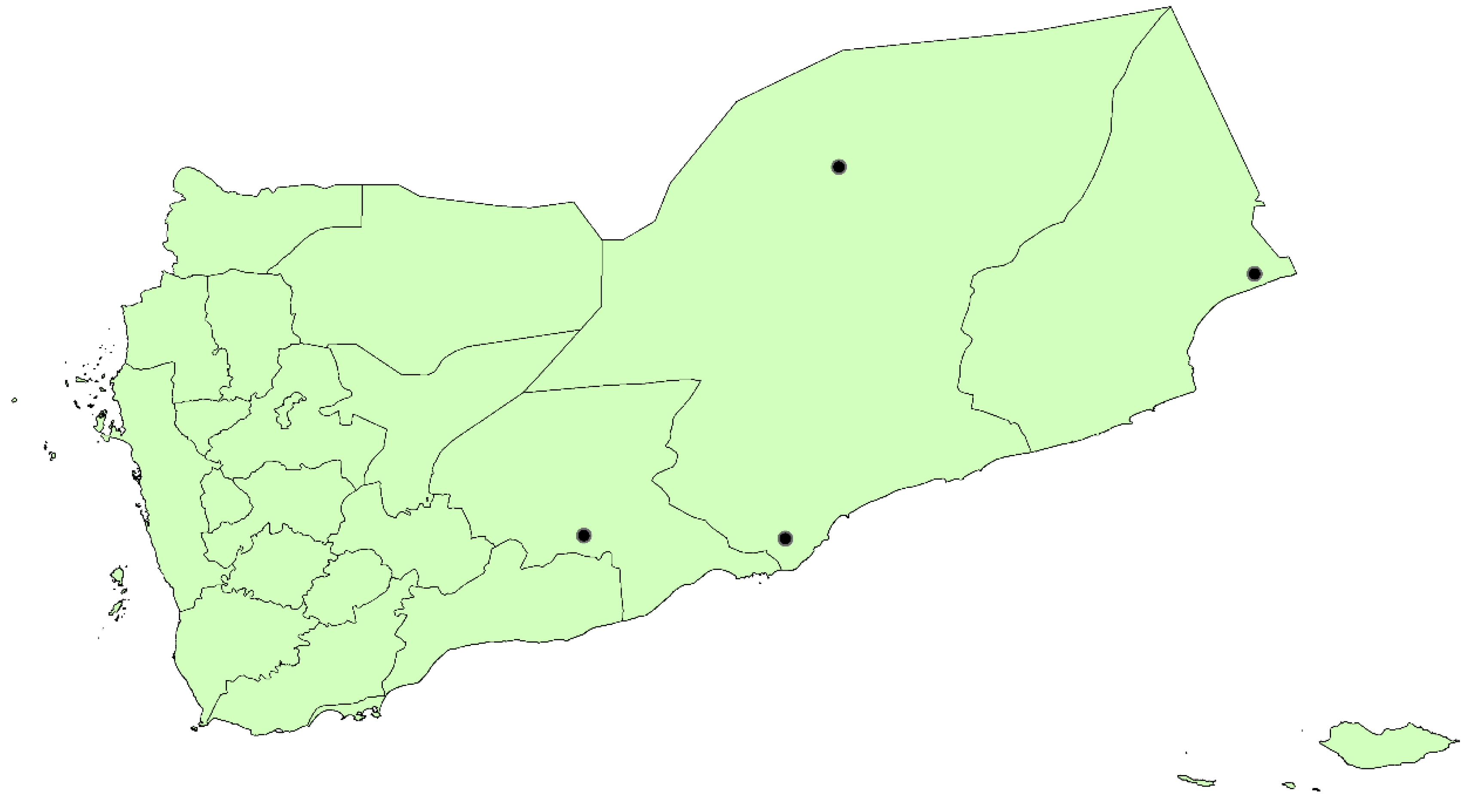
Distribution: Rare and uncommon. Distribution status of this fox is unknown in Yemen. Popov (1960) noted this fox can be found in Aden. According to Castelló (2018), its occurrence might be widespread in Yemen. Ubadi (1993) noted this fox could be found northern Hadramaut and in the rocky hills of northeastern Yemen. Showler (1996) recorded this fox from three localities: Yashbum- Wadi Habban, Wadi Hajr, and Ras Fartak hills. On the other hand, Al-Safadi (1992) noted that this fox can be found in the bordering areas of Rub Al-Khali north of Yemen. Mallon and Budd (2011) indicated this fox was recorded in the south and north of Yemen.
Vulpes vulpes – Red fox (Linnaeus 1758)
Subspecies: V. v. arabica (Thomas 1902)
Figure 15.
Records of Vulpes vulpes.
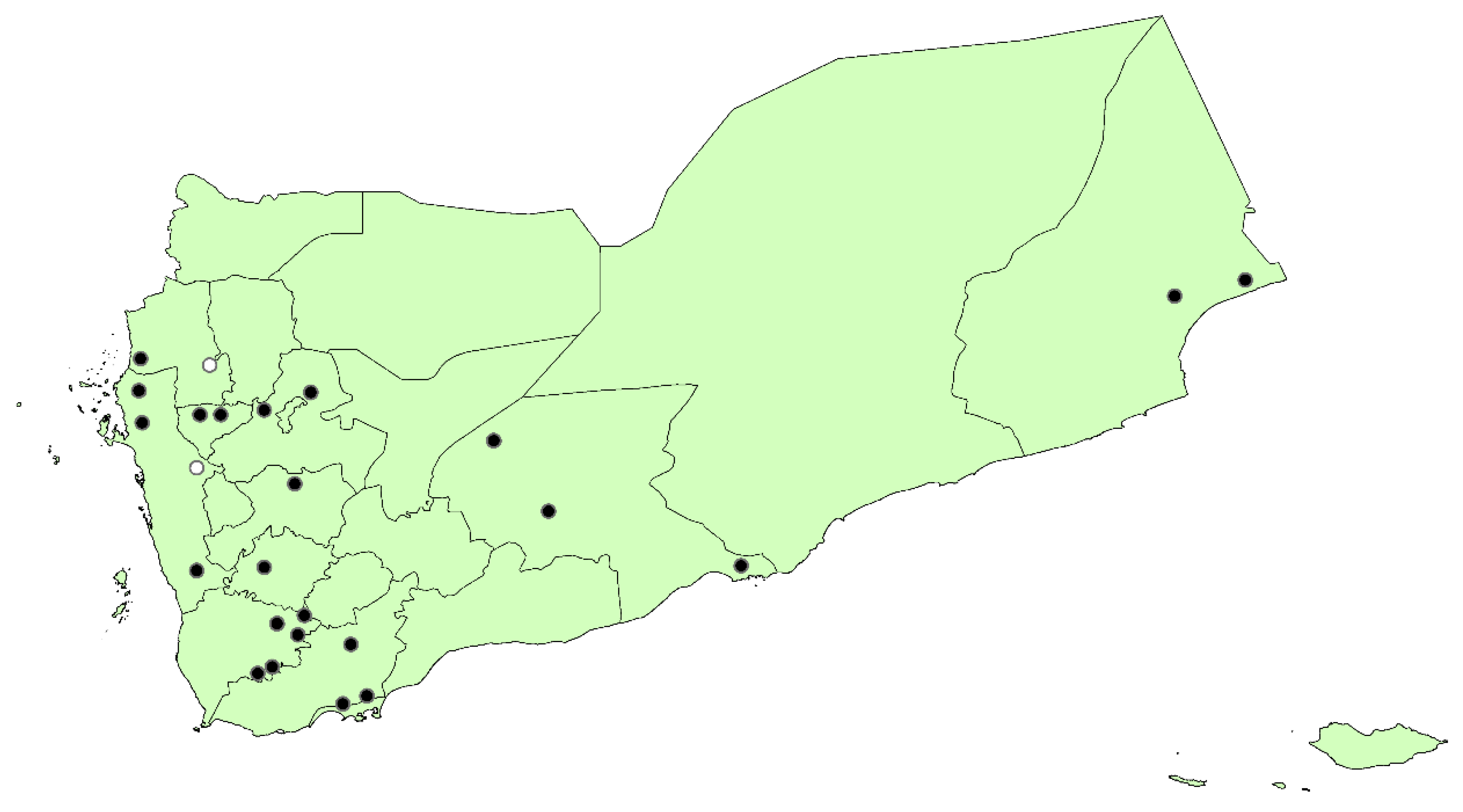
Distribution: This is a very common fox in Yemen. Recently recorded from Wadi Sharras and Bura’. Hunter (1877) and Morrison-Scott (1939) recorded this fox from Aden. Sanborn and Hoogstraal (1953) examined two male specimens collected from Jebel Zarba in Ta’iz and from three km east of Ma'bar. Reported also from the same area Jabal Zarba by Hoogstraal & Kaiser (1959). Popov (1960) reported this fox from Aden. Specimens collected by H. W. Setzer in (1961) from the province of Hadramaut are included in the collection of the USNM. Another specimen collected from Ta’iz is in the collection of the FMNH. Scaramella (1975) recorded this fox from San’a and its surroundings. Ubadi (1993) found this fox in Nisab, Bi’r Ali, Lahej. Showler (1996) recorded this fox from Wadi al-Masilah in addition to 13 observations from different areas. Al-Safadi (1992) noted this fox is widespread in all regions of Yemen. Al-Safadi (1995) reported this fox from 15 localities: Luah, Kadan, Siham, Zabid, Ausaifera, Dabab, Barakani, Warazan, Malhah, Bana, Mabar, Dahr, Nahim, Al-Ahgor, and Makhala. Ravishankar et al. (2008) reported this fox from Wadi Bayhan in the northern areas of Shabwa province. According to a distribution map provided by Mallon and Budd (2011), this fox is abundant in Yemen. Al-Khorozyan et al. (2014) reported this fox from Hawf. While Baker and Al-Balam (2016) recorded this fox from Al-Haswa natural protectorate.
Family: Felida
Felis silvestris – wildcat (Schreber 1777)
Subspecies: F. s. tristrami (Pocock 1944)
Figure 16.
Records of Felis silvestris.
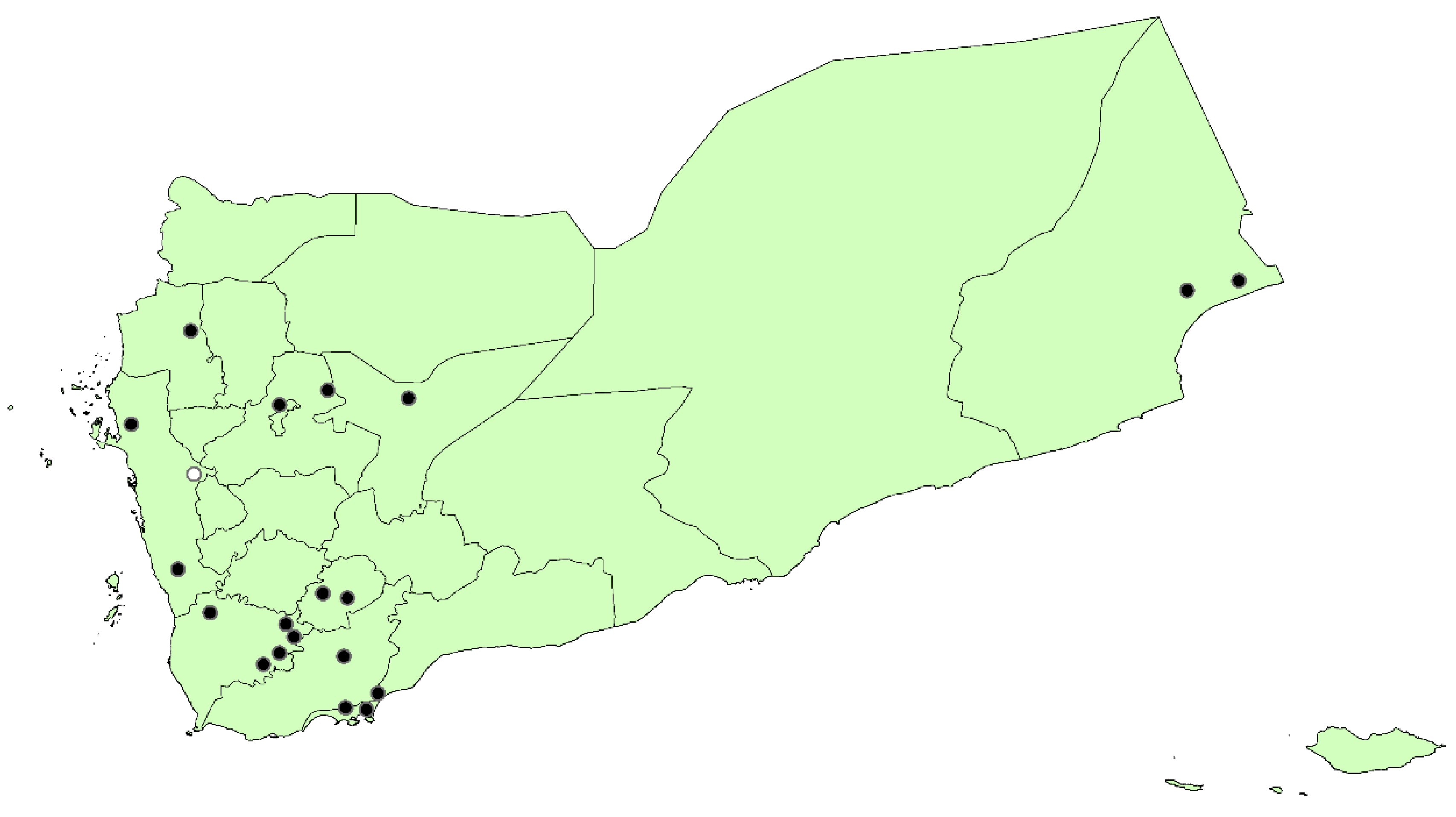
Distribution: Common. Recently recorded from Bura’. Previously reported from Jabal Harir (Scott 1942); Aden (Popov 1960); Wadi Warazan, Quatabah, Wadi al-Barh, and Wadi Zabid (Al-Safadi and Nader 1990); Lahej, Hodeidah, Wadi Shafwat, between Aden and Abyan, Wadi Mawr (Ubadi 1993). Al-Safadi observed wildcats in Ausaifera, Dabab, Warazan, and Nahim. Al-Jumaily (1998) reported a dead individual was found in Hadda street in Sana on the 15th of June )1994(. Al-Khorozyan et al. )2014) recorded this species from Hawf using camera traps. Han (2011) reported seeing a wildcat in Marib in (2004). According to Mallon and Budd (2011), the distribution of this cat is possibly widespread in Yemen. Baker and Al-Balam (2016) reported and photographed wildcats in Al-Haswa natural protectorate.
Felis margarita – sand cat (Loche 1858)
Subspecies: F. m. harrisoni (Hemmer, Grubb and Groves 1976)
Figure 17.
Records of Felis margarita.
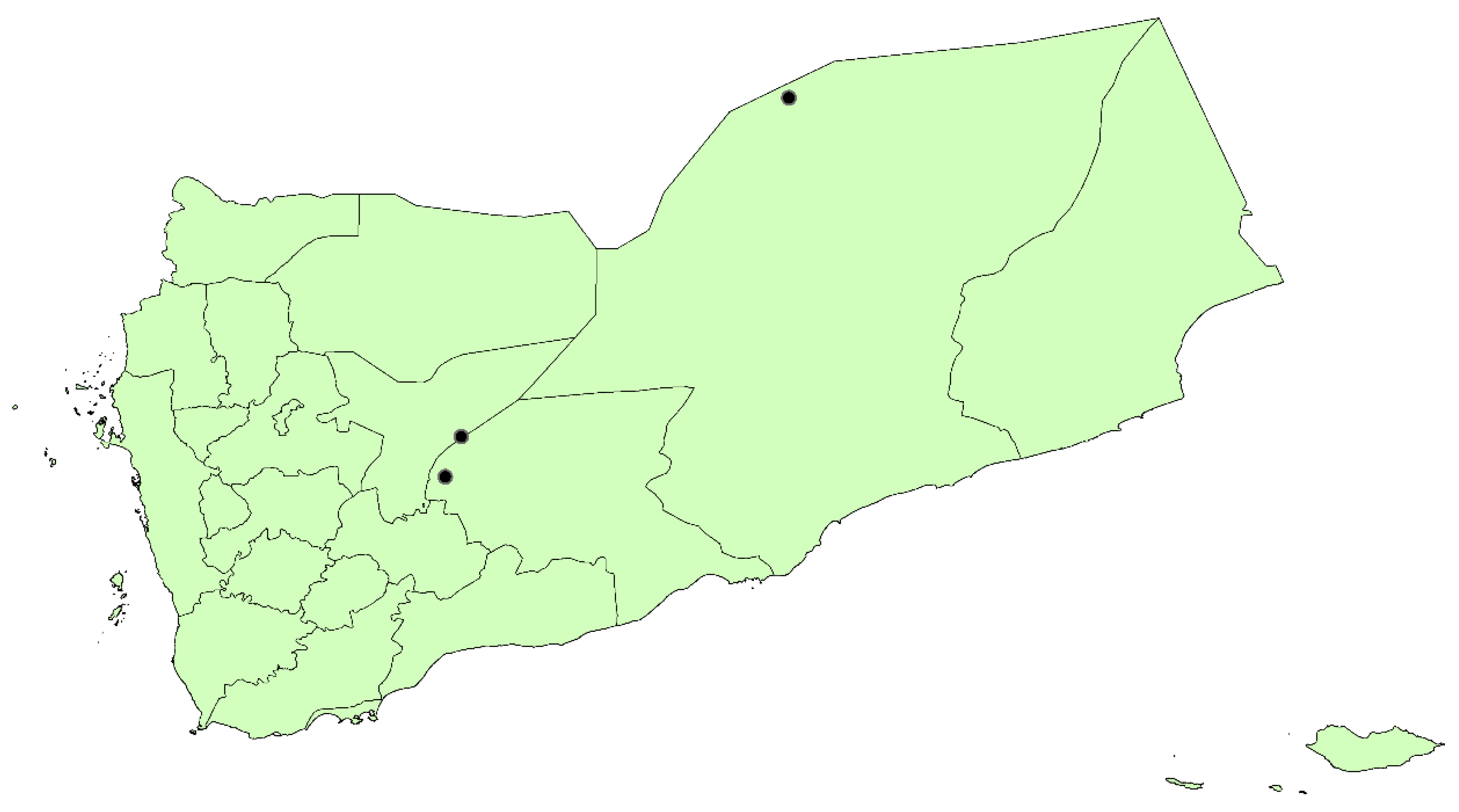
Distribution: Reported from Beihan (Hayman 1952; Popov 1960). Al-Safadi (1990) noted its presence in the eastern desert, at the borders of the Rub al-Khali. Mallon and Budd (2011) suggested the distribution of this species was possible in the Rub al-Khali. Howard-McCombe et al. (2019) suggested that lack of recent sightings might raise concerns about local extinction in Yemen. The distribution status of this cat is currently unknown in Yemen. However, it is too early to assume this species has gone extinct based on just lack of recent sightings. This cat is very likely still occur in the northern desert areas of Hadramaut. Banfield et al. (2014) described the southern fringe of the Rub al-Khali and in the Ramlat as Sabatayn as possible habitats that can shelter sandy cats.
Caracal caracal - Caracal lynx (Schreber 1776)
Subspecies: C. c. schmitzi (Matschie 1912)
Figure 18.
Records of Caracal caracal.
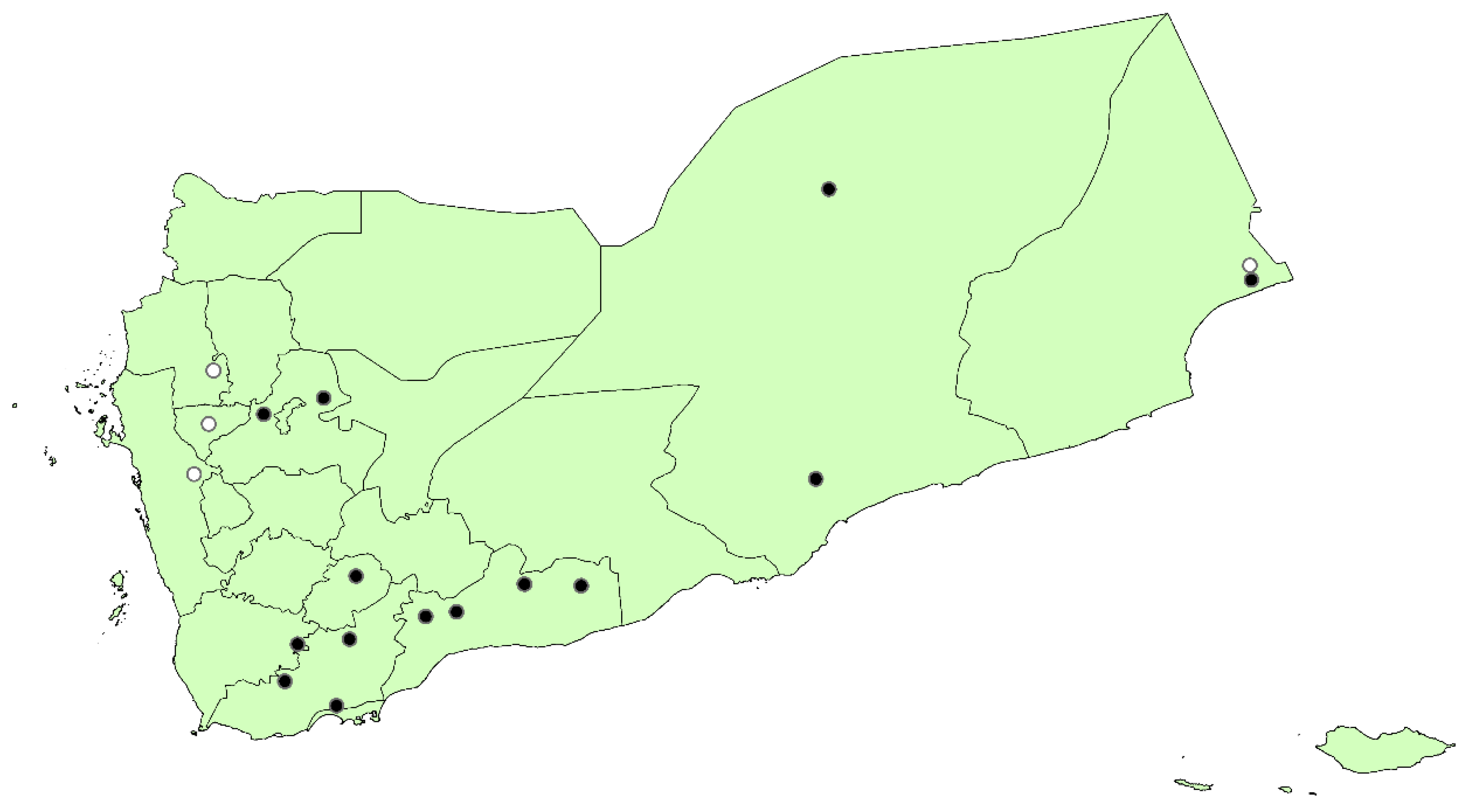
Distribution: Recently reported from Hawf, Al-Mahweet, Wadi Sharres and Bura’. Yerbury and Thomas (1895) reported this species from Haithalhim and Habil. Also, it was reported from Wadi el-Kabir by Thomas (1900). Popov suggested this species might exist in Aden. While Harrison and Bates (1991) reported it from Dhala. Al-Safadi (1990) noted its distribution in the woods and the heavily vegetated areas in the southern and southeastern parts of northern Yemen. Ubadi (1993) observed few specimens in Wadi Hassan, Abyan, Ahwar, Thamud, Al-Habilayn. Jennings (1992) noted the Caracal lynx was seen from over a widespread area near the Omani borders in the east, to the borders with the former North Yemen in the west. Al-Safadi recorded this lynx from three localities: Warazan, Dahr, and Nahim. Al-Jumaily (1998) provided records of this species from southern regions of Yemen. This species was also reported and photographed from Hawf (Pittet 2011; Al-Khorozyan et al. 2014).
Panthera pardus - Leopard (Linnaeus 1758)
Subspecies: P. p. nimr (Hemprich & Ehrenberg 1833)
Figure 19.
Records of Panthera pardus.
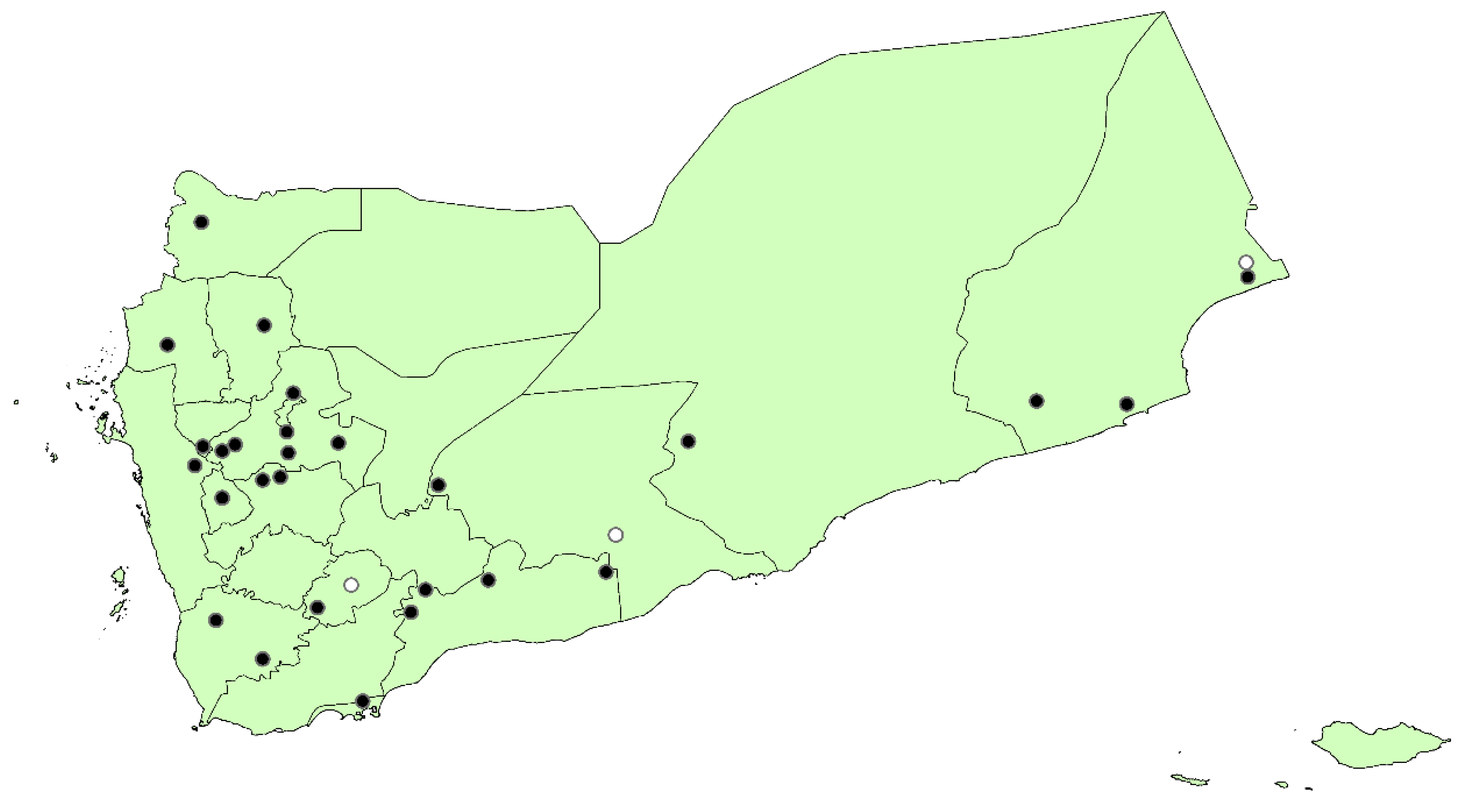
Distribution: Restricted to the mountainous and hilly terrains of Yemen. Thomas (1902) noted leopards are abundant in Dethina. Bury (1911) reported leopards were hunted in Mar’an. Glaser (1913) described this species as occurring in Marib. Al-Tha’alibi (1924) noted the leopard is common in Walan and the mountainous areas between the villages of Naqil Yaslih and Bait Az Zaydah. Scott (1942) reported in his book “In the High Yemen” that he saw a leopard recently being captured from Sabr Mountain near Ta’iz and he also saw a skin of a leopard in San’a. Thesiger (1949) noticed tracks of a leopard in Wadi Makhya, north of Wadi Hadhramaut. Sanborn and Hoogstraal (1953) reported s leopard skin was bought at Mabar and two other skins at San’a. The skins from San’a were taken from a recently killed leopards neaby Bani Dabiyan area. According to their field notes, Sanborn and Hoogstraal (1953) described the distribution of leopard in Yemen as rare in the coastal lowlands and also uncommon in the uplands. Popov (1960) suggested this species could occur in the mountains of Aden. Stookey (1982) noted the leopard had disappeared from the southern areas of Yemen from the beginnings of the twentieth century; Harrison and Bates (1991) noted the leopard could be found in Aden, Jabal Hasha, Mahfid, and Beihan. Ubadi (1993) recorded leopards from Habil Jabr, Wadi Al-Masila, mountains of Kawr, Qishn and Hawf. Al-Safadi (1995) recorded a leopard from Al-Ahgor. Stuart & Stuart (1996) indicated the leopard still occurs widely in the western mountains but probably in very low numbers. CBSG (2000) report on the distribution status of leopards in Yemen noted this species was found in Al-Wada. EPAA report on the threatened mammals of Arabia (2002) noted the occurrence of leopard in Yemen in the following areas: Al-Haym, Al-Wada north of Sana'a, Al-Mahra and mountains north of Aden. According to Al-Jumaily et al. (2006), distribution of the Arabian leopard in Yemen is restricted to the following localities: between Sa’dah and the northern border with Saudi Arabia; Kufl Shammar, in Hajjar Governorate; Al Hayma, east of Manakhah; Jebel Bura and Jebel Raymah; between Ta’iz and Aden; Hadhramaut; and Al Mahra. Malon et al. (2008) reported two leopard live-trappers from Wa’da said they had captured 14 animals in (2007). Kasparek (2007) mentioned unconfirmed reports of this leopard in the lower regions of the mountains of Haraz. Stanton (2008) described Wadi Lefaj in Wada’a, Amran as a probable area where leopards might still exist. Pittet (2011) mentioned reports of locals killing a leopard trapped in a cave in Al-Hawf. Mallon and Budd (2011) provided a camera trap photograph of a leopard in Hawf. A recent confirmed record included a photograph of a local hunter with two killed leopards from Al-Sha’ib in Al-Dhali’ province. Previous records of illegal hunting of leopards described 18 leopards were killed between the period of 2014 to 2018 in different areas from the provinces of Al-Mahra, Al-Dhali’, and Ibyan. In addition to stories from hunters reporting the killing of more than 11 leopards in the village of Hadwab in Hawf. Most recent reports from locals confirmed seeing leopards in the mountains of Koor Al-Awaliq in 2019. A most recent record of a female leopard was captured in Yafa’. Another female individual was captured in Shabwa. In addition to one male leopard trapped in Lawdar. A specimen collected in (1951) from San’a is in the collection of the FMNH.
Acinonyx jubatus- Cheetah (Schreber 1775)
Subspecies: A. j. venaticus (Griffith 1821)
Figure 20.
Records of Acinonyx jubatus.
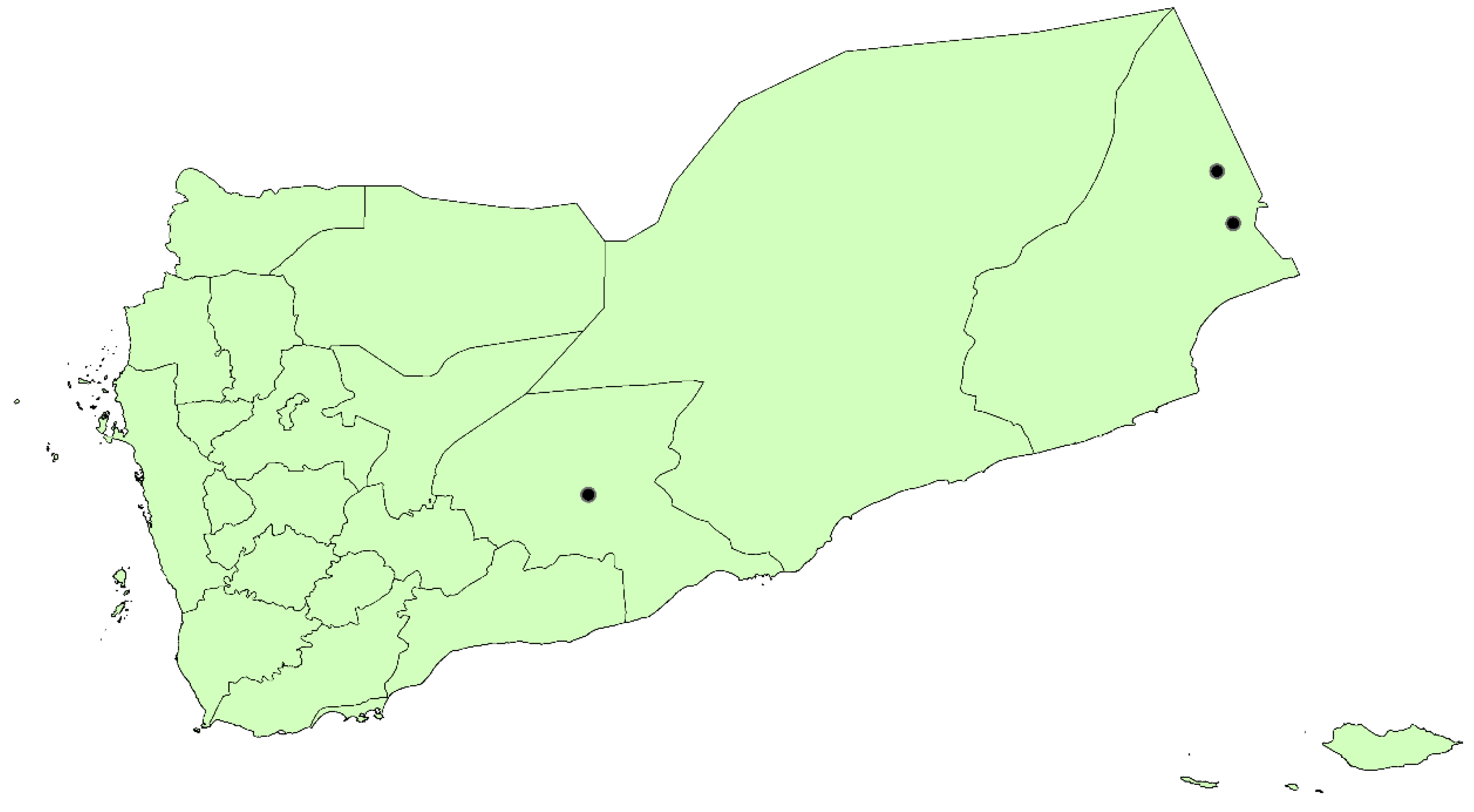
Distribution: Cheetah is now officially considered a regionally extinct species from the Arabian Peninsula (Mallon 2011). Ducker (2006) mentioned seeing a cheetah in March 1963 in an area to the east of Sanau. Based on this account, Harrison (1972) described Ducker’s reporting as one of the last verified cheetah records in wild Arabia. However, Harrison’s (1968) distribution map of cheetah in Arabia did not show this species exists in Yemen. Harrison and Bates (1991) reported a cheetah was seen in Wadi Mitan south of Yemen in (1963). Kingdon (1991) described Al-Mahra province as the last stronghold of cheetah in Yemen. Jennings (1992) was informed of an unsubstantiated reference to a possible Cheetah sighting in the mid-1980s. Ubadi (1993) noted a stuffed skin of cheetah was seen hanging on a building in Ataq in (1985), and was thought to have been killed in the same area. Al-Jumaily (1998) noted the cheetah might be extinct in Yemen. Mallon and Budd (2011) described the distribution of cheetah in the Arabian Peninsula as regionally extinct. Based on the previous reports and the lack of any recent confirmable evidence of the occurrence of this species in Yemen, cheetah now is definitely an extinct species in Yemen and should not be included in any further updated checklist of living mammals of Yemen.
Family Viverridae
Viverricula indica –Small Indian Civet (Geoffroy Saint-Hilaire 1803)
Subspecies: V. i. indica (Geoffroy Saint-Hilaire 1803)
Figure 21.
Records of Viverricula indica.
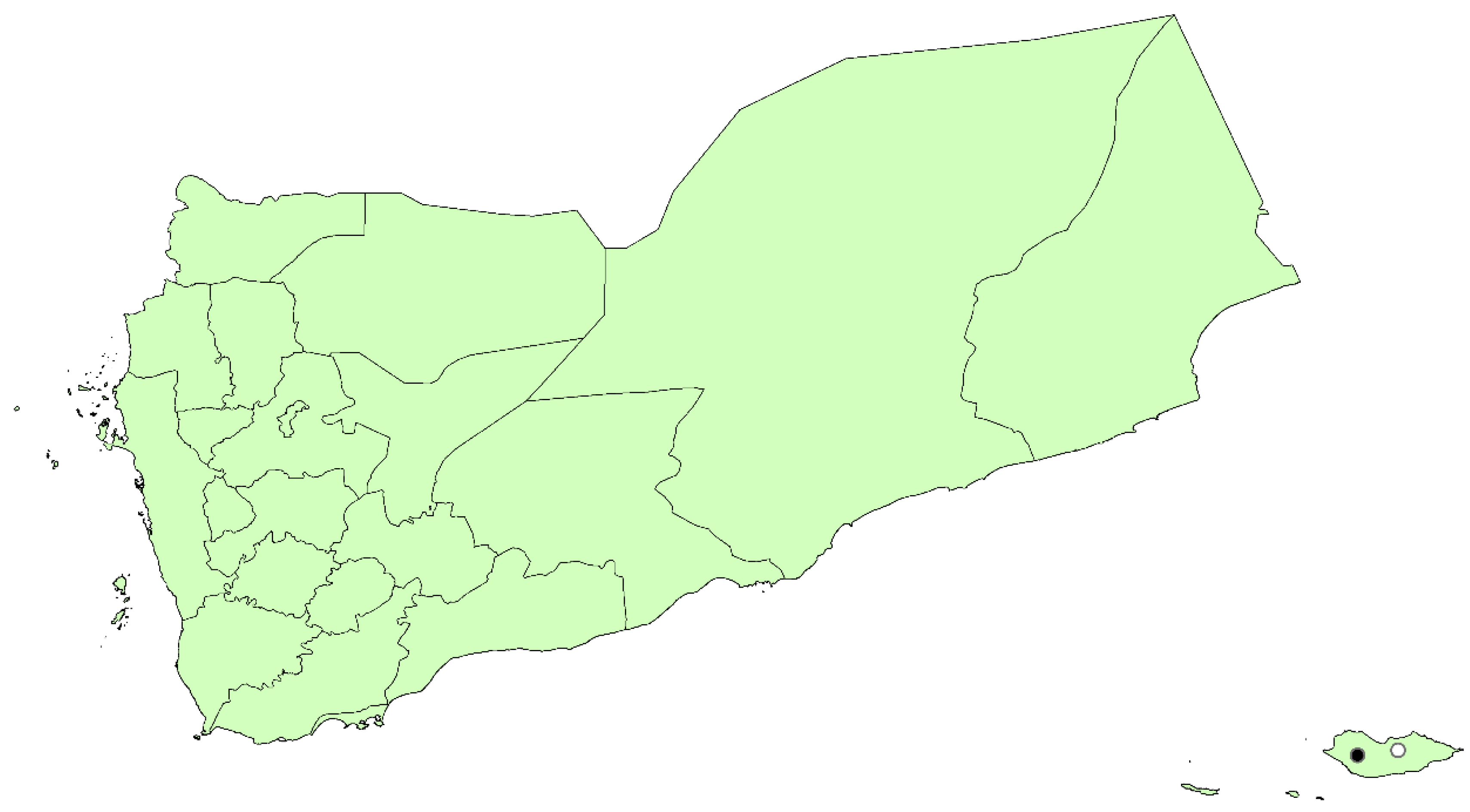
Distribution: An introduced species. Restricted and common in Socotra. Recent records: Local hunters captured and killed one civet cat in Hadiboh town in Socotra. Sclater (1876) mentioned civets occur in Socotra. Balfour (1888) collected two civiets from Socotra. Later records from Socotra were reported by (Miller 1912; Botting 1958 a & b; Banfield et al. 2010; Gaubert et al. 2017). Damme and Banfield (2011) noted that civets have been introduced to Socotra during centuries of trade from the Indian subcontinent. According to Dannenfeldt (1985), the earliest reports of civets in Socotra date back to (1607) when the English explorer William Finch reported that there were many civets on the island of Socotra. The BMNH collection included a specimen from Socotra. Another specimen collected from Socotra is included in the collection of the USNM.
Genetta genetta - Common Genet (Linnaeus 1758)
Subspecies: G. g. grantii (Thomas 1902)
Figure 22.
Records of Genetta genetta.
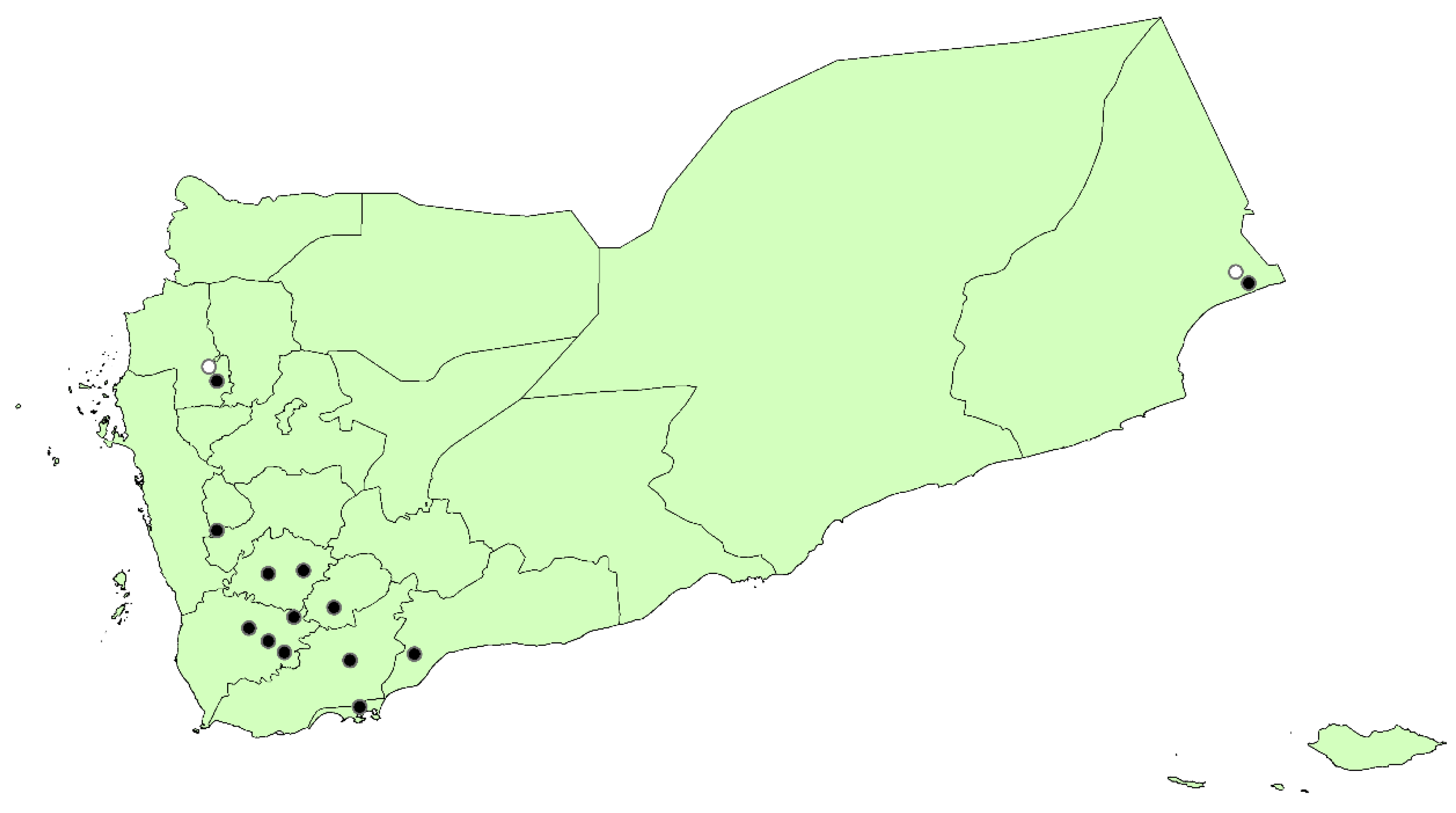
Distribution: Widespread. Recently recorded from Wadi Sharres and Hawf. According to Al-Safadi (1992), this species is common in the vegetated wadis and mountainous areas of Yemen. Harrison (1968) noted its occurrence in the mountains north of Aden. Scholte (1992) reported this species from Wadi Rima. Ubadi (1993) recorded this species from Suq Al-Khamees, Al-Azraq, Hajjah, San’a, Ta’iz, Abyan. Al-Safadi (1995) reported this species from Ausaifera, Dabab, Barakani, and Bana. Also recorded from Ta’iz (Gaubert et al. 2009); and Hawf (Al-Khorozyan et al., 2014). A specimen collected from Al-Furrah Island is in the collection of the MCZ.
Family: Herpestidae
Ichneumia albicauda - White-tailed Mongoose (Cuvier 1829)
Subspecies: I. a. albicauda (Cuvier 1829)
Figure 23.
Records of Ichneumia albicauda.
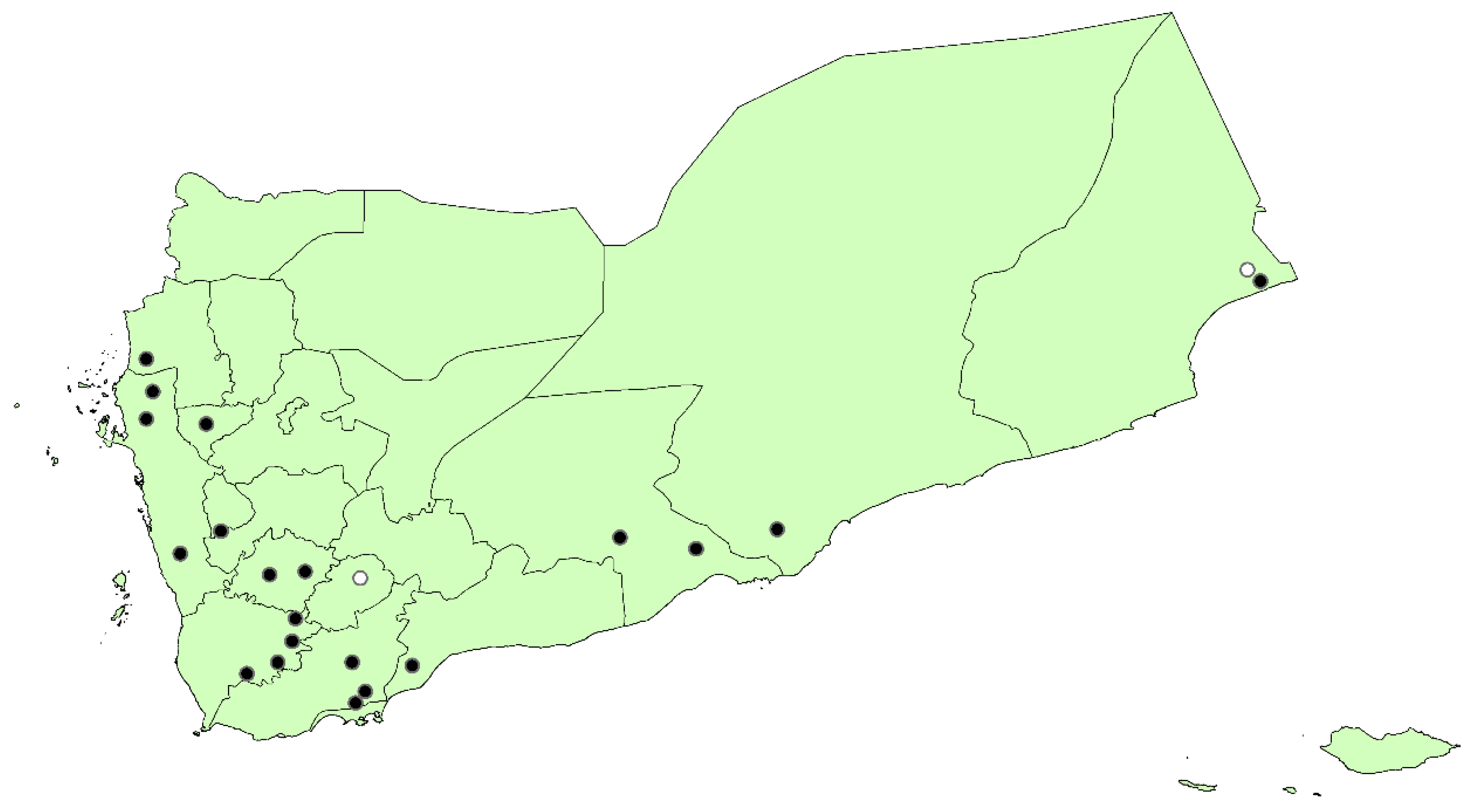
Distribution: Widespread at low altitudes in the wadis and cultivated areas of the Tihama plain. Recently recorded from Juban and Hawf. Yerbury and Thomas (1895) saw a mongoose at Haithalhim and noted it was possibly a white-tailed mongoose. Morrison-Scott (1939) suggested it might exist around Aden. Recorded from Wadi Rima (Scholte 1992); Ausaifera, Lahej, Wadi Hajr, Habban, Mayfa’a, Abyan (Ubadi 1993); Luah, Kadan, Siham, Zabid, Ausaifera, Dabab, Barakani, Warazan, Malhah, Bana, and Makhala (Al-Safadi 1995); Hawf (Al-Khorozyan et al. 2014). Mallon and Budd (2011) noted this mongoose is restricted to the northwestern, western, and southwestern regions of Yemen. The SMF collection included a specimen from Yemen.
Bdeogale crassicauda - Bushy-tailed Mongoose (Peters 1852)
Subspecies: B. c. crassicauda (Peters 1852)
Figure 24.
Records of Bdeogale crassicauda.
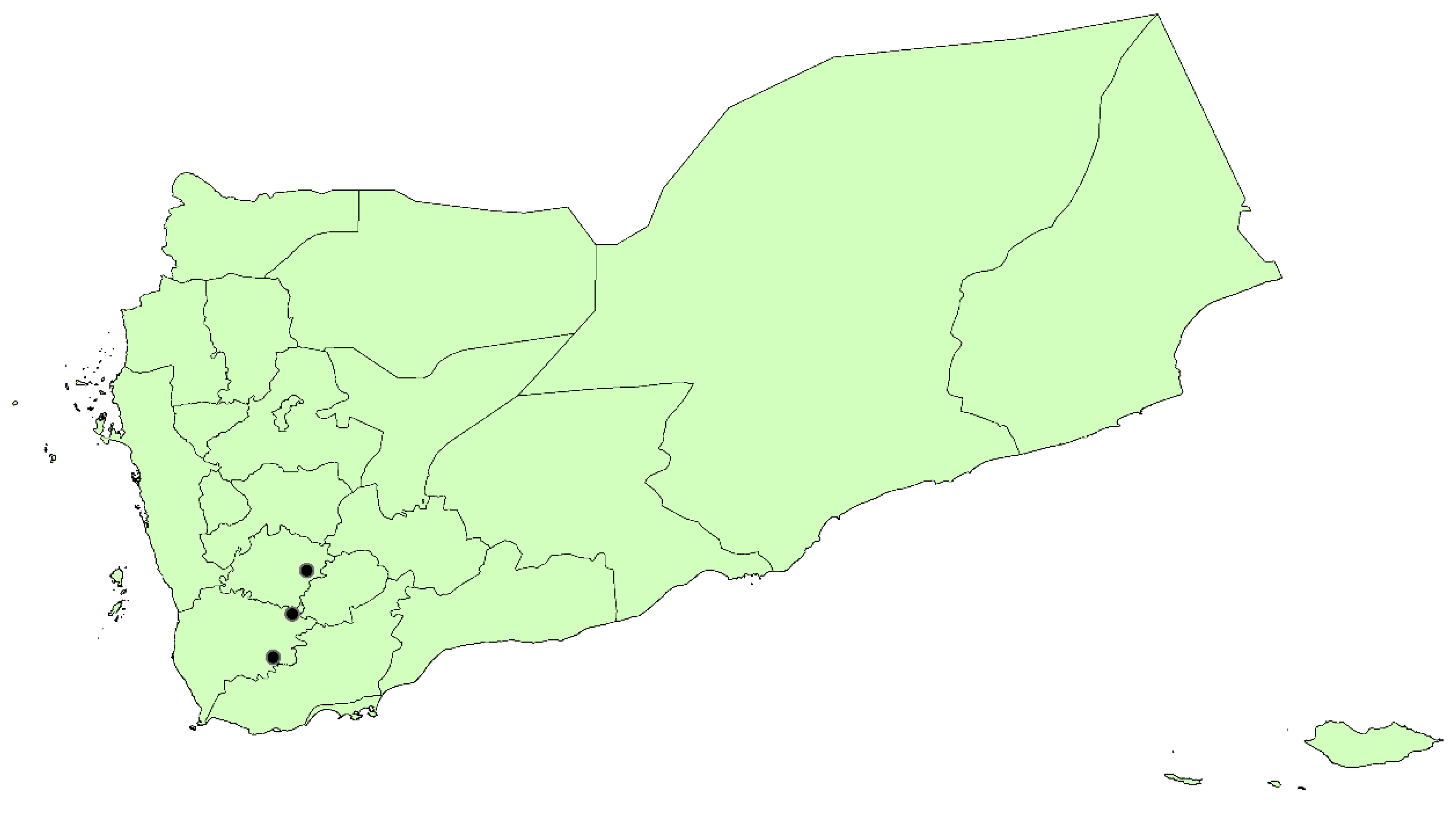
Distribution: Al-Safadi (1995) recorded this mongoose, for the first time, from three localities: Ausaifera, Dabab, and Bana.
Family: Hyaenidae
Hyaena hyaena - Striped Hyena (Linnaeus 1758)
Subspecies: H. h. sultana. Pocock (1935)
Figure 25.
Records of Hyaena hyaena.
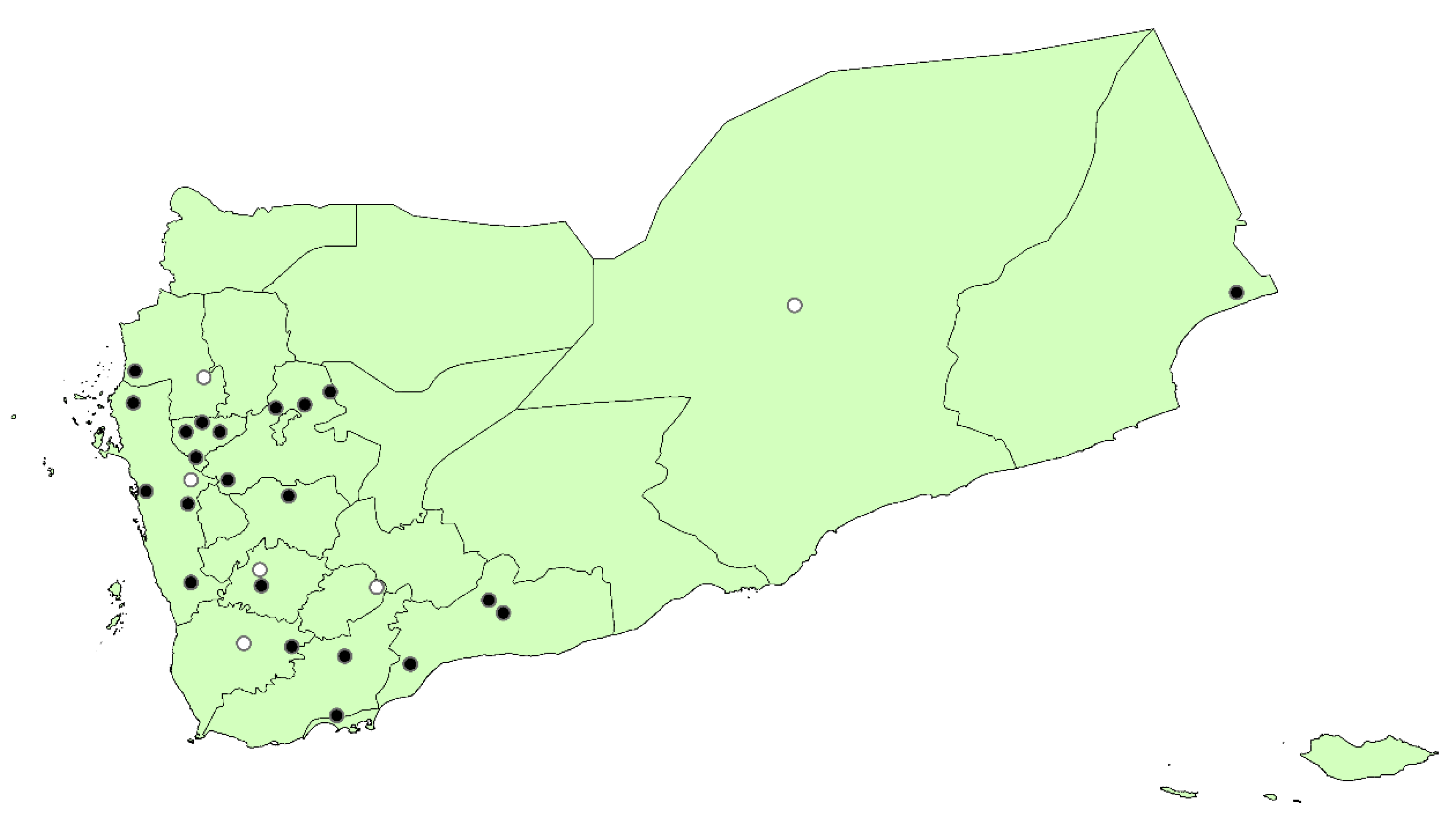
Distribution: Widespread. Recently reported from Wadi Sharres, Al-Mahweet, Hadramaut and villages around Ta’iz. One hyena was captured by locals in Qahza and another one killed in Naqeel Haqr. Hunter (1877) noted this was a common hyena in Aden. Yerbury and Thomas (1895) observed hyenas in the areas around Aden. Sanborn and Hoogstraal (1953) examined a female from the outskirts city of Hodeida and found evidence of hyenas’ presence in caves at Al 'Asr and Wadi Dhahr in the San'a region. Recorded from Aden (Pocock 1935; Popov 1960); Hodeida (Hoogstraal & Kaiser 1959; Kuntz & Myers 1968); outside Aden (Stookey 1982; Jennings 1992); Mudiyah, Al-Qaws, Abyan, Lahej (Ubadi 1993); Luah, Kadan, Warazan, Malhah, Mabar, Dahr, Nahim, Al-Ahgor, and Makhala (Al-Safadi 1995); western mountains in the south of Yemen (Al-Jumaily 1998); Wadi Rijaf (Cowan 2004). Kasparek (2007) noted this hyena could be seen in the valleys (Wadi Siham and Wadi Durdud) around Haraz mountains. Mallon and Budd (2011) reported this hyena from Milhan mountain in Hajja province. Pittet (2011) and Al-Khorozyan et al. (2014) both recorded and photographed this hyena from Hawf.
Family: Mustelidae
Mellivora capensis - Honey badger (Schreber 1776)
Subspecies: M. c. pumilio (Pocock 1946)
Figure 26.
Records of Mellivora capensis.
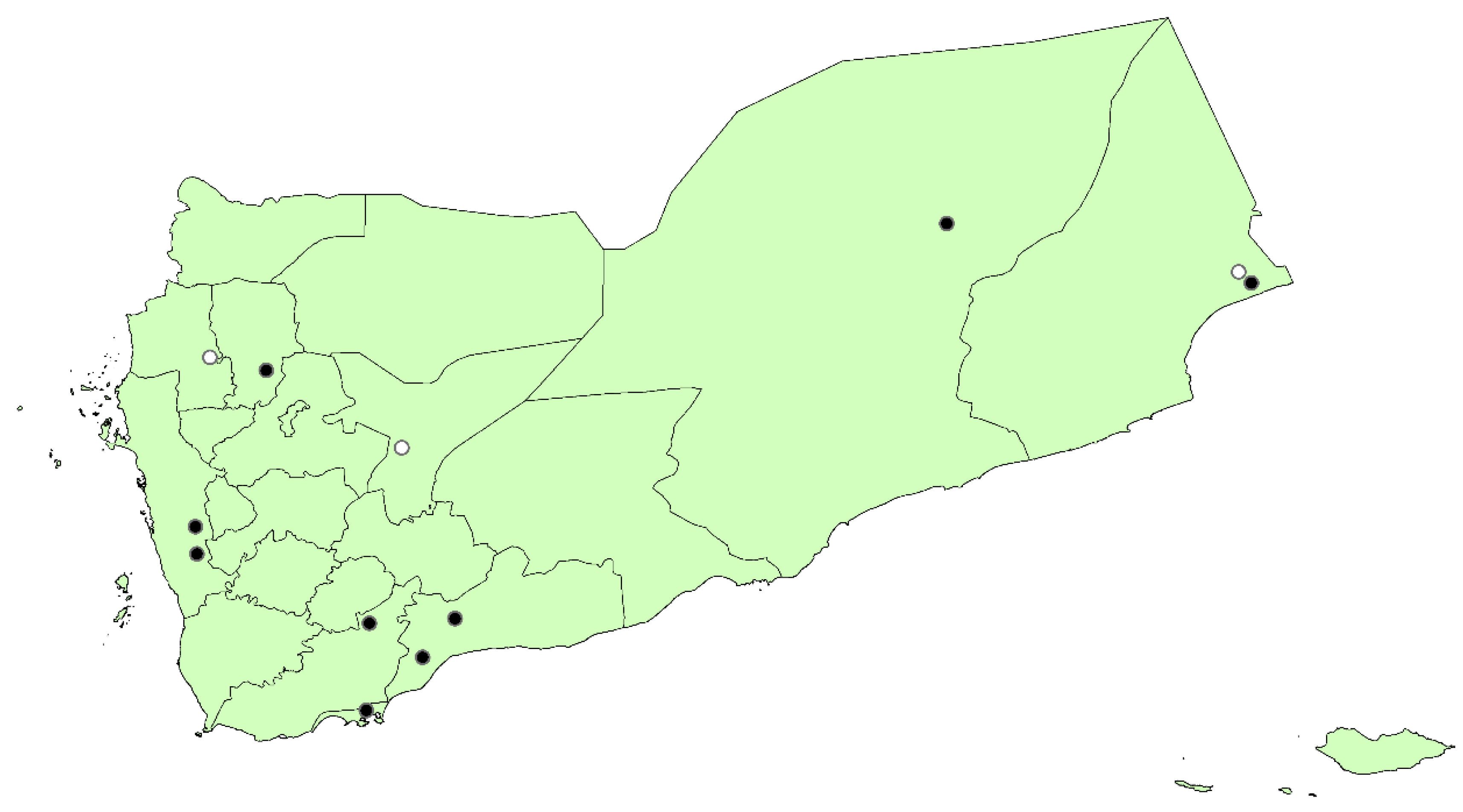
Distribution: This is a widespread species in Yemen. Recently recorded from Hawf, Wadi Sharres and Al-Juba in Marib. Thomas (1900) reported this species as M. ratel from Habil Jabr district in Lahej south of Yemen. Gaspertti et al. (1985) reported its occurrence north of Yemen in an area between Bait Al-Faqeeh and Zabid. Jennings (1992) noted this species widely occurs in western Yemen. Recorded from Hadramaut (Pocock, 1946; Popov 1960; Al-Jumaily 1998); Aden (Popov 1960; Harrison 1968); Hadramaut, Habil Jabr, Musaimer Al-Hawashib, Raydat Al-Say’ar, Wadi Hassaan, Thamud (Ubadi 1993); Wadi Ardan (Mallon and Budd 2011); Hawf (Al-Khorozyan et al. 2014). Proulx et al. (2016) noted this badger has a wide distribution in Yemen but its numbers maybe decreasing due to trapping, roadkill, and persecution.
Order HYRACOIDEA
Family Procaviidae
Procaviacapensis - Rock Hyrax (Pallas 1766)
Subspecies: P. c. jayakari (Thomas 1892)
Figure 27.
Records of Procavia capensis.
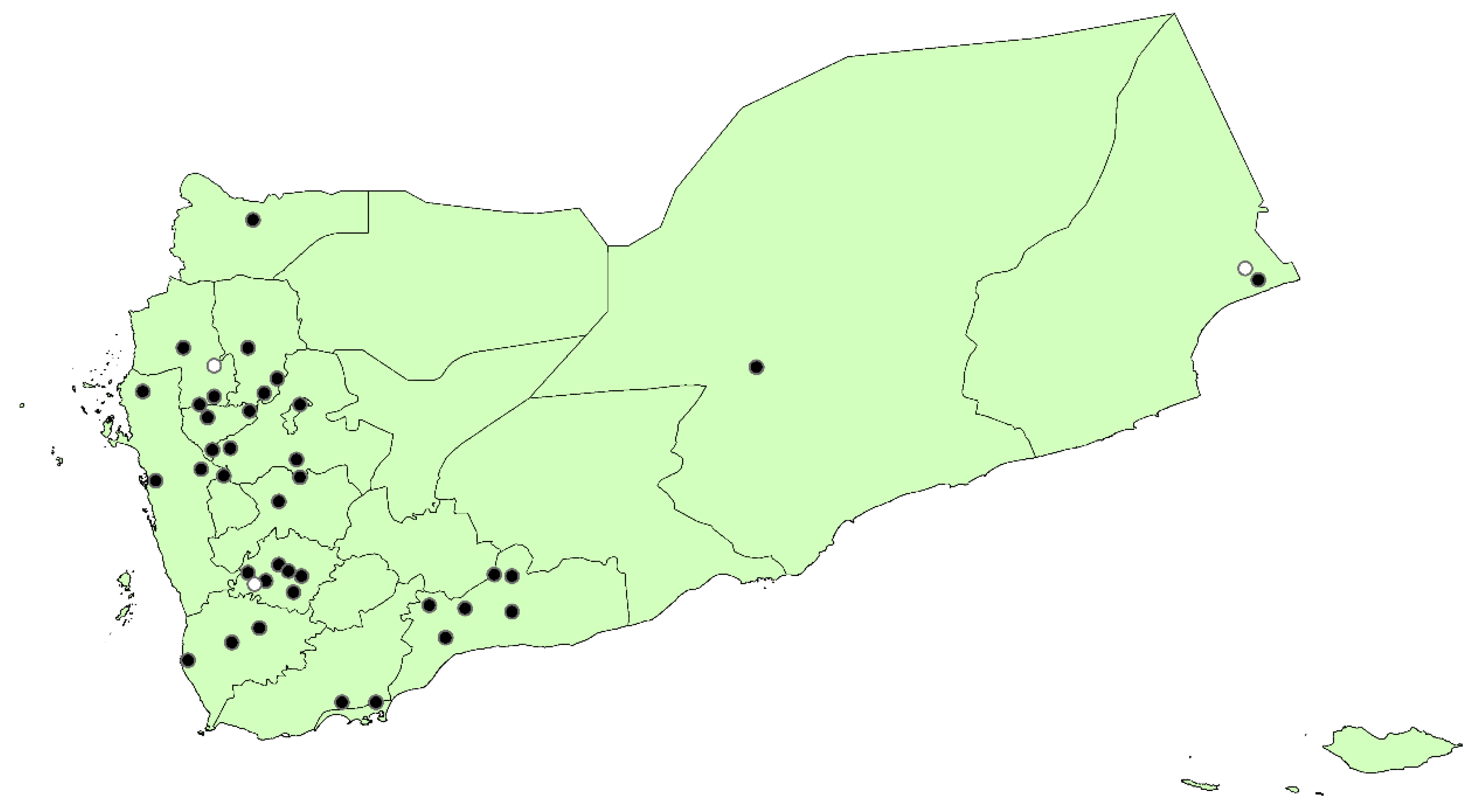
Distribution: Widespread in the hills and mountains of Yemen. Recently recorded from Hawf, Wadi Sharres, Wadi Hawr. According to Thomas (1902), hyraxes were not rare in the hills behind Shukra and they were very common in Dethina. Bury (1915) saw several individuals basking on the lower ledges of the uplands of the Wasl village. Al-Tha’alibi (1924) observed it between the villages of Naqil Yaslih and Bait Az Zaydah. Pocock (1935) recorded this species as P. syriacus jayakari from Abyan mountains near Aden. Meulen (1947) noted hyraxes are abundant in the wadis of Abyan. Reported from Ta’iz and San’a (Sanborn and Hoogstraal 1953); Aden (Popov 1960); Ta’iz (Kuntz & Myers 1968); Mocha (Harrison 1985); Tihama foothills above 400 metres (Brockie 1985); Shibam, Kawkaban, Wadi Hammam Ali, Suq as-Sabt (Evans 1987); Ta’iz, Bajil, Kawkaban, Suq As-Sabt, Al-Maraqishah mountain, Al-Kawr, Mudiyah, Al-Khubaiya mountains, Zughaynah (Ubadi 1993). Harrison (1968) reported seeing hyraxes in the mountains near Ta’iz, in the hills around the lowland town of Bajil, and in the foothills nearby Sabt Al-Mihrab. Stookey (1982) noted the hyrax was abundant in Aden and the southwestern areas of Yemen. Stevenson and Hesse (1990) reported the hyrax from the following localities: in the Ba’dan area, near Jubla and Rada’, Al Mahwit, Al-Ahgor, Al-Ashmur, Bani Al-Awam, and the in the hills around the town of Amran. Showler (1996) saw two specimens at Jabal Iraf; reported two from Wadi Mararah and saw one in Kawkaban. Reported from Khamis Bani Sa’ad (Mackintosh-Smith 2001); Haraz mountains (Kasparek 2007); Hawf (Al-Khorozyan et al. 2014); Al-Haswa natural protectorate (Baker and Al-Balam 2016) and Hajjah (El Sawaf et al. 2016). The FMNH collections included a specimen collected by Hoogstraal in (1951) from Jabal Zarbah, Jebel Halil Salma, and Daha Al-Nokhayib to the west of Ta'iz.
OrderARTIODACTYLA
Family Bovidae
Capra nubiana – Nubian ibex (Cuvier 1825)
Subspecies: nubiana was formerly considered as a subspecies to ibex but elevated to a species by Uerpmann (1987).
Figure 28.
Records of Capra nubiana.
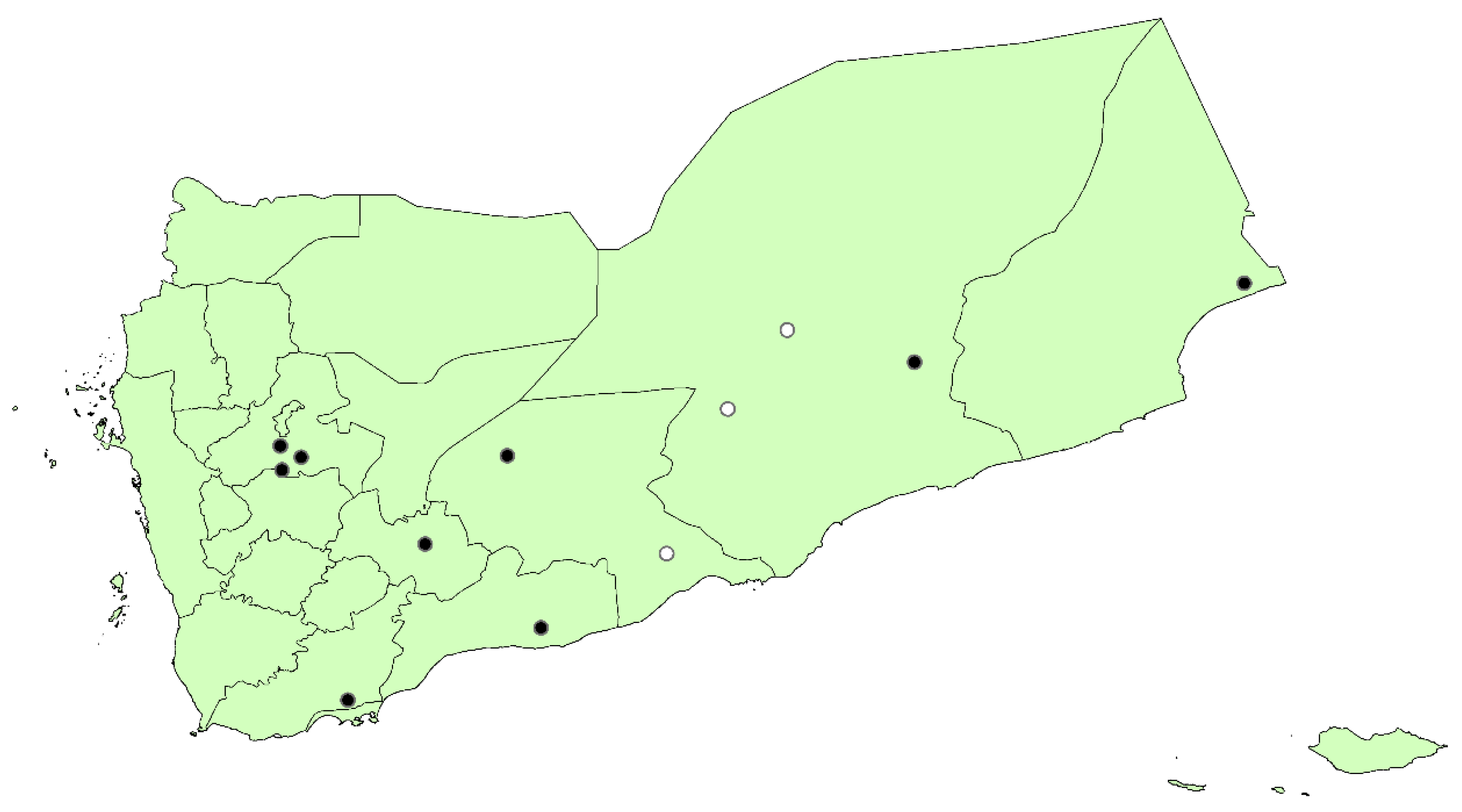
Distribution: This is the most hunted large mammal in Yemen. Recent records: an adult ibex was killed by poachers in Shabwa. Herds of ibex were seen in the mountains of Mayfa’a in Shabwa province. In addition, it was reported from Wadi Tarba and Wadi Daw’an in Hadramaut. Bury (1911) saw a herd in Wadi Kaura in Shabwa province and noted they were plenty on Mara’an. Bury (1915) indicated that it was no longer widespread in the central areas of Yemen and was mainly found in the thinly populated districts in the southeastern regions. Al-Tha’alibi (1924) noted the ibex is very common in Walan and the mountainous areas between the villages of Naqil Yaslih and Bait Az Zaydah. Schwarz (1935) noted this species, which he called Capra hircus nubiana, can be found in Aden. Thesiger (1959) said this ibex existed in the mountainous surrounding areas of southern Yemen and ranges eastwards to Hadramaut. Popov (1960) described this species as occurring in Hadramaut and the western mountains of Aden. Harrison and Bates (1991) noted it was formerly ranging widely in the mountains of Aden, Hadramaut, and the southeastern areas of Yemen. Ubadi (1993a) saw specimens near Mayfa’a and reported this ibex was hunted near Al-Baidha in (1983), in the mountains north of Ahwar in (1987), and in Al-Ma’adi at the southern border of the Hadramaut Plateau. Rodionov (1994) described the systematic hunting parties organized by local tribesmen in Hadramaut in search of ibex trophies. According to Al-Safadi (2000), this species was very common in most mountainous areas and now extinct from the northern parts of Yemen. It occurs now only in the steep cliffs, gullies, and high rugged mountains of Shabwa province. Al-Khorozyan et al. (2014) recorded this species from Hawf.
Oryx leucoryx - Arabian Oryx (Pallas 1777)
Figure 29.
Records of Oryx leucoryx.
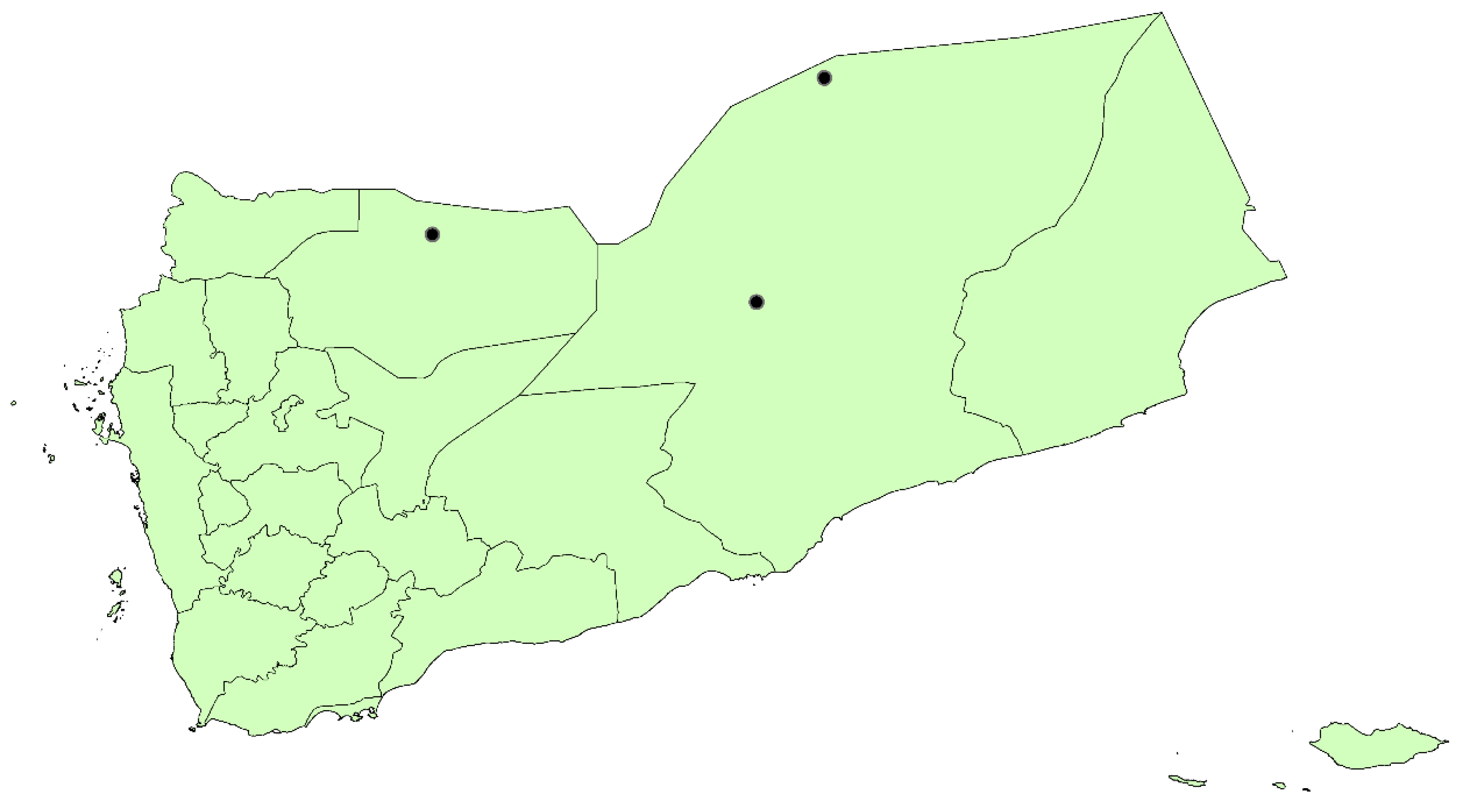
Distribution: Bury (1911) noted the oryx can be found in the desert of the northern areas of Yemen. Harper (1945) confirmed actual records of this species from areas north of Hadramaut. Foster-Vesey-Fitzgerald (1952) noted the oryx is now extinct from the great Nefud desert and it still exists in the southern areas of the Rub Al-Khali. Thesiger (1959) mentioned several accounts of oryx being hunted and killed by the local tribes in Yemen and noted seeing an oryx in the area of Uruq al Zaza on the edge of the Rub Al-Khali north of Yemen. Talbot (1960) noted the oryx was exterminated everywhere from the Arabian Peninsula except the southern areas of Rub Al-Khali. According to Popov (1960), a two-month fieldtrip in northern Hadramaut didn’t result in capturing or seeing a living specimen but found a dozen skeletons. Stewart (1964) reported unconfirmed sightings of few animals in the Jawf province north of Yemen. Shepherd (1965) reported three oryxes were captured in Hadramaut in (1962). Harrison and Bates (1991) described records of this species from the Hadramaut and other localities in eastern Yemen, in addition to an unverified report from Wadi Jawf in northern Yemen. Stuart & Stuart (1996) noted this species is almost certainly extinct from Yemen. According to Al-Safadi (2000), the oryx was once distributed in most of the desert areas of Arabia, but now it is extinct in the wild in Yemen. Mallon and Al-Safadi (2001) noted this species is extinct in Yemen. Islam et al. (2010) noted that the Fauna and Flora Preservation Society captured three specimens (two males and one female) in the years of 1962-1963 in Yemen. These three animals were sent to the Phoenix Zoo, USA and later to the San Diego Zoo, USA.
Gazella arabica – Arabian gazelle (Lichenstein 1827)
Figure 30.
Records of Gazella arabica.
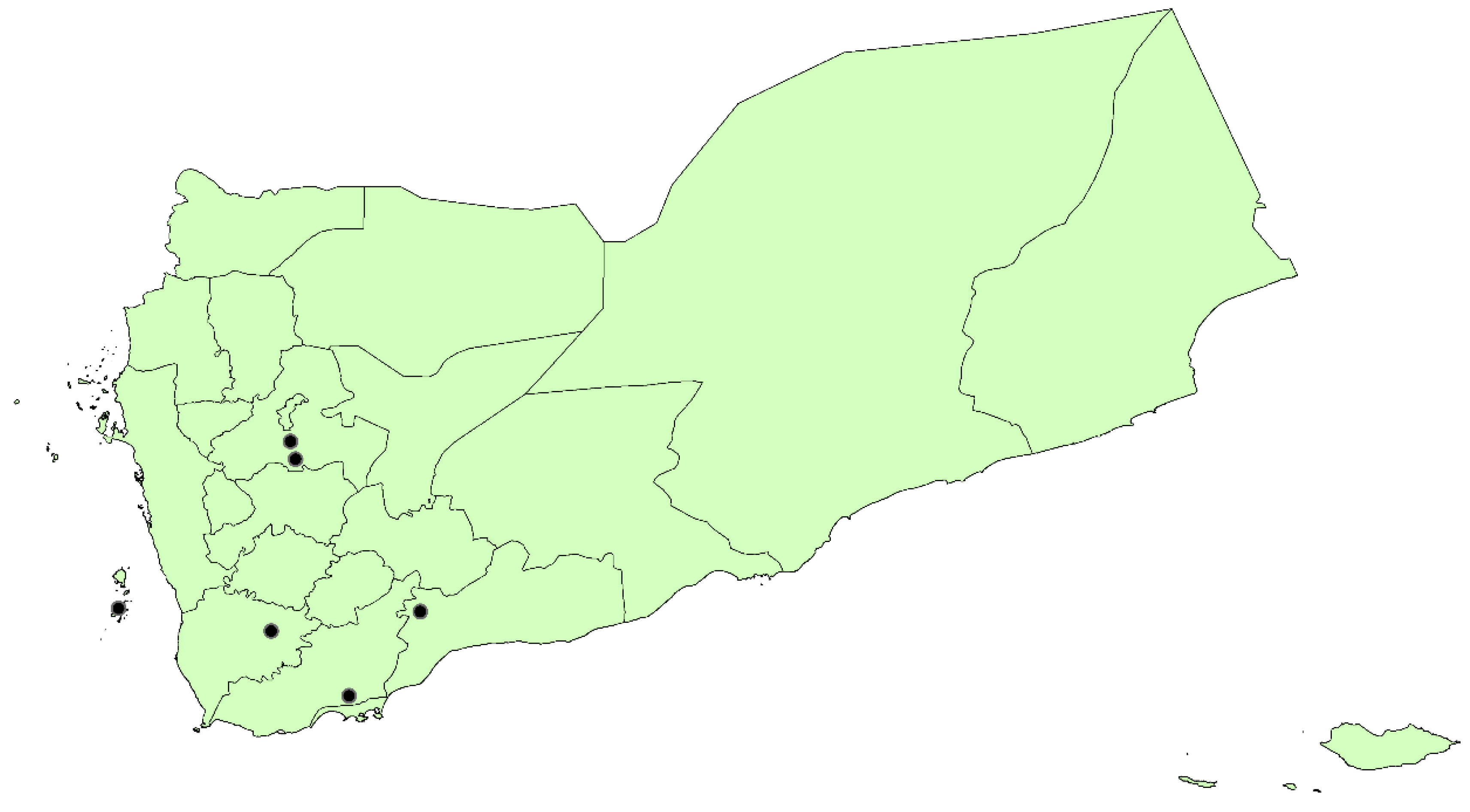
Distribution: The current distribution status of this gazelle in Yemen is unknown. Al-Tha’alibi (1924) found this gazelle in Walan and the mountainous areas between the villages of Naqil Yaslih and Bait Az Zaydah. Hoogstraal & Kaiser (1959) captured one specimen from Ta’iz area. Popov (1960) recorded this gazelle from areas around Aden. Scaramella (1975) noted the numbers of this gazelle in Yemen are on the decrease and found this species in Hanish Al-Kabir island.
Gazella saudiya - Saudi Gazelle (Carruthers and Schwarz 1935)
Figure 31.
Records of Gazella saudiya.
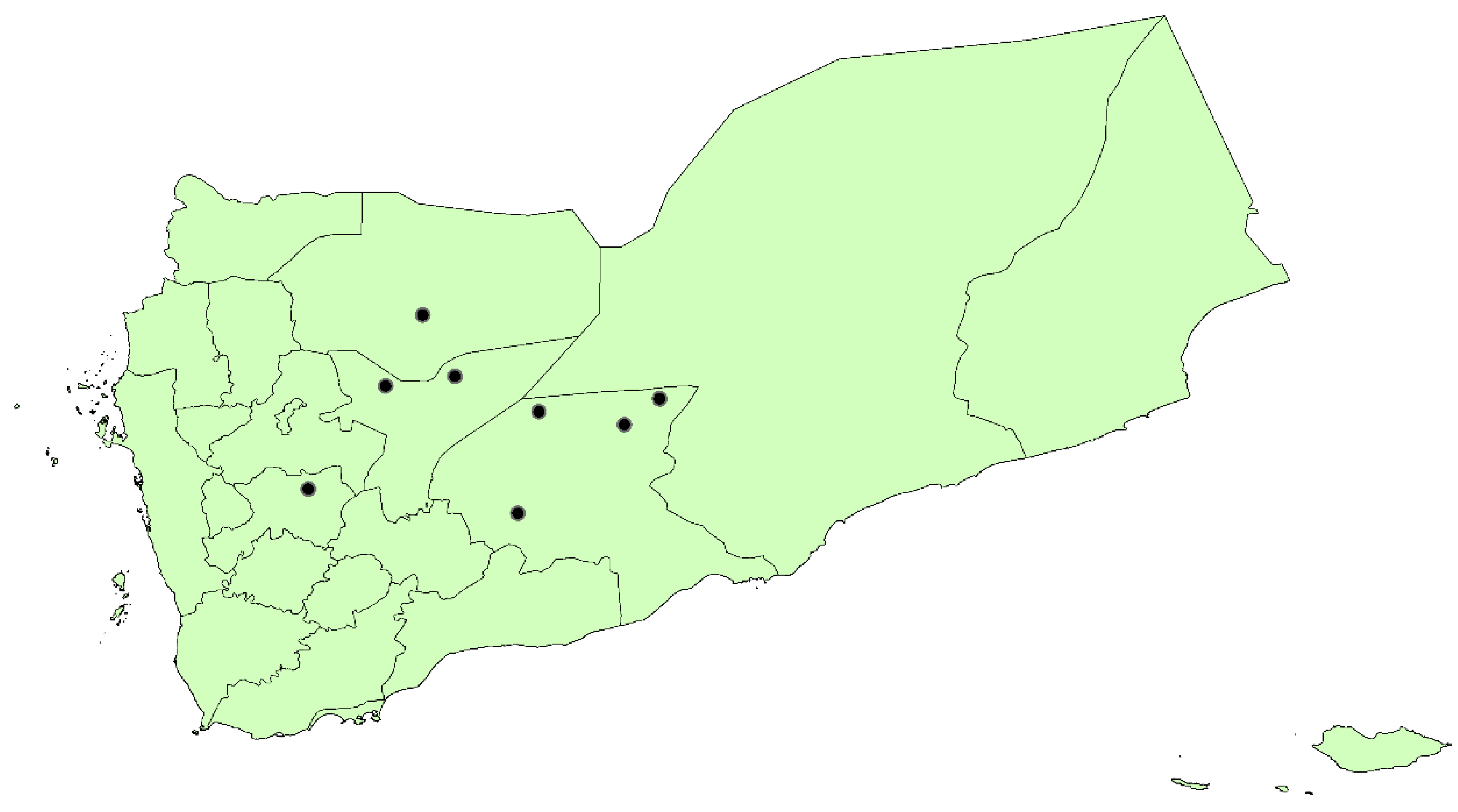
Distribution: Recorded from: Ma’bar (Hoogstraal & Kaiser 1959); Arq Abu Da’ir, Alam Abyadh, Ruwaik Tract, Jau al Khudaif, Taraf al Ain, Wadi Markha and Wadi Naq’a (Harrison and Bates 1991). Kuntz & Myers (1968) examined one specimen from Ma’bar. Popov (1960) described this species as one of the gazelles that can be found in Aden. Scaramella (1975) noted this is a rare gazelle in Yemen. Ubadi (1993) suggested this gazelle is extinct in the wild in Yemen. According to Al-Safadi (2000), this gazelle was once considered the second most abundant and widespread gazelle species in Yemen. Mallon and Al-Safadi (2001) noted this species is extinct in Yemen.
Gazella gazelle - Mountain Gazelle (Pallas 1766)
Subspecies: G. g. cora (Smith 1827)
Figure 32.
Records of Gazella gazelle.
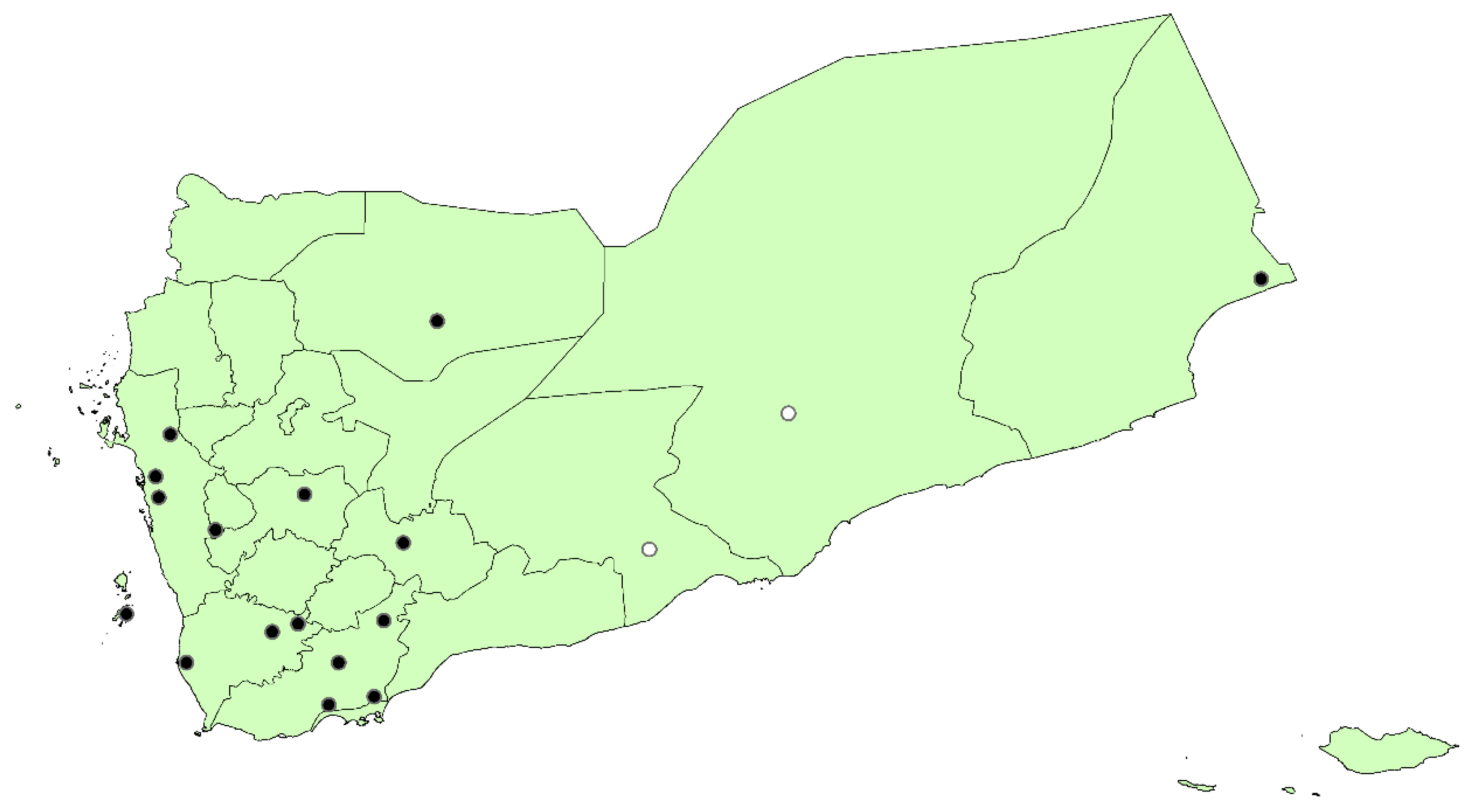
Distribution: Used to be widespread but now very rare in the wild. Recently recorded from Wadi Al-Ain in Hadramaut and Mayfa’a in Shabwa. Al-Tha’alibi (1924) found this species in Sharman. According to Groves (1969), this gazelle occurs in Mocha, Jabal Zarba (near Ta’iz), and Wadi Maleh. Harrison and Bates (1991) recorded this gazelle from Ma’bar, Sawadiya, Arq Abu Da’ir, Aden, Sheikh Othman, Lahej, and Al-Hanish Al-Kabir Island in the Red Sea. Greth (1992) mentioned seeing two groups of this gazelles in private collections; one specimen was captured in Wadi Surdud in the Tihamah coastal strip. Greth (1992) also described unconfirmed records of this gazelle from Wadi Saham, near Hodeida and at a locality that is 30 km north of Aden. Unconfirmed reports of seeing this gazelle came from Wadi Rima in the western highlands during 1989–1990 (Scholte 1992); Al Zuhra near Hodeida, between Mocha and Bab Al-Mandeb (Varisco et al. 1992). Ubadi (1993) reported this gazelle from Ahwar, Bi’r Ali, Al-Haroor, Wadi Falgham. According to Mallon and Al-Safadi (2001), local reports showed that these gazelles also occur in Lahej, Abyan, Shabwa, and Hadhramawt Provinces. Collection of the FMNH included a specimen from Ma’bar collected by Hoogstraal in (1951). Khorozyan et al. (2014) noted this gazelle might still occur in Hawf.
Gazella bilkis - Queen of Sheba’s Gazelle / Yemen Gazelle (Groves and Lay 1985)
Figure 33.
Records of Gazella bilkis.
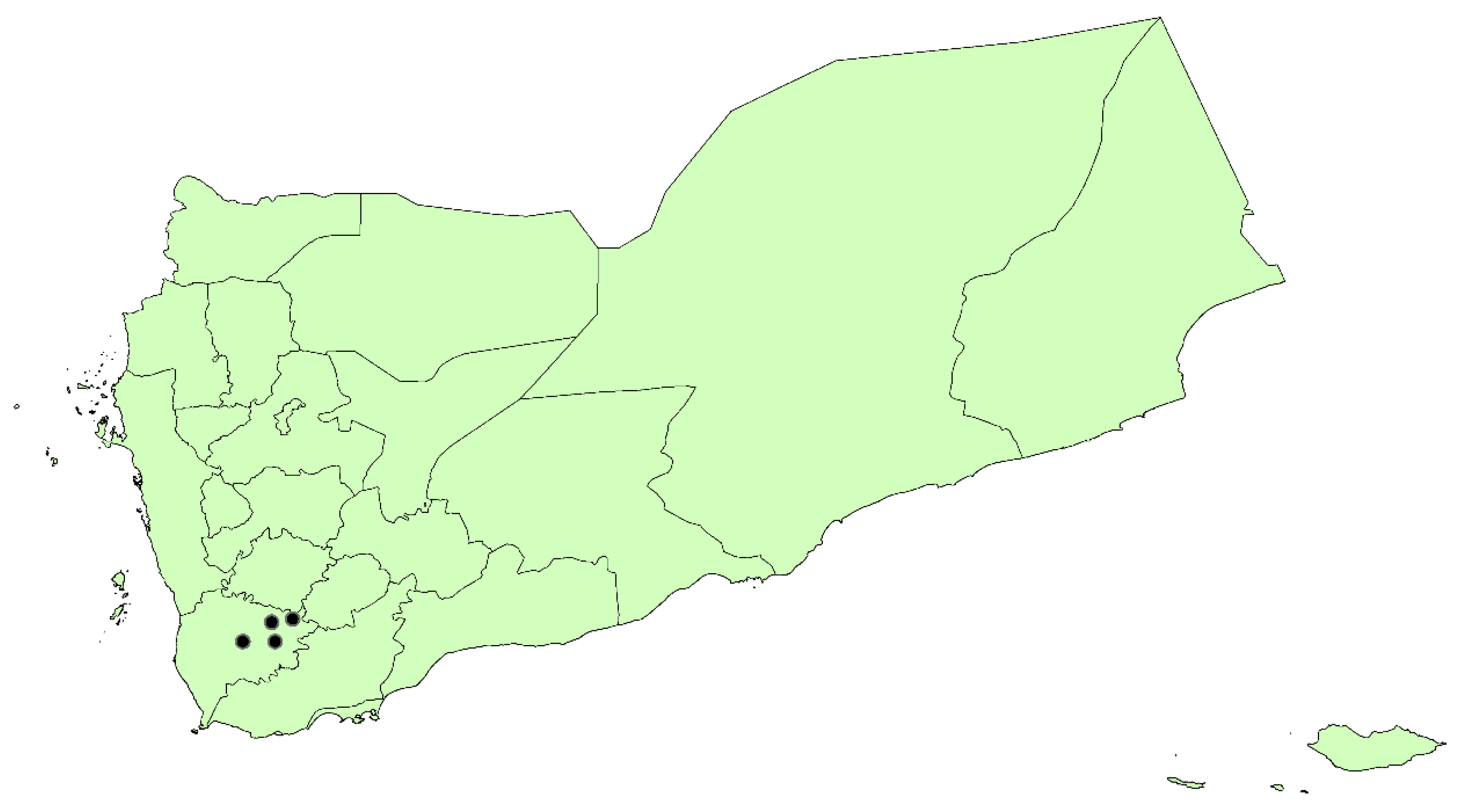
Distribution: This gazelle was identified by Groves & Lay (1985) as a new species from preserved skins that were originally collected by the United States Naval Medical Mission to Yemen in 1951. Only five specimens were collected from areas nearby Ta’iz. These localities included Al-Hauban, Usaifera, and Jebal Zarba (Sanborn and Hoogstraal 1953). All these specimens were kept in the collection of the FMNH. Al-Safadi (1992) noted this was a very rare gazelle which was only known from Ta’iz province. Greth et al. (1993) found no record of this gazelle and people reported it had not been seen in the area for decades. Ubadi (1993) described distribution status of this gazelle as unknwon in Yemen. Stuart & Stuart (1996) noted this gazelle is almost certainly extinct from Yemen. Mallon and Al-Safadi (2001) concluded that this gazelle is extinct. Currently, this is an extinct species although Scholte (1992) noted it might still be present in Wadi Rima west of Yemen.
Gazella subgutturosa - Arabian Sand Gazelle (Guldenstaedt 1778)
Subspecies: G. s. marica (Thomas 1897)
Figure 34.
Records of Gazella subgutturosa.
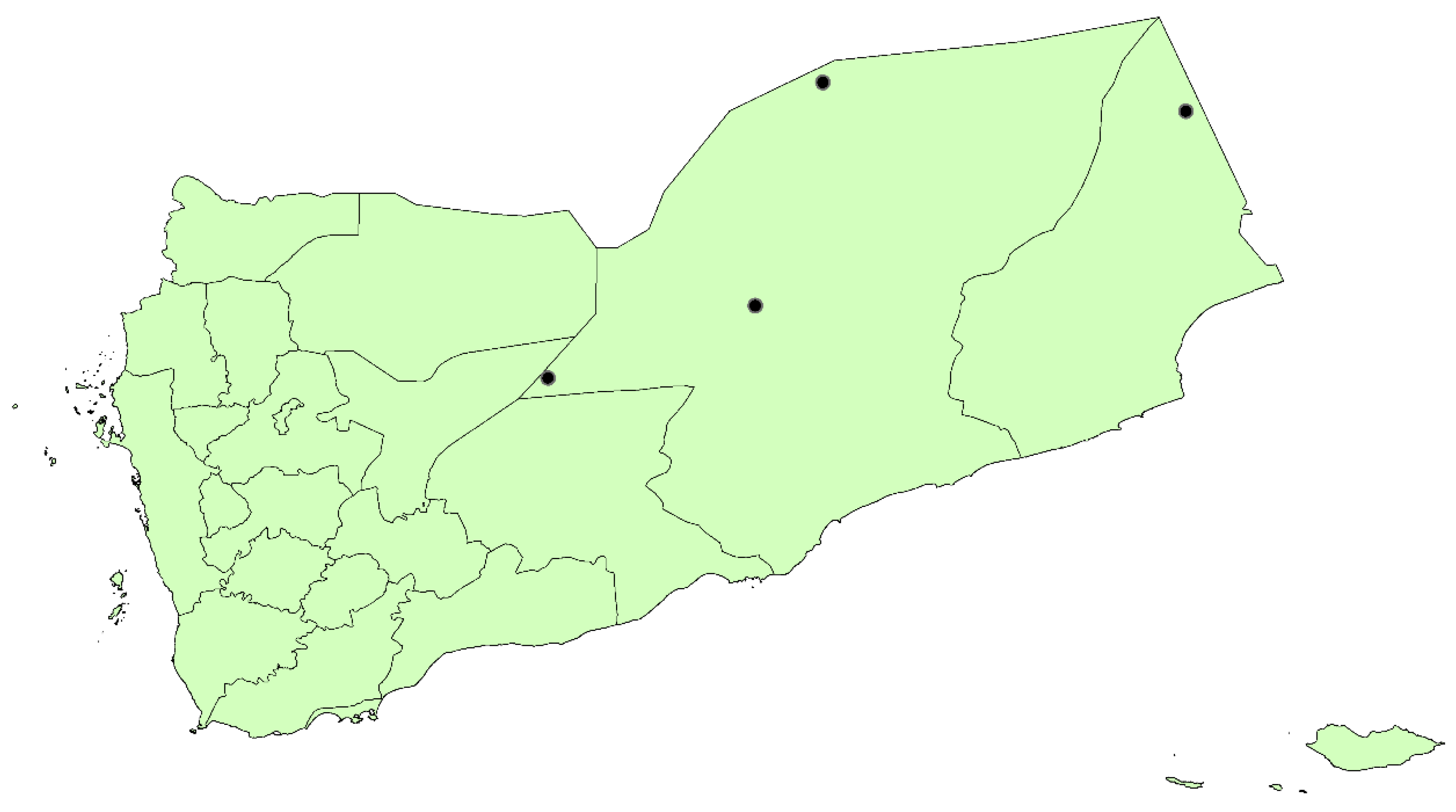
Distribution: Desert areas of Yemen. Possibly no longer occurs in Yemen. Harrison and Bates (1991) listed records of this gazelle that were dated back 50 to 60 years ago from Uruq Al-Zaza (northwest of Wadi Hadhramawt) and Al-Afalil. Popov (1960) indicated this gazelle is restricted to the edges of Rub Al-Khali. Shepherd (1965) described sightings and tracks of this gazelle in Wadi Mitan on the eastern border of Yemen. Ubadi (1993) described this gazelle as formerly common in central Hadramaut and northern Al-Mahra but now extinct from Yemen. Al-Safadi (2000) noted that this gazelle was known to occur on the edge of the Rub Al-Khali desert. Mallon and Al-Safadi (2001) concluded that this species is probably extinct in Yemen.
Order RODENTIA
FamilyMuridae
Acomys dimidiatus - Eastern Spiny Mouse (Cretzschmar 1826)
Subspecies: A. d. homericus (Thomas 1923)
Figure 35.
Records of Acomys dimidiatus.
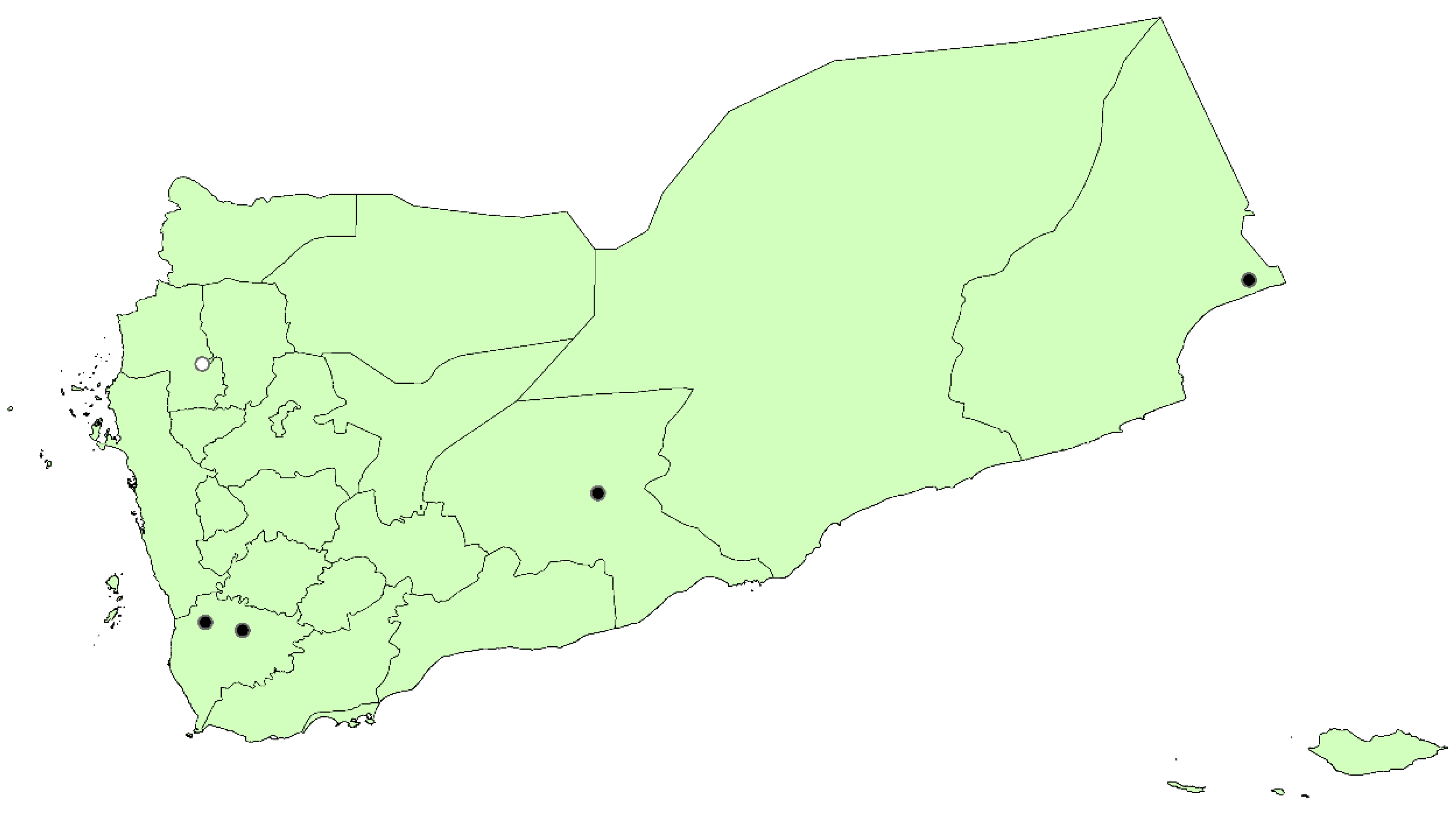
Distribution: Recently recorded from Wadi Sharres. Previously recorded from El-Khaur (Thomas, 1923); Tai’z (Sanborn and Hoogstraal 1953; Hoogstraal & Kaiser 1959); Hawf (Frynta et al. 2010). Specimens collected from Al-Hajar village in Ta’iz by Jean-Antoine Rioux in (1991) are included in the collection of the Muséum national d’Histoire naturelle. Bates (1994) considered Acomys dimidiatus a synonym for Acomys cahirinus but recent studies show that A. cahirinus is a different species from A. dimidiatus based on mitochondrial, chromosomal, and dental characters (Denys et al., 1994; Volobouev et al., 1991; Barome et al., 2000).
Acomys cahirinus - Northeast African Spiny Mouse (Geoffroy 1803)
Figure 36.
Records of Acomys cahirinus.
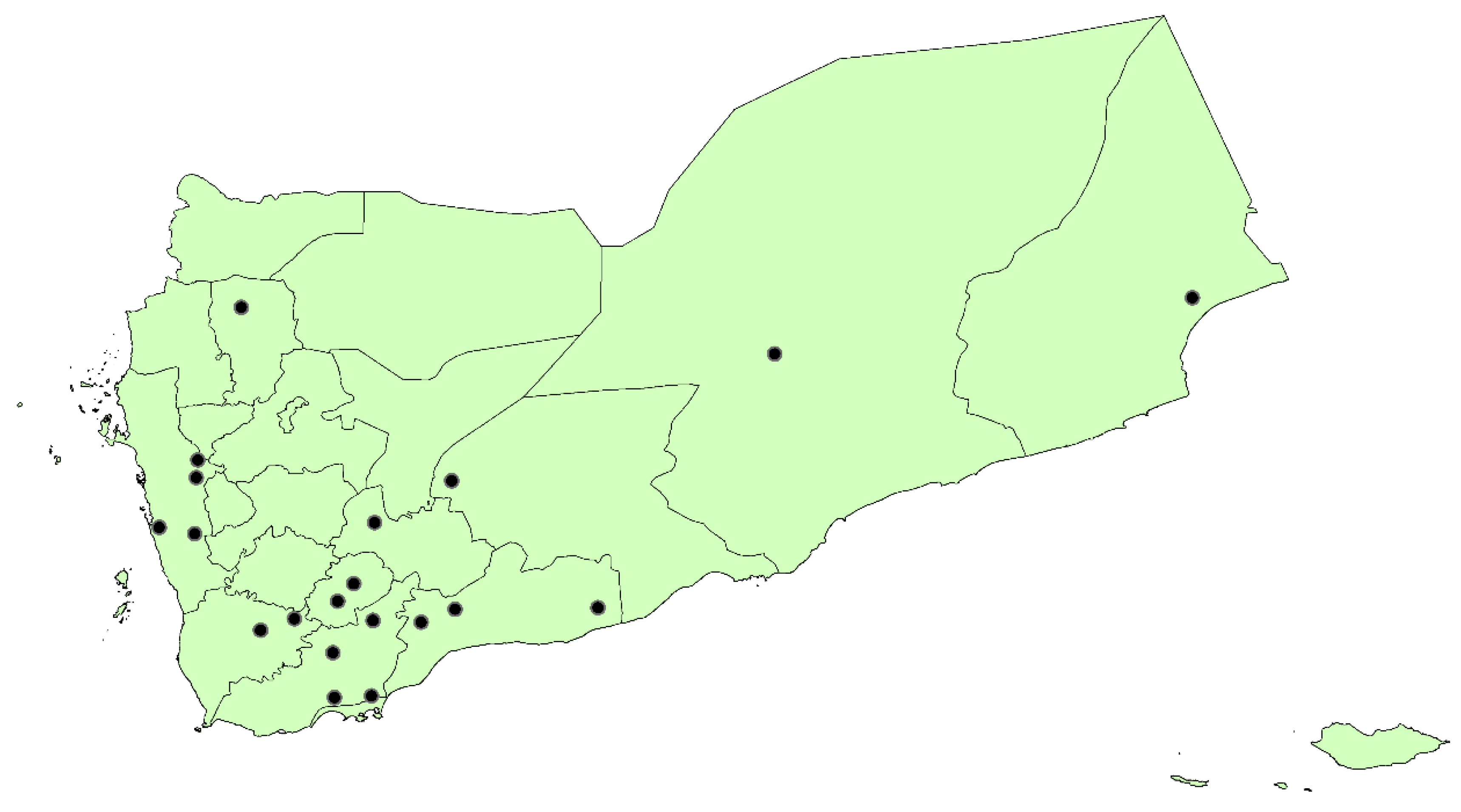
Distribution: Recorded from Lahej, Aden, Haithalhim (Yerbury and Thomas 1895); Ta’iz, Al-Hawban, Wadi Maleh (Sanborn and Hoogstraal 1953); Al-Khaur, Al-Dhala’, Khalla, Jabal Jihaf, Thi Al-Khod, near Beihan, Hajar (Harrison 1972); Suhknah, Hosainiya, Beir Ghazi (Bahmanyar and Lay 1975); Ghulayfiqah (Harrison 1985); Shahrut hills west of Damqawt (Showler 1996) Bura (Wildman 1998). Specimens collected by H. W. Setzer in (1961) from Taribah in the province of Hadramaut are included in the collection of the USNM. Specimens collected by A. R. M. Rickards in (1932) from Aden are kept in the collection of the FMNH.
Acomys russatus - Golden Spiny Mouse (Wagner 1840)
Figure 37.
Records of Acomys russatus.
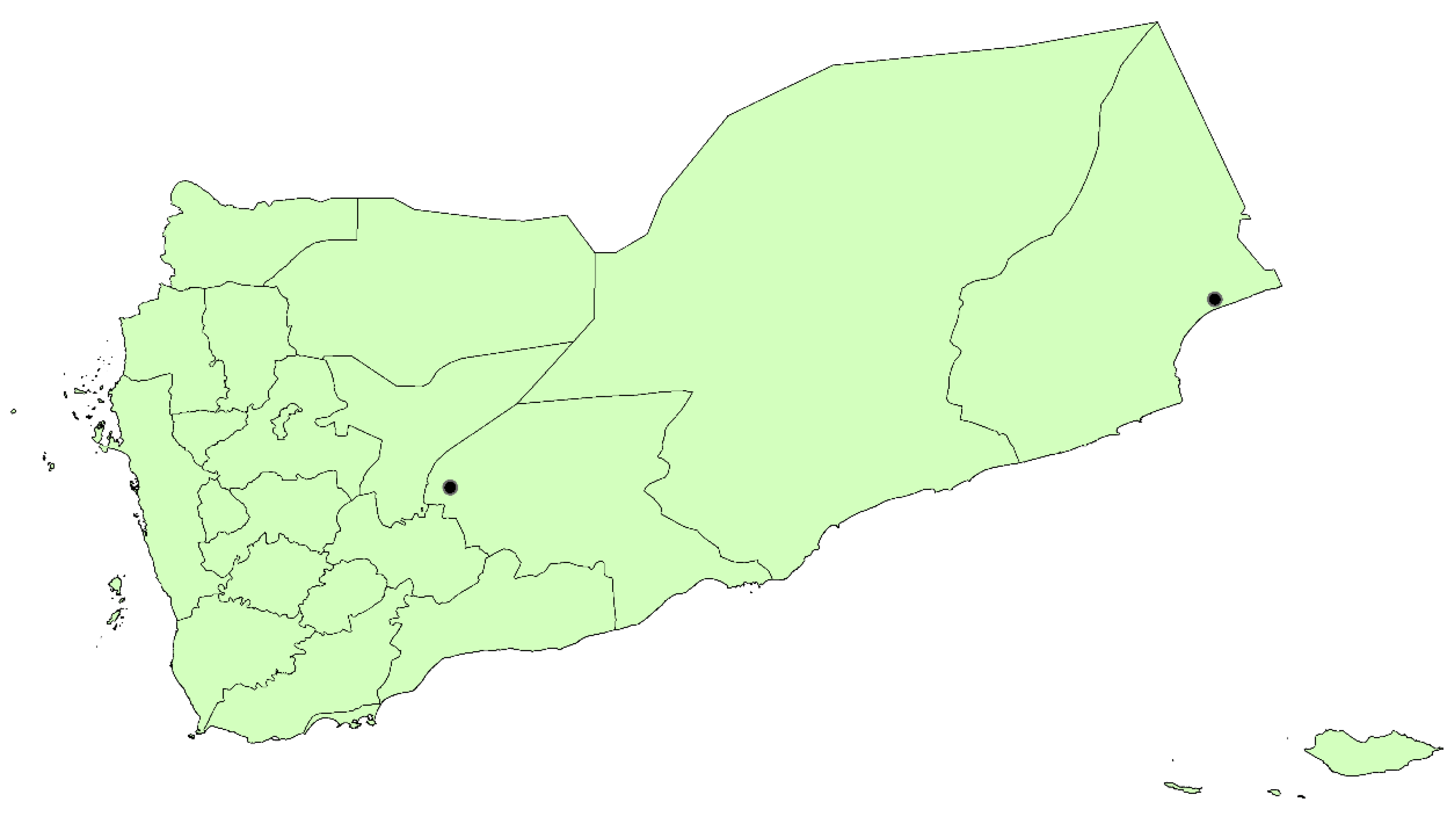
Distribution: This is mouse can be found in the rocky mountainous areas. Recorded from Beihan (Harrison and Bates, 1991); Al-Fatk (Showler 1996).
Arvicanthis niloticus - African grass rat, Nile rat (Geoffroy 1803)
Subspecies: A. n. naso (Pocock 1934)
Figure 38.
Records of Arvicanthis niloticus.
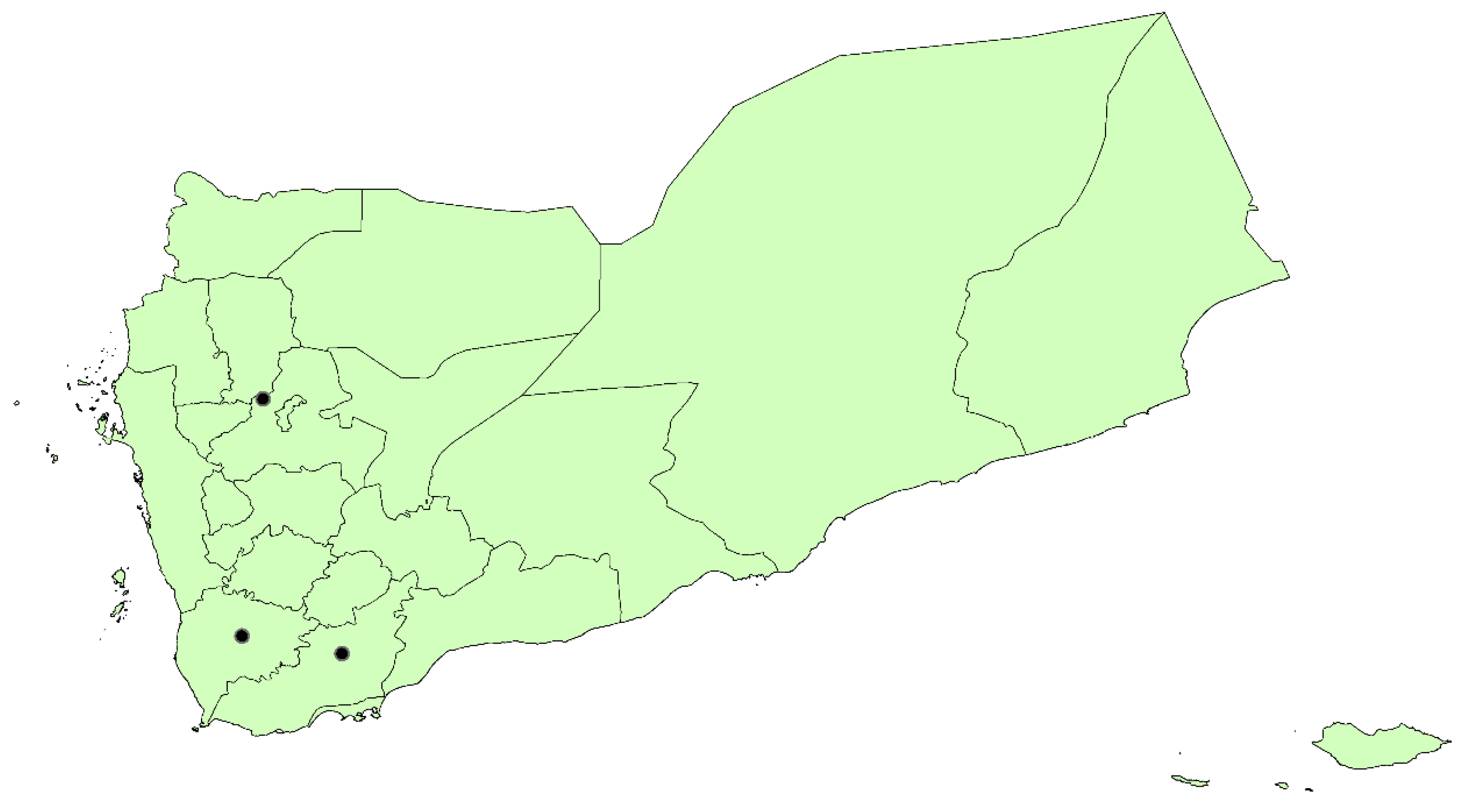
Distribution: Recorded from Lahej (Pocock 1934); Tai’z (Hoogstraal & Kaiser 1959; Kuntz & Myers 1968); Thula village about 50 km northwest of San’a (Wildman 1998). Specimens collected by Bahmanyar in (1973) from Ta’iz are kept in the collection of the FMNH.
Dipodillus dasyurus - Wagner’s Dipodil (Wagner 1842)
Figure 39.
Records of Dipodillus dasyurus.
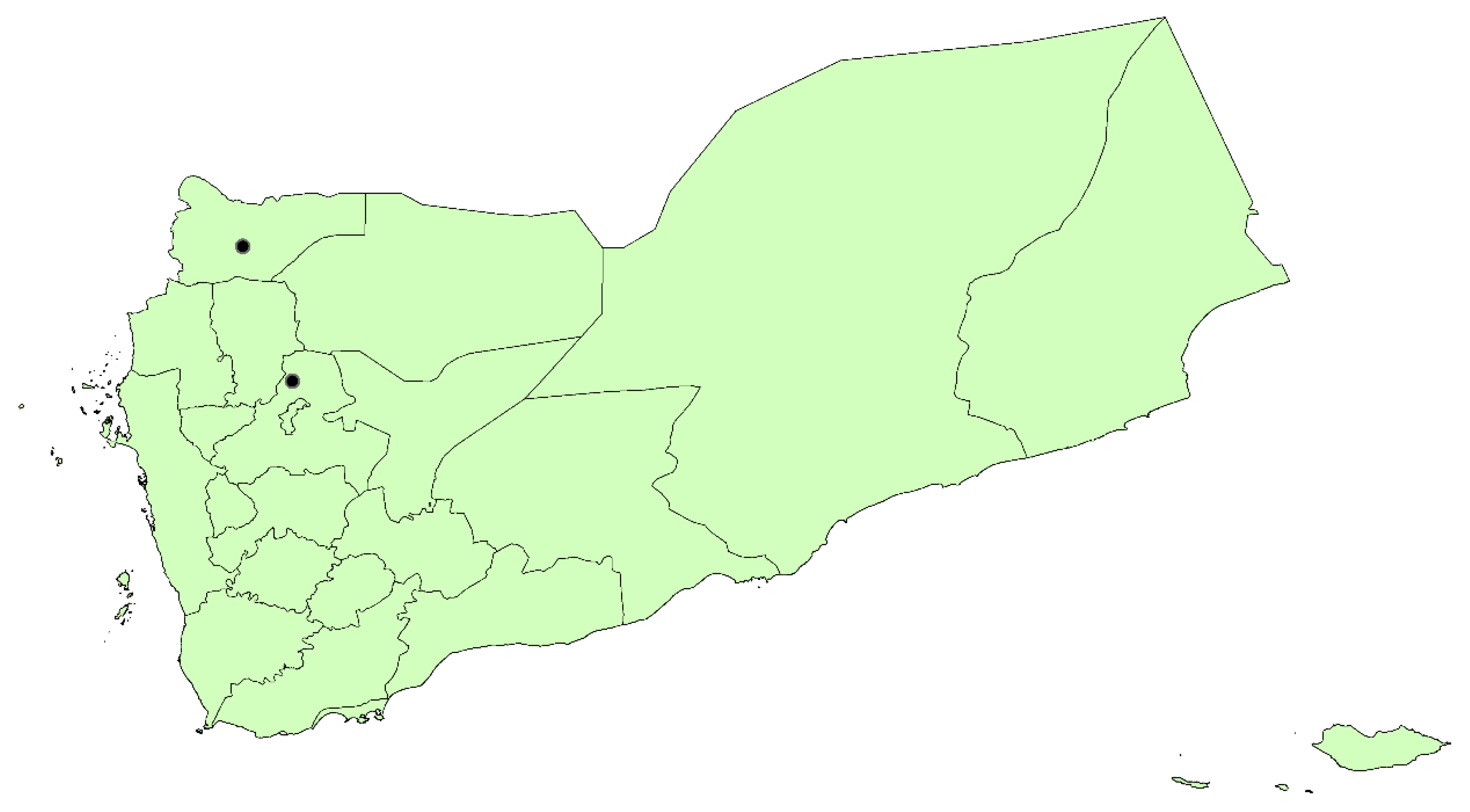
Distribution: Bahmanyar (1973) found this species in Olaman, which is located 15 km northwest of San'a and he also collected this species from Beir Shawath, near Sa'da. These specimens are kept in the collection of the FMNH. Another specimen is in the collection of the SMF.
Praomys fumatus – Rock rat (Peters 1878)
Figure 40.
Records of Praomys fumatus.
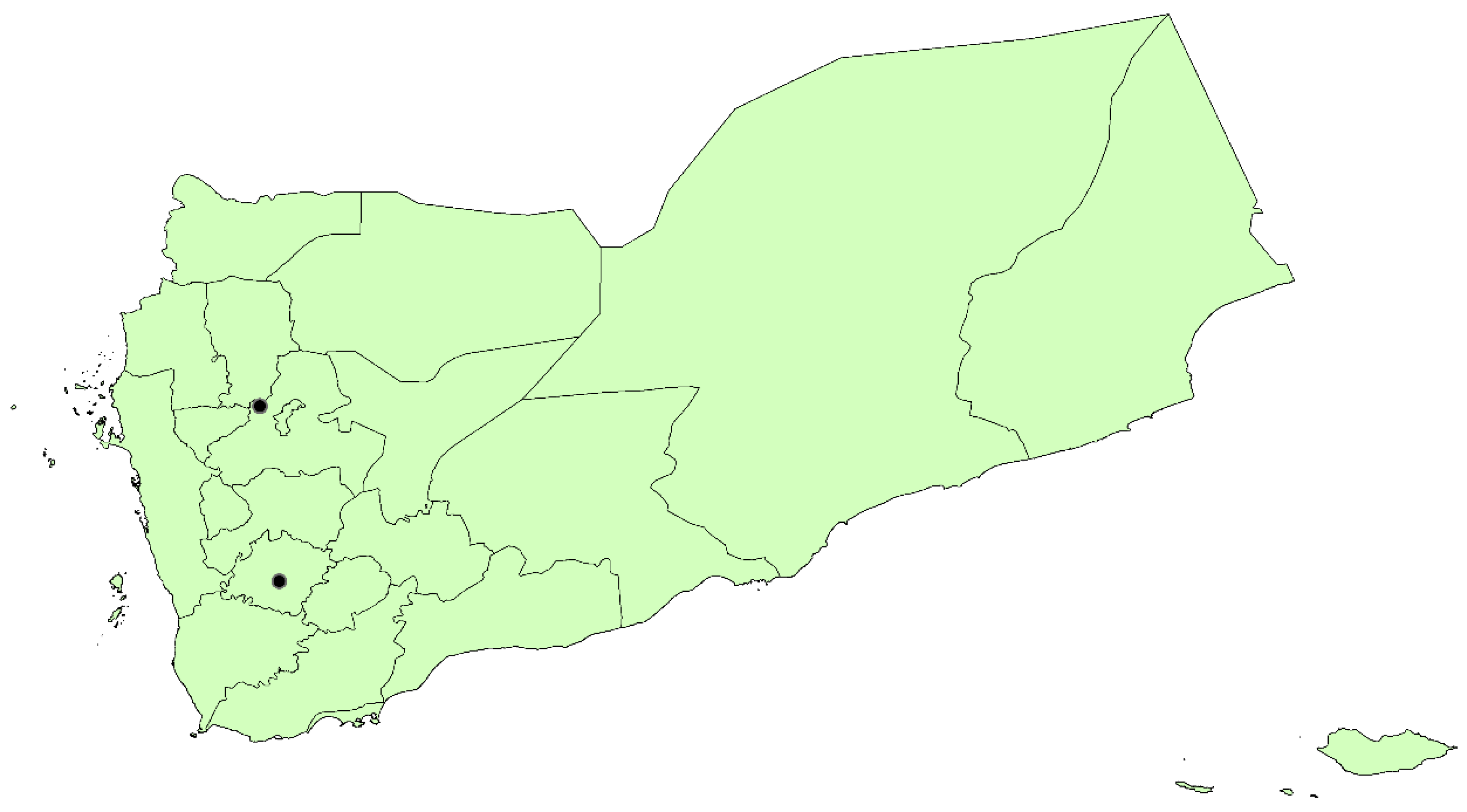
Distribution: Recorded from Al-Najd Al-Ahmar (Showler 1996); Thula village about 50 km northwest of San’a (Wildman 1998).
Myomyscus yemeni - Yemen White-footed Rat (Sanborn & Hoogstraal 1953)
Figure 41.
Records of Myomyscus Yemeni.
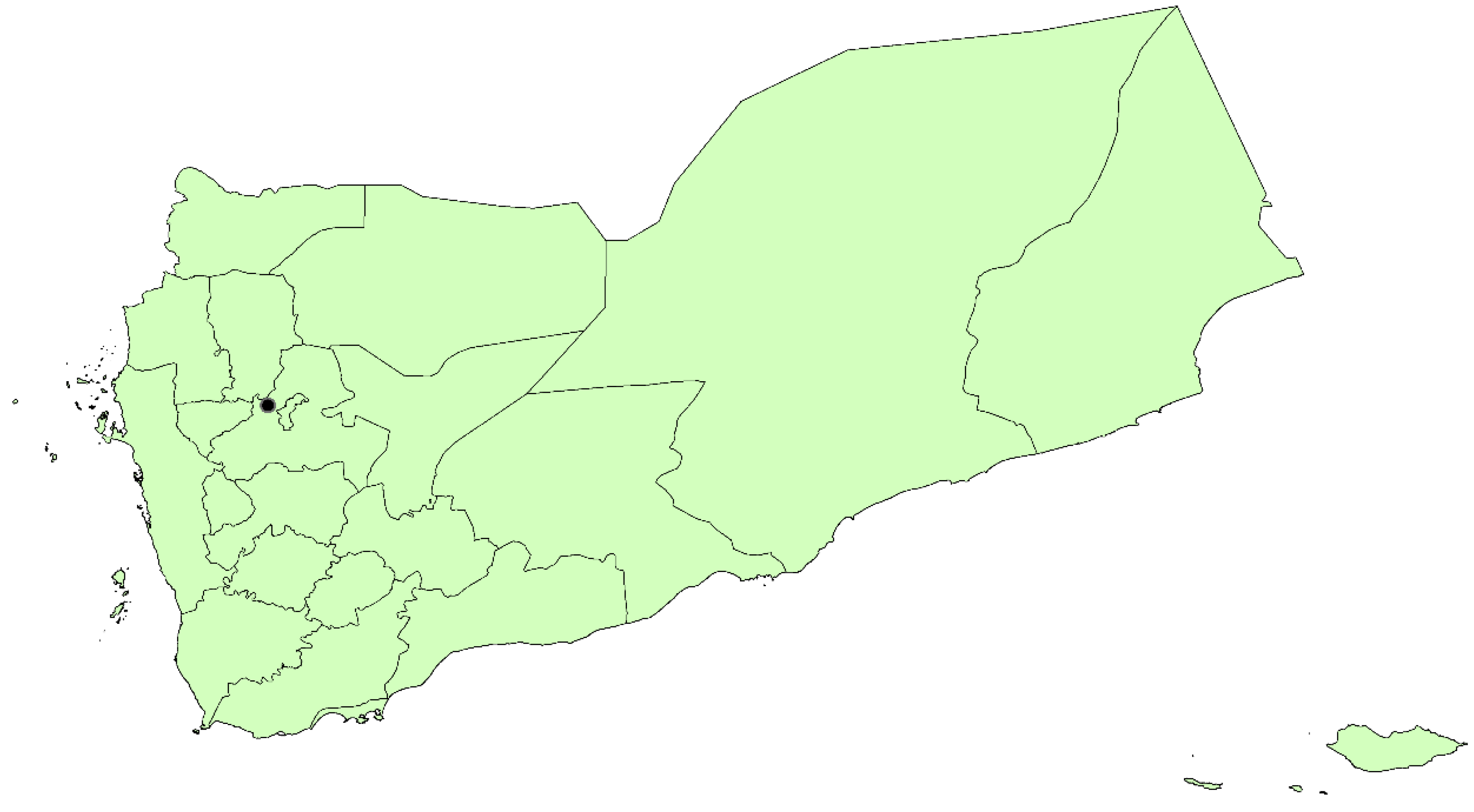
Distribution: Sanborn and Hoogstraal (1953) discovered this new species from Wadi Dhahr about 14 km northwest of San’a. They described it as Myomys fumatus, considering yemeni as a subspecies. Kuntz & Myers (1968) examined a single specimen from Wadi Dhahr.
Gerbillus chessmani - Cheesman’s Gerbil (Thomas 1919)
Subspecies: G. c. maritimus (Sanborn & Hoogstraal 1953) and G. c. arduus (Cheesman & Hinton 1924)
Figure 42.
Records of Gerbillus chessmani.
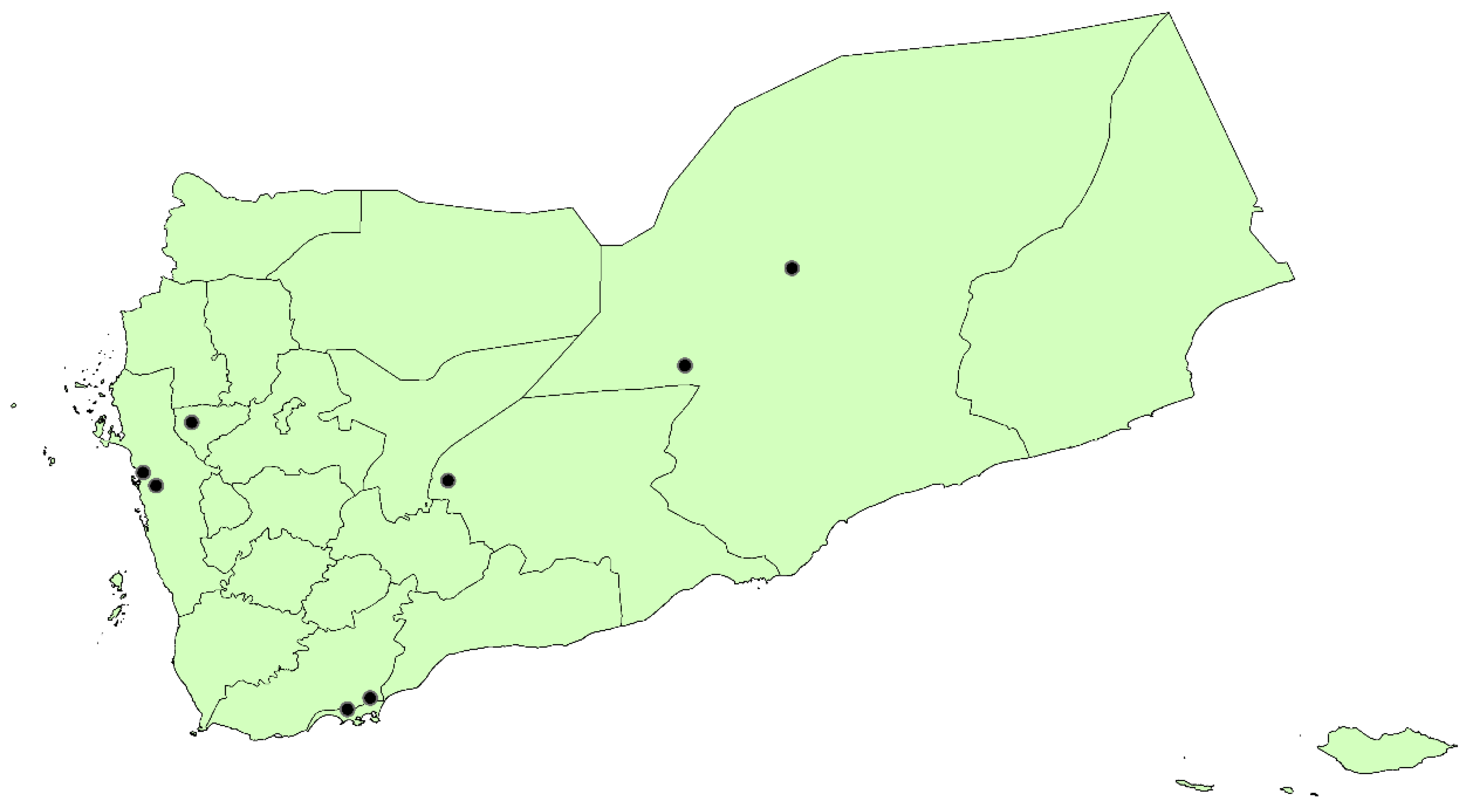
Distribution: Recorded from 3 and 5 miles southeast of Hodeida (Sanborn & Hoogstraal 1953); Hodeida (Hoogstraal & Kaiser 1959; Kuntz & Myers 1968); Al-Ittihad (currently Madinat Asha’ab), Ras Imran village; Beihan (Harrison 1971). Showler (1996) noted it is common in west and central Yemen eastwards to Hadramaut and reported it from Wadi Al-Khabt and Al-Qutay’. Specimens collected by H St JB Philby in (1936) from Ras al Khabb are included in the collection of the BNHM.
Gerbillus famulus - Black-tufted Gerbil (Yerbury & Thomas 1895)
Figure 43.
Records of Gerbillus famulus.
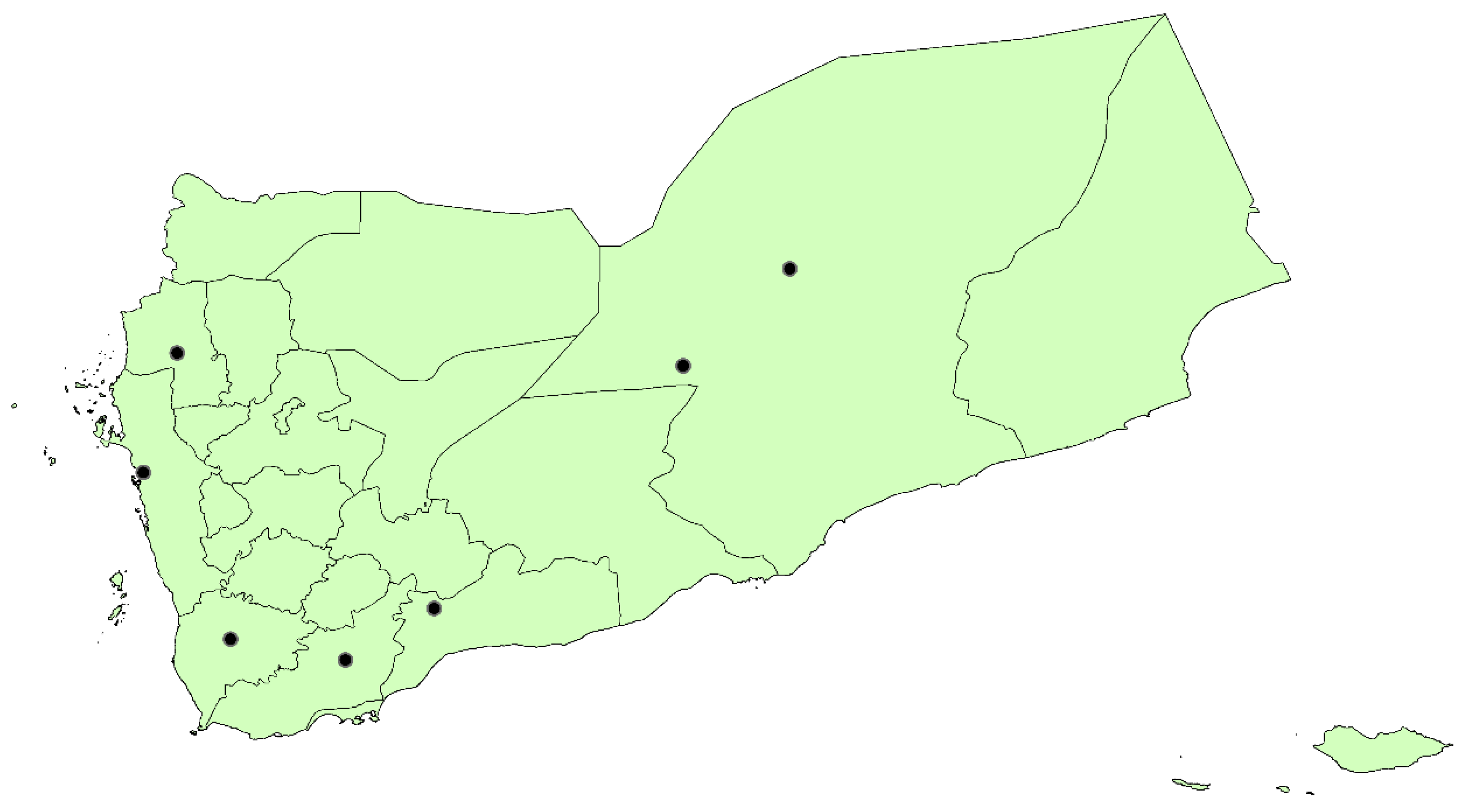
Distribution: Recorded from Lahej (Yerbury & Thomas 1895); Al-Khawr (Thomas 1900); Ta’iz (Kuntz & Myers 1968); two villages in the valley of Wadi el Jaber (Bahmanyar 1972). Specimens collected by H. W. Setzer in (1961) from the province of Hadramaut are included in the collection of the USNM. Collections of the BNHM included specimens obtained by W Dodson in 1899 from Wadi Husan, Al-Khaur. Specimens collected by Bahmanyar in 1973 from Hodeida and Ta’iz are kept in the collections of the FMNH.
Gerbillus henleyi - Pygmy Gerbil (de Winton 1903)
Figure 44.
Records of Gerbillus henleyi.
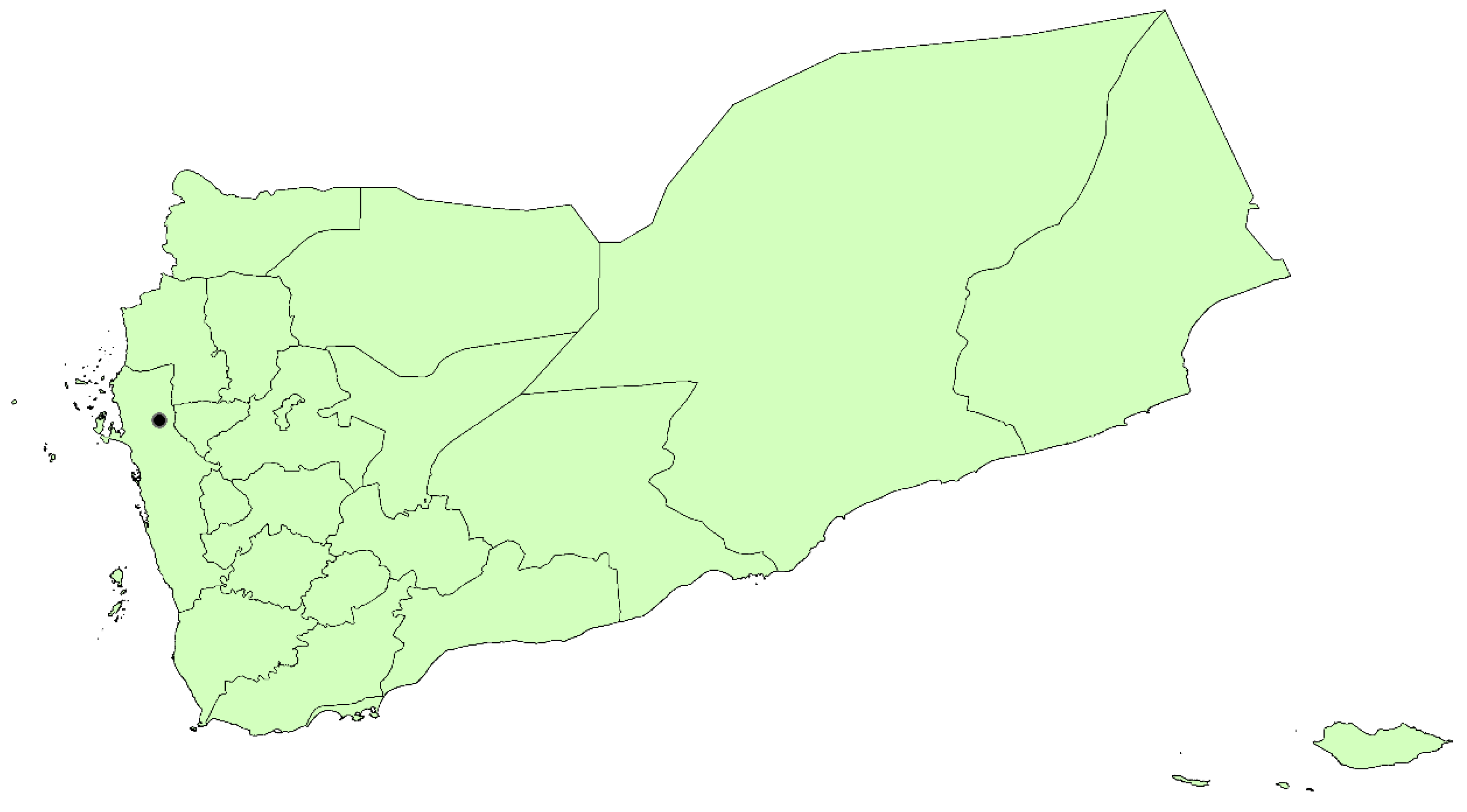
Distribution: Bahmanyar & Lay (1975) reported this gerbil from the northern areas of Yemen. Collections of the FMNH included specimens collected by Bahmanyar in 1973 from Tihama desert in Hodeida province.
Gerbillusgerbillus - Lesser Egyptian Gerbil (Olivier, 1801)
Figure 45.
Records of Gerbillus gerbillus.
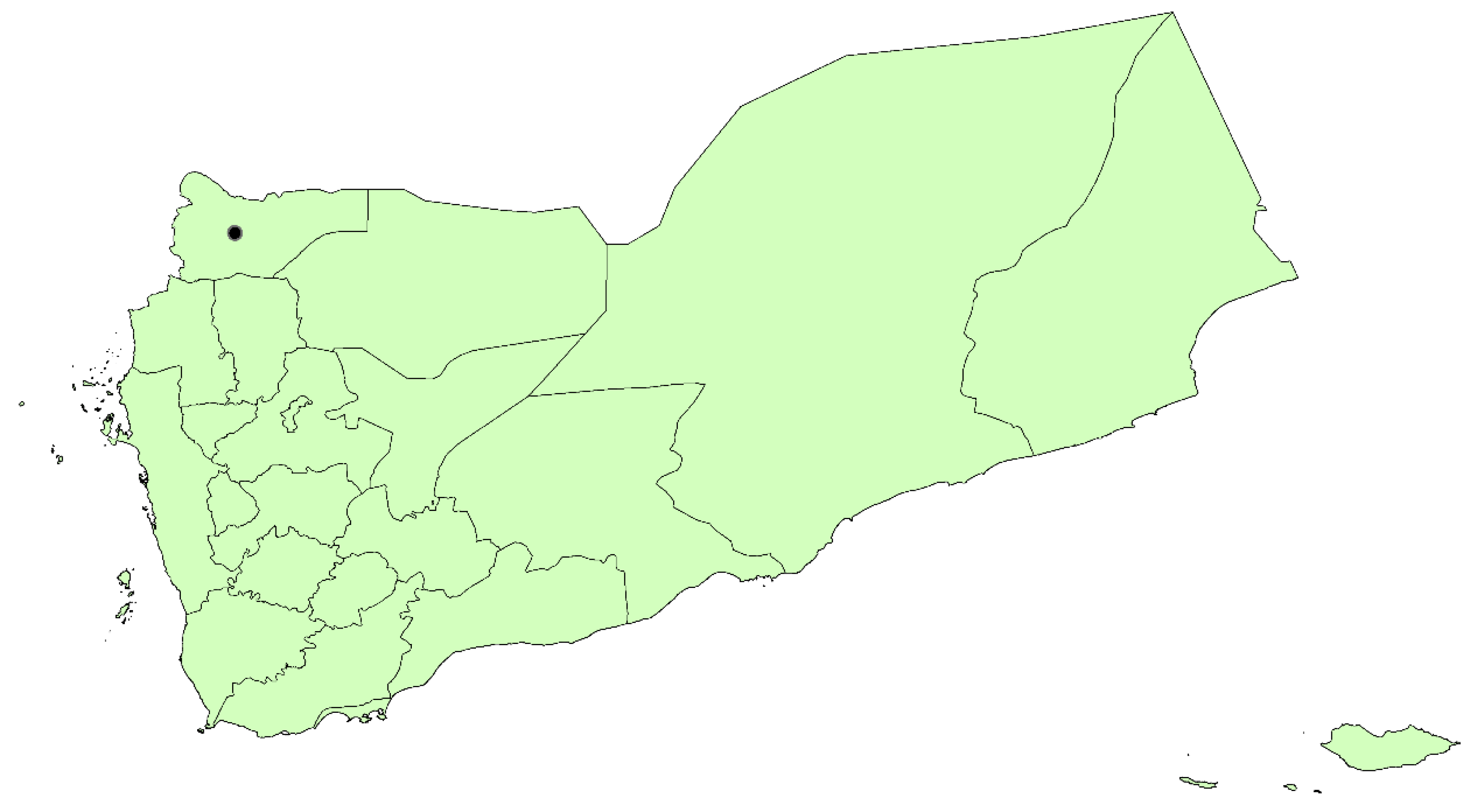
Distribution: Bahmanyar (1972) found this mouse in Sa'dah north of Yemen.
Gerbillus poecilops - Large Aden Gerbil (Yerbury & Thomas, 1895)
Figure 46.
Records of Gerbillus poecilops.
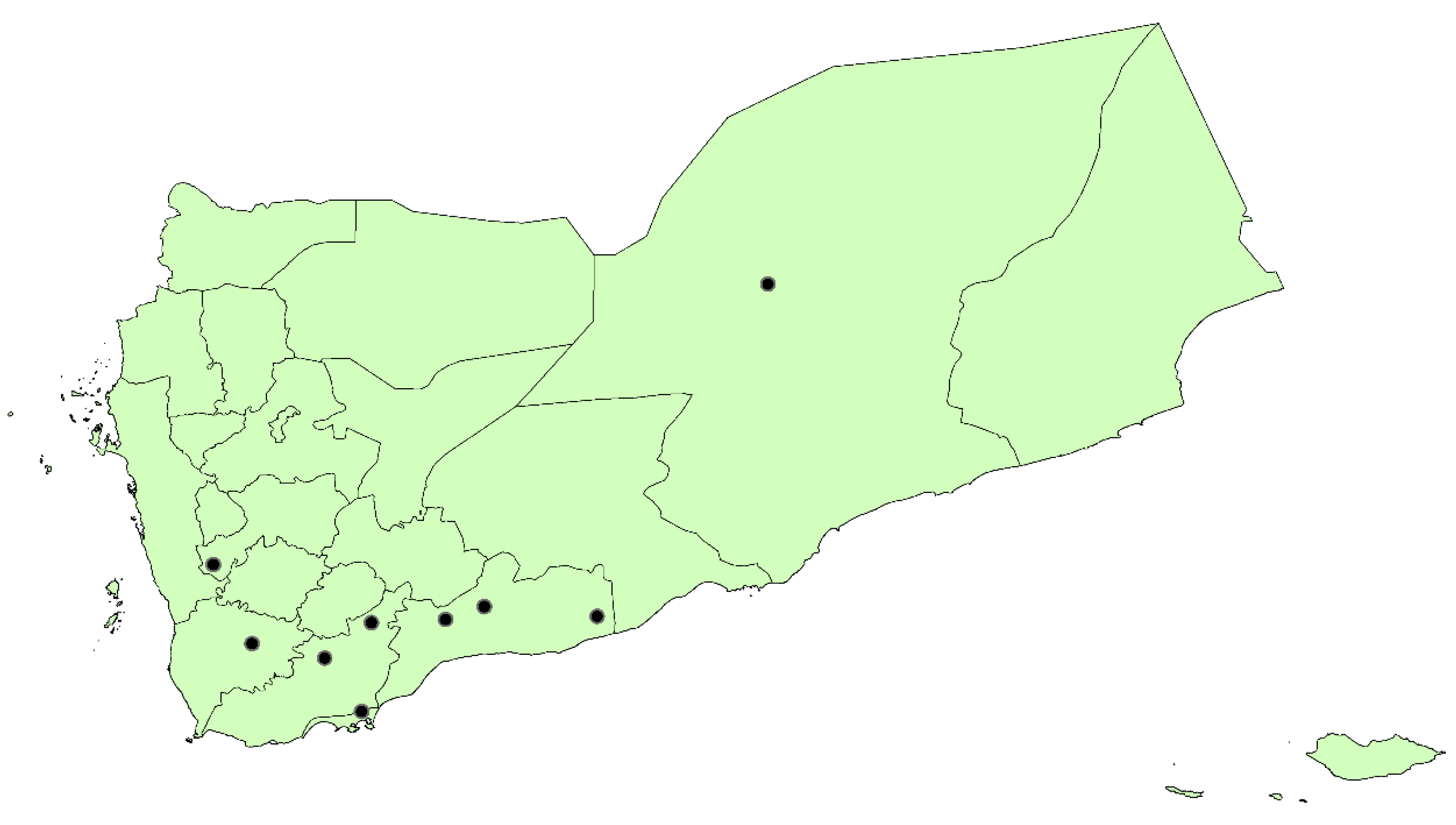
Distribution: Recorded from Lahej and Sheik Othman (Yerbury & Thomas 1895); Lahej, Wadi Bana, and Al-Khaur (Thomas 1900); Aden (Popov 1960); Ta’iz (Bahmanyar & Lay 1975); Thi Al-Khod, Abyan (Harrison 1972). Harrison & Bates (1984) mentioned a specimen collected from Wadi Zabid by Keith Brokie in January 1982. Specimens collected by H. W. Setzer in 1961 from the province of Hadramaut are included in the collection of the USNM; the ones collected from Wadi Bana and Lahej in 1899 by A. B. Percival and W. Dodson are included in the collection of BNHM. Collections of the FMNH included specimens collected by Bahmanyar in 1973 from Ta’iz.
Gerbillus nanus - Baluchistan Gerbil (Blanford, 1875)
Figure 47.
Records of Gerbillus nanus.
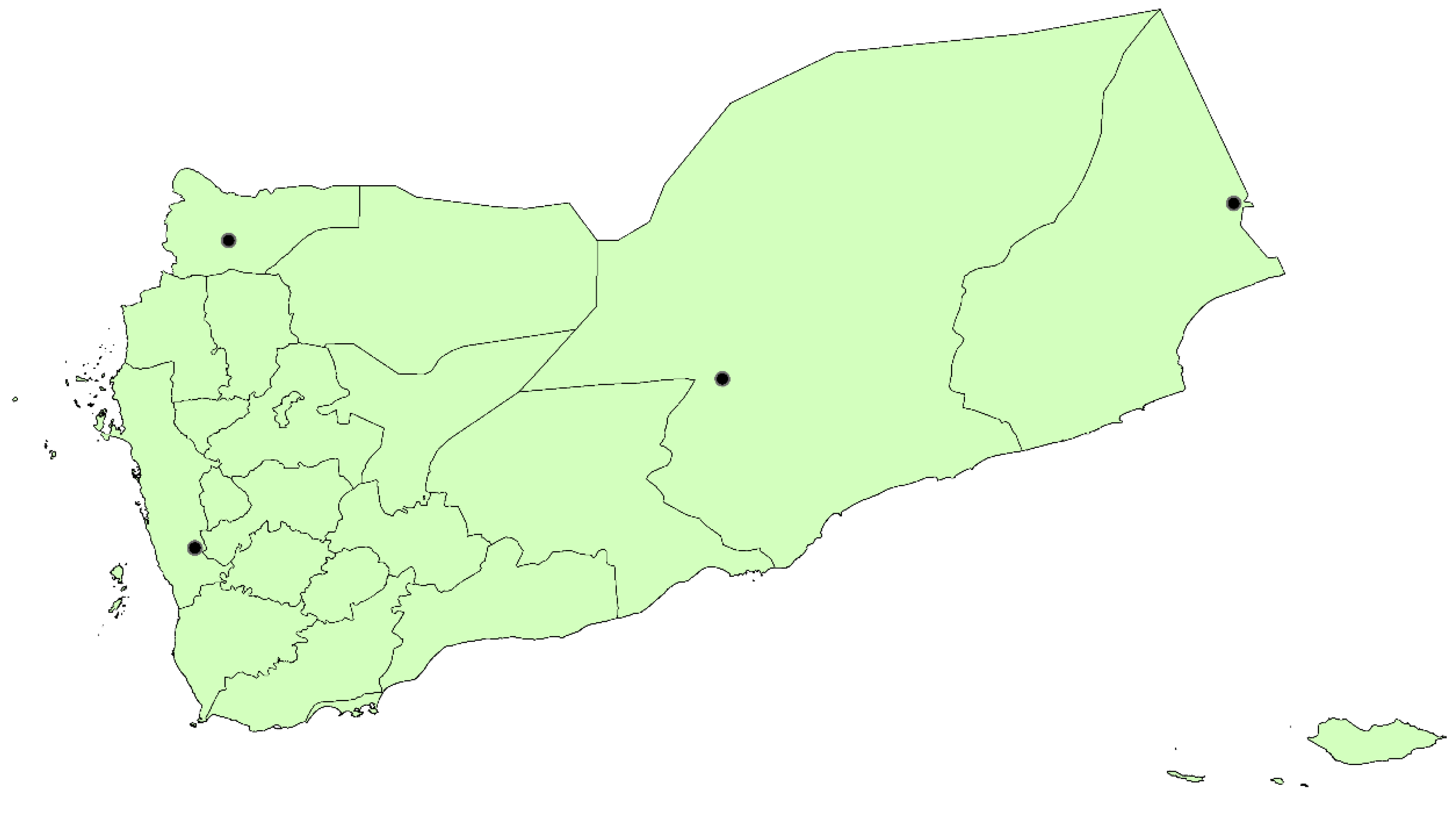
Distribution: Recorded from Habarut (Thesiger 1946). Specimens collected by Thesiger (1946) are included in the collection of the BNHM. Specimens collected by Bahmanyar in 1973 from Hosainiya and Sa'da are included in the collections of the FMNH. Al-Safadi (1988) also collected this gerbil from a locality that is 30 km west of Banil. This specimen was also included in the collection of the BNHM.
Meriones (Parameriones) rex - King Jird (Yerbury & Thomas, 1895)
Subspecies: M. r. buryi (Thomas 1902)
Figure 48.
Records of Meriones (Parameriones) rex.
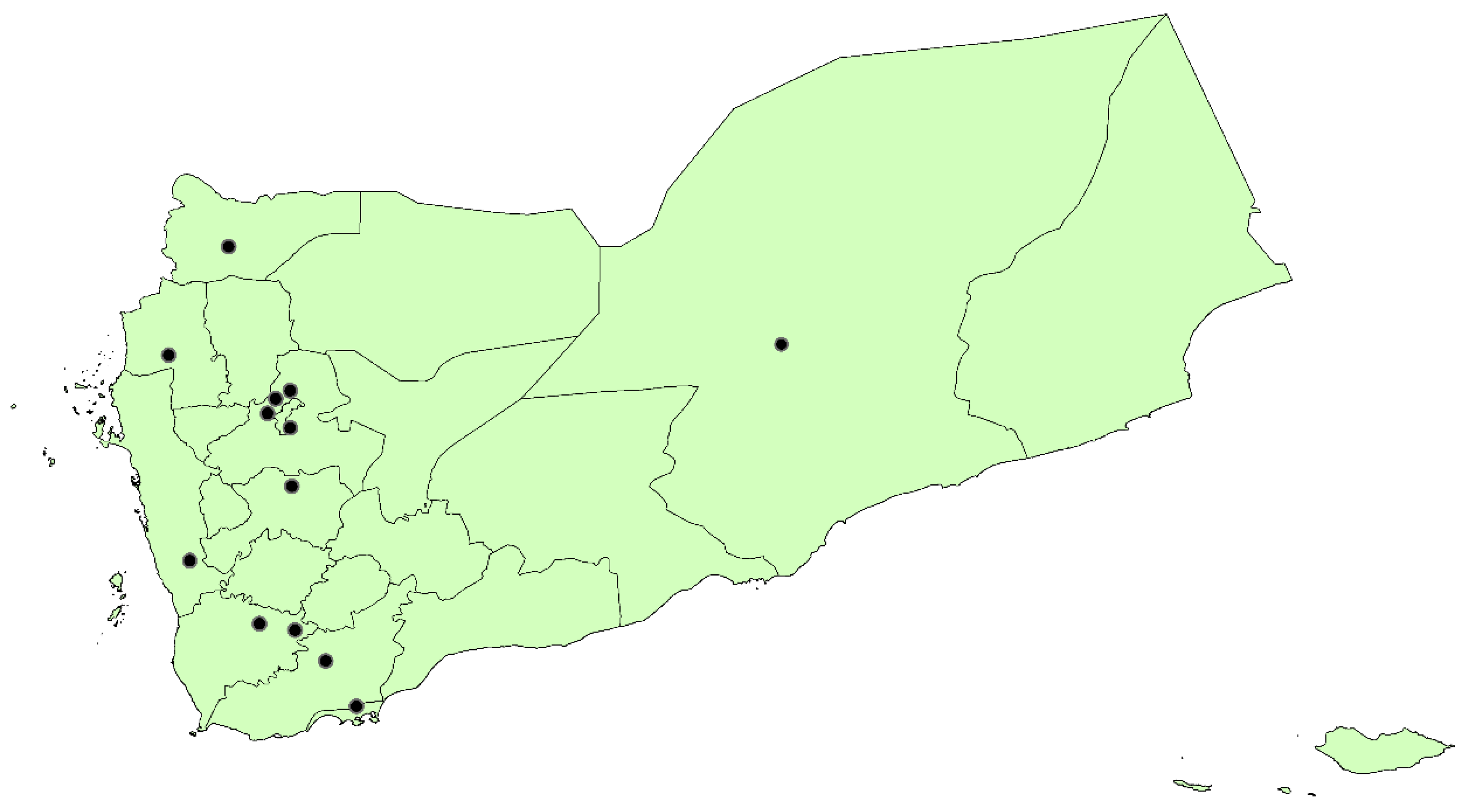
Distribution: This is a common species that can be found in the wadis of the northwest and southwest areas of Yemen. According to Vesey-Fitzgerald (1953), it is confined to the southwestern Arabia. Recorded from Lahej (Yerbury & Thomas 1895); 6 miles south of Ma'bar, 2 miles east of Ma'bar, Al 'Asr (3 miles west of San'a), Wadi Dhahr, 3 miles north of Ta'iz, 5 miles north of Ta'iz, 1 mile west of Ta'iz, Al-Hauban (in Wadi Maleh) (Sanborn & Hoogstraal 1953; Hoogstraal & Kaiser 1959); 6 miles south of Ma'bar (Arthur 1955); Ta’iz (Kuntz & Myers 1968); areas around the valley of Wadi el Jaber (Bahmanyar 1972); Aden (Scaramella 1975). Rands et al. (1987) found one specimen in a valley 15 km west of Sa'dah and collected another five specimens from Al Munaqqab. Popov (1960), Harrison & Bates (1991) reported this species from Aden. Showler (1996) observed many specimens in the western highlands of Yemen. Specimens collected by H. W. Setzer in 1961 from the town of Taribah in the province of Hadramaut are included in the collection of the USNM. Specimens collected by G W Bury in 1902 from Zabid in addition to other specimens collected from Sana’a are included in the collection of the BNHM. Specimens collected from Ta’iz and Beir Ghazi near Sa’da by Bahmanyar in 1973 are kept in the collection of the FMNH. The collection of the natural history museum of Kansas University (KU) included a specimen collected by Hoogstraal from Ta’iz in 1951. Another specimen is in the collection of the SMF.
Meriones (Pallasiomys) libycus – Libyan jird (Lichtenstein, 1823)
Figure 49.
Records of Meriones (Pallasiomys) libycus.
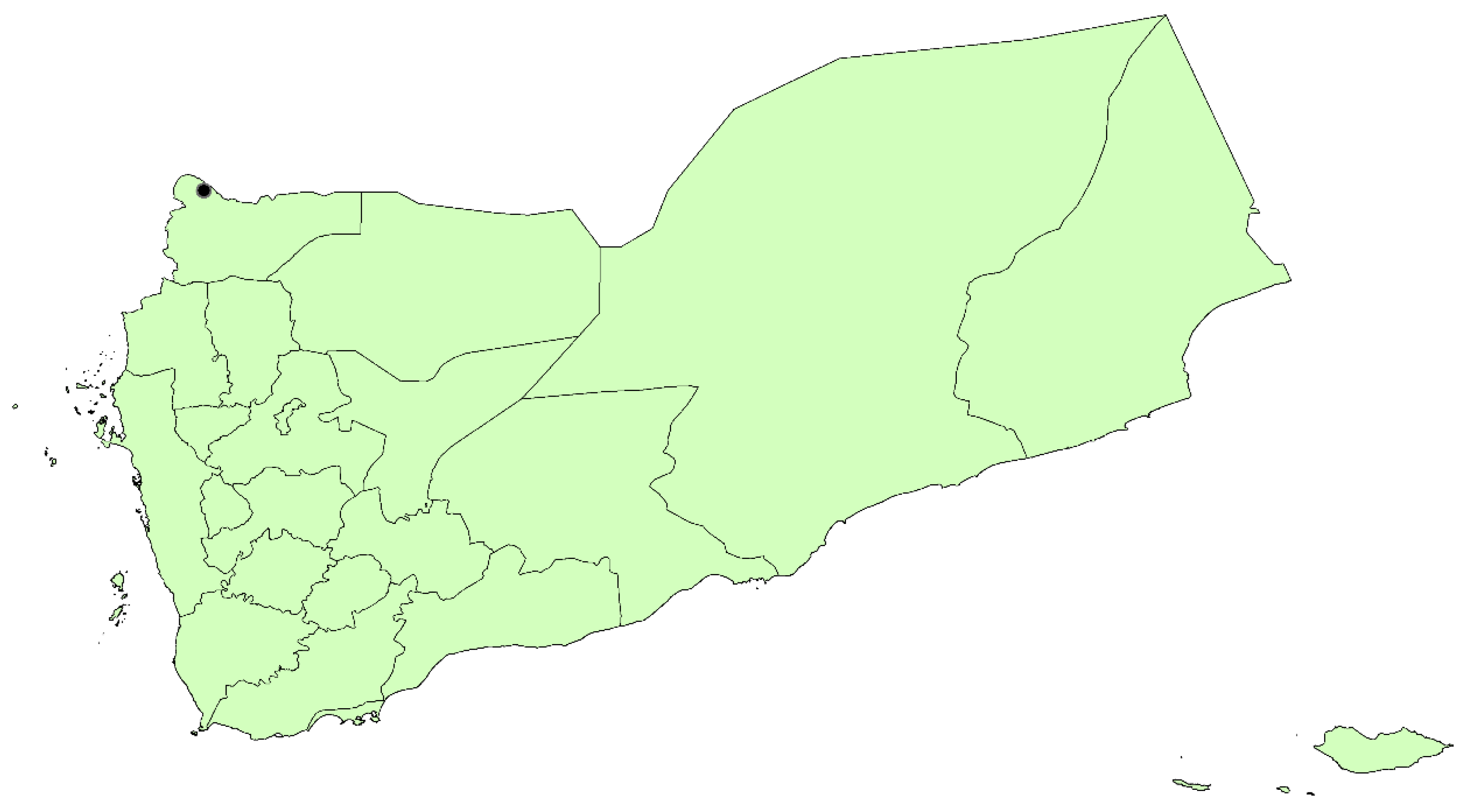
Distribution: Recorded from Wadi Jizan (Thesiger 1947). Specimens collected by Thesiger in 1947 are included in the collection of the BNHM.
Mus musculus - House Mouse (Linnaeus 1758)
Subspecies: M. m. gentilulus (Thomas 1919) and M. m. bactrianus (Blyth 1846)
Figure 50.
Records of Mus musculus.
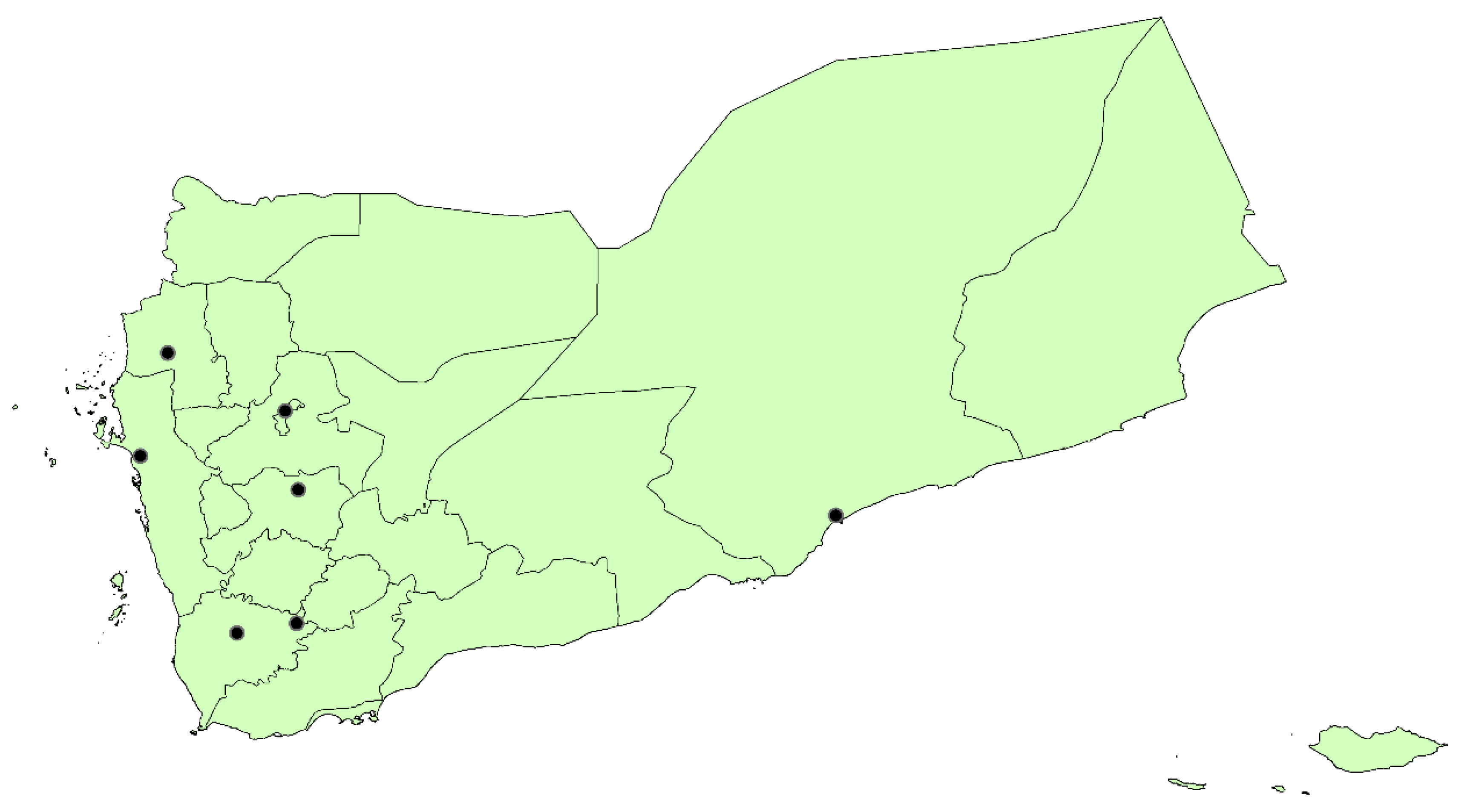
Distribution: Very common pest that can be found throughout the territories of Yemen. Recorded from Ta’iz area by (Hoogstraal & Kaiser 1959). Reported from Mukalla by G S. Garg in 1990 and included in the collections of the BNHM. Prager et al. (1988) found this mouse in Sana’a, Hodeida, Wadi Maleh, 12 km east of Ta’iz, and Ma’bar. These specimens, which were originally collected during 1951–1954, came from the collection of the FMNH. Kuntz & Myers (1968) examined five specimens of M. m. bactrianus from Sana’a and Hodeida. Bahmanyar (1972) found this mouse in the villages of Wadi el Jaber north of Yemen. The collection of the natural history museum of Kansas University (KU) included a specimen collected by Hoogstraal from San’a in 1951.
Rattus rattus – Black rat (Linnaeus, 1758)
Figure 51.
Records of Rattus rattus.
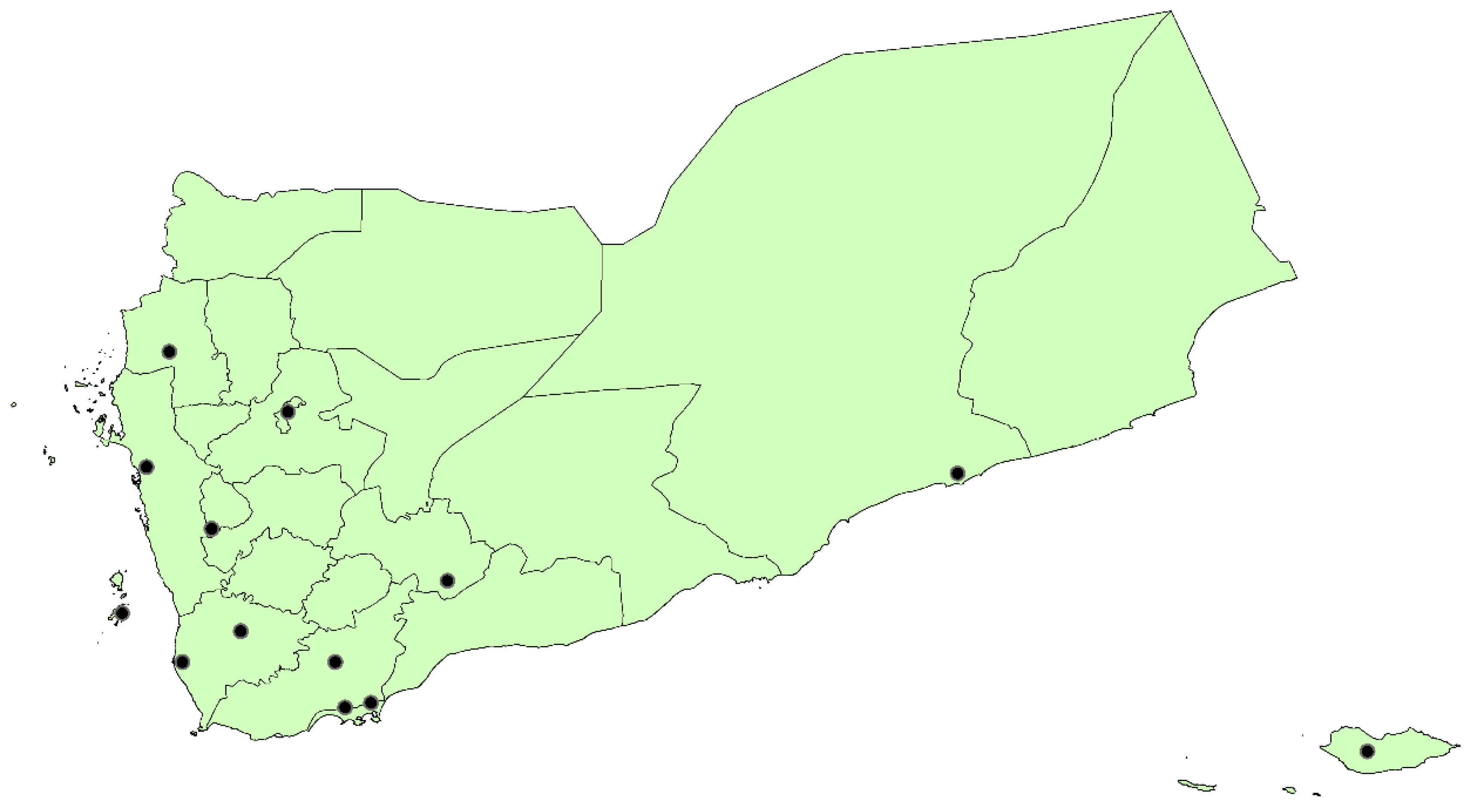
Distribution: Very common. Recorded from Hodeida (Hoogstraal & Kaiser 1959); Aden (Popov 1960); San’a, Ta’iz, Hodeida (Kuntz & Myers 1968); Wadi el Jaber (Bahmanyar 1972); San’a, Aden, Hodeidah, Ta’iz, Lahej, Al-Mukalla, Mukeiras, Socotra (Ubadi 1993); Socotra (Banfield et al 2010; Masseti 2015); Al-Haswa (Baker & Al-Balam 2016). Specimens collected from Mukalla by G S. Garg in 1990 are kept in the collection of the BNHM. Specimens collected from Al-Hajar village in Ta’iz by Jean-Antoine Rioux in 1982 are included in the collection of the Muséum national d’Histoire naturelle. The collection of the natural history museum of Kansas University (KU) included a specimen collected by Hoogstraal from San’a in 1951.
Rattus norvegicus – Brown Rat (Berkenhout 1769)
Figure 52.
Records of Rattus norvegicus.
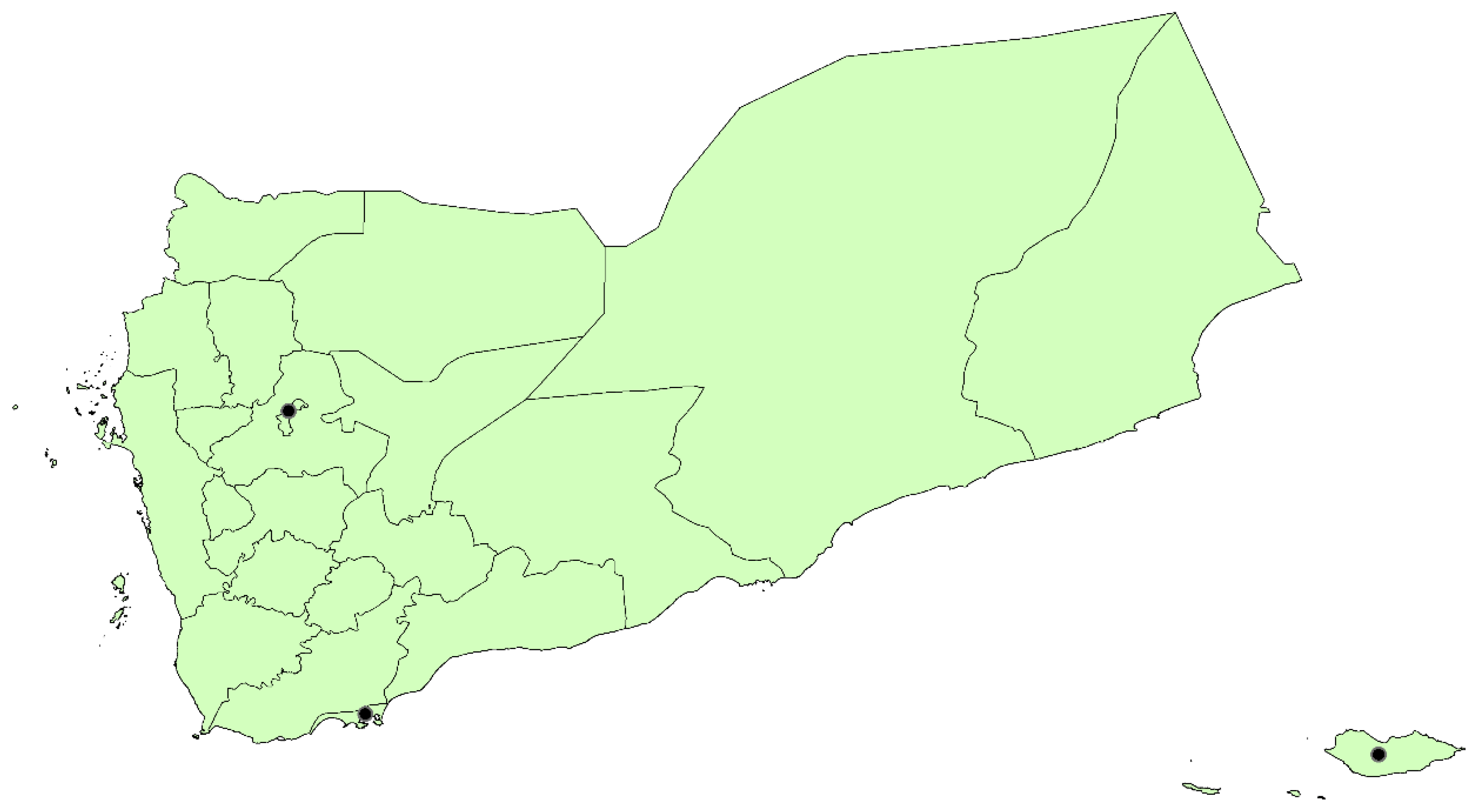
Distribution: Recorded from Aden (Popov 1960); Socotra (Banfield et al. 2010); San’a (Al-Mehdar & Al-Battah 2016).
Family Dipodidae
Jaculus jaculus - Lesser Egyptian Jerboa (Linnaeus, 1758)
Subspecies: J. j. vocator (Thomas, 1921)
Figure 53.
Records of Jaculus jaculus.
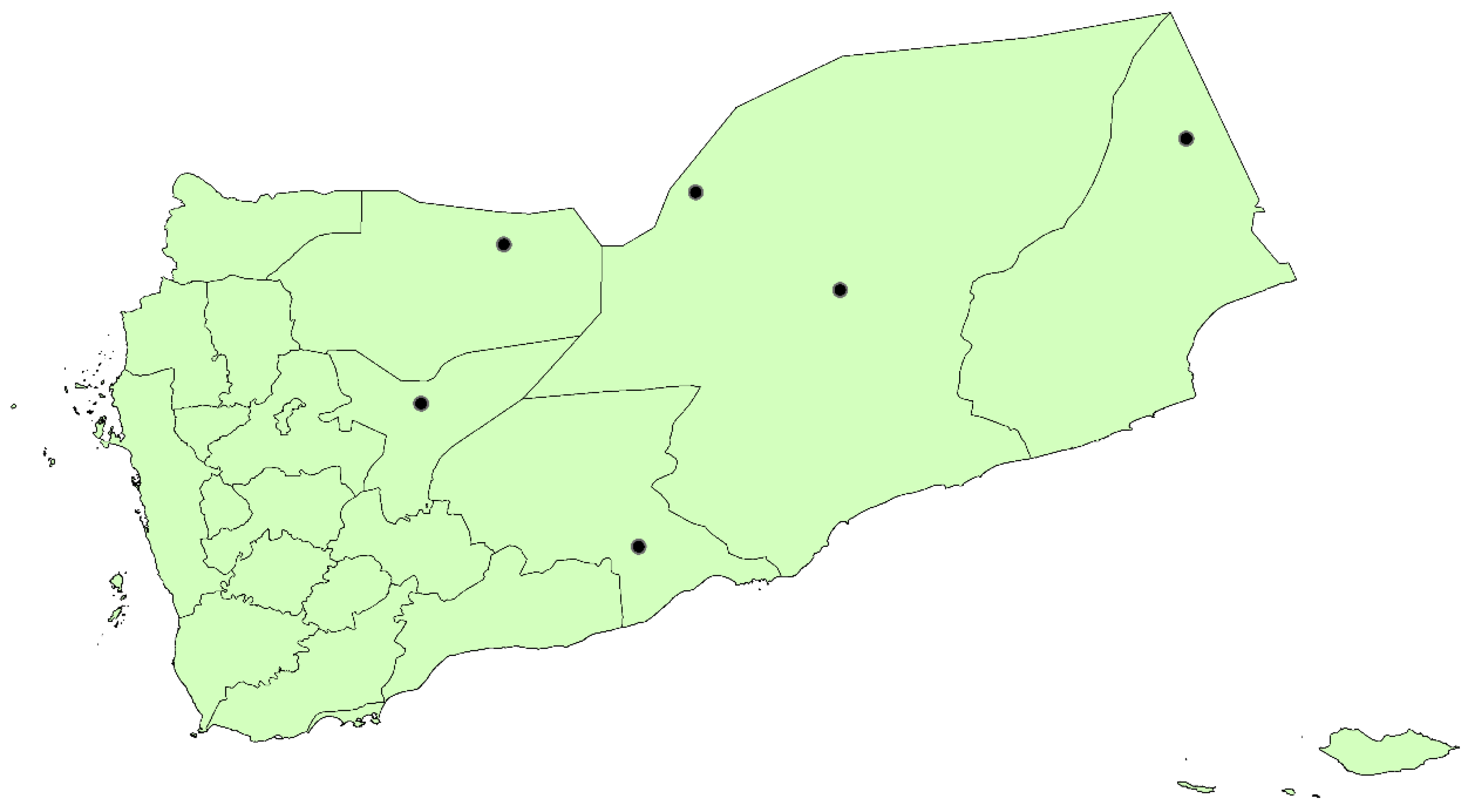
Distribution: Scaramella (1975) noted this is a common gerboa that can be found in the central plateau (central provinces). Recorded from North of Yemen by Harrison & Bates (1991) and Al-Jumaily (1998). Ubadi (1993) reported this jerboa from Thamud, Ma’rib, northern deserts of Al-Mahra. Specimens obtained by A. R. M. Rickards in 1933 from Wadi Hammam are kept in the collection of the FMNH.
Family Hystricidae
Hystrix indica - Indian Crested Porcupine (Kerr, 1792)
Subspecies: H. i. schmidtzi (Müller, 1911)
Figure 54.
Records of Hystrix indica.
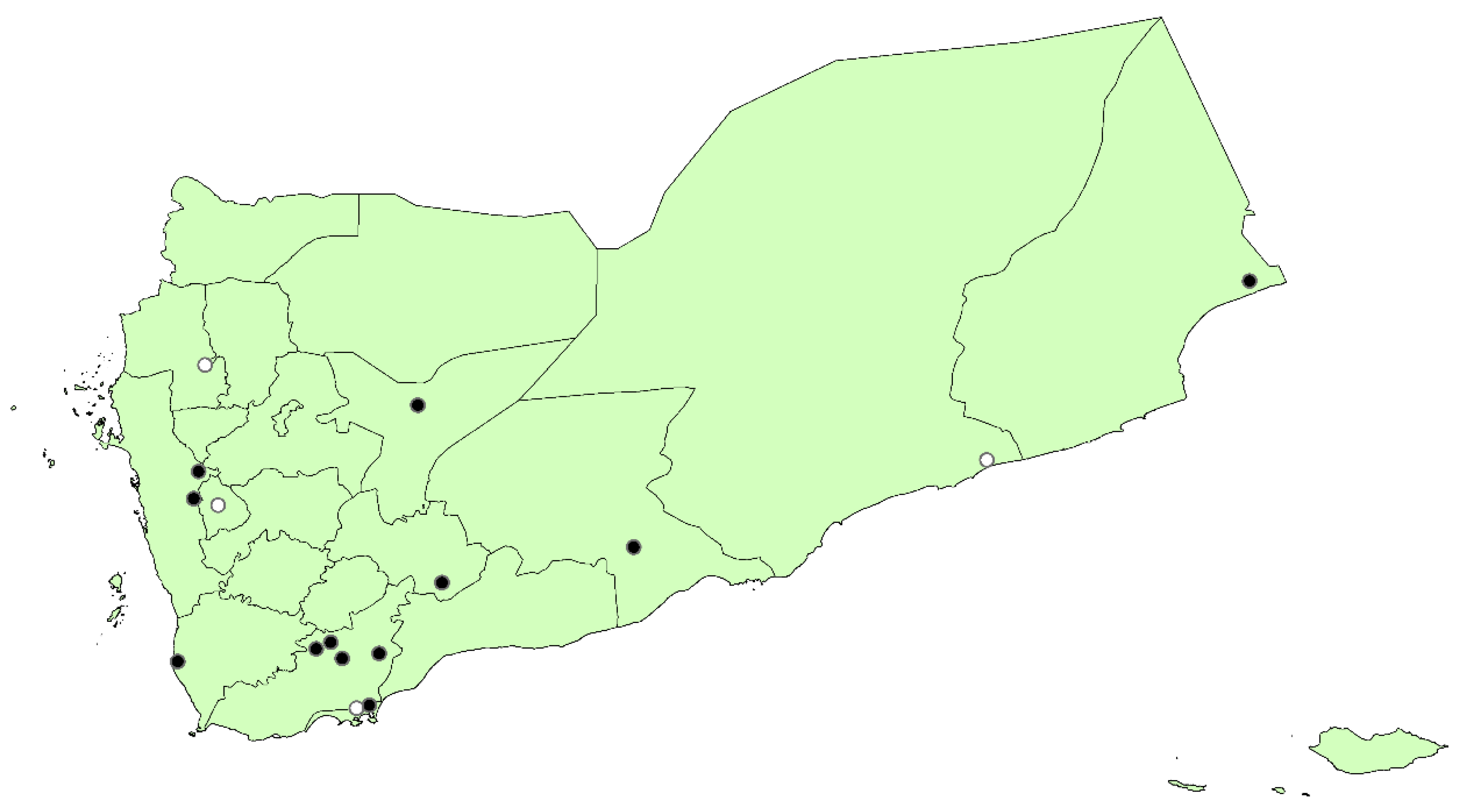
Distribution: Widespread. Recently recorded from Aden, Wadi Sharres, Bani Matar, Qusay’ir. Previously recorded from south of Mocha (Scaramella 1975); north of Yemen (Al-Safadi & Nader 1991); eastern Yemen (Jennings 1992); Aden, Lahej, Thar, Alsan, Mukeiras (Ubadi 1993); Marib dam (Showler 1996); Bura (Wildman 1998); Wadi Rijaf (Cowan 2004); and Hawf (Al-Khorozyan et al. 2014). Popov (1960) suggested this species could be found in Aden.
OrderLAGOMORPHA
FamilyLeporidae
Lepus capensis - Cape Hare (Linnaeus 1758)
Subspecies: L. c. arabicus (Ehrenberg 1833)
Figure 55.
Records of Lepus capensis.
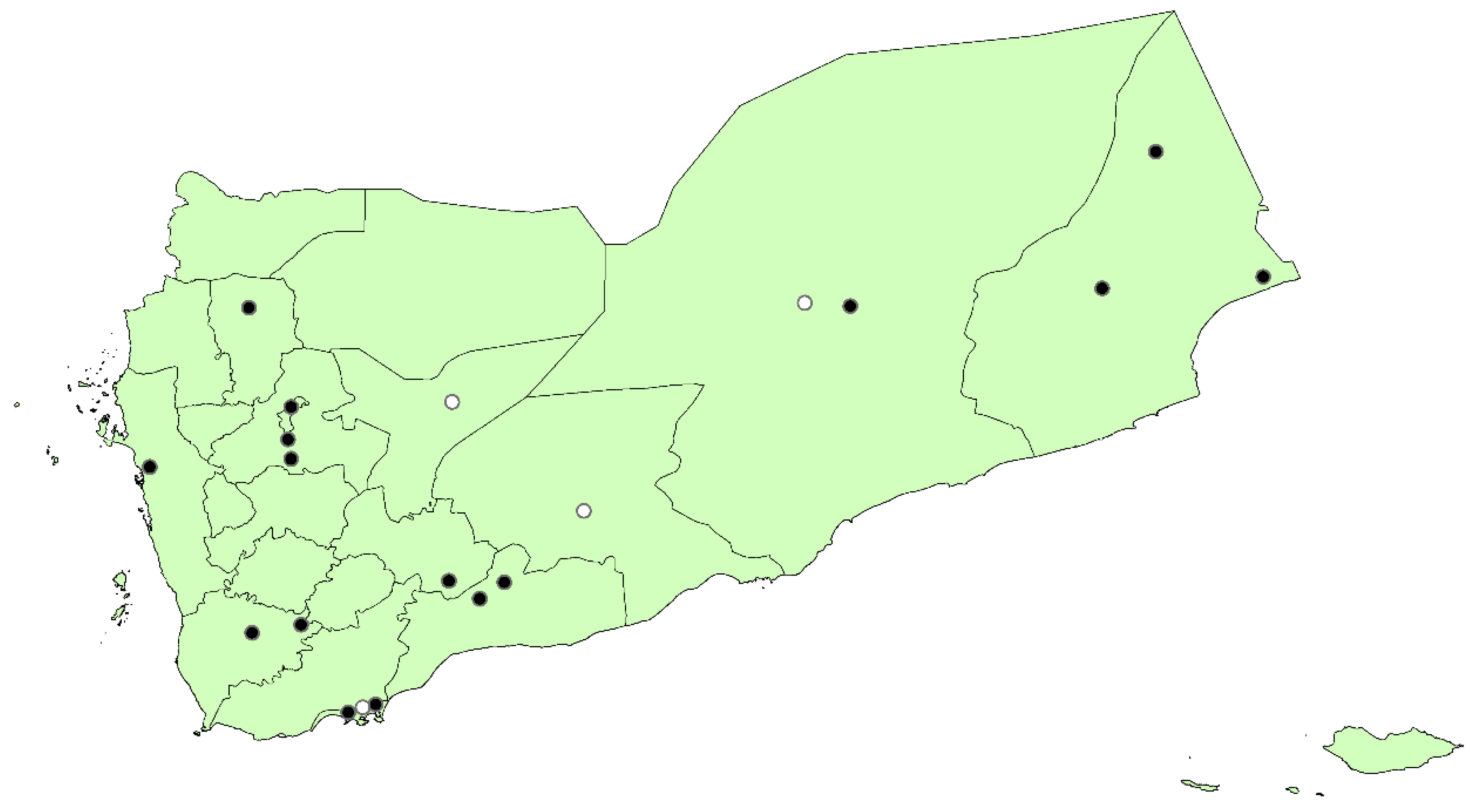
Distribution: Widespread. Recently recorded from 11 localities in the following provinces: Ma’rib, Hadramaut, Shabwa, and Aden. Previously recorded from areas between the villages of Naqil Yaslih and Bait Az Zaydah (Al-Tha’alibi 1924); San’a (Cheesman 1926); areas around Jihaf mountain (Scott 1942); Ta’iz area, Hodeida, Al-Hawban, Wadi Maleh (Hoogstraal & Kaiser 1959); Aden (Popov 1960; Ellermann & Morrison-Scott 1966; Stookey 1982); San’a and Ta’iz (Kuntz & Myers 1968); San’a (Scaramella 1975); Kitaf in Sa’da province (Thesiger 1980); Thamud, north of Al-Mahra, Lawder, Mudiya, Mukeiras (Ubadi 1993); Wadi Sh'hout and 17 other records from western Yemen in the highlands and the coastal Tihamah plain (Showler 1996); Hawf (Al-Khorozyan et al. 2014); Al-Haswa natural protectorate (Cheesman 1926; Baker & Al-Balam 2016). Specimens collected by H. W. Setzer in 1961 from the province of Hadramaut are included in the collection of the USNM.
Order PRIMATES
Family:Cercopithecidae
Papio hamadryas - Hamadryas Baboon (Linnaeus 1758)
Figure 56.
Records of Papio hamadryas.
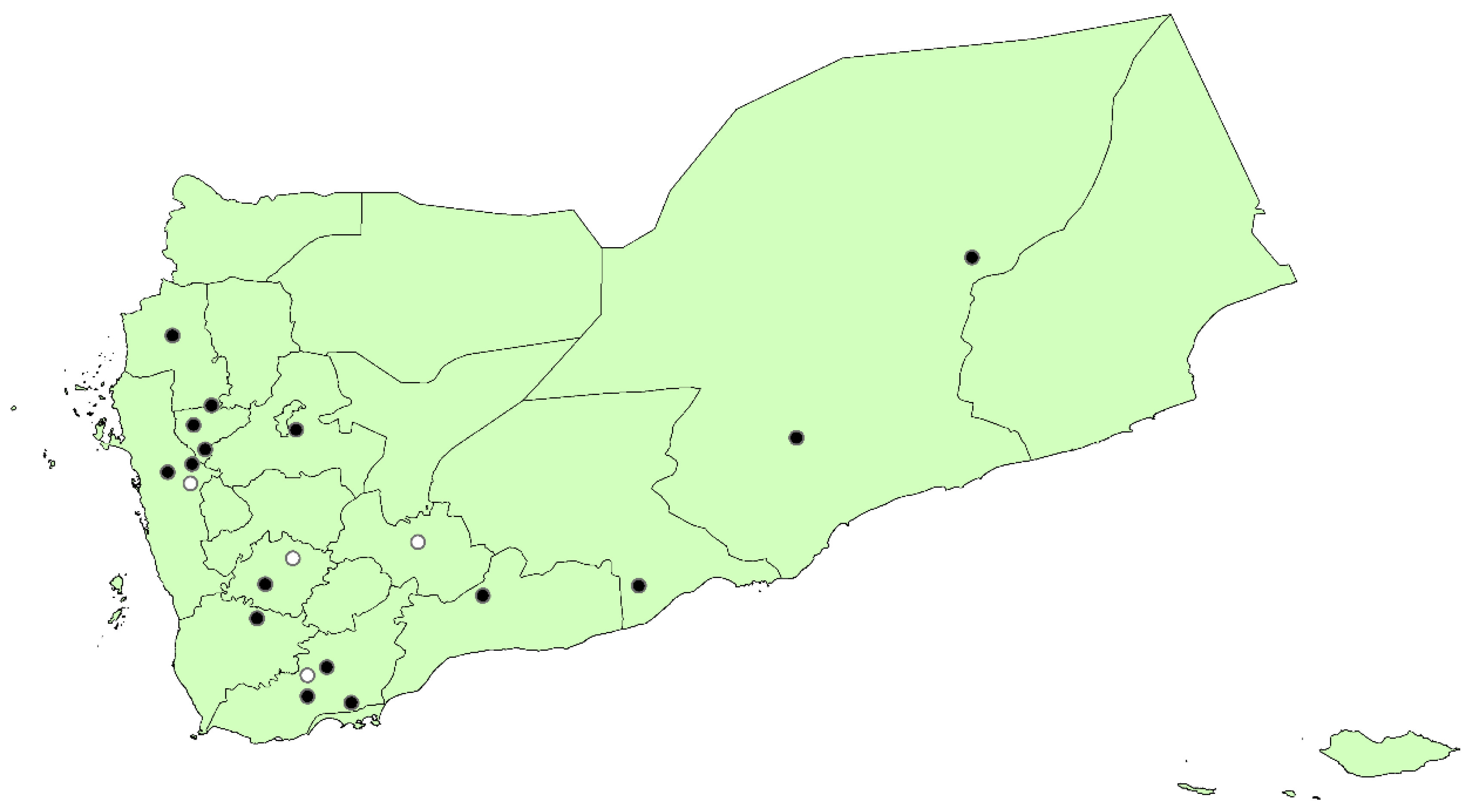
Distribution: Widespread. Restricted to mountainous areas. Recently recorded from Al-Sha’ar mountains in Ib province; mountains of Aqabat Malih in the district of Nati’ in Al-Baidha’ province; mountains around Zuraiqat Al-Yemen; mountains of Ib; and in the natural protectorate of Bura’. Hunter (1877) noted this monkey inhabited the unreachable parts of the hills around Aden. Yerbury (1895) observed this baboon in Haithalhim. Matchie (1896) observed flocks of baboons descending from the mountains in Aden. Thomas (1900) reported this species from Subaihi Country, about 60 miles northwest of Aden. Bury (1911) saw many baboons in different mountainous areas in Yemen. Al-Tha’alibi (1924) found this species abundant in Jabel Ali. Scott (1942) spotted baboons in Jihaf mountain. Sanborn & Hoogstraal (1953) noted these baboons were very common around Ta’iz. Scaramella (1975) reported this is a very common species in the southern parts of Ta’iz. Jennings (1992) indicated the occurrence of baboons in Yemen is restricted to the western mountains. Scholte (1992) reported this baboon from Wadi Rima. Ubadi (1993) recorded baboons from Jihaf mountain, Lahej, Ta’iz, Wadi Aidam, Al-Kawr mountains. Al-Safadi (1994) recorded this baboon from 18 localities in the following provinces: Hajah, Mahweet, Hodeida, San’a, Ibb, Ta’iz. Wildman (1998) reported this baboon from Jabal Bura and Jabal Iraf. Also reported from Wadi Rijaf (Cowan 2004). Showler (1996) observed baboons near Ibb, Jabal Iraf, Yashbum/Wadi Habban, and Wadi Shabdh. Wildman et al. (2004) recorded this species from Jabal Rayma, Jabal Iraf, Ta’iz, and Wadi Mur. Additional records of this species from Aden was provided by (Elliot 1913; Starck & Frick 1958; Popov 1960; Harrison 1964; Kummer et al. 1981; Nader 1990; Harrison & Bates 1991; Al-Jumaily 1998). Stuart & Stuart (2017) noted that baboons occur throughout Yemen and are known as far eastwards as Wadi Idim in the Hadramaut area. Museums Victoria collections include a male specimen collected from Aden. BNHM collection also include a specimen from Yemen.
Order SIRENIA
Family Dugongidae
Dugong dugon – Dugong (Müller 1776)
Figure 57.
Records of Dugong dugon.
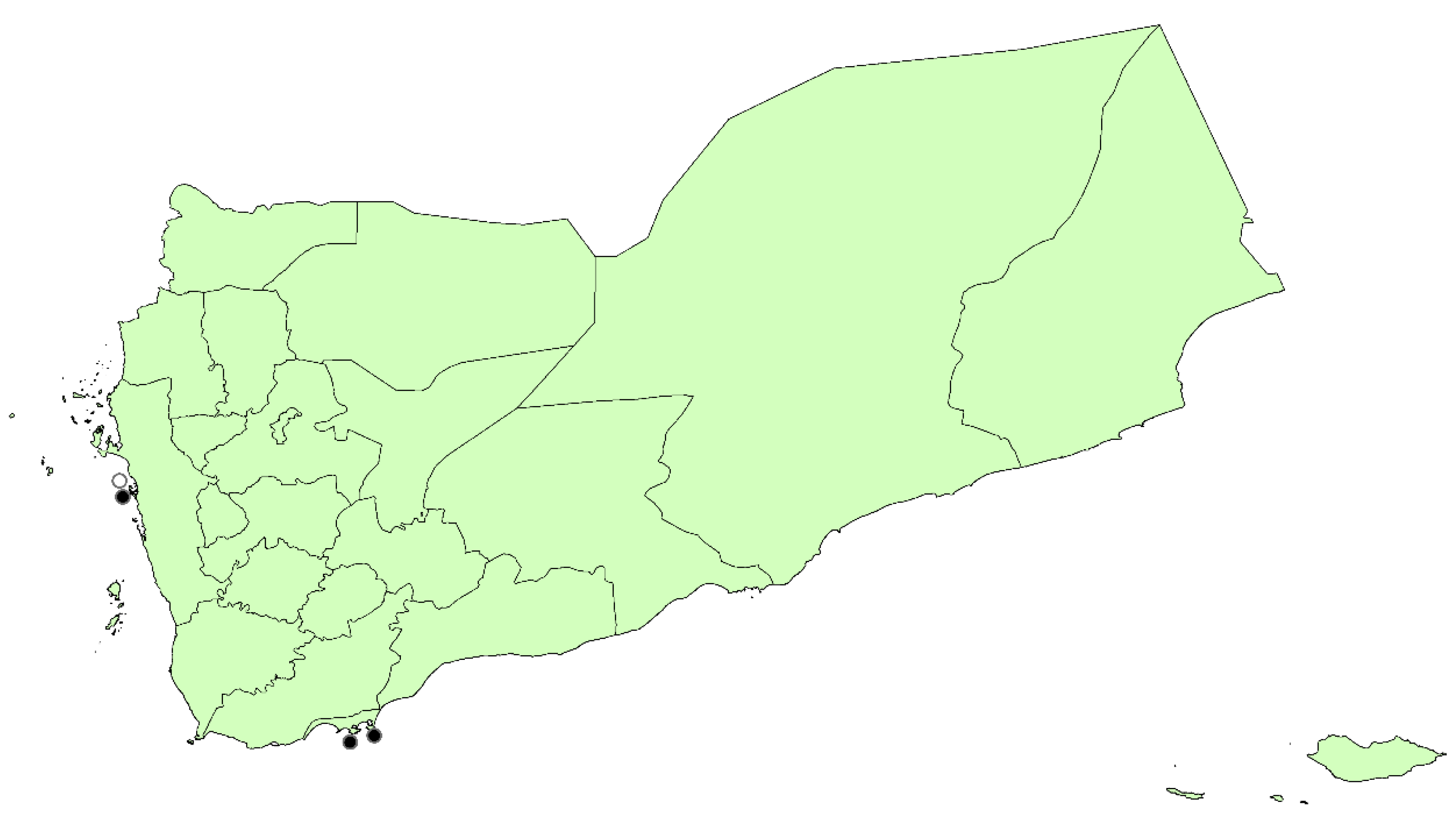
Distribution: Yerbury & Thomas (1895) noted that dugongs could be found at Little Aden and they saw one during March 1895 at Steamer Point. Cheesman (1926) recorded this species from Aden. Scaramella (1975) noted this species was almost disappeared from the Red Sea. Reported from the shores of Hodieda (Preen 1989), and alsorecently recorded from there.
Order CETACEA
Family Delphinidae
Delphinus capensis - Long-beaked Common Dolphin (Gray 1828)
Subspecies: D. c. tropicalis (van Bree 1971)
Figure 58.
Records of Delphinus capensis.
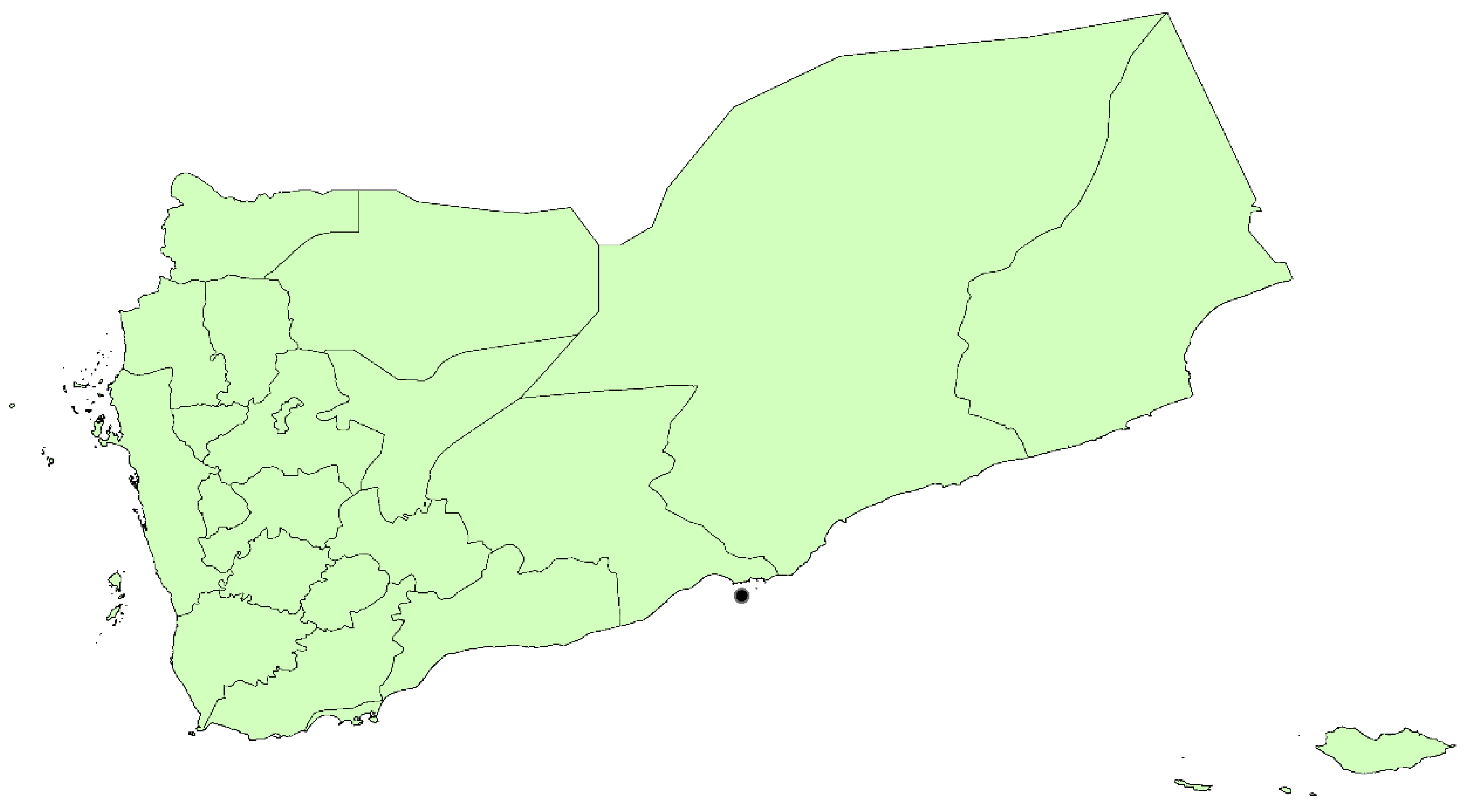
Distribution: Recorded from Bir Ali – Belhaf waters (Kemp et al. 2002).
Stenella longirostris - Spinner Dolphin (Gray 1828)
Figure 59.
Records of Stenella longirostris.
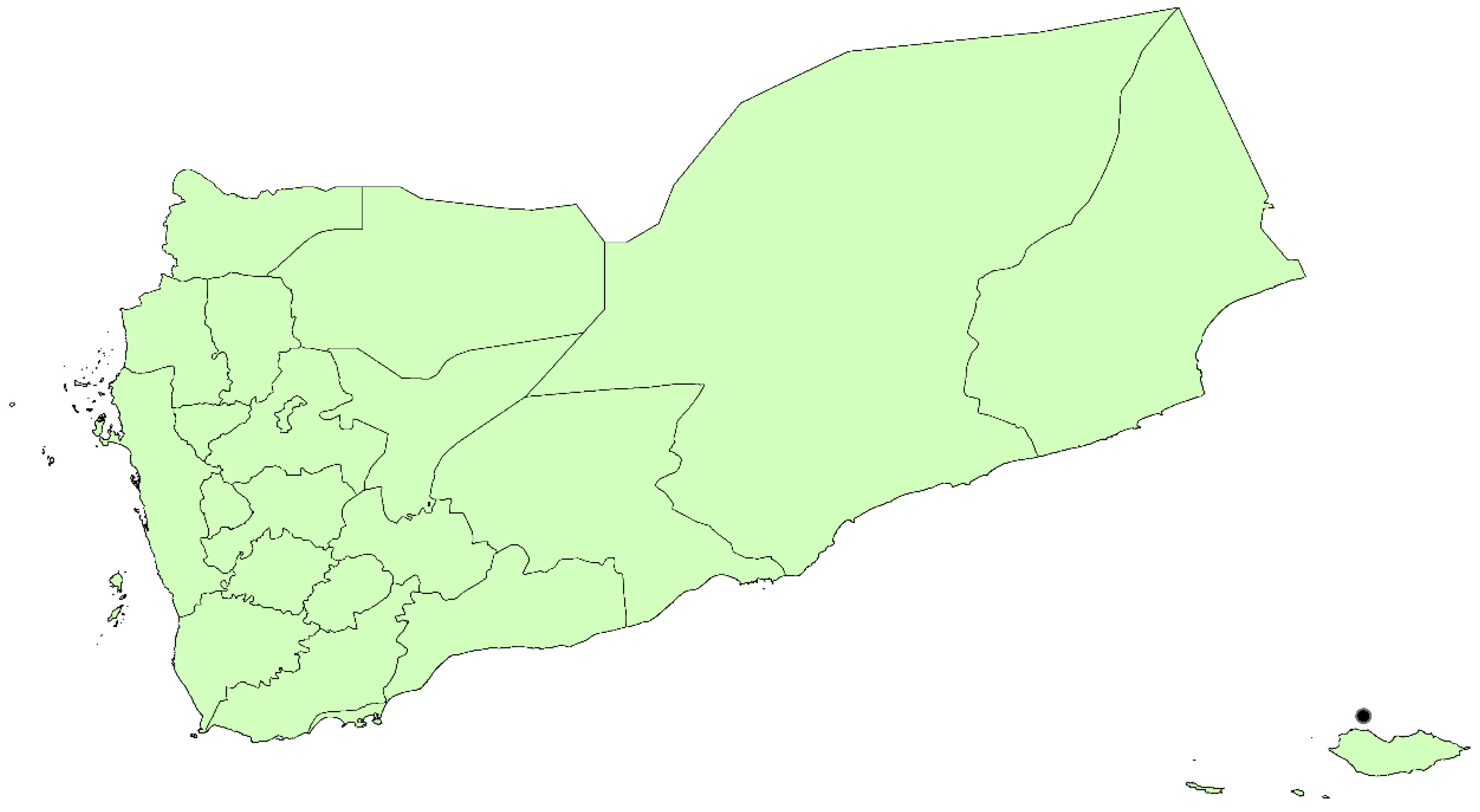
Distribution: Recorded from offshore west of Hadibu, Socotra (Showler 1996).
Grampus griseus - Risso’s Dolphin (Cuvier 1812)
Figure 60.
Records of Grampus griseus.
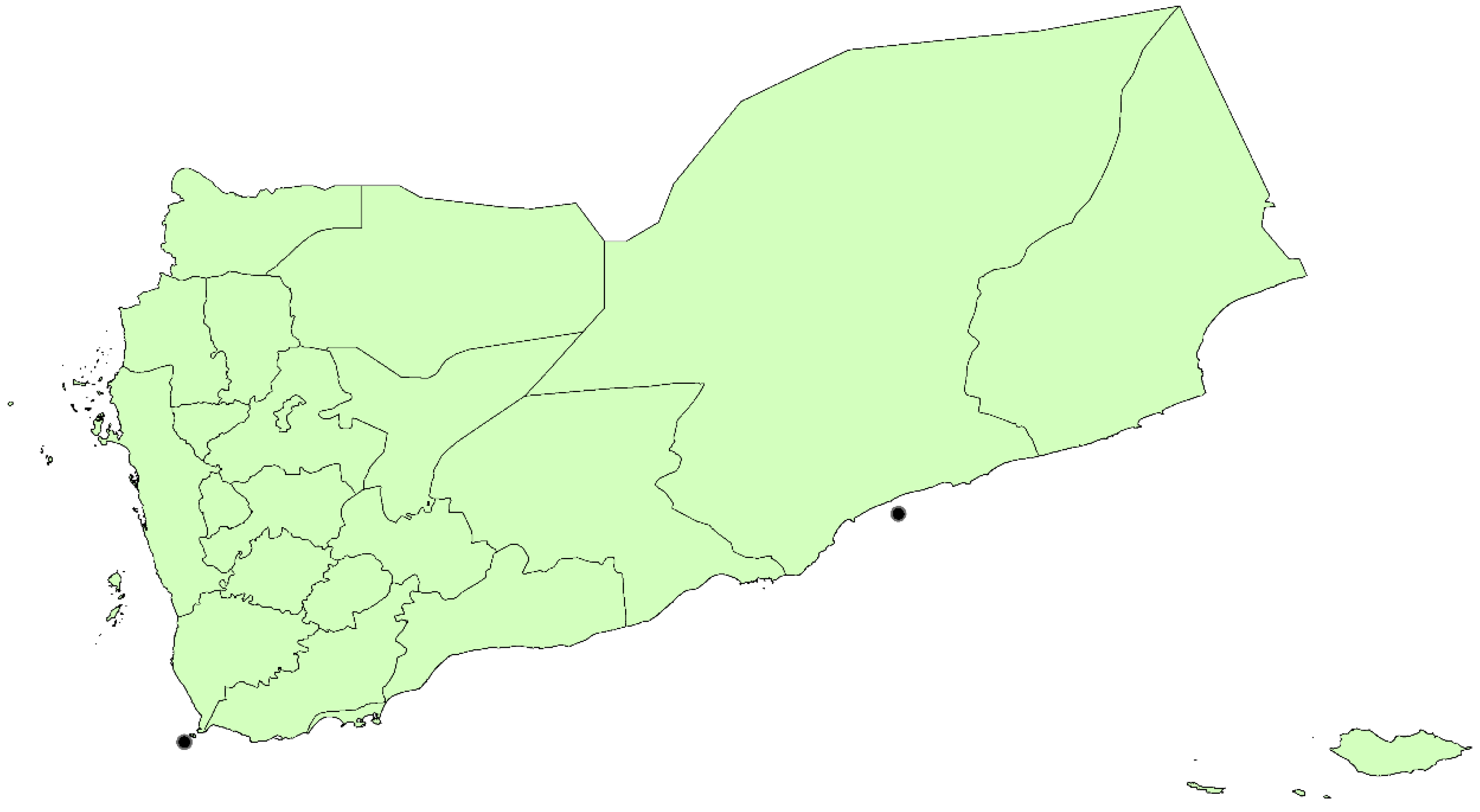
Distribution: Recorded from coastal waters of South Yemen near Al-MukaIla, Perim island (Weitkowitz 1992).
Tursiops truncatus - Bottlenose Dolphin (Montagu 1821)
Figure 61.
Records of Tursiops truncates.
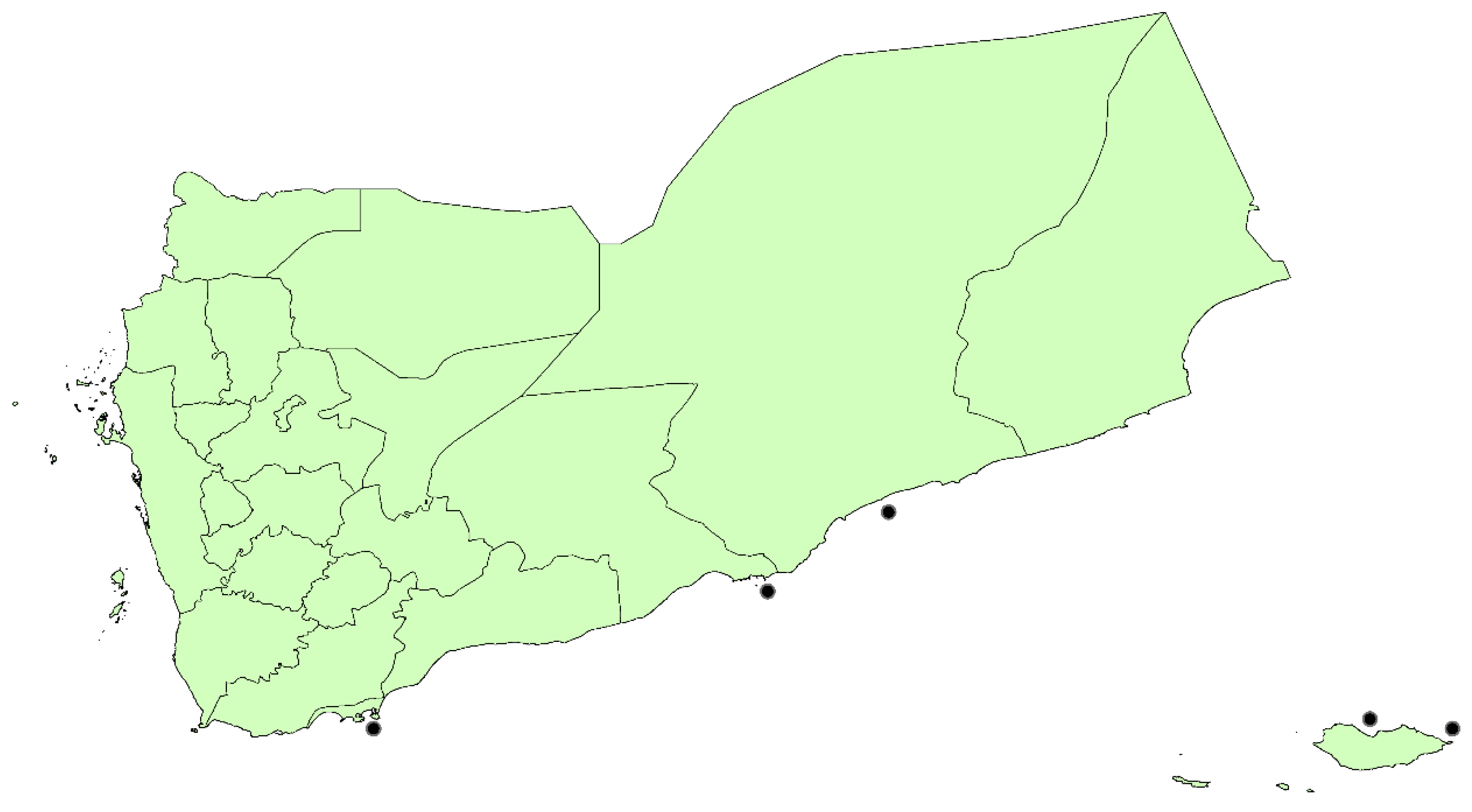
Distribution: Recorded from Aden Beach, Al-Mukalla, Ras Momi, Socotra (Showler 1996), and Bir Ali – Belhaf waters (Kemp et al. 2002). A specimen collected from Aden beach by George R.W. is included in the collection of the natural history museum of Kansas University (KU).
Tursiops aduncus – Indo-Pacific Bottle-nosed Dolphin (Ehrenberg 1833)
Figure 62.
Records of Tursiops aduncus.
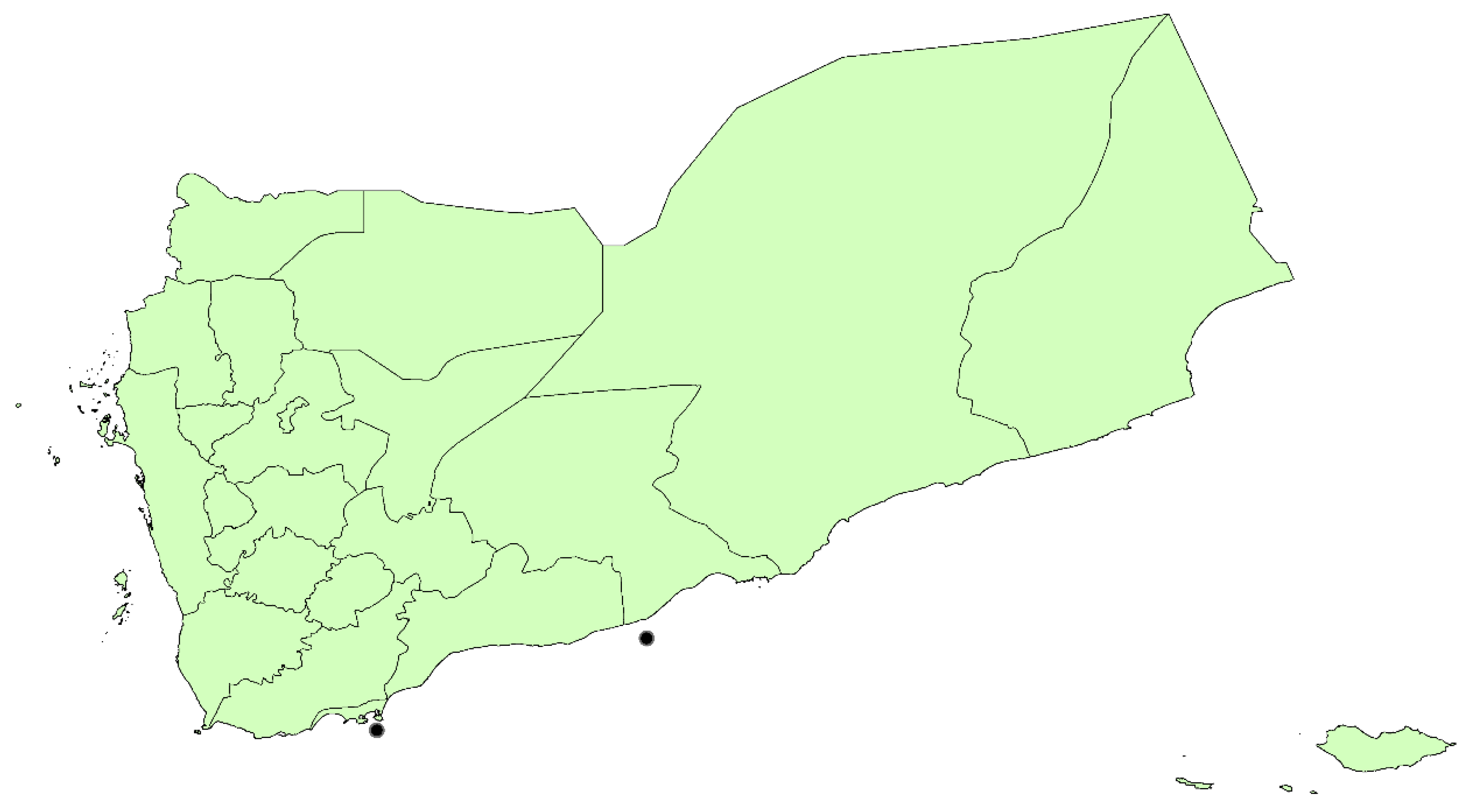
Distribution: Recorded from Aden (Scaramella 1975); Aden, Al-Irqah (Weitkowitz 1992).
Sousa chinensis - Indo-Pacific Humpbacked Dolphin (Osbeck 1765)
Subspecies: S. c. plumbea (Cuvier 1829)
Figure 63.
Records of Sousa chinensis.
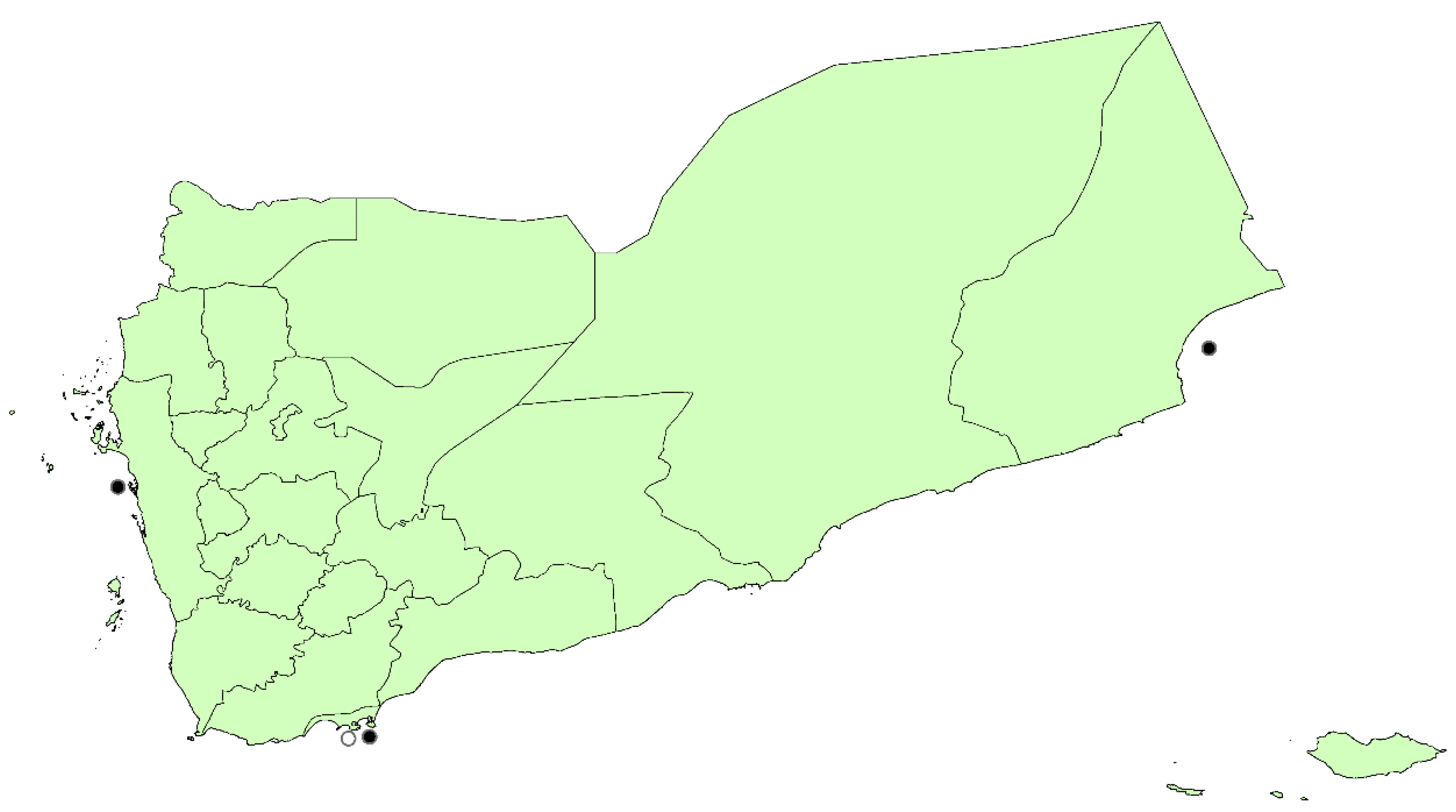
Distribution: Recorded from six sightings off Aden (Leatherwood 1986); Hodeida (Weitkowitz 1992); Aden and Wadi Mararah (Showler 1996). Recently recorded from Aden.
Globicephala macrorhynchus - Short-finned Pilot Whale (Gray 1846)
Figure 64.
Records of Globicephala macrorhynchus.
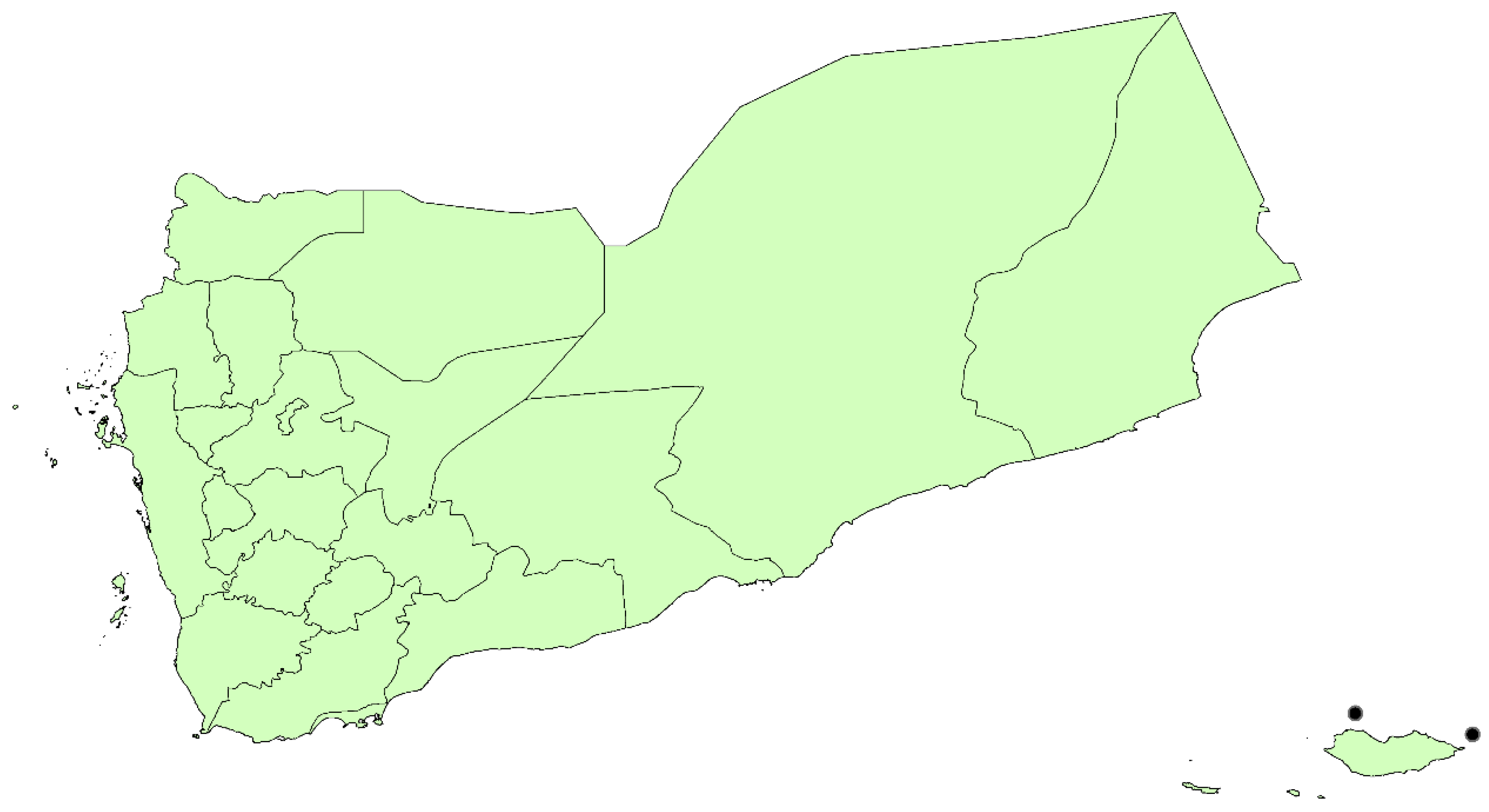
Distribution: Recorded from Ras Momi, Socotra (Showler 1996).
Family Physeteridae
Physeter catodon – Sperm whale (Linnaeus 1758)
Subspecies: P. c. macrocephalus (Linnaeus 1758)
Figure 65.
Records of Physeter catodon.
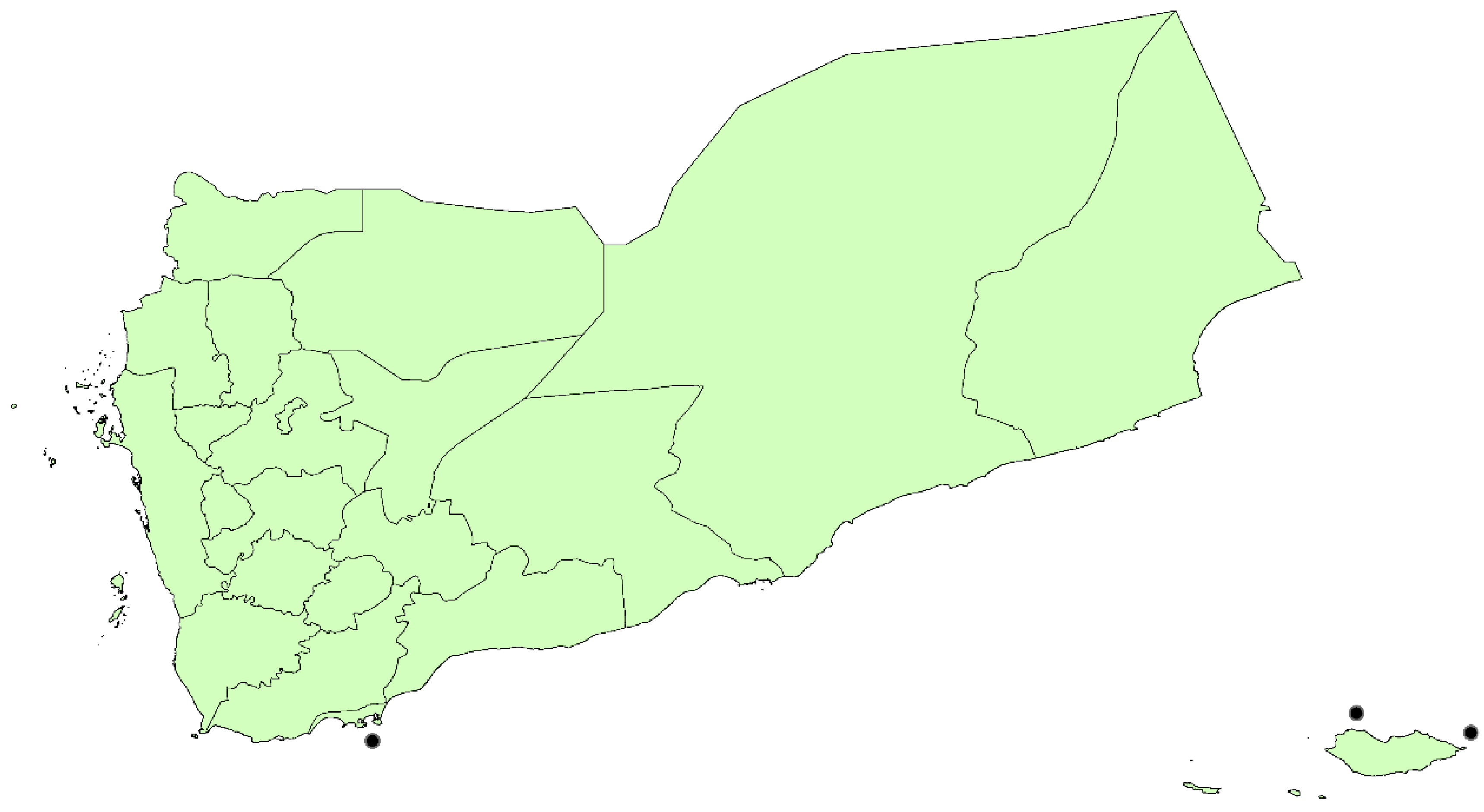
Distribution: Recorded from north of Ras Momi, Socotra (Showler 1996). Scaramella (1975) noted that this is a frequent species in the Gulf of Aden.
FamilyZiphiidae
Ziphius cavirostris - Cuvier’s Beaked Whale (Cuvier 1823)
Figure 66.
Records of Ziphius cavirostris.
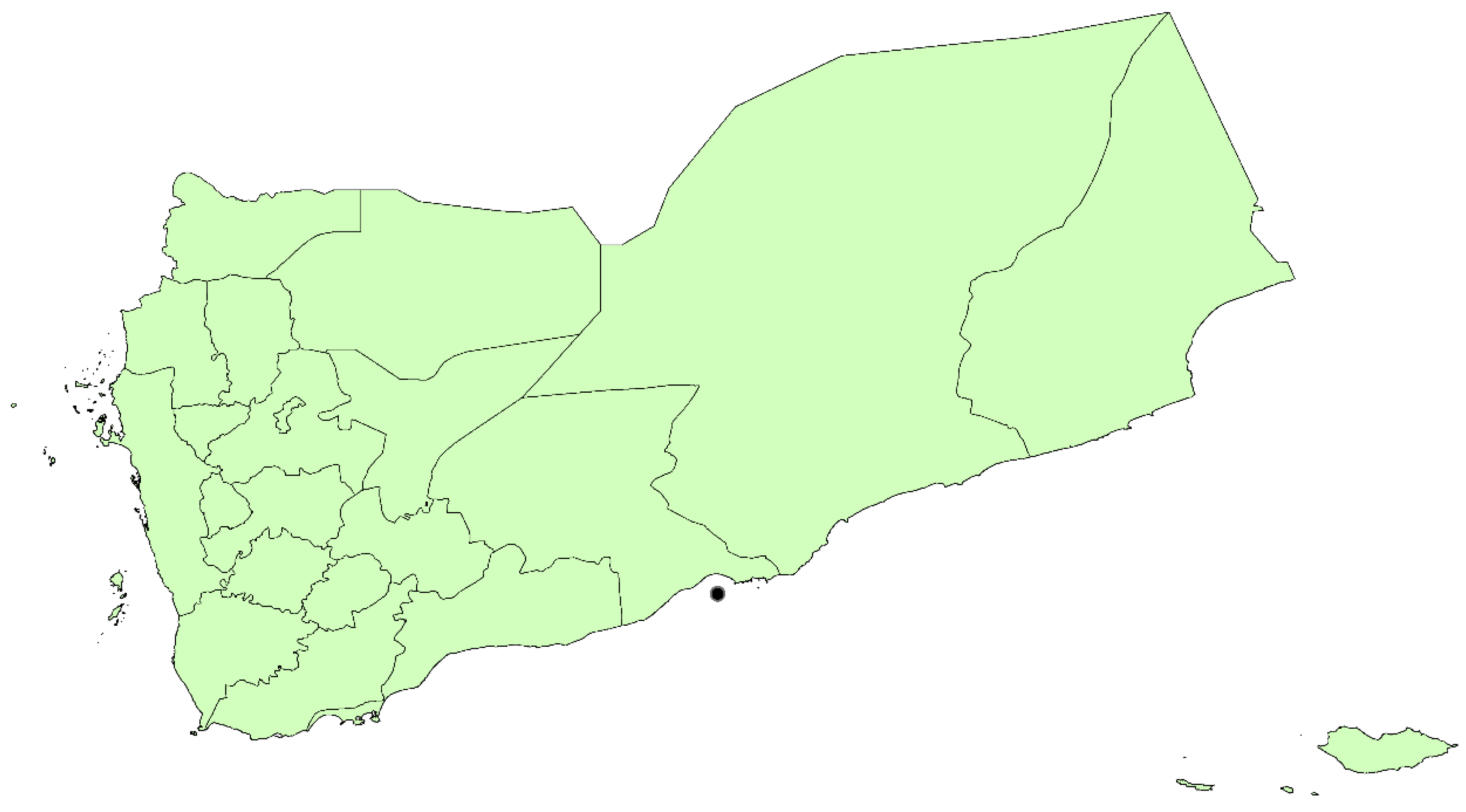
Distribution: Recorded from 46 km off Al-Hawra (Weitkowitz 1992).
Discussion
The current checklist provides a most recent update on the zoogeographical distribution of marine and terrestrial mammals of Yemen. This information will help initiatives, plans, and projects aimed at the conservation of the Yemeni fauna further develop better intervention measures. In this checklist, 11 orders, 28 families, 64 genera and 100 species were reviewed. This paper is the first systematic checklist of marine and terrestrial mammals occurring in Yemen since Al-Jumaily’s work in 1998. In her list of mammals, Al-Jumaily included 72 species. Ubadi (1993) counted 70 mammals but included only 31 species in his book. Showler (1996) observed 20 terrestrial and marine species. Al-Safadi (1992) listed only 22 mammals (ungulates and carnivores). Harrison (1964, 1968, 1972, 1991) provided further updated information on the mammals of Yemen. Scaramella (1975) recorded 68 mammalian species from Yemen. Yerbury & Thomas (1895) included 34 species. Forsskål (1775) described 34 mammals in addition to 11 mythical creatures from Yemen and Egypt. As for the island of Socotra, according to a report developed by the British Association for the Advancement of Science in 1882 on the island of Socotra, the wild mammals of Socotra were limited to the civet cat Viverricula indica, mice, and rats. Domesticated mammals such as horses, camels, sheep and cows were introduced by human settlers in the island. Like many remote island systems, bats are the only mammals native to Socotra (Claudino-Sales 2018).
Hedgehogs are common in Yemen and they are distributed and can be found in most of the Yemeni biomes. They are not under any kind of threats in Yemen except the fact that they are hunted and killed by some locals under the pretext of having magical and spiritual powers.
Shrews are abundant in different regions in Yemen. Ohdachi et al. (2017) suggested that shrews in Yemen might have come from Madagascar/Comoros populations. Yerbury & Thomas (1895) collected from Aden in 1885 a new shrew which they called Crocidura russula. Later on, Harrison (1964) considered that shrew immature and its specific identity uncertain. Then, Bates & Harrison (1984) reexamined and compared this Aden specimen with C. russula from Saudi Arabia and with C. suaveolens from Oman. They concluded that the shrew originally collected by Yerbury & Thomas (1895) should be reassigned to C. suaveolens based on morphological characteristics. Shrews are often mistaken for rodents in Yemen and for this reason are exterminated when found in houses or other residential compounds.
Bats represent the largest mammalian order distributed in Yemen and Socotra. The 34 species recorded can be found almost in every Yemeni province. Out of the 34 bats in Yemen, only three species listed as near threatened and one as endangered. Just like other countries in the Middle East, the loss of habitat due to urbanization and modernization seem the main threat against the distribution of bats in Yemen (Mensoor 2020). Harrison & Bates (1991) included Hypsugo bodenheimeri in their bat species occurring in Yemen as they recorded it under the name Pipistrellus bodenheimeri from Abd Al-Khuri Island. Corbet & Hill (1991) suggested this bat could also be found in Socotra Island. Scaramella (1975) noted this bat might be distributed in south of Yemen. Al-Jumaily (1998) and Benda et al. (2011) did not list this bat in their checklists of bats of Yemen, but Horáček et al. (2000), Wilson & Reeder (2005) and Wilson & Mittermeier (2009) included this species in the bats occurring in Yemen. Taylor (2019) listed Pipistrellus rueppellii and Rhyneptesicus nasutus as bat species with possible distribution and occurrence in Yemen. Al-Jumaily included Asellia patrizii in her list of bats occurring in Yemen. However, Benda et al. (2011) did not list it under their checklist and suggested this bat together with the following six more species could possibly occur in Yemen: Hipposideros megalotis, Mops midas, Rhinolophus hipposideros, Tadarida teniotis, Rhinopoma microphyllum, and Otonycteris hemprichii. Al-Jumaily (2004) listed Plecotus austriacus as a bat species that occurs in Yemen. However, Benda et al. (2011) dismissed this record saying this bat should be Plecotus cf. balensis on a morphological, geographical, and ecological basis. Nader & Kock (1990) and Artyushin et al. (2018) suggested that Eptesicus bottae could be distributed northwest of Yemen.
There are 16 carnivores that are distributed throughout the north, south, east, and west parts of Yemen. In addition, one species (the civet) can be found in Socotra Island. Field (1956) noted that legends about the existence of lions in Yemen persist. According to Kasparek (2007), the Asiatic lion (Panthera leo persica) was resident in Haraz about 150 years ago and is now extinct from Yemen and the entire Arabian Peninsula. However, Kingdon (1991) noted Yemeni locals who met with the British traveler Charles Doughty in the 1880s told him that lions still occurred in Yemen. Talbot (1960) noted Asiatic lions were common around the year 1800 in southern Arabia. Interestingly, Kinnear (1920) noted that he could not find any record of lions’ occurrence in southern Arabia. Cheetahs are now extinct from Yemen since there is no any recent confirmed report of seeing a specimen, and the last established record of cheetahs in Yemen dates back to the early 1960s. Based on archeological findings, cheetahs were abundant in the northeast of Yemen and Sa’da province (Ba’alyan 2012). Al-Tha’alibi (1924) noted the leopard was continuously hunted and killed in Yemen and he expected it would go extinct. Hyenas are hunted, killed continuously in Yemen and some locals eat them (Ubadi 1993).
Hyraxes are among the most common species that can be found in Yemen. Hyraxes are not threatened in Yemen. However, they are continuously hunted and killed by local hunters. Yemeni locals snipe, snare, and trap this animal as it is considered a delicacy food. Locals claim that the meat of hyrax is more delicious than any other meat (Ubadi 1993). Forsskål (1775), Al-Tha’alibi (1924) and Mackintosh-Smith (2001) described how locals in Yemen favor hyrax as a food. In addition, the skin is sewn to store water and oil, teeth are used for decorating weapons, and urine of the hyrax is used by the locals for medical purposes.
There are seven even-toed ungulates in Yemen. Two species went extinct, one is endangered and four are vulnerable. Stuart & Stuart (1996) noted that it is unlikely to find wild ungulates still surviving in the western areas of Yemen. Gazella erlangeri (Neumann's Gazelle) was not included in the current checklist although it was previously counted by Al-Jumaily (1998) and Wilson & Reeder (2005). Moreover, Al-Safadi (1992) did not list this species in the ungulates occurring in Yemen. This gazelle is morphologically distinct from other similar species and Groves (1997) treated it as a separate type. However, a more recent study on the mitochondrial and genetic differences among Gazella erlangeri and Gazella muscatensis showed that G. erlangeri represents a domestic form of G. arabica (Wronski et al. 2017). On the other hand, Wilson & Reeder (2005) included Tragelaphus imberbis (lesser kudu) in their list of mammals occurring in Yemen. Harrison and Bates (1991) reported a single set of horns of lesser kudu that were obtained in (1967) from an animal supposedly being shot in Jabal Halmayn, southeast of Al-Dhal’i. Mallon & Al-Safadi (2001) dismissed this report indicating that the lesser kudu is a large and distinctive antelope, which is not likely to have been unnoticed. Furthermore, the absence of other records or hunting trophies makes it unlikely that this sample represents a former wild population in Yemen. This specimen could have originated from an animal that had escaped from a private collection or one that had been intentionally released. According to Bury (1911), wild ass existed in the northern deserts of Yemen and it was regularly hunted together with the oryx and the ostrich.
There are 20 species of rodents in Yemen. They are distributed and can be found in every province in Yemen. Rodents are medically important animals since they represent victors of many diseases. Previous research on rodents and their relationship with disease in Yemen were conducted by Mount (1951), Sanborn & Hoogstraal (1953), Hoogstraal & Kaiser (1959), and Bahmanyar (1972). All rodent species that are found and distributed in Yemen are not threatened although there are many animals found in Yemen prey on them. Some Bedouins in the Rub Al-Khali areas hunt and eat jerboas. In addition, porcupines are traded for food, medicine and decoration (Stanton 2009). Porcupines are exterminated in Yemen for being a rodent pest known to inflict serious damages to crops (Prakash & Mathur 2018).
The Nubian Ibex and the Arabian leopard are the most hunted mammals in Yemen. The ibex is at the risk of extinction due to the increased hunting in the provinces of Hadramaut, Shabwa, Al-Bayda. The ibex was a sacred animal in the ancient Yemeni civilizations, and it was mentioned in the ancient Sabaean inscriptions. It is believed that this animal was considered the symbol of the moon god during the reign of Balkees, the Queen of Sheba. In addition, the head of the ibex was used as a figure on the metallic coins that were found in the temple of the moon god in Marib. Some Yemeni locals prefer the meat of the ibex and for this reason it is hunted and killed. Winter is the optimal season for hunting ibex in Hadramaut. A special ritual is conducted every year during hunting parties where locals chant and dance while raising decapitated heads of the ibex. These rituals are called the sacred hunting or Athtar hunt. For ancient Yemenis, Athtar was the god of rain. The traditional rituals of ibex hunting practiced by many local tribes in Shabwa and Hadramaut provinces unfortunately continues. Ritual hunt of the ibex in Yemen was reviewed by Stark (1936), Beeston (1948), Thesiger (1959), Seargent (1976), Ubadi (1993), Rodionov (1994), Sima (2000) and Mackintosh-Smith (1997, 2001).
Major threats to the distribution of mammals in Yemen can be summarized by: poaching and overhunting, the current continuous military actions, loss of habitats due to urbanization and modernization, clearing of native vegetation, and smuggling of endangered species to neighboring countries. However, it looks like the biggest factor that contributed to the almost decimation of mammalian fauna in Yemen was and will always be the wars. Effects of military actions on mammals in Yemen were previously mentioned by Al-Tha’alibi (1924), Seargent (1976), and Thesiger (1980). DiPiazza (2007) believed that humans’ hunting and farming activities in Yemen are the main factor that led large mammals close to extinction. Trafficking of large mammals in Yemen still represents a huge concern. Different species especially leopards, caracals, porcupines, and baboons are hunted and sold in Yemen (Judas et al. 2006, Stanton 2009).
Conclusions
The current study has counted 100 species of terrestrial and marine mammals from Yemen. Out of these 100 species, four went extinct and some are on the verge of local extinction due to the continuous systematic illegal hunting in addition to loss of natural habitats. Political unrest and deterioration of the security situation in Yemen during the last ten years have negatively affected the conservation efforts and hindered scientific exploration and research. Hunting remains the major threat that can shape the distribution and biodiversity of mammals in Yemen. The continuous hunting of leopards, hyenas, Nubian ibex and other gazelle species will definitely lead to their regional extinction from Yemen.
Figure 67.
A caracal captured in Al-Mahweet province. Photo © Montazer K. Mensoor.
Figure 68.
A caracal in Bura’. Photo©Montazer K. Mensoor.
Figure 69.
Two badgers in Bura’. Photo © Montazer K. Mensoor.
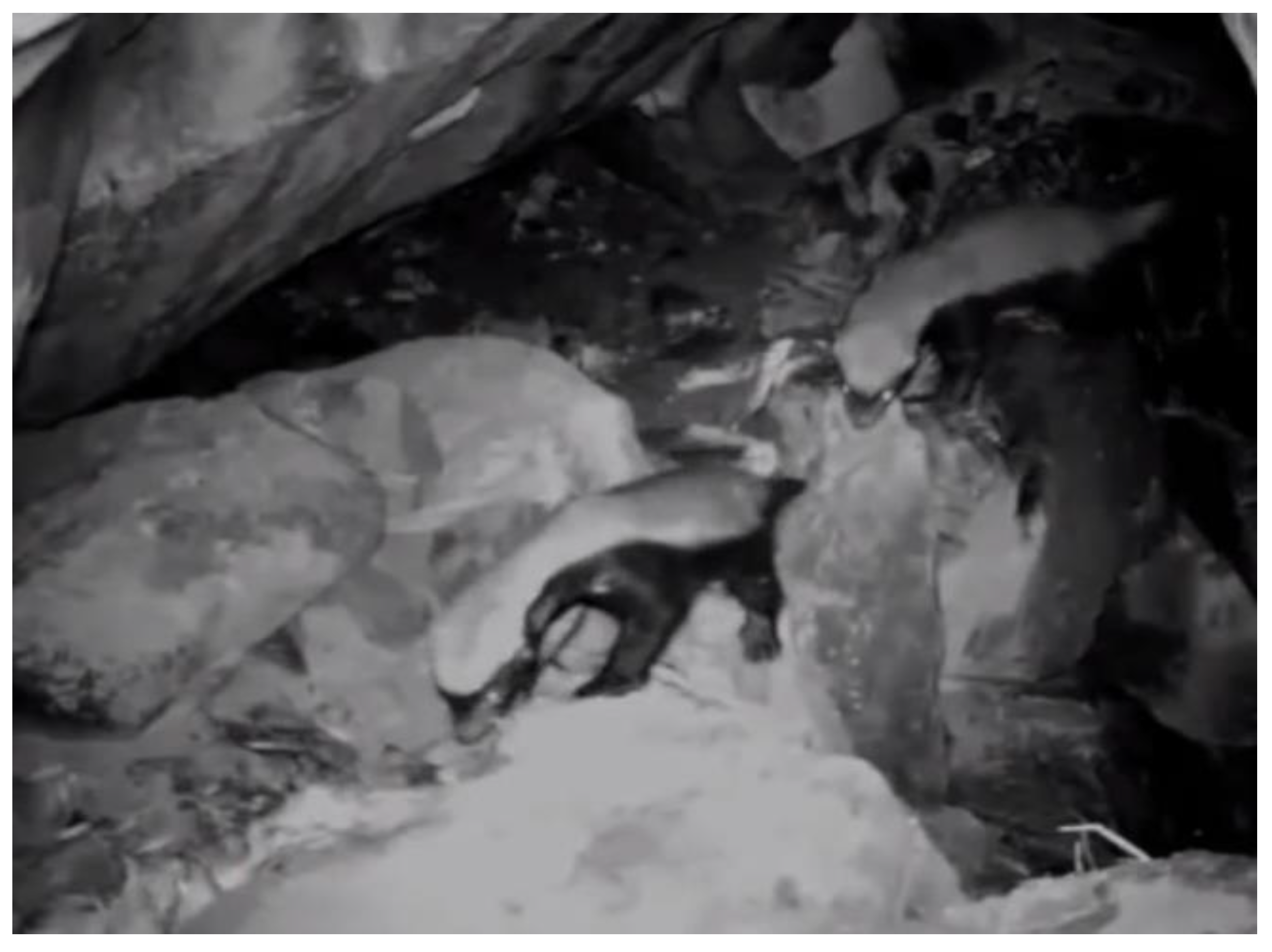
Figure 70.
A wildcat in Bura’. Photo © Montazer K. Mensoor.
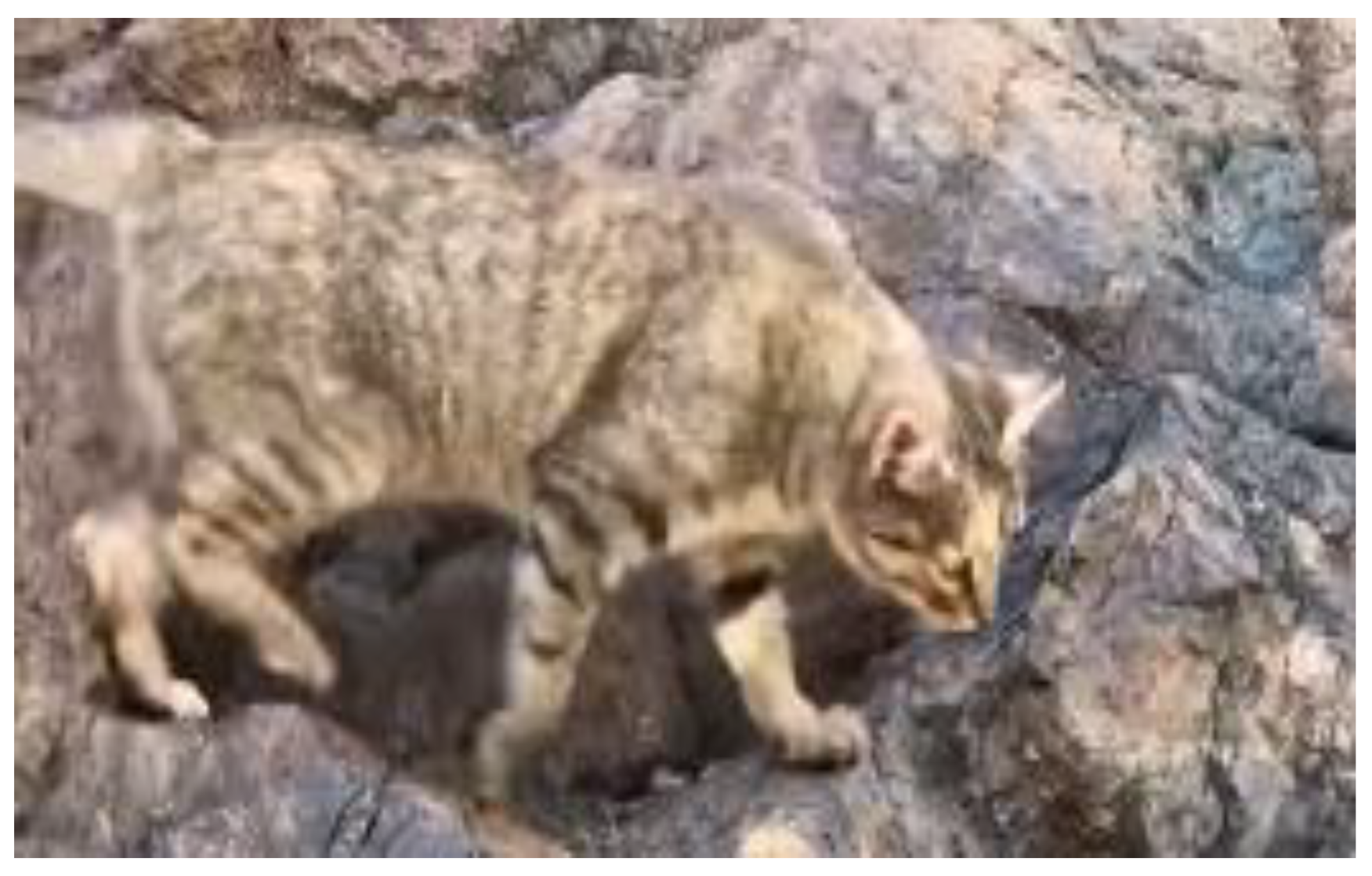
Figure 71.
Two rock hyraxes in Bura’. Photo © Montazer K. Mensoor.
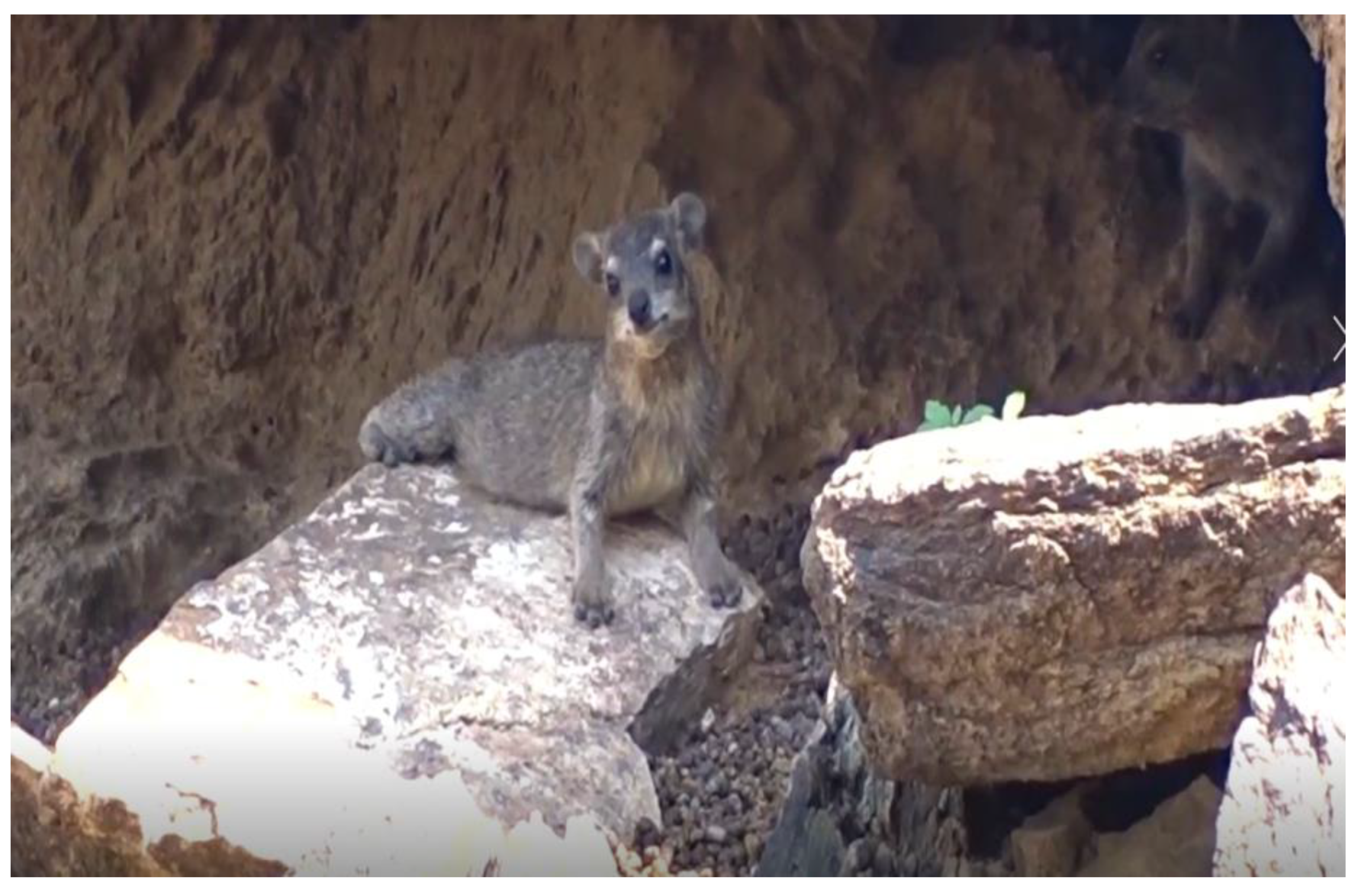
Figure 72.
Mountain gazelles captured from Hadramaut. Photo © Montazer K. Mensoor.
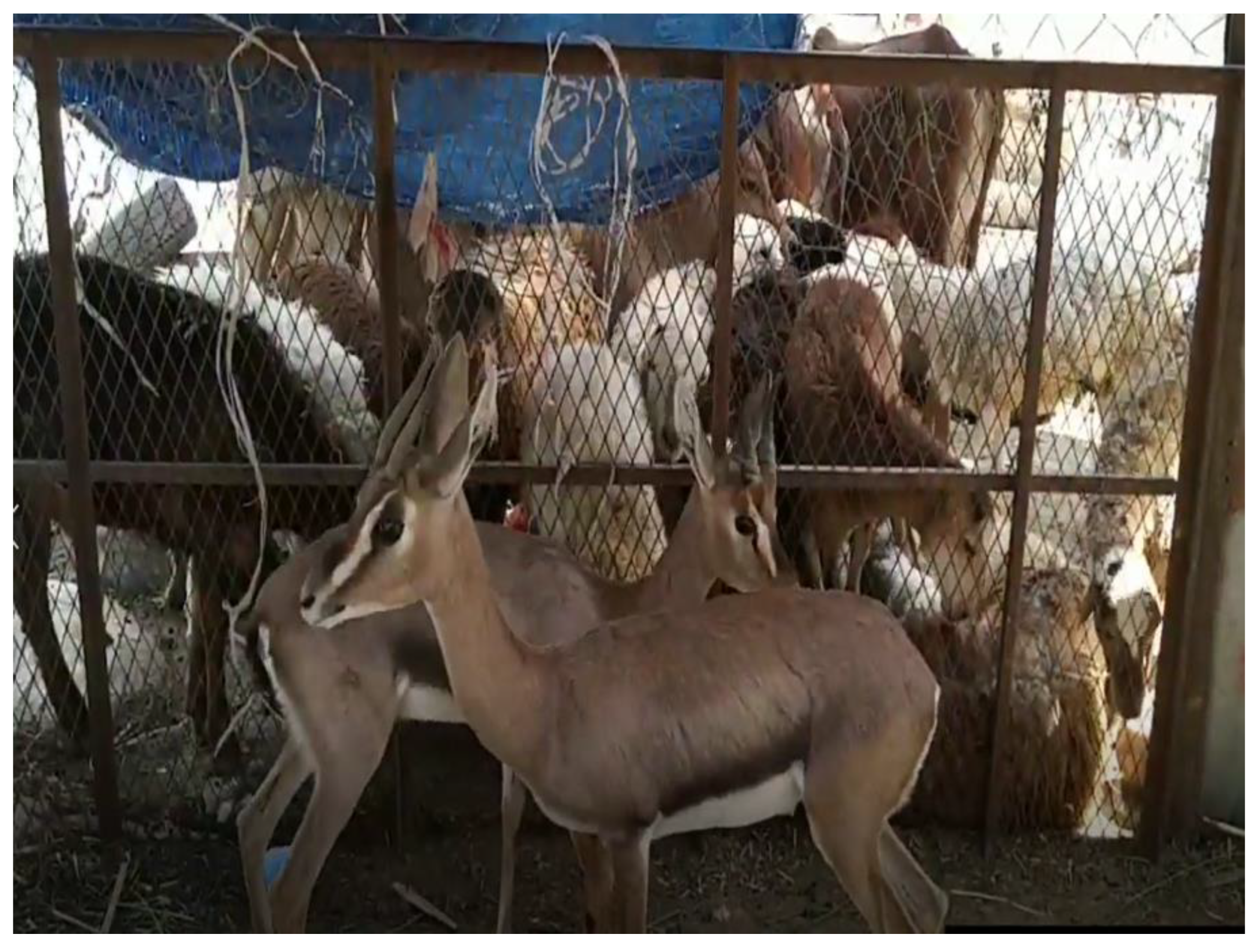
Figure 73.
A caged female leopard with her three cubs captured from Al-Jaban in Dali’ province. Photo © Muhammed Al-Kabous.
Figure 73.
A caged female leopard with her three cubs captured from Al-Jaban in Dali’ province. Photo © Muhammed Al-Kabous.
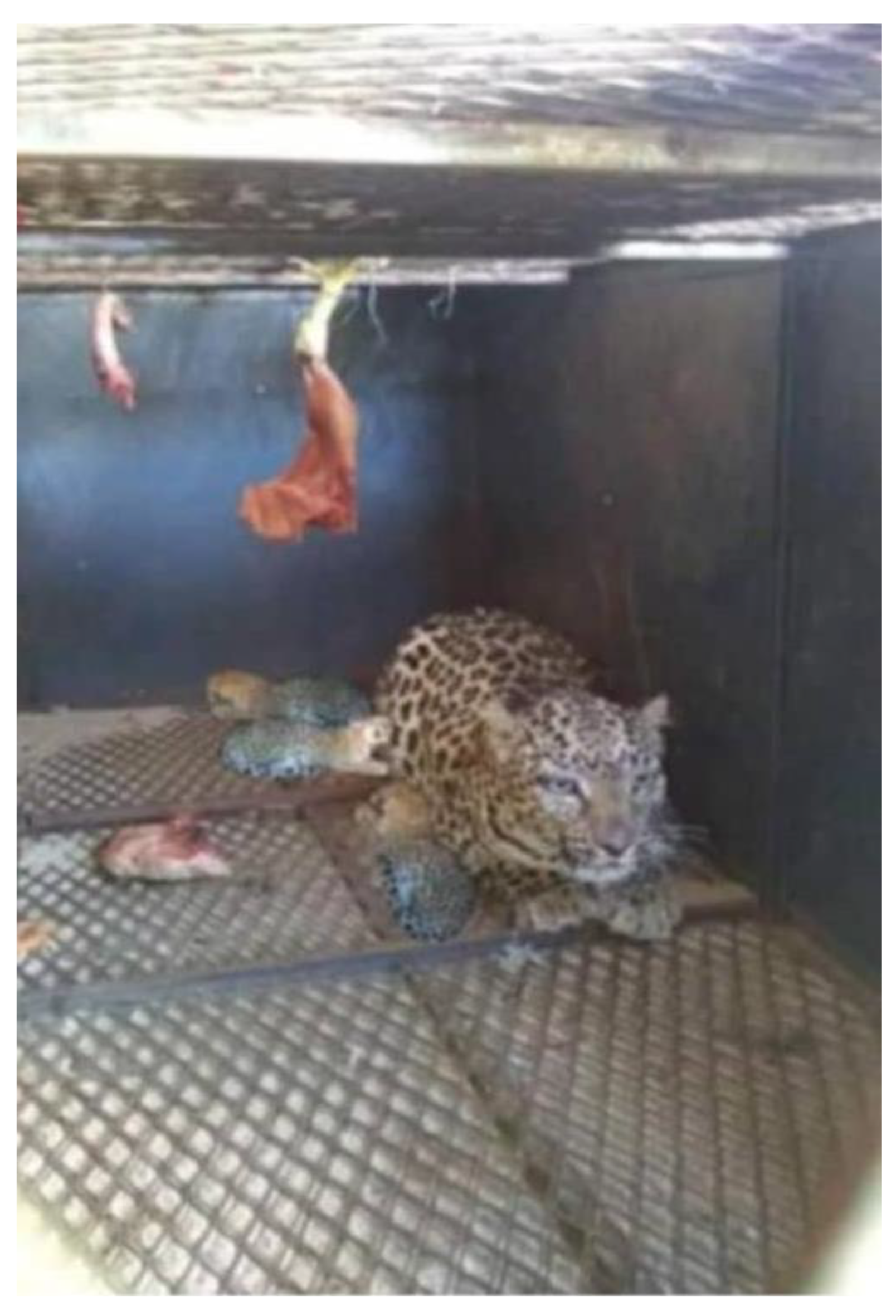
Figure 74.
A male wolf captured from northern Al-Mahra province. Photo © Montazer K. Mensoor.
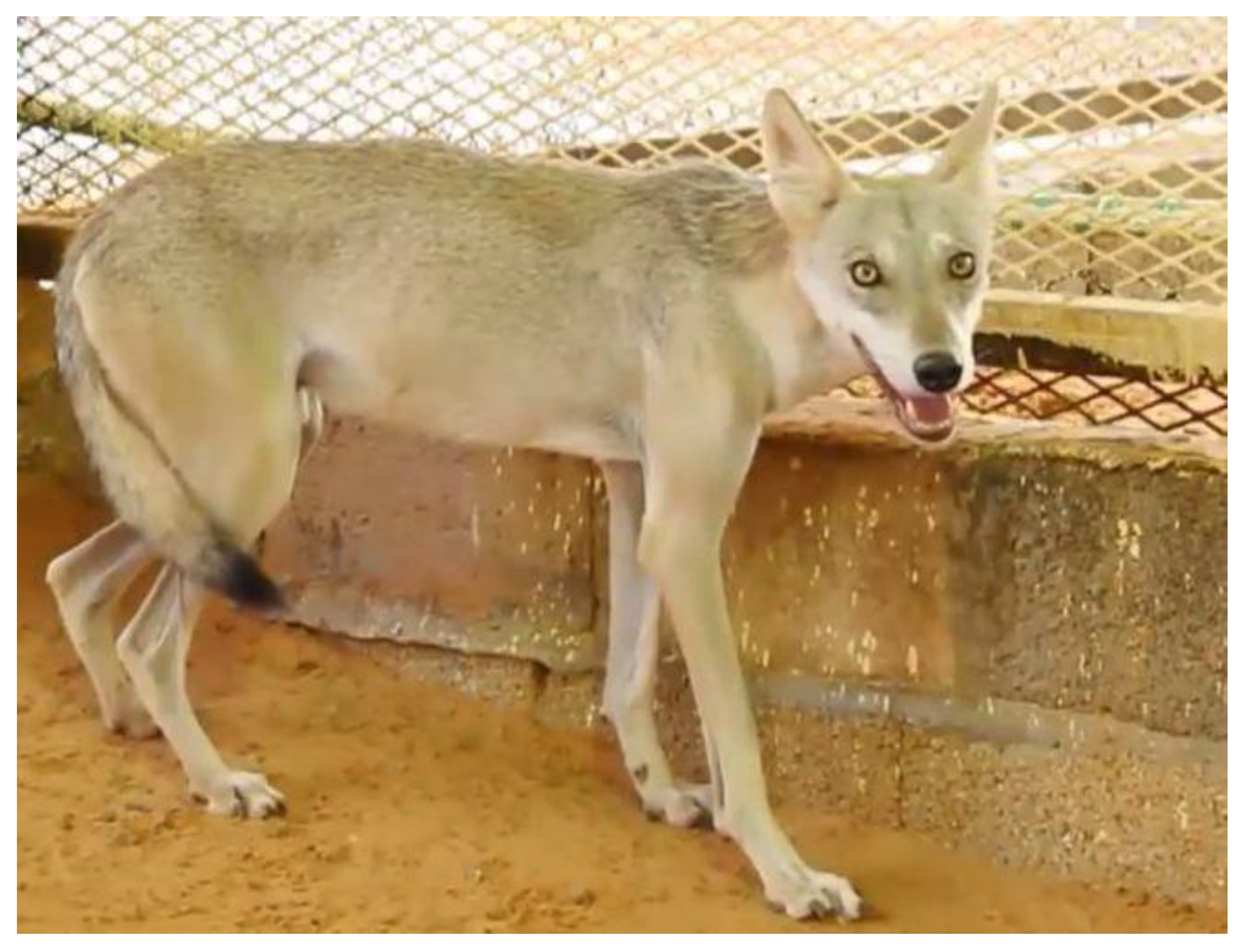

Table 1.
List of wild mammals (Terrestrial and marine) in Yemen.
| Order | Family | Genus | Species | IUCN status |
|---|---|---|---|---|
| ERINACEOMORPHA | Erinaceidae | Paraechinus | Paraechinus hypomelas | LC |
| Paraechinus aethiopicus | LC | |||
| Hemiechinus | Hemiechinus auratus | LC 3 | ||
| SORICOMORPHA | Soricidae | Suncus | Suncus murinus | LC |
| Suncus etruscus | LC | |||
| Suncus madagascariensis | LC | |||
| Crocidura | Crocidura dhofarensis | DD | ||
| Crocidura arabica | LC | |||
| Crocidura suaveolens | LC 7 | |||
| CHIROPTERA | Pteropodidae | Rousettus | Rousettus aegyptiacus | LC |
| Epomophorus | Epomophorus labiatus | LC | ||
| Eidolon | Eidolon helvum | NT | ||
| Rhinolophidae | Rhinolophus | Rhinolophus clivosus | LC | |
| Rhinolophus blasii | LC | |||
| Rhinopomatidae | Rhinopoma | Rhinopoma cystops | LC | |
| Rhinopoma hardwickii | LC | |||
| Rhinopoma hadramauticum | EN | |||
| Nycteridae | Nycteris | Nycteris thebaica | LC | |
| Hipposideridae | Hipposideros | Hipposideros tephrus | LC | |
| Asellia | Asellia tridens | LC | ||
| Asellia italosomalica | DD | |||
| Asellia arabica | DD | |||
| Triaenops | Triaenops parvus | DD | ||
| Emballonuridae | Taphozous | Taphozous perforatus | LC | |
| Coleura | Coleura afra | LC | ||
| Vespertilionidae | Eptesicus | Eptesicus nasutus | LC | |
| Hypsugo | Hypsugo ariel | DD | ||
| Hypsugo lanzai | DD | |||
| Myotis | Myotis bocagii | LC | ||
| Myotis emarginatus | LC | |||
| Neoromicia | Neoromicia guineensis | LC | ||
| Nycticeinops | Nycticeinops schlieffeni | LC | ||
| Scotophilus | Scotophilus dinganii | LC | ||
| Scotophilus leucogaster | LC | |||
| Plecotus | Plecotus balensis | DD | ||
| Pipistrellus | Pipistrellus kuhli | LC | ||
| Pipistrellus dhofarensis | DD | |||
| Miniopteridae | Miniopterus | Miniopterus natalensis | LC | |
| Miniopterus schreibersii | NT | |||
| Molossidae | Tadarida | Tadarida aegyptiaca | LC | |
| Chaerephon | Chaerephon nigeriae | LC | ||
| Chaerephon pumilus | LC | |||
| Otomops | Otomops martiensseni | NT 34 | ||
| CARNIVORA | Canidae | Canis | Canis aureus | LC |
| Canis lupus | LC | |||
| Vulpes | Vulpes cana | LC | ||
| Vulpes rueppellii | LC | |||
| Vulpes vulpes | LC | |||
| Felidae | Felis | Felis silvestris | LC | |
| Felis margarita | LC | |||
| Caracal | Caracal caracal | LC | ||
| Panthera | Panthera pardus | VU | ||
| Acinonyx | Acinonyx jubatus | CR | ||
| Viverridae | Viverricula | Viverricula indica | LC | |
| Genetta | Genetta genetta | LC | ||
| Herpestidae | Ichneumia | Ichneumia albicauda | LC | |
| Bdeogale | Bdeogale crassicauda | LC | ||
| Hyaenidae | Hyaena | Hyaena hyaena | NT | |
| Mustelidae | Mellivora | Mellivora capensis | LC 16 | |
| HYRACOIDEA | Procaviidae | Procavia | Procavia capensis | LC 1 |
| ARTIODACTYLA | Bovidae | Capra | Capra nubiana | VU |
| Oryx | Oryx leucoryx | VU | ||
| Gazella | Gazella arabica | VU | ||
| Gazella saudiya | EX | |||
| Gazella gazelle | EN | |||
| Gazella bilkis | EX | |||
| Gazella subgutturosa | VU 7 | |||
| RODENTIA | Muridae | Acomys | Acomys dimidiatus | LC |
| Acomys cahirinus | LC | |||
| Acomys russatus | LC | |||
| Arvicanthis | Arvicanthis niloticus | LC | ||
| Dipodillus dasyurus | LC | |||
| Praomys | Praomys fumatus | DD | ||
| Myomyscus | Myomyscus yemeni | DD | ||
| Gerbillus | Gerbillus chessmani | LC | ||
| Gerbillus famulus | LC | |||
| Gerbillus henleyi | LC | |||
| Gerbillus gerbillus | LC | |||
| Gerbillus poecilops | LC | |||
| Gerbillus nanus | LC | |||
| Meriones | Meriones (Parameriones) rex | LC | ||
| Meriones (Pallasiomys) libycus | LC | |||
| Mus | Mus musculus | LC | ||
| Rattus | Rattus rattus | LC | ||
| Rattus norvegicus | LC | |||
| Dipodidae | Jaculus | Jaculus jaculus | LC | |
| Hystricidae | Hystrix | Hystrix indica | LC 20 | |
| LAGOMORPHA | Leporidae | Lepus | Lepus capensis | LC 1 |
| PRIMATES | Cercopithecidae | Papio | Papio hamadryas | LC 1 |
| SIRENIA | Dugongidae | Dugong | Dugong dugon | VU 1 |
| CETACEA | Delphinidae | Delphinus | Delphinus capensis | DD |
| Stenella | Stenella longirostris | LC | ||
| Grampus | Grampus griseus | LC | ||
| Tursiops | Tursiops truncatus | LC | ||
| Tursiops aduncus | NT | |||
| Sousa | Sousa chinensis | VU | ||
| Globicephala | Globicephala macrorhynchus | LC | ||
| Physeteridae | Physeter | Physeter catodon | VU | |
| Ziphiidae | Ziphius | Ziphius cavirostris | LC 9 | |
| 28 | 64 | 100 |
Conflicts of Interest
The author declares no conflicts of interest.
Acknowledgments
There are many people I would like to thank for their help in completing this study. But my special thank goes to the following individulas for providing invaluable assistance in logistics, photography, references, geographic information, and species review: Gamal Al-Hamadi, Muhammed Al-Kabous (Chairman of Sanid Organization for Relief and Development, San’a), Abdul Salam Abdul Aziz Al-Hamadi, and Dr. Masaa Al-Jumaily.
References
- Abdel-Wasae BM, El MG. Incidence and prevalence of Eimeria infection among the hedgehog, Hemiechinus auritus in Yemen. Journal of the Egyptian Society of Parasitology 2009, 39, 723–729.
- Al-Tha’alibi A (1924) The Yemeni Journey. Dar Al-Gharb Al-Islami Press, Lebanon (in Arabic).
- Al-Jumaily, MM. Review of the mammals of the Republic of Yemen. Fauna of Arabia 1998, 17, 477–499. [Google Scholar]
- Al-Jumaily, MM. First record of Otomops martiensseni (Matschie 1897) for the Republic of Yemen (Mammalia, Chiroptera, Molossidae). Senckenbergiana biologica 1999, 78, 241–245. [Google Scholar]
- Al-Jumaily, MM. Chaerephon nigeriae Thomas, 1913, an addition to the bat fauna of the Republic of Yemen (Mammalia: Chiroptera: Molossidae). Myotis 2002, 40, 55–58. [Google Scholar]
- Al-Jumaily, MM. First record of Myotis emarginatus (E. Geoffroy 1806) for the Republic of Yemen (Mammalia, Chiroptera, Vespertilionidae). Senckenbergiana Biologica 2003, 82, 243–246. [Google Scholar]
- Al-Jumaily, MM. Recent records of bats from Yemen including Plecotus cf. austriacus (Fischer, 1829) (Mammalia: Vespertilionidae) new to the country. Myotis 2004, 41, 57–68. [Google Scholar]
- Al Jumaily M, Mallon DP, Nasher AK, Thowabeh N (2006) Status report on Arabian leopard in Yemen. Cat News, 20-25.
- Al Jumaily M, Al Rayl WA, Abdulla Naji MM. First record of Blanford’s Fox, Vulpes cana Blanford, 1877, for Yemen (Mammalia: Carnivora: Canidae). Zoology in the Middle East 2012, 57, 137–139.
- Al-Masawa MI, Manab NA, Omran A (2018) The effects of climate change risks on the Mud architecture in Wadi Hadhramaut, Yemen. In: Tthe Impact of Climate Change on Our Life (pp. 57-77). Springer, Singapore.
- Al-Mehdar AA, Al-Battah AM. Evaluation of hypoglycemic activity of Boswellia carterii and Cissus rotundifolia in streptozotocin/nicotinamide-induced diabetic rats. Yemeni Journal for Medical Sciences 2016, 10, 30–38.
- Al-Safadi MM, Nader IA. First record of the wild cat, Felis silvestris Schreber, 1777 from the Yemen Arab Republic (Carnivora: Felidae). Mammalia 1990, 54, 621–626.
- Al-Safadi, MM. The Carnivora of Yemen Arab Republic. Proceedings of the Egyptian Academy of Sciences 1990, 40, 129–138. [Google Scholar]
- Al-Safadi, MM. Chiropteran fauna of Yemen Arab Republic. Mammalia 1991, 55, 269–274. [Google Scholar] [CrossRef]
- Al-Safadi MM, Nader IA. The Indian Crested Porcupine, Hystrix indica Kerr 1792 in North Yemen with comments on the occurrence of the species in the Arabian Peninsula. Fauna of Saudi Arabia 1991, 12, 411–415.
- Al-Safadi, MM. Checklist of the mammals of Yemen (Carnivora and Artiodactyla). Dirasat Yamaniyah 1992, 48, 399–429. [Google Scholar]
- Al-Safadi, MM. The Hamadryas Baboon, Papio hamadryas (Linnaeus, 1758) in Yemen (Mammalia: Primates: Cercopthecidae). Zoology in the Middle East 1994, 10, 5–16. [Google Scholar] [CrossRef]
- Al-Safadi, MM. On the biology and ecology of the white-tailed and bushy-tailed mongoose (Ichneumia albicauda and Bdeogale crassicauda) in Yemen. Zoology in the Middle East 1995, 11, 5–13. [Google Scholar] [CrossRef]
- Al-Safadi, MM. On the status of Artiodactyles in the Republic of Yemen. Zoology in the Middle East 2000, 20, 5–8. [Google Scholar] [CrossRef]
- Andersen, K. LXIV. —Brief diagnoses of eight new Petalia, with a list of the known forms of the genus. Annals and Magazine of Natural History 1912, 10, 546–550. [Google Scholar]
- Andersen, K. XIV. —On the bats of the family Megadermatidæ. Journal of Natural History 1907, 19, 129–145. [Google Scholar] [CrossRef]
- Anderson J, de Winton WE. VI. — On an undescribed species of hedgehog from Southern Arabia. Journal of Natural History 1901, 7, 42–45.
- Anderson J, De Winton WE (1902) Zoology of Egypt: Mammalia. Revised and completed by WE de Winton. London.
- Arthur, DR. Ixodes hoogstraali, a new species of tick from Yemen. Parasitology 1955, 45, 128–130. [Google Scholar] [CrossRef]
- Artyushin IV, Kruskop SV, Lebedev VS, Bannikova AA. Molecular phylogeny of serotines (Mammalia, Chiroptera, Eptesicus): evolutionary and taxonomical aspects of the E. serotinus species group. Biology Bulletin 2018, 45, 469–477.
- Atallah SI, Harrison DL. New records of rodents, bats and insectivores from the Arabian Peninsula. Journal of Zoology 1967, 153, 311–319.
- Ba’alyan MA (2012) War and transport animals in ancient Yemen. PhD dissertation. Aden University.
- Bahmanyar, M. Human plague episode in the district of Khawlan, Yemen. The American Journal of Tropical Medicine and Hygiene 1972, 21, 123–128. [Google Scholar] [CrossRef] [PubMed]
- Bahmanyar M, Lay DM. First record of Gerbillus henleyi de Winton 1903 and records of other rodents from northern Yemen. Mammalia 1975, 39, 322–325.
- Baker TS, Al-Balam FA (2016) Vertebrates biodiversity in Al-Haswa protectorate. Proceedings of the 2nd Arab conference for the conservation of wildlife. Cairo, Egypt (In Arabic).
- Balfour IB (1888) Botany of Socotra (Vol 31), R. Grant. Edinburgh.
- Banfield L, Miller A, Neubert E, Porter R, Senan A, Van Damme K. Invasive species: The dangers of introducing alien animals and plants on Soqotra. Friends of Soqotra Newsletter (Tayf) 2010, 7, 10–15.
- Banfield LM, Al Qahtani H, Mallon D (2014) Arabian sand cat Felis margarita harrisoni status review and conservation strategy. Al Ain Zoo, Abu Dhabi.
- Barome PO, Monnerot M, Gautun J. Phylogeny of the genus Acomys (Rodentia, Muridae) based on the cytochrome b mitochondrial gene: Implications on taxonomy and phylogeography. Mammalia 2000, 64, 423–438.
- Bates PJ, Harrison DL. Significant new records of shrews (Soricidae) from the southern Arabian Peninsula, with remarks on the species occurring in the region. Mammalia 1984, 48, 144–147.
- Bates PJJ (1987) Systematics and zoogeography of Tatera (Rodentia: Gerbillinae) of north-east Africa and Asia (Doctoral dissertation, University of London).
- Bates, P. Arabia’s hedgehogs: primitive but successful. Arabian Wildlife 1995, 2, 18–19. [Google Scholar]
- Benda P, Nasher AK. First record of Crocidura dhofarensis Hutterer et Harrison, 1988 (Mammalia: Soricidae) in Yemen. Časopis Národního muzea, Řada přírodovědná 2006, 175, 27–30.
- Benda P, Nasher AK, Van Damme K, Vallo P, Reiter A. Bats (Mammalia: Chiroptera) of the Eastern Mediterranean and Middle East. Part 14. Bat fauna of the Socotra Archipelago, Yemen. Acta Societatis Zoologicae Bohemicae 2017, 81, 99–169.
- Benda P, Reiter A, Uhrin M, Varadínová Z. A new species of pipistrelle bat (Chiroptera: Vespertilionidae) from southern Arabia. Acta Chiropterologica 2016, 18, 301–323.
- Benda P, Vallo P. Taxonomic revision of the genus Triaenops (Chiroptera: Hipposideridae) with description of a new species from southern Arabia and definitions of a new genus and tribe. Folia Zoologica 2009, 58, 1.
- Benda P, Al-Jumaily MM, Reiter A, Nasher AK. Noteworthy records of bats from Yemen with description of a new species from Socotra. Hystrix, the Italian Journal of Mammalogy 2010, 22, 23–56.
- Benda P, Vallo P, Reiter A. Taxonomic revision of the genus Asellia (Chiroptera: Hipposideridae) with a description of a new species from southern Arabia. Acta Chiropterologica 2011, 13, 245–270.
- Botta PE (1841) Relation d'un voyage dans I'Yemen, entrepris en 1837 pour Ie Museum d'Histoire naturelle de Paris, par Paul Emile Botta. Benjamin Duprat. Paris.
- Botting, D. The Oxford University Expedition to Socotra. The Geographical Journal 1958, 124, 200–207. [Google Scholar] [CrossRef]
- Botting, D. (1958 b) Island of the Dragon's Blood. Hodder & Stoughton. London.
- British Association for the Advancement of Science (1882) Report of the Annual Meeting, Volume 51. J. Murray.
- Bury GW (1911) The land of, Uz. Macmillan & Co. London.
- Bury GW (1915) Arabia Infelix: Or, The Turks in Yamen. Macmillan & Co. London.
- Busais SMS (2011) Taxonomy and molecular phylogeny of Hemidactylus in the mainland of Yemen (Class: Reptilia, Order: Squamata, Family: Gekkonidae) (Doctoral dissertation).
- Castelló JR (2018) Canids of the World: Wolves, Wild Dogs, Foxes, Jackals, Coyotes, and Their Relatives. Princeton University Press, New Jersey.
- Cheesman RE, Hinton MA. LXII. —On the mammals collected in the Desert of Central Arabia by Major RE Cheesman. Journal of Natural History 1924, 14, 548–558.
- Cheesman RE (1926) In unknown Arabia. Macmillan & Co., Lt, London.
- Claudino-Sales V (2018) Coastal World Heritage Sites. Springer, Dordrecht.
- Conservation Breeding Specialist Group (CBSG) (2000) Conservation assessment management plan for Arabian carnivores population habitat viability assessment for the Arabian leopard tahr: Draft report, C.B.S.G. Apple Valley, MN.
- Corbet GB, Hill JE (1991) A world list of mammalian species. Natural History Museum Publications, Oxford.
- Cowan, P. Wadi Rijaf, Jebel Bura’, Yemen. The Phoenix 2004, 20, 11–12. [Google Scholar]
- Damme KV, Banfield L. Past and present human impacts on the biodiversity of Socotra Island (Yemen): implications for future conservation. Zoology in the Middle East 2011, 54, 31–88.
- Dannenfeldt KH (1985) Europe discovers civet cats and civet. Journal of the History of Biology (volume): 403-431.
- de Beaux, O. Spedizione del barone Raimondo Franchetti in Dancalia. Mammiferi. Annali del Museo Civico di Storia Naturale di Genova 1931, 55, 183–217. [Google Scholar]
- De Winton WF, Forbs HO, Ogilvie-Grant WR (1903) Mammalia in: (Forbes HO Ed.) The natural history of Sokotra and Abed el Kuri. Henry Young & Sons, Liverpool.
- Delany, MJ. The zoogeography of the mammal fauna of southern Arabia. Mammal Review 1989, 19, 133–152. [Google Scholar] [CrossRef]
- Denys, C. Diet and dental morphology of two coexisting Aethomys species (Rodentia) in Mozambique. Implications for diet reconstruction in related extinct species from South Africa. Acta Theriologica 1994, 39, 357–364. [Google Scholar]
- DiPiazza FD (2007) Yemen in pictures. Twenty-First Century Books, Minneapolis.
- Dollman JG (1932) Mammals in Arabia Felix. Jonathan Cape, London.
- Doughty CM (2010) Travels in Arabia deserta. Cosimo, Inc., New York.
- Ducker J (2006) Historical and constitutional background. In: (Hinchcliffe et al. Eds.): Without Glory in Arabia: The British Retreat from Aden. London, IB Taurus.
- Dundarova C (2011) Phylogeography of Rousettus aegyptiacus in the Mediterranean region. MSc thesis. Charles University, Prague.
- Eisentraut M (1960) Der Rassenkreis Rousettus aegyptiacus E. Geoff. Bonner Zoologische Beiträge10: 218–235.
- Ellermann JR, Morrison-Scott TCS (1966) Checklist of Palearctic Mammals, 1758-1946. British Museum, London.
- Elliot DG (1913) A review of the Primates. American Museum of Natural History 11: 147.
- El Sawaf BM, Kassem HA, Mogalli NM, El Hossary SS, Ramadan NF. Current knowledge of sand fly fauna (Diptera: Psychodidae) of northwestern Yemen and how it relates to leishmaniasis transmission. Acta tropica 2016, 162, 11–19.
- Environment and Protected Areas Authority (EPAA) (2002) Conservation Assessment and Management Plan (CAMP) for the Threatened Fauna of Arabia’s Mountain Habitat. BCEAW/EPAA.; Sharjah; UAE.
- Field H (1956) Ancient and modern man in Southwestern Asia. University of Miami Press, Miami.
- Fleming W (1838) The Scripture gazetteer: A geographical, historical, and statistical account of the empires, kingdoms, countries, provinces, cities, towns, villages, mountains, valleys, seas, lakes, rivers, &c mentioned in the Old and New Testaments: their ancient history, natural productions, and present state: with an essay on the importance and advantage of the study of sacred geography (Vol. 2). Edinburgh Printing and Publishing Company, Edinburgh.
- Forbes HO (1903) The natural history of Sokotra and Abd-El-Kuri. Henry Young & Sons, Liverpool.
- Forskål, P. (1775) Descriptiones animalium, avium, amphibiorum, piscium, insectorum, vermium: quae in itinere orientali observavit. ex officina Mölleri.
- Foster-Vesey-Fitzgerald D (1952) Wild life in Arabia. Oryx 1: 232-235.
- Frynta D, Palupčíková K, Bellinvia E, Benda P, Skarlantova H, Schwarzova L, Modrý D. Phylogenetic relationships within the cahirinus-dimidiatus group of the genus Acomys (Rodentia: Muridae): new mitochondrial lineages from Sahara, Iran and the Arabian Peninsula. Zootaxa 2010, 2660, 46–56.
- Gasperetti J, Harrison DL, Buettiker W. The carnivora of Arabia. Kingdom of Saudi Arabia Meteorological Environmental Protection Administration, Fauna Publication 1985, 7, 397–439.
- Gaubert P, Godoy JA, Del Cerro I, Palomares F. Early phases of a successful invasion: mitochondrial phylogeography of the common genet (Genetta genetta) within the Mediterranean Basin. Biological Invasions 2009, 11, 523–546.
- Gaubert P, Patel RP, Veron G, Goodman SM, Willsch M, Vasconcelos R, Fickel J. Phylogeography of the small Indian civet and origin of introductions to western Indian Ocean islands. Journal of Heredity 2017, 108, 270–279.
- Geffen E, Hefner R, Macdonald DW, Ucko M. Biotope and distribution of Blanford's fox. Oryx 1993, 27, 104–108.
- Glaser E (1913) Eduard Glasers Reise nach Mârib, A. Hölder, Vienna.
- Greth, A. Vanishing gazelles. Gnusletter 1992, 11, 21–22. [Google Scholar]
- Greth A, Williamson D, Groves C, Schwede G, Vassart M. Bilkis gazelle in Yemen–status and taxonomic relationships. Oryx 1993, 27, 239–244.
- Groves, CP. On the smaller gazelles of the genus Gazella de Blainville, 1816. Zeitschrift für Säugetierkunde 1969, 34, 38–60. [Google Scholar]
- Groves, CP. A new species of the genus Gazella (Mammalia: Artiodactyla: Bovidae) from the Arabian Peninsula. Mammalia 1985, 49, 27–36. [Google Scholar] [CrossRef]
- Groves CP (1997) Taxonomy of Arabian gazelles. The Gazelles of Arabia. National Commission for Wildlife Conservation and Development, Riyadh, 24-51.
- Han C (2011) Where the paved road ends: one woman's extraordinary experiences in Yemen. Potomac Books, Inc., Lincoln.
- Harper F (1945) Extinct and vanishing mammals of the Old World. The lord Baltimore Press. MD, U.S.A.
- Harrison DL (1968) The Mammals of Arabia, I.I. London, Ernest Benn Limited.
- Harrison, DL. Observations on some notable Arabian mammals, with the description of a new Gerbil (Gerbillus, Rodentia: Cricetidae). Mammalia 1971, 35, 111–125. [Google Scholar] [CrossRef]
- Harrison DL (1972) The mammals of Arabia, Vol. 3. Ernest Benn Limited, London.
- Harrison DL, Bates PJ (1964) The mammals of Arabia, Vol. 1. London, Benn.
- Harrison DL, Bates PJJ. On the occurrence of the European free-tailed bat, Tadarida teniotis Rafinesque, 1814 (Chiroptera: Molossidae) in Saudi Arabia with a zoogeographical review of the molossids of the Kingdom. Fauna of Saudi Arabia 1984, 6, 551–556.
- Harrison DL, Bates PJ. New geographical records of the large Aden gerbil (Gerbillus poecilops Yerbury and Thomas 1895, Rodentia: Cricetidae) with observations on the osteology of the species. Mammalia 1984, 48, 299–302.
- Harrison DL, Bates PJJ (1991) The mammals of Arabia. 2nd. Harrison Zoological Museum Publication, Sevenoaks, Kent, UK.
- Hayman, R.W. Sand cat from Arabia. Zoo Life 1952, 7, 277–295. [Google Scholar]
- Hayman RW, Harrison DL. XXXIV.—Notes on some mammals newly recorded from Arabia. Journal of Natural History 1950, 3, 417–419.
- Hoeck E (1962) Doctor among the Bedouins, R. Hale, London.
- Hoogstraal, H. Yemen opens the door to progress. National geographic 1952, 101, 213–243. [Google Scholar]
- Hoogstraal H, Kaiser MN. Ticks (Ixodoidea) of Arabia with special reference to the Yemen. Fieldiana: Zoology 1959, 39, 297–322.
- Horáček I, Hanák V, Gaisler J. Bats of the Palearctic region: a taxonomic and biogeographic review. In Proceedings of the VIIIth European bat research symposium 2000, 1, 11–157.
- Howard-McCombe J, Banfield L, Kitchener AC, Al Qahtani H, Toosy A, Al Qarqas M, Azizi S (2019) A mitochondrial phylogeny of the Sand Cat (Felis margarita Loche, 1858). Journal of Mammalian Evolution (volume): 1-10.
- Hunter FM (1877) An account of the British settlement of Aden in Arabia. Edinburgh University Press, Edinburgh.
- Hutterer R, Harrison DL. A new look at the shrews (Soricidae) of Arabia. Bonner zoologische Beiträge 1988, 39, 59–72.
- Islam MZ, Ismail K, Boug A (2010) Catastrophic die-off of globally threatened Arabian Oryx and Sand Gazelle in the fenced protected area of the arid central Saudi Arabia. Journal of Threatened Taxa (volume): 677-684.
- IUCN 2020. The IUCN Red List of Threatened Species. Version 2020-3. https://www.iucnredlist.org. Downloaded on [2 February 2020].
- Jefferson TA, Leatherwood S, Webber MA (1994) FAO species identification guide. Marine mammals of the world. Rome, FAO.
- Jennings M (1992) Wildlife and conservation in Eastern Yemen. Tribulus 2.2: 34-37.
- Judas J, Paillat P, Khoja A, Boug A (2006) Status of the Arabian leopard in Saudi Arabia. Cat News 1: 11-19.
- Kasparek M (2007) Yemen: the Haraz Mountains: A hiking and trekking guide; hike or trek in a magnificent terraced landscape among the fortified villages in the Yemen Mountains. Kasparek Verlag, Heidelberg.
- Kemp J, Salem M, Klaus R, Bawazir G, Nasser G (2002) Survey of the proposed Marine Protected Area at Bir Ali–Belhaf, Republic of Yemen. Survey report on behaf of the Regional Network of Marine Protected Areas.
- Khorozyan I, Stanton D, Mohammed M. Patterns of co-existence between humans and mammals in Yemen: some species thrive while others are nearly extinct. Biodiversity and Conservation 2014, 23, 1995–2013. [Google Scholar] [CrossRef]
- Kingdon J (1991) Arabian mammals: a natural history. Academic Press, London.
- Kingdon J, Happold D, Butynski T, Hoffmann M, Happold M, Kalina J (2013) Mammals of Africa, Vol. 1. A&C Black. Bloomsbury, New York.
- Kinnear NB (1920) The past and present distribution of the lion in south eastern Asia. Journal of the Bombay Natural History Society (Volume): 33-39.
- Kock D, Al-Jumaily M, Nasher AK. Horseshoe bats, genus Rhinolophus Lacépède, 1799 (Mammalia: Chiroptera: Rhinolophidae), of Yemen. Fauna of Arabia 2002, 19, 507–515.
- Krupp F, Apel M, Hamoud A, Schneider W, Zajonz U. Zoological survey in the Red Sea coastal zone of Yemen. Fauna of Arabia 2006, 21, 11–32.
- Kummer H, Banaja AA, Abo-Khatwa A, Ghandour AM. Mammals of Saudi Arabia. Primates. A survey of hamadryas baboons in Saudi Arabia. Fauna of Saudi Arabia 1981, 3, 441–471.
- Kuntz RE, Myers BJ. Helminths of vertebrates and leeches taken by the US Naval Medical Mission to Yemen, Southwest Arabia. Canadian Journal of Zoology 1968, 46, 1071–1075.
- Leatherwood S (1986) Whales, dolphins and porpoises of the Indian Ocean Cetacean Sanctuary: a summary of available information. Hubbs Marine Research Institute Technical Report, 87-197.
- Mackintosh-Smith T (1997) Yemen: Travels in Dictionary Land-The unknown Arabia. Trafalgar Square, London.
- Mackintosh-Smith T (2001) Yemen: The unknown Arabia. Woodstock, NY. Mackintosh-Smith T (2001) Yemen: The unknown Arabia. Woodstock, NY.
- Macy RW, Heyneman D, Kuntz RE (1961) Records of trematodes of the families Lecithodendriidae, Dicrocoeliidae, and Heterophyidae from Chiroptera collected in Egypt and Yemen, SW Arabia. Proceedings of the Helminthological Society of Washington 28: 13-17.
- Mallon D, Al Jumaily M, Budd K, Edmonds JA, Fattebert J, Nasher AK. Leopard traps in Arabia. Wildlife Middle East News 2008, 3, 7.
- Mallon, DP. Global hotspots in the Arabian Peninsula. Zoology in the Middle East 2011, 54, 13–20. [Google Scholar] [CrossRef]
- Mallon D, Budd K (2011) Regional Red List status of carnivores in the Arabian Peninsula. Cambridge, UK and Gland, Switzerland: IUCN, and Sharjah, UAE: Environment and Protected Areas Authority. vi+ 49pp.
- Mallon DP, Al-Safadi M (2001) Yemen. In: Mallon DP & Kingswood, SC (Compilers). Antelopes. Part 4: 63-68.
- Masseti M, De Marchi G, Chiozzi G (2015) Forbidden islands. The absence of endemics among the insular non-volant terrestrial mammalian fauna of the Red Sea. Natural History Sciences, 101-130.
- Matschie P (1893) Mammalia. Sitzungsberichte der Gesellschaft Naturforschender Freunde zu Berlin, volume: 24-31.
- Mensoor MK (2020) A checklist of bats (Mammalia: Chiroptera) from Iraq. Mammalian Biology. [CrossRef]
- Meulen DVD (1947) Aden to the Hadramaut. John Murray, London.
- Miller, AW. Products of the Island of Socotra. Journal of the American Pharmaceutical Association 1912, 1, 874–877. [Google Scholar] [CrossRef]
- Mlíkovský J, Benda P, Moravec J, Šanda R. Type specimens of recent vertebrates in the collections of the National Museum, Prague, Czech Republic. Journal of the National Museum (Prague), Natural History Series 2011, 180, 133–164.
- Monamy E (2019) Eduard Glaser: from Bohemia through Yemen to Austria Elisabeth. In: (Hatke G & Ruzicka R Eds.), Ancient South Arabia through History: Kingdoms, Tribes, and Traders, 63.
- Morrison-Scott TCS. Some Arabian mammals collected by Mr, H. St. JB Philby, CIE. British Museum. Novitates zoologicae 1939, 41, 181–211.
- Mount, RA. Medical Mission to the Yemen, Southwest Arabia, 1951. The American Journal of Tropical Medicine and Hygiene 1953, 2, 1–12. [Google Scholar] [CrossRef]
- Nader IA, Al-Safadi M. The bushy-tailed mongoose, Bdeogale crassicauda Peters, 1850, a new record for the Arabian Peninsula (Mammalia: Carnivora: Herpestidae). Zoologischer Anzeiger 1991, 226, 202–204.
- Nader, IA. New distributional records of bats from the Kingdom of Saudi Arabia (Mammalia: Chiroptera). Journal of Zoology 1982, 198, 69–82. [Google Scholar] [CrossRef]
- Nader, IA. Checklist of the mammals of Arabia. Fauna of Saudi Arabia 1990, 11, 329–381. [Google Scholar]
- Nader IA, Al-Safadi MM. The Ethiopian hedgehog Paraechinus aethiopicus (Ehrenberg, 1833) and Brandt's hedgehog Paraechinus hypomelas (Brandt, 1836) (Mammalia: Insectivora: Erinaceidae) from Northern Yemen. Fauna of Saudi Arabia 1993, 13, 397–400.
- Nader IA, Kock D. First record of Miniopterus schreibersi (Kuhl 1819) (Mammalia: Chiroptera) from North Yemen with zoogeographical relationship evidenced by wing mites (Acarina: Spinturnicidae). Senckenbergiana biologica 1987, 67, 225–229.
- Nader IA, Kock D. First record of Tadarida nigeriae (Thomas 1913) from the Arabian Peninsula (Mammalia: Molossidae). Senckenbergiana biologica 1980, 60, 131–135.
- Nader IA, Kock D. A new slit-faced bat from central Saudi Arabia (Mammalia: Chiroptera: Nycteridae. Senckenbergiana biologica 1982, 63, 9–15.
- Nader LA, Kock D. Eptesicus bottae (Peters, 1869) in Saudi Arabia with notes (Mammalia: Chiroptera: Vespertilionidae). Senckenbergiana biologica 1990, 70, 1–13.
- Noack T, I. Wissenschaftliche Mittheilungen. 1. Ein neuer Steinbock und ein neuer Canide aus Arabien.Zoologischer Anzeiger 1896, 19, 353–356. [Google Scholar]
- Ohdachi SD, Kinoshita G, Nasher AK, Yonezawa T, Arai S, Kikuchi F, Saw B. Re-evaluation of the phylogeny based on mitochondrial cytochrome b gene in the house shrew, Suncus murinus-S. montanus species complex, with special reference to Yemen and Myanmar populations. Journal of Wildlife and Biodiversity 2017, 1, 79–87.
- Owen RD, Qumsiyeh MB. The subspecies problem in the Trident leaf-nosed bat, Asellia tridens: homomorphism in widely separated populations. Zeitschrift für Säugetierkunde 1987, 52, 329–337.
- Pittet, M. Legends of the Arabian leopard in the Hawf Protected Area, Southern Yemen. Wildl Middle East News 2011, 5, 4. [Google Scholar]
- Pocock RI., L.X.V.I. Preliminary diagnoses of some new races of South Arabian mammals. Annals and Magazine of Natural History 1934, 10, 635–636. [Google Scholar] [CrossRef]
- Pocock, RI. XLII—The mammals collected in SEArabia by Mr Bertram Thomas Mr, H. St. J. Philby. Annals and Magazine of Natural History 1935, 15, 441–467. [Google Scholar] [CrossRef]
- Pocock, RI. XII. —The wild cat (Felis lybica) of Palestine. Journal of Natural History 1944, 11, 125–130. [Google Scholar]
- Pocock RI (1946) External and cranial characters of some rare Asiatic mammals recently exhibited by the society. Proceedings of the Zoological Society of London 115: 310-318 Popov GB (1960) Mammals of Aden. Port of Aden annual, 62-65.
- Prager EM, Orrego C, Sage RD. Genetic variation and phylogeography of central Asian and other house mice, including a major new mitochondrial lineage in Yemen. Genetics 1998, 150, 835–861.
- Prakash I, Mathur RP (2018) Rodent problems in Asia. In: Prakash I (ed.): Rodent pest management. CRC Press, NY.
- Preen A (1989) Technical Report, Dugongs, Volume 1: The status and conservation of dugongs in the Arabian Region. MEPA Coastal and Marine Management Series, Saudi Arabia.
- Proulx G, Abramov AV, Adams I, Jennings A, Khorozyan I, Rosalino LM, Do Linh San E (2016) World distribution and status of badgers–A review. In: (Proulx & San Eds.), Badgers: Systematics, Biology, Conservation and Research Techniques, 31-116.
- Radford CD (1954) Some mites of Yemen collected by the medical mission of the United States Naval Medical Research Unit No. 3. Chicago Natural History Museum.
- Rands MRW, Rands G, Porter R (1987) Report of the Ornithological Society of the Middle East: Expedition 1985. International Council for Bird Preservation.
- Ravishankar K, Brower RA, Thurber MW, McClurg J (2008) Waste Management in a Desert Environment, Yemen. In: SPE International Conference on Health, Safety, and Environment in Oil and Gas Exploration and Production. Society of Petroleum Engineers, Nice, France.
- Rodionov, M. The ibex hunt ceremony in Hadramawt today. New Arabian Studies 1994, 2, 123–129. [Google Scholar]
- Romano A (2003) A historical atlas of Yemen. The Rosen Publishing Group, Inc, NY.
- Sanborn CC, Hoogstraal H. Some mammals of Yemen and their ectoparasites. Fieldiana: Zoology 1953, 34, 229–52.
- Scaramella, D. I mammiferi dello Yemen (YAR) controllati al livello della sottospecie. Boll. Soc. Natur. Napoli 1975, 84, 373–403. [Google Scholar]
- Scholte, P. The birds of Wadi Rima, a permanently flowing mountain wadi in western Yemen. Sandgrouse 1992, 14, 93–108. [Google Scholar]
- Schwarz, E. XLIV. — On ibex and wild goat. Annals and Magazine of Natural History 1935, 16, 433–437. [Google Scholar]
- Sclater, PL. Socotra. Nature 1876, 13, 426–426. [Google Scholar] [CrossRef]
- Scott H (1942) In the High Yemen. xx + 260 pp. London, John Murray.
- Seargent RB (1974) Porcupines in the Yemen In: Arabian Studies, I. Seargent RB, Bidwell RL (eds): 180. New Jersey, Rowan and Littlefield.
- Seargent RB (1976) South Arabian Hunt. London, Luzac.
- Shepherd A (1965) Flight of the Unicorns. Elek books, London.
- Showler, DA. Mammal observations in Yemen and Socotra, spring 1993. Sandgrouse 1996, 17, 165–169. [Google Scholar]
- Sima, A. Die Jagd im antiken Südarabien. Die Welt des Orients 2000, 31, 84–109. [Google Scholar]
- Stanton, DB. Yemeni leopard recovery program. Wildlife Middle East News 2008, 3, 2. [Google Scholar]
- Stanton, DB. Opportunistic wildlife trade in Yemen. Wildlife Middle East News 2009, 4, 7. [Google Scholar]
- Starck D, Frick H. Beobachtungen an aethiopischen Primaten. Zoologische Jahrbücher Systematik 1958, 85, 41–70.
- Stark F (1936) The Southern Gates of Arabia; a Journey in the Hadhramaut. Modern Library, NY.
- Stevenson TB, Hesse B. Domestication of hyrax (Procavia capensis) in Yemen. Journal of Ethnobiology 1990, 10, 23–32.
- Stewart DRM. The Arabian Oryx (Oryx leucoryx Pallas): 2. African Journal of Ecology 1964, 2, 168–169.
- Stone RD (Ed.) (1995) Eurasian insectivores and tree shrews: status survey and conservation action plan (Vol. 26). IUCN, Gland.
- Stookey RW (1982) South Yemen: a Marxist Republic in Arabia. Westview Press, Inc, Colorado.
- Stuart C, Stuart T (1996) Summary of findings of an exploratory visit to the Republic of Yemen. Unpublished report, African-Arabian Wildlife Research Centre.
- Stuart C, Stuart T (2017) Mammals of North Africa and the Middle East. Bloomsbury Publishing, (City??
- Talbot, LM. A look at threatened species. Oryx 1960, 5, 55–293. [Google Scholar] [CrossRef]
- Taylor M (2019) Bats: an illustrated guide to all species. Ivy Press, Brighton.
- Thesiger, W. A new journey in southern Arabia. The Geographical Journal 1946, 108, 129–145. [Google Scholar] [CrossRef]
- Thesiger, W. A Journey Through the Tihama, the'Asir, and the Hijaz Mountains. The Geographical Journal 1947, 110, 188–200. [Google Scholar] [CrossRef]
- Thesiger, W. A further journey across the Empty Quarter. The Geographical Journal 1949, 113, 21–44. [Google Scholar] [CrossRef]
- Thesiger W (1959) Arabian Sands. Longmans, London.
- Thesiger W (1980) The last nomad: one man's forty-year adventure in the world's most remote deserts, mountains, and marshes. EP Dutton, NY.
- Thomas MRO. On the mammals obtained in south-western Arabia by Messrs. Percival and Dodson. Proceedings of the Zoological Society, London 1900, 7, 95–112.
- Thomas O (1913). XIII.—Some new Ferœ from Asia and Africa. Annals and Magazine of Natural History 12: 88-92.
- Thomas, O. XVIII. —Notes on some spiny mice (Acomys). Annals and Magazine of Natural History 1923, 12, 173–174. [Google Scholar] [CrossRef]
- Tomlins FG (1845) A complete system of geography, ancient and modern; comprising a full description of the world, physical, political, and historical ... Including the most recent discoveries, and the latest territorial arrangements. Compiled and arranged by F. G. Tomlins. William Milner, London.
- Ubadi NA (1993) Animals of Yemen: Mammals. Vol. 1. 104 pp. Ubadi Publication Centre [in Arabic].
- Uerpmann HP (1987) The ancient distribution of ungulate mammals in the Middle East. Beiheft zum Tübinger Atlas des Vorderen Orients. Reihe A (Naturwissenschaften) Nr. 27.
- United Nations Development Program (UNDP)/United Nations Environmental Program (UNEP)/Global Environment Facility (GEF) (2001) The Integration of Biodiversity into National Environmental Assessment Procedures—National Case Studies. Yemen.
- Van Damme K, Benda P, Van Damme D, De Geest P, Hajdas I. The first vertebrate fossil from Socotra Island (Yemen) is an early Holocene Egyptian fruit bat. Journal of Natural History 2018, 52, 2001–2024.
- Varisco DM, Ross JP, Milroy A, Rands MR (1992) Biological diversity assessment of the Republic of Yemen (No. 52). International Council for Bird Preservation.
- Vesey-Fitzgerald, D. Notes on some rodents from Saudi Arabia and Kuwait. Journal of the Bombay Natural History Society 1953, 51, 424–428. [Google Scholar]
- Volobouev VT, M Tranier, B Dutrillaux. Chromosome evolution in the genus Acomys: Chromosome banding analysis of Acomys cf. dimidiatus (Rodentia, Muridae). Bonner Zoologische Beiträge 1991, 42, 253–260. [Google Scholar]
- Weitkowitz, W. Sightings of whales and dolphins in the Middle East (Cetacea). Zoology in the Middle East 1992, 6, 5–12. [Google Scholar] [CrossRef]
- Wildman DE (1998) Historical Biogeography of the Mammals of Yemen.
- Wildman DE, Thore JB, Abdulwali A, Kirstin NS, Timothy KN, Jane E, Clifford JJ, Todd RD. Mitochondrial evidence for the origin of hamadryas baboons. Molecular Phylogenetics and Evolution 2004, 32, 287–296.
- Wilson D E, Reeder DM (Eds.) (2005) Mammal species of the world: a taxonomic and geographic reference (Vol. 1). JHU Press. Baltimore.
- Wilson DE, Mittermeier RA (2009) Handbook of the Mammals of the World. Lynx Edicions, Barcelona.
- Wranik W, Feiler A, Obadi N. Notes on some bats from the southern part of Yemen (Mammalia, Chiroptera). Zoologische Abhandlungen, Staatliches Museum für Tierkunde Dresden 1991, 46, 207–213.
- Wronski T, Lerp H, Baermann EV, Butynski TM, Plath M. Dark grey gazelles Gazella (Cetartiodactyla: Bovidae) in Arabia: Threatened species or domestic pet. Hystrix: the Italian Journal of Mammalogy 2017, 28, 1–8.
- Yerbury JW, Thomas O. On the Mammals of Aden. Proceedings of the Zoological Society of London, 1895; 1895, 542–555. [Google Scholar]
Disclaimer/Publisher’s Note: The statements, opinions and data contained in all publications are solely those of the individual author(s) and contributor(s) and not of MDPI and/or the editor(s). MDPI and/or the editor(s) disclaim responsibility for any injury to people or property resulting from any ideas, methods, instructions or products referred to in the content. |
© 2023 by the authors. Licensee MDPI, Basel, Switzerland. This article is an open access article distributed under the terms and conditions of the Creative Commons Attribution (CC BY) license (http://creativecommons.org/licenses/by/4.0/).
Copyright: This open access article is published under a Creative Commons CC BY 4.0 license, which permit the free download, distribution, and reuse, provided that the author and preprint are cited in any reuse.


