

Submitted:
12 April 2023
Posted:
13 April 2023
You are already at the latest version
Abstract
Small rodents and insectivores are potential reservoirs of many pathogens transmissible to humans such as bacteria, parasites and viruses responsible for epidemics in sub-Saharan Africa, particularly in West Africa. Few studies on small mammal species in the Kolikoro and Sikasso regions are available, hence the interest in investigating the different species of small rodents and insectivores, and their role in the transmission of pathogens to humans. The study aims to identify commensal small mammal species circulating in Faladjè and Bougouni areas, and likely to represent major risks of epidemic disease emergence. Sessions of trapping were carried out in December 2016 in Faladjè and Bougouni with wire mesh traps type “Besançon tous services” (BTS) baited with peanut butter and/or onion. All animals captured were identified morphologically. Out of 123 small rodents and insectivores captured in 674 trap nights, 75 (60.97%) were from Faladjè and 48 (39.02%) from Bougouni, Of these, six species of small rodents belong to the family Muridae (Mastomys erythroleucus, Mastomys natalensis, Rattus rattus, Praomys daltoni, Gerbilliscus gambianus, Taterillus gracilis) and two species of insectivores associated with the genus Crocidura spp. belong to the family Soricidae and Erinaceidae (Crocidura cf olivieri and Atelerix cf albiventris) respectively. There is low specific diversity within these two stands, but the variation in relative abundance is significant (binomial test, p = 0.018 ˂ 0.05) between the Faladjè and Bougouni stands of small mammals. Mastomys erythroleucus was the most dominant species (57.33%, 43/75) in the Faladjè settlement and R. rattus dominated (37.5%,18/48) that of Bougouni. These two species of small mammals are potentially involved in the transmission of bacteria, parasites and pathogenic viruses to humans.
Keywords:
Small mammals
; Reservoirs
; Pathogenic agents
; Transmission
; Low diversity
; Relative abundance
; Mali
1. Introduction
Severe epidemics related to emerging pathogens threaten the global population in the near future [1]. Small rodents and insectivores constitute the most diverse group of mammals. Because of their wide distribution, high reproductive potential, and often domestic and/or peridomestic affinity, they represent natural reservoirs for many bacterial, parasitic, and viral zoonotic diseases [2]. Sub-Saharan Africa remains home to a wide variety of these pathogens transmissible to humans [3]. Serious or even fatal infections secondary to bites from small mammals can occur [4]. Those related to infected small mammal urine and feces are leptospirosis, salmonellosis [5], intestinal schistosomiasis, arenaviruses, and hantavirus hemorrhagic fevers. The arenaviruses and hantaviruses responsible for hemorrhagic syndromes are RNA viruses closely associated with infected small rodents that excrete the virus continuously in their feces (urine, feces) as is the case with Lassa fever virus for which Mastomys natalensis is the main reservoir host in Mali [6]. The geographic distribution of the viruses and their remarkable biological adaptation in rodents suggest co-evolution between the viruses and their murid hosts [7]. The faeces of small rodents infected with Schistosoma mansoni, Hymenolepis diminuta and Hymenolepis nana that contaminate water are likely to cause S. mansoni intestinal schistosomiasis, helminthiasis due to H. diminuta or H. nana, or cause gastrointestinal infection induced by the presence of numerous helminths, on contact with humans [8].
Some small rodent diseases are transmitted to humans via hematophagous ectoparasitic vectors including fleas that transmit the plague bacillus Yersina pestis [9] whose reservoir micromammal species are Rattus norvegicus, Rattus rattus and the house mouse Mus musculus domesticus, but also to a lesser extent commensal species such as Arvicanthis niloticus, Mastomys erythroleucus and Crycetomys gambianus. Cutaneous leishmaniasis (CL) due to Leishmania major, which is more widespread in West Africa, is transmitted to humans by sandflies [10] that live in the burrows of Gerbilliscus gambianus, M. erythroleucus, and A. niloticus, small rodents that serve as reservoirs. Tick-borne borreliosis, widely distributed in West and North Africa, is caused by Borrelia spp. species, which are transmitted to humans by ticks of the genus Ornithodoros [11] living in the burrows of small rodents that are the primary animal reservoir for Borrelia infections [11-15]. Recent epidemics of cutaneous leishmaniasis with L. major described in urban areas in Burkina Faso [16,17] and in rural areas in Mali [18] illustrate with probable evidence the risk of emergence of these zoonotic diseases transmissible to humans. Schistosoma mansoni schistosomiasis still remains a public health problem in Mali, despite the implementation of control strategies, the animal reservoir seems to slow the elimination of the disease. The risk of vectorized or straight transmission of bacterial diseases from small rodents to humans is high in Mali, with notably a 35% seroprevalence of Borrelia crocidurae borreliosis identified in small rodents in Bandiagara [19]. The emergence of bacteria transmitted by ixodid and/or ornithodoros ticks is a threat to livestock keepers in Mali where 15.8% to 58.3% of ticks carry bacteria such as Rickettsia spp., Coxiella burnetii, Borrelia spp. and Anaplasmataceae like Wholbachia spp. and Ehrlichia ruminantium [20].
The security crisis in Mali has led to the displacement of populations, the abandonment of health structures, and the disorganization of the communicable disease surveillance and prevention system. This situation is a factor favoring the unpredictable emergence and spread of transmissible pathogens. Few surveys of the small rodent and insectivore population, distribution, and abundance are available from the study sites in Koulikoro and Sikasso. Better implementation of small mammal control strategies at the national level to prevent the transmission of pathogens from small rodents to humans requires knowledge of the dynamics of small mammal reservoirs of endemic transmissible infections. The purpose of this study is to identify commensal small mammal species circulating in Faladjè and Bougouni areas that may represent a risk for the emergence of potentially epidemic diseases in Mali.
2. Material and Methods
2.1. Study Sites
Small mammal sampling was conducted in two areas:
The rural village of Faladjé (Kati District/Koulikoro Region) and its surroundings (13°00’N/8°20’W and 13°08’N/8°20’W) in rural areas is located 80 km Northwest of Bamako. The village has a Catholic mission health center that serves 23,000 inhabitants living in the village and surrounding areas. Most of the population is of the Bambara ethnic group with agriculture as the main occupation.
The semi-urban locality of Bougouni was located in the Sikasso Region (11°25’N/7°29’W and 11°25’N/7°28’W) is located 160 km from Bamako. Bougouni has recently been designated as an administrative region. The population is mainly composed of people that belong to the Bambara ethnic group and practices agriculture as the main occupation.
Faladjè and Bougouni are two sites with different bioclimatic facies located northwest and southeast of Bamako, respectively (Figure 1). The village of Faladjé and the town of Bougouni are located in the Sudano-Saharan and Sudano-Sahelian zones, respectively, 77 km and 160 km from Bamako (Figure 1) and are research sites of the Malaria Research Training Center (MRTC) program. The habitat is essentially traditional rural in Faladjè composed of mud-made houses with a few modern houses. In contrast, in the town of Bougouni, there are two contrasting types of housing, modern semi-urban and traditional rural. The populations of these two sites, who are mainly of Bambara ethnicity, practice rain-fed agriculture, family livestock raising, and market gardening in the dry season.
The average temperature in the dry season (December-April) and in the rainy season (May-August) is 41°C and 32°C respectively, and the average rainfall in the dry season (December-April) is 8 mm and 134 mm in the rainy season (May-August) in Faladjè. In Bougouni, the average temperature in the coldest month (December) is 26.0°C, and in the hottest month (April) it is 32.5°C [21]. During the least rainy months (December ,January, February,), the rainfall recorded was 1 mm, and in the wettest month (August) it reached 280 mm.
2.2. Sampling and Dissection of Small Mammals Captured
Captures of small rodents and insectivores were conducted from 11 to 14 and 15 to 18 December 2016 in the village of Faladjè and in Bougouni respectively. Trapping was carried out using wire mesh traps type “Besançon tous services” (BTS) baited with peanut paste and/or onion. Two trapping devices were used depending on the type of environment. In the natural environment and crops, the method adopted was that of line trapping with an inter-trap distance of about 10 meters. In homes, 1 to 4 traps were placed in attics, stores, and sleeping rooms, depending on the size of the room and the presence of small mammals.
In Faladié, sampling sessions were conducted in a lowland rice field and cassava and/or market gardens outside, then inside village homes, and in the Catholic parish garden. In Bougouni, the trapping series were carried out in maize and millet fields in Hérémakono North, in a lowland cultivation area in Dougounina and a cultivation area near a tributary of the Niger River in Niébala, and then in the respective dwellings of Tourakabougou and Dougounina. In all of the capture sites, the traps were set in the evening and at night. They were then collected the next morning and a number was assigned chronologically to each small mammal captured, and the location of the various specimens was georeferenced.
The small mammals were euthanized with chloroform, each small mammal was attributed a unique ID number, identified morphologically, weighed, and measured before necropsy, and the reproduction parameters were recorded. These parameters can be used to determine the risk of an outbreak. Rodents and insectivors organs such as spleen, liver, pancreas and blood from heart were taken for pathogens detection. The remaining small mammal body was kept in formol diluated at 10% for future use.
2.3. Statistical Analysis
Data were entered into SPSS (version 16.0, 2007) and analyzed to assess the relative abundance, diversity, and difference in species composition of the stand between the two locations. The variation in relative abundance of the small mammal population was evaluated, using the binomial test, to compare catch rates in Faladjè and Bougouni. The variation in relative abundance was considered significant when p ˂ 0.05. The indices used to examine the community of small rodents and insectivores were the Shannon index (H’), which expresses the specific diversity of a stand, and the equi-partition index (E) [22]. If the stand is homogeneous, consisting of one and the same species, then the index H’ = 0. The more different species are present in a stand, the higher its value becomes and it is common to see H’ values between 1 and 5 to account for species diversity. The value Hmax = log2(S), corresponds to a heterogeneous stand for which all individuals of all species are equally distributed. To better discuss the Shannon index, it must be accompanied by the equi-partition index whose formula corresponds to the ratio between H’and Hmax. E = H’/Hmax, and varies between 0 and 1. If E tends towards 1, then the species present in the stand have identical abundances, if E tends towards 0, then there is the presence of an imbalance where a single species dominates the entire stand [22].
pi = the proportional abundance or percent abundance of a species present (pi = ni/N)
ni = the number of individuals counted for a species present
N = the total number of individuals counted, all species combined
S = the total or cardinal number of the list of species present.
2.4. Ethical Approval
The study protocol was submitted to ethic committee of USTTB/FMPOS and approved under the number N⁰2016/113/CE/FMOS, the small mammal were collected in the framework of the study of Survey of prevalence, surveillance, investigation of emerging and re-emerging viruses and causes of fevers in Mali.
3. Results
3.1. Size of Mall Mammals Sampled
A total of 123 small rodents and insectivores were captured inside homes and outdoors in Faladjè and Bougouni for 674 trap-nights, for a capture efficiency of 18.25% (Table 1), including 75 animals captured in Faladjè for 318 trap-nights, for a capture efficiency of 23.58%, and 48 individuals captured in Bougouni for 356 trap-nights, for a capture efficiency of 13.48% (Table 1). Six species of small rodents and insectivores were identified in each of the two study areas (Table 2). In Faladjè, there were almost as many males as females, but in Bougouni the predominance of males was greater (Table 3).
3.2. Specific Diversity and Relative Abundance of the Sampled Species
Shannon index (H) calculated (Table 2) showed low species diversity of small rodents and insectivores in both study areas. Calculated equirepartition index (E) indicated that there is an imbalance in the population of small rodents and insectivores in Faladjè where M. erythroleucus was the dominant species. This imbalance was also noted in Bougouni where R. rattus was the dominant species in the entire stand. The relative abundance of small rodents and insectivores was 60.97% 95% CI [51.8-69.6] in Faladjè and 39.02% 95% CI [30.3-48.2] in Bougouni. The variation in relative abundance between the small mammal species in Faladjè and Bougouni was significant (binomial test, p = 0.018).
3.2.1. Small Rodents Caught
All captured animals were morphologically identified, as previously described [23]. A total of six species of small rodents of the family Muridae named Mastomys erythroleucus, Mastomys natalensis, Rattus rattus, Praomys daltoni, Gerbilliscus gambianus, Taterillus gracilis (Table 2) were caught, including four species belonging to the subfamily Murinae (M. erythroleucus, M. natalensis, R. rattus, P. daltoni) and two other to the subfamily Gerbillinae (G. gambianus, T. gracilis). Four species (P. daltoni, G. gambianus, T. gracilis, M. erythroleucus) were captured outdoors and two other species (M. natalensis, R. rattus) were trapped inside houses. Mastomys natalensis and R. rattus are strictly commensal species due to their frequentation inside houses, however M. erythroleucus was the only ubiquitous species captured (Table 2) in both areas.
3.2.2. Insectivores Caught
As well as with small rodents, insectivores species were captured both indoors and outdoors. Atelerix cf albiventris of the family Erinaceidae was trapped outdoors, while Crocidura cf olivieri and Crocidura spp. of the family Soricidae were trapped inside houses (Table 2).
4. Discussion
The sessions sampling performed during our investigation study revealed the presence of six small mammals species circulating both in Faladjè and/or Bougouni areas including M. erythroleucus, M. natalensis, R. rattus, P. daltoni, G. gambianus, T. gracilis, Crocidura cf olivieri, Atelerix cf albiventris and Crocidua spp. among them three species frequented the both areas (M. erythroleucus, M. natalensis, P. daltoni) and five other species (R. rattus, G. gambianus, T. gracilis, C. cf olivieri, A. cf abiventris) associated with the genus Crocidura spp. were captured either in Faladjé or in Bougouni. Variation in relative abundance between Faladjè and Bougouni stands of small mammals was significant, therefore the M. erythroleucus species was the most dominant (57.33%, 43/75) in the Faladjè stand and R. rattus dominated (37.5%,18/48) that of Bougouni. Most of these small mammal species sampled in our study represent a source of contamination of infectious diseases such as salmonellosis, leptospirosis, tick-borne relapsing fever borreliosis, murine typghus, Lassa fever, Rift Valley fever, Crimean-Congo hemorrhagic fever, viral meningitis, toxoplasmosis and coxiellosis, through ingestion of contaminated food, water or through the bite of infected arthropod vectors (ticks, fleas, mosquitoes) [2,3,5,6,9,11-15]. Of these infectious diseases cited above, it is particularly important to note that all of the small mammal species captured were found to be naturally infected with Borrelia crocidurae, the pathogen of tick-borne relapsing fever borreliosis endemic in West African countries (Senegal, Mali, Mauritania and The Gambia) and like so known in that of north Africa (Morocco, Algeria and Tunisia) with a high prevalence of Borrelia infections in small rodents and insectivores and Ornithodoros tick vectors [11,24]. Mastopmys natalensis frequently captured in both sites seems to be the principal reservoir of Lassa virus in West Africa [25,26]. Other small rodents like P. daltoni and M. erythrolocus identified as carriers of LASV IgG in Guinea are involved in the transmission of Lassa virus (LASV) to human [27], then Rattus rattus and Crocidura spp. were found positive to LASV IgG in Nigeria [28]. Human morbidity cases due to LASV are currently reported in Guinea, Sierra Leone, Liberia and Central African Republic [23]. However, in Mali, a case of death, repatriated to health, observed in 2009 was reported in a member of an NGO working in southern Mali. There are many asymptomatic forms and only 1% of cases are reported to be fatal [29]. In Senegal, positive serologies have been found in M. erythroleucus, but no human cases are known. The emergence of hantavirus hemorrhagic fevers in West Africa has been caused by a threat Crocidura theresae (C. obscurior) found infected by Tanganya virus (TGNV), the only shrew-associated hantavirus reported to date from sub-Saharan Africa [30]. Numerous positive serologies have also been reported throughout Senegal, with two hyperendemic foci identified in the southern regions, particularly involving the black rat R. rattus. In Mauritania, opposite Bakel on the right bank of the Senegal River, positive serologies due to Crimean-Congo haemorrhagic fever virus (CCHF) have been reported in M. erythroleucus and Arvicanthis nilotucus [23]. The CCHV has already been isolated from Mastomys in the Central African Republic [31]. Adam and Saluzzo [32] suggest that small rodents may participate in an epizootic of CCHF and probably still in its amplification, but thus would not be involved in maintenance of infection. In July 2017, 2 imported cases from Mauritania and 1 indigenous case had been recorded in the Matam region. In September and November 2019, 1 human case of CCHF and then 1 other case were confirmed in the Matam and Fatick regions respectively. In August 2020, another case was reported by the epidemiological surveillance system of the Ministry of Health and Social Action of Senegal in the Pikine district of Dakar. An outbreak of human cases of CCHF in the department of Podor was reported in August 2022 by the World Health Organization (WHO). Presumably, there is currently an active outbreak of CCHF in Podor in the Saint-Louis region where 2 additional cases have been reported, one of which represents the first recorded case of CCHF-related death. In May 2022, another case attributed to this disease was detected and confirmed in the Matam region in the north of the country, after another case was recorded two months earlier in the Koumpentoum department of the Tambacounda region in eastern Senegal. CCHF disease, detected four times in a row in Senegal in 2022, appears to be a major public health concern, even at the level of the West African region. Evidence of the passage of antiviral antibodies to this virus has been identified in rodents in Nigeria, Senegal, Ethiopia, Namibia, Madagascar and Egypt, and R. rattus could be involved in the amplification of the virus. In addition, M. natalensis, R. rattus, and C. olivieri abundant in both sites of our study were reported elsewhere with potential role in dissemination of Leptospira [33], sewage disease frequent in urban and semi-urban areas, then in irrigated crop areas such as the Senegal Valley and that of Niono in Mali. Mastomys sp. is involved in the spread of this disease in sub-Saharan Africa and its range may expand further when more extensive surveys are conducted [23]. In Senegal, many species such as R. rattus, Mastomys huberti, A. niloticus and M. erthroleucus identified as carriers of anti-Rift Valley fever (RVF) antibody play as potentiels reservoirs of RVF virus [34]. Positive serologies have been encountered in the Senegal River valley in M. erythroleucus and R. rattus [23]. Experimental infections have also shown that M. erythroleucus could be an amplifying host during inter-epidemic transmission of this virus [35]. The role of rodents as a potential host within the natural cycle of RVF virus in enzootic zone of Senegal is discussed, however highest antibody prevalence was recorded at Richard Toll (9.6%), within the enzootic area of Senegal River delta [35].
The trapping yield was higher in Faladjè (23.58%) than in Bougouni (13.48%) while the capture effort was greater, and was comparable to that obtained in 3 villages in Mali [36]. Mastomys erythroleucus and M. natalensis were the most frequently captured species at both study sites, but the predominance of M. erythrolocus observed in this sampling has also been reported in other localities in Senegal [10] where it is endemic. In an investigative study on Lassa fever in Mali, Safronetz and colleagues [36] showed that the predominance of the genus Mastomys sp. represented 79.6%. Arvicanthis ansorgei was not collected at either site although this species had been reported in Mali [37,38] The absence of Arvicanthis niloticus and/or A. ansorgei in our sample could be explained by the fact that the sampling was done at night when this species has a diurnal activity. Rattus rattus which was more abundant in Bougouni was also found to be the predominant species in Algeria [39]. Bougouni is a continental city, which explains why Rattus. norvegicus often co-endemic with R. rattus in African port cities is absent there. Study of small mammalian species reservoirs geographic distribution and habitat associations help define potential diseaseendemic areas and more precisely identify the spacial variation in relative risk to humans [2].
5. Conclusions
Sampling of small rodents and insectivores revealed a variation in relative abundance of small mammals between the Faladjè and Bougouni sites. Specimens of small rodents and insectivores captured suggest that relative abundance was greater in the Faladjè area than in Bougouni with low species diversity. The commensal species R. rattus was more common in Bougouni but appear to be rare in Faladjè, while M. natalensis was relatively more found in Faladjè than in Bougiouni. Mastomys erythroleucus and R. rattus, the two dominant species in the Faladjè and Bougouni populations, are known reservoirs of bacteria and viruses potentially transmissible to humans, and thus take appropriate measures to ensure epidemiological surveillance of these small mammal populations is a major health requirement.
Author Contributions
Conceptualization, O.D., M.A.T., A.D., I.S.; Methodology, A.K.K., D.S.N., G.D., S.A.A., A.Z.D., M.C.; Collected the samples, A.K.K., G.D., D.S.N.; Data curation, AKK, G.D., Writing-original draft preparation, A.K.K., G.D.; Writing-review and editing, A.K.K., G.D.; Visualization and supervision, M.A.T.
Funding
This work was supported by the Minister of Health and Hygiene of Mali through the subvention No. 2016/668116-0 from the Mali World Health Organization Local Office.
Data Availability Statement
Not applicable.
Acknowledgments
All the autors are grateful to the populations of Faladjè and Bougouni localities for their compliance with and involvement in the success of the study. We would like to pay a vibrant tribute to the late Professor Ogobara DOUMBO who passed away too early, for his great scientific vision and his passion for the training of young African scientists.
Conflicts of Interest
The authors declare no conflict of interest.
References
- OMS. La communication sur les risques- Une cible mouvante dans la lutte contre les risques infectieux et les épidémies. REH 2016, 91, 82–87. [Google Scholar]
- Mills, J. N. The role of rodents in emerging human disease: examples from the hantaviruses and arenaviruses. Ecologically-based management of rodent pests. ACIAR Monograph. 1999, 59, 134–160. [Google Scholar]
- O’Hearn, A.E.; Voorhees, M.A.; . Fetterer, D.P.; Wauquier, N.; Coomber, M.R.; Bangura, J.; Fair, J.N.; Gonzalez, J.P.; and Schoepp, R.J. Serosurveillance of viral pathogens circulating in West Africa. Virology Journal 2016, 13, 163. [Google Scholar] [CrossRef]
- Dekeyser, P.L. Les mammifères de l’Afrique française; Institut Français Afrique Noire: Daker, Senegal, 1955. [Google Scholar]
- Brooks, Joe E. and Rowe, F. P. Commensal rodent control. 1987.
- Manning, J.T.; Forrester, N.; Paessier, S. . Lassa virus isolates from Mali and the Ivory Coast represent an emerging fifth lineage. Frontiers in microbiology 2015, 6, 1037. [Google Scholar] [CrossRef]
- Saluzzo, J.F. Is there an alternative to the amaril 17 D vaccine. Bull Soc Pathol Exot. 1999, 92 Pt 2, 436. [Google Scholar] [PubMed]
- Chaisiri, K; Siribat, P; Ribas, A; Morand, S. Potentially zoonotic helminthiases of murid rodents from the Indo-Chinese peninsula: impact of habitat and the risk of human infection. Vector-Borne and Zoonotic Diseases. 2015, 15, 73–85. [Google Scholar] [CrossRef] [PubMed]
- Johnson, T. L; Hinnebusch, B.J; Boegler, K.A; Graham, C. B; MacMillan, K; Montenieri, J.A; Eisen, R. J. Yersinia murine toxin is not required for early-phase transmission of Yersinia pestis by Oropsylla montana (Siphonaptera: Ceratophyllidae) or Xenopsylla cheopis (Siphonaptera: Pulicidae). Microbiology 2014, 160 Pt 11, 2517. [Google Scholar] [CrossRef]
- Dedet, J.P.; Hubert, B.; Desjeux, P.; Derouin, F. Ecology of a focus of cutaneous leishmaniasis in the Thies region (Senegal, West Africa). 5. Spontaneous infestation and the role of the reservoir of various species of wild rodents. Bulletin de la Societe de pathologie exotique et de ses filiales. 1982, 75 Pt 2, 599–605. [Google Scholar]
- Trape, J.F.; Diatta. G.; Arnathau, C.; Bitam, I.; Sarih, M.H.; Belghyti, D.; Renaud, F. The epidemiology and geographic distribution of relapsing fever borreliosis in West and North Africa, with a review of the Ornithodoros erraticus complex (Acari: Ixodida). PLoS One. 2013, 8, e78473. [Google Scholar] [CrossRef]
- 13-. Vial, L.; Diatta, G.; Tall, A.; Ba, EL.H.; Bouganali, H.; Sokhna, C.; rogier, C.; Renaud, F.; Trape, J.F. Incidence of tick-borne relapsing fever in West Africa: longitudinal study. Lancet 2006, 368, 37–43. [Google Scholar] [CrossRef]
- 14-. TRape, J.F.; Godeluck, B.; Diatta, G.; Rogier, C.; Legros, F.; Albergel, J.; Pepin, Y.; Duplantier, J.M. The spread of tick-borne borreliosis in West Africa and its relation to Subsaharan drought. American Journal of Tropical Medecin and Hygiene 1996, 54, 289–296. [Google Scholar] [CrossRef]
- Diatta, G.; Trape, J.F.; Legros, F.; Rogier, C.; Duplantier, J.M. A comparative study of three methods of detection of Borrelia crocidurae in wild rodents in Senegal. Transactions of the Royal Society of Tropical Medicine and Hygiene. 1994, 88, 423–424. [Google Scholar] [CrossRef]
- Trape, J.F.; Duplantier, J.M.; Bouganali, H.; Godeluck, B.; Legros, F.; Cornet, J.P.; Camicas, J.L. Tick-borne borreliosis in West Africa. Lancet 1991, 337, 473–475. [Google Scholar] [CrossRef] [PubMed]
- Traoré, K.S.; Sawadogo, N.O.; Traoré, A.; Ouedraogo, J.B.; Traoré, K.L.; Guiguemdé, T.R. Preliminary study of cutaneous leishmaniasis in the town of Ouagadougou from 1996 to 1998. Bulletin de la Societe de Pathologie Exotique. 1990, 94, 52–55. [Google Scholar]
- Kweku, M.; Odoom, S.; Puplampu, N.; Desewu, K.; Nuako, G.K.; Gyan, B.; Akuffo, H. An outbreak of suspected cutaneous leishmaniasis in Ghana: lessons learnt and preparation for future outbreaks. Global health action. 2011, 4, 5527. [Google Scholar] [CrossRef] [PubMed]
- Kone, A.K. : Delaunay, P.; Djimdé; A.A.; Thera, M.A.; Giudice, P.D.; Coulibaly, D.; Traoré, K.; Goita, S.M.; Abathina, A.; Izri, A.; Marty, P.; Doumbo, O.K. Epidemiology of cutaneous leishmaniasis in five villages of Dogon country, Mali. Bull Soc Pathol Exot. 2012, 105, 8–15. [Google Scholar] [CrossRef]
- Schwan, T.G.; Anderson, J.M.; Lopez, J.E.; Fischer, R.J.; Raffel, S.J; McCoy, B.N.; Traoré, S.F. Endemic foci of the tick-borne relapsing fever spirochete Borrelia crocidurae in Mali, West Africa, and the potential for human infection. PLoS neglected tropical diseases. 2012, 6, e1924. [Google Scholar] [CrossRef]
- Diarra, A.Z.; Kone, A.K.; Niare, S.D.; Laroche, M.; Diatta, G.; Atteynine, S.A.; Parola, P. Molecular detection of microorganisms associated with small mammals and their ectoparasites in Mali. The American journal of tropical medicine and hygiene. 2020, 103, 2542. [Google Scholar] [CrossRef] [PubMed]
- Climat - Bougouni (Mali). Climat Bougouni: températures, précipitations, quand partir (climatsetvoyages.com).
- Calu, G. Les indices de diversité en écologie des écosystèmes. Louernos Nature, Observatoire de Biodiversité, 8 Juin 2020.
- Granjon, L.; Duplantier, J.-M. Les rongeurs de l’Afrique Sahélo-soudanienne; IRD : Marseille, French, 2009 ; ISBN 2-85653-646-8.
- Diatta, G. , Souidi, Y., Granjon L., Arnathau, C., Durand, P.; Chauvancy, G.; Mané, Y.; Sarih, M.; Belghyti, D.; Renaud, F.; and Trape, J.F. Epidemiology of tick-borne borreliosis in Morocco. Plos Neg Trop. Dis. Drosophila Inf Serv 2012, 6, e1810. [Google Scholar]
- . Lecompte, E.; Fichet-Calvet, E.; Daffis, S.; Koulémou, K.; Sylla, O. , Kourouma, F.; Doré A.; Soropogui, B.; Aniskin, V.; Allali, B.; Kouassi Kan, S.; Lalis, A.; Koivogui, L.; Günther, S.; Denys, C.; Ter meulen, J. Mastomys natalensis and Lassa Fever, West Africa. Emerging Infectious Diseases 2006, 12, 1971–1974. [Google Scholar]
- Fichet-Calvet, E.; Lecompte, E.; Koivogui, L.; Soropogui, B.; Doré, A.; Kourouma, F. , Sylla, O.; Daffis, S., Koulémou, K.; Ter Meulen, J. Fluctuation of abundance and Lassa virus prevalence in Mastomys natalensis in Guinea, West Africa. Vector-Borne and Zoonotic Diseases 2007, 7, 119–128. [Google Scholar] [CrossRef]
- Fichet-Calvet, E.; Becker-Ziaja, B.; Koivogui, L.; Günther, S. Lassa serology in natural populations of rodents and horizontal transmission. Vector Borne Zoonotic Dis. 2014, 14, 665–74. [Google Scholar] [CrossRef]
- Olayemi, A.; Oyeyiola, A.; Obadare, A.; Igbokwe, J.; Adesina, A.S.; Onwe, F.; Ukwaja, K.N.; Ajayi, N.A.; Rieger, T.; Günther, S.; Fichet-Calvet, E. Widespread arenavirus occurrence and seroprevalence in small mammals, Nigeria. Parasit Vectors. 2018, 11, 416. [Google Scholar] [CrossRef]
- Ogbu, O.; Ajuluchukwu, E.; Uneke, C.J. Lassa fever in West African sub-region: an overview. Journal of Vector Borne Diseases, 2007, 44, 1–11. [Google Scholar] [PubMed]
- Kang, H.J.; Kadjo, B.; Dubey, S.; Jacquet, F.; Yanagihara, R. Molecular evolution of Azagny virus, a newfound hantavirus harbored by the West African pygmy shrew (Crocidura obscurior) in Côte d’Ivoire. Virol J. 2011, 8, 373. [Google Scholar] [CrossRef] [PubMed]
- CNRS. Fièvre hémorragique de Crimée-Congo, htt: //Sofia.medicalistes.fr, 2007, 2p.
- Adam, F. , and Saluzzo, J. F. Analyse préliminaire des résultats des isolements de virus et des sérologies obtenues chez les rongeurs. Rapport du programme Fièvres hémorragiques Contrat CEE n° TSD M050, Institut Pasteur Dakar, 1985.
- Dossou, H.J.; Le Guyader, M.; Gauthier, P.; Badou, S.; Etougbetche, J.; Houemenou, G.; Djelouadji, Z.; Dobigny, G. Fine-scale prevalence and genetic diversity of urban small mammal-borne pathogenic Leptospira in Africa: A spatiotemporal survey within Cotonou, Benin. Zoonoses Public Health. 2022, 69, 643–654. [Google Scholar] [CrossRef]
- Gora, D.; Yaya, T.; Jocelyn, T.; Didier, F.; Maoulouth, D.; Amadou, S.; Ruel, T.D.; Gonzalez, J.P. The potential role of rodents in the enzootic cycle of Rift Valley fever virus in Senegal. Microbes & Infect. 2000, 4, 343–6. [Google Scholar] [CrossRef]
- Diop, G.; Thiongane, Y.; Thonnon, J.; Fontenille, D.; Diallo, M.; Sall, A.; and Gonzalez, J.P. The potential role of rodents in the enzootic cycle of Rift Valley fever virus in Senegal. Microbes & Infection 2000, 2, 343–346. [Google Scholar]
- Drouai, H.; Belhamra, M.; Mimeche, F. March). Inventory and distribution of the rodents in Aurès Mountains and Ziban oasis (Northeast of Algeria). In Anales de Biología. 2018, (No. 40, pp. 47–55). Servicio de Publicaciones de la Universidad de Murcia.
- Sicard, B; Catalan, J. ; Ag’Atteynine, D.; Abdoulaye, D.; and Britton-Davidian, J. Effects of Climate and Local Aridity on the Latitudinal and Habitat Distribution of Arvicanthis niloticus and Arvicanthis ansorgei (Rodentia, Murinae) in Mali. Journal of Biogeography. 2004, 31, 5–18. [Google Scholar] [CrossRef]
- Garidou-Boof, M.L.; Sicard, B.; Bothorel, B.; Pitrosky, B.; Ribelayga, C.; Simonneaux, V.; Pévet, P.; Vivien-Roels, B. Environmental control and adrenergic regulation of pineal activity in the diurnal tropical rodent, Arvicanthis ansorgei. J Pineal Res. 2005, 38, 189–97. [Google Scholar] [CrossRef]
- Safronetz, D.; Lopez, J.E.; Sogoba, N.; Traore, S.F.; Raffel, S.J.; Fischer, E.R.; Feldmann, H. Detection of lassa virus, Mali. Emerging infectious diseases. 2010, 16, 1123. [Google Scholar] [CrossRef] [PubMed]
Figure 1.
Location of sampling sites of small rodents and insectivores captured in 2016, in Mali.
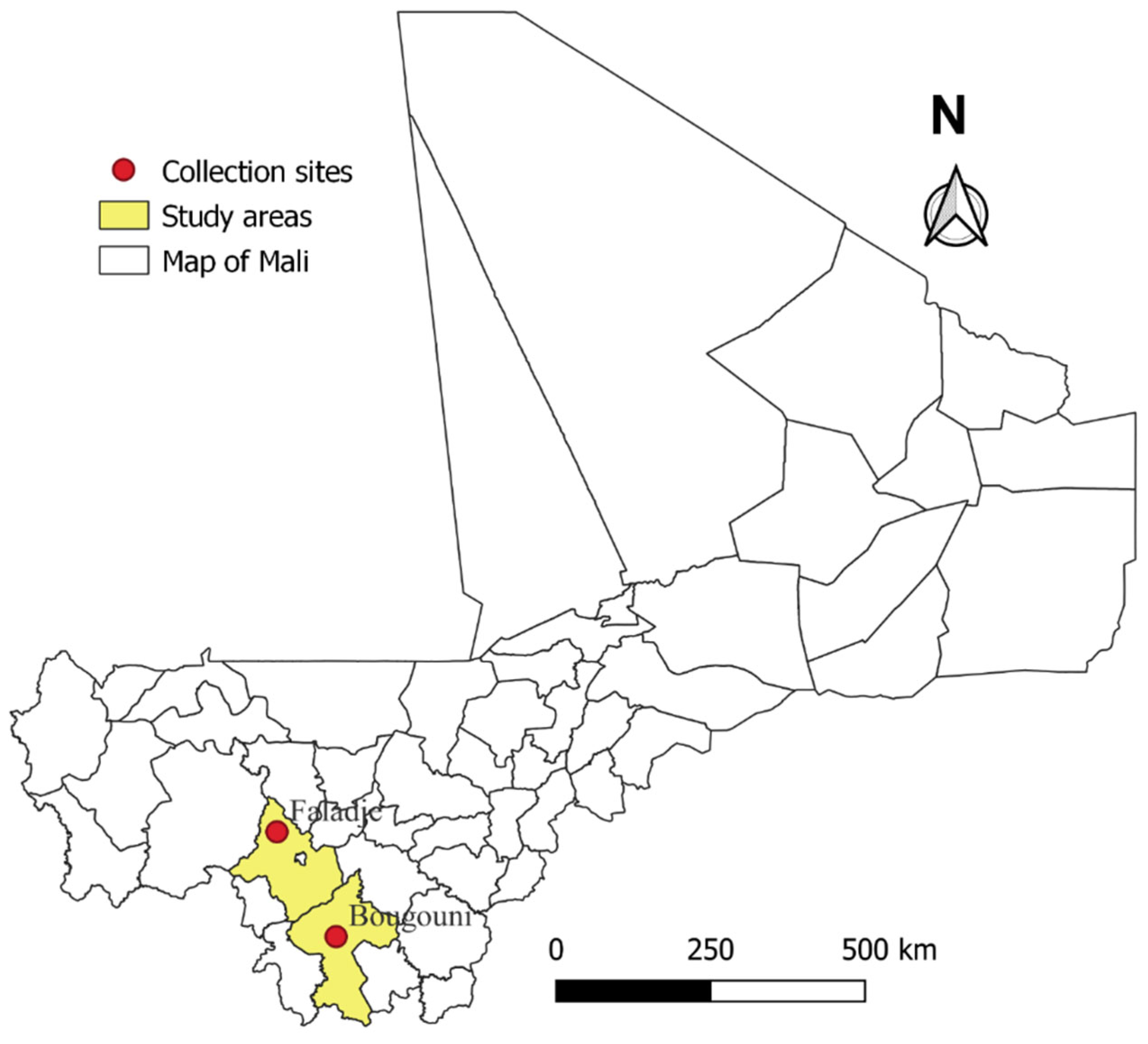

Table 1.
Number of captures and trap-nights per small mammal sampling site in Faladjè and Bougouni, in Mali, December 2016.
Table 1.
Number of captures and trap-nights per small mammal sampling site in Faladjè and Bougouni, in Mali, December 2016.
| Sites/Place of capture | Number of trap-nights |
Number of animals captured | Trapping yield (%) |
|---|---|---|---|
| Faladjè | |||
| Dwellings | 166 | 25 | |
| Lowland rice cultivation | 15 | 1 | |
| Hedge 1 of a cultivated garden | 50 | 17 | |
| Hedge 2 of a cultivated garden | 63 | 29 | |
| Catholic parish garden | 24 | 3 | |
| Sub-total | 318 | 75 | 23.58% |
| Bougouni | |||
| Dwellings in Tourakabougou | 86 | 18 | |
| Dwellings in Dougounina | 62 | 15 | |
| Cultivated area in Dougounina | 30 | 1 | |
| Cultivated area in Niébala | 120 | 11 | |
| Natural habitat and cultivated area in Hérémakono north |
58 | 3 | |
| Sub-total | 356 | 48 | 13.48% |
| Total | 674 | 123 | 18.25% |
Table 2.
Small rodent and insectivore species caught in Faladjè and Bougouni, in Mali, December 2016.
Table 2.
Small rodent and insectivore species caught in Faladjè and Bougouni, in Mali, December 2016.
| Species captured | Subfamily | Family | Number of specimens captured in Faladjè (n = 75) |
Number of specimens captured in Bougouni (n = 48) |
Total |
|---|---|---|---|---|---|
| Mastomys erythroleucus | Murinae | Muridae | 43 | 14 | 57 |
| Mastomys natalensis | Murinae | Muridae | 15 | 12 | 27 |
| Rattus rattus | Murinae | Muridae | 0 | 18 | 18 |
| Praomys daltoni | Murinae | Muridae | 8 | 2 | 10 |
| Gerbilliscus gambianus | Gerbillinae | Muridae | 3 | 0 | 3 |
| Taterillus gracilis | Gerbillinae | Muridae | 1 | 0 | 1 |
| Crocidura cf olivieri | Crocidurinae | Soricidae | 5 | 0 | 5 |
| Crocidura spp. | Crocidurinae | Soricidae | 0 | 1 | 1 |
| Atelerix cf albiventris | Erinaceinae | Erinaceidae | 0 | 1 | 1 |
| Total P-value 95% confidence interval (95% CI) Shannon index (H) Equi-distribution index (E) |
4 | 3 | 75/123 (60.97%) Binomial test; p = 0.018 ˂ 0.05 95% CI [51.8-69.6] 0.54 0.26 |
48/123 (39.02%) 95% CI [30.3-48.2] 0.59 0.28 |
123 |
Table 3.
Sex type of small rodent and insectivore specimens autopsied in Faladjè and Bougouni, in Mali, December 2016.
Table 3.
Sex type of small rodent and insectivore specimens autopsied in Faladjè and Bougouni, in Mali, December 2016.
| Type of sex | Faladjè (n = 75) | Bougouni (n = 48) |
|---|---|---|
| Male (M) | 38 (50.7%) | 28 (58.3%) |
| Female (F) | 37 (49.3 %) | 20 (41.7%) |
| Total | 75 (100) | 48 (100) |
Disclaimer/Publisher’s Note: The statements, opinions and data contained in all publications are solely those of the individual author(s) and contributor(s) and not of MDPI and/or the editor(s). MDPI and/or the editor(s) disclaim responsibility for any injury to people or property resulting from any ideas, methods, instructions or products referred to in the content. |
© 2023 by the authors. Licensee MDPI, Basel, Switzerland. This article is an open access article distributed under the terms and conditions of the Creative Commons Attribution (CC BY) license (http://creativecommons.org/licenses/by/4.0/).
Copyright: This open access article is published under a Creative Commons CC BY 4.0 license, which permit the free download, distribution, and reuse, provided that the author and preprint are cited in any reuse.


