

Submitted:
23 December 2022
Posted:
29 December 2022
You are already at the latest version
Abstract
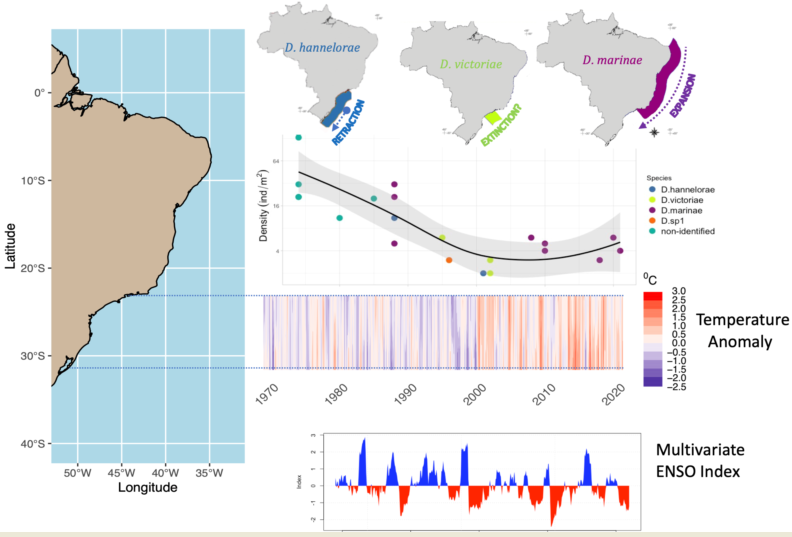
Patches of Diopatra species from Brazilian sandy beaches were followed for ca. 50 years. Data were accessed from papers, gray literature, images and collections to verify time changes in the South Brazilian Bight (SBB) from 1974-2021. We modeled maximum density over time at 15 beaches, observing very high densities (> 100 ind.m-2) in 1974 followed by a decrease (~ 10 ind.m-2) of three species of Diopatra until 1995 and a strong decline (1996-2002) when populations were almost regionally extinct (0-1 ind. m-2). A slight recovery (3-4 ind.m-2) occurred after 2006 for a single species, D. marinae, associated with warmer northern waters, suggesting a range shift. This pattern was associated with a) heatwaves linked to an El-Niño event (1988) and gradual SST surface warming of ca. 1 oC since 1974. The usage of Diopatra spp. as fishing bait could also be associated with such a reduction. After 2016, D. neapolitana, a likely alien species, was established in the SBB in high densities. Projections based on Species Distribution Modeling (SDM) suggest a potential of invasion in the same range of the known species of D. cuprea complex along the Brazilian coast despite that there are no signs of competition between both species.
Keywords:
South Brazilian Bight
; biogeography
; heatwaves
; global warming
; range-shifts
; alien species
Copyright: This open access article is published under a Creative Commons CC BY 4.0 license, which permit the free download, distribution, and reuse, provided that the author and preprint are cited in any reuse.


