

Submitted:
01 May 2025
Posted:
06 May 2025
You are already at the latest version
Abstract
The author introduces a novel theoretical framework that suggests matter and energy are both converted from curved space. In Space Theory, gravitation is generated by the flow of space, instead of being transmitted by the graviton as in String Theory. This theory also suggests that Newton's gravitational constant, denoted as G, may not be truly constant but could vary over time. The equivalent equation of space is S=Ec2=mc4, and the gravitation of hollow sphere space is Sμν=4πGm=(4/3)π((r+a)3-r3). The Space Theory also predicts that the surface gravitational acceleration of the neutron star Crab Pulsar (PSR B0531+21) is approximately 8.21924883×10⁶ m/s2.
Keywords:
space
; gravitation
, may not be truly constant but could vary over time. The equivalent equation of space is , and the gravitational force formula is . The Space Theory also predicts that the surface gravitational acceleration of the neutron star Crab Pulsar (PSR B0531+21) is approximately .
Introduction
Newton’s law of universal gravitation [1] provides the equation for the gravitational force, which states that:
When a star dies, it undergoes a contraction and blows off its outer envelope, forming a planetary nebula. [3,4] If the star collapses to within its Schwarzschild radius, it forms a black hole. [5]
Figure 1.
A star forms a black hole.

Before the star collapses, the gravitational force between the planet and the star is represented by . After the collapse, the gravitational force between the planet and the black hole is represented by . The gravitational force of a black hole is extremely strong and nothing, not even light, can escape it. [6] Therefore, is greater than . In this equation, represents the mass of the star, represents the mass of the black hole, represents the mass of the planet, represents the distance between their centers of mass, and is the gravitational constant.
As the star collapses into a black hole, it blows off its outer envelope and loses mass. [7] Assuming the star loses of its mass during this process, the mass of the black hole can be represented as of . This can be rewritten as:
When the common parameters are removed, the equation can be simplified to:
How is it even possible that is less than ? As the mass decreases from to and the distance between the objects remains unchanged, it suggests that the gravitational constant has increased. In Einstein’s theory of relativity [2], matter curves spacetime, and the Einstein field equations can be expressed in the following form:
In this equation, is the Einstein tensor and is the gravitational constant. However, if the gravitational constant is constantly changing, it raises the question of whether Einstein’s theory is still accurate.
Model
In Einstein’s theory of relativity [2], matter curves spacetime. What if the situation were reversed, and both matter and energy were converted from curved space?
Matter can release energy through annihilation, fission, and fusion [2], as matter and energy are different forms of the same thing. Therefore, matter curves spacetime because it is converted from curved space, and the flow of space released by matter creates gravitational force. The greater the amount of space released, the stronger the gravitational force generated. If one object releases much more space than another object, the flow of space will narrow the distance between the two objects. It is the space that moves, not the objects.
Figure 2.
Gravitation.

When two galaxies are very far apart, the space they release accumulates in the middle, and this expands their distance. Therefore, the expansion of the universe and the phenomenon of redshift [8] are caused by the increase in space.
Figure 3.
Expansion of the universe.

Thus, space curves in one dimension, converting matter and energy.
Figure 4.
Curved space.

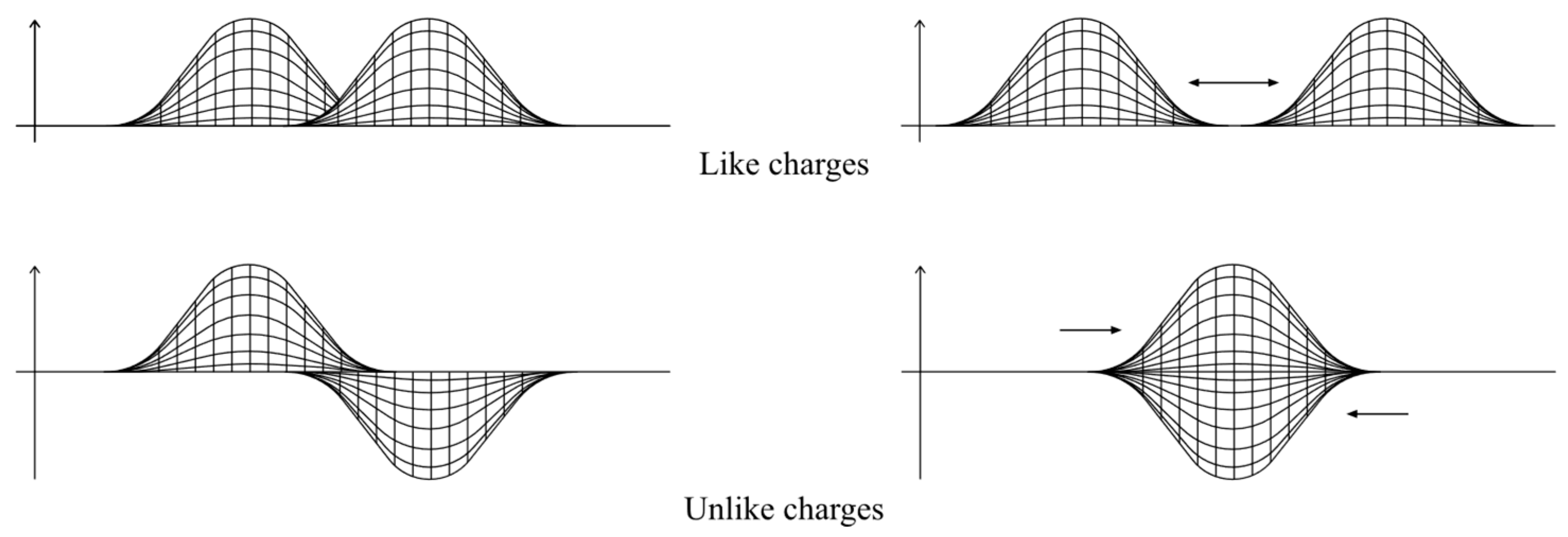
Since an electron is matter and there are only two directions in one dimension, matter curves in two different directions, creating two types of electric charges: positive and negative. Like charges repel each other because they occupy the same position in one dimension, while unlike charges attract each other because they occupy opposite positions in one dimension. Since they are all matter, they can only attract or repel each other, not annihilate.
Figure 5.
Electric charges.
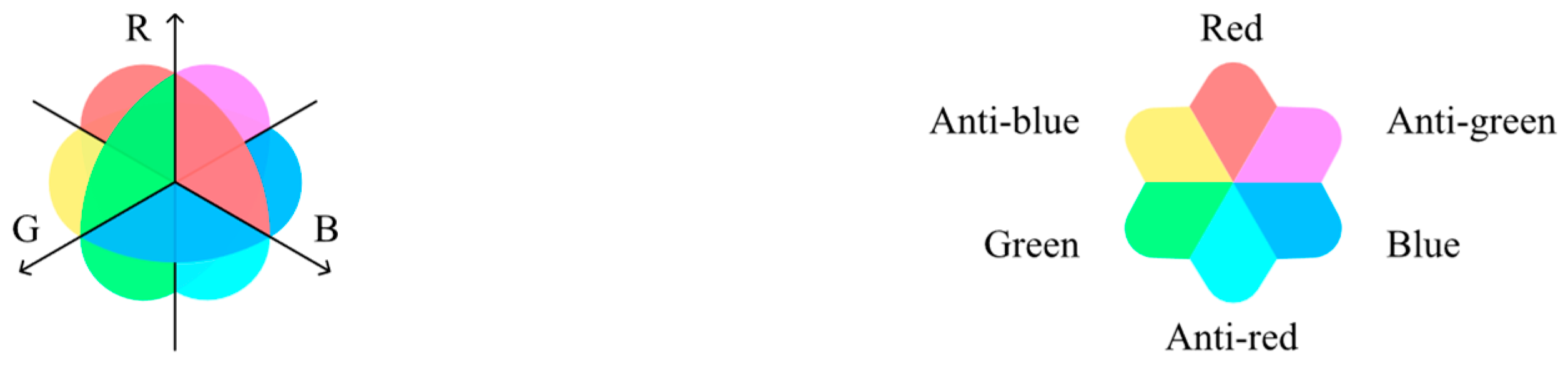
Quarks have three color charges [9]: red, green, and blue, which are converted by matter curving in three different dimensions. When a gluon is transferred between quarks, a color change occurs in both. For example, if a red quark emits a red–antigreen gluon, it becomes green; if a green quark absorbs a red–antigreen gluon, it becomes red. Quantum chromodynamics [10] proves that these three values of quark color can be converted into each other: they are different forms of the same thing.
Figure 6.
Quark color.
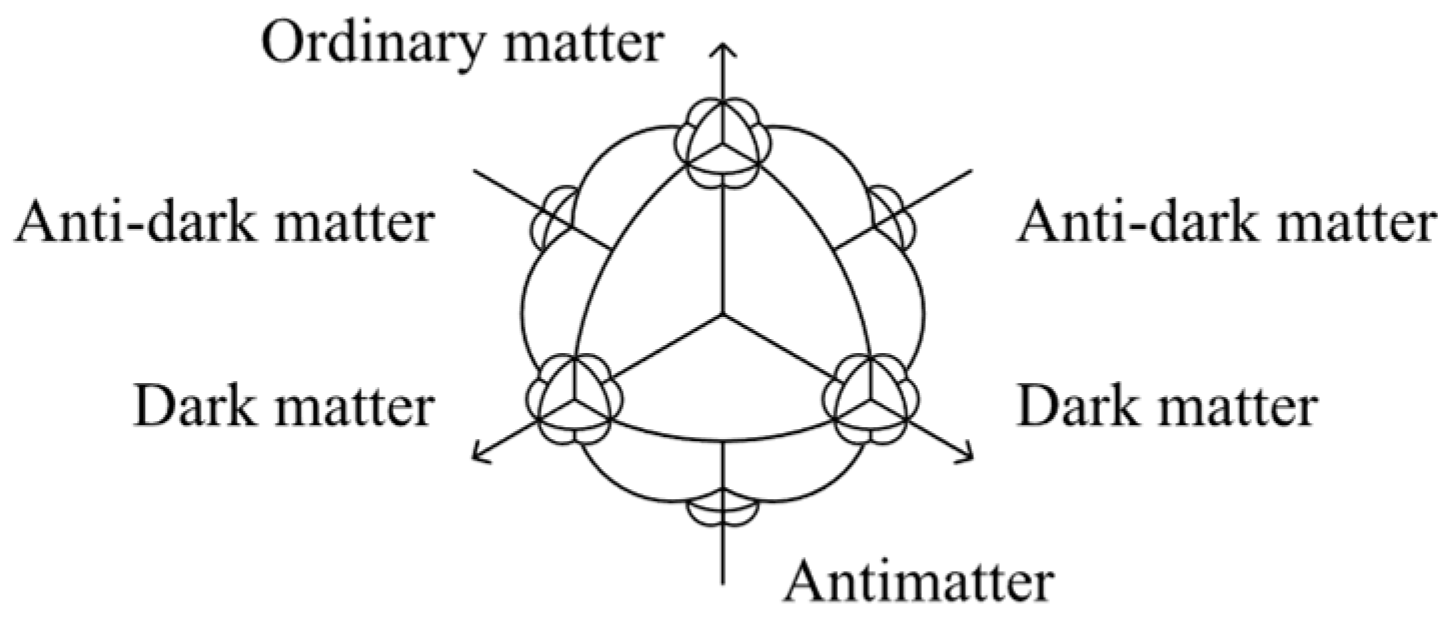
Since there are only three values of quark color, space has only three dimensions. Therefore, space curves in six different directions of three dimensions, creating six types of matter: ordinary matter, antimatter, two types of dark matter, and two types of anti-dark matter.
Matter and antimatter in opposite directions attract and annihilate each other, while matter and dark matter perpendicular to each other in another dimension have no electromagnetic force. Both matter, antimatter, dark matter, and anti-dark matter are affected by gravitation.
During the Big Bang, matter and antimatter moved in opposite directions, so antimatter ended up on the other side of the universe. Currently, there is only dark matter and anti-dark matter in the observable universe. Particle collision experiments [11] prove that ordinary matter can be converted into antimatter: they are different forms of the same thing.
Figure 7.
Six types of matter.
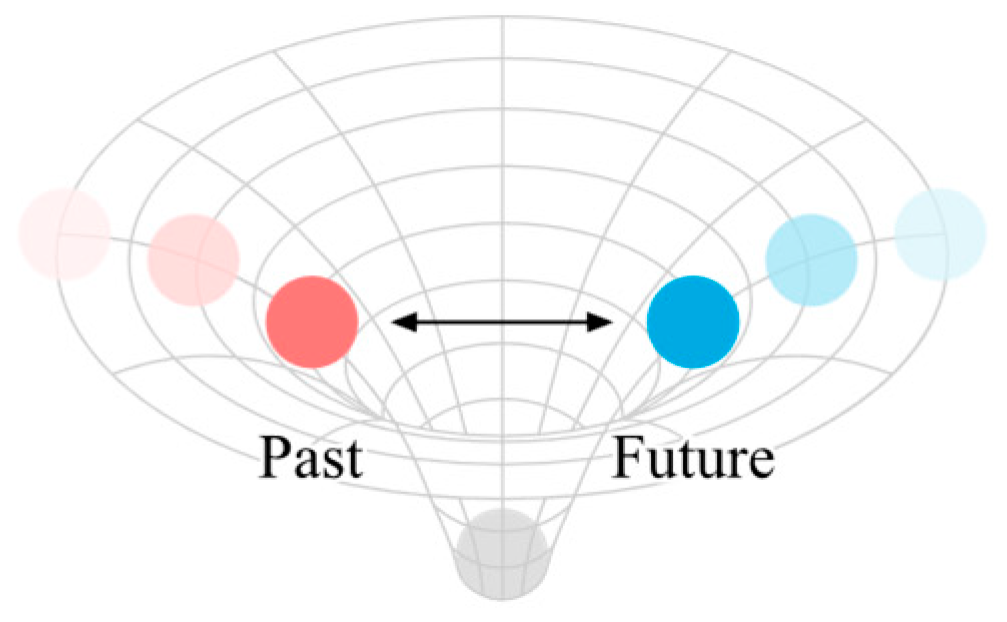
Matter is converted from curved space, and it also curves time.
In the double-slit experiment, an interference pattern emerges as the particles build up one by one. [12] This occurs because matter curves time, causing the particle from the past to interfere with the particle from the future.
In which-way experiment, if particle detectors are positioned at the slits, showing through which slit a photon goes, the interference pattern will disappear. [13] The mass of the observer is much greater than the particle, and when the observation occurs, the time of the observer engulfs the time of the particle, similar to how a black hole swallows a star, resulting in wave function collapse.
The Wheeler’s delayed choice experiment demonstrates that extracting “which path” information after a particle passes through the slits can appear to retroactively alter its previous behavior at the slits. [14] Because matter curves time, the particle from the future can interfere with the particle from the past, meaning that the present behavior can have an impact on the past.
The quantum eraser experiment further shows that wave behavior can be restored by erasing or making permanently unavailable the “which path” information. [15] Since the time of the particle has no connection with the time of the observer, no wave function collapse occurs.
Figure 8.
Matter curves time.
Every elementary particle is matter, and they are all converted from curved space, which gives them rest mass. However, the current commonly accepted physical theories imply or assume that the photon is strictly massless [16]. The Lorentz factor is defined as [17]:
In Newton’s law of universal gravitation [1], the gravitational acceleration is:
In Einstein’s theory of relativity [2], the stress-energy tensor for a non-interacting particle with rest mass and trajectory is given by:
If the photon has no rest mass, it would not be subject to gravitation and could escape from a black hole, contradicting observations. [6]
Of course, there is no doubt that the Standard Model is accurate, so the blame is on the photon. The mistake, therefore, lies with the photon, which should behave precisely as predicted by scientists. The photon is both a wave and a particle, both matter and antimatter, and both has and does not have rest mass.
According to the standard model in particle physics [18], neutrino has zero rest mass and is a spin-half particle. Unfortunately, experimental observations by the Super-Kamiokande Observatory and the Sudbury Neutrino Observatories have shown that the neutrino actually has a non-zero rest mass, revealing the limitations of the Standard Model. [19,20,21]
The Higgs mechanism requires very precise values for certain parameters, such as the mass of the Higgs boson, the vacuum expectation value, and the self-coupling constants, to match experimental observations. This “fine-tuning” is often criticized as unnatural. In particular, the “naturalness problem” questions why the Higgs mass hasn’t escalated to very high values due to quantum effects, which often necessitates additional explanations like supersymmetry, extra dimensions, or other extensions to the Standard Model.
The Higgs mechanism does not answer deeper questions, such as why mass exists at all or why the vacuum expectation value of the Higgs field is what it is. The vacuum expectation value of the Higgs field introduces a form of negative energy density, which conflicts with observations of dark energy. The mechanism also doesn’t explain why the universe has a mass distribution that allows for complex structures, nor does it help us understand the overall properties of the universe, especially the observed acceleration in cosmic expansion.
Furthermore, as is widely known, dark matter possesses mass. Is this mass conferred by the Higgs field? If the answer is yes, does the Higgs boson composed of both matter, antimatter, and dark matter? If the answer is no, where does the mass of dark matter originate from?
Gravitation
Since there are only three values for the color charge of quarks, so the space has only three dimensions. Therefore, the space released by matter takes the form of a three-dimensional sphere. As this space flows outward, it forms a hollow sphere, and its volume can be written in the following form:
where is the space released by the matter, is the radius of the sphere, and is the degree of space curvature. The greater the degree of space curvature, the greater the gravitational acceleration of the object. When the outward flow of space occurs, its volume remains constant, allowing for the direct calculation of the gravitational acceleration at a different distance using the gravitational acceleration at a known distance. The equation can be rewritten to:
The mass of the Earth is approximately , and the average distance from its center to its surface is about . [22,23] According to Newton’s law of universal gravitation, the value of the gravitational constant is approximately . [24] The gravitational acceleration at the Earth’s surface can be calculated using this law and is given by:
If the distance up to , the gravitational acceleration is:
When the gravitational acceleration is equal to the Newtonian gravitational acceleration at , the gravitational acceleration at is:
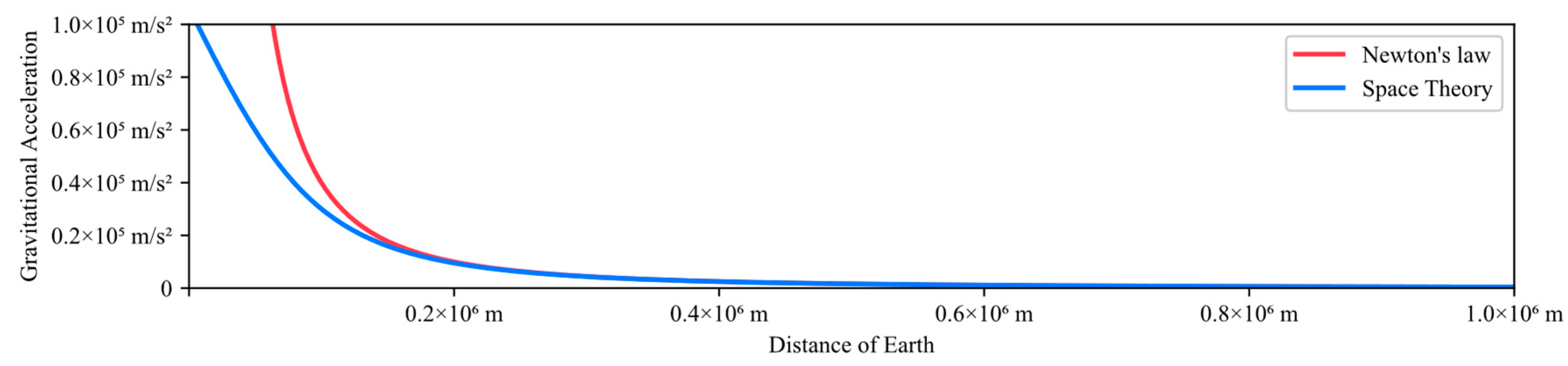
As you can see, the value of the gravitational acceleration calculated using the Space Theory is extremely close to the value calculated using Newton’s law of universal gravitation. This confirms that the Space Theory can be used to accurately calculate the gravitational acceleration. The gravitational acceleration of the Earth at different distances in both models is shown in the following table:

Table 1.
Gravitational acceleration of Earth.
| Distance of Earth | ||||||
| Newton’s law | ||||||
| Space Theory |
The mass of the Moon is approximately , its mean radius is about , and the time-averaged distance between the centers of the Earth and Moon is about . [25,26,27] When considering different distances, the gravitational acceleration of the Moon in two different models is shown in the following table:
Table 2.
Gravitational acceleration of Moon.
| Distance of Moon | ||||||
| Newton’s law | ||||||
| Space Theory |
The mass of the Sun is approximately , with a mean radius of about , and the mean distance between the centers of the Earth and the Sun is about . [28,29] The table below shows the gravitational acceleration of the Sun in two different models at varying distances:
Table 3.
Gravitational acceleration of Sun.
| Distance of Sun | ||||||
| Newton’s law | ||||||
| Space Theory |
When the distance is zero, Newton’s gravitational acceleration becomes infinite, which is obviously incorrect. In contrast, the gravitation of the Space Theory is more accurate and does not require the use of Newton’s constant of gravitation. The Schwarzschild radius [5] is a physical parameter that appears in the Schwarzschild solution to Einstein’s field equations. It corresponds to the radius defining the event horizon of a black hole and can be expressed as:
The Schwarzschild radius of Earth is approximately . However, when the distance is , the Newton’s gravitational acceleration exceeds approximately , it is greater than the speed of light in vacuum, approximately , and this leads to the formation of a black hole, which is obviously wrong.
Expanding the formula, the gravitational acceleration of the Space Theory can be derived as:
Then introduce a new variable to represent . The equation can be simplified to:
The expression implies that can approach as closely as desired by increasing the distance to infinity. At the surface of the Earth, the ratio of the gravitational acceleration to the distance is approximately , which is negligible and can be omitted. The formula can be rewritten as:
Since the accelerations of the two formulas are equal at long distances, the formula can be simplified to:
After removing the same parameters, the gravitation of the Space Theory thus takes the form:
The result demonstrates that the space released by matter per kilogram is precisely equal to , providing evidence that matter is converted from curved space, indicating that they are different forms of the same thing. The further the distance between the objects, the closer the values of the formulas.
Figure 9.
Gravitational acceleration of Earth.
In Einstein’s theory of relativity [2], matter curves spacetime, and the Einstein field equations can be expressed in the following form:
where is the Einstein tensor, is the stress-energy tensor, is the speed of light in vacuum, and is the Einstein constant of gravitation. In the geometrized unit system, the value of is set equal to unity. Therefore, it is possible to remove the Newton’s constant of gravitation from the equations to avoid mistakes, especially since the Newton’s law of universal gravitation does not apply to black holes. The equation can be rewritten as:
Since the theory is that matter and energy are both converted from curved space, the form should also be reversed. As space is proportional to mass and the fourth power of the speed of light in vacuum , the equivalent equation for space can be expressed as:
Of course, under ordinary circumstances, if the Newton’s “constant” of gravitation doesn’t change too much, it can still be used to calculate the gravitational acceleration, the form can be rewritten to:
On the surface of Earth, the gravitational acceleration is:
And the relative error is:
As you can see, this value is still extremely close to the original. What’s more, this formula does not introduce any new variables.
In 1665, Newton extended the binomial theorem [1] to include real exponents, expanding the finite sum into an infinite series. To achieve this, he needed to give binomial coefficients a definition with an arbitrary upper index, which could not be accomplished through the traditional factorial formula. Nonetheless, for any given number , it is possible to define the coefficients as:
The Pochhammer symbol is used to represent a falling factorial, which is defined as a polynomial:
This formula holds true for the usual definitions when is a nonnegative integer. For any complex number and real numbers and with , the following equation holds:
The series for the cube root can be obtained by setting , which gives:
At long distances where , the equation becomes:
Then introduce a new variable , the equation can be simplified to:
At the surface of the Earth, the variable is approximately , which is negligible and can be omitted. This is the reason why it is extremely close to Newton’s value at long distances.
At short distances where , the form of the equation is different:
In summary, formulas inversely proportional to the distance raised to the power of can all be replaced with the hollow sphere model:
In Chapter 7 of the book “Why String Theory?”, it is mentioned that there is no direct experimental evidence for the String Theory. [30] To avoid encountering the same issue of unverifiability as String Theory, the author makes a prediction about the surface gravity of neutron star. The Crab Pulsar (PSR B0531+21) has a mass of solar masses (M☉) and a radius of approximately . [31] The solar mass (M☉) is a standard unit of mass in astronomy, equal to approximately . [28] On the surface of Crab Pulsar, the gravitational acceleration is:
Newton’s prediction of , which is significantly greater than the speed of light in vacuum, , and this leads to the formation of a black hole, clearly deviates from what is expected. In contrast, the predicted value from the Space Theory, , aligns more closely with reality. In addition, the distance can also be determined by the gravitational acceleration, it can be rewritten as:
And the product of variables, and , becomes:
As you can see, when the acceleration is very small, the results between the two formulas will be very close. Due to the modification of the Newton’s law, the orbital velocity also requires a corresponding adjustment, and it can be expressed in the following form:
The mass of the Earth is approximately , and the mass of the Moon is approximately . [23,25] The time-averaged distance between the centers of the Earth and Moon is about . [27] The orbital velocity is:
The modified formula resolves the issue of approaching infinity as the distance nears zero. Similarly, the distance of the orbit can also be determined by velocity, it can be rewritten as:
When the orbital velocity is , the distance is:
To ensure the accuracy of calculations, the author recommends using the Decimal Module in Python, and suggests setting precision to digits.
Electromagnetism
The same formula can also be used to calculate the electrostatic force. Interpret the formula as describing the propagation of photons in three-dimensional space, extending as a hollow sphere, with the number of particles remaining constant, and the density decreasing with distance, causing changes in the electric field. Therefore, the electric field can also be represented using the formula:
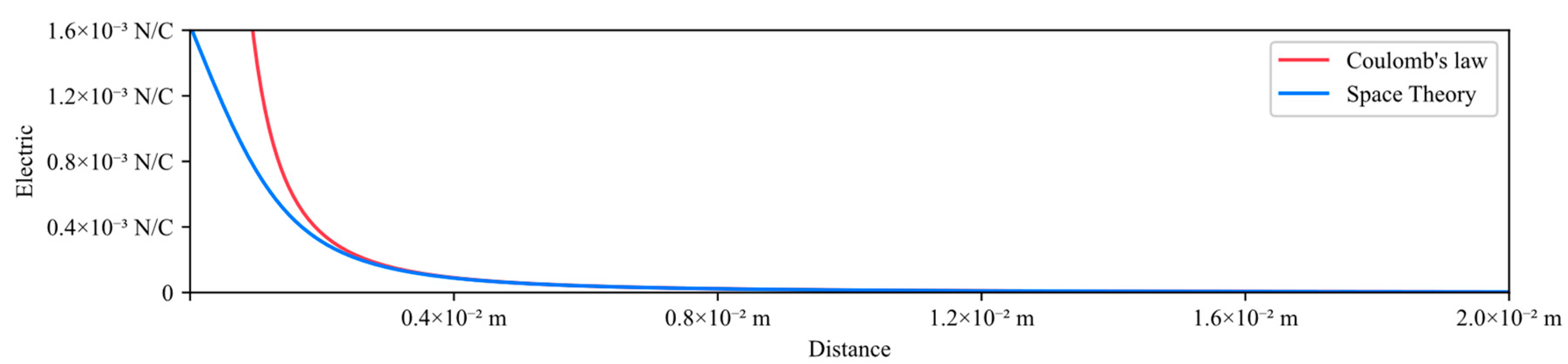
where is the electric field of photons, is the Coulomb constant, and is the quantity of each charge. The Coulomb constant is about , and the electric charge of a single electron is approximately [32]. If the distance of an electron is , the electric field is:
The further the distance between the objects, the closer the values of the formulas.
Figure 10.
The electric field of an electron.
In the geometrized unit system, where and . For the convenience of calculation, here represents the atomic number of the atom, and the quantity of charge is set to . The Bohr radius, symbolized , is approximately . When the distance is equal to the Bohr radius, the electric field of the hydrogen atom is:
The electric field is shown in the following table:
Table 4.
The electric field of the Hydrogen atom.
| Coulomb’s law | ||||||
| Space Theory |
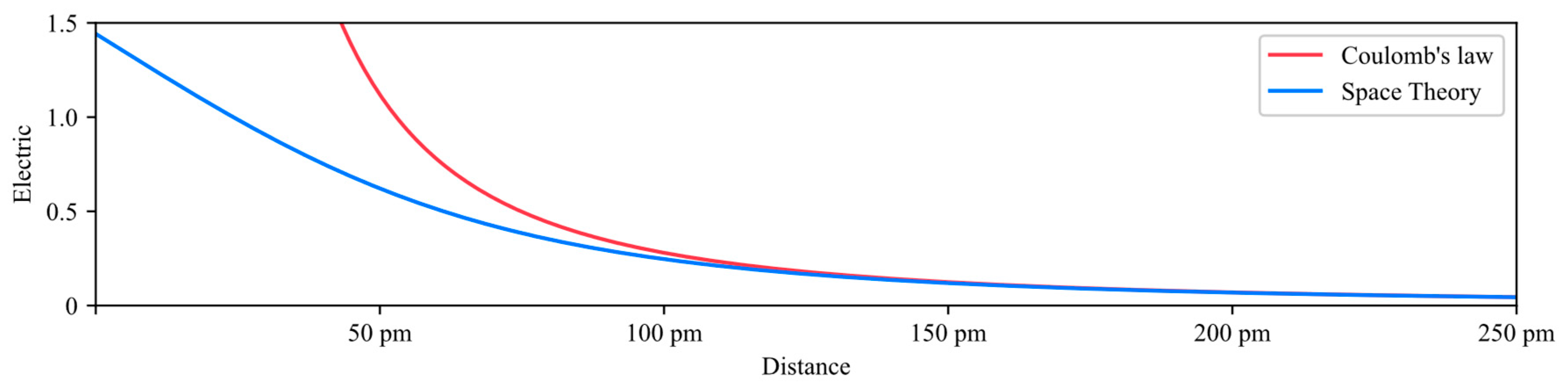
The variation is illustrated in the diagram:
Figure 11.
The electric field of a Hydrogen atom.
And the orbital velocity is:
The velocity is shown in the following table:
Table 5.
The orbital velocity of a Hydrogen atom.
| Newton’s law | ||||||
| Space Theory |
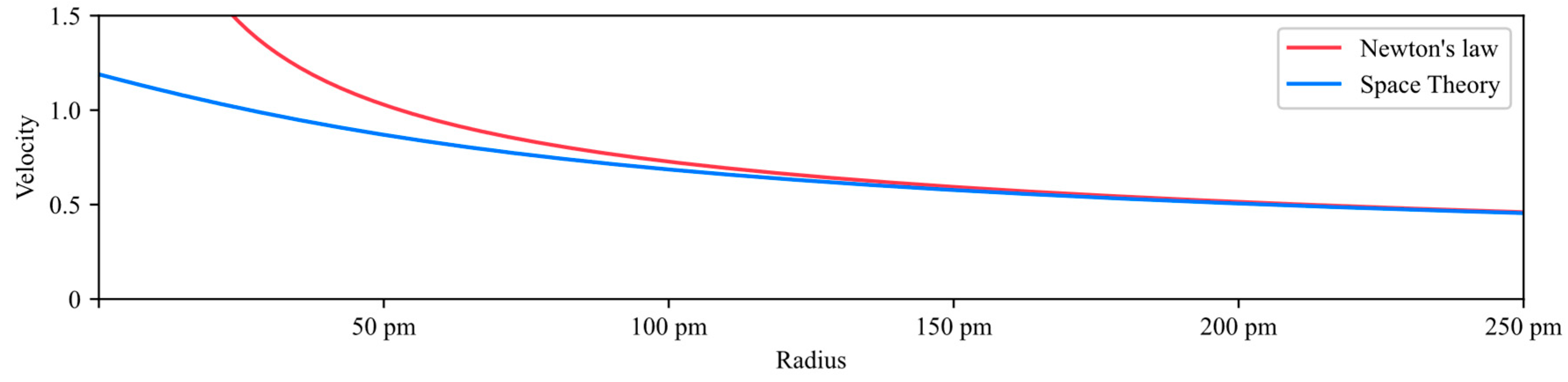
The revised formula shows that the orbital velocity of an electron near the atomic nucleus increases by only compared to when it’s at the Bohr radius, which is completely different with the value in classical physics. After the correction, the electron will no longer fall into the nucleus when the distance is zero.
Figure 12.
The orbital velocity of a Hydrogen atom.
In quantum mechanics, spin is an intrinsic form of angular momentum, but it doesn’t correspond to classical rotation. It suggests that particles are spinning around an axis, even though no classical rotational movement occurs. When two electrons occupy the same orbital, they have opposite spins. However, the probability cloud implies that their position is probabilistic, which contradicts the concept of an orbital. Spin is just a mathematical byproduct rather than a fundamentally understood physical property, just a “phenomenon” projected onto physical behavior.
In classical mechanics, angular momentum is calculated using mass, radius, and rotational velocity, but quantum spin has no direct equivalent. Spin quantum numbers are discrete (e.g., 1/2, 1) and independent of mass or volume, which makes spin counterintuitive and difficult to reconcile with classical physics. In the Standard Model, spin-2 particles, like the hypothetical graviton, are proposed to represent gravitational interactions. However, describing spin-2 particles is impossible, particularly due to the nonexistence of a unified quantum gravity theory.
The lanthanide contraction refers to the greater-than-expected decrease in atomic and ionic radii of the elements in the lanthanide series from left to right, and this phenomenon has been attributed to the shielding effect and relativistic effects. [33] The shielding effect assumes that electrons are independent, but in reality, there is a strong correlation between them. Furthermore, using relativistic quantum chemistry to explain this phenomenon is inappropriate, especially when attempting to forcibly combine completely incompatible theories, such as relativity, quantum mechanics, and classical physics, resulting in a huge stitch creation, like the Frankenstein’s monster, deformed and twisted.
Due to irreconcilable conflicts between String Theory and Space Theory, it is necessary to abandon the concepts in quantum mechanics. The revised orbital formula prevents electrons from falling into the nucleus, which changes the mode.
Figure 13.
Hydrogen and Helium.
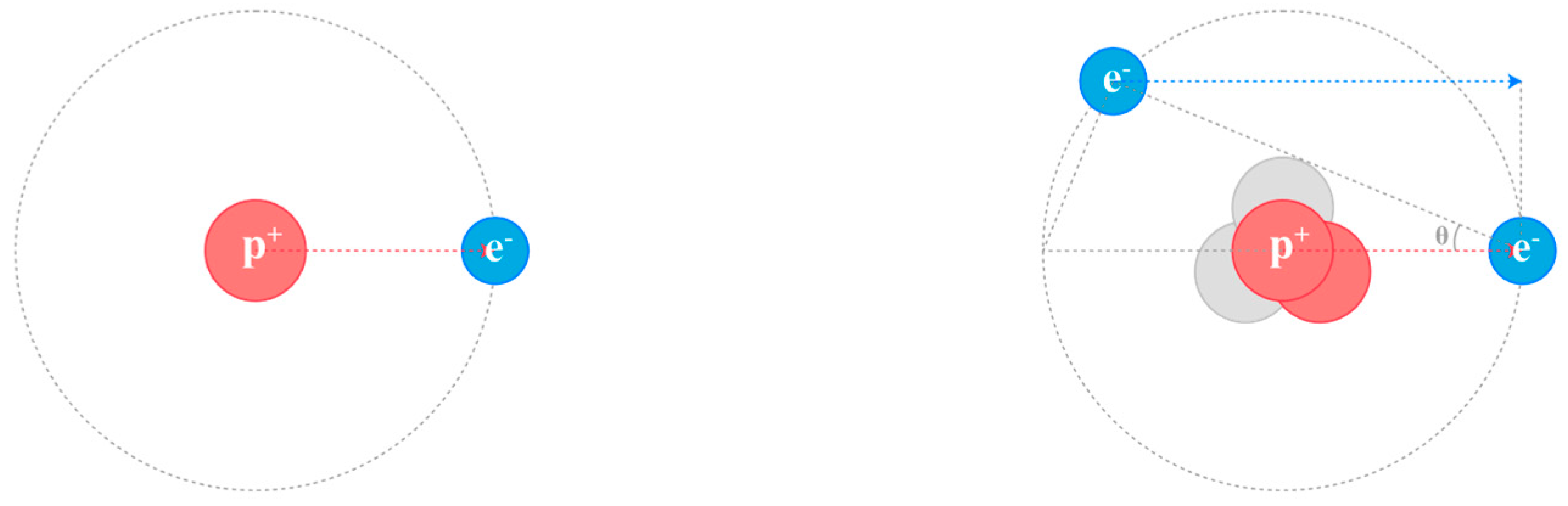
Without considering the shielding constant, the orbital radius of the Bohr model can be simplified to:
The electric field of a hydrogen atom with and is:
Even at a distance of zero, the electron will not fall into the atomic nucleus.
In a vacuum environment, neglecting external conditions, if two objects move along the same orbit and interact with each other, according to Newton’s third law, the two objects will eventually reach equilibrium after moving for a long time. The radius of the helium atom’s orbital is about of . When two electrons are equidistant from each other, the set of coordinates and are:
The hypotenuse and angle of the right triangle are:
The sum of and is:
The radius of the lithium atom’s orbital is about of . Assuming three electrons are equidistant and form an equilateral triangle, the set of coordinates are:
The sum of and is:
Since each photon’s electric field and its total number remain unchanged, the electric field near the nucleus decreases rather than increases. This means that the electric field exerted by the lithium atom’s orbital on the third electron is much weaker than that in the hydrogen atom’s orbital. This force is not strong enough to keep the third electron in the orbital, resulting in the electron moving to the orbital. The empirically measured [34] and calculated radii of lithium are and , respectively. Assuming the orbital radius of the third electron is , the set of coordinates are:
The sum of and is:
At long distances, the sum of two electrons’ electric field is about of three protons, and the value approximating Coulomb’s law.
The amplitude and frequency of the spacetime oscillation around elements from different periods and groups also vary. The curve is a two-dimensional curve defined in parametric form, with the parameter ranging from to , and the parameter ranging from to .
where is the principal quantum number, and the index is ranging from 1 to 4. The amplitude is , the frequency is , and the decay is . The total arc length of the curve is given by the integral from to , so the length of each arc is:
The variation is illustrated in the diagram:
Figure 15.
Spacetime oscillation around elements.
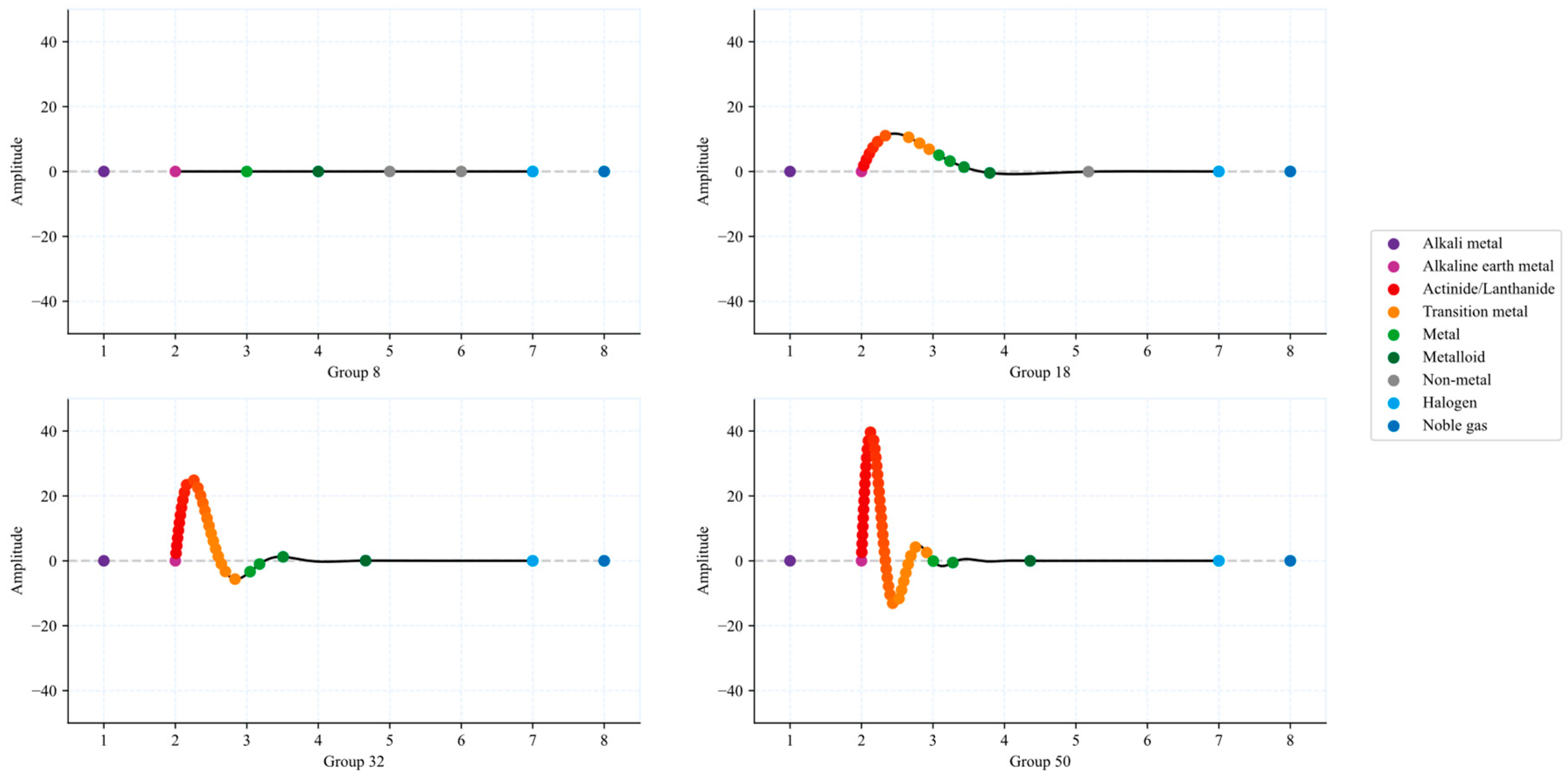
The revised model eliminates several outdated concepts, including the P-zone diagonal, the scandium-yttrium contraction, the lanthanide-actinide contraction. Since the first three concepts have been entirely discarded, they will not be mentioned in subsequent articles.
Machine learning uses both simple linear regression and multiple linear regression as fundamental techniques for predicting a continuous target variable based on one or more input features. To fit the curve to the data, logarithmic and exponential models are also used here.
Table 6.
Linear, logarithmic and exponential model.
| Model | Formula | |||
| Linear | ||||
| Logarithmic | ||||
| Exponential | ||||
The coefficient of determination is a statistical measure that evaluates how well the regression model explains the variation in the target variable based on the independent variables:
Since the theory is incompatible with quantum mechanics, the empirically measured atomic radii [34] are used here rather than theoretical calculations. The method from SciPy is used to obtain parameters, and the method from Scikit-Learn is used to calculate the value.
The x, y, and z axes represent period, group, and radius, respectively. The values of , , , , and are , , , , and , respectively. The values of and are approximately and , respectively. The formulas, after being simplified, are:
The values of , and are , and , respectively. The values of and are approximately and , respectively.
Figure 16.
Atomic radius.
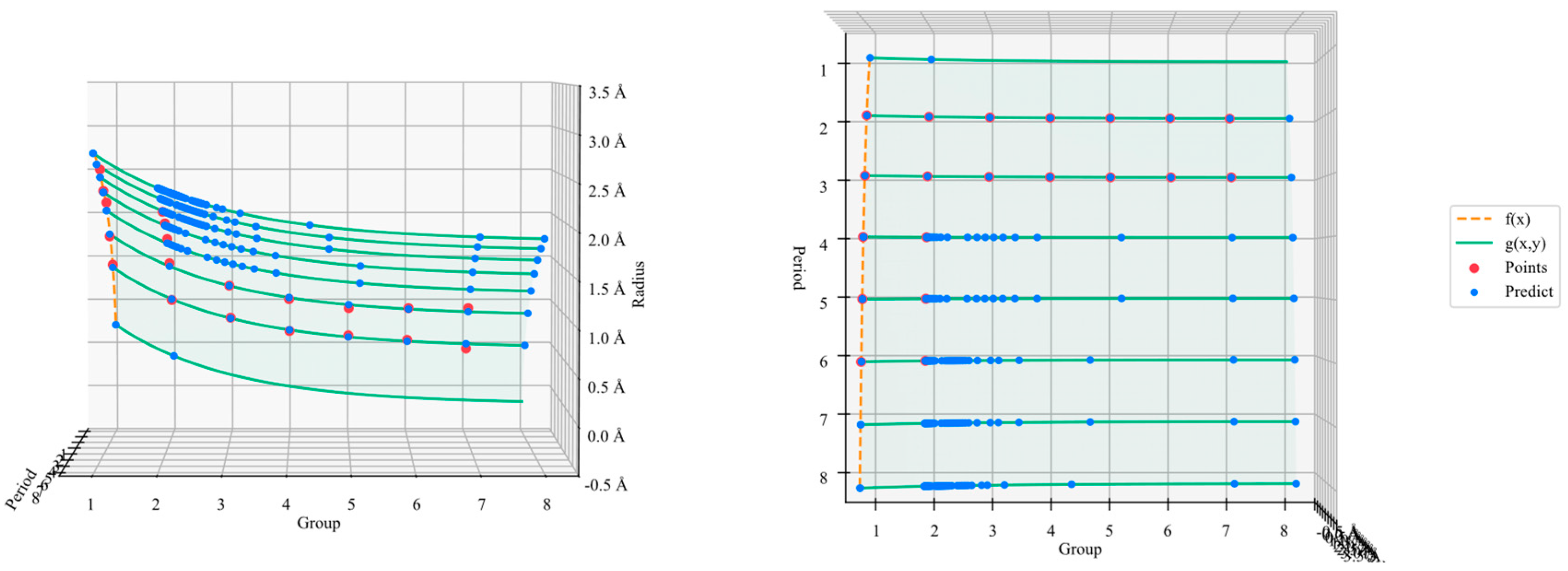
This method predicts other points (blue) from existing points (red). The empirically measured [34], calculated, and model-obtained atomic radii of hydrogen are , , and , respectively. For helium, the empirically measured atomic radius is not available, while the calculated and model-obtained radii are and , respectively. The model predicts that ununennium and unbinilium (element 119 and 120) have radii of and , respectively.
Discussion
This paper is not yet complete. As of this writing, graviton has not been found yet.
Funding
None.
Acknowledgments
I would like to thank the scientists who study String Theory and make outstanding contributions to physics. The thickening speed of physics journals has surpassed the speed of light, but this doesn’t violate the theory of relativity, because those journals aren’t transmitting any information.
Conflicts of Interest
None.
References
- I. Newton. (1687). “Philosophiae Naturalis Principia Mathematica.” The Mathematical Principles of Natural Philosophy.
- A. Einstein. (1916). “Die Grundlage der allgemeinen Relativitätstheorie.” Annalen der Physik, Vierte Folge, Band 49, 769-822.
- R. Penrose. (1965). “Gravitational Collapse and Space-Time Singularities.” Physical Review Letters. American Physical Society, 14, 57-59. [CrossRef]
- A. Frankowski, N. Soker. (2009). “Very late thermal pulses influenced by accretion in planetary nebulae.” New Astronomy, 14, 8, 654-658. [CrossRef]
- K. Schwarzschild. (1916). “Über das Gravitationsfeld eines Massenpunktes nach der Einsteinschen Theorie.” Sitzungsberichte der Königlich Preußischen Akademie der Wissenschaften, Seite 189-196.
- D. Clery. (2020). “Black holes caught in the act of swallowing stars.” Science, 367, 6477, 495. [CrossRef]
- S.W. Hawking. (1974). “Black hole explosions.” Nature 248, 30–31. [CrossRef]
- E. Hubble. (1929). “A relation between distance and radial velocity among extra-galactic nebulae.” PNAS 15, 3, 168-173. [CrossRef]
- O.W. Greenberg. (1964). “Spin and Unitary Spin Independence in a Paraquark Model of Baryons and Mesons.” Physical Review Letters, 13, 598–602.
- R.P. Feynman. (2006). “QED: The strange theory of light and matter.” Princeton University Press.
- V. Hatton. (1991). “Operational history of the SPS collider 1981-1990.” Conference Record of the 1991 IEEE Particle Accelerator Conference, 2952-2954. [CrossRef]
- R. Pfleegor, L. Mandel. (1967). “Interference of Independent Photon Beams.” Physical Review, 159, 5, 1084–1088. [CrossRef]
- W. Wootters, W. Zurek. (1979). “Complementarity in the double-slit experiment: Quantum nonseparability and a quantitative statement of Bohr’s principle.” Physical Review D, 19, 2, 473–484. [CrossRef]
- A. Peruzzo, P. Shadbolt, et al. (2012). “A Quantum Delayed-Choice Experiment.” Science, 338, 6107, 634–637. [CrossRef]
- X. Ma, J. Kofler, et al. (2012). “Quantum erasure with causally disconnected choice.” Proceedings of the National Academy of Sciences, 110, 4, 110–1226. [CrossRef]
- M. Alonso, E. Finn. (1968). “Fundamental University Physics Volume III: Quantum and Statistical Physics.” Addison Wesley, ISBN 978-0-201-00262-1.
- J. Forshaw, G. Smith. (2014). “Dynamics and Relativity.” John Wiley & Sons, ISBN 978-1-118-93329-9.
- R. Oerter. (2006). “The Theory of Almost Everything: The Standard Model, the Unsung Triumph of Modern Physics.” Penguin Group, ISBN 978-0-13-236678-6.
- Pontecorvo. (1958). “Mesonium and Antimesonium.” Soviet Journal of Experimental and Theoretical Physics, 6, 429–431.
- B. E. Kearns, T. Kajita, Y. Totsuka. (1999). “Detecting Massive Neutrinos.” Scientific American, 281, 64–71. [CrossRef]
- A. McDonald, J. Klein, D. Wark. (2006). “Solving the Solar Neutrino Problem.” Scientific American, 288, 40–49. [CrossRef]
- B. Luzum, N. Capitaine, A. Fienga, et al. (2011). “The IAU 2009 system of astronomical constants: The report of the IAU working group on numerical standards for Fundamental Astronomy.” Celestial Mechanics and Dynamical Astronomy, 110, 293–304. [CrossRef]
- F. Chambat, B. Valette. (2001). “Mean radius, mass, and inertia for reference Earth models.” Physics of the Earth and Planetary Interiors, 124, 3–4, 234–253. [CrossRef]
- P. Mohr, D. Newell, B. Taylor. (2016). “CODATA Recommended Values of the Fundamental Physical Constants: 2014.” Journal of Physical and Chemical Reference Data, 45, 4, 1527–1605. [CrossRef]
- M. Wieczorek, B. Jolliff, A. Khan, et al. (2006). “The Constitution and Structure of the Lunar Interior.” Reviews in Mineralogy and Geochemistry, 60, 1, 221–364. [CrossRef]
- C. Hirt, W.E. Featherstone. (2012). “A 1.5 km-resolution field model of the Moon.” Earth and Planetary Science Letters, 329–330, 22–30. [CrossRef]
- J. Battat, T. Murphy, E. Adelberger, et al. (2009). “The Apache Point Observatory Lunar Laser-ranging Operation (APOLLO): Two Years of Millimeter-Precision Measurements of the Earth-Moon Range.” Astronomical Society of the Pacific, 121, 875, 29–40. [CrossRef]
- G. Poole. (2019). “Cosmic Power Generation and Gravity.” Journal of High Energy Physics, Gravitation and Cosmology, 5, 920-927. [CrossRef]
- E. Pitjeva, E. Standish. (2009). “Proposals for the masses of the three largest asteroids, the Moon-Earth mass ratio and the Astronomical Unit.” Celestial Mechanics and Dynamical Astronomy, 103, 365–372. [CrossRef]
- J. Conlon. (2016). “Why string theory?” CRC Press.
- D. Jeffery. (n.d.). “Neutron Stars and the Crab Nebula.” University of Nevada, Las Vegas.
- NIST. (2019). “2018 CODATA Value: vacuum electric permittivity.” The NIST Reference on Constants, Units, and Uncertainty.
- P. Pyykko. (1988). Relativistic effects in structural chemistry. Chemical Reviews, 88(3), 563-594.
- J.C. Slater. (1964). Atomic radii in crystals. The Journal of Chemical Physics, 41(10), 3199-3204.
Disclaimer/Publisher’s Note: The statements, opinions and data contained in all publications are solely those of the individual author(s) and contributor(s) and not of MDPI and/or the editor(s). MDPI and/or the editor(s) disclaim responsibility for any injury to people or property resulting from any ideas, methods, instructions or products referred to in the content. |
© 2025 by the authors. Licensee MDPI, Basel, Switzerland. This article is an open access article distributed under the terms and conditions of the Creative Commons Attribution (CC BY) license (http://creativecommons.org/licenses/by/4.0/).
Copyright: This open access article is published under a Creative Commons CC BY 4.0 license, which permit the free download, distribution, and reuse, provided that the author and preprint are cited in any reuse.


