

Submitted:
08 January 2025
Posted:
09 January 2025
You are already at the latest version
Abstract
The curvature of space-time is replaced by the variable energy density of the time-invariant superfluid space, where the variable energy density of space carries gravity. The gravity vector points in the direction from a higher energy density to a lower energy density. When light moves in the direction of the gravity vector, it causes a blue shift. When light moves in the opposite direction, it causes a redshift. The Doppler effect in an expanding space has not been experimentally confirmed. The cosmological redshift originates from the gravitational redshift. Universal space does not expand.
Keywords:
superfluid space
; time
; gravity
; redshift
; blueshift
; universe expansion
1. Introduction
Currently, space-time is still considered a physical reality that can curve [1]. A recent study suggested that universal space is time-invariant, time is not 4th dimension of space, and time is the duration of motion of a given physical object in time-invariant space. The curvature of space-time does not cause gravity, and the variable energy density of the time-invariant superfluid space carries it [2]. Gravity is not directly related to time, which is an emergent physical reality that enters the measurement process. Einstein’s idea that physical objects could exist in the “empty” space deprived of physical attributes requires examination. A common sense in physics is that only a medium with a physical attribute of “energy” can contain physical objects. In the model presented in this article, the universal space is a four-dimensional type of energy, and the material objects are three-dimensional. The velocity of the motion of material objects in a time-invariant space does not require time. Time as duration enters existence when the clock measures the velocities. Humans invent clocks and time to measure the velocity of motion in a time-invariant space [3].
In this study, a Newtonian gravity model was developed. Newton’s idea was that stellar objects diminish the density of space and that his generates gravity: “Doth not this aethereal medium in passing out of water, glass, crystal, and other compact and dense bodies in empty spaces, grow denser and denser by degrees, and by that means refract the rays of light not in a point, but by bending them gradually in curve lines? I is not this medium much rarer within the dense bodies of the Sun, stars, planets, and comets than in the empty celestial space between them? In passing from them to great distances, doth it does not grow denser and denser perpetually, and thereby cause the gravity of those great bodies towards one another, and of their parts towards the bodies; everybody endeavoring to go from the denser parts of the medium towards the rarer’ [4].
A fundamental unit of a four-dimensional superfluid quantum space is a Planck volume . This volume of space is not empty; it is occupied by the 4-dimensional fundamental quanta, named “Planck quanta.” Planck quanta are a fundamental unit of energy that builds a universal space. Planck quanta cannot be created or destroyed, and their density in a given volume of space varies and depends on the presence of physical objects. One 4-dimensional meter of intergalactic space contains Planck quanta. The sum of the energy of space and that of matter in a given volume of space is constant. When there is a material object in a given volume of space, the amount of energy in space diminishes correspondently to the mass of material objects, which means that the number of Planck quanta in a given volume of space diminishes. In Newton’s words, the density of the space diminishes.
Let us take that we have in the intergalactic space a mass of one gram in one 4-dimensional meter. The volume of a 4-dimensional meter is of the same size as the volume of one cubic meter, and only the dimensionality is different. The mass of one gram converted into energy is . One Planck quanta had an energy of . The number of Planck quanta in one 4-dimensional meter that has a mass of one gram in its center will diminish for about units. This implies that a mass of one gram causes a decrease in the energy density of the space. In this study, we extend the mass-energy equivalence principle to universal space.
2. Gravity Is Carried by the Variable Energy Density of Superfluid Quantum Space
Every material object diminishes the energy density of the space in its center by exactly the amount of its mass and the corresponding energy as shown in Equation (1) below:
where is the Planck energy density of the superfluid space in the intergalactic areas, is the energy density of the superfluid space at the center of a given object, and is the volume of the object. Equation (1) in units of are as follows:
Planck quanta are 4-dimensional and universal space is 4-dimensional. The gravitational mass and inertial mass can be expressed as follows in Equation (2) below:
The gravitational forces between two objects are generated by their gravitational masses. This is expressed in Equation (3) as follows:
Two physical objects create an area of the superfluid space with a lower energy density. The outer space with a higher energy density pushes toward a lower energy density where the physical objects are situated. This pushing force is the gravitational force [2]. See Figure 1 below.
Physical objects are 3-dimensional; the superfluid space is 4-dimensional. 3D physical objects are trapped in 4D space, and they follow the gravity vectors push. NASA measured in 2014 that the universal superfluid space has a Euclidean shape [5], which means that the universal space is flat and infinite in its spatial dimension. The geometrization of gravity in the GR has no physical meaning; it is only a mathematical description. Light does not bend because the space is curved, and light is bent because of the variable energy density of space. When light approaches the sun, the energy density of space diminishes, which changes its refractive index. When light moves away from the sun, the energy density of space increases, which changes its refractive index [6].
Since Newton, the modelling of gravity has had several phases. Einstein’s idea that gravity is carried by the curvature of space is a step ahead, as physics has not yet been discovered on how matter emits or receives gravity force. It is known how matter emits and absorbs photons. The idea that gravity is similar to electromagnetism, which also emits and absorbs gravity, remains an actual subject of scientific research [7]. The problem with this model is that it has not been experimentally verified. However, hypothetical gravity has not yet been observed. This is why the curvature of space is advanced; however, it cannot explain how the curvature of space generates a gravity force. This leads to the idea that gravity is not a force [8]. We measured gravity in Newtons and believe that gravity is not a force that is somehow out of the common sense of physics. The geometrization of gravity is the first step in resolving this problem. With the discovery of NASA that universal space has a Euclidean shape [5], the idea arises that the curvature of space is a mathematical description of some more fundamental properties of space, such as its energy density. The flat intergalactic space has a Planck energy density, and stellar objects diminish the number of Planck quanta and, consequently, the energy density of space, more space is curved, and less space is dense. Out of Equation (1) follows:
where is the mass of the physical object, is the Planck energy density of the intergalactic space, is the energy density at the center of the object, is the velocity of light, and is is the volume of the object. Let us assume that is the mass of Earth. The gravitational acceleration at Earth’s surface is given by Equation (5) below:
where M is the mass of Earth, is the gravitational constant, and is the diameter of Earth. We combine Equations (5) and (6), we obtain Equation (6) below [9]:
Gravitational acceleration on the surface of the Earth is defined by the energy density of space in the center, by the volume of the Earth, and by its radius ., which expresses the size of the gravity vector , see Equation (7) below:
Gravity is an intrinsic force incorporated into the quantum structure of a space. Gravity does not propagate as light does; it is an immediate force of the time-invariant superfluid quantum space.
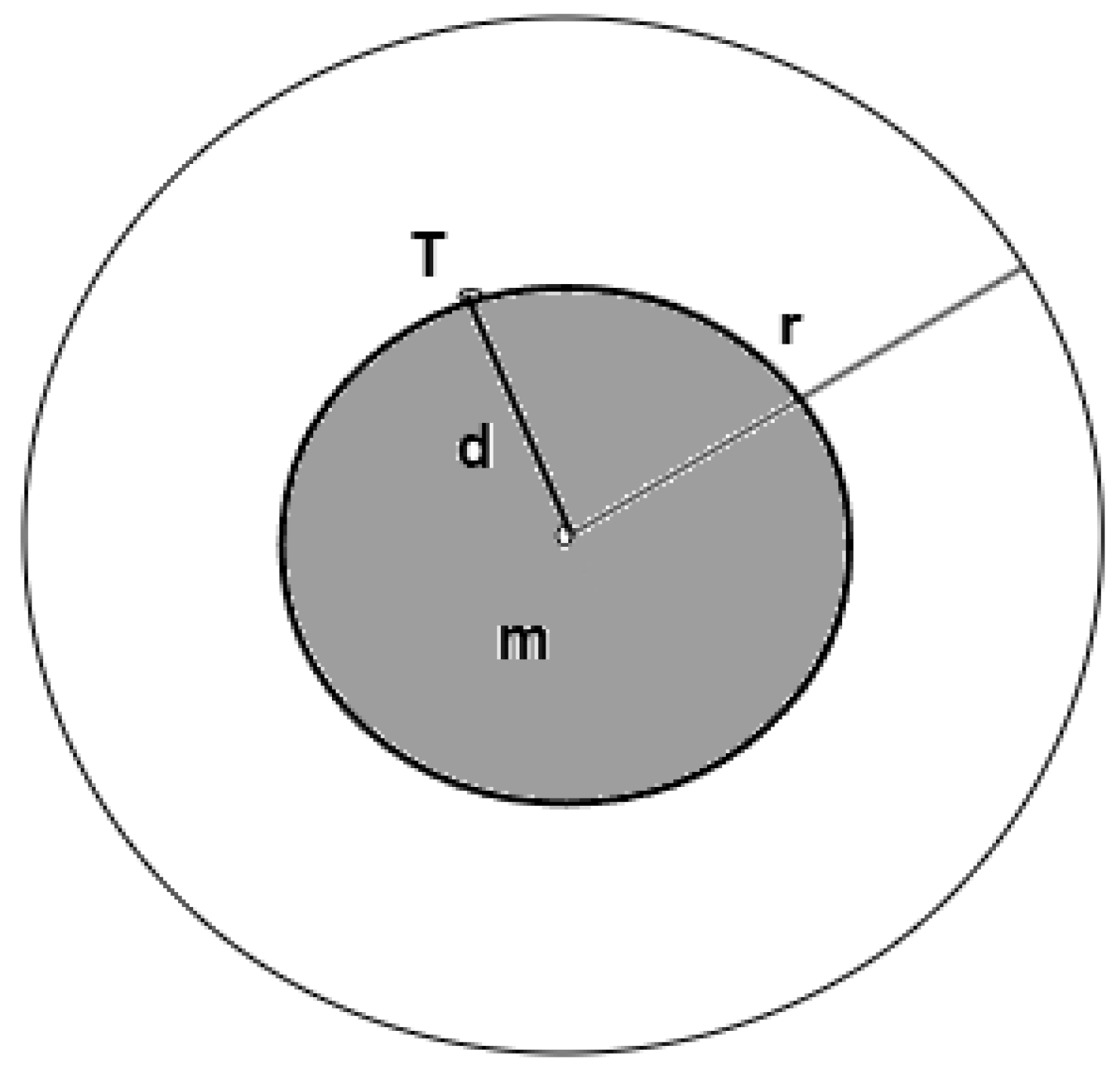
With increasing distance from the center of a given physical object, the energy density of space at a given point T increases according to Equation (8) below:
where r is the radius of the physical object, and d is the distance from its center [2]. The size of the gravity vector at point T depends on mass m, radius r, and distance from the center of the physical object. On the surface of a black hole, d is equal to r (), and the gravity vector is at its maximum and diminishes towards the center of the black hole. At the center of a black hole, the gravity vector is zero, as is the case for all stellar objects. In all stellar objects, gravity obeys Newton’s shell theorem. See Figure 2 below.
The gravity vector at point T is equal as shown in Equation (9) below:
where is the mass of the inner part of the black hole that is confined by the radius , and is the gravitational constant.
The idea that a black hole is some kind of hole in space-time is wrong. “Black hole” is a misnomer. A more appropriate term is “black star”, which means a star with an extremely high density of matter. The curvature of space has led to gravitational singularities [10] that contradict the fundamental laws of mathematics and physics. If we had only one gravitational singularity in the observable universe, the entire universe would have a gravitational singularity. It is known in mathematics and physics that an infinite quantity at a given point T of space does not decrease with distance from point T. In the centre of a black hole energy density of space is extremely low. This changes the electromagnetic properties of space and consequently, electromagnetic forces between the nucleus and electrons become unstable. Atoms fall apart into elementary particles that form in AGNs astrophysical jets [11]. Advances in cosmology require the abandonment of initial singularities [12].
We have seen in Chapter 1 that the model in which gravity is carried by the variable density of space was already proposed by Newton. In this model, we develop a four-dimensional superfluid quantum space is 4-dimensional. The excitation of the superfluid space at coordinates X1, X2, and X3 is an electric field. The excitation of the superfluid space on coordinates X2, X3, and X4 is an electric field. The photon is the excitation in the superfluid space on coordinates X1, X2, X3, and X4. The variable energy density of a superfluid quantum space carries gravity [2].
3. Gravity Vectors Are the Physical Cause of Redshift and Blueshift
Gravity vectors affect the frequency of light. Einstein predicted that when light moves in the direction of a gravity vector, it gains some energy; when light moves in the opposite direction of gravity, it loses some of its energy [13]. The gravity model presented in this paper explains Einstein’s vision in detail. Gravity vectors are the physical origin of redshift and blueshift vectors. The cosmological redshift does not exist and is a misinterpretation of gravitational redshift.
The expansion of the universe with a velocity of 72,8 km per Mps [15] is a result of the misinterpretation of the gravitational redshift. The Doppler effect in an expanding space has no solid theoretical basis and has never been measured in an expanding space. Expanding space is a working hypothesis that has never been experimentally proven [12]. If the universal space expands, this would diminish the energy density of the space, which would impact its permeability and permittivity. How the physical properties of light would change in an expanding space has not been studied and never observed. The idea that the expansion of universal space causes the Dopler effect of light is unfalsifiable. The interpretation of gravitational redshift as the Doppler effect caused by expanding space is methodologically unacceptable.
4. Hypothetical Expansion of Universal Space Can Be Measured on the Earth’s Surface
Today, precise measurements of distances measure 113 km on one nanometre (1nm) precisely [16]. This precision allows us to measure universal space expansion directly and accurately on Earth’s surface. The method of measuring the redshift of distant galaxies and calculating out of these data the expansion is indirect. We can measure universal space expansion directly by measuring the daily increase of distance between two points on the Earth’s surface. It is clear that at bigger distances the expansion of space is bigger and at smaller distances expansion is smaller, but it exists. If universal space expands this means that also distances on Earth are expanding. The only question is if these small dilations are measurable. At a distance of 113 km, the velocity of space expansion is 2.665975305E-13 m/s. In one year, this yields 0.0000084132 m. The distance of 0.0000084132 m is 8413 nm. If the universe expands at the declared rate of 72,8 km per Mps [15], the distance of 113 km will increase by 23 nm per day.
5. Conclusions
There is a major phenomenological difference between the curvature and variable energy density of space. NASA confirms that the universal space has a Euclidean shape, the curvature of the space has never been measured, and the bending of light is the result of the variable energy density of the superfluid space. The curvature of space is a purely mathematical concept, and the variable energy density of the superfluid space is an extension of the mass-energy equivalence principle in universal space.
There is a major phenomenological difference between the cosmological redshift and gravitational redshift. The gravitational redshift is theoretically well-described and directly observed. Cosmological redshift has no underlying theoretical description and has borrowed experimental results from the gravitational redshift. To progress cosmology, this should be understood, acknowledged, and accepted.
References
- Najeh Rekik, Bachir Ouari, Einstein’s spacetime curvature and gravitational waves: Elucidating the gradient flow of scalar invariants, variations in the Ricci scalar, and gravitational wave propagation, Chaos, Solitons & Fractals, Volume 189, Part 1, December 2024, 115707. [CrossRef]
- Šorli, A.S. & Čelan Š., Time-Invariant Superfluid Quantum Space as the Unified Field Theory, Reports in Advances of Physical Sciences, 4 (2020), no. 3, 2050007. [CrossRef]
- Fiscaletti, D., Sorli, A. Perspectives of the Numerical Order of Material Changes in Timeless Approaches in Physics. Found Phys 45, 105–133 (2015). [CrossRef]
- Newton, The Third Book of Optics (1718), https://www.newtonproject.ox.ac.uk/view/texts/normalized/NATP00051.
- NASA, https://map.gsfc.nasa.gov/universe/uni_shape.html (2014).
- Sorli, N. Gorjup, R. Gorjup, Replacement of space-time with superfluid space and restoration of Newton’s dynamic ether, Rep. Adv. Phys. Sci., 7 (2023) 2350005. [CrossRef]
- Roy Maartens and Bruce A Bassett 1998 Class. Quantum Grav. 15 70, https://iopscience.iop.org/article/10.1088/0264-9381/15/3/018.
- Warren B Stannard 2018 Phys. Educ. 53 025007 https://iopscience.iop.org/article/10.1088/1361-6552/aa9d6e/meta.
- Niko Gorjup, Amrit Sorli, Vector model of gravity, Advanced Studies in Theoretical Physics, 16 (2022), no. 4, 281-289. [CrossRef]
- Penrose, R. Gravitational collapse and space-time singularities, Physical Review Letters, 14 (1965), no. 3, 57. [CrossRef]
- Amrit Srecko Sorli, Rado Gorjup, Niko Gorjup, Tomaz Makovec, Akash Saroj, Akash Ranjan, Piyush Singh, Re-examination of Penrose’s and Kerr’s singularities and the origin of protons in astrophysical jets, Advanced Studies in Theoretical Physics, Vol. 18, 2024, no. 2, 61-82.
- Sorli A., Jafari. S., Fiscaletti D., Gorjup N., Gorjup R. Makovec T., Evidence-Based Cosmology – Black holes are rejuvenating systems of the universe, Reports in Advances of Physical Sciences, 7 (2023), 2350012. https://www.worldscientific.com/doi/10.1142/S2424942423500123.
- Einstein, On the influence of gravitation on the propagation of light, in The Collected Papers of Albert Einstein. Volume 3: Writings 1909-1911 (English translation supplement), eds. M. Klein, A. J. Kox, J. Renn and R. Schulman, Translated by A. Beck (Princeton University Press, 1911), p. 485.
- Lucas Lombriser, Cosmology in Minkowski space, Classical and Quantum Gravity, Volume 40, Number 15, (2023). [CrossRef]
- Adam G. Riess et al. 2024 ApJ 977 120 https://iopscience.iop.org/article/10.3847/1538-4357/ad8c21.
- Yan-Wei Chen et al., 113 km absolute ranging with nanometer precision, (2024).
Figure 1.
Gravity vectors of superfluid space.
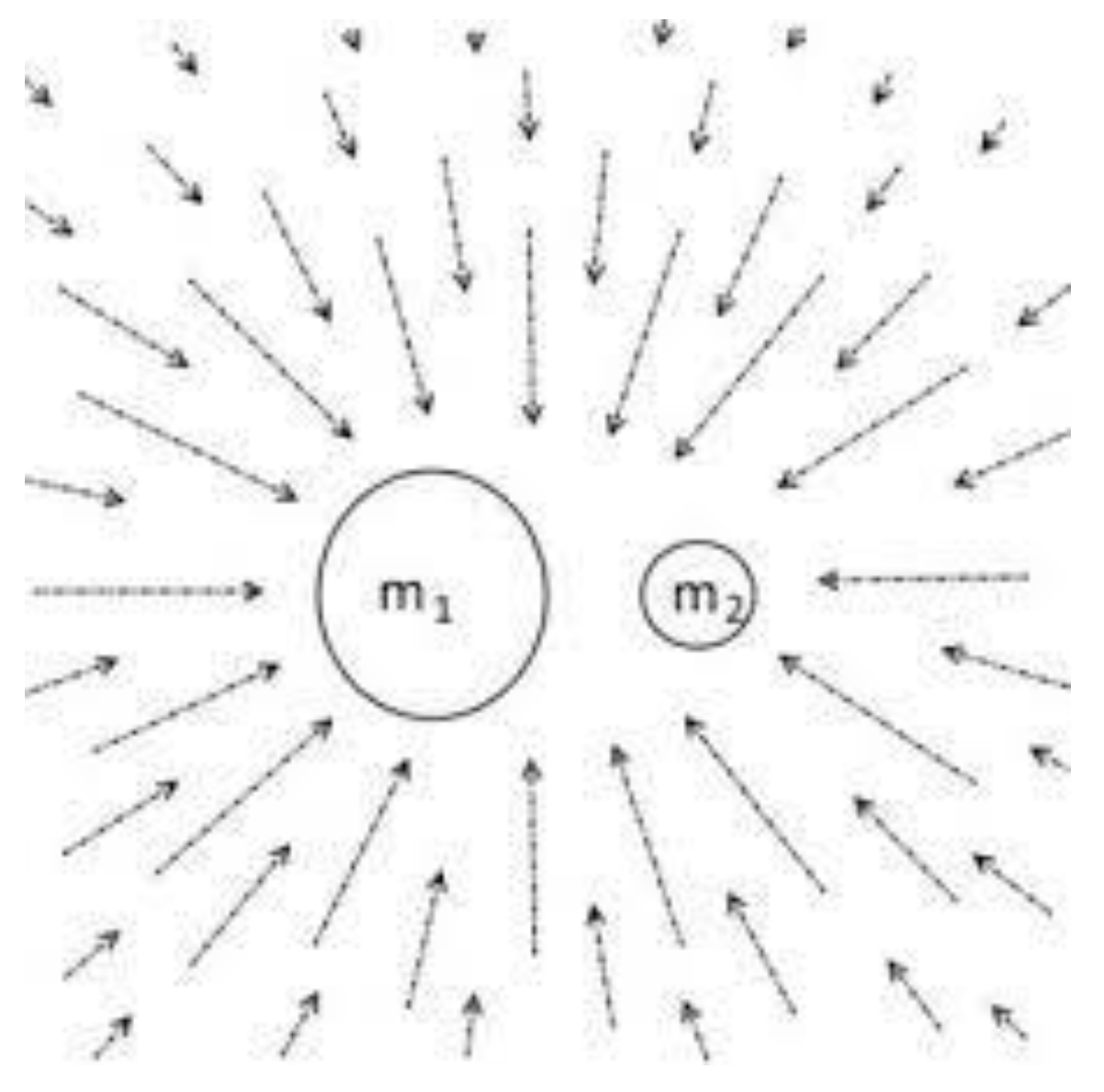
Figure 2.
Newton’s shell theorem is valid inside a black hole.
Disclaimer/Publisher’s Note: The statements, opinions and data contained in all publications are solely those of the individual author(s) and contributor(s) and not of MDPI and/or the editor(s). MDPI and/or the editor(s) disclaim responsibility for any injury to people or property resulting from any ideas, methods, instructions or products referred to in the content. |
© 2025 by the authors. Licensee MDPI, Basel, Switzerland. This article is an open access article distributed under the terms and conditions of the Creative Commons Attribution (CC BY) license (http://creativecommons.org/licenses/by/4.0/).
Copyright: This open access article is published under a Creative Commons CC BY 4.0 license, which permit the free download, distribution, and reuse, provided that the author and preprint are cited in any reuse.


