

Submitted:
15 February 2026
Posted:
18 February 2026
You are already at the latest version
Abstract
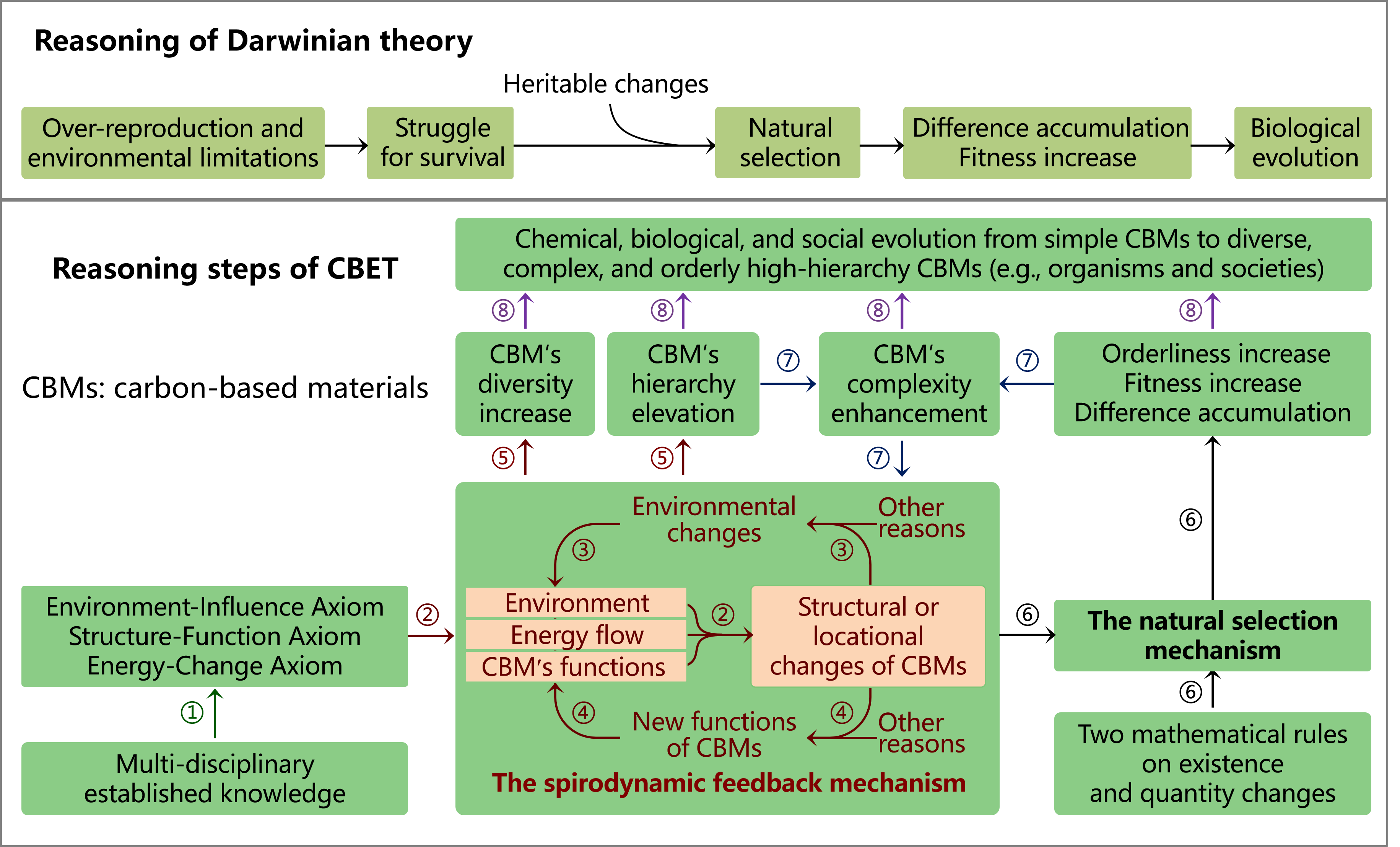
What mechanisms drive and shape the stepwise evolution from simple carbon-based materials (CBMs) to complex organisms and societies? This fundamental question remains unresolved because chemical, biological, and social evolution have often been studied in isolation. Here we propose the Carbon-Based Evolutionary Theory (CBET), which is grounded in rigorous integrative reasoning and supported by extensive empirical evidence, mathematical modeling, resilience to falsification, and cross-hierarchical explanatory power. CBET extends the natural selection mechanism from Darwinian theory and introduces the spirodynamic feedback mechanism. These dual mechanisms respectively drive and shape CBM evolution, resolving the aforementioned fundamental question for the first time and explicitly explaining the increasing orderliness in biological and social systems. Furthermore, CBET reveals the natural balances of competition versus collaboration, elimination versus inclusiveness, selfishness versus altruism, and individual versus collective interests. It thus establishes an evolutionary foundation for the social sciences and fosters the core ethics for harmonious societal development.
Keywords:
carbon-based material
; mechanism
; chemical evolution
; biological evolution
; social evolution
; natural selection
; theory
Copyright: This open access article is published under a Creative Commons CC BY 4.0 license, which permit the free download, distribution, and reuse, provided that the author and preprint are cited in any reuse.


