
Submitted:
07 June 2018
Posted:
08 June 2018
You are already at the latest version
Abstract
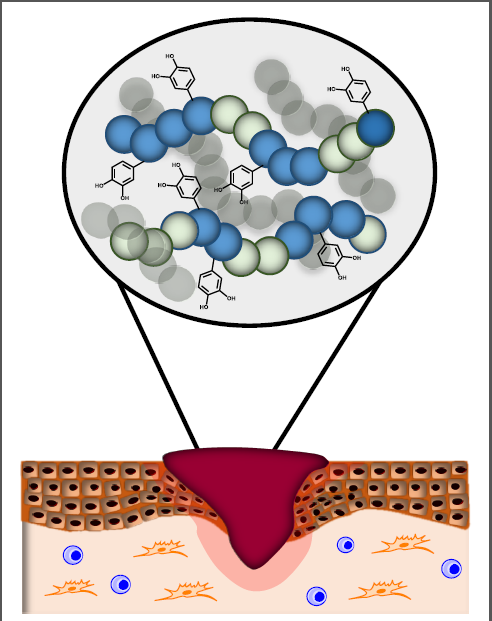
The effective treatment for chronic wounds constitute one of the most common worldwide health care problem due to the presence of high levels of proteases, free radicals and exudates in the wound, which constantly activate the inflammatory system avoiding the tissue regeneration. In this study, we describe a multifunctional bioactive and resorbable membrane with in-built antioxidant agent for the continuous quenching of free radicals as well as to control inflammatory response helping to promote the wound healing process. To reach that goal synthesized statistical copolymers of N-vinylcaprolactam (V) and 2-hydroxyethyl methacrylate (H) have been conjugated with catechol bearing hydrocaffeic acid (HCA) molecules. The natural polyphenol (catechol) is the key molecule responsible for the mechanism of adhesion of mussels, and provides the functionalized polymer conjugate a continuous antioxidant response, antiinflammatory effect, UV screen and bioadhesion in the moist environment of the human body, all of them key features in the wound healing process. Therefore, these novel mussel-inspired materials have an enormous potential of application and can act very positively, favoring and promoting the healing effect in chronic wounds.
Keywords:
wound healing
; catechol
; conjugated
; antioxidant
; antiinflammatory
; bioadhesion
; UV shielding
Copyright: This open access article is published under a Creative Commons CC BY 4.0 license, which permit the free download, distribution, and reuse, provided that the author and preprint are cited in any reuse.


