

Submitted:
26 May 2018
Posted:
28 May 2018
You are already at the latest version
Abstract
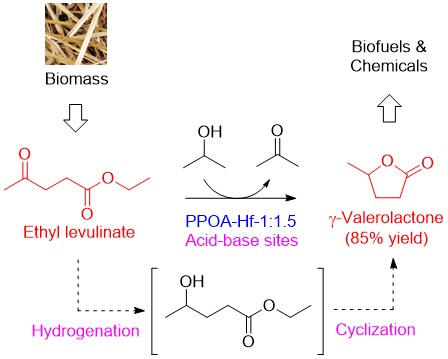
Catalytic upgrading of bio-based platform molecules is one of promising approaches for biomass valorization. However, most solid catalysts are thermally and/or chemically unstable and difficult to prepare. In this study, a stable organic phosphonate-hafnium solid catalyst (PPOA-Hf) was synthesized, and acid-base bifunctional sites were found to play a cooperative role in the cascade transfer hydrogenation and cyclization of ethyl levulinate (EL) to γ-valerolactone (GVL). Under relatively mild reaction conditions of 160 ºC for 6 h, EL was completely converted to GVL in a good yield of 85%. The apparent activation energy was calculated to be 53 kJ/mol, which was lower than other solid catalysts for the same reaction. In addition, the PPOA-Hf solid catalyst did not significantly decrease its activity after five recycles, and no evident leaching of Hf was observed, indicating its high stability and potential practical application.
Keywords:
heterogeneous catalysis
; transfer hydrogenation
; biomass conversion
; biofuels
; catalytic materials
Copyright: This open access article is published under a Creative Commons CC BY 4.0 license, which permit the free download, distribution, and reuse, provided that the author and preprint are cited in any reuse.


