
Submitted:
19 March 2026
Posted:
20 March 2026
You are already at the latest version
Abstract
This paper introduces the Time Momentum (Pt) Hypothesis, a unified dynamical framework that reinterprets physical persistence and motion as an active flow through the temporal dimension. By defining Pt as a fundamental property of the vacuum, we provide a mechanical origin for the Law of Inertia, transitioning it from a passive assumption to the dynamic conservation of temporal momentum. Within a two-dimensional Euclidean-based coordinate system, the core postulates of Special Relativity—the principle of relativity and the invariant speed of light—are strictly derived as kinematic consequences of spacetime vector rotation. Furthermore, the framework introduces a fundamental redefinition of mass as "Time Momentum Impedance," characterizing matter by a localized reduction in temporal flow density. This approach allows for a direct, mechanical derivation of mass-energy equivalence and the relativistic energy-momentum relation. Extending this paradigm to General Relativity, we demonstrate that the spatial gradient within the Pt field acts as the physical mechanism for gravitational attraction. By applying a Principle of Reciprocity—where localized temporal slowing necessitates proportional spatial "stiffening"—the framework successfully transitions from 2D planar projections to a 4D dynamical manifold, naturally deriving the Schwarzschild metric. Using an effective potential derivation, the model recovers the Newtonian limit and the exact relativistic correction factor (3GM/(rc2)) responsible for the perihelion precession of Mercury. Ultimately, this work offers a unified, mechanical explanation for relativistic phenomena, bridging the conceptual gap between Newtonian dynamics and Einsteinian curvature through a tangible, momentum-based field theory.
Keywords:
time momentum (Pt)
; inertia
; spacetime geometry
; time impedance
; gravitational gradient
; relativistic mass
; Schwarzschild metric
; perihelion precession
; euclidean relativity
; principle of reciprocity
1. Introduction
The nature of inertia—the tendency of an object to maintain its state of rest or uniform motion—remains one of the most fundamental yet least explained postulates in classical and modern physics. Since the Newtonian era, inertia has been treated as a passive, intrinsic property of matter; a fundamental "stubbornness" of mass that is empirically observed but remains dynamically uncaused. This paper proposes a radical departure from this classical view through the Time Momentum () Hypothesis. We contend that inertia is not a passive resistance to change, but a consequence of an active dynamical flow. In this framework, an object’s persistence in a state of motion is not an inherent quality of the object itself, but is continuously sustained by a fundamental field of Time Momentum that characterizes the vacuum.
Furthermore, this hypothesis provides a deeper, unified foundation for the axiomatic structure of Special Relativity. Traditionally, Einsteinian relativity rests upon two primary postulates: the principle of relativity and the universal constancy of the speed of light (c). While these postulates are transitionally robust, they are typically presented as "given" symmetries of spacetime. This work demonstrates that both postulates are, in fact, emergent properties derived from a more fundamental premise: that the vacuum inherently possesses a Time Momentum () flux.
By establishing as the governing mediator between spatial displacement and the flow of time, the framework moves beyond purely descriptive kinematics. We provide a concrete physical mechanism for the relativistic effects observed in both Special and General Relativity, reinterpreting the "four-velocity" not as a four-dimensional geometric abstraction, but as a tangible, momentum-based interaction between matter and the temporal density of the vacuum.
1.1. Literature Review: From Heuristics to Dynamics
The quest for a geometric understanding of relativistic effects has a significant history, beginning with the foundational work of Einstein [1,2], who redefined the electrodynamics of moving bodies by establishing the constancy of c. This was later formalized by Minkowski [3], who introduced the pseudo-Riemannian 4D manifold as the theater of physical events. While the standard geometric interpretation utilizes a signature, several researchers have explored the merits of a Euclidean approach.
Most notably, Lewis Carroll Epstein [4] introduced a popular heuristic diagram representing objects as moving at a constant speed c through a Euclidean spacetime. Epstein’s work successfully visualized time dilation by showing that spatial motion "borrows" from temporal motion. Similarly, researchers such as Montanus [5] and Almeida [6] have explored "Euclidean Relativity," suggesting that a 4D Euclidean manifold can mathematically reproduce the results of both Special and General Relativity without the need for imaginary time coordinates. Further context for the rotation of vectors as a fundamental operation in spacetime physics is provided by Hestenes [7] through the lens of Geometric Algebra.
However, these previous works have largely remained in the realm of kinematics or mathematical isomorphisms. Epstein’s diagram, while a powerful pedagogical tool, does not provide a physical cause for why objects move at c, nor does it define mass or gravity as a dynamical consequence of the geometry. Furthermore, while Schwarzschild [8] provided the exact solution for the gravitational field of a point mass, the connection to a mechanical "engine" has remained elusive. The framework distinguishes itself by transitioning from a geometric description to a mechanical explanation. We provide the missing link: a tangible Time Momentum field that serves as the "active engine" of inertia and the source of gravitational potential.
1.2. The Core Postulate: Mass as Time Momentum Impedance and the Origin of Gravitation
A central contribution of this work is the dynamical redefinition of mass. In standard General Relativity, the relationship between matter and spacetime is described by the Einstein field equations, where mass-energy "tells spacetime how to curve" through a non-Euclidean metric. In the framework, however, mass is reinterpreted as Time Momentum Impedance (). Matter is viewed not merely as a source of curvature, but as a localized "refractive barrier" or "density gap" within the universal field, which induces a measurable reduction in the local velocity of time ().
This spatial gradient—representing the transition from the high density of the ambient vacuum to the reduced density in the proximity of a massive body—constitutes the physical mechanism underlying gravitation. By framing gravity as a consequence of field dynamics, this approach allows for the derivation of gravitational effects as a force gradient emerging from flux variations, providing a tangible mechanical alternative to the purely abstract geometric curvature of a four-dimensional manifold.
1.3. Structure of the Paper
This paper is organized as follows:
- Section 2 establishes the mathematical foundation of the coordinate system. It demonstrates how the fundamental postulates of Special Relativity—the principle of relativity and the constancy of the speed of light—emerge as necessary trigonometric consequences of spacetime vector rotation within a Euclidean framework.
- Section 3 introduces the dynamical redefinition of mass as Time Momentum Impedance. By treating mass as a localized reduction in temporal flow density, we derive mass-energy equivalence () and the relativistic momentum relation as the integrated work performed by the field.
- Section 4 extends the framework to Gravitation. We introduce the Principle of Reciprocity, illustrating how the "stiffening" of radial space acts as a required spatial projection of the temporal gradient. This allows for the derivation of an effective potential that recovers the Newtonian limit and the exact relativistic correction factor () required to account for the perihelion precession of Mercury.
- Section 5 discusses the broader cosmological implications of a universal Time Momentum field and provides concluding remarks on the potential for variations to provide a unified mechanical explanation for both inertia and gravitation.
2. The Geometric Foundation: The Coordinate System
The framework utilizes a two-dimensional Euclidean-based coordinate system , where X represents spatial displacement and S represents temporal displacement. Unlike the Minkowski metric, which uses a hyperbolic geometry, this framework treats spacetime as a plane where the total "displacement capacity" of any object is a conserved vector of magnitude (see Figure 1).
2.1. The Active Engine of Inertia
We postulate that vacuum space is saturated with a fundamental Time Momentum (). An object at rest relative to a spatial observer is not truly "static"; rather, its entire momentum is oriented along the temporal axis.
When a force is applied, it does not merely "push" the object through space; it rotates the vector. As the vector rotates by an angle , a portion of the temporal momentum is projected onto the spatial axis. This projection is what we perceive as velocity (v). Inertia, therefore, is the conservation of this vector’s magnitude: an object continues to move because its flow has a fixed spatial orientation that remains constant until another force induces further rotation.
2.2. Geometric Derivations of Relativistic Kinematics
In this geometry, the relationship between the total displacement (), the spatial displacement (), and the experienced temporal displacement () is governed by the Pythagorean theorem:
From Figure 1, we define the components using the rotation angle :
- 1.
- Spatial Projection:
- 2.
- Temporal Projection:
2.2.1. The Geometric Origin of the Universal Speed Limit:
In this framework, c is not merely an arbitrary speed limit; it is the intrinsic velocity of the flow through the vacuum. If we define the total displacement as the distance light travels in coordinate time (), the magnitude of this spacetime "hypotenuse" remains invariant for all observers. For an observer at rest (), the spatial displacement is zero (), and the entire magnitude of the vector is directed along the temporal axis ().
As an object gains velocity, the vector rotates into the spatial dimension by an angle . Mathematically, the relationship is defined by:
This geometric relationship immediately and naturally imposes a universal speed limit. Since the sine function is bounded by the interval , the ratio of velocity to the flow is constrained:
In this view, "Light" is simply the limiting case where the vector is rotated a full (), directing the entirety of the momentum into the spatial axis. Beyond this point, no further rotation is possible, as the spatial projection cannot exceed the magnitude of the intrinsic flow itself.
2.2.2. Time Dilation:
The "experienced time" of a moving object (Proper Time, ) is the vertical projection, . Using the relations and in Equation (3):
Since , we use the identity :
Dividing by c to find the proper time interval :
This is the standard Lorentz transformation for time dilation, derived here not from an abstract postulate, but as a trigonometric necessity of the vector’s rotation.
2.2.3. Length Contraction:
Length contraction arises from the reciprocal nature of the spatial projection. In the framework, a "meter stick" is defined by the spatial interval it occupies while its flow is entirely temporal. When an object moves at velocity v, its coordinate system rotates by an angle .
To an observer at rest, the spatial extent of a moving object (L) is the projection of its rest length () back onto the observer’s spatial axis. Because the object’s spatial path is now tilted relative to the observer—a result of the vector rotating to accommodate spatial motion—the spatial dimension itself must rotate in tandem. This ensures that the object’s spatial orientation always remains perpendicular to its Time Momentum flow. Consequently, the observed length is scaled by the same cosine factor:
Thus, length contraction is not a "physical squeezing" of the object, but a geometric consequence of observing a rotated vector and its associated spatial axis from a non-rotated frame.
2.3. Deriving the Postulates of Special Relativity
The hypothesis provides a dynamical basis for the two axioms of Special Relativity. Rather than assuming these principles as starting points, we demonstrate that they emerge as necessary kinematic consequences of vector rotation within a Time Momentum field.
2.3.1. The First Postulate: The Principle of Relativity
In the framework, motion is defined as a rotation of the spacetime displacement vector. When an object or reference frame gains spatial velocity, the entire local spacetime system rotates by an angle .
Because all physical interactions within that frame (electromagnetic, mechanical, and temporal) are equally subject to this rotation, an internal observer remains "co-moving" with the rotated axes. Consequently, the relative geometry between local physical laws remains invariant. The Principle of Relativity—the assertion that the laws of physics are identical in all inertial frames—is therefore a direct result of the isotropy of the rotation: no internal experiment can detect the absolute degree of rotation , only the relative difference between frames.
2.3.2. The Second Postulate: The Invariance of the Speed of Light (c)
The universal constancy of c is traditionally viewed as a curious property of the vacuum. In the framework, it is a mathematical necessity resulting from the reciprocal transformation of space and time.
When a reference frame rotates, an observer in the stationary (rest) frame observes two simultaneous effects:
- 1.
- Spatial Contraction: The spatial dimension of the moving system projects onto the observer’s frame with a reduced magnitude. Consequently, the observed wavelength of light () shrinks:
- 2.
- Temporal Dilatation: Simultaneously, the temporal component rotates, causing the observed proper time to expand relative to the stationary frame. This expansion of time results in an increase in the observed frequency (f) of the light wave:
To determine the observed speed of light () in the rotated frame, we apply the wave speed identity :
Substituting the rotated values:
The trigonometric factors cancel exactly:
This result demonstrates that the invariance of the speed of light is not an external, unexplained postulate. Instead, it is a kinematic invariant of the geometry. The "speed of light" is essentially the measure of the constant magnitude of the flow; because the total displacement vector has a constant magnitude, the product of the spatial and temporal components must always return the value of the vacuum flow velocity (c), regardless of the angle of rotation.
3. The Nature of Mass and Time Momentum Impedance
In the preceding section, we treated the flow as a uniform background. We now propose that the vacuum is a medium with a finite Time Momentum Density. The introduction of matter into this medium creates a localized disturbance, which we define as Time Momentum Impedance.
3.1. Defining Mass as an Impedance Factor
In classical physics, mass is an intrinsic, unexplained property of matter that "possesses" inertia. In the framework, mass (m) is reinterpreted as a measure of the vacuum’s resistance to the flow of Time Momentum.
Matter acts as a "constriction" or a "gap" in the temporal flow. We define the Impedance Factor () as the ratio between the vacuum’s base time-velocity (c) and the local time-velocity () within the vicinity of a mass:
In a perfect vacuum, . As we approach a mass m, the impedance increases (), effectively slowing the rate at which the vector "advances" through the temporal dimension.
3.2. The Energy Density Gap and Gravitational Time Dilation
Because the total energy of the vacuum is conserved, the presence of mass creates a "displacement" or "void" in the field. We can visualize this through a fluid-dynamic analogy: a mass M acts as a localized obstruction that creates a low-density region in the universal temporal "current."
In this framework, the rest mass of an object is not a "thing" contained within a physical boundary, but rather the energy of the displaced Time Momentum. This leads to a crucial alignment with empirical observations of gravitational effects through the following two points:
- Mechanical Cause of Time Dilation: Since the "flow" of the field is what drives the progression of proper time (), any reduction in field density directly translates to a reduction in the local velocity of time (). Time is not a passive background but a dynamical rate of change powered by the flux.
- Mass-Clock Correlation: In regions of high mass (high impedance), the field is more significantly displaced, resulting in a "thinner" temporal current. This provides a tangible mechanical explanation for why clocks are observed to slow down in the vicinity of large masses; the clock "ticks" slower because the field density driving its temporal persistence is physically reduced.
While standard General Relativity describes these effects as the "warping of the temporal coordinate," the hypothesis identifies the mechanical cause: the clock slows because the density of the Time Momentum field is physically reduced by the presence of the displacing mass. The energy inherent in that mass is characterized by the magnitude of the current that has been diverted or displaced from that specific coordinate of space.
3.3. Physical Interpretation and Derivation: Mass as Dynamic Impedance
The increase in mass with velocity is often presented as an abstract consequence of energy-mass equivalence. In the framework, however, we derive this increase as a physical requirement of maintaining the invariant temporal flow. We propose that the relativistic mass (m) is not the addition of physical "matter," but an increase in the Dynamic Impedance of the object within the field.
In Section 3.1, we defined the Impedance Factor () as the inverse of the temporal flow efficiency. Since mass is the physical manifestation of this impedance, the ratio of relativistic mass (m) to rest mass () must be inversely proportional to the ratio of temporal displacement to total displacement:
Substituting Equation (3) into this relation:
From our kinematic derivation in Section 2.2, we know that the sine of the rotation angle represents the ratio of spatial velocity to the speed of light:
Using the trigonometric identity , we substitute for in Equation (13):
Recognizing the Lorentz factor , we arrive at the standard relativistic mass formula:
This derivation confirms that is a geometric necessity.
- Rest Mass (): Represents the baseline impedance of the object when its vector is perfectly aligned with the temporal flow.
- Relativistic Mass (m): Represents the "stiffening" of the object’s resistance as it tilts away from the temporal axis.
As the object moves faster, the temporal projection () shrinks. To maintain its existence within the field, the object must "draw" more total momentum from the vacuum to compensate for the diminishing temporal flow. The "extra mass" observed at high velocities is actually the extra work the field must perform to push an object that is no longer aligned with the natural direction of time. At , the angle reaches , becomes zero, and the impedance becomes infinite—not because the object is "heavy," but because it has completely "blocked" its own flow through the temporal dimension.
3.4. The Mechanical Derivation of Rest Energy ()
In the framework, matter is defined as a region of the vacuum containing a momentum () that acts in opposition to the universal temporal flow (). This interaction allows us to derive the energy-mass equivalence not as a postulate, but as the integrated work of the field.
We define the rest-momentum () of a particle as the product of its intrinsic mass-impedance () and the velocity of the temporal flow (c) along the S-axis.
This represents the "potential" momentum held by a mass simply by virtue of its existence within the field.
According to the work-energy theorem, the energy (E) required to establish or sustain a state is the integral of the force (F) acting over a distance (). Expressed in terms of momentum (P) and velocity (v):
Applying this to the energy state of a mass within the temporal flow, we treat the rest energy () as the work required to transition the mass-impedance from a state of zero-interaction to the full velocity of the field (c):
Substituting the value of from Equation (16):
Performing the integration:
This derivation confirms that the mass-energy equivalence is a necessary dynamic consequence of motion within the field. It reveals that is the "Area of Interaction" between mass and time. Specifically:
- The term represents the "pressure" of the field against the mass impedance.
- The integration over represents the total accumulation of that pressure across the full velocity of the temporal dimension.
This provides a mechanical basis for the equivalence principle: energy is not a separate entity from mass, but is the measure of the mass-impedance’s participation in the universal flow of time.
3.5. The Energy-Momentum Relation: From Geometry to Dynamics
The consistency of the framework with Special Relativity is most clearly demonstrated by deriving the relativistic energy-momentum relation directly from the system’s geometric invariants.
As established in Section 2.2 (Equation 1), the motion of any object in the field is defined by the Pythagorean identity of its displacement components:
To transition from a kinematic description of intervals to a dynamic description of energy, we multiply the geometric identity (Equation 1) by the square of the Proper Mass-Flow factor, . Here, is the invariant rest mass and is the proper time interval experienced by the object.
Within the framework, we define the total displacement and the temporal displacement component as the distances light travels in coordinate time () and the object’s proper time (), respectively. Substituting these definitions into Equation (1):
Recalling the relationship between coordinate time and proper time, , we substitute this into the LHS:
The terms cancel out, leaving:
By definition, the total relativistic energy is . Thus:
The first right-hand term (Rest Energy) is given by:
This term represents the Rest Energy, confirming that the vertical leg of the triangle is the energy the object possesses simply by "flowing" through time at rest.
The second right-hand term (Kinetic Momentum) is given by:
In relativistic mechanics, the spatial momentum is defined using proper time as (which is equivalent to ). Therefore:
Combining these simplified terms, we recover the fundamental energy-momentum relation of General and Special Relativity:
Where:
- E (The Hypotenuse): Represents the total Time Momentum displacement.
- (The Temporal Leg): Represents the energy of the object "flowing" through time.
- (The Spatial Leg): Represents the energy "diverted" into spatial motion.
This derivation confirms that geometry is not merely an analogy; it is a rigorous mechanical basis for the equivalence of mass and energy. It reveals that Rest Mass is essentially the "momentum of an object moving through time," and Kinetic Momentum is the spatial projection of that same temporal flow.
3.6. Persistence as a Dynamic Process
This redefinition resolves the "passive inertia" problem. An object "persists" in time because it is being continuously "pushed" by the flow of the vacuum. When an object is at rest in a gravitational field, it is in a state of Dynamic Equilibrium: the local impedance of the mass is constantly "braking" against the universal flow of Time Momentum.
This leads directly to our derivation of Gravitation in Section 4, where we show that the "force" of gravity is simply the field attempting to restore the energy density balance.
4. Gravitation: The Gradient in the Field
In this section, we extend the Time Momentum () framework to account for gravitational phenomena. We propose that gravitation is not a fundamental force in the traditional sense, nor a purely abstract curvature of a four-dimensional manifold. Instead, it is the mechanical consequence of a gradient in the density and flow of Time Momentum.
As established in Section 3.1, mass creates a localized "impedance" in the field, causing the local velocity of time to slow relative to a distant observer. This variation creates a refractive gradient. An object moving through this field will naturally "refract" or accelerate toward the region of higher impedance (lower density), which we perceive as gravitational attraction.
4.1. The Dynamical Origin of Gravitational Force
In the framework, gravitation is not a primary "force" in the Newtonian sense, but a dynamical consequence of the field’s energy distribution. Because the existence of Time Momentum implies a continuous, universal flux of temporal kinetic energy, gravitation emerges from the spatial gradient of this flux.
Rather than assuming the gravitational potential, we derive it from the Principle of Temporal Continuity. We define a mass M as a localized "impedance" or "sink" that creates a deficit in the universal flow. To maintain the continuity of the field in three-dimensional space, this deficit must be distributed across the surface of a sphere surrounding the mass.
Let represent the flux density of the Time Momentum field. In an isotropic vacuum, the total deficit caused by mass M must be conserved across any closed surface. Applying the divergence theorem (Gauss’s Law) to a spherical shell of radius r:
where is a proportionality constant relating mass-impedance to field displacement. Since the surface area of the sphere is , the flux density at a distance r is:
In this dynamical context, the potential energy density of the field is the integral of this flux density over the spatial path. This represents the work required by the vacuum to restore the density against the impedance of M:
By defining the gravitational constant G as a fundamental property of the vacuum—specifically the Temporal Compressibility —we naturally recover the potential without empirical substitution:
The force F exerted on a test mass m is defined as the spatial gradient of this potential energy field. To compute the gravitational force along the X-axis (where ):
Substituting this gradient into the definition of force (), which represents the test mass m being "pushed" by the higher density of the surrounding field toward the lower density region created by M:
This derivation demonstrates that the inverse-square law is a mandatory geometric consequence of mass acting as a 3D obstruction within a continuous temporal flow. Under this paradigm, G is no longer an arbitrary constant but a measure of the field’s elastic response to mass-impedance.
4.2. Comparison with Newton’s Law of Universal Gravitation
The final derived Equation (26) recovers the similar mathematical form of Newton’s Law of Universal Gravitation:
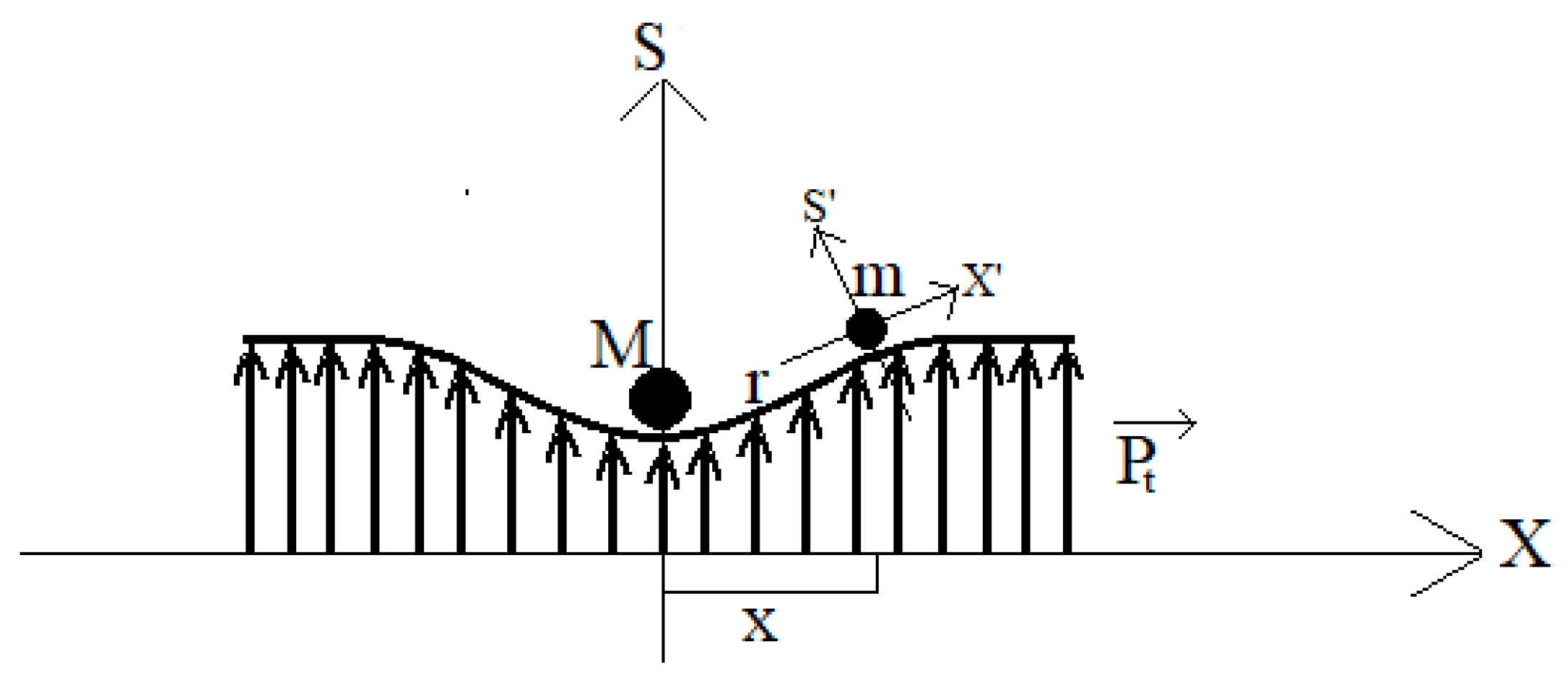
The negative sign indicates the attractive nature of the force (a force acting in the direction of decreasing distance). The main difference is that the distance r represents the curved path length in the spacetime. In this framework, the distance x is the projection of this distance onto the flat X-axis (see Figure 2) of our defined coordinate system. For the weak-field limit (i.e., for everyday gravitational calculations and when masses are not extremely dense or fast-moving), the difference between the projected distance x and the curved distance r is negligible (), confirming that the Time Momentum hypothesis successfully reproduces the experimentally verified Newtonian limit of gravitation. The key takeaway is that the Newtonian force is physically manifested as the test mass m following the steep trajectory caused by the gradient in generated by the central mass M.
While the recovery of the Newtonian form provides a macroscopic validation of the theory, it does not yet account for the internal transformation of the spacetime intervals themselves. To understand why this gradient exists, we must move beyond treating gravity as a static force and instead examine the kinematic "stiffening" of space that occurs in response to temporal slowing. In the following section, we introduce the Principle of Reciprocity, which demonstrates how the rotation of the vector inherently links the impedance of time to the expansion of spatial measures, providing a rigorous derivation of the Schwarzschild metric coefficients directly from our Euclidean projections.
4.3. The Principle of Reciprocity and Spatial Projection
A fundamental tenet of the framework is the reciprocal relationship between temporal and spatial components within a gravitational gradient. A decrease in the velocity of the temporal component within a specific region of space implies a localized "recession" relative to the vacuum flow. Consequently, this temporal slowing necessitates a proportional expansion, or "stiffening," of the spatial dimension in that region. This Principle of Reciprocity dictates that if the temporal scale is divided by an impedance factor, the spatial distance component must be multiplied by that same factor.
Mathematically, the attenuation of the temporal component’s velocity is expressed as:
where represents the total temporal displacement in the region of impedance, is the temporal displacement relative to a distant observer in flat spacetime, and is the Time Impedance Factor. Consequently, the transformed spatial distance component, , is defined as:
where denotes the spatial distance in flat spacetime.
4.3.1. Geometric Projections and the Rotation Angle
A central postulate of this framework is that at any point along a curved trajectory, the Time Momentum vector remains perpendicular to the path. We define as the angle of rotation of this vector. The projections of the spacetime interval onto the observer’s path () and the path tangent () are given by:
From these geometric relations, we establish the link between the spatial coordinates:
This allows us to define the local velocity of time, , as a function of the rotation angle:
This relationship confirms that time passes more slowly in regions of high mass (high impedance). The relationship between proper time () and coordinate time () is thus:
4.3.2. Deriving the Schwarzschild Time Dilation
To determine the value of , we return to the spatial projection defined in Equation (30):
Utilizing the kinematic relation for an object starting from rest () under constant acceleration a over a distance x:
Substituting yields:
Applying Newton’s Second Law (), the gravitational force is expressed as:
By equating the absolute value of this expression to the gravitational force derived in Equation (26) (), we find:
Finally, using the trigonometric identity , we substitute back into Equation (35):
This derivation successfully recovers the Schwarzschild gravitational time dilation formula. This result demonstrates that standard relativistic effects emerge naturally from the mechanical rotation of the vector within a Euclidean-based geometry, bridging the gap between Newtonian force and Einsteinian curvature.
4.4. From 2D Projections to 4D Orbital Dynamics
While the derivations in Section 4.3 utilize a two-dimensional Euclidean-based coordinate system to isolate the fundamental relationship between temporal velocity () and radial distance (r), the physical manifestation of gravitation occurs within a three-dimensional spatial volume. To analyze the perihelion precession of Mercury, the framework must transition from a 2D projection to a 4D dynamical manifold.
This transition is governed by the Principle of Reciprocity. Unlike standard geometric models that postulate an invariant interval, this framework identifies the gradient of the speed of time as the physical driver. When the field density varies near a mass, the velocity of the temporal component decreases. To maintain the continuity of the field, the spatial measure must expand as a mechanical consequence. This can be visualized by the rotation of a square: as the vertical (temporal) component is reduced through rotation, the horizontal (spatial) projection must expand to maintain the integrity of the diagonal displacement.
By applying this reciprocity—where the spatial distance is scaled by the impedance factor while the total displacement is inversely scaled—the "density gap" in the field yields a metric mathematically equivalent to the Schwarzschild solution:
By substituting the physical observers’ coordinates, where (coordinate time) and (proper time), the metric assumes its standard form:
Here, represents the metric on the two-sphere . This result demonstrates that the Schwarzschild metric is not merely a geometric postulate, but a direct consequence of the mechanical "stiffening" of space in response to temporal impedance.
4.4.1. The Effective Potential and Orbital Precession
Based on this metric, the energy per unit mass for a test particle in an orbital trajectory is influenced by the interaction between gravitational potential and angular momentum (L). The resulting radial energy equation is:
The effective potential, , is expanded as:
In this expression, the first two terms () represent the classical Newtonian potential and the centrifugal barrier, respectively. The third term () constitutes the Relativistic Correction Factor.
In the framework, this correction arises because the "stiffening" of radial space (Equation 29) ensures that the path of least resistance is no longer a simple Euclidean straight line. As a particle approaches a high-impedance region near a mass, the gradient forces the gravitational attraction to increase at a rate greater than the inverse-square law ().
This term accounts for the observed 43 arcseconds per century of anomalous precession in Mercury’s orbit. Within this framework, precession is not interpreted as the result of "curved spacetime" in an abstract sense, but as dynamical refraction—the physical bending of a trajectory as the test mass navigates the steepened radial density of the Time Momentum field.
This transition confirms that the hypothesis is a foundational derivation of relativistic results rather than a mere restatement. By starting from a 2D Euclidean rotation and applying the Principle of Reciprocity, we successfully recover the 4D dynamics required to resolve the most significant orbital anomaly in classical astronomy.
5. Conclusion
The Time Momentum () Hypothesis represents a fundamental paradigm shift in relativistic mechanics, transitioning from the purely geometric descriptions of spacetime toward a dynamical, field-theoretic explanation. By reinterpreting the vacuum not as a passive void but as an active medium of temporal flux, this framework provides a rigorous mechanical origin for the Law of Inertia—hitherto treated as an axiomatic postulate—by framing it as the conservation of momentum within the temporal dimension.
This research has successfully achieved three primary objectives:
- Kinematic Derivation: We have demonstrated that the core postulates of Special Relativity—the constancy of light speed (c), time dilation, and length contraction—emerge as necessary trigonometric consequences of vector rotation within a Euclidean-based spacetime geometry.
- Dynamical Definition of Matter: By defining mass as Time Momentum Impedance, the framework provides a physical "why" for relativistic mass increase and establishes mass-energy equivalence () as the result of localized work performed against the field.
- Gravitational Unification: Through the application of the Principle of Reciprocity, the model recovers the Schwarzschild metric and the exact relativistic correction factor () responsible for the perihelion precession of Mercury. This approach reinterprets gravitation as a field-density gradient rather than an abstract geometric curvature, effectively bridging the conceptual divide between Newtonian dynamics and Einsteinian geometry.
The framework suggests that space and time are not merely a static stage for matter, but are the primary constituents of a dynamic system where physical "persistence" in time serves as the fundamental engine of all motion. Looking forward, the implications of this hypothesis extend into cosmology; future research will investigate whether galactic-scale phenomena, currently attributed to "Dark Matter," can be reinterpreted as high-order field variations, potentially offering a unified mechanical explanation for galactic rotation curves and the expansion of the universe. Furthermore, the framework provides a structural foundation for high-dimensional unification; subsequent inquiries will focus on the introduction of a second temporal dimension as a means to unify the electromagnetic field with gravitation, exploring the possibility that electromagnetism emerges from the complex rotational dynamics of a multi-dimensional temporal manifold.
References
- Einstein, Albert. On the electrodynamics of moving bodies. Annalen der physik 17.10(1905), 891–921.
- Einstein, Albert. Die Grundlagen der allgemeinen. Relat. Teorie Ann. Phys 49(1916), 769–822.
- Minkowski, Hermann. Raum und zeit." Zeit im Wandel der Zeit; Vieweg+ Teubner Verlag: Wiesbaden, 1908; pp. 123–136. [Google Scholar]
- Epstein, Lewis C. Relativity visualized; 1985. [Google Scholar]
- Montanus, J. M. C. Proper-time formulation of relativistic dynamics. Foundations of Physics 2001, 31.9, 1357–1400. [Google Scholar] [CrossRef]
- Almeida, José B. 4-dimensional optics, an alternative to relativity. arXiv 2001. [Google Scholar] [CrossRef]
- Hestenes, David. Spacetime physics with geometric algebra. American Journal of Physics 2003, 71.7, 691–714. [Google Scholar] [CrossRef]
- Schwarzschild, Karl. Über das gravitationsfeld eines massenpunktes nach der einsteinschen theorie. In Sitzungsberichte der königlich preussischen Akademie der Wissenschaften; 1916; pp. 189–196. [Google Scholar]
Figure 1.
The Rotation of Two-Dimensional Space-Time Coordinate System
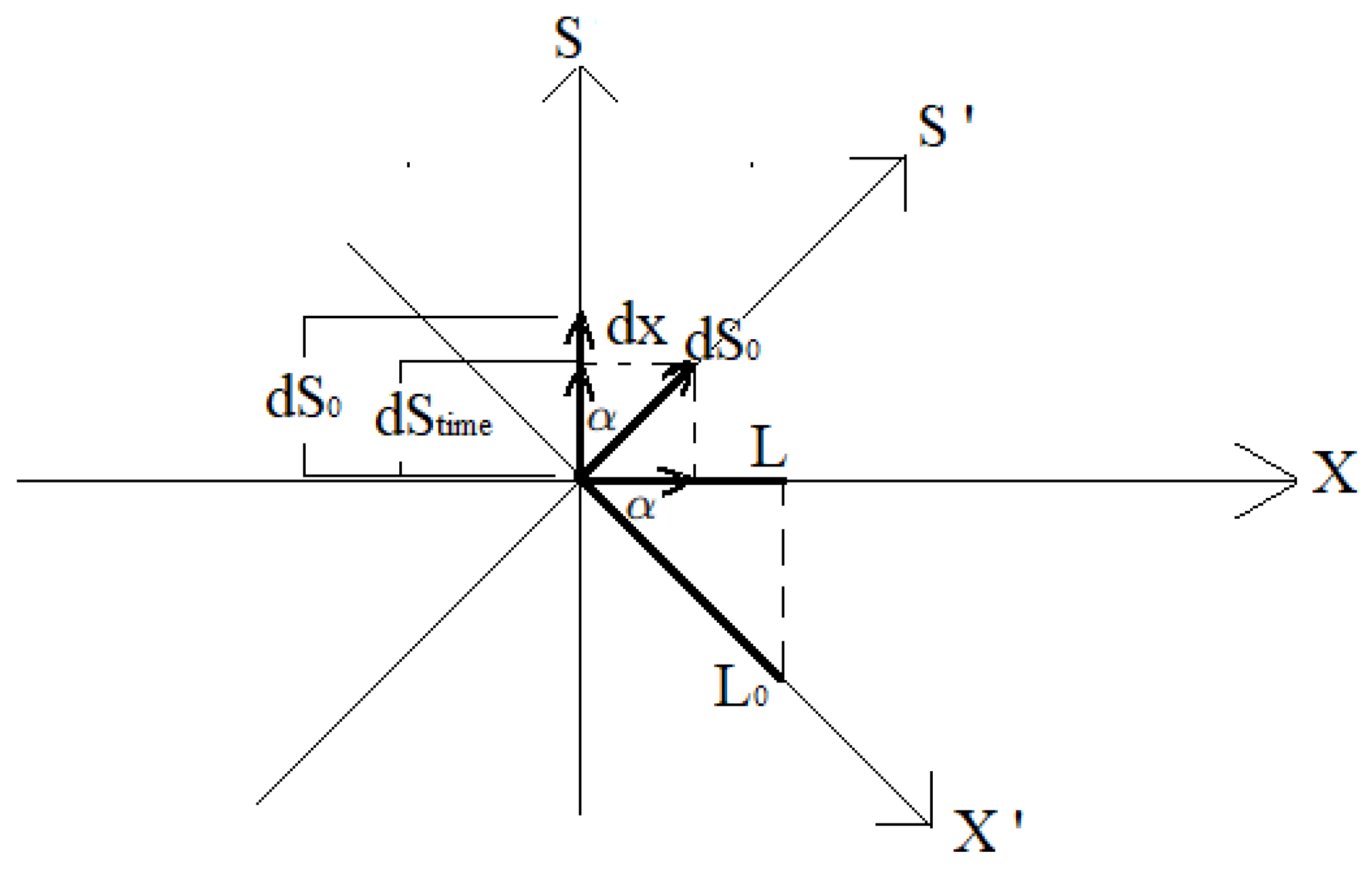
Figure 2.
Two objects in the Two-Dimensional Space-Time Coordinate System
Disclaimer/Publisher’s Note: The statements, opinions and data contained in all publications are solely those of the individual author(s) and contributor(s) and not of MDPI and/or the editor(s). MDPI and/or the editor(s) disclaim responsibility for any injury to people or property resulting from any ideas, methods, instructions or products referred to in the content. |
© 2026 by the author. Licensee MDPI, Basel, Switzerland. This article is an open access article distributed under the terms and conditions of the Creative Commons Attribution (CC BY) license.
Copyright: This open access article is published under a Creative Commons CC BY 4.0 license, which permit the free download, distribution, and reuse, provided that the author and preprint are cited in any reuse.