
Submitted:
17 March 2026
Posted:
18 March 2026
You are already at the latest version
Abstract
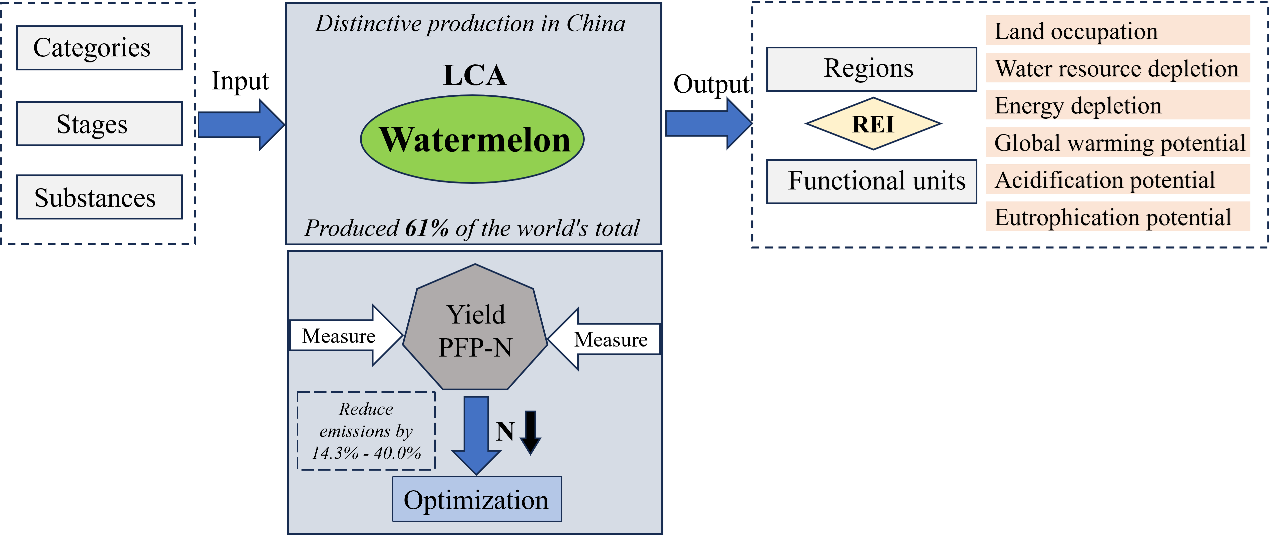
The global consumption of resources and environmental problems are becoming increasingly serious. China produces 61.0% of the world's watermelons, yet no comprehensive assessment of the resource consumption and environmental effects of China's watermelon production system has been reported. This study applies life cycle assessment (LCA), combining farmer surveys with field experiments, to systematically evaluate and verify the reduction potential of land occupation (LO), water depletion (WD), energy depletion (ED), global warming potential (GHG), acidification potential (AP), and eutrophication potential (EP), as well as the resource budget and environmental impact index (REI), in north China (NC), northwest China (NW), and southwest China (SW). The results reveal significant differences in resource consumption and environmental effects. The NC region was found to achieve the highest yield, 146% and 174% greater than the two other regions, but also to exhibit the highest resource use and emissions per unit area, with the lowest REI. By contrast, the SW region was found to achieve the most favorable performance in resource consumption and environmental emissions per unit yield. During the material stage (MS), more than 86.6% of energy and water resources are consumed, while in the farm stage (FS), 47.3% to 98.7% of total pollutants are emitted. Nitrogen (N) fertilizer is identified as the main contributor to GHG, WD, and EP, with field application accounting for more than 85% of the total impact. Although REI values across the three regions remain low, yield management and improved N fertilizer efficiency (PFPN) present a reduction potential of 46.5% to 55.4%, enabling both high yield and high efficiency. Field experiments further verify that reducing N fertilizer use by 14.3% to 40.0% can lower environmental impacts, which is of great significance for promoting green watermelon production.
Keywords:
watermelon
; life cycle assessment
; resource consumption and environmental effects
; mitigation potential
; green watermelon production
Copyright: This open access article is published under a Creative Commons CC BY 4.0 license, which permit the free download, distribution, and reuse, provided that the author and preprint are cited in any reuse.


