
Submitted:
12 March 2026
Posted:
13 March 2026
You are already at the latest version
Abstract
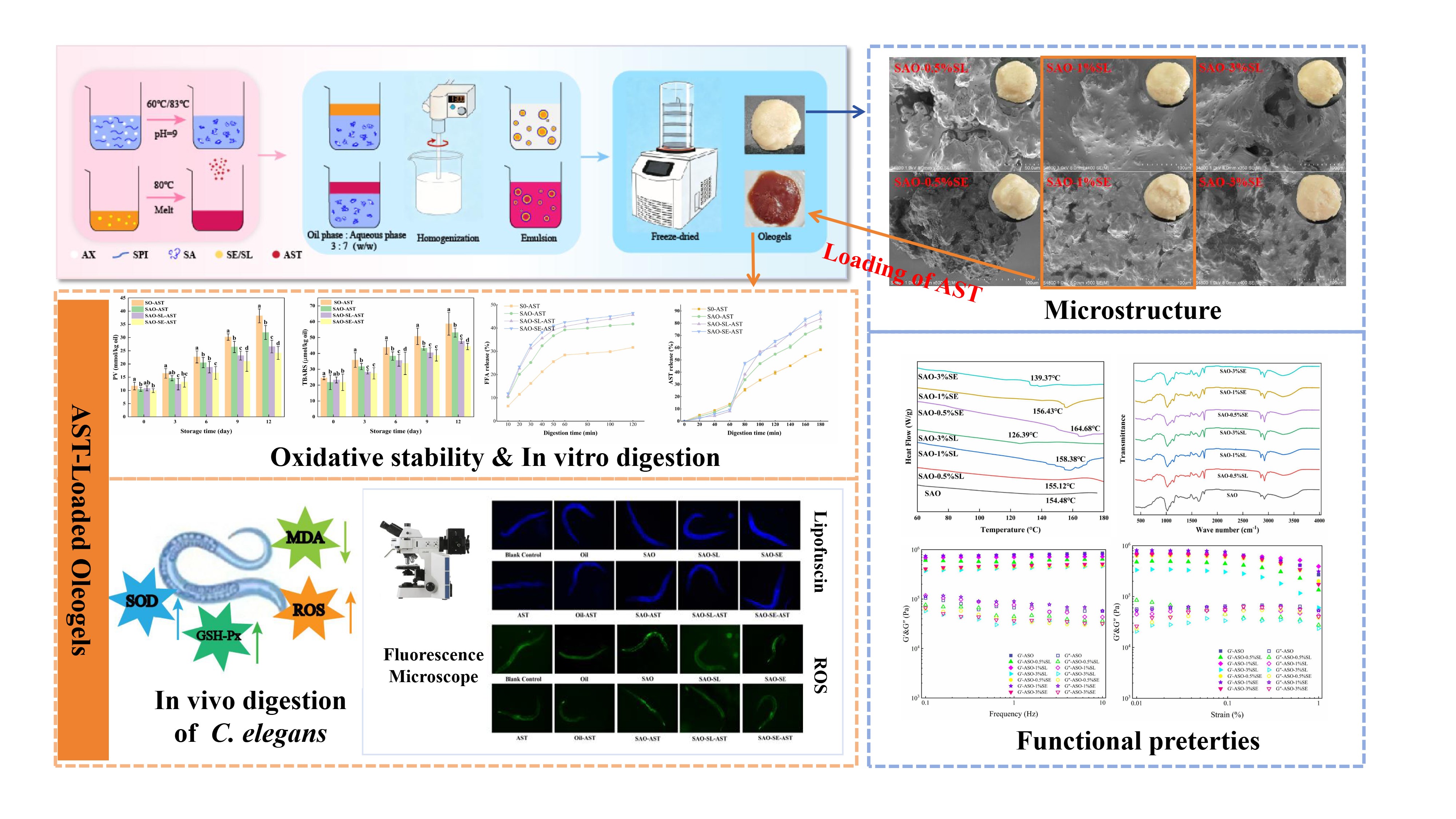
Astaxanthin (AST), despite its high bioactivity, exhibits poor stability and low bioavailability due to its strong lipophilicity and inherent degradation susceptibility. To overcome such a challenge, we developed a food-grade oleogel delivery system using a soy protein-arabinoxylan (SA) glycosylated complex modulated by different concentrations (0.5%–3%) of sucrose ester (SE) or soy lecithin. We show that the emulsifier concentration has a non-linear effect on the oleogel microstructure: an optimal level of 1% had a significant impact on the interfacial compactness and network density, giving rise to improved thermal stability, rheological strength and AST encapsulation efficiency (81.27%). During in vitro digestion, the SA matrix in combination with emulsifiers allowed gastric protection and intestinal-targeted release of AST with a bioaccessibility of up to 88.84% (SAO-SE-AST). This controlled-release profile directly translated into enhanced in vivo antioxidant efficacy in wild-type Bristol N2 Caenorhabditis elegans as evidenced by reduced lipofuscin accumulation, elevated thermotolerance (survival rate: 64.44%-73.33%), suppressed reactive oxygen species levels and activation of endogenous antioxidant enzymes (superoxide dismutase as well as glutathione peroxidase). Collectively, this research has uncovered that food-grade emulsifiers are not only stabilizers, but also key regulators of oleogel architecture and bioactive functionality. These results provide a structure-digestion-bioactivity correlation for protein-polysaccharide oleogels, representing a rational design strategy for high-performance delivery systems of lipid-soluble nutraceuticals.
Keywords:
soy protein
; arabinoxylan
; emulsifier
; astaxanthin
; oleogel
Copyright: This open access article is published under a Creative Commons CC BY 4.0 license, which permit the free download, distribution, and reuse, provided that the author and preprint are cited in any reuse.


