

Submitted:
11 March 2026
Posted:
12 March 2026
You are already at the latest version
Abstract
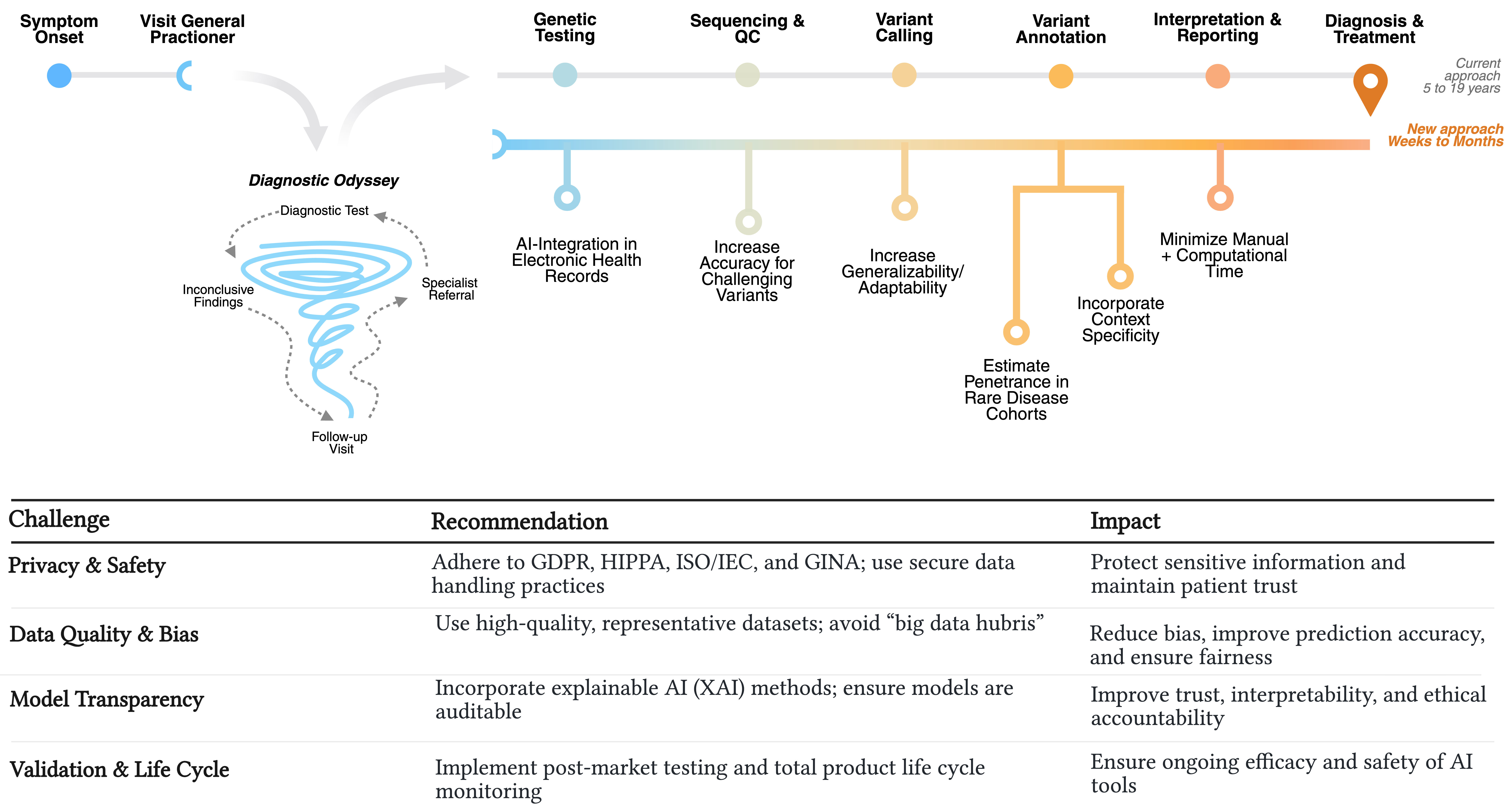
While falling costs have increased access to genomic sequencing, the impact of clinical sequencing is often hindered by the challenge of interpreting complex genetic data. The high prevalence of variants of unknown significance (VUSs) can lead to false reassurance or psychological distress, as patients and non-expert clinicians may misinterpret inconclusive results. We propose that artificial intelligence (AI) may serve as a critical clinical decision-support tool to improve the efficiency of genetic testing, especially in variant analysis. We advocate integrating AI throughout the genetic diagnostic workflow and outline current approaches to AI-assisted variant analysis to enable efficient personalized treatment. We also discuss anticipated challenges in this pursuit and offer recommendations to ensure precision, accuracy, reproducibility, and transparency.
Keywords:
variant analysis
; clinical decision support
; genomics
; explainable ai
; precision medicine
; diagnostic odyssey
Copyright: This open access article is published under a Creative Commons CC BY 4.0 license, which permit the free download, distribution, and reuse, provided that the author and preprint are cited in any reuse.


