
Submitted:
04 March 2026
Posted:
10 March 2026
You are already at the latest version
Abstract
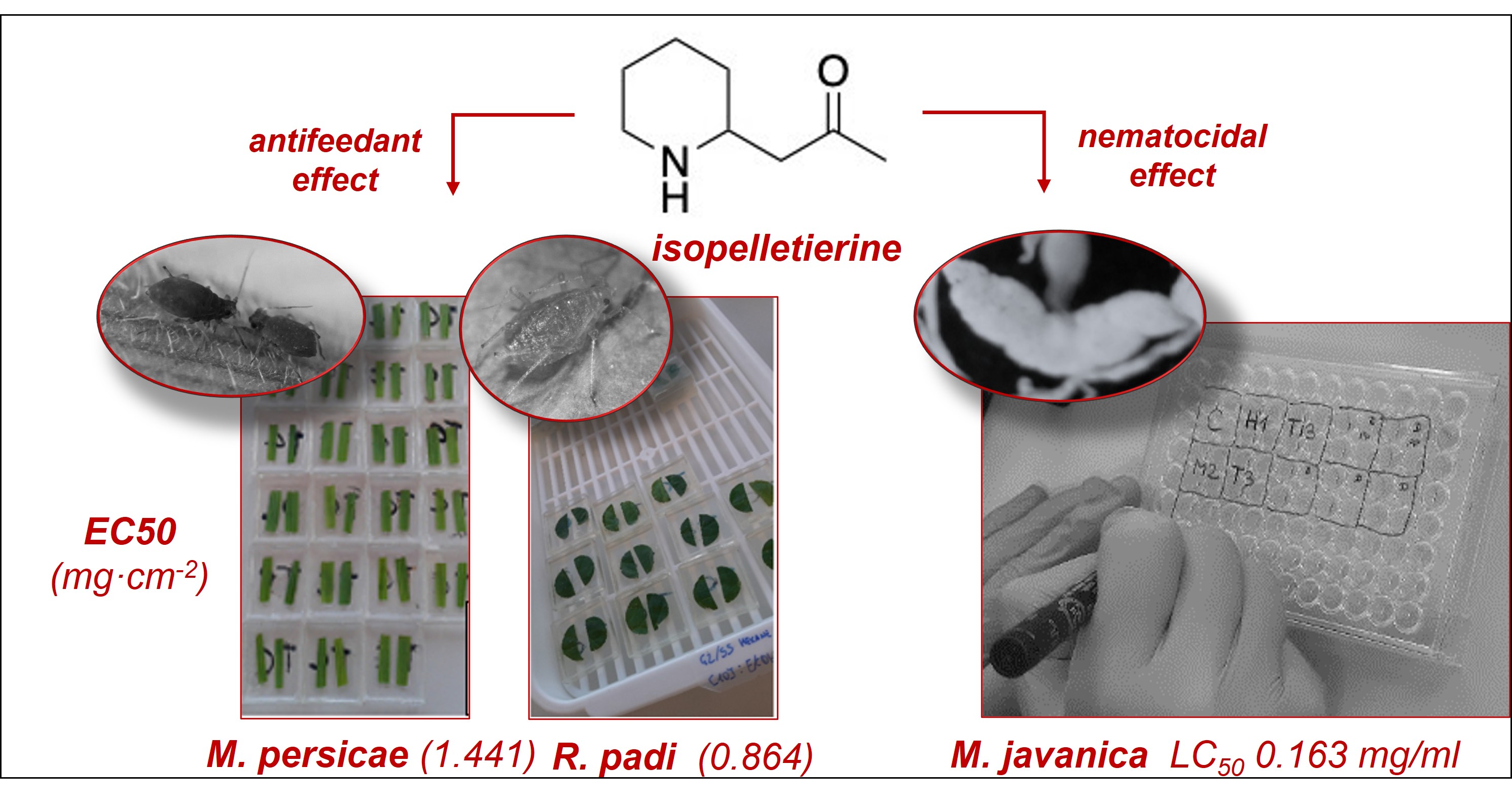
Today, interest in natural remedies for biocontrol of crop pests is paramount. Punica granatum L. (pomegranate) is studied worldwide to obtain interesting bioactive compounds. Its anti-parasitic activity is associated with the presence of alkaloids in its roots. In this work, we explored the possibility of obtaining from P. granatum roots pelletierine-like alkaloids, which were extracted, characterized, isolated and used for the biocontrol of pests such as Spodoptera littoralis, Myzus persicae, Rhopalosiphum padi and Meloidogyne javanica. Two different extracts were obtained, characterised and quantified by GC-MS and LC-ESI-HRMS. In vitro assays of nematicidal activity were performed comparing the extracts with isopelletierine and pseudopelletierine as pure molecules. The results of these assays showed a difference in activity between iso- and pseudopelletierine, especially in terms of the nematocidal effect against M. javanica with isopelletierine being more active than pseudopelletierine. This leads us to conclude that only extracts from P. granatum roots with a high concentration of isopelletierine alkaloid can be used in effective pest control products.
Keywords:
elletierine
; Punica granatum L.
; Myzus persicae
; Rhopalosiphum padi
; Meloidogyne javanica
; nematicidal activity
; antifeedant activity
Copyright: This open access article is published under a Creative Commons CC BY 4.0 license, which permit the free download, distribution, and reuse, provided that the author and preprint are cited in any reuse.


