
Submitted:
09 March 2026
Posted:
09 March 2026
You are already at the latest version
Abstract
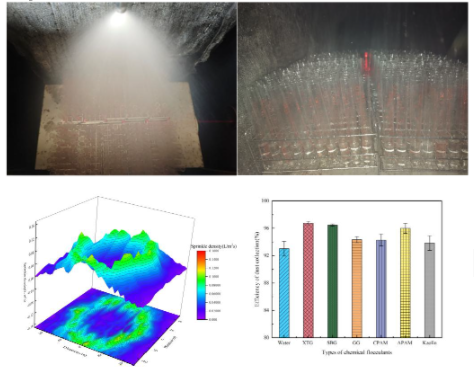
Blast furnace gas (BFG) must be deeply purified when it is as fuel for combined-cycle power generation. To improve collection efficiency of the fine particulate dust in BFG by wet electrostatic precipitators (WESPs), this study implemented measures such as optimizing nozzle atomization performance and spatial distribution of droplets, along with adding chemical agglomeration agents and surfactants, These approaches pro-moted the chemical agglomeration of fine dust and enhanced dust collection efficiency. The results show that under overlapping spray conditions, the 1/8 solid cone nozzle produced the smallest droplets size with the most uniform spatial distribution, exhib-iting a d50 of 141.17 μm. When this nozzle was used in combination with guar gum (GG) as a chemical agglomerant, the d50 of BFG dust increased from 8.46 μm to 14.75 μm. The synergistic application of 5 mg/m³ sesbania gum (SBG) and 5 mg/m³ oc-tylphenol ethoxylate (OP-10) further increased the dust d50 to 19.08 μm. Using the 1/8 solid cone nozzle and with an XTG concentration of 5 mg/m³, resulted in the highest dust collection efficiency of 96.76%, while the synergistic use of SBG/OP-10 achieved an efficiency of 97.69%. This study elucidates the influence of nozzle atomization charac-teristics and spray liquid type on dust agglomeration and collection efficiency, providing both theoretical and practical foundations for the deep purification of blast furnace gas.
Keywords:
oculomics
; retinal imaging
; systemic biomarkers
; artificial intelligence
; preventive medicine
; precision health
; neurodegeneration
; cardiovascular disease
; tear fluidomics
; healthcare integration
Copyright: This open access article is published under a Creative Commons CC BY 4.0 license, which permit the free download, distribution, and reuse, provided that the author and preprint are cited in any reuse.


