

Submitted:
06 March 2026
Posted:
09 March 2026
You are already at the latest version
Abstract
Analysis of a digitalized databank of books indicates that the topic of life’s meaning first emerged around 1800 and increased sharply in frequency during the middle of the 19th century, with take-off dates fairly similar across the six literatures we searched (American English, British English, French, German, Italian, and Spanish). We discuss major historical changes around this time that likely impacted people’s psychological approaches toward understanding their lives. Of five major needs for meaning, purpose and value were severely impacted, efficacy and self-worth found new contexts, and comprehensibility / continuity was also challenged. Important changes in society included the following. Secularization reduced the sense that the world operated under divine plan and also undermined the presumptive basis for moral values. The industrial revolution disrupted society with new kinds of goals but new problems, including changing the meaning and nature of work. Urbanization offered new life paths for many while weakening the reputational basis for morality. Cognitive changes including expanded education and literacy, thereby exposing people to new ideas. Political upheavals raised questions about how society should be organized and what the individual’s duty was. Social mobility in both directions transformed individual lives in unprecedented fashion.
Keywords:
meaning
; meaning of life
; purpose
; value
; secularization
; industrialization
; urbanization
; social mobility
1. Introduction
Finding meaning in one’s life is a positive experience. People whose lives are meaningful are generally happier than other people (e.g., Baumeister et al., 2013). Finding meaning can help people cope with stress (e.g., Taylor, 1983). Indeed, Frankl’s (1959) seminal work on meaning proposed that under adverse conditions, finding life meaningful can contribute to survival, thereby improving longevity.
We assume that the value of a meaningful life resonates deeply with the human psyche across most times and places. However, that does not mean that people have always had the same struggles that the modern individual does, to find or create it. Many writers, such as Martela (2020), have concluded that members of ancient civilizations were confident that they knew what their lives were all about. The present article seeks to understand the transition: Why did people start having problems finding the meaning of their lives?
According to Leach and Tartaglia (2018), the term “meaning of life” was first used by the German writer Johann Wolfgang von Goethe1 in a letter of 9 July 1796 to his friend Friedrich Schiller. The first time the phrase “meaning of life” appeared in an English language book was in 1833, in Thomas Carlyle’s book Sartor Resartus (Martela, 2020). Its first mention in other European languages was slightly earlier or later. Obviously, prior to that there were many books on many topics, and plenty of works of philosophy. But these did not consider the meaning of human life to be something that needed discussing. That didn’t mean people never discussed topics highly related to meaning of life before that. But the explicit problem of the meaning of life seemed to only emerge in the 19th century.
Of course, we cannot know what private conversations or private thoughts were like in bygone centuries. Nevertheless, people have long written books to address problems that were important to them (and that they assumed were also important to others, i.e., potential readers). The content of books thus offers one empirical method to track what people thought were important problems. The recent digitalization of large numbers of past and present books has provided a powerful tool for considering trends over time. The present work uses that database to examine such trends in discussion of meanings of life in Western civilization.
1.1. Needs for Meaning
Before proceeding to our data, it is useful to consider what a meaning of life is, from a psychological perspective. What sort of meanings of life do people want? Obviously people can consult the dictionary and look up “life,” which will furnish them the literal meaning of the word, but (also obviously) that is not what people want.
Nearly all sources agree that purpose is one foundational source of meaning in life. Purposes are future events or states that lend meaning to present activities, especially activities that bear on progress toward or away from those goals. Frankl’s (1959) work, which introduced the importance of a meaningful life to psychology, focused heavily on purpose.
Subsequent work by Baumeister (1991) settled on four needs for meaning. Purpose was the first. Value was another. Value means knowing what was good vs. bad, right vs. wrong, and satisfying that need requires finding a way to believe that one’s life has positive value. The third need was for efficacy, that is, the ability to do something that will make a difference by steering events toward the positively valued purposes. After all, having a purpose in one’s life may not be all that satisfying if one feels powerless to fulfill that purpose. The fourth need was for self-worth, which in practice often means finding a way to regard oneself as better than other people.
More recent treatments have emphasized comprehensibility, which is linked to coherence and continuity (George & Park, 2016; Martela & Steger, 2016). The different events of a life should fit together in some meaningful fashion, perhaps making a satisfying story. Incoherence would mean that different events in the course of a life bear little or no relation to each other. In a sense, comprehensibility encompasses all the issues of life’s meaning. (Purpose and value, for example, help one comprehend one’s life.)
George and Park (2016) also mentioned mattering (see also Goldstein, 2026). We understand mattering as a combination of efficacy and value. Mattering often boils down to making a difference, which the essence of efficacy (and usually people want to make a difference in some valued domain).
1.2. Definition of Meaning
Meaning is essentially non-physical connection (Baumeister & Landau, 2018). The meaning of a flag, for example, does not reside in its physical properties of colored cloth, but rather in its symbolic association with a particular nation or organization. Meaning is real but not physically real. Physical items (brains) represent meanings, which is why different brains can have the same thought (essential for communication).
Life, in contrast, is a physical process. A meaning of life thus links physical with nonphysical reality. In particular, meaning connects across time. Purpose, for example, connects present actions to future intended outcomes. An experience sampling study of everyday thoughts found that people rated their thoughts as more meaningful to the extent that these combined across time (Baumeister et al., 2020). The most meaningful thoughts were ones that combined past, present, and future. Happiness was maximized when thoughts focused narrowly on the present.
Thus, when people want their lives to be meaningful, they want several specific things. They want an idea (which could be a story) to integrate the major events of their lives across time, linking past, present, and future. They want this idea or schema to explain purpose, value, efficacy, and continuity, and to furnish a basis for positive value and self-worth. Apparently, the ancients had all that, but over the course of history, and especially into the 1800s, people lost some of that.
1.3. Historical Course of Discussions of Meaning
People have long written books to address problems that were important to them. The content of books thus offers one empirical method to examine what people thought were important problems. The recent digitalization of large numbers of past and present books has provided a powerful tool for considering trends over time. The present work uses that database to examine such trends in discussion of meanings of life in Western civilization.
The Google Books Ngram Viewer (GBNV) is a search engine that tracks the frequency of words across a massive corpus of digitized texts, covering millions of books in Chinese, English (with separate corpora for American and British English), French, German, Hebrew, Italian, Russian, and Spanish from 1500 to 2022 (Google Books Ngram Viewer, 2026). By comparing the frequency of specific words or phrases across time and cultures, GBNV has been used to investigate research questions in fields ranging from lexicography and history to epidemiology, economics, sociology, and political science (Michel et al., 2011). In psychology, it has been used to explore topics such as the rise of individualistic values in American books (Twenge, Campbell, & Gentile, 2012a, 2013), the association between urbanization and self-focused language in both American and British English (Greenfield, 2013), the decline of moral virtue terms in 20th-century American texts (Kesebir & Kesebir, 2012), the overall decline of religious language in English, French, and Spanish (Younes & Reips, 2019), shifts in gendered pronoun use and women’s status (Twenge, Campbell, & Gentile, 2012b), and the decline of emotional expression in 20th-century English texts (Acerbi et al., 2013). Many of these trends have been replicated across other languages, including Chinese (Hamamura & Xu, 2015; Zeng & Greenfield, 2015; Yu et al., 2016), German (Younes & Reips, 2018), and Russian (Skrebyte, Garnett, & Kendal, 2016; Velichkovsky et al., 2019). Overall, GBNV has proven to be a useful tool for psychological research on historical and cultural change (Pettit, 2016).
GBNV has also been used to examine historical trends in the concept of meaning in life, especially as it relates to well-being, often considered a foundational component of human flourishing (e.g., Ryff & Keyes, 1995; Seligman, 2012). For example, Qiu, Lu, and Chiu (2014) tracked hedonic well-being terms (e.g., pleasure, fun) versus eudaimonic well-being terms (e.g., meaning in life, purpose, fulfillment) in American books from 1800 to 2000. Strikingly, while hedonic terms declined, eudaimonic terms increased in frequency. Moreover, during periods of hardship, language shifted toward hedonic themes, while during periods of greater income and stability, people expressed more focus on meaning and purpose. Similarly, Grant (2017) analyzed the phrase “purpose in life” across French, Spanish, American English, British English, and Chinese texts, finding a broad rise in “purpose” language in recent decades.
Despite its utility, GBNV has limitations as a method in psychological research. Pettit (2016) raised four major concerns: (1) it assumes printed culture represents general culture, (2) it can conflate long-term trends with short-term events, (3) it presumes word meanings remain stable over time, and (4) researchers often use inconsistent methods to measure change. Other issues include OCR errors (Gooding, 2013) and corpus composition bias, such as the overrepresentation of prolific authors (Pechenick, Danforth, & Dodds, 2015). To improve reliability, Younes and Reips (2019) propose five guidelines: use multiple corpora and languages, cross-validate within a language, include word inflections, use related synonyms, and apply standardization procedures. Our analyses followed these practices to maximize robustness and interpretability.
2. Method
To investigate historical trends in the problematization of meaning, it is insufficient to measure only the explicit phrase “meaning of life” in books. Following the guidelines of Younes and Reips (2019), we therefore constructed lexica designed to capture the problematization of meaning more comprehensively during the modernization of Western Europe and North America. We first theorized that the problematization of meaning would be reflected in dissatisfaction with the five basic meaning needs. A postdoctoral researcher, a doctoral candidate with training in psychology, and the second author each generated an English word list that explicitly indexed concern, uncertainty, or dissatisfaction related to each need. The three researchers subsequently reconciled discrepancies and agreed on final lexica. These English lexica were then translated into French, German, Italian, and Spanish.
The same procedure was applied to construct a lexicon for secularization. Because “secularization” itself is a modern analytic label rarely used in the historical period, we instead identified terms indexing religiousness, interpreting declines in their frequency as proxies for secularization. The secularization lexicon was organized into four dimensions of religiousness: metaphysical authority (e.g., God), institutional religion (e.g., church), moral authority (e.g., sin), and experiential practices (e.g., prayer). Table 1 lists the full multilingual lexica for English. The full lexica of all languages are provided in the supplementary materials.
We queried each term in the lexicon using the Google Books Ngram Viewer across six corpora: American English, British English, French, German, Italian, and Spanish. Because the corpora are language-based rather than nation-based (especially for Spanish), we interpret these trends as shifts in major language communities, while using national histories as the most relevant context for those print cultures. Data collection was implemented in Python 3.13.12; the full code is provided in the supplementary materials.
The output consists of annual relative frequencies for each term across all books indexed by Google Books in the corresponding language. Because absolute frequencies varied substantially across terms (e.g., God appeared far more frequently than prayer), we standardized each term’s time series across years following the recommendations of Younes and Reips (2019). Specifically, term frequencies were transformed into within-term standardized scores (z-scores), allowing comparability across lexicon items. Standardized frequencies of terms referring explicitly to “meaning of life”, dissatisfaction or uncertainty related to the five meaning needs, and religiousness were averaged to form indices of Explicit Meaning Discourse, Meaning Problematization, and Religiousness.
3. Results
Explicit references to the phrase “meaning of life” were virtually absent before the nineteenth century, consistent with some previous findings (Leach & Tartaglia, 2018; Martela, 2020). Although a small number of isolated occurrences appear in the Google Books corpus prior to 1800, these instances are not accompanied by nonzero frequencies in adjacent years (with the partial exception of German texts in the 1790s). As such, they are unlikely to reflect genuine early discourse on the meaning of life. Instead, they most plausibly arise from well-documented limitations of the Google Books Ngram Viewer, including OCR scanning errors, bibliographic misdating (e.g., later editions incorrectly attributed to earlier publication years), semantic mismatches, and translation artifacts (Gooding, 2013). Accordingly, we excluded isolated single-year occurrences with zero frequencies in the preceding or following years.
As shown in Figure 1, across all languages examined, broader concerns related to unmet meaning needs consistently emerged before the explicit use of the term “Meaning of Life.” That is, individuals appear to have experienced meaning-related dissatisfaction prior to explicitly conceptualizing and naming it as a distinct problem. Once the phrase “meaning of life” entered common usage, typically during the twentieth century, it often grew more rapidly than individual terms indexing specific meaning needs. This likely reflects the fact that the phrase functioned as a concise, integrative label, allowing diverse meaning-related concerns to be discussed under a single, widely recognized expression.
To identify the historical onset of meaning-related concerns, we employed a sliding-window comparison approach designed to detect sustained upward shifts in discourse intensity. For each language and for each index, we evaluated candidate years by comparing the mean index value in the ten years following a candidate year with the mean in the ten years preceding it. Takeoff was defined as the earliest year at which the post-window mean exceeded the pre-window mean, and the difference was statistically significant according to a one-sided Welch’s t-test (p < .01), and the standardized effect size (Cohen’s d) was at least 1.0, indicating a large and substantively meaningful increase. To ensure that detected changes reflected durable shifts rather than short-lived fluctuations, we additionally required that these criteria be met for at least five consecutive candidate years. This procedure yields a conservative estimate of takeoff, capturing the onset of sustained growth in meaning-related words rather than transient or gradual background trends.
As shown in Table 2, terms indexing Meaning Needs concerns generally emerged earlier than the explicit phrase “Meaning of Life” across most languages, with the exception of the second wave in German. The rise of meaning-related terms in German followed a distinctive pattern: it occurred in two waves, with the first wave earlier than in all other languages and the second wave later than the single wave observed elsewhere. A modest increase in meaning-needs-related terms appears in the mid-eighteenth century, accompanied by a brief rise in “meaning of life” expressions in the late eighteenth century. However, this early pattern was short-lived: they stagnated through the mid-nineteenth century. Both indices then rose sharply again in the late nineteenth century, comparable to other languages in both magnitude and timing. We speculate that the first wave was largely driven by the reflections of a relatively small group of thinkers and writers, whereas the second wave reflected deeper concerns over meaning needs resulting from the widespread social and cognitive transformations of nineteenth-century Western Europe. The reason that meaning discourse took off slightly before meaning needs in the second wave was likely that the explicit phrase “meaning of life” had already become familiar after the first wave, making German writers more inclined than their European counterparts to use this expression to synthesize their concerns about Meaning Needs. Italian and Spanish show the latest takeoff for both meaning needs and meaning discourse, consistent with later modernization and with longer persistence of traditional Catholic meaning frameworks.
Figure 2 displays the trajectories of religiousness across Western European languages and American English from 1700 to 2022 (smoothed using a 25-year moving average). Although several languages exhibit minor secondary peaks, all languages show a prominent peak in the nineteenth century, marking the period immediately preceding the subsequent decline in religiousness associated with secularization. Peaks were defined as local maxima, operationalized as years in which the smoothed religiousness index exceeded both the immediately preceding and following years. Using this criterion, the largest peaks for American English, British English, French, German, Italian, and Spanish occurred in 1841, 1849, 1863, 1869, 1850, and 1851, respectively. The elevated concern with religion may have reflected a growing sense that people were starting to question religion, possibly out of a felt need to defend religion.
Thus, the pattern is fairly consistent across five major Western European languages, plus the United States. The meaning of life started to become a problem in the 1800s. Discussion increased slowly then went up fast toward the end of the century, up till roughly the start of World War One. It leveled off for much of the 20th century but started to rise sharply in the final decades, and the 21st century has seen a sharp and steady further increase. The biggest inconsistency is that the British showed a substantial increase right after 1850, whereas for other countries it was more gradual.
It seems reasonable to assume that something had started to become a problem somewhat (shortly) before books began to talk about it. The books may have recognized that meaning was an issue of concern to many people.
In sum, we can focus on the 19th century as the time when the meaning of life became problematized in the leading Western civilizations. This may have begun in the early decades but seemingly increased markedly toward the end of the century. Further problematization seems to have occurred about a century later and accelerated in the 21st century thus far.
4. Review of Correlated Historical Changes
Here we review some of the major candidates regarding historical changes during the 1800s that could have contributed to the rise of psychological problems of meaningfulness. We note that we are not historians but psychologists, so we rely on the expert work of historians for this. We are not trying to contribute to scholarship in history but rather to apply that scholarship to changes in psychological phenomena. How did the lives of individuals change in ways that stimulated psychological concerns with life’s meaning?
4.1. Secularization
It is difficult for any modern intellectual (or indeed any modern citizen) to appreciate what it was like to live in a society in which almost everyone assumed the factual reality of one particular religious doctrine. Today, many people are not religious at all, and even the ones who are religious regularly encounter other people who do not share their faith. Modern religion lacks what Berger (1967) labeled a “plausibility structure,” that is, a social context in which religious belief is not a matter of private opinion and personal faith but rather a widely shared assumption of basic reality, thus seeming obviously and objectively true. Nevertheless, that is what it must have been like in almost every society in the world before the scientific and industrial revolutions, and what it is still like in many communities. Taylor (2007) emphasized that secularization is not only a decline in belief, but a shift in the conditions of belief: faith becomes one option among others rather than the default background reality. When transcendence becomes optional, people must actively justify ultimate purpose and value without assuming a shared sacred order. This helps explain why “meaning” becomes discussable as an explicit problem even when many people remain nominally religious.
In such a society, wherein everyone agrees that one or more gods created the world and perhaps decreed what people are supposed to be doing, the meaning of life is not a question or problem. If the god had a plan, then each person’s purpose is defined by the plan and may contain an obligation to act so as to help carry out the plan. Also early gods were ancestors (Jaynes, 1976; Norenzayan, 2013), and a major purpose of life was to sustain the family. It was a duty to the past and the future. The individual regarded himself or herself as a custodian placeholder, part of a long chain that should in theory extend from ancient ancestors to distal future generations. To fulfill one’s life’s purpose, it was important to survive, marry, and raise children who would in turn marry and reproduce. Making this possible, including raising children to childbearing age, was not easy in the capricious past (unlike today). The task gave plenty of meaning to life.
But if one sought a broader context and broader purpose than just continuing one’s own family, religion was a very effective answer. As Eliade’s (1978) history of religious ideas documents, early religions addressed some of the big questions about the meaning of life, such as how the universe got started, what happens when you die, and why specific things happen (such as a god retaliating when angry about inadequate offerings or disobeying his rules).
Thus, if the medieval Europeans paused to ask the meaning and purpose of their lives, Christianity provided a powerful and compelling answer. Death meant going to heaven or hell, based on who you were or what you did when you were alive, so your own particular purpose of life was to get a good result for eternity after you die.
Religion seemed the only way to understand the world. But gradually Western civilization developed alternatives, especially when Christianity’s explanation lost some credibility. First, the religious authorities fell into fundamental disagreement. The Catholic monopoly fell apart, first during the scandalous era of the two rival popes, both of whom excommunicated everyone following the other pope2, and second, with the Protestant Reformation and ensuing wars of religion. The religious consensus (Berger’s plausibility structure) was irreparably damaged.
Secularization also made room for alternative value bases—such as humanism, natural rights, and faith in scientific or social progress—that could provide meaning for some people even as religious certainty weakened. Thus, people lived in a social world that made several alternative meanings of a life possible.
In Catholic strongholds such as Spain and many Italian states, the Reformation had far less traction, so the loss of religious consensus arrived later and often through political conflict over church–state power rather than through doctrinal pluralism. As shown in Table 2, the concerns about meaning appeared later in Spanish and Italian books than in the other countries.
Meanwhile, the Enlightenment gradually embraced the scientific method, and it started to challenge inherited meaning systems. Geology normalized the idea of deep time and weakened traditional chronologies grounded in Genesis (Lyell, 1830–1833/2025). Later in the century, higher biblical criticism treated scripture as a historically layered document rather than a single, unified revelation (Strauss, 1835/1913; Wellhausen, 1885). Together with theory of evolution, with its alarming suggestion that humankind had evolved from apes rather than having been directly created by God in God’s image (Darwin, 1859/2025), they destabilized the broader teleological narrative in which human life derived its ultimate meaning from divine design.
In addition to advances in the natural sciences, the nineteenth century also saw the rapid growth of the human sciences (including but broader than psychiatry and the emerging discipline of psychology) which made inner life a legitimate object of systematic explanation and intervention (Wolff, 1738; Fechner, 1860). This encouraged a more reflexive stance toward the self: people were increasingly invited to analyze their motives, monitor their feelings, and interpret suffering as a personal condition that required insight and self-work. Such psychologization could amplify the meaning problem by making questions like “Who am I?” and “What is my life for?” more culturally available, more discussable, and harder to ignore once raised (Rose, 1990; Danziger, 1994).
Science also offered novel explanations of the world’s events that did not assume the guidance or intervention of a supernatural god but instead invoked natural physical causes. As one vivid example, solar eclipses, regarded for millennia as divine communications, were predicted in advance by scientists not invoking gods but rather based on mathematical computations tracking the physically lawful movements in astronomy. The moon simply rotated in front of the sun for a brief time, rather than God admonishing humankind for its sins by showing how he could make the sun disappear.
Max Weber (1919/1946) described this broader shift as disenchantment: the world becomes increasingly interpreted through rational, technical explanation rather than supernatural forces. Disenchantment does not eliminate the human need for meaning, but it makes meaning less “given” by a shared sacred cosmos and more dependent on human interpretation and choice. Prior to that, people lived in an enchanted world (Martela, 2020): natural and supernatural phenomena were obviously intertwined in a giant mysterious system. Such an attitude can be summarized as “Everything means something”. Disenchantment swept away that worldview, along with its rich stock of meaningfulness.
The shift in the default explanatory style was psychologically consequential because it changes what counts as an acceptable answer. Weber pointed out that science couldn’t speak to “the meaning of the world” (p. 9), and warned that the natural sciences can erode belief in any such cosmic meaning “at its very roots” (p. 9).
Disenchantment changes what kinds of questions feel answerable. Science can explain how events occur and how to control them, but it cannot decide what ultimately matters or what one should live for (Weber, 1919/1946). As a result, modern societies tend to contain multiple competing value frameworks—religious, scientific, political, aesthetic—without a single shared authority to settle conflicts among them. This pushes more of the work of justification onto individuals and makes meaning something that must be chosen, defended, and continually revised.
4.2. Secularization Weakens Morality
Morality is an important but sometimes hidden part of life’s meaning. (We speculate that the actual meaning of most people’s lives is experienced by them as a moral narrative: that is, a sequence of actions and undertakings by which they strive to be a good person, as they understand it.) Changes to prevailing moral sentiments are therefore likely to raise questions about the properly meaningful life. Disenchantment changes what kinds of questions feel answerable. One reaction to disenchantment was Romanticism, which relocated meaning from inherited doctrine to inner experience, nature, and artistic self-expression (Taylor, 1989). This offered new sources of purpose and value, but it also made meaning more dependent on subjective fulfillment and thus more vulnerable to doubt.
Religion and morality are often deeply intertwined in the modern world. As one famous example, the Judeo-Christian god is said to have given Moses stone tablets containing the Ten Commandments, which are supposedly universal moral rules. Loss of faith in religion would be seen as threatening to morality. As Houghton (1957) explained in his notion of “sincere insincerity,” many Victorian intellectuals had lost much religious faith, but they worried that if society as a whole turned away from Christianity, public morals would degenerate. As a result, many of these budding agnostics and atheists continued to attend church and express religious sentiments, thinking that their moral duty to society required them to encourage others to sustain religious faith, including by pretending themselves to believe.
Accordingly, Nietzsche’s (1882/2024) parable of “the madman” portrayed “God is dead” as a warning rather than celebration. Consequences of secularization arrived with a delay, so that social practices and moral assumptions continued for a time, even after their metaphysical foundation has been undermined. On this view, the crisis is not simply a loss of religion, but a broader loss of shared premises that once anchored purpose, value, and ultimate justification, creating a cultural environment in which doubts about meaning are no longer marginal but structurally expected.
Similarly, Heidegger (1954) argued that modern technology is not only a set of tools but a pervasive “mode of revealing” that frames reality as resources to be ordered, optimized, and mobilized. In that frame, not only nature but persons and lives become legible as inputs and outputs (consider terms like “human resources,” “time resources,” “efficiency”), which intensifies alienation and can thin out the experiential bases of meaning by narrowing what is noticed, valued, and pursued. He advocated a life of “poetic dwelling,” as dwelling can be grounded in receptivity, attunement, and meaning-disclosure rather than control and calculation. This is in line with the call for “re-enchantment” in the 21st century (Elkins & Morgan, 2011; Jenkins, 2000; Landy & Saler, 2009).
Recent scholarship complicates a simple ‘disenchantment’ narrative. Josephson-Storm (2019) argued that modern Western societies did not straightforwardly abandon spirits, myths, or magic. Efforts to suppress such beliefs often failed, and occult and spiritualist revivals flourished in Britain, France, and Germany at the very time that influential scholars were theorizing modernity as disenchanted. He further suggested that “disenchantment” came to operate partly as a cultural norm sustained by boundary-drawing between religion and science, with superstition or magic serving as a third, discredited term. This implies that modernization problematized meaning not only by weakening traditional religious authority, but also by producing a more contested field of meaning-making in which multiple frameworks, like religion, science, and politics, competed without a single unquestioned arbiter.
A more systematic treatment by MacIntyre (1981) put it this way. The traditional moral view of human life had three components. First, there was a set of assumptions about human nature in its raw, unenlightened form. Second, there was a concept of the ideal, typically fulfillment in the form of eternal salvation in heaven. Third, there was a set of rules about how to pass from the first state into the second. Morality was a prominent part of these rules (along with some other things, like regular participation in church rituals).
Unfortunately, the widespread decline of religious faith removed the second component, leaving just the view of untutored human nature and a set of rules for how to behave — but without any reason to obey those rules. As MacIntyre put it, Western moral philosophy has struggled with this dilemma unsuccessfully ever since the 19th century. Put more bluntly, if the moral rules don’t come from God and don’t show the way to eternal salvation, then why should one obey them?
Secularization is not the only blow against morality. More will be covered below, especially with regard to urbanization.
4.3. Industrial Revolution
The industrial revolution is variously dated as starting in the mid 1700s but moving into high gear around the 1830s. Some separate it into two steps, with the second occurring around the end of the 1800s as technology advanced (including cars). It started in Great Britain and gradually spread to other places. That Britain led the way both in terms of industrialization and early preoccupation with life’s meaning suggests a link, though it could be indirect or even pure coincidence. The spread was uneven, and later industrialization in Italy and Spain could offer a possible interpretation for why their meaning discourse takes off later in the present language data (see Table 2).
Why should industrialization contribute to a problem of meaningfulness? There are multiple possible reasons. First were sweeping changes to the nature and meaning of work, including doing tasks for pay rather than growing one’s own food. Large tasks were gradually broken down into component parts, which were performed by different workers, thereby reducing the worker’s relationship to the product. In a traditional craft workshop, a weaver or spinner could often see the whole product and take responsibility for the entire process, from raw material to finished cloth. In an early cotton factory, work was divided into narrow, repetitive tasks — tending a spinning frame, piecing broken threads, or feeding material into a machine — under the discipline of the clock and a supervisor. Furthermore, whereas traditional crafters or famers had often sold their products to customers directly, the more modern workers in factories were separated from the selling work. The connection between one’s own labor and the finished product and its social value became less visible.
As is well known, the industrial revolution replaced many of women’s traditional jobs. It started with the textile industry, thereby removing the need for women to spend hours every day spinning and sewing. Food storage was another. The 1800s debated the so-called “Woman Question,” namely what women could and should be doing with their lives now that their traditional roles were so far reduced. There was a culture-wide move to elevate motherhood into a sacred calling, as if putting more value into the same activities women had always done would be an effective substitute for the lost meaningfulness of the women’s work that had now been replaced.
At the same time, industrialization also created new routes to purpose and self-worth through paid careers, entrepreneurship, and rising standards of living. For some, participation in building new technologies, institutions, and markets offered a sense of contributing to something larger than the village or family. Furthermore, as market relations expanded, value and self-worth became more tied to achievement, income, and status comparisons, creating new meaning opportunities but also more fragile and competitive standards for a ‘successful’ life (Campbell, 1987).
The Industrial Revolution also brought in expanded contact with other cultures and religions, through travel, trade, and colonial governance. That made alternative meaning systems more visible, which can weaken the taken-for-granted status (again, the plausibility structure) of any single framework and intensify value pluralism.
4.4. Urbanization
Cities have long existed, but the industrial revolution was a big stimulus to city life. Factories were in cities, so workers had to live near other people rather than scattered around the countryside as farmers could. The rise of cities is hardly specific to the 1800s, of course. Cities have gradually expanded all over the world for many centuries. Up until quite recently, almost none of them could sustain their populations without a steady influx of migrants from rural areas. Crime, disease, and corruption were serious disadvantages of city life. But life in the country was often painfully boring, bereft of opportunities for advancement, and often quite poor. This applied to work, but also romantic opportunities were often limited to near zero. Moving to the city promised excitement, meeting new people including potential romantic partners, and perhaps more money. Factory work paid money on a fairly regular basis, unlike much farm work. And so people moved there.
Why would city life elevate the problem of meaninglessness? One factor is again the weakening of morality. Friedman’s (2002) history of law notes that moral rules and laws generally condemn the same sorts of antisocial actions, such as murder, theft, dishonest trading, and illicit sex. Nearly everywhere, however, there is gradual progress away from relying on morality and instead emphasizing law enforcement. Morality, he says, relies heavily on reputational pressure. In a small, stable group (such as a tribe of hunters/gatherers, or a small farming village), one immoral action can damage one’s social interactions for decades. The pressure to maintain a good reputation among the people you live with is enough to make people be mostly good. But reputational pressures are greatly weakened in cities. Lofland (1973) defined a city as a place in which one constantly encounters strangers. Unlike a farming village where everyone knows everyone, a city fosters many interactions among strangers, and one immoral action against a stranger might leave no stain on one’s moral reputation in one’s inner social circle. The single largest deterrent to immoral action is thus eliminated, or at least greatly weakened. It takes time for big-city law enforcement institutions to catch up (if they ever do) to the effectiveness of moral reputation pressures in a small village. Urban populations grew rapidly through the 1800s, thereby weakening morality. Insofar as life’s meaning includes some basis for understanding one’s life as having positive moral value, city life probably reduced meaningfulness.
Modernization also expanded large, rule-governed institutions like factories, schools, bureaucracies, where individuals can feel interchangeable and judged by abstract metrics. This can weaken efficacy and self-worth by making personal contributions harder to see and harder to connect to a larger moral narrative (Weber, 1933).
Cities also increased access to communities of choice—political movements, religious minorities, clubs, artistic circles, and professional networks. These groups could supply belonging, identity, and shared purpose in ways that were less available in small villages.
4.5. Social Mobility
Social mobility is much discussed as a socioeconomic phenomenon, a public good, and so forth. It is also a meaning of life issue. To move from being a poor man to a rich one, or the reverse, changes the meaning of one’s life in fundamental, powerful, palpable ways. Certainly everyday activities, goals, and concerns become quite different.
Medieval Europeans generally regarded society as fixed and stable (Nisbet, 1973). St. Augustine had asserted that each person’s place in the social system was part of the divine plan3, akin to how God had designed the human body with each organ or body part performing its specifically assigned duty. A person should not wish to change his or her station in life, any more than a finger should wish to become an eye (as Augustine put it). This assumption of divinely mandated social stability clashed with historical developments. A particular boost was the Black Death (bubonic plague) during the 14th century, which killed a large proportion of the population, thereby shifting the balance of power in favor of serfs and other workers: The shortage of farmers made some nobles willing to offer their serfs better terms so as to retain the ones they had and possibly attract others. The immediate result may have been geographical mobility more than socioeconomic, but it did enable the lowest status groups to have more options.
The gradual rise of trade, and the ensuing wealth it brought, enabled some traders to become rich, so that wealth was no longer limited to the traditional aristocracy. Meanwhile, some of the traditional aristocrats began to suffer financial problems, and the periodic oversupply of children of rich families led to the problem of overproduction of elites (Turchin, 2023), resulting in downward mobility. Turchin notes that downwardly mobile offspring of elites are understandably and broadly discomfited with life and society and are often a potent force for societal disruption and political change. Clark (2009) has proposed that the industrial revolution began in England precisely because of this downward mobility: The extra children of the well-to-do had to move down the social ladder but brought with them the self-discipline and other traits of the upper middle classes, making them better able to follow the rules and procedures needed for factory work.
Social mobility brings more options and possibilities. Insofar as one is no longer permanently stuck in a particular position in society, one’s life can have multiple, alternative meanings, which the person may need to consider in order to make choices.
4.6. Advances in Thinking?
Pondering the meaning of life is not necessarily something that comes naturally to people. One sign is that it does not seem to have been recognized as an interesting problem until the 1800s. Such pondering may require some mental ability and training, at least in terms of coming to question aspects of one’s life.
It seems crude but fair to say there was much more thinking going on in the 1800s than previously. For one thing, schooling had become more common, so more people had some degree of education. Schooling also involved learning to read, and literacy was much higher in the 1800s than previously. Literacy enabled people to read other people’s thoughts and thereby to encounter different perspectives. As already noted, this may have been detrimental to religiosity. People might think for themselves about their lives rather than accepting the teachings of the church.
There is even some evidence that people had become more intelligent. Frost (2024; Piffer & Kirkegaard, 2024) has compiled research on head sizes. Larger heads, presumably housing bigger brains, are correlated with higher intelligence. Taking the long view, he finds that brains gradually increased in size from ancient antiquity into the 1800s (aided partly by improved nutrition) and then have declined recently. Today’s Europeans have smaller brains as compared to the Europeans who lived during mid 19th century. The historical peak in Western civilization appears to have been around 1850, which is near the time when thinking about the meaning of life began to rise.
To be sure, discussion of life’s meaning has continued to increase even after brain size began to decline, so this is hardly a direct causal factor. We assume that the changes in brain size have all been gradual and quite small. Nevertheless, one could argue that it was the newly literate, larger-brained thinkers of the mid 1800s who first problematized the meaning of life. Once the problem was recognized and discussed, it would continue to be a challenge and a popular concern even if brain size decreased slightly. (Literacy has continued to rise.)
4.7. Politics and Social Structure
Political developments might seem largely irrelevant to life’s meaning except for the few people involved in politics. Many such developments are thus irrelevant, but some are not. In particular, politics addresses how the social system functions. Insofar as the human mind evolved to participate in complex social systems organized by culture (e.g., Baumeister, 2005), the purpose of a human life is intimately bound up with how the system works and what its place in that system is. Political change revises the system and almost inevitably changes the relationship of the individual to society and government.
The political changes were linked to secularization. In medieval times, it was widely assumed that God had decreed political organization. Economic historians often cite the investiture crisis of 1076-1122, in which the religious authority (the Catholic Church, headed by the Pope) clashed with secular authority (the Holy Roman Emperor, in what is now Germany). The emperor capitulated in dramatic, spectacular fashion (walking penitentially to Rome and then standing barefoot in the street for three days until the Pope agreed to let him in). But the supreme political authority of the Church and Pope did not last, being diluted by the period of two competing popes, and then the Protestant Reformation, after which many rulers did not acknowledge the Catholic leadership. The French Revolution briefly united the European monarchs against the upstart French Republic (which soon reverted to monarchy anyway), but the point had been made that the people could reject their government.
The 1800s were a time of considerable political upheaval. It began with the Napoleonic wars, which were not only highly disruptive themselves but also instigated many political changes. Napoleon eventually did take the crown but retained and extended many reforms from the French Revolution, indeed including his new legal system (the Napoleonic code). When his armies conquered neighboring areas, these reforms were instituted. All people were supposedly equal before the law, thus promoting a wide legal equality that had not previously existed. Some of these reforms continued after Napoleon’s eventual defeat. The relevant point is that people saw the law could change in a big way.
It would be a century before Europe encountered such bloody warfare again (though the United States had its costliest war ever in mid-century), but political agitation and reform continued. 1848 alone saw multiple attempted revolutions in various countries. Anarchist movements sought to abolish all government and along the way killed many leaders. Marx and Engels (1848) issued the communist manifesto, asserting on the first page that the “specter” of communism was already circulating widely in Europe. Great Britain solidified its empire and took on major tasks such as suppressing the international slave trade. International alliances shifted, as Germany united under a single government and France and England set aside their centuries-old enmity to become allies hoping to contain the Germans and others. American democracy started out with abundant corruption but gradually cleaned up its act, partly under pressure from the middle class who needed an effective government to make economic trade reasonably safe and viable. Women began to gain voting rights and other legal rights. Italy’s 19th-century upheavals culminated in national unification, which reorganized social roles and made church–state authority a central political issue as the Papacy’s temporal power was challenged. Spain likewise cycled through repeated constitutional crises and civil conflicts, with recurrent disputes over the Church’s public authority and privileges.
While we should not overestimate the stability of prior times, the 1800s arguably reinvented the relationship of the individual to the state. Political change became not just possible but assumed, expected, even demanded. Secularization contributed to this, insofar as kings of bygone eras claimed to rule by divine right (and typically until they died), making it not only treasonous but heretical to agitate for political change. No more. The life of an individual was thus less a preordained process of performing the role assigned by God’s plan for all of society. Instead, it became something negotiable, with an understanding that society was changing. The divine justifications for inequality succumbed to the rising sentiment in favor of equality (McMahon, 2024). For many people, civic participation became a new source of meaning: fighting for legal equality, abolition, labor protections, women’s rights, or national self-determination could provide purpose and moral value.
To the medieval, the social hierarchy was supported by armed force and decreed by God, so there was not much the individual could do about it. In the 1800s, people were realizing that they could contribute to mass movements that might reform society. Kings had been executed, and God had not protested. This was if nothing else a boost to the efficacy of the individual. The right to vote also affirmed efficacy. The meaning of society and government was not a settled fact but open for discussion.
5. Discussion
An earlier work by one of us sought to document how selfhood and identity became problematic in Western Civilization (Baumeister, 1987). This was a process spread across many centuries, with multiple discrete steps. The present work sought to gain similar understanding into how the meaning of life became a problem. The pattern was quite different. Instead of many steps and centuries, the meaning problem seems to have burst forth in the 1800s and more or less steadily gained public attention ever since. Importantly, we ran independent analyses in six major languages, corresponding to different cultures (all however in Western civilization), and the similarity of the results across all of them can be considered as successful replication. The problem emerged in all of these during the 1800s. Of course, one should not generalize these findings to different (e.g., Asian, African) cultures.
Hence the first and main thrust of our Discussion will be to examine how historical and cultural circumstances changed during the 1800s, providing the context and presumably the impetus for the problematization of life’s meaning. Given that life’s meaning is a broad and vague notion, we shall proceed by considering the five specific needs for meaning in life.
Historians traditionally denote the early modern period as 1500-1800 (e.g., Stone, 1977). Meaning of life became a problem as society modernized further. Thus, the problem of meaning emerged in connection with modernization. Modernization gradually undermined some traditional sources that gave life a clear and largely indisputable source of meaning (Weber’s disenchantment). But modernization also created new sources of meaning that were harder to realize in traditional life, such as romantic love as a central life project, artistic and intellectual creation, careers and achievement, civic reform movements, and national or humanitarian causes. These new sources could support flourishing, but they were less automatic than inherited meanings and therefore increased the need for people to work out meaning for themselves.
5.1. Needs for Meaning in Historical Context
Purpose. Natural evolution has emphasized that the importance of continuing life is one basic purpose for much human action. Surviving and reproducing have always been important (and hence are the basis of evolutionary selection). These did not change. But more exalted purposes, such as achieving religious salvation in the Christian heaven, began to lose some appeal when religion began to recede to the edges of life and unbelief spread. This was a huge change, taking away the consensually assumed supreme purpose of human life (i.e., to earn access to heaven). The decline of religion prompted people to begin to seek fulfillment here on earth, leading to the Romantic era’s fascination with passionate love, artistic creativity, philosophy, and the rest.
Purpose was also perhaps clearer for farmers than city dwellers. Cities offered many possible ways of life, whereas farmers have often been tied to the farm, with no alternative (other than running away to a big city). Social mobility elevated earning money into a guiding purpose for many lives.
Value. Morality was weakened by secularization and urbanization. As noted above, MacIntyre (1981) explained that secularization removed the main presumed reason for obeying moral rules (i.e., to qualify for salvation in heaven). Meanwhile, urbanization vastly increased interactions with strangers, thereby weakening the hitherto vital importance of maintaining a good moral reputation.
The political upheavals made questions of value (and conflicts among people whose values differed) highly relevant to daily life. As one vivid example, Americans clashed over slavery, with the abolitionists eventually prevailing after a long bloody struggle. Newly literate people could read newspapers, pamphlets, even books, thereby encountering alternate perspectives on values. We suspect that the crucial change was away from widespread assumption that most people shared the same and correct values and into a society in which it was obvious that many people had different values.
Efficacy and mattering. Efficacy was built into farm work. One grew crops and tended animals, and the results were palpable. Industrialization, especially combined with the task division of labor, reduced the sense of efficacy, as each worker’s contribution to the finished product was limited. Above all, perhaps, the emergence of the new mass society made individuals feel like small, helpless creatures whose lives were dictated by forces far beyond their control. This may have reached its peak during the early 20th century, when alienation was a popular theme among Western intellectuals. The interplay of giant societal forces emphasized the relative powerlessness of individuals. (Note, this was long before the welfare state and its safety nets were in place, and indeed some of those changes were motivated by the sense that individuals needed protection. Thus, people were really much more vulnerable then.) World War One was a terrific shock to collective awareness, lasting much longer than expected and causing the deaths of millions of young men, often with little benefit to show for it, such as during the stagnation of interminable trench warfare. Then the economic collapse in the 1920s war likewise dramatized the vulnerability of the individual life. By contrast, the Panic of 1837 had shaken up the American economy, but given that most people lived on farms, many city dwellers who lost their jobs could muddle through by joining relatives on farms. In contrast, by the time of the Great Depression, most people lived in cities, and there was no way the remaining farms could absorb the huge throngs of newly unemployed city dwellers. The view of the individual as a small, vulnerable individual at the mercy of giant social forces represented a serious challenge to people’s efficacy and indeed life’s meaning more broadly, especially in contrast to the traditional views that each individual counted in a world established and organized by divine and presumably benign powers.
The impact of industrialization may have been particularly acute on women, given that many of women’s traditional jobs on the farm were replaced by factories.
In a word, there was a rising sense that the individual life did not matter. Whether on the battlefield or in the labor market, an individual’s life could be preserved or destroyed almost at random, with consequences hardly extending beyond the immediate family.
Self-worth. The worth of the individual likewise declined during the period of alienation (early 20th century), when, again, it was readily apparent that the individual was expendable (again, in economic life or in warfare). One solution was to embrace one’s political unity all the more fervently. Nationalism was a way of asserting that one’s own country and people were inherently superior to others, and many nations found ways to feel superior: the British empire was at its peak, America was gaining rapidly in size and power, French civilization explored advanced levels of sophistication and refinement, and, most notoriously, the Germans embraced the doctrine that as a “master race” they belonged to an elite category of human beings. Italy’s drive toward national unification and Spain’s efforts to sustain national identity amid imperial decline likewise offered collective narratives that could bolster individual self-worth through identification with the nation.
Indeed, the rediscovery of individual self-worth was a theme of the 20th century. While politicians struggled to create a welfare state that would take care of individuals, many citizens found themselves beset with ambiguous freedoms. Erikson (1950, 1968) coined the term “identity crisis” to capture the struggle to define oneself, and the popularity of that phrase over the next several decades indicated that the concept resonated widely. This was replaced by the self-esteem movement of the late 20th century, in which much effort was put into encouraging people to think well of themselves. The resulting epidemic of narcissism (e.g., Twenge & Campbell, 2009) was probably not what was originally hoped for.
Comprehensibility. The ability to comprehend one’s life as a whole is more difficult to assess as a historical change in psychology. As already noted, multiple competing frameworks were now available, as opposed to the rather singular, integrative worldview from the Middle Ages. Continuity of life may have suffered to some degree, as people moved to cities and embarked on a series of various enterprises. Careers emerged, such that people would see their work life not as doing the same job throughout but rather as accumulating a series of promotions and other achievements. Yet a career is not incoherent simply because one gets promoted. As Bellah et al. (1985) explained, the career is a different kind of coherent unity, based on the gradual accumulation of credentials, money, occupational roles, and achievements.
5.2. Concluding Remarks
A provocative recent article by Jara-Ettinger and Dunham (in press) proposes that the human mind has an innate attunement to social systems, which the authors dub an institutional stance. That is, the mind is designed to expect role-based systems of cooperation. It looks to understand how all the roles fit together and also to learn how to perform its own role in the system. Humankind evolved for life in small groups, and insofar as people are naturally attuned to understanding how the group’s roles fit together, this would be highly adaptive.
The question of life’s meaning can be regarded as a side effect of the institutional stance: People began to seek to understand not just how their small group functions but how all human life and society, indeed perhaps all life, functions and what one’s role is, including one’s purposes and values, and how to make oneself matter by efficaciously fulfilling one’s role duties (and thereby establishing self-worth and coherence). In a sense, life is a job, and one learns how to perform it and what its purpose is. At least, that is how a human mind blessed with institutional stance will start to understand its life.
A coherent social system that was deliberately set up by a divine power, in which each person has a role to play, even though some of the god’s edicts are unfathomable to humans, is one way to answer those questions. But as people turned away from religion and began to focus on purposes, goals, and other meanings attainable during their lifetime on earth (instead of in the afterlife), that scheme began to lose its power, raising fundamental questions about life’s meanings.
At the same time this was happening (the 1800s), the institutions that made up society began to undergo radical changes, for better and for worse. The industrial revolution, widespread urbanization, political upheavals, and social mobility did their part, while increased education and literacy exposed more people to more novel ideas. The institutional mind’s task of ascertaining the proper way to live one’s life was rather abruptly made much more complicated. And whereas for religious believers, the institutions are to some extent beyond question (because of their divine origin and legitimacy), secular political institutions do not enjoy that privilege. Citizens of the 1800s knew that institutions across society could be changed in abundant radical ways, whether through violent political revolution (as in France and the USA), or in government-mandated reforms to the economy (as in America’s first Progressive Era, marked by antitrust policies, anti-corruption drives, social safety nets, and other reforms that laid the foundation for economic prosperity). It is hardly surprising that such seismic changes to how society operated raised questions about life’s meaning — questions that had once had answers that had been widely regarded as reasonably satisfying. Those answers were no longer persuasive or sufficient.
An important next step is to test how general these patterns are by examining other modernization paths and timetables. For example, Eastern Europe and Russia, where modernization followed a different sequence and was shaped by distinct political and religious institutions, and Asia, where trajectories differed sharply even for neighboring countries (e.g., China versus Japan). Such comparisons would help clarify which parts of meaning-problematization reflect broad features of modernization and which depend on local histories and cultural starting points. A second priority is to investigate the later resurgence of concerns with meaning in the late twentieth century. That second wave may reflect political shocks (world wars and new geopolitical orders), but it may also reflect broader social and cultural shifts and major technological change, including the information revolution and new media environments. Mapping these later developments onto the same basic meaning needs framework could clarify whether they represent a continuation of the same process or a qualitatively new form of meaning strain.
Author Contributions
YZ proposed the idea based on some previous work by RFB. YZ collected and analyzed the data. RFB conceptualized the paper. Both authors wrote sections of the first draft as well as subsequent drafts. Both authors helped compile the References list. YZ made the tables and figures. All authors have read and agreed to the published version of the manuscript.
Funding
This research received no external funding.
Institutional Review Board Statement
Not applicable.
Informed Consent Statement
Not applicable.
Data Availability Statement
No new data were created or analyzed in this study.
Conflicts of Interest
The authors declare no conflicts of interest.
References
- Acerbi, A.; Lampos, V.; Garnett, P.; Bentley, R. A. The expression of emotions in 20th century books. PloS one 2013, 8(3), e59030. [Google Scholar] [CrossRef] [PubMed]
- Augustine/Aquinas, finger not be an eye.
- Baumeister, R. F. How the self became a problem: A psychological review of historical research. Journal of Personality and Social Psychology 52 1987, 163–176. [Google Scholar] [CrossRef]
- Baumeister, R. F.; Vohs, K. D.; Aaker, J. L.; Garbinsky, E. N. Some key differences between a happy life and a meaningful life. Journal of Positive Psychology 8 2013, 505–516. [Google Scholar] [CrossRef]
- Baumeister, R.F. Meanings of life.; Oxford University Press, 1991. [Google Scholar]
- Baumeister, R.F.; Landau, M. J. Finding the meaning of meaning: Emerging insights on four grand questions. Review of General Psychology 2018, 22, 1–10. [Google Scholar] [CrossRef]
- Baumeister, R.F.; Hofmann, W.; Summerville, A.; Reiss, P.T.; Vohs, K.D. Everyday thoughts in time: Experience sampling studies of mental time travel. Personality and Social Psychology Bulletin 46 2020, 1631–1648. [Google Scholar] [CrossRef]
- Bellah, R.N.; Madsen, R.; Sullivan, W.M.; Swidler, A.; Tipton, S.M. Habits of the heart: Individualism and commitment in American life; University of California Press: Berkeley, CA, 1985. [Google Scholar]
- Berger, P.L. The sacred canopy: Elements of a sociological theory of religion; Doubleday Anchor, 1967. [Google Scholar]
- Campbell, C. The romantic ethic and the spirit of modern consumerism; Basil Blackwell, 1987. [Google Scholar]
- Clark, G. A farewell to alms: A brief economic history of the world; Princeton University Press, 2009. [Google Scholar]
- Darwin, C. On the origin of species. In Scientific Methodology in Nineteenth Century Britain; (Original work published 1859); Routledge, 2025; pp. 133–181. [Google Scholar]
- Danziger, K. Constructing the subject: Historical origins of psychological research; Cambridge University Press, 1994. [Google Scholar]
- Eliade, M. A history of religious ideas . In From the Stone Age to the Eleusinian mysteries; Trask, W., Translator; University of Chicago Press: Chicago, IL, 1978; Volume 1. [Google Scholar]
- Elkins, J.; Morgan, D. Re-enchantment; Routledge, 2011. [Google Scholar]
- Erikson, E.H. Childhood and society; Norton: New York, 1950. [Google Scholar]
- Erikson, E.H. Identity: Youth and crisis; Norton: New York, 1968. [Google Scholar]
- Fechner, G. T. Elemente der psychophysik . In Breitkopf u. Härtel; 1860; Vol. 2. [Google Scholar]
- Frankl, V. E. Man's search for meaning; Pocket, 1976/1959. [Google Scholar]
- Friedman, L. M. Law in America: A short history; Modern Library: NY, NY, 2002. [Google Scholar]
- Frost, P. Cognitive evolution in Europe: Twonew studies. In Peter Frost’s Newsletter; 14 March 2024. [Google Scholar]
- George, L. S.; Park, C. L. Meaning in life as comprehension, purpose, and mattering: Toward integration and new research questions. Review of General Psychology 2016, 20, 205–220. [Google Scholar] [CrossRef]
- Goldstein, R. The mattering instinct.; Norton / Liveright, 2026. [Google Scholar]
- Gooding, P. Mass digitization and the garbage dump: the conflicting needs of quantitative and qualitative methods. Literary and Linguistic Computing 2013, 28(3), 425–431. [Google Scholar] [CrossRef]
- Google Books Ngram Viewer Release Notes. Google Books Ngram Viewer. 3 February 2026. Available online: https://books.google.com/ngrams/info.
- Grant, G. B. Exploring the possibility of peak individualism, humanity's existential crisis, and an emerging age of purpose. Frontiers in psychology 2017, 8, 1478. [Google Scholar] [CrossRef]
- Greenfield, P. M. The changing psychology of culture from 1800 through 2000. Psychological science 2013, 24(9), 1722–1731. [Google Scholar] [CrossRef]
- Hamamura, T.; Xu, Y. Changes in Chinese culture as examined through changes in personal pronoun usage. Journal of Cross-Cultural Psychology 2015, 46(7), 930–941. [Google Scholar] [CrossRef]
- Heidegger, M. The question concerning technology. Technology and values: Essential readings 1954, 99, 113. [Google Scholar]
- Heidegger, M. Poetry language thought; Original work published 1971; Harper and Row, 2001. [Google Scholar]
- Houghton, W.E. The Victorian frame of mind, 1830-1879; Yale University Press, 1957. [Google Scholar]
- Jara-Ettinger, J.; Yarrow, Y. The institutional stance. In Behavioral and Brain Sciences; in press. [Google Scholar]
- Jaynes, J. The origin of consciousness in the breakdown of the bicameral; 1976. [Google Scholar]
- Jenkins, R. Disenchantment, enchantment and re-enchantment: Max Weber at the millennium. Max Weber Studies 2000, 11–32. [Google Scholar]
- Josephson-Storm, J. A. The myth of disenchantment: Magic, modernity, and the birth of the human sciences; University of Chicago Press, 2019. [Google Scholar]
- Kesebir, P.; Kesebir, S. The cultural salience of moral character and virtue declined in twentieth century America. The Journal of Positive Psychology 2012, 7(6), 471–480. [Google Scholar] [CrossRef]
- Landy, J.; Saler, M. The Re-enchantment of the World. In Standford: Standford UP; 2009. [Google Scholar]
- Leach, S.; Tartaglia, J. The Original Meaning of Life. Philosophy Now 2018, 126, 24–25. [Google Scholar]
- Lofland, L. A world of strangers; Basic Books, 1973. [Google Scholar]
- Lyell, C. Principles of geology. In Scientific Methodology in Nineteenth Century Britain; (Original work published 1830 – 1833); Routledge, 2025; pp. 65–79. [Google Scholar]
- MacIntyre, A. After virtue; University of Notre Dame Press, 1981. [Google Scholar]
- Martela, F. A wonderful life: Insights on finding a meaningful existence; Harper, 2020. [Google Scholar]
- Martela, F.; Steger, M. F. The three meanings of meaning in life: Distinguishing coherence, purpose, and significance. The Journal of Positive Psychology 2016, 11(5), 531–545. [Google Scholar] [CrossRef]
- Marx, K.; Engels, F. The communist manifesto (1848); Penguin: London, UK, 1967. [Google Scholar]
- Michel, J. B., Shen, Y. K., Aiden, A. P., Veres, A., Gray, M. K., Google Books Team, ... & Aiden, E. L. (2011). Quantitative analysis of culture using millions of digitized books. science 2011, 331(6014), 176–182. [CrossRef] [PubMed]
- Nietzsche, F. NIETZSCHE-THE GAY SCIENCE; Original work published 1882; Lebooks Editora, 2024. [Google Scholar]
- Nisbet, R. The social philosophers: Community and conflict in Western thought; Crowell, 1973. [Google Scholar]
- Norenzayan, A. Big gods: How religion transformed cooperation and conflict; Princeton University Press, 2013. [Google Scholar]
- Pechenick, E. A.; Danforth, C. M.; Dodds, P. S. Characterizing the Google Books corpus: Strong limits to inferences of socio-cultural and linguistic evolution. PloS one 2015, 10(10), e0137041. [Google Scholar] [CrossRef]
- Pettit, M. Historical time in the age of big data: Cultural psychology, historical change, and the Google Books Ngram Viewer. History of psychology 2016, 19(2), 141. [Google Scholar] [CrossRef]
- Piffer, D.; Kirkegaard, E.O.W. Evolutionary trends of polygenic scores in European populations from the Paleolithic to modern times. Twin Research and Human Genetics 27 2024, 20–49. [Google Scholar] [CrossRef]
- Qiu, L.; Lu, J.; Chiu, C. Y. Detecting the needs for happiness and meaning in life from google books. 2014 International Conference on Orange Technologies, 2014, September; IEEE; pp. 145–148. [Google Scholar]
- Rose, N. Governing the soul: The shaping of the private self; Taylor & Frances/Routledge, 1990. [Google Scholar]
- Ryff, C. D.; Keyes, C. L. M. The structure of psychological well-being revisited. Journal of Personality and Social Psychology 1995, 69(4), 719. [Google Scholar] [CrossRef] [PubMed]
- Seligman, M. E. Flourish: A visionary new understanding of happiness and well-being; Simon and Schuster, 2012. [Google Scholar]
- Skrebyte, A.; Garnett, P.; Kendal, J. R. Temporal relationships between individualism–collectivism and the economy in Soviet Russia: A word frequency analysis using the Google Ngram corpus. Journal of Cross-Cultural Psychology 2016, 47(9), 1217–1235. [Google Scholar] [CrossRef]
- Stone, L. The family, sex and marriage in England: 1500-1800; Harper & Row, 1977. [Google Scholar]
- Strauss, D. F. The life of Jesus: critically examined; Original work published 1835; C. Blanchard, 1913. [Google Scholar]
- Taylor, C. Sources of the self: The making of the modern identity; Harvard University Press, 1989. [Google Scholar]
- Taylor, C. A secular age; Harvard University Press, 2007. [Google Scholar]
- Taylor, S.E. Adjustment to threatening events: A theory of cognitive adaptation. American Psychologist 1983, 38, 1161–1173. [Google Scholar] [CrossRef]
- Turchin, P. End times; Penguin/Random House, 2023. [Google Scholar]
- Twenge, J. M.; Campbell, W. K.; Gentile, B. Increases in individualistic words and phrases in American books, 1960–2008. PloS one 2012a, 7(7), e40181. [Google Scholar] [CrossRef] [PubMed]
- Twenge, J. M.; Campbell, W. K.; Gentile, B. Changes in pronoun use in American books and the rise of individualism, 1960-2008. Journal of cross-cultural psychology 2013, 44(3), 406–415. [Google Scholar] [CrossRef]
- Twenge, J.; Campbell, W.K. The narcissism epidemic: Living in the age of entitlement; Free Press, 2009. [Google Scholar]
- Velichkovsky, B. B.; Solovyev, V. D.; Bochkarev, V. V.; Ishkineeva, F. F. Transition to market economy promotes individualistic values: Analysing changes in frequencies of Russian words from 1980 to 2008. International Journal of Psychology 2019, 54(1), 23–32. [Google Scholar] [CrossRef] [PubMed]
- Weber, M. Economy and society; an outline of interpretive sociology; JCB Mohr, 1933. [Google Scholar]
- Weber, M. Science as a Vocation. In Science and the Quest for Reality; (Original work published 1919); Palgrave Macmillan UK: London, 1946; pp. 382–394. [Google Scholar]
- Wellhausen, J. Prolegomena to the History of Israel: With a Reprint of the Article Israel from the" Encyclopaedia Britannica; A. & C. Black, 1885. [Google Scholar]
- Wolff, C. Psychologia empirica: methodo scientifica pertractata. . In Officina libraria Rengeriana; 1738. [Google Scholar]
- Younes, N.; Reips, U. D. Guideline for improving the reliability of Google Ngram studies: Evidence from religious terms. PloS one 2019, 14(3), e0213554. [Google Scholar] [CrossRef]
- Yu, F., Peng, T., Peng, K., Tang, S., Chen, C. S., Qian, X., ... & Chai, F. Cultural value shifting in pronoun use. Journal of Cross-Cultural Psychology 2016, 47(2), 310–316. [CrossRef]
- Zeng, R.; Greenfield, P. M. Cultural evolution over the last 40 years in China: Using the Google Ngram Viewer to study implications of social and political change for cultural values. International Journal of Psychology 2015, 50(1), 47–55. [Google Scholar] [CrossRef]
Figure 1.
Trends in explicit references to “Meaning of Life” and in broader concerns related to unmet meaning needs across six languages, 1700–2022.
Figure 1.
Trends in explicit references to “Meaning of Life” and in broader concerns related to unmet meaning needs across six languages, 1700–2022.
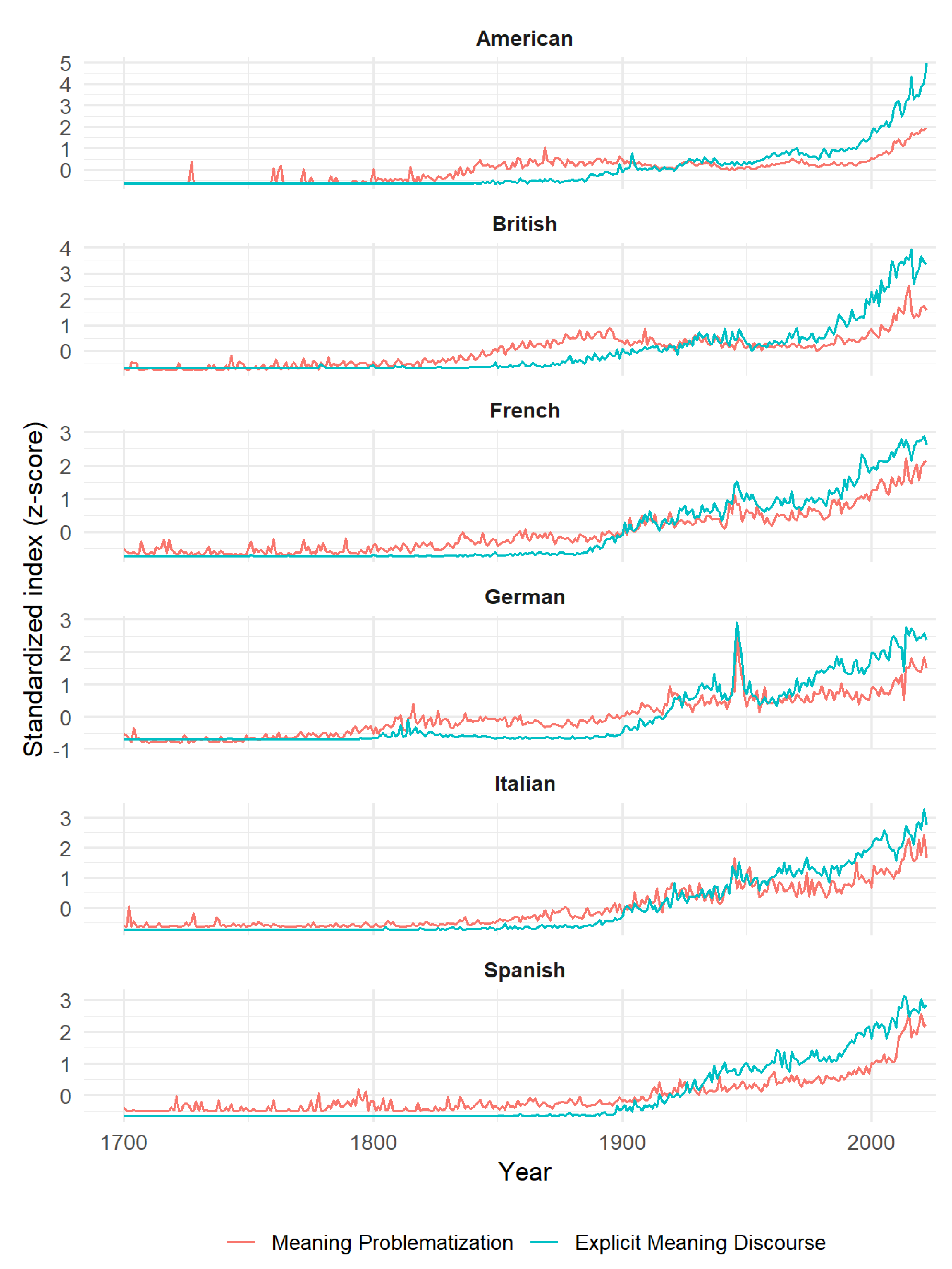
Figure 2.
Time course of religious words in books.
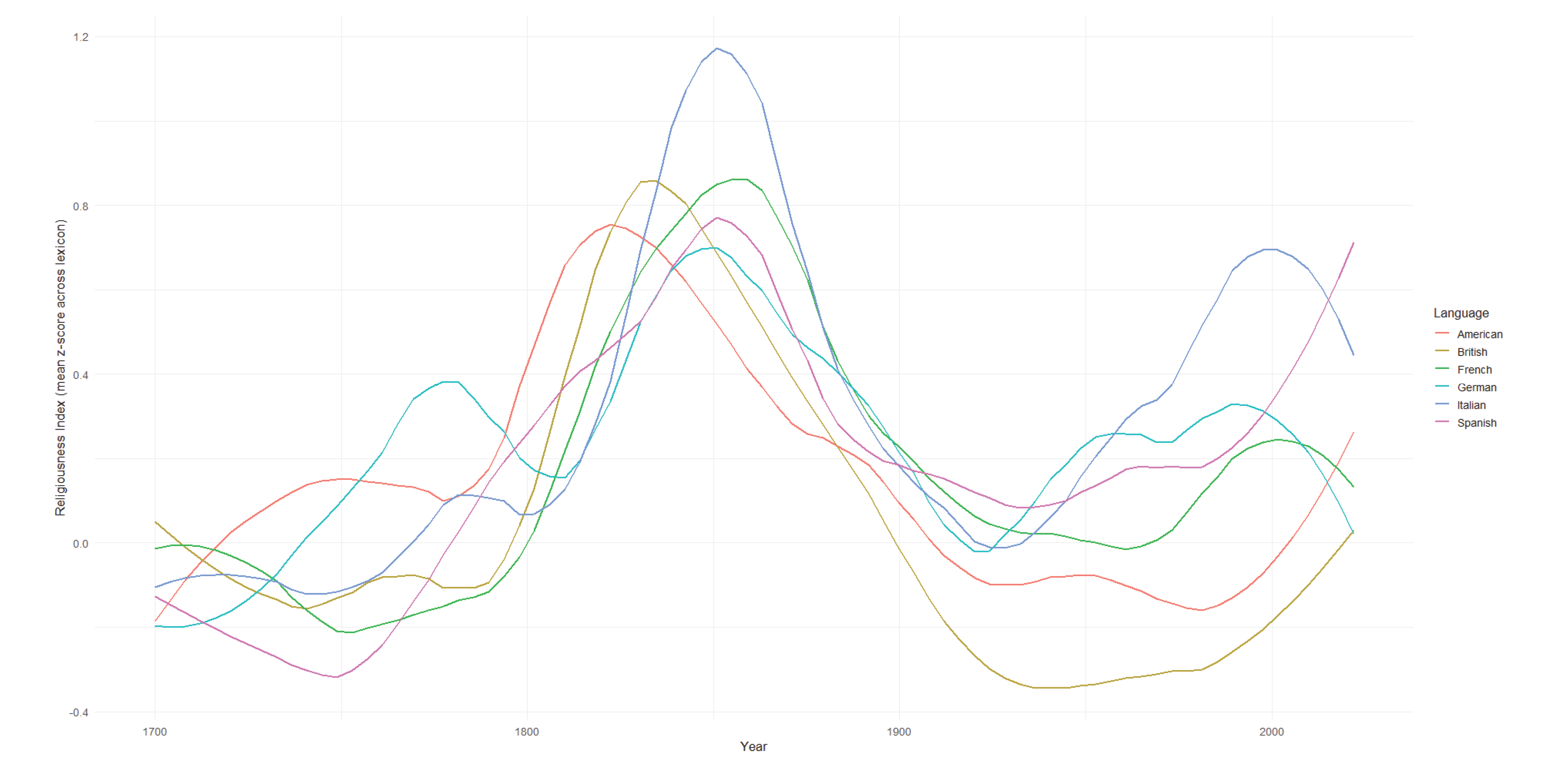

Table 1.
The full lexica of meaning and religiousness related words.
| Meaning | Explicit | Comprehensibility | Purpose | Values | Efficacy | Self-worth |
| meaning of life | absurdity of life; life is absurd; absurdity of existence | purposeless life; life without purpose; aimless life; reason to live; reason for living | moral uncertainty; moral crisis | helpless in life; powerlessness in life | worthless life; life without value; significance of life; emptiness of life; empty life | |
| Religiousness | Metaphysical Authority | Institutional Religion | Moral Authority | Experiential Practices | ||
| God; Jesus; Christ; Bible; Gospel; Scripture; Providence; devil; Satan; heaven; hell | clergy; priest; parish; chapel; cathedral; bishop; archbishop; vicar; rector; parson; Christianity; Christian; Protestant; Catholic; Anglican; Methodist; Quaker; Presbyterian | salvation; redemption; atonement; repentance; resurrection; immortality | prayer; worship; worship service; adoration; baptism; sacrament |
Table 2.
Take-off years of the explicit “Meaning of Life” terms and broader concerns of meaning needs in six languages.
Table 2.
Take-off years of the explicit “Meaning of Life” terms and broader concerns of meaning needs in six languages.
| Meaning Discourse | Meaning Needs | |||||||
|---|---|---|---|---|---|---|---|---|
| Language | Takeoff year | t | p | cohen's d | takeoff_year | t | p | cohen's d |
| American | 1838 | 3.176 | 0.005 | 1.421 | 1829 | 2.932 | 0.005 | 1.311 |
| British | 1871 | 2.946 | 0.006 | 1.317 | 1834 | 3.121 | 0.003 | 1.396 |
| French | 1857 | 2.719 | 0.007 | 1.216 | 1829 | 2.707 | 0.008 | 1.211 |
| German-1 | 1797 | 2.983 | 0.007 | 1.334 | 1747 | 2.917 | 0.005 | 1.304 |
| German-2 | 1886 | 2.945 | 0.006 | 1.317 | 1891 | 2.598 | 0.009 | 1.162 |
| Italian | 1884 | 2.901 | 0.006 | 1.297 | 1848 | 4.412 | <0.001 | 1.973 |
| Spanish | 1892 | 3.14 | 0.006 | 1.404 | 1857 | 2.694 | 0.008 | 1.205 |
| 1 | German allows phrases to be made into single words. Goethe used the term “Lebenssinn,” which combines life (Leben) and sense/meaning (Sinn). Unlike English, but like some other languages, German has two words for meaning, Bedeutung for literal meaning as in a dictionary definition, and Sinn for loftier meanings such as purpose. |
| 2 | This may seem like a technicality to modern readers, or mere empty bluster, but if you lived back then and were concerned about your immortal soul, which was after all the purpose of your life, it had to weigh on you that one pope had excommunicated you. Straight to Hell when you die, no chance of heaven. Cynics remarked that nobody had gone to heaven since the start of the papal schism. |
| 3 | This may be another version of “everything means something.” God put you where you are, presumably for good reason.. |
Disclaimer/Publisher’s Note: The statements, opinions and data contained in all publications are solely those of the individual author(s) and contributor(s) and not of MDPI and/or the editor(s). MDPI and/or the editor(s) disclaim responsibility for any injury to people or property resulting from any ideas, methods, instructions or products referred to in the content. |
© 2026 by the authors. Licensee MDPI, Basel, Switzerland. This article is an open access article distributed under the terms and conditions of the Creative Commons Attribution (CC BY) license.
Copyright: This open access article is published under a Creative Commons CC BY 4.0 license, which permit the free download, distribution, and reuse, provided that the author and preprint are cited in any reuse.


