

Submitted:
06 March 2026
Posted:
09 March 2026
You are already at the latest version
Abstract
The transition toward sustainable pest management requires evaluation frameworks that extend beyond conventional efficacy-based pesticide assessment. This study proposes the Structural–Activity–Economic Sustainability (SAES) framework, a multidimensional composite model designed to evaluate natural bioactive compounds through integrated molecular, biological, and economic performance indicators. Ten representative phytochemical compounds were assessed using standardized molecular descriptors, bioactivity metrics, and economic sustainability parameters. A composite SAES Index was constructed using balanced domain weighting to quantify overall sustainability performance. The results revealed a tiered distribution of sustainability scores ranging from 0.730 to 0.498, demonstrating measurable differentiation among compounds. Pyrethrin (0.730) and Azadirachtin (0.716) formed a high-performance cluster, whereas mid-ranked compounds exhibited relatively compressed values, suggesting competitive equilibrium zones. Lower-ranked compounds showed sharper declines, indicating cross-domain imbalance. Sensitivity and robustness analyses confirmed ranking stability under weight perturbation and scenario variation, supporting the structural consistency of the SAES framework. These findings indicate that sustainability cannot be reduced solely to biological potency or structural magnitude, but instead emerges from multidimensional balance across molecular optimization, functional efficacy, and economic viability. By operationalizing sustainability into a quantifiable composite metric, the SAES model provides a decision-support framework for compound selection, regulatory evaluation, and sustainability-oriented agricultural investment strategies.
Keywords:
Structural–Activity–Economic Sustainability (SAES)
; sustainable pest management
; bioactive phytochemicals
; molecular sustainability
; green agricultural finance
; ESG-aligned agriculture
1. Introduction
Agricultural systems are increasingly challenged by climate change, biodiversity loss, and soil degradation, while the intensive use of synthetic pesticides has reached ecological and economic constraints [1,2],(pp. 337–342), (pp. 20260–20264). Although synthetic agrochemicals contribute to yield stability, their long-term application is associated with resistance development, non-target toxicity, and environmental persistence [3] (pp. 48–60). Consequently, sustainable pest management strategies emphasizing reduced chemical dependency have gained importance in agricultural policy and environmental risk assessment frameworks [4,5], (pp.97–105), (pp.243-255). Botanical and naturally derived bioactive compounds represent promising alternatives due to their biodegradability and compatibility with integrated pest management (IPM) systems [6](pp. 233–249). However, plant origin alone does not guarantee sustainability; efficacy, selectivity, and economic feasibility remain critical determinants. Current evaluation approaches rarely integrate molecular performance parameters with economic and environmental metrics. To address this limitation, we propose a Structural–Activity–Economic Sustainability (SAES) framework, conceptualizing sustainability as an integrated balance between molecular structure, functional bioactivity, and economic viability. The SAES approach enables compound-level comparison and supports alignment with environmental, social, and governance (ESG) criteria [7,8] (pp.1-39),(pp. 210–233). In this study, we (i) introduce a systems-based sustainability model at the molecular level, (ii) implement a quantifiable composite index, and (iii) demonstrate its relevance for agrochemical evaluation.
2. Scientific Background
Modern pest management has progressively shifted from chemical-intensive strategies toward integrated pest management (IPM) and bio-based innovation. Plant-derived bioactive compounds—including terpenoids, alkaloids, phenolics, and limonoids—represent promising alternatives due to their biodegradability and multi-target mechanisms [9,10] (pp. 610–632), (pp.446-475). Molecular characteristics such as lipophilicity, molecular weight, and polar surface area strongly influence bioactivity, environmental persistence, and receptor interactions [11,12] (pp.2475),(p. 115922). However, the translation of plant-derived compounds into scalable agrochemical solutions remains constrained by variability in efficacy, formulation stability, and economic feasibility. Therefore, integrating molecular descriptors with ecological and economic parameters is essential for comprehensive sustainability assessment.
3. Theory Development: Structural–Activity–Economic Sustainability (SAES) Theory
The SAES framework integrates molecular structure, biological activity, and economic indicators to assess sustainable pest management solutions. Structural parameters—such as molecular weight, lipophilicity, and hydrogen bonding capacity—inform functional activity, including insecticidal potency and resistance mitigation. Economic viability is captured through commodity prices and production costs.
SAES treats sustainability as an emergent property arising from the interaction of microstructural, biological, and economic layers, adopting a bottom-up systems perspective. Data are derived from publicly accessible databases [13,14,15] and normalized to enable comparability, with environmental, biological, and economic criteria aggregated into a weighted Composite Sustainability Index.
3.1. The Structural Transmission Mechanism
The core theoretical mechanism of SAES is conceptualized as a four-stage transmission pathway, linking molecular features to functional bioactivity and economic performance, and ultimately to a composite sustainability outcome.
3.2. The Structural Transmission Mechanism
The core theoretical mechanism of SAES is conceptualized as a four-stage transmission pathway (Figure 1), illustrating how molecular descriptors propagate upward into sustainability performance metrics.
Unlike linear adoption models, SAES includes nonlinear feedback loops. For example, high hydrophobicity (logP) may enhance membrane penetration (positive activity) but also increase environmental persistence (negative ecological effect), ultimately reducing economic sustainability due to regulatory and remediation costs. Therefore, sustainability optimization requires structural balance rather than maximal activity alone.
4. Methodology
The SAES Sustainability Index (SI) was calculated using:
where M represents the structural efficiency score, A the activity-related score, and E the economic performance score. Weighting factors satisfy α + β + γ = 1. Interaction terms explore cross-domain effects. All calculations were performed using MATLAB R2021b.
Molecular descriptors included molecular weight, logP, hydrogen bonding, and polar surface area. Bioactivity was assessed via pIC₅₀ values. Economic evaluation included Cost Substitution Ratio (CSR), Externality Reduction Score (ERS), and Yield Stability
Weighting factors (α, β, γ) were assigned equally to balance the domains. Molecular, biological, and economic data were normalized using min-max scaling to ensure comparability. Data sources included [public databases or references]. Interaction terms accounted for synergistic or antagonistic effects across domains.
5. Result and Discussion
The SAES composite index ranged from 0.498 to 0.730, with Pyrethrin (0.730) and Azadirachtin (0.716) forming the high-performance tier. Top-ranked compounds achieved balanced performance across structural, biological, and economic dimensions. Mid-tier compounds exhibited compressed scores, and lower-tier compounds demonstrated sharper declines (Table 1).
(researchers’ findings).
Key Insights:
- Sustainability is a multidimensional equilibrium, not solely determined by bioactivity or molecular magnitude.
- Cross-domain compensation allows compounds with moderate economic performance to rank highly if structural and bioactivity profiles are favorable.
- Tiered SAES Index distribution supports targeted decision-making for sustainable agrochemical investment.
6. Conclusions
The SAES framework provides a quantitative, multidimensional method for evaluating the sustainability of plant-derived bioactive compounds. Balanced structural and bioactivity profiles drive higher composite sustainability, even when economic indicators are moderate. The framework is applicable for regulatory assessment, compound selection, and investment in sustainable agricultural technologies.
References
- Foley, J. A.; Ramankutty, N.; Brauman, K. A.; Cassidy, E. S.; Gerber, J. S.; Johnston, M.; Mueller, N. D.; O’Connell, C.; Ray, D. K.; West, P. C.; et al. Solutions for a cultivated planet. Nature 2011, 478(7369), 337–342. [Google Scholar] [CrossRef] [PubMed]
- Tilman, D.; Balzer, C.; Hill, J.; Befort, B. L. Global food demand and the sustainable intensification of agriculture. Proc. Natl. Acad. Sci. USA 2011, 108(50), 20260–20264. [Google Scholar] [CrossRef] [PubMed]
- Carvalho, F. P. Pesticides, environment, and food safety. Food Energy Secur. 2017, 6(2), 48–60. [Google Scholar] [CrossRef]
- Geiger, F.; Bengtsson, J.; Berendse, F.; Weisser, W. W.; Emmerson, M.; Morales, M. B.; et al. Persistent negative effects of pesticides on biodiversity and biological control potential on European farmland. Basic Appl. Ecol. 2010, 11(2), 97–105. [Google Scholar] [CrossRef]
- Popp, J.; Pető, K.; Nagy, J. Pesticide productivity and food security: A review. Agron. Sustain. Dev. 2013, 33(1), 243–255. [Google Scholar] [CrossRef]
- Isman, M. B. Botanical insecticides in the twenty-first century—Fulfilling their promise? Annu. Rev. Entomol. 2020, 65, 233–249. [Google Scholar] [CrossRef] [PubMed]
- Erdoğdu, A.; Dayi, F.; Özbek, A.; Ganji, F. The role of green finance in investing in environmentally friendly technologies: Risks and returns. Sustainability 2025a, 17(21), 9652, 1–39. [Google Scholar] [CrossRef]
- Friede, G.; Busch, T.; Bassen, A. ESG and financial performance: Aggregated evidence from more than 2000 empirical studies. J. Sustain. Financ. Invest. 2015, 5(4), 210–233. [Google Scholar] [CrossRef]
- Mordue, A. J. L.; Nisbet, A. J. Azadirachtin from the neem tree Azadirachta indica: Its action against insects. Anais da Sociedade Entomológica do Brasil 2000, 29(4), 615–632. [Google Scholar] [CrossRef]
- Bakkali, F.; Averbeck, S.; Averbeck, D.; Idaomar, M. Biological effects of essential oils—A review. Food and Chemical Toxicology 2008, 46(2), 446–475. [Google Scholar] [CrossRef] [PubMed]
- Neves, B. J.; Braga, R. C.; Melo-Filho, C. C.; Moreira Filho, J. T. QSAR-based virtual screening: Advances and applications in drug discovery. Frontiers in Pharmacology 2018, 9, 1275. [Google Scholar] [CrossRef] [PubMed]
- Karaduman, G.; Seo, S. B. Generation of explainable QSAR models for predicting chemical-induced urinary tract toxicity. Food and Chemical Toxicology 2026, 209, 115922. [Google Scholar] [CrossRef] [PubMed]
- University of Hertfordshire. Pesticide Properties DataBase (PPDB). 2024. Available online: https://sitem.herts.ac.uk/aeru/ppdb/en.
- European Chemicals Agency. Information on chemicals database. 2024. Available online: https://echa.europa.eu.
- Food and Agriculture Organization of the United Nations. FAOSTAT statistical database. 2023. Available online: https://www.fao.org/faostat.
Figure 1.
The core theoretical mechanism of SAES can be conceptualized as a four-stage transmission pathway:(researchers’ findings).
Figure 1.
The core theoretical mechanism of SAES can be conceptualized as a four-stage transmission pathway:(researchers’ findings).
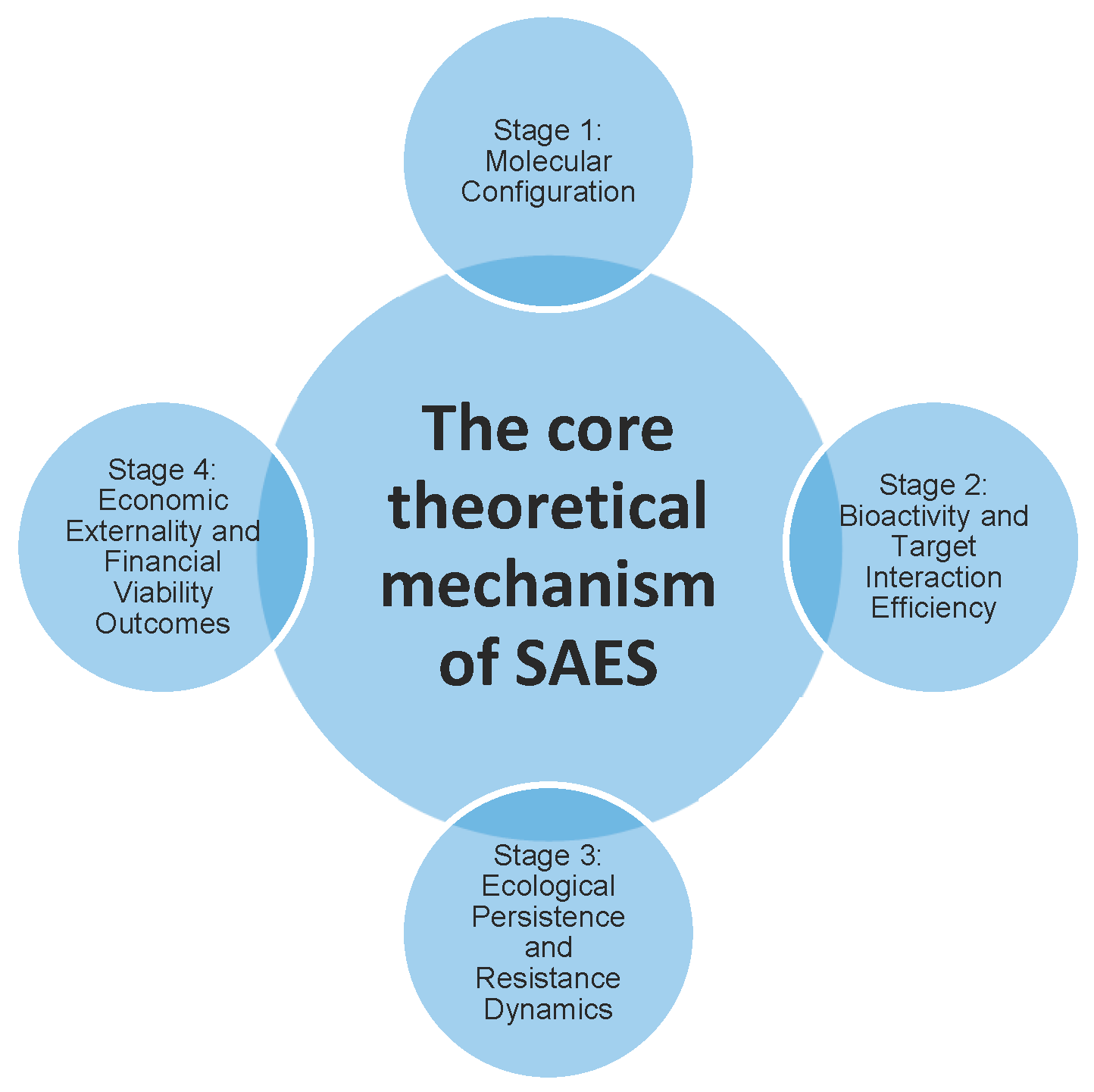

Table 1.
SAES Composite Sustainability Index.
| Rank | Compound | SAES_Index |
| 1 | Pyrethrin | 0.730 |
| 2 | Azadirachtin | 0.716 |
| 3 | Menthol | 0.696 |
| 4 | Allicin | 0.679 |
| 5 | Carvacrol | 0.651 |
| 6 | Citral | 0.646 |
| 7 | Limonene | 0.645 |
| 8 | Eucalyptol | 0.627 |
| 9 | Thymol | 0.577 |
| 10 | Rotenone | 0.498 |
Disclaimer/Publisher’s Note: The statements, opinions and data contained in all publications are solely those of the individual author(s) and contributor(s) and not of MDPI and/or the editor(s). MDPI and/or the editor(s) disclaim responsibility for any injury to people or property resulting from any ideas, methods, instructions or products referred to in the content. |
© 2026 by the authors. Licensee MDPI, Basel, Switzerland. This article is an open access article distributed under the terms and conditions of the Creative Commons Attribution (CC BY) license (http://creativecommons.org/licenses/by/4.0/).
Copyright: This open access article is published under a Creative Commons CC BY 4.0 license, which permit the free download, distribution, and reuse, provided that the author and preprint are cited in any reuse.


