
Submitted:
06 March 2026
Posted:
09 March 2026
You are already at the latest version
Abstract
Insect trap records are widely used for monitoring stored-product pests but are less frequently applied in predictive decision-support systems. The present study aimed to evaluate whether biweekly trap data could support the development of a temperature-driven population dynamics model for stored-product pest management. A facility-level time series of aggregated biweekly insect counts was analyzed using a discrete negative binomial regression model, with mean temperature during the preceding 14 days and the number of insecticidal spraying applications within each monitoring interval as predictors. The fitted model showed that recent temperature was positively associated with expected insect counts, whereas spraying applications were negatively associated with expected counts. Specifically, each 1°C increase in 14-day mean temperature was associated with a 17.5% increase in expected biweekly insect counts, while each additional spraying application was associated with a 39.6% reduction. Scenario analysis was used to compare alternative temperature-triggered spray policies. A standard threshold policy produced outcomes very similar to those of the observed historical schedule, suggesting that the original intervention timing was already broadly aligned with a biologically plausible temperature-based rule. In contrast, a preventive intensified policy substantially reduced predicted insect counts but required a markedly higher number of spraying applications. Overall, the results indicate that routine biweekly trap data can support a practical, facility-level population dynamics model and can be used to quantify trade-offs between expected pest suppression and intervention effort. The proposed framework provides a proof of concept for transforming routine monitoring records into an operational tool for pest-management decision support.
Keywords:
trap monitoring
; population dynamics model
; negative binomial regression
; decision support
; pest management
; stored-product insects
1. Introduction
Stored-product insects remain a major challenge in postharvest systems because they cause quantitative losses, reduce the quality of the commodity, contaminate products, and increase management costs. Their economic importance has been emphasized repeatedly in the stored-product protection literature, and the continuing need for improved management is also reflected in the widespread use of chemical and non-chemical control tactics [1,2,3]. In commercial food and feed environments, pest management depends heavily on reliable monitoring. Trap-based surveillance is widely used in processing plants, storage facilities, and grain handling systems to detect pest presence, identify spatial hotspots, and follow seasonal changes in abundance [4,5,6,7,8]. These studies show that trap records can capture both persistent infestation patterns and strong temporal variation, making them valuable for operational monitoring. However, in many facilities, trap data are still used mainly descriptively rather than analytically, despite their potential to support predictive decision-making [4,8,9].
Temperature is one of the most important environmental drivers of stored-product insect activity and population change, particularly as warming trends shift the risk and distribution of pests in processing facilities [10]. Thermal conditions affect development, movement, reproduction, and trap capture probability across a wide range of storage-related taxa [11,12,13]. In particular, lower temperatures suppress activity and development, whereas warmer conditions promote increased movement and faster population growth [11]. Jian [13] highlighted that flight activity across many stored-product insects is strongly limited at lower temperatures, while Stejskal et al. [12] reviewed lower developmental and activity thresholds across 121 pest species. Fields [11] also showed that the thermal environment is central to the biology and control of stored-product insects. All these findings support the use of recent temperature as a biologically meaningful predictor in operational population models based on trap catches.
At the same time, observed trap dynamics are shaped not only by pest biology but also by management actions. Insecticide applications, sanitation, and other interventions can suppress pest pressure, although their practical outcome depends on timing, coverage, persistence, and the possibility of reinfestation [1,2,3]. Therefore, a useful applied model should ideally account for both the environmental conditions that favor insect activity and the management actions intended to reduce it. A framework that combines routine trap counts with recent temperature and intervention history may thus provide a realistic basis for forecasting short-term pest pressure under alternative control schedules.
The use of models for decision support in stored-product protection is not new, but most established systems have focused on grain storage conditions, insect density, and risk forecasting in elevator-scale settings. A notable example is Stored Grain Advisor Pro, which was developed as a decision-support system for insect management in commercial grain elevators and used current insect density together with grain temperature and moisture to estimate future risk [14]. Similarly, another work by Flinn et al. [15] further demonstrated that insect population dynamics in commercial grain elevators can be modeled and used to improve pest-management planning. These studies provide an important precedent for linking monitoring data to operational decisions, but comparable predictive approaches are less commonly reported for facility-level trap-monitoring datasets from food or feed environments.
From a statistical standpoint, trap-monitoring data are typically count data and are often overdispersed, meaning that the variance exceeds the mean. This is common in insect datasets because captures tend to be aggregated in time and space. Therefore, negative binomial models are especially suitable in this context, as suggested by Buchelos and Athanassiou [16], Sileshi [17] and Elmouttie et al. [18]. Specifically, Elmouttie et al. [18] showed that negative binomial-type formulations described stored-product insect distributions well in sampling contexts, while broader entomological work has emphasized the importance of selecting count-data models that properly handle overdispersion [17]. These characteristics make negative binomial regression a logical and interpretable framework for modeling routine trap-count series.
Recent studies have also emphasized that improving stored-product pest management increasingly depends on integrating monitoring, modeling, and decision-support tools into practical workflows [3]. In parallel, recent work has continued to refine the analytical value of trap networks and predictive monitoring systems in insect management settings, reinforcing the view that monitoring records can be more than descriptive logs if they are linked to explicit forecasting or scenario analysis [3,19].
The present study builds on this perspective by extending a previously published monitoring dataset from a feed manufacturing facility in Greece into a predictive modeling framework [8]. While the original study documented insect diversity and seasonal dynamics within the facility, the present work asks whether the same routine biweekly trap records can support a facility-level population dynamics model with practical decision-support value. Specifically, the objectives of this study were: (i) to determine whether biweekly insect trap counts can be modeled as a function of recent temperature and the number of insecticidal spraying applications within each monitoring interval; (ii) to evaluate the suitability of a discrete negative binomial framework for describing the temporal dynamics of the trap-count series; and (iii) to use the fitted model to compare alternative temperature-triggered spray schedules as a basis for pest-management planning. By framing the analysis as a facility-level case study, the aim was not to develop a fully mechanistic species-specific model but rather to assess whether routine monitoring data can be transformed into a practical predictive tool for operational decision support.
2. Materials and Methods
2.1. Study Design and Data Source
The present study was conducted as a secondary analysis of a previously published long-term monitoring dataset collected in an animal feed manufacturing facility in northern Greece [8]. The original work focused on insect diversity, dominance, and seasonal trends. In contrast, the objective of the present study was to evaluate whether routine trap-monitoring records could support the development of a practical population dynamics model for pest-management decision support. For the present analysis, the original trap-level observations were aggregated into a facility-level biweekly time series of total insect counts per inspection interval. This aggregated biweekly total was used as the response variable in the statistical models.
2.2. Facility and Trap Monitoring
The monitoring was carried out in a feed industry handling hard and soft wheat, together with smaller quantities of barley and maize [8]. The facility included raw material storage, production areas, and finished-product warehouse zones, and environmental conditions were not artificially regulated. A total of 38 traps were installed on 15 July 2021 and monitored until June 2023. The trap network consisted of 30 food-baited dome traps and 8 pheromone-baited delta traps distributed across the first and basement floors of the facility. Sampling was conducted on 51 consecutive dates at approximately biweekly intervals. During each inspection, traps were checked, captured insects were collected, and lures or trapping units were refreshed or replaced as needed. In the original study, each record corresponded to the catch from an individual trap on a given inspection date. In the present study, those records were pooled across traps to produce a single facility-level biweekly insect count for each sampling occasion.
2.3. Insect Count Variable
The original monitoring study identified insects to the lowest possible taxonomic level using morphological keys [8]. However, species-level information was not used in the present modeling framework, because the purpose of this study was to estimate overall facility-level pest pressure rather than taxon-specific dynamics. Accordingly, the response variable was defined as the total number of insects captured across all traps during each biweekly monitoring occasion. This aggregated measure was considered an operationally relevant indicator of short-term insect pressure within the facility.
2.4. Insecticidal Applications
Periodic applications with Actellic 50 EC (48% active ingredient; Syngenta Hellas, Athens, Greece) were conducted in the facility and occasionally affected access to trapping areas. The same study also reported that applications were more frequent during warmer periods and less frequent during winter, when insect activity was lower. In the present study, applications with Actellic were incorporated as a management variable. For each biweekly observation, the number of spraying applications occurring after the previous inspection date and on or before the current inspection date was counted. This interval-based coding ensured that the intervention variable matched the same time window represented by the aggregated insect count response. The intervention variable was treated as a numeric predictor representing the number of spraying applications per monitoring interval.
2.5. Temperature Data and Predictor Construction
The earlier monitoring study used weather records from the Athens National Observatory [8]. In the present study, temperature data were aligned with the facility location and matched to the biweekly sampling dates to construct predictors representing recent thermal conditions. The main environmental predictor was the mean air temperature during the 14 days preceding each inspection date. This variable was selected because it matched the temporal resolution of the biweekly trap-monitoring series and represented the recent thermal conditions most likely to influence insect development, activity, and trap captures. Hourly weather data were first summarized to daily values and then aggregated over rolling 14-day windows.
2.6. Statistical Analysis
Biweekly insect counts were analyzed using a discrete negative binomial regression model. This approach was selected because insect trap counts are typically overdispersed, and negative binomial regression is appropriate when count variance exceeds the mean, according to Hilbe [20]. The primary model related the expected biweekly insect count to: (i) the mean temperature during the preceding 14 days and (ii) the number of spraying applications within the same interval. The model was specified as
where is the expected insect count for interval , is the 14-day mean temperature prior to the inspection date, and is the number of spraying applications in that interval. Because consecutive monitoring intervals were not all identical in length, interval duration (in days) was included as an exposure term. This allowed the model to account for minor variation in sampling duration across the time series. Regression coefficients were interpreted on the log scale and as exponentiated values. Exponentiated coefficients were reported as incidence rate ratios (IRRs). For temperature, the IRR represented the multiplicative change in expected insect counts associated with a 1 °C increase in the 14-day mean temperature. For spraying applications, the IRR represented the multiplicative change associated with one additional application within the interval. Alternative model specifications, including seasonal terms and interaction structures, were also explored as sensitivity analyses. However, the temperature-plus-spray model was retained as the main decision-support model because it provided the clearest balance between statistical performance and operational interpretability.
2.7. Scenario Analysis
To evaluate the practical utility of the fitted model for pest-management planning, scenario-based predictions were generated under alternative temperature-triggered spray schedules. In all scenarios, the observed biweekly temperature trajectory was retained, while the spray schedule was modified according to predefined threshold rules.
Two alternative policies were evaluated:
- 1.
-
Standard threshold policy
- o 0 applications when temp_mean_prev_14d < 17 °C
- o 1 application when 17 °C ≤ temp_mean_prev_14d < 25 °C
- o 2 applications when temp_mean_prev_14d ≥ 25 °C
- 2.
-
Preventive intensified policy
- o 0 applications when temp_mean_prev_14d < 15 °C
- o 2 applications when 15 °C ≤ temp_mean_prev_14d < 22 °C
- o 3 applications when temp_mean_prev_14d ≥ 22 °C
The standard threshold policy was intended to represent a biologically informed temperature-triggered schedule. The intensified preventive policy represented a more aggressive management approach, combining earlier intervention with higher application intensity during warmer periods. These policies were compared in terms of: (i) total number of spraying applications, (ii) total predicted insect count across the study period, and (iii) mean predicted biweekly insect count.
Because the intensified preventive policy included a three-application category, which extended beyond the most common historical intervention intensity, it was treated as an exploratory decision-support scenario.
2.8. Data Visualization
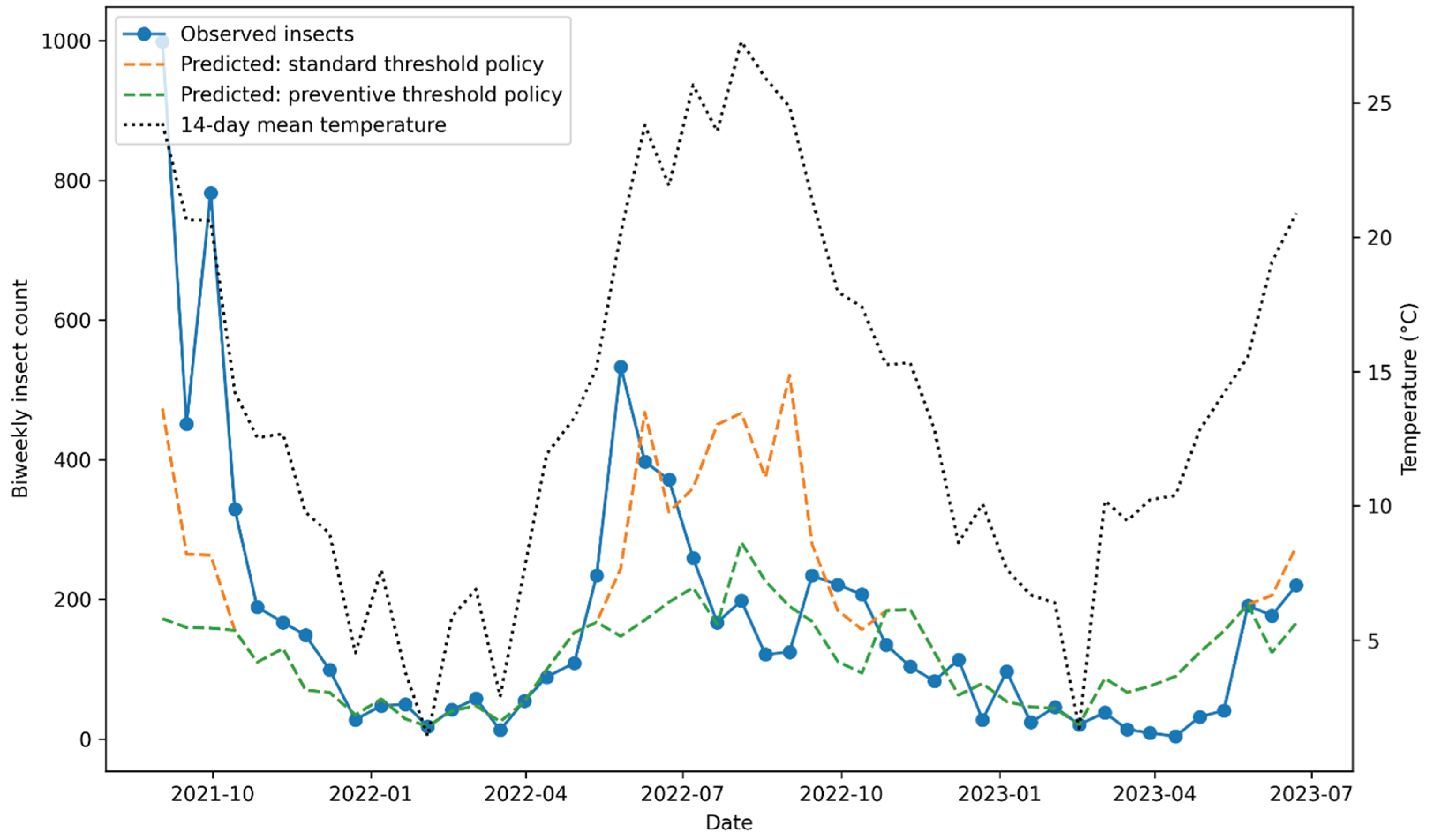
Two time-series visualizations were used. The first compared observed and fitted biweekly insect counts from the primary model, with the 14-day mean temperature displayed on a secondary y-axis. The second compared predicted insect counts under the two temperature-triggered spray policies, again using the observed biweekly temperature trajectory on a secondary axis. These figures were used to illustrate both model fit and the practical value of the modeling framework for management planning.
2.9. Software
All preprocessing, statistical analyses, and visualizations were conducted in Python. Data handling was performed using pandas, statistical modeling using statsmodels, and graphical outputs using matplotlib. The workflow was implemented programmatically to enable reproducible recalculation of fitted values and scenario predictions from the original time-series data.
3. Results
3.1. Performance of the Primary Population Dynamics Model
The primary discrete negative binomial model indicated that both recent temperature and the number of spraying applications within the biweekly interval were significantly associated with insect trap counts. The estimated dispersion parameter was positive (a = 0.3868), confirming overdispersion in the count data and supporting the use of a negative binomial rather than a Poisson framework. Mean temperature during the preceding 14 days was positively associated with insect counts (β = 0.1614, p < 0.001). On the exponentiated scale, this corresponded to an incidence rate ratio (IRR) of 1.1751, indicating that each 1 °C increase in the 14-day mean temperature was associated with an estimated 17.5% increase in expected biweekly insect counts, holding spraying applications constant.
By contrast, the number of spraying applications within the same interval was negatively associated with insect counts (β = -0.5046, p = 0.0007). The corresponding IRR was 0.6037, indicating that each additional spraying application was associated with an estimated 39.6% reduction in expected biweekly insect counts, holding temperature constant. Overall, these results indicate that the fitted model captured a biologically plausible pattern in which warmer recent conditions were associated with increased pest pressure, whereas greater intervention intensity was associated with lower expected trap counts.
3.2. Observed Versus Fitted Biweekly Counts
A visual comparison of observed and fitted values (Figure 1) showed that the model reproduced the broad temporal structure of the biweekly insect count series. As shown in Figure 1, the fitted values followed the main seasonal rises and declines in insect abundance, particularly during warmer periods when temperature values were elevated. Although some sharp peaks in the observed series were not fully reproduced, the fitted trajectory captured the overall direction and magnitude of variation across the study period. This pattern suggests that a relatively simple temperature-plus-intervention model can provide an adequate description of the dominant temporal dynamics in routine trap-count data, even without incorporating more complex mechanistic or species-specific terms.
3.3. Observed Versus Fitted Biweekly Counts
Comparison of the observed and temperature-triggered spray schedules (Figure 2) showed that the standard threshold policy produced predictions similar to those of the observed schedule, whereas the preventive intensified policy yielded visibly lower expected counts, particularly during warmer periods. The historical dataset included a total of 21 spraying applications across the study period. Most monitoring intervals had no applications (n = 37), one interval had a single application (n = 1), and ten intervals had two applications (n = 10).
Under the standard threshold policy (0 applications below 17 °C, 1 application at 17 to <25 °C, and 2 applications at ≥25 °C), the total number of spraying applications was 19. This policy produced 32 intervals with no applications, 13 intervals with one application, and 3 intervals with two applications. Despite the slightly lower intervention burden, the model predicted a total of 8160.93 insects across the study period, compared with 8081.14 insects under the observed historical schedule. Thus, the standard threshold policy was associated with a 0.99% increase in total predicted insect counts relative to the observed schedule, indicating near-equivalent performance.
Under the preventive intensified policy (0 applications below 15 °C, 2 applications at 15 to <22 °C, and 3 applications at ≥22 °C), the total number of spraying applications increased to 39. This policy produced 32 intervals with no applications, 9 intervals with two applications, and 7 intervals with three applications. As illustrated in Figure 2, this intensified intervention scenario generated consistently lower predicted counts during high-temperature periods. Across the full study period, the model predicted a total of 5599.46 insects under this scenario, corresponding to a 30.71% reduction relative to the observed schedule. Mean predicted biweekly insect counts followed the same pattern. The observed historical schedule yielded a mean predicted count of 168.36 insects per interval, the standard threshold policy yielded 170.02 insects per interval, and the preventive intensified policy yielded 116.66 insects per interval.
3.4. Observed Versus Fitted Biweekly Counts
The scenario analysis showed that the standard threshold policy produced outcomes very similar to those of the observed historical spray schedule (Figure 2), while requiring slightly fewer total applications. This suggests that the historical intervention timing was already broadly aligned with a biologically plausible temperature-triggered rule. In contrast, the preventive intensified policy produced a marked reduction in expected insect counts (Figure 2), but only at the cost of a substantially higher number of spraying applications. This demonstrates that the model can be used to quantify a practical trade-off between intervention burden and expected pest suppression. Taken together, these findings indicate that routine biweekly trap monitoring data can support a useful applied population dynamics model for decision support. In particular, the fitted model was able to translate differences in recent temperature and spray intensity into clear differences in expected insect pressure under alternative management policies.
4. Discussion
The present study showed that routine biweekly insect trap records can be used to construct a practical, facility-level population dynamics model for stored-product pest management. The fitted discrete negative binomial model identified a strong positive association between recent temperature and expected insect counts, together with a significant negative association between the number of spraying applications and expected counts. In addition, the estimated dispersion parameter was clearly positive, supporting the choice of a negative binomial framework for these overdispersed count data. Taken together, these findings indicate that routinely collected monitoring data can provide more than descriptive information and can be transformed into an operational decision-support tool.
A central finding of the study was the strong temperature dependence of the modeled insect counts. This is biologically consistent with the broader stored-product literature, according to Fields [11], Stejskal et al. [12], and Jian [13], all of whom emphasized that temperature strongly influences development, movement, trap capture, and overall activity of stored-product pests. In practical terms, this means that the fitted positive coefficient for recent temperature is not merely a statistical artifact but is aligned with established biological expectations: warmer recent conditions are expected to increase pest activity and, consequently, trap captures. The fact that the present model detected this relationship at the facility level suggests that even a relatively simple thermal predictor, such as the 14-day mean temperature, can capture an important component of short-term pest pressure.
It is important to acknowledge that although this model successfully uses mean 14-day temperature as a primary driver for facility-level population dynamics, it reflects an aggregate of the entire pest complex present. Aggregate models provide a broad facility-level overview; however, they encompass a diverse range of species, each with its own discrete thermal thresholds for development and movement [11,21]. Consequently, even if the aggregate model captures the general trend of increased activity during warmer periods, individual species may react differently to these thermal thresholds [22,23]. For instance, more cold-tolerant species may persist at temperatures where others become inactive, potentially leading to shifts in community composition that a facility-level model might not explicitly detail [8]. Future refinements could involve applying this negative binomial framework to species-specific counts to provide more granular decision support for targeted pest management.
In the specific context of this facility, the insect complex was characterized by several dominant species, including the red flour beetle, Tribolium castaneum (Herbst) (Coleoptera: Tenebrionidae), the confused flour beetle, Tribolium confusum Jacquelin du Val (Coleoptera: Tenebrionidae), the sawtoothed grain beetle, Oryzaephilus surinamensis (L.) (Coleoptera: Silvanidae), Sitophilus granarius (L.) (Coleoptera: Curculionidae), the cigarette beetle, Lasioderma serricorne (F.) (Coleoptera: Anobiidae), and various Lepidoptera adults, which collectively accounted for more than 85% of all captures [8]. The 17 °C trigger used in the standard threshold policy is highly representative of this assemblage, as it aligns with the lower developmental and activity thresholds of these key taxa [12]. While thermophilic species such as T. castaneum and L. serricorne typically require temperatures near or above 20 °C for significant population growth, more temperate-adapted species like S. granarius and O. surinamensis can remain active and continue development at temperatures as low as 15–17 °C [11,12]. Furthermore, the flight activity of Lepidoptera is strongly constrained below 16–18 °C [13]. Thus, the aggregate 17 °C threshold effectively captures the biological ‘tipping point’ for the majority of the pest pressure in the facility, even though specific taxa vary slightly in their individual thermal responses [8].
The negative association between spraying applications and insect counts is also consistent with the intended direction of control, but it should be interpreted carefully. In the present analysis, additional spraying applications within a monitoring interval were associated with lower expected counts, which supports the practical value of including intervention history in a predictive model. However, this does not by itself establish a fully causal treatment effect. As noted in the literature, the practical effect of insecticide interventions depends on timing, coverage, persistence, and reinfestation pressure, as suggested by Phillips and Throne [1] and Boyer et al. [2]. Thus, the estimated spray effect in the present model should be interpreted as a management-linked association within the observed operating conditions of the facility, rather than as a universal treatment-response coefficient.
An important methodological result was the suitability of the negative binomial model itself. Stored-product trap data are commonly aggregated and variable, and they are often overdispersed because captures fluctuate sharply between time periods and may be clustered in both time and space. This has been recognized in both stored-product and broader entomological modeling literature, and related count-modeling work [18]. The present dataset showed the same behavior, and the positive estimated dispersion parameter confirms that a Poisson formulation would have been less appropriate. In this respect, the modeling approach used here is not only statistically justified but also consistent with previous work showing that negative binomial-type models perform well in stored-product insect sampling contexts.
From an applied standpoint, one of the most informative results was the comparison between the observed historical spray schedule and the two temperature-triggered scenarios. The standard threshold policy produced outcomes that were very similar to those of the observed schedule, with slightly fewer total applications but nearly identical total predicted insect counts. This suggests that the historical timing of spray interventions was already broadly aligned with a biologically plausible temperature-triggered rule. In practical terms, this is a useful finding: it indicates that the current operational logic may already reflect the broad seasonal structure of pest risk in the facility. Therefore, the similarity between these two schedules should not be interpreted as model failure, but rather as evidence that the observed practice and the standard temperature-triggered policy are functionally close under the conditions studied.
By contrast, the preventive intensified policy produced a substantial reduction in predicted insect counts, but only at the cost of a markedly higher number of spray applications. This result highlights the contribution of the model: it quantifies the trade-off between intervention burden and expected pest suppression. Such trade-offs are central to practical pest management, yet they are often not expressed quantitatively in routine monitoring workflows. The ability to compare alternative schedules in terms of both predicted pest pressure and required intervention effort is closely aligned with the broader purpose of decision-support systems in stored-product protection [14], which described Stored Grain Advisor Pro as a tool for translating monitoring and environmental information into management advice. Although the present model is much simpler and facility-specific, it serves a comparable role by converting trap and temperature data into operationally interpretable scenarios.
The scenario results also suggest a broader interpretation regarding the role of treatment timing versus treatment intensity. Because the standard threshold policy is tied to the observed schedule, changing the timing rule alone may not produce major gains in this facility. In contrast, the preventive intensified policy reduced expected counts only when intervention intensity increased substantially. This implies that, under the modeled conditions, further improvements may depend less on refining the trigger logic and more on either increasing intervention intensity or improving the effectiveness of the existing applications. In operational terms, this could involve not only more frequent spraying but also better targeting, improved coverage, or integration with complementary control measures. This interpretation is compatible with the broader stored-product management literature, which emphasizes that successful control depends on a combination of monitoring, intervention quality, and facility-specific implementation [1,3].
At the same time, the intensified scenario should be interpreted cautiously because it included a three-application category in the warmest intervals, which extended beyond the most common historical intervention intensity in the dataset. This means that part of that scenario represents an extrapolative exercise rather than a condition strongly represented in the observed data. For this reason, the intensified policy is best viewed as an exploratory planning scenario rather than a directly validated operating schedule. Nevertheless, exploratory scenarios remain useful in decision-support contexts because they allow managers to estimate the likely direction and approximate magnitude of change under more aggressive control assumptions. This use of scenario analysis is consistent with the logic of practical forecasting systems, which often aim to compare options rather than to claim exact prediction under every hypothetical condition.
The present study has several limitations that should be acknowledged. First, the model was developed for a single facility, and the results should be interpreted as site-specific rather than universally generalizable. Second, the response variable was based on aggregated total insect counts rather than species-specific populations for the present management-oriented objective, but different taxa may respond differently to temperature and control measures. Third, the temperature predictor reflected recent external thermal conditions rather than detailed internal microclimatic measurements from all operational zones of the facility. This reliance on ambient weather data introduces a potential ‘thermal lag’ or insulation effect, as the building’s physical structure likely buffered external temperature extremes in an environment where conditions were not artificially regulated [8]. External records successfully captured the broad seasonal trends that drove the aggregate model; however, internal temperatures in large manufacturing environments are often influenced by structural insulation and localized heat sources, which can create complex variations in insect movement and population dynamics [13,24]. The omission of these localized indoor thermal dynamics may explain why the model did not fully reproduce every sharp peak in the observed trap captures. Future research utilizing indoor data-loggers could refine the model by accounting for the specific microclimates within different production and storage zones [24]. Finally, although the model captured the broad temporal structure well, it did not reproduce every sharp peak in the observed series, indicating that additional unmeasured factors, such as localized infestation sources, sanitation variation, or short-term operational changes, may also influence trap captures. These limitations are not unusual in applied facility-level studies and should be viewed as opportunities for further refinement rather than as weaknesses that invalidate the overall decision-support value of the approach.
Despite these limitations, the study demonstrates a useful practical principle: routine monitoring data can be converted into a simple predictive framework that helps translate observed insect activity into management decisions. This is an important extension beyond descriptive surveillance. The present model does not attempt to replace detailed ecological or mechanistic approaches, nor does it seek to provide universally transferable thresholds. Instead, it shows that even a relatively simple, facility-level model based on trap counts, recent temperature, and intervention history can support structured pest-management planning. In this sense, the work contributes to the growing emphasis on integrating monitoring and modeling into stored-product pest management practice [3,14].
5. Conclusions
This study showed that routine biweekly insect trap records can support a practical, temperature-driven population dynamics model for stored-product pest management. The fitted discrete negative binomial model indicated that higher recent temperature was associated with increased expected insect counts, whereas greater numbers of insecticidal spray applications were associated with lower expected counts. The scenario analysis revealed a clear trade-off between pest suppression and intervention effort. While the ‘preventive intensified policy’ resulted in a substantial reduction in predicted insect counts, it required a markedly higher frequency of spraying applications [25]. From a cost-benefit perspective, the adoption of such a policy depends on whether the reduction in pest-related commodity loss, such as quantitative weight loss, quality degradation, and contamination, outweighs the increased expenses associated with insecticide products and labor [26,27]. In high-value commodity sectors, where even low levels of infestation can lead to significant financial penalties or loss of market access, the higher operational costs of a more aggressive, temperature-triggered preventive strategy may be economically justified compared to the reactive ‘threshold’ approach [1,28]. These findings demonstrate that routine trap data can be used not only for monitoring but also for decision support by quantifying trade-offs between pest suppression and intervention effort. The proposed framework is facility-specific, but it provides a useful proof of concept for converting routine monitoring records into an operational pest-management tool.
Funding
This research received no external funding.
Conflicts of Interest
The authors declare no conflicts of interest.
References
- Phillips, T. W.; Throne, J. E. Biorational approaches to managing Stored-Product insects. Annual Review of Entomology 2009, 55(1), 375–397. [Google Scholar] [CrossRef] [PubMed]
- Boyer, S.; Zhang, H.; Lempérière, G. A review of control methods and resistance mechanisms in stored-product insects. Bulletin of Entomological Research 2011, 102(2), 213–229. [Google Scholar] [CrossRef] [PubMed]
- Hagstrum, D. W.; Athanassiou, C. G. Improving stored product insect pest Management: From Theory to practice. Insects 2019, 10(10), 332. [Google Scholar] [CrossRef]
- Campbell, J. F.; Mullen, M. A.; Dowdy, A. K. Monitoring Stored-Product Pests in Food Processing Plants with Pheromone Trapping, Contour Mapping, and Mark-Recapture. Journal of Economic Entomology 2002, 95(5), 1089–1101. [Google Scholar] [CrossRef]
- Arthur, F. H.; Campbell, J. F.; Toews, M. D. Distribution, abundance, and seasonal patterns of stored product beetles in a commercial food storage facility. Journal of Stored Products Research 2013, 56, 21–32. [Google Scholar] [CrossRef]
- Athanassiou, C. G.; Buchelos, C. Th. Grain properties and insect distribution trends in silos of wheat. Journal of Stored Products Research 2020, 88, 101632. [Google Scholar] [CrossRef]
- Hasan, Md. M.; Athanassiou, C. G.; Hossain, Md. A. Estimating long-term spatial distribution of Plodia interpunctella in various food facilities at Rajshahi Municipality, Bangladesh, through pheromone-baited traps. Scientific Reports 2022, 12(1), 15986. [Google Scholar] [CrossRef]
- Lampiri, E.; Agrafioti, P.; Kaloudis, E.; Kateris, D.; Athanassiou, C. G. Diversity and seasonal dynamics of Stored-Product insects in a feed manufacturing facility in Greece. Insects 2025, 16(12), 1209. [Google Scholar] [CrossRef]
- Athanassiou, C. G.; Morrison, W. R.; Stejskal, V.; Riudavets, J. Monitoring of stored product insects and decision support systems at the post-harvest stages of durable agricultural commodities: a review. Entomologia Generalis 2025, 45(4), 991–1015. [Google Scholar] [CrossRef]
- Adler, C.; Athanassiou, C.; Carvalho, M. O.; Emekci, M.; Gvozdenac, S.; Hamel, D.; Riudavets, J.; Stejskal, V.; Trdan, S.; Trematerra, P. Changes in the distribution and pest risk of stored product insects in Europe due to global warming: Need for pan-European pest monitoring and improved food-safety. Journal of Stored Products Research 2022, 97, 101977. [Google Scholar] [CrossRef]
- Fields, P. G. The control of stored-product insects and mites with extreme temperatures. Journal of Stored Products Research 1992, 28(2), 89–118. [Google Scholar] [CrossRef]
- Stejskal, V.; Vendl, T.; Li, Z.; Aulicky, R. Minimal thermal requirements for development and activity of stored product and food industry Pests (Acari, Coleoptera, Lepidoptera, Psocoptera, Diptera and Blattodea): a review. Insects 2019, 10(5), 149. [Google Scholar] [CrossRef]
- Jian, F. Influences of stored product insect movements on integrated pest management decisions. Insects 2019, 10(4), 100. [Google Scholar] [CrossRef]
- Flinn, P. W.; Hagstrum, D. W.; Reed, C. R.; Phillips, T. W. Stored Grain Advisor Pro: Decision support system for insect management in commercial grain elevators. Journal of Stored Products Research 2007, 43(4), 375–383. [Google Scholar] [CrossRef]
- Flinn, P. W.; Hagstrum, D. W.; Reed, C.; Phillips, T. W. Insect population dynamics in commercial grain elevators. Journal of Stored Products Research 2009, 46(1), 43–47. [Google Scholar] [CrossRef]
- Buchelos, Τh.; Athanassiou, C. G. Dominance and frequency of coleoptera found on stored cereals and cereal products in central Greece. ENTOMOLOGIA HELLENICA 2017, 11, 17. [Google Scholar] [CrossRef]
- Sileshi, G. Selecting the right statistical model for analysis of insect count data by using information theoretic measures. Bulletin of Entomological Research 2006, 96(5), 479–488. [Google Scholar] [CrossRef] [PubMed]
- Elmouttie, D.; Flinn, P.; Kiermeier, A.; Subramanyam, B.; Hagstrum, D.; Hamilton, G. Sampling stored-product insect pests: a comparison of four statistical sampling models for probability of pest detection. Pest Management Science 2013, 69(9), 1073–1079. [Google Scholar] [CrossRef]
- Yanchenko, E.; Chappell, T. M.; Huseth, A. S. Bayesian Optimization of insect trap distribution for pest monitoring efficiency in agroecosystems. Frontiers in Insect Science 2025, 4, 1509942. [Google Scholar] [CrossRef] [PubMed]
- Hilbe, J. M. Negative binomial regression; 2011. [Google Scholar] [CrossRef]
- Hagstrum, D. W.; Subramanyam, Bh. Stored-Product insect resource 2009.
- Subramanyam, B.; Hagstrum, D. W. Predicting development times of six stored-product moth species (Lepidoptera: Pyralidae) in relation to temperature, relative humidity, and diet. European Journal of Entomology 2013, 90(1), 51–64. [Google Scholar]
- Trematerra, P.; Sciarretta, A. Spatial distribution of some beetles infesting a feed mill with spatio-temporal dynamics of Oryzaephilus surinamensis, Tribolium castaneum and Tribolium confusum. Journal of Stored Products Research 2003, 40(4), 363–377. [Google Scholar] [CrossRef]
- Anukiruthika, T.; Jayas, D. S. Mathematical modeling for management of stored-grain ecosystems: Approaches, opportunities, and research needs. Journal of Stored Products Research 2024, 106, 102304. [Google Scholar] [CrossRef]
- Pedigo, L. P.; Rice, M. E. Entomology and pest management: Sixth Edition; Waveland Press, 2014. [Google Scholar]
- Hagstrum, D. W.; Phillips, T. W. Evolution of Stored-Product Entomology: Protecting the world food supply. Annual Review of Entomology 2017, 62(1), 379–397. [Google Scholar] [CrossRef]
- Trematerra, P. Aspects related to decision support tools and Integrated Pest Management in food chains. Food Control 2013, 34(2), 733–742. [Google Scholar] [CrossRef]
- Flinn, P. W.; Hagstrum, D. W.; Reed, C.; Phillips, T. W. Simulation model of Rhyzopertha dominica population dynamics in concrete grain bins. Journal of Stored Products Research 2003, 40(1), 39–45. [Google Scholar] [CrossRef]
Figure 1.
Observed and fitted biweekly insect counts from the primary discrete negative binomial model. The secondary y-axis shows the mean temperature during the preceding 14 days.
Figure 1.
Observed and fitted biweekly insect counts from the primary discrete negative binomial model. The secondary y-axis shows the mean temperature during the preceding 14 days.
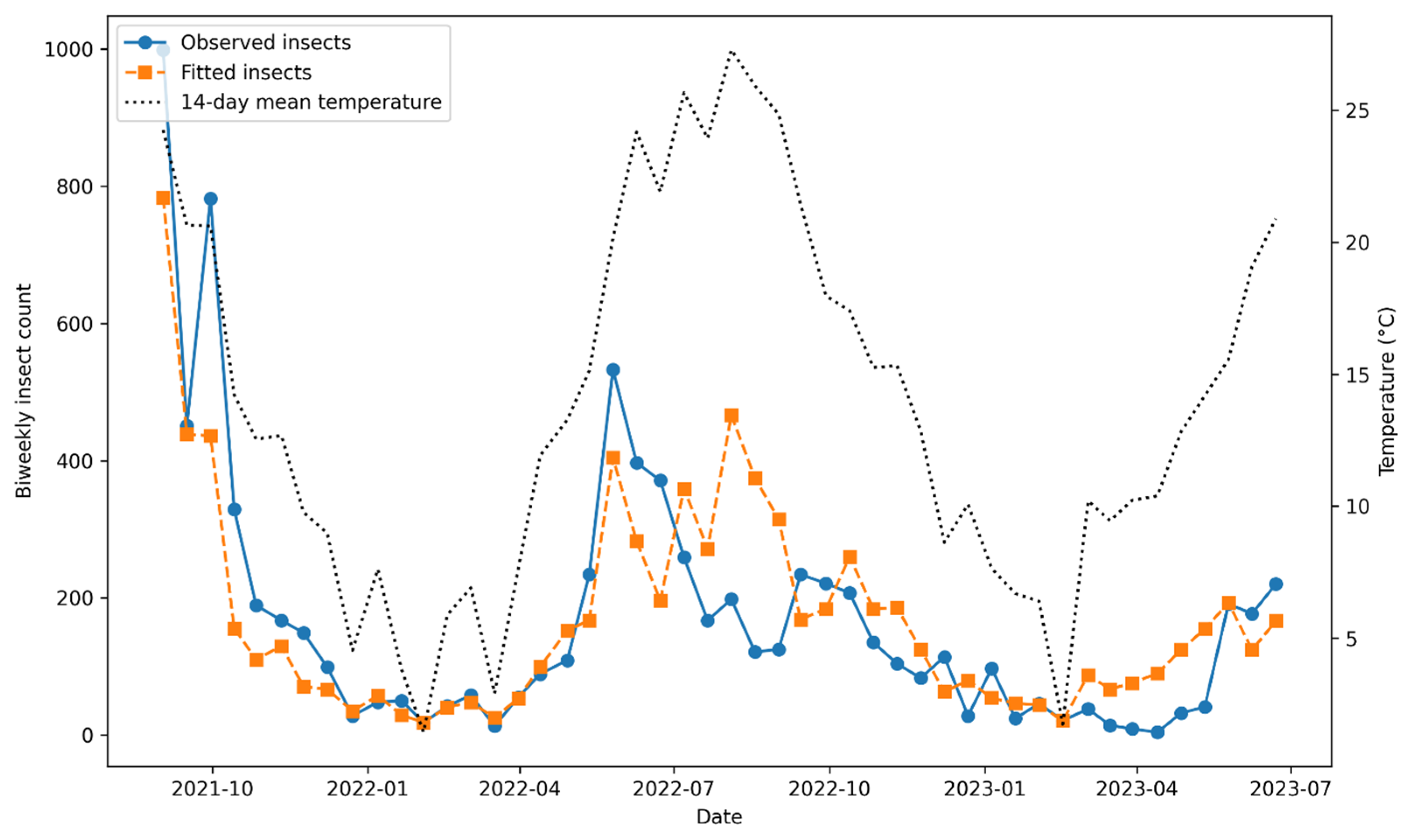
Figure 2.
Predicted biweekly insect counts under two temperature-triggered spray policies (standard threshold policy and preventive intensified policy), based on the observed biweekly temperature trajectory. The secondary y-axis shows the mean temperature during the preceding 14 days.
Figure 2.
Predicted biweekly insect counts under two temperature-triggered spray policies (standard threshold policy and preventive intensified policy), based on the observed biweekly temperature trajectory. The secondary y-axis shows the mean temperature during the preceding 14 days.
Disclaimer/Publisher’s Note: The statements, opinions and data contained in all publications are solely those of the individual author(s) and contributor(s) and not of MDPI and/or the editor(s). MDPI and/or the editor(s) disclaim responsibility for any injury to people or property resulting from any ideas, methods, instructions or products referred to in the content. |
© 2026 by the authors. Licensee MDPI, Basel, Switzerland. This article is an open access article distributed under the terms and conditions of the Creative Commons Attribution (CC BY) license (http://creativecommons.org/licenses/by/4.0/).
Copyright: This open access article is published under a Creative Commons CC BY 4.0 license, which permit the free download, distribution, and reuse, provided that the author and preprint are cited in any reuse.


